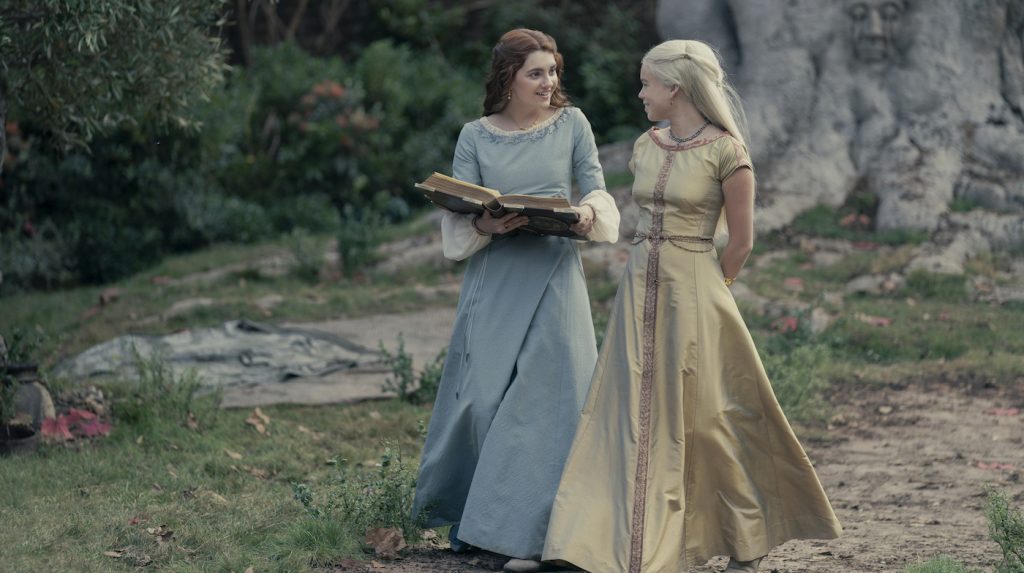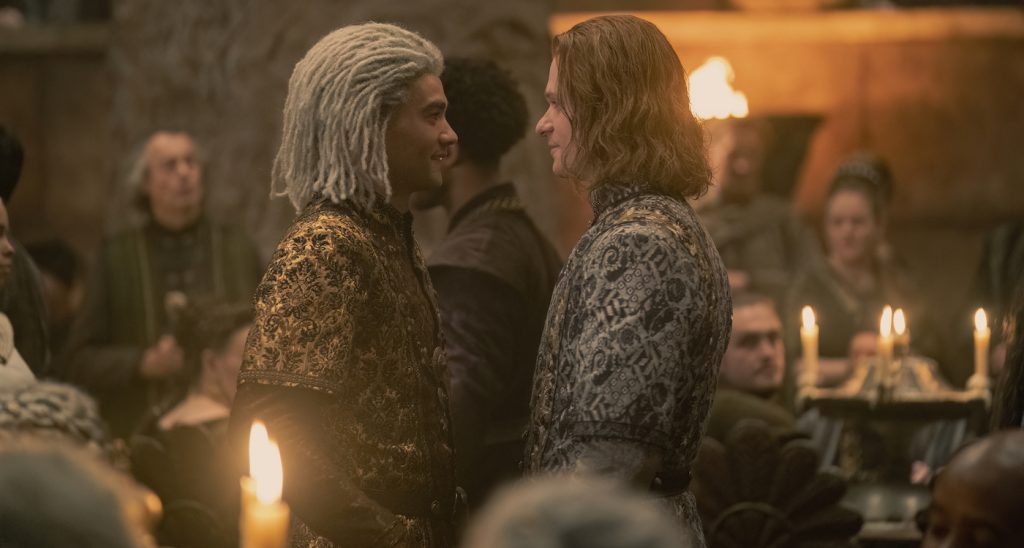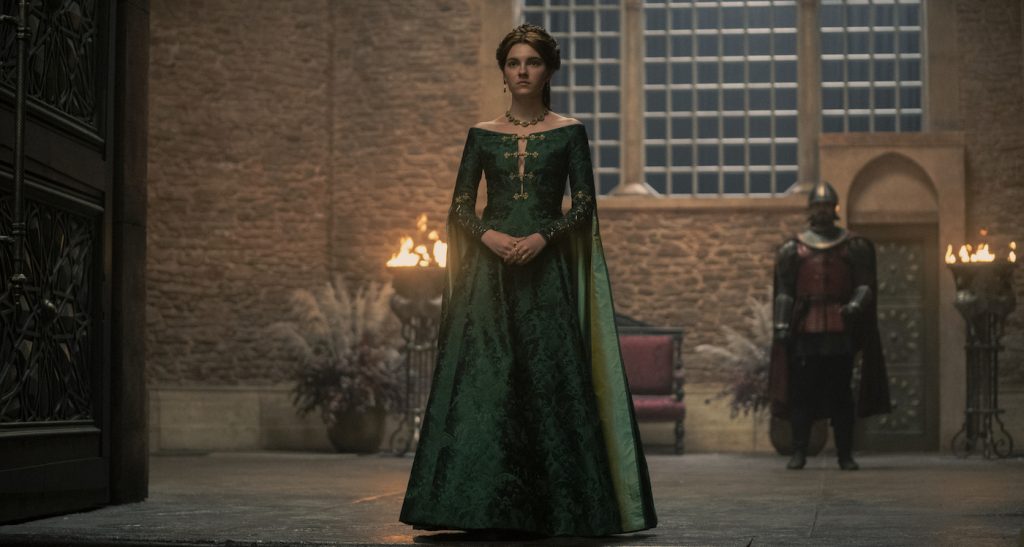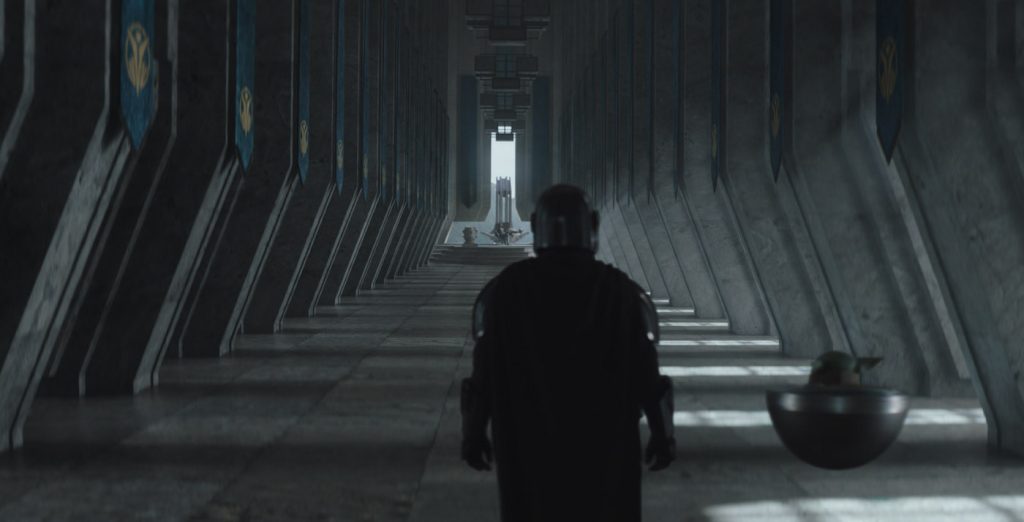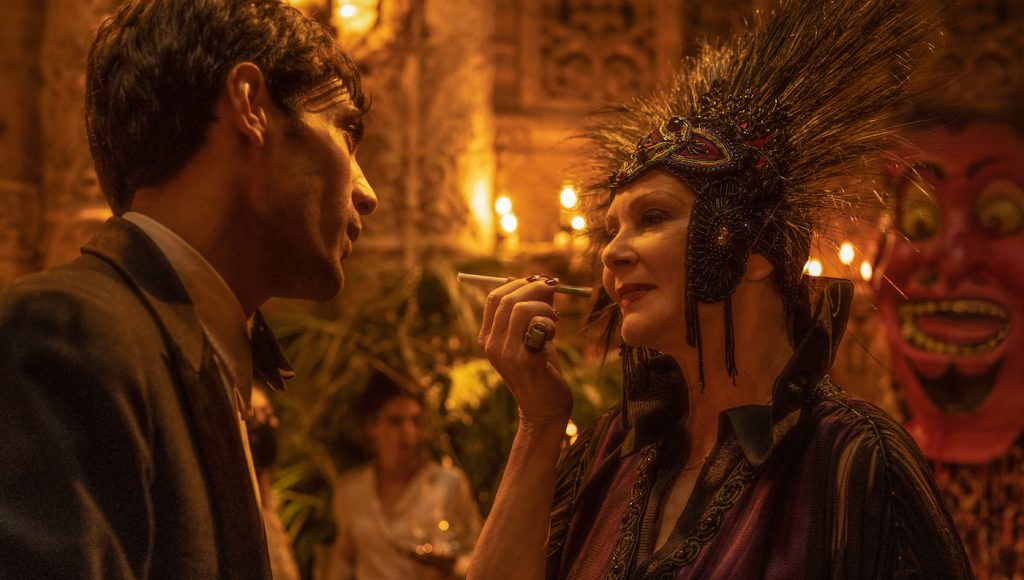
A power struggle over who might ascend to the Iron Throne. A brutal, heartbreaking birth scene. A vicious attack by armed watchmen on the so-called ne’er-do-wells of King’s Landing, led by the king’s impetuous, dangerous brother. These are a few of the intrigues that House of the Dragon delivered in its series premiere, the first Game of Thrones prequel to make it on air and one that looked every bit as polished and paced as its predecessor.
Set 200 years before the events in Game of Thrones, the 10-episode season of House of the Dragon will take us inside the succession battle within House Targaryen, despite the fact that King Viserys Targaryen (Paddy Considine) is still relatively young and in decent health. The reason the undisputed leaders of the seven kingdoms are squabbling over the Throne is that King Viserys’ has no male heir. He hoped his pregnant wife, Queen Aemma Arryn (Sian Brooke), was going to give birth to a son during the epic tournament he’s arranged in King’s Landing. This leads to the episode’s toughest scene when the King is forced to make an impossible decision between the life of his wife and unborn child. Viserys decides to save the child and has the baby cut from Queen Aemma’s womb. He loses both wife and son in one fell swoop, and the vultures fighting over the fate of the Throne descend shortly thereafter.
The concern over the throne, voiced most eloquently by the King’s Hand, Otto Hightower (Rhys Ifans), is that without a clear heir, the populace might get restive. The hold on power, even for a family that controls ten adult dragons, is always precarious in Westeros. The thing is, the King does have someone who is obviously next in line—his brother, Prince Daemon Targaryen (Matt Smith), the current leader of the City Watch (it was Daemon who unleashed his Watchmen on King’s Landing to bloody effect). But Daemon is a violent hothead, Otto Hightower argues, and there are other candidates to choose from.
One of those candidates is the person the King has been overlooking her whole life, his eldest child no less, his daughter Princess Rhaenyra Targaryen (Milly Alcock while young, Emma D’Arcy as an adult). It’s Princess Rhaenyra who the King taps as his successor by episode’s end, while Daemon, aware he’s being overlooked, rides off on one of the Targaryen’s dragons.
For a deeper inside look into how the premiere episode was made, this behind-the-scenes video released by HBO will do you right. Here, co-creators Ryan Condal and Miguel Sapochnik, as well as various cast members, discuss the reasons why they opened the episode with the Great Council, the twinned scenes of the violent tournament and Queen Aemma’s violent birth, and why Viserys chose Rhaenyra as heir. House of the Dragon returns next Sunday at 9 p.m. ET/PT.
For a peek at what’s coming in the weeks ahead, check out this new video:
For more on House of the Dragon, check out these stories:
Netflix’s Regency-era romance Bridgerton became one of its most-streamed series thanks to creator Chris Van Dusen’s modern, Skittles-hued take on historic upper-crust British mores. His ethos going in — that this London Ton would be a “bonnet-free world” — held up for Season 2, in which the eldest Bridgerton heir, Anthony (Jonathan Bailey), finds true love, not with the season’s social diamond, Edwina (Charithra Chandran), but her romance-averse older sister, Kate (Simone Ashley).
While each of the primary families of the Ton — the Bridgertons, the Featheringtons, and the newcomer Sharmas — is defined by a particular palette, this season saw Emmy-nominated costume designer Sophie Canale infuse each family’s look with new colors and, among the younger characters who’ve grown up a bit since Season 1, more sophisticated silhouettes. Hair and makeup designer Erika Ökvist, who joined the crew this season and is likewise up for an Emmy, gave already over-the-top Queen Charlotte (Golda Rosheuvel) ever-higher wigs while more subtly reflecting the opposite journeys of sisters Kate and Edwina via their personal styling.
For both Canale and Ökvist, Bridgerton is a massive undertaking, with, for example, 160 costumes made every six weeks just for the principal characters alone. The show’s costume warehouse, the size of a commercial rental depot, became a source of inspiration in itself. “Every time you felt a little bit tired or down, you had to go look at costumes, and all of a sudden you were back on track, like yes, I want to do this, I want to do more,” Ökvist said. We spoke with both designers about working in this period-specific yet bonnet-free world, creating collaborative, holistic looks, and setting the season’s newcomers apart from the show’s original fan favorites.
How does the overall Bridgerton ethos influence your process, making the show feel aesthetically fresh yet still like the period series it is?
Ökvist: You take in all of the Regency things that would work in fashion today and make them bigger or more extreme. Our maids have bigger hairstyles than most of the Regency dramas that are on TV. We just took a concept and then really twisted it and made it as wacky while still as glamorous as we could.
How much do the sets influence costume design? The clothes really have a symbiotic aesthetic relationship with their surroundings.
Canale: Will Hughes-Jones, the production designer, and I would communicate every time he was designing a new set or going on location, and I would get all the color palettes. How I would then start is I would drape fabrics on a stand for each character, take photographs of those, and then put them on a board next to one another, so I could make sure the color palettes worked for all the families and everyone in the scene before we even started cutting the fabric. I’d then check with Will, go to the sets if possible, look at his wallpapers and paints, and then be able to put the colors next to them. It’s an incredibly collaborative process we go through.
And how much of the final looks do you develop together across costumes, hair, and makeup?
Canale: We all work together, from costume and makeup to set design and lighting. But with Erika and I, there’s very much collaboration from the early starting points of color palettes and the fabrics I’m choosing for each character. It’s this really nice journey, starting from the feet up to the hair and accessories.
Ökvist: You give me the samples of all the fabrics, but also the shape. You’re looking at the décolletage — is it square? Is it round? V-neck shape? Then the sleeves, as well, and then trying to create a hairstyle that works within this shape, so that there is no like, this is the head, and this is the body. I think that’s where we work really well together, making sure it’s a style of a whole. And for me, because I didn’t do Season 1, Sophie really saved me there and would give me very quickly pointers on how to think with a Bridgerton head.
I think to a layperson, the clearest example of this stylistic unity would be the bejeweled hairstyles that came out in force this season.
Canale: I think Erika and I are very fortunate to work with one another because we’ve got a very similar eye and a similar way of working, so that collaboration came really quickly and easily for both of us. We had an incredible jewelry team. They made a set of hair decorations, and you can see that very much in the Sharmas this season. That was really a collaboration of how Erika wanted the hairstyles and what we could make to enhance them.
Ökvist: Certain things don’t work with curly hair, and certain things don’t work with smooth hair. I think it was really important we had that sorted out, first of all, but also that it really worked with the general jewelry and costumes as a whole. I remember the first time we did Queen Charlotte, it was the Diamond Ball, and it was a massive wig. Because we were in Covid, you weren’t allowed to come visit me, so when we did the test, you were like, oh, it’s that big, is it? We had to take the tiara back and make it bigger because of the scale. You can’t grasp it when you look at pictures.
Can you tell us more about the Queen’s over-the-top styling?
Ökvist: I had to look at Season 2 the way we do with fashion nowadays, where all of these influencers go away to all the Fashion Weeks, get new influences, and would never be caught dead with an old look. I think that’s how we look at the Ton and quite certainly with Queen Charlotte. She’d never, ever be caught looking the same. I had to go and dig deep into loads of different inspiration — African heritage, we’ve got a lot of high fashion, and then obviously the Regency and Georgian eras as well — and then try and create looks we haven’t seen before.
How about newcomers Kate and Edwina? How do you set them apart from characters who we already knew?
Canale: The main conversation when first reading the script and discussing it with Chris was how much Indian influence we were going to bring into the Sharmas and how much they brought that with them from their origins. It was very much keeping them part of the Ton and keeping the Regency period cut dress, the empire line, but having Indian fabrics and textiles, embroideries, and also bringing that into a mix with their jewelry. Having all the families with their color palettes, I wanted to bring in stronger colors. You can see with Kate, I used all the emeralds and beautiful Indian color palettes. She’s such a strong character, you can see that within her journey. In episodes 1 and 2 there are taffetas and heavier-weight fabrics, and as we travel through the season, she becomes softer in both colors and fabric choices. With Edwina, still keeping her in stronger pinks, but she’s a softer character, so I used softer colors to portray her.
Erika, how did you develop Kate and Edwina’s hair and makeup looks over the season to reflect their developing character arcs?
Ökvist: Absolutely. And going exactly with what Sophie said, Kate is starting off as a no-nonsense character. She doesn’t even have time to sit still for the maid to do her hair, so she braids her own hair before she goes riding in the morning, and then to quickly sort it out, she pulls the braid up, puts in her own hair sticks, and then gets going, still looking Regency and polished enough, but very simple. Then as we all do when we fall in love, you might sit twiddling your hair in front of the mirror; you might try a little bit of rouge even though you don’t normally do that. You might forget if all your hair has been tucked away because you’ve been distracted by somebody that’s just fallen into the water and has a wet shirt on.
Now that we know Penelope’s (Nicola Coughlan) secret, we also see her grow up a bit in terms of her look.
Ökvist: She’s a lady who’s just starting to come into her own. She’s got her own means, her own money. And she’s got a reputation and a career which is unheard of for any Regency woman. I think she feels she’s now strong enough to elaborate her own look. She’s definitely a lady coming of age, as well, and maybe daring even to say no to mummy, to say I’m not wearing anymore yellow.
And Eloise is so delightfully off. What do you do in your departments to enhance her fish-out-of-water look?
Canale: I think Claudia [Jessie] plays her extremely well. As much as she has this masculine element about her, her mom is still dressing her. So I made her a little bit softer in the choices of fabrics; that was also because I wanted to be able to use embroidery and fabric manipulation techniques that I wouldn’t have been able to do with the fabrics we used on Season 1. It was all about being able to create these lovely pleats and collars. With Penelope, you’ve got the floral fabrics, and with Eloise, I was using Regency stripes and checks, which are a lot more masculine and wouldn’t have necessarily been worn by the rest of the women. I think in comparison with the Ton, putting her in stripes and checks does set her apart and give her that awkwardness compared to everyone else.
Ökvist: And also, she’s a new thinker. She feels the value of a woman other than just being a wife. She’s got dreams, and she’s aspiring to do something. She might not necessarily know what yet, but it’s not being like everybody else. So even though she’s still got her fringe, we made her hair a little more grown up this season and a little bit more modern. She is the female maverick of this world. And so it should be something you’d feel could be at a ball in Regency times but also on the streets at Oxford Circus.
It all begins this Sunday. The first Game of Thrones prequel has arrived, and there’s reason to get excited. The early buzz is very positive, the cast is incredible, and every fresh peek looks better than the last. To that end, this brand new teaser from HBO, rich with dragons and fire, only heightens the excitement. At long last, we’re back in Westeros, and things are as dangerous as always.
The new teaser, “Fire Will Reign,” is a thrilling jolt of dragons, fire, blood, and intrigue. We’re 200 years before the events of Game of Thrones when House Targaryen was in control and dragons were a common if terrifying sight. The new series will feature ten episodes, exploring the battles within House Targaryen that ultimately led to a bloody civil war that shaped Westeros for centuries to come.
House of the Dragon comes from co-creator, co-showrunner, executive producer and writer Ryan Condal, co-showrunner, executive producer, and director Miguel Sapochnik (a Game of Thrones alum), and, of course, George R. R. Martin, the man who brought Westeros to life with his books, and serves as co-creator and executive producer.
Check out the new teaser below. House of the Dragon premieres Sunday, August 21, at 9:00 p.m. ET/PT on HBO and will be available to stream on HBO Max.
Here’s the full cast description:
Paddy Considineas King Viserys Targaryen, chosen by the lords of Westeros to succeed the Old King, Jaehaerys Targaryen, at the Great Council at Harrenhal. A warm, kind, and decent man, Viserys only wishes to carry forward his grandfather’s legacy. But good men do not necessarily make for great kings.
Matt Smith as Prince Daemon Targaryen, younger brother to King Viserys and heir to the throne. A peerless warrior and a dragonrider, Daemon possesses the true blood of the dragon. But it is said that whenever a Targaryen is born, the gods toss a coin in the air…
Olivia Cooke as Alicent Hightower, the daughter of Otto Hightower, the Hand of the King, and the most comely woman in the Seven Kingdoms. She was raised in the Red Keep, close to the king and his innermost circle; she possesses both a courtly grace and a keen political acumen.
Emma D’Arcy as Princess Rhaenyra Targaryen, the king’s first-born child, she is of pure Valyrian blood, and she is a dragonrider. Many would say that Rhaenyra was born with everything… but she was not born a man.
Steve Toussaint as Lord Corlys Velaryon, “The Sea Snake.” Lord of House Velaryon, a Valyrian bloodline as old as House Targaryen. As “The Sea Snake,” the most famed nautical adventurer in the history of Westeros, Lord Corlys built his house into a powerful seat that is even richer than the Lannisters and that claims the largest navy in the world.
Eve Best as Princess Rhaenys Targaryen, a dragonrider and wife to Lord Corlys Velaryon, “The Queen Who Never Was” was passed over as heir to the throne at the Great Council because the realm favored her cousin, Viserys, simply for being male.
Fabien Frankel as Ser Criston Cole, of Dornish descent, the common-born son of the steward to the Lord of Blackhaven. Cole has no claim to land or titles; all he has to his name is his honor and his preternatural skill with a sword.
Sonoya Mizuno as Mysaria, who came to Westeros with nothing, sold more times than she can recall. She could have wilted… but instead she rose to become the most trusted — and most unlikely — ally of Prince Daemon Targaryen, the heir to the throne.
Rhys Ifans as Otto Hightower. The Hand of the King, Ser Otto loyally and faithfully serves both his king and his realm. As the Hand sees it, the greatest threat to the realm is the king’s brother, Daemon, and his position as heir to the throne.
For more on House of the Dragon, check out these stories:
Westworld season four wrapped this past Sunday after a dizzyingly twisted 8-episode arc, burrowing ever deeper into the rabbit hole of a post-human world. As ever, Westworld remains one of the most ambitious shows on television, and season four has arguably been the series’ most devilishly complex yet. With the line between “real” and synthetic obliterated ever since the hosts slipped the confines of the original theme park and infiltrated the real world, Westworld itself has branched out, broadened its scope, and covered new spaces, new places, and near-future eras.
Key to this season’s success was costume designer Debra Beebe, who helped shape many of the show’s new looks and mark the passage of time, both into the future and connecting to the characters’ messy, often distant pasts. Whether that was designing looks for Dolores (Evan Rachel Wood), who began the season living a quiet life as a corporate writer named Christina at Olympiad Entertainment, the cyro-suit for William (Ed Harris), trapped in a cryo-chamber while his host double operates in the real world, or Charlotte Hale (Tessa Thompson)—actually a copy Dolores—who started the season replacing U.S. government officials with host copies in her ongoing effort to create a new world order, and was season four’s main villain.
“Even though it’s these futuristic, forward-looking designs, I always want what the characters wear to be true to themselves,” Beebe says. “You don’t want to notice the costume more than the character. You want it all to read as one whole piece, from head-to-toe, authentic to the character that you’ve gotten to know for several seasons now. As we move forward in time, we want to keep them true to who they’ve been all along.”
Beebe discusses designing for a new character (sort of) for Evan Rachel Wood, how she created a suit built for freezing its wearer, and designing for Tessa Thompson’s Charlotte Hale, a goddess among mortals.
Tell me about taking the baton from previous designers and stepping into Westworld.
Grabbing the baton and running is more like jumping out of a helicopter with this show [laughs]. In some ways, it was good that I was coming into a season that had such a different vibe and direction, even though there are definitely lines and images that take you back to previous seasons. When I came in and met with the producers, I started the next day. I had just to devour the scripts.
How did you approach the look for Evan Rachel Wood’s new character Christina, who begins the season believing her life as a corporate writer is, in fact, her actual life?
With Christina, [co-creator] Lisa Joy refers to her as a whole new character rather than another version of Dolores, but we still wanted touches of Dolores in Christina, especially in the colors. So with her modern looks, we keep her in blues. What’s different is Christina is in this professional office setting versus Dolores living in the old west. It was just pulling her into the future, where she’s living in New York City and having some foggy memories of a past life, but trying to sort out where she is now. Then Teddy comes in and helps her understand what her life is and who she is in this world.
Evan Rachel Wood is Christina in “Westworld.” Photograph by John Johnson/HBO
Teddy’s look has changed tremendously from his gunslinging days in the first season.
For Teddy [James Marsden], they wanted him to have a very handsome, leading man kind of look. The first thing we did was the suit for his date with Christina, which, by the way, was a fun look for Evan Rachel Wood as well. She had this futuristic look with some cutouts at the top, and it was very angular. Teddy was first in a suit, and then later, we put him in a leather jacket. t It was about clean looks because he’s a simple guy, and he’s just handsome. With James, you don’t even notice the clothes because he’s so handsome and warm and wonderful.
Evan Rachel Wood, James Marsden. Photograph by John Johnson/HBO
Thandiwe Newton’s Maeve has steadily grown into the series’ hero, and for this season, her look changed more than anybody else’s from episode to episode. How did you approach her season 4 arc?
Yeah, Maeve’s character is so great. She goes from the barmaid in the west to the 1920s, which I think suited her really well, and all of her gorgeous snarkiness. We also did flashbacks to where she and Caleb were taking out Rehoboam, and we shot those at a lighthouse in Mexico, so they just referred to her and Caleb both being badass and militant looking at that point. We also see her in flashbacks in Alaska as she’s trying to hide and figure out her direction. One more outfit after she’s brought back to life after Bernard finds her in the desert. She’s in a black tank top, pants, and boots; she puts another jacket over that and looks badass again.
Thandiwe Newton is Maeve in “Westworld.” Photograph by John Johnson/HBOJeffrey Wright and Thandiwe Newton. Ed Harris. Photograph by John Johnson/HBO
Charlotte Hale is an interesting character to track. She was a human, then she was turned into a host, and she’s actually a copy of Dolores.
That’s my understanding [laughs]. I know some fans refer to her as Halores.
Her look remains somewhat similar to seasons past, as she’s this very successful, very unflappable woman in charge, but I’m curious if you tweaked her designs as she takes on more of an outright villain role?
She was definitely more corporate in the past. This season, it’s her world, she’s starting to play it, and she is a goddess. Like in the scene in New York where she’s in that white dress controlling people. That’s her just having fun and playing. We wanted to give some weight with fashion to her look, to show that Charlotte is the one in control and, as Maeve says, “You can be whoever you want, and do whatever the f**k you want”—that’s Charlotte Hale.
Tessa Thompson is Charlotte Hale in “Westworld.” Photograph by John Johnson/HBO
Charlotte got horribly burned in season 3—how did you factor that into designing for her in season 4?
Jonah [Nolan, co-creator] and Lisa [Nolan] wanted to factor that in every chance we got, so we’d shorten a sleeve if it was too long. That black and white outfit showed her burnt arm all the way down. That was working with Jennifer Aspinall on those appliances they’d put on Tessa, whether it was a full arm or a half arm. That was all about working with the other departments to make the magic happen. They wanted to track her arm, her past, so any time there was a chance to expose even part of it, they wanted to do that.
Tessa Thompson is Charlotte Hale in “Westworld.” Photograph by John Johnson/HBO
And finally, you were working with two versions of Ed Harris’s William. One is a human trapped by Charlotte Hale in a cryo-chamber, and the other is a host, doing Charlotte’s bidding in the real world.
When William meets with the board of directors for Delos, he’s in a suit, but he’s still the Man in Black in whatever setting he’s in. There are a few times where he does go back to his western look, which is exactly the same look that Trish [Summerville] designed for the pilot. The cryo-suit was a big thing for us and a cool piece to work on. When I arrived, they were like, “You’ve got to get on this because we’re shooting in six weeks.” So we had to finalize the concept and start building, which for the most part, we built in-house. I wanted a clean line on him, something futuristic, with the tubing square rather than round. The way we connected that onto the suit was to make it look like it would actually freeze his body down and be believable and play against that wonderful set that John Carlos did with the cryo-chamber, which literally opened that way. It was rigged with hydraulics and lighting effects. It was a really cool, clean, futuristic outfit to work on.
Ed Harris. Photograph by John Johnson/HBO
All episodes of Westworld season 4 are available on HBO Max.
Before the opening credits even clear the screen, Nopeplunges us into an alarming soundscape: the canned laughter of a sitcom. Knowing that this is a Jordan Peele horror film, immediate tension strikes. Something is bound to shatter that wholesome sound, and, of course, this happens in a brutal way.
Our ears get the first warning sign moment after terrifying moment in Nope as we hear what we can’t yet, or never will, see clearly. Sound designer, re-recording mixer, and supervising sound editor Johnnie Burn was the architect behind the film’s unnerving audio layers. He praised Peele for knowing that sometimes the most chilling impact is the threat of what lurks just off screen.
“I think [Peele] knows to tap into the power of suggestion and the fact that if you start a thought in someone’s head, they’re going to take that thought is to be painting images in their head that are far worse than anything he could supply visually,” Burn explained. “Because it’s personal to you. A lot of what’s happening is giving you the seeds of a sound that describes an off-camera action, and you go and fill in the blanks with the worst possible scenario.”
The worst possible scenario does eventually unfold for most of Nope’s characters, but there is a desperate mystery throughout the first half of the film as we wonder just what monster we’re inching toward. There are subtle clues early on that the tranquility of the Haywood Ranch is being upended. Small disturbances in the natural ambiance signal the looming invasion.
“One of the things we were trying to do was not just have wind, but have a whistling wind,” Burn noted. “On a second watch, you would realize that you were actually not just hearing whistling winds, but you were hearing screams right from the beginning of the film. When O.J. (Daniel Kaluuya) is out in the valley first at night, standing with Ghost [one of his horses] by the railing by the fence listening, you hear faint whistles and screams. On your first watch, you’re like, ‘Oh, that’s just a whistling wind. That’s a bit weird.’ But retrospectively, you’d be like, ‘Oh, there were people dying there too. That’s pretty horrific.’”
Daniel Kaluuya as OJ Haywood in Nope, written, produced and directed by Jordan Peele.
Burn submerges the audience in one of humanity’s most primal fears. Is that sound outside my safe dwelling a beast? Or just an enthusiastic wind? For the California community terrorized in Nope, it’s an unsettling mix of both.
“I had a lot of different winds which had a particularly scream-y whistle to them that I recorded in various forests during high winds,” Burn revealed. “What I was doing was getting my kids to do screaming that was matching the kind of cadence and the melody of that whistle so that I could then overlay and have a scream on top of the wind that sounded a bit like it, and then I’d turn the screaming part up for a moment until it catches the ear and then get rid of it so that your outtake is, ‘Oh, did I just hear a scream or was that just a bit of whistly wind?’”
O.J. suggests that the unexplainable occurrences might be a “bad miracle,” hinting that he feels things in the atmosphere are shifting out of place. At first, it is nearly impossible to pinpoint the source of our unease as Burn manipulates our expectations of what we should be hearing.
“The main thing that we were trying to do is make sure that it was retrospectively a very natural environment,” Burn explained. “The presentation of how we’re understanding something as alien or wrong or unusual is because you’re hearing the natural world, but you’re hearing it in a slightly different way to how you are used to hearing it. Jordan would always be telling me, ‘We want some wrong winds in here. I don’t want to hear a spaceship. I just want to hear the wrong kind of wind happening.’ That’s what we were after.”
(from left) OJ Haywood (Daniel Kaluuya) and Emerald Haywood (Keke Palmer) in Nope, written, produced and directed by Jordan Peele.
The tonal quality of an excited scream and a tortured scream is a tick apart. Sometimes only the knowledge of what that person is experiencing can clue you into its meaning. It’s a variance that the sound team toyed with as the danger closed in.
“Dhyana Carlton-Tims, who is the ADR supervisor, did a really fantastic pass with a lot of actors doing a really skillful, ‘I’m on a roller coaster, I’m having fun,’ then a really painful scream,” Burn explained. “What you’re hearing in the background layers of that interior shot is the ‘roller coaster screams.’ Which I think is what makes it extra horrific because it’s that hidden scream painting the sound of what you’re not actually seeing. The horror is magnified there.”
Jean Jacket is the familiar name that the Haywood siblings give to the unidentified entity lurking in the sky. They carefully study the visitor and pick up on its patterns, which proves to be essential to their survival. Jean Jacket doesn’t have as much in common with traditional cinematic UFOs as it first appears. The sounds it makes help clue the characters into just what kind of threat they’re dealing with.
Courtesy MPC/Universal Pictures.
“We wanted to make sure that there was ambiguity initially,” Burn acknowledged. “So if it’s in the sky, it better be humming. I think equally, it’s a predator, so how is it going to be getting away with this if it’s going to be making a loud noise? We were like, ok, so it has to be a quiet thing. If you listen carefully to all those Jean Jacket sounds in the first half of the film, they could be sci-fi, or they could be natural.”
Ultimately, there’s no denying the destructive power of the stealthy hunter overhead. It’s here to devour. Once Jupe (Steven Yeun) openly engages with the alien, we finally witness its all-consuming conquest.
“We had a lot of particles where you can take various sounds, and it will blend them and make enormous multi-layered textured things and put it in a viable environment, and that’s what you’re hearing mostly when we’re looking at Steve Yeun’s face and Jean Jacket is overhead beginning with a major suck up sound. Then we cut to the interior of the humans being sucked up inside.”
Steven Yeun as Ricky “Jupe” Park in Nope, written, produced and directed by Jordan Peele.
There’s an extraterrestrial fake-out before the true intergalactic reveal that sets a spooky, surreal tone. O.J. has a close encounter in his barn with some unearthly creatures. An isolated and desolate soundscape compounds the shock of the unexpected moment.
“We did try for score and then found that Nicholas Monsour put sprinklers in the initial temp score, and then we found that actually just working the sprinklers out and making a rhythm out of that gave an enormous amount of tension,” Burn said. “The reality of using real sounds to create tension was, in that particular scene, scarier than having music telling you to be scared. You were experiencing it firsthand alongside O.J.”
All along, that sitcom that lays the first chilling punch is still in play. Eventually, Peele plops the camera right down on set and challenges us to endure the savage events of that day. Gordy the chimp (Terry Notary) becomes disturbed by popping birthday balloons and embarks on a bloody rampage. Some of it we witness visibly in disturbing fashion, but for much of it, we must rely on audio to depict what Jupe’s costars are suffering from the perspective of his hiding spot.
“Really, the more we sat with that scene, it became obvious that the more you take out of it and the emptier it is, the more chilling it is. It somehow seems more credible. It made it more real. Sounds in real life are not quite like ones in a movie. They’re more weird and disparate.”
It’s a scene that’s fully immersive and feels so vulnerable. You see destruction, people hiding, and evidence of fear, but listening is where you learn most about the predator on the loose.
“A lot of when we first come into the building, and you’re creeping through the background on the back of the set, there’s so much that’s happening there in terms of piquing your interest,” Burn said. “You’re hearing these close sounds to you as you brush by it, but it’s the thumping off camera and the rhythm that creates that puts you on edge of, ‘Oh my god. What is happening here?’ We’re back where we were at the beginning of the film.”
Burn said that working with Jonathan Glazer on films like Under the Skin and Birth was his “film school.” Those experiences emphasized how critical it was to record practical sounds to work with. It’s a practice he carried on through Nope.
“The great thing about going out to do as best you can to replicate the real thing is that you’ll get lots of things that you didn’t expect,” Burn noted. “It’s all the unexpected, fortuitous stuff that you get when you go out to do it for real that is why you do it.”
There’s some major buzz (apologies) happening around Yellowjackets season two right now. Simone Kessell has joined the cast as the adult Lottie Matthews, a juicy role in one of television’s most intriguing series. Kessell is coming off another significant role in a big series, having played Breha Organa, mother to Leia Organa, in Disney+’s Obi-Wan Kenobi. Kessell will be trading in the far-off galactic intrigue for a drama a little closer to home, but one no less vested with dark magic.
In season one, the teenage version of the mysterious Lottie was played by Courtney Eaton, who will also return for season two as a regular. Lottie’s witchy ways throughout the first season blossomed into outright madness towards the finale, with the question “who the f**k is Lottie Matthews” serving as one of the big unanswered questions heading into season two. The series was filled with mysterious, sometimes gruesome happenings in the Canadian wilderness after the titular Yellowjackets crash-landed during a high school soccer trip. This is the second big casting scoop for the show, following the news that Lauren Ambrose (Six Feet Under) was joining the cast as the adult version of Van, played as a teenager by Liv Hewson in season one.
Yellowjackets season one was a critical hit and a ratings darling, offering an often grim, always entertaining, and superbly shot and acted thriller. It scooped up seven Emmy nominations, including for Oustanding Drama Series, Oustanding Lead Actress for Melanie Lynskey, and Outstanding Supporting Actress for Christina Ricci. It drew an average of 5 million weekly viewers across all platforms, making it the second-most streamed Showtime series in the channel’s history.
The series is set to go into production on August 30 in Vancouver. The series was created by Ashley Lyle and Bart Nickerson, who serve as showrunners alongside Jonathan Lisco.
For more stories on hotly-anticipated series, check these out:
Featured image: Simone Kessell attends the 7th AACTA International Awards at Avalon Hollywood in Los Angeles on January 5, 2018 in Hollywood, California.
The wonderfully weird journey of the Addams family continues. And who better to continue telling the tale of this beloved family of oddballs than Tim Burton, one of the world’s most beloved oddball filmmakers. Netflix has just revealed the first teaser trailer for Burton’s Wednesday, Burton’s reimagining of the Addams family with a story focused on daughter Wednesday (You star Jenna Ortega).
The series will track its young heroine as she’s bounced from school after school only to end up in Nevermore Academy finally, a place where she might finally be understood. Wednesday is the daughter, of course, of Morticia (Catherine Zeta-Jones) and Gomez (Luis Guzmán) and the sister of Pugsley (Issac Ordonez). While at Nevermore, Wednesday will hone her psychic abilities and try to sort out a puzzling murder mystery that is directly connected to her family.
For Addams Family fans, you couldn’t be in better hands than Burton’s (and the disembodied hand servant Thing, played here by Victor Dorobantu, would agree). The cast also includes George Burcea as the servant Lurch and a slew of talented, non-Addams Family members, including Gwendoline Christie, Jamie McShane, Percy Hynes White, Hunter Doohan, Emma Myers, Joy Sunday, Naomi J Ogawa, Moosa Mostafa, Georgie Farmer, and Riki Lindhome.
And if you were wondering whether Christina Ricci, who had an iconic turn as Wednesday in the ’90s film series, is involved, we have good news for you. Ricci makes a special appearance as Marilyn Thornhill.
Burton executive produces and directs four of the eight episodes, with Gandja Monteiro and James Marshall directing episodes. The showrunners, writers, and executive producers are Alfred Gough and Miles Millar.
Watch the full teaser trailer below.
Here’s the synopsis for Wednesday:
The series is a sleuthing, supernaturally infused mystery charting Wednesday Addams’ years as a student at Nevermore Academy. Wednesday’s attempts to master her emerging psychic ability, thwart a monstrous killing spree that has terrorized the local town, and solve the supernatural mystery that embroiled her parents 25 years ago — all while navigating her new and very tangled relationships at Nevermore.
For more on big titles on Netflix, check these out:
Unlike in Game of Thrones, when dragons were a scarce, almost mythical commodity, House of the Dragon will show us a time when dragons were a common if still an awe-inspiring sight. HBO has released a dragon’s lair worth of new images, which includes two shots of the iconic beasts that made such a huge difference in the drama that fueled eight seasons of Game of Thrones. Now, with the new series focused on the dragonlords of House Targaryen and taking place some 200 years before the events in Game of Thrones, we can expect a lot more dragon action.
But dragons aren’t the only draw—House of the Dragon has already received some great early buzz—the series has a stellar cast that will be generating a ton of human-sized drama. House of the Dragon will track the growing unrest in Westeros as the intrigue within House Targaryen barrels towards a civil war. The series comes from showrunners Ryan J. Condal and former Game of Thrones director Miguel Sapochnik, with George R. R. Martin, the man who brought Westeros to life with his novels, on board as a producer.
The new images include shots of the three key Targaryens, led by Paddy Considine as King Viserys, a man looking to find an heir to the throne; Emma D’Arcy is Princess Rhaenyra, heir apparent to the Iron Throne; and Matt Smith as Daemon Targaryen, the younger brother of King Viserys and heir presumptive. The images also include shots of Olivia Cooke as Alicent Hightower, Rhys Ifans as Otto Hightower, Eve Best as Princess Rhaenys Velaryon, and Steven Toussaint as Lord Corlys Velaryon.
Check out the images below. House of the Dragon premieres on HBO on August 21.
Milly Alcock. Photograph by Ollie Upton / HBOEve Best, Steve Toussaint. Photograph by Ollie Upton / HBOEmma D’Arcy. Photograph by Ollie UptonEmily Carey, Milly Alcock. Photograph by Ollie Upton/HBO.Graham McTavish. Photograph by Ollie Upton/HBO.Steve Toussaint, Rhys Ifans, Milly Alcock, Paddy Considine. Photograph by Ollie Upton/HBO.Olivia Cooke, Emma D’Arcy. Photograph by Ollie Upton/HBO.Paddy Considine, Sian Brooke, Michael Carter, Steve Toussaint, Eve Best. By Ollie Upton/HBO.Steve Toussaint. Photograph by Ollie Upton/HBO.
Milly Alcock, Paddy Considine. Photograph by Ollie Upton/HBO.Rhys Ifans. Photograph by Ollie Upton/HBO.Graham McTavish, Milly Alcock. Photograph by Ollie Upton / HBOEve Best. Photograph by Ollie Upton / HBOEmily Carey. Photograph by Ollie Upton / HBOMatt Smith. Photograph by Ollie Upton / HBOMatt Smith, Milly Alcock. Photograph by Ollie Upton / HBOMatt Smith. Photograph by Ollie Upton / HBOPaddy Considine. Photograph by Ollie Upton / HBOPaddy Considine, Milly Alcock. Photograph by Ollie Upton / HBOMilly Alcock, Emily Carey. Photograph by Ollie Upton / HBO“House of the Dragon.” Photograph by Courtesy HBO“House of the Dragon.” Photograph by Courtesy HBO
For more on The House of the Dragon, check out these stories:
First, we hear the great Viola Davis will play a villain in The Hunger Games: Ballad of Songbirds and Snakes. Now, we’ve got our first image from the film. It’s a good day to be a Hunger Games fan.
Lionsgate has released the image of Rachel Zegler as the tribute Lucy Gray Baird and Tom Blyth as the young Coriolanus Snow, looking quite cozy on a picnic blanket. Although this being Panem, we know there’s trouble brewing. Upon closer inspection, the image holds a bounty of important details. Note the dog tags the young Snow is wearing, the close-cropped, almost military-style haircut, and, most notably, the haunted look in his eyes. At this point in his life, Snow was an orphan in the Capitol and enrolled at the Academy. The image is emblematic of the title itself—here we have a songbird in Lucy, and a snake, in young Snow, but it didn’t have to be that way. The movie will explore how a teenage Coriolanus Snow eventually became the tyrannical President Snow (played with such nimble menace by Donald Sutherland) we know and loathed from the original film series.
The upcoming prequel, to be directed by Hunger Games alum Francis Lawrence, is based on the 2020 prequel novel of the same name by Suzanne Collins, the woman who dreamed up the dystopian horrors of Panem. The Ballad of Songbirds and Snakes is set some 64 years before the events in the first Hunger Games film when Coriolanus’s path towards becoming the despotic ruler of Panem is not yet set. The young Snow is in love with Zegler’s Lucy Gray Baird, who becomes a tribute in the 10th Annual Hunger Games. The woman Snow wants to protect Lucy from is Dr. Volumnia Gaul, to be played by Viola Davis.
In an interview with Vanity Fair, director Francis Lawrence said, “This is very much a story about love. It’s this kind of love story set in a different kind of a world in a different time.”
Joining Zegler, Blyth, and Davis are Peter Dinklage, playing Casca Highbottom; Josh Andrés Rivera, playing Sejanus Plinth; Hunter Schafer, playing Tigris Snow; and Jason Schwartzman, playing Lucretius “Lucky” Flickerman.
Here’s the official synopsis for The Hunger Games: The Ballad of Songbirds and Snakes:
Return to The Hunger Games, the landmark film franchise that has earned over $3 billion globally, with Lionsgate’s adaptation of Suzanne Collins’ #1 New York Times Bestseller The Ballad of Songbirds and Snakes. Years before he would become the tyrannical President of Panem, 18-year-old Coriolanus Snow (Tom Blyth) is the last hope for his fading lineage, a once-proud family that has fallen from grace in a post-war Capitol. With the 10th annual Hunger Games fast approaching, the young Snow is alarmed when he is assigned to mentor Lucy Gray Baird (Rachel Zegler), the girl tribute from impoverished District 12. But, after Lucy Gray commands all of Panem’s attention by defiantly singing during the reaping ceremony, Snow thinks he might be able to turn the odds in their favor. Uniting their instincts for showmanship and newfound political savvy, Snow and Lucy Gray’s race against time to survive will ultimately reveal who is a songbird, and who is a snake.
For more on The Hunger Games: The Ballad of Songbirds And Snakes, check out these stories:
Featured image: Rachel Zegler as Lucy Gray Baird and Tom Blyth as Coriolanus Snow in The Hunger Games: The Ballad of Songbirds and Snakes. Photo Credit: Murray Close
She-Hulk: Attorney at Law has cleared the most crucial hurdle of all—you care about its main character. This is one of the common themes of the early reactions to Marvel Studios’ latest Disney+ series, introducing Jennifer Walters (Tatiana Maslany) to the MCU as a fourth-wall-breaking tour de force. It’s unsurprising that a performer as talented as Maslany has pulled it off, however—she’s been aces in everything she’s in. Still, it’s heartening to hear that She-Hulk is a fun, funny, and satisfying new addition to Marvel’s growing series slate. The fact that Maslany breaks the fourth wall and addresses the viewer directly also makes She-Hulk the first pure comedy in the MCU, even if it’s a comedy with a super-sized lead and some formidable villains.
A little background on the show before we get to the early reactions. Maslany’s Jennifer Walters has a very famous cousin—Bruce Banner (Mark Ruffalo)—who has a big part to play here as her mentor (of sorts). Her day job, as the show’s title makes clear, is working as a practicing attorney. Yet she’s no ordinary lawyer—she’s representing some of the “eccentric superhumans” that are popping up all over the world, which includes Emil Blonsky (Tim Roth), also known as Abomination, who you might remember tried to kill the Hulk a while back. Roth is coming in for a lot of praise from critics, too.
Jen will be undergoing a lot more than work stress, of course. She’s got the added burden of trying to figure out how to live her life with the incredible powers vested in her after an accident has given her Hulkian super strength. Luckily, her cousin knows a thing or two about living life as a super strong green person. The vibe of the show is that of a legal comedy with an MCU kick.
Joining Maslany, Ruffalo, and Roth are Benedict Wong, reprising his role as Wong, Jameela Jamil as Titania, She-Hulk’s rival, Ginger Gonzaga as Nikki Ramos, and Charlie Cox, reprising his role as Matt Murdock/Daredevil. The series was created by Jessica Gao, with directing duties led by Kat Coiro and supplemented by Anu Valia.
Now that you’ve got the lay of the land, let’s have a look at what critics are saying. She-Hulk: Attorney at Law premieres on August 17:
She-Hulk: Attorney at Law far exceeds all of my expectations. This show is extremely self-aware & self-deprecating. In the first 4 episodes it has answered numerous burning MCU questions in very clever ways. It’s hilarious, fun, & Tatiana Maslany is phenomenal!#SheHulkpic.twitter.com/DCkCDXRZvD
#SheHulk: As the first series in the MCU to play out in a traditional episodic structure, it stands out from other shows in the franchise. A light, refreshing, and hilarious look at the MCU through a real-world lens, it’s worth a watch for diehard fans. pic.twitter.com/N94gngZjTx
I’ve seen the first 4 episodes of #SheHulk and this thing is basically firing on all cylinders for me. Tatiana Maslany is pitch-perfect and Jennifer’s relationship with her cousin Bruce is so relatable. It’s incredibly charming and, most important, you care about Jen so much. pic.twitter.com/ViNTIImd7C
Marvel’s #SheHulk is a VERY funny legal procedural that’s lighter on action, but heavy on breaking the fourth wall. This is the most self-referential the MCU has ever been. Cameos & references galore + a dynamite Tatiana Maslany performance. Also, Tim Roth rules! pic.twitter.com/Sx3cDTVUa4
I’ve see the first four episodes of #SheHulk, and they’re just a delight. It’s part superhero show, part legal procedural comedy. It really feels like a show rather than an 8 hour movie, and is pretty well paced accordingly pic.twitter.com/zu5Ww6sSDn
I’ve now seen the first four #SheHulk episodes three times, and they’re everything I want them to be, and so much more. The show is breezy, unabashedly weird, and wildly entertaining. This sets a new gold standard for what MCU shows are capable of. pic.twitter.com/4Z8jAe293L
After watching the first 4 episodes of #SheHulkAttorneyAtLaw I’m all in. #TatianaMaslany nails the role but have to give Jessica Gao huge props for the great writing.
Wasn’t sure about the series going in but it’s so much better than I expected. Can’t wait to watch more. pic.twitter.com/EBfUwxDfxS
#SheHulk is simply stellar. It starts off fast,really fast, but as it went on it grew on me, and is easily one of my favorite MCU shows. The setting is pretty grounded but it does a great job at establishing itself in the MCU in a way that’s both respectful to the MCU, 1/2 pic.twitter.com/NCJPM1D5Le
The Hunger Games: The Ballad of Songbirds and Snakes just landed a massive star for a major role.
The Hollywood Reporter confirms that Viola Davis will be playing Volumnia Gaul, the game maker of the 10th annual Hunger Games and the villain of the film. Davis will bring her considerable acting chops to a growing ensemble that already includes Rachel Zegler, playing tribute Lucy Gray Baird, and Tom Blyth, playing the young Coriolanus Snow, Peter Dinklage, playing Casca Highbottom, Josh Andrés Rivera, playing Sejanus Plinth, Hunter Schafer, playing Tigris Snow, and Jason Schwartzman, playing Lucretius “Lucky” Flickerman.
“The Hunger Games films have always been elevated by their exceptional casting, and we are thrilled to be continuing that tradition with Viola Davis as Volumnia Gaul,” said Lionsgate motion picture group president Nathan Kahane in a statement. “Her formidable and powerful presence will add layers of complexity and menace to this story.”
The most seasoned Hunger Games director, Francis Lawrence, returns to helm the prequel. Lawrence directed three of the four original films and will also produce alongside franchise producer Nina Jacobson and her collaborator Brad Simpson. “The Hunger Games” author Suzanne Collins will executive produce alongside Tim Palen.
“Dr. Gaul is as cruel as she is creative and as fearsome as she is formidable,” said Francis Lawrence in a statement. “Snow’s savvy as a political operator develops in no small part due to his experiences with her as the games’ most commanding figure.”
Nina Jacobson added: “From the beginning, Viola has been our dream for Dr. Gaul because of the finely layered intelligence and emotion she brings to every role. A brilliant and eccentric strategist, Gaul is instrumental in shaping a young Coriolanus Snow into the man he will become. We are incredibly fortunate to have an actor with Viola’s extraordinary range and presence to play this pivotal role.”
Here’s the official synopsis for The Hunger Games: The Ballad of Songbirds and Snakes:
Return to The Hunger Games, the landmark film franchise that has earned over $3 billion globally, with Lionsgate’s adaptation of Suzanne Collins’ #1 New York Times Bestseller The Ballad of Songbirds and Snakes. Years before he would become the tyrannical President of Panem, 18-year-old Coriolanus Snow (Tom Blyth) is the last hope for his fading lineage, a once-proud family that has fallen from grace in a post-war Capitol. With the 10th annual Hunger Games fast approaching, the young Snow is alarmed when he is assigned to mentor Lucy Gray Baird (Rachel Zegler), the girl tribute from impoverished District 12. But, after Lucy Gray commands all of Panem’s attention by defiantly singing during the reaping ceremony, Snow thinks he might be able to turn the odds in their favor. Uniting their instincts for showmanship and newfound political savvy, Snow and Lucy Gray’s race against time to survive will ultimately reveal who is a songbird, and who is a snake.
For more on The Hunger Games: The Ballad of Songbirds and Snakes, check this out:
Featured image: ATLANTA, GEORGIA – OCTOBER 05: Viola Davis attends Tyler Perry Studios grand opening gala at Tyler Perry Studios on October 05, 2019 in Atlanta, Georgia. (Photo by Paras Griffin/Getty Images for Tyler Perry Studios)
This is going to be a banner year for all of us Guillermo del Toro fans. And we are legion.
The visionary filmmaker has two big releases coming up, both for Netflix. The first is his long-gestating passion project, Pinocchio, which he’s got coming out on September 8. Del Toro has been aiming to make that movie for as long as he’s been a filmmaker. Then, his mysterious anthology series Cabinet of Curiosities is due in October, and Netflix has just dropped a brand new teaser to give us our first look.
This new video reveals a look at Del Toro’s horror series, which the director himself promises will explode our notions of what the horror genre can contain. Del Toro serves as showrunner and head visionary, but he’s tapped a slew of talented writers and directors to help steer Cabinet of Curiositie‘s eight episodes. Those directors include Jennifer Kent (The Nightengale, The Babadook), David Prior (The Empty Man), Guillermo Navarro (the cinematographer on Del Toro’s Pan’s Labyrinth, Cronos, Director of Photography), Panos Cosmatos (Mandy), and Catherine Hardwick (Twilight, Thirteen).
Like so many of Del Toro’s creative endeavors, Cabinet of Curiosities abounds with sometimes playful, often terrifying, always beautifully created practical effects, creatures, props, and more. His preference has long been for what his performers can see and touch (and wear), yet he also intuitively knows what he can amplify, when need to be, with a touch of VFX. In short, he’s one of our greatest visual storytellers, and his fingerprints are all over Cabinet of Curiosities.
“With Cabinet of Curiosities, what I’m trying to say is, ‘Look: The world is beautiful and horrible at exactly the same time,’” Del Toro says in the video, perfectly summing up his creative vision.
Check out the teaser below.
Here’s the brief synopsis from Netflix:
Acclaimed Academy Award-winning filmmaker Guillermo del Toro curates this collection of sinister stories, each more horrifying than the next.
For more on big titles on Netflix, check these out:
The Boys are back in town. That town is Toronto. This is good news.
After concluding a wild, ambitious third season back in July, we’ve been waiting on word for what would happen next for showrunner Eric Kripke’s deeply NSFW superhero send-up. We assumed that season four was a sure thing considering how popular and consistently engaging the series was, but we like our confirmations to be official. Luckily, Kripke himself has answered that question, sharing a Tweet that teases the upcoming fourth season. That’s right—The Boys are returning for another round of madness.
Kripke tweeted an image of himself boarding a flight to Toronto, Canada. This was followed by The Boys‘ official Twitter page having a little fun with their innocent reveal of the team heading to Canada, where the past three seasons have been filmed.
In the images, we see Karen Fukuhara, who plays Kimiko; Jack Quad, who plays Hughie; Antony Starr, who plays the demented Homelander; and Chace Crawford, who plays the Deep. If this isn’t proof that season 4 is underway, well, we don’t know what would be.
It also jibes with what the series lead, Karl Urban, told Collider back in June: “Yeah, we’re starting, I think August the 22nd, we’re going to be starting season four. So I’m getting back, getting my Butcher back on, and I can’t wait. It’s a fun gang to play with, we work hard and play hard, and I can’t wait to see where they take the characters from where we leave them at the end of this season.”
The end of the third season saw a very surprising turn of events, with Homelander and Billy Butcher being forced to team up against Soldier Boy (Jensen Ackles) to stop him from going nuclear and killing them all. We’re betting that brief alliance is over now, and Billy will back to wanting to destroy Homelander once and for all.
Jordan Peele’s extraterrestrial spectacle Nope has a secret you may not know about: the sky itself is a digital recreation. And among the roughly 700 effects shots in the film, VFX supervisor Guillaume Rocheron (1917, Life of Pi) admits it’s one of the most rewarding as “most people don’t realize they’re looking at a giant visual effect.”
The Nope VFX team set out to make the blue ether a haunting character, one indicative of the dooming waters in Spielberg’s 1975 thriller Jaws. “Jordan said if we do our job well, the audience, after seeing the movie, will look at the sky differently. You are going to look at the clouds and have to be scared,” Rocheron tells The Credits. “So the sky became a big subject where we had to design a whole playground for the events to happen.”
Those events Rocheron hints at taking place at the Haywood family ranch, miles outside of Hollywood, where, after the loss of their father (Keith David), siblings OJ (Daniel Kaluuya) and Emerald (Keke Palmer) discover a celestial creature hiding in the clouds, feeding on anything staring at it for too long.
(from left) OJ Haywood (Daniel Kaluuya), Angel Torres (Brandon Perea) and Emerald Haywood (Keke Palmer) in Nope, written, produced and directed by Jordan Peele.
The hurdle wasn’t a simple cosmetic sky replacement but months-long research and development project where innovative tech was created, which allowed them to design cloudscapes that seamlessly blended with the set photography from Dutch cinematographer Hoyte van Hoytema. The results gave VFX complete control over the look and feel of Earth’s atmosphere. Animators were able to lay out the sky and simulate each cloud (and their movements) based on actual altitudes and wind speeds. The digital creations were then infused to match the sunlight and lighting of the location imagery. “It had to be incredibly invisible to the audience, so no one said I’m looking at a digital sky,” says Rocheron. “The challenge was different because our whole movie was about the sky.”
For the entity, which OJ names Jean Jacket after a horse Emerald was promised as a child, its development tracks to when Peele was writing the script. “Jordan had in his head that he wanted a creature that looks like a classic UFO but evolves into something else,” says Rocheron. “Early on in the process, we connected on a minimalistic design. Very simple, very clean. We worked with Leandre Lagrange, our main concept artist, and he came back with some incredibly unique design proposals.”
The extraterrestrial had influences from Japanese anime while grounding its movement from real-world animals. “We consulted with John Dabiri, a professor at CalTech who studies jellyfish. It’s one of the most efficient animals in the world as it uses very little energy to eat, move, to do whatever it needs to do because their whole body is designed to be functional,” explains Rocheron. “We started to think about that deeply for our creature.”
Courtesy MPC/Universal Pictures.
Jean Jacket hides in the clouds shaped in a saucer form as a way not to be exposed. It stretches nearly 250 feet wide with a large hole on the bottom and a square, green eye deep within its shell. “Jordan never said exactly where Jean Jacket comes from but that it comes from a planet that has conditions similar to Earth. An environment where it’s able to ride the wind and air currents skillfully,” notes Rocheron. “Even as a UFO, it doesn’t have an engine. It’s using ion propulsion to propel itself and is perfectly aerodynamic, and is able to detect the wind current. You can see it when you get closer to Jean Jacket. Its shell is not solid but ripples in the wind. It’s incredibly light and is able to pick up the wind speed and be silent and be a perfect predator for this environment.”
The more horrifying scenes in Peele’s film are when Jean Jacket turns into a hunter. Entire bodies of people are pulled through its digestive system where you can hear their screams until they are belched back out like a summer storm. But instead of water, it rains blood. To shoot the sequences, a horizontal semi-transparent set was constructed to look like the digestive tract. LEDs were placed behind to give a sense of movement before visual effects stepped in to create digital body doubles of the people being pushed through Jean Jacket. VFX further added texture to the membrane to give it depth and life. On set, the camera was rotated 90 degrees to aid in the illusion.
Hoyte van Hoytema and Jordan Peele on the set of “Nope.” Glen Wilson/Universal Pictures
When Jean Jacket unfolds, its entire shape creates a sense of awe. Graceful, it rides the wind using a giant sail and skirt to control its floatation. It’s beautiful, mesmerizing yet haunting. And by the climactic finale, it’s equally indignant as it chases down OJ and Emerald. Visual effects sought to physically ground those waning moments through practical effects (very akin to the production design efforts of Ruth De Jong).
So as Jean Jacket glides closer to the ground, heavy amounts of dust and debris kicks up. To create the swirl, a helicopter was flown mimicking the creature’s movements. “We really tried to drown everything in reality so the actors felt the elements and the danger and the camera could pick it up,” says Rocheron. “The entire film was a real collaboration between special effects, visual effects, and Hoyte about how do we make this [movie] feel grounded and real.”
Director J.J. Perry is one the most seasoned action directors in the business, despite Day Shift (streaming August 12) representing his feature debut. Perry has directed some of the most thrilling sequences over the past two decades, working as a second unit director and stunt coordinator (sometimes both in the same film) on the first two John Wick films, Skyscraper and F9. With Day Shift, Perry marshaled his talent for practical stunts and effects, his knowledge of helming highly complex action sequences, and years of research and development into the latest filmmaking technology into a fun, funny, and ferociously paced vampire romp.
Jamie Foxx plays Bud Jablonski, a doting father working his butt off in San Fernando Valley as a pool cleaner. Yet Bud’s job scraping the grime out of gutters is a front—he’s actually a vampire hunter, a former member of an international Union of vampire hunters who needs some quick cash to keep his ex-wife Jocelyn (Meagan Good) from leaving southern California with their daughter. Day Shift also stars a very game Dave Franco and a perfectly cast Snoop Dogg and is the perfect late summer film, a lean, mean feast for the eyes.
We spoke to Perry about finding his way to his first feature, working with contortionists to create a brand new kind of action sequence, and why he wanted Calvin Broadus (Snoop’s given name) in the role of vampire hunter Big John.
I watched Day Shift while I had Covid and I felt like it was the turning point where I started to feel better.
Doctor J.J. is here to fix everything, brother!
Day Shift includes a lot of wonderfully bonkers action sequences, which is your bread and butter. Tell me about how you pulled them off.
I got the script a few years ago. I’ve wanted to direct, and I’ve gotten a bunch of scripts before that because I direct second unit. In my opinion, it’s harder to direct second unit and handle a big car chase than it is to direct a couple of guys in a room. Unless you don’t have good actors, and I don’t know what that’s like yet. I was in the army, and I was getting all these scripts like, “A sniper with PTSD!” Or, “Let’s do a John Wick thing!” And I was like, well, I kind of already did that, and I don’t want to do any dark material. If you look at the news right now, it’s like World War III with a double feature of Covid, monkeypox, and almost war with China. It’s dark out there, dog. I wanted to do something that was fun.
Day Shift is definitely fun. Did you have any cinematic reference points for this?
What really resonated with me from the 80s, because I’m 54, was Big Trouble in Little China and Lost Boys and Fright Night and Evil Dead, action/comedy/horror. So as director, you have the upper hand on your audience at all times. You can hit ‘em with the action, you can hit ‘em with the comedy, and then you can hit ‘em with the horror. You keep them moving.
This is your first feature, and you managed to get a hell of a cast. Tell me about working with Jamie Foxx.
Coming out of the army, I thought, I’ll probably be a stunt man for a while and probably f**k it up, and I just got really lucky. Getting this movie was a big win, but getting Jamie Foxx was like winning the lottery. I’ve worked with him before, I was super stoked. He’s from Texas, I’m from Texas, we’re about a month apart in age, so we grew up in the same time and the same neck of the woods, drinking the same water and listening to the same music, and I’m just a big fan of his in general.
DAY SHIFT. JAMIE FOXX as BUD JABLONSKI. CR. PARRISH LEWIS/NETFLIX
In the very first scene, Jamie Foxx’s “pool cleaner” Bud deals with a very flexible vampire—you shot that scene with a contortionist?
People had seen people walking on their hands, but nobody has weaponized contortionists like this before. So what I did was, I found some very flexible people, we did some test shoots, we shot it in reverse, and it looked great. I used that because it’s shocking when you see a woman getting wadded up in that way and then correcting herself; it’s almost like if you did MMA and couldn’t submit someone, you were just fighting an octopus. That’s the feeling I wanted to give it. I’d also been R&D’ing this drone technology, using drones in vehicle chases. This is stuff that’s been in my bag of tricks for years as a second unit director; having worked on a lot of big films, you’re always looking for what’s the next gag.
It’s so wild it almost seems like it might be a visual effect.
So the truth is I learned how to do this in the 90s before VFX was out there. So we had to figure it out in-camera; you couldn’t fix it in post. Every movie I’m on now, it’s like, “Oh, fix it in post.” I want to fancy myself being a really good action filmmaker, which I think is a dying art. For second unit, a lot of the movies that you watch, especially the big ones, for the most part, the directors don’t direct the action; second unit directors direct the action. Us Gen X folks who learned how to do it in-camera, VFX was painting out wire work, we augmented scenes with VFX, but it was never driving the train. If we couldn’t figure it out in-camera, we weren’t doing it. I want it to feel real, with gravity and consequences.
The wildest action sequence in the film, for my money, is when Bud and Seth team up with the Nazarian brothers to take out a vampire nest. How did you conceive of that insane scene?
I’ve worked with Scott Adkins, one of the Nazarian brothers, on Undisputed 2, The Wolverine, The Shepherd—we go way back to really low-budget movies in Bulgaria. I wanted to show the difference between two pairs of vampire hunters. One vampire hunter who is protecting a rookie [Bud and Seth, the rookie played by Dave Franco], and two badass, top of the food chain vampire hunters [the Nazarian brothers, played by Scott Adkins and Steve Howey], and see the difference in how they work. For instance, if Big John (Snoop Dogg) and Bud had teamed up on that, they’d have wiped out the place without any help. But then you see the fumble-y, bumble-y version with Seth and Bud trying to save Seth, and then these two Armenian brothers using all their tchotchkes—the nun chucks, the sword stick, the boot trick, the chewing the gum spit in the eye gag—and that makes it a lot of fun. Fast and furious, not slow and curious.
Casting Snoop in the role of sage vampire hunter Big John was genius. You’re making a movie set in L.A., and Snoop is the L.A. guy.
In the beginning, I always thought of Big John as Snoop. I had a sergeant in the army who looked just like Snoop, I mean Snoop’s better looking, but he had the same swagger. His name was Sergeant Cobb, I don’t know if he’s still with us now, Rest In Peace. But he was a guy who was a big influence on me when I was in the army, he was a mentor, a friend, a big bro, but sometimes he was very hard on us. So I always admired him. When Jamie signed on, I immediately told him about Snoop, and we really landed on casting him. And the trick was, I wasn’t really hiring Snoop, I was hiring Calvin Broadus. I wanted him to have a different swagger, and that’s how I pitched it to Snoop. I told him I wanted him to be Calvin Broadus, and then he told me his father was in the military as well, so we had this common thread. I told him, “I want you to talk to your father and research that,” and I said, “Maybe you’re playing your father in a way.” And also, selfishly, Snoop is a massive star. When I think of L.A., I think of palm trees and Snoop Dogg. He was a total pro and an asset and I’d love to work with him again.
While The Russo Brothers’ The Gray Mancontinues to pull in heaps of viewers on Netflix, the directing duo is already hard at work on their next feature, The Electric State. In fact, they’ve just added two sensational actors to their star-studded cast, Deadline reports—Michelle Yeoh and Stanley Tucci. Yeoh is coming off her sensational performance in one of the year’s best films, Dan Kwan and Daniel Scheinert’s Everything Everywhere All At Once.
Yeoh and Tucci join Millie Bobby Brown, Chris Pratt, Jason Alexander, Brian Cox, and Jenny Slate. We told you it’s a star-studded cast.
The Electric State is based on Simon Stålenhag’s illustrated sci-fi book of the same name, adapted by the Russos’ longtime screenwriting team of Christopher Markus and Stephen McFeely, and is centered on a teenage girl and her robot journeying across a very strange American west that looks like the graveyard to some cataclysmic collapse. The film is expected to start production in the fall, and Brown will be playing the teenage girl whose mission is to find her younger brother. It’s still unknown who the rest of the cast is playing, although Deadline reports that Cox and Slate are voicing CGI characters.
The Russo Brothers’ Netflix deal has been a boon for the streamer. Their 2020 Chris Hemsworth-led action/thriller Extraction, which they produced and wrote, pulled in a ton of viewers, and The Gray Man is currently climbing Netflix’s most-watched list. With the intriguing source material and fantastic cast for The Electric State, there’s little reason to think their hot streak with Netflix won’t continue.
For more on big titles on Netflix, check these out:
Featured image: LONDON, ENGLAND – FEBRUARY 10: Michelle Yeoh attends the EE British Academy Film Awards at Royal Albert Hall on February 10, 2019 in London, England. (Photo by Gareth Cattermole/Getty Images)
Timothée Chalamet has revealed the first teaser for Bones and All, his upcoming collaboration with his Call Me By Your Name director Luca Guadagnino. Bones and All will make its world premiere at the Venice Film Festival at the end of this month (August 31, to be exact) and is one of the fest’s most eagerly-anticipated entries.
Guadagnino’s film is an adaptation of Camille DeAngelis’s novel of the same name by his longtime collaborator screenwriter David Kajganich, who scripted his films Suspiria and A Bigger Splash. In Bones and All, we have a highly unusual coming-of-age love story centered on two young lovers, Maren (Taylor Russell) and Lee (Chalamet), as they take a road trip across America. The catch? Maren and Lee are cannibals. The brief glimpse provided by Chalamet shows us the two lovers on the road in the U.S., cut with a few sinister screams and visions of a darker current running beneath their journey. Russell and Chalamet are joined by Mark Rylance, Michael Stuhlbarg, André Holland, Chloë Sevigny, David Gordon-Green, Jessica Harper, and Jake Horowitz.
“There is something about the disenfranchised, about people living on the margins of society, that I am drawn toward and touched by,” Guadagnino said in a statement. “I want to see where the possibilities lie for them, enmeshed within the impossibility they face. The movie is, for me, a meditation on who I am and how I can overcome what I feel, especially if it is something I cannot control in myself. And lastly, and most importantly, when will I be able to find myself in the gaze of the other?”
Here’s the synopsis for Bones and All:
A story of first love between Maren (Taylor Russell), a young woman learning how to survive on the margins of society, and Lee (Timothée Chalamet), an intense and disenfranchised drifter, as they meet and join together for a thousand-mile odyssey which takes them through the back roads, hidden passages and trap doors of Ronald Reagan’s America. But despite their best efforts, all roads lead back to their terrifying pasts and to a final stand that will determine whether their love can survive their otherness.
Bones and All debuts in theaters on November 23.
Featured image: Taylor Russell and Timothée Chalamet in “Bones and All.” Courtesy MGM
Composer Michael Abels has become the artist of choice for writer/director Jordan Peele. He has scored all three of his features, Get Out, Us, and now has put his talent and inspiration behind Peele’s latest, the genre-busting sci-fi horror thriller Nope.
Nope stars Daniel Kaluuya and Keke Palmer as siblings OJ and Em, the heirs of a struggling horse ranch and animal wrangling business for film and television in the Santa Clarita valley. OJ and Em start witnessing an unexplained phenomenon that suggests the potential for UFOs and visitors not of planet Earth. They become obsessed with capturing it on film, regardless of the dangers, which prove life-threatening.
Abels was tasked with scoring this exciting, out-of-this-world story of familial commitment, spectacle, and deadly visitation in Peele’s new take on a summer blockbuster. Sometimes a blend of sound and music, often playing with older classic scores of genre film, but always original, the score to Nope not only enhances Peele’s storytelling but it is also an engaging listen for its own sake. The Credits spoke to Abels about his latest collaboration with Peele and how his score for Nope fits into his larger body of work.
There’s this notion of the ‘bad miracle’ in Nope. You even have a cue named that. In a way, it feels like some of what’s happened in the last few years, especially for Black Americans, would qualify as bad miracles, but in this context, what were you and Jordan going for?
You’re absolutely right, there have been a lot of bad miracles in the past few years, but the way Jordan came up with that is he meant if you were to see a giant alien creature, you would feel both this sense of awe, like almost a spiritual magnificence and a sense of sheer terror. That was the balance he was trying to get out of the actors, but he was also trying to get that from the music. He wanted the music to have both a sense of wonder and a sense of terror. If you listen to the score, you can hear it and think, “That’s what Abels had to do.” I feel like there are moments in Nope, I mean, I find what happens to the ending of Nope to be heroic, and the music is meant to be heroic and transcendent.
There’s an opportunity in genre films to speak to what’s happening in society in a way that a broader audience might be willing to see and consider.
Yes. That’s the thing that Jordan does, and that is one of his most extraordinary gifts. You know, taking the Muybridge clip and making us see it from the Black perspective, I think has never happened before, and now it’s going to be indelibly part of how we look at that, thanks to him.
(from left) OJ Haywood (Daniel Kaluuya), Angel Torres (Brandon Perea) and Emerald Haywood (Keke Palmer) in Nope, written, produced and directed by Jordan Peele.
The cue “Growing Up Hayward” has a strong emotional center, which really speaks to OJ and Em’s bond as brother and sister.
That’s really about the relationship between OJ and Em and their dad, who all really have this strong familial bond that Jordan doesn’t show you in a Hallmark card sort of way. He shows them not getting along, or their reminiscences are a little reluctant. They’re reminiscing as they drink out of their dad’s liquor cabinet up in the house, talking about what they remember about growing up. You hear this theme, all on strings there, and then you hear it later, near the climax of the film, in “A Hero Falls.” To me, it’s the bond, it’s the deep love that OJ and Em have for each other. In the cue “Growing Up Hayward,” I was just trying to use it in a way that felt emotionally like where they were in that moment.
Your “The Run (Urban Legends)” cue has a bit of a John Adams “Shaker Loops” vibe, but then you bring in the brass, and it’s this masterful meld of musical genres, which is so perfectly in sync with Jordan’s aesthetic as a director.
I wrote that so early. It was the first piece of mine that Jordan ever heard, even before he called me for Get Out. That’s from a concert piece of mine called “Urban Legends,” and that concert piece melds the things that you’re talking about, and it kind of has an EDM dance vibe to it too, but then there’s also a jazz element. It’s deliberately a genre collision, which I think was something that appealed to Jordan because he’s a genre collider. He was actually listening to that when he wrote the script for Nope. It was his idea to temp with that in that climactic scene. We had other ideas about that, and I wasn’t expecting that it would make the final cut. Eventually, though, he decided that’s the music we were going to use, so I took the DNA of that music and created a version that went to the picture, and that’s what we recorded for the score.
The film, in some respects, is Jordan Peele’s take on Close Encounters of the Third Kind, and I love how you play with that and touch ever so slightly on a few elements from the John Williams score for Close Encounters in your cues “It’s in the Cloud,” and even more in “Holy Sh*t It’s Real.” Where did that come from?
It comes from wanting to place it in the vicinity of that genre, but also it actually grows out of the bad miracle idea that it’s both awe-inspiring and terrifying at the same time. At different moments we’re on different sides of that line, depending on how scary or how amazing it is. Unlike Close Encounters, though, this encounter is not one that you want to get that close to. The whole idea is, “how close do we come to this miracle before we regret it?” That’s what the characters are experimenting with throughout the whole film. Can we stop ourselves? Should we stop ourselves? What if we got it on camera? It’s this very practical, realistic 21st-century approach to how they deal with their fear of it that makes the film one of a kind, but we see that in the context of other things we expect about the alien encounter genre and about the western genre. It comes from wanting to acknowledge that, “Yeah, this is sort of a thing you think you’ve seen, but only enough to make you really appreciate when your expectation is busted.”
You worked closely with sound designer Johnnie Byrne. What are some of the ways you two, working with Jordan, balanced silence, sound, and score?
That’s exactly what we do. From my very first conversation with Jordan before Get Out, he said, “I want silence to be part of the score.” That has become a touchstone for me, not just with Jordan. I think all of my music has been enhanced by realizing the power of the negative space in the music. There’s some music I write with a textural sound that’s very close to sound design. Johnnie will do some of that too, and it’s a fun place to work, that place where you’re not sure if it’s sound or score. Jordan likes having options to make those choices in the final dub, deciding the best way to tell the sonic version of the story.
Featured image: (from left) OJ Haywood (Daniel Kaluuya), Emerald Haywood (Keke Palmer) and Angel Torres (Brandon Perea) in Nope, written, produced and directed by Jordan Peele.
The Morning Show has just added a big name to their series regulars for season 3.
Mad Men alum Jon Hamm has joined the cast, which is particularly sweet in light of the very funny commercial Hamm did in which he teased Apple TV for having every A-list star on its roster but him. At one point, Hamm’s watching The Morning Show and says, “Jen and Reese, no Jon. Feels like a missed opportunity!” That commercial earned Hamm an Emmy nomination for Oustanding Commercial, and while we’re confident it wasn’t what led to his The Morning Show gig (he can get those on his own), it adds a fun bit of zest to the news.
This means Hamm will once again get to play a business powerhouse, although here he’ll be operating in the present day, and he’ll be playing opposite Jennifer Aniston, as Alex, Reese Witherspoon, as Bradley, and Billy Crudup, as Cory, all three of whom work at the United Broadcast Association (UBA). Hamm is set to play a corporate titan named Paul Marks, who has UBA in his sights. Fireworks will surely ensue. Witherspoon, Crudup, and Marcia Gay Harden (as a guest actress) were all nominated for Emmys for season 2.
The Morning Show also recently announced a new showrunner, Homeland‘s Charlotte Stoudt. The series is set to begin filming season 3 this month.
Hamm recently starred in a little movie called Top Gun: Maverick, which recently cruised past Titanic as the seventh-highest grossing domestic release ever.
Here’s that funny Hamm/Apple TV commercial for your viewing pleasure:
For more on The Morning Show, check out these stories:
Imagine having an exquisitely lavish meal at a fiendishly private restaurant where the “game” is to guess what the theme of that meal was. Now imagine finding out that the theme of the meal was survival and that the dinner, painstakingly prepared over months, was an elaborate scheme to turn the diners into prey. Such is the captivating, creepy first trailer of The Menu from Succession director Mark Mylod, starring Anya Taylor-Joy, Nicholas Hoult, and a supremely unsettling Ralph Fiennes as the chef and mastermind behind the deadly meal.
The trailer begins with Margot (Taylor-Joy) and Tyler (Hoult) heading off on a boat ride to the exclusive restaurant of Chef Slowik (Fiennes), where the meal is being prepared. While Tyler seems tickled by the prospect of eating the Chef’s delectable treats, Margot seems uneasy from the start.
“He’s not just a chef. He’s a storyteller,” Hoult’s Tyler explains to Taylor-Joy’s Margot. “The game is trying to guess what the overarching theme of the entire meal is going to be. You won’t know until the end.”
Soon, Margot’s intuition that something seems off is confirmed when horrors start happening in the austere, beautiful dining room. The game has been revealed. Eventually, Chef Slowik comes clean to his guests and admits that, yes, their lives are in danger. Graciously, he gives them a 45-second head start to try and escape.
Taylor-Joy, Hoult, and Fiennes are joined by Hong Chau, John Leguizamo, Judith Light, Janet McTeer, Aimee Carrero, and Rob Yang.
Check out the trailer below. The Menu will be delivered to theaters on November 18.
Here’s the synopsis for The Menu:
A couple (Anya Taylor-Joy and Nicholas Hoult) travels to a coastal island to eat at an exclusive restaurant where the chef (Ralph Fiennes) has prepared a lavish menu, with some shocking surprises.
For more stories on Century Studios, Searchlight Pictures, Marvel Studios, and what’s streaming or coming to Disney+, check these out: