“House of the Dragon” Episode 4: Sex, Lies, & High Treason

For Game of Thrones fans, you knew coming into House of the Dragon that it wouldn’t be long until things got very weird within the Targaryen household. And while the first three episodes provided plenty of intrigue and danger within the halls of power at the Red Keep and beyond, it was episode 4, “King of the Narrow Sea,” that finally dipped into officially taboo territory.

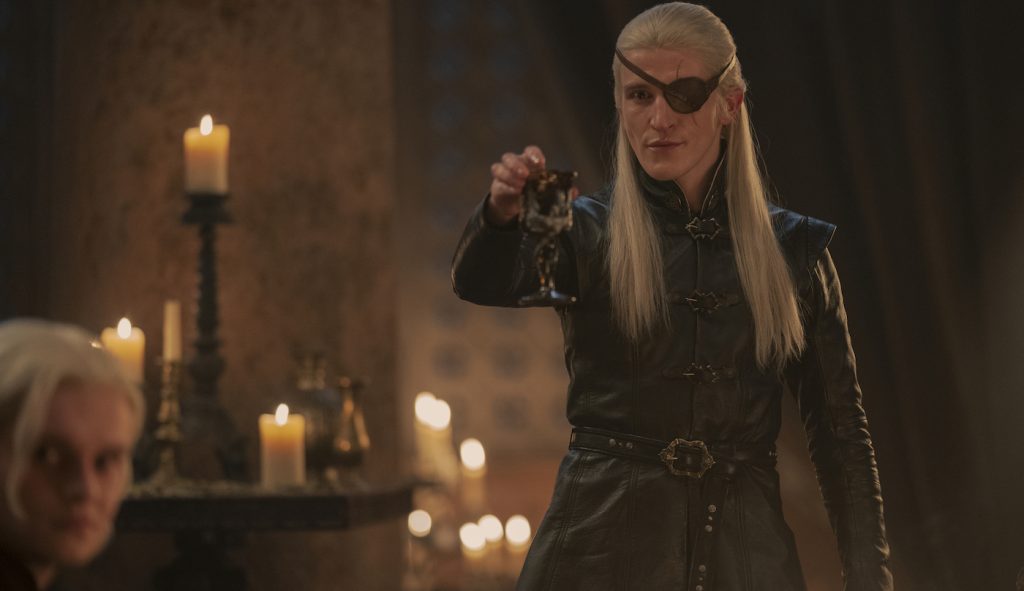
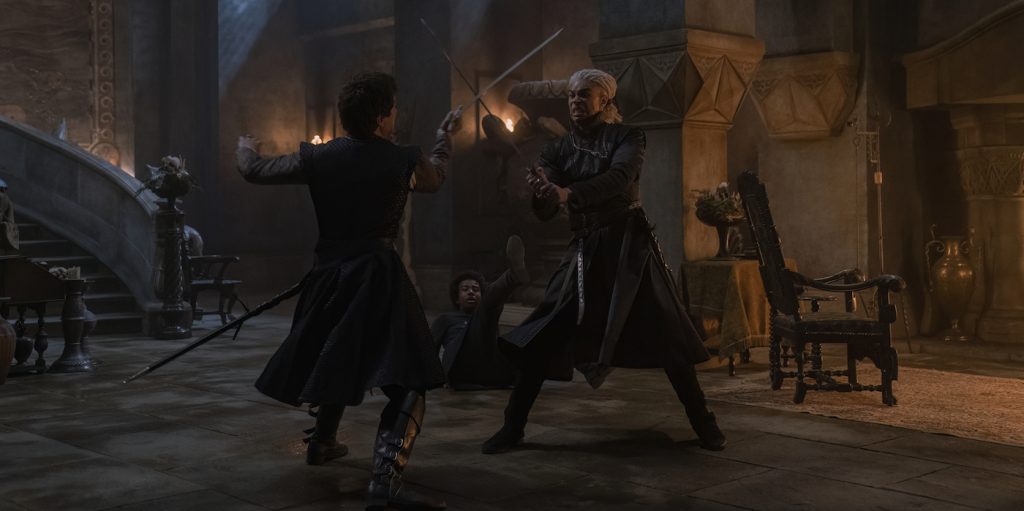
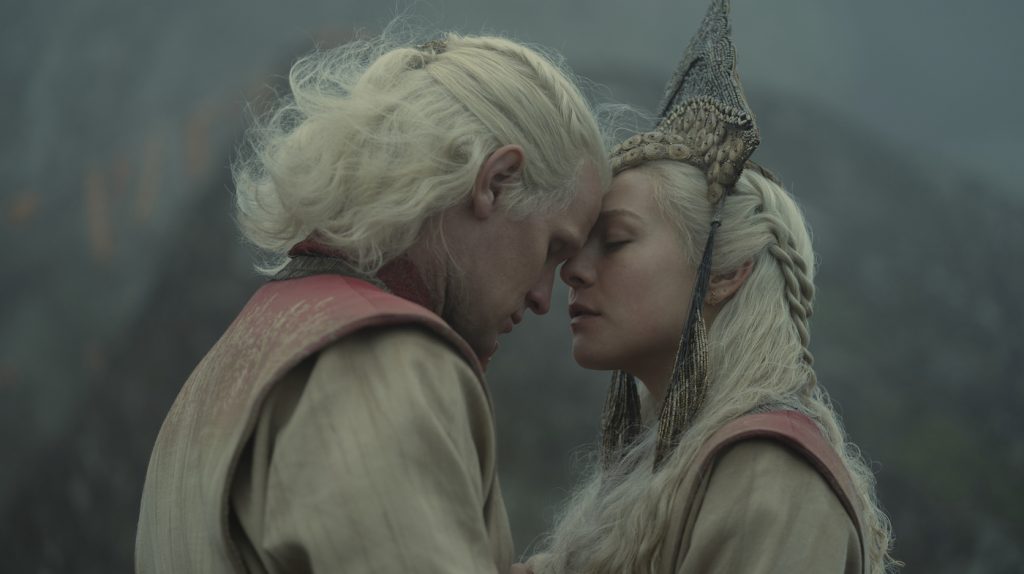
“You Targaryens do have queer customs,” Alicent (Olivia Cooke) says to her friend (and now the daughter of her husband) Princess Rhaenyra Targaryen (Milly Alcock). Alicent is referring to an accusation against the young Princess that she “coupled” with her uncle, the swaggering, loathsome Prince Daemon (Matt Smith), in the bowels of a brothel out beyond the castle walls in King’s Landing. The princess protests, swears that it’s all lie, and promises her queen that’s she still a maiden. These are half-truths at best, revealing that Rhaenyra knows when to flatter her friend—I’d never lie to you, etc.—and proves she’s a nimble political player herself. In fact, Rhaenyra turns this accusation, made by Otto Hightower (Rhys Ifans), to her advantage. At long last, she convinces her father, King Viserys (Paddy Considine), that Otto is nothing but a schemer, desperate to see his grandson Aegon on the throne. Although furious with Rhaenyra, Viserys is convinced by her speech, and the episode ends with him relieving Otto of his duties as Hand to the King. Yet this move is also exactly what Prince Daemon would have wanted, too. While Rhaenyra is an intelligent, potent presence, the entire episode felt like a game constructed by Daemon that everyone else was playing.

All of this was set into motion by Prince Daemon’s return from the Steppstones, arriving in King’s Landing in a homemade crown and carrying a weapon he prized from the dead hands of the Crabfeeder, the man he defeated after years of battle. He offers both to Viserys as a sign of respect, yet this being Daemon, we know he’s not suddenly a good and loyal subject of his brother, the king. Although Viserys, the most emotional of all the major players in House of the Dragon, wants desperately to believe his brother is back, mature, and finally reasonable, the rest of us see his treachery a mile away. You understand the desire to be close to your brother again, but you do want to shake Viserys by his royal robes and tell him to get some sense. His brother is plotting. Always plotting.

“We thought he should come back a seemingly changed man and then turn out to be exactly as the same as he was before,” says showrunner/executive producer/director Miguel Sapochnik in a new video released by HBO. “When he comes back, he’s not looking for his brother anymore, he’s somehow looking to get back at this brother, and Rhaenyra becomes the apple of his eye,” he continues.

The chemistry, creepy as it is, was established between Daemon and Rhaenyra from the first episode when he gifted her with a necklace she’s worn ever since. Yet, in “King of the Narrow Sea,” that chemistry is being used to Daemon’s advantage. He secrets her out of the Red Keep for a night amongst the regular folk in King’s Landing and leads her, eventually, to the brothel he knows so well. While Sapochnik stresses in the new behind-the-scenes video that they talked a lot about how Rhaenyra isn’t some naive innocent here, she is clearly being manipulated. Yet by now, Westeros-watchers who have 8 seasons of Game of Thrones under their belt know that for people like Targaryens, an uncle/niece pairing is par for the course. But it’s still gross.

Back from that sordid night—it should be said that Daemon and Rhaenyra did not actually couple, but they got close—Rhaenyra ended up seducing her sworn hand, Ser Criston. By the time she woke up the next morning, news of her eventful evening out had spread to her father and his wife. The machine of revenge was set into motion by Daemon, and per his design, it would spread within House Targaryen, clearing the deck of Otto Hightower, one of Daemon’s enemies within his brother’s court, and driving his brother, whose body is already literally falling apart, even deeper into paranoia and ill cheer. King Viserys banished Daemon from his sight, but that, too, felt like a weak move. What he should have done, if he was as ruthless as he needed to be, was separate Daemon’s head from his shoulders. Alas, Daemon likely knew he never would.

All in a night’s work for the sinister Prince Daemon.

For a deeper look inside the episode, check out this video from HBO:

For more on House of the Dragon, check out these stories:

Inside “House of the Dragon” Episode 3’s Crab-Nasty Drama

“House of the Dragon” Renewed For Season 2

“House of the Dragon” Torches Previous Records & Becomes HBO’s Biggest Premiere Ever

Inside The Fiery First Episode of “House of the Dragon”

Dragons Reign Supreme in New “House of the Dragon” Teaser

Featured image: Milly Alcock and Matt Smith. Photograph by Ollie Upton / HBO
“Captain America: New World Order” Reveals Cast at Disney’s D23

There were Marvel Cinematic Universe announcements aplenty at Disney’s D23 this past weekend, and one of the most significant was the reveal of some of the headliners in Captain America: New World Order, the first feature film to star Anthony Mackie as the new Cap.

Joining Mackie is Tim Blake Nelson, returning to the MCU after he appeared in 2008’s Incredible Hulk, now playing The Leader. Carl Lumbly returns as the original super soldier Isaiah Bradley after his emotional, series-shifting turn in The Falcon and the Winder Soldier, the series that showed Mackie’s Sam Wilson at first rejecting, and finally accepting, the mantle of Captain America. Danny Ramirez will also reprise his The Falcon and the Winter Soldier role as Joaquin Torres, while Shira Haas marks her debut as the Israeli hero Sabra.

The road for Mackie from being Captain America’s right-hand man to Captain America himself has been a long one. It began nearly a decade ago when Mackie began filming his scenes as Sam Wilson in Captain America: The Winter Soldier (2014), revealing his flying superhero alter ego, The Falcon. Sam/The Falcon became a huge part of Cap’s life and the larger MCU, featuring prominently in Captain America: Civil War (2016), Avengers: Infinity War (2018), and Avengers: Endgame (2019). It was during the bittersweet finale of Endgame that the world learned that Steve Rogers was retiring as Captain America and handing the shield over to his friend and trusted ally, Sam Wilson. Yet before Mackie would appear in his own stand-alone feature as Cap, he had his trial-by-fire in The Falcon and the Winter Soldier, Marvel’s most action-packed, feature-sized series yet.

During the run of The Falcon and the Winter Soldier, we spoke to series creator Malcolm Spellman about creating Sam’s long journey to accepting the shield. Spellman teased the bigger things ahead in the feature film he was then writing with co-writer Dalan Musson. Now, that script is done, and the film is one step closer to reality, with Julius Onah on board as director, the cast coming together, and a release date of May 3, 2024.

Needless to say, we’re excited about the Anthony Mackie era of Captain America.

Falcon/Sam Wilson (Anthony Mackie) in Marvel Studios' THE FALCON AND THE WINTER SOLDIER exclusively on Disney+. Photo courtesy of Marvel Studios. ©Marvel Studios 2021. All Rights Reserved.
Falcon/Sam Wilson (Anthony Mackie) in Marvel Studios’ THE FALCON AND THE WINTER SOLDIER exclusively on Disney+. Photo courtesy of Marvel Studios. ©Marvel Studios 2021. All Rights Reserved.

For more stories on all things Marvel Studios, check these out:

Marvel Reveals “Secret Invasion” Trailer Led by Samuel L. Jackson’s Nick Fury

“Thor: Love and Thunder ” Costume Designer Mayes C. Rubeo on Dressing Gods & Goddesses

“Thor: Love and Thunder” Casting Director Sarah Finn on Picking Stars for the Marvel Cinematic Universe

“She-Hulk: Attorney At Law” Early Reactions Call Tatiana Maslany a Super Addition to the MCU

Watch “She-Hulk: Attorney at Law” Star Jameela Jamil Become Supervillain Titania

New “Black Panther: Wakanda Forever” Images + Synopsis Reveal Villain Namor

Featured image: Falcon/Sam Wilson (Anthony Mackie) in Marvel Studios’ THE FALCON AND THE WINTER SOLDIER exclusively on Disney+. Photo by Chuck Zlotnick. ©Marvel Studios 2021. All Rights Reserved.

Marvel Reveals “Secret Invasion” Trailer Led by Samuel L. Jackson’s Nick Fury

Marvel Studios has revealed, at long last, our first look at their upcoming Disney+ series Secret Invasion, starring Samuel L. Jackson as a weathered, wearied Nick Fury. The official trailer was revealed during Disney’s D3 this weekend and opens with the arrival of a spaceship and a strange alien figure emerging from its glowing interior. That figure turns out to be Nick Fury, fresh off a years-long adventure off-planet. Fury arrived to meet with his former #2, the perpetually on-point Maria Hill (Cobie Smulders). Maria wants to know why he’s been avoiding her calls for the past couple of years. He’s back on Earth on a mission, and he’s worried that both Maria and James Rhodes’s (Don Cheadle)’s security details have been compromised. Oh, and Fury isn’t alone; he’s brought a friend—Talos (Ben Mendelsohn)—his shapeshifting alien buddy he met during the adventures of Captain Marvel, back when Fury thought Talos was his enemy. Fury and Talos are back on Earth to stop the alien Skrulls (the bad ones, not the good ones aligned with Talso), who, they believe, have infiltrated the halls of power and have a secret agenda that won’t be good for the people of our humble blue planet.

Jackson and Mendelsohn made a terrific pairing in Captain Marvel, and part of Secret Invasion‘s excitement is around seeing the two of them get hours of screen time together to sort out this new, pesky problem. The cast that surrounds them is also fantastic. Having Cobie Smulders, Martin Freeman’s Evertt Ross, and Don Cheadle on board, three MCU staples, is always a boon. So, too, are the new faces, which include A-list talents like Olivia Colman, Emilia Clarke, Kingsley Ben-Adir, and Carmen Ejogo. It’s arguably the most impressive cast yet in a Marvel Studios series on Disney+, and that’s saying something considering the talent they consistently have on hand.

Secret Invasion is sourced from a very sprawling storyline from the comics and has the potential to mark some major changes in the larger MCU through Phases 5 and 6. The series comes from creator Kyle Bradstreet (Mr. Robot) and is slated to hit Disney+ in 2023.

Check out the official trailer below:

For more stories on all things Marvel Studios, check these out:

“Thor: Love and Thunder ” Costume Designer Mayes C. Rubeo on Dressing Gods & Goddesses

“Thor: Love and Thunder” Casting Director Sarah Finn on Picking Stars for the Marvel Cinematic Universe

“She-Hulk: Attorney At Law” Early Reactions Call Tatiana Maslany a Super Addition to the MCU

Watch “She-Hulk: Attorney at Law” Star Jameela Jamil Become Supervillain Titania

New “Black Panther: Wakanda Forever” Images + Synopsis Reveal Villain Namor

Featured image: Samuel L. Jackson is Nick Fury in Columbia Pictures’ SPIDER-MAN: ™ FAR FROM HOME. Photo Credit Jay Maidment

“Star Wars: The Acolyte” Adds “Squid Game” Star Lee Jung-Jae

The Star Wars galaxy adds yet another rising star to its firmament.

Just a few days after learning that Jodie Turner-Smith was joining the upcoming series Star Wars: The Acolyte, Squid Game star Lee Jung-jae has found his first major American studio role, Deadline reports. The news comes at an opportune moment for Lee, as he’s vying for an Emmy for Oustanding Lead Actor in a Drama Series for his work in Squid Game, while the show is up for Oustanding Drama.

The new Star Wars series, led by writer/director/producer/showrunner Leslye Headland, now boasts Turner-Smith, Lee, and The Acolyte herself, Amandla Stenberg. Headland is putting together a diverse, star-studded cast for the show, which will focus on Stenberg’s titular Acolyte, a term for a student studying the Dark Side under the instruction of a Sith Lord. The series is being billed as a mystery-thriller and is set during the final days of the High Republic era. It’s rich material to mine and will be the first live-action Star Wars series to focus on the galaxy’s most feared and loathed force practitioners.

Lee has become a mega-star after his stellar performance in Squid Game, playing Seong Gi-hun, a gambling addict conned into becoming a participant in the sadistic games. The series became an absolute juggernaut, seen by millions of people (and, of course, Hollywood producers) all over the world. While The Acolyte is set to start shooting in the late fall, Lee’s first order of business remains the Emmys, where he’ll be a huge part of Squid Game‘s historic night.

For more on all things Star Wars, check out these stories:

“Star Wars: The Acolyte” Adding Rising Star Jodie Turner-Smith

Disney+ Releases Sneak Peek of “BTS: PERMISSION TO DANCE ON STAGE – LA” & “Andor”

Official “Andor” Trailer Reveals how the Rebellion Began

First “Andor” Trailer Reveals Diego Luna’s Big “Star Wars” Return

Featured image: Lee Jung-jae, Park Hae-soo in “Squid Game.” Photo by Noh Juhan | Netflix

Second “Black Adam” Trailer Reveals Dwayne Johnson’s Cursed Superhero

“These powers are not a gift but a curse.”

These are the sentiments of Black Adam (Dwayne Johnson) as the second Black Adam trailer begins, the most potent new superhero to enter the DC Extended Universe in a long time and possibly the most powerful of them all. Yet, unlike the super abilities of Wonder Woman, Aquaman, and Superman, Black Adam’s powers were gained from a horrific sacrifice. Born a slave, he was eventually executed. His powers came when his son sacrificed himself to resurrect his father. So yeah, those are some dark waters from which Black Adam’s abilities rose.

The new trailer offers some fresh looks at Johnson’s long-awaited turn as the antihero, a film he’s been working on for years now. While we’ve known for a while that Black Adam will introduce the Justice Society—Hawkman (Aldis Hodge), Doctor Fate (Pierce Brosnan), Cyclone (Quintessa Swindell), and Atom Smasher (Noah Centineo)—the new trailer reveals that Viola Davis’s ruthless wrangler Amanda Waller is involved.  This is a pretty big reveal, as Waller has had her fingerprints all over the two Suicide Squad films and the Peacemaker series on HBO Max. What her involvement is here, and how much more trouble she’ll get herself into, is still unknown. One could imagine her and Black Adam getting along horribly, or, considering they’re both not in the superhero game but rather share the “whatever it takes” mentality, maybe they’ll be besties.

Sure, we’ve known the film would introduce the Justice Society, but this trailer finally gives us a better look at their capabilities. There’s one really great shot of Atom Smasher, you know, smashing atoms, and some pretty great sequences showing off Hawkman’s majestic suit.

Black Adam comes from director Jaume-Collet Serra, working off a script by Adam Sztykiel, Rory Haines, and Sohrab Noshirvani.

Check out the new trailer below. Black Adam arrives in theaters on October 21.

Here’s the official synopsis for Black Adam:

Nearly 5,000 years after he was bestowed with the almighty powers of the ancient gods—and imprisoned just as quickly—Black Adam (Johnson) is freed from his earthly tomb, ready to unleash his unique form of justice on the modern world.

For more on Black Adam, check out these stories:

New “Black Adam” Sneak Peak Brings Out the Beast in Dwayne Johnson

First “Black Adam” Trailer Reveals Dwayne Johnson’s Epic Arrival In DCEU

Expect CinemaCon to Bring New Looks at “Top Gun: Maverick,” “Avatar 2,” “Black Adam” & More

See Dwayne Johnson as “Black Adam” in 3 New Images

Featured image: Caption: DWAYNE JOHNSON on the set of New Line Cinema’s action adventure “BLACK ADAM,” a Warner Bros. Pictures release. Photo Credit: Courtesy Warner Bros. Pictures

Benoit Blanc is Back in First “Glass Onion: A Knives Out Story” Trailer

We open on a massive yacht cruising through the beautiful blue waters of Greece. Inside, there’s a table full of suspects, all nattily attired and eagerly awaiting the arrival of one very particular man. “Ladies and gentlemen,” a voice offscreen says with a familiar twang, announcing his arrival. We know who this is; it’s Benoit Blanc (Daniel Craig), the gentleman detective who has arrived onboard to solve a mystery. Chaos, intrigue, and the exacting work of one very brilliant man are sure to ensue.

The first teaser for Rian Johnson’s follow-up to Knives Out has arrived, and it’s a beautiful piece of intrigue. It also reveals very little about the plot, which is to be expected of a murder mystery. Glass Onion: A Knives Out Story will find Craig’s Benoit Blanc trying to piece together another dangerous puzzle, working with (and against) another colorful cast of potential victims, or potential murderers. The cast includes Edward Norton, Janelle Monáe, Leslie Odom Jr., Kathryn Hahn, Jessica Henwick, Madelyn Cline, Kate Hudson, and Dave Bautista, looking particularly Grecian in his speedo. 

Glass Onion is set to have a theatrical release, by the way, which means that Netflix is positioning Johnson’s sequel for awards season, as the theatrical release allows it to vie for Oscars.

The sequel will arrive on Netflix on December 23 (and will play in select theaters at a soon-to-be-announced date), following its world premiere at the Toronto International Film Festival in September.

Check out the official teaser trailer below:


For more on big titles on Netflix, check these out:

Why Jenna Ortega (And More) Has Us So Excited For “Wednesday”

“All Quiet on the Western Front” Trailer Reveals Netflix’s Ambitious WWI Feature

“Knives Out 2” Sequel “Glass Onion” Reveals Photos, Release Date

Featured image: GLASS ONION: A KNIVES OUT MYSTERY. Courtesy Netflix.

Disney+ Releases Sneak Peek of “BTS: PERMISSION TO DANCE ON STAGE – LA” & “Andor”

Who better to help celebrate the international scope of Disney+ Day than releasing a concert film with arguably the biggest band in the world and a sneak peek at their next live-action Star Wars series, arguably the most globally popular franchise ever?

The streamer has revealed viewers can now stream their first collaboration with the K-Pop supergroup BTS, the concert film BTS PERMISSION TO DANCE ON STAGE – LA—huge news for their legion of fans. The new video also reveals a fresh look at their upcoming series Andor, starring Diego Luna as the thief-turned-Rebel spy.

BTS: PERMISSION TO DANCE ON STAGE – LA will give viewers a front-row seat to a series of BTS concerts held at the Los Angeles SoFi Stadium in late November and early December of 2021. The concert film includes performances of some of their biggest hits, including “Dynamite,” “Butter,” and “Permission to Dance.” For those yet not initiated into the BTS superfan group, their name is an acronym of Bangtan Sonyeondan or “Beyond the Scene.” Since BTS launched in 2013, they’ve become a global phenomenon.

As for Andor, there are high hopes for the new series, which will explore the seeds of the rebellion against the Empire from the viewpoint of some of the first rebels to stand up to their galactic overlords. Andor is set before the events depicted in Rogue One (the greatest Star Wars spinoff in our opinion), when Cassian Andor (Diego Luna) was a key part of a team of rebels who successfully lifted the Death Star plans off the empire—and paid the ultimate price for their efforts.

Andor will go deeper into Cassian’s story, showing us how a one-time thief became one of the leaders of the rebellion and how he and his comrades started to piece together a way to infiltrate the Empire from the inside. The series sees the return of another Rogue One standout, Forest Whitaker’s resistance fighter Saw Gerrera.

Andor will begin with a bang—a three-part premiere on September 21—with the series totaling 12 episodes.

Check out the new video below:

In a press release from this past July, Disney+ announced the partnership with BTS and TK and the three projects they’d be revealing. They are as follows:

“BTS: PERMISSION TO DANCE ON STAGE – LA”: This exclusive cinematic 4K concert film features BTS’ live performance in Los Angeles’ Sofi Stadium in November 2021. Performing Billboard hit songs “Butter” and “Permission to Dance,” this was the first time in two years since the pandemic that the band met fans in person.

“IN THE SOOP: Friendcation”: An original travel reality show with a star-studded cast including V of BTS, Itaewon Class’ Seo-jun Park, Parasite star Woo-shik Choi, Hyung-sik Park, and Peakboy. The program features the five friends venturing on a surprise trip and enjoying a variety of leisure and fun activities.

“BTS MONUMENTS: BEYOND THE STAR”: This original docu-series follows the incredible journey of 21st-century pop icons BTS. With unprecedented access to a vast library of music and footage over the past nine years, the series will feature the daily lives, thoughts, and plans of BTS members, as they prepare for their second chapter. The docu-series will be available exclusively on Disney’s streaming services next year.

For more stories on what’s streaming or coming to Disney+, check these out:

“Star Wars: The Acolyte” Adding Rising Star Jodie Turner-Smith

“She-Hulk: Attorney At Law” Early Reactions Call Tatiana Maslany a Super Addition to the MCU

Watch “She-Hulk: Attorney at Law” Star Jameela Jamil Become Supervillain Titania

Featured image: The K-pop super group BTS on stage in Los Angeles. ©2022 BIGHIT MUSIC & HYBE. All Rights Reserved.

Going For Broke in HBO’s “Industry” With Cinematographer Federico Cesca

For fans of HBO’s Industry who relished its hyper-intensive peek into the world of international finance, the series’ return this August after an 18-month hiatus was like welcome news on the financial markets.

The ambitious hirers who survived the cutthroat trading floor in season one are upping their game as they fight to make their mark at Pierpoint & Co, the prestigious London-based investment bank. Harper Stern (Myha’la Herrold) is scoring points by currying the favor and business of Jesse Bloom (Jay Duplass), an uber-powerful American hedge fund manager. Yasmin Kara-Hanani (Marisa Abela) is angling to parlay a chance meeting with Celeste Pacquet (Katrine De Candole), an executive in Pierpoint’s private wealth management section, into her ticket off the trading desk. And Eric Tao (Ken Leung) is fighting for relevancy as Danny Van Deventer (Alex Alomar Akpobome), a young executive from the New York office, maneuvers to take control of the CPS desk.

Federico Cesca - Industry - Photo Credit: Amanda Searle
Federico Cesca – Industry – Photo Credit: Amanda Searle

There’s no doubt the trading action is just as potent as the first season. But cinematographer Federico Cesca, who shot four of this season’s eight episodes, was more interested in revealing a different side of the characters. 

“I feel like the moments that stand out the most are the ones that are a bit outside of that world,” says Cesca during a recent conversation over Zoom. 

Cesca cites a bird hunting excursion to Wales in episode three that plants the seeds of a blossoming relationship between “Gus” Sackey (David Jonsson), who was fired from Pierpoint last season, and Bloom’s son Leo (Sonny Poon Tip), who feels lost in his father’s shadow. Episode four offers a unique look into Tao’s homelife as he connects with his wife and young daughters. There’s a glimpse of Bloom’s quirky lifestyle in episode seven as a visit to his cavernous mansion shows furnishings consisting of a wall of computer screens and a basketball hoop. 

“Those, to me, were really cool memorable moments when I was shooting them,” Cesca continues. “Previously, 80% of the time, you’re on the trading floor. This is just different. You get the sense that you can explore different aesthetics, different things with a more personal touch.”

Andrew Buchan, Ken Leung, Jay Duplass. Photograph by Amanda Searle/HBO

Cesca’s previous work, which includes the feature Patti Cake$ and the TV series Tales of the City, was primarily based in the United States. So he was intrigued when the producers of Industry approached him. Watching season one sealed the deal. “My wife loved it,” says Cesca. “My wife was like, ‘You have to do this.’”


Cesca read the scripts for the first two episodes of season two, but the director of those had already chosen a DP. But Cesca didn’t mind. It gave him the opportunity to team up with director Isabella Eklöf. “I’d seen Border, which is a great film that she co-wrote. And then I watched her first feature, Holiday, which is also really good…a very strong vision, a clear kind of idea.”

Even though he hadn’t read the scripts, Cesca signed on for episodes three, four, seven, and eight. “I just jumped in blindfolded,” he says with a laugh. “Your instinct tells you this is gonna be good.”

Shooting was done with an ALEXA Mini and Canon K35 lenses. Knowing Industry creators Mickey Down and Konrad Kay were pushing for a more cinematic and textured look than season one, Cesca mixed things up by opting for 24mm and 35mm lenses rather than the typically used 50mm lens. “We were going with wider lenses which immediately changed the way things feel,” he explains. “Because you are making the depth of field deeper, you’re closer to the actors and feel the world a little more.”

Marisa Abela. Photograph by Nick Strasberg/HBO

Eklöf shook things up by asking Cesca to avoid over-the-shoulder shots and to always keep the characters in the middle of the frame.

“That’s something that I hadn’t really done before. That was challenging to me,” Cesca continues. “But I think it’s something that you feel in the episodes that we shot, especially when you compare them with the others. It’s a signature of what Isabella likes.”

Ken Leung. Photograph by Amanda Searle/HBO

In many of the two-character scenes, Cesca was so close that the camera was literally between the actors. “We were in the middle of the action with a very reacting and very proactive camera,” he adds. “The camera itself is a participant as opposed to just watching.”

Cesca admits that at first, the cast wasn’t quite sure how to react to these unusual setups. But as shooting progressed, he believes it helped spark the actors’ creativity. “As soon as we started shooting, Isabella and I felt we were on the right path,” he says. “You could see something unexpected happening. I did feel the actors were enjoying it. It was exciting for them to work this way.”


Cesca also decided at the start of production to deliberately give his director and actors some space. He’d watch the blocking and strategize about his lighting choices. But he didn’t intrude and made sure he wasn’t cluttering the stages with stands and equipment. “I’m prioritizing so that the directors and actors can move freely,” he explains, adding it freed him up as well. “I can basically shoot 360 degrees in most of the situations. It feels like we are in that world, and the world is three-dimensional. It’s not three walls and a fourth wall.”

Though most of Industry’s action is shot at Wolf Studios Wales, some location shooting was needed. Cesca remembers the difficulty in particular of finding a suitable hotel look for Tao’s trip to New York City in episode four. Scouting trips to nearby Cardiff and Bristol came up empty. Finally, a suitable space was found in London.

“The irony is that you have these incredible views of London. You see the tower Bridge and all that,” Cesca says. “But then you have to put in a green screen, block the view completely, and pretend you’re in New York City.”

Federico Cesca – Industry – Photo Credit: Nick Strasburg

Location choices for episodes seven and eight also presented Cesca with some challenges. The script called for a team led by Stern and Tao, to meet with a variety of different investment bankers. All these scenes were shot in the Bloomberg London building.

“You’re kind of in a box with windows pretty much all around,” explains Cesca. “You can’t really light from outside. So you really need to take into consideration the sun and the natural light and somewhat manage to keep it consistent throughout — whatever four or five hours or more that you’re shooting in this room.”

Myha’la Herrold. Photograph by Simon Ridgway/HBO

Wanting to vary the shots, this was the only occasion when Cesca brought in a second camera. “Shooting in all these offices and meeting rooms when you have seven, eight characters, all with lines, you just need to start using the second camera and try to grab as much as you can in the shortest amount of time possible,” he adds.

The British weather proved to be an unlikely ally when Cesca was shooting these scenes. “I just loved it. One thing that is incredible is that the sun never really gets quite high,” he says. “The light kept getting lower and lower as we were going into winter. That’s definitely an advantage. It’s easier to make something look good when the sun is shining straight up.”


Season Two of Industry debuted on August 1, 2022, on HBO and HBO Max with new episodes airing on Monday nights at 9 pm ET.

For more on Warner Bros., HBO, and HBO Max, check out these stories:

“Joker 2” Adds Brendan Gleeson

Inside “House of the Dragon” Episode 3’s Crab-Nasty Drama

“House of the Dragon” Renewed For Season 2

“Godzilla vs Kong 2” Synopsis Reveals Epic Continuation of Monster Fight

Featured image: Jay Duplass. Photograph by Simon Ridgway/HBO


“Star Wars: The Acolyte” Adding Rising Star Jodie Turner-Smith

The Star Wars galaxy is set to add a rising star to its roster of talent.

After Yang, Queen & Slim, and Anne Boleyn star Jodie Turner-Smith is finalizing a deal to join Amandla Stenberg in Disney+’s Star Wars: The Acolyte, Deadline reported yesterday. Turner-Smith would be the only other star aside from Stenberg we know currently cast in the hotly anticipated series from the multitalanted writer/director Leslye Headland.

The Acolyte is set in the waning days of the High Republic era, according to Disney+, and will be centered on Stenberg’s titular Acolyte, a term used to describe those learning to use the Dark Side under tutelage from Sith Lords. This would make The Acolyte the first live-action Star Wars series to focus directly on an ostensible villain—although we’re guessing Stenberg’s character might end up challenging her masters—whereas The Mandalorian and The Book of Boba Fett focused on bounty hunters (and both are portrayed in a more heroic light). The other Star Wars series—Obi-Wan Kenobi, which centered on the iconic Jedi Master, and the upcoming Andor, which will follow the thief-turned-Rebel spy Cassian Andor (Diego Luna) as the rebellion against the Empire kicks into high gear—deal with outright heroes. This gives The Acolyte a chance to explore darker territory, and with the trio of Headland, Stenberg, and Turner-Smith at the top of the call sheet, we’ve got high hopes.

Turner-Smith’s star has been rising since her standout performance in Queen & Slim, leading to her starring turn as the titular character in Anne Boleyn, and, giving a quietly masterful performance in Kogonada’s After Yang. She’s set to star opposite Adam Driver in Noah Baumbach’s adaptation of Don DeLillo’s White Noise, which is set to hit theaters on November 25.

Star Wars: The Acolyte is set to start filming in London in late fall.

For more on all things Star Wars, check out these stories:

Official “Andor” Trailer Reveals how the Rebellion Began

“Obi-Wan Kenobi” Composer Natalie Holt Finds the Force

“Obi-Wan Kenobi” Finale Delivers on The Tragedy of Darth Vader

Featured image: VENICE, ITALY – SEPTEMBER 04: Jodie Turner-Smith attends “The Whale” & “Filming Italy Best Movie Achievement Award” red carpet at the 79th Venice International Film Festival on September 04, 2022 in Venice, Italy. (Photo by Vittorio Zunino Celotto/Getty Images)

Why Jenna Ortega (And More) Has Us So Excited For “Wednesday”

They’re creepy, they’re kooky, and for more than 50 years, the Addams Family have captivated the hearts of a worldwide audience. Now, their gloomy daughter, Wednesday, takes center stage in Tim Burton’s widely anticipated Netflix series, with the maestro of the maladjusted serving as director and executive producer. 

The Streamer has billed Wednesday as a “sleuthing, supernaturally infused mystery charting Wednesday’s years as a student at the peculiar Nevermore Academy.” As we’ve learned from showrunners Alfred Gough and Miles Millar (Smallville), the upcoming original will really be about Wednesday’s journey into adulthood, which sets it apart from previous Addams Family features.

We’ll see a bright, polymathic Wednesday Addams as a maladapted high school student who is also an aspiring writer, a talented cellist, and a skillful fencer. Once she’s plucked from her normie school and sent to Nevermore Academy, she’ll navigate new relationships with her equally creepy classmates that include sirens, werewolves, and vampires. She’ll be absorbing all of this—remember how hard it could seem to be a child?—while she investigates a serial killer terrorizing the local town and tries to solve a paranormal mystery involving her parents’ past. And, presumably, pass math.


Wednesday constitutes the live-action-TV-debut for the legendary Burton. His sublimely somber aesthetics, his way with actors, and his attention to the most minute detail of his perpetual Halloween universe are ideally suited to introduce Wednesday Addams to a new generation.

Then there’s the cast. Jenna Ortega (The Fallout) stars as Wednesday Addams, a standout performer and horror expert, having been dubbed Gen Z’s Scream Queen thanks to her performances in the latest ScreamThe Babysitter: Killer QueenX, and Studio 666. Ortega is already one of the most outstanding actors of her generation, and earning the title role in a Tim Burton-directed Netflix series means only bigger things for the Mexican-American actress. 

“She’s like a silent movie actress…able to convey things without words…We’re lucky to have Jenna because I can’t imagine any other Wednesday,” said Burton about Ortega in the latest featurette released by Netflix. 


Unlike past incarnations of the character, Burton’s Wednesday possesses budding psychic powers, but that’s only one of her new gifts.  

“(Wednesday) is technically a Latina character, and that has never been represented. For me, any time that I have an opportunity to represent my community, I want that to be seen.”  Ortega shared.

We already caught a glimpse of the Latinidad of the Addams when Wednesday sardonically refers to the “spooky altar” her family keeps in their living room for a year-long Día de Los Muertos.

The Addams Family is, in fact, “technically” Latinx. Wednesday’s father Gomez, unforgettably incarnated by Puerto Rican American Raul Julia in Barry Sonnenfeld’s 1991 film The Addams Family, is of Castillian-Spanish descent.

“Looking the way I do and having the cultural background I have, there aren’t many iconic characters out there,” Ortega told Empire Magazine. “As someone who still struggles to this day with representation or relatability in mainstream media…I recognized this was an opportunity for me to give that to other girls like myself.” 

Ortega will portray a seemingly emotionless character who also will have to deal with coming out of the shadow of her glamorous mother. A degree of complexity we don’t really get to witness as much as we should for Latinas on film.

Wednesday. (L to R) Luis Guzmán as Gomez Addams, Jenna Ortega as Wednesday Addams, Catherine Zeta-Jones as Morticia Adams in episode 101 of Wednesday. Cr. Courtesy Of Netflix © 2022

The first season of Wednesday comprises eight one-hour episodes. We’ve never gotten to spend so much time with the adored deadpan child since the character’s TV debut in 1964.

(Actually, we have. But only in an unofficial—and viral—manner. Melissa Hunter’s 2013 unlicensed web series Adult Wednesday Addams gathered well over 20 million views. Proving that the spell of Wednesday holds strong, especially among Millennials, like the one writing this article.) 

For us, it was Cristina Ricci in the 90’s films who perfectly embodied the surliest of the Addams. Ricci’s unforgettable rendition has been acknowledged by Jenna Ortega. “She killed it, and it’s very important to me to honor her legacy and the role,” she said in an interview with Mitú. The admiration is mutual. Ricci herself has given Ortega her nod of approval, telling Variety she’s “amazing” while appreciating how the original character has been respected with an “incredibly modern” twist to it. 

Ricci herself will be part of the Addams universe in a yet-to-be-revealed character. Another tightly kept secret is who will play Uncle Fester. As for the rest of the cast, we’re in for a treat. 

Prolific nuyorican actor Luis Gonzalez (Traffic, Boogie Nights) will incarnate devoted husband and loving father, Gomez Addams, in a casting choice that pays homage to the original 1938 cartoon by Charles Addams. We’ll see Oscar-winner Catherine Zeta-Jones (Chicago, Traffic) take on the role of the sophisticated matriarch, Morticia. Wednesday’s favorite human to torture, Pugsley, will be played by Isaac Ordonez (A Wrinkle In Time). Hailing from Romania, the place where Wednesday was shotVictor Dorobantu is Thing, and George Burcea is Lurch. Wednesday also boasts one of Game of Thrones’ most beloved performers, Gwendoline Christie, as a series regular, portraying Nevermore’s principal and longtime enemy of Morticia.

Wednesday. (L to R) Catherine Zeta-Jones as Morticia Adams, Jenna Ortega as Wednesday Addams, Luis Guzmán as Gomez Addams, Issac Ordonez as Pugsley Addams in Wednesday. Cr. Courtesy of Netflix © 2022

While Netflix hasn’t announced a release date, we can expect the MGM-produced show to premiere just in time for Halloween. If that still feels too far away, we can relish Ortega’s spot-on characterization as Wednesday in these teasers and start enjoying her dead-cold deliveries on her official Twitter account.

For more on big titles on Netflix, check these out:

“All Quiet on the Western Front” Trailer Reveals Netflix’s Ambitious WWI Feature

“Knives Out 2” Sequel “Glass Onion” Reveals Photos, Release Date

“Bridgerton” Emmy-Nominated Costume & Hairstyling Team on Season Two’s Sumptuous Styles

Featured image: Wednesday. Jenna Ortega as Wednesday Addams in Wednesday. Cr. Matthias Clamer/Netflix © 2022

How the Ebo Sisters Find Comedy in Megachurch Scandal Feature “Honk For Jesus. Save Your Soul.”

Honk For Jesus. Save Your Soul. came seemingly out of nowhere in January to become a breakout hit at the 2022 Sundance Film Festival, where Jordan Peele‘s Monkeypaw production company, Focus Features, and Peacock picked up the dark comedy. But in fact, the movie was a long time coming. Writer/director Adamma Ebo and her twin sister, producer Adanne, spent six years developing their 2015 short film of the same name. Exposure to Issa Rae’s “Short Film Sundays” YouTube series led to the Sundance Screenwriters Intensive Program along with backing from producers, including actor Daniel Kaluuya. 

And no wonder. The mockumentary (in theaters and now streaming on Peacock) features bravura performances from three-time Emmy winner Sterling K. Brown (This Is Us) as the disgraced pastor of a Southern Baptist megachurch, with Oscar co-host Regina Hall (Girls Trip) playing his stressed-out wife. Together, they try to stage a comeback in the wake of a congregation-rocking sex scandal.

Sitting in near-identical poses—Adanne’s hair tilts to the right, Adamma’s to the left—the Ebo Sisters spoke from Los Angeles about how casting, clothing, and the specific details of Black church culture informed their mostly funny, sometimes sad Honk for Jesus. saga. 


Honk for Jesus includes all kinds of fascinating details that might be surprising for people who didn’t grow up in the Black church, starting with. . .mime! Is that really a thing?

Adanne: Yes, mime praise is a real thing. 

The sequence where we see Regina Hall in her mime makeup performing on the side of the road feels surreal, funny, and tragic all at once. When did you become aware of this mime praise phenomenon?

Adamma: Growing up in the Black church, we’ve been aware of it for a long time. A lot of people like it, but for me, mime praise always tilted over into the uncanny valley. At some point in the film, I wanted a mime scene that would feel otherworldly. And as we became aware that a lot of people didn’t know what praise miming is, I knew it would be shocking to see Regina out on the side of the road doing this. 

How did you direct that sequence?

Adamma: We tried different things. We had a take where Regina’s uncomfortable through the whole thing, we did a take where she’s more pained, a take where she’s actually into it, a take where she’s pissed off the whole time, and sometimes an evolution of all those things. We built a whole mini-arc in that one scene. 

Actor Regina Hall and writer/director Adamma Ebo on the set of their film HONK FOR JESUS. SAVE YOUR SOUL., a Focus Features release. Credit: Steve Swisher / © 2021 Pinky Promise LLC

The gospel song underscoring that scene really packs an emotional punch. What’s it called?

Adanne: “Never Would Have Made It” by Marvin Sapp. It’s definitely a crowd pleaser. At our premiere last night, people were singing along. 

Adamma: It’s not only one of our favorite songs, but it also pairs perfectly with the fact that Regina’s character is starting to crack. 

Everybody addresses Regina’s character Trinitie as “First Lady.” Is that a common title in the Black church? 

Adamma: Yes. I thought all pastors’ wives were called First Lady, so it was a culture shock to realize: “This is not common knowledge.”


And the thrones?

Adamma: Yeah. A lot of Black churches have these ornate throne-like chairs on stage. 

Adanne: Anything to do with the culture of the Black church and Christianity, we weren’t making anything up. 

Regina Hall and Sterling K. Brown star as Trinitie and Lee-Curtis Childs in HONK FOR JESUS. SAVE YOUR SOUL., a Focus Features release. Credit: Steve Swisher / © 2021 Pinky Promise LLC

That includes the Honk for Jesus scandal itself, right? I read somewhere that in Atlanta, where you grew up, something similar happened at one of the megachurches there?

Adanne: It was everywhere, to be honest. There’s a multitude of megachurches in Georgia, Texas, Tennessee, Alabama, and throughout the south in general. The communities were very insular, so we’d hear about everything, like at our cousin’s church in Texas. 

Adamma: In high school, I became dismayed with people’s responses to these occurrences, where they’d want to protect the person at fault. That’s when I was like: Okay, we have to take a look at what’s going on here because it’s like we don’t care about [victimized] people in the church where you’re supposed to love thy neighbor.

Adanne: There’s also this culture of “family business” in the Black community, where we resolve issues like this internally. Black people believe in presenting ourselves to society at large in a particular way.

Adamma: So much of that is because we’re usually not in control of the narrative created around us, so that when we do have control, we don’t want to put out anything bad. But there’s inherent harm in situating things that way. If we sweep it under the rug, if we don’t talk about things, then nothing gets resolved in a healthy manner.

Writer/director Adamma Ebo and producer Adanne Ebo on the set of their film HONK FOR JESUS. SAVE YOUR SOUL., a Focus Features release. Credit: Steve Swisher / © 2021 Pinky Promise LLC

Adamma, when did you translate your feelings about this kind of wrongdoing into script form?

Adamma: In film school, I decided it could be something more than me just complaining. Honk for Jesus. was a feature script that turned into a short film that turned into a feature.

Honk for Jesus. could have been treated as a straight-up drama. Why did you take the comedic route?

Adamma: A lot of the story is nothing new, so we wanted the approach to be fresh. People are getting mostly comedy in the first act, and then you slowly roll in these [darker] aspects as a way to Trojan Horse in the [serious] points we wanted to make. The comedy helps the medicine go down.

Adanne: We love dark comedies, we love satire, and I also think it’s just inherent to our sensibilities. Black folks handle the tough stuff through humor. 

ATLANTA, GEORGIA – AUGUST 26: (L-R) Adamma Ebo and Adanne Ebo attend a special Atlanta screening of HONK FOR JESUS. SAVE YOUR SOUL. at Plaza Theatre on August 26, 2022 in Atlanta, Georgia. (Photo by Paras Griffin/Getty Images for Focus Features)

A casting question: Regina Hall’s well known for her comedic talent, but Sterling K. Brown appeared in Black Panther, earned an Emmy nomination for portraying Christopher Darden in The People v. O.J. Simpson: American Crime Story, and won an Emmy for the very serious TV drama This Is Us. He’s not usually associated with comedy, so what made you think of him for this role?

Adamma: We did not think of him at first, until one of our producing partners suggested him. Our first question was, Wait, is Sterling funny? But we dived into his credits and saw… 

Adanne: He was nominated for a Best Guest Star in the half-hour comedy Brooklyn Nine-Nine where he plays a murderous dentist. Very deadpan…

Adamma: And absolutely hilarious. 

Adanne: So we’re like, oh, he is funny. Seeing that he could do deadpan, the hardest kind of comedy to pull off, we felt he could definitely do the broad stuff and the dramatic thing and everything in between. 

Adamma: People are used to Regina being funny, but they’re certainly not used to Sterling being funny. They both get to be deeply dramatic and deeply funny, oftentimes in the same scene. 


You two obviously work well together, but it’s rare to see filmmaking sisters in an industry that welcomes teams like the Coen Brothers and the Russo Brothers. When you attended Spelman College together in Atlanta, did you hatch a master plan to join forces as filmmakers? 

Adanne: Well, first of all, I just want to say there would probably be more sister filmmaking duos if people let women make more films. We’ll ultimately see more of that in the future. But as far as our journey, the plan was for both of us to go to law school. Adamma strayed from the plan and went to film school, but I did go to law school thinking, “I’ll be on the business and legal side, you’ll be on the creative side, it’ll be real cute.” But I became disillusioned with being an attorney, so when Adamma asked me to produce her second-year short film while she was at UCLA, that’s what really kicked off our creative partnership.

One more question about Honk For Jesus. The costumes are incredible. From Lee-Curtis’ purple plaid suit to Trinitie’s fancy hats, the pastor and his First Lady wear wonderfully over-the-top outfits. Do their clothes reflect Black church attire?

Adamma: Black folks get dressed for church. 

Adanne: It’s a fashion show. 

Adamma: It’s a frigging fashion show. I like fashion, so I don’t mind it at all, I want to see what people are wearing, I want to look good all the time. But aside from the fact that it’s true to the culture, the costumes were instrumental in showing the wealth and opulence of this couple. Lee-Curtis and Trinitie are very much about their image, and they like the finer things in life. Sterling had a good time in those suits!


For more on Universal Pictures and Focus Features projects, check out these stories:

“Armageddon Time” Trailer Reveals James Gray’s Star-Studded, Critically Acclaimed New Feature

Jason Momoa Teases his Androgynous “Fast & Furious 10” Villain

“Nope” Sound Designer Johnnie Burn Puts the Fear in What We Hear

Featured image: Regina Hall and Sterling K. Brown star as Trinitie and Lee-Curtis Childs in HONK FOR JESUS. SAVE YOUR SOUL., a Focus Features release. Credit: Steve Swisher / © 2021 Pinky Promise LLC


“Armageddon Time” Trailer Reveals James Gray’s Star-Studded, Critically Acclaimed New Feature

Writer/director James Gray has returned from deep space, where his last, excellent feature Ad Astra was mostly set, to a very specific place on Earth. Gray’s latest feature, Armageddon Time, is a deeply personal coming-of-age drama set at the cusp of Ronald Reagan’s America, a place of panting optimism and deep-seated, still largely unexplored racism. The cast, led by Anne Hathaway, Anthony Hopkins, Jeremy Strong, and Jessica Chastain, offers the big names in Gray’s ensemble, but this story revolves around two young boys, played by Banks Repeta and Jaylin Webb  Armageddon Time made its world premiere at Cannes this year and has been hailed as “quietly extraordinary” by Time‘s Stephanie Zacharek, a “truly poignant, troubling, and ultimately brilliant work of memory and self-implication,” by Voxs Alissa Wilkinson, while The New Yorker‘s Richard Brody writes that, “Gray lovingly conjures what he cherished while recognizing that it was inseparable from the epochal horrors that its seeming normalcy was fostering.

The trailer reveals the budding friendship between Paul Gaff (Repeta) and Johnny (Webb), two sixth graders at PS 173 in Queens. Paul is white and Johnny is black, and in early 1980s America, this kind of friendship could be fraught—in the best of cases. Eventually, the boys are separated when the rebellious Paul is removed from the school he attends with Jaylin. When Paul reveals to his grandfather, Aaron (Hopkins), that the kids at his new private school say “bad words about the black kids,” Aaron asks him what he said in response, Paul says, “Obviously nothing, of course.” His grandpop isn’t impressed by this, telling Paul about how his own mother fled Europe for America because of the persecution she faced for being Jewish. “They hated us then, and they still hate us,” he says. “Next time those schmucks say anything bad about those kids, you’re going to say something,” he says.

Gray is a deeply gifted filmmaker, having made trips to the Amazon in The Lost City of Z and the aforementioned interstellar drama of Ad Astra sizzle with specificity—these are epic backdrops, no doubt, but Gray’s attention to character and story made them both feel personal. With Armageddon Time, he’s taking direct aim at his own childhood and the things, some good and some very, very bad, that shaped him. The critics at Cannes were moved by the results, and this greatly affecting trailer will give you a hint as to why.

Check out the trailer below. Armageddon Time arrives on October 28.

Here’s the synopsis for Armageddon Time:

From acclaimed filmmaker James Gray, ARMAGEDDON TIME is a deeply personal story on the strength of family, the complexity of friendship, and the generational pursuit of the American Dream. The film features an all-star cast including Anthony Hopkins, Anne Hathaway, and Jeremy Strong.

For more on Universal Pictures and Focus Features projects, check out these stories:

Jason Momoa Teases his Androgynous “Fast & Furious 10” Villain

“Nope” Sound Designer Johnnie Burn Puts the Fear in What We Hear

“Nope” VFX Supervisor Guillaume Rocheron on Creating That Spectacular Alien Creature

“Nope” Composer Michael Abels on Scoring Jordan Peele’s Sci-Fi Epic

Featured image: (L to R) Jaylin Webb stars as Johnny Crocker and Michael Banks Repeta stars as Paul Graff in director James Gray’s ARMAGEDDON TIME, a Focus Features release. Courtesy of Focus Features

“All Quiet on the Western Front” Trailer Reveals Netflix’s Ambitious WWI Feature

The first trailer for Netflix’s All Quiet on the Western Front has arrived, revealing the streamer’s ambitious WWI epic. This is the first-ever German-language adaptation of novelist Erich Maria Remarque’s iconic WWI novel and, fittingly, the trailer opens with Remarque’s own words: “This is neither an accusation nor a confession…and least of all an adventure.”

All Quiet on the Western Front aims to show the horror of the war without zeroing in on the figures usually prominent in such a tale—namely heroes and villains. Sticking with the novelist’s ethos that this story is not an adventure as well, the film will explore what a violent slog trench warfare was, the wanton slaughter of millions for inches of scorched earth, and the shattered lives of the survivors it left behind. Director Edward Berger adapted the novel with co-writer Lesley Paterson, and as he told The Hollywood Reporterhis goal was to show the war’s effects on Germans, who did not get to return home heroes but rather tortured, shellshocked, and guilt-ridden.

“I watch a lot of American and English films, as we all do, and occasionally there is a war movie or even an anti-war movie among them. And I find them extremely entertaining. But I feel they never show my perspective, the perspective I have as a German,” Berger told THR. “Not that of America, that saved Europe from Fascism, or England, which was attacked and drawn into a war against their will, whose soldiers returned home, certainly traumatized and psychologically broken, but celebrated as heroes, [where] the war is an event that enters the national psyche as something that the society is in part proud of. For us, it’s the exact opposite. In our national psyche, there is nothing but guilt, horror, terror, and destruction.”

The cast includes Daniel Brühl, Sebastian Hülk, Albrecht Schuch, Anton von Lucke, and Devid Striesow.

Check out the trailer below. All Quiet on the Western Front will make its world premiere at the Toronto Film Festival on September 12.

Here’s the synopsis for All Quiet on the Western Front:

All Quiet on the Western Front tells the gripping story of a young German soldier on the Western Front of World War I. Paul and his comrades experience first-hand how the initial euphoria of war turns into desperation and fear as they fight for their lives, and each other, in the trenches. The film from director Edward Berger is based on the world renowned bestseller of the same name by Erich Maria Remarque.

For more on big titles on Netflix, check these out:

“Knives Out 2” Sequel “Glass Onion” Reveals Photos, Release Date

“Bridgerton” Emmy-Nominated Costume & Hairstyling Team on Season Two’s Sumptuous Styles

“Wednesday” Trailer Reveals Tim Burton’s “The Addams Family” Reboot

Netflix Reveals First Look at Guillermo del Toro’s “Cabinet of Curiosities”

Featured image: All Quiet on the Western Front – Production Still Image. Photo by Reinar Bajo/Netflix.

“Joker 2” Adds Brendan Gleeson

Joker: Folie á Deux just landed an ace performer.

The Irish actor Brendan Gleeson, one of the most reliably intriguing performers around, will join Joaquin Phoenix and Lady Gaga in the sequel, The Hollywood Reporter confirms. Gleeson is currently busy taking a victory lap after his latest film, director Martin McDonagh’s Banshees of Inisherin, got a rave reception at the Venice Film Festival. That film stars Gleeson and Colin Farrell, who both starred in McDonagh’s breakout 2008 film In Bruges. Banshees of Inisherin just received a 13-minute standing ovation at Venice.

It’s not yet clear who Gleeson might be playing in the Joker sequel, but he’s got the chops to step into Todd Phillips’ moody, messy Gotham, which this time around will shown through the lens of a musical. Joker: Folie á Deux was written by Phillips and his original Joker co-writer Scott Silver, and, as the title clues us in (a “Folie á Deux” is a medical term referring to identical or similar mental disorders affecting two or more people), the sequel will make the most of the pairing between Phoenix’s Joker and Gaga’s Harley Quinn. When you’ve got a singer like Gaga in your corner, a musical is suddenly all the more appealing.

The original Joker was a critical and commercial smash for Warner Bros. back in 2019, a gritty character study of Phoenix’s Arthur Fleck, a would-be comedian whose grip on reality, tenuous to begin with, completely disintegrates by the film’s end in a bloody, Gotham-shaking breakdown. Joker earned 11 Oscar nominations, including Best Picture, and netted wins for Phoenix and its composer, Hildur Gudnadottir.

Gleeson is a welcome addition to any film. Let the speculation begin on whether he’ll be playing a known Gothamite or an entirely new character.

Joker: Folie á Deux is slated to arrive in theaters on October 4, 2024.

For more on Joker: Folie á Deux, check out these stories:

Zazie Beetz Circling a “Joker 2” Return

Lady Gaga Releases “Joker 2” Teaser Hyping Upcoming Musical Mayhem

“Joker 2” With Joaquin Phoenix & Lady Gaga Gets a 2024 Release Date

Lady Gaga Eyeing “Joker 2” Harley Quinn Role in Musical Sequel

Featured image: VENICE, ITALY – SEPTEMBER 05: Brendan Gleeson attends “The Banshees Of Inisherin” red carpet at the 79th Venice International Film Festival on September 05, 2022 in Venice, Italy. (Photo by Pascal Le Segretain/Getty Images)

Inside “House of the Dragon” Episode 3’s Crab-Nasty Drama

In House of the Dragon‘s third episode, “Second of His Name,” the birth of Aegon Targaryen is but one of the major intrigues that unsettle things within the dragonlords power structure. The littlest member of the family is now expected to be named heir to King Viserys’s (Paddy Considine) throne, no matter the King’s promise to his eldest born, his daughter Princess Rhaenrya (Milly Alcock), that she was his heir. While the King’s Hand, Lord Otto Hightower (Rhys Ifans), spends the early part of the episode gently reminding the King that choosing Aegon as his heir is the appropriate, nay, the expected thing to do, the king’s brother Prince Daemon (Matt Smith) is at war with the Crabfeeder (Daniel Scott Smith), trying to show the realm what a real leader looks like.

These twin issues—two potential heirs at home, a surly, violent would-be usurper (in his own family, no less) fighting in the Stepstones to sure up valuable trading routes and remind people why he should be the rightful heir—have made the crown as heavy as its ever been for Viserys. In a new “Inside the Episode” video from HBO, the creators and cast discuss the intricate episode, which was set over several years worth of drama.

Emily Carey and Paddy Considine. Photograph by Ollie Upton / HBO
“We always talked about episode three being about leaving childhood behind for many of the characters,” says co-creator and showrunner Ryan Condal. “For Daemon, for Rhaenyra, for Alicent (Emily Carey).” One of the ways in which “Second of His Name” brewed up a heady blend of trouble for King Viserys is by subtly eliding a few years in the opening scenes. The fighting in the Stepstones has been going badly for House Targaryen for three years now, as the Crabfeeder’s army is both brutal and wily, melting into the caves whenever Prince Daemon flambés them with his dragon. Meanwhile, Queen Alicent gives birth to Aegon, and by the time the episode really kicks into gear, a royal hunt has been arranged to celebrate Princ Aegon’s second birthday.

Episode three leans into this “end of childhood” theme for Rhaenyra most of all. The young princess is now expected to marry. What’s worse, she’s expected to let go of her desire to ascend to the throne and forget her father’s promise. If Rhaenrya were to marry, she’d be making it all that much easier for the King to name Aegon as his heir. She’s tired of being a political pawn in her father’s games. For a young, headstrong, and very savvy woman, these are bitter pills to swallow.

Rhaenrya has had enough by the time the royal hunt rolls around, and after a very public fight with her father, she takes off into the woods on horseback. Her sworn protector, Criston Cole (Fabien Frankel), takes off after her, and the two are having a lovely time avoiding the royal shindig until a feral boar breaks up their party. How frustrated has Rhaenrya been? Ask the boar, who she stabs to death with a fury her uncle Daemon would recognize. They drag the boar back to the royal hunt, and everyone gets to eat pulled pork sandwiches.

Milly Alcock, Fabien Frankel. Photograph by Ollie Upton / HBO
Speaking of Prince Daemon, the man has had it. He’s been fighting down in the Stepstones now for years and there’s growing unrest among the rank and file, as the Crabfeeder and his army have been effectively keeping the battle at a brutal, bloody stalemate. Not even Daemon’s dragon has turned the tide, with the Bloodstone Caves offering the Crabfeeder and his men safety against the dragon’s fire. The problem for Daemon is immediate and life or death, but it for King Viserys, its one of his optics as well as economics. It’s more proof that the King doesn’t quite have his eye on the ball.

L-r: Wil Johnson, Matt Smith, Theo Nate. Photograph by Ollie Upton / HBO
So, with all the pieces in place for a dramatic ending, “Second of His Name” delivers with a few declarative strokes that will have major implications for what’s ahead. King Viserys ignores Lord Otto Hightower (and the rest of the realm, frankly) and assures Rhaenyra she is still the heir. Meanwhile, Prince Daemon goes on what appears to be a suicide mission to take out the Crabfeeder and ends up successful (thanks to the cavalry showing up just in time), pulling the Crabfeeder’s torso out of his cave. The war in the Stepstones appears won, but the battle of the Iron Throne, as ever, rages on.

Check out the new “Inside the Episode” video here:

For more on House of the Dragon, check out these stories:

“House of the Dragon” Torches Previous Records & Becomes HBO’s Biggest Premiere Ever

Inside The Fiery First Episode of “House of the Dragon”

Dragons Reign Supreme in New “House of the Dragon” Teaser

New “House of the Dragon” Images Tease a Westeros Filled With Dragons

First “House of the Dragon” Reactions Hail “Game of Thrones” Prequel as Worthy Successor

Featured image: Daniel Scott Smith in “House of the Dragon.” Courtesy Ollie Upton/HBO.

Best of Summer: “Elvis” Composer Elliott Wheeler on The King’s Music & That Doja Cat Collab

As we’ve done for the past few summers, we’ve compiled a few of our favorite interviews to highlight in this last week of August. This is by no means a comprehensive list, but a little taste of some of the great conversations we’ve had during these hot summer months. Bring on sweater season. 

The dazzling visuals of director Baz Luhrmann’s spine-tingling biopic of Elvis, which were beautifully shot by cinematographer Mandy Walker, undoubtedly hold your attention. But it’s the rhythmic melodies of the soundscape that flutters the soul. Elvis is made to be seen (and heard) in the theater.

The journey explores the relationship between the legendary artist and his manager, a former carny named Colonel Tom Parker (Tom Hanks), who sees the potential profit in Elvis’s musical gift. Luhrmann cast Austin Butler to fill the voice (and costumes) of Elvis and does so to a tee down to the iconic dance moves and sultry stare.

Overseeing the musical efforts was Elliott Wheeler, the composer and musical executive producer on the film. Wheeler’s relationship with Luhrmann dates back to The Great Gatsby, and more recently, the Netflix series The Get Down, which Wheeler notes served as a jumping-off point in terms of the storytelling process and department collaboration for Elvis.

Wheeler and the entire music team, including longtime Luhrmann collaborator Anton Monsted, put together a dynamic aural soundtrack with over thirty plus hits that include contemporary versions from Doja Cat (Vegas) and Eminem with CeeLo Green (The King and I). It’s hard to not want to move in your seat.

The composer spoke with The Credits to share all the harmonies, notes, and processes that went into creating the euphonious aural landscape.


How did being the composer and executive music producer allow you to explore things creatively?

It meant as early as 2017, Jamieson Shaw [supervising music editor / music producer], who was my right hand in this from the very beginning, was able to sit down with Baz and go through playlists trying to understand the catalog of music. There are over 800 songs Elvis recorded. Wading through them we were able to make shortlists about which songs will be in the film and find undiscovered gems. From that process, we met with the scriptwriters to help create the story through the telling of music.

So the music had an influence on the storytelling from the jump?

Yes, the way Baz tells a story is so much through music. We were able to make the performances part of the emotional story beats. We need to also be able to get to an emotional point. It meant we didn’t have to compartmentalize the story too much. It meant that we could sort of be a free-flowing Elvis opera and take the music where we needed to go. 

There are several musical themes that connect to the storytelling. How did they come about?

Early on, once the story started to take shape, we were able to look at various themes for our characters and different relationships. As a composer, you normally have to work out your own themes, but with this, it was an absolute gift to be able to look at the themes already being performed by Elvis and then augment them with an orchestra or band or other artists to get to that extra storytelling point. We ended up with sort of six main themes throughout the film.


For Elvis’s relationship with his mother Gladys Presley [Helen Thompson], the song Heartbreak Hotel seemed like a great theme. Are You Lonesome Tonight? became a theme for Elvis and Colonel Parker. Another theme we had was the Battle Hymn of the Republic which comes up in [the album] “An American Trilogy.” That becomes Elvis’s relationship with the audience. Then with Priscilla [Olivia DeJonge] we had Can’t Help Falling In Love.

 Caption: (L-r) AUSTIN BUTLER as Elvis and HELEN THOMSON as Gladys in Warner Bros. Pictures’ drama “ELVIS,” a Warner Bros. Pictures release. Photo Credit: Courtesy of Warner Bros. Pictures
Caption: (L-r) AUSTIN BUTLER as Elvis and HELEN THOMSON as Gladys in Warner Bros. Pictures’ drama “ELVIS,” a Warner Bros. Pictures release. Photo Credit: Courtesy of Warner Bros. Pictures

Since you mentioned the Elvis-Priscilla relationship, how did you want the music to evolve with their tumbling relationship?

Once we started the scoring process, we settled on the notion that Can’t Help Falling in Love should be their theme. Kasey Musgraves [American country singer] recorded an absolutely stunning performance of just vocals and piano and that sort of plays the first time they kiss. Then by the end of the film, the theme becomes an extremely poignant and extremely moving minor version of it. We had a beautiful performance of the song by the orchestra out of AIR Studios in London, recorded and mixed by Geoff Foster. A good example of how within that one theme, you can take one well-known melody and do an incredible amount of storytelling with it.


You brought up the idea of “undiscovered gems” in Elvis’s music catalog. What did you find and how did you want to use them in the storytelling?

One example was a fairly obscure piece of Elvis music called Cotton Candy Land. Part of the lyrics are the “Sandman’s comin’, yes he’s comin’.” With Colonel Parker, he often talks about how “All showmen are snowmen.” [The idea being Col. Parker is pulling the wool over someone’s eyes.] So, “Sandman” became “Snowman” and we used it as this motif for when Parker is about to snow someone.

Caption: (L-r) TOM HANKS as Colonel Tom Parker and AUSTIN BUTLER as Elvis in Warner Bros. Pictures’ drama “ELVIS,” a Warner Bros. Pictures release. Photo Credit: Hugh Stewart

That’s clever. It also sounded like you mixed multiple Elvis songs together, no?

Yes. One of the things we were doing a lot was to pull in different Elvis songs.  We called it making up DNAs. For example, we’d take the string line from Edge of Reality, then the baseline from I Got A Feelin’ in My Body and the melody of Summer Kisses, Winter Tears and combine all those elements into a new song entirely made up of Elvis tracks. Our music editor, Jamieson Shaw, has an incredible ear for picking out the smallest fragments of pieces and working them into a new creation.

Austin’s performance as Elvis is dazzling. How was it working with him to create this legend?

We were extremely blessed with Austin’s voice. I remember at the audition he was already fantastic without any training at all. His dedication and the practice he put in were just insane. There’s not an Elvis song, movie, performance, or interview that Austin hasn’t seen and studied. We had this great vocal coach in Irene Bartlet, but it was also Austin and I sitting and going over every line of Elvis to get the voice and the breathing down. The detail Austin went to was microscopic and he had to cover such a wide vocal range.


Vocal range meaning how Elvis’s singing changed over the years?

Yes. Elvis has at least four quite distinct vocal characteristics in different points in his career. At the beginning, he is very high up in his head, but then by the time of Unchained Melody, near the end, it’s operatic. Austin had to learn his voice and his body in all those different ways. We were lucky in that we could isolate the original Elvis vocal tracks and really focus on what was happening.

Makes sense why Austin nails the role. Curious though, there are songs in the film where it is Elvis’s actual vocals. How was the performance and singing treated on set?

With Austin, our approach was to use Elvis’s voice when we could but it wasn’t until the 1968 Comeback Special where we felt like we had the fidelity in the original recordings to be able to translate it to the cinema. And even with the ’68 Special, we ended up re-tracking the entire backing. So the entire first half of Elvis’ career is Austin performing all the vocals.

That said, even when we got to the point where we were using Elvis’s vocal stem and Austin was on stage performing back, Austin was still singing absolutely every note and we recorded everything live. What that allowed us to do, for example, was if Austin was breathing on set or if there was a slight difference between the original, we could put Austin’s voice in and manipulate it to when Elvis took off or vice versa.


That’s awesome.

We had an amazing team on the ground here with Wade Keighran [on set music playback operator] who was doing the playback and live recordings for us. Our on-set music supervisor Camera Bruce was there and the props department was looking after all the instruments for us. Every single microphone that we used was an exact working replica of what Elvis would be using on the day which allowed us to move between the original and set recordings.

Caption: AUSTIN BUTLER as Elvis in Warner Bros. Pictures’ drama “ELVIS,” a Warner Bros. Pictures release. Photo Credit: Hugh Stewart

Speaking of original recordings. You have to share how the incredibly moving gospel scene came together. The Pentecostal revival sequence.

We hooked up with Dave Cobb [music producer] over in Nashville who works out of the same RCA Studios where Elvis recorded a large amount of his material. Dave pulled together an all-star group of gospel singers and took us to this tiny church two hours outside of Nashville that was built in the 1700s. The musicians were just incredible – led by Shannon Sanders, we had the McCrary Sisters, Odessa Settles and Settles Connection, the Randolph family, Shonka Dukuereh, Jordan Holland, and many others. It was like being in a service and we were able to take all these themes we wanted to work within the film and get these amazing gospel performances. Baz would describe the scene and give some context and the music just came to life.

Astonishing.

That day was one of the most special days I ever had making music. Austin was there and everyone had tears flowing. Going there and unlocking that with Dave gave us the confidence that we were going to be able to pull off that sound and get to that level of excitement.

You brought up a good point. A “level of excitement.” With Elvis’s early music, a lot of it was mono-track recordings which don’t always translate to a cinema experience. How did you want to treat those early songs?

That was something we worked on with Dave early in the process. With Elvis being so ubiquitous, there’s a short circuit in the brain that says, ‘Oh that’s Elvis.’ So we had to find a way of recreating some of the early recordings, which were mono or adjusted three-track, and have control over them. A lot of the band tracks we recorded with Dave over in Nashville and we did some in Australia as well. We wanted to be faithful to the production style of the 50s and 60’s era and the Elvis sound, but make it sound new and fresh to an audience in a way that you’ll want to hear in the cinema.

Before we go, it would be remiss to not ask about the Doja Cat song Vegas and how it came about.

Baz asked if we were on Beale Street now who would you be listening to. And that’s Doja Cat. She did such a fantastic job with that song. We were able to record a version of Hound Dog with Shonka Dukureh [who plays Willie Mae “Big Mama” Thornton] over here in Australia and send it to Doja where she was able to make a track out of it. Everything worked out pretty seamlessly. Our music supervisor, Anton Monsted, and Baz have a long relationship going back over twenty years, and their ability to bring in external artists that connect to the story and bring currency is one of the very special parts of the experience.


Sounds like the entire process was inspiring.

When you’re working with Baz, you’re given this creative license to play and you get to work with this hugely collaborative team. It’s a hallmark of his production where he enables that kind of dialogue to happen. It’s fun.

For more on Elvis, check out these stories:

The Final “Elvis” Trailer Teases Baz Luhrmann’s Rollicking Biopic

First “Elvis” Trailer Reveals Baz Luhrmann’s Ode to the King

Featured image: Caption: AUSTIN BUTLER as Elvis in Warner Bros. Pictures’ drama “ELVIS,” a Warner Bros. Pictures release. Photo Credit: Courtesy of Warner Bros. Pictures

Best of Summer: How The “Westworld” Makeup Effects Team Built Body Doubles & More in Season 4

As we’ve done for the past few summers, we’ve compiled a few of our favorite interviews to highlight in this last week of August. This is by no means a comprehensive list, but a little taste of some of the great conversations we’ve had during these hot summer months. Bring on sweater season. 

Every season of Westworld is an ambitious undertaking, requiring hundreds of talented artists to create HBO’s gorgeously wrought sci-fi puzzle box. Season 4 has been especially complex, owing to the fact that the line between “real” and synthetic, between host and human, has been blurred to the vanishing point. Season one’s western-themed rebellion story, in which the synthetic hosts of the titular park eventually rebelled against their human abusers, is now a distant memory as some of those hosts wield enormous power and control over their human subjects in the real world.

Keeping up with who’s human and who’s a host is one of season four’s twisted delights. Dolores (Evan Rachel Wood) is living a quiet life as a corporate writer named Christina at Olympiad Entertainment, writing stories for the non-player characters in video games, haunted by intimations of some larger truth she can’t quite grasp. Maeve (Thandiwe Newton) and Caleb (Aaron Paul) are on the move together after surviving assassination attempts at the behest of William (Ed Haris), looking to unpuzzle their reality’s mysteries. Meanwhile, Charlotte (Tessa Thompson), who is actually a rogue copy of Dolores, has been replacing U.S. government officials with host copies in her ongoing effort to create a new world order.

These are but a few plot points in a remarkably intricate season, but one through-line you’ll notice throughout Westworld season 4 is the idea of copies—hosts made in the image of a particular human with the express purpose of taking over without alerting the rest of the world. To that end, we spoke with special makeup effects designer Jason Collins and special makeup effects design department head Jennifer Aspinall about what it took to create body doubles of Westworld‘s cast (and more).

When you get the script for an episode, are you breaking it down into the pieces you’ll need to create? 

Collins: It’s funny because that’s where Jen and I shine. I break the script down from a design perspective and what we’re making, while Jen breaks the script down for planning, and then we sit down and talk together and decide what needs to be made, what the approach is, what the design aesthetic will be, and then we go through and hit it all from a unified front. The show creators are sculpting in real-time, which means they’re always crafting the scripts to the last minute. Even into editing, they’re moving around the chess pieces and sculpting with live clay as they go, so you have to be on your feet and know that things are going to change because this is Westworld, it’s world-building. 

Aspinall: We’re blessed enough to get the scripts a little bit ahead of time. The variable is that what we break down in the initial script does change by the time we get to shoot it. By the time it gets to a production meeting, it could be a completely different script.

Collins: Westworld isn’t a show like any other; it’s not like you can go to the cabinet of ideas and pull one out. It’s a multi-layered show, and you have to think about what came before and what came later, and that affects design. Westworld is a very design-heavy show. 

Aaron Paul, Thandiwe Newton. Photograph by John Johnson/HBO

Let’s discuss the aesthetics of Westworld, which have remained remarkably consistent and consistently gorgeous, so much so that it’s sometimes hard to decipher what’s a practical effect and what’s the work of visual effects artists. 

Aspinall: That’s one of the things that’s special about this show. It’s shot on film, so it has film quality, which makes it very beautiful. And these are all top-level designers; it’s so inspiring to go to work with these people because everyone in the room is at the top of their game. This year, we had to create dummies, or copies, of a lot of our actors, and that’s something you as a viewer aren’t going to know whether we created it or if it’s just the actor. I think this show is a great marriage of practical and visual effects.

Collins: There’s so much the VFX artists have to do, not just from an effects standpoint, but a world-building standpoint, so anytime you can give visual effects the assets to build on or handle the effect completely in camera, it’s one less thing for them to do. The show is so vast and expansive. Jay Worth, the VFX supervisor on the show, he’s incredible. I think if I had his position, I’d be freaked out every day. Like the episode when a synthetic version of Caleb’s daughter’s head opens up [episode 3], that’s completely a VFX shot. I was excited when I read it because I thought we’d build it, but Westworld had already established that in the first season. But you get plenty of other opportunities.


This season of Westworld introduces a new park, Temperance, that is a recreation of 1920s-era Chicago, but there are resonances to the original western-themed park. How much fun was it to play with those echoes from the first season?

Collins: What I thought was fun was we got to re-envision these knockoff characters. At the Butterfly Club in Temperance, it’s the same story beats as there were at the Mariposa [in the previous Westworld park]; you get to re-envision those characters, but as cheap knockoffs. They kind of look like them, like with Hector and his scar and with Artemis and her face tattoo. In the first season, she had a snake tattoo; in this season, she still has it, but it’s an Art Deco snake. We had fun with a lot of that stuff, it’s a nod to the people who have really stuck with the show.

There are a lot of duplicates of the Westworld cast in season 4, from Ed Harris’s William early on in the season to some big reveals throughout. How do you build those body doubles?

Aspinall: We took the duplication of the actors to another level this year. Jason and his shop did an amazing job. I’ve been doing this for 45 years, and I’ve watched the technology transition to something that is so lifelike it’s breathing in the space with you. I find that beautiful as an artist.

Collins: A lot of the actors you can’t get in for a full live cast due to their schedules. Take Ed Harris, for example. Ed’s on the show all the time, so what we did is we asked visual effects if they’d done a scan of him in the past, and they had. We then take that scan, clean it in a Z-brush application, then print out his head out and do another mold on it. We do a clay pour, we add the details, nuances, the little things that Ed has that maybe the average viewer wouldn’t see, but you see it in their totality, their essence. That’s what is really difficult in these body doubles, you want to find the essence of the actor. You can be technically right on the money to the exact measurement and skin tone of a person, but if you don’t have their essence, like the way they hold their head, or there’s a slight asymmetry in the eyes, you don’t know what you’re looking at, but you feel it. And those are the really important nuances that we as artists have to capture.

Ed Harris. Photograph by John Johnson/HBO

It must be difficult because you’re not just re-creating someone to look identical in a two-dimensional image but to look identical in three-dimensional space. 

Collins: Sometimes it goes against your better judgment because it’s not technically clean, but none of us are perfectly symmetrical. Those are the things we really have to focus on so the camera can find that allure that makes the real actor appealing to the audience. In episode 2, when they’re freezing Ed, that’s a body double in there because we can’t have a real person in there when they’re shooting the CO2, and they were able to park the camera on Ed’s head, and most people couldn’t tell that was a dummy.

Aspinall: That was a magical moment for us. The visual of Ed in that chamber and then the visual of our dummy in there was stunning. And it really worked.

What are the dummies made out of?

Collins: We create a master mold, and then we cast it in silicone. Most of what we’re creating are hosts, so there’s the pearl husk that goes inside of the head. That pearl husk opens up, and there’s the cradle where the pearl sits, and all of those things have to be there on our host dummies. That’s speaking to that cool aesthetic design of the show; there are rules to Westworld when you’re designing it, the aesthetic has been set up, and you have to follow through with those things. Even when you open up the head and see the pearl sitting in the husk, there’s nothing to change there because it looks perfect, like something you’d get at an Apple store.

Aspinall: We then do the hair punching, which is an art form of its own. You’re trying to find the natural hair pattern of someone’s beard or hairline, and it’s a detail we have to nail. Hair can be over-punched or applied, and things sometimes need to be removed because what you see on camera isn’t what’s always in real life. You have to adjust our fake stuff as if it has eyebrow makeup on, for example. Sometimes we have to style the dummy, then do the makeup on top of the dummy, so it matches the character. The eyebrows are always a tricky thing. You can’t duplicate it from a photo because that’s a two-dimensional image, and you’re making a three-dimensional thing, so it’s about looking at where the planes of the face are as opposed to just the shapes. I love doing that work. 

Collins: I love working on the show with you, Jen, because you’re my second set of eyes. I can present designs to you and say, ‘I think this is good?’, but then you can look at it and help tweak it. That’s the lovely part of being able to do a show with a friend.

Aspinall: We’ve got trust and respect. 

Westworld season 4 is currently streaming on HBO and HBO Max.

Featured image: Aaron Paul in “Westworld” season 4. Photograph by John Johnson/HBO

Best of Summer: “Ozark” Director Amanda Marsalis on Ruth, Wendy, and Bittersweet Goodbyes

As we’ve done for the past few summers, we’ve compiled a few of our favorite interviews to highlight in this last week of August. This is by no means a comprehensive list, but a little taste of some of the great conversations we’ve had during these hot summer months. Bring on sweater season. 

When Ozark came to its bloody, sin-soaked end this year, you might have found yourself, Marty Byrd (Jason Bateman) style, sitting there quietly for a moment to do some accounting. The Byrd family had, against all odds, survived the chaos they’d been plunged into four seasons back when Marty’s business partner in Chicago made the mistake of cheating the wrong client. That put Marty in a life-or-death situation that would carry on for over a year—make matters right by laundering money for a powerful Mexican cartel, or he and his whole family would be killed. This made a move to the Ozarks necessary and set off month after month of mayhem and murder, in which nearly everyone the Byrds came into contact with suffered, including Wendy Byrd (Laura Linney)’s beloved if troubled brother, Ben, who was killed on account of the Byrd’s dealings. In the final accounting, you could reasonably ask yourself if all the trouble the Byrds went through was worth all the death it caused. But, again, Marty-style, you could reason that if it wasn’t the Byrds laundering Cartel money and poisoning nearly everyone around them, it would have been somebody else. Right?

When it came to the collateral damage caused by contact with the Byrds, perhaps none felt as personal to the viewer as the fate of Ruth Langmore (Julia Garner). Ruth was one of the first people the Byrds met in the Ozarks, and she was practically the living embodiment of the area’s haunted, resilient population, by turns rageful, rueful, clever, caring, impetuous, and fiercely loyal. She was a fan favorite, with Garner rightfully becoming a star thanks to her ferocious, wounded take on the doomed Ruth. And yes, Ruth was doomed, even if we rooted for her to make it, against those pesky odds, to break the Langmore curse, to get out from under the Byrd’s baleful shadow, and get free.

Key to handling the final season’s emotional tumult was director Amanda Marsalis, who helmed four of the final seven episodes. We spoke to Marsalis about what it felt like to direct episodes like “The Cousin of Death” (episode 8 of season 4), where, at long last, Ruth gets her revenge, working with mega-talents like Garner and Laura Linney, and why she loved being a part of the Ozark family.

You directed episode 8, “The Cousin of Death,” which started the second half of the final season with such a bang. Can you talk about what it was like taking on Ruth’s revenge for Wyatt’s murder?

I feel like episode eight is the yin to the finale’s yang, right? Ruth gets her revenge, and the episode is almost entirely about her, and it’s so emotional. You’re in her head. You’re in her space. Honestly, when I got the script, I got really nervous. That’s the one that I put all the pressure on myself for. I was just like, ‘Can I deliver? Am I worthy of this script?’ I felt very protective of it and honored. I read the script very early. So I knew for a very long time what was going to happen to Ruth before the final season started filming. So you’re just walking around the world being like, ‘You guys have no idea what’s coming. And I have to keep my mouth shut!’

Ozark. (L to R) Joseph Sikora as Frank Cosgrove Jr., Julia Garner as Ruth Langmore in Season 4 Part 2 Episode 3 of Ozark. Cr. Courtesy Of Netflix © 2022

What were you the most nervous about directing this episode? 

The script had such a vision. Nas’s “Illmatic” [his iconic album from 1994, Ruth is listening to it when she bumps into another iconic rapper, Killer Mike, at a diner in Chicago] is there, on paper, throughout the script. It’s not something that was thought of later. So reading the script just felt so special. It was one of the more emotional episodes of Ozark. It’s not the most emotional of shows, even though lots of people have feelings and a lot of sh*t happens. I wanted to honor that, and I had to make sure Ruth had her, well, day in the sun sounds wrong, but she was given this thing she needed. And Julia’s an extraordinary actress. You kind of just let her go.

The way you filmed Ruth’s revenge was so matter-of-fact and so impactful. We’re in a high rise in Chicago, it’s night, she lures Javi (Alfonso Herrera) into her trap, and then it’s over in a matter of seconds. Tell me about constructing that scene.

As a director, when I see a space, I can tell the story in this space. I was a photographer before I was a director, so I’m more visual in my storytelling, as opposed to some directors who are more writer-directors. When we were talking about the space and how to work it, something about it made me just know it was going to play here and be perfect. Technically, Alfonso Herrera, the actor who plays Javi, is very good at looking like he’s being shot. So I could play it in the wide shot because Alfonso’s got the skill to go down. You can watch it over and over, you believe he’s being shot. I had a vision for the shot but Alfonso was capable of doing it in that wide so I didn’t have to hide anything in a cut. So I’m very lucky.

In episode 9, “Pick a God and Pray,” we get to really see what kind of life Wendy had growing up with her father, Nathan (Richard Thomas), who is now back in her life looking for his son Ben (Tom Pelphrey). It helps paint a much more vivid picture of why Wendy is like she is. How much of Wendy’s emotion were you factoring in with your decisions in that episode?

The arc of the whole series, in the talks I’ve had with showrunner Chris [Mundy], he takes something that’s misogynistic and slowly, believably takes the story and brings all these strong women to the surface through the seasons. You see all this fierceness come into them and you believe it was always there. So all of Wendy’s backstory, all of the things she was experiencing, was always there with her character. Her stuff with her dad, her stuff with her brother, and her meltdown in front of her dad in episode 12, Laura Linney is the most generous, talented, prepared actor/human ever. Laura knows what she’s doing. What her intentions are. Always. She comes to set completely prepared, and if I didn’t know what I was doing, it would be so embarrassing. I needed to attempt to rise to Laura’s level. Then episode 12 [“Trouble in the Water”] is a very Laura-centric episode, with her meltdown, ending with her cracking her head against the window just like her brother Ben did. I felt like I was there to support Laura. Not to say that actors don’t need directors, it’s just that she’s an absolute force and just a pleasure.

Ozark. Laura Linney as Wendy Byrde in Season 4 Part 2 Episode 4 of Ozark. Cr. Courtesy of Netflix © 2022

You got to direct the penultimate episode of the entire series, “Mud,” and I’ve always felt like the penultimate episode is often the most daring or shocking in a series.  Less pressure than the finale, more room to really let it rip. Did you feel this way?

Our penultimate episode has a lot of climaxes, and then the finale wraps it all up. So you do get to party in the penultimate episode a little bit and you don’t get as much pressure. Which is really fun, because who wants that pressure? Jason Bateman can handle that pressure.

Do you have an overarching approach to how you direct?

It’s that I have to give this the respect it deserves. Like, there is no reason to get up and put on my pants and leave the house unless I’m going to give this everything. While you’re shooting, there are always a number of factors at play. It’s time, money, and performance. In Atlanta, you also have thunderstorms that disrupt you all the time, especially out on the lake where we shoot Ozark. My first episode of directing Ozark was the fourth episode of television I’d ever directed, so it was a huge break for me and kind of a miracle that it happened. It was Jason [Bateman] and Chris [Mundy] and producer Patrick Markey taking a chance on me, and then I stayed in the Ozark family, and here I am. I wouldn’t say I operate from a fear-based place, but I’m just so excited to be invited to the party that I’m not going to get myself un-invited. I’m going to do everything I can every day to say. So in those final episodes, I definitely felt the weight of the fact, ‘Oh, I’m directing over half of the ending of Ozark.’ But, I also felt, ‘Well, you better not f**k this up. Come up with some good stuff! Just get it done.’

Featured image: Ozark. Julia Garner as Ruth Langmore in Season 4 Part 2 Episode 2 of Ozark. Cr. Tina Rowden/Netflix © 2022

Best of Summer: “Stranger Things 4” Music Editor Lena Glikson on Cutting Kate Bush’s “Running Up That Hill”

As we’ve done for the past few summers, we’ve compiled a few of our favorite interviews to highlight in this last week of August. This is by no means a comprehensive list, but a little taste of some of the great conversations we’ve had during these hot summer months. Bring on sweater season. 

From the get-go, Netflix hit Stranger Things has excelled in the art and craft of needle drops. Encompassing eighties classics from David Bowie’s “Heroes” in Season One to “Everlasting Love” in Season Three, song choices curated by three-time Emmy nominated music supervisor Nora Felder have consistently amplified the characters’ emotions to uncanny effect. 

But nothing in Stranger Things’ previous hit list prepared audiences for this summer’s zeitgeist-smashing anthem “Running Up That Hill.” Recorded in 1985 by British singer-songwriter-producer Kate Bush, the track drives Episode Four’s heart-rending montage featuring Max (Sadie Sink) as she fends off the monster Vecna. Viewers were swept away by the psychodrama and propelled “Running Up That Hill” to the top of the charts 38 years after its release. A video of the sequence posted on YouTube has generated more than ten million views and counting.

Like many viewers of Stranger Things, the series’ music editor Lena Glikson had never heard “Running Up That Hill” until she was tasked with synching the song to the picture. She explains, “I didn’t grow up in America so certain songs in the show that were internationally famous I definitely recognized, but some of the songs, like “Running Up That Hill,” were completely new to me.” 

A Russian native, Glikson played piano and sang from an early age, moved to the U.S. to study film composing at Berklee College of Music, then found her way to Los Angeles, where she worked her way up to become a music editor on Joker and A Star Is Born before joining the Stranger Things team for Season Four. Speaking from her Los Angeles home, Glikson talked about cutting “Running Up That Hill,” making the move from Russia to Hollywood, and working with the Duffer Brothers to “massage” Kyle Dixon and Michael Stein’s Emmy-winning synth scores. 

Vintage pop songs are embedded in Stranger Things’ DNA but “Running Up That Hill” introduced Kate Bush to a whole new audience, including yourself. What was your reaction when you first heard the song?

I loved it. Just the fact that “Running Up That Hill” is so unique, we had to make sure that it plays beautifully so there were many many revisions I did just to make it fit the picture. [Producer] Shawn Levy, who actually picked the song, and the Duffer Brothers and the picture editor Dean Zimmerman—they all had to agree on the way it should sound within the episode, so there was a long process in getting to that point.

STRANGER THINGS. (L to R) Maya Hawke as Robin Buckley, Gaten Matarazzo as Dustin Henderson, Joe Keery as Steve Harrington, and Sadie Sink as Max Mayfield in STRANGER THINGS. Cr. Courtesy of Netflix © 2022
STRANGER THINGS. (L to R) Maya Hawke as Robin Buckley, Gaten Mazzo as Dustin Henderson, Joe Keery as Steve Harrington, and Sadie Sink as Max Mayfield in STRANGER THINGS. Cr. Courtesy of Netflix © 2022

What did that process entail?

My job was to massage the edits and so all the cuts match the picture 100 percent. For me, it was also about creating the build toward the end, because it’s not only the song—there are additional orchestral stems composed by Rob Simonsen and recorded by the London Contemporary Orchestra. Dean created a little mock-up and then building in additional tracks from these different stems, and different orchestral instruments, became a big part of my job. Especially during the [flashback] montage with Eleven and Max, it was very emotional for me because I really love those characters. 


At the end of the sequence, this quiet piano solo reprises the song’s melody as the sun sets. Was it exciting to edit that shift in dynamics?

One of the arrangements already contained those piano notes, which sound so gentle, so delicate. They have a lot to do with who Max is and bring us back to the essence of her character in a way. Especially in this scene, the dread, the pain, and then the fact that she got saved — I was so worried about Max not coming back to life, it’s an amazing moment to hear how this quiet piano brings such a tumultuous scene to a close.

STRANGER THINGS. Sadie Sink as Max Mayfield in STRANGER THINGS. Cr. Courtesy of Netflix © 2022

Besides working on “Running Up That Hill” and songs like “Psycho Killer,” Journey’s “Separate Ways” and The Cramps’ “I Was a Teenage Werewolf,” you also edited scores by Emmy-winning composers Kyle Dixon and Michael Stein. What was that like?

Working with Kyle and Mike was very interesting because they don’t come from the film world; they come from a band. That gives them a certain kind of flexibility about trying different things.  I interacted with them quite a lot because I was kind of the bridge between the Duffer Brothers and the composers, to make sure Kyle and Mike knew exactly what they wanted. I’d translate the brothers’ notes into musical language, technical stuff like “Let’s use sixteenth notes here instead of quarter notes.” 

Those pulsating sequencers create such a spooky vibe.

In terms of tone, it’s pretty dark, for sure. And even though we all know Stranger Things for having lots of synth music, I also cut some nice classical pieces. For instance in Episode Six when everyone’s playing at Suzie’s house, we have Violin Concerto in D Major by Korngold playing on top of that scene. I loved cutting that to make sure it lines up with all the little changes. I also cut a long piece by Philip Glass when Nancy’s walking through Victor Creel’s s house.

That’s a thoughtful tip of the hat, given that Glass pioneered the style of sequencer-based music that Kyle and Michael specialize in for the show.

Yeah.

Long before Stranger Things came along, you studied piano and voice from the age of six in your hometown of Voronezh, Russia. Then you got into Berklee College of Music, one of the best music schools in the United States. How did that happen? 

I wanted to become a jazz singer and I also acted in musicals. I figured the best place to embrace this culture was the United States. 

Musical theater! What was your favorite role?

I was part of a company that did original music by this incredibly talented composer from Kyiv and a director from St. Petersburg. My favorite role was playing the godmother in our vampire remake of Cinderella called Halloween Story. It was pretty dark. 

Evil characters are so fun to play.

Oh yeah. And what I do now on the post-production side as a music editor—part of why I’m able to do movies like A Star is Born is that I have that background as a vocalist. I know how your face looks when you sing a certain sound and what the vocal position is, so doing lip-synch for musicals is my huge specialty.

How did you transition from Berklee to Hollywood? 

After graduation, I came to Los Angeles, sent out sixty or seventy applications, and got a wonderful internship with music editor Nick South who’s worked a lot with composer Rolfe Kent on romcoms like Freaky Friday and Illegally Blond. Nick taught me all the key command shortcuts and talked about the diplomatic parts of our job, like, literally, how to write an email. After a couple of months, he offered me a position as an assistant in his studio, which I did for a year and a half. 

And now you can add Stranger Things to your resume. What’s the key lesson you’ve learned along the way about what it takes to be a good music editor?

It’s a hard skill to develop because you only learn by practicing, cutting, temping, tracking, and assembling things to fit the scene better. You have to serve the picture. Sometimes there are tiny things you do to make the cut work, like a tiny bit of time-stretching so the downbeat happens exactly on the cut. It’s a very kind of OCD type of work to make sure everything’s perfect. And of course, you’re talking to the director or showrunners so you understand the emotional content of the scene. It’s always about empathy.

For more on Stranger Things, check out these stories:

“Stranger Things 4” Makes History & Crosses Billion-Hour Viewing Mark

“Stranger Things” Season 4 Volume 2 Trailer Teases Feature-Length Final Episodes

How the “Stranger Things” Sound Team Creeps You Out

“Stranger Things” Casting Director Carmen Cuba on Finding Season 4’s New Faces

Featured image: STRANGER THINGS. Sadie Sink as Max Mayfield in STRANGER THINGS. Cr. Courtesy of Netflix © 2022

Marvel Studios Casting Director Sarah Finn on Finding the Heroes & Villains of the MCU

As we’ve done for the past few summers, we’ve compiled a few of our favorite interviews to highlight in this last week of August. This is by no means a comprehensive list, but a little taste of some of the great conversations we’ve had during these hot summer months. Bring on sweater season. 

She’s arguably the most powerful casting director in Hollywood, working alongside Marvel Studios President Kevin Feige and his team along with numerous directors to populate 28 superhero movies that have so far earned more than $25 billion at the box office. Her name is Sarah Finn. She majored in Theater Studies at Yale, moved to Los Angeles and cast the Oscar-winning Crash. Then, in 2006, Finn got a call to meet with Feige about a little thing called Iron Man. Finn says, “Had I known at the time the path I was about to be walking down, I would have been a lot more nervous!”

Finn, speaking from Los Angeles, described her most recent collaboration with filmmaker Taika Waititi on Thor: Love and Thunder, explained how Oscar winner Christian Bale wound up playing the film’s villainous Gorr, pondered the pros and cons of top-secret casting, and talked about diversifying Marvel’s ever-expanding cinematic universe. 


Thor: Love and Thunder is such a fun ride; I have to imagine it must have also been fun to cast the picture with writer/director Taika Waititi.

Yes. I also worked with Taika on Thor: Ragnarok, and it’s always fun, sometimes too much fun. If your biggest challenge of the day is to get through meetings and actually accomplish something and not just laugh all the time, that’s a good situation to be in. Taika’s a force of nature where there’s always a whirlwind of ideas, and he’s so open to playing around, visualizing things, and working with actors. Often, he’ll jump in and just start reading with them. Everybody just has to try and keep it together.

(L-R): Director Taika Waititi as Korg and Chris Hemsworth as Thor on the set of Marvel Studios’ THOR: LOVE AND THUNDER. Photo by Jasin Boland. ©Marvel Studios 2022. All Rights Reserved.

Getting Christian Bale on board to play Gorr in Love and Thunder was a huge “get.” How did that happen? 

Getting Christian was a coup, and it speaks to one of Taika’s strengths as a filmmaker: he has this hilarious sensibility, but underneath, there’s also something much deeper and heartfelt in his work. With a villain like Gorr, you want to understand the trauma, the pain from which the evil is born, so to have someone of Christian Bale’s caliber embrace that was a dream come true. 

So you arranged for Christian Bale to meet with Taika? 

At that level, it’s really about putting artists with artists, so Christian coming on board was really about his connection with Taika and coming at this [role] with spirit and passion. And of course, Kevin Feig and Louis [D’Esposito], Victoria [Alonso] at Marvel were very involved too when it comes to the vision, so they’d also be creatively on board when we’re setting those meetings. 

Christian Bale as Gorr in Marvel Studios’ THOR: LOVE AND THUNDER. Photo courtesy of Marvel Studios. ©Marvel Studios 2022. All Rights Reserved.

Natalie Portman returns as Jane Foster after skipping Thor: Ragnarok. How did you guys get her back into the fold? 

I think with Natalie, there was always a desire to have her back, but we needed something special, something meaningful for her to do. It became about Taika going to Natalie and basically saying, “Here’s what I’m thinking. How does that sound?”

Natalie Portman as The Mighty Thor in Marvel Studios’ THOR: LOVE AND THUNDER. Photo by Jasin Boland. ©Marvel Studios 2022. All Rights Reserved.

You first joined forces with Marvel in 2006 to cast Iron Man, which set the whole MCU juggernaut in motion. Do you remember your first encounter with Marvel Studio’s defacto mastermind Kevin Feige?

I remember it all! I was kind of a geek, I have kids and we’d watched Fantastic Four. When I walked into my first meeting with Kevin, I saw a Dr. Doom [statue] in the conference room. “Oh, I’ve seen that movie thirty times!” From there, we just kind of connected. Our tastes were similar, and the ideas I had seemed to resonate, like when I’d bring up actors who were kind of different. Robert Downey Jr. wasn’t an obvious action star, but being in that room with Kevin and Jon [Favreau] in that conversation, we had the idea that Robert could be great. And Jeff Bridges [as villain Obadiah Stane]. I remember going to the Marvel offices early on, and someone sort of ribbing me, saying, “Are we only looking at Academy Award-winning actors for these movies?” 

Robert Downey Jr. is Iron Man. Courtesy Marvel Studios/Walt Disney Studios.

You have so many film and TV projects in various stages of progression at any given time. How do organize all your casting ideas?

I’m very visual, so it always helps me to go to the art department to look at character design and wardrobe, as well as the words of the script. Because we’re rarely in the same room anymore, we do virtual corkboards, which are good indicators of where the whole ensemble might be headed. For a while, I had a screen in my office that I could pull down over my [corkboard] if anybody came into the office because everything was so confidential. [laughing] My poor staff got tired of taking all the push pins out all the time and cleaning off my wall.

Because those casting options were considered top-secret?

And often, the people we cast are not announced for a year. Like Brie Larson was cast as Captain Marvel well before she was announced at Comic-Con. 

Marvel Studios' CAPTAIN MARVEL..Carol Danvers/Captain Marvel (Brie Larson)..Photo: Chuck Zlotnick. ©Marvel Studios 2019
Marvel Studios’ CAPTAIN MARVEL..Carol Danvers/Captain Marvel (Brie Larson)..Photo: Chuck Zlotnick. ©Marvel Studios 2019

That level of secrecy extends to scripts, which are generally not shared with actors when they’re being considered for a Marvel role. Does that kind of secrecy hinder or inspire your work?

Both: It hinders in that many actors are material driven. It’s often a real courtship to bring an actor to a place where they’re comfortable making that leap of faith. The flip side is that there’s also a lot of freedom. Often — and this is where my background in theater is helpful — we come up with a piece of material that encapsulates the essence of a character or emotional beats we’re looking to represent. I’m not saying it’s Clifford Odets, but we try to find something that allows actors the freedom of just being expressive and creative.

But not a scene from the actual script. Can you give an example?

Casting the new Peter Parker for Spider-Man, we wanted to see as many people as possible, which ended up being in the thousands. So the piece of material we had them read was from [1985 comedy] Weird Science. 

Weird Science! 

On the initial rounds.

How do you go from there to narrow down the choices? 

At a certain point, we get into in-person auditions and interviews with the director. We went through seven auditions with Tom Holland. In the final rounds, we had a much smaller group of actors who had the actual script pages, but that was not something I could have shared with 2000 people a year earlier. 

Tom Holland is Spider-Man in "Spider-Man: No Way Home." Courtesy Sony Pictures.
Tom Holland is Spider-Man in “Spider-Man: No Way Home.” Courtesy Sony Pictures.

Compared to the first few Marvel movies, it’s interesting to see how the Marvel Cinematic Universe, most spectacularly with Black Panther, has gained momentum on the diversity front by including more people of color, more women, and more culturally specific points of view. Has that been an intentional effort on your part?

You’re absolutely right in calling it momentum. It is momentum. Ten years ago, when we cast the first Thor, there was a bit of a reaction to casting Idris Elba as Heimdall. We really pushed and made an active effort to increase representation and diversity by willfully changing some of the characters and casting the best actors, like Tessa Thompson as Valkyrie [in Thor] and on and on. By the time Spider-Man came around, nobody batted an eye when we cast Zendaya or when we cast Jacob Batalon as Ned. Now the wind is at our back, and the material is coming from diverse writers and different perspectives. We looked for a Pakistani Muslim female teenage superhero in Ms. Marvel. Ironheart stars the Black character Riri Williams. There’s America Chavez [in Doctor Strange in the Multiverse of Madness]. And let’s not forget Alaqua Cox. She’s playing Echo, the next comic book character we’re doing, who’s native American and deaf. 

How do you go about finding next-generation talent like the folks you’ve just mentioned?

That’s the million-dollar question. My work ethic is to start with the widest possible talent pool, so we spend a lot of time watching tapes. A lot, a lot of time watching tapes. And doing research. And really listening and digging deep, going to cultural organizations and film festivals, speaking to directors, looking at everything we can think of because you never know where you’re going to find your next discovery.

What’s a favorite audition tape from an actor you’d never heard of before?

Let’s talk about Iman Vellani, whom we cast as Kamala Khan in Ms. Marvel. Her first audition tape was joyous, delightful, fresh, original, intelligent, and full of life. That audition instantly lodged in my brain: “She could be our Kamala.”


Many Marvel projects, including the Avengers and Guardians of the Galaxy franchises, draw their power from the strength of an ensemble. How do you know which actors will work well together and generate chemistry on screen? 

The interesting thing about casting is that you’re talking about intangibles – – the sensibility, the life force, the wit, the connection an actor might have with the director, their history with the comics – – or not! We’ve encountered actors who have never seen a Marvel movie! 

Do you organize in-person “chemistry reads?”

We’ve had many situations where we bring actors together in a room and let them do a scene so we can see how they connect. I’m trying to think of something that’s not spoiler-y. Chris Pratt and Dave Bautista as Star-Lord and Drax. 

Do any others come to mind?

And we had Tom Holland do a chemistry read with Robert Downey Jr. because that was going to be a really important relationship. We needed a young actor who wouldn’t be intimidated by Downey and could toss it back and forth. In both of those cases, it was very helpful to see the actors in the room. We don’t always have that luxury, so then it becomes about finding common ground: does the actor have a curiosity and willingness to come into the sandbox and play in this world? 

For more on Thor: Love and Thunder, check out these stories:

“Thor: Love and Thunder ” Costume Designer Mayes C. Rubeo on Dressing Gods & Goddesses

“Thor: Love and Thunder” Hammers Out Franchise-Best Opening Weekend

The Simple Solution to Making Natalie Portman 6 Feet Tall in “Thor: Love and Thunder”

Featured image: (L-R): Marvel Studios’ AVENGERS: ENDGAME. L to R: Hawkeye/Clint Barton (Jeremy Renner), War Machine/James Rhodey (Don Cheadle), Iron Man/Tony Stark (Robert Downey Jr.), Captain America/Steve Rogers (Chris Evans), Nebula (Karen Gillan), Rocket (voiced by Bradley Cooper), Ant-Man/Scott Lang (Paul Rudd) and Black Widow/Natasha Romanoff (Scarlett Johansson). Photo: Film Frame. ©Marvel Studios 2019