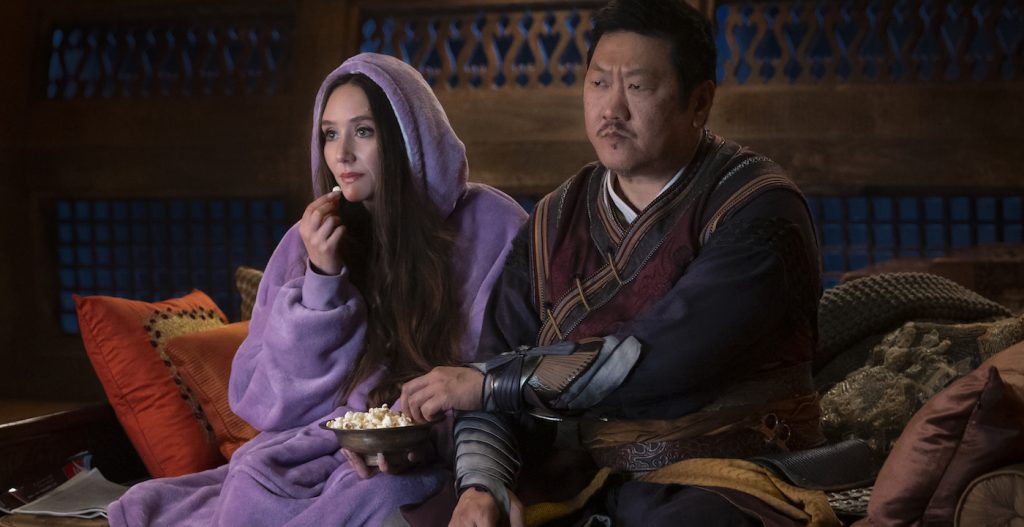
Ryan Reynolds made a major announcement on Twitter yesterday—he finally lured his good pal Hugh Jackman to come back to the role of Wolverine. Jackman will don the adamantium claws for Deadpool 3, which is due in theaters on September 6, 2024.
Jackman’s run as Wolverine, which spanned 17 years and made him a global superstar, began way back in 2000 with the very first X-Men. Jackman’s beloved portrayal of the temperamental, ultimately decent superhero seemed to have come to a definitive close in director James Mangold‘s excellent 2017 film Logan, in which Jackman’s mutant hero was finally killed by a cloned version of himself (only the clone was stronger and with none of the actual Wolverine’s gruff charm). Logan was a brutal, beautiful sendoff for Jackman’s turn as Wolverine—until Reynolds coaxed him out of retirement.
There’s a whole lot of symmetry for Jackman to reappear in Deadpool 3, considering Reynolds made his first ill-fated appearance as Deadpool in a Wolverine movie. That was in 2009’s X-Men Origins: Wolverine, which infamously had Reynolds taking his first crack as Deadpool, also known as the Merc with the Mouth. Here’s the thing; in X-Men Origins: Wolverine, the Merc with the Mouth couldn’t wisecrack, let alone speak, because he had his mouth sewn shut, an iteration of the character Reynolds himself has been making fun of for years. In fact, Reynolds alludes to his previous Deadpool incarnation in the big announcement about Jackman.
Reynolds has since turned Deadpool into one of the most vibrant and definitely most foul-mouthed superheroes of them all, beginning with his gangbusters 2016 Deadpool, which became a critical and commercial smash hit. With Deadpool 3, Reynolds will, at long last, get Jackman’s Wolverine in one of his movies, something he’s been publicly, hilariously seeking for years. Reynolds and Jackman’s banter on social media (and in real life) has been joyous, and you always wondered when it would evolve into them returning to the screen together in the roles that have made them both superstars. The wait is over.
Deadpool 3 will be directed by Shawn Levy, with a script from longtime Deadpool scribes Rhett Reese and Paul Wernick. This film will also be the first Deadpool film made by Marvel Studios after Disney acquired Fox, as the previous two Deadpool films were under the Fox banner.
It’s all coming to an end. The final battle between Laurie Strode (Jamie Lee Curtis) and Michael Myers (Nick Castle) is just a few weeks away. Universal Pictures has released the final trailer for Halloween Ends, director David Gordon Green’s trilogy-capping film, which will give us the definitive end to one of the marquee matchups in the history of the horror genre.
Halloween Ends picks up four years after the events in Halloween Kills, with Laurie living with her granddaughter Allyson (Andi Matichak) and trying to put the decades-long trauma she’s suffered to good use—shes’ putting the finishing touches on her memoir. Guess who would rather she never get to live to see that book published? That’s right, The Shape, whose official return to his murderous ways begins when a young man named Corey Cunningham (Rohan Campbell) is accused of killing a boy he was babysitting. Laurie knows all too well what’s really going on, that the killing machine that is Michael Myers is back, although the rest of the town can be forgiven if they’d rather believe Laurie is seeing things. In fact, in the final trailer, Laurie’s granddaughter Allyson accuses her of only pretending to want to move on but in reality being “obsessed with death.” That stings, considering the obsession isn’t really Laurie’s fault.
“This time, something feels different,” Laurie says. “He’s more dangerous.” If you’re curious how one of the most insatiable psychopaths in the history of horror films could possibly get more dangerous, you can be sure David Gordon Green answers that question in the film. Having already lost her daughter to the Shape, Laurie Strode is ready to do battle in Halloween Ends. So much so that she even unlocks the front door in the final moments of the trailer to invite him in. It’s time, she’s saying, to do this once and for all.
Check out the final trailer here. Halloween Ends hits theaters on October 14.
For more on the Halloween franchise, check out these stories:
Featured image: Jamie Lee Curtis as Laurie Strode and Michael Myers (aka The Shape) in HALLOWEEN ENDS, directed by David Gordon Green. Photo by Ryan Green/Universal Pictures.
They call him Sarcastic Fringehead, and the gargoyle-like fish with its glow-in-the-dark inflatable mouth must be seen to be believed. A resident of the Pacific Ocean, Sarcastic Fringehead is just one of 40 or so naturally gifted characters filmed in their native habitats for National Geographic’s Super/Natural show. Executive produced by James Cameron with voice-over narration from Benedict Cumberbatch, the eight-episode series (which debuted on Wednesday, Sept. 21) features creatures great (elephants) and small (Mexican fireflies) as they engage in stranger-than-fiction survival skills. Captured with low-light cameras, hyper-sensitive microphones, and other advanced gear, the subjects of Super/Natural demonstrate ingenious communication skills incorporating everything from phosphorescent light to rarely recorded vocalizations.
Executive producer Tom Hugh-Jones, whose previous nature documentaries include the Emmy-winning Planet Earth II, says, “In making Super/Natural, we wanted to bring the latest research together with the latest technology to showcase things that are beyond human perception. I think our show will keep you on the edge of your seat because we’re trying to blow your mind all the time.”
Speaking from his home in Bristol, England, Hugh-Jones talked about technology, collaboration, and the wonders of the Little Devil Tree Frog.
James Cameron has Avatar: The Way of Water coming out in December but of course he’s been fascinated with cutting-edge camera technology for a long time. What did he bring to the table as an executive producer of Super/Natural?
Nat Geo suggested we partner with James because he’d worked on their series Secrets of the Whales. It was a great match. James and his team were constantly pushing us to be more adventurous with the visuals and the music and the narration and storytelling. He understands how to tell a story that engages people so they can relate to some strange beast like the jumping vampire spider.
You and your team do a great job of portraying tiny creatures. In Ecuador, for example, you film a frog the size of a thumb.
The Little Devil Tree Frog.
Little devil poison dart frog on a mossy log. (National Geographic for Disney+/Chris Watts)
But you go a step further and photograph the tadpole baby on the Little Devil Tree Frog’s back. How do you film such small critters?
In the industry, we call that macro photography. There’s this whole community of people here in Bristol where it’s a little like Honey I Shrunk the Kids. They get a bit obsessed with tiny dollies and techniques for pulling focus remotely and moving the camera without touching it because if you touch the camera. You’ll send huge vibrations into the shot. There’s a real art to it.
Close up of little devil poison dart frog skin. (National Geographic for Disney+/Chris Watts)
The series documents incredibly inventive communications that take place within and even between species. For example, you show a squirrel mimicking the alarm cry of a chickadee to warn its neighbors about an incoming hawk. How did you record these sounds of survival?
Our sound men and sound women use contact mikes and high-level gun mikes to pick up the sounds. In some situations, we’ll make the sounds louder or slow them down in post. When you hear birds making these strange, high-pitched sounds, it’s so interesting to learn what it is that they’re communicating.
In this case, the squirrels and little birds are basically yelling at each other: “Here comes a predator!”
Run!
How did you capture that hawk footage?
We trained a Northern Goshawk from the time it was a chick to fly with a cable cam system called Mabel. Our cable run was about 300 feet long with high-speed Phantom Veo [cameras] onboard. Shots were achieved flying at 40 miles an hour one foot off the forest floor at 450 frames per second.
In your capacity as producer, do you travel to these wildlife locations yourself, or do you stay in Bristol?
On this one, I didn’t go on many of the shoots. A lot of this series was made during coronavirus, so we often had to operate remotely, collaborating with amazing camera people from around the world.
Guide, Peter Blackwell, left, and leopard researcher Lenguya Layon in Laikipia, Kenya. (National Geographic for Disney+/Norbert Rottcheter)
I read somewhere that you went with your parents to the Amazon when you were five years old.
Yeah.
How did that experience impact your view of nature?
I had a kind of wild upbringing anyway, and I was young enough to be quite accepting: “I have a pet monkey and a blowpipe, and I hang out with the tribal kids.” In fact, I had more of a culture shock when I got back to England: “Why is everybody wearing clothes, and why can’t I make a fire in the middle of the living room?”
A mongoose in Queen Elizabeth Park. (National Geographic for Disney+/Chris Watts)
Benedict Cumberbatch narrates the series, and he’s very engaging. How did he get involved in the show?
The credit has to go to the head of wildlife [programming] at Nat Geo, Janet Han Vissering. She’s very fond of Benedict and suggested him. We’d been going through a variety of names, but when we listened to Benedict’s voice, we realized he’s able to put drama and emotion into [the voiceover] without overplaying it. Of course, we also liked the connection to Doctor Strange. Super/Natural is almost psychedelic in how it brings out these amazing colors and strange experiences of the natural world so that connection seemed very apt.
Bull elephant seal vocalizing on the beach. (National Geographic for Disney+/Joel Wilson)
Each of your previous documentaries had a specific theme. What’s the concept behind Super/Natural?
Human Planet was about tribal people. Hostile Planet looked at how the changing climate affects animals. On this one, we wanted to visualize things you can’t capture with normal cameras. We used thermal cameras to show how hot bees get when they’re trying to kill a hornet. We use ultra-high-speed cameras to reveal the mating displays of birds you can’t see with the naked eye. We use low-light cameras with the fireflies in Mexico during their nighttime mating ritual. Pretty much every sequence has elements in there that you couldn’t have captured 10 or 15 years ago.
Most of the segments feel character driven in the sense that you focus on one individual creature as it moves through a survival story with a clear-cut beginning, middle and end. That structure was deliberate?
Yes. We’re trying to bring this aesthetic from feature movies, where every shot tells a story and comes from someone’s point of view. That can be hard in natural history because animals don’t read scripts or behave on cue, but if you’re determined and clever about how you shoot, it can be done. On top of that layer, the mission of James Cameron and his team was to impart information in a fun way to people who aren’t necessarily fascinated by science. I’m proud of the way we swept all this information into the scripts and made sure there’d be revelations in every sequence.
An African fish eagle catches a fish. (National Geographic for Disney+/Joe Hope)
Your knowledge of wildlife must be encyclopedic. Did you learn anything new while making Super/Natural that you didn’t know before?
I’m a big fan of lizards I used to keep geckos when I was young, my son keeps lizards, and I thought I knew everything about them. But then one of our researchers found an incredible story about the scuba lizard, who hides from predators underwater by trapping air bubbles under its scales and channeling them to make this kind of scuba bubble on top of its head. The scuba lizard can breathe from this bubble for about 20 minutes until the danger’s passed. I thought I’d seen it all, but I’d never seen that.
Filming a close up shot of a water droplet on an anole lizard’s head in Costa Rica. (National Geographic for Disney+/Robin Cox)
For more stories on what’s streaming or coming to Disney+, check these out:
There’s a menacing unreality looming beneath the surface in Olivia Wilde’s Don’t Worry Darling that cinematographer Matthew Libatique (The Whale, A Star is Born) stitched together through a tapestry of largely subliminal clues, subconsciously pinning you to the story’s shocking twist.
Midsommar scene-stealerFlorence Pugh steps into the role of Alice Chambers, a young housewife living her best life circa the 1950s. She’s married to a handsome, hardworking husband named Jack (Harry Styles), who can’t keep his hands off her, and has a beautiful home in the flourishing community of Victory, where her effervescent neighbors couldn’t be more cut from Barbie’s cloth. She shops, drinks, and attends parties. What more could she ask for?
Caption: (L-R) FLORENCE PUGH as Alice and HARRY STYLES as Jack in New Line Cinema’s “DON’T WORRY DARLING,” a Warner Bros. Pictures release. Photo Credit: Courtesy of Warner Bros. Pictures
In designing the palette, Libatique spoke with Wilde about the atmosphere beneath the surface. The film’s themes eventually reveal themselves—manipulation, control, and the chimera of living a perfect life—which are filtered through an increasingly unnerving psychological drama doused with sexual energy. The cinematographer curated a dreamy visual language that reflected the color, shine, and brilliance of what production designer Katie Bryan and costume designer Arianne Phillips established early on.
For the neighborhood of Victory, where Alice and Jack reside nestled in a picturesque cul-de-sac, the Palm Springs planned community of Canyon View Estates stood in. Warm, earthy hues were balanced with natural sunlight to heighten the bespoke environment. “It’s an aspirational world in this idyllic place, and obviously in the film, it gets turned upside down, but the whole idea is to transport our audience,” the two-time Oscar nominee tells The Credits.
(L-R) HARRY STYLES as Jack, FLORENCE PUGH as Alice and OLIVIA WILDE as Bunny in New Line Cinema’s “DON’T WORRY DARLING,” a Warner Bros. Pictures release. Photo Credit: Courtesy of Warner Bros. Pictures
Libatique’s driving philosophy while filming was to motivate exterior and interior lighting based on the sun. Fortunate to shoot in the hot Palm Springs desert during November allowed the Black Swan cinematographer to take advantage of the lower-angled rays of sunlight that would fill Alice’s home, which was a designed set. “It didn’t matter if we were going to cut outside or not; the plan was to honor the path of the sun at the actual location,” he says. “If it was morning, we knew the sun would come from behind the house. If Jack was coming home at the end of the day, the sun would set in front of the house. In my mind, the audience registers the continuity in the way the sun falls between location and set, so it was one of the directions I gave my crew. It was really important to create such a reality in the house.”
Caption: FLORENCE PUGH as Alice in New Line Cinema’s “DON’T WORRY DARLING,” a Warner Bros. Pictures release. Photo Credit: Courtesy of Warner Bros. Pictures
The interior of the couple’s home was period-perfect, designed with creamy hues and muted pastels. But it’s all a façade. To speak to the ruse, Libatique chose Blackwing lenses, which have more aberration and flare to add to the distorted reality. “I wanted there to be a sort of happy accident to the imperfections just because I knew that the design was meticulous,” he says.
FLORENCE PUGH as Alice in New Line Cinema’s “DON’T WORRY DARLING,” a Warner Bros. Pictures release. Photo Credit: Courtesy of Warner Bros. Pictures
For certain exterior sequences, Sigma Classic Primes were used for their low contrast and flare to express desolation and heat.
Caption: FLORENCE PUGH as Alice in New Line Cinema’s “DON’T WORRY DARLING,” a Warner Bros. Pictures release. Photo Credit: Courtesy of Warner Bros. Pictures
Other striking locations Libatique shot were Richard Neutra’s Kaufmann House, made famous by Slim Aarons’ “Poolside Gossip” photo, which stood in for the home of Jack’s boss Frank (Chris Pine) and his wife Shelley (Gemma Chan). The Cicada Restaurant and Lounge in downtown Los Angeles stirred a wild party scene with Jack and Frank dancing to a live band. Harold James Bissner, Jr.’s flying-saucer-shaped Volcano House became the headquarters for the Victory Project, as well as a climactic action sequence that has Alice racing up its hilltop as she’s being chased by men trying to capture her.
Caption: CHRIS PINE as Frank in New Line Cinema’s “DON’T WORRY DARLING,” a Warner Bros. Pictures release. Photo Credit: Courtesy of Warner Bros. Pictures
To bring the riveting moment together, Wilde and Libatique laid the foundation in prep with a storyboard artist, where they continued to tune the action through reference material. “Creatively, we wanted to capture Pugh’s performance, so making sure we had the right equipment was important. We put the car on a Biscuit Rig, which is a drivable base that the car can sit on, and the actor can actually focus on performance while seemingly driving,” says Libatique. “I think that was the biggest win in the sequence because we could interject Florence and intercut her with the car-to-car work we did with an amazing stunt driver. We destroyed that car. It was incredible.”
Caption: (L-R) Director/producer/actor OLIVIA WILDE and FLORENCE PUGH on location for New Line Cinema’s “DON’T WORRY DARLING,” a Warner Bros. Pictures release. Photo Credit: Merrick Morton.
As fulfilling as the chase sequence was, intimately framing Alice’s journey was key for the cinematographer. Libatique compositionally kept the camera close to Pugh. “We had many moments where Alice is by herself, so we could focus on her and then carry that same language over to other scenes involving more of the cast.”
FLORENCE PUGH as Alice in New Line Cinema’s “DON’T WORRY DARLING,” a Warner Bros. Pictures release. Photo Credit: Courtesy of Warner Bros. Pictures
Juxtaposing her emotions and the world around her provided a window into her thoughts while adding scale. When Alice starts to question her surroundings (which is dynamically on display during a tense dinner scene between Pugh and Pine), visual metaphors in the shape of an eye flash on screen, including burlesque dancers shown in black and white. “It’s a great example of the depth of Olivia’s creativity,” Libatique says. “For her, it symbolized women as an object and then layering the idea into the shape of an eye tied it to the captivity and the mind of Alice.”
Don’t Worry Darling is in theaters now.
For more on Warner Bros., HBO, and HBO Max, check out these stories:
Featured image: Caption: (L-r) HARRY STYLES as Jack and FLORENCE PUGH as Alice in New Line Cinema’s “DON’T WORRY DARLING,” a Warner Bros. Pictures release. Photo Credit: Courtesy of Warner Bros. Pictures
“The world is still processing the loss of Chad,” Marvel Studios president Kevin Feige told Empire about the death of Chadwick Boseman, who passed away at 43 in August of 2020. Boseman’s death was a shock at a time of shocks, the loss of not only a rising star at the peak of his powers but a beloved husband, friend, and colleague. For the Black Panther family, Boseman was their North Star, along with co-writer/director Ryan Coogler. His loss meant that work on Black Panther 2 (now officially Black Panther: Wakanda Forever) would have to be completely rethought. A Black Panther sequel without its Black Panther would require some difficult choices. The notion of recasting Boseman’s character was one choice the filmmakers made early on. It wasn’t going to happen. Not yet.
In an interview with Empire, Feige says that recasting T’Challa, the proper name of Boseman’s character, was not in the cards at that point. “It just felt like it was much too soon to recast,” Feige told Empire. “Stan Lee always said that Marvel represents the world outside your window. And we had talked about how, as extraordinary and fantastical as our characters and stories are, there’s a relatable and human element to everything we do. The world is still processing the loss of Chad. And Ryan poured that into the story.”
When Boseman passed away, Feige, Coogler, and the filmmaking team had to imagine a world, and a Wakanda, without Boseman.
“The conversations were entirely about, yes, ‘What do we do next? And how could the legacy of Chadwick — and what he had done to help Wakanda and the Black Panther become these incredible, aspirational, iconic ideas — continue?’ That’s what it was all about,” Feige said to Empire.
The first trailer for Black Panther: Wakanda Forever managed to strike the almost impossible perfect note, somber and mournful and grief-stricken in the beginning, subtly shifting towards the epic action that Marvel Studios is known for when Wakanda is forced to face a new threat, in the form of Tenoch Huerta’s Namor the Submariner, as they are all still grieving. The remaining heroes of Wakanda—Lupita Nyong’o’s Nakia, Winston Duke’s M’Baku, Danai Gurira’s Okoye, Angela Bassett’s Ramonda, and Letitia Wright’s Shuri—must once again come together and fight for their futures, as well as for the memory of their fallen leader.
How Coogler, his co-writer Joe Robert Cole, and the rest of the Marvel team figured out a way to re-write the sequel to honor Boseman’s passing and to look to the future will be revealed soon. Black Panther: Wakanda Forever hits theaters on November 11.
For more on Black Panther: Wakanda Forever, check out these stories:
At long last, we’ve got our best look yet at The Last of Us, HBO Max’s highly-anticipated adaptation of the popular video game series. The deliciously moody teaser trailer reveals creator Craig Mazin (Chernobyl)’s series, which follows Joel (Pedro Pascal) and Ellie (Bella Ramsey) as they journey across a devastated American landscape in a post-apocalyptic world.
The teaser is a thing of bleak beauty, set to Hank Williams’ haunting ballad “Alone and Foresaken,” which is precisely how Joel and Bella must feel as they try to survive in a world that seems hellbent on death. The post-apocalyptic series is a massively ambitious undertaking and one of the big swings that HBO is taking in 2023, yet they’ve kept details very under wraps (including the precise release date).
The teaser at last gives us a sense of the series’ aesthetics while keeping plot specifics to a minimum. In fact, there are only a few lines spoken throughout the entire teaser, including the final words, spoken in voiceover: “Save who you can save.” There’s also a brief, legitimately terrifying look at one of the afflicted, his (or her, it’s hard to tell) face utterly transformed into a monstrous disfiguration. It happens at the 1:16 mark if you want to prepare yourself.
The series is set 20 years after civilization has fallen, with Joel trying to smuggle Ellie out of the dangerous quarantine zone. Joining Pascal and Ramsey are a great cast that includes Nick Offerman, Gabriel Luna, Storm Reid, Merle Dandridge, Nico Parker, Murray Bartlett, Ashley Johnson, Graham Greene, Anna Torv, Lamar Johnson, Keivonn Woodard, and Troy Baker. In fact, Dandridge, Baker, and Johnson all did voice work on the original video game series.
Mazin co-created the series alongside the video game’s writer and creative director, Neil Druckmann.
We’re still waiting on an exact release date for The Last of Us, but we know it arrives sometime in 2023 and will consist of 10 episodes.
Check out the chilling teaser below.
Featured image: Pedro Pascal, Bella Ramsey. Photo courtesy HBO.
Andor isn’t quite like any of the Star Wars live-action series we’ve seen thus far on Disney+. Compared to The Mandalorian, The Book of Boba Fett, and Obi-Wan Kenobi, Andor is almost heroically unconcerned with the legends of the larger Star Wars galaxy, be they Boba Fett, Darth Vader, or Obi-Wan Kenobi himself. The show is a street-level view of regular people, most of whom living on the margins of society, reacting and rebelling against the Galactic Empire’s increasingly autocratic regime. In fact, creator Tony Gilroy, who came in to help get Rogue One, the best Star Wars prequel film ever made (in our humble opinion), into shape, had some intriguing advice for his Andor creative team. The gist? Don’t worry about Star Wars. “You’re here because we want you to be real,” Gilroy said, as The Hollywood Reporterdetails.
When Gilroy joined the Rogue One production, along with his considerable skills as a storyteller (this is the man who wrote and directed the nearly perfect film Michael Clayton, for starters), he brought one highly unusual skill to the franchise—he wasn’t a big Star Wars fan. This gave him the critical distance he needed to push Rogue One into some genuinely new territory for a Star Wars film, including the film’s shocking conclusion. Considering Andor would star one of Rogue One‘s main characters, Cassian Andor (Diego Luna), Gilroy was the logical choice to lead the series—but it would take a long time for Gilroy to officially become Andor‘s man for Disney+.
Once he was finally on board, Gilroy noticed something early on during Andor‘s production—his creative team, including his performers, were changing the way they might go about their work because of their reverence for, and connection to, Star Wars. This was when Gilroy gave them some freeing advice; let go of their fondness as much as they could.
“In every department, we’ve had all kinds of people come in, and they know it’s Star Wars, so they change their behavior,” Gilroy told THR. “They change their attitude. They change their thing. And you go, ‘Wait, no. Do your thing. You’re here because we want you to be real.’ So it’s a testament to the potent power of Star Wars. It really gets into people’s heads, but to change the lane and do it this way, it takes a little effort.”
Gilroy gives THR a lot more about his creative vision for Andor, including the manifesto about the series he wrote for Lucasfilm president Kathleen Kennedy that eventually won her over and got him into the driver’s seat. The road to Gilroy running Andor was a long and winding path, but the end result has been a Star Wars series unlike any that have come before, and that, it turns out, is exactly what we’ve been waiting for.
For more on Andor and all things Star Wars, check out these stories:
It’s a bit of a miracle that director Brett Morgen survived creating Moonage Daydream, his kaleidoscopic deep dive into David Bowie’s unique sound and vision.
Morgen was six months into editing the film, the first project that had the full cooperation of Bowie’s estate. But assembling the massive volume of footage, some of it never before seen, was taking its toll on the filmmaker.
“It was traumatic because we’d run out of funding, and I was the only producer, and I’d signed a contract. I could not afford to hire an editor or any consultants. I had to work my way out a rabbit hole, and that pressure got intense,” said Morgen.
“Then the pandemic hit, and I was working in total isolation and, because of security concerns, we could not send a link out to anyone. I had no idea if [the edited footage] made any sense. It was as if I showed you something in Mandarin and you don’t speak Mandarin. It’s not going to make sense. It was at that level.”
David Bowie in “Moonage Daydream.” Courtesy Neon.
Morgen was about to leave Los Angeles to go to another location to edit when he asked his wife, Debra Eisenstadt, who is also his executive producer, “to come and look at what I had assembled. I told her, I just need you to tell me if it’s sensible in any shape or form,” said Morgen.
“I turn around to press play, and she has her back to me, and I just start shaking and crying. I felt like I was about to get exposed. I was crazy. I was Jack Torrance, and she was going to read, ‘All work and no play makes Jack a dull boy.’ I mean, I was totally convinced that was going to happen. When it was over, she said, ‘keep going … there may be a diamond in the raw there. Keep doing what you’re doing. You’ll get there.’ That was an empowering moment because at that point, I didn’t have any idea it would resonate.”
David Bowie in “Moonage Daydream.” Courtesy Neon.
Morgen had been down the fully immersive documentary road before. He’d crafted memorable films from footage of Hollywood producer Robert Evans for The Kid Stays in the Picture; musician Kurt Cobain for Kurt Cobain: Montage of Heck; and another about the renowned primatologist Jane Goodall for Jane, his 2017 film compiled from hours of film footage shot by Hugo van Lawick that was rediscovered in 2014.
“Jane took three weeks to screen the material. I had put aside four months to screen Bowie owing to how large the inventory list was,” Morgen said. “It ended up taking two years just to screen the material and a year to get it ready to be looked at. I was not prepared for this, budgetary or emotionally or physically. I was overwhelmed with images and media all sort of chained together.”
David Bowie in “Moonage Daydream.” Courtesy Neon.
His quest from the start was to create a non-biographical narrative about Bowie, which was likely why Morgen earned the trust of Bowie’s estate. “That became the kind of unicorn; to write a story without leaning entirely on the biographical chain of events,” said Morgen.
“The film is essentially rooted in Bowie’s ideas of transience on a philosophical level. On a physical level, that manifests itself in a set of challenges he sets to try to get himself into environments that are foreign to him so he can put himself through the fire. He found that was when he could create, in these extreme environments, until he met [his wife] Iman, after which he found a way to create without having to put himself in the fire.”
David Bowie in “Moonage Daydream.” Courtesy Neon.
But Morgen wasn’t at all convinced that his kaleidoscopic approach to Bowie would resonate with audiences until the film opened in theaters.
“I thought no one was going to get it, and I was going to spend the weekend reading a bunch of social media posts from people saying it’s awful, it’s boring, I walked out, and it doesn’t make sense,” said Morgen. Instead, “to see people have life-affirming experiences [watching] a music documentary in Lima, Peru, in Melbourne, all over the globe, it’s like we needed this. It’s one thing at Cannes where the response is from European film critics. But when we opened globally, to see that it’s registering with people, that in and of itself is a miracle. It is, as David would say, a heroic act.”
Morgen is also heartened by the cross-section of audiences drawn to Moonage Daydream. “I’ve been going around Los Angeles this week to see the film in Burbank, in Century City, and it has an unusual audience of any film out there. The over-50s that you just don’t see at movies too much are next to a 17-year-old kid with pink hair and 32-year-olds totally rocking out.”
David Bowie in “Moonage Daydream.” Courtesy Neon.
Immersing himself in Bowie’s creative transformations triggered Morgen’s own, he said. “It changed everything about how I want to proceed with my life and how I want to proceed with my career and what type of art I want to make. To not take a radical change, to me, would be to betray the last seven years of work.
“It demands that I take these lessons to heart. I’m eagerly looking forward in the next few months to restoring some physical balance to my life. But in terms of my feelings as an artist, I feel both fully satiated and at the same time inspired.”
Featured image: David Bowie in “Moonage Daydream.” Courtesy Neon.
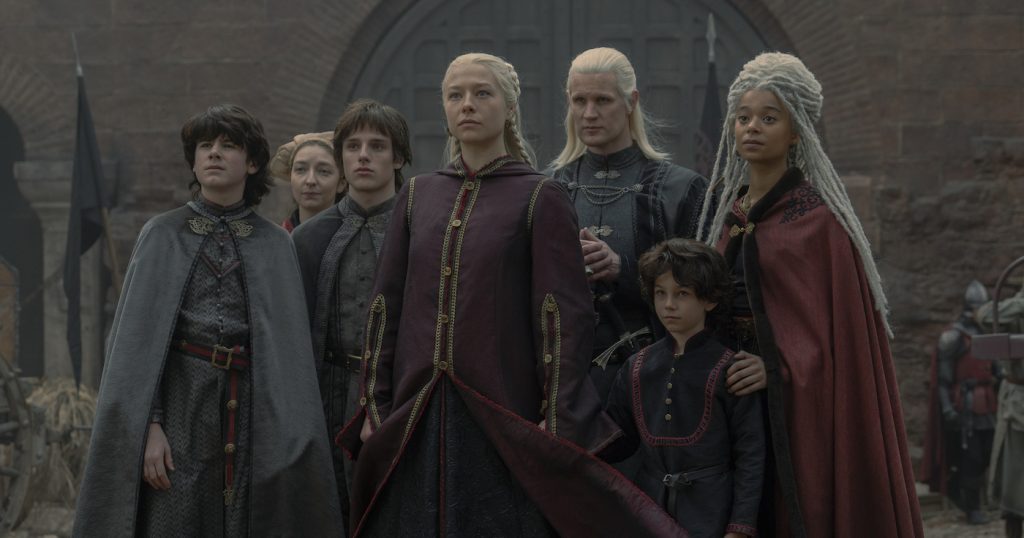
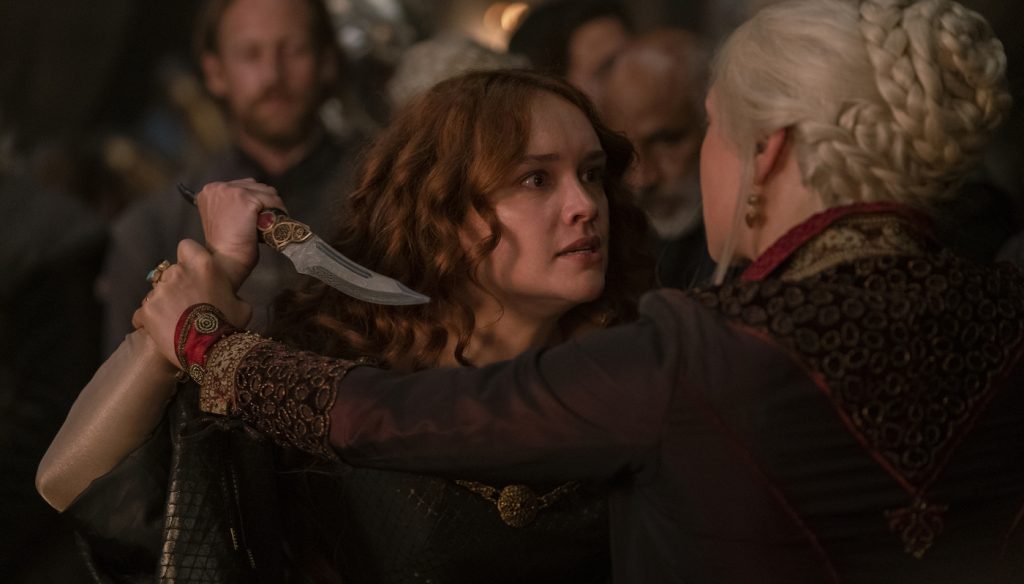
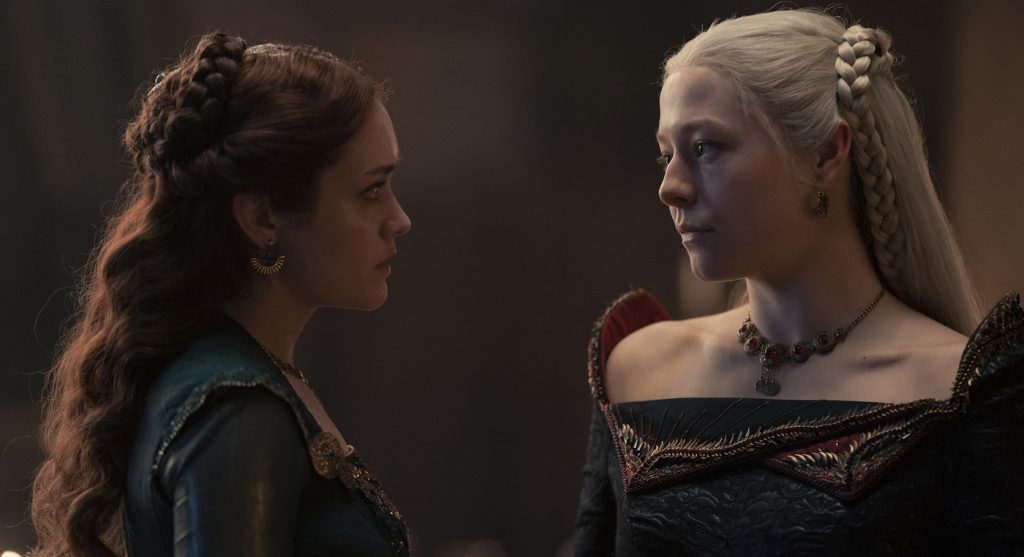
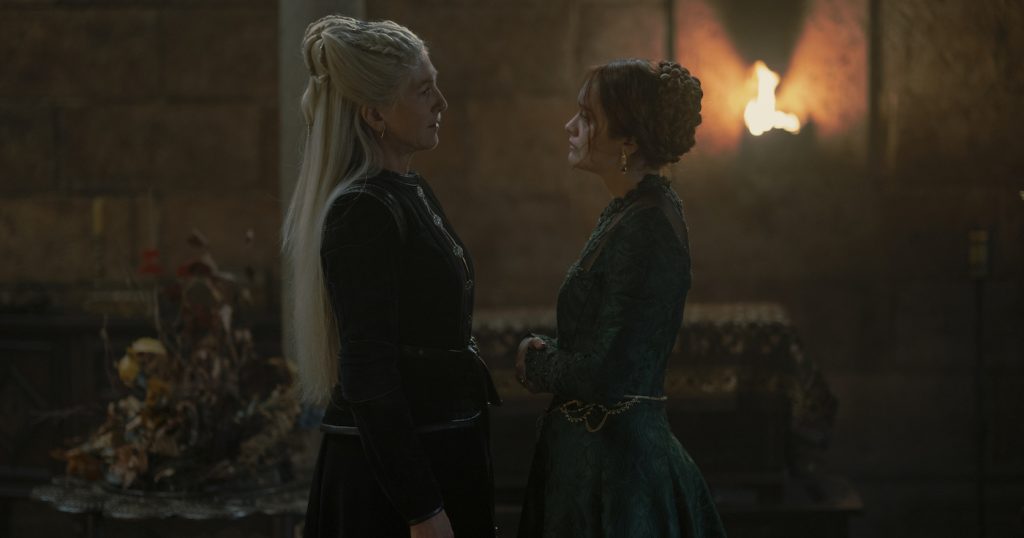
Episode 6 of House of the Dragon takes us on a major jump forward in time, a leap in years that also includes the switch-over for the actresses playing two of the main roles. Out are the great Milly Alcock as Princess Rhaenyra and Emily Carey as Queen Alicent, and in are Emma D’Arcy and Olivia Cooke, playing the Princess and the Queen, respectively. As episode 6 gets underway, Princess Rhaenrya is giving birth (a relatively mild birth scene by Game of Thrones standards), and the baby is not even a minute old before she’s told she and her new son are being summoned by the Queen. So soon? It turns out that there’s been no refreshed love between Rhaenyra and Alicent over the years, and episode six explores their frosty relationship and the implications that will be felt realm-wide because of it.
This ten-year jump and major recasting of a series halfway through its first season run is no easy feat. Yet we quickly come to accept D’Arcy and Cooke as Rhaenyra and Alicent as they immediately set upon each other. In fairness, it’s Queen Alicent who makes the first move. After summoning the Princess and her Prince, Ser Laenor Velaryon (John Macmillan), she tells Ser Laenor not to worry; one of these times, he’ll get a child that looks like him. The implication, explicit and cruel, is that the Queen is well aware that the children don’t belong to Laenor but Princess Rhaenyra’s true paramour, her sworn defender, Ser Harwin “Breakbones” Strong.
L-r: Ryan Corr, Leo Hart, Harvey Sadler. Photograph by Gary Moyes / HBO
And what about Rhaenyra’s old sworn protector, Criston Cole? He’s found a new purpose by protecting Alicent. “His loyalties have shifted completely because Alicent was the one who pulled him out at the moment at which he was at his lowest, and now he’s sworn his vows to her,” says Fabien Frankel, the man who plays Criston, in a new “Inside the Episode” released by HBO.
In fact, Criston Cole takes it upon himself to publicly imply that Ser Harwin Strong is the true father to Princess Rhaenyra’s children, suggesting his devotion to one of the prince’s training is odd and would only be as fierce if the child were related to Ser Harwin, especially if he were his son. Ser Harwin takes this poorly and beats Ser Criston down. This is precisely what Ser Criston wanted. Stirring the pot and making life miserable for Princess Rhaenyra, with Queen Alicent’s approval, of course, now seems to be a part of Ser Criston’s charge.
“Criston Cole’s rationale is if I can goad this guy into a fight, it proves the point,” the episode’s director Miguel Sapochnik says. “This has been percolating for a long time. The pressure that Rhaenyra is under. It seems that finally, she has reached a point where the lie is too much to bear.”
“She’s living multiple lies at once, believing she’s getting away with it, and ultimately nobody’s buying it,” Emma D’Arcy says about the Princess. “When King Viserys named her air, that comes with an understanding that she’ll have to change.” Yet the Princess hasn’t changed enough for the members of the King’s court, especially his Queen. So Princess Rhaenyra strikes her most conciliatory tone yet—she suggests that her son, the heir to the throne once Rhaenyra herself is gone, should marry the Queen’s daughter. It’s a gesture of humility; here is Rhaenyra admitting she’s erred and offering a way to align her house with the Queen’s and strengthen all of them in the process. Unfortunately, Queen Alicent is in no mood for such gestures. She promises she’ll consider it, along with the King, but it’s clear Alicent has grown in power and impatience in the past ten years, and her view of Rhaenyra is dim, perhaps even cruel.
There was more in episode 6, quite a bit more, including another doomed marriage for Prince Daemon (Matt Smith), this time with Princess Laena Velayron (Nanna Blondell). We get yet another brutal birthing scene, only in this instance, Lady Laena decides to take matters into her own hands. Daemon finds himself faced with the same decision his brother Viserys was in the pilot, whether to kill his wife in order to save the baby. Daemon doesn’t do it, but Laena, as a dragon rider, wants to die a dragon rider’s death, so she instructs her dragon Vhagar, the biggest in the fleet, mind you, to finish her off. Vhagar hesitates at first, but before Daemon can get to his young wife, the colossal dragon finally takes the order, and Laena is killed in a blast of fire.
Matthew Needham. Photograph by Ollie Upton / HBO
And finally, before we turn you over to the “Inside the Episode” video, a word on one of House of the Dragons’ true villains coming fully into view, Larys Strong (Matthew Needham), the man who has been gently pushing Queen Alicent into an ever colder, darker place of paranoia and revenge. “He’s a player, and he’s looking into the future and seeing what she’s going to be,” says writer Sara Hess, who co-wrote the episode with showrunner Ryan J. Condal. “He’s sort of placed his chips, and he’ll wait for that to come home for him.” Larys’ maneuvers to get the Queen’s father, Otto Hightower (Rhys Ifans), back as King Viserys’ hand. How does he suggest they do this? By having his own father, the current hand, killed. Despite Larys’ physical weakness, he is perhaps House of the Dragon‘s most ruthless schemer.
Check out the “Inside the Episode” for episode 6 of House of the Dragon here:
For more on House of the Dragon, check out these stories:
Before Amazon Prime’s The Lord of the Rings: The Rings of Power debuted on the streamer on September 1, much of the talk surrounding the series was just how big of a swing it was. It was being hailed as the most expensive show of all time, a massive investment of time, money, and talent to create a series worthy of J.R.R. Tolkien’s creative vision and the six Peter Jackson films that have become popular culture touchstones and the defining adaptations of Tolkien’s work. It feels safe to say that after 4 episodes (with a second season already guaranteed), The Rings of Power has delivered.
A good showcase of how the series has lived up to the hype is the below scene, now made available by Amazon, which shows the elf Arondir (Ismael Cruz Cordova) going toe-to-claw with one of the orc’s gnarly beasts. Arondir had been captured by the orcs and enslaved, along with many fellow elves and humans, too, and forced to help Sauron’s minions dig a trench through the Southlands. An escape plan is hatched by Arondir and a few others, but it doesn’t go quite to plan. The orcs can’t handle direct sunlight, but their beast can, so they unleash the monster to put down the rebellion before it’s had a chance to start.
Check out the clip here:
For those of you who still haven’t checked out the series but are wizard-and-elf curious, you’ve got some highly absorbing binge-watching in your future. Plus, you don’t have to be a Tolkien stan or have seen every minute of Peter Jackson’s films to get into the action. The Lord of the Rings: The Rings of Power differs from Peter Jackson’s two trilogies (The Lord of the Rings and The Hobbit) as the storyline does not come from a specific Tolkien novel. Instead, the thrust of the action comes from the rich mythology Tolkien created around his stories to give them weight, history, and texture. The series is centered on the young Galadriel (Morfydd Clark), who is convinced the evil Sauron has returned and it’s only a matter of time before he has replenished his forces enough to destroy Middle-earth for good. The series is set thousands of years before the events in Tolkien’s “The Hobbit” and “The Lord of the Rings” and follows the young heroine on a quest to wake the slumbering realms up to the fact that a great evil has returned.
And, even if you aren’t the biggest LOTR fan or even much of a fantasy person, there’s still much to enjoy here. The series is as epic as promised and stands well enough on its own to warrant potential interest even from those not already deeply vested in Tolkien’s mythology. It’s absorbing, it’s beautifully shot and performed, and it is, as promised, epic.
For more on The Lord of the Rings: The Rings of Power, check out these stories:
Breaking Bad and Better Call Saul creator Vince Gilligan is taking his talents to Apple. Not only that, but Gilligan’s next series, which has already gotten a two-season straight-to-series order at Apple, will star Better Call Saul‘s Rhea Seehorn. This is terrific news for all of us mourning the end of Better Call Saul‘s 6-season run, which just aired its finale this past August.
While details of the series are being kept under wraps, what we do know is Gilligan created it and will serve as showrunner and executive producer. The series comes from Gilligan’s longtime partners at Sony Pictures Television, which produced both Breaking Bad and Better Call Saul.
There’s history between Gilligan and the folks at Apple, too. As Varietyreports, the heads of worldwide video at Apple are Zack Van Amburg and Jamie Erlicht, the former co-presidents of Sony Pictures Television. Gilligan’s new series at Apple also reunites him with former Sony TV co-president Chris Parnell, who now has a senior programming role at Apple.
“After fifteen years, I figured it was time to take a break from writing antiheroes… and who’s more heroic than the brilliant Rhea Seehorn?” Gilligan said in a statement. “It’s long past time she had her own show, and I feel lucky to get to work on it with her. And what nice symmetry to be reunited with Zack Van Amburg, Jamie Erlicht, and Chris Parnell! Jamie and Zack were the first two people to say yes to Breaking Bad all those years ago. They’ve built a great team at Apple, and my wonderful, long-time partners at Sony Pictures Television and I are excited to be in business with them.”
Rhea Seehorn attends the AMC Summit at Public Hotel on June 20, 2018 in New York City.
Seehorn was key to Better Call Saul‘s success, playing Kim Wexler, a fellow lawyer and one of the few consistent bright lights in Saul’s life. Seehorn is definitely deserving of her own series, and she and her old scene partner, Bob Odenkirk (Saul, of course) will now be leading their own series on different networks. Odenkirk will head up the new series Straight Man for AMC.
For more on Better Call Saul, check out this interview:
You won’t see a more sumptuous, surreal trailer than Bardo anytime soon. This look at director Alejandro G. Iñárritu’s new feature, his first since his masterful 2015 epic The Revenant, received a six-minute standing ovation after its world premiere at the Venice Film Festival. That screening latest three hours, but the new trailer reflects a trimmed-down version of the film (Iñárritu cut 22 minutes) that will be released theatrically in Mexico on October 27, followed by a limited theatrical release in the U.S., Spain, and Argentina on November 4, before moving to Netflix on December 16.
Bardo, False Chronicle of a Handful of Truths follows Silverio (Daniel Giménez Cacho), a well-respected Mexican journalist and documentary filmmaker living in Los Angeles. Silverio finally has a good reason to return to his native Mexico—he’s been named the recipient of a prestigious international award—yet this trip will prove far more meaningful than a mere ego boost. What follows is a journey into Silverio’s heart and soul, a realm of memory and fears that begin to invade his waking life. His trip home becomes a trip within himself as Iñárritu’s film grapples with life’s biggest questions. Who is Silverio, really? What has his life meant? What does his family mean to him? What does it mean to be a human being, alive today, when everything feels so desperately unsteady?
Such heady material is hardly a departure for Iñárritu, one of the most daring filmmakers of his generation. Working with cinematographer Darius Khondji (Amour, Se7en) and written by Iñárritu and his Birdman co-writer Nicolás Giacobone.
Check out the trailer here:
Here’s the official synopsis for Bardo:
Bardo, False Chronicle of a Handful of Truths is an epic, visually stunning and immersive experience set against the intimate and moving journey of Silverio, a renowned Mexican journalist and documentary filmmaker living in Los Angeles, who, after being named the recipient of a prestigious international award, is compelled to return to his native country, unaware that this simple trip will push him to an existential limit. The folly of his memories and fears have decided to pierce through to the present, filling his everyday life with a sense of bewilderment and wonder.
For more on big titles on Netflix, check these out:
Featured image: Bardo: False Chronicle of a Handful of Truths (2022). (L-R) Daniel GimÈnez Cacho as Silverio and Ximena Lamadrid as Camila. Cr. Limbo Films, S. De R.L. de C.V. Courtesy of Netflix
A knock at a cabin door is never just a neighbor asking for some sugar in an M. Night Shymalan movie. So, when that first knock arrives in the trailer for his aptly titled Knock at the Cabin, it brings with it a tremor of precognition. Things are about to get very, very bad.
The first look at Shymalan’s latest reveals that the trouble starts even before that fateful knock. Leonard (Dave Bautista), a man who looks almost comically out of place taking a midday walk through a beautiful forest, comes upon Wen (Kristen Cui), the young daughter of Andrew (Jonathan Groff) and Eric (Ben Aldridge), the family renting the cabin in the woods. “Why are you here?” Wen asks Leonard. “I suppose I’m here to make friends with you. Your dads, too.” But then Leonard gives away the game when he tells Wen that his heart is broken. When she asks him why, he says, “Because of what I have to do today.” A classic Shymalan line, filled with the pathos of a man who feels he has no choice but to do the unthinkable. That’s when Wen sees more people coming through the woods towards the cabin. Talk about a ruined vacation.
It gets more unsettling from there. Leonard and three accomplices—played by Nikki Amuka-Bird, Abby Quinn, and Rupert Grint—break into the cabin and tie the family up. They come not to rob or murder (well, we’ll see about the latter) but on a solemn mission, they say, to prevent the apocalypse. Leonard informs them that their family “has been chosen to make a horrible decision.” What’s more, “If you fail to choose,” he says, “the world will end.”
And what is the choice they need to make? The trailer isn’t telling, but we’re guessing it has to do with Andrew and Eric being forced to pick a sacrifice among themselves. Yet, this being Shymalan, a master trickster, we’re also guessing it’s not so simple.
Knock at the Cabin will be an intriguing early 2023 film, hitting theaters on February 3.
Check out the trailer below:
Here’s the official synopsis for Knock at the Cabin Door:
While vacationing at a remote cabin, a young girl and her parents are taken hostage by four armed strangers who demand that the family make an unthinkable choice to avert the apocalypse. With limited access to the outside world, the family must decide what they believe before all is lost.
From visionary filmmaker M. Night Shyamalan, Knock at the Cabin stars Dave Bautista (Dune, Guardians of the Galaxy franchise), Tony award and Emmy nominee Jonathan Groff (Hamilton, Mindhunter), Ben Aldridge (Pennyworth, Fleabag), BAFTA nominee Nikki Amuka-Bird (Persuasion, Old), newcomer Kristen Cui, Abby Quinn (Little Women, Landline) and Rupert Grint (Servant, Harry Potter franchise).
For more on Universal Pictures and Focus Features projects, check out these stories:
Marvel Studios’ Fantastic Four now has three of its most important pieces in place.
After naming WandaVision director Matt Shakman as the man helming the upcoming reboot of Fantastic Four at Disney’s D23 Expo, Deadlinereports that Marvel Studios has tapped Jeff Kaplan and Ian Springer to write the script. The duo is new to Marvel, but they’ve recently had a hot streak, including selling their script Disaster Wedding to Warner Bros, which Palm Springs director Max Barbakow will direct.
Kaplan and Springer have actually been working on Fantastic Four since before Shakman was officially named director, helping outline how the film will fit into the MCU with Marvel Studios President Kevin Feige. Deadline writes that now that all three have been named officially, they’ll join forces in earnest to shape the future of this super-group.
Shakman comes to the project having proven himself a deft Marvel hand with his ace handling of Marvel’s first Disney+ series, WandaVision. Now that Shakman, Kaplan, and Springer will be teaming up to shape the story, the next big piece—or pieces—of the puzzle will be put together, and that’s casting.
Fantastic Four—along with X-Men and Deadpool—was one of the most intriguing properties that Disney absorbed when it acquired Fox and its film assets. Made up of Reed Richards/Mister Fantastic, Susan Storm/the Invisible Woman, Johnny Storm/the Human Torch, and Ben Grimm/Thing, they have been a massive part of the Marvel comics world, debuting in 1961, as well on the big screen. The three major Fantastic Four films were Tim Story’s 2005 Fantastic Four, his 2007 film Fantastic Four: Rise of the Silver Surfer, and Josh Trank’s 2015 reboot Fantastic Four. Now, the iconic characters will be getting the full Marvel treatment as they’re slotted into the massive, mega-popular MCU.
In fact, one member of the Fantastic Four already appeared in an MCU film. In Doctor Strange in the Multiverse of Madness, an alternate version of Reed Richards, played by John Krasinski, appeared as a council member on the Illuminati.
Feige finally confirmed that Fantastic Four was officially happening at this year’s Comic-Con in San Diego when he revealed that it would be the movie that would start the MCU’s Phase 6 when it was released on November 8, 2024. Fantastic Four will kickstart a three-pack of epic Marvel movies, with the two Avengers films following it, Avengers: Kang Dynasty on May 2, 2025, and Avengers: Secret Wars six months after that.
For our interview with Matt Shakman, check this out:
The new Black Adam teaser, titled “Legacy,” makes it case plainly from the start. That case is made by none other than Amanda Waller (Viola Davis), the black-ops antihero who led the other antiheroes of The Suicide Squad into battle (twice). “Before a world of heroes and villains, one power ruled it all.” As we hear Waller’s voiceover, what we’re seeing are glimpses of those heroes and villains—Batman’s throwing stars (known as Batarangs), Superman’s iconic red and blue suit, Wonder Woman (Gal Gadot), Aquaman (Jason Momoa), and even Harley Quinn (Margot Robbie). These are the most recognizable DCEU characters of them all (missing a Joker here, a Flash there), but they’re actually predated, as far as the superhero lore goes, by Dwayne Johnson’s Black Adam.
The new teaser offers a few glimpses of fresh footage while reminding us of the core details of Black Adam’s backstory. Born a slave, executed, and resurrected by his son’s sacrifice, Black Adam has been asleep for 5,000 years, until now. He’ll come into contact with the Justice Society, who initially (and misguidedly) attempt to negotiate his “peaceful surrender.” Good luck with that. As the man says himself, he’s not peaceful, and he doesn’t surrender. The Justice Society, comprised of Hawkman (Aldis Hodge), Doctor Fate (Pierce Brosnan), Cyclone (Quintessa Swindell), and Atom Smasher (Noah Centineo), will learn that while Black Adam doesn’t negotiate, he might just be the ally they need.
The teaser also reinforces how much of a burden Black Adam’s powers are. They were not bestowed through lineage or legacy or, in Batman’s case, via an unlimited supply of money and technological brilliance. They’re a curse, and Black Adam wields them with an incandescent rage at the evil and evil-adjacent alike. Just how he’ll fit into the larger DCEU (and his inevitable showdown with Shazam) remains to be seen. But we’ll find out soon enough—Black Adam finally hits theaters on October 21.
Featured image: Caption: DWAYNE JOHNSON as Black Adam in New Line Cinema’s action adventure “BLACK ADAM,” a Warner Bros. Pictures release. Photo Credit: Courtesy Warner Bros. Pictures
There’s a reason that the battle sequences in The Woman King look so authentic. The actors, from star Viola Davis on down, worked for months to get into physical shape to play an army of women warriors. They learned all the right moves from a team of expert trainers that included fight choreographer Jénel Stevens.
A New York-based personal trainer with an extensive martial arts background, Stevens made the transition to movie stunt performer in 2015. Since then, her resume has grown steadily to include high profile big screen projects such as Black Panther and The Gray Man, along with television mini-series including Ms. Marvel and The Falcon and the Winter Soldier.
L-r: Viola Davis, Jenel Stevens, Lashana Lynch, and Sheila Atim. Courtesy Sony Pictures.
Stunt and fight coordinator Daniel Hernandez, who’d worked on The Woman King director Gina Prince-Bythewood’s 2020 action adventure The Old Guard, tapped Stevens for the job. “Danny had been trying to get me on this project for a year before it had even started. I worked on The Gray Man with him, and he kept talking about this movie,” said Stevens over Zoom from Colombia, where she’s on location with a new film. “He knows I have an extensive martial arts background, as does [fight coordinator] Johnny Gao. There were so many moving parts; a lot of people had to be in a lot of different places.”
Training was underway for months before Prince-Blythewood shot a single frame of The Woman King, which is about the real-life Agojie, an all-women army of warriors who protected the African Kingdom of Dahomey in the 1800s. They are led by General Nanisca [Davis], who issues the command that the Agojie “train hard. Fight harder.”
“Viola and Thuso [Mbedu, who plays Nawi, an orphan mentored by Nanisca] trained starting in April and May,” with Davis’s personal trainer Gabriela Mclain, said Stevens. Stevens came on board in September and worked extensively in drilling the cast on how to handle the machetes and knives that the warriors wield.
Jenel Stevens on set of “The Woman King.” Courtesy Sony Pictures
“It was their mindset that got them to look so badass on camera,” said Stevens. “They came in earlier than their call time for training, and they did not want to leave, probably because the next step was Gabby [Mclain], and they wanted to stay in weapons training. They worked their butts off. Their mentality showed they were willing to put in the work to get where they needed to be.”
Jenel Stevens and Viola Davis on set. Courtesy Sony Pictures.
Stevens taught the actors basic fight techniques that would allow the Agojie to battle male opponents. “Being in the same lineage of martial arts that Danny is in, we were like-minded. We did basic strikes. The martial arts we have all trained in comes from centuries ago, so being able to incorporate that in its basic form lends itself easily to choreography in a movie,” she said. “It’s not anything crazy or fancy, but it’s pretty cool.”
The fight coordinators “were all over the place. There was a lot of hands-on deck because there were a lot of people to train,” said Stevens. “Johnny [Gao] might have an hour to teach some stuff; then Mackensi [Emory], another stunt performer, might be doing something else, and then I’d come in and do machete, knives, blades. Many things didn’t even make it to camera, but I trained them in the basic moves of everything so that they were adept at wielding a basic weapon if they needed to do that. We drilled and drilled.”
She said it was not difficult to teach the actors because they were so attentive and determined. “It was very important to them to be able to look the way they needed to look on camera — like a warrior who’d been doing this for decades,” Stevens said.
Once on location in South Africa, the rigorous training continued. Stevens was one of just four stunt coordinators, including Hernandez, Gao, and assistant stunt coordinator Alex Benevent, who made the trip. She earned Prince-Blythewood’s trust during the filming of the action scenes.
Viola Davis stars in THE WOMAN KING. Courtesy Sony Pictures.
“I had intense communication with Gina, especially once we started filming. She trusted me enough to be in video village with her, especially when we’d be watching Viola going through takes with weapons and fighting. It blew me away one time after a take when she asked, ‘Are you happy with that?’ I said, ‘Well…’ and Gina immediately said, ‘Nope. Cut. Go again’ because of my reaction. Not until we were satisfied on all ends did we go to the next take.”
Although Stevens is credited as Davis’s stunt double, Stevens says that the Oscar winner “did 95 to 98 percent of her own work.”
“She did everything other than falling on her face. That was me,” laughs Stevens. “But the fighting, all that, was all her. We trained her up to a certain point, and she was very determined to make it look the way she wanted it to look. She’d see me do the choreography in rehearsals, and she took it and ran with it. I would learn the choreography and show it to her, and she tried to emulate not just using the machete but the root of how I moved. She studied my body mechanics and then added her own spice to it. My hat goes off to her. To do all that plus say her lines and show emotion, it’s a lot to deal with, but she nailed it in true Viola Davis fashion.”
Viola Davis and Lashana Lynch with young recruits in THE WOMAN KING.
The experience of shooting The Woman King with a cast and crew of mostly women and particularly Black women was a profound one, said Stevens. “We have not seen women, especially dark-skinned women in droves, being able to do something like this on screen and even on set. That scene in the grass [when the warriors rise in unison] gave us all goosebumps. There were people who cried on set, I’m not gonna lie. It was very empowering, and it was important to be there. I feel very proud to be part of showing the world that these women existed. They were real. I’m so happy I was able to be part of that.”
Andor is a major departure from the first three live-action Star Wars series that have aired on Disney+. This is one of the major through-lines of the initial, very positive reviews of the show, which follows Cassian Andor (Diego Luna) as he becomes a key player in the Rebel Alliance’s stand against the Galactic Empire. Unlike The Mandalorian, The Book of Boba Fett, and Obi-Wan Kenobi before it, Andor is a darker, grittier affair, a slow burn that pays off big time for those looking for a Star Wars series unlike any that have come before.
Andor comes to us as a prequel to the 2016 Star Wars spinoff film Rogue One: A Star Wars Story, a film that had a boldness and originality that surprised many (and upset some people, too). Rogue One introduced us to Luna’s thief-turned-Rebel Alliance intelligence agent as he was part of a team that was attempting to steal the Death Star plans. Not only was Rogue One the grungiest, most street-level Star Wars film ever made, but it also delivered the most bittersweet ending in the entire franchise. While The Empire Strikes Back famously ended on a downbeat (Han Solo frozen in carbonite, Darth Vader close to crushing the rebellion for good), Rogue One ended in a sacrificial victory that still seems shocking today. Spoiler alert, all of its heroes, including Andor, died, but not before they managed to deliver the Death Star plans to Princes Leia. These little-known heroes helped save the entire galaxy.
Another striking thing about both Rogue One and now Andor—despite the fact we now know who Cassian Andor is—is the fact that it deals with a large number of regular people within the galaxy. This means it’s not relying on the iconic names within the Star Wars franchise to lure viewers and satisfy that seemingly insatiable collective desire to get fresh angles on old friends and enemies within the galaxy. “Where The Mandalorian, Boba Fett, and Obi-Wan Kenobi wove their biggest reveals into the larger fabric of the Lucasfilm universe, Andor doesn’t rush toward those moments that might make fans gasp out of pure recognition,” writes Variety‘s Caroline Framke. “Instead, it does something more surprising still: it tells the story of people who have nothing to do with Solos, Skywalkers, or Palpatines, but whose lives matter nonetheless.”
Andor takes us back to the first initial sparks of that rebellion and the people who led the way. Created by Tony Gilroy, the man who helped land Rogue One (the initial director of that film was Gareth Edwards), Andor largely eschews the usual Star Wars aesthetics—bizarre aliens, vast exotic vistas, space opera vibes—for a sci-fi world that owes as much of its influence to Blade Runner as it does to Return of the Jedi or The Mandalorian.
“And the good news about Andor is that the new look and feel are rendered meticulously and evocatively; a lot of effort, led by the creator and showrunner Tony Gilroy, has been spent on giving the show a gritty and realistic texture,” says The New York Times Mike Hale. “Moment to moment, it’s easy to just relax and enjoy the change. The opening scene, a Blade Runner homage that leads into a dark, seamy version of the typical Star Wars cantina, is a witty example of the show’s method.”
That method means keeping the action firmly focused on the growing rebellion and the increasingly brutal Empire as these two forces inch ever closer to all-out war. Andor is set roughly four years after the events in Obi-Wan Kenobi, long before the original Star Wars, when Luke and Leia become the Galaxy’s shining beacons of hope.
“The comforting nostalgia of the most recent Star Wars series, Obi-Wan Kenobi, has been replaced with something gnarlier,” writes The Guardian‘s Jack Seal. “This has more dirt under its nails and colder blood in its veins. Those first two episodes are almost all atmosphere, but they evoke a convincingly shadowy dystopia.”
With the first three episodes of Andor now available on Disney+, viewers can, if they like, absorb the slow-burn early episodes until things really catch fire in episode three. This approach, unique to the Star Wars world, is a good thing.
“The first four episodes of Andor present a story that is unlike any Star Wars series that has come before it,” writes Collider‘s Maggie Lovitt. “It opts to approach its protagonist from a distance, giving its story the chance to organically evolve as the world at large starts to come into focus. While series like The Mandalorian chose to go in guns blazing, Andor leans into the uneasiness of a slow-burning story thread that is unraveling at both ends.”
For more on all things Star Wars, check out these stories:
“It’s a movie about a final reckoning,” Jamie Lee Curtis says at the top of this new look at Halloween Ends, the final film (presumably) that will feature her indomitable Laurie Strode facing off against the seemingly unkillable Michael Myers. “Michael Myers, in that mask, represents pure evil,” Curtis continues, “there is no rhyme or reason.”
That lack of a rhyme or reason is one of the aspects of Myers that has made the character such a potent fixture in our imaginations—the dude is just awful. It’s also one of the reasons why Halloween and its various iterations and sequels have continued on years after John Carpenter’s 1978 original. You can project anything onto The Shape, as he lacks the personality of other iconic movie monsters and instead presents as both an unstoppable force and an immovable object. He’s an unkillable killing machine.
Writer/director David Gordon Green breathed new life into the franchise with the first film in his soon-to-be-complete trilogy, 2018’s Halloween, followed by 2021’s Halloween Kills and now, the final film—and possibly the final say—in the decades-long battle between Laurie and Michael.
The new teaser connects Curtis’s first outing, in the 1978 original, to these last three films she’s appeared in. “It will be difficult to say goodbye to Laurie Strode,” Curtis says, but what we can be assured of is that goodbye is going to be bloody, brutal, and possibly (one can hope) cathartic.
Halloween Ends picks up four years after the events of last year’s Halloween Kills, with Laurie living with her granddaughter Allyson (Andi Matichak) and putting the finishing touches on her memoir. Michael Myers hasn’t been seen in those four years, and Laurie is trying, at long last, to move on. That’s when things get grim. A young man named Corey Cunningham (Rohan Campbell) is accused of killing a boy he was babysitting, which begins a process Laurie knows only too well—the return of the killing machine that is Michael Myers.
Check out the new teaser here. Halloween Ends hits theaters on October 14.
Here’s the official synopsis for Halloween Ends:
This is Laurie Strode’s last stand.
After 45 years, the most acclaimed, revered horror franchise in film history reaches its epic, terrifying conclusion as Laurie Strode faces off for the last time against the embodiment of evil, Michael Myers, in a final confrontation unlike any captured on-screen before. Only one of them will survive.
Icon Jamie Lee Curtis returns for the last time as Laurie Strode, horror’s first “final girl” and the role that launched Curtis’ career. Curtis has portrayed Laurie for more than four decades now, one of the longest actor-character pairings in cinema history. When the franchise relaunched in 2018, Halloween shattered box office records, becoming the franchise’s highest-grossing chapter and set a new record for the biggest opening weekend for a horror film starring a woman.
Four years after the events of last year’s Halloween Kills, Laurie is living with her granddaughter Allyson (Andi Matichak) and is finishing writing her memoir. Michael Myers hasn’t been seen since. Laurie, after allowing the specter of Michael to determine and drive her reality for decades, has decided to liberate herself from fear and rage and embrace life. But when a young man, Corey Cunningham (Rohan Campbell; The Hardy Boys, Virgin River), is accused of killing a boy he was babysitting, it ignites a cascade of violence and terror that will force Laurie to finally confront the evil she can’t control, once and for all.
Halloween Ends co-stars returning cast Will Patton as Officer Frank Hawkins, Kyle Richards as Lindsey Wallace and James Jude Courtney as The Shape.
From the creative team that relaunched the franchise with 2018’s Halloween and Halloween Kills, the film is directed by David Gordon Green from a screenplay by Paul Brad Logan (Manglehorn), Chris Bernier (The Driver series), Danny McBride and David Gordon Green, based on characters created by John Carpenter and Debra Hill. Halloween Ends is produced by Malek Akkad, Jason Blum and Bill Block. The executive producers are John Carpenter, Jamie Lee Curtis, Danny McBride, David Gordon Green, Ryan Freimann, Ryan Turek, Andrew Golov, Thom Zadra and Christopher H. Warner.
For more on the Halloween franchise, check out these stories:
Netflix has a new horror series coming just in time for Halloween.
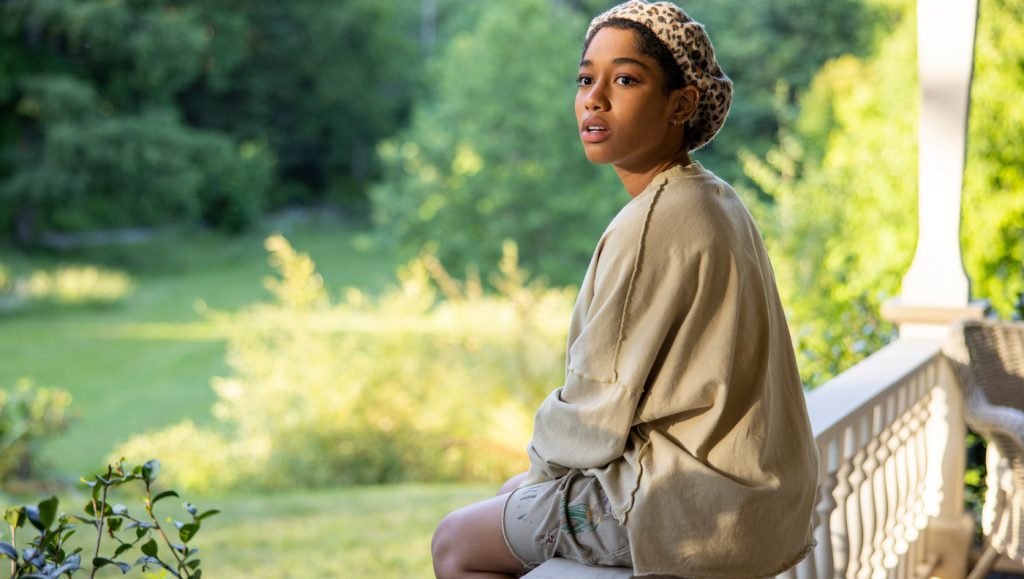
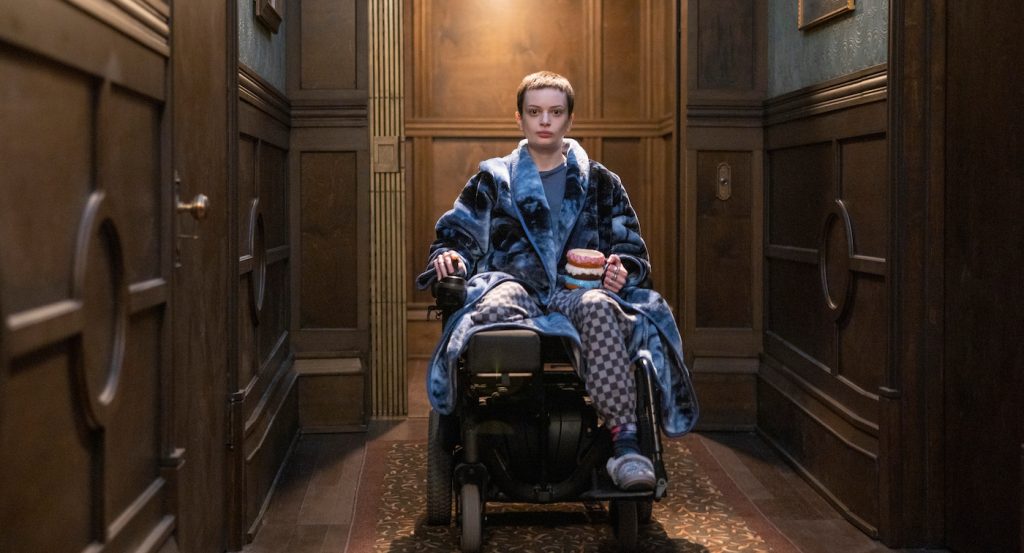
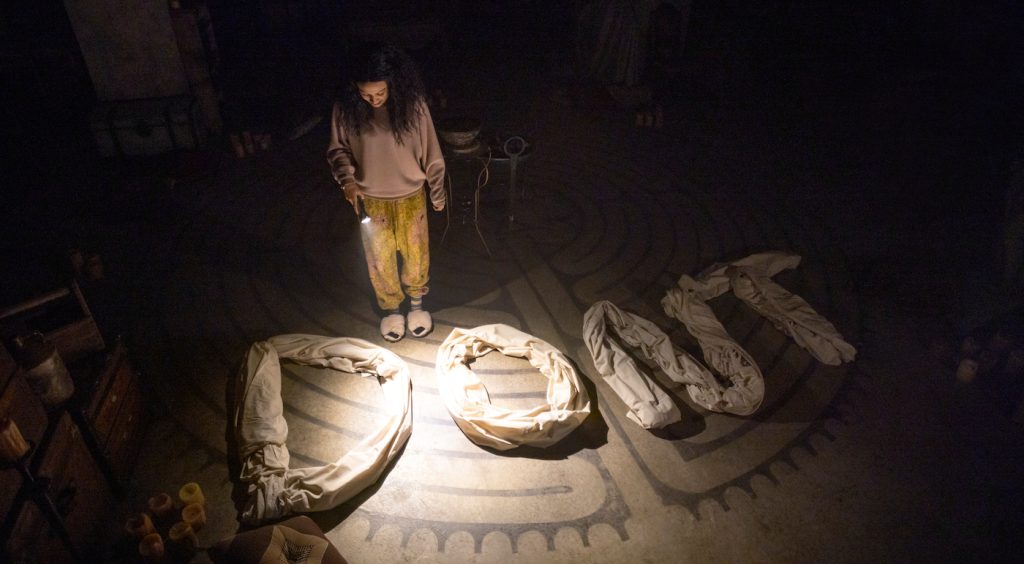
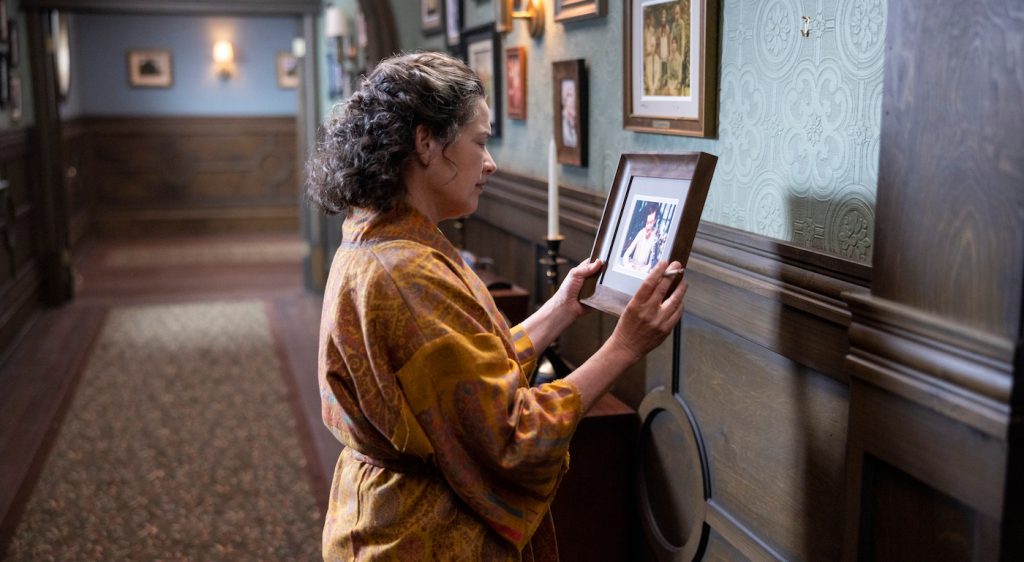
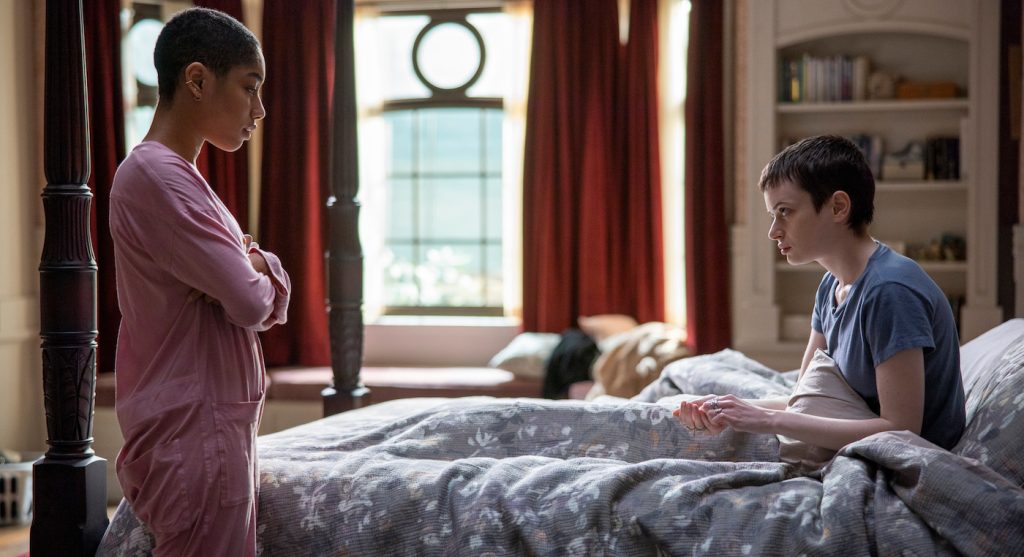
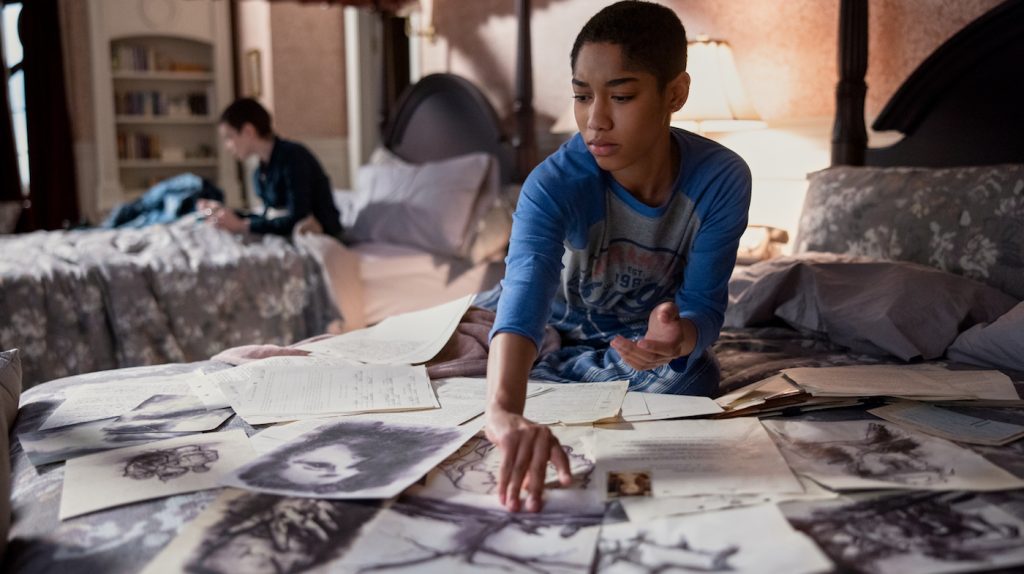
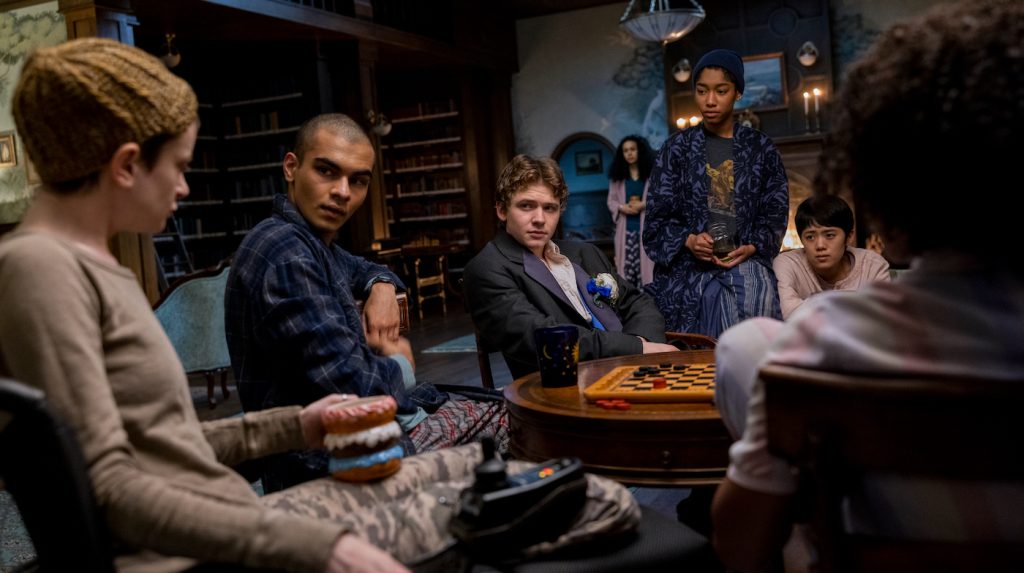
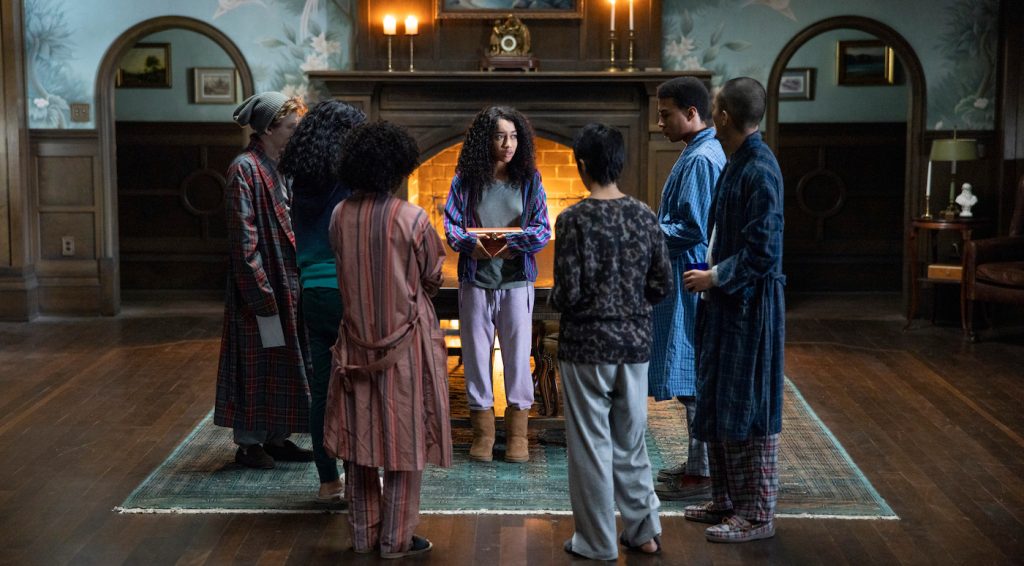
Doctor Sleep and The Haunting of Hill House director Mike Flanagan’s The Midnight Club will bring 10 episodes worth of supernatural creepiness to the streamer in early October. The series, based on a novel of the same name by Christopher Pike, is centered on a group of terminally ill patients at the Rotterdam Home who comes together—at midnight, of course—to swap scary stories. Adding a deeper component to the group’s storytelling ritual is a promise they make to one another; if one of the dies, they’ll contact the others from beyond the grave.
The first trailer reveals the terrifying diagnosis that Annarah Cymone’s character gets, which sends her on her path to the Rotterdam House. Cymone is joined by Adia, Igby Rigney, Ruth Codd, Aya Furukawa, William Chris Sumpter, Sauriyan Sapkota, and Heather Langenkamp.
Flannagan created the series alongside writer Leah Fong (The Haunting of Bly Manor), both of whom bring a successful track record in the horror genre with them.
Check out the trailer below. The Midnight Club streams on Netflix on October 7.
Here’s the official synopsis for The Midnight Club:
At a hospice for terminally ill young adults, eight patients come together every night at midnight to tell each other stories — and make a pact that the next of them to die will give the group a sign from the beyond. Based on the 1994 novel of the same name as well as other works by Christopher Pike.
For more on big titles on Netflix, check these out:
A beautiful, somber new poster has arrived for Black Panther: Wakanda Forever.
The new poster pays tribute to Chadwick Boseman, who passed away at the age of 43 in August of 2020, cutting off a spectacularly bright career. Boseman, of course, was Black Panther, playing T’Challa in Ryan Coogler’s game-changing 2018 smash hit Black Panther. The new poster reveals T’Challa’s iconic Black Panther mask and claw necklace, set against a dark black background, in an understated yet sublime tribute to the fallen hero.
Check out the full poster here:
BLACK PANTHER: WAKANDA FOREVER. New theatrical poster. Courtesy Marvel Studios/Walt Disney Studios.
Black Panther: Wakanda Forever will find the remaining heroes of Wakanda, including his mother Ramonda (Angela Bassett), his sister Shuri (Letitia Wright), Nakia (Lupita Nyong’o), and M’Baku (Winston Duke) facing an uncertain future now that their king and leader is gone. We learned about the threat they’ll face in that first trailer, revealing Namor (Tenoch Huerta) and his people, the Atlanteans, moving in on a wounded, grieving nation. A new image released by Marvel Studios reveals a few of Namor’s allies, but before we get to it, a brief bit of background on who this new threat is.
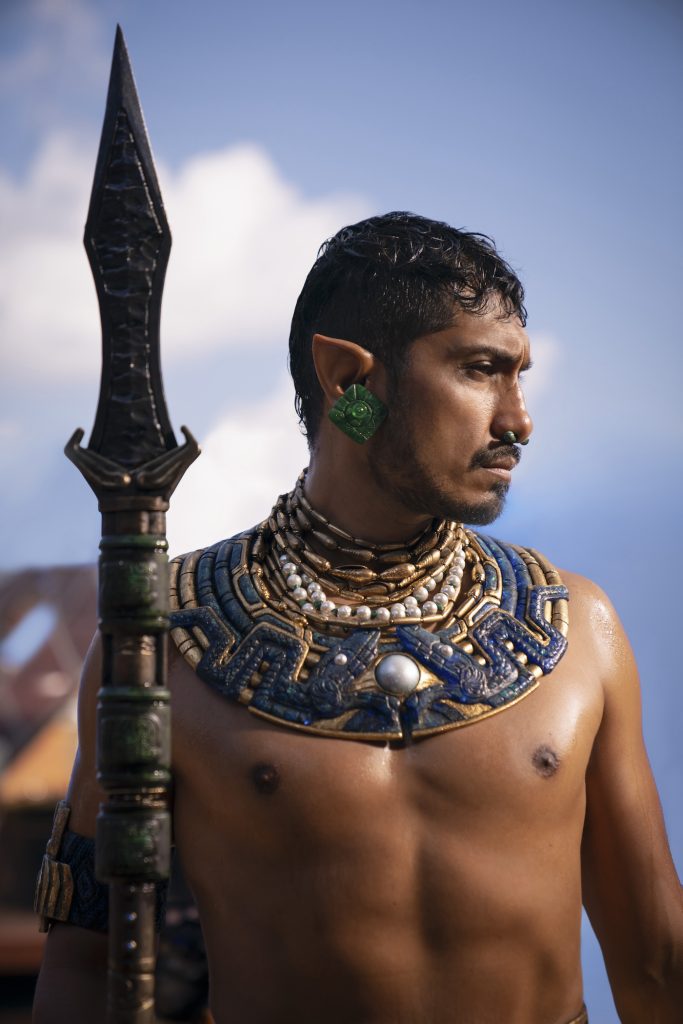
While Namor might not be a household name—yet—the character is one of the most storied antiheroes in the Marvel canon, first appearing on the pages of a comic back in 1941. In the comics, Namor the Submariner is a half-human, half-Atlantean ruler of the undersea kingdom of Atlantis. Possessing superhuman strength, Namor can fly through both the ocean and the air, he can speak telepathically to marine animals, and has a history of being both friend and foe of nearly every major Marvel hero, from the X-Men to the Fantastic Four to the Avengers, as well as some pretty ferocious battles with Black Panther and the Wakandans. He might sound like Aquaman to you, but Namor predates Aquaman by three years. He’s a force to be reckoned, and in his new MCU iteration, his backstory and culture will be richer and more specific. In Black Panther: Wakanda Forever, Namor’s influences will include Mayan and Aztec cultures, and Huerta, who broke out in Narcos, is of Aztec and Purépecha origin.
The new image shows us a few of Namor’s Atlantean warriors, led by Attuma (Alex Livinalli) and Namora (Mabel Cadena). The MCU version of Namor and his fellow Atlanteans will focus not only on what separates them and makes them antagonists of the Wakandans but also on how their own rich cultural heritage informs their decisions. As Huerta said at Disney’s D23 expo, Namor and the Atlanteans have much in common with the Wakandans.
“You will see them in a light of … confrontation. We don’t get along. But, it’s funny, in the end, they have too much in common,” Huerta said. “It portrays what is happening here in the States, from my perspective, between the minorities of this country. I think at some point we need to join together and create that different thing.”
Needless to say, Black Panther: Wakanda Forever is one of the most eagerly-anticipated films of the year, and it’s right around the corner—it hits theaters on November 11.
For more on Black Panther: Wakanda Forever, check out these stories: