The first trailer for Christopher Nolan’s Oppenheimer dropped last night, revealing the auteur’s upcoming period epic. Oppenheimer boasts yet another stellar A-list cast as the writer/director now turns his attention to a turning point in world history, focusing on the titular J. Robert Oppenheimer (Cillian Murphy), the man who risked creating something that could destroy the entire planet in order to save it.
Nolan’s film will explore Oppenheimer’s life and role in Manhattan Project, a government research effort that was created to build and test nuclear weapons that went on from 1942 to 1946. Oppenheimer was the director of the Los Alamos Laboratory at the time, where the bombs were assembled. He is widely considered to be the key architect of the bomb and a morally and ethically conflicted genius who quoted Hindu scripture while witnessing the first detonation of a nuclear weapon on July 16, 1945; “Now I am become Death, the destroyer of worlds.”
This is not Murphy’s first time working with Nolan, of course. He has had important roles in Nolan’s Dark Knight Trilogy, Inception, and Dunkirk. However, this is the first time that he’s the star, and he heads up a sensational cast that includes Emily Blunt as his wife, botanist and biologist Katherine “Kitty” Oppenheimer; Matt Damon as General Leslie Groves. Jr., director of the Manhattan Project; Robert Downey Jr. as Lewis Strauss, a founding commissioner of the U.S. Atomic Commission; Florence Pugh as psychiatrist Jean Tatlock; Benny Safdie as theoretical physicist Edward Teller; Josh Hartnett as pioneering American nuclear scientist Ernest Lawrence; Michael Angarano as Robert Serber; Gary Oldman as Harry S. Truman; and Rami Malek and Kenneth Branagh in undisclosed roles.
Nolan adapted his script from Kai Bird and Martin J. Sherwin’s “American Prometheus: The Triumph and Tragedy of J. Robert Oppenheimer.
Check out the first trailer below. Oppenheimer drops into theaters on July 21, 2023.
Here’s the official synopsis for Oppenheimer:
Written and directed by Christopher Nolan, Oppenheimer is an IMAX®-shot epic thriller that thrusts audiences into the pulse-pounding paradox of the enigmatic man who must risk destroying the world in order to save it.
The film stars Cillian Murphy as J. Robert Oppenheimer and Emily Blunt as his wife, biologist and botanist Katherine “Kitty” Oppenheimer. Oscar® winner Matt Damon portrays General Leslie Groves Jr., director of the Manhattan Project, and Robert Downey, Jr. plays Lewis Strauss, a founding commissioner of the U.S. Atomic Energy Commission.
Academy Award® nominee Florence Pugh plays psychiatrist Jean Tatlock, Benny Safdie plays theoretical physicist Edward Teller, Michael Angarano plays Robert Serber and Josh Hartnett plays pioneering American nuclear scientist Ernest Lawrence.
Oppenheimer also stars Oscar® winner Rami Malek and reunites Nolan with eight-time Oscar® nominated actor, writer and filmmaker Kenneth Branagh.
The cast includes Dane DeHaan (Valerian and the City of a Thousand Planets), Dylan Arnold (Halloween franchise), David Krumholtz (The Ballad of Buster Scruggs), Alden Ehrenreich (Solo: A Star Wars Story) and Matthew Modine (The Dark Knight Rises).
For more on Universal Pictures and Focus Features projects, check out these stories:
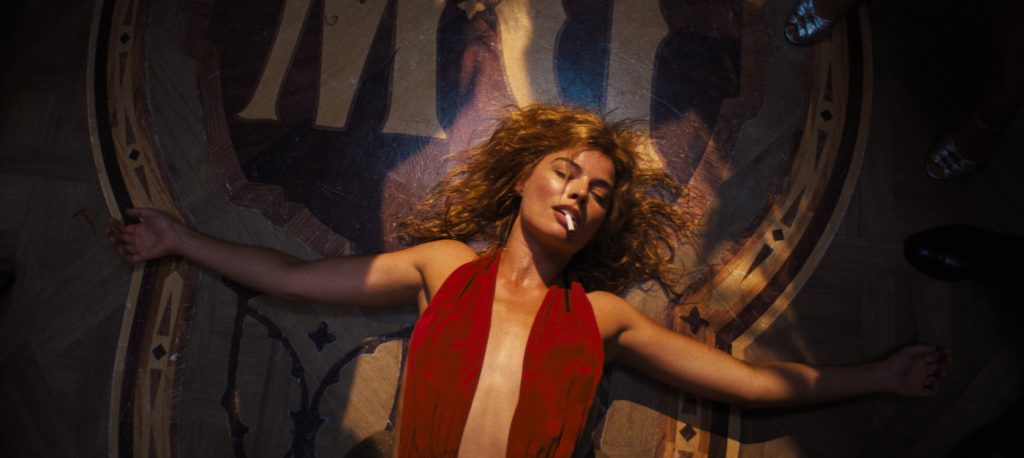
The opening sequence to Damien Chazelle’s Babylon (in theaters today) hits you like one of the many lines of powder its characters will ingest. It’s eye-opening, choreographed chaos, leaving you with an intensely euphoric feeling – quite fitting for a story that revisits Hollywood’s infancy of the 1920s and ‘30s when La La Land was a sandbox of drugs, sex, and all night partying.
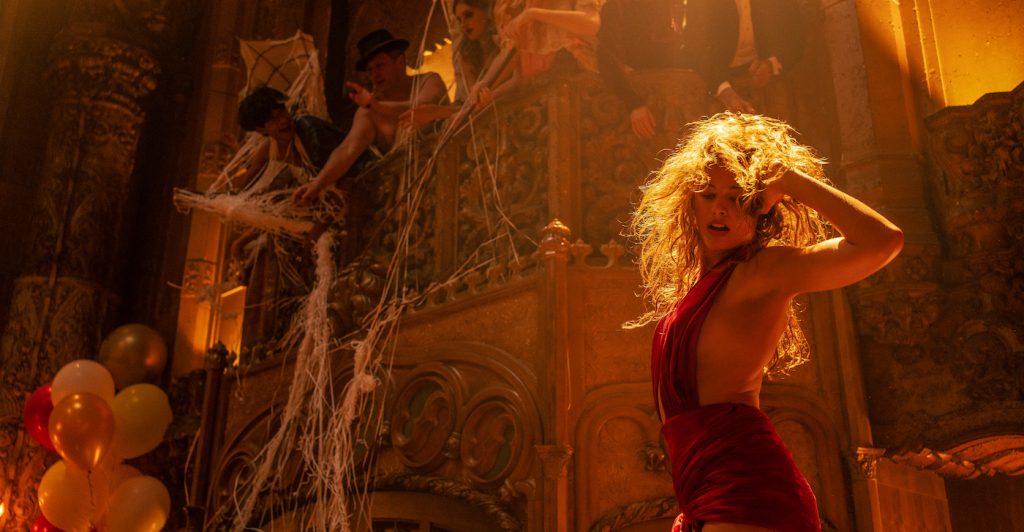
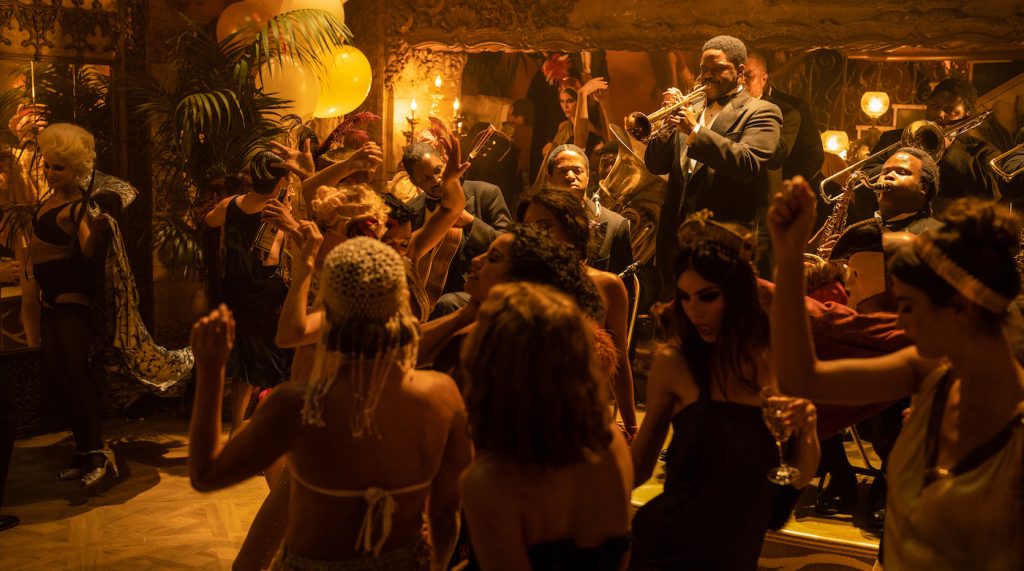
It’s here we meet Manny Torres (Diego Calva), a low-level “yes man” with aspirations to make it in the biz, putting together the finishing touches on an elephant-sized bash for the who’s who, including silent movie star Jack Conrad (Brad Pitt) and Nellie LaRoy (Margot Robbie), a party-crasher looking to make a name for herself on the silver screen. Bedlam arrives at nightfall when tux-clad half-naked men, topless women, and hundreds of drunkards and coke fiends descend on the mansion of studio boss Don Wallach (Jeff Garlin), drinking and snorting anything and everything until sunrise. The mash-up has serious FOMO vibes and is glued together by the music from a live orchestra playing in the ballroom. That orchestra is led by trumpeter Sidney Palmer (Jovan Adepo), and galvanizing the moment is a tantalizing dance by Nellie, which catches the eye of a producer who needs to replace an actress who happened to die of a drug overdose in a nearby room. It’s her chance at stardom.
Margot Robbie plays Nellie LaRoy in Babylon from Paramount Pictures.
Beautifully shot on anamorphic 35mm push-processed film by cinematographer Linus Sandgren (La La Land, First Man) and exquisitely alluring production design from Florencia Martin (Licorice Pizza), the visual tapestry of Babylon invites you into the world with open arms, though it’s the sonic creativity that subliminally keeps you moving to the beat of Chazelle’s narrative drum.
“His films are very motivated by music,” says production sound mixer Steven Morrow (La La Land). “There’s a lot of discussion in preproduction about certain music hits and cues as well as the feel he [Chazelle] wants. We work heavily with the music department to make sure Damien has all the tools he needs.” Composer Justin Hurwitz returns for his fourth film with the director, and his up-tempo score helps drive the opulent soundscape.
“Damien wanted the sound to be visceral and real, to be a little larger than life,” says the multi-hyphenated supervising sound editor Ai-Ling Lee (La La Land, First Man), who collaborated alongside the likes of supervising sound editor Mildred Iatrou (La La Land, First Man) and re-recording mixer Andy Nelson (La La Land). “Because there’s a lot of action in the frame, he wanted the sound to be as immersive, in a sense, as much as the visuals.”
In filming the epic party, production sound fitted each actor with a wireless transmitter and lavalier to record their dialog. Boom operator Craig Dollinger placed an additional microphone overhead when viable, though the set walls of the Wallach location were lined with mirrors, limiting opportunities. The bigger hurdle for sound though was finding a solution to the music from the orchestra, so it didn’t trample on the dialog throughout the scene. Morrow decided to give each band member an earwig that the music would be played through, allowing them to mimic playing their instruments. The problem: there were dozens of dancers who also needed to hear the music, plus Robbie’s character. Sound utility Bryan Mendoza organized a system to give each one of them their own earwig to hear the songs and dance to the lavish choreography created by Mandy Moore (La La Land).
For Robbie’s dance number, Morrow devised another solution. “Mandy and Margot came up with the song Firestarter [by Prodigy] that she’s dancing to. Everyone else is dancing to what you hear on screen, but Margot had a separate earwig and transmitter so she could hear that specific song,” Morrow notes. “It may not look like it, but that party scene became a technical challenge where we had 42 earwigs going out on two different channels.”
Margot Robbie plays Nellie LaRoy in Babylon from Paramount Pictures.
Lee admits the opening party sequence is heavily driven by music. For sonic clarity, post had to craft a visceral sound effects track that heightened the scene without overwhelming the audience. “Andy Nelson started the mix by setting what’s the loudest he can play the music for the sound effects, like the party crowd, fights, elephant, etc. I made sure not to play them too loud and be specific when we play them, rather than a bed of sounds. This way, if a small sound doesn’t overpower the music, that helps create an illusion that the music is always big, except for certain moments like the crowd cheers taking over the music on the last half of Nellie’s dance sequence,” explains Lee.
Jovan Adepo plays Sidney Palmer in Babylon from Paramount Pictures.
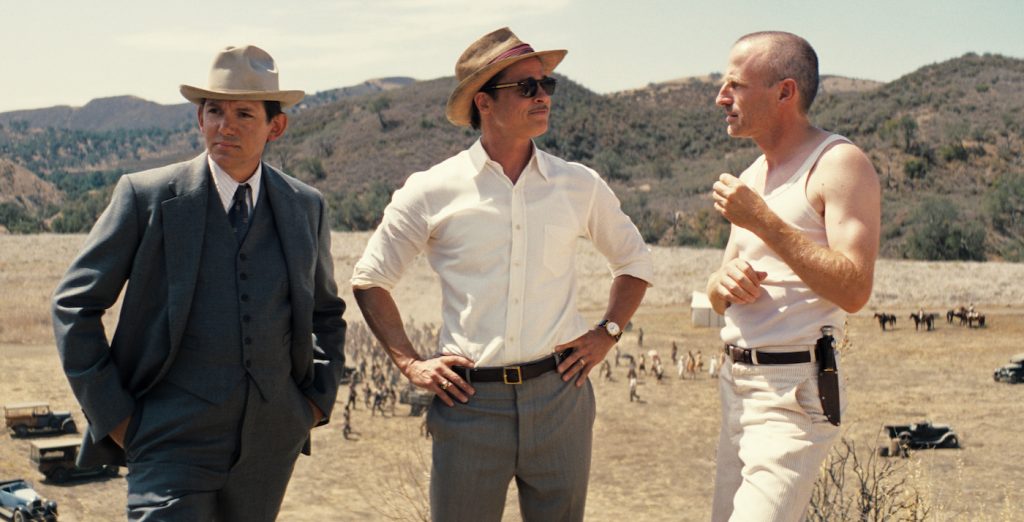
The mantra for production sound throughout filming was to find creative ways to protect the dialogue and not let the music play over entire sequences. Another such instance was a massive battlefield scene that has multiple storylines taking place at once, including Nellie’s first day on set, where she’s asked to repeatedly shed a tear and Jack Conrad climbing a hill to kiss a princess at sunset.
Lukas Haas plays George Munn, Brad Pitt plays Jack Conrad and Spike Jonze plays Otto Von Strassberger in Babylon from Paramount Pictures.
Supervising location manager Chris Baugh found an empty field in Simi Valley where Martin designed a number of open-air sets to represent Kinsocope studio owned by Wallach. “Kinoscope is what you’d call a Poverty Row studio,” Martin says in the production notes, “so we wanted to show how ramshackle and seat-of-your-pants the approach in those days could be. It’s really these pockets of fantasy sprouting out of the desert, where only months or weeks before nothing existed.” Every individual movie set, every painted backdrop – all were created from scratch.”
The colossal sequence had over 700 extras fighting, explosions, horse stunts, and a full orchestra. “On a traditional movie, you would blast the music and the orchestra would play along as the battle takes place. We thought since we had a large earwig count already, why not just give everyone in the orchestra an earwig, including the conductor [cameo by composer Justin Hurwitz]. This way, they can play along to the silent music, and then good sound effects of the battle and everything that’s going on could be recorded.”
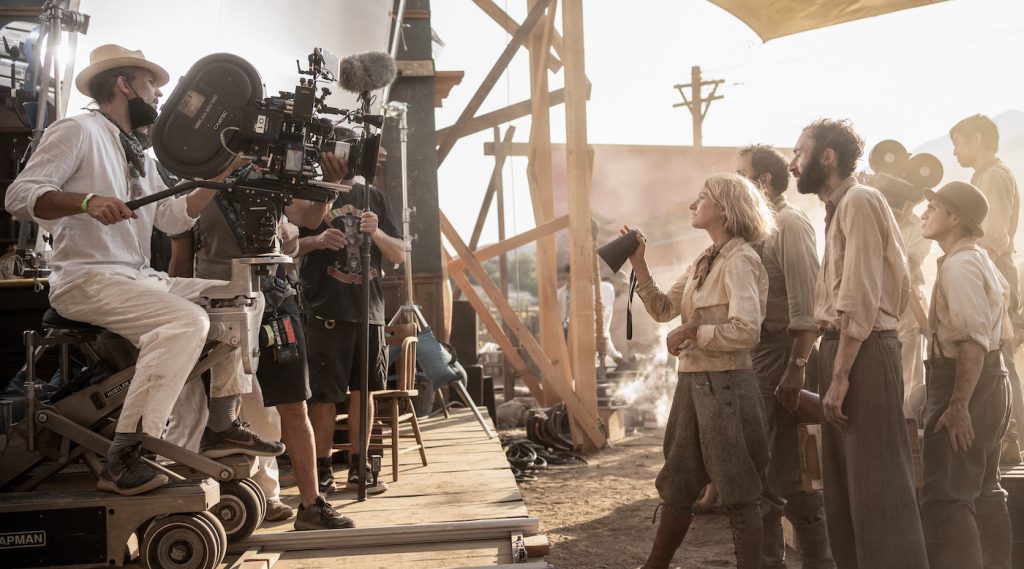
Director of Photography Linus Sandgren and Olivia Hamilton as Ruth Adler on the set of Babylon from Paramount Pictures.
Lee sent two sound effects recordists to capture the aural palette during the multi-day shoot. “They were able to set up a bunch of mics around the set to record a wider perspective of the extras yelling, attacking, and the different prop sounds,” mentions Lee. “We thought it might be kind of cool to capture the sound of 1,000 extras with props weapons and hear what it sounds like.” Morrow adds, “It may seem odd to say [to Chazelle] we don’t want to play this orchestra out loud, but in the end, it helps the authenticity of the scene. It lent all that extra sound that would be very difficult to recreate where you have all these extras on the field running at each other.”
In post, the team further pushed the battle sequence, finding moments to aurally heighten the drama of the unfolding storylines. “Justin’s score is driving a lot of the scene forward,” says Lee. “For sound to play it up, we would hit the cut to play in rhythm and pitch to his score.” Mixing in Dolby Atmos created more of an immersive soundscape where they pulled sound effects from the center speaker placing them in different perspectives for viewers to hear and feel.
Morrow admits none of it would be possible without the collaborative nature of Chazelle. “Damien really cares about every aspect of a movie, and you can tell that in the small details. He has storyboards he sends out to everybody to understand what his goals are for the shoot, but he’s collaborative in the sense that he’s not locked into a specific vision. It’s a very rewarding experience working on his movies.”
For more films and series from Paramount and Paramount+, check out these stories:
“Since the beginning of time, since the first little girl ever existed, there have been…dolls.”
This is how the first teaser trailer for writer/director Greta Gerwig’s Barbie opens, with little girls playing with dolls in a beautiful but barren landscape that is meant to evoke, both in sound and image, the iconic prehistoric “Dawn of Man” sequence in Stanley Kubrick’s 2001: A Space Odyessy, where a band of apes are ejected from their watering hole.
“But the dolls are always and forever baby dolls,” our narrator continues. “Until…”
Until Barbie (Margot Robbie) appears, larger than life in a striped bathing suit and standing as tall as the monolith behind her. Then, just as the apes in 2001 began to evolve after stumbling upon a monolith and realizing they can use bones as a weapon, the little girls begin smashing their baby dolls after beholding the majestic colossus that is Barbie.
It’s a cheeky, delightfully weird teaser. Gerwig has become a rising star as a writer/director for a reason, and she’s working with a stacked deck here, so hopes are high that Barbie is going to be something special.
The teaser ends with a peek at the world Barbie inhabits, heavy on pinks, with a glimpse of Ken (Ryan Gosling), as well as Issa Rae and Simu Liu’s characters. They’re joined by America Ferrera, Kate McKinnon, Ariana Greenblatt, Alexandra Shipp, Kingsley Ben-Adir, Michael Cera, and Will Ferrell.
“We like the things that feel a little left of center,” Robbie told The Hollywood Reporter about Barbie. “Something like Barbie where the IP, the name itself, people immediately have an idea of, ‘Oh, Margot is playing Barbie, I know what that is,’ but our goal is to be like, ‘Whatever you’re thinking, we’re going to give you something totally different — the thing you didn’t know you wanted’…can we truly honor the IP and the fan base and also surprise people? Because if we can do all that and provoke a thoughtful conversation, then we’re really firing on all cylinders.”
If this first teaser is any indication, Barbie is definitely going to subvert expectations.
Check out the teaser trailer below. Barbie hits theaters on July 21, 2023.
For more on Warner Bros., HBO, and HBO Max, check out these stories:
Featured image: Caption: MARGOT ROBBIE as Barbie in Warner Bros. Pictures’ “BARBIE,” a Warner Bros. Pictures release. Photo Credit: Courtesy Warner Bros. Pictures
Growing up in Malaysia, Alvin Wee was drawn to “big action movies” such as the Harry Potter series and Transformers. “I liked sensory overload, the loud, visual spectacle. My favorite movie was Superman with Christopher Reeve. It’s also my favorite score, by John Williams,” says Wee, the Score Mixer on Sony’s Devotion, now in theaters. Wee was also the score mixer for Disney’s Encanto, working closely with composer Germaine Franco.
Wee got to do both epic and intimate with director J.D. Dillard‘s Devotion, the true story of the friendship between US Navy fighter pilots Capt. Thomas Hudner, Jr. (Glen Powell) and Ensign Jesse Brown (Jonathan Majors) during the Korean War when both were honored for their heroism. Devotion is notable for being equal parts action movie with Top Gun– like aerial maneuvers and a poignant drama about the genuine friendship between the two men, one white and one Black, from very different backgrounds.
As score mixer, Wee worked in close collaboration with Devotion composer Chanda Dancy. “I appreciate the collaborative process,” says Wee, who studied arranging and jazz composition at Berklee School of Music in Boston. “As a musician myself, I am able to bring more of the production process to collaboration. My goal from the beginning is always the ‘A-ha!’ moment. I live for that moment when the director, conductor, or composer is asking me ‘what if …’ and I’m able to help realize their vision.”
He also credits Devotion sound mixer Joel Dougherty for “making sure the music is well represented. For instance, there’s the big scene when the [fighter planes] get to the bridge, and the plane comes down. It could have been all gunshots and explosions. I like things loud, so I mix loud, but even I thought the sound was exciting … Joel said we needed the music to be just as good as the effects, and it makes the scene. [Director] J.D. [Dillard] had a lot of say, obviously; if the music was not mixed well, it would not have been able to compete with the effects.”
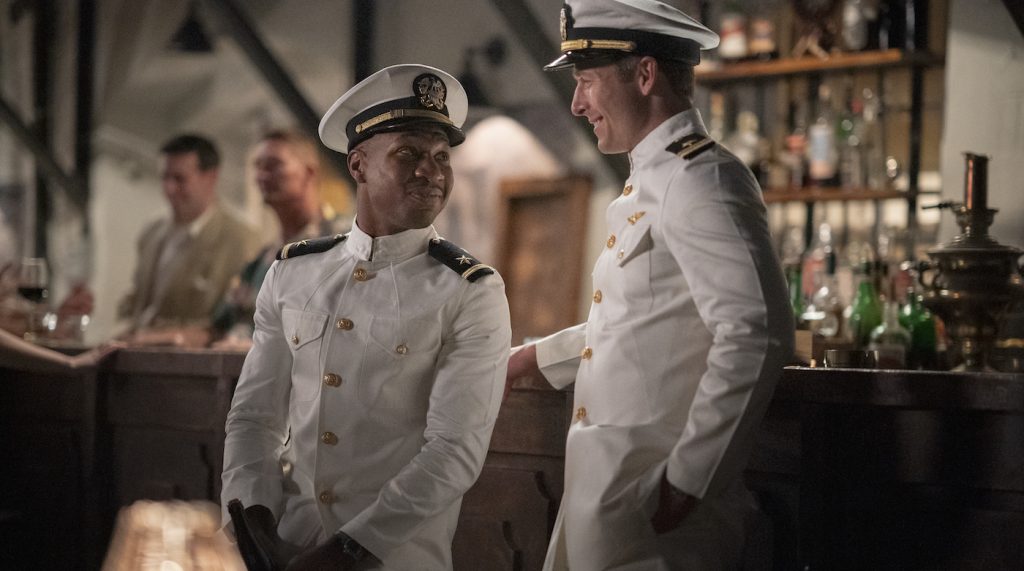
Wee’s knowledge of jazz and the technical aspects of production turned out to be unexpectedly useful since Devotion isset in 1950. Dancy composed period music for several sequences, most notably an important scene in a casino in France where the Naval officers meet the young screen legend Elizabeth Taylor.
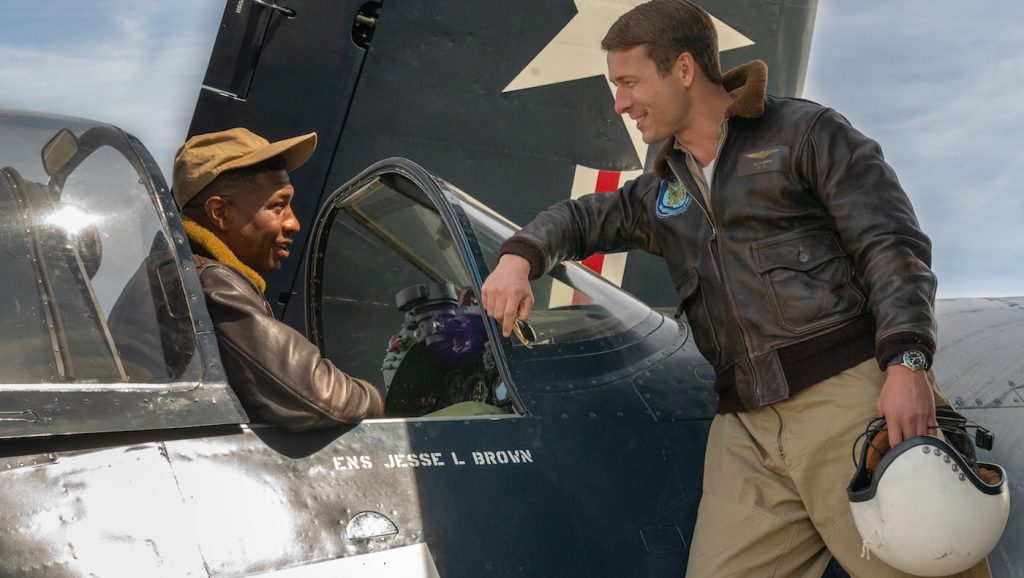
Jesse Brown (Jonathan Majors) with Tom Hudner (Glen Powell) in Columbia Pictures’ DEVOTION.
“It was a conscious decision to make sure that musically it was appropriate to the time, and Chanda did her own version of it. The casino scene has a big band playing Chanda’s original music, but it’s reflective of the era,” Wee says. “We were in the studio in Nashville, and we used the same setup and the same types of musicians that would have been in a 1950s big band. We used the same arrangements and harmonies. I researched recording and mixing techniques to make it historically accurate. We made sure it was right, down to the types of notes in a solo, the tempo, the sonic representation, whether it sounds like Django Reinhardt or Duke Ellington. We made sure it was done intentionally.”
When he first got to work in the Devotion sound studio, says Wee, “I didn’t see any visuals. Chanda and J.D. were working closely, but at that point, I had nothing but music to go on in the initial mixing,” he says. “Once I started mixing, I got the sense of beautiful, tender moments with pianos, quiet moments in the score that needed sculpting. We wanted big, and we wanted intimate. When Jesse and Tom are having a conversation, we didn’t want music to get in the way. So I went with my instincts. Once I saw the visuals, I knew the communication was right, and the way it translated made sense.”
Jesse Brown (Jonathan Majors) and Tom Hudner (Glen Powell) in Columbia Pictures’ DEVOTION.
Wee moved to Los Angeles to work in music production but eventually found his way to film. He was hired as score mixing assistant on the 2014 movie Kingsman: The Secret Service. “That was my introduction to film music. I’ve never looked back,” says Wee, whose music department credits since then include No Time to Die, Encanto, Top Gun: Maverick, and the upcoming Whitney Houston biopic I Wanna Dance with Somebody, which reunites him with composer Chanda Dancy.
The top-to-bottom attention to detail in Devotion was all the more rigorous because the film is based on real-life heroes.
“We got to meet [members of Jesse’s and Tom’s] families at screenings, and it makes it more real; there’s a weight to it,” says Wee.
“At the end of the day, everyone is so invested; we all tried to represent the story as well as we could. No one in that room in Nashville was doing it for any other reason. There’s so much to be said about the people who gave their lives for their country. I wanted to make sure it was done accurately and people understand the emotion and heart behind it.”
Devotion is playing in select theaters now.
For more upcoming films from Sony Pictures, check out these stories:
James Cameron’s long-awaited return to Pandora is tracking to make a monster splash in its opening weekend. Avatar: The Way of Water, riding high on a wave of good reviews and overwhelmingly positive reactions to its visual splendor, is looking to overtake Top Gun: Maverick, Jurassic World: Dominion, and The Batman for the biggest opening weekend. If current tracking holds, it could also become the largest global opening of the year, topping Doctor Strange in the Multiverse of Madness.
This shouldn’t be that surprising given Cameron’s track record and, specifically, his way with sequels. This is the guy who brought us Aliens and Terminator 2: Judgement Day. Yet, in the weeks and months (and years) leading up to his Avatar sequel, there was plenty of speculation about whether people still cared about the franchise, which debuted in world-beating fashion with the 2009 film but left, according to countless articles since, little cultural impact. Well—according to the most recent numbers, people are enthused about seeing The Way of Water in theaters this weekend. This is the kind of movie that demands to be seen on the biggest screen possible.
The Hollywood Reporterwrites that, if current tracking is correct, The Way of Water should bring in between $150-$170 million and between $450-$550 globally. If it falls in the middle range of that global number, it will be the biggest global opening of the year. THR writes that one detail that could act as a potential brake on The Way of Water‘s success is the meaty running time of three hours and 12 minutes, which limits the number of showtimes. The caveat, however, is it’s not facing much competition.
The current leader in 2022 is Disney/Marvel’s Doctor Strange in the Multiverse of Madness, which pulled in $185 million domestically and $449 million worldwide on its opening weekend. As for the year’s other big openings, Way of Water would also best Paramount’s Tom Cruise-led blockbuster Top Gun: Maverick, which opened to $126.7 million domestically, Universal’s Jurassic World: Dominion, which nabbed $145 million, and Warner Bros. The Batman, which made $134 million.
It all points to what has become a common refrain since the initial reactions to Way of Water were so positive—never bet against James Cameron.
For more on Avatar: The Way of Water, check out these stories:
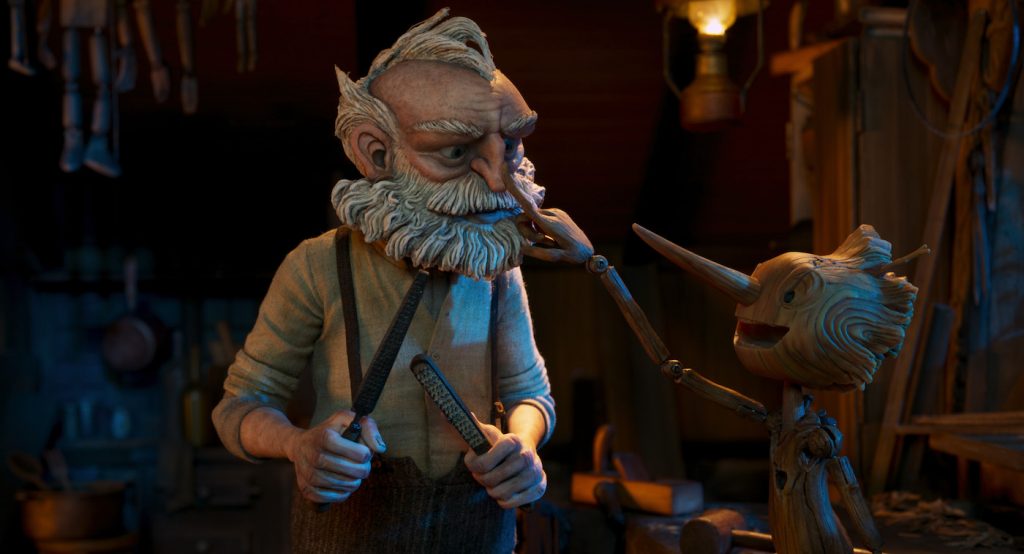
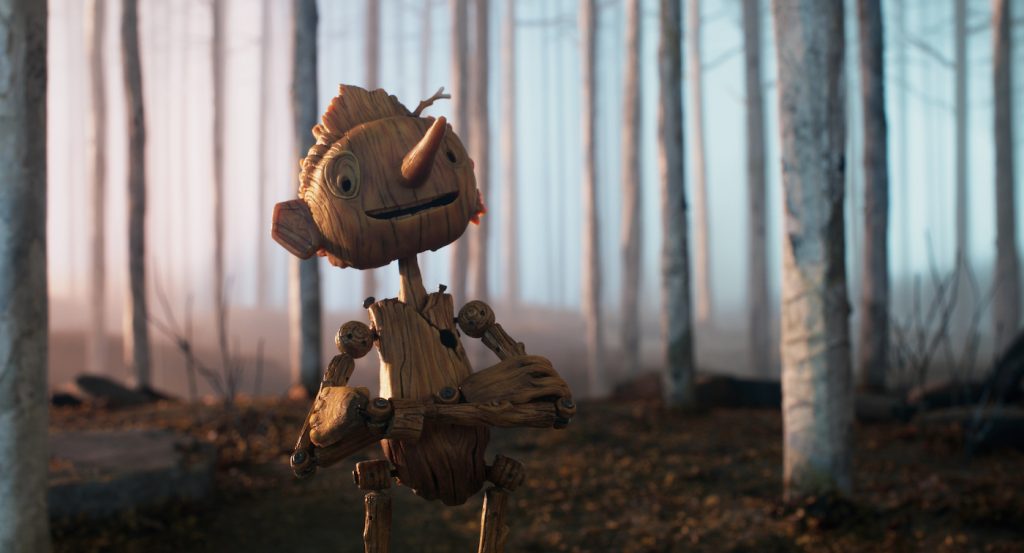
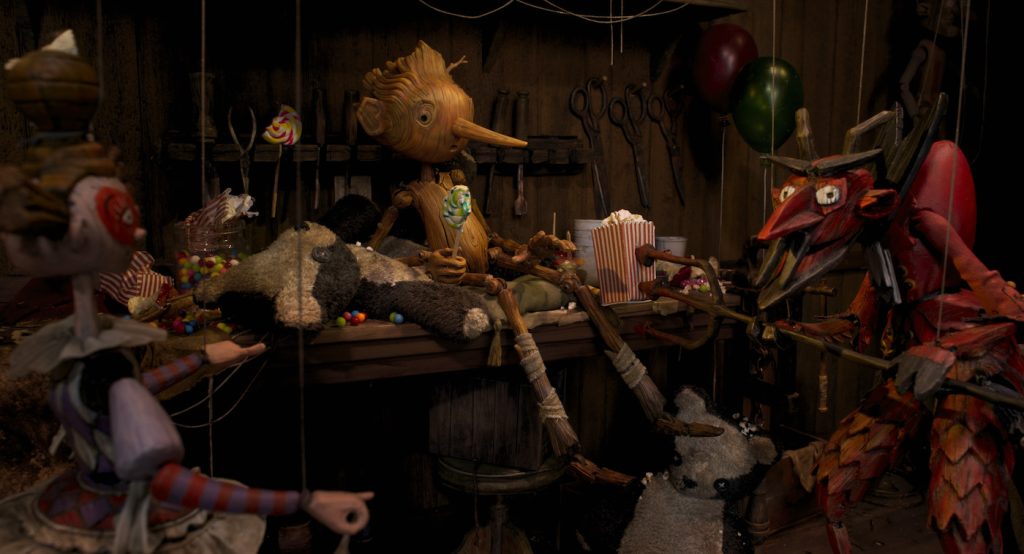
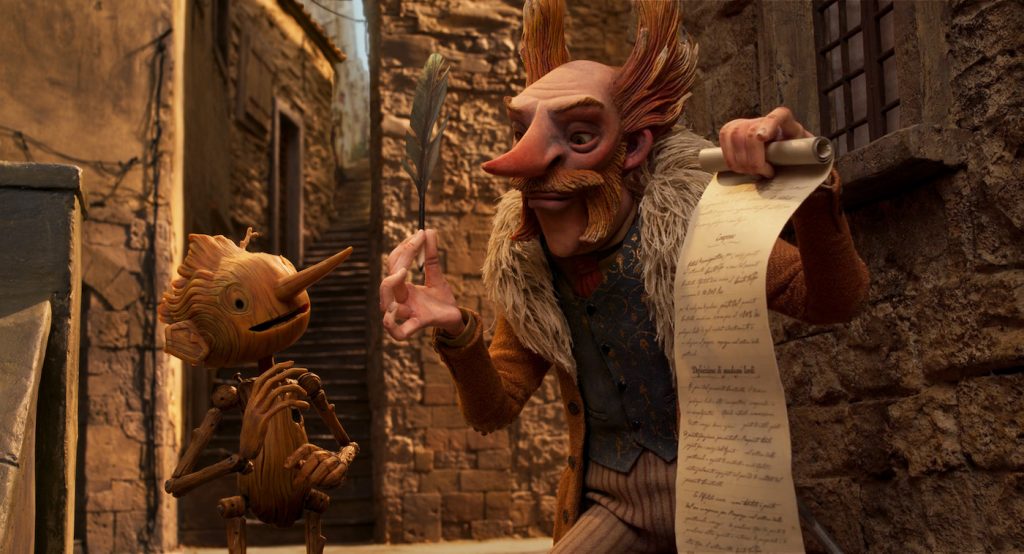
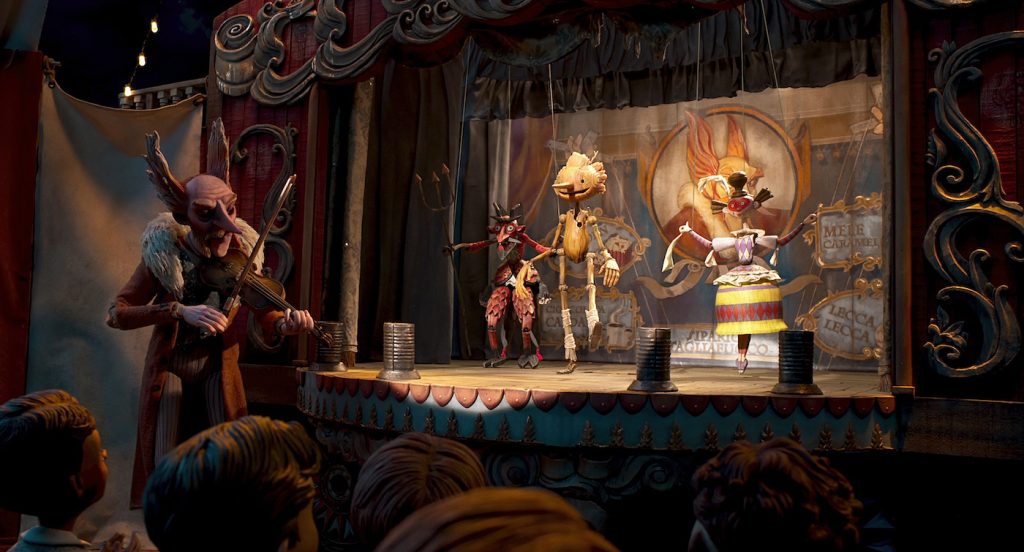
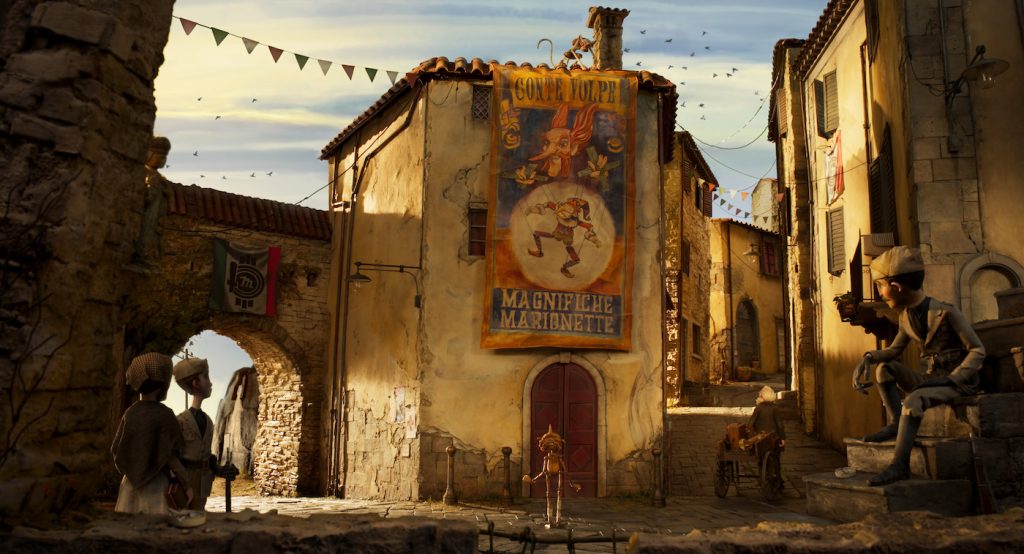
Inside a nondescript warehouse on the outskirts of Portland, a little boy made of wood galvanized efforts by stop motion filmmakers for three years before emerging now to wow moviegoers in Guillermo del Toro’s Pinocchio. This dark stop-motion iteration of Carlo Collodi’s 1882 tale, in theaters and streaming on Netflix, takes place in 1930’s Italy, adding Mussolini and forest witches to the story’s signature evil doers: circus master Volpe (voiced by Christoph Waltz) and the monster whale.
Puppets were fabricated in Manchester, England, and Guadalajara, Mexico, then shipped to Portland, where 41 animators teamed with grips, gaffers, lighting designers, camera operators, and scenic artists to create the fairy tale world inhabited by Pinocchio (voiced by English 10-year-old Gregory Mann) and his father Geppetto (David Bradley). Pinocchio co-director Mark Gustafson enlisted veteran Danish stop motion artist Brian Leif Hansen to serve as the show’s animation supervisor. “We averaged 3.8 seconds of animation output per week,” says Hansen, who abandoned his early ambitions to become a chef and instead moved to England, where he helped animate Tim Burton’s Corpse Bride. Hansen later servedunder Gustafson on Wes Anderson’s Fantastic Mr. Fox stop-motion feature, followed by Laika-produced Missing Link and Kubo and the Two Strings.
Speaking from Manhattan, where he helped install the Museum of Modern Art’s “Guillermo del Toro: Crafting Pinocchio” exhibition, Hansen drilled into the painstaking process of bringing 12-inch tall heroes and villains to life.
Stop-motion animators move Pinocchio characters in tiny increments to build a scene. What kind of blueprint do the animators refer to as a guide?
The animators rely heavily on these [animatic] storyboards, and the voice actors have already been directed, so there’s a voice track to let them know what’s going on. The animator is like an actor. A director relies on the animator to give life to the character and to give a performance, and most times, they get it right.
This film packs such an emotional wallop. Part of that must come from the way voice actors inspire animators to synch the puppet’s movement to feelings expressed through their vocal performances.
Yeah. Emotions are a very important thing. [As an animator] You’ve got these headphones on, and you’re moving these puppets around; if you listen carefully to the voice recordings, you can hear breath and hear the actor shifting around. So you listen very carefully to the voice, and then you stuff all of that into your puppet in a way that lifts it up, enlarges it to become almost a caricature. You don’t just do it plainly. It’s crucial to have a good sound to work with when you’re creating a performance.
You worked as a hands-on animator yourself for about 15 years, and now, with Pinocchio, you’ve graduated to animation supervisor. How did that happen?
Mark Gustafson needed a wingman, somebody who’s done this many times before, to make sure he could deliver this high level of animation. That wingman being me. It turned out we work really well together.
What’s the division of labor?
Mark basically takes care of the emotion and the story, and I take care of all the technical things that need to be working so the animator could do his or her best performance. Also, I’m sort of a cheerleader, keeping up the spirit of this jolly ambiance within the animation department. Animators are artists, so they’re sometimes nervous about their work. And you need to make sure they focus on the right things rather than things that nobody’s going to see.
The puppets in Pinocchio are moved by hand 12 or 24 times per second of screen time. How do the animators make that happen?
There’s enough tension [in the gears beneath the silicone surface] to hold a pose. You go in and move the core of the body, arms, legs, then your head, then your eyes and eyelids. Then you step away from the frame and they take a picture. Then you go back in and move everything again. What’s crazy about this process, called straight ahead, is that you don’t have key poses drawn on paper to show where you’re going. The animator’s moving into unknown territory, so you have to have everything planned out in your head before your start. Otherwise, it’s going to go south really quickly.For example, if you come in too high or too low with the puppet’s heel, it’ll look like he’s got a limp. Walking a human is really difficult because the human eye easily recognizes if it’s not perfect. Dogs are easier.
In this digital age, it’s refreshing to realize that the human hand, not an algorithm, dictates exactly how high the eyebrow goes or where the finger will point.
Exactly.
Stop motion is so labor-intensive! Just to get the timeline straight, when did you start, and when did you finish?
I started in January 2019. There was only one animator at the beginning. Two weeks later, another couple started, then a third one started. We ramped up to a maximum capacity of 41 animators on 60 sets. We shot the first frame in August 2019 and the last frame this August. We were rushing big time, and everything was being shot at the same time. We had like 30 Pinocchio’s, 18 Geppetto’s, seven Volpes. If there were only one Pinocchio, it would have taken ten years to shoot the movie. [laughing]
Yeah. The Director of Photography, Frank Passingham, had four lighting and camera teams, each with ten or twelve sets. One crew did most of the church sequences. We had two and a half churches. Other people worked primarily on Geppetto’s workshop, which was actually three workshops split down the middle so we could shoot from both directions at the same time.
Count Volpe, the greedy carnival boss voiced by Christoph Waltz, has a huge physical and performance presence. What was it like bringing him to life?
In Guillermo’s terminology, Volpe is a ten. He’s very purposefully the most caricatured being. And he has a Jekyll and Hyde personality: He’s either this showman with the happy face and big arms [waving around], or he’s this narrow-focused meanie. Also, the Volpe puppet was very big, so his joints need to be tight, which made them difficult to move. Most of the time, Count Volpe had to be attached to a rig because he was too heavy to stand by himself.
Looking back at your immersion for more than three and a half years in the Pinocchio bubble, which sequence stands out as your favorite?
There are so many well-animated shots that I don’t really have a favorite. But the interaction between Geppetto and Pinocchio in the church is beautiful, the argument in the woods between them is genius, Geppetto waking up drunk and discovering Pinocchio for the first time is great, and the songs are funny and cool . . I could go on. But it’s not like there was one big mountain we climbed and everybody cheered when it was over. This was more like hedge jumps in the Olympics.
Hurdles?
In Denmark, we call them hedges but yeah, in Pinocchio, there was constant problem-solving that had to happen on the spot, but they weren’t impossible to solve because the problems came a little bit at a time. You had a whole team of collaborators, so you could just pick away at it, slowly.
You’re making progress, three or four seconds a week.
Yes, because if you had to think about the whole movie all at once, you’d just sit in the corner, shaking and crying. Here, we just had to carry on with these little bits that needed to be made, and then after you make all the little bits, you have a big thing.
For more on Guillermo del Toro’s Pinocchio, check out these stories:
As you’ve likely heard, Guardians of the Galaxy and Suicide Squad writer/director James Gunn has taken over DC Studios, along with producer Peter Safran, and the two have made major headlines in the past week and change about coming changes to DC’s superhero universe. Now, we have some concrete news—Gunn is penning a new Superman film that will focus on the superhero’s early days, and the role will not go to Henry Cavill.
Multiple outlets have confirmed Gunn’s script and Cavill’s exit from a role he clearly loved. Gunn’s Superman will not be an origin story but will include a new actor in the role. Cavill confirmed his exit—”My turn to wear the cape has passed.” Cavill reacted to the news on Instagram:
This news follows the shakeup concerning Patty Jenkins’ Wonder Woman 3, which is not moving forward. Jenkins confirmed the news on Twitter. Gunn and Safran have a 10-year plan for DC, which they’re presenting in January, so you can expect more shakeups to come.
Hold on, there’s more. Gunn and Safran are in talks with Ben Affleck about staying in the DC universe, but not as Batman, as a director. He’s still got one more Batman turn left in him as he reprises the role in The Flash, which races into theaters on June 16, 2023. Yet now the new DC Studio bosses are looking for a project for him to direct, which is something Affleck was planning on doing years ago on his own Batman film.
Met with Ben yesterday precisely because he wants to direct & we want him to direct; we just have to find the right project. https://t.co/Haz1APdlVN
Here’s what Gunn shared on Twitter about all the news:
Peter & I have a DC slate ready to go, which we couldn’t be more over-the-moon about; we’ll be able to share some exciting information about our first projects at the beginning of the new year.
Among those on the slate is Superman. In the initial stages, our story will be focusing on an earlier part of Superman’s life, so the character will not be played by Henry Cavill.
So for Cavill fans, who are legion, there is a chance he could return in some other role within the DC Extended Universe. It’s hard to imagine him playing anyone other than Superman, but stranger things have happened, and recall that some people had a hard time imagining him as Superman when he landed the role back in 2011.
Will we continue to share what news we have from the DC Universe as it unfolds.
For more on all things DC, check out these stories:
Featured image: LOS ANGELES, CALIFORNIA – AUGUST 02: James Gunn attends the Warner Bros. premiere of “The Suicide Squad” at Regency Village Theatre on August 02, 2021 in Los Angeles, California. (Photo by Matt Winkelmeyer/Getty Images)
Ghostface is about to take a big bite—er, slash—out of the Big Apple. The mayhem leaves Woodsboro, California, for the first time in the franchise and relocates to the City that Never Sleeps. Ghostface on a crowded F train during rush hour? Talk about a hellish commute! (Apologies).
The first trailer for Scream IV picks up after the horror in Woodsboro from the last film. The four survivors from the last chapter have left Woodsboro—who can blame them—and have moved to NYC to try and get a fresh start. Sisters Sam Carpenter (Melissa Barrera) and Tara Carpenter (Jenna Ortega) are in New York trying to rebuild their lives, yet Scream IV will find a Ghostface copycat doing his (or her) level best to ruin their city escape. Returning stars from the last film are Gale Weathers (Courtney Cox), Mindy Meeks-Martin (Jasmin Savoy Brown), Chad Meeks-Martin (Mason Gooding), and Kirby Reed (Hayden Panettiere). Newcomers include Jack Champion, Henry Czerny, Liana Liberato, Dermot Mulroney, Devyn Nekoda, Tony Revolori, Josh Segarra, and Samara Weaving.
The franchise began back in 1996 with Wes Craven’s gangbusters original film. Craven ultimately directed the first four films in the franchise, and then directors Matt Bettinelli-Olpin and Tyler Gillett took over Scream 5. They return to helm the latest installment, back alongside screenwriters James Vanderbilt and Guy Busick, who penned the last entry.
Check out the trailer below. Scream IV hits theaters on March 10, 2023.
Here’s the official synopsis:
Following the latest Ghostface killings, the four survivors leave Woodsboro behind and start a fresh chapter. In Scream VI, Melissa Barrera (“Sam Carpenter”), Jasmin Savoy Brown (“Mindy Meeks-Martin”), Mason Gooding (“Chad Meeks-Martin”), Jenna Ortega (“Tara Carpenter”), Hayden Panettiere (“Kirby Reed”) and Courteney Cox (“Gale Weathers”) return to their roles in the franchise alongside Jack Champion, Henry Czerny, Liana Liberato, Dermot Mulroney, Devyn Nekoda, Tony Revolori, Josh Segarra, and Samara Weaving.
For more films and series from Paramount and Paramount+, check out these stories:
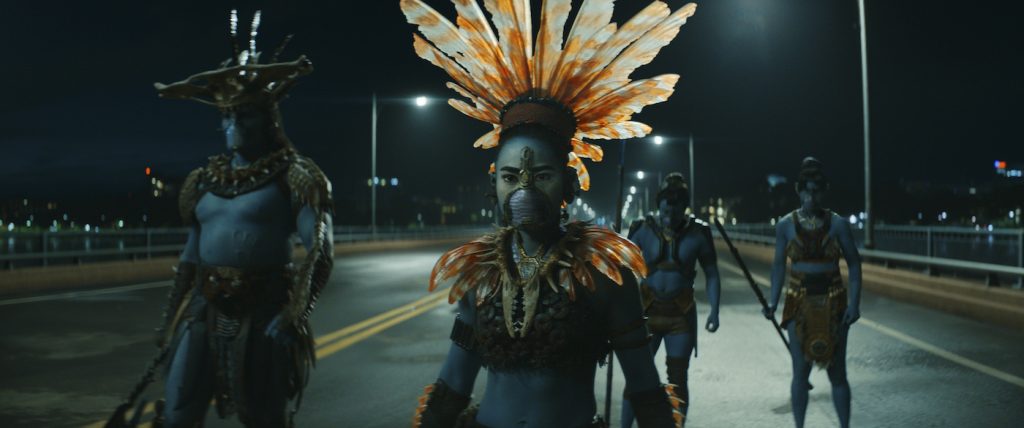
One of Black Panther: Wakanda Forever director Ryan Coogler’s closest collaborators throughout his entire Marvel journey has been composer Ludwig Göransson. Beginning with Coogler’s 2018 Black Panther, Göransson has been by his side, helping him breathe life into the music and sounds of the fictional African nation of Wakanda. Along with other key collaborators like costume designer Ruth E. Carter and production designer Hannah Beachler, Göransson’s talent has helped Coogler create the most immersive, richly detailed, vibrant world in the entire Marvel Cinematic Universe.
For Wakanda Forever, however, the stakes, emotions, and challenges were even higher than on the first film. Chadwick Boseman’s death at the age of 43 in August 2020 devastated the Black Panther family and millions of his fans around the globe. Göransson, who had read the initial, T’Challa-focused script for Black Panther 2, approached the re-tooled story, which Coogler and co-writer Joe Robert Cole agonized over in the wake of Boseman’s death, with serious trepidation. So much of the sounds of the original Black Panther, and many of its major compositional themes, were centered on T’Challa. Göransson and the rest of the Black Panther team had to find a way to tell a new kind of story that would be focused on grief and heartbreak. Art imitating life, on set and in the music studio.
Göransson succeeded, as did Wakanda Forever. Collaborating with megastars (Rhianna and Tems) and lesser-known but no less vibrant talents from Mexico, Nigeria, and beyond, the composer created a singular score for a blockbuster focused primarily on grief and the way the women of Wakanda processed that grief and found a way to carry on.
We spoke with Göransson about finding the sound of Wakanda Forever in ancient graves, music studios in Mexico City and Lagos, Nigeria, and why it was the simplest instrument, the human voice, that became the score’s secret weapon.
What were you thinking musically when you read the revised script for Wakanda Forever after Chadwick passed, after reading the original script written from the perspective of T’Challa?
In the beginning, I had no idea how I was going to do this. In the first movie, a lot of the things that we recorded in West Africa, like the talking drums and the themes, were so tied to T’Challa and Chadwick. After I read the second script, I was talking to Ryan, and I was like, ‘Are we going to re-use any of these sounds and themes?’ So I wasn’t sure how to go about it. So my approach instead was to start off with a completely new component and culture: Namor and the Talokans.
How did you approach creating the soundscape for this vast, secret underwater empire?
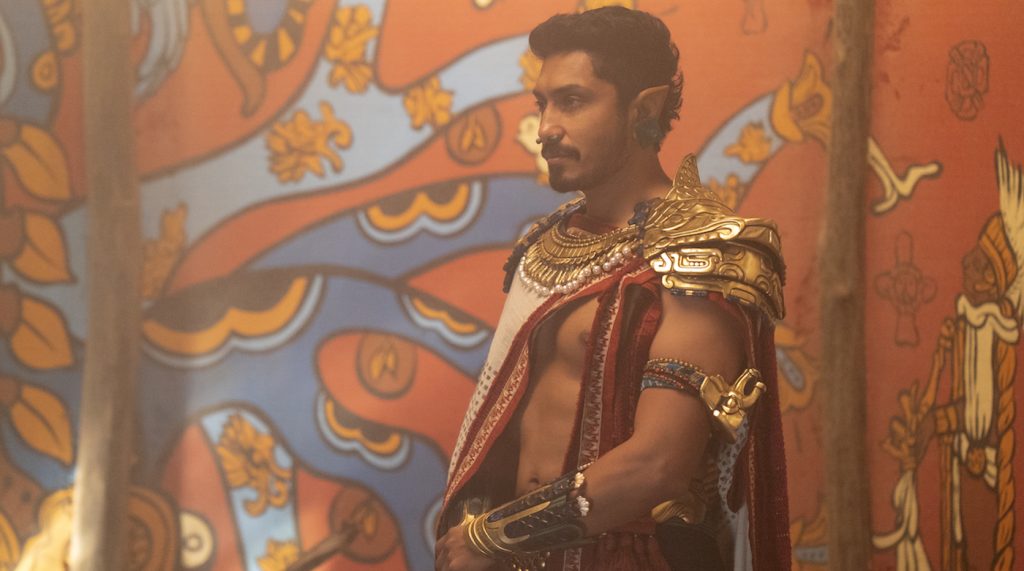
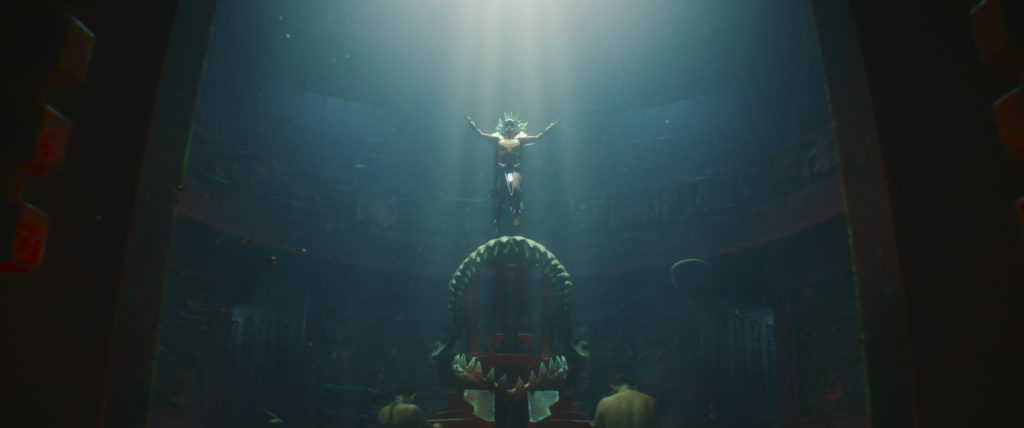
Namor and the Talokans were inspired by Mayan culture and history. I quickly realized that much of that history was erased; the Mayan music, dances, and books were all erased by force. So we don’t know exactly what it sounded like; there’s nothing scribbled down, and obviously, there are no recordings. In Africa, for example, those traditions are all passed down from generation to generation. But with Mayan culture, they were not allowed to play their instruments or even sometimes speak their language. So, I went to Mexico City, started working with some music archeologists, and tried to reimagine what the Mayan sound and music were like.
They’ve found instruments in the graves, like flutes, and you can see on the flute holes where the fingerprints were and which intervals were used the most. You can look at the codex and see different formations of musicians in the drawings, like five musicians playing seashells and three musicians behind them playing turtle shells. So through that research, we started to record and reimagine what Mayan music could sound like. That was an incredible journey because I got to work with these fabulous musicians and was introduced to many instruments I’d never seen before.
What were the instruments?
There’s a flute called The Flute of Truth, which is almost like a dog whistle. It’s played at such a high pitch you can’t be in the same room as the performer because it’s almost like torture. So that’s how it was used, they would play it for someone, and that person would have to tell the truth; otherwise, they wouldn’t stop. When the conquistadors came with their guns, the indigenous people didn’t have those weapons, but they had these instruments, so they would play these super loud flutes and paralyze them.
Which we see in Wakanda Forever when the Talokans use these flutes to hypnotize their enemies. What about the seashell?
The seashell became Namor’s main theme. So every day, I was recording these musicians and archeologists. At night, I recorded contemporary Mexican artists, singers, songwriters, and rappers to work on the songs for the movie. This was very different from what I did with the previous Black Panther and very different from what I’ve done so far in my career. For Wakanda Forever, I was tying together the songs with the score and making a completely immersive sound experience where you can’t tell the difference between which is which.
How did you actually marshall this vast archive of instrumentation and performances into a coherent score?
It can be a lot, but while I’m recording this material, I’m constantly sending it to Ryan while he’s shooting, and we have this back and forth. Then it was kind of magical a lot of the time, seeing how the songs fit in. In Namor’s origin story, we have a song that became a siren song with Quintana singing this beautiful melody. Then I worked with the rapper Mare, and I remember being in the studio, and she was blowing into the mic. I asked her, what if you start whispering your raps? Then in the film, there’s this underwater birth scene, and we put the mouth blowing there and the whispering there, and it was just a very cathartic, magical experience.
You’ve got the kora (a West African stringed instrument) and traditional African drums like the saber and djembe; you’ve got the flutes and seashells, the orchestral instruments, modern synthesizers, and more. Would you say there was any single instrument or sound that ties the whole score together?
I would say the thing really threading it all together is the human voice. We have some incredibly powerful female voices in the movie, with characters singing or humming, and then the Dora Milaje are doing ululations. When I was sitting down listening to the soundtrack and putting it together, I was listening through the score and thought, ‘Oh my God, it’s like there’s a voice through everything.’ Then when I watched the movie, it didn’t strike me how many vocals were in there; it felt natural. Like Shuri’s theme, the first time you hear it, she’s sitting by the river with her mother, Ramonda. First, you hear Ramonda’s theme, and that’s actually Rhianna’s “Lift Me Up.”
Then a split second later, Shuri’s telling her side of the story. She says she just wants to see the world burn because she couldn’t save T’Challa, and that voice turns into Jorja Smith’s voice singing a different melody. Shuri is split between spirituality and technology, she doesn’t know which path to take. But as she grows and finally finds herself, technology is the one thing that brings the Black Panther back to life. She uses that element, and that voice and the melody turn into a crazy distorted synthesizer to go with that side of her choice, the technology side of her.
You collaborated with so many musicians for this score, including Rhianna, Tems, Senegalese singer Baaba Mal, talking-drum player Massamba Diop, Mexican singer Foudeqush, and a community of Mayan rappers—how do you approach these collaborations?
It’s funny because when I started recording in Mexico, people were like, ‘You’re working on Black Panther; why are you recording in Mexico?’ So obviously, I had to tell them what the movie was about, the Mesoamerican storyline, and as soon as I did that, they thought it was fascinating. So everyone there immediately connected with it. Then when I went to Nigeria and Lagos, I went with Ryan, and it was almost like when we landed, people there knew immediately. They were so ready for it, already knew what they wanted to do, and were so pumped up. It was just about finding the right voices and doing the work.
Black Panther: Wakanda Forever is in theaters now.
For more on Black Panther: Wakanda Forever, check out these stories:
Just because the Merc with the Mouth is moving over to the Marvel Cinematic Universe, don’t expect him to be any less foul-mouthed, ferocious, or funny. That’s the promise that Deadpool 3 director Shawn Levy is making. In a conversation with Collider, Levy says that what fans have come to expect from the Deadpool franchise remains very much intact as they prep the third film, the first to officially fall under Disney’s MCU banner.
Levy is prepping Deadpool 3 with Reynolds and screenwriters Rhett Reese and Paul Wernick. Levy and Reynolds have already made two successful films together—Free Guy and The Adam Project, yet this is Levy’s first time directing Reynolds’ cinematic baby, so to speak, following Tim Miller, who directed 2016’s Deadpool, and David Leitch, who helmed 2018’s Deadpool 2.
“We are writing, rewriting, developing, prepping Deadpool every day now,” Levy told Collider. “It is such a blast to laugh every day. It is so delicious to hear and write and come up with these scenes where people are just talking foul. And the violence is in your face and hardcore, and it’s very much a Deadpool movie.”
While not a single frame of the film has been shot, there’s already been a ton of excitement surrounding this third go-round thanks, in part, to the announcement that Hugh Jackman will be reprising the role of Wolverine for the film. This is, of course, despite Wolverine’s very dramatic and bittersweet death in James Mangold’s Logan. The film is slated to begin filming around May 2023.
“I’m having so much fun, and I haven’t even hit the shooting floor yet,” Levy told Collider. “I have to say, developing a Deadpool movie is one of the most fun, creative experiences of my life because it’s not just that it’s rated R. It’s that it’s so filled with self-awareness, and that makes in-writing very, very fun in a way that is unique to that franchise.”
Now that the franchise is officially a Marvel movie, all those jokes in the previous two films about how Deadpool couldn’t get any of the proper Marvel superheroes on his side—he even visited Professor X’s School for Gifted Youngsters, and had to “settle” for the likes of Colossus (Stefan Kapicic) will likely be turned on his head. Especially considering Wolverine is now officially in the mix.
Deadpool 3 is set for a November 8, 2024 release.
For more on all things Marvel Studios, check out these stories:
The first trailer for Spider-Man: Across the Spider-Verse is here, and Brooklyn’s friendly neighborhood Spider-Man, Miles Morales (Shameik Moore), is in a Spot of trouble. Pun intended, of course, because the Spot (Jason Schwartzman) is one of the villains Miles will be facing in this sequel to 2018’s Oscar-winning Spider-Man: Into the Spider-Verse.
The trailer reveals Miles and his mother, Rio Morales (Luna Lauren Vélez), having a conversation in which Mama Morales is having a little trouble letting go of her baby boy. “It’s just hard to see my little man not being my little boy all the time,” Rio says. Rio wants to ensure her little boy is cared for, loved, and poised to go out into the world and do great things. We all know Miles has already done great things, and we see some of that action, including the moment when Gwen Stacey (Hailee Steinfeld) yanks Miles through the multiverse portal.
The trailer takes a turn there, with Miles under a massive assault from a slew of other Spider-Men. The gravest threat? That honor just might go to Miguel O’Hara (Oscar Isaac), also known as Spider-Man 2099, who attacks Miles and slams him down, hard. And he considers himself a good guy?
Joining Moore, Vélez, Steinfeld, and Isaac are returning stars from Into the Spider-Verse and newcomers alike. Those returning stars include Brian Tyree Henry as Jefferson Davis and Jake Johnson as Peter B. Parker The newcomers include Oscar-winner Daniel Kaluuya as Spider Punk, Issa Rae as Jessica Drew, Jorma Taccone as the Vulture, and Shea Whigham as George Stacey. The sequel is to be directed by the trio of Joaquim Dos Santos, Kemp Powers, and Justin K. Thompson. Into the Spider-Verse veterans Phil Lord, Christopher Miller, and Dave Callaham wrote the script.
Check out the trailer below. Across the Spider-Verse is set to hit theaters on June 2, 2023, and will be the middle installment of what’s planned as a trilogy, with Spider-Man: Beyond the Spider-Verse pegged for a March 29, 2024, release date.
For more upcoming films from Sony Pictures, check out these stories:
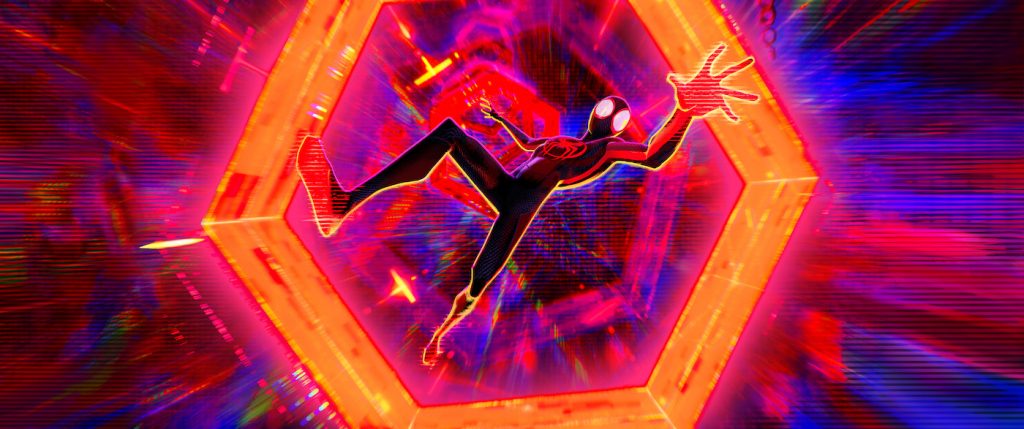
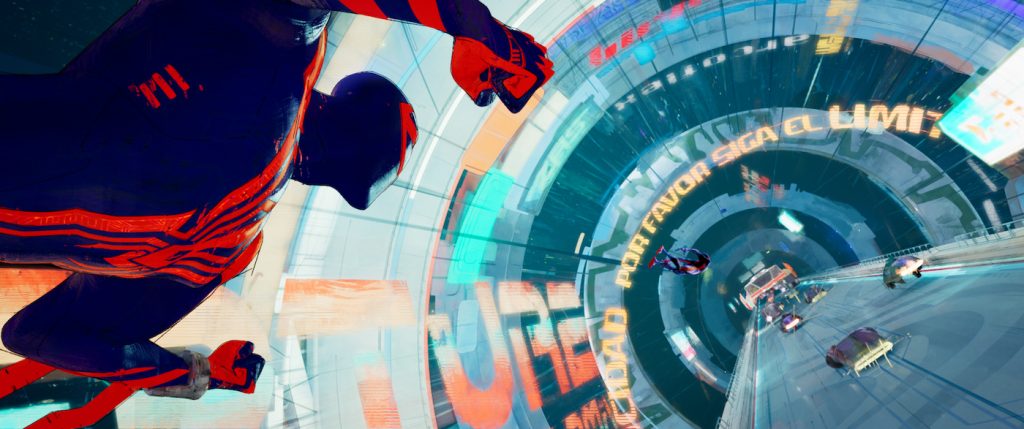
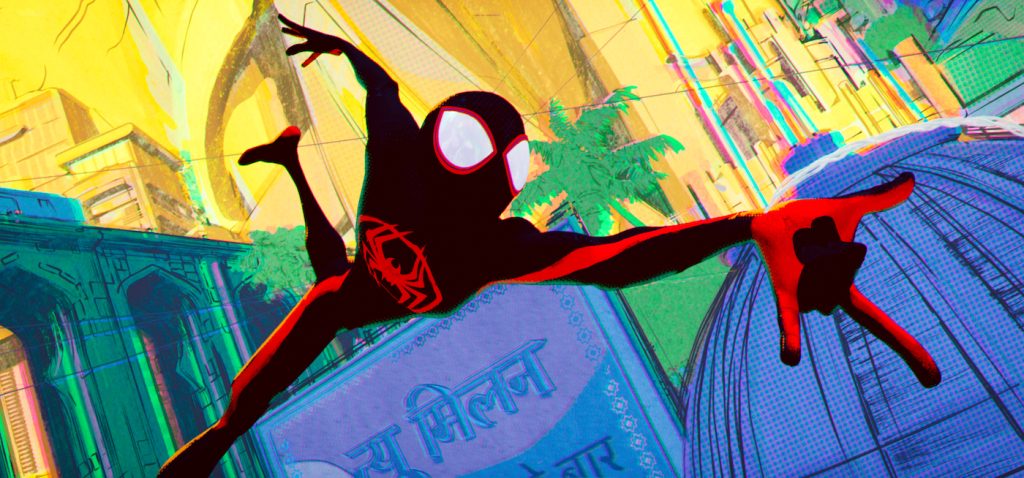
The first trailer for Spider-Man: Across the Spider-Verse arrives today, yet Sony has revealed a sneak peek via four new images.
The images remind us of what made Spider-Man: Into the Spider-Verse such a revelation. Those colors! That fantastic design work! The gorgeous animation makes the world of the Spider-Verse a Spidey fever dream, but the original film was rooted in the epic adventures of Brooklyn’s own Miles Morales (Shameik Moore) as he traversed across the multiverse encountering fellow Spider-People and lunatic villains. Across the Spider-Verse will continue that duality, with trippy animation nested within a story about a young, Afro-Latino Spider-Man and his growing group of Spidey-friends.
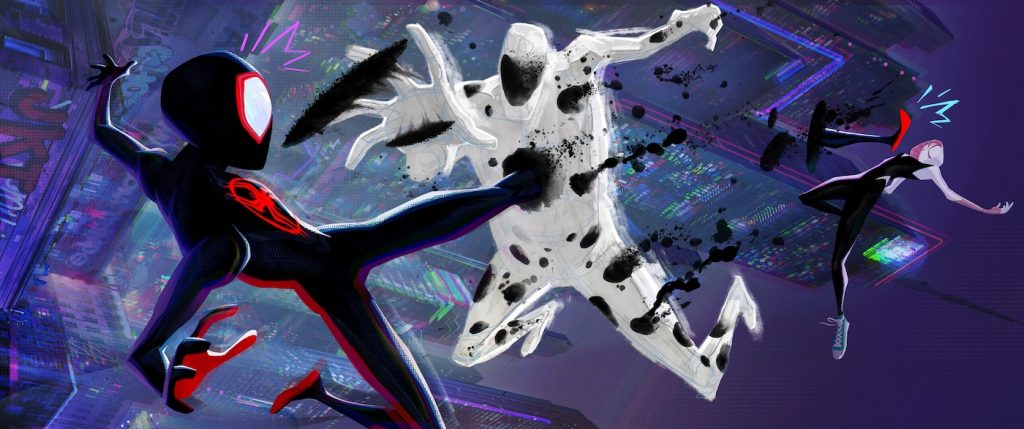
The new images reveal that Miles’ upcoming adventures are even more kaleidoscopic than his previous odyssey. One of the images reveals Oscar Isaac’s Spider-Man 2099, while the featured image shows Spider-Man and Gwen Stacy (Hailee Steinfeld) taking on the Spot (Jason Schwartzman).
The trailer will finally reveal Across the Spider-Verse‘s plot—or at least way more than the little we know about it now. We know that Oscar-winner Daniel Kaluuya is on hand as Spider-Punk, joined by Jake Johnson as Peter B. Parker, Issa Rae as Jessica Drew, Brian Tyree Henry as Jefferson Davis, Jorma Taccone as the Vulture, and Shea Whigham as George Stacey. The sequel is to be directed by the trio of Joaquim Dos Santos, Kemp Powers, and Justin K. Thompson.
Into the Spider-Verse veterans Phil Lord, Christopher Miller, and Dave Callaham wrote the script, with the original film’s directors, Peter Ramsey and Bob Persichetti, executive producing alongside Aditya Sood. Across the Spider-Verse is set to hit theaters on June 2, 2023, and will be the middle installment of what’s planned as a trilogy, with Spider-Man: Beyond the Spider-Verse pegged for a March 29, 2024, release date.
Check out the images below.
Spider-Man (Shamiek Moore) in Columbia Pictures and Sony Pictures Animation’s SPIDER-MAN: ACROSS THE SPIDER-VERSE.Spider-Man 2099 (Oscar Isaac) and Miles Morales (Shameik Moore) in Columbia Pictures and Sony Pictures Animation’s SPIDER-MAN™: ACROSS THE SPIDER-VERSE (PART ONE).Miles Morales (Shameik Moore) in Columbia Pictures and Sony Pictures Animation’s SPIDER-MAN™: ACROSS THE SPIDER-VERSE (PART ONE).Miles Morales (Shameik Moore) and Gwen Stacy (Hailee Steinfeld) take on The Spot (Jason Schwartzman) in Columbia Pictures and Sony Pictures Animation’s SPIDER-MAN™: ACROSS THE SPIDER-VERSE.
Featured image: Miles Morales (Shameik Moore) and Gwen Stacy (Hailee Steinfeld) take on The Spot (Jason Schwartzman) in Columbia Pictures and Sony Pictures Animation’s SPIDER-MAN™: ACROSS THE SPIDER-VERSE.
Both 2018’s Black Panther and this year’s Wakanda Forever have hugely impacted popular culture, not least by expanding the acceptance and expression of Afro-Futurism in everything from fashion and hairstyles to architecture. Both production designer Hannah Beachler and costume designer Ruth E. Carter won Oscars for their work on the first film and are in the running for a return to the podium with Wakanda Forever.
For Black Panther, hair department head Camille Friend found ways to incorporate elements of African tribal culture and expanded those influences in Wakanda Forever. She used the same trial and error and inventive thinking required to create looks that could be worn over the entire production or in challenging environments, like those underwater sequences in Talokan. How could the Mayan-inspired Talokani hairstyles look consistent when the cast members wearing them were submerged in water for over 12 hours?
In a chat with The Credits, Friend takes us through the problem-solving required to get those gorgeous looks in Wakanda Forever. She also considers the lasting effects her designs have had on pop culture and how she is helping Hollywood become more inclusive as the founder of Hair Scholars, which mentors and educates professional hair stylists about working in film and TV.
The hair design in Wakanda Forever was partly based on research into Senegalese warriors, the Zulu tribe, and the Maasai people. What are some of the direct results of that research that viewers can see expressed as part of the specific characters or specific scenes in the film?
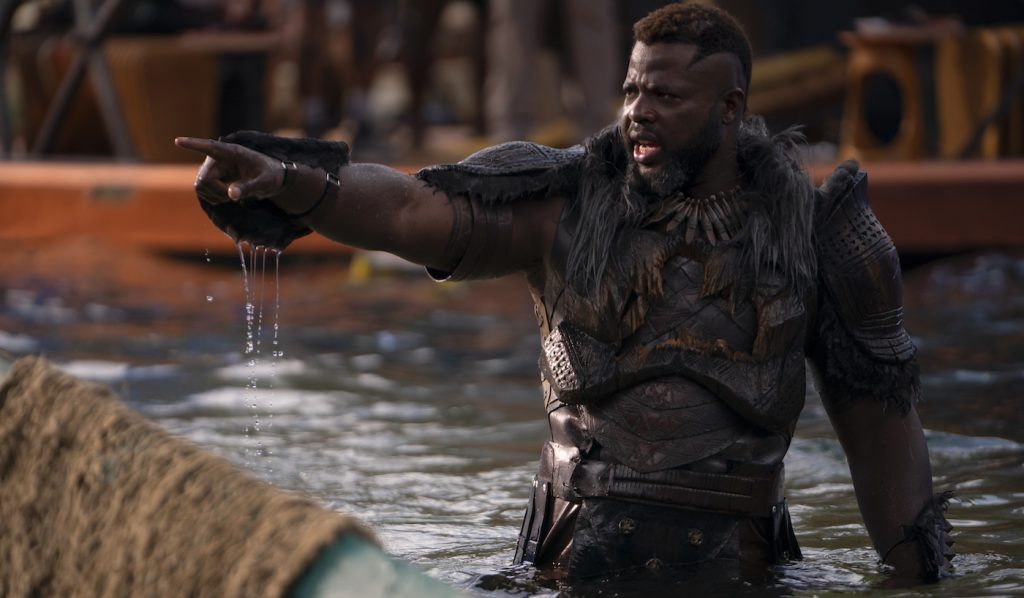
The Jabari are definitely inspired by Senegalese warriors. Even from the first one, you know, with Winston Duke, we really talked a lot about how the Jabari were going to look, everything from the angles of the cuts to the lines in the head, even the white paint. All of that really comes from Senegalese warriors. Then you have the Himba tribe, where you have the beautiful clay look on the tribal elders. I remember on the first one, Ryan said he really wanted to do a clay wig. I thought it would be easy. It was not so easy.
Yes! We had weeks of trial and error. After a while, I just had to pray to God for the answer, and actually, the answer was going to Home Depot. We ended up making a clay wig from different substances that would hold up and last during filming. This time, we got the clay wig down. We could do a clay wig in two days, whereas it used to take us a week. So we have evolved. It’s all basically plaster of Paris. I’ll tell you the steps. We basically take a braid wig, and then we put the plaster on top of it, and we smooth it with gloves and a little water. We let that dry, and then we go in and paint it. That’s what stays and lasts forever. We’ve got it down to a science. I’m very happy about that one.
Were there any elements pulled from history for the scenes of mourning and memorial for T’Challa?
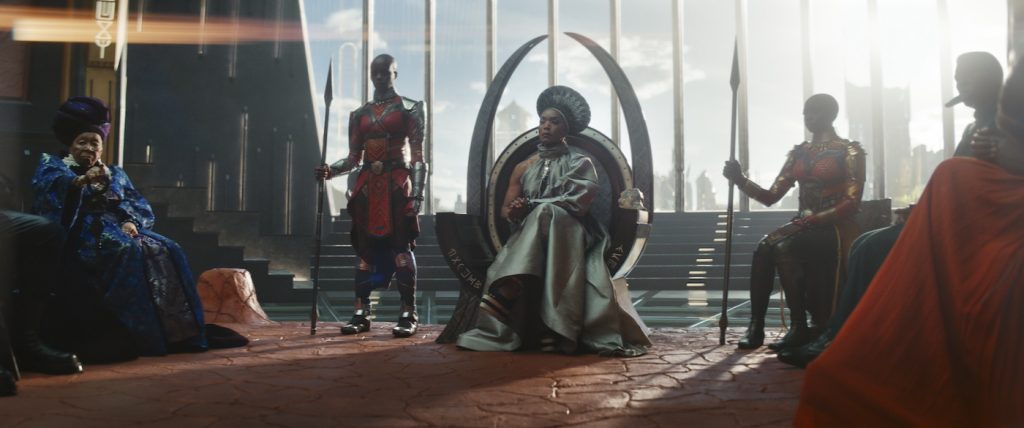
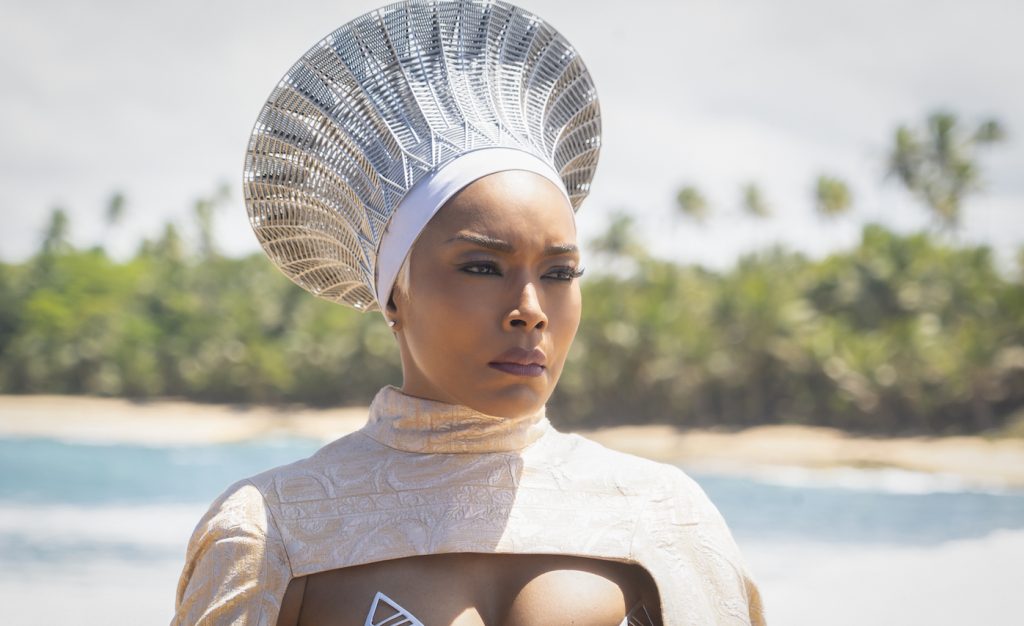
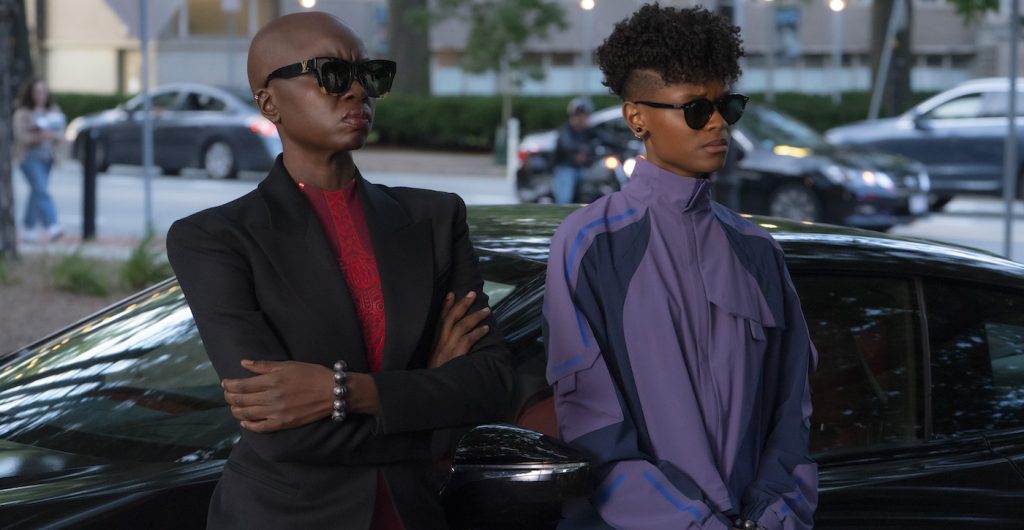
Definitely, I’ll tell you that backstory. The reason why Shuri and Ramonda’s hair ended up short is Ryan knew that in West African culture, when somebody is in mourning, they cut all their hair off. When we go into the story, it’s the year after T’Challa’s death, so how would their hair look a year later? That’s where my design began for those characters in Wakanda Forever.
How did you design the underwater sequences in Talokan? That had to be a challenge.
I’m going to say I have a whole different respect for water. In a lot of movies, you shoot them dry for wet. The hair is really dry, but we’re putting a little spritz on them. In Wakanda Forever, it was a whole different ballgame. When you have people thoroughly submerged in water for 12 hours a day, how will you make this happen? Plus, we could not put any product in the hair because hair product in water makes it cloudy. So how are we going to make this hair stay with no product in it? We had to figure it out, and again, it was through a lot of trial and error. What glues work? What glues don’t? We ended up using a lot of silicone glue because they hold up under water and they’re more of a flexible glue. We took spirit gum, broke it down with alcohol, and made it really thin. Then we made it into a hairspray that we would spray on all the pieces and let them dry. We figured out how to get it thin enough so that it wouldn’t change the color of the hair. Then we sprayed all the pieces with the glue hairspray that we’d made, and that’s how all the hair would stay up while in the water for 12 hours a day.
Can you talk about how both Black Panther and Wakanda Forever have had an influence in the real world in terms of access and expansion of hair products and designs for Black hair?
After the first one, a writer friend called and told us we made Black hair beautiful. After Black Panther, there have been so many more movies that have showcased natural hair. I’m so proud that we could have an impact in starting that movement. I have people who hit me up on Instagram and tell me, “My daughter was so happy to see somebody that looks like her onscreen.” They saw somebody whose hair texture was the same. Also, 3C or 4A, B, or C textures were very hard to find on the first one. We had to make it. We had to perm it. It was a lot of work that we had to do. On this one, every manufacturer has that now. I think culturally, that’s what’s changed. Even with products, I was doing some research recently and found over 40 Black-owned, female-owned haircare companies. That’s a beautiful thing to have that many in the marketplace.
It’s the whole spectrum of natural hair, both on the screen and off, being celebrated.
I think there’s a huge difference. And we have things like the C.R.O.W.N. Act, which has legalized wearing your hair naturally. You can wear your hair in any style that you want and still be in the workplace. It doesn’t matter if you’re a lawyer, doctor, or a short-order cook; you have the right to wear your hair naturally, how it grows out of your head. The younger generation will grow up with that, without any shame about their hair. It just gives us such better body positivity and gives us so much more of a beautiful image and confirmation that Black hair is beautiful.
And to further push the needle forward in Hollywood, you founded Hair Scholars, which has its own website and is having a big impact on inclusivity in the business.
It’s one of my greatest passions. I’m a firm believer in equity and inclusion. I used to work for Warner Brothers, and that’s what I did for them. It’s about education. Education is freeing for people. What I love to teach is how to be in the business, how to treat it as a business, how to make your deals, and how to be a department head because that’s definitely what people are looking for, is equity in the business. This is how you put on a wig. This is how you do textured hair. So all those things, together, will make a better community. At this point, a lot of producers call me on movies that I don’t even do, and I help people crew up because I know the people in LA, New York, London, and Atlanta; I know all the people and what their skill sets are. I’m perfectly happy to do that. Whether you’re white, Black, Native American, Asian, or Filipino, there’s absolutely no excuse why a performer sits in the chair and you, as a professional hair artist, makeup artist, or barber, cannot do their hair. That is unacceptable in 2022 and 2023 and going forward. Every performer has a right to walk into the trailer and sit down in the chair and be taken care of and feel beautiful.
Black Panther: Wakanda Forever is currently in theaters nationwide.
For more on Black Panther: Wakanda Forever, check out these stories:
Co-writer/director Denis Villeneuve’s Dune: Part Two has officially wrapped filming. We learned this from Paul Atreides himself—Timotheé Chalamet—via an Instagram post. The image shows Chalamet in the desert, along with his father Marc, and the caption “DUNE 2 WRAPPED (with desert dad !!).
Dune: Part Two will now move into post-production, where editing, visual effects, sound, color correcting, and a whole lot more will be fine-tuned. The sequel will pick up where Dune left off, with Paul Atreides and Lady Jessica (Rebecca Ferguson) moving deep into the Arrakis desert with the Fremen, led by Stilgar (Javier Bardem), and with Chani (Zendaya) taking on a much larger role, as they plot to strike back at House Harkonnen.
Chalamet, Ferguson, Bardem, and Zendaya are joined by returning cast members Josh Brolin as Atreides ally Gurney Halleck, Stellan Skarsgård as Baron Vladimir Harkonnen, and Dave Bautista as Glossu Rabban Harkonnen. New cast members include Léa Seydoux as Lady Margot, Florence Pugh as Princess Irulan Corrino, and Austin Butler as Feyd-Rautha Harkonnen.
Dune: Part Two will complete Villeneuve’s vision for adapting Frank Herbert’s seminal, meaty 1965 tome. He and his fellow Oscar-nominated co-writer Jon Spaihts had made a bold (and brilliant) decision to cut Herbert’s novel in half instead of trying to fit the entire epic into a single film. Their decision paid off when Dune was a critical and commercial success and the sequel was greenlit. Now, Villeneuve is one step closer to completing his adaptation.
Check out Chalamet’s update below. Dune: Part Two will hit theaters on November 3, 2023.
Featured image: Caption: (L-r) ZENDAYA as Chani and TIMOTHÉE CHALAMET as Paul Atreides in Warner Bros. Pictures’ and Legendary Pictures’ action adventure “DUNE,” a Warner Bros. Pictures and Legendary release. Photo Credit: Courtesy of Warner Bros. Pictures and Legendary Pictures
Joker: Folie À Deux has officially begun filming. How do we know this? Co-writer/director Todd Phillips has shared an image from the sequel to his critical and commercial 2019 hit Joker on Instagram, revealing Joaquin Phoenix’s Arthur Fleck catching a shave. The caption simply reads: “Day 1. Our Boy. #joker.”
I’m not sure I’d go so far as considering Arthur Fleck my boy, but you can’t fault Phillips for being excited about going deeper on this troubled, would-be comedian and killer after the success of Joker. And the sequel is not short on intrigue. For starters, Lady Gaga is co-starring with Phoenix as Harley Quinn. The two of them will get to embody arguably the most demented relationship in the entire comic book canon. Folie À Deux refers to the medical term for insanity shared by two or more people, which certainly fits the romance between the Joker and Harley. Plot details are, of course, being kept secret, but we know that Brendan Gleeson has also joined the cast, and, incredibly, the film will be a musical.
The first image looks more in line with the original film’s moody, gritty tone and less like a still shot from a fun, colorful musical. Yet considering Gaga’s immense talent and the desire by all involved not to simply follow the playback from Joker, we should expect Folie À Deux to upend our expectations. Yet there’s little chance Phillips and his team won’t double down on just how un-superhero-y the first film was.
It’ll be a while until we get a trailer for Folie À Deux, but we’ll keep an eye on any updates Phillip or the cast shares from production. Joker: Folie À Deux is due to dance and sing its way into theaters on October 4, 20
For more on Joker: Folie á Deux, check out these stories:
Featured image: Caption: JOAQUIN PHOENIX as Arthur Fleck in Warner Bros. Pictures, Village Roadshow Pictures and BRON Creative’s “JOKER,” a Warner Bros. Pictures release. Photo Credit: Niko Tavernise
In Darren Aronofsky’s The Whale, Brendan Fraser is transformed so completely he is nearly unrecognizable playing the title character. Fraser has been the frontrunner for Best Actor in the Oscars race since the film received a six-minute standing ovation at its Venice International Film Festival premiere in September.
The film is based on Samuel Hunter’s award-winning 2012 play of the same name, which is inspired by Hunter’s own challenges with eating disorders and growing up gay in the Midwest as part of an evangelical community. The story centers on five days in the life of Charlie, a reclusive English professor still mourning the loss of his partner. Charlie is working to reconnect with his estranged daughter Ellie (Sadie Sink), a teen who seems to feel nothing but disdain and bitterness for her father.
The Credits spoke to Hunter about his connection to the material, both as a playwright and screenwriter, the inspiration he took from Walt Whitman’s “Leaves of Grass,” and the importance of optimism even in the face of dark realities.
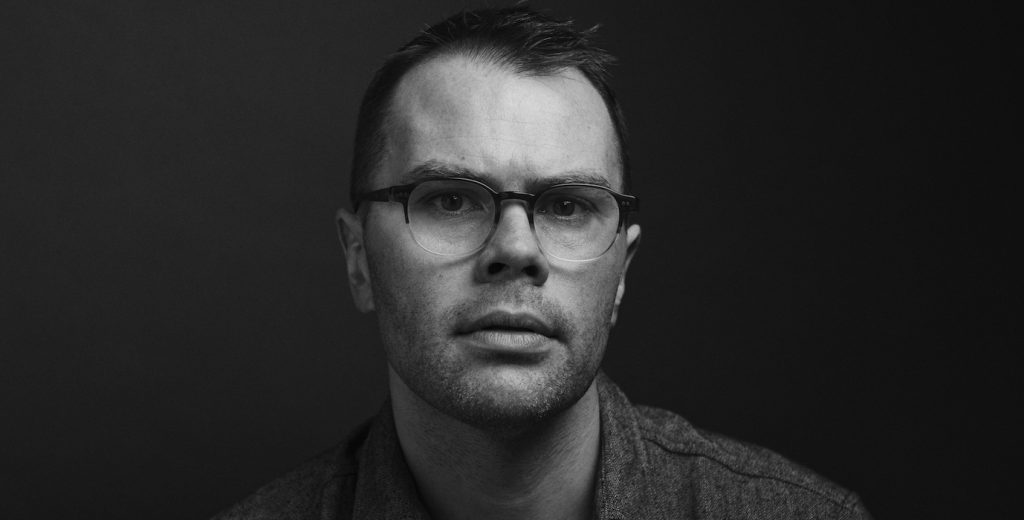
Samuel Hunter. Courtesy A24.
What were some of the references for your own life that inspired the writing of The Whale? And in terms of the experience of having had a food addiction, being a larger size, and having emotional trauma that you were carrying?
I had been writing plays, but my plays up until The Whale were kind of like student writing. In those plays, I was figuring out structure, I was figuring out the landscapes that I was interested in, and the dramatic vocabulary I was interested in. But there was something with The Whale where I left the tools behind.
What shifted for you?
I just wanted to write something from a scary and deeply personal place, a place of growing up gay in North Idaho in the 90s, where Matthew Shepard was murdered one state away when I was 16 or 17 years old, and attending a very fundamentalist religious school where I hide that part of myself until I was outed and had to leave. Once I left and came out of the closet, I moved to New York to go to NYU and become a playwright, where it’s safer to be gay. I arrived in New York thinking, “Here I am.” But I was still a very young person, and I had not properly processed everything that I had gone through over the last few years. Because I hadn’t, and I was always a big kid, but in college, it got pretty bad. I didn’t feel like I fit in with the gay community at NYU at all because I didn’t fit within their prescribed ideas of beauty. I did well in school, and I worked hard, but I was isolated. I spent a lot of time in my dorm room self-medicating with food and getting pretty big. I was able to find an off-ramp, the biggest off-ramp being when I met my husband in 2005. I had that love and support, and love and support of my parents, too, so I was able to, over many years and many therapy sessions, work my way out of that. Writing The Whale was not the final piece of it, but a big piece of that personal reckoning for me.
There are so many kinds of loss explored in this story, not just the loss Charlie experiences, but for him, it’s like grief is a ghost that haunts him.
So many people have dealt with loss in so many different ways. Grief is a fundamental aspect of modern life, and I feel like it’s under-explored. There’s a value in grief. Grief is what we do with love after we lose it. There’s this fundamental kind of positivity about it. I don’t believe in closure. The myth of closure is really toxic, actually, because it makes people feel bad for not being able to let things go.
In the film, there’s redemption but not really any closure.
For all the stories in the film, there’s a kind of closure, but it’s not this neat thing where everybody goes their separate ways. I’m thinking about the Thomas storyline. He doesn’t leave that apartment with any amount of certitude about anything. If anything, that’s the gift that Charlie has given him. “You live in the gray, kid, you don’t live in a black-and-white world.” We all live in that gray. Loss has a lot to do with living in that gray. On a daily basis, we’re always negotiating our own traumas and our own senses of loss by just trying to be human beings and trying to be kind and trying to live our lives with meaning and substance. There are all these little pebbles that we accumulate that weigh us down in different ways. All five of these characters are weighed down by those things, and they’re desperate to shed them, but we can’t. We can process them. I think that’s the tragedy of Charlie is he never had that therapist or personal reckoning. He’s just still carrying all of this grief and trauma around.
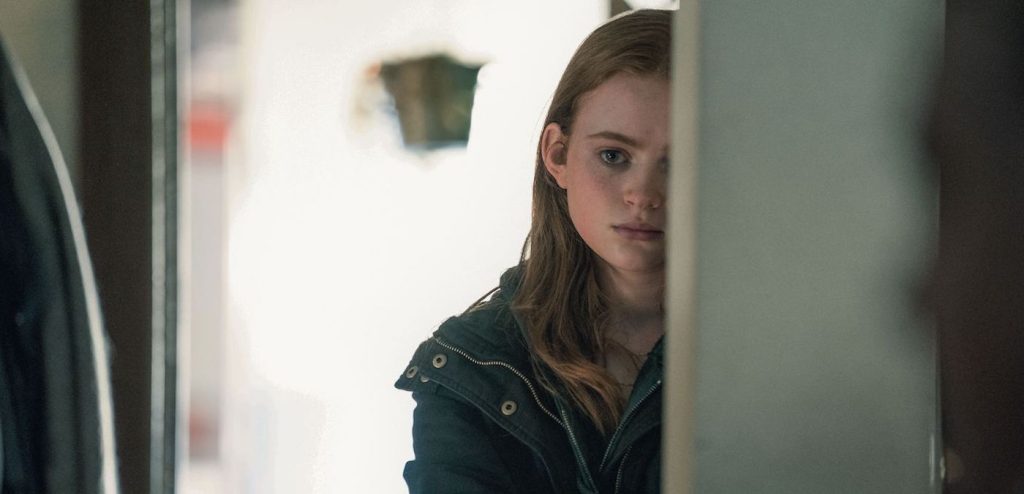
Sadie Sink in “The Whale.” Courtesy A24.
In the film, Leaves of Grass is referenced. Walt Whitman once said his book of poems was “the most religious book among books crammed full of faith.” It definitely has a lot of religious influences. How did it figure for you in the screenplay and the play?
There’s something about Leaves of Grass that is so humanist at its core. I’ve had a long story with my own relationship to faith. When I left that school and moved to New York, I think I had this idea I was leaving all that behind, but there is just a part of me that was like, “Nope.” It’s never going to leave me. I think I do have a fundamental worldview that feels Christo-centric, in both good and bad ways, in ways that I’ve had to unpack. The beautiful thing that I take away from Christianity and still hold very dear to myself is the sense of grace, forgiveness, redemption, and love. When religion is doing its best, that’s what it’s doing. It’s plugging into those values and lifting people up. I chose “Leaves of Grass” because it does feel very religious, but it’s also so humane.
Humanism as religion.
It’s the religion of love, of people, interaction, connection, and communication. That’s where a lot of modern day evangelicals misstep; they stop thinking it’s about other people. They think it’s just about God and vengeance and punishment and rules and tribalism. I had to leave that school because I was no longer part of the tribe there. They were telling me that couldn’t be there if identified as gay. I was like, “Okay, I broke the rule, so I’m out.” That was easy for them. It’s very clear. These are the people who are allowed in the door, everybody else needs to stay out. Leaves of Grass is so radically inclusive, and it was published in the 1850s.
There’s a quote in the film about people being incapable of not caring. And there’s definitely a battle between cynicism and optimism at play. In what way do you see the film as a message of hope?
It’s pretty dark, but here’s the thing: I’m not interested in easy hope. I’m not interested in facile hope, because I think hope is hard. Hope is really hard, especially right now. I think there’s this really idiotic notion that being cynical is also being intelligent or that saying cynical things like the world’s going to hell demonstrates sophistication. Cynicism is so easy and boring and pointless. Especially as a dad, now, I just can’t be cynical. I’ve never been a cynical person, but now especially. How can I say the world’s burning and then actively raise a child in that world? I think the play and the movie are all about hard-won hope. The valuable hope is the stuff that you actually have to earn. Faith is hard. Faith takes work, especially faith in other people. It takes work and dedication, and that’s what the movie is fundamentally about.
The Whale plays in select theaters December 9th and nationwide on December 21st.
For more interviews with filmmakers, check out these recent stories:
It’s that rare thing in our current era of whole-season episode binging where a single series, with an episode-per-week release schedule, seems to capture everyone’s attention at once. This was definitely the case for the second season of Mike White’s The White Lotus, which began by promising multiple deaths at the eponymous Sicilian resort and spent seven episodes building to them and creating a delicious amount of speculation among the viewing public about who was leaving Sicily with a toe tag. If you’re anything like this writer, you had multiple text threads with multiple groups of friends that became devoted to the series and took on the feel of a Reddit subthread. At last, we have our answer. Spoilers ahead.
Whereas season one of The White Lotus was a biting social satire centered on money with a surprise death in the finale, season two was built as a who-dun-it, with sex and death at its very core. We learned in the opening moments of the season that Daphne (Meghann Fahy), on her final swim in the Ionian sea off the coast of the resort, comes across a dead body. Then, when The White Lotus resort’s director Valentina (Sabrina Impacciatore) is alerted to the tragedy by her much-maligned staffer Rocco (Federico Ferrante), we learn that “a few” people have actually died. We were no more than two minutes into season two, but the game was already afoot. Who was going to die? Who would be the killer? Which one of the disaffected guests would meet their fate?
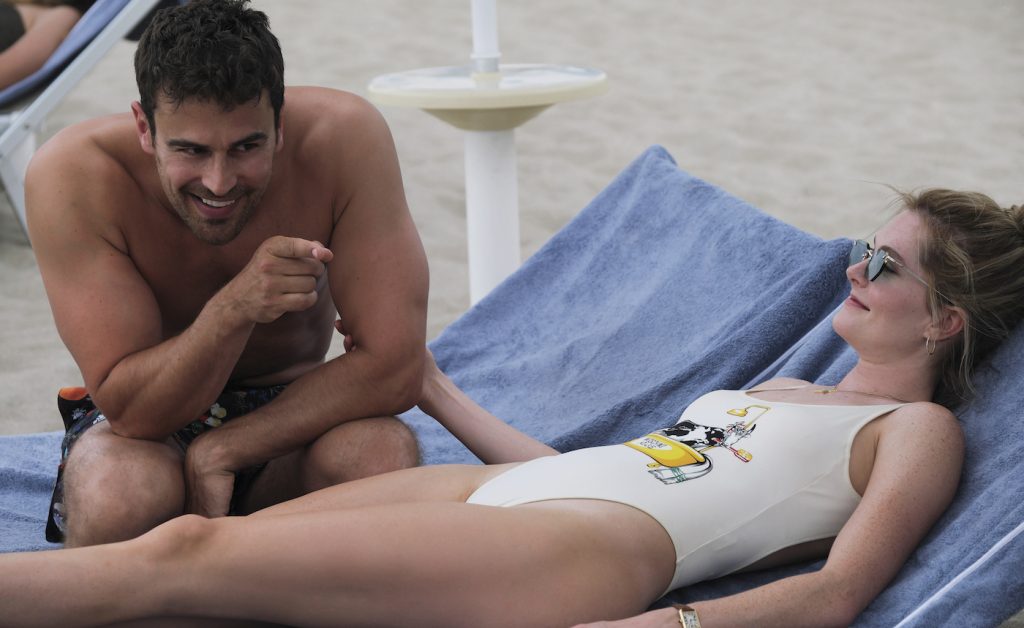
Theo James, Meghann Fahy. Photograph by Fabio Lovino/HBO
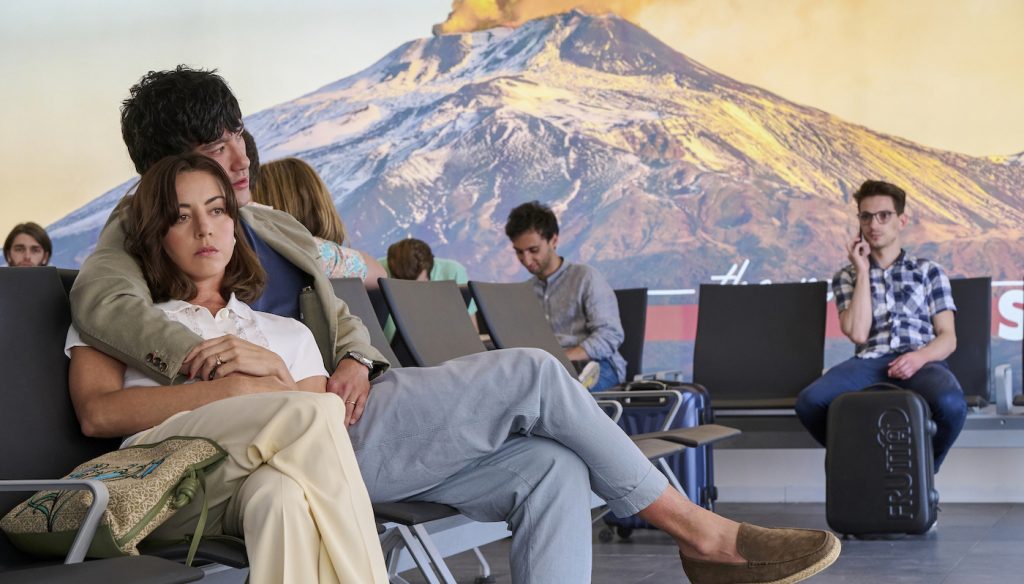
We knew Daphne, Valentina, and Rocco would survive, but they were the only characters we could say that about. And throughout the season, Daphne herself was given reasons to have possibly put that dead body (or bodies) in the water. Might the body Daphne “discovers” in the opening belong to her philandering, finance bro husband Cameron (Theo James)? Or what about Cameron’s mopey, newly super-rich college roommate Ethan (Will Sharpe), who, as the season progressed, turned out to be a bit of a rage ball and whose faltering marriage to his wife Harper (Aubrey Plaza) became a source of tension, and paranoia, between him and Cameron? Might Ethan have killed Cameron, or might they both have died, fighting over Cameron’s possible seduction of Harper? Maybe Daphne and Harper killed them both? Did Daphne kill Harper after finding out something happened between her and Cameron? These four characters alone had enough drama to fuel a tragedy, and yet there were plenty more possible killers and victims in season two.
Beatrice Granno, Simona Tabasco. Photograph by Fabio Lovino/HBO
Or what about the Italian American Di Grasso family, traveling from Los Angeles to reconnect with their Sicilian roots? Father Dominic (Michael Imperioli), another philanderer, quickly finds two local girls, Lucia (Simona Tabasco) and Mia (Beatrice Grannó), to pay to pass the time. Lucia, especially, seems ripe to take center stage in the death plot. She’s got an aggressive pimp who would be a likely source of violence—that is, if that’s what he actually is and he isn’t part of some overarching scam she’s running. Dominic’s father, Bert (F. Murray Abraham), a frisky oldster with a penchant for unwanted flirting, was certainly the most likely person to meet a bad fate, no? The man fell multiple times in the first few episodes. Or, the son, Albie (Adam DiMarco), a painfully earnest Stanford grad who in short order falls in something adjacent to love with Lucia, the young woman his own father has already paid to sleep with, who seems ripe to die. For one thing, he becomes, predictably, convinced he can save Lucia. For another, he seems like the type of guy who makes a big, grand gesture having to do with his decency and fraught masculinity and dies in the process. Might Lucia be entrapping them all with deadly results? Or, this being a Mike White show, wouldn’t it make sense for Lucia and Mia to be the ones to pay the prices, much as the manager of the White Lotus in Hawaii, Armond (Murray Bartlett), was the one who suffered at the hands of the obnoxious guests in season one?
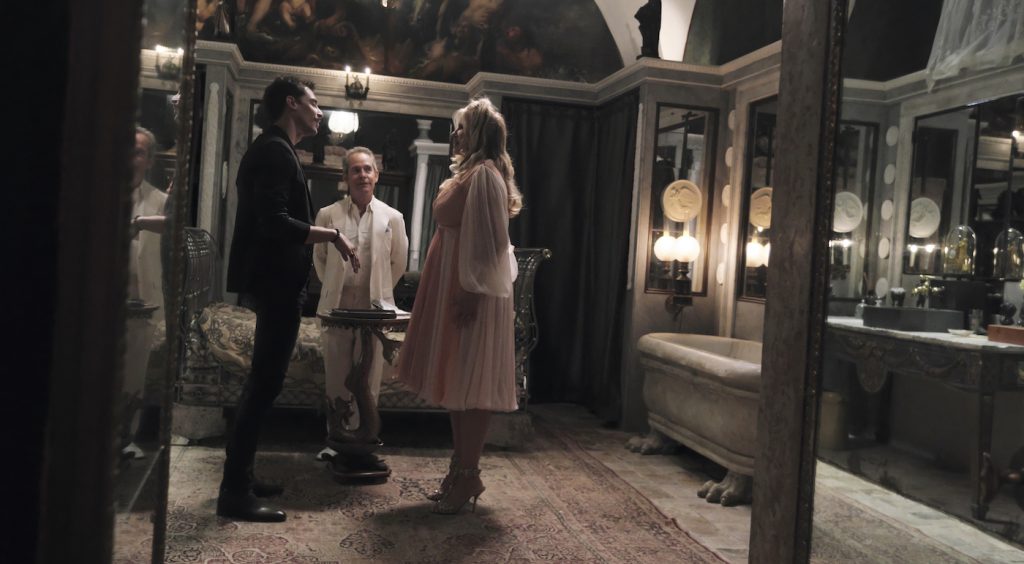
And then, there were the only crossover characters from season one, Tanya (Jennifer Coolidge), the multi-millionaire heiress with money to burn, and her deeply unpleasant new husband, Greg (Jon Gries), who we learn fairly early on loathes her and seems to be playing her for her money. Tanya’s assistant Portia (Haley Lu Richardson) is swept up in the drama, first kissing Albie, then sleeping with Jack (Leo Woodall), the supposed nephew of Tanya’s new bestie Quentin (Tom Hollander), a rich gay Brit who owns an insanely gorgeous Palazzo in Palermo and seems to have been planted in the White Lotus solely to charm and fete Tanya, with growing intensity, until even Tayna herself starts to doubt his sincerity. With so much foreshadowing of Tanya’s potential demise (Quentin takes her to see Madam Butterfly at the opera, and she muses it seems like a coded message that she’s going to be the heroine who dies at the end), one of the dead bodies at the end of season two couldn‘t be Tayna’s, not with so much evidence pointing that way.
Stefano Gianino, Tom Hollander, Jennifer Coolidge. Photograph by Fabio Lovino/HBO
Well…the dead body that Daphne swam into in the opener was, in fact, Tanya. However, Tanya’s death came after she refused to be the victim of Quentin’s dastardly plot to kill her and split the windfall of money surely to flow Greg’s way after (A photo of a young Quentin and young Greg, at Quentin’s palazzo, alerted Tanya to something darker going on). Portia knew something terrible was coming when she realized the handsome but unhinged Jack, who had essentially abducted her and taken her to Cefalu, was not who he said he was. He left her on the side of the road, near the airport, and told her not to mess around with Quentin or his cohort. This was while Tanya was uncovering their plot on board their yacht and trying, and failing, to shoot her way to freedom.
Tanya uncovered the hit that had been planned on her life and shot her way to near freedom on Quentin’s yacht, killing nearly everyone on board. Her problem? She had to get down to the dinghy tied to the yacht and, in the process, fell overboard, slammed her head against the metal railing, and drowned. Cue Puccini.
Naturally, when Tanya is face down in the water, she’s framed like an opera heroine, and, in fact, the swelling music and the beauty of the composition (she looks angelic in death) evoke Puccini’s iconic opera Madam Butterfly one last time. In an interview with White in an after-the-episode special on HBO, the creator said he’d had the idea to center season two on Tanya’s death while they were filming the season one finale. In that episode, Tanya told Greg, “I’ve had every kind of treatment over the years. Death is the last immersive experience I haven’t tried.” So, White brought Tanya back so she could have that experience. He went on:
“Not that I really wanted to kill Tanya, because I love her as a character, and I obviously love Jennifer, but I just felt like, we’re going to Italy, she’s such a kind of diva, larger-than-life female archetype; it just felt like we could devise our own operatic conclusion to Tanya’s life and her story.”
White hinted that season three of The White Lotus might resolve some of the lingering questions from season two, including Greg’s culpability in the murder plot. He said that if season one was all about money, and season two about sex, season three, set in Japan, will be a “satirical and funny look at death and eastern religion and spirituality.”
There are a lot of questions that remain from season two. Did Harper and Cameron sleep together? White says it was probably just a kiss but that the specter of infidelity freed Ethan in a sense. “It kind of brings back that first sexual charge that happens in the beginning of relationships and sometimes fades away over time. By the end you’re like, well, maybe what Ethan and Harper need was just a small dash of what Cameron and Daphne have.”
Aubrey Plaza and Will Sharpe. Photograph by Fabio Lovino/HBOa
Michael Imperioli’s Dominic seems to be getting another shot at redeeming his marriage, which we learned on a phone call towards the end of the episode. While both Portia and Albie got played, respectively, by the messed up Jack and Lucia, they exchanged phone numbers at the airport and might have their own fling, or more, in the future.
Tanya’s future, however, is no more, but what Jennifer Coolidge brought to the first two seasons of The White Lotus will be hard to replace. Yet it will be really fun to see Mike White try in season three. That’s a ticket many, many people are eager to book.
For more on Warner Bros., HBO, and HBO Max, check out these stories:
This is a major casting coup. Michelle Yeoh, coming off a big year with her incredible performance in the astonishing Everything Everywhere All At Once, is joining the cast of director Jon M. Chu’s Wicked films.
Varietyreports that Yeoh will be playing Madame Morrible, the headmistress of Crage Hall at Shiz University, joining a star-studded cast that includes Ariana Grande as Glinda and Cynthia Erivo as Elphaba. Bridgerton star Jonathan Bailey will play Fiyero, while Broadway veteran Ethan Slater will play Boq. The two Universal Pictures films will be released on Christmas in 2024 and 2025.
Wicked, of course, has been a best-selling book and a best-selling Broadway show, and tells the story of how Elphaba turned into the Wicked Witch of the West and how Glinda became the Good Witch, in The Wizard of Oz. Madame Morrible, a canny, opportunistic figure, sees her own future political power in Glinda.
As Chu said when the film was announced, it was decided that the adaptation needed to be big. So big, in fact, it couldn’t be contained in a single film.
“We decided to give ourselves a bigger canvas and make not just one Wicked movie but two,” Chu wrote in his announcement statement. “With more space, we can tell the story of Wicked as it was meant to be told while bringing even more depth and surprise to the journeys for these beloved characters.”
For more on Universal Pictures and Focus Features projects, check out these stories:
Featured image: TORONTO, ONTARIO – SEPTEMBER 11: Michelle Yeoh attends the TIFF Tribute Awards Gala during the 2022 Toronto International Film Festival at The Fairmont Royal York Hotel on September 11, 2022 in Toronto, Ontario. (Photo by Jeremy Chan/Getty Images)
As the Wood Sprite (Tilda Swinton) grants Geppetto’s (David Bradley) grief-stricken wish to bring forth a son from his wood carving, Guillermo del Toro’s Pinocchio draws life where there are only puppets and sound where there is only silence. The hearty revamp of Carlo Collodi’s classic is so engrossing, you may not recognize the meta miracle the movie accomplishes in an inanimate world. However, there are endless marvels to be seen and heard.
Sound designer/supervisor Scott Martin Gershin developed a sound library that is as expressive as the film’s characters. “I have to give Pinocchio (Gregory Mann) emotion with sound,” he described. “At one point, he’s embarrassed – like he apologizes – and he does a cute wave. I could do a very delicate squeak that was so endearing to the moment. So, what you’re constantly doing is taking inanimate objects and trying to figure out how to make wood, rubber, and metal squeaks to give it emotion. To glue it to a picture in such a way that it’s not annoying, but it has personality.”
Nothing about the stop-motion movie is as straightforward as it may seem. Developing many of the sounds in a literal way will not yield the intended result. Matching the action with effective audio often requires creative solutions.
“It’s a puzzle. It’s a puppet. We gotta go get a puppet and record a puppet. Sounds like bowling pins,” Gershin recognized. “Well, we’re getting an old puppet. Well, old puppets don’t work. So now you have to start using your imagination. What does work?”
Instead, Gershin turned to a musically inspired source for Pinocchio’s wooden sounds. He contacted Paul Reed Smith guitars to acquire truly unique and handcrafted wood. But like the film’s hero, these “guitars” have no strings.
“I said, ‘I’ve got this crazy idea. I know when you guys cut the wood for guitars, you always have scraps. I’m wondering, can I get your scraps?’” Gershin recalled. “And [Paul] was like, ‘Sure.’ So he sent me fifty pounds of scraps. But it was all like Brazilian rosewood and mahogany and flame maple and very tonal wood.”
Gershin’s musical inclinations are reflected throughout his work. The dramatics of a well-composed piece are akin to the structure of a sonic arc.
“As a musician, I like things to phrase, and everything resolves,” Gershin described. “I sometimes go up to create tension because most times when you resolve on an up, it feels awkward. So, part of what I have to do is be an audio psychologist. I’ve got to push people’s buttons based on sounds.”
With his signature sound library assembled, Pinocchio was ready to set off on an epic journey through adolescence. The dark new vision from del Toro is the most daring interpretation yet, filled with monsters, a chilling reeducation camp, and even visits to a bureaucratic afterlife. Pinocchio learns and grows with an audio track that reflects his developing maturity.
“When Pinocchio is first created and born in the first 15% of the show, he sounds like he’s going to fall apart,” Gershin noted. “He sounds like if you hit him, it would sound like a bunch of Lincoln Logs. His nails are sticking out, and he looks very haphazard, and he looks fragile.”
Eventually, Pinocchio finds his wooden footing and even learns to dance. His innocence is endearing and unpredictably insightful. As his personality takes shape, Gershin fills out Pinocchio’s audio palette.
“But then, as he keeps talking and moving and then scenes go on, I start fading away that [fragility]. Now he becomes a character who you love. So, you start taking away the ‘it’ and turn it into the ‘he’ in a way that doesn’t force itself on the audience.”
Once viewers are familiar with the characters’ expressions, Gershin can manipulate them to serve the story. A return to form can be equally impactful as introducing a new element. A previous sound cue can speak volumes.
“There’s a time later in the film where [Pinocchio] is exhausted, and he’s being pushed beyond his limits, and he collapses, and I revisit the fragility that I introduced at the beginning,” Gershin revealed. “You want to remind the audience in ways that aren’t obvious. When you hear it, you should automatically go, ‘I know what that means. I know what that is,’ without having to think about it. You should just feel it.”
Gershin worked with foley artist Dan O’Connell to create the library of sounds that were used for the film. Gershin estimates that 99% of Pinocchio’s sound alone was recorded from scratch. Of course, not a single sound is organic in animation. Everything we hear must be added and is truly intentional.
“People just think there’s a microphone perfectly spaced, and they just think you record all the cars and the ambiances and the police sirens and all the newsrooms, and all of it is just there because the illusion works,” Gershin noted. “But the reality is, in many of these shows, I’m doing a thousand different audio tracks. There are thousands of sounds that go into a movie to make it feel like there’s no sound.”
Of course, all those painstakingly recorded sound effects rely on a counterpoint. Gershin says that the absence of sound can be just as powerful as an explosion.
“Part of what I do is deciding what sounds to put and what sounds not to. The loudest sound that I have is silence, especially in a theater,” Gershin reflected. “There are times the only way for me to get loud is to start with silence. Sometimes I can jolt you quickly. Sometimes I can build it up to a crescendo. Tension, tension, and then release.”
Your ears play a critical role in understanding the story the way the filmmakers intended. Sometimes audio reveals action offscreen or can even highlight the most important information you see.
“There’s given points of what we want to focus our eyes and our ears on because they work together,” Gershin confirmed. “Every time you watch a show, if you look to the left, you’ll hear that. If you look to the right, you’ll hear that. But you may not always hear everything because if you’re not looking at it, you won’t hear it. It’s this weird psychological effect.”
Gershin recognizes that no one audience member can take in all his work in a single sitting. Unbothered, he sees every piece of a film as being in service to the whole.
“A great film is a film that you watch, and you lose yourself. You buy the illusion.” Gershin said. “If you lose yourself in the story, all the crafts – the painters, the puppeteers, everybody who did it – they all disappear into the illusion. And that’s why we’re in it. To tell a story and create an experience.”
Guillermo del Toro’s Pinocchio is now streaming on Netflix.
For more on big titles on Netflix, check these out:
This year, the Motion Picture Association partnered with the Entertainment Industry College Outreach Program (EICOP) to launch a first-of-its-kind initiative—the MPA-EICOP Entertainment Law & Policy Fellowship. This is the first entertainment-focused law and policy program to serve outstanding recent graduates from Historically Black Colleges & Universities (HBCUs), Hispanic-Serving Institutions (HSIs), and other Minority-Serving Institutions (MSIs).
The fellowship program, which lasts a year, provides housing, travel, and stipends, eliminating the systemic barriers that would bar a potential Fellow from the experience. For one of our first Fellows, Billy Davis, a graduate of Howard University and the Howard University School of Law, the program felt like a perfect fit.
“When I graduated from law school, I was just trying to find stuff within sports and entertainment or something within intellectual property, and this came across my desk,” Davis says. “It was the perfect opportunity for me. Especially as the first step in my career, it just seemed like it was the best way to get into the entertainment field.”
At the MPA, Davis supports the legal team on various issues, including privacy rights, content protection, intermediary outreach, and legal drafting. Davis joined his fellow Fellow (if you will) Rhyan Lewis, a graduate of Spelman College. They both worked in the MPA’s Los Angeles offices, and are now in-house at the MPA’s Washington D.C. headquarters with longtime MPA employees, working with the MPA’s member studios alongside senior executives and policymakers. It was a front-row seat to a side of the entertainment industry neither Davis nor Lewis had prior experience with, yet were well suited to thanks to their backgrounds and work ethic.
“Working on the policy side has given me a bird’s eye view of the entertainment industry,” Lewis said. “I learned so much. Whether it was about how many hours child actors can work or production incentives and how much of a benefit it is to the filmmaking process, I just didn’t realize how much thought goes into this area of production and how important the policy side of filmmaking is. All the different issues that the MPA focuses on have been the most interesting part of this Fellowship and the part I will carry with me no matter what I’m doing in the entertainment world. It’s just really valuable knowledge to have.”
Davis was surprised and gladdened by the amount of collaboration he was a part of.
“Probably the first thing I would say about the Fellowship was how collaborative everyone was,” Davis says.”Coming out of law school, you don’t have many group projects, but at the MPA, everybody’s been extremely helpful regarding the legal drafting and the legal research. It’s really a team effort.” he says.
Davis was also surprised with how big of a part technology is in the DNA of the MPA’s work.
“Another thing that surprised me is just how on the cutting edge the MPA is, especially with the intersectionality of technological advancements and how the law has to keep up with it, whether it’s NFTs or Crypto and how contracts will have to reflect that, and past contracts didn’t. It’s challenging when there’s no case law or no precedent set. Most of what I was working on was content protection and intellectual property. Then I also worked on privacy matters, diversity standards, and having to work with privacy regulations in the US and abroad. I just never thought of that stuff before this Fellowship; like, it never crossed my mind. So working here has definitely been a valuable experience.”
Part of the Fellowship Program’s goals is to not only give Fellows experience working on the MPA’s core issues but also help them build the skills to become the next generation of law and policy leaders in the entertainment industry. One major way to do that is to create opportunities and build a much bigger pipeline for graduates from diverse backgrounds.
For Billy and Rhyan, their journey is just beginning. Billy will continue his work with Paramount as their inaugural Legal Fellow next January, while Rhyan is headed to Sony to work with their Government Affairs Team.
“One of the things that I’ve developed an interest in since being a part of this Fellowship and getting so much exposure to entertainment is the production side of things,” Lewis said. “And I talked to Sony about how they’re implementing entertainment policy into what they there. They want to give me a very collaborative and immersive experience, so I’ll probably be able to dip my toe in many different areas, and I’m really excited about that.”