Jon Bernthal’s ready to mete out some punishment in the MCU.
The multi-talented Bernthal is reprising his role as the Punisher, only now, he’ll be doing it for Marvel Studios in their upcoming Disney+ series Daredevil: Born Again. Bernthal’s brutal antihero will be mixing it up with Charlie Cox’s Matt Murdock/Daredevil and Vince D’Onofrio’s Wilson Fisk/Kingpin, The Hollywood Reporterconfirms.
Bernthal first appeared as Frank Castle, better known as the Punisher, in Netflix’s Daredevil during its second season in 2016, and then went on to star in Netflix’s stand-alone series The Punisher for two seasons, from 2017 to 2019. Back then, Marvel TV and the Marvel Cinematic Universe were not integrated, so series like Daredevil, The Punisher, Luke Cage, Jessica Jones, and Iron Fist existed outside the MCU. Once Netflix canceled those series ahead of the launch of Disney+, it seemed possible we’d not see Bernthal, Cox, and D’Onofrio (who co-starred in Daredevil) again in those roles.
Then, Marvel Studios president Kevin Feige revealed he very much felt these characters had a future on the new streamer and within the MCU. Cox then appeared in both Spider-Man: No Way Home and She-Hulk, while D’Onofrio had a key role in Hawkeye. Now, all three will be featured in the new series.
Daredevil: Born Again begins shooting in New York this month and is planned for an astonishing 18-episode arc, meaning there’s plenty of runway for writers and executive producers Chris Ord and Matt Corman to explore Matt Murdock, Frank Castle, and Wilson Fisk’s intersecting storylines. The title Born Again is derived from a “Daredevil” comic book storyline from the legendary writer Frank Miller and artist David Mazzuchelli, although the series will not follow Miller’s plot exactly. For example, Frank Castle wasn’t in that storyline, but you can be certain he’ll have a big role to play here.
Daredevil: Born Again is slated for a 2024 release.
For more on all things Marvel Studios, check out these stories:
Featured image: HOLLYWOOD, CALIFORNIA – NOVEMBER 14: Jon Bernthal attends the 2021 AFI Fest Closing Night Premiere of Warner Bros. “King Richard” at TCL Chinese Theatre on November 14, 2021 in Hollywood, California. (Photo by Jon Kopaloff/Getty Images)
Our first look at the four-part docuseries Rennervations is here, revealing a heartwarming glimpse at Jeremy Renner’s long-standing passion project. The trailer arrives a mere two months after Renner’s deeply scary New Year’s Day snowplow accident and comes rumbling in with a whole lot of good vibes considering Renner’s recovery and the subject matter of the series.
Rennervations features Renner and his hand-picked crew of fabricators, mechanics, construction veterans, and more traveling the world to reimagine and reconfigure vehicles that will roll into communities across the globe to serve their specific needs.
From Renner’s hometown of Reno, Nevada, to Rajasthan, India—with stops in Cabo San Lucas, Mexico, and Chicago, Illinois—Rennervations is centered on Renner and his team of experts turning decommissioned vehicles into everything from water treatment facilities to a mobile music studio to a community center complete with a basketball hoop. Working with his partner and friend Rory Millikin, lead fabricator Rob “Bender” Park, lead mechanic Corey Wardleigh, and build crew members Merri Oswald, Justin Self, Roxy Bonilla, Merri Oswald, Akamu “AK” Whatley, Skiland “Ski” Judd, Ryan Gunter and Nick Socha, Renner’s docuseries is the culmination of a passion for community building and retrofitting vehicle’s he’s been exploring for years.
“I’ve been on this journey for many years, and I started in my community by building vehicles for people in need,” Renner said in a statement announcing the show. “But a few years ago, I thought: How can I plus this up and create a bigger impact on a whole community? And that’s what this show does. This is one of my biggest passions, and it’s a driving force in my recovery, and I can’t wait for the world to see it.”
Rennervations includes some familiar faces from Renner’s other career as a movie star—the series features four guest stars: his Marvel partner Anthony Mackie, Vanessa Hudgens, Anil Kapoor (Mission Impossible), and Sebastián Yatra (Encanto). The joy is palpable in the trailer, the cause is righteous, and as Renner continues to recovery from the New Year’s Day accident, on imagines the release of Rennervations will serve as a turning point moment for him this year.
Check out the trailer below. Rennervations arrives on Disney+ on April 12.
For more stories on Century Studios, Searchlight Pictures, Marvel Studios and what’s streaming or coming to
Featured image: NEW YORK, NEW YORK – NOVEMBER 22: Jeremy Renner attends the “Hawkeye” Special Screening at AMC Lincoln Square Theater on November 22, 2021 in New York City. (Photo by Dimitrios Kambouris/Getty Images)
What does it take to become Wolverine? Hugh Jackman revealed the menu he’s working with in order to bulk up to become the adamantium-clawed mutant for Deadpool 3. The photo Jackman shared of his meal plan (which he credits to Chef Mario) is, of course, only part of his process of recapturing the fully jacked physique of arguably the toughest member of the X-Men. You can’t just eat your way to a six-pack and jacked biceps, but if you want to become Wolverine, you’ll need to eat. A lot.
Jackman’s putting away Patagonia salmon (2,100 calories), black bass (2,000 calories), two chicken burgers (roughly 1,000 calories each), and two grass-fed sirloins (1,100 calories each)—a day. That totals 8,000 calories every 24 hours for Jackman, which is a lot. As Varietyhelpfully pointed out, Jonathan Majors bulked up for his turn as an obsessive bodybuilder for the Sundance hit Magazine Dreams by consuming 6,000 calories a day for four months. Obviously, both Jackman and Majors are able to consume this amount of calories because they’re turning a huge percentage of those calories into muscle by working out, hard, for hours a day.
Here’s Jackman’s tweet:
Bulking. A day in the life. Thank you Chef Mario for helping me stay healthy and properly fed whilst .. Becoming. Wolverine. Again. pic.twitter.com/bnNAzDiZuR
Jackman’s reprisal of his most iconic role was massive news in the Marvel Cinematic Universe world. This will be the first time he’s played Wolverine for Marvel, a character he brought to the big screen back in 2000 in the very first X-Men film, and then played in multiple X-Men film, and, for what was billed as his final turn, in James Mangold’s 2017 Logan. Jackman’s Wolverine died in that film, yet that didn’t stop his longtime buddy Ryan Reynolds from lobbying Jackman repeatedly to reprise the role in a Deadpool movie.
In Deadpool 3, Jackman will be sharing the screen with Reynolds in their respective roles as Wolverine and Deadpool, but not for the first time. The pair appeared briefly together in X-Men Origins: Wolverine as these characters, but that version of Wade Wilson (Deadpool’s civilian name) was decidedly not the version Reynolds re-launched in 2016. Now, the duo will be wise-cracking and superhero’ing in an R-rated film (like the previous two Deadpool installments) in a franchise that has become legendary for it’s humor, it’s hardcore action, and Deadpool’s relentless riffing and joking.
Jackman will be buffed and ready to handle whatever lunacy Reynolds and the Deadpool 3 brain trust—director Shawn Levy and screenwriters Rhett Reese and Paul Wernick—have cooked up for him. The man can clearly absorb just about everything.
When Seth Rogen revealed the star-studded cast helping bring the heroes in a half shell back to the big screen, even those not intimately connected to the 1980s cartoon (or the previous film adaptations thereafter, or the new, more recent animated series) had to pause. Rogen revealed that along with the central cast, all appropriately voiced by teens, the supporting stars included Rose Byrne, Jackie Chan, Ice Cube, John Cena, Paul Rudd, Maya Rudolph, Hannibal Buress, and more. All this star power for a movie about teenage turtles with mutant superpowers mucking it up in New York City? Yup.
Then Paramount Pictures dropped this delicious first trailer, and even for the uninitiated, perhaps, the excitement makes more sense. The film was conjured into life by “permanent teenager” Seth Rogen, as the opening credits reveal, and the animation has a texture and playfulness to it that would be impossible to recreate in a live-action version. Mutant Mayhem will tell a brand new story about the Turtle Brothers emerging from the sewers of the Big Apple to fight crime and have a blast doing it while explaining to the world just how they came to be (baby turtles meet “mystery goo” and voila—they’re buff superhero turtles extremely capable with throwing stars). The Turtle Brothers act precisely like normal teenagers act, only, you know, with shockingly awesome ninja skills and, again, they’re talking turtles. The trailer begins with our heroes filming each other doing ninja stuff on their phones with the goofy, giddy energy that is sacrosanct to teen life.
Mutant Mayhem is the second CG animated Turtles movie (2007’s TMNT was the first), but it looks better than any we’ve seen before, and it’s the first outing for our half-shelled heroes since Michael Bay’s 2016 live-action film Teenage Mutant Ninja Turtles: Out of the Shadows. This new film was originally supposed to be the third installment in Bay’s live-action TMNT trilogy, but then Seth Rogen picked it up in 2018, and the rest is turtle history. The new film is, thankfully, a fully CG-animated romp. Jeff Rowe and Kyle Spears direct from a script by Brendan O’Brien, and the trio seem to have captured the spirit of the original cartoon, the lunacy of the central conceit, and the love that flows between these mutant turtles.
The film’s four Turtle Brothers are played by Micah Abbey (Donatello), Nicolas Cantu (Leonardo), Shamon Brown Jr. (Michaelangelo), and Brady Noon (Raphael). The turtle’s mentor Splinter is voiced by Jackie Chan. Rogen stars as the villain Bebop, while John Cena plays Rocksteady, Bebop’s best bud. Paul Rudd plays Mondo Gecko, Rose Bryne is Leatherhead, Maya Rudolph voices Cynthia Utrom, Ice Cube is Superfly, Ayo Edebiri is April O’Neil, Hannibal Buress plays Genghis Frog, Giancarlo Esposito is Baxter Stockman, Natasia Demetriou is Wingnut, and Post Malone is Ray Fillet.
Check out the trailer below. Teenage Mutant Ninja Turtles: Mutant Mayhem hits theaters on August 4.
For more films and series from Paramount and Paramount+, check out these stories:
Veteran production designer Rick Carter art-directed the first Avatar, won an Oscar for his work on Forrest Gump, designed two Star Wars films, and collaborated with Steven Spielberg on ten movies ranging from Jurassic Park to Lincoln. Last month, Carter earned his fifth Oscar nomination for designing Spielberg’s autobiographically inspired The Fabelmans.
In contrast with much of his previous work, this sixties-era coming-of-age drama, nominated for seven Academy Awards, including Best Picture, unfolds on an intimate scale, with Paul Dano and Michelle Williams featured as the quarreling parents of Spielberg’s alter ego Sammy (Gabriel LaBelle). “It’s pretty subtle,” Carter says. “There’s almost an invisibility to the production design so you can feel the movie, but it’s not very showy.”
Carter, speaking from his home in Los Angeles, explained how he tracked Sammy’s journey from New Jersey to Phoenix to Hollywood without once leaving southern California.
How did you approach the design for what is arguably Steven Spielberg’s most personal movie?
It’s a fable about Steven’s growing up, so there’s a three-act structure oriented to the three houses that the Fabelmans inhabit. We show a progression starting with their post-war house on the East Coast with the grandparents — the New Jersey house. Then they move to Phoenix in the desert for the middle section, and then we get to the “Promised Land,” the West Coast, where things don’t turn out the way they wanted, and the family splits up.
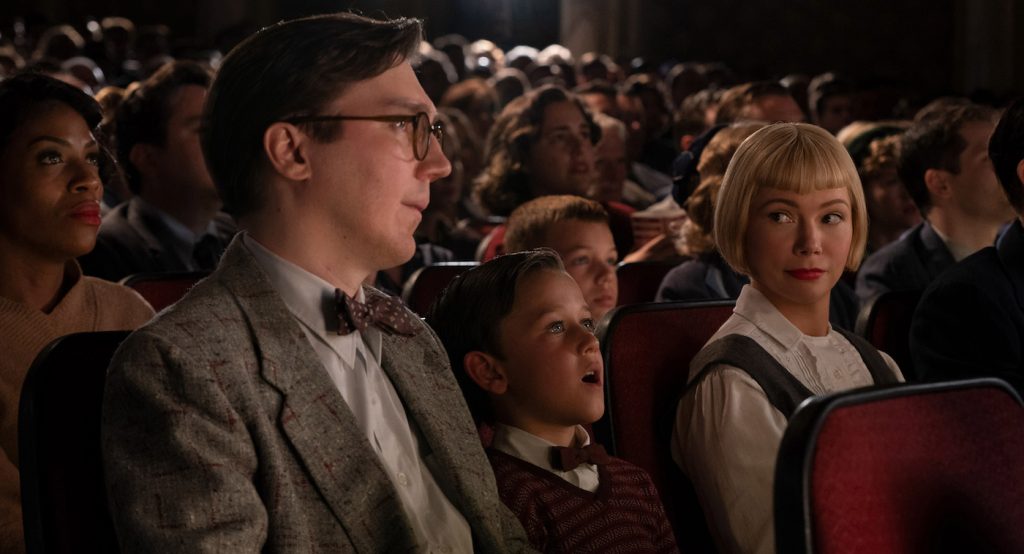
(from left) Burt Fabelman (Paul Dano), Younger Sammy Fabelman (Mateo Zoryan Francis-DeFord) and Mitzi Fabelman (Michelle Williams) in The Fabelmans, co-written, produced and directed by Steven Spielberg. Courtesy Universal Pictures.
You filmed The Fabelmans during the pandemic. How did that constraint impact your design strategy?
It became absolutely necessary to shoot the exteriors in Los Angeles, basically within a 30-mile range. Also, we wanted to make the movie as inexpensively as we could, which meant not traveling great distances and putting people in hotels. But Steven and I share this background of working in TV and movies during the early seventies when you had to stay local and make it work. I think that limitation was helpful in the way it rooted Steven and myself to this era when you were expected to convey locations from all around the world using Los Angeles environments and with the minimal amount of building
So the “New Jersey” house was, in fact, shot where?
We needed a simple two-story plan that would have been built right after the War for a young family starting life on the east coast. Where do you find that in Los Angeles? We found it in [suburban] Chatsworth on a cul de sac with a lot of houses that seemed to fit that period. It was funny to be out there in the middle of the summer, 100 degrees, laying down all these white snow blankets to make it look cold. Then you look around at people [in the crew] wearing shorts and tank tops.
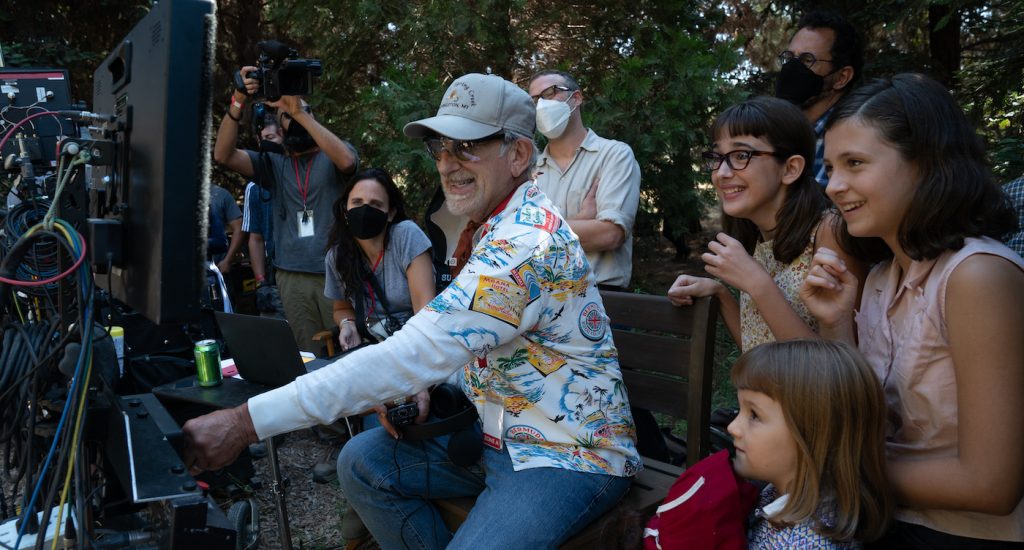
(from left background) Producer Kristie Macosko Krieger, co-writer/producer/director Steven Spielberg, Seth Rogen, Julia Butters, co-writer/producer Tony Kushner, Keeley Karsten and Sophia Kopera on the set of The Fabelmans. Courtesy Universal Pictures.
How did Spielberg guide you in terms of the home’s interior?
Steven did little drawings of the New Jersey floor plan with a staircase near the center, a living room on the right, a dining room on the left, and the kitchen behind that. We made sure our interior allowed for this bifurcation. To the right is [Sammy’s father] Burt’s side of the house, and then the warmer place — dining room and kitchen area — that’s for [Sammy’s mother] Mitzi. Almost by osmosis, these visual cues set up a duality between the two parents having problems in this traditional house.
Next, the Fabelman family moves to Phoenix, and it’s a whole new mid-century modern look. Where did you locate the Phoenix ranch house stand-in?
We found a house in Simi Valley, painted the wood, and made all the tones reflect the desert.
Did you have references to work from?
Yes. Steven had photographs of the Phoenix house and some home movies as well so we could see what the exterior cladding looked like. For the interior, the round dining room table and chairs are space-age sixties, very much like the ones he had. Steven also had pictures showing where the sink and refrigerator were located, and we knew where the baby grand went. None of it was as photogenic as we made it look. [laughing]
How did this ranch house interior reflect growing tensions within the family?
By the middle of the movie, we’re getting into the metaphoric level of art versus family and the toll that takes. The Fabelmans now live in this mid-century, one-story ranch, elongated from the kitchen all the way to where Sammy has his bedroom. You’re seeing this division that happens between Sammy and his family as he turns to cinema and art.
In the “Phoenix” chapter, Seth Rogen’s Uncle Bennie character encourages Sammy outside a camera shop that seems very authentic to the period. How did those shots come together?
What anchored that scene was this old-style camera shop that our spectacular location manager Leann Emmert found in Whittier, California. It stocked many old cameras, so simply by pulling things away that were more modern, we had all the bones of an old camera shop. The shop was actually located in a modern mall, but luckily there was a street two blocks away that fit the period, so we didn’t have to do a lot for the exterior. We digitally added a Cinerama sign and mountains in the background to make it look like [Phoenix-area landmark] Camelback Mountain. Then we combined that exterior with the camera store interior.
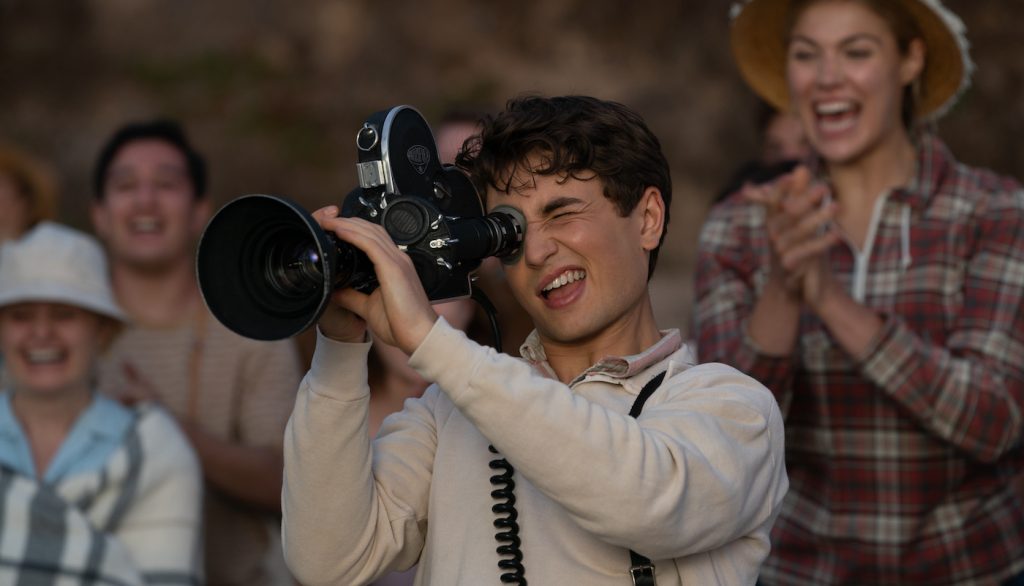
Gabriel LaBelle as Sammy Fabelman in The Fabelmans, co-written, produced and directed by Steven Spielberg. Courtesy Universal Pictures.
It almost looks like a vintage snapshot of Main Street USA circa 1965.
I’m nearly 73, Steven’s 75, and because we were of the era, it’s almost like we were doing it as a memory. We didn’t feel any need to fetishize the period.
You’ve worked on many fantastical spectacles like Avatar and Star Wars: Episode VII – The Force Awakens. By contrast, the environments in The Fabelmans seem familiar rather than exotic. Did that kind of naturalism call for a different mindset than you would bring to a world-building epic?
Most movies that get recognized for honors like this [Oscar nomination] are what I would call horizontal movies. They expand out to an epic level, and designers fill that in. The Fabelmans is more of what I would call a vertical movie. You only have the three-act structure plus an epilogue, so everything goes vertical in terms of how deep you can go. We’re showing splits within the characters, and we’re showing [Sammy’s home] movies within the movie where a few frames can have as much impact as a big battle sequence.
Gabriel LaBelle as Sammy Fabelman in The Fabelmans, co-written, produced and directed by Steven Spielberg. Courtesy Universal Pictures.
So little details can play a bigger role in the storytelling?
Which is why the set dressing becomes so important. We relied heavily on set decorator Karen O’Hara and the art department and the props. For example, When Sammy goes into his girlfriend’s room for the first time, we see posters of Jesus and rock stars; then we pan over to this crucifix surrounded by a heart and pink light. People laugh, seeing what Sammy’s gotten himself into. The set décor is telling you stuff without words being spoken.
(from left) Monica Sherwood (Chloe East) and Sammy Fabelman (Gabriel LaBelle) in The Fabelmans, co-written, produced and directed by Steven Spielberg. Courtesy Universal Pictures.
For Sammy’s senior year of high school, the Fabelmans move to central California. Then we jump ahead a few months, and Sammy’s in Hollywood, where finds himself unexpectedly in the office of John Ford, played by David Lynch, the gruff director responsible for The Searchers and other classic westerns. What was your design focus for that sequence?
When Sammy meets John Ford, we had to replicate paintings or come up with paintings to demonstrate what Ford tells Sammy about the low horizon and high horizon. It’s Ford’s way of saying that all the drama and all the confusion that Sammy feels can make him a good director if he can put it into an interesting form. Not in the middle, but in this case, raising or lowering the horizon. We’re literally putting exposition into the set dressing.
At the end, Sammy saunters through an old-school studio lot surrounded by giant soundstages. Where did you film that final scene?
Paramount Studios. Damien Chazelle was shooting Babylon there, but he very graciously let us use the location for an afternoon. That scene shows this kid entering into a world that already has a structure to it. It’s the way many young people feel when they first get to town. To be right there when the visuals are being created, you realize as a production designer, “Oh, I’m making it!” It’s not so much “I’ve made it.” It’s about the making of the thing and creating an illusion that might become iconographic in the future. You just have to get in there, create images that go along the discovery of the story, and hope you get lucky.
For more interviews with Oscar nominees, check out these stories:
Featured image: (from left) Sammy Fabelman (Gabriel LaBelle), Mitzi Fabelman (Michelle Williams), Burt Fabelman (Paul Dano), Natalie Fabelman (Keeley Karsten), Reggie Fabelman (Julia Butters) and Lisa Fabelman (Sophia Kopera) in The Fabelmans, co-written, produced and directed by Steven Spielberg. Courtesy Universal Pictures.
You can’t ask for a better pairing for an action rom-com than Chris Evans and Ana de Armas, and that’s precisely what Apple TV’s Ghosted is offering. The twist is that Captain America himself isn’t the one doing the wooing and the rescuing; in fact, Evans plays a likable if “average” (despite still looking like, you know, Chris Evans) guy named Cole who falls in love with Sadie (de Armas) who seems equally enthused about the relationship until, per the title, she ghosts him.
But Cole isn’t going to give up just yet—the man is smitten—so he heads off to London to track the mysterious Sadie down. Cole describes it as a “grand romantic gesture,” eschewing some cold hard facts, like how he and Sadie barely know each other and that Sadie, you know, ghosted him. Cole arrives in London, believing that perhaps Sadie hasn’t ghosted him but simply doesn’t have an international calling plan (riiiiiight), and ends up getting kidnapped by some bad dudes intent on torturing him because, it seems, they believe he’s a spy.
Again, this isn’t Evans in Captain America-form, or Evans as the heartless assassin from Netflix’s The Gray Man, either. In Ghosted, he’s utterly helpless, and that’s when Sadie makes her grand re-entrance. It turns out she’s a spy herself, and before Cole can ask her out for a second date, he’s swept up in the world of international intrigue that is Sadie’s bread and butter.
You couldn’t ask for two more likable, talented stars than Chris Evans and Ana de Armas, and the trailer makes clear that director Dexter Fletcher knew what he had in his two leads. The script comes from Deadpool writers Rhett Reese and Paul Wernick and Spider-Man: No Way Home scribe Chris McKenna. The supporting cast includes Amy Sedaris, Adrien Brody, Tim Blake Nelson, Tate Donovan, Marwan Kenzari, and Lizze Broadway. All these ingredients add up to what could be a delightful romp.
Check out the trailer below. Ghosted arrives on Apple TV on April 21.
For more stories on Apple TV series and films, check these out:
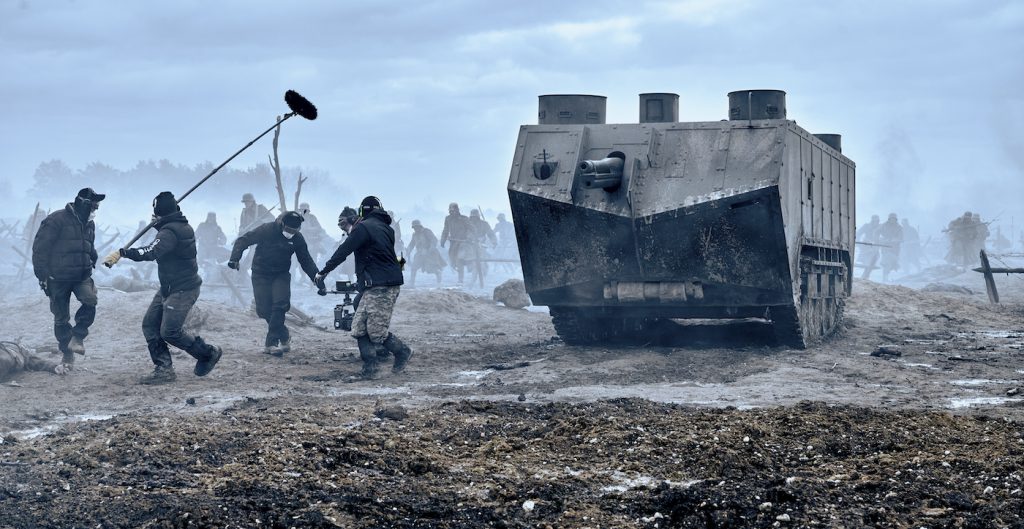
Director Edward Berger’s adaptation of All Quiet on the Western Front is a painfully absorbing epic. Berger’s take on Erich Maria Remarque’s iconic 1929 novel, captured with astonishing vividness by cinematographer James Friend, teases out the themes in the seminal work about the horrors of World War I with bloody precision. The film wastes no time in depicting the dehumanizing industry of the first mechanized war, in which a dead soldier is stripped of his uniform so that it can be stitched up, resewn, and shipped to Northern Germany, where it will be reused by Paul Bäumer (Felix Kammerer), the young man through whose eyes the carnage of the war is seen. When Paul notices someone else’s name on the label on his uniform, he begins to appreciate the gravity of his situation.
The film follows Paul’s journey, which finds him enlisting in the Imperial German Army three years into the Great War, earning him a relocation to the nightmarish Western Front, where millions of soldiers have already been obliterated along a front line that remains more or less immobile. Berger’s film captures the cruel clash of combat eras that made World War I so horrific, with outdated stationary tactics pitted against the new machines of war, capable of meting out death from afar. The result was a repulsive charnel house of carnage, where 17 million men died in the muck.
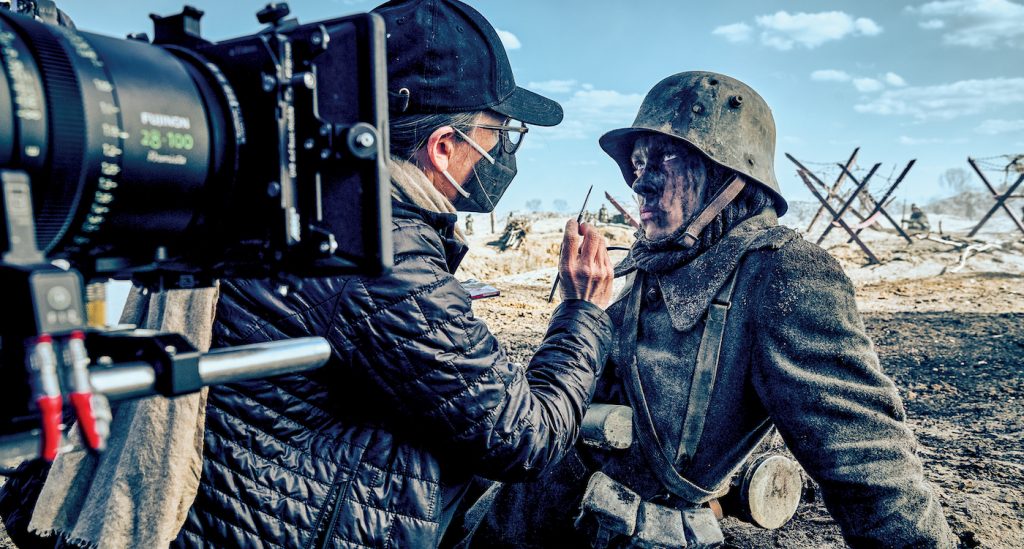
To create such a believable vision of war, Berger relied on collaborators like the Oscar-nominated head of the makeup and hair department Heike Merker [nominated alongside Linda Eisenhamerová], who helped turn the film’s cast into credible combatants in a horrific war. Merker also found ways of emphasizing their humanity beneath the layers of mud, blood, and gore they were often covered in.
We spoke to Merker about how she stepped into her very first war movie and stepped out with an Oscar nomination in a production that, while it made her weep, was also shot through with joy.
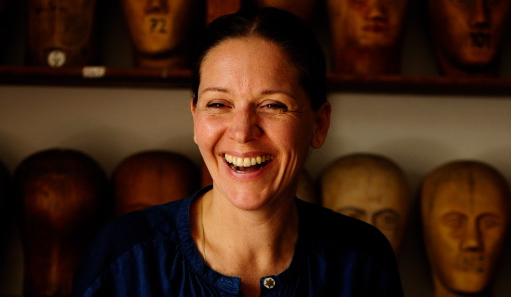
Heike Merker.
How did you approach this project initially, before cameras started to roll, knowing the challenge would be immense?
I knew immediately it would be a tough project. My first thoughts were that while I know the book and the time period, I still need to get a feeling for it. I need to get my head more the into the war and the soldiers’ lives. I’ve never worked on a war movie before, so my prep included intense research in watching war movies and trying to find as many pictures as possible from that particular time. Then I went on to documentaries until I found one for me that changed everything, which was They Shall Not Grow Old.
Tell me how Peter Jackson’s documentary changed things for you.
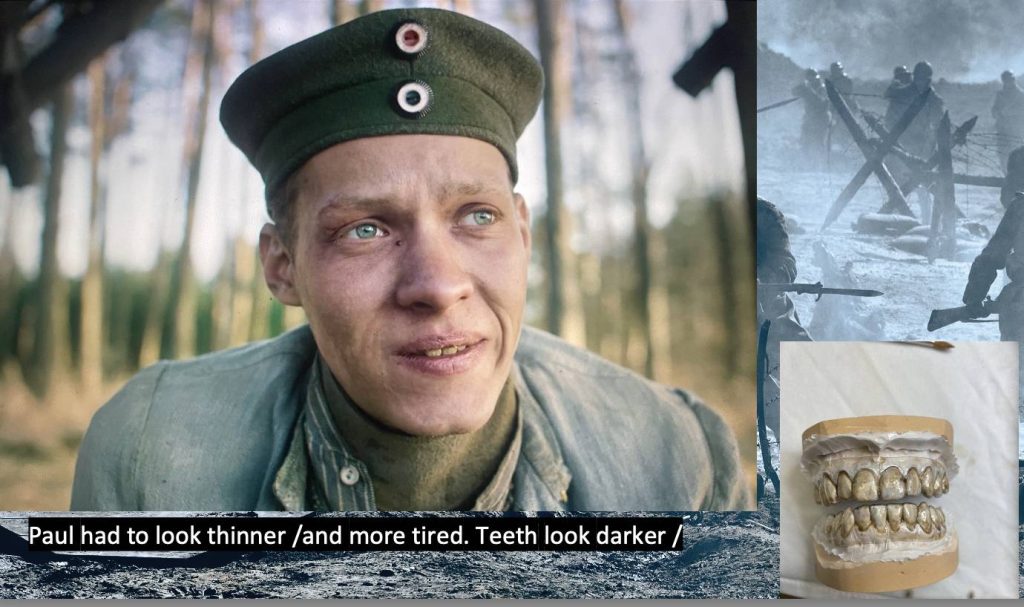
It’s just a perfect entrance into a soldier’s life in the First World War and how terrible it was, how they suffered, how they looked, and how the conditions were. This was basically my door into the project. In that documentary, they were immediately talking about teeth; their teeth were so bad, so that’s why after a while, we gave our actors dirty teeth to get the white and the freshness away. We gave their teeth different colors. In the beginning, we were playing with the idea of breaking their teeth or taking them away or changing them to a silver grill, as some of the soldiers had, but it became all too much and it took away from the actor, so we wanted to have something very subtle, so that became focusing on the story, the actor, and the acting.
Details from Heike Merker’s makeup and hair submission book, with the teeth splints created by George Korpas. Courtesy Heike Merker/Netflix.
Are there any other narrative films that helped you get a feeling for a soldier’s world?
I watched 1917, and I watched films from other periods, like Platoon. Having a new subject, I always need to grow into it. I read the letters soldiers wrote to their relatives or wives at home, and what they described gave me a different feeling. I know it doesn’t have the feel of makeup, but it gives me the feeling of growing into a subject so that I can approach it. To understand them, to support them with the part that I’m there to do.
What was your approach to depicting the horrible carnage of the war?
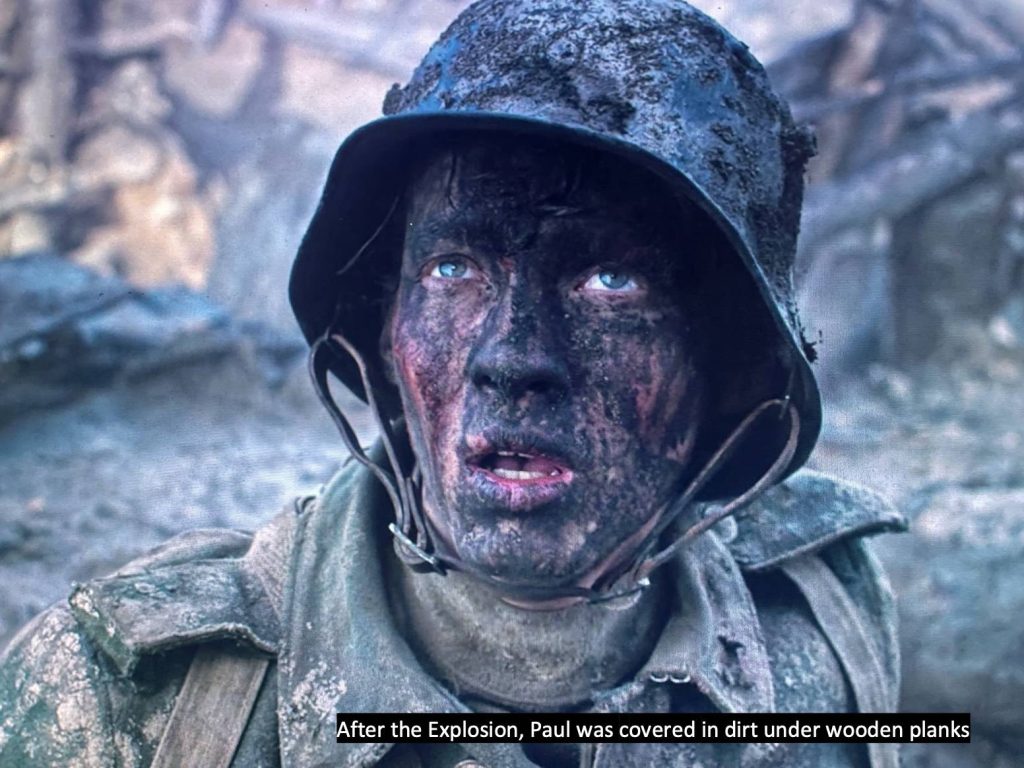
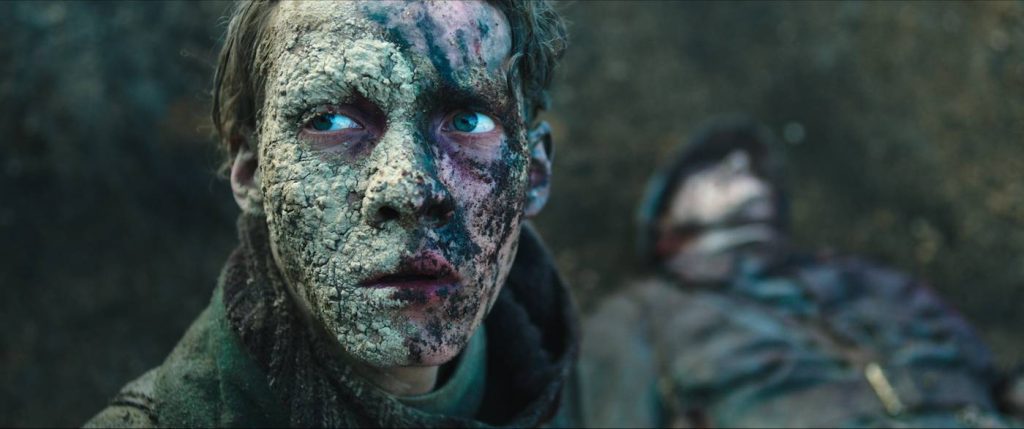
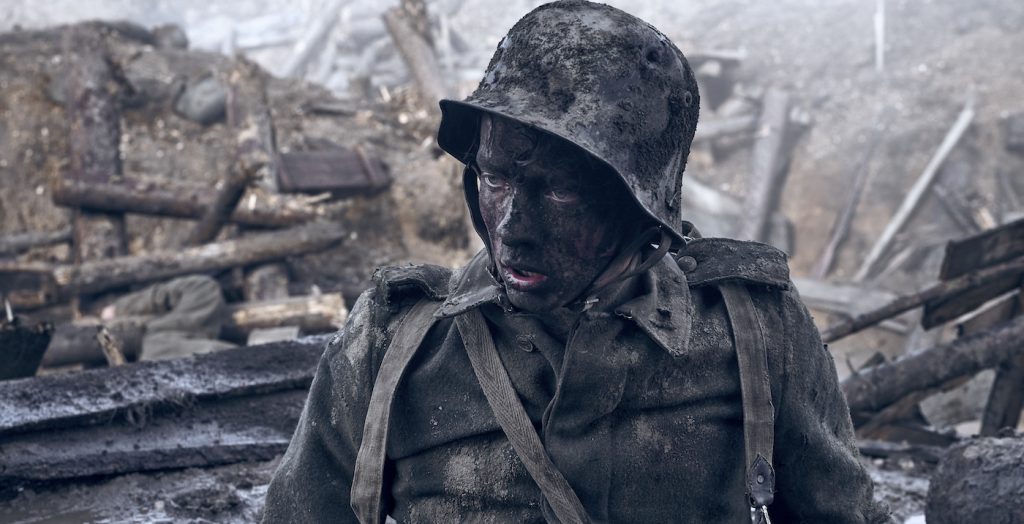
So you break the script down in sections and you know, for example, at this point, an explosion happens, and Paul’s underground, so he needs to be dirty. He needs to have mud and dirt on his face. So we broke the script down to find out where he needs to be dirtier, muddier, where he’s feeling cold, worn out, fragile, or thinner. We apply all the tools in the makeup and special effect prosthetics world. It was almost like a painting where I painted things on and took them off again. So you break each character down, scene by scene, you decide where you want to go, and then you start testing.
Details from Heike Merker’s makeup and hair submission book. Courtesy Heike Merker/Netflix.
On a practical level, how did you manage to test all these looks to make sure the actors looked exactly right for each and every scene?
First, you book an extra to come in and you try different dirt level stages; what can we do to make him look tired, which colors are the right ones, do we have to thin the colors, thicken them, do we have to put on more layers, can we take some of the layers and have a leftover residue and apply something else? All this testing is done on the extra, so when the principal actor comes, you have a plan and you have it down in stages. And you do that with the whole cast for their particular scenes.
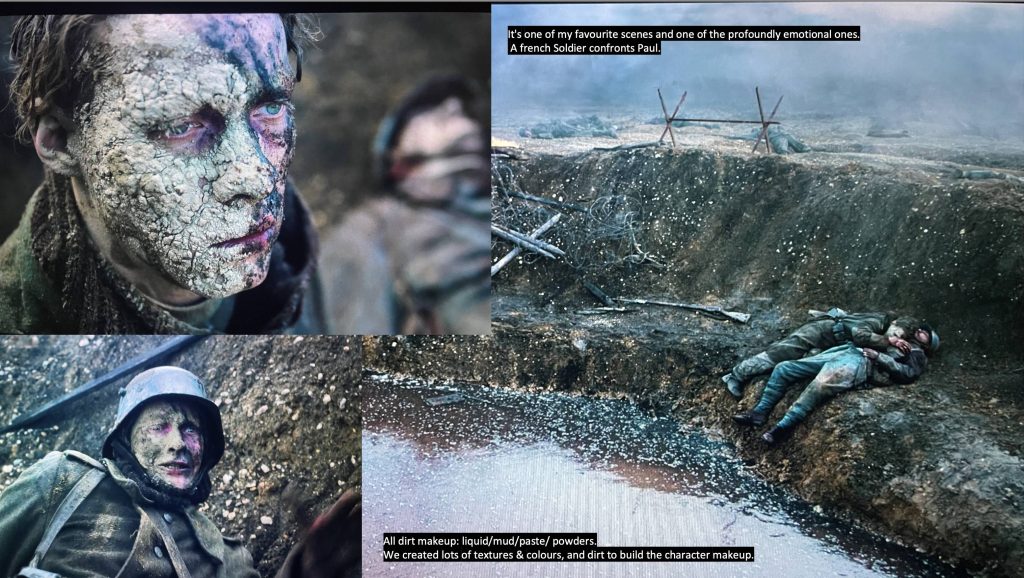
I’ve done other movies where I had people who were dirty or muddy, but here I needed a much bigger range of mud and dirt; I had mud from a very light version in yellow to gradually darker mud and then black, and all different textures. I had this very thin, water-resistant dirt, semi-liquid dirt, and clay versions. You rely on materials you’re used to working with, like grease paint or skin illustrators, too. I have boxes full of equipment, and because you never know what you’re going to need, you carry everything with you.
Mud and dirt examples from Heike Merker’s makeup and hair submission book. Courtesy Heike Merker/Netflix.
How many people did you have working with you in your department?
So for the main cast, including myself, we had four people. But after several weeks, we struggled a bit so we hired another person and became five. Then we had a background crew of three on a daily basis. But they had to book additional people in according to how many background players we had. So not a big crew.
Let’s talk about the wounds, which are plentiful, realistic, and harrowing to behold. How did you and your team approach their creation?
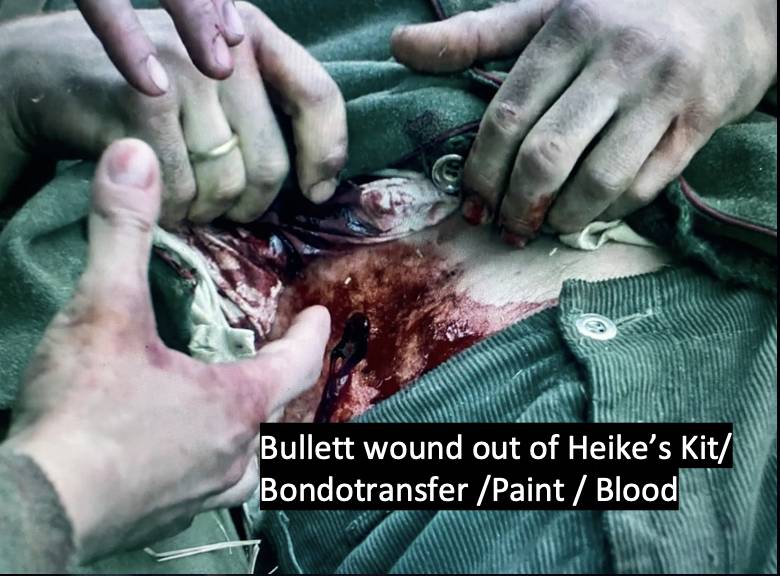
The wounds and gore still fall to makeup and hair, and if it comes to bigger appliances [prosthetics], then I take pictures and draw what I’d like to have and give it to a workshop that can make a life cast of the actor and make the wound. But when it comes to blood and dirt and little wounds, this is still makeup, not special effects or prosthetics.
A bullet wound created from Heike Merker’s makeup kit from her makeup and hair submission book. Courtesy Heike Merker/Netflix.
So you’re drawing wounds by hand?
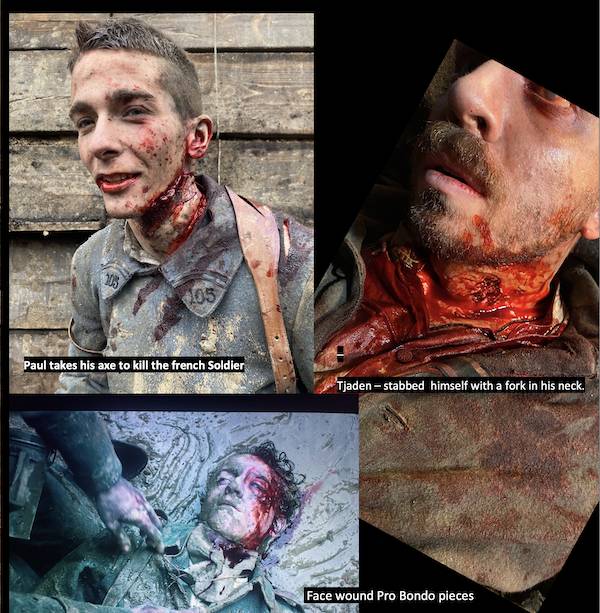
I’m giving positions and drawing reference pictures of how I think the wounds should look. Like, if the chin is wounded, we have to know how long the actor’s chin is and figure out if it makes sense to have the wound there. We need to know how the wound will play with the costume, and work with the costume department, too. For example, one character got hit on the face, and in his first costume fitting, he had a heavy helmet with a leather chin strap. So we realized we couldn’t do that, so the costume designer [Lisy Christi] took away that helmet so that we could create the wound because it’s an important moment in the story. Then the workshop tells us we have to move the wound up or down because otherwise, it wouldn’t make sense, and then we take that information back to our director Edgar Berger. You figure it out bit by bit. And the prop department is important — what is causing the wound? A bullet? A knife? A wooden stick? Because each has a different impact and creates a different wound. We pored over so many books where we learned about all these different impacts.
Wounds created from Heike Merker’s makeup kit from her makeup and hair submission book. Courtesy Heike Merker/Netflix.
What was it like for you emotionally to work on this film, considering the subject matter and all the death you’re depicting?
I had a moment, yes. It’s not the first movie I’ve worked on with heavy situations, and it’s not personal because I know it’s fake. But, there was a moment where you have the crater scene, and Paul and the French soldier are coming together to fight. Basically, it’s a moment where it’s like, okay, you’re German and you’re French—you’re a human being with a family at home. They could be friends in normal circumstances. Paul could go to France on the holidays and be friends with this French soldier and they could have a wonderful life. So this was such an emotional moment that, while they were filming it, I had to cry. It was so intense, and the acting was amazing. Then there’s a technical part of this scene and you have to do the blood pump, and the mud keeps getting shoveled into his face, but of course, it’s not real mud because we had to make something that was okay for him to have in his mouth, so you still have to do your work but it was so extremely emotional I was shocked. I was so happy to end that day. And yet, it was kind of a dream to work on this film…we all enjoyed working together because the group was so fantastic. It was a wonderful collaboration.
All Quiet on the Western Front is streaming on Netflix now.
For more stories on Oscar nominees, check these out:
Michael B. Jordan’s critically acclaimed directorial debut can now add a record-making opening weekend to its list of accolades. Jordan’s Creed III delivered a knockout debut, bringing in $58.7 million, a franchise record, knocking Ant-Man and The Wasp: Quantumania off its perch as the weekend’s top-grossing film. At the global box office, Creed III became the first sports movie in film history to pass $100 million in its opening weekend. Not a bad debut for Mr. Jordan.
Incidentally, Creed III features Jonathan Majors as Damian Anderson, Adonis Creed (Jordan)’s toughest opponent yet, and Majors also stars as the villain Kang the Conqueror in Quantumania. The man is a star, is the point, and was battling himself for box office supremacy.
The first post-Rocky Creed film dropped in 2015 to rave reviews and earned $29.6 million in its opening weekend, while the 2018 sequel Creed II opened with $35.5 million. So Jordan’s Creed III didn’t just best those previous films but practically doubled the original film.
Jordan took the helm for the third film and sensibly brought back some of the key stars from the Creed franchise, most notably Tessa Thompson as Bianca Creed and Phylicia Rashad as his mother, Mary-Anne Creed. The biggest missing piece in Creed III was, of course, Rocky Balboa (Sylvester Stallone), but the addition of Majors, one of the fastest-rising stars in Hollywood, more than made up for the loss. Majors plays bruiser Damian Anderson, a man with a long, once-happy connection to Adonis Creed (Jordan) dating back to when they were childhood friends. That happy connection turned massively sour, however, after a seminal night that saw them breaking off in two separate directions. Anderson went to jail for 18 years, while Adonis became a superstar boxer. In Creed III, Anderson comes looking for payback with a massive, championship belt-sized chip on his shoulder.
The New Yorker‘s Richard Brody wrote that “Jordan, as director, delivers a captivating blend of explosive energy and melodramatic intensity; he sharpens the stark lines of conflict with keen attention to performance… and a controlled, storm-like feeling of moods building to crises.”
Clearly, audiences were eager to see two big stars, Jordan and Majors, not only share the screen together but step into the ring against one another. The strong reviews, including an A- CinemaScore and an 87% fresh rating on Rotten Tomatoes (with a 96% fresh Audience Score), helped bolster interest. In the end, Creed III delivered a delicious cinematic uppercut that audiences were more than happy to step right into.
Get ready for a fresh take on Teenage Mutant Ninja Turtles with a stellar cast. Seth Rogen revealed that his animated feature Teenage Mutant Ninja Turtles: Mutant Mayhem, centering on everybody’s favorite amphibious teenage heroes, will include Rose Byrne, Jackie Chan, Ice Cube, John Cena, Paul Rudd, Maya Rudolph, Hannibal Buress, and more.
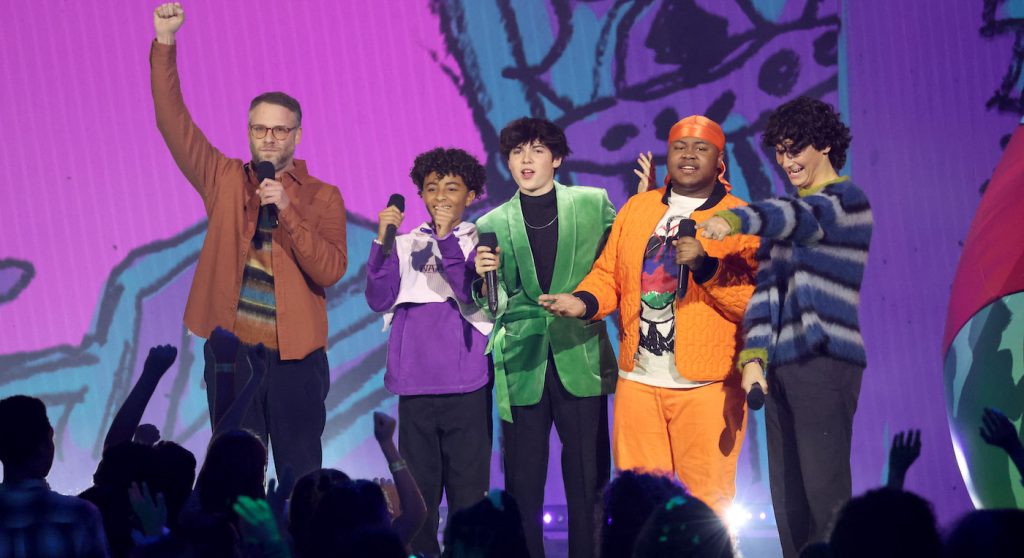
Rogen revealed the cast at the Nickelodeon Kids’ Choice Awards while on stage and was joined by the young stars playing the new turtles—Micah Abbey (Donatello), Nicolas Cantu (Leonardo), Shamon Brown Jr. (Michaelangelo), and Brady Noon (Raphael). The turtle’s mentor Splinter will be voiced by none other than Jackie Chan. Rogen is starring as the villain Bebop, while John Cena will play Rocksteady, Bebop’s best bud.
LOS ANGELES, CALIFORNIA – MARCH 04: (L-R) Seth Rogen, Micah Abbey, Brady Noon, Shamon Brown Jr. and Nicolas Cantu speak onstage during the 2023 Nickelodeon Kids’ Choice Awards at Microsoft Theater on March 04, 2023 in Los Angeles, California. (Photo by Monica Schipper/Getty Images for Nickelodeon)
Meanwhile, Paul Rudd is playing Mondo Gecko, Rose Bryne will be Leatherhead, Maya Rudolph will voice Cynthia Utrom, Ice Cube is Superfly, Ayo Edebiri is April O’Neil, Hannibal Buress will play Genghis Frog, Giancarlo Esposito is playing Baxter Stockman, Natasia Demetriou is Wingnut, and Post Malone is Ray Fillet. In short, this will be the most star-studded cast ever to tell the tale of New York City’s Turtle brothers.
Mutant Mayhem finds the Turtle brothers trying to earn the love and respect of their fellow New Yorkers by proving their heroism in the hopes that if they do enough good, the city will accept them as regular teens. Their troubles grow exponentially when they try to take down a crime syndicate and are pitted against an army of mutants.
Rogen produces alongside Evan Goldberg and James Weaver for the Paramount and Nickelodeon feature. Mutant Mayhem will be the first CG-animated movie for Nickelodeon. The Turtle brothers were conceived in 1984 in an underground comic by creators Kevin Eastman and Peter Laird and then became an iconic animated series in the 1980s. It was later adapted into a 1990 live-action feature, an animated feature in 2007, and then again in two more live-action features in 2014 and 2016, produced by Michael Bay. Recently, Nickelodeon released the 2D-animated series Rise of the Teenage Mutant Ninja Turtles in 2019.
“We are beyond thrilled by this world-class cast we’ve assembled to bring these iconic, beloved characters to life in a new chapter of the Teenage Mutant Ninja Turtles universe,” said Nickelodeon Animation and Paramount Animation Ramsey Naito in a statement. “This really sets a new bar for this globally celebrated franchise, and we can’t wait to show audiences this film.
Teenage Mutant Ninja Turtles: Mutant Mayhem is set for an August 4 release date.
For more films and series from Paramount and Paramount+, check out these stories:
Featured image: LOS ANGELES, CALIFORNIA – MARCH 04: Seth Rogen speaks onstage during the 2023 Nickelodeon Kids’ Choice Awards at Microsoft Theater on March 04, 2023 in Los Angeles, California. (Photo by Alberto E. Rodriguez/Getty Images)
Michael B. Jordan has taken his talents to the next level with Creed III, making his directorial debut in a film he also stars in and produced. The critics are calling his effort championship belt worthy.
Jordan brought back some of the stars from the Creed franchise (most notably Tessa Thompson as Bianca Creed and Phylicia Rashad as his mother, Mary-Anne Creed), said goodbye to Rocky Balboa (Sylvester Stallone, who doesn’t appear here), and added one of the fastest rising stars in Hollywood in Jonathan Majors. Majors plays bruiser Damian Anderson, a man with a long, unhappy connection to Adonis Creed (Jordan), who shows back up in Adonis’s life after 18 years in prison with a serious bone to pick with the champ. They were once childhood friends, but one fateful night tore them into opposite directions—Adonis went on to become a boxing champion, and Damian did his fighting and training in prison. In Creed III, Damian is looking for payback.
Let’s take a quick peek around the web to see what the critics are saying about Jordan’s debut directorial effort in the third film in the Creed franchise.
The New Yorker‘s Richard Brody writes, “Jordan, as director, delivers a captivating blend of explosive energy and melodramatic intensity; he sharpens the stark lines of conflict with keen attention to performance… and a controlled, storm-like feeling of moods building to crises.”
The Los Angeles Times’ Katie Walsh writes, “What Jordan does best as star, director and producer is showcase Majors’ heavyweight performance, cementing him as one of our brightest stars. Taking over a behind-the-scenes role is a part of the “Rocky” legacy, and Jordan takes the reins with ease.”
Vanity Fair’s Richard Lawson writes, “Jordan keeps the film clear of head and light on its feet. As Creed III glides and grunts to its close, the series feels anything but spent.”
Manohla Dargis writes in The New York Times, “And as emotion floods this movie, Jordan lets loose a torrent of ideas about Black masculinity and community, about how the past haunts the present, the legacy of state violence, the chimera of self-reliance and the existential necessity of love. So, come for the boxing, yes — but bring plenty of hankies, too.”
The Washington Post‘s Ann Hornaday writes, “Michael B. Jordan and Jonathan Majors face off in a boxing story told with style, taste and respect for the audience.”
Empire Magazine‘s Amon Warmann writes, “Giving the gloves to Michael B. Jordan both in front of and behind the camera leads to satisfying results, and the year of great Jonathan Majors performances continues.”
And Lindsey Bahr at the AP says, “A promising debut for [Michael B. Jordan], who shows here that he’ll never let his own star ego get in the way of a film: Majors steals the show, and Jordan is there to capture it.”
Are you ready to step in the ring this weekend with Jordan and Majors? We know we are.
It’s old news by now that Tom Cruise is a man who likes to do his own stunts, which includes a lot of the flying he has done in movies like Top Gun: Maverick and his many installments in the Mission: Impossible franchise. For Mission: Impossible – Fallout, Cruise famously piloted a helicopter in the climatic final scene in his chopper-to-chopper battle against Henry Cavill’s August Walker. Stunt coordinator Wade Eastwood told us that Cruised trained on the helicopter for a year to get it right. The scene was ludicrous and it’s wild to think that it was really Cruise doing all those death-defying maneuvers in his chopper, but it really shouldn’t be all that surprising by now.
So the news from Varietythat Cruise has been using a chopper to get from the Italian port city of Bari to a U.S. aircraft carrier off the Italian coast (speculation is that it’s the U.S.S. George H.W. Bush) to film scenes for the final installment in his long Mission: Impossible career – Dead Reckoning Part Two is par for the course. Cruise, writer/director Christopher McQuarrie and the cast and crew have been filming the epic two-part conclusion to the franchise back-to-back, and you know they’re going to lay it all on the line, again to deliver a finale worthy of one of the most breathless action franchise in cinematic history.
Variety confirms from the head of the Apulia Film Commission, Antonio Parente, that the U.S. aircraft carrier is “somewhere between Italy and Croatia.”
“We are proud that [the] Apulia [region] has been chosen as the operational base for this rather complex shoot,” Parente told Variety. He added that the Apulia Film Commission liaised with Paramount Italia but only provided help with airport logistics for the Mission: Impossible shoot.
The first half of the two-part conclusion, Dead Reckoning Part One, was shot in Italy, in both Venice and Rome. The locations for the second part have been kept largely under wraps.
Mission: Impossible – Dead Reckoning Part One is due in theaters on July 14, 2023, while Part Two is slated for a June 28, 2024 release.
For more stories on Mission: Impossible, check these out:
After three seasons and 48 Emmy nominations, Succession‘s 4th and final seasonis nearly upon us. Creator Jesse Armstrong recently announced that his delicious deep dive into the serial infighting among one family of American billionaire berserks, the Roys, is coming to an end, and HBO has just released a decidedly high-octane official trailer to remind viewers why Succession has been one of the most consistently satisfying shows on TV.
Here we have Logan Roy (the exquisitely cast Brian Cox) at what appears full strength. Gone, it seems, is his King Lear-like doddering from previous seasons, where physical ailments and the occasional mental lapse made the lion appear weak enough for rivals and members of his own family to pounce. The trailer reveals an energized and hungry Logan Roy, ready to tear his family apart (if need be) to maintain control, rousing his employees with a speech befitting a general on the eve of war. And war really is the only analogy that seems to fit Logan’s approach to business—you either serve beneath him or you are the enemy. As the sale of the company Logan built, Waystar Royco, to Lukas Matsson (Alexander Skarsgård)’s tech company GoJo gets closer, the family Roy is circling each other for one final, climatic battle royale to see who ends up on top. These people only know one way to communicate; a perpetual power struggle.
The trailer teases the new alliances (always shaky in the Roy’s world) and battle lines being drawn. Tom (Matthew Macfayden) has aligned with Logan after turning on his own wife, Shiv (Sarah Snook), at the end of season three to sidle up to the man he believes can’t lose. Kendall (Jeremy Strong) and his siblings Shiv and Roman (Kieran Culkin) are a united front as they try to take down their father and stop the sale to GoJo. They’re going to need to figure out a way to get one step ahead of Logan, a challenge they’ve not yet successfully met. The trailer also gives us a sneak peek at one of Logan’s most timeless maneuvers; he tries to lure Roman back to his side by swearing he “needs” his youngest son. Knowing Roman, he’ll likely take the bait.
Caught up in the blast radius of the Roy family war are series regulars Gerri (J. Smith Cameron ), Greg (Nicholas Braun), Stewy (Arian Moayed), Lady Caroline Collingwood (Harriet Walter ), Ewan Roy (James Cromwell), Rava Roy (Natalie Gold) and more. Season four will welcome new cast members, including Eili Harboe, Annabeth Gish, Adam Godley, and Jóhannes Haukur Jóhannesson.
Check out the official trailer for Succession season 4 below. All good things and greedy billionaires must, eventually, come to an end.
Before we try to unpack an intriguing clue that Hugh Jackman revealed to the French newspaper Le Parisien about his upcoming return as Wolverine in Deadpool 3, let’s quickly assess what we do know about the film.
Jackman returns as Wolverine in Deadpool 3 despite dying a hero’s death in James Mangold’s terrific Logan via some narrative trickery. Or really, it doesn’t even have to be all that tricky considering Logan is set in 2029 and Deadpool 3 is presumably set before then. Yet Jackson himself has hinted that his be-clawed mutant’s return is due to Marvel’s use of the multiverse and its ability to superimpose two, three, or a million universes on top of each other. As Jackson said to Sirius XM, Wolvy’s return is possible because of “this device they have in the Marvel world of moving around timelines. Now we can go back because, you know, it’s science. So I don’t have to screw with the Logan timeline, which was important to me. And I think probably to the fans too.”
We also know that Jackson’s Wolverine and Ryan Reynolds’s Merc with the Mouth will face off against a villain played by The Crown‘s Emma Corrin, which is an exciting bit of casting. We also know that director Shawn Levy and longtime Deadpool screenwriters Rhett Reese and Paul Wernick have promised that Deadpool 3 will be as hardcore as ever, even though the famously R-rated franchise is now housed within the vast Marvel Cinematic Universe, which itself lives in the even vaster Disney realm. Marvel Studios president Kevin Feige confirmed the hardcore-ness of Deadpool 3 when he revealed the film would, indeed, be rated R.
Now, onto that nugget that Jackman revealed to Le Parisien about his return as Wolverine:
“Yes, it will even be a double role. Ryan and I have been friends for twenty years; we have a lot of fun together. We’re shooting this summer. That’s why I’m so happy to be in Paris right now and to be able to enjoy French gastronomy. Because very soon, I will have to go on a strict diet to remake Wolverine’s body: steamed chicken and broccoli!”
A double role, you say? This makes us wonder if we might be getting two versions of Wolverine here. Considering that Jackman has already teased the multiverse, one can be forgiven for speculating that screenwriters Reese and Wernick might not have swung for the fences after learning Jackman was willing to return and ginning up the most gonzo storyline for Wolverine ever. Consider that Logan introduced a purely evil version of Wolverine with X-24, a clone of our hero who was, nominally, under the control of Dr. Zander Rice in that film. A “double role” could, of course, mean a ton of different things, and not necessarily that Jackman will be literally pulling double duty as two Wolverines he did in Logan, but it’s intriguing to imagine multiple Wolverines giving the Merc with the Mouth more than even he can handle.
Deadpool 3 is currently slated for November 8, 2024.
All Quiet on the Western Front, Erich Maria Remarque’s 1929 novel that lays bare the harsh brutality of war through the eyes of a naive youth fighting in the German trenches during WWI, is considered a literary classic. So Frank Kruse admits some hesitation when director Edward Berger told him he was doing a modern retelling. That disappeared after Kruse read the script. Though the challenge would be daunting, he wanted to be the film’s sound designer and supervising sound editor.
Kruse’s instincts proved correct. Hailed as one of the best films of 2022, All Quiet on the Western Front recently won seven BATFAs, including Best Film and Best Director. Kruse, along with Lars Ginzel, Viktor Prášil, and Markus Stemler, was honored for Best Sound. The sound team (with the addition of Stefan Korte) is vying for an Oscar in the same category. In total, the film has received nine Academy Award nominations, including Best Picture.
During a Zoom interview, Kruse detailed the important role the sound played in heightening the horrors of the battlefield and the emotional toll war takes on those who fight it.
What was the strategy for the sound design?
I love to support the production sound mixer on projects by recording wild tracks — vehicles, crowds, whatever sound is on set. This is really hard to recreate in post-production. This was at the height of COVID. They were shooting in the Czech Republic. The borders would be closed. Travel wouldn’t be easy. I worked as a production mixer myself for 10-plus years. I know the focus during a shoot is capturing dialogue. There’s rarely time for sound. I made a list ofitems that would be impossible to source later. Then I went through the script with Viktor,the production sound mixer, and flagged all this stuff. Luckily,Edward is a huge fan of recording wild tracks. He was up for directing the wild tracks himself, having the extras run and scream, do takes of them dying, rollingin the mud. That was a godsend.
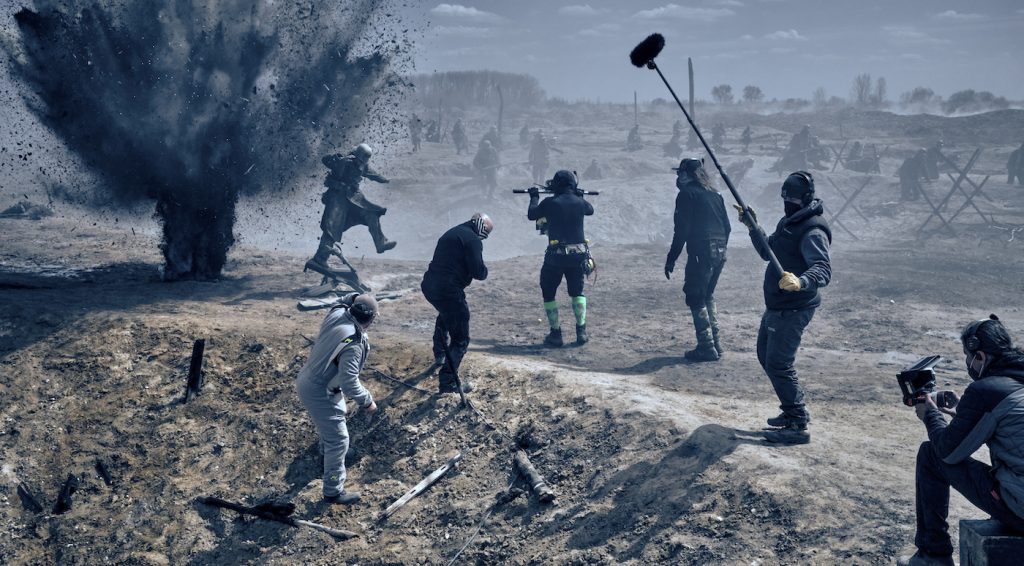
Behind the scenes on “All Quiet On the Western Front.” Courtesy Reiner Bajo/Netflix.
Approximately how much sound was captured during the actual filming?
I think it was eight-plus hours of wild tracks. Unheard of for a film of this scale. Viktor had two, sometimes three mics mounted on the main characters. One mic would be leveled all the way up to capture the breathing and the close-up exhaustion. Another mic was gained way down for screams so they wouldn’t distort. The mics locked up, giving the sounds this documentary feel. That became a base layer for the entire design work. But we didn’t want to go overboard — you know, the cliche of spooky drones and designy ambiances — stuff like that. We tried to find metaphorical naturalistic sounds for the emotional moments.
How did you research WWI sounds?
World War One is tricky. I tried to find actual recordings from that time. Wax cylinders had been invented, so it was possible to record sound. At Britain’s Imperial War Museum, I found reconstructions using a technology called sound ranging. But they were done later with modern sounds.
So I dug deeper and found an article quoting letters written at the front to relatives back home. They described the horror of the sound very graphically. That became a big source of inspiration. We realized that it wouldn’t make sense to create sounds that were technically correct. We decided to tackle the soundtrack from an emotional side. The story is told so much through Paul Bäumer (Felix Kammerer), the main character. It was about incorporating a subjective soundscape that connected the audience as the camera ran next to him.
The way it was shot really helped. Most of the onscreen effects were done in-camera. The first cut was full of bullet impact explosions, dirt explosions, etc. We used all the gunshot explosions from the production recordings.
What did you layer in?
I call them shell shock moments. When Heinrich (Jakob Schmidt) gets killed hiding behind the tree stump in the first battle, this extreme panic grips him. The background battle sounds get muffled and go away. Only the main sound element is left. We did that sound by scraping and dragging microphones through dirt. We wanted a certain sound for his panic, as if his body is being pushed through the soil — the sound you hear when your ears are literally covered in sand or dirt.
There’s a similar moment in the tank attack when Paul sees his friend Albert (Aaron Hilmer) being burned by the flamethrowers. Everything goes away. His voice stays close and untreated — almost like it’s in this quiet bubble. The sound creates this moment of peace while horrific things are happening. We always try to go against what you see in a subtle but organic way. Personally, I think it is less interesting when all the departments do the same thing at the same moment. It leaves very little space for an audience tofind their own emotion for that scene.
How did Voker Bertelmann’s score impact your design
He came on board a little later than we did. I did a layout of an early sequence where the uniforms are recycled. We see them taken off dead soldiers and refurbished for the next batch of 18-year-olds getting ready to die.
It’s a metaphoric symbol for the industry behind this war. Edward wanted a sound for that. You hear the sewing machines low and pounding like steel mills. That morphs into the real sound of the sewing machines with close-ups of the needles. Eventually, it turns into what sounds like an endless burst of machine gun fire.
I sent that layout to Voker. He introduced another rhythm over that sequence using a harmonium. I found the sound I had made was clashing. So I changed the pitch and tuned it to his music. We tried to find moments when the music did a better job and where the effects were more efficient in telling the story. We never wanted to do the same thing at the same time as the music.
What sounds were the most challenging?
The battle scenes were a huge challenge. There was just so much going on. The tank sound was challenging. We designed it as an emotional element rather than as a technology. These thanks were strategically useless. They barely moved two or three kilometers an hour. They were meant for psychological warfare — to tell the enemy, “You can shoot at us, but the bullets won’t harm us.” We had a wooden toy car. In a weird, funny coincidence, we found when we ran it across a metal ventilation shaft; the wheels resonated in this howling, groaning way — almost like a whale. It became the main element for the tanks. Viktor had wired the tanks with multiple microphones. The original recordings had a rhythmic cadence coming from the metal tracks. We layered them in. It’s always these happy accidents and experimentation in the foley studio.
Behind the scenes on “All Quiet On the Western Front.” Courtesy Reiner Bajo/Netflix.
Any favorite scenes that you worked on or particular sound moments you’re proud of?
I must say, some of my favorite scenes are the quiet ones. I love the moment at the end of the film when Kat (Albrecht Schuch) is in the forest. He looks up into the sky and the (leafless) trees. We added the wind blowing through the trees, shaking the leaves even though there aren’t any. It was going against the visuals to create a dream — past the war, at home with his wife. It’s so peaceful. I really like the contrast.
For more on big titles on Netflix, check these out:
When Sara Dosa won Best Film Documentary Director from the Directors Guild on February 18 for Fire of Love, it was no doubt an acknowledgment of the daunting task Dosa faced in shaping nearly 200 hours of 16 mm archival footage shot by her subjects, without sound, into her mesmerizing film. Fire of Love is also nominated for this year’s Best Documentary Oscar.
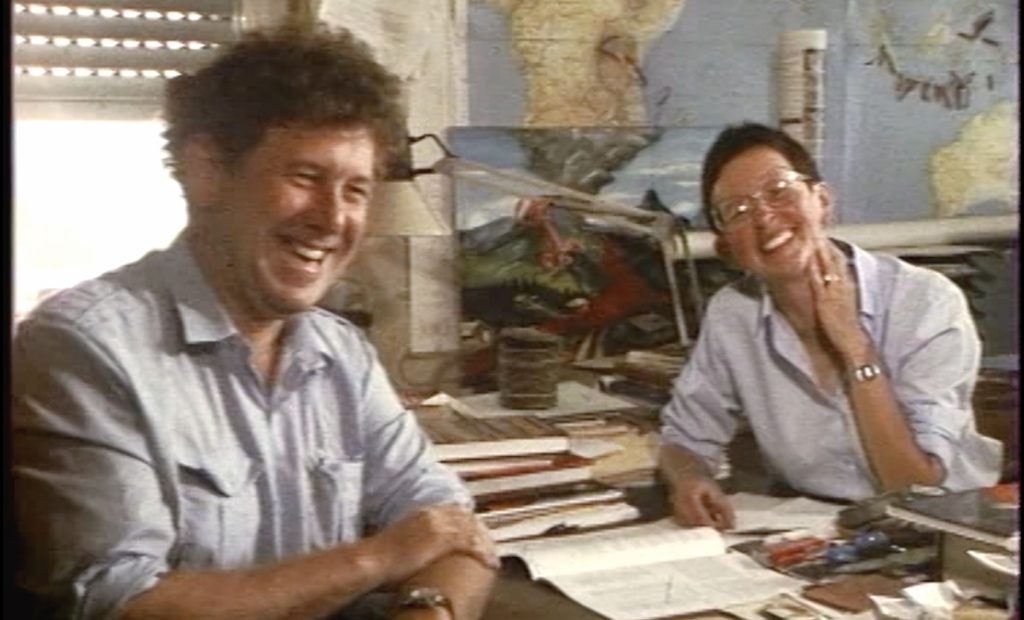
Fire of Love, a National Geographic film on Disney+, is about Katia and Maurice Kraftt, chemist and geologist, respectively, and their passion for science and each other. The couple, who both hailed from Alsace in France, chased volcanos around the world for two decades after they married in 1970, getting close enough to capture extraordinary footage of erupting, bubbling volcanos sending rocks and boiling lava shooting into the atmosphere.
Katia and Maurice Krafft are seated for an interview in their home in Alsace, France. (Credit: INA)
Despite being recognized as the world’s foremost volcano experts, Dosa says few people outside France and the scientific community know of the Kraftts. She hopes the success of Fire of Love changes that.
“They are not well known but it’s a timeless story…they seem out of a myth but they are real and for us it was so extraordinary to [create] a film about these humans who worked with this utter clarity of purpose,” says Dosa.
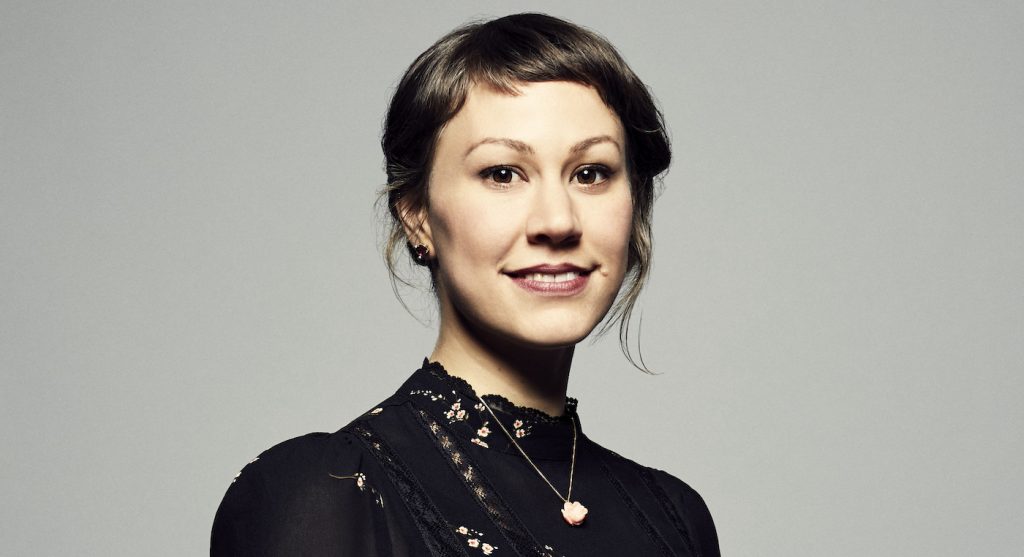
FIRE OF LOVE Director, Sara Dosa. (Credit: Erik Tanner/Contour by Getty Images)
The Kraftts’ vast 16mm archive and Katia’s trove of photographs are housed in a facility in Nancy, France, called Image’Est. The research was challenging because after the Kraftts died in 1991, Maurice’s older brother Bertrand managed the archive, and it moved around over the years before landing at Image’Est, says Dosa. “Image’Est loves the images and took care of it and stayed in touch with Bertrand. He was happy with us and is part of the journey,” she says.
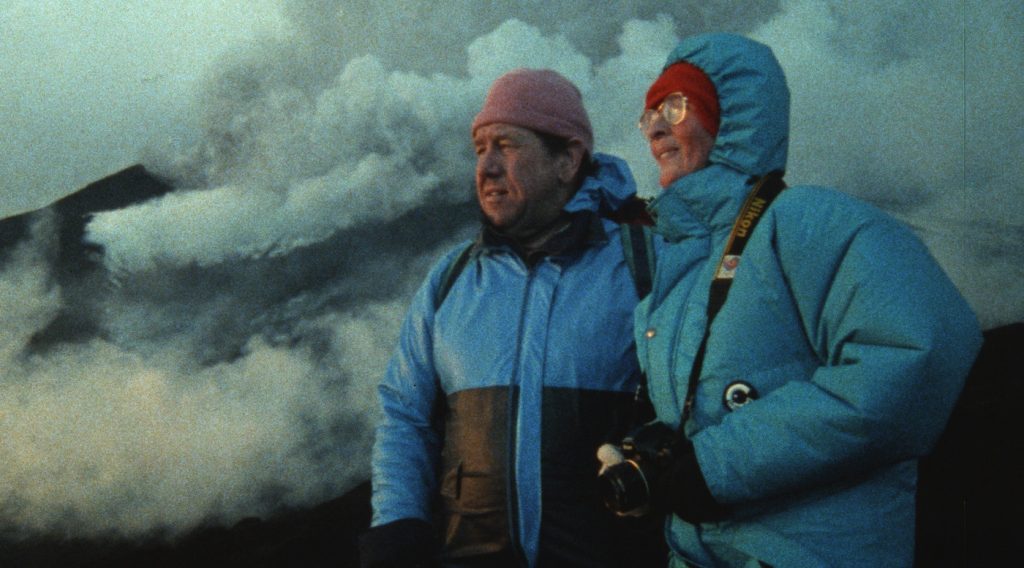
Katia and Maurice Krafft, in blue winter jackets, gaze upon a volcano in the distance as smoke, steam and ash swirl behind them. (Credit: Image’Est)
Due to pandemic, Dosa could not travel to France until October of 2021.
“By then, we were far into editing. They would scan and send [material] over the internet 20 hours at a time and we’d hungrily watch all of it.”
Besides the Kraffts’ films and photos, the Fire of Love team all had to cull though 50 hours of their radio interviews and televisions appearances on variety and talk shows as the couple became celebrities in France, a rarity for scientists at the time with the possible exception of oceanographer Jacques Cousteau.
Besides their haunting film footage, one of the key decisions Dosa made early on was to trust the Kraffts’ own words. The story unfolds through their letters, poetry and journal entries narrated by actress and filmmaker Miranda July.
“At the beginning, we didn’t want narration at all. We hoped the archive would speak for itself but we quickly realized the challenges with the footage and if we wanted to tell the love story, which felt like their true legacy, we needed a narrative vehicle to tell that love story,” says Dosa. “We were inspired by the tropes of French New Wave, which already existed in Katia and Maurice’s own work. We decided to embrace that subjective, playful narrator that people associate with the French New Wave as part of our style.”
Katia smiles while putting on her giant metal helmet while on Mt Etna in 1972. (Credit: Image’Est)
Once they decided on a narrator, the team knew they wanted a woman’s voice to counter the prevalence of male narrators in nature documentaries, says Dosa. But they assumed it would be a French woman until producer Greg Boustead suggested July. “We were excited because she possesses what we call a deadpan, curious voice,” says Dosa. “It reminded us of the narration in Godard’s Masculine Feminine. A deadpan narrator can make space for the images and story. She was perfect on a lot of levels. She took the writing we did and elevated it. Working with her was a total dream.”
Another key decision was to reveal early on in the film that the Kraffts died doing what they loved. We learn at the start of the film that they died while filming the eruption of Mount Unzen in Japan in 1991, an event that killed 43 people.
“We did not want it to feel like a third act payoff,” says Dosa. “It was important to be sensitive to them and not let their deaths feel sensationalized or a plot twist. We also didn’t want the question of when or how they died to take up narrative space and be distracting. So we took that question out and dwelled in how they lived because that’s what it was about — how to live a meaningful life in the pursuit of a dangerous love.”
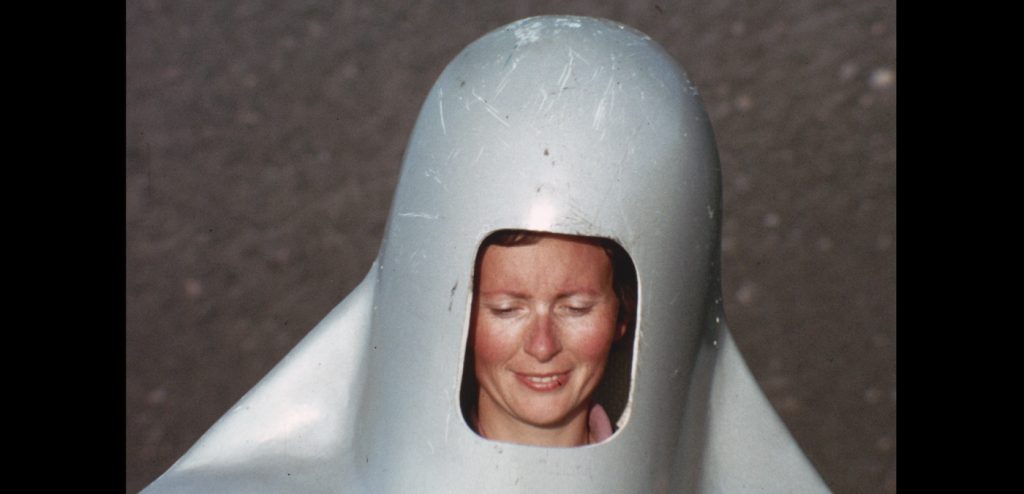
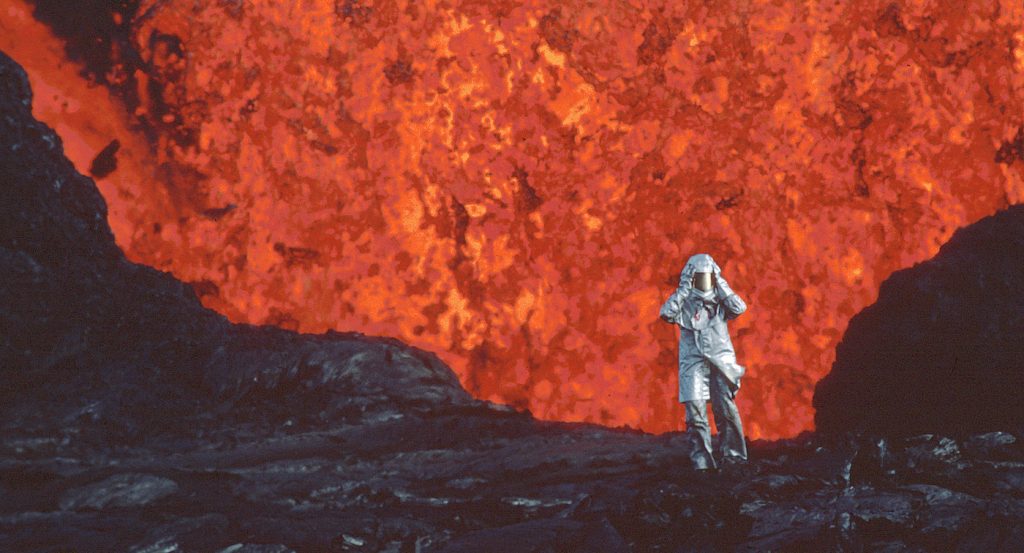
Katia Krafft wearing aluminized suit standing near lava burst at Krafla Volcano, Iceland. (Credit: Image’Est)
Dosa and her team were also keen to focus on the nature of time and the difference between time on the human scale—the duration of a single life—and time on a geologic scale.
“We were also thinking carefully about the theme of time in the film, the fleeting nature of human life set against the immortality of a volcano,” Dosa says. “That pulls into focus these existential questions of the meaning, life and love that make it all the more full of longing. Even though they died, death is not end for them. They are bound up in this endless cycle of creation and destruction. So we start with death and then connect it back to the beginning.”
The DGA award may boost Fire of Love’s Oscar chances despite hefty competition from critical favorite All the Beauty and the Bloodshed and BAFTA winner Navalny. Dosa says the precursor awards have fostered “camaraderie rather than competition” among the nominees. She hopes the awards spotlight “will help people all over world know the story of Katia and Maurice Krafft.”
“They would be ticked by all of this,” she says. “Our deep hope is that people can be inspired by their love for the earth, and maybe people will develop their own relationship with it. That’s the goal for me.”
Featured image: Katia Krafft wearing aluminized suit standing near lava burst at Krafla Volcano, Iceland. (Credit: Image’Est)
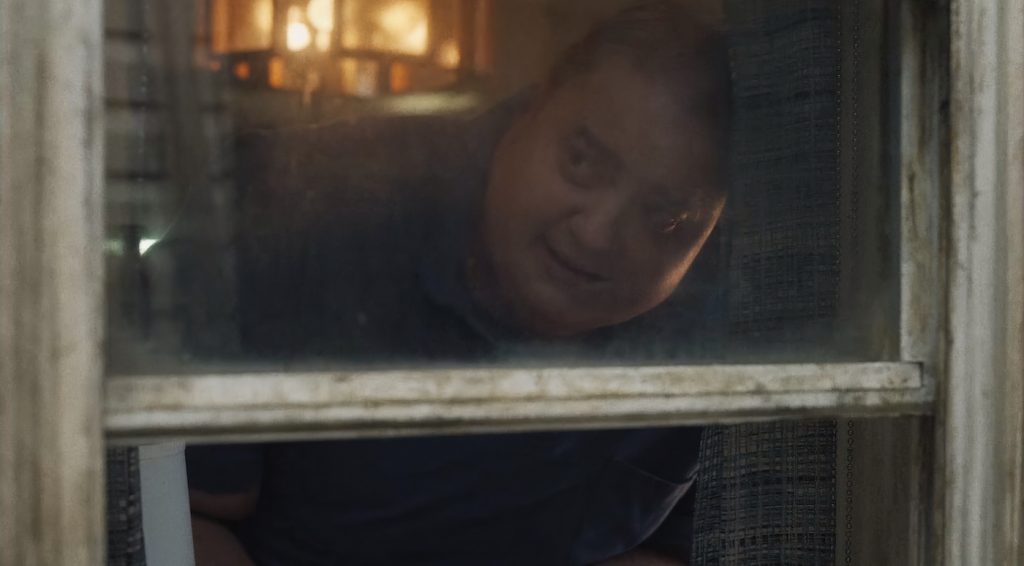
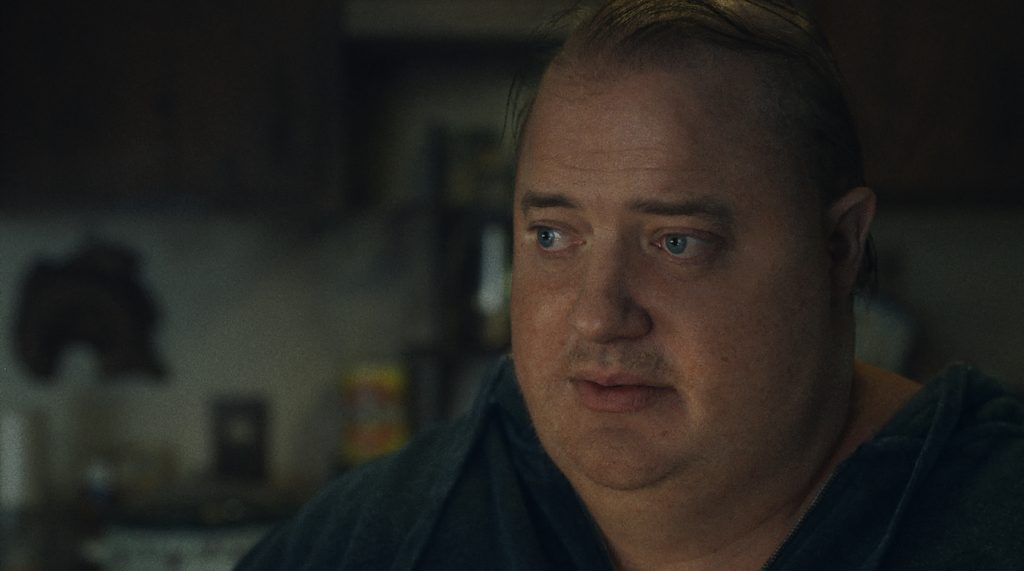
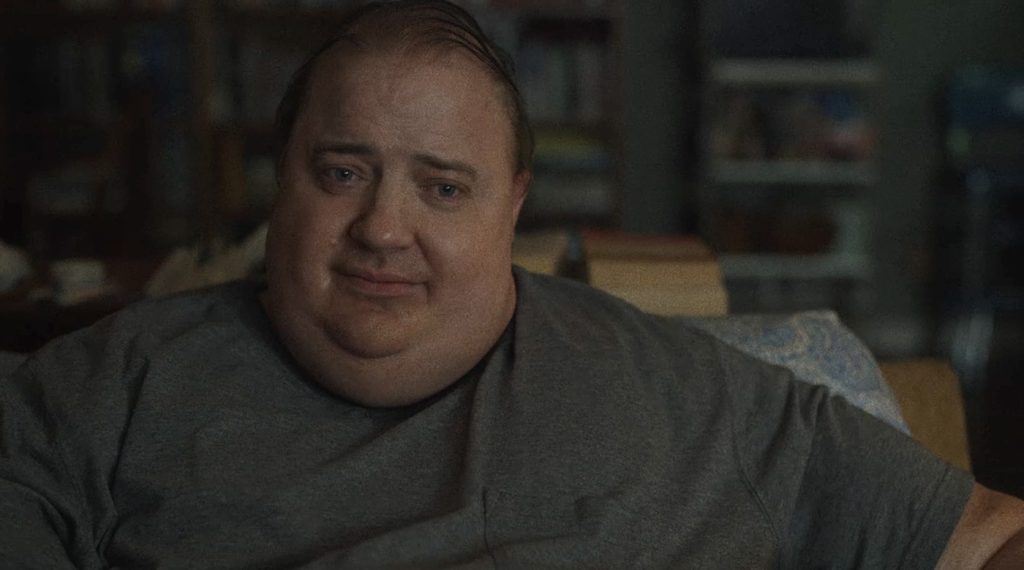
Filmmaker Darren Aronofsky often pursues the road less taken in movies like The Wrestler, Black Swan and Requiem for a Dream. He’s done it again in The Whale, which stars Oscar-nominated Brendan Fraser as Charlie, a 600-pound English teacher who conducts classes over Zoom with his screen image hidden so students can’t see his true size. The entire film (now available on demand on Prime Video, Apple TV and elsewhere) takes place inside Charlie’s apartment, where he argues with his caretaker (Oscar-nominated Hong Chau) and tries to reconcile with his estranged daughter (Stranger Things star Sadie Sink) while suffering from a heart condition. Fraser’s transformation into an enormous man makes for riveting spectacle, but, the actor insists, “This not a film about an obese man. It’s about a man in search of redemption and the breathless [suspense] that comes with whether or not he will achieve it.”
Fraser starred in his first blockbuster The Mummy in 1999. Since then, he’s made dozens of comedies, biopics, action pictures and dramas, including Gods and Monsters opposite Ian McKellen. But until last month, Fraser had never been nominated for an Oscar. His children woke him with the news, armed with ice cream, cake and balloons. Fraser says. “To share that moment with my kids, it’s among the top five happiest days of my life.”
Fraser, who lives in upstate New York with his family, spoke by phone during a recent visit to Los Angeles, detailing the nuances of his Whale hero and offering some hard-earned advice for young actors.
You imbue Charlie with so much heart and soul. How did you go about understanding the psyche of this troubled man?
On one hand, he’s the victim of having fallen in love with the wrong person so there’s the fallout from that cataclysmic event. And then knowing that a child got lost in the mix, whether it’s because of a court action, his former wife’s drinking, maybe his economic status — we don’t really know the reason, but what it means is that his little girl got compromised. When we meet Charlie, he’s dealing with the ramifications of this life he’s lived, the regrets, the failures. He has possibly five days left [to live] so he makes this Hail Mary to reach out to his daughter and apologize. I just had intense empathy for this character, and somehow the love I have for my own kids — that fueled me.
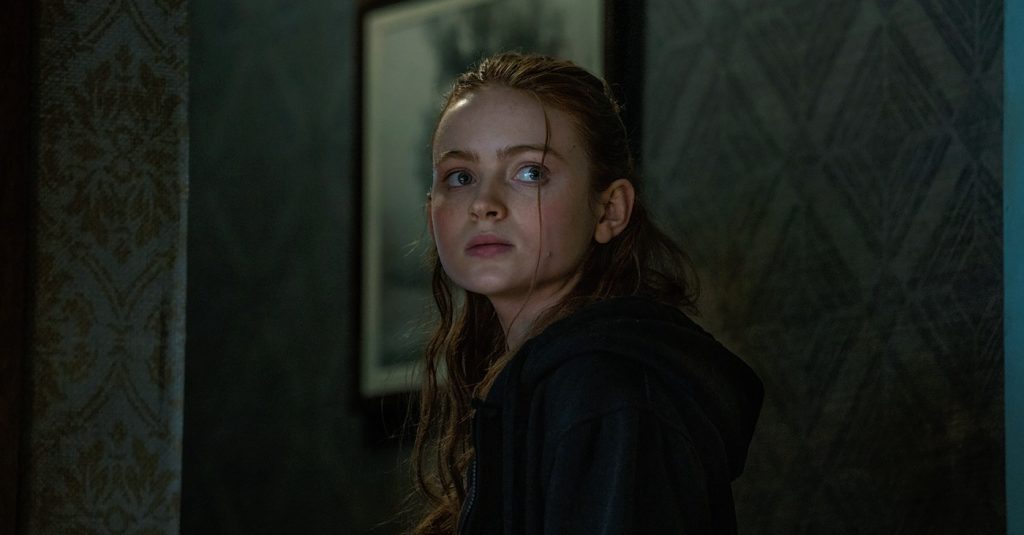
Sadie Sink in “The Whale.” Courtesy A24.
You shot The Whaleduring Covid. How did the pandemic impact the vibe of this film?
We were frightened, living under existential threat: Will there be a tomorrow? I’m not trying to be dramatic, but it wasn’t lost on all of us that this could be the last time we ever get to make a movie! But it was important to get up off of the couch, like Charlie must do, and go back to work. The pandemic made us all realize how much we cared about what we were doing.
Brendan Fraser on the set of “The Whale.” Photo by Niko Tavernise. Courtesy A24.
The prosthetics in this movie are sensationally seamless. Had you ever done extensive prosthetics before The Whale?
In Bedazzled, directed by Harold Ramis, I played a guy who goes through five different incarnations in this Faustian bargain he makes with the devil, Elizabeth Hurley. There were a lot of transformative prosthetics, but it was the traditional process: you get a life cast done, they put goop on your face, straw through your nose, a mold is made, it’s compounded into sculpting for an appliance — nose, cheek, whatever — and then applied to your face. There are seams, but the audience buys into it because there’s a suspension of disbelief.
The Whale sets a new standard in photo-realistic prosthetics, with Adrien Morot earning an Oscar nomination in the makeup and hairstyling category. How did you get fitted for the “Charlie” fat suit?
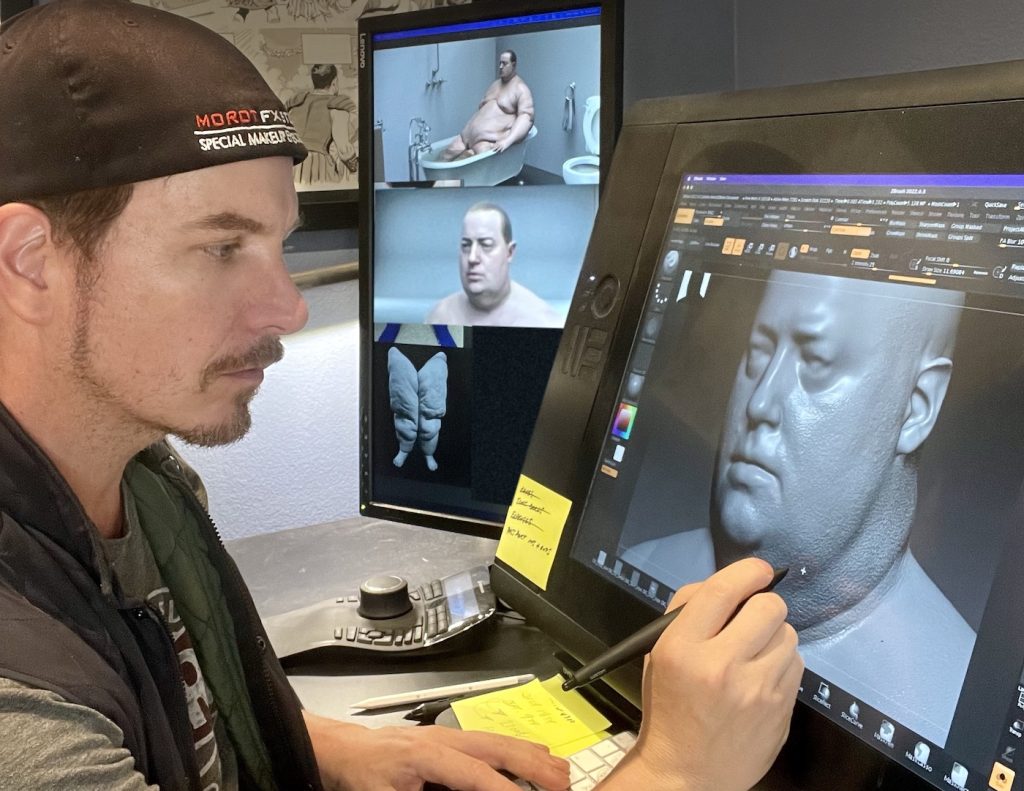
I couldn’t sit for a mold because of the virus so the producer had this iPad and did a digital scan of my body in my driveway in freezing January. From that body scan, data was sent to Arden Morot in Montreal. He imported the data to create a virtual Charlie body, with absolute dominion over the placement of pores, skin anomalies, everything. He imported textures so [the body] became like a giant texture map. From that data, molds were 3-D printed, appliances were made to fit my face perfectly, and you never see the construction line.
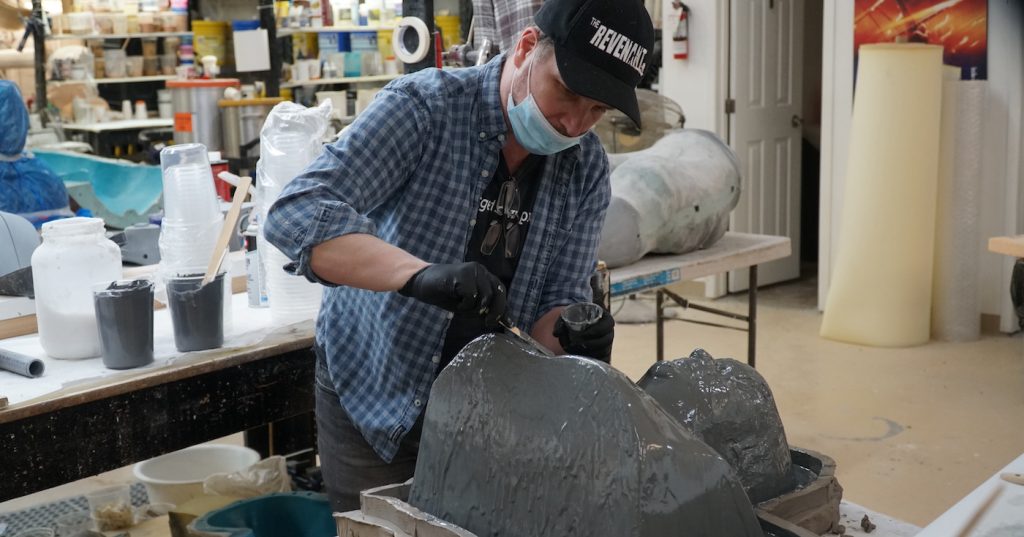
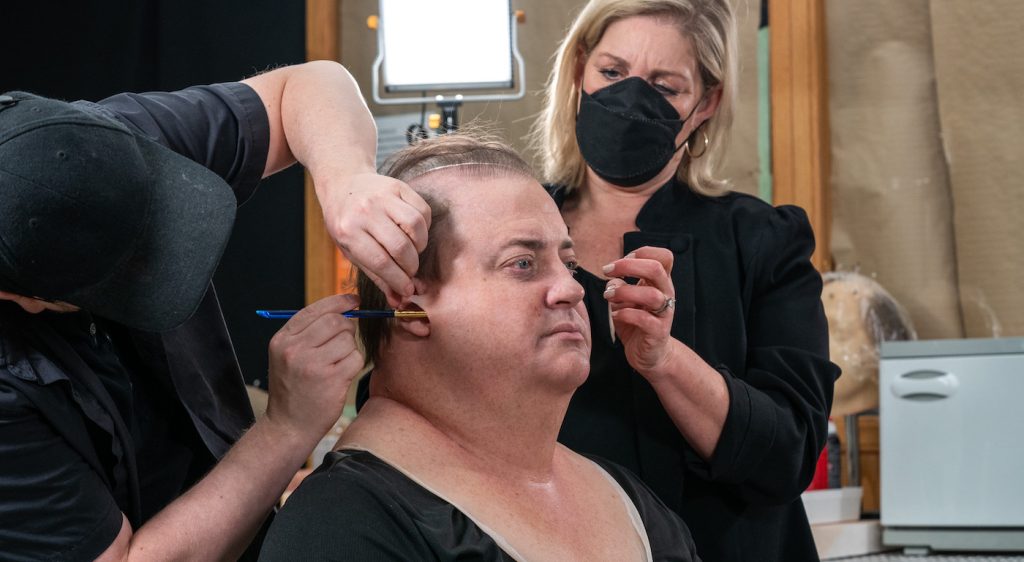
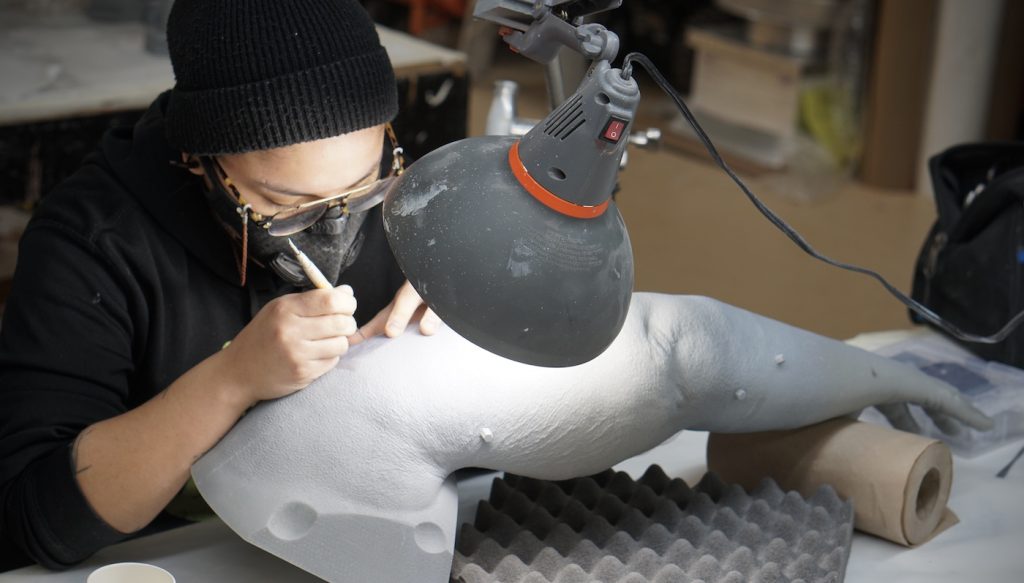
Adrien Morot sculpting Charlie’s body. Courtesy Adrien Morot/A24.Adrien Morot painting resin over the 3D printed sculpture of Charlie’s facial appliance. Courtesy Adrien Morot/A24.Adrien Morot adds a bit of glue to Charlie facial appliance while Annemarie Bradley-Sherron styles his hair. Courtesy Adrien Morot/A24.
From the outside in, “Charlie” represents a marvel of technology, but you had to animate his physicality from the inside out. What kind of research did you do in preparation?
I watched documentary and reality television footage with the volume turned down because I wanted to study bodies and their centers of gravity. I wanted to understand the mobility issues and disabilities and challenges faced by those who live in larger bodies. I also took inspiration from the great creatures of nature. Watching a great white [whale] crest and break the water and come down? To my eye, it’s reminiscent of the silhouette we see [at the end of the movie] when Charlie takes to his feet.
Movies rarely feature characters like Charlie in the lead role. Was it important for you to shine a light on the ways society as a whole views people who are heavy?
Yes! I worked with an advocacy group called the Obesity Action Coalition. Their mission statement is to end the bias that we as a society uphold as an accepted norm. The Coalition wants to make corrections wherein we don’t refer to people who live with obesity with the prevalent terminology. It’s not fair and we can do better. It’s the Coalition’s belief, and I concur, that this character Charlie can save lives by changing someone’s heart.
Audiences have responded deeply to your performance, famously giving you a six-minute standing ovation after The Whale screened at Cannes. What do you make of that?
When Charlie chooses to get up on his feet under his own power, which he could not do before, and goes to the light? I think that’s why audiences are having this collective – I don’t know if you call it catharsis or what — but there’s this undeniable emotional response from people in the audience taking part in this ritual that is cinema, sitting in a dark room with strangers, hopefully, checking their biases at the door.
Brendan Fraser. Courtesy of A24
Darren Aronofsky is such a distinctive filmmaker, always bringing a very specific vision to his projects. Who are some of the other directors you’d like to work with?
I’d like to work with Martin Scorsese again. Here’s the drill when you work with a masterful filmmaker like him: Everybody’s at the top of their game, all departments, and they’re all standing by like sentries. I’m serious! I gladly waited for a month to be called in for five or six days on Killers of the Flower Moon. There were a couple of scenes that Martin decides he wants to put in: “Call Brendan, can he get here now?” “Yes, I can!” I jump in the car and go. We’re all duty-bound to give Martin Scorsese what he needs to make the piece the best that it can be because we’re in service of something higher than our own interests. That’s the way I felt.
You’ve been acting professionally since you were about 22 years old. Back in 1992, when your first big movie Encino Man came out, did you ever picture yourself being nominated for a Best Actor Academy Award?
Are you kidding me?! No. Way. If I had allowed myself the fantasy, it would have been the category I’ve always admired: supporting actor. I’ve always wanted to be the bass player who backs somebody up and is really good at it. That’s how I felt when I worked with Ian McKellen [in Gods and Monsters]. He’s the lead guitarist.
In your field, career longevity can be a rare thing, yet you’re still going strong after three decades in show business. What advice do you have for actors who are in it for the long haul?
Have courage. Acting is about wanting and wanting and wanting again. There’s always going to be something in the way. An obstacle. And the actor’s job is to get around the obstacle and achieve the objective. And how you do that all comes down to tactics, really. Whether it’s a film, a play, or just the business itself, you need to want and want and want again. And to do that, you need courage. And to have courage is to acknowledge that something is scary. You can’t have courage until you acknowledge that. Thirty years ago, as a young actor myself, I would have done well to have somebody telling me to have courage. It’s something I learned by not achieving the goal, by being stopped by the obstacle. Living in this city is an obstacle: You’ve got to take Fountain because if you take Sunset, you’re going to get stuck in traffic. Finding an agent? That’s an obstacle. Staying in the game, staying relevant? That’s an obstacle. So that’s my epistle for the day. A hero is not just some guy running around in a helmet with a sword and a round shield. It’s a guy like Charlie. He’s a hero.
When it comes to makeup effects, Adrien Morot ranks among the very best. From fierce alligators (Crawl), to mutant superheroes (X Men films X-Men: Days of Future Past, X-Men: Apocalypse, and Dark Phoenix), to this year’s favorite film doll (M3GAN), Morot has proven time and again he’s a prosthetic wizard. But even he wondered if he had met his match when director Darren Aronofsky offered him The Whale.
“Terrified,” answers Morot with a smile during a recent Zoom interview when asked about his initial reaction. “It’s the kind of project that anybody with a head on their shoulders should run away from…the challenge is so immense.”
Based on the stage play by Samuel D. Hunter (who also wrote the screenplay), The Whale stars Brendan Fraser as Charlie, a morbidly obese online English teacher attempting to reconnect with his estranged teenage daughter (Sadie Sink) as he self-destructs by overeating.
Fraser needed to look hundreds of pounds heavier. After reading the script, Morot knew it wouldn’t be easy. Overweight makeups are typical to comedy (The Nutty Professor, Shallow Hal) or sci-fi (Thinner). Each permits a suspension of belief. The Whale didn’t allow for that.
“It’s a chamber piece with a small cast. Nobody’s wearing prosthetics other than the main character. He’s almost in every single scene,” explains Morot. “He’s going to fill up the screen. Any sort of flaw will be immediately noticeable. It’s a prosthetic artist’s nightmare.”
Brendan Fraser. Courtesy of A24
Having worked with Aronofsky in the past, including Mother! and Noah, Morot just couldn’t say no. He would create a makeup unlike any he had done before.
But that was only part of the challenge.
The pandemic was rearing its ugly head. Aronofsky thought The Whale, with its small cast and one location, would be the perfect COVID bubble project. Anticipating a shutdown lasting weeks, not months, the director wanted to act quickly. He scheduled five weeks of prep. Knowing something this complicated usually takes longer, that deadline concerned Morot.
Morot watched the stage production. It created Charlie’s look with padding and wardrobe cheats. This didn’t feel right. “They were using all sorts of tricks to help them out,” Morot observes. “The character is wearing long sleeves, a high collar, those kinds of things. It hides the padding.”
Brendan Fraser. Courtesy of A24.jpg
Consulting on the film, the Obesity Action Coalition, a non-profit that advocates for overweight individuals, confirmed Morot’s suspicions. Overweight people commonly wear minimal, loose clothing. “For practical reasons, a lot of skin is exposed,” he explains. “There’s no hiding it like they did in the play. It’s not true to reality.”
Charlie would require prosthetic arms, legs, chest, neck and oversized cheeks. And then there was the shower scene where he’d be totally nude. That added cascading ripples of fat hanging around his midsection. More time was needed to get it right. “If the makeup is a distraction because its show-offy or it’s bad, your movie doesn’t work,” Morot remembers telling Aronofsky.
Aronofksy agreed and expanded preproduction to 12 weeks.
Nina Anton finishes cleaning a 3D printed sculpture of Charlie’s arm prosthetic. Courtesy Adrien Morot/A24.
Unfortunately, that didn’t solve another problem. Normally, an actor comes to Morot’s workshop to do a full body cast. This generates molds used to manufacture body parts. But COVID restrictions prevented Fraser from traveling. It was time to push the envelope.
“We’ve been tinkering with 3D printing for a few years — doing internal tests at the shop,” continues Morot. “Makeup effects use 3D printing quite a bit, but it’s mainly robot stuff like M3GAN. The nature of successful prosthetics is doing a seamless transition with the skin. The accuracy of and consistency of 3D technology is not made for that.”
Morot decided to take 3D makeup to the next level. He contacted a colleague with a 3D scanner, asked him to mount it to an iPad and get it to one of the film’s producers. The producer went to Fraser’s house and, at a socially-distanced length, scanned the actor’s body.
“He sent me the data. I was able to clean it up and have a workable model to start the sculptures from,” adds Morot. “And it worked.”
Adrien Morot painting resin over the 3D printed sculpture of Charlie’s facial appliance. Courtesy Adrien Morot/A24.
Morot’s design featured two headpieces — one that fitted to the front of Fraser’s face and stretched down to his breast. The other covered his skull and neck. Arm pieces extended to Fraser’s shoulders. Each leg was covered by two pieces. A multi-layered midsection gave Charlie his bulging stomach. Most of the time it was covered by an oversized t-shirt, except for the shower shots.
The first application took seven hours.
Adrien Morot adds a bit of glue to Charlie facial appliance while Annemarie Bradley-Sherron styles his hair. Courtesy Adrien Morot/A24.
“No kidding,” says Morot. “But that’s a lot of tinkering because it’s so heavy. It’s finding the right height so that once it’s glued, it drags to where it’s supposed to land. That takes a little back and forth. Then finding the right palette of color that not only matches Brendan’s skin tone, but also the color palette the DP is using.”
Morot ultimately cut application time to under three hours.
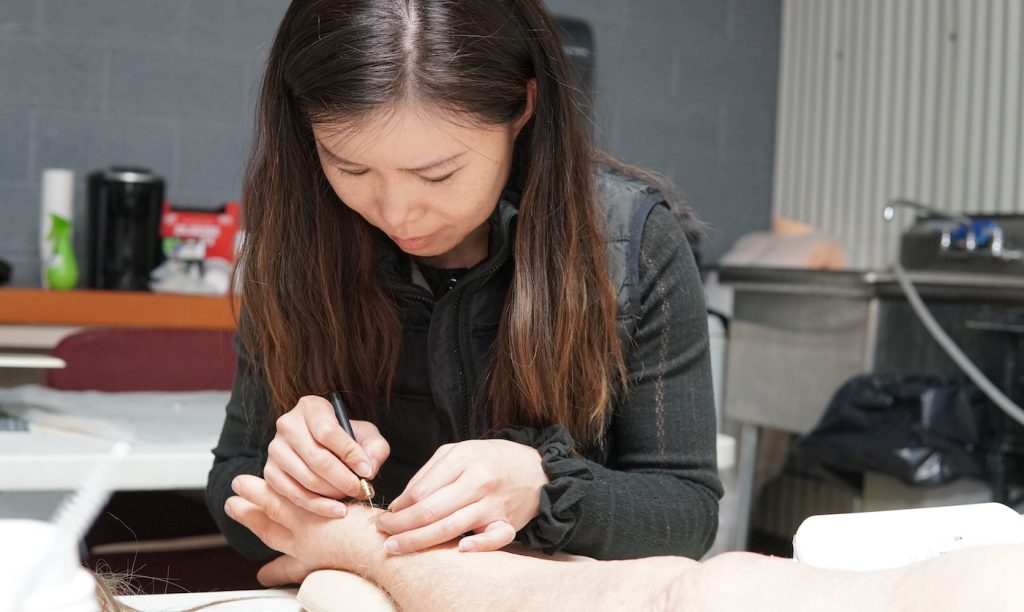
As prosthetics can only be used once, new body parts were needed for each day of shooting. Morot credits Kathy Tse for painstakingly hand punching the hairs that covered Charlie’s arms and legs and gave his face its stubble. She logged a lot of workshop hours to ensure every hair was in place.
Morot FX Studio co-owner Kathy Tse punches in hair one by one into Charlie’s arm prosthetic. Courtesy Adrien Morot/A24.
The shower scene initiated a crucial change. Because of its lightweight and its resemblance to skin, foam latex is the prosthetic material of choice. But if it gets wet, it acts like a sponge. So Morot switched to silicone. It delivers a similar look, but is much heavier.
“It was like over 200 pounds. So we engineered a sort of parachute harness that would spread the entire weight over his body,” said Morot. He thought Fraser would balk at carrying all that weight, but the actor gladly bore the load. “He told me that it helped him find the character. Maybe he was just trying to be nice.”
Aronofsky had one final curve. He wanted a shot of Charlie rising from a sitting position. Prosthetics don’t work this way. Sitting pieces are shaped differently from standing pieces. A movement like this had never been done before.
“I was like, ‘Yeah, but you’re gonna do a cut…clever editing. Come on buddy, you’ve got to help me out,’” remembers Morot. “And he’s like, ‘No. I want to see it.’”
Morot and Tse spent hours strategizing without a solution. Then Aronosky got an idea. Could the prosthetics be modeled after a Russian doll, where the smaller versions fit inside the larger ones?
“I thought, ‘That’s pretty clever actually,’” remembers Morot. “We ended up gutting the entire thing. Each piece, depending on where it was located, would fit into the one under it or above it,” explains Morot. “After we did those modifications, the pieces collapsed and puddled on the side in a natural shape. When he got up, it would all deploy. Sometimes, I would have to run in and re-jam something. But for most of it, it ended up working. For sure, I’m gonna use it in the future.”
Brendan Fraser as Charlie in THE WHALE. Courtesy Adrien Morot/A24.
The effort has been appreciated. Fraser received an Oscar nomination for his portrayal. Morot, along with makeup department head Judy Chin and hair department head Annemarie Bradley-Sherron, were nominated for Best Achievement in Makeup and Hairstyling.
“There are so many technological breakthroughs in this movie,” says Morot. “I have to admit, the first day we were on the set, I realized this had never been done before. This is a turning point in movie history and it’s nice to be part of that.”
For more on The Whale, check out our interview with Oscar-nominee Brendan Fraser and the film’s screenwriter Samuel D. Hunter.
Featured image: Adrien Morot adds a bit of glue to Charlie facial appliance while Annemarie Bradley-Sherron styles his hair. Courtesy Adrien Morot/A24.
Cocaine Bear began snorting up viral eyeballs last fall, boosted by a madcap trailer that racked up 18 million views. Now boasting a $28 million opening weekend, second only to M3GAN as 2023’s biggest non-franchise hit, it’s based on the true story of a black bear who discovered a duffel bag of cocaine in the Georgia woods. Directed by Elizabeth Banks, Cocaine Bear features human stars Keri Russell, Alden Ehrenreich and Isiah Whitlock Jr., but the main attraction, nicknamed “Cokey,” owes its CGI existence to the New Zealand-based Wētā FX team led by visual effects supervisor Robin Hollander.
Joined by some 150 artisans, Hollander spent two years perfecting a computer-generated bear that has now entered the pantheon of weirdly irresistible comedy horror creatures. Hollander, who previously worked on the Planet of the Apes trilogy and Avatar, remembers attending a sneak preview screening in November. “People in the audience were losing their minds! It’s not going to change the world, but this is something I think people need right now. Ultimately, that’s what movies are: an escape into shiny green pastures — only our pasture is laced with cocaine and blood!”
In Los Angeles recently for Cocaine Bear‘s Hollywood premiere, Hollander checked in with The Credits to talk about hair count, sun bears and the magic of a well-made “stuffy.”
What were the steps involved in building the star of Cocaine Bear in all her detailed splendor?
In all her gory glory? It started with the first call we got from Elizabeth Banks. One of her mandates was that if this bear isn’t photoreal, the whole thing falls apart. She was very clear that the bear is not stylized, it’s not a cartoon, it can’t look like bad taxidermy every time she comes on stage.
But there’s a lot of trial and error before you get to “photoreal,” right?
Yes. We spent two years and nine days working on this. Liz had some experience with CGI on Charlie’s Angels but this is her first time, I think, building a creature. We showed her examples from other movies where the final result looks amazing, but we needed her to understand: it’s a long road to get there, with many iterations. As we were chipping away and making the nuances of Cokey come alive, we would show Liz stuff that looked a little rough, like a doodle on a napkin, and if she didn’t like it, then we’d pull the plug and not waste time. It was very efficient.
What steps were involved in building Cokey?
We built a model standing on all fours in the “rest pose” — no animation, no expression. Once we had that base model, our creatures department put in joints and restraints, which is called the puppet. Then the animation department goes into the puppet and animates each limb. Our facial model department works with the lip puller and the nose wrinkler and the eyes squasher, all sorts of stuff like that. In order to get the performance our animation supervisor needed, there was a lot of back and forth. The puppet is also used by the creatures department to do all the simulations controlling how the fat under the fur bounces and contracts and expands in order to make the fur shake and jiggle. All of that is fed into the puppet.
Cokey’s face looks so convincing, even in close-ups. How did you achieve that level of detail?
We had the bear looking incredible in shots that were middle ground or background. As post [production] progressed and we got closer up to Cokey in the third act, we took another look at her face. She looked too bristle-y, almost like a brush, so we decided to up the fur count from about half a million to about four million, from her snout to her ears. Instead of one strand, you now have eight. We we were able to make each strand finer and taper them off, which results in smoother, more organic-looking hair.
Courtesy of Wētā FX.Courtesy of Wētā FX.Courtesy of Wētā FX.
You worked previously on three Planet of the Apes sequels that used motion capture of human actors, who were then digitally enhanced to look like apes. Did you consider performance capture for Cocaine Bear?
The Apes trilogy lent itself to motion capture because you can transfer somewhat easily from people to apes. You can’t do that with a black bear anatomically just because the gaze and the walk cycle are so different. We decided early on that it’s not worth the hassle of doing performance capture. Instead, we had an amazing artist named Allan Henry on set.
Allan Henry acted out the bear’s behavior?
Yeah. He could stare at the actor and smile and make grunting noises. We also had Wētā Workshop build this amazing life-size bear — we called it a stuffy — which gave us a really good reference for how fur reacts under different lighting conditions and helped the DP frame shots. Most importantly, the stuffy gave our actors the opportunity to get psyched out by the bear. There was a sweet moment on set where I remember seeing Isiah Whitlock off to the side looking at the stuffy, sort of peering into his eyes, almost like two actors getting acquainted and having a chat between scenes.
Keri Russell as Sari in Cocaine Bear, directed by Elizabeth Banks. Courtesy Universal Pictures.
You’re based in New Zealand. How did you coordinate the CGI work with Elizabeth Banks?
We’d do virtual review sessions every week and send hi-res files that they could cut into the AVID. It was nice to have direct input from the filmmaker because, usually, you’re dealing with a client-side supervisor. That makes sense on a big show with multiple vendors. But for this one, it was refreshing to get a message from Liz’s husband, Max Handelman, when he’d forward me an Instagram post of a bear doing something funny. We’d flesh it out and say, “Here’s what we did with that link you sent over.” It was more like sending messages to a friend.
As you mentioned earlier, Elizabeth Banks needed a photoreal hero bear. What were some of the real-world references that inspired Cokey’s behavior?
We showed Liz footage of sun bears because they just looked naturally coked up.
Sun bears?
Sun bears. If you go on YouTube and look them up, you’ll see what I mean. Their eyes roll around in their heads, and the tongue lolls out. They’re incredibly ferocious and make really weird facial shapes if they want to get into a coconut or a bag of food or something. When we saw the footage, we said, “Surely this is what a bear would look like on coke.”
(from left) Stache (Aaron Holliday) and Daveed (O’Shea Jackson, Jr.) in Cocaine Bear, directed by Elizabeth Banks. Courtesy Universal Pictures.
Anything else?
The Revenant, of course, gets referenced a lot when you talk about bears in movies so we wanted to build on that. The thing is, the back knees [of The Revenant bear] felt quite bent and we found that when Cokey had bent back knees, she just looked like a fat dog, limping. So we gave Cokey peg legs, basically, having seen footage of black bears taking long steps with straight legs where it almost looked like they were dragging them.
Does Cokey sometimes stretch the limits of what a bear could physically accomplish in real life?
Well, the ambulance chase — people say that would never happen, but black bears run up to 35 miles an hour. The ambulance isn’t going that fast on a winding road, so in our minds, a normal black bear could keep up; plus, she’s on coke, so let’s take it to the nines.
And then Cokey makes that incredibly long slo-mo jump?
Obviously, the jump is not going to happen quite like that, although black bears are very good at jumping. We saw tons of footage of bears jumping between trees or jumping onto someone’s deck.
What about that wild sequence where Cokey’s on her back pushing herself across the ground?
There’s ample footage of bears rolling around scratching their backs on the ground, although not quite as seductive as Cokey’s doing it. That was Liz’s idea, wanting to show that Cokey was enamored with Eddie. The bear’s high on coke and likes this man in the blue jacket. At one point in time, it was more sexual, with Cokey fully dry-humping him. We were like, “Yeah, let’s not do that; it takes us out of the movie too much.”
You spent a lot of time and energy bringing this movie bear to life. Looking back on Cocaine Bear, what are you most proud of?
For me, the proudest achievement is the team that we put together back home at Wētā FX and the fact that we built this great relationship with Liz. Also, our producer Lily Lawrence was fantastic at managing the process. And having worked now on something really hilarious, we just hope Liz makes a franchise out of it and churns out more coke bear movies!
For more on Universal Pictures, Peacock, and Focus Features projects, check out these stories:
Willem Dafoe is a national treasure, which makes his latest film Inside such a perfect vehicle for him. Dafoe plays an art thief poetically named Nemo who takes on a job filching treasures from a high-tech New York penthouse that goes disastrously wrong. In a new featurette released by Focus Features, art curator Leonardo Bigazzi walks us through the exquisite art collection depicted in the film, and explains how each work of art speaks directly to Nemo’s increasingly dire circumstances.
Yet this isn’t just a high-concept art thief caper film like, say, The Thomas Crown Affair. No, Inside owes at least part of its DNA to thrillers like David Fincher’s 2002 film Panic Room, which found Jodie Foster having to lock herself and her daughter inside the family’s titular safe space while three men intent on stealing a fortune prowl through her house. In Inside, as the title suggests, Nemo gets trapped inside the penthouse after triggering an alarm that turns the place into a super-heated fishbowl. Used to ingeniously figuring out ways to quietly separate rich people from their priceless works of art, now Nemo’s life will depend on whether or not he can find a way to steal himself out of this deathtrap. The art contained in the penthouse might be his salvation—or his ruin.
The art on display is a mixture of paintings, sculptures, and new media, Bigazzi explains. In fact, Bigazzi curated the art depicted in Inside as he might have done for an exhibit in a museum, with each piece picked specifically to heighten Nemo’s growing desperation as the heat ticks higher towards certain death, and the art itself seems to a part of the torment. Each piece, Bigazzi explains, speaks to Nemo, urging him to take certain actions at certain moments as he tries to devise a way out of the penthouse before he loses his mind and his life. The art itself becomes his guide, and making art, even though Nemo is a thief, not an artist, becomes key to his survival.
Inside comes from director Vasilis Katsoupis, from a script by Ben Hopkins, and the conceit is such that the film is essentially a one-man show. Inside will let us see how Nemo puzzles his way out of his dire situation. Or not. The trailer indicates that our high-end art thief will start to lose his mind while trapped inside this sweltering, multi-million-dollar cage, yet this new featurette suggests that maybe, just maybe, the art thief will become an escape artist and find a way to survive. How Nemo attempts to escape, what lengths he’ll go to get free, and how badly it will get before the end credits roll are all part of the excitement. Getting to see Dafoe use his considerable gifts in feverish genre film is worth the price of admission alone.
Check out the trailer below. Inside arrives in theaters on March 17, 2023.
For more on Universal Pictures, Peacock, and Focus Features projects, check out these stories:
Featured image: Willem Dafoe stars as Nemo in director Vasilis Katsoupis’ INSIDE, a Focus Features release. Credit: Wolfgang Ennenbach / Focus Features
Christophe Beck is one of the most prominent composers in the Marvel sandbox. He not only scored all three Ant-Man films but co-composed Hawkeye and, to great acclaim, WandaVision. After eight years of collaborating with the Marvel team, Beck is well-versed in the MCU’s sonic landscape.
The composer’s first collaboration with director Peyton Reed was years before he composed themes for Ant-Man’s miniaturized adventures. The two first worked together on Bring It On, the quintessential cheerleader film. Even though their stories have grown in scope, most notably in Ant-Man and the Wasp: Quantumania, the duo stay in good touch with their comedy and electronic roots for their latest Marvel adventure.
When you worked on the first Ant-Man, you tried some crazy electronic experiments that didn’t work for the movie. Did you return to any of those early ideas for the quantum realm?
It’s interesting you asked that. I have a real passion for electronic music and modular synthesizers, which is a specific kind of instrument that invites experimentation and is particularly good at making incredibly strange noises. Peyton and I got really excited about getting all insect-y with the modular synth, and we created a suite of demos that was glitchy and experimental and skittery, and it was really, really cool.
It got to a certain point when we realized it was not working with the tone of the movie, which was more of a lighthearted heist/caper vibe. In fact, at one point, Kevin Feige heard some of that stuff and he said something like, “Ah, it sounds cool, but I’m worried people are going to think their speakers are broken when they listen to it.” Peyton and I thought he might be right about that.
We ended up putting that aside and going back to a classic heist feel, picking up on the iconic heist sound of the sixties and seventies. Now, when Peyton called me before Quantumania, he was like, “Hey, I’m excited. We’re going to be exploring this entirely fantastical, strange, and magical universe. Can we pull out some of those little sounds?” I did go back and listen, but it still didn’t feel quite right. There’s something very angular and just too strange about those sounds.
We wanted to make sure the Quantum Realm, particularly when we’re first introduced to it, was a place that inspired awe and that was a place that was beautiful and exotic and not just weird, weird, weird. There’s enough weirdness in the characters that are down there that we don’t need to lean into that so hard with the music. The music could focus more on the emotional quality of what it’s like to be there and less on literally mirroring what we’re seeing. So yeah, it’s interesting you bring that up because that did come up in some early conversations with Peyton.
That was eight years ago. Would you say what a Marvel movie sounds like has changed much since then?
I don’t think so. I think what’s amazing about how Marvel handles their movies, and I think Quantumania is the 31st film in the franchise, is they’re so good at giving each film a unique identity. The first couple Ant-Man movies were heist movies. Captain America: Winter Soldier was more of a political thriller. You end up with these movies that explore different classic genres, and that gives composers a chance to imbue their scores with a bit of a unique identity.
Yet the films all still cohere into a larger narrative.
It’s Marvel. There needs to be a fundamental throughline, not only in the stories that they tell. It’s something else that Kevin and Marvel are incredibly good at, giving each film its own identity while also having a place in the larger story that they’re telling, some more than others, but they all fit in. That has to be reflected musically as well.
Kevin is a big fan of movie music and knows his movie music history and iconography. These are superheroes, so there has to be an element of that classic boldness. Of course, big themes are always welcome when you’re trying to evoke that classic superhero feel. I think he was right; even with moving away from strange, weird electronic noises to a classic heist feel, there still needs to be thematic continuity and bold themes, and that’s what we have in Ant-Man. One of the things that have been consistent in all three Ant-Man movies is his theme, something that I’ve taken great joy in revisiting and exploring and developing and finding new ways to say it musically.
In the first movie, Scott is a thief. Now, he’s saving universes. How’d that huge personality change affect his theme?
I think all you need to do is listen to that first theme, which has a sneaky feel to it. It introduces the idea of getting big and getting small, and you hear that musically as the piece develops as well. It goes from really loud to really soft and sneaky, back to really loud. Skip forward to Quantumania, the variation of the Ant-Man theme in Quantumania, which you hear first; it’s the first track on the album. It’s also the main end credits piece in the movie. Now, it’s high energy; it’s bolder. The orchestra is taking a much bolder approach to state the theme, and there’s a real drive and power to it that reflects the maturity of the character and Scott Lang coming into his own as a hero.
How about for Ant-Man and the Wasp? As a duo and the central romance in the series, did their theme develop?
Yeah, that’s something else we talked about too. Quantumania is the first of the Ant-Man movies where you get a feel for the romantic love between Ant-Man and the Wasp. It culminates at the end when they have a scene where that feeling is at the forefront. Again, we went to the Ant-Man theme, but this time it was played slowly on cellos with flowing strings around it, and I tried to evoke the heart in the theme as well. One of the things I try to do is make sure that [the themes] are versatile, that they can be developed and varied to evoke the full range of emotions that a story might call for. Sometimes it is a challenge to make it work, but it felt natural in Quantumania to find not only the sort of more mature, bold, super-heroic version of that theme but also the more gentle, more bittersweet, and romantic version of that theme.
The first movies were, as you said, heist movies. Here, there are far more moving pieces, characters, different cultures, and a whole new world. How’d the leap in scope provide more challenges?
Besides everything you just said, the sheer amount of music was off the charts for this one. I think the first couple of movies might have had a little over an hour of score in each one. This one we’re talking about is a little over two hours. The music starts and basically never ends until the end of the movie. Sometimes it’s like I’m driving a cruise ship. I’ve got this behemoth under me, there’s all this chaos going on underneath, and I just have to focus on what’s in front of me on that particular day. Working on a film of this size and complexity is a new challenge, for sure.
And a film that’s kicking off Marvel’s Phase 5, no less.
This film has an important role to play in the overarching story, so I took direction from Kevin Feige and Peyton to let me know what is important, what to highlight, what to not worry about so much, and especially in early days when very little of the visual effects are completed, and so much is left to the imagination as I’m working on it.
There is a lot of buildup to Kang the Conqueror in the movie. How’d you want to build up to his reveal, to make him present in the Quantum realm before he even appears?
A lot of what my decisions ended up being, the decisions I ended up making, shifted as I saw more and more footage of Jonathan Majors as Kang. Jonathan is an incredible actor, and he brings so much intensity to the role. One of the things I learned as a composer early in my career is when an actor comes on screen and is killing it, stay out of the way and let the actor do their thing. My job becomes less about merely mirroring what’s already on the screen and amplifying what’s on screen. Opportunities become available for me to add different layers. If Jonathan is bringing so much to his portrayal of Kang, that leaves me free to think about what else is going on in the scene, more subtext and keeping things simple, and letting his performance carry the day.
At first, my themes for Kang, I got excited. I wrote this theme for a big Marvel villain, and it was big and complex, and I went through a process of simplifying and simplifying until his performance could really speak. Also, the first time we see Kang in this movie, he’s not at his full power. He’s confused. He doesn’t know where he is. He’s exiled. He’s trapped and lonely, and so when we first hear Kang’s theme, it’s a little bit more melancholy than later on when it blooms into his full malevolent power.
When he goes full-on villain at the end, do you still want to keep those notes of melancholy? Or do you want a blasting sound of villainy?
That hearkens back to what we were talking about earlier with the Ant-Mantheme. Kang’s theme, just like the Ant-Man theme, depending on how I treat it and depending on what other phrasings and chords and harmony are underneath it, can shift from something more melancholy to something more malevolent. One of the things I noticed is when there’s an actual chord progression underneath a melody, that brings a little bit more emotionality to it, a little more heart, and a little more musical direction.
Eagle-eared listeners to the movie score will notice as the film progresses I rely less on chord progressions and more on static harmony, which gives a more driving, more ambitious, more insistent feeling to Kang’s theme. Of course, the instruments that his theme plays on as well have a lot to do with it. We have a processed solo violin. It doesn’t sound that much like a violin, just enough to make it feel a little bit familiar in the early scenes with Kang. As it progresses, I bring in the rest of the orchestra, and by the end, we’ve got all 80 musicians blasting away.
Before the film reveals MODOK’s identity, the track “The Hunter” is hilarious because it plays this ridiculous character deadly straight and serious. Was that a lesson from your days of scoring comedies?
Absolutely. I think a lot of comedy scoring is taking a character’s inner emotional landscape and amplifying it and putting it on steroids. A lot of comedy scoring, effective comedy scoring, is not making funny music to help the audience laugh, but to get inside characters’ heads and exaggerate it, and that’s what brings the permission to laugh in the audience. We did that a lot in the score, especially once MODOK’s face is revealed, and we see him for the ridiculous character that he is. The track you mentioned, “The Hunter,” occurs at a point in the movie when we haven’t seen his face yet, and we wanted to sell the idea that MODOK is this unstoppable killing force and feared by all, a terror-inspiring presence in this world, and that’s why we really went for it in that track.
How’d you want to strike the balance of familiar and otherworldly within the Quantum Realm?
You know, we’ve had glimpses of the Quantum Realm in the previous two movies, not enough to warrant diving in and giving the Quantum Realm its own sonic universe. This was the first opportunity. As I mentioned, Peyton and I had early conversations about wanting to make sure that the Quantum Realm had a unique sound to it, and we both love electronic music, so I pulled out my synths for it. We went through a pass of the score early on where we watched the first four reels in a run one day and we were like, whoa, this score feels very dark and intense, and I think we need to find the fun again. We need to give the Quantum Realm a proper theme in the classic tradition of movie themes to make it feel a little bit less angular and a little bit less weird. We wanted to make sure that we grounded it a little bit so that audiences could appreciate the beauty and the wonder and the exoticism of this heretofore unexplored universe.
From what I’ve read, you are a huge Depeche Mode fan. How much influence would you say they have on you when you compose electronic music for a movie like Quantumania?
By this point, their music, their melody writing, and the phrasing of their melodies is so baked into my DNA I don’t even notice it anymore. I went to a show at the Hollywood Bowl that they played about eight or nine years ago, and it was the first time I’d really had an opportunity to revisit their music. First of all, I loved the show, but also I felt I needed to take a bit of a cold shower after because it was just like, oh, that, that’s where I get that. Oh, that too. The way they turn the phrase here and the way that note matches up against that chord, it’s like, oh, that comes from this song. It was surprising and kind of wonderful to me that I was able to connect those dots and see how big of an influence they are.
For more on all things Marvel Studios, check out these stories: