“The Last Kingdom: Seven Kings Must Die” Stunt Coordinator Levente Lezsák on Orchestrating a Viking Melee

Action buffs who enjoy English history will find much to savor in The Last Kingdom: Seven Kings Must Die. The Netflix epic (now streaming) follows five seasons of The Last Kingdom to chronicle the bloody Battle of Brunanburh in 937 when native Saxons crossed swords with invading Vikings and warriors from Scotland. Both sides suffered huge losses in the brutal Game of Thrones-meets-Braveheart massacre, led by near-mythic warrior Uhtred (Alexander Dreymon). The fight sequence involved 120 stunt performers, 180 extras, dozens of horses, and many gallons of simulated gore.

The story’s tribal politics and archaically named characters like Aelfweard, Aethelstan, and Aldhelm might be hard to follow at times, but the combat choreographed by stunt coordinator/second unite director Levente Lezsák makes it spectacularly clear: Seven Kings Must Die thrives on precisely choreographed chaos. Stunt fighters in close quarters who appear to be stabbing, slashing, and beheading each other en route to Valhalla had every move orchestrated in advance by Lezsak and his team. Lezsak, who previously worked on Underworld and Witcher, spent most of the past eight years recreating ancient warfare for The Last Kingdom saga.

Speaking from his farm in Hungary, where Seven Kings Must Die was filmed, Lezsák drills into his battlefield inspirations ranging from Viking re-enactor videos to 15th-century textbooks on the science of horsemanship


Your battle sequences are so visceral; they seem reminiscent of Braveheart and Game of Thrones’ now famous Battle of the Bastards” episode. Your fight scenes are so visceral that the viewer feels completely immersed in the action.

I try to keep away from any other shows, especially the most popular ones, because I try to find my own way of creating a battle. But obviously, there are impressions from my life. Braveheart, for example, was one of my favorites when I was a kid. The big battle was so stunning; everybody wanted to be Scottish when they came out of the theater. The thing I realized from Braveheart that I’ve carried throughout my career is that every action sequence has to serve the story. If you just do action after action it becomes boring after maybe a couple of minutes and people will lose interest. The big battles of Braveheart were great because they were character-driven, and that was the case with The Last Kingdom as well. Each battle represents some kind of turning point in this ongoing journey of Uhtred.

The Last Kingdom: Seven Kings Must Die. Alexander Dreymon as Uhtred in The Last Kingdom: Seven Kings Must Die. Cr. Courtesy of Netflix © 2023

Martial arts play such a dominant role in contemporary fight choreography, but these battles take place in 10th-century England. How did you structure these fights so they felt authentic to the period?

Even though people usually always think about martial arts as being Chinese or Japanese, we also have a beautiful European martial arts tradition that started to flourish in the Middle Ages. I also did research on how the Vikings used their short swords and their shields. There are lots of great re-enactment people keeping the Viking tradition alive, and they use the weapons authentically, so I watched their videos.

Levente Lezsák on set of “The Last Kingdom: Seven Kings Must Die.” Courtesy Netflix.

How did you train the stunt performers in these traditions?

On my farm, I ran a boot camp for the stunt team and trained them step by step until they felt like they’d been using these weapons for ages and they were part of their bodies. You can easily see the difference between someone who’s just trying to copy a fight style as opposed to having it come from inside. That’s why I did all this research for the fight choreography, and it’s why you feel these battle sequences are accurate. I tried to be faithful to history as much as I could.

The Last Kingdom: Seven Kings Must Die. (L to R) Alexander Dreymon as Uhtred and Mark Rowley as Finan in The Last Kingdom: Seven Kings Must Die. Cr. Courtesy of Netflix © 2023

A lot of characters come and go throughout The Last Kingdom, but Alexander Dreymon carries the story from start to finish as Uhtred of Bebbanburg — “Born a Saxon but raised a Dane,” as he says throughout the story. What was it like working with Alex on this role?

He’s a really tough guy. Alex has a great horsemanship background and also martial arts, including jiu-jitsu. Before we started season one, I had three weeks of boot camp with him and Emily Cox, who plays [Viking warrior] Brida. That gave me the time to teach him this very different fight style. The Viking short sword, his own [long] sword, the shield — all of that requires very specific skills, so Alex had to practice until he became a good warrior. And through all the seasons and this movie — eight years of our life — Alex got better and better as he gained more confidence and more technique.

The Last Kingdom: Seven Kings Must Die. (L to R) Mark Rowley as Finan, Arnas Fedaravicius as Sihtric and Alexander Dreymon as Uhtred in The Last Kingdom: Seven Kings Must Die. Cr. Courtesy of Netflix © 2023

In Seven Kings Must Die, how many fighters did you put on the field for that climactic battle between the Saxons and Vikings?

We had 120 stunt performers and with extras, a total of 300 for the final battle sequence.

What was your schedule for shooting the final Battle for Brunanburh?

Almost two weeks, plus a couple of Second Unit days.

Levente Lezsák on set of “The Last Kingdom: Seven Kings Must Die.” Courtesy Netflix.

How did you prepare?

We had a page-turn meeting with the director [Ed Bazalgette], the producer, the DP [Luke Bryant], and the first A.D [Zsolt Tolmár]. We shared our ideas and discussed what we wanted to do. Then the rehearsals took about three weeks for stunt riders, stunt horses, and stunt performers. We practiced formations like shield walls and other formations. Then we rehearsed with costumes. That’s how we proceeded toward the end result.

It’s impressive to watch this very disciplined Viking army operating like one giant, well-coordinated unit.

The shields were a big part of the strategy because the Vikings were the first to figure out how to raise their shields in unison and effectively form a wall. We had page-turn sessions to go through the script and then used pre-vis to plan how the should look.

The Last Kingdom: Seven Kings Must Die. (L to R) Arnas Fedaravicius as Sihtric, Alexander Dreymon as Uhtred and Mark Rowley as Finan in The Last Kingdom: Seven Kings Must Die. Cr. Courtesy of Netflix © 2023

Horseback warriors come to the rescue midway through the Battle of Brunanburh. How did you guide horses into these noisy crowds of stuntmen without causing the animals to panic?

Horses are fleeing animals. It’s abnormal for them to be part of a huge battle sequence. But on the other hand, you can train them for fights with “natural horsemanship.” This method shows you how to deal with body language and make deep bonds with horses. Once they admit you as a member of the herd, as an “alpha,” then you can teach horses tricks. But they have to understand you and fully trust you. I also studied lots of books from the Middle Ages because [in Europe] we have a military tradition that includes great horse masters from the 15th century who wrote about how to train horses for warfare. I’m really proud that we had no injuries or accidents with horses during the filming of this show.

The Last Kingdom: Seven Kings Must Die. Mark Rowley as Finan in The Last Kingdom: Seven Kings Must Die. Cr. Courtesy of Netflix © 2023

Like most fight choreographers, you started your career as a stuntman yourself. Have you suffered any broken limbs?

I’ve been lucky. I had one femur broken at the beginning of my career in 1995. I did a stunt with a horse in an open theater in Austria. I was playing an Apache Indian. My leg is pretending to be stuck in a stirrup and the horse is dragging me. That was the stunt. I did many takes but one time I made a small mistake and broke my femur. I also broke my little finger once and a couple of ribs but they don’t really count. The femur was the big one.

Setting up a wire-work stunt. Courtesy Netflix.

Do you still perform stunts yourself?

Yes. I did a car turnover two months ago. Nice stunt. If you’re the guy who’s leading a team into danger, I feel like you have to take the biggest risk, so even now, if it’s a dangerous stunt where someone could die if it goes wrong, I’ll usually do it. In The Last Kingdom, when [Uhtred’s father] Ragnar comes out from the barn fully on fire and kills a couple of guys? That was me. I did the full-body burn.

Levente Lezsák on fire on the set of “The Last Kingdom: Seven Kings Must Die.” Courtesy Netflix.

For more on big titles on Netflix, check these out:

“Beef” Costume Designer Helen Huang on Dressing “Chill” Angelenos Seething With Rage

Chris Hemsworth is Back as Tyler Rake in Thrilling “Extraction 2” Trailer

Rob Lowe is a Narcissist-Adjacent Biotech Entrepreneur in Netflix’s New “Unstable”

Featured image: The Last Kingdom: Seven Kings Must Die. Alexander Dreymon as Uhtred in The Last Kingdom: Seven Kings Must Die. Cr. Courtesy of Netflix © 2023

“Chevalier” Screenwriter & Executive Producer Stefani Robinson on Hitting the Right Narrative Notes

The story behind French Creole composer and virtuoso violinist Joseph Bologne, Chevalier de Saint-Georges, has been largely neglected in music history until recently. His life sounds too incredible to be true. He was born in 1745 in Guadeloupe, the son of an enslaved Senegalese woman Nanon and her captor Georges de Bologne Saint-Georges, and sent to France as a young child to be educated in the best schools. Though he struggled with the bigotry of being a man of color and was limited by racist laws that controlled his life, he rose to become the finest swordsman in France, a renowned violinist and composer, and a tutor and confident to Marie Antoinette. He also distinguished himself in the French Revolution fighting for equal rights of all French people. 

Though historians have found a fair amount about him, there is little known about his personal life. Chevalier, which is directed by Stephen Williams and features Kelvin Harrison Jr in the title role, pieces together historical information and extrapolates what might have happened at several pivotal points in his life that would explain his shift from court favorite to revolutionary hero. 

The Credits spoke to executive producer and screenwriter Stefani Robinson, who worked for years to make the film a reality, about the importance of this extraordinary historical figure and how the themes of identity and acceptance in Chevalier make it as relevant today as it was in the 18th century. 


Given how little there is out there about Joseph Bologne’s personal life, how did you proceed in terms of shaping the narrative? 

There are clues and facts available. We know where he was born, when he was born, and to whom. It’s not like this guy is a complete mystery. There’s enough information about this historical figure out there to really whet your appetite and to get to understand the shadings of who he is. But his personal life was the hardest part for me because there really isn’t a lot of detail about Joseph the person. A lot of the documentation about his life is based more on people’s reactions to him. There were letters from people who had relationships with him or saw him from afar or heard gossip or rumors about him, but there was nothing directly from him.  There was no, “This is who I am, this is what I like, this is what I enjoy about my music, what frustrates me, who I’m in love with.” All of that stuff is a complete mystery. So Stephen and I just had to fill in the blanks a little bit and pay attention to the clues. Like, if this situation was true, if this romantic relationship actually happened, if it’s true what happened to his baby, how must he have felt? It was a difficult exercise, but it was an incredibly liberating exercise at the same time. 

Kelvin Harrison Jr. and Ronke Adekoluejo in the film CHEVALIER. Photo Courtesy of Searchlight Pictures. © 2023 20th Century Studios All Rights Reserved.

The extrapolation that his relationship with Marie Antoinette impacted his evolution towards a commitment to social change is fascinating and makes a lot of sense as you lay it out in the film. 

That idea that his relationship with her was a catalyst for social change isn’t obviously explicitly what happened in his life. An important thing to note about this movie is I didn’t want it to be a Wikipedia page—his and this and this happened. I was just excited to tell a story that was operatic, an accessible, conventional story that invites the viewer in so they understand it and are introduced to this character and introduced to this time period in a way that doesn’t feel too alienating. With his relationship with Marie Antoinette, the thing that is true is, at one point, he was very close to her. They shared what seems like an overly positive relationship with one another; they shared time with one another, they share music with one another, and she supported him. Then you fast forward to the latter part of his life, and he’s taking up arms against her, so clearly something happened within a period where there was this shift, so that speaks to just needing to excavate what was spiritually true, and then render it in terms of storytelling in this more operatic or more of a dramatic way to explain the shift in his psyche. 

Kelvin Harrison Jr. and Lucy Boynton in the film CHEVALIER. Photo by Larry Horricks. Courtesy of Searchlight Pictures. © 2023 20th Century Studios All Rights Reserved.

Aspects of the film centered on not just Chevalier himself but the women surrounding him and their limited choices at the time. 

The truth of the time was that they didn’t have options, Marie Josephine, obviously, but even more so in Nanon, who was property. By all accounts, when you do read about her, it shows she had a child with her master, and that child was Joseph. The subtext being she was property, and she was taken advantage of in probably one of the most horrific ways possible as a very young woman, and she didn’t have a choice, and she couldn’t emancipate herself. She was like Marie Josephine, trying to survive within the context of the life that she was living. The women in the movie are complex. Marie Josephine, in particular, has so much awareness about her limited choices, and she hates that and is grappling with it, but at the same time, there’s a sort of cowardice or fear there, too. That’s real, and she’s not a lesser woman because she’s unable to emancipate herself from it at the moment. She’s weighing her choices, but I go back to the word survival. How can she survive? How does she pick her battles? What’s beautiful is in real life, she did divorce her husband. Nanon, as well, is so strong and resolute, but she doesn’t completely connect with her son anymore. Still, she can both feel distance and love her son, even if he wants to thrive in an environment she doesn’t understand. 


Both in life and in Hollywood now, especially for Black women, there’s this idea of the double-edged sword of Black excellence. That brings Chevalier into a very contemporary context around excellence and identity. 

I feel like that aspect of his life was the thing that invited me in and made me want to tell the story because I understood it. He had what seemed like on the surface to be this incredible life. But I think, having the experiences that I’ve had in my life, I really felt like there was probably a different story going on there. There was a subtextual story that was scratching the surface. Black excellence used as armor. Black excellence used as a survival mechanism. It is something that I have leaned into, and so many other peers of mine have leaned into, as a way of protecting themselves from being ostracized and to make themselves feel like we do belong. We’re here, and we need to strive harder and faster and better than everyone else because we aren’t usually invited into spaces like this. I think that that idea is incredibly contemporary. I don’t think it ever went away from Joseph’s time to now. I think that was just the truth of why it felt contemporary, because it’s something that is still happening, and has happened since then and was probably happening before then, too.

Kelvin Harrison Jr. in the film CHEVALIER. Photo by Larry Horricks. Courtesy of Searchlight Pictures. © 2022 20th Century Studios All Rights Reserved.

Chevalier is just a small part of Joseph Bologne’s extraordinary life. What are you hoping people will take away from the experience of the film? 

I just hope, first and foremost, that we’ve successfully introduced an audience to this historical figure, his music, and the legacy he left behind and that they feel inspired to do more research. I also hope the audience takes the curiosity about him and they apply it elsewhere because it doesn’t end with Joseph. He’s not a solitary figure forgotten by history. There are so many other people, women, queer people, and people of color throughout history who have been marginalized for so many reasons, for their sexuality, their race, and their relationships across all aspects of society. I hope the film inspires people to seek out the truth and the remarkable people hidden or lost in the corners of history. 

Chevalier is now in theaters nationwide.


For more stories on Century Studios, Searchlight Pictures, Marvel Studios and what’s streaming or coming to

Disney+, check these out:

Peter Quill Embarrasses Himself in New “Guardians of the Galaxy Vol. 3” Clip

“The Acolyte” Creator Leslye Headland on How Her New Series Will Approach the Jedi Order

Marvel’s “Blade” Adds Rising Star Mia Goth

Featured image: Kelvin Harrison Jr. in the film CHEVALIER. Photo by Larry Horricks. Courtesy of Searchlight Pictures. © 2023 20th Century Studios All Rights Reserved.

“Evil Dead Rise” Makeup & FX Artist Tristan Lucas on Loose Limbs, Buckets of Blood, & That Cheese Grater Scene

Evil Dead Rise keeps the spirit of the franchise alive by conjuring the living dead in the most emphatically gnarly way. The fifth installment in the horror franchise is a bloodbath of riches, full of wondrous practical effects and makeup. Most of the body horror in director Lee Cronin’s film is tangible, not computer generated, the work of talented artists at the top of their gore game.

Senior makeup FX & prosthetic artist Tristan Lucas is one of the artists responsible for the horrific delights on display, including a stellar cheese grater sequence you have to see to believe. Based in Australia, Lucas dreamed of working on horror movies thanks to the likes of Sam Raimi’s original Evil Dead, so the job was a nightmare come true.

In addition to Evil Dead Rise, he’s worked on an Alien prequel and a Mad Max film. “I’ve been very lucky to do what I do,” Lucas says, “and it still doesn’t make sense to me sometimes that I get paid to make monsters and throw blood around. It’s crazy, but I wouldn’t want anything else.”

Recently, Lucas told us about splashing buckets of blood around—a whole lot more—in Evil Dead Rise.


Obviously, you’re dealing with a lot of limbs in this movie. What is the hardest part of the body to create for a horror movie?

A head, for sure. Just for likeness purposes. It has to look like that person, so we do life-casting of that person where we make a copy of their face. But there are subtle changes happening; even the weight of the material that we use for the impression pulls the face down a bit. Eyes especially make or break a fake head. An arm, a leg, anything like that, those body parts are kind of generic. With a face, it has to look exactly like that person, or it’s going to look fake.

Caption: GABRIELLE ECHOLS as Bridget in New Line Cinema’s horror film “EVIL DEAD RISE,” a Warner Bros. Pictures release.

How do you get the eyes right then?

Carefully (Laughs). Generally, we’ll take a very high-definition photo up close. Back in the day, they used to be hand-painted to match. These days we cheat a bit and mostly print it. We literally do a photo-quality print of the eyes. There’s something about the gloss of an eye and the depth, like the pupil, that if it is a cheap eye or it doesn’t look right, the whole head looks wrong. Whereas you could also take a head that’s not perfect, but if it’s got really good eyes that look wet and have that depth, then it kind of sells better.

Which gnarly effect was, in your mind, one of the toughest moments to sell?

I think the gnarliest moment I did was the cheese grater.

How was that pulled off?

That’s a great combination of practical and visual effects. There are not a lot of visual effects in the film to do with our makeup unless it’s gags. Basically, there was a clean shot of the leg they filmed, and then we put a prosthetic on it and had tracking markers around it, and then they had a cheese grater with the side touching the skin missing essentially, and it’s just graded down over it. Visual effects [artists] then did the blend between the two as they reveal. It was a great way for the two departments to work together when sometimes there can be a bit of animosity between them.

A cheese grater was used to a horrific purpose in “Evil Dead Rise.’ Courtesy of Warner Bros. Pictures

Oh, really? Why is that?

Yeah, although practical blood is having a bit of a resurgence lately, visual effects have been taking over in terms of blood these days. It’s very often digital blood.

It rarely looks good.

It never looks good, but it happens a lot. We’re losing some work to it, but the best way is [for us to] work together. The cheese grater is a great example of that. The only thing they did for our makeup, really, is the eyes. They decided not to do contact lenses in this film for the comfort of the actors. On this, all the eyes are digital, and all the contacts are digital, but it works really well because it gives our actors a chance not to have to worry about being in pain or being uncomfortable. It lets them do their job better. The end result is we get this fantastic look with crazy eyes.

Caption: ALYSSA SUTHERLAND as Ellie in New Line Cinema’s horror film “EVIL DEAD RISE,” a Warner Bros. Pictures release. Photo Credit: Courtesy of Warner Bros. Pictures

Circling back to blood, what are the nuances of making it sell on film or, more specifically, on an actor’s face?

There are little things, like thinking about the way gravity will affect blood flow and the volume of blood out of a specific injury. I saw something the other day, I can’t remember what it was, but someone got shot in the arm, and then there was blood coming out of their mouth (Laughs). You’re like, that wouldn’t happen unless it’s deliberately comedic or something. The volume of blood is a big one. If someone’s losing liters of blood, and then ten scenes later, they’re still alive? I don’t know about that.

So your goal is to create a realistic amount of blood flow depending on the type and placement of the wound.

With gravity, it’s making sure the blood flow matches. If someone gets hit and falls down, blood’s gonna flow the direction they’re lying, not straight down their face. The continuity of the blood is a big one. It’s about making sure it stays the same as well as you can for the whole shoot. It gets tricky on something like Evil Dead Rise, where you have people literally covered head to toe in blood. You never want someone to say, “Oh, that’s a prosthetic.” You want it almost not to be noticeable. You have a photo of the blood from yesterday, and you just have to match it. But when you have someone that has so much blood on them, all of a sudden, you’re spending 45 minutes trying to copy the drips down. It’s little things like that that aren’t difficult, but if you do them wrong, it looks bad.

Caption: ALYSSA SUTHERLAND as Ellie in New Line Cinema’s horror film “EVIL DEAD RISE,” a Warner Bros. Pictures release. Photo Credit: Courtesy of Warner Bros. Pictures
Caption: LILY SULLIVAN as Beth in New Line Cinema’s horror film “EVIL DEAD RISE,” a Warner Bros. Pictures release. Photo Credit: Courtesy of Warner Bros. Pictures

When you have a tight schedule, as you did on Evil Dead Rise, what changes are you able to make on the fly?

It was a crazy schedule. Long days, long weeks, and lots of working on the weekend at the workshop to get stuff done. We try to accommodate as much as we can. There’s not much we’ll say no to. Our head of department, [prosthetics designer] Luke Poltie, I’ve worked with a lot, and he’s always reinforced the idea it’s our job to get what they want on the screen. As long as we’re not killing ourselves or working for free, we should do what we can to get it done in a healthy way. There are always some crazy things where schedules change and days switch around, but luckily, these days, we come prepared with a backup of a lot of prosthetics for cuts, scrapes, and wounds. If the filmmakers are like, “You know what? I want to see this prosthetic on the person right now,” we can do it.

Caption: ALYSSA SUTHERLAND as Ellie in New Line Cinema’s horror film “EVIL DEAD RISE,” a Warner Bros. Pictures release. Photo Credit: Courtesy of Warner Bros. Pictures

What are some recent advancements in your field that have helped speed production up, though?

I’ll say the advancement of 3D scanning and 3D printing is a huge one. Now, you can have someone in LA that needs a head scan done, and you can get it done there and emailed to you. You can print out their head and start working instead of having to get something physically shipped halfway across the world. It’s a huge benefit. Those technologies are changing so fast.

Evil Dead Rise is in theaters now. 

For more on Warner Bros., HBO, and HBO Max, check out these stories:

Transportation Manager Ryan Doucette on How Warner Bros. Turned “Kung Fu” Season Three Green

“Godzilla vs. Kong” Sequel Gets its Title

James Gunn Announces Pre-Production Has Begun on “Superman: Legacy”


Featured image: Caption: ALYSSA SUTHERLAND as Ellie in New Line Cinema’s horror film “EVIL DEAD RISE,” a Warner Bros. Pictures release. Photo Credit: Courtesy of Warner Bros. Pictures


New “Guardians of the Galaxy Vol. 3” Teaser Has All The Feels

We are a mere two weeks away from the premiere of Guardians of the Galaxy Vol. 3, the third and final film in writer/director James Gunn’s trilogy. A new teaser promises that all the feels, laughs, and love that our cosmic jokers have been providing will come together for one final, epic adventure.

Vol 3. will find our heroes all grown up. Well, not really, but they’re getting there! No, they’re not, but still, at least Groot is finally filling out after his heroic regression to babyhood to save the gang in the very first Guardians. The third film will introduce some lovable new characters, like Cosmo the dog (voiced by Maria Bakalova), and some less lovable types, especially The High Evolutionary (Chukwudi Iwuji), who is connected to Rocket’s heartbreaking backstory.

The feels will include finally getting some closure on the on-again/off-again romance between Star-Lord (Chris Pratt) and the woman he fell in love with, Gamora (Zoe Saldana). As we know, the Gamora in Vol. 3 isn’t the same woman he met in Vol. 1—she died (thanks to that all-time sociopathic monster, Thanos), and the current Gamora is from a different timeline. This previous trailer even hinted at a budding romance between Star-Lord and Gamora’s sister, Nebula (Karen Gillan), although she shuts that down pretty quickly in this new teaser.

It’s going to be a bittersweet final adventure. The Guardians have been one of the weirdest, most consistently surprising bunch of weirdos in the MCU, but as we know you’re well aware, writer/director James Gunn has moved on to DC Studios, where he’s now the new boss, along with producer Peter Safran, of the entire DC Studios slate. Along with Star-Lord, Gamora, Rocket, and Nebula, the core crew returns for Vol. 3—Drax (Dave Bautista), Groot (voiced by Vin Diesel), Mantis (Pom Klementieff). Their new mission will pit them against the aforementioned High Evolutionary and Adam Warlock (Will Poulter), first teased back in Vol 2. after Ayesha (Elizabeth Debicki) created him to hunt down and kill the Guardians. Yeesh.

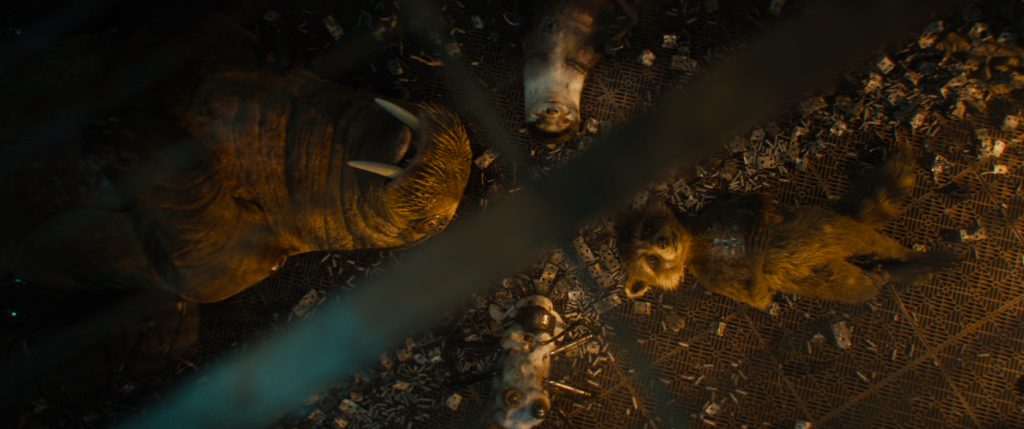
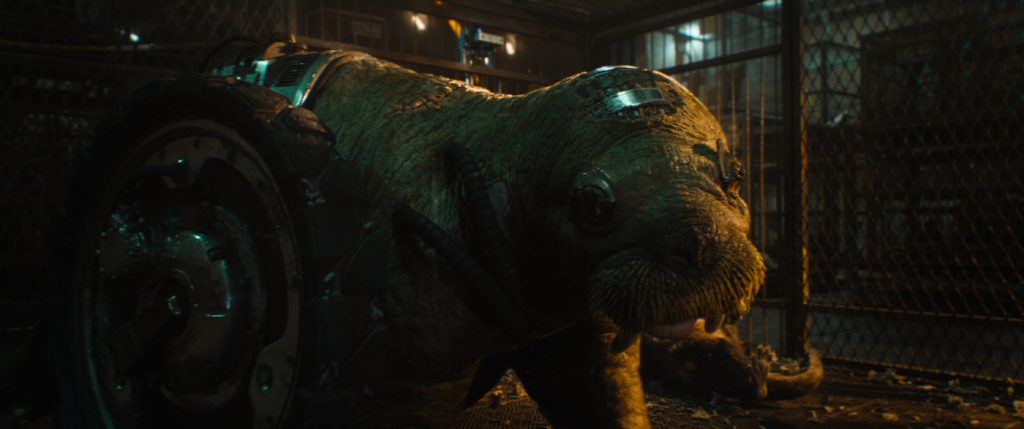
But back to the High Evolutionary, the person who’s most likely the real villain here. Vol 3. will finally reveal Rocket’s tragic backstory. It was The High Evolutionary who experimented on Rocket and turned him into a talking, weapons-loving raccoon. Their showdown will be one of Vol. 3‘s most intriguing plots.

What has made the Guardians films so enjoyable has been the sense of mischief and oddball vitality they’ve brought to the MCU. Saying goodbye is such sweet sorrow.

Check out the new teaser below. Guardians of the Galaxy Vol. 3 hits theaters on May 5:

For more on Guardians of the Galaxy Vol. 3, check out these stories:

Peter Quill Embarrasses Himself in New “Guardians of the Galaxy Vol. 3” Clip

“Guardians of the Galaxy Vol. 3” Images Tease Rocket’s Heartbreaking Story

“Guardians of the Galaxy Vol. 3” Trailer Reveals Big Changes for Our Galactic Misfits

“Guardians of the Galaxy Vol. 3” Trailer Unleashes Adam Warlock on the Galactic Gang

Featured image: (L-R): Sean Gunn as Kraglin, Groot (voiced by Vin Diesel), Chris Pratt as Peter Quill/Star-Lord, Karen Gillan as Nebula, Rocket (voiced by Bradley Cooper), Dave Bautista as Drax, and Pom Klementieff as Mantis in Marvel Studios’ Guardians of the Galaxy Vol. 3. Photo courtesy of Marvel Studios. © 2023 MARVEL.

Juno Temple Circling “Venom 3” Role Alongside Tom Hardy

If there’s one thing we’ve learned from Ted Lasso, it’s that both Keeley Jones and the woman who plays her, Juno Temple, can do it all. So why not mix it up with an alien symbiote and the unlucky sap who hosts him?

Temple is in talks to join Tom Hardy in Venom 3, which would mark her debut in a Marvel film after a very successful run on Apple’s darling comedy. The film will be directed by longtime Venom scribe Kelly Marcy, who is making her directorial debut and working off a script she’s writing based on a story she and Hardy crafted.

Details at this time are being guarded by Venom himself, but The Hollywood Reporter scoops that Temple might be playing an existing Marvel character. Could this mean we’ll be getting more Juno in the MCU? One can hope.

Sony is expanding their Spider-Man Universe with a host of upcoming projects, including Kraven the Hunter, Madame Web, and even a movie Donald Glover is producing and will star in about the villain the Hypno-HustlerVenom (2018) was initially conceived as a completely stand-alone project, but its sequel, Venom: Let There Be Carnage (2021), and the Jared Leto-led Morbius (2022) established, via mid-credits, a connection to the Spider-Man Universe and the MCU via the multiverse.

Temple has appeared in major comic book movies before—she had a role in Christopher Nolan’s trilogy capping The Dark Knight Rises (2012), as well as in Sin City: A Dame to Kill For (2014).

Temple’s become a star thanks to her Emmy-nominated work as Keeley Jones on Lasso and has the fifth season of FX’s excellent anthology series Fargo coming out next.

For more on Sony’s Spider-Man universe, check out these stories:

The Second “Spider-Man: Across the Spider-Verse” Trailer Pits Miles Morales Against an Army of Spider-People

New “Spider-Man: Across the Spider-Verse” Teaser Finds Miles Morales in a Sticky Situation

Marvel Studios Boss Kevin Feige Says “Spider-Man 4” Script Being Written for Tom Holland

Featured image: BEVERLY HILLS, CALIFORNIA – JULY 18: Juno Temple attends a FYC special screening of Apple TV+’s “Ted Lasso” at The Maybourne Beverly Hills on July 18, 2022 in Beverly Hills, California. (Photo by David Livingston/Getty Images)

Transportation Manager Ryan Doucette on How Warner Bros. Turned “Kung Fu” Season Three Green

Ryan Doucette is the manager of transportation compliance for Warner Bros. Studio Operations, Canada, and while that title might not immediately bring to mind a job at the forefront of the studio’s efforts at creating ever more sustainable productions, that’s precisely where Doucette finds himself.

“This is probably not as exciting as talking to a cinematographer,” Doucette joked when we spoke, “but it’s really important, and it’s not something we have a choice about.”

Doucette was part of the team that helped Warner Bros. Television’s popular series Kung Fu implement renewable diesel into the production of season three in an effort to make positive impacts on the series’ carbon footprint. More productions at Warner Bros. are gearing up to follow Kung Fu‘s lead, with both the economics making increasing sense and the moral and ethical responsibilities becoming ever more apparent.

We spoke to Doucette about his role, how he sees the future of more sustainable TV creation taking shape, and how a TV or film production will likely look very different in just a few short years.


Let’s start with a basic but crucial question: what is renewable diesel, and how is it different from biodiesel?

That’s one of the biggest misconceptions out there—that they’re the same—and there’s a misunderstanding around diesel fuel options. One hundred hydro-treated renewable diesel is not biodiesel. While biodiesel is made from animal and seed fats, it’s got a completely different chemical structure from renewable diesel. The main thing about renewable diesel is it’s a drop-in fuel, meaning that it can be put into any diesel engine, whereas biodiesel can gel in cold temperatures, plug up some of the filters, and has some implications for the manufacturer’s warranties on trucks, so it’s a case-by-case use. Renewable is not that; it’s just a pure, straight, chemically similar compound that you can drop into any existing diesel engine. The fuel can be used year-round in temperate climates like Vancouver and provided seasonally in colder climates and has better cold-weather performance compared to biodiesel fuel blends

I imagine you have to explain this distinction a lot?

When people hear we’re using renewable diesel, they think it’s going to ruin their equipment, so we have to educate them and say that this isn’t the case with renewable diesel.

Walk us through how renewable diesel is being used on sets today.

Renewable diesel is something I learned about from one of our previous transportation coordinators on Superman & Lois. It’s made from one hundred percent renewable materials, which can include everything from food waste, animal fats, and vegetable oils, and it’s produced through a refining process called hydrotreating. The process involves treating the renewable feedstock with hydrogen under high pressure and temperatures, which upgrades the renewable feedstock to a diesel-quality fuel. The final product is really high quality, low carbon intensive renewable diesel, which is comparable to the chemical composition of conventional diesel. Renewable diesel can be used undiluted in diesel equipment, such as motion picture generators and diesel trucks.

There are so many barriers to entry to try and get people to do things differently, so I imagine it’s a huge help to be able to say that you can use renewable diesel in existing vehicles.

For sure. With biodiesel, there’s also an increase in maintenance cost as you’re having to change out filters, and it can even break down some of the rubber housing in the engines. Renewable diesel is a really clean burning fuel, basically a pure diesel fuel that functions identically to fossil fuels, but you get the benefit of lower carbon emissions and environmental impacts. They say it generates 75 to 85 percent fewer greenhouse gas emissions compared to regular fossil fuels, and it’s immediate. You don’t have to do very much, so it’s an easy thing to implement to help lower the carbon footprint of a production.

Do you look at renewable diesel as a stepping stone to an even purer, cleaner fuel, or do you see it as a solution itself?

They’re setting some really aggressive targets here in Canada as well as in the United States to hit zero-emission vehicles, but that takes time, and we need to start making a difference now. We’re starting to explore more EV usage in production, and there are larger vehicles coming online we’re looking into, including fuel cell trucks, but there’s a whole range of different logistics and considerations you need to take into account to make those things work on a production, charging infrastructure being one of them.

What are the logistical challenges unique to TV sets that make electric vehicles more difficult?

We work long hours, we’re running around all the time moving equipment here, there, and everywhere, and we need to have dedicated chargers to charge those vehicles. And if the general public is also fighting for those charging stations, we have to think about that. If we’re trying to get an actor to set and all of a sudden we need a charge, where do we get that? We really want it to work, but we also need as little interruption to the actual process of filmmaking as possible, so renewable diesel is really easy to implement right now.

“Kung Fu” season 3 utilized renewable diesel throughout production. Courtesy Warner Bros.

How widely available is renewable diesel in the Vancouver area?

I’ll start with California because it’ll give you a sense of how far behind we are. You can go to retail gas locations and get 100% renewable diesel right from the pump. In British Columbia, we’re reliant on bulk fuel suppliers and large energy companies. Yes, we have it available; sometimes, depending on the vendor, it can be a little more expensive than regular diesel, so that can be a barrier. Oftentimes, because of carbon credits offered to these energy companies, they subsidize these fuels to bring the cost down to get in line with parody for conventional diesel, which makes it a little more palatable for production managers to say yes, let’s do it. It’s a no-brainer if it’s pretty much the same cost and you’re getting all of these benefits in terms of overall carbon emissions.

Telling the story about how using renewable diesel is making a real impact on carbon emissions has to be a huge part of getting all the necessary players on board. How do you do that? 

The renewable diesel vendor provided calculators to help us see the impact we were making. It was a really helpful partnership; the calculator showed the impact of renewable diesel in terms of the equivalent of cars removed from the road in a year. That was helpful in communicating with our production managers. We can use the calculator to clock past usage, and we can show them, relative to a ten-episode season, how much they’d potentially use and what they’d be offsetting relative to the conventional diesel. It’s important to drive this home and help people see why it’s worth it. But most people are already really aware we need to make a difference, and I’d say many in the motion picture industry are really taking an interest in a transition to clean fuel. Kung Fu deployed renewable diesel for their third season, and the calculator made it possible to see what they achieved and give them a pat on the back for taking that leap and making a commitment.


Can you walk me through how Kung Fu and other Warner Bros. productions use renewable diesel?

A lot of productions are focused on the important step of putting renewable diesel into diesel generators because that makes the most impact. Right now, we’re running our diesel generators to power the lights on our sets and various equipment. For our trucks, yes, it’s a good opportunity to put this fuel into them, but in our industry, we drive and we stop; we’re not long-haul truckers. But our generators are running all day long. So Kung Fu made the decision to put renewable diesel into the generators and made the most impact. We have another show called Dead Boy Detectives that’s shooting in BC and Riverdale season 7, and both are taking advantage of renewable diesel. We hope any future production will take the opportunity to use it, and I think it’ll be an easy sell.

What are the economics of using renewable diesel versus the dirty stuff?

Much easier as it becomes more available and comes down in price compared to conventional diesel. Conventional diesel could skyrocket because of certain elements in the marketplace, and suddenly renewable diesel is 15 cents a liter cheaper, and then it’s even more attractive. But the hope is that it becomes pretty much on par so productions will use it.

How does using renewable diesel affect the communities where these productions are being shot?

We’re driving along your streets and parking and shooting in locations around your community, so we’re a part of the community. It makes a big difference when there’s a generator on the side of the road, and someone is out walking their dog and sees that it’s using renewable diesel. There’s this effect that can happen where you see a generator humming along and lighting up a street and all the production’s lights and the hair and makeup trailers and the cast’s trailers, and it’s doing all that with renewable diesel. That really does have an impact on the community. We’ll continue to look at different options, such as hydrogen fuel cells. We’re looking into sustainable alternatives with batteries, water, and electricity—there are lots of implications on how we can roll that out, but it’s happening. We’re also exploring battery energy storage solutions, which are basically big batteries that can power and light the set and help charge our electric vehicles when needed.

The future of the TV and movie set sounds appropriately sci-fi.

The typical TV set will start to look a little different in the next few years, and communities are going to see that—particularly solar options, with trailers that are completely sufficient on solar and battery. In BC, we have the Reel Green  Clean Energy Committee, I sit on that, and Ontario Green Screen, which is focused on moving the needle and driving knowledge into the community and making big differences. Implementing environmentally sustainable practices is a challenge we’re all facing in the industry, but we’re working to find solutions. We still have to make content, but we’re conscious that what we do has an impact on the community and planet.

  To learn more about environmentally sustainable practices at Warner Bros. Discovery, click here.

For more on Warner Bros., HBO, and HBO Max, check out these stories:

“Godzilla vs. Kong” Sequel Gets its Title

James Gunn Announces Pre-Production Has Begun on “Superman: Legacy”

“Barry” Season 4 Review Round-Up: A Stunning Coda For Bill Hader’s Hitman Series

Featured image: Olivia Liang in Kung Fu. Courtesy CW/Warner Bros.

Industry Veterans Discuss Diversity in Filmmaking – From Below the Line to Front & Center

After two alternative years, the Berlinale Film Festival returned in person in February to alleviate the doldrums of late winter Berlin. Per tradition, the Motion Picture Association held their annual topical panel discussion (in the past, they’ve covered themes like artificial intelligence and greening the industry) in conjunction with the law firm Morrison and Foerster. A 100-plus audience crowded into the firm’s office above Potsdamer Platz to hear industry veterans discuss diversity in filmmaking — where it stands and how it can get better — and more broadly, the burgeoning symbiosis between Hollywood and social justice movements.

Charles Rivkin, the MPA’s chairman, opened the discussion. Audiences around the world demand more authentic and nuanced portrayals of their societies and experiences,” he said, with films and television series a means to broaden understanding and foster empathy. To that end, the MPA, he mentioned, is working “below the line, to help diversify the talent pipeline and create new opportunities for young people of color and other under-represented communities,” which puts the association’s efforts right where the event’s panelists believe they should be.

Remarks from the French director-producer-screenwriter Euzhan Palcy were a springboard for the discussion, led by the MPA’s Vice President of Communications for the EMEA, Sabine Henssler, and Morrison and Foerster’s partner Christiane Stuetzle. Palcy, the recipient of the 2022 Honorary Academy Award, an Oscar for her lifetime achievement, made it her goal at age eleven to become a filmmaker after asking her parents why “they” (Palcy is Black) were not on the screen. “‘We aren’t the ones making the films,’” her parents told her. At the beginning of the discussion, the director laid out the solution, remarking, “There will be no change until people of color are where decisions are made.”

Stuetzle asked Palcy to weigh in on the debate between historical authenticity versus diversity in filmmaking. For the director, the answer was clear — it is destructive and disrespectful to put people of color into the so-called gallery without any meaningful agenda. For fellow panelist John Gibson, the MPAs Vice President of External and Multicultural Affairs, meaningful visibility is also significant because “if you can see it, you can dream it.” Further resonating with Palcy, Gibson added that the communities being shown in film and television need to be not just represented on screen but understood, and one avenue to make this possible is access, to both support and leadership, for the people from those communities entering the industry. Jennifer Sobol, the Senior Manager of Programmes in Equity and Inclusion International at Warner Bros. Discovery, agreed, pointing out that you have to have a seat at the table to know you belong at the table. If potential newcomers don’t see themselves on screen, she warned, they may shy away from entering the industry.

So how best to kick off this cycle toward meaningful representation? Gudny Hummelvoll, producer, CEO of Hummelfilm, and President of the European Producers Club, cited encouraging statistics from Norway, where requirements for diversity among projects’ cast and crew were established as a condition for funding. After implementation, the share of female directors rose to 44%. Prior to these requirements, Hummelvoll mentioned that she’d often heard the excuse that there simply weren’t women directors — clearly there, the industry just had to look for them (and, it seems, make funding conditional on their participation in the industry).

Casting director Anja Dihrberg-Siebler also mentioned a disconnect between prevailing attitudes and reality, having often heard that “the audience doesn’t want to see it” regarding diversity in casting — in fact, she pointed out, nobody actually asks the audience what they want to see. “Fantasy needs no boundaries,” Dihrberg-Siebler said, and when she receives screenplays she finds herself making suggestions to increase diversity before the casting process begins.

And the industry is listening. Palcy pointed out the significance of a perceived shift in Hollywood after the diverse demonstrations in the wake of George Floyd’s murder — “Their humanity reacted,” the director said of those who came out to demonstrate, and “that’s why Hollywood decided to try to make an effort.” The panel struck a broadly hopeful tone, and as Palcy summed up, moving forward, “whatever little change we see, we need to encourage, not stay in the negative and complain. We need to support it.”

Featured image: L-r: Patricia Ernst, Morrison Foerster; Cherrie S. Daniels, Cultural Attaché U.S. Embassy Berlin; Christiane Stuetzle, Morrison Foerster; Charles Rivkin, MPA; Anja Dihrberg-Siebler, Casting Director; Euzhan Palcy, Director, Screenwriter, Producer; Sabine Henssler, MPA EMEA; Jennifer Sobol, Warner Bros. Discovery; Gudny Hummelvoll, Producer, Hummelfilm, European Producers Club; John Gibson, MPA)

“Godzilla vs. Kong” Sequel Gets its Title

Godzilla and Kong are back at it again.

The sequel to the monster matchup is officially titled Godzilla vs. Kong: The New Empire. And their next battle royale is set to stomp into theaters on March 15, 2024.

The New Empire boasts some familiar faces from the original monster matchup, with Adam Wingard back in the director’s chair, and stars Rebecca Hall, Brian Tyree Henry, and Kaylee Hottle all returning. Newcomers include Dan Stevens, Rachel House, and Fala Chen.

Wingard’s original film was centered, naturally, on the mega-battle between the world’s two most iconic behemoths. While it seemed, on paper, like a mismatch, Kong held his own for quite a while against the larger, radioactive Godzilla. That’s when things got tricky, however; with Godzilla taking the upper hand, er claw, it seemed the battle was about to be won in an ultimately decisive, fatal way, but that’s when Mechagodzilla showed up. Kong and Godzilla joined forces to take down the techno-monster. In The New Empire, the two colossal beasts will stay on the same team, as the synopsis revealed by Warner Bros. and Legendary says they’ll “team up to face a world-ending threat so terrifying that neither could survive alone.”

Godzilla vs. Kong was one of the first films to punch its way to success during the pandemic, battling to a haul of $470 million at the global box office back in March 2021 just as theaters were starting their long road to recovery. The appetite for the sequel should be large as they two beloved beasts form the world’s largest super-squad.

For more on the Godzilla vs. Kong franchise, check out these stories:

“Godzilla vs Kong 2” Synopsis Reveals Epic Continuation of Monster Fight

“Godzilla vs. Kong” Sequel Coming 2024, “Dune: Part Two” Moves to Thanksgiving 2023

“Godzilla vs. Kong” VFX Supervisor on Creating Titan Title Match of the Ages

Featured image: Caption: (L-r) GODZILLA battles KONG in Warner Bros. Pictures’ and Legendary Pictures’ action adventure “GOZILLA VS. KONG,” a Warner Bros. Pictures and Legendary Pictures release. Photo Credit: Courtesy of Warner Bros. Pictures and Legendary Pictures

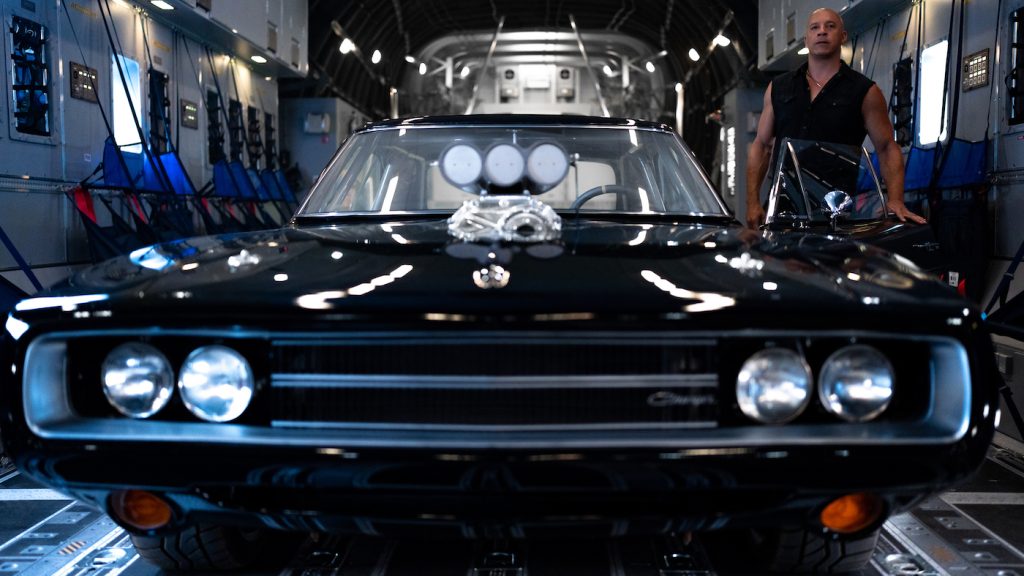
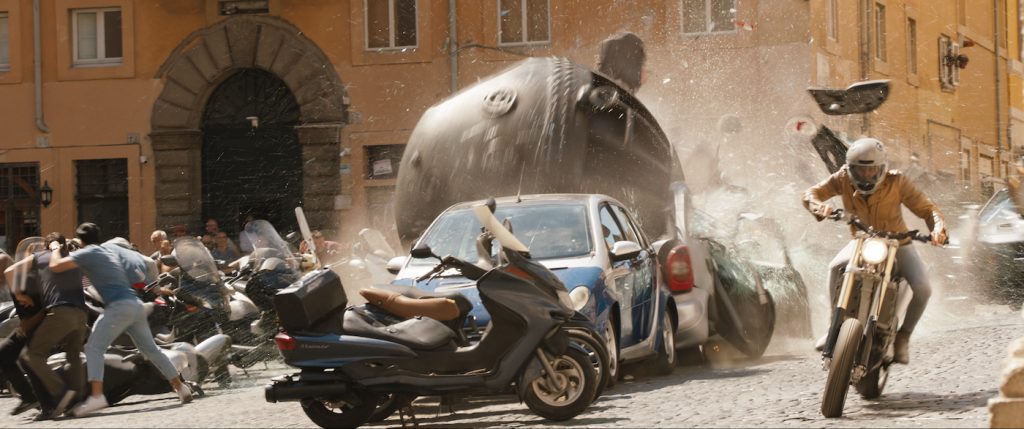
New “Fast X” Trailer Finds Jason Momoa’s Dante Taking on the Family

The end of the road is now in sight.

The second trailer for Fast X has arrived with a serious bang, with Dom Toretto (Vin Diesel) and his beloved family facing the gravest threat of their utterly insane lives. This new look at the tenth film in the franchise finds our heroes where they’re most comfortable, behind the wheel of various cars and trucks, racing through Rome. Only there’s one problem; they’re being led into a trap by that aforementioned threat, Dante (Jason Momoa), a man with a major beef against Dom and the fam that goes back a decade. Dante promises Dom that he’s going to break his family, piece by piece.

The first trailer revealed that Dante’s vendetta against Dom and the family began during the events of Fast Five (2011) when Dom and the crew took down the Brazilian drug kingpin Hernan Reyes (Joaquim de Almeida) in Rio de Janeiro. It turns out Dante’s feud with the family is deeply personal; that kingpin was his father, and he watched the entire thing go down. Watching his father get killed turned Dante into the fearless, ferocious lunatic he is today, and he’s spent the past dozen years planning his revenge on Dom.

Dom will need the family and a few extra helping hands. He’ll get them. Not only will he have the family—Michelle Rodriguez’s Letty, Tyrese Gibson’s Roman, Chris “Ludacris” Bridges’s Tej, Jordana Brewster’s Mia, and Sung Kang’s Han—but old friends like Nathalie Emmanuel’s Ramsey, Jason Statham’s Deckard Shaw, and John Cena’s Jakob will get involved. There’s more—Scott Eastwood’s Little Nobody, Helen Mirren’s Queenie, and Charlize Theron’s Cipher are all on hand.

The biggest newcomers are Momoa’s Dante and Brie Larson’s Tess, who turns out to be the daughter of Kurt Russell’s Mr. Nobody. Also onboard are Alan Richtson as Aimes, the new head of the Agency; Daniela Melchior as a Brazilian street racer connected to Dom’s past; and the icon Rita Moreno as Dom and Mia’s Abuelita Toretto.

Check out the new trailer below. Fast X races into theaters on May 19:

For more on Fast X and the Fast & Furious franchise, check out the stories below:

Brie Larson Reveals Her “Fast X” Character

First “Fast X” Trailer Unleashes Jason Momoa’s Villain Dante

Jason Momoa Teases his Androgynous “Fast & Furious 10” Villain

Featured image: Jason Momoa is Dante in FAST X, directed by Louis Leterrier

“Renfield” Stunt Coordinator Chris Brewster Sinks His Teeth Into Hyperkinetic Action-Comedy

Chris Brewster knows how to make a bloody mess. The stunt coordinator has been making the rounds in Hollywood for over twenty years now and reteams with director Chris McKay on Renfield, following their collaboration on The Tomorrow War (2021), where Brewster served as a fight choreographer.

This time around, Brewster sinks his teeth into a Dracula story that stars Nicolas Cage as the Count and Nicholas Hoult as Renfield, his familiar, who starts to question his evil behavior after falling for a stouthearted cop played by Awkwafina. The comedic tale juxtaposes entertainingly well with McKay’s delightfully violent action sequences. The laughter is in the blood.

In creating the stunts, Brewster shares with The Credits that nothing was off limits. “My favorite meeting with McKay was when I told him this might be a little too far, and he goes, ‘no, no, anything that starts off with ‘this might be too far’ is definitely on the right path.’”

Brewster shares how the collaborative efforts of special effects, visual effects, and the entire production team allowed them to pull off some of the goriest fight sequences in a film this year.

Did you and Chris McKay have an overall approach to the stunt pieces of Renfield?

We both have similar core values when it comes to action in movies. There are all based on the idea that every move needs to be character-driven and story-driven. We don’t believe in action for the sake of action and want to make sure we’re telling the same story through the action we’re telling through the dialogue.

How did you two start to tackle your ideas in preproduction?

We broke down what we like and don’t like about action sequences. Then we looked at the tone, the energy, and the style that we really wanted for this film. Once I got into his head and saw what he was really looking for, we started to get into the character design of how each character would move. Then we broke down the script and took each character and put them in those moments of the script where each piece of action took place. It was all built from the ground up.

Nicolas Cage as Dracula in Renfield, directed by Chris McKay. Courtesy Universal Pictures.
Since you mentioned character design, how did you want Renfield and Dracula to move on screen?

One thing that made action fun to work on in this film was that the characters were so very different. Renfield is old and has been doing what he does for Dracula for years. We wanted to design a style that was not technical but smooth in a way that makes it look like he’s done it a million times. We avoided any specific martial arts form for Renfield, but since he was a soldier, we took military close-quarters combat and added simple flare to it. Because he’s borderline indestructible, he fights without being defensive and is not worried about getting hit. Dracula has a very eclectic style. He goes from being the Prince with an elegant posture to turning into a bull, becoming more animalistic and more aggressive.


Another fun character is Tedward, played by Ben Schwartz. He acts tough but is essentially a mama’s boy. How did you want to translate that personality into his fight sequences?  

Teddy is the most un-stylized fighter. He was the prince of the mafia, but he’s not a tough badass. We created a stylized version of fighting that is not a martial arts version of fighting. Once he becomes familiar, he becomes this guy who has never thrown a punch but can now punch really hard. His fighting style doesn’t have any technique. It just has a lot of power and a lot of impact to it.

(from left) Tedward (Benjamin Schwartz) and Renfield (Nicholas Hoult) in Renfield, directed by Chris McKay. Courtesy Universal Pictures.
Is there any collaboration with the actors in designing their character’s choreography?

With action design, it’s our job to come up with a skeleton between taking McKay’s vision and choreographing movement that works for the character. That is the skeleton. Then the actors really build the body onto the skeleton. They basically put their different nuance onto each move. Luckily, the actors on this show were absolutely out of this world. They were incredible performers and could remember the choreography really fast and then add layer upon layer of character and style to what they were doing.

(from left) Renfield (Nicholas Hoult) and Phil (Joseph Mikel) in Renfield. Courtesy Universal Pictures.
The tone of the action gets wildly entertaining. No holds barred. Did McKay let you run with your imagination?

Chris came up with guidelines for each piece of action, and to summarize it very briefly, he said if we have a single piece of action that doesn’t involve Mortal Kombat-level fatalities then we are not doing our job. He told us from day one there are no handcuffs. He encouraged us to go way above and beyond and told us if he needed to, he’d pull us back in.

So scenes like when Renfield rips off someone’s arms to use them as swords make sense now. That entire apartment complex scene was a ride.

There was so much wirework in that scene. We were three and four levels off the ground, so height was variable. We had lots of special effects and other things that could have made the set dangerous, but we had every single department head on our side, and we were all working together. We were able to pull off one of the most over-the-top action sequences that I have ever been a part of without injury, and everyone was happy.

(from left) Director Chris McKay and Nicolas Cage on the set of Renfield. Courtesy Universal Pictures.
Another large set piece has Renfield rescuing Rebecca (Awkwafina) inside Mulates. How did you approach the massive fight sequence?

Chris McKay has us previs every piece of action before we went to camera. Previs is our concept of what we think the action could look like in the story. In doing that, it’s like having a proper dress rehearsal before going to camera. So we basically got to design all the action, choreograph it, and rehearse it before we went to the location to shoot it. Everything is done in the prep work. Because we got to prep and build it, everyone was safe and we got to do some cool, fun stuff.

(from left) Renfield (Nicholas Hoult) and Rebecca (Awkwafina) in Renfield, directed by Chris McKay. Courtesy Universal Pictures.
There were plenty of special effects, visual effects, and blood-laced makeup design in each scene. How was the collaboration among different departments?

Everything you see in this film is what you get when every department works together and is actually one large family. I have never been on a project that was as seamless from department to department as Renfield was. I think it starts all the way at the top with Chris McKay, all of our producers, and the whole production team made it so easy for every department head to communicate and work together. Every person who worked on this crew was incredible and amazing at their job. I really feel like the action specifically is a true testament to what happens when the crew works seamlessly together. It felt like we were surrounded by friends and family doing what we all loved to do. It was genuinely the best experience of my career.


Renfield is in theaters now.

For more on Universal Pictures, Peacock, and Focus Features projects, check out these stories:

James McAvoy Re-teams With Blumhouse for Horror Thriller “Speak No Evil”

“Scream” Queen Melissa Barrera Re-teaming With Radio Silence in Mysterious Monster Movie for Universal

Glen Powell Ready to Twirl in “Twister” Sequel With Daisy Edgar Jones

Featured image: Nicholas Hoult on the set of Renfield, directed by Chris McKay. Courtesy Universal Pictures.
Michelle Yeoh to Star in “Star Trek: Section 31” Movie for Paramount+

Fresh off winning her first Oscar for her stellar work in Everything Everywhere All At Once, Michelle Yeoh has set a new course on her star chart.

Yeoh will be headlining a new Star Trek movie, Star Trek: Section 31, reprising her Star Trek: Discovery role as Emperor Philippa Georgiou. Section 31, which will stream on Paramount+, was initially conceived as a series, but the stars aligned for Star Trek captain Alex Kurtzman to convert the series into a feature.

The Hollywood Reporter scoops that Kurtzman had already been thinking about making the switch with Section 31 from a series to a feature film, but the idea really hit warp speed after he saw Everything Everywhere All At Once and thought that Yeoh would win an Oscar for her performance. Who can blame him for thinking that the world would want more of Yeoh with meaty film roles?

Yeoh was the first person to be cast on Star Trek: Discovery, appearing in its first three seasons. Sources tell THR that Section 31 is being imagined in the same vein as two very popular and very different film franchises—”Mission: Impossible meets Guardians of the Galaxy.” Breathless action sequences mixed with adventures on alien planets and with a cast of colorful, often non-human characters? Sold.

Production on Section 31 is slated to begin later this year, and Kurtzman is planning on releasing a direct-to-streaming Star Trek film on Paramount+ every two years. There’s a lot more going on in the Star Trek universe, including the new teen-focused series Star Trek: Starfleet Academy, set to start production in the spring of 2024; the third and final season of Star Trek: Picardwhich ends this week; the return of Star Trek: Strange New Worlds this June; the adult animated series Star Trek: Lower Decks will return for a fifth season; and finally, Star Trek: Discovery will bow for its fifth and final season in early 2024.

For more films and series from Paramount and Paramount+, check out these stories:

“Dungeon & Dragons: Honor Among Thieves” VFX Team on the Owlbear, Talking Corpses & More

“Dungeons & Dragons: Honor Among Thieves” Sound Mixer Ronan Hill’s Formula for Fantastic Sounding Fantasy

How “Dungeons & Dragons: Honor Among Thieves” Costume Designer Amanda Monk Casts a Sartorial Spell

“Dungeons & Dragons: Honor Among Thieves” Review Round-Up: A Passionate, Fun-Loving Fantasy Romp

Featured image: “Terra Firma, Part 2” — Ep#310 — Pictured: Sonequa Martin-Green as Commander Burnham and Michelle Yeoh as Georgiou of the CBS All Access series STAR TREK: DISCOVERY. Photo Cr: Michael Gibson/CBS ©2020 CBS Interactive, Inc. All Rights Reserved.

Peter Quill Embarrasses Himself in New “Guardians of the Galaxy Vol. 3” Clip

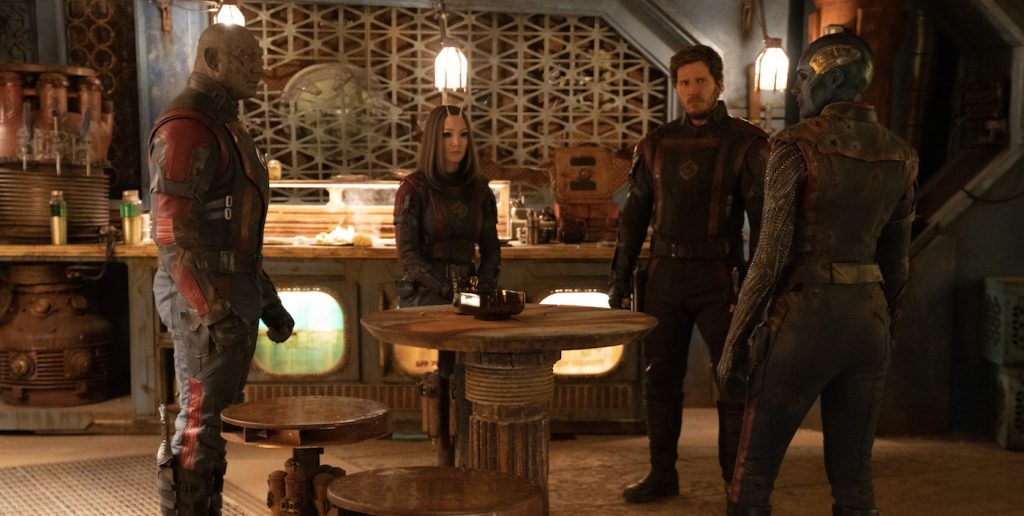
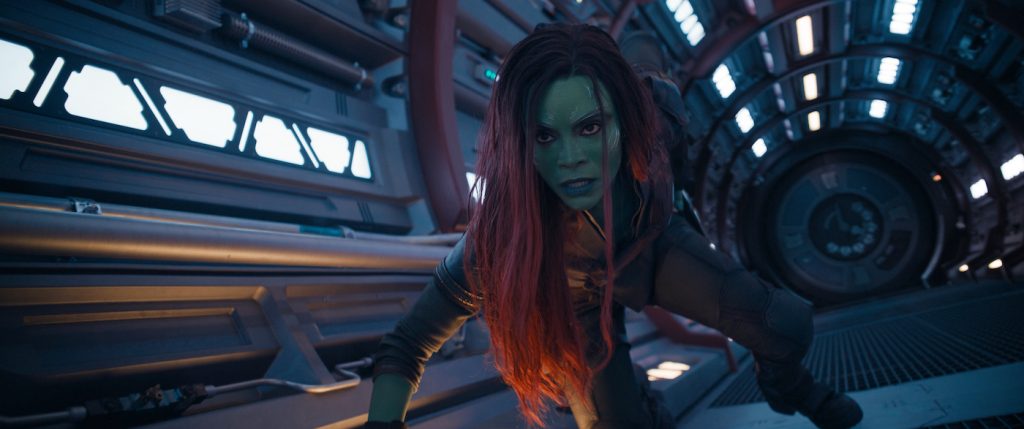
A fresh clip from James Gunn’s Guardians of the Galaxy Vol. 3 captures, in a single minute, what has made the trilogy so special. We’ve got heartfelt emotion, heartbreak, and drama, all delivered with real feeling. And then the jokes begin. The clip, titled “I Miss You,” is centered on Peter Quill (Chris Pratt) admitting to Gamora (Zoe Saldana) that he’s missed her so much and that maybe, just maybe, if she opened herself up to the idea that the two of them should be together, things could happen. Then Gamora tells him she doesn’t think so, gets his name wrong (she calls him “Quinn” instead of “Quill”), and that’s only the top note of Peter’s song of embarrassment. Turns out, he’s been using his spacesuit’s communications all wrong and everyone in the group has heard every word he’s said. Oof.

The third and final installment in the Guardians trilogy, all of them written and directed by Gunn (who you’ve probably heard has a fairly big new job over at DC Studios), will be the bittersweet coda to a franchise that’s carved out one of the most inventive corners of the Marvel galaxy. The storyline between Peter and Gamora will finally get resolved (we think), one of the more doomed relationships in all of the MCU, and that’s saying something. Peter has pretty much loved Gamora since the moment they first met in the very first Guardians, but that was a different Gamora. The version Peter is trying to connect with now is from a different timeline in the multiverse; the Gamora Peter fell in love with was killed by Thanos years before. This is what we mean by bittersweet.

The Peter/Gamora storyline is but one narrative thread Vol. 3 will be resolving. We’ll also be dealing with a few new villains in the form of The High Evolutionary (Chukwudi Iwuji) and Adam Warlock (Will Poulter). The former is connected to Rocket’s (Bradley Cooper) tragic backstory—he’s the one who masterminded the experimentation on Rocket, and so many others, in his effort to create a “perfect” society. The latter is connected to the Guardians from their adventures in Vol. 2 when the Sovereign queen Ayesha (Elizabeth Debicki) created a superior being that would hunt down and kill the gang. Whether or not Adam Warlock remains a villain the entire film is yet to be seen.

It’s going to be a wild final ride for the Guardians. Quill, Gamora, Rocket, Nebula (Karen Gillan), Drax (Dave Bautista), Groot (voiced by Vin Diesel), and Mantis (Pom Klementieff) are coming together for one more epic adventure. This latest clip is a perfect example of why the ride has been so fun.

Check out the clip below. Guardians of the Galaxy Vol. 3 hits theaters on May 5:

For more on Guardians of the Galaxy Vol. 3, check out these stories:

“Guardians of the Galaxy Vol. 3” Images Tease Rocket’s Heartbreaking Story

“Guardians of the Galaxy Vol. 3” Trailer Reveals Big Changes for Our Galactic Misfits

“Guardians of the Galaxy Vol. 3” Trailer Unleashes Adam Warlock on the Galactic Gang

“Guardians of the Galaxy Vol. 3” Sets World-Record While Still Filming

Featured image: Pom Klementieff as Mantis, Dave Bautista as Drax, and Chris Pratt as Peter Quill/Star-Lord, and Karen Gillan as Nebula in Marvel Studios’ Guardians of the Galaxy Vol. 3. Photo courtesy of Marvel Studios. © 2023 MARVEL.

James Gunn Announces Pre-Production Has Begun on “Superman: Legacy”

It’s Superman’s anniversary today, and new DC Studios co-chief James Gunn is celebrating it in style. Gunn revealed via Twitter that early pre-production has officially begun on his upcoming film Superman: Legacy, which is both writing and directing. Superman’s first appearance on the pages of Action Comics came on April 18, 1938, and now, 85-years later, the most iconic superhero of them all is about to get his first stand-alone film in a decade.

Things are moving fast now over at the reinvigorated DC Studios, with Gunn and co-chief Peter Safran taking the studio in a new, more unified direction, and Superman: Legacy is a major part of that effort and will be the first film released under their leadership. (Upcoming DC titles The Flash, Blue Beetle, and Aquaman and the Lost Kingdom were all produced and filmed before Gunn and Safran took over).

Here was Gunn’s reveal on Twitter:

Gunn also responded to some questions from fans on Twitter, including whether or not he’d finished the entire Legacy script or had only completed the title page:

Superman: Legacy will be the first new stand-alone Superman film since Zack Snyder’s 2013 Man of Steel, which, of course, starred Henry Cavill. Cavill went on to portray Superman in Batman v Superman: Dawn of Justice (2016) and Justice League (2017) and had a brief cameo in Black Adam (2022). Gunn is recasting the role for a younger Clark Kent, and it will be one of the most sought-after jobs in Hollywood, a role that will likely result in multiple films.

Here’s how Peter Safran described Superman: Legacy after he and Gunn unveiled the first part of their DC Studios slate: “It focuses on Superman balancing his Kryptonian heritage with his human upbringing. He is the embodiment of truth, justice, and the American way. He is kindness in a world that thinks that kindness is old-fashioned.”

Superman: Legacy is slated for a July 11, 2025 release.

For more on James Gunn and DC Studios, check out these stories:

James Gunn Will Direct “Superman: Legacy”

James Gunn Says “The Flash” is One Of The Best Superhero Movies He’s Ever Seen

James Gunn Reveals New DC Slate: New Batman, Superman, Supergirl Films, a Green Lantern Series & More

Featured image: SEOUL, SOUTH KOREA – APRIL 18: Director James Gunn attends the press conference for “Guardians Of The Galaxy Vol.3” at the Conrad Hotel on April 18, 2023 in Seoul, South Korea. (Photo by Chung Sung-Jun/Getty Images)

Rachel Weisz Delivers Double the Trouble in Prime Video’s “Dead Ringers”

The world needs more of Rachel Weisz. This is made evident anytime the abundantly talented performer appears in anything, and now, thankfully, we’ll be getting a double dose of her in Prime Video’s new series Dead Ringers (streaming on Prime Video on April 21), which is a new take on David Cronenberg’s deeply unsettling 1988 film. Weisz plays both Elliot and Beverly Mantle, a pair of twins who share everything—and we do mean everything. Whether it’s lovers, drugs, or the willingness to eschew medical ethics in their pursuit to bring women’s healthcare to the forefront, the Mantle twins are in lockstep. Beverly and Elliot are doctors, but unlike in Cronenberg’s original film, the new series is a much more female-centered take, with Weisz playing the twins as doctors determined to remake a medical field they find dehumanizing and demeaning to women. The lengths they’ll go to do this, however, are extreme. While Dead Ringers isn’t a straight adaptation from Cronenberg’s original, the series is by no means a polite, easy-going affair.

The Mantle sisters are OG-GYN superstars at the fictional Westcott Memorial Hospital in New York. Beverly has had several miscarriages and really wants a child. She’s sensitive, thoughtful, and buttoned up. Elliot, on the other hand, yearns for control. She’s impetuous, hedonistic, and cruel. Elliot is also more than happy to play god; one of her pet side projects is to see how long she can gestate an embryo outside of a womb. And this barely scratches the surface of where Dead Ringers goes.

So what are the critics saying? The unsurprising but unanimous reaction is that Weisz is sensational in the dual roles, while the adaptation puts a fresh spin on Cronenberg’s body horror freakout.

The first two episodes come from director Sean Durkin, with horror maestro Karyn Kusama (Jennifer’s Body, Girlfight) also onboard, alongside fellow directors Karena Evans (P-Valley, Snowfall), and Lauren Wolkstein (A Friend of the Family, Y: The Last Man)

Here’s a quick peek at some of the reactions thus far:

Check out the trailer below:

Here’s the synopsis for Dead Ringers:

A modern take on David Cronenberg’s 1988 thriller starring Jeremy Irons, Dead Ringers will feature Rachel Weisz playing the double-lead roles of Elliot and Beverly Mantle, twins who share everything: Drugs, lovers, and an unapologetic desire to do whatever it takes—including pushing the boundaries on medical ethics—in an effort to challenge antiquated practices and bring women’s health care to the forefront. The series’ ensemble cast includes Britne Oldford (The Umbrella Academy, American Horror Story: Asylum) as Genevieve, Poppy Liu (Hacks, iCarly) as Greta, Michael Chernus (Severance, Orange is the New Black) as Tom, Jennifer Ehle (Zero Dark Thirty, Saint Maud) as Rebecca, and Emily Meade (The Deuce, The Leftovers) as Susan.

Filmmaker Sean Durkin (Martha Marcy May Marlene, The Nest, The Iron Claw) directed the first two episodes and co-directed the last episode of the series. Durkin also serves as an executive producer. The directing team also includes Karyn Kusama (Jennifer’s Body, Girlfight), Karena Evans (P-Valley, Snowfall), and Lauren Wolkstein (A Friend of the Family, Y: The Last Man).

For more on Amazon Prime Video, check out these stories:

“Daisy Jones & the Six” Makeup Department Head Rebecca Wachtel Captures the Many Faces of Stardom

“Daisy Jones & the Six” Cinematographer Checco Varese on Evoking 70s Vibe Through a Contemporary Lens

“Harlem” Costume Designer Deirdra Elizabeth Govan on Season Two’s Evolving Looks

“Spider-Man Noir” Live-Action Series Coming to Amazon

Featured image: Rachel Weisz in “Dead Ringers.” Niko Tavernise/Prime Video

James McAvoy Re-teams With Blumhouse for Horror Thriller “Speak No Evil”

James McAvoy is reteaming with the studio he worked with on M. Night Shyamalan’s Split and Glass for a new, twisted project.

McAvoy has boarded the film Speak No Evil for the horror maestros at Blumhouse, a remake of the Danish film Gaesterne, which was directed by Christian Tafdrup. Eden Lake and The Woman in Black director James Watkins will helm the film, and Universal Pictures has slated it for an August 9, 2024 release.

The conceit for the film is the classic horror setup; a family takes a vacation to a beautiful country home, not realizing they’re booking themselves into a nightmare. It’s a premise that’s been explored countless times to maximum effect, from Jordan Peele’s excellent sophomore feature Us to M. Night Shyamalan’s recent Cabin in the Woods. 

The original Danish film was a critical darling, earning 11 Danish Film Awards (their version of the Oscars). The script for Speak No Evil will be based on the original script written by Christian Tafdrup and Mads Tafdrup.

McAvoy has proven himself more than able and willing to go dark. In Shyamalan’s Split, McAvoy played the Horde, the film’s terrifying villain who unleashed multiple personalities on his victims. It was a bravura performance, and one wonders if he’ll get another chance to flex those mean muscles in Speak No Evil—or—if he’ll be playing a family man faced with unthinkable choices. Either way, it’ll be worth watching.

Here’s a peek at the thoroughly affecting trailer for the original film:

For more on Universal Pictures, Peacock, and Focus Features projects, check out these stories:

“Scream” Queen Melissa Barrera Re-teaming With Radio Silence in Mysterious Monster Movie for Universal

Glen Powell Ready to Twirl in “Twister” Sequel With Daisy Edgar Jones

“Scream VI” Filmmaking Team Radio Silence Helming Mysterious Horror Film for Universal

Wes Anderson’s “Asteroid City” Trailer Reveals Scarlett Johansson, Tom Hanks, Aliens & More

Featured image: NEW YORK, NEW YORK – APRIL 14: Actor James McAvoy attend Opening Night for “Cyrano De Bergerac” at BAM Harvey Theater on April 14, 2022 in New York City. (Photo by Arturo Holmes/Getty Images)

A Legend Lives Again in Lisa Cortés’s Sparkling New Documentary “Little Richard: I Am Everything”

Little Richard liked to call himself the King of Rock and Roll, and it’s hard to argue with that claim after seeing the new documentary about the incendiary singer’s wild music and even wilder life. Little Richard, born Richard Penniman, not only pioneered rock attitude with piano-pounding hits like “Lucille” and “Long Tall Sally, but” he also flaunted a gender-bending persona that continues to resonate in the culture three years after his death in 2020 at age 87.

Little Richard: I Am Everything (April 21) chronicles a rollicking life story that began in Macon, Georgia. One of 12 children, Little Richard was kicked out of the house at age fourteen by his pastor/bootlegger father and started performing in drag with traveling medicine shows. Releasing his first single, “Tutti Frutti,” in 1956, Little Richard followed up with a flurry of exhilarating tracks only to renounce rock and roll in 1957 and immerse himself in bible studies. Comebacks, talk show appearances, and troubled times ensued.

Directed by Lisa Cortés, whose Oscar and Emmy-nominated projects include Precious, The Apollo, and All In: The Fight For Democracy, her I Am Everything doc combines rare archival footage with fresh interviews from LGBTQ activists, scholars and artists, including John Waters, Billy Porter, Nona Hendryx, and Mick Jagger.

Speaking from New York, Cortés recounts her meeting with Jagger, describes the challenges of navigating Little Richard’s complicated personality, and explains the too-graphic-for-airplay origins story behind “Tutti Frutti.”

Lisa Cortés

Lisa Cortés: “Can I have a drum roll?”

Bllltttttttttt.

[laughter]

You’d created a vivid body of work before taking on Little Richard. What was the spark that inspired you to make a documentary about this great American rock and roller?

In May 2020, it was the lockdown. We were finishing All In: the Fight for Democracy, the documentary about the long struggle for voting rights in this country, and Little Richard passed away. I started listening to his music all over again. And I became really intrigued by the tributes that seemingly disparate people were giving about Richard and how important he was to them — Dave Grohl from the Foo Fighters and Bob Dylan and Elton John — and I’m like, wait a minute, is this the same “shut up!” one-note Little Richard caricature? I started to realize he had an amazing story, and when I learned there had not been a feature-length doc about him, that was the catnip, that was the catalyst.

You interview more than two dozen scholars and artists for this film, including Rolling Stones frontman Mick Jagger, one of the most famous musicians on earth. He doesn’t really give a lot of interviews. Was it tricky to get him on camera talking about Little Richard?

Once Mick Jagger said yes, it happened very quickly. The funny thing is, his rep told me you only have twenty minutes to interview him. But he came to the interview at his office in London and said, “Why don’t you and I talk first,” because I think he wanted to get a vibe about what I knew about the history and what the angle was. We had a lovely conversation, and then he said, “Okay, we’ll do the interview.” Twenty minutes in, I said, “Hey, I want to be considerate of your time,” and he said, “No, I’m fine.” An hour later, we were still talking. He was so genuine in his love and affection for Richard and really asserted the importance of Black artists in rock and roll. He’s also a big fan of Sister Rosette Tharp, so we had many things to explore in our conversation.

The Rolling Stones opened for Little Richard in 1962 when he made a comeback tour in the UK. You unearth some incredible archival footage from that tour with Little Richard tearing off his shirt and running around on stage. You can see how he would have excited a whole generation of British musicians, including the Beatles and David Bowie. What did you learn from Bowie producer Nile Rodgers?

Oh my gosh, what’s that album — “Let’s Dance” — David Bowie comes in and shows Niles a picture of Richard in front of a red Cadillac and says, ‘I want my album to sound like this. I want the music to have the spirit of Little Richard.’ It was fun listening to Niles tell this story because he’s like, ‘Wow, no other artist has ever come to me and said I want to be connected to another artist’s energy.’ Certainly, David Bowie turned it into his own thing; he was such a fan that he wanted to pay homage to the performance and the musicality of Richard.


The documentary can feel bittersweet at times. On the one hand, Little Richard brings enormous joy to people through his music. On the other hand, he struggled with his own sexuality. How did you want to weave those themes together?

I think this story is a balance between bittersweet and joy. It’s about experimentation, about being bold, about not being accepted, and all of these things make this a beautifully human story because throughout his life, Richard is like a pendulum, a roller coaster. He’s super religious! Oh no, he’s a rock and roll sinner! He’s gay! No, he’s renouncing his gayness! That is the tension that Richard constantly navigates, and it’s also what makes him such an interesting character to peel back the layers on. Ultimately, this film is about understanding all those different components and then looking at legacy, looking at Richard’s influence on so many places in our culture now.

Little Richard on September 14th, Wembley stadium, London, Great Britain – 1974, (Photo Gijsbert Hanekroot)

You show how Little Richard had an impact beyond music on filmmaker John Waters, drag queen Billy Porter, and many others. Little Richard in the sixties basically invented glam rock when he started wearing glittery outfits – the sparkle suit?

Mirror suit!

Before anybody else was dressing up like that.

When we go from Richard to David Bowie to Harry Styles, they’re not big leaps.

LITTLE RICHARD at Wrigley Fields, Los Angeles, 2 September 1956

In connection with Little Richard’s sexuality, some of the details from your film are kind of startling. Did he really travel through the South as a teenager performing in drag?

He did, as Princess LeVonne.

The film includes reminiscences from Little Richard’s close friend Sir Lady Java, the transgender entertainer. Did that relationship surprise you?

It wasn’t surprising, but I’ll tell you what the difficulty was: Richard did not openly speak about it, for the most part. In the eighties, he’d say, “I used to be gay.” But in exploring the archival material and finding ways for Richard to narrate his story, that’s why we included moments like meeting Sir Lady Java, Richard’s dear friend in Los Angeles, and an LGBTQIA activist. We wanted to give viewers an understanding that Richard’s struggles don’t just start in the eighties. His struggles with his sexuality go back many decades.

 “Tutti Frutti” put Little Richard on the map back in 1956. But it seems the song that people heard on the radio was different from the version he originally wrote?

In the film, we tell you about the original lyrics: It’s “Tutti Fruity, good booty.” I’ll leave it to people’s imagination to take it from there and see the film to learn a little more about what Richard was really writing about before the lyrics got cleaned up.


Featured image: LITTLE RICHARD at Wrigley Fields, Los Angeles, 2 September 1956

Inside “Succession” Episode 4: Kendall Makes His Move

“The terrible bubble of grief has burst,” says Succession creator Jesse Armstrong at the top of the latest “Inside the Episode” video, which unpacks the fourth episode, the first in the series to carry forth without Brian Cox’s Logan Roy, the brutal sun upon which all the rest of Succession’s characters and plot points swirled. The promise in the show’s title is now in its final, desperate lurch towards bearing out, and a single scrap of paper left behind among Logan’s personal effects might have huge consequences for the Roy children and the rest of the bloodhounds sniffing around for a piece of the remaining pie.

That scrap of paper had Kendall’s name as the next CEO of WayStar. The name is either underlined or crossed out—it’s unclear—but it’s enough for Kendall (Jeremy Strong) to make a play for the top job.

“I don’t even think it’s Kendall saying I’m going to take the lead here,” says Strong in the “Inside the Episode” video. “I think it’s Kendall saying, ‘Let’s call this what it is—I am the lead here.’”

“To Kendall, it looks like he definitely meant for me to take over,” says J. Smith Cameron, who plays Gerri. “To someone else, it looks like a grocery list he’s half struck through.”

This scrap of paper re-establishes a dynamic between the three Roy children (sans Connor [Alan Ruck], of course, who was never considered as a successor) in which Kendall believes himself to be the obvious choice, yet he takes a less bullheaded approach this time around. In fact, he suggests that he and Roman (Kieran Culkin) share the top job, leaving Shiv (Sarah Snook) out, claiming she’s too green for the job and her inclusion wouldn’t look serious to the board or Wall Street. But, both he and Roman promise their sister she’ll be very much involved in every big decision and will be their co-leader, just not on paper. It’s a dubious promise, made especially so because the Roy family is not known for their honor.

“Previously, I’d go a couple of days without seeing Jeremy in a scene because we’ve been on opposite sides of the fence,” Sarah Snook says, “but then, we’re doing scenes altogether, which has been great.”

The Roy Three, as Kendall, Shiv, and Roman have always been (even if, as Snook said, they were often at odds and not even in the same physical space), all agree with Kendall’s plan, even if Shiv can clearly sense her position is weak and her brothers aren’t trustworthy. But then the Roy Three are given a shock by the sudden appearance of Stephen Root’s Ron Petkus, who they find blathering on about Logan in a bullsh*t-laden toast at their father’s massive New York apartment (soon to be Conor’s, by the way).

“Suddenly, a guy we’ve only met once or twice in the show is giving a speech about your dad as you watch on,” says Jesse Armstrong. “I’ve heard about such events around the deaths of public figures and how the family can sometimes get edged out.”

The arrival of Ron Petkus gives the kids a reason to rally around each other. The scene had special meaning for Strong.

“So much has happened at our father’s house, and I can’t walk in there without feeling the history of that,” Strong says. “Our last day on that set was probably the only time, really, that I felt emotionally the sense of loss of this ending.”

Armstrong says that the way Kendall navigates the discovery of the paper with his name on it is by handling it in a very Logan-ish way; he keeps all his options open. “I don’t think at that point he has decided he’s going to push aside his siblings,” Armstrong says. “I think what he finds unbelievably annoying is their unwillingness to face the facts.”

The episode ends with a greasy suggestion by the WayStar comms team, led by Hugo (Fisher Stevens) and Carolina (Dagmara Domincyzk); they tell the kids that one way to calm the nerves of the market and the business press is by telling them that Logan had been slipping much more than the public realized and that the Roy kids had secretly been running WayStar for a while now. The idea is to make the ascension of Kendall and Roman as the new heads of the company less destabilizing; the kids had been alright the whole time. Roman and Shiv are grossed out by the idea of besmirching their dad so soon after his death, and Kendall claims to agree. But then, he does what he believes Logan would have done; he goes behind his sibling’s backs and tells Hugo to spread the rumors about his dearly departed dad. To do it quietly, without his fingerprints on it.

And so, the endgame has begun. Kendall has made his move. 

Check out the full Inside the Video below.

For more on Succession, check out these stories:

“Succession” Writers Kept Shocking Death From Leaking By Using the Perfect Code Word

Inside the Shocking Death That Rocked “Succession” Episode 3

Inside the “Succession” Season 4 Premiere & Logan Roy’s Bummer of a Birthday

Critics Say “Succession” Season 4 Sees The Series Going Out on Top

Featured image: Sarah Snook, Jeremy Strong, Kieran Culkin David M. Russell/HBO ©2022 HBO. All Rights Reserved.

“Mafia Mamma” Director Catherine Hardwicke Creates a Comedy You Can’t Refuse

Oscar-nominated actor Toni Collette stars in the title role of Mafia Mamma, a new femme-forward comedy that offers a twist on the gangster film genre. The movie features women in roles both above and below the line, with director Catherine Hardwicke at the helm, writer Amanda Sthers as producer, and Monica Bellucci and Sophia Nomvete as co-stars. 

Filmed in some of the most beautiful locations in Italy, Mafia Mamma tells the story of an unfulfilled American wife, empty nester, and marketing professional Kristin Balbano (Collette), who gets called to Italy when her grandfather dies. She discovers that not only is the family winery a front for one of the two most powerful mafia families in Italy, her grandfather’s right hand, Bianca (Bellucci), informs her she is meant to take over the family business. Through Kristin’s very fish-out-of-water experiences as the new mafia don, she undergoes a transformation and finally steps into her own power.  

Mafia Mamma allows Toni Collette to exercise her considerable comedy chops, so it’s tons of fun to watch. It also brings a feminist lens to a genre overwhelmingly populated by men in front of and behind the camera. The Credits spoke to Catherine Hardwicke about her experience bringing the film to the screen, shooting in locations with hundreds of years of history, and more. 


A lot is on the page in terms of Kristin and Bianca’s reactions and interactions being driven by their experience as women over 40. What, though, were some things that came up during the production or filming that Toni and Monica, as real-life women of a certain age working in a challenging industry, brought to it?

Every day we’d think about that. So, wardrobe, for example. How are we going to present ourselves to the public? How’s the hair going to be? What are the styles? The wardrobe actually shows Kristin’s transformation because she starts out much more conservative and frumpy, and by the end, you see that she’s a bit more body-conscious, and she’s happy to live in her body much more than she did before. So I think that’s something that women, as we age, can relate to. Everybody navigates, “How do we dress? What’s our appearance? What do we put forward?” We question if we’re going too youthful or maybe too old. That was interesting to examine.

And for Monica Bellucci? 

In a way, we could talk about sexuality because how often do we give a woman that age permission to be sexual and to admit that they want to be sexual? Monica’s character has a mysterious past. She’s very sexy, and the way she dresses is obviously this amazing femme fatale. So actually, right in the middle of shooting, when we were in the limoncello scene, and you see a mob boss die, I said, “Monica, maybe he was your lover.” Monica said, “I like that. It adds another layer of mystery to her.” So she just improvised.  She said, “Yeah, let me run with that.” And she whispers, “Ciao, Carlito.” She leaned into it.

Monica Bellucci is Bianca in “Mafia Mamma.” Courtesy Bleecker Street.

There’s a gunfight in the streets of an Italian town that has tiny alleyways. How did you approach that?

Yes. That little town is Bracciano, and it’s about an hour north of Rome, on a lake. The town actually was pretty friendly because people live in all those little buildings. So I said, “Let’s have the real people that live there popping out of their windows. Let’s really involve the community.” They were very supportive of that, so when you see a girl looking out the window and shutting the shutters, that’s the woman that lives there. It made it so much fun. I think they were amused by the whole situation, and we did a lot of planning, “We’re going to run from point A to point B… the motorcycle’s coming here.” You did have to plan it all out, but the town was very excited about it.

From left, stars Toni Collette, Monica Bellucci, Eduardo Scarpetta, director Catherine Hardwicke on the set of MAFIA MAMMA. Courtesy of Bleecker Street.”

The Italian locations are gorgeous, especially the villas for both of the families. 

Cattleya was our local Italian production company. They had a great location scout who showed many, many photos, and when I saw those two villas, I thought they looked very cool. And then you get to go, and as a former architect, I was thrilled to get to go scout through the villas, and as you walk through, “This villa is 400 years old.” “This villa is 500 years old. The pope slept here. This cow head on the wall is the cow that gave milk to the pope during World War II.” The history is insane. One of the villas is right on the Appian Way. You’re standing on the rock, the stones. The tree is 1000 years old where they’re stomping the grapes. At one point, the owner asks me, “Hey, do you want to see this tombstone we found in the yard here?” It was a Roman Emperor’s eye doctor’s tombstone. It’s just casually in the backyard. So, as an architect, of course, the cinematographer [Patrick Murguia] and I really tried to show that as much as we could and to give you a sense of the scope and the scale.


What were some of the challenges for you and your cinematographer Patrick Murguia in terms of shooting in spaces that were hundreds of years old? The lighting inside the villas was beautiful. 

I’m so glad you noticed that because you’re right, in the villas, the walls all had paintings that have been there for, like, 300 years. You cannot touch it. So how are you going shoot?  You can’t put a spreader on the ceiling, and we don’t really love to have light stands in the rooms because then you can’t move, so we had many challenges. You light through the windows, but the walls are so thick, so you’re trying to shoot light through that, and we would have light stands. The really cool Italian gaffer would follow actors around with a light if we did a moving shot. Patrick was always just like, “New challenge. New challenge. New challenge.”

Toni Collette is Kristin in “Mafia Mamma.” Courtes Bleecker Street

There’s a scene outside under a canopy between Toni and Monica with great lighting.  

We had the canopy, so there was shade, and then that area is actually quite beautiful because it’s in a field with all these flowers, and somehow, the place already looked great.  We shot at the right time of day, at magic hour, and we had some soft bounces around and, yes, they just glowed. They’re gorgeous. I love that scene.

Having worked on so many projects in your career, what did this film offer you that you’d not had before as a filmmaker? 

I don’t think I’d ever got to have this much fun on-set, and get to be quite as creative, because with comedy, even if it’s beautifully written on the page, which it was, with these great actors, you still think, “Can I make it any funnier in the moment? Can I add one more little funny thing?” How do we add one more layer? So all the time, you are trying to, kind of, improv, so then the comedy improv classes that I took, I think they were very helpful. Monica and Toni were just game for everything. Monica would always push things. Sophia Nomvete, who played Kristin’s friend, the lawyer, Oh, my God, when she walked into that courtroom, and she saw the vault and sings? She just did that. I didn’t even know she could sing like that. I’m like, “Oh my god, dude, you are radical.”  This is the first movie she’s ever been in. And the first TV series she’s ever been in is Lord of the Rings. Those are pretty fun for your two first things!


Mafia Mamma is now in theaters nationwide. 


“The Acolyte” Creator Leslye Headland on How Her New Series Will Approach the Jedi Order

There has been so much going on in the Star Wars galaxy lately that you need an Imperial TIE Interceptor to keep up. Since the Star Wars Celebration in London last weekend, we’ve gotten fresh glimpses of the upcoming series Ahsokalearned more about James Mangold’s vision for a Biblical epic-style Star Wars he’s referring to as Star Wars Zero, and the return of Daisy Ridley as Rey in a brand new Star Wars movie from Oscar-winning documentarian and Ms. Marvel director Sharmeen Obaid-Chinoy. This brings us to Leslye Headland’s The Acolyte, the first live-action Star Wars series to focus on those dreaded death dealers of the galaxy, the Sith Lords. Yet The Acolyte will also dare to do something that’s gotten previous Star Wars creators into some trouble; it’ll take a more nuanced view of the Jedi Order, not just their sacrifices and triumphs, but their blindspots and mistakes.

The Acolyte is going to be a different kind of Star Wars show. Think about how the excellent Andor functioned as a heist thriller that also happened to reveal how the rebel alliance began fighting back; Headland’s series is being billed as a mystery-thriller that will “take viewers into a galaxy of shadowy secrets and emerging dark-side powers in the final days of the High Republic era.” The series is centered on a former Padawan (Amandla Stenberg) who reconnects with her Jedi Master to investigate a series of crimes, leading them both into a confrontation with darker forces than they even knew existed.

Headland’s new series boasts a sensational cast—Stenberg is surrounded by Carrie Anne Moss, Jodie Turner-Smith, Lee Jung-jae, Manny Jacinto, Dafne Keen, Dean-Charles Chapman, Rebecca Henderson, and Charlie Barnett. Those ace performers will help Headland and The Acolyte team offer something rarely explored in the Star Wars galaxy; scrutiny of the Jedi order and how they operate. In fact, Headland said that her series shares this trait with Rian Johnson’s 2017 film The Last Jedi. In that movie, Luke Skywalker shocks Rey by being open about his belief that the Jedi Order caused their own demise through their excessive pride. Rey wasn’t having it. It turned out that some folks online (a smaller number than originally advertised, by the way) weren’t having it, either, and took it upon themselves to act like the Praetorian Guards of a “pure” Star Wars mythology. In their view, there was only one way to depict the Jedi Order; as virtuous cosmic samurais for peace. The problem with this view, one might have pointed out, was that none other than George Lucas had cast doubts about the Jedi way of doing business long before The Last Jedi.

Lucas’s exploration of the fallibility of the Jedi was explored most notably in the prequels when Annakin Skywalker began to get swayed to the Dark Side and those in a position of protecting him pretty spectacularly failed to do so. This was made especially vivid in Lucas’s underrated Revenge of the Sith. While the Jedi Council was squabbling over what to do with Annakin, how to punish or expel him, the Sith Lord Darth Sidious was winning him over to the Dark Side by showering him with attention and promising him that, despite whatever the Jedi Council might say, he was the Chosen One. The Jedi Council failed Anakin, Darth Vader was born, and the rest is galactic history.

In a conversation with ColliderHeadland discussed the way the Jedi have been explored in the past and how, even despite the backlash Johnson got for his film, Lucasfilm president Kathleen Kennedy supported her desire to explore a more nuanced look at the Jedi Order. Kennedy agreed with Headland that for The Acolyte to work, she had to be able to present a picture of the Jedis that was rich enough to amplify the choices Stenberg’s former Padawan makes. Here’s how Headland explained her conversation with Kennedy to Collider:

“But I think when you think you’re going to tell the story about bad guys, and the Jedis might be the antagonist to those Jedis; I think that makes people nervous. But it didn’t make Kathy nervous. And I will say that in that room when I pitched her, it was probably one of the most exciting things because it felt like a conversation and less like I was up for a job. It felt much more like, ‘Okay, but what are you going to do about this? And what are you going to do about that?’ And so I was able to fold in what I know about Star Wars, and what I love about Star Wars, into what she’s always pushing for, which is, ‘What’s the emotional throughline?'”

It’s far too early for us to know what Headland and her cast and crew have come up with for that emotional throughline, but we can be pretty certain The Acolyte will offer something even the most hardcore Star Wars fans need, even if they don’t know it; a fuller picture of the Jedi Order, warts and all, that makes their heroism all the richer for coming from human beings rather than avatars of nobility.

For more on The Acolyte, check out these stories:

Carrie-Anne Moss Joins Cast of “Star Wars: The Acolyte”

“Star Wars: The Acolyte” Adds “Squid Game” Star Lee Jung-Ja

“Star Wars: The Acolyte” Adding Rising Star Jodie Turner-Smith

New “Star Wars” Disney+ Series “The Acolyte” Eyeing Amandla Stenberg For Lead

Featured image: L-r: Amandla Stenberg, Lee Jung-jae, and director Leslye Headland on the set of “The Acolyte.” Courtesy Disney+. Photo by Christian Black.

“Scream” Queen Melissa Barrera Re-teaming With Radio Silence in Mysterious Monster Movie for Universal

Yesterday with learned that the filmmaking team Radio Silence (directors Tyler Gillet and Matt Bettinelli-Olpin and producer Chad Villella) are tackling a mysterious monster movie for Universal. Now we know that the Scream (2022) and Scream VI (2023) team are bringing in one of their all-stars from those films, Melissa Barrera, who will be joining them on the new project.

The movie’s details are being kept hidden in a locked crypt (for now), but we do know that the film will re-imagine one of Universal’s iconic monsters, much in the way Leigh Whannell’s The Invisible Man and Chris McKay’s current release Renfield have. We also know that the new film they’re teaming up for was once titled Dracula’s Daughter and was about a group of deeply doomed kidnappers abducting some young people only to find out one of them is, you guessed it, Dracula’s daughter. We’d suggest letting her go and then running!

As they did on Ready or Not (2019) and the two Scream films, Gillet and Bettinelli-Olpin will direct and Villella will produce. Their producing partners include Project X Entertainment’s Paul Neinstein, James Vanderbilt, and William Sherak. The original script was written by Stephen Sheilds, which Guy Busick is currently revising.

Barrera led the ensemble in Scream VI, the highest-grossing film in the franchise. There’s no word yet if she is playing Dracula’s daughter, but our money is always on Barrera making it through the mayhem in whichever horror she’s in.

For more on Universal Pictures, Peacock, and Focus Features projects, check out these stories:

Glen Powell Ready to Twirl in “Twister” Sequel With Daisy Edgar Jones

“Scream VI” Filmmaking Team Radio Silence Helming Mysterious Horror Film for Universal

Wes Anderson’s “Asteroid City” Trailer Reveals Scarlett Johansson, Tom Hanks, Aliens & More

Brie Larson Reveals Her “Fast X” Character

Featured image: Melissa Barrera (“Sam Carpenter”) stars in Paramount Pictures and Spyglass Media Group’s “Scream VI.”