Angela Bassett has made history as the first actor to nab an Oscar nomination for their performance in a Marvel film. Bassett is nominated for Best Actress in a Supporting Role for her moving work as Queen Ramonda in Black Panther: Wakanda Forever.
This is Bassett’s second Oscar nomination, which makes her only the fourth Black Woman in history to earn multiple Oscar nominations (her first nomination, for Best Actress in a Leading Role, came in 1993 for her sensational performance in What’s Love Got To Do With It.) Speaking with The Hollywood Reporter this morning, Bassett said she wasn’t thinking about making Marvel history heading into filming the emotional Black Panther sequel, which required all involved to channel their grief over the passing of Black Panther star Chadwick Boseman into their work.
“I certainly didn’t think about that going into the first day of filming — I began to hear about that a couple of weeks ago,” says Bassett told THR about breaking new territory for Marvel performers. “Others have pondered that reality, but it certainly wasn’t me. I’m grateful for the role and the opportunity to work with the incredible artists, the amazing crew and artisans behind the scenes.”
Bassett told THR that everyone on the Wakanda Forever team went through an emotional journey coming together in the wake of the tragic loss of Boseman.
“We’ve been through so much — as much as you can go through in life together, with the passing of our king. That really served to bring us together all the more.”
Black Panther: Wakanda Forever nabbed five Oscar nominations in total, including costume design, visual effects, best song, and makeup and hairstyling. The film managed the seemingly impossible feat of being both a proper comic book movie with all the thrills and colossal action set pieces you’d expect, as well as a moving, at times heartbreaking meditation on grief and loss. While the film’s focus was centered most closely on Letitia Wright’s Shuri (who was excellent, too), Bassett’s performance was the film’s beating heart. Making Marvel history seems fitting for a performer of her ability.
For more on all things Marvel Studios, check out these stories:
The Best Picture category includes war epics historical (All Quiet on the Western Front), imagined (Top Gun: Maverick), alien (Avatar: The Way of Water), and one between friends (The Banshees ofInisherin). The category also includes one Spielberg (The Fablemans), a couple of directing Daniels (Everything Everywhere All At Once), two incredible female-focused films (Tár and Women Talking), a fantastic satire (Triangle of Sadness), and a bio-pic that’ll make you shake your hips (Elvis).
For Best Actress in a Leading Role, you have some repeat customers like Cate Blanchett (for Tár) and Michelle Williams (TheFablemans), newcomers like Ana de Armas (Blonde) and Andrea Riseborough (To Leslie), and long-deserving legends like Michelle Yeoh (Everything Everywhere All At Once). The Best Actor category includes Brendan Fraser (The Whale), Paul Mescal (Aftersun), Bill Nighy (Living), Colin Farrell (The Banshees of Inisherin), and Austin Butler (Elvis).
Everything Everywhere All At Once ultimately leads the pack with 11 total nominations, while All Quiet on the Western Front and The Banshees of Inisherin are close behind with 9 nominations each.
But let’s get to the list, shall well? Below you’ll find the nominees in 13 of the 24 categories, with the full list available here.
Best Picture
All Quiet on the Western Front (Netflix)
Avatar: The Way of Water (Walt Disney)
The Banshees of Inisherin (Searchlight)
Elvis (Warner Bros.)
Everything Everywhere All at Once (A24)
The Fabelmans (Universal/Amblin Partners)
Tár (Focus Features)
Top Gun: Maverick (Paramount)
Triangle of Sadness (Neon)
Women Talking (Orion Pictures/United Artists Releasing)
Directing
Martin McDonagh, The Banshees of Inisherin
Daniel Kwan & Daniel Scheinert, Everything Everywhere All At Once
Steven Spielberg, The Fablemans
Todd Field, Tár
Ruben Östlund, Triangle of Sadness
Actress in a Leading Role
Cate Blanchett, Tár
Ana de Armas, Blonde
Andrea Riseborough, To Leslie
Michelle Williams, The Fablemans
Michelle Yeoh, Everything Everywhere All At Once
Actor in a Leading Role
Austin Butler, Elvis
Colin Farrell, The Banshees of Inisherin
Brendan Fraser, The Whale
Paul Mescal, Aftersun
Bill Nighy, Living
Best Actress in a Supporting Role
Angela Bassett, Black Panther: Wakanda Forever
Hong Chau, The Whale
Kerry Condon, The Banshees of Inisherin
Jamie Lee Curtis, Everything Everywhere All at Once
Triangle of Sadness (Neon) “An Irish Goodbye” (Floodlight Pictures)
Best Animated Feature Film
Guillermo del Toro’s Pinocchio (Netflix)
Marcel the Shell With Shoes On (A24)
Puss in Boots: The Last Wish (DreamWorks Animation)
The Sea Beast (Netflix)
Turning Red (Pixar)
Best Animated Short Film
The Boy, the Mole, the Fox, and the Horse (Apple TV+)
The Flying Sailor
Ice Merchants
My Year of Dicks
An Ostrich Told Me the World Is Fake and I Think I Believe It
Documentary Feature Film
All That Breathes
All The Beauty and the Bloodshed
Fire of Love
A House Made of Splinters
Navalny
International Feature Film
All Quiet on the Western Front
Argentina, 1985
Close
EO
The Quiet Girl
For the full list, check out the official Academy Awards sites here.
Featured image: HOLLYWOOD, CALIFORNIA – FEBRUARY 09: In this handout photo provided by A.M.P.A.S. Oscars statuettes are on display backstage during the 92nd Annual Academy Awards at the Dolby Theatre on February 09, 2020 in Hollywood, California. (Photo by Matt Petit – Handout/A.M.P.A.S. via Getty Images)
The Sundance staff and execs have always believed it essential to honor Indigenous people as part of their film festival and institute, as exampled by their Native Lab and Indigenous Program. This year, there is an even greater focus on Native cultures, both inside and outside the cinemas, with 11 Indigenous films as part of the program. 2023 also marked the inaugural year for The Indigenous House, which provided a gathering space for community members and allies, and featured events and conversations with Native creatives and leaders.
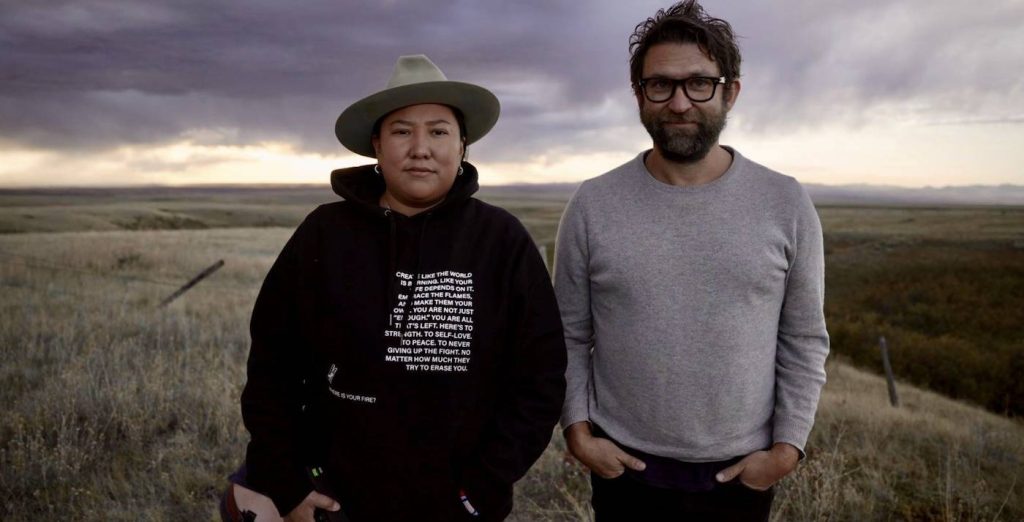
One of the panels, Storytelling Beyond the News, included Oglala Lakota/Diné filmmaker Razelle Benally, co-director and producer of Showtime’s upcoming 3-part documentary series, Murder in Big Horn. The show premiered at Sundance and streams on Showtime starting February 3rd. Benally, who partnered on the project with Showtime directing alum Matthew Galkin, was a Sundance Native Lab Fellow and recently wrote for the Navajo tribal police drama series Dark Winds.
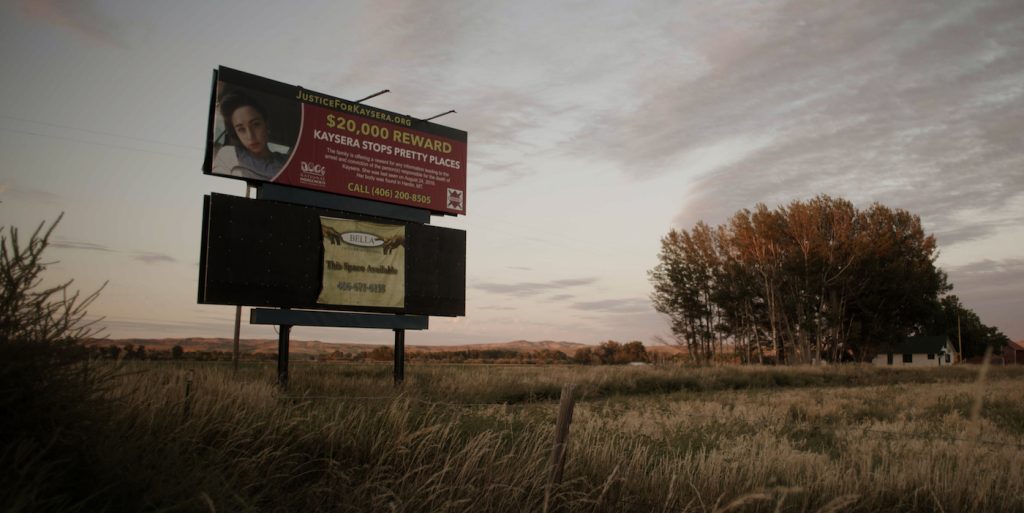
Murder in Big Horn considers the epidemic of Missing and Murdered Indigenous Women (MMIW) through specific cases in and around Big Horn County, Montana. Within the past decade, dozens of women and girls have disappeared or have been murdered in the area. The docuseries focuses on three such cases, 14-year-old Henny Scott, 18-year-old Kaysera Stops Pretty Places, and 16-year-old Selena Not Afraid. Their stories galvanized the media and public attention for the first time about an issue that has been prevalent since colonization and has been plaguing Native communities around the country for decades.
The Credits spoke to Murder in Big Horn’s Benally about the MMIW epidemic. She shares how the portrait she and Galkin crafted about three lost girls represents a microcosm of a larger issue that requires far more attention and major changes in policies that have been putting Indigenous women and girls at risk for centuries.
How did you get involved with this project?
Showtime brought the project to Matthew Galkin, my directing partner and executive producer of the series. He had a good prior relationship with Showtime, having worked with them before. Showtime didn’t know much about the MMIW epidemic that was happening, though they had learned about it through their own news sources. They brought the idea of a docuseriestoMatthew, and Matthew, as a heteronormative cis white male, very quickly learned that he might not be the best person to do this all himself, but he did see the story and wanted to get behind helping create awareness for this issue. So he brought me on, and as an Oglala Lakota/Diné woman, unfortunately, I grew up through my own lived experience as a Native woman very much knowing and learning and understanding what the MMIW issue is ever since I could remember, so we were able to collaborate. I believe we provide a broader perspective by having somebody who doesn’t know much about the issue and somebody who grew up and lived with this issue.
Razelle Benally and Matthew Galkin. Courtesy Showtime.
What kinds of discussions were there around the investigative true-crime aspect of the story and the issue itself?
We knew we needed to make sure that the human story was there and that the stories were coming from the community members and the surviving relatives of the victims. We wanted to give them a platform to voice their truth, and we wanted to ensure that they were going to be heard. Even though Murder in Big Horn does encompass many things, including a true crime element, we’re able to sort of bait and switch the viewer and talk about this issue. The mystery that would make it a true crime, where you unravel the cases, you’re given clues, and you’re finding answers, doesn’t exist in this story. The bait and switch is that if you, as a viewer, think you’re going to watch that, unfortunately, there are no answers because the answers lie in history. Violence against Native women exists today because it started with colonization. You cannot talk about MMIW without talking about the history of Native peoples.
Finding a way to tell that story, that history, requires so much nuance and balance.
We had to ensure that those different perceptions of European settlers versus our traditional Indigenous men were juxtaposed in the series because even though there may have been violence in our tribes, in our communities pre-contact, we did have systems of addressing violence, and what would be deemed as crimes, and they rarely occurred. When settlers started moving west, that’s when we started truly seeing, in my particular tribes, this onslaught of violence, not only against all of our people but particularly targeting our women as well.
Still frame from MURDER IN BIG HORN. Photo credit: Jeff Hutchens/Courtesy of SHOWTIME.
Can you speak to why you chose the specific women that were highlighted in this series?
Within the community of Big Horn in Montana and just throughout the Midwest, because my homelands are in Pine Ridge, South Dakota, as well as Arizona, within that area, these cases were actually well-known. The reason why is that there was something about the combination of Henny, Kaysera, and Selena, unfortunately with what happened with their disappearances and their turning up as deceased, there was a groundswell of movement within the communities that occurred and a buildup of media coverage. Also, unfortunately, in Big Horn County, the concentration of cases is so high we found that area to be a microcosm of what’s happening not only there but in a lot of different Indigenous communities. Their families were super helpful and vocal about their loved ones, so we also took that into consideration. But there are so many other cases everywhere that we couldn’t cover each one. Just because we focus on these cases doesn’t mean that all the other cases aren’t equally as important, because they are.
You have an Indigenous female artist as the composer for the show’s score. What was your partnership like with Laura Ortman?
I’m really grateful to call Laura a friend of mine. She’s an amazing violinist, an amazing composer, and a great artist in general. When the conversation came up regarding music and the score, I immediately thought of Laura because I know how sensitive of a human being she is, and she has done work with films before. I’m very familiar with her music, and when Matthew heard her for the first time, it was a no-brainer for both of us. In terms of working together, it was very much a back-and-forth but a great collaboration. It was important for us to give her a lot of room for creative experimentation and a lot of space to use her own voice as an artist.
At the end of the series, there is a list included of over 70 names of other missing or murdered Indigenous girls and womenin the greater Big Horn community. Can you talk about that?
The list of names we include is based on documented and reported cases. There are so many more cases that haven’t been documented or, by legal standards, don’t have what it takes to be a missing persons case, so it was really important for us, and for the production and the series, that people can understand how vast and wide this issue is, not only in Big Horn County but everywhere. Our series isn’t meant to represent all communities. The series serves as a microcosm for a widespread issue. It’s just a sad and heartbreaking reality. I hope that by the end, part of what the audience takes away is that this is a national issue for Indigenous communities in the United States. It’s also an issue in Canada, Mexico, and all Indigenous communities across the world.
Murder in Big Horn streams on Showtime starting on February 3rd.
For more on must-see Showtime series, check out these stories:
If you watched the riveting second episode of HBO’s The Last Of Us, you were a part of history. The series delivered the largest-ever viewership growth for a drama from a premiere episode to its second, according to measurements by Nielsen. Episode two bested the premiere’s gangbusters numbers by bringing in 5.7 million viewers across linear airings across HBO and HBO Max. That’s a 22% jump from last week’s record-breaking 4.7 million haul.
The second episode found our protagonists, the emotionally closed-off and hardened Joel (Pedro Pascal), his equally resilient and gruff partner Tess (Anna Torv), and their charge, the 14-year-old Ellie (Bella Ramsey), venturing out of the Quarantine Zone into the “open city” of Boston, which is overrun with what are essentially zombies. Their mission is to deliver Ellie to a group of rebels (so to speak) and, in exchange, get a trunk battery and some other equipment so they can go search for Joel’s missing cousin, Tommy (Gabriel Luna). The problem is that the population at large outside the QZ, long since infected with the fungal parasite cordyceps, controls pretty much the entire country. A single step on one of the long fungal filaments that can stretch a mile beneath the surface of a road can call dozens or more of these ravenous, murderous former humans. The second episode delivered a terrifying sequence involving a variation of the infected called “clickers,” whose skulls have been cracked open by their fungal parasite into a mushroom-like nightmare. The clickers track and try to kill our survivors through a Boston museum. Spoiler alert — not all of them make it.
In order to make sure the clickers looked appropriately terrifying and that they matched what gamers saw when they played the video game upon which the HBO series is adapted, co-creators Neil Druckmann, the man behind the video game, and Craig Mazin (Chernobyl) brought in Mazin’s Chernobyl collaborator Barry Gower, an ace prosthetics designer. Not only did they obsess over the look of the clickers, but they brought in performers who could match the deeply creepy movements of the infected zombies (the performers were also fans of the game) to deliver one of the most unsettling and dramatically satisfying sequences you’ll see on a screen all year.
Want to go inside the episode and learn more? Fear not, HBO Max has you covered:
For more on The Last Of Us, check out these stories:
When you’re watching an M. Night Shyamalan movie, even the most common sounds are terrifying. And nothing, it turns out, is scarier than the sound of a knock at the door, especially when you’re renting a cabin in the woods for a weekend and not expecting any company. What’s even worse is when the person doing the knocking is Dave Bautista’s Leonard.
In a new behind-the-scenes look at Shyamalan’s latest released by Universal Pictures, Bautista sets up the film’s conceit; we have a family of three made up of Wen (Kristen Cui) and her dads Andrew (Jonathan Groff) and Eric (Ben Aldridge) whose weekend idyll is obliterated by the arrival of Leonard and his accomplices (played by Nikki Amuka-Bird, Abby Quinn, and Rupert Grint). The reason for Leonard’s arrival is dire; here’s there with news of the end of the world, and the only way to keep the apocalypse from coming is for one of the three members of the family to sacrifice themselves. Talk about a buzzkill.
“I believe in this type of storytelling that when you come to the movie theater, you want to see something incredibly powerful,” says Shyamalan, “incredibly emotional, experiential, but you want it to be bigger than life.”
“There is no place to run, no place to hide,” says Bautista, “so I think it’s like layers of nightmares in this film.”
Shyamalan explains that, as he’s done so evocatively in his past work in contained thrillers like The Sixth Sense and Signs, Knock at the Cabin tells a larger-than-life story through a very suffocating, confined space.
“I’m very drawn to stories of confinement and telling very large stories through a small window,” he says. “That constriction, that balance, the juxtaposition of the size of the story and the way we’re telling is very exciting to me.”
Leonard and his accomplice’s mission seems nearly as hard on them as it is on the family. With brief sequences showcasing visions of the apocalypse that Leonard promises is nigh if they don’t choose—planes falling out of the sky, a terrifying tidal wave—Shyamalan seems to have built his very favorite kind of film, a puzzle box that opens out into a vast nightmare.
Check out the behind-the-scenes look below. Knock at the Cabin Door arrives in theaters on February 3.
For more on Universal Pictures and Focus Features projects, check out these stories:
We’ve got a fresh look at Paramount’s long-awaited Dungeons & Dragons: Honor Among Thieves, and the vibes are groovy. The star-studded epic from directors John Francis Daley and Jonathan Goldstein (the pair behind Game Night) is led by Chris Pine as Edgin, a rakish sort who teams up with Regé-Jean Page’s Xenx, Justice Smith’s Simon, and Michelle Rodriguez’s Holga on an adventure that’ll pack in plenty of action, hijinx, and danger.
Our merry band of thieves has joined forces to retrieve a lost relic that they let slip into the wrong hands, but they’ll learn in short order that in order to survive and succeed, they’re going to have to learn to trust each other and lean on each other’s specific skills. Some of those skills are useful (like Holga’s fighting ability), some, like Edgin’s wit, will at least offer a distraction as they court death again and again.
The new trailer opens with Edgin (Pine) and Holga (Rodriguez) in a spot of trouble—they’re captives and are about to have their heads separated from their necks. The comedic tone in the scene, with Holga doing the rescuing and Edgin doing the quipping, speaks to the vibethis adaptation of the iconic role-playing game aims to strike. Our thieves are fun and funny, and while the stakes couldn’t be higher for them (wanton death and destruction via the greatest evil the world has ever known, etc.), Honor Among Thieves promises to be a joyous romp.
The new trailer, like the last, is set to Led Zeppelin’s “Whole Lotta Love” and once again includes some impressive creatures, huge fight sequences, and a cast that seems to be enjoying themselves immensely. In short, Dungeons & Dragons: Honor Among Thieves looks fun, which is the first thing you want from an adaptation of the most iconic role-playing game of all time.
Joining Pine, Rodriguez, Page, and Smith are Hugh Grant, Sophia Lillis, Chloe Coleman, and Daisy Head.
Check out the trailer below. Dungeons & Dragons: Honor Among Thieves opens on March 31:
For more films and series from Paramount and Paramount+, check out these stories:
Featured image: Justice Smith plays Simon, Sophia Lillis plays Doric, Chris Pine plays Edgin and Michelle Rodriguez plays Holga in Dungeons & Dragons: Honor Among Thieves from Paramount Pictures.
Jonathan Majors is turning heads and earning major buzz for his astonishing transformation in Magazine Dreams. Granted, Majors’ star has been rising for a while now, and the man was already in extremely good shape, but what he did to prepare for the role of amateur bodybuilder Killian Maddox is astonishing.
Majors revealed at the Variety Studioat the Sundance Film Festival that his training regimen to transform his already ripped physique into a bodybuilder’s hulking frame included eating more than 6,000 calories a day and working out three times daily.
“I’m 6 feet tall. I’m 202 pounds,” Majors told Variety. “In order to sustain that and to grow that you have to eat as much protein that you weigh. I ate 6,100 calories a day for about four months. That included the pre-work and the post-work of Creed III.”
Again, Majors was already in incredible shape. He was in great shape when he filmed Ant-Man and the Wasp: Quantamania, he’s in impeccable shape in Creed III, and he was in amazing shape when he starred in HBO’s Lovecraft Country. But with Magazine Dreams focused on the kind of pathological commitment to every single muscle of a man’s body, and with Majors shirtless and the camera on him for so much of the film, he went above and beyond in his preparation and workout routine.
“The normal bodybuilder works out two times a day,” Majors said to Variety. “I’m playing Killian Maddox… Playing him, you don’t f**k around. What ended up happening is I would train two hours, two times a day for the movie and a third time after wrap. Meanwhile, you eat six times a day. Lots of chicken. Lots of elk. That’s just for me. I like it.”
That commitment has paid off. The Lost Angeles Times critic Justin Chang writes that Magazine Dreams is “a brutal study of physical extremity and psychological meltdown built around an entirely astonishing lead performance from Jonathan Majors.” Variety‘s Owen Gleiberman writes that Majors “creates a character haunting in his extremity. But his dream becomes ours, as does the heartbreaking prospect of it being snuffed before our eyes.” And Carlos Aguilar at The Wrap writes, “What Majors does is the kind of earth-shattering showcase that turns an actor into a legend. His unclassifiable potency leaves us, the audience, to grapple with the fearlessness on display.”
While Majors won’t be continuing at quite this pace, both in caloric consumption and thrice daily workouts, he’s not exactly planning on becoming a couch potato, either.
“I played football in Texas. I got an appetite,” Majors told Variety. “I really like being physical. I like hiking and running. I’ve got dogs. I’m only 33… I got to do something to stay with it. I don’t work out three times a day anymore. Just once a day.”
Featured image: Jonathan Majors appears in Magazine Dreams by Elijah Bynum, an official selection of the U.S. Dramatic Competition at the 2023 Sundance Film Festival. Courtesy of Sundance Institute | photo by Glen Wilson
Writer/director Elegance Bratton’s autobiographical The Inspection is one of the year’s breakout films. Bratton stuck with the project for years because it most reflected who he is: a gay Black man who was homeless as a teenager, a Marine Corps veteran, and a Columbia University and NYU-educated filmmaker.
Bratton’s struggles began practically at birth with that unusual, magnificent name. “My mother named me Elegance but had a problem with me being gay,” Bratton said over the phone from his home in Baltimore. “She was the first person who loved me and who rejected me. She was a complicated woman. You can’t give people things you have not been given, and no one ever gave my mom unconditional love.”
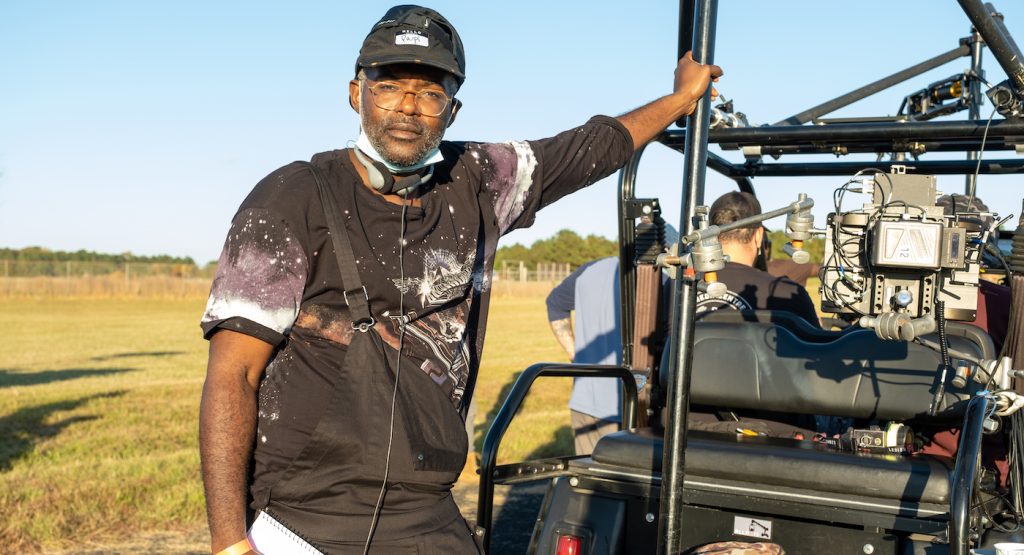
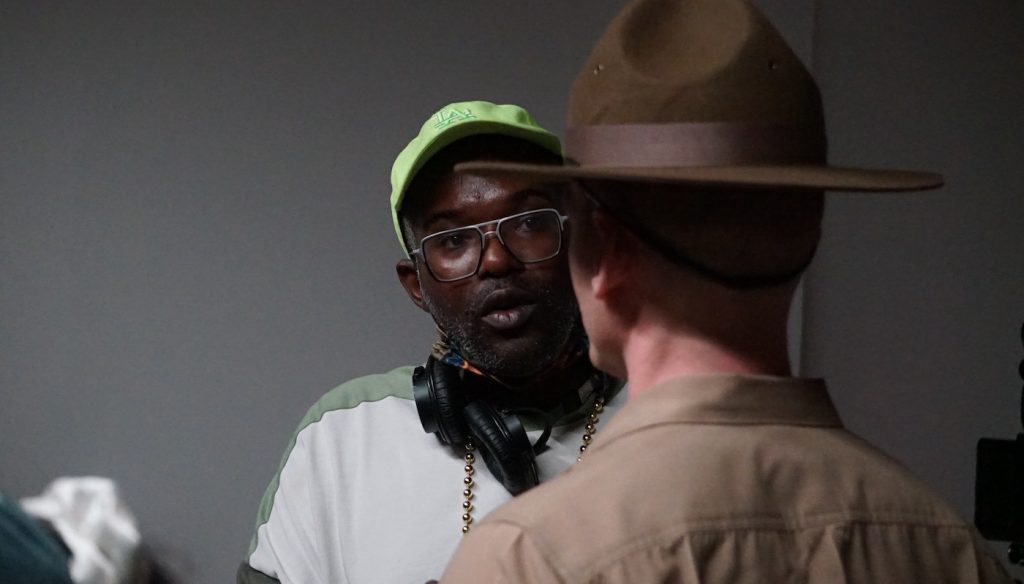
Writer/director Elegance Bratton on the set of “The Inspection.” Courtesy A24.
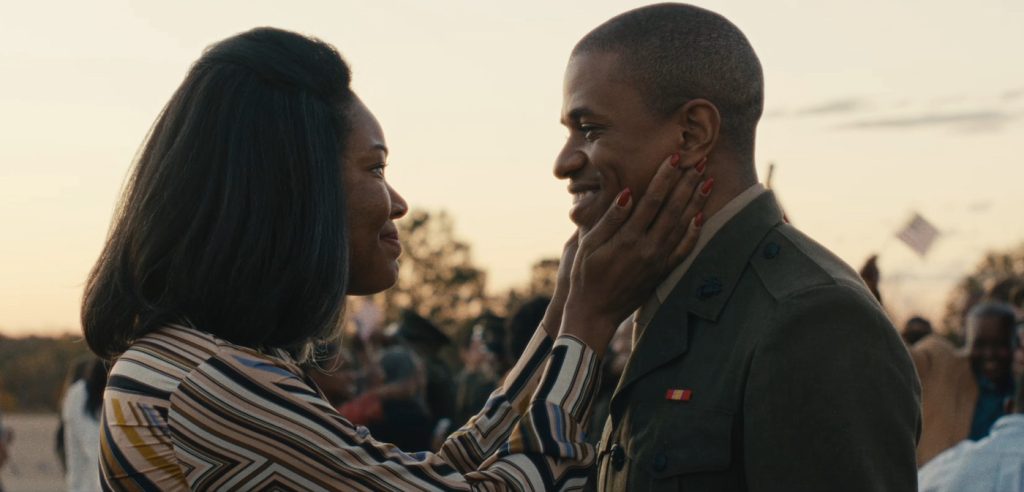
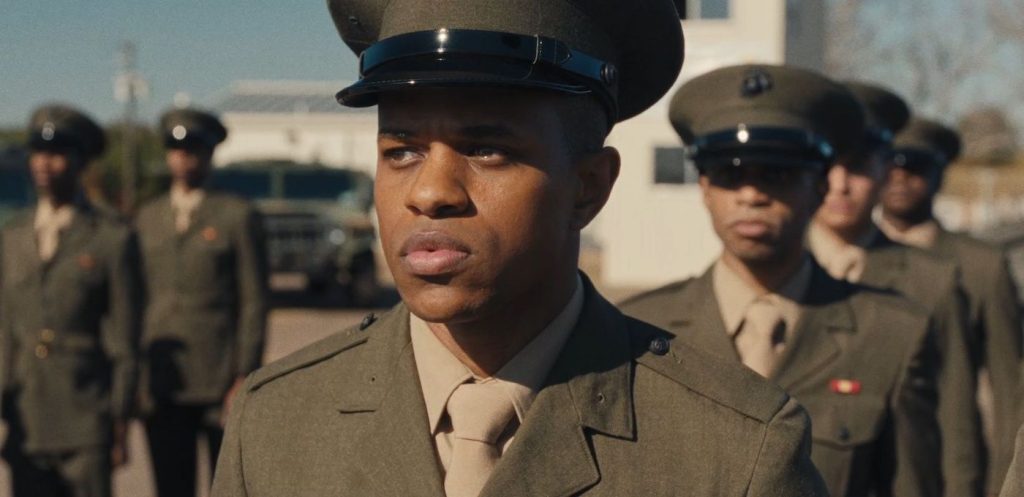
As Inez French in The Inspection, Gabrielle Union gives a fierce performance as Bratton’s religious but homophobic single mother who throws her 16-year-old gay son out of their New Jersey home. After 10 years of living in shelters and on the streets, Bratton stand-in Ellis French (played by Jeremy Pope in a star-making turn) joins the Marine Corps in 2005 during the “don’t ask, don’t tell” era. He survives grueling boot camp and endures constant physical and verbal harassment by a drill sergeant and by many of his fellow recruits. Ellis may have joined the Marines to win back his mother’s love, but it is his own self-respect that he earns.
L-r: Gabrielle Union, Jeremy Pope. Courtesy A24.
The Inspection has garnered critical acclaim and award nominations, including Golden Globes, Gothams, and Film Independent Spirit Awards. Bratton was named one of Variety’s 10 Directors to Watch for 2023, and he is the inaugural recipient of Boston’s Coolidge Breakthrough Artist Award. He will attend the event on January 27 at the Coolidge Corner Theater.
But the success has been bittersweet. “My mom was killed three days after the film was green-lit [by A24 in early 2020]. I’ve been grieving my mom since I was 16 since it all happened. It made me question, ‘Am I doing this just for her?’ Of course, I wasn’t, but there was a lot of emotion happening with me [during production],” he said. “Seeing Gabby on set — she wore my mother’s jewelry, she used my mother’s bible. I finished those days as a wreck and had to learn how to work through those emotions. I could not be in a corner crying. I am grateful to Gabby for helping to bring my mom back to life and for this film and the reaction to it. There’s been a lot of healing from this project.”
Bratton is currently “deep into post-production” on the feature documentary Hellfighters about James Reese Europe, “another Black veteran and the first to serve as a uniformed officer during World War I,” he said. A lieutenant in the 369th Infantry Regiment known as the Harlem Hellfighters,Europe was a Jazz pioneer and music mogul and “the first black man to conduct a show at Carnegie Hall,” said Bratton. “There will be animation and an expansive approach to the archival because there’s not much footage.”
After Bratton made his television debut as the creator and executive producer of the Viceland series My House, which chronicled underground competitive ballroom dancing, he finally had some money in the bank. For the first time in his life, he said, he could concentrate solely on writing scripts.
By 2017, he’d written three scripts, including The Inspection. Bratton said he “asked Chester [Chester Algernal Gordon], who is my husband and producer, creative partner, and love of my life,” which one he should pursue. Gordon advised him to “bring the audience to a place they can’t go without you. Let them know you. You are a Black gay storyteller. So I committed to making The Inspection.”
Writer/director Elegance Bratton on the set of “The Inspection.” Courtesy A24.
But most studios, including A24, initially passed on the project. Bratton was undaunted. “When I hear ‘no,’ I look at what they are responding to. I am encouraged by the slightest bit of response. They liked the shower scene, so OK, how do I make it really land? I’m listening for feedback to make it better.”
Besides watching films including Full Metal Jacket, Jarhead, Beau Travail, and Rocky, Bratton prepared for shooting his film by studying photography and cites William Eggleston as influential for “how to use the environment” and Nan Goldin, “who is important to me in every film I make.”
Jeremy Pope. Courtesy A24.
“It takes a long time for a first feature to get made, but once it’s agreed to, it all goes by so fast,” he said. “It took four years to get the film [approved], but then it was shot, edited, played festivals, and was released. We shot it in 19 days in Mississippi, and we lost a week because of a COVID shutdown, so that was time- crunched as well.”
Bratton “had to fight to the mat to make sure” that Pope was cast as Ellis. “I don’t believe that only gay actors should play gay characters. That being said, this is based on my life; every fear, every hope, and every desire is autobiographical. As a gay person, you don’t get to see examples of yourself as a hero in film. People pay to see movies because they’re aspirational versions of themselves. So with this film, I wanted an out queer actor,” he said.
To watch Pope “come into his own and become a big name is all the sweeter,” Bratton added. “Two years ago, nobody wanted to make [The Inspection], and now anything is possible.”
The Inspection is streaming now Apple, Amazon, AMC on Demand, and more.
For more recent interviews with filmmakers, check out these stories:
For those of you wondering— and worrying—about Jason Momoa’s future with DC in light of all the recent news and shakeups, the man himself is here to put you at ease.
As you’re no doubt aware by now, the new co-chairs of DC Studios are Guardians of the Galaxy and The Suicide Squad writer/director James Gunn and producer Peter Safran. They took over the studio with the goal of getting all of the stories that DC tells across film, television, and even video games, into a single, cohesive universe. That has meant some tough decisions and major changes, including going in a new direction with a younger Superman (so no more Henry Cavill) and putting the brakes on Wonder Woman 3. So, it was reasonable to wonder where this left Jason Momoa, who has his Aquaman sequel, Aquaman and the Lost Kingdom, due out this Christmas. Would Gunn and Safran decide to move away from Aquaman, and Momoa, and go in a new direction? Would Momoa be recast in a new role (like Lobo)? Or would Momoa’s time as Aquaman continue?
Well, Momoa seems to feel very good about his future at DC, as he shared some news after leaving Warner Bros. with One Media. In a video, Momoa talks about how it was four years ago when he left Warner Bros. feeling on top of the world (about Aquaman, presumably), and here he is, leaving the studio, feeling on top of the world again. Momoa says he has “great news” to share about his future in the DC universe and even lets loose a joyous scream.
If you’re hoping Momoa goes into detail on what, exactly, that news is, well, you’re outta luck. But, from the sound of it, Jason Momoa isn’t leaving DC, and whatever his specific future is, he’s excited about it. Check out the video below:
Jason Momoa teases some very exciting news regarding his future at DC Studios, thanking @JamesGunn, Peter Safran and David Zaslav in the process. pic.twitter.com/nl3rCW1kem
While we wait to hear more details on Momoa’s future in the DC Universe, we’ll be seeing him soon enough in Aquaman and the Lost Kingdom, which hits theaters on December 25.
For more on Warner Bros., HBO, and HBO Max, check out these stories:
The Tron train might be finally leaving the station.
After years of potential sequels going nowhere, Tron 3 is moving forward at Disney, with Jared Leto set to star. Leto has been championing the project for half a decade and will now lead the feature, with director Joachim Ronning (Pirates of the Caribbean: Dead Men Tell No Tales, Maleficent: Mistress of Evil) potentially helming the film. The script comes from Jesse Wigutow and will follow the events in 2010’s Tron: Legacy. The title of the third film? Tron: Ares.
The third film would arrive more than four decades after the original Tron, which bowed in 1982 and starred Jeff Bridges as the video game designer Kevin Flynn who gets morphed inside of his own game and must team up with the titular Tron (Bruce Boxleitner), a security program, to survive the ordeal. While the original Tron wasn’t a smash hit, it was hailed as a visually stunning glimpse at a potential near future and had a cultural impact that was larger than its $33 million box office haul.
Tron: Legacy, which was directed by Top Gun: Maverick helmer Joseph Kosinski, starred Bridges, Olivia Wilde, and Garrett Hedlund, and though it pulled in $400 million at the box office, a sequel was not immediately greenlit. A potential third film with Kosinski and his stars was officially nixed in 2015 and repeated attempts to revive a Tron 3 came to naught. Until now.
Ronning has a long-standing relationship with Disney after directing the fifth Pirates of the Caribbean film and the Maleficent sequel. He’s recently finished helming Young Woman and the Sea for Disney+, which stars Daisy Ridley as Trudy Ederle, the first woman to ever swim across the English Channel, who achieved the feat in 1926.
Leto has his own Disney project coming up—Haunted Mansion—in which he stars with a stacked cast that includes LaKeith Stanfield, Rosario Dawson, Winona Ryder, Owen Wilson, and Jamie Lee Curtis. He’s also starring in Darren Aronofsky’s next film, Adrift, about a deckhand taking lone control of a ghost ship while it’s towed to port, with sinister implications.
For more stories on Century Studios, Searchlight Pictures, Marvel Studios and what’s streaming or coming to Disney+, check these out:
Featured image: LOS ANGELES, CALIFORNIA – MARCH 17: Jared Leto attends the global premiere of Apple TV+’s “WeCrashed” at Academy Museum of Motion Pictures on March 17, 2022 in Los Angeles, California. (Photo by Frazer Harrison/Getty Images)
When Netflix revealed their full slate of films for 2023, one of the biggest has got to be Zack Snyder’s Rebel Moon. We learned last April that Snyder had begun filming his sci-fi epic for Netflix. Then, Netflix revealed its release date, December 22. And now, Snyder and one of his stars, Cary Elwes, have shared a few more looks at the upcoming film, including an 8-second teaser and an image of star Sofia Boutella.
Snyder had been thinking about Rebel Moon for years. It began as a potential Star Wars feature more than a decade ago, but that ship sailed when Disney acquired Lucasfilm in 2012. Snyder, of course, was busy on lots of other projects, but he eventually explored the idea with Netflix after the success of his zombie/heist thriller Army of the Dead. Now, years later, we’ll get a chance to see Snyder’s original sci-fi epic.
Elwes shared the snack-sized teaser via Twitter, which gives us a peek at Djimon Hounsou’s General Titus, Boutella’s Kora, and Charlie Hunnam’s character:
And Snyder revealed a look at Sofia Boutella as Kora:
Sofia Boutella is Kora. The reluctant hero from a peaceful colony who is about to find she’s her people’s last hope. #RebelMoonpic.twitter.com/AlEwIoiNxJ
Rebel Moon is based on a script by Snyder, his Army of the Dead co-writer Shay Hatten, and his 300 co-writer Kurt Johnstad. The story is centered on a peaceful colony on a distant planet in the far reaches of space that’s attacked by the army of the tyrant Balisarius (Ed Skrein). The only way the colony can survive is if Kora (Boutella) can recruit people from other planets to help them save their home.
Joining Hounsou, Boutella, Elwes, and Hunnam are Corey Stoll, Michiel Huisman, Alfonso Herrera, Doona Bae, Ray Fisher, Rupert Friend, and Stuart Martin.
New Yorkers are legendarily tough, so it’ll be interesting to see how they handle Ghostface, that notorious killer (and his many copycats) who usually do their slashing in Woodsboro, California. Paramount Pictures has released a new trailer for Scream VI, which plucks Ghostface from the Cali burbs to the Big Apple, and brings back a familiar face in Hayden Panettiere, who returns as Kirby Reed from Scream 4.
The trailer opens in the most New York of settings, a bodega, with Ghostface slashing his way through customers and the man behind the register (who tries, and fails, to take him out) in an effort to tidy up some loose ends from last year’s Scream V (officially just titled Scream). Those loose ends are sisters Sam Carpenter (Melissa Barrera) and Tara Carpenter (Jenna Ortega), who moved to New York trying to rebuild their lives. As the trailer shows us, not even moving across the country to NYC will cleave these two from Ghostface.
We’ve got plenty of returning characters in Scream VI: Gale Weathers (Courtney Cox), Mindy Meeks-Martin (Jasmin Savoy Brown), and Chad Meeks-Martin (Mason Gooding). Newcomers include Jack Champion, Henry Czerny, Liana Liberato, Dermot Mulroney, Devyn Nekoda, Tony Revolori, Josh Segarra, and Samara Weaving.
The trailer also reveals that this new Ghostface is the most committed, psychotic Ghostface fanboy of them all, as our survivors find a shrine to the masked murderer in the city. In another scene, our heroes find themselves on a subway with multiple people in Ghostface masks. Talk about a bad commute.
Scream 5 directors Matt Bettinelli-Olpin and Tyler Gillett return, working from a script by James Vanderbilt and Guy Busick. In their first effort helming Scream 5, the directors made sure they were building upon the legacy created by Wes Craven in the 1996 original film. For Scream VI, it sounds as if they’re going all out, as they told Colliderthat their upcoming sequel was “potentially a hundred times gorier.”
Check out the new trailer below. Scream IV hits theaters on March 10.
Here’s the official synopsis:
Following the latest Ghostface killings, the four survivors leave Woodsboro behind and start a fresh chapter. In Scream VI, Melissa Barrera (“Sam Carpenter”), Jasmin Savoy Brown (“Mindy Meeks-Martin”), Mason Gooding (“Chad Meeks-Martin”), Jenna Ortega (“Tara Carpenter”), Hayden Panettiere (“Kirby Reed”) and Courteney Cox (“Gale Weathers”) return to their roles in the franchise alongside Jack Champion, Henry Czerny, Liana Liberato, Dermot Mulroney, Devyn Nekoda, Tony Revolori, Josh Segarra, and Samara Weaving.
For more on the Scream franchise, check out these stories:
Andrea Mona Bowman knew that Emancipation was going to be special.
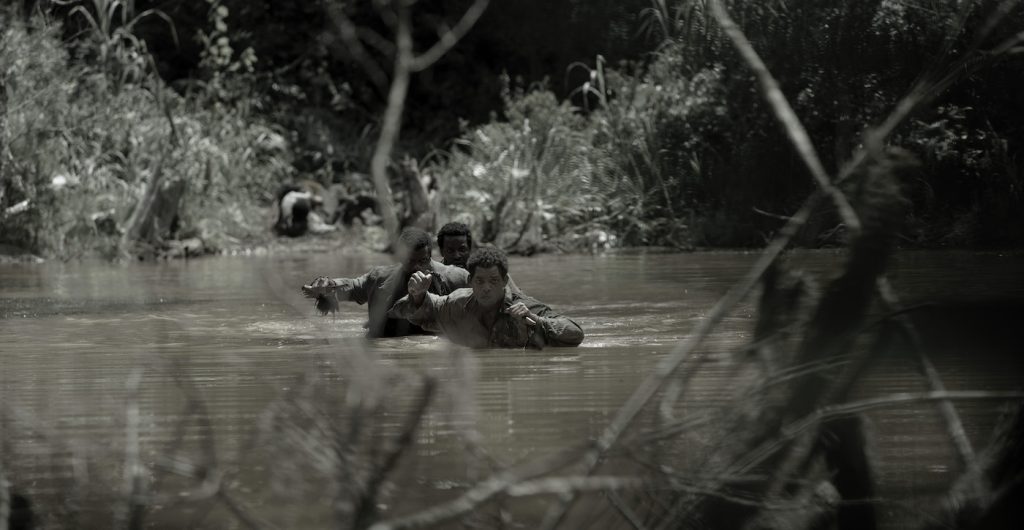
Based on a true story, Emancipation stars Will Smith as Peter, a Southern slave who breaks free from his Confederate captors and escapes into the Louisiana swaps. Chased for days, Peter makes his way to Baton Rouge, where he joins the Union army to fight for his freedom. There, he is introduced to new technology — photography. Peter agrees to have his bare back — covered from waist to neck with deep scars from repeated whippings — captured on film. The image became a worldwide symbol of the brutality of slavery, fueling the rallying cry for emancipation.
Will Smith, Michael Luwoye and Gilbert Owuor in “Emancipation,” now streaming on Apple TV+.
Bowman, whose credits include the 2022 TV series Women of the Movement and the 2019 feature Just Mercy, was well aware of the iconic 1863 photo of “Whipped Peter” by pioneering photographers McPherson & Oliver. So when she learned director Antoine Fuqua was helming a film based on its story (the original photo appears in the end credits), Bowman jumped at the chance to head the hair department for the 2023 Apple TV+ release.
“For me, it is personal. I’m from Louisiana. Peter could be one of my ancestors. So telling Peter’s story was more of a spiritual thing,” Bowman says during a recent interview from the set of Young Rock, where she heads the hair department. “I felt that this one was a lot different because of the intenseness — how it was shot and portrayed and who Peter was. Peter was a real human being. There is documentation of all these things.”
Will Smith in “Emancipation,” now streaming on Apple TV+.
Bowman’s first step was absorbing all that documentation. She spent hours on Google scouring for images. She found documentaries on YouTube. She spent her spare time during the Women of the Movement shoot hunting through Mississippi thrift stores for Civil War books. Stacks of material began piling up at home.
“I had this whole board with over 3,000 pictures. I’m still erasing pictures out of my phone,” Bowman says. “My son would come in and say, ‘Mama, you’re surrounded by all of this stuff!’ I was so intent on wanting to be correct.”
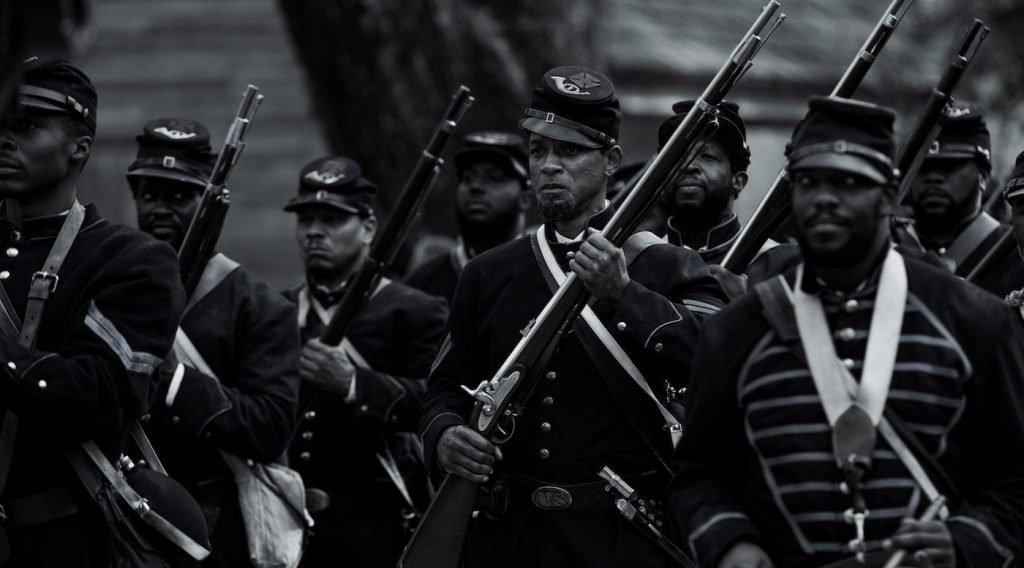
Her quest for historical accuracy led to a unique strategy. Bowman decided to match each Emancipation performer to a historical photo. 19th-century images of slave hands, black and white Union soldiers, slave masters, and even slave catchers were brought to life.
Andrea Bowman on the set of “Emancipation.” Courtesy Apple TV+.
“I did my research by going back and forth and basing it off the length, color, and texture of the hair,” Bowman adds. “I wanted every character from the background players and the stunt guys to the main characters to link to a real person.”
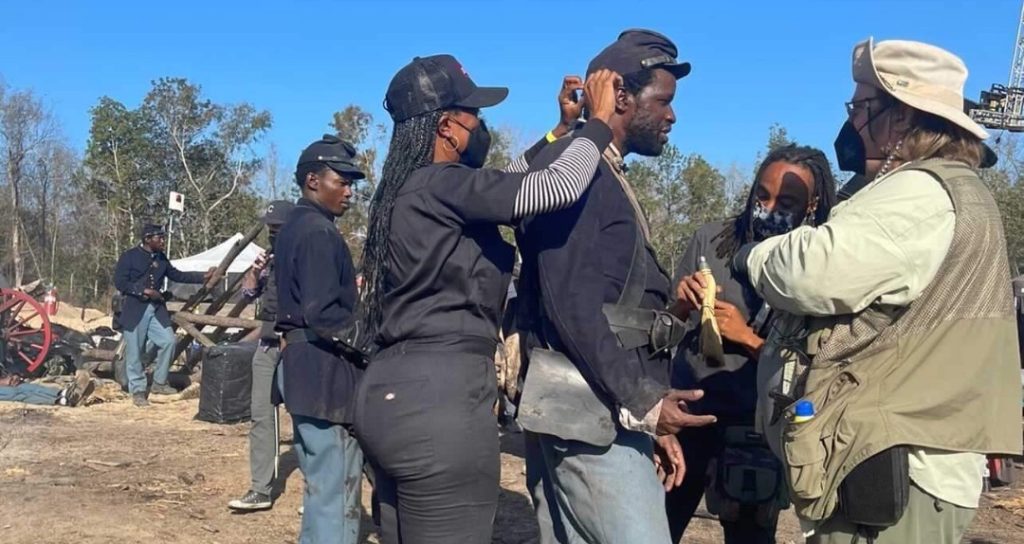
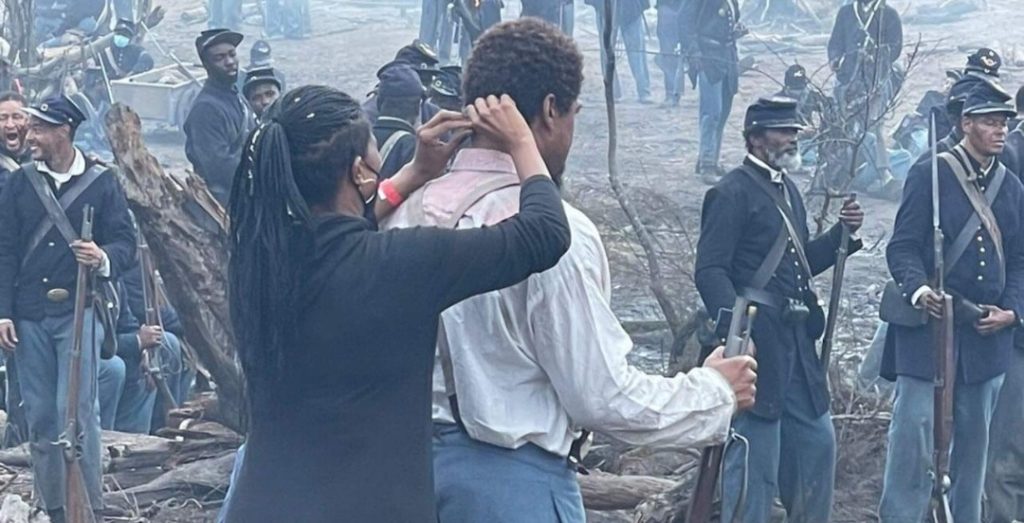
With a set that stretched almost five miles long and a script calling for a sweeping plantation, epic Civil War battles, and grueling scenes of a Confederate camp where the slaves were forced to build a railroad, the task was not easy. Bowman estimates that during the first six weeks of filming, in addition to the main characters, the hair department transformed about 300 background extras. And that meant taking a lot of 21st-century haircuts back in time.
“Nobody came 1863,” Bowman jokes. “Tomas (Jabbar Lewis), the young man that gets bit by the dogs, when he first came in, he had a nice haircut. “I was like, ‘Oh, we can’t have that’ because they didn’t razor edge their hair in the slave pen.”
Andrea Bowman on the set of “Emancipation.” Courtesy Apple TV+.
Adding to the degree of difficulty, everyone had to pass a COVID test each morning before work. This ate into prep time. But the team, which included a core group of Jorge Benitez, Christy Caudle, and Daina Daigle, and between 15 and 20-day stylists for the more expansive scenes, rose to the challenge.
“I had section techniques that I taught my team. They knew how many pieces were placed, how many sections were twisted, cross pinned. Everything had a process. It was like a well-oiled machine,” says Bowman.
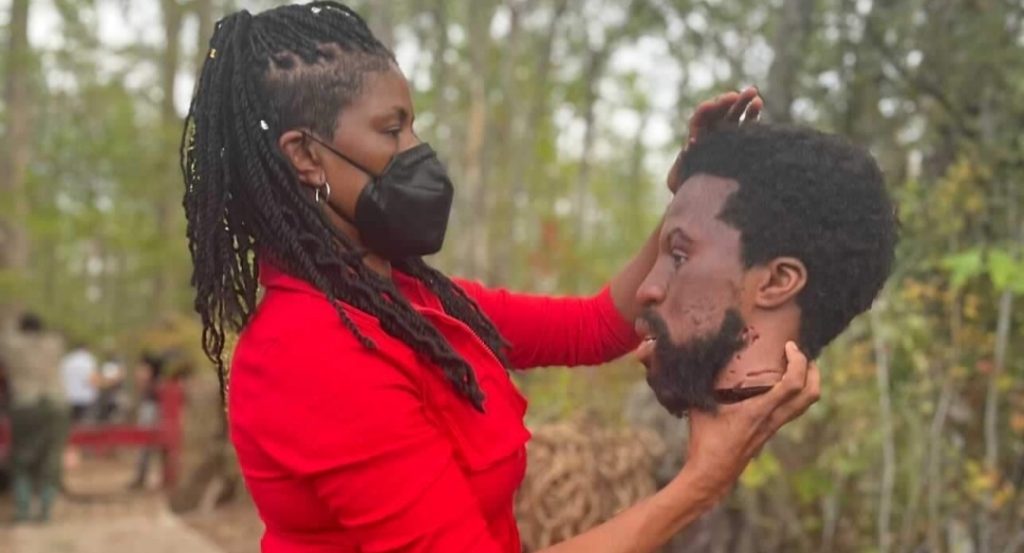
Wigs were used extensively. The hair team even created handmade pieces to fit the heads of the numerous dummies representing the dead slaves executed by the slave masters.
Andrea Bowman on the set of “Emancipation.” Courtesy Apple TV+.
Smith wore a custom wig that was designed by Pierce Austin, his personal hairstylist. Bowman was tasked with recreating that look for Smith’s stunt double.
All that extra hair added an additional challenge. Shooting extensive battle scenes, dusty construction sites, bustling cotton fields and murky swamps is tricky enough. But doing it during the height of a 100-degree Louisiana summer is just asking for a bad hair day.
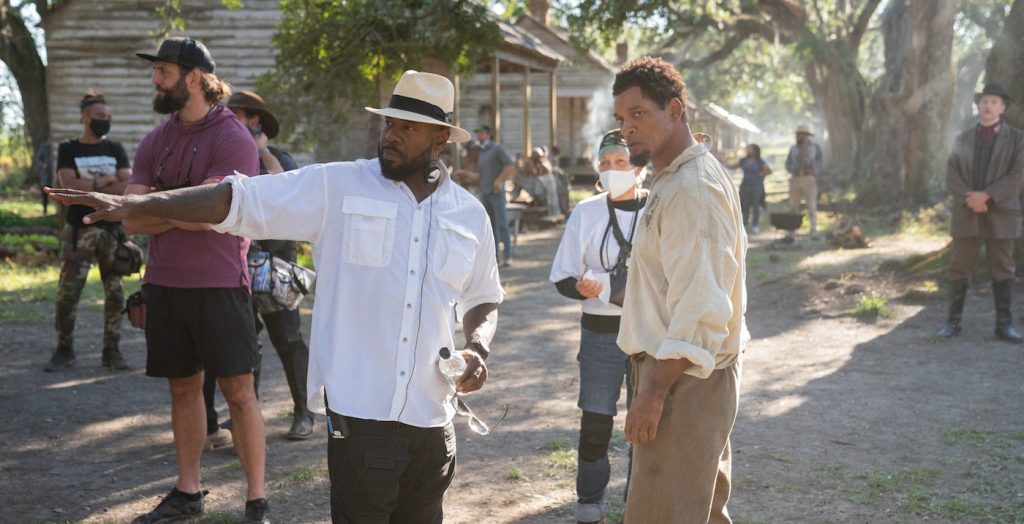
Director Antoine Fuqua and Will Smith behind the scenes of “Emancipation,” premiering December 9, 2022 on Apple TV+.
“The sweating, the dirt, the bombs exploding… glue don’t care about none of that. It only lasts a couple of hours,” Bowman explains. “So if you add the heat, which makes the body react with sweating… and the oils, you’ll turn around and see a nicely done person going south. The heat had a great impact.”
Bowman credits preplanned pinning techniques and constant vigilance for keeping things under control. And they had a secret weapon — cordless, battery-powered hair dryers. Easy to maneuver around the set, they kept the actors cool, the glue dry, and helped cut down on reapplications throughout the day.
As much as Bowman used historical imagery, she was also open to taking advantage of her actors. “We played off each person, what they had, what they brought to the table,” she says.
Ronnie Gene Blevins, who plays Harrington, one of the slave catchers who chases Peter through the swamps, was fitted with hair extensions to make him stand apart from his colleagues. On the other hand, for Howard (Steven Ogg), a slave master, Bowman opted to use the actor’s natural hairline. “He had such an edgy look, older and thinner on top,” she adds. “We wanted that effect for the character as well.”
Bowman also opted to keep it real with Charmaine Bingwa, who plays Peter’s wife Dodienne. “We were thinking about a wig at first but I wanted to show texture,” she explains. “I did a twist set technique on her hair so I could use her own hair.”
Bowman adds that many of the slaves didn’t have healthy hair because they were malnourished. But from the script, she knew that Dodienne needed to be the exception. “Peter was a strong-willed man,” says Bowman. “As his wife, I wanted to show that she was the type of woman that would take that extra care of herself — much as she could. When I presented this to Antoine, he agreed. He wanted a good structured look that fit the period. He trusted me to bring that. When you see her, that is her natural texture.”
Imani Pullum, Will Smith, Jeremiah Friedlander, Landon Chase Dubois, Charmaine Bingwa and Jordyn McIntosh in “Emancipation,” now streaming on Apple TV+.
Bowman’s efforts haven’t gone unnoticed. Emancipation made the cut on the Oscar shortlist in the Makeup and Hairstyling category and is in the running for an Academy Award nomination.
Perhaps as important was the reaction when her mother saw the film. “It’s actually living history. She said it looked like it was a picture moving,” says Bowman. “And that’s what we want, a seamless look. So when you see it, it draws you into the story. It’s not just a history lesson, but a lesson of love and faith and endurance in a young black man.”
Emancipation is streaming on Apple TV now.
For more stories on Apple TV series and films, check these out:
Don’t worry, M3GAN fans, the murder-doll with a keen sense of fashion and a keener sense of vengeance is returning, along with some key players.
Spoiler alert for those who haven’t seen the original—M3GAN 2.0 is now officially in the works, with Universal not only announcing a speedy January 17, 2025 release date but also the return of stars Allison Williams and Violet McGraw. The script will come from M3GAN scribe Akela Cooper, yet it hasn’t been announced yet whether director Gerard Johnstone will also return.
Williams played Gemma, the brilliant robotics engineer who created the A.I.-infused doll for McGraw’s Cady, a grieving child dealing with the loss of her parents. The idea was simple—M3gan, short for Model 3 Generative Android, would provide unwavering friendship to Cady as she settles into her new life with Gemma and without her parents. God knows why anyone would think it’s a good idea to upgrade the murderous M3gan, but we’re sure Cooper will find a great way to bring the robot with a heart of poison back. M3GAN has been a big hit, nabbing $91 thus far globally on a budget of just $12 million. The film was produced by horror maestros James Wan and Jason Blum of Blumhouse, which produced the movie alongside Atomic Monster for Universal Pictures.
“After I first saw the movie, we had a good sense that a sequel might really work,” Blum told Variety.” “So, we broke our cardinal rule, and we started talking about a sequel before the movie was released. I felt so bullish that we started entertaining a sequel earlier than we usually do.”
Fans of the original M3GAN will no doubt be delighted.
From Chris Hemsworth to Chris Evans—and a slew of non-Chris named stars in between—Netflix has revealed its entire 2023 film slate via a new trailer.
Netflix is releasing 49 new films this year, with some huge names and huge collaborations between stars and top-flight directors. Some of the marquee releases include David Fincher’s The Killer, based on Alexis Nolent’s graphic novel and starring Michael Fassbender and Tilda Swinton, David Yates’s Pain Hustlers, starring Emily Blunt and Chris Evans, and Zack Snyder’s sci-fi epic Rebel Moon, starring Charlie Hunnam and Sofia Boutella.
There’s more, a lot more. That other Chris (Hemsworth) returns in the action thriller Extraction 2, Gal Gadot stars in the spy drama Heart of Stone, and director Mr. Robot creator Sam Esmail’s apocalyptic drama Leave the World Behind, an adaptation of Rumaan Alam’s novel starring Ethan Hawke, Julia Roberts, Kevin Bacon, and Mahershala Ali, debuts this year.
Idris Elba appears in Luther: The Fallen Sun, reprising his beloved TV role of detective John Luther; Millie Bobby Brown stars in the fantasy film Damsel, and Nicole Kidman, Zac Efron, and Joey King star in the comedy A Family Affair.
We’re still waiting on word on when Bradley Cooper’s Bernstein, which he directs and stars in, will premiere, and ditto Wes Anderson’s adaptation of Roald Dahl’s work, but there’s plenty here to sink your teeth into.
Check out the trailer below for the current full slate of Netflix films coming out this year:
For more on big titles on Netflix, check these out:
Last April, director Zack Snyder revealed that he’d begun filming his sci-fi epic Rebel Moon for Netflix. Now, Netflix has revealed the official release date for the film, which arrives at the tail end of the holiday season on December 22.
The story of Snyder’s long quest to make Rebel Moon is a good one, with the project originating as a potential Star Wars feature more than a decade ago. When Disney acquired Lucasfilm in 2012, the project never came to pass. Snyder eventually explored the idea with Netflix after the success of his zombie/heist thriller Army of the Dead. Now, all these years later, Synder’s ready to deliver an original sci-fi epic, one that he and his collaborators re-shaped so that it existed within its own galaxy rather than the pre-existing Star Wars realm.
Rebel Moon is based on a script by Snyder, his Army of the Dead co-writer Shay Hatten, and his 300 co-writer Kurt Johnstad. The story is focused on the story of a peaceful colony on a distant planet in the far reaches of space that’s attacked by the army of a dictator named Balisarius, played by Ed Skrein. In a desperate attempt to survive, the colonists place all their hopes on Kora, played by Sofia Boutella, who they send to nearby planets in the hopes she can recruit people to help them save their home.
Snyder’s recruited a great cast. Joining Hounsou and Boutella are Cary Elwes, Corey Stoll, Michiel Huisman, Alfonso Herrera, Charlie Hunnam, Doona Bae, Ray Fisher, Rupert Friend, and Stuart Martin.
Back when Snyder revealed that he’d begun filming Rebel Moon, he also revealed these photos from set:
Now we know that the Snyder-verse, which formerly included some of the most iconic characters in the world like Batman and Superman, is evolving on its own terms, including zombies, space tyrants, and more.
For more on big titles on Netflix, check these out:
Michael B. Jordan’s mission is clear, and he’s got a man who knows his way around an epic action film to guide him.
The Hollywood Reporterhas the scoop that Jordan is teaming up with John Wick director Chad Stahelski for Paramount’s Rainbow Six, an adaptation of one of Tom Clancy’s most popular novels. The film is a follow-up to the 2021 action thriller Without Remorse, which was adapted from another Clancy novel by Taylor Sheridan and Will Staples and directed by Stefano Sollima.
Rainbow Six will find Jordan reprising the role of former Navy SEAL and current CIA operative John Clark and will track Clark’s journey into the shadow precincts of international spy work. Without Remorse, which was filmed during the pandemic, served as an origin story for the character, who was one of the most popular in Clancy’s vast canon and intersected with his most popular character, Jack Ryan. While Without Remorse was released directly on Amazon, Rainbow Six will likely get a theatrical release, THR reports.
In Stahelski, Jordan has a collaborator who is one of Hollywood’s leading experts in choreographing thrilling action set pieces, having perfected his craft on the John Wick franchise. The former stuntman is now one of the go-to directors in Hollywood for action thrillers, and with Jordan in the lead role in Rainbow Six, he has an ideal collaborator to center in the mayhem.
For more films and series from Paramount and Paramount+, check out these stories:
Featured image: LOS ANGELES, CALIFORNIA – JANUARY 06:Michael B. Jordan attends the LA Community Screening Of Warner Bros Pictures’ “Just Mercy” at Cinemark Baldwin Hills on January 06, 2020 in Los Angeles, California. (Photo by Frazer Harrison/Getty Images)
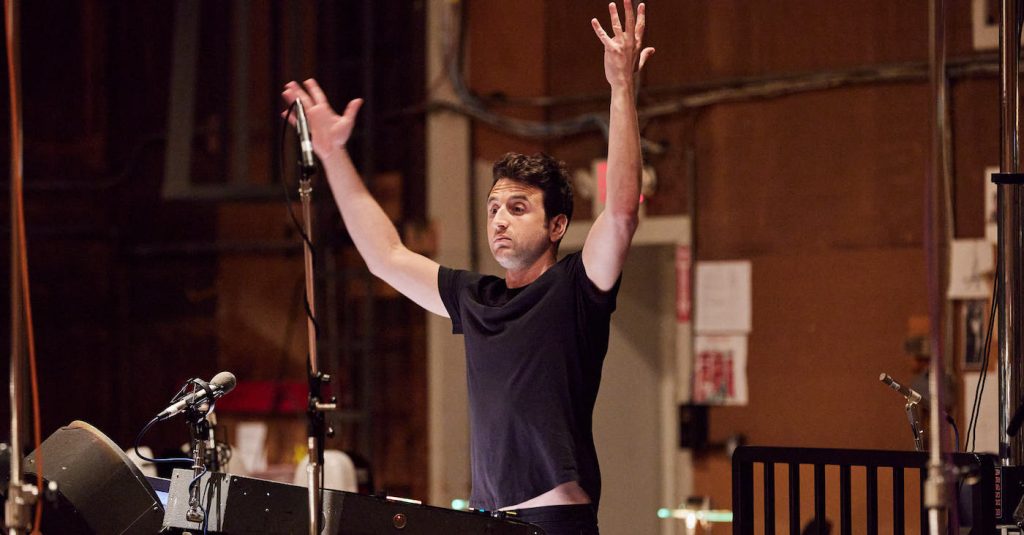
“I’m very obsessive, and I can only do one thing at a time, so when Damien has a movie to work on, I go all in.” That’s composer Justin Hurwitz talking about his ongoing collaboration with filmmaker Damien Chazelle, and clearly, the laser vision has paid off. Hurwitz started working on his Oscar short-listed score for Babylon back in 2019, a few years after winning two Academy Awards for the Chazelle-directed La La Land. He also scored Chazelle’s acclaimed 2014’s jazz-themed feature Whiplash and his 2018 epic First Man.
Hurwitz started taking piano lessons at age six, composed original music by age 10, and studied music theory at Harvard University. There, he met Chazelle. In their freshman year, Hurwitz and drummer Chazelle formed a band called Chester French. By the time the group had signed with Pharrell’s label, Hurwitz and Chazelle had quit, re-directing their talents toward making student films together.
For Babylon, starring Brad Pitt, Margot Robbie, and newcomer Diego Calva as fierce talents struggling to navigate Hollywood’s silent movie era, Hurwitz wrote more than two hours of music, including four dozen cues featured on the film’s soundtrack album.
Speaking from his home studio in L.A., Hurwitz, flanked by a synthesizer and a piano, talked about recruiting a wild saxophone player he found on YouTube and explains how he blended modern production with 20s-era jazz instrumentation to drive the movie’s fever-dream party sequences.
Justin Hurwitz. Courtesy Paramount Pictures
Your Babylon music cues manage to evoke a twenties jazz feel without sounding retro. How did you approach that synthesis?
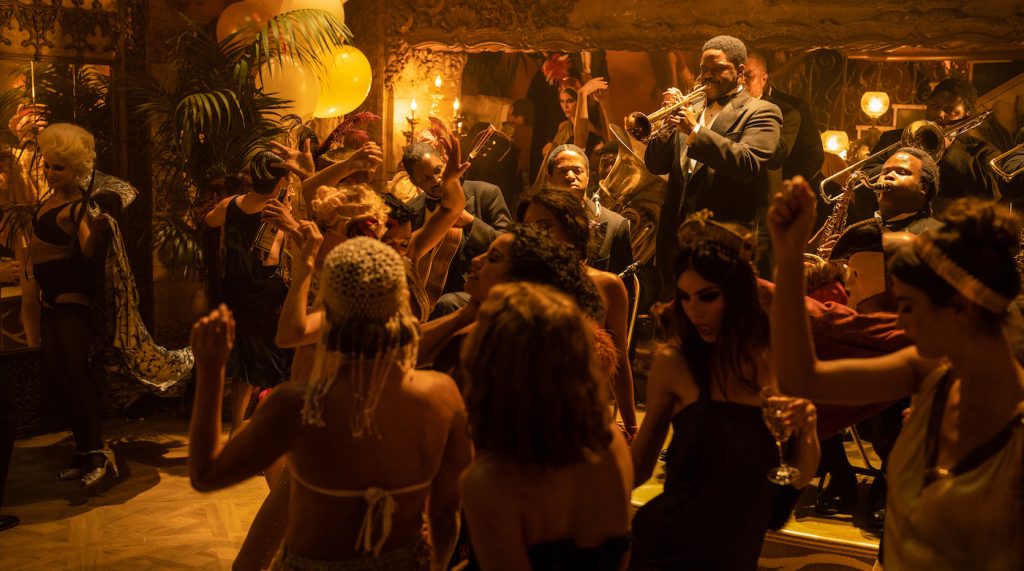
The party music instrumentation is basically a 1920s jazz band, cheated up with a slightly bigger horn section – – two trumpets, two trombones, and three saxes. There was probably a four-on-the-floor kick drum back then but not as forward [in the mix] as we’ve done it, so that seems modern. I also did a lot of riff-based writing, taking inspiration from rock and roll bands like the Rolling Stones and AC/DC. Where their songs are written around a riff played on an electric guitar, we’ve given the riff instead to unison horns, so the music has a muscular feel different from the lighter style of jazz we think of as the twenties.
It’s a compelling mixture: jazzy horns arranged like rock riffs and set to the kind of driving rhythms you might find in electronic dance music.
Yeah, Damien put together a playlist at the beginning. There were like 90 dance music and EDM tracks, some sixties jazz, some Latin inspired pieces — all sorts of stuff, but it really wasn’t twenties music.
So you didn’t go back and listen to recordings by people like Duke Ellington or Louis Armstrong?
No. I actually avoided music from that period. We wanted a more wild feeling. Damien brought up the idea that music we think of as “twenties” was just a sliver of what was actually being played at the time. Recording on wax or whatever was very new, and very few people had access. There was actually a much more vibrant music scene at parties and clubs and underground music places where people are really sweating and going for it. So we tried to imagine the kind of music that was being played at the time but was never recorded.
Jovan Adepo plays Sidney Palmer in Babylon. Courtesy Paramount Pictures.
To capture that wild feeling, I believe you came across a great saxophone player online?
For the wild sax solos at the opening party, I worked with a player named Jacob Scesney, who I’d never worked with before. Our vocal contractor sent me a YouTube video of him playing a small jazz club, and I thought he was perfect. Then for the dance sax, I found this guy Leo Pellegrino searching YouTube. I was writing early demos for a baritone sax using this [pointing to the synthesizer]. I went searching for “Does anybody play dance music on a sax?” And Leo does exactly that. There are viral videos of Leo busking in New York subways, kicking his legs and spinning around as he plays the sax. For one cue, “Herman’s Hustle,” we remotely recorded Leo playing his baritone sax from Philadelphia, where he lives, and then you’ve got this great drummer Peter Erskine here in L.A. with his snare and cowbells and woodblocks doing awesome stuff. It was exciting to pair them together. I’ve never done a score with this many moving parts.
A lot of film composers score one or more movies a year, but you don’t work that way?
I’m very slow, first of all, and I obsess over every detail, so it takes me a long time to find stuff that I think is good enough, that Damian agrees is good enough. It starts here at the piano with the melodies. We go through a lot of iterations, we talk about arrangements and instrumentation. I’m very lucky that Damien thinks about music early in his process and allows me to build the score with him. And I do need a lot of time to feel like I’m doing my best work, so I’m glad I get to start early.
How do you match the music to the sequences?
Damien hand-draws storyboards, hundreds of pages, then he cuts these stick figures to my demos on Final Cut Pro or whatever he uses. Then I refine the demos to the length of his storyboards, or sometimes he changes the timing of the scene to fit the music if he thinks that’s worth doing.
Most of your Babylon cues include a contemporary element, but your re-creation of “Singin’ in the Rain” sounds like a straight-up homage to 1920s-era music.
Yeah, that was a fun task. Everybody thinks of “Singin’ in the Rain” from the 1952 Gene Kelly movie, but it’s actually a much older song used in a revue from 1929. You can find the recording on YouTube, but it’s very crunchy. I tried to pick out the harmonies; I heard a xylophone that kind of poked out, and it’s definitely a jazz band with a horn in the rhythm section. I did my best to interpolate that arrangement based on what I could hear. And then it was about trying to get that flavor out of the choir.
Many women and men sing together at the top of their lungs in the original and in your re-creation. How did you approach the vocals for “Singin’ in the Rain’?
I started by demoing it right here. I’m a bad singer. I’m not being humble. I’m a truly horrendous singer. But I did a bunch of vocal tracks, crudely tuned it to the right pitch, then got my friend Riki to sing the female parts. Twelve of me, twelve of Riki. Then we brought in a great choir, 16 or 24 singers hired by our great vocal contractor Jasper Randall. But Damien figured that the people singing in our Babylon sequence are actors in rain slickers — it shouldn’t be a perfect choir with perfect vibrato. It should be a little rough around the edges. So we blended in my amateur demo vocals with the professional singers to strike that balance.
You brought in three different trumpet players to provide the solos for Babylon musician Sidney Palmer, portrayed by Jovan Adepo. Did you also create themes for the Margot Robbie and Diego Calva characters Nellie and Manny?
Yeah. It’s a bittersweet tune which is actually a slowed-down version of the baritone sax dance piece [earlier in the movie]. We harmonized it and used three different pianos. One was a beautiful Steinway with a very warm tone. The second piano was a slightly out-of-tune spinet with tacks in hammers, which add a twang. And then the third piano was an extremely out-of-tune upright. When we blended the three pianos together, it gave us this mixture of sweet and sour. Like Nellie and Manny’s relationship, it felt fragile and broken.
Can you talk about some of the other musical styles featured in Babylon?
There are a few cues we recorded with a 98-piece orchestra. On the hilltop, when Brad Pitt’s character has this big kiss, we’ve taken one of the score themes called “Gold Coast Rhythm” and turned it into a Wagnerian-inspired orchestration. At a fancy party later in the movie, we have a Bolero-inspired piece that grows more and more insane. In the scene where we first meet Tobey Maguire’s character, we have a Greek folk-sounding piece on guitars followed by a Hawaiian orchestra piece, both playing twisted versions of tunes we’ve heard earlier in the score. Then the Tobey character takes us to a set piece where we have these creepy Gregorian sorts of vocals, and under that creepy male drone are pitched gongs playing a twisted version of the “Voodoo Mama” tune, which was Nellie’s big dance piece at the Wallach party. Damien and I love to establish our themes early and then bring them back in all sorts of ways. For this sequence, Nellie’s life is on the line, so it felt right to bring back a piece of music that represented her, even if it was really disguised.
First came the outstanding reviews, and then came a monster debut. It’s all good news for HBO’s The Last Of Us, which lived up to its hype with not a more or less unanimously positive critical reception—it’s sitting at 99% fresh on Rotten Tomatoes—but by pulling in a whopping 4.7 million viewers across all linear and HBO Max platforms on Sunday night in the United States. This puts the video game adaptation, from co-creators Craig Mazin (Chernobyl) and Craig Druckmann (the creator of the original game), just behind House of the Dragon as the largest debut since 2010, when Boardwalk Empire bowed.
Because the Sunday night viewership for an HBO series typically only represents 20%-40% of the show’s total gross audience per episode, a whole lot more people will have watched the Pedro Pascal and Bella Ramsey-led series.
“Our focus was simply to make the best possible adaptation of this beloved story for as big an audience as we could,” said Executive Producers Craig Mazin and Neil Druckmann in a statement. “We are overjoyed to see how many fans, both old and new, have welcomed ‘The Last of Us’ into their homes and their hearts.”
“We are thrilled to see fans of the series and game alike experience this iconic story in a new way, and we extend our gratitude to them for helping to make it a success,” said Casey Bloys, Chairman and CEO, HBO & HBO Max Content, in a statement. “Congratulations to Craig, Neil, and the brilliant cast and crew who worked tirelessly to bring this show to life. We look forward to fans around the world enjoying the rest of the season.”
The Last Of Us is set 20 years after the fall of civilization following the spread of a pandemic kickstarted by a fungal mutation and is centered on Joel (Pascal) and Ellie (Ramsey) as they venture out of the Quarantine Zone on a dangerous mission. Their quest is so terrifying because the fungal mutation hijacks peoples’ brains and essentially turns them into zombies. Want to get a little bit more freaked out? This fungal mutation is real, it’s called Cordyceps and, as the Washington Post puts it, it “does induce zombie-like symptoms in insects.” This is the phenomenon that originally inspired Neil Druckmann to create The Last Of Us video game for Naughty Dog.
We don’t think you need to add Cordyceps to your index of concerns, however, but you should add The Last Of Us to your watch-list if you enjoy a brilliantly depicted zombie thriller that’s even more interested in its human characters than it is the zombies threatening to tear everything to shreds.
For more on The Last of Us, check out these stories:
Marvel Studios’ first Disney+ spinoff is now officially underway.
Agatha: Coven of Chaos begins filming today in Atlanta, with Kathryn Hahn reprising her role as Agatha Harkness from the very first Marvel Studios Disney+ series, WandaVision. Hahn is re-teaming with WandaVision head writer Jac Schaeffer, who serves as head writer and executive producer here, as well as director of several episodes. Agatha: Coven of Chaos has a slew of talented women behind the camera, including Wednesday director Gandja Monteiro and Resident Evil and A Friend of the Family director Rachel Goldberg.
The talent level is just as strong in front of the camera, too. Hahn is joined by The White Lotus star Aubrey Plaza, Broadway legend Patti LuPone, Heartstopper star Joe Locke, Buffy the Vampire Slayer star Emma Caulfield, That ’70s Show actress Debra Jo Rupp, and comedian Sasheer Zamata.
So where will Agatha: Coven of Chaos find its titular mischief maker, and how will the show factor into the larger MCU and Phase 5? Plot details are, naturally, well guarded, but we know that Agatha’s identity as the actual villain of WandaVision was revealed by the end of that series. Agatha was bested by Wanda (Elizabeth Olsen) and trapped in the friendly neighbor persona she was portraying, yet we know she’s somehow going to break free and get back to her witchy ways.
Joining the aforementioned stars are returning WandaVision actors David Lengel, David Payton, Asif Ali, Amos Glick, Kate Forbes, and Brian Brightman. Newcomers include Miles Gutierrez-Riley, Maria Dizzia, and Okwui Okpokwasili.
For more stories on all things Marvel Studios, check these out: