“Cat Person” Production Designer Sally Levi on Turning a Viral Short Story Into a Feature-Length Film

“Margot met Robert on a Wednesday night toward the end of her fall semester. She was working behind the concession stand at the artsy movie theatre downtown when he came in and bought a large popcorn and a box of Red Vines.” This is how writer Kristen Roupenian’s short story “Cat Person” begins, a vignette about a young college student, Margot, meeting an older man named Robert. It was published in The New Yorker and appeared online on December 4, 2017. Three days later, as Roupenian recounted in a follow-up story for The New Yorker about the shock of what happened next, a friend of hers said to her, “There’s something going on with your story.” That something was an incredibly rare event—Roupenian’s “Cat Person” had become a viral sensation.

“Cat Person” is about Margo, the twenty-year-old college student, and Robert, a man in his mid-thirties, who go on one very bad date. Written in the close third person, Roupenian describes Margot’s thoughts on the date as she becomes increasingly convinced she does not want to sleep with Robert but does so anyway. The story was a flashpoint for young women who identified with the experience of, as Rouopenian put it in her follow-up piece, “the sense that there is a point at which it is ‘too late’ to say no to a sexual encounter.”

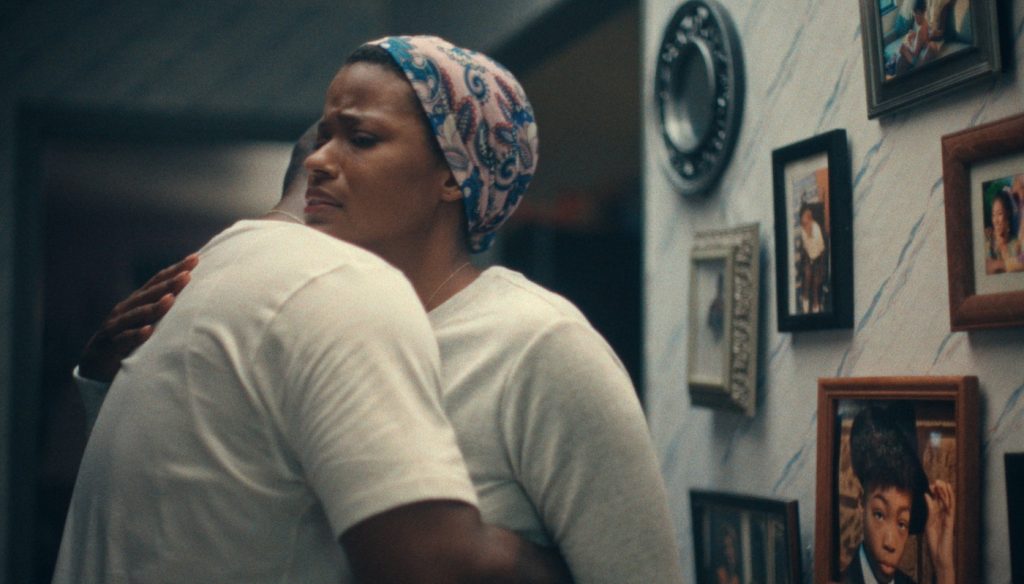
Now, nearly six years later, “Cat Person” has been adapted by director Susanna Fogel (The Flight Attendant, Booksmart) from a script by Michelle Ashford (Operation Mincemeat). Fogel and Ashford have taken Roupenian’s taut, tense encounter between Margot (Emilia Jones) and Robert (Nicholas Braun) and expanded it into a feature-length film, teasing out a tale about male toxicity and turning it into a romantic thriller.

Aiding them in their effort to build out the world of Cat Person was production designer Sally Levi, who went to some ingenious lengths to create spaces that young women would curate and create and make the most of locations, especially an abandoned Toys R Us headquarters, that had just the right amount of creepiness.

I’m curious if you had read the original short story before you signed onto this project?

I’d heard of the story, but I read it after I read the script. I knew it was based on a New Yorker short story, then I decided to read the script first. In most books I read, I don’t end up liking the movies [laughs], and this was obviously a short story versus a book, but it was interesting to read it in reverse. Cat Person was a passion project of mine and probably the best experience I’ve had as a production designer.

How so?

I didn’t want to do the job at first. My agent actually did a bit of convincing for me to meet on it because I was a little scared it would end up being like a sexploitation movie in the wrong hands. Obviously, it was not. Once I met with the director, Susanna [Fogel], I was one hundred percent on board because her vision was to do this in a real way and to do it for younger women. Not that it can’t be for all generations and sexes, but the idea that teenagers through their twenties could actually watch this and process it because it’s so like real life, it might make a difference to a lot of people. To someone like me, when I read the short story, I got chills. It took me a long time to understand the relationship between men and women, and I was incredibly fearful in a lot of ways when it came to dating. I wondered if I had watched this movie when I was younger how it might have affected me or changed my relationship with dating. So then I was fully on board, and I was very excited about the cast. I really respected who they chose, because it could have gone to some big celebrities, but they really tried to cast to the short story.


Adapting a book into a feature-length film has plenty of its own challenges, including deciding all the good parts you have to leave out of your movie, but for a 7,000-word short story, how difficult was it to build that out into a full world?

It’s very different from the short story, as it always had to be. Anybody who is going to interpret a very short story into a feature-length film is going to have to add a lot of details and make a lot of strong choices. That was definitely challenging. The dorm room—people think, oh, it’s a dorm room, it’s basically a concrete block that’s painted, what is there to do? When I was looking at a lot of movies that have done dorm rooms, it was very interesting to see how cheesy or forced they felt. There were a lot of posters everywhere that weren’t really relevant or specific. So, it was actually not an easy task. I’ve done dorm rooms before, so I did know it’s not that you just go to the thrift store and buy a bunch of stuff, and it’s fine. Young people are very curated. What they have in their dorm room is what they want the world to see because their bedroom is exposed to the whole floor of people. It’s an open book to who they are and how they want to express themselves.

How did you research the modern dorm room to avoid the pitfall of making it generic?

I met someone very similar to Margo, the same age, and I rented a lot of her stuff [laughs]. So we had the rug, the blanket, the artwork, even things she’d taped onto her walls that were so perfect. Then, we got clearance on what we could use.

It’s a brilliant way to make sure the dorm rooms look authentic. It’s like going antiquing or thrifting, buying things that once were in someone’s personal space, only here, you’re doing it from someone still using those pieces.

Yeah. [Laughs.]


So your team had to remove stuff from her dorm room and then, later, put it back?

She had left the dorm system, she was in a shared apartment, and she removed everything, which was really nice of her. There were a lot of little specific details, like a stationary pad, these amazing details that would have taken us so much time to shop and age that. Everything was aged appropriately. We obviously had to get more than just her stuff. And then she worked on the movie. She was actually the assistant to the director. She was always on set, and she had the perfect style. She looked like Margo. She’s not an actress. She wants to be a director herself one day.

She’s got a good start. And what a great way to capture what a young woman’s design preferences are and how they curate their world.

Exactly. In a movie I did this summer, we rented a bunch of stuff from my niece. [Laughs.]

What about the rest of the world you’re creating?

We had very specific parts of the movie. The parent’s home was incredibly difficult to find because it was particularly chosen to reflect the uncomfortable relationship between the mother and stepfather. We wanted to shoot from aunt into winter because we didn’t want any leaves on the trees outside of the house. We made that choice to have all the big windows with the stark trees outside. We wanted to create a home that felt like it was missing something, which it was. That location we found right before we started to shoot. There was another location that wasn’t right, and we almost went with it because time was running out. That house was very much like the Ferris Bueller’s Day Off home, that quintessential, perfect home where you want to go and cry to your mom, and if you’re sick, your mom takes care of you, which is not the home we wanted to create for Cat Person. Location scouting is never easy. Sometimes, you get lucky, but finding the right location is half of my job and worth the effort.

And what about the university?

For the school, we actually shot at three different campuses to create the one school that Margot attends. FDU [Farleigh Dickinson University] in New Jersey was near where our base camp was, but it was so picture perfect, it was too good to be true. So we went and shot at a school in New York to get that brutalist feel. Then, we went to the old Toys R Us headquarters to shoot a lot of the campus. They had a very interesting, eerie Toys R Us campus that’s since been shut down, so we shot exteriors there.

Sounds like the making of a horror movie, actually.

It was a little creepy. We were there setting up at night, and we were like, this is incredibly creepy.


Cat Person is in theaters now.

Featured image: Emilia Jones and Nicholas Braun in “Cat Person.” Courtesy Studio Canal
Learn Filmmaking Network Founder Gabriel Alexis on Building a Community

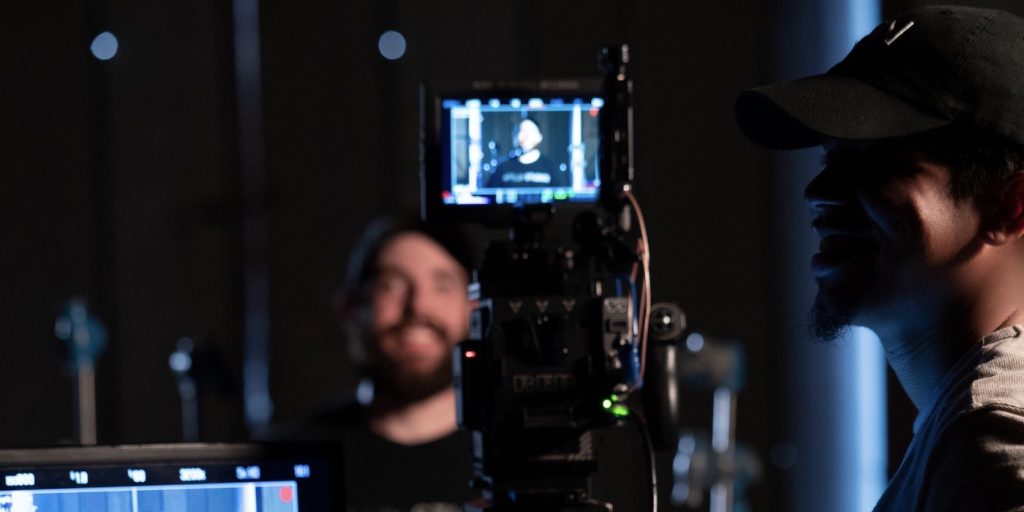
Bronx-born Gabriel Alexis’s love of visual storytelling began when he was a kid in his childhood home, capturing family moments, a prelude to a career in which he would devote himself to helping filmmakers connect, inspire each other, and grow. After learning the ropes himself on a variety of projects, from TV to commercials, from music videos to creating short videos for the New York State Bar Association, Alexis had a moment while driving his car in 2018. “I was trying to create a community around me, so I said, let me just build my community, and one day, I was in my car thinking about a name. I love to learn, and I love filmmaking, so that’s how the name came about. [Laughs]. Learn Filmmaking: as a marketer, I was thinking about what people do if they go to Google and search for filmmaking. I was trying to make it so obvious you don’t have to think about it, and luckily, on February 2, 2018, Learn Filmmaking was available. I got the domains and the trademark.”

Then he got busy. Learn Filmmaking Network (LFN) became Alexis’s passion project. His goal has been to revolutionize the way that creators can access resources, giving them opportunities to hone their craft, meet their peers, and connect with already established filmmakers and creators in the industry. LFN is aimed at eliminating traditional barriers and creating a community where people can really engage with each other, show their work, and hone their craft. Thus far, LFN has a community of 756,000 and growing.

We spoke to Alexis about how he built his own dream job, what members of the LFN community experience themselves, and his hopes for growing the platform.

Learn Filmmaking founder Gabriel Alexis. Photo by Bryan Wolfinger.

Tell me a bit about your background.

I have a background where I started as an editor, then I directed and produced short and feature films and commercials, and I even went corporate—I used to work for the New York State Bar Association doing videos for lawyers. I felt like there was more to me, so when I created LFN, it wasn’t really about the followers; I was really looking for community. I love human connection, so I started reaching out to filmmakers and showing them love. My mission was to connect creators who are trying to get into the industry with people who are already established and bridging the gap. In 2018, I hit my first ten thousand followers, and then by 2020, we hit 300,000.

And, of course, 2020 was a year where the idea of a community, at least temporarily, changed drastically.

We all went through so much, and the LFN community was really loving the fact that we were bringing together so many creators and filmmakers to our platform and letting people know they weren’t alone. We used to go live Monday through Friday with different hosts. On Monday, it would be lighting breakdowns; on Tuesday, it would be filmmakers talking about their path; on Wednesday, we’d bring people in from the creator community to actually meet these directors or cinematographers. So, Learn Filmmaking bridged the gap. Filmmaking can be a lonely journey, so when you’re part of a community and you have people that actually take a moment to reach out, that’s why we’re growing. Now, in 2023, we have over 750,000 followers, and we keep growing.

Gabriel Alexis.

What was your method for reaching out to people and gaining their trust that LFN was a platform that could really help them?

I started messaging them and letting them know how much I loved their work. I’ve always been very bold. I try not to let fear get to me. I still reach out to filmmakers and creators at all different levels. It really doesn’t matter to me. I’d do video calls with them through Instagram or Zoom. I’d say, ‘Hey, let’s take ten minutes and let me just get to know you better, where you’re from, and what you do.’ For me, it’s about the work and how passionate people are as a creator.  I always just want to be kind, and I think that’s why people started trusting me with their work. They were like, ‘Look, this is what I have, I trust you.’  Our community is global—we’re in India, Indonesia, Mexico, and Africa. It’s a beautiful thing. I make sure our community is very diverse. I always put diversity first because if you want to see a change in the world, it’s got to start with you. So I started doing that myself, posting content from diverse creators, showcasing people of color and female filmmakers, and that’s what I feel like the community started growing because people could see themselves in our community.

How do you envision LFN growing?

So we started as a digital platform, now we’re building those human connections, and we’ve started to do workshops. We had a workshop in Los Angeles this past October 7th. We brought some of our community members there to learn about cameras and gimbals. So, more workshops in the future, and also to have networking events. Networking is so important to connect with other creators from your city or state. It’s awesome to connect digitally, but when you can actually get to know them in person, it’s a different level of connection, a different vibe. When you see somebody you’ve been following on social media for so many years and then meet them in person, it’s mind-blowing! We had our first private networking event three months ago in New York City. Community members came from Atlanta, Washington D.C., and Florida. It was amazing. We had 130 people show up, and honestly, it was such a moment for me because I saw the community come together to be a part of this event to connect with each other. We had a private chef, we had a red carpet, and it was free! [Laughs.]

Filmmaking is an incredibly collaborative medium, so connecting with people and establishing relationships is really crucial.

I have a bunch of followers, but how do you know it’s a real community? So, building these networking events and workshops shows that they are real people behind these followers. It’s amazing to me sometimes. We have a real community. People react to what I post. When I have a networking event or workshop, they’re just so involved. They want to learn. They want to keep growing. That’s what it’s about, really interacting and engaging with people. We live in a world where people focus on followers, followers, followers, but are these followers actually interacting with each other? My goal is to have real human connections and people that are actually interacting with each other and learning from one another. It’s a big difference. Let’s make the world a better place. We’re all in this together!

Check out Learn Filmmaking Network on Instagram and YouTube.

Featured image: Learn Filmmaking founder Gabriel Alexis. Photo by Bryan Wolfinger.

Swifties Rejoice: “Taylor Swift: The Eras Tour” Opening a Day Early

Taylor Swift: The Eras Tour is heading for a record global opening, with forecasters saying it will become a record-smashing debut for a concert film as it eyes $150 million to $200 million. What every Swiftie fan (and their parents) will be happy to hear is the film is also opening a day early. Swift herself announced that early screenings for the film will be held on Thursday in North America, most likely at 6 p.m., as well as during the day on Friday. Additional showtimes have been added throughout the weekend. Tickets are currently on sale.

This is a full day earlier than the original release schedule, which slated The Eras Tour for a Friday, 6 p.m. screening time in theaters across the globe. Such is the gravitational pull of Swift that demand for a ticket has been through the roof. For everyone who couldn’t catch a stop during The Eras Tour or couldn’t afford a ticket, this concert film is the next best thing.

Swift revealed the news on Instagram:

View this post on Instagram

A post shared by Taylor Swift (@taylorswift)

Taylor Swift: The Eras Tour documents her historic tour in pointillist fashion, running a meaty two hours and 48 minutes, giving her legion of Swifties the kind of backstage access most could only dream of. AMC is distributing the movie, and as of now, it will run from Thursday through Sunday and play for four weekends in over 8,000 theaters worldwide.

“I can’t thank you enough for wanting to see this film that so vividly captures my favorite adventure I’ve ever been a part of: The Eras Tour,” Swift wrote in her Instagram post. “And the best part is, it’s an adventure we’re still on together.”

At the world premiere at The Grove in Los Angeles on Wednesday night, Swift said of her fans, “The fact that this tour was such a grand adventure has everything to do with the ways in which you cared about this tour and about these shows.”

The stars were out in force at Swift’s premiere, including Beyoncé (who has her own concert film, Renaissancecoming to theaters this December), who posed with Smith on the red carpet. Rachel Zegler, Simu Liu, Julia Garner, Adam Sandler, Mariska Hargitay, and more were on hand.

Swift also told fans ahead of the screening that they were a crucial part of her film. “I think that you’ll see that you’re absolutely a main character in the film because it was your magic and your attention to detail and your sense of humor and the ways that you lean into what I’m doing and the music I create.”

Featured image: LOS ANGELES, CALIFORNIA – OCTOBER 11: Taylor Swift attends “Taylor Swift: The Eras Tour” Concert Movie World Premiere at AMC The Grove 14 on October 11, 2023 in Los Angeles, California. (Photo by Matt Winkelmeyer/Getty Images)

“The Iron Claw” Trailer Finds Zac Efron and Jeremy Allen White Ready to Rumble

The first trailer for A24’s The Iron Claw has leaped into the ring. Writer/director Sean Durkin (The Nest, Martha Marcy May Marlene) has taken on the true story of the Von Erich brothers, a trio of supremely talented and extremely close siblings who were wrestling phenoms in the early 1980s. Durkin and casting director Susan Shopmaker have put together a terrific ensemble, including Zac Efron, The Bear breakout star Jeremy Allen White, and Harris Dickinson as the three brothers. Their coach is their father, Fritz (played by Mindhunters star Holt McCallany)—always a recipe for turmoil—a hard-charging and domineering figure the brothers live to make proud.

Efron stars as Kevin Von Erich, the Golden Warrior, while White is Kerry and Dickinson is David. Fritz himself was once a three-time world champion wrestler, and he instilled in his boys a will to win, to dominate, to live and breathe wrestling no matter the costs. Those costs piled up as the family endured a string of tragedies. You can’t watch The Iron Claw trailer without noticing just how bulky and ripped Efron and White got for their respective roles. While both guys were already muscular, White revealed to GQ that his goal for preparing for the role was to put on 40 pounds of muscle.

Durkin made a big splash with Martha Marcy May Marlene, and more recently with The Nest, and is comfortable with the psychology of bonds that both sustain and devour people. The Iron Claw will plunge into the bonds that bound the Von Erichs together like the ropes of a wrestling ring and the tumult that existed outside of the ring’s parameters.  It’s rich material for a talented filmmaker, cast, and crew to explore.

Joining the aforementioned cast are Lily James, Maura Tierney, Brady Pierce, Kevin Anton, Brett Beoubay, and Cazzey Louis Cereghino.

Check out the trailer below. The Iron Claw hits theaters this December 22.

Here’s the official synopsis:

The true story of the inseparable Von Erich brothers, who made history in the intensely competitive world of professional wrestling in the early 1980s. Through tragedy and triumph, under the shadow of their domineering father and coach, the brothers seek larger-than-life immortality on the biggest stage in sports.

For more on films from A24, check out these stories:

Nicolas Cage Enters the Collective Subconscious in Compelling “Dream Scenario” Trailer

“Talk To Me” Directors Danny & Michael Philippou on Crafting the Year’s Most Unsettling Horror Film

From “Papyrus” to “Problemista”: Inside The Beautiful Mind of Julio Torres

Featured image: Zac Efron in “The Iron Claw.” Courtesy A24.

New “Killers of the Flower Moon” Featurette Reveals How the Osage Language Deepened the Film

“We’re making a film about a historical event that is central to the Osage history,” Martin Scorsese says at the time of a new featurette about his upcoming film Killers of the Flower Moon. “So, of course, it’s important we spoke that language.”

We’re then whisked back to Oklahoma in the 1920s, where Ernest Burkhart (Leonardo DiCaprio), a white man new to the area, drives Mollie Kyle (Lily Gladstone), a member of the Osage Nation, who speaks Osage. Naturally, Ernest doesn’t understand a word—not yet, anyway. The Osage have recently come into great wealth when oil was discovered under their land, and Ernest is but one white face among many who have arrived in the aftermath of the discovery.

One of the key components for Scorsese to fully embed viewers in that time and place was to make sure the Osage language was woven throughout his film.

“This was the 1920s,” says Geoffrey Standing Bear, the current principal chief of the Osage Nation, “where people were still speaking the Osage language daily.”

“We wanted to be as authentic as possible,” says Leonardo DiCaprio, “and using the duality of both English and Osage was a symbol was the enmeshment of the two cultures.”

“Language and culture are inseparable,” says Christopher Cote, who was the film’s Osage language teacher and trainer. “You understand the way people operate through their language.”

Killers of the Flower Moon is centered primarily on two relationships: one, the growing love between Ernest and Mollie; the second between Ernest and his uncle, William Hale (Robert De Niro), one of the many white men who has come to Osage land to try and pry their oil wealth from the Osage Nation matter what it takes. The film was adapted from David Grann’s 2017 nonfiction book of the same name and covers the hideous crime spree that rocked the Osage Nation and eventually got the attention of the U.S. Government: a spat of brutal murders in which white usurpers began killing members of the Osage to get to their land holdings.

“Speaking Osage changed the way that I even moved as Mollie,” says Lily Gladstone. “I took months to get comfortable even with the different pace of speaking.”

Cote says that Robert De Niro was also very diligent about learning Osage. “We met every day getting the gestures right and the voice right,” Cote said.

“They got very comfortable with the words, the sounds, the rhythms,” Scorsese says. “In some cases, I didn’t put subtitles on the scenes because you know what’s going on. We’re deeply committed to staying true to the reality of the world in which this story unfolds.”

Check out the new vignette below. Killers of the Flower Moon comes to theaters on October 20:

For more on Killers of the Flower Moon, check out these stories:

“Killers of the Flower Moon” Star Lily Gladstone Takes Center Stage in New Video

“Killers of the Flower Moon” Star Robert De Niro the Focus of New Character Video

“Killers of the Flower Moon” Character Video Reveals Leonardo DiCaprio’s Ernest Burkhart

Martin Scorsese’s “Killers of the Flower Moon” Unveils Thrilling New Trailer

Featured image: JaNae Collins, Lily Gladstone, Cara Jade Myers and Jillian Dion in “Killers of the Flower Moon,” premiering in theaters around the world on October 20, 2023.

How “Quantum Leap” DP Ana M. Amortegui Keeps the Show Dynamic Across the Centuries

The past is prologue, but on Quantum Leap, the past is also the present and the future as Dr. Ben Song (Raymond Lee) and his team embark on dangerous lifesaving excursions through history. The time travel epic is back with more mysteries that continue to escalate and may even threaten the project itself.

Director of photography Ana M. Amortegui kicked off the style of the series last season working on the pilot and several other episodes. She continues her work on episodes 2, 4, 6, and 8 in season two. The reboot picks up decades after the beloved classic that originally ran from 1989 – 1993. “Quantum Leap 30 years ago was a show that was really heartfelt,” Amortegui reflected. “It was a show about doing right when things were wrong. It was about bringing what feels like home to you. You want to always go back to your home. That part of the show remains the same. Time has changed, technology has changed. We want to revamp it and give it its own feeling visually and story wise. I think this new season has so many different turns that go way beyond what it was.”

By leaping into the bodies of people in the past, guided by computer intelligence system Ziggy (Deborah Pratt), Ben can correct tragic events before they occur. Of course, it is a hazardous occupation as every leap drops Ben into a crisis. The targets have included a doctor, an astronaut, and an undercover police officer, giving each episode a different tone.  

“Sometimes we have more action-driven stories, sometimes more drama, sometimes it’s in between. It’s always different. That’s the beauty of this show. It can always be different,” Amortegui noted. “One episode took place on a battleship. We don’t do zap zooms, but that episode was great because it was such a fast-paced episode with so much going on. We said, ‘Why don’t we just do a kind of zap zoom to create that kind of hurriedness in between what has been said and what they’re going to do?’ We can change every leap that we do with the camera. Everything is permitted. We can get as creative as we want within our limits.”

QUANTUM LEAP — “This Took Too Long!” Episode 201 — Pictured: (l-r) Raymond Lee as Dr. Ben Song, Melissa Roxburgh as Lt. Ellen Grier — (Photo by: NBC)

Although Ben can traverse time and space in an instant, there’s one major flaw with the quantum leap technology. He can’t remember who he is or why he’s there. Luckily, Ben’s fiancé Addison (Caitlin Bassett) and teammates Ian (Mason Alexander Park), Magic (Ernie Hudson), and more are on hand to assist. Amortegui explained that having the headquarters as a standing set and consistent period throughout the series is grounding.

“The main thing for the headquarters is it’s the place where a lot of the information is said,” she explained. “A lot of what the story is about or what’s going to happen or what Ben needs to do to succeed on the leap is set there. It has a lot of important information. There’s so much to say that we need to be very dynamic and very creative with the camera so that space doesn’t become boring or uninteresting and people don’t become lost in so much information.”


The scientific team was spread thin at the close of season one. Ben found himself split between three times, and the crew suspected an imposter among their own ranks. Both the course of history and the accelerator project were at risk. Amortegui lensed the thrilling episode.

“I did the finale of last season, which goes to the 50s, the present, and the [future]. It’s the same place, but you’ve got to make it look different in three different time periods with different colors,” she said. “That was really special. I did a lot of work on it because we really needed to make sure it was right because it was the same exact place in three different time periods.”

The return of the series will see Ben leaping as far back as 1692 to the age of the witch trials. A leap that is nearer in time but one of the most distant filming locations took the film crew to Cairo.

QUANTUM LEAP — “Nomad” Episode 208 — Pictured: (l-r) — (Photo by: Saaid Abdel Ghani/NBC)

“We went to Egypt to shoot, which was a dream,” Amortegui revealed. “You could think maybe they shot it in blue screen or VFX, but we actually did go to Cairo. We were in the pyramids; we were in the markets and the mosques. It was the most beautiful experience being able to work with people from another culture. It was magical. That episode has my heart. I feel super proud. I think it looks gorgeous. The beauty of the show is it’s always so diverse and so different. Shooting a time period is really amazing every time. Cairo was in the 60s. The wardrobes, the colors, the places we shoot at – everything has to honor that time. It was really wonderful. All my episodes have been so beautiful to shoot.”

From futuristic cyber technology to high-flying stunts in space, Quantum Leap calls for large-scale visual effects. Amortegui compares each episode to the scale of a feature film. With a dozen and a half episodes in the first season, production was on a tight schedule.

“TV goes so fast. We have to be super prepared. By the time I get to start my episode, I need to make sure I have everything ready that needs to be done camera and lighting-wise,” she explained. “We have all these meetings, and we read the script, so we know there’s an explosion or we are in Greece. We all read the script. We know what things are going to be VFX. Then we have a meeting in general with everybody. Then, we have a meeting with the VFX team, and we decide what to do. I just need to be sure whatever they need to be successful with the effect that I shoot it. Lock the camera and take the information. It depends. Whatever they need, but when I put foot on set to do that effect, I know exactly what they need from me to make it happen.”

Season two teases even bigger adventures and more leaping in both the past and present. As the stakes escalate, the show further sculpts the Quantum Leap legacy.

“A lot of new things are going to happen [this season] that is going to make this Quantum Leap unique and its own show,” Amortegui promised. “It will always honor what it was but take its own nature. It’s going to be really, really cool.”


Quantum Leap airs on NBC Wednesdays at 9/8c. Episodes are available to stream the following day on Peacock.  

For more on Universal Pictures, Peacock, and Focus Features projects, check out these stories:

Official “Night Swim” Trailer Unveils Blumhouse’s Deep Dive Into Madness

“SNL” Returning With Pete Davidson Hosting the Season 49 Premiere

“Oppenheimer” Has Reached Another Milestone for Christopher Nolan

Featured image: QUANTUM LEAP — “One Night in Koreatown” Episode 205 — Pictured: (l-r) — (Photo by: Casey Durkin/NBC)

New “The Marvels” Teaser Reveals a New Superteam and an Old Ally in Nick Fury

A new teaser for co-writer and director Nia DaCosta’s The Marvels has arrived, revealing the biggest non-Avengers team-up in a minute for the MCU. The film tracks the trials and tribulations of Brie Larson’s Carol Danvers, a.k.a. Captain Marvel, who has long grown used to operating as the universe’s mightiest solo act as she traverses the galaxy cleaning up galactic messes and returning to Earth to help out when supervillains like Thanos set their sights on her home planet.

The new teaser highlights Carol’s unasked-for new teammates, which have been highlighted in previous trailers. Those teammates are her estranged niece, S.A.B.E.R. astronaut Captain Monica Rambeau (Teyonah Harris), who was just a young girl who looked up to Carol in the original Captain Marvel and then appeared (as played by Harris) in WandaVision. The third member of the team is a young girl from Jersey City named Kamala Khan (Iman Vellani, reprising her role from Disney+’s Ms. Marvel), who has gone from idolizing Captain Marvel to being her (very young) contemporary. The new team will be joining forces to take on a Kree revolutionary named Dar-Benn (Zawe Ashton), who has a bone to pick with Captain Marvel. What makes the superteam’s cohesion a little more difficult is the fact that their powers are all mixed up, creating a bizarre situation where they switch places with one another anytime they unleash their abilities. 

Then there’s Carol’s old pal Nick Fury (Samuel L. Jackson), who we see here in that fateful moment in Avengers: Infinity War when he summoned Captain Marvel moments before he turned to dust thanks to Thanos’s snap. 

Joining the above-mentioned cast are Park Seo-joon, Zenobia Shroff, Saagar Shaikh, Mohan Kapur, Jessica Zhou, and Caroline Simonnet.

Higher. Further. Faster. These three words have long been the motto of Captain Marvel, but now that she’s part of a super-team, she’s added another—together.

Check out the new look below. The Marvels arrives in theaters on November 10:

For more on The Marvels, check out these stories:

“The Marvels” Drops New IMAX Spot That Goes Higher, Further, Faster

“The Marvels” Drops Electric New Trailer Ahead of Director Nia DaCosta’s Big Marvel Studios Debut

“The Marvels” Official Trailer Finds Captain Marvel Teaming Up to Fight Against Dar-Benn

“The Marvels” Trailer Reveals Brie Larson’s Return as Captain Marvel Alongside New Allies

Featured image: (L-R): Iman Vellani as Ms. Marvel/Kamala Khan, Brie Larson as Captain Marvel/Carol Danvers, and Teyonah Parris as Captain Monica Rambeau in Marvel Studios’ THE MARVELS. Photo by Laura Radford. © 2023 MARVEL.

A New “The Color Purple” Trailer Unlocks an Unbreakable Bond Between Sisters

A brand new trailer for director Blitz Bazawule’s The Color Purple has arrived, the musical adaptation of Alice Walker’s Pulitzer-Prize-winning 1982 novel which boasts a trio of super-producers—Oprah Winfrey, Quincey Jones, and Steven Spielberg. Spielberg directed the original The Color Purple adaptation back in 1985, which co-starred Winfrey.

Bazawule’s musical adaptation is centered on Celie—played in her younger years by Phylicia Pearl Mpasi and then by Fantasia Barrino as an adult—a Black woman living in the American South who is separated from her sister beloved sister Nettie (played by both The Little Mermaid star Halle Bailey, as a young woman, and by Ciara as an adult). The film tracks Celie’s life, her joys and struggles, and the unbreakable bond she shares with her sister, Nettie. Utilizing the cast’s singing chops and Bazawule’s felicity with staging lush musical numbers (he was one of the directors of Beyoncé’s Black is King), this is a brand new take on Walker’s seminal source material.

The film boasts a bevy of talent both in front of and behind the camera. Bazawule directs from a screenplay by Marcus Gardley and counts composer Kris Bowers (King Richard), cinematographer Dan Laustsen (The Shape of Water, John Wick: Chapter 4), and costume designer Francine Jamison-Tanchuck (Emancipation, One Night in Miami) as some of his main collaborators.

Joining the aforementioned cast are Taraji P. Henson as Shug Avery, Aunjanue Ellis-Taylor as Mama, Corey Hawkins as Harpo, Colman Domingo as Mister, Louis Gossett Jr. as Old Mister, David Alan Grier as Rev. Avery, and Stephen Hill as Buster.

Check out the trailer below. The Color Purple arrives in theaters on Christmas Day:

For more on Warner Bros., Max, and more, check out these stories:

Michael Mann Confirms That “Heat 2” is His Next Movie & Adam Driver Could Star

Greta Gerwig Reveals “Barbie” Joys, Anxieties, and Teases Next Project

New “Joker: Folie à Deux” Image Finds Joaquin Phoenix Soaked But Serene

Featured image: Caption: (L-r) PHYLICIA PEARL MPASI as Young Celie and HALLE BAILEY as Young Nettie in Warner Bros. Pictures’ bold new take on a classic, “THE COLOR PURPLE,” a Warner Bros. Pictures release. Photo Credit: Photo Courtesy Warner Bros. Pictures

“Mission: Impossible – Dead Reckoning Part One” is Now Available to Stream

The globe-trotting pyrotechnics and death-defying stunts of Mission: Impossible – Dead Reckoning Part One are now available for your viewing pleasure while seated comfortably on your couch. Writer/director Christopher McQuarrie and star Tom Cruise’s latest lunatic mission is available to stream on Prime Video ($19.99). Dead Reckoning Part One finds Cruise’s Ethan Hunt and his IMF team tracking an A.I.-powered weapon called “The Entity” that could lead to global chaos if it ends up in the wrong hands. The film includes a desert shootout in Abu Dhabi, a thrilling car chase in a redoubtable yellow Fiat in Rome, and that wild motorcycle stunt in which Cruise launched himself off a 4,000-foot cliff, while on a motorcycle, into a ravine before opening a parachute to land atop a moving train. He did this seven times while filming the movie. 

Tom Cruise in Mission: Impossible Dead Reckoning Part One from Paramount Pictures and Skydance.

For those of you who not only missed the latest installment but find yourself hopelessly out of date with the entire franchise, you can stream all previous six Mission: Impossible movies on Paramount+.

Dead Reckoning Part One features Cruise and his usual band of merry pranksters/world savers—Ving Rhames as Luther Stickell, Simon Pegg as Benji Dunn, and Rebecca Ferguson as Ilsa Faust. Vanessa Kirby also returns as the mysterious, morally flexible White Widow. Newcomers include Hayley Atwell as Grace, Esai Morales as Gabriel, Pom Klementieff as Paris, Henry Czenry as Kittridge, Greg Tarzan Davis as Degas, and Shea Whigham as Briggs.

Mission: Impossible Dead Reckoning Part One is, as its title makes clear, one part of a two-part epic. Part Two was shot concurrently and is due in theaters on June 28, 2024.

For more on Mission: Impossible – Dead Reckoning Part One, check out these stories:

How “Mission:  Impossible – Dead Reckoning Part One” DP Fraser Taggart Pulled Off That Insane Train Sequence

“Mission: Impossible – Dead Reckoning Part One” Production Designer Gary Freeman Creates an Artificially Intelligent Palace

“Mission: Impossible 7” Director Christopher McQuarrie Reveals He Considered De-Aging Tom Cruise for a Scene

Featured image: Tom Cruise in Mission: Impossible Dead Reckoning Part One from Paramount Pictures and Skydance.

Michael Mann Confirms That “Heat 2” is His Next Movie & Adam Driver Could Star

When Michael Mann’s Heat hit theaters in December of 1995, it gifted us with the first time that Robert De Niro and Al Pacino acted in a scene together. The stars of Godfather 2 had never actually gotten a chance to play off one another, and in Mann’s Heat, while they had an entire movie to enact a brilliant, brutal cat-and-mouse game as Pacino’s Lt. Vincent Hanna tracked De Niro’s criminal Neil McCauley in one of the decade’s most satisfying crime sagas, they finally got to sit down and share a scene in a diner that has now become the stuff of movie history. Now, after writing the novel “Heat 2” alongside co-writer Meg Gardiner, which detailed the lives of Heat‘s protagonists when they were young men, Mann has confirmed that adapting that novel will be his next film project. He also teased the possibility that Adam Driver, the star of his current film, Ferrari, could have a major role.

Speaking at Deadline’s Contenders event in London this past weekend, this is how Mann replied to a question about whether he’d adapt “Heat 2” for the big screen:

“Yes. Meg Gardiner and myself wrote the novel Heat 2, which came out right when we were shooting Ferrari. It did very well. I plan to shoot that next.”

Deadline scooped earlier in the year that Adam Driver was in talks to play De Niro’s character Neil McCauley as a younger man. Although Mann was careful about the potential when asked if Driver was his man for Heat 2, he certainly wasn’t denying it.

“Perhaps,” Mann said at the Contenders event. “We don’t talk about that yet. Let me put it this way: Adam and I got along like a house on fire [on Ferrari]. We have the same work ethic – which is pretty intense. We like each other, and we had a great time working together artistically.”

Mann and Gardiner’s “Heat 2” isn’t just a prequel; it also functions as a sequel to the original Heat. The story follows McCauley, Vincent Hanna (Pacino’s character), and Chris Shiherlis (played by Val Kilmer) in the years before the events in Heat, as well as what happens to the survivors of the events in that film after the dust has settled. “Heat 2” follows a younger McCauley and Shiherlis as their crew racks up scores along the U.S./Mexico border, the West Coast, and in Chicago, where Hanna is rising in the ranks in the Chicago Police Department, going after a brutal gang of home invaders.

Heat has become one of the most well-regarded crime thrillers ever made. Recently, Ava DuVernay’s One Perfect Shot featured Mann re-creating the particulars of a thrilling heist sequence in that film, one of the most thrilling set pieces of any movie that decade.

It’ll be a while before we know more about where Heat 2 stands, but for now, we’ve got Mann’s Ferrari zooming into theaters this Christmas. Driver stars as Enzo Ferrari as he prepares his team to race in the notorious Mille Miglia, the grueling, deadly 1,000-mile race across Italy. Penelope Cruz, Shailene Woodley, and Patrick Dempsey co-star.

Featured image: VENICE, ITALY – AUGUST 31: Adam Driver and director Michael Mann attend a photocall for the movie “Ferrari” at the 80th Venice International Film Festival on August 31, 2023 in Venice, Italy. (Photo by Andreas Rentz/Getty Images)

“Special Ops: Lioness” Cinematographer & Director Paul Cameron on Taylor Sheridan’s International Thriller – Part Two

As noted in part one of our interview with Paul Cameron, he took his first turns at directing for series helming two episodes of Westworld, and he drew on his experience as a cinematographer and from his work for some pretty important mentors. “I learned so much from working with Tony Scott,” Cameron said, referring to collaborating with Scott on films like Man on Fire and Déjà Vu.  “Tony was all about really understanding the authenticity of situations and characters and really digging into the reality of a scene. And, more than anything, watching a very playful director manifest the performance he was going after. He knew what scenes were going to be like in the editing room and had a very playful way of setting things up to ensure that the end result would be what he thought it would be.” Cameron learned, for example, how to apply creative and innovative camera techniques to bring out even more.

Working with Jonathan Nolan on Westworld, he saw a director who “had linear beliefs of story and stayed with it, and doing that within the work of television,” he says.  “The reason I started directing there was because I could see somebody setting the bar as high as I’ve ever seen.”  He also learned how to handle a massive amount of scenes in a limited time window.  “We might lose a day for some reason and need to make it up, and even with all my experience, I was, like, ‘Oh, my God – how are we gonna do all this stuff?’  And, inevitably, we did it.  And that gave me great confidence when I went to direct on Westworld.  I knew, “Don’t sell yourself short.  Go in big, and stay big, and go after it like there’s no tomorrow.’  And that, I got from Jonah.”

L-r: Aaron Paul and Paul Cameron on the set of "Westworld." John Johnson/HBO
L-r: Aaron Paul and Paul Cameron on the set of “Westworld.” John Johnson/HBO

For Special Ops: Lioness, he had to hand his director of photography hat to cinematographers like Niels Albert, John Conroy, and Nichole Hirsch Whitaker, something that can be difficult for someone who’s been in their shoes for so many decades.  “It’s a challenge for me – because I’m so trained!” he laughs.

Most important, he says, is to make sure to include them in prep as much as possible, evaluating scenes and locations, “And to really be open to big decisions,” he says.  “What is this scene about?  What are the storytelling aspects, and how are we going to manifest it in this location?” And if changes occur that reshuffle a day’s shoot, Cameron wants his cinematographers to ask themselves, ‘How do we get the core shots to tell this story?’

For crafting scenes and blocking, Cameron draws on his decades of experience on big films with A-level actors, who often can be counted on to help with problem-solving. “But also talking about script and story, as I’ve done with them over the years. So it’s a very natural thing to talk to them about now, as a director.”

Laysla De Oliveira as Cruz Manuelos with Director Paul Cameron In Special Ops: Lioness, episode 5, season 1, streaming on Paramount+, 2023. Photo Credit: Greg Lewis/Paramount+

Regarding designing coverage, Cameron says it begins with poring over the script, then going to locations, and eventually rehearsing and blocking. With streaming television, he notes, there is often no time to discuss blocking or to get a rehearsal with actors before they go to Hair & Makeup. “Oftentimes, we’re just waiting for them to get out of Hair & Makeup and just run right into the shooting. But I know actors well enough to guess whether they’re going to be comfortable with a particular blocking from working as a DP for so many years.”  But that also means being open to other ideas. “You have to be open to blowing apart whatever preconceptions you have and rolling with it. You take a deep breath, and you go for it.”

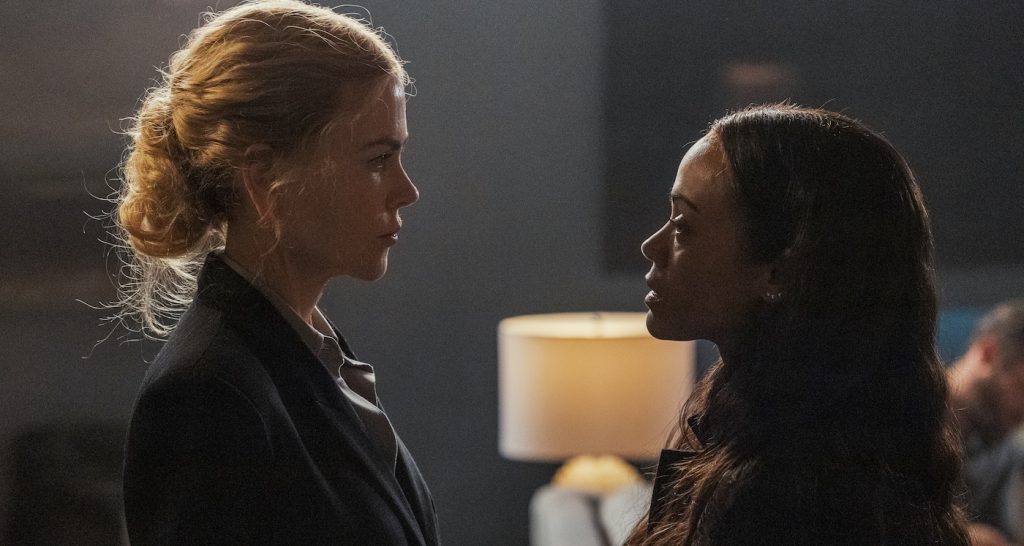
Cameron has to draw on his years of creative shooting to balance the needs of streaming producers with his desire to keep scenes alive.  “A three-page scene can be fairly static.  And the last thing I would want to do is shoot closeup coverage of the entire scene.  For me, close-ups are extremely important, and there’s the tendency on streaming television to cut back and forth between close-ups. It’s the difference between theatrical films and streaming – films are about plot, streaming is about character. So I’ll shoot those close-ups to satisfy a showrunner, but save the hero close-ups for the times you know you’re going to need them editorially.  And keep it real, keep it alive – plan on a particular line that I’m going to rack focus in on Nicole [Kidman] and then pan back to Zoe [Saldana].”

Nicole Kidman as Kaitlyn Meade and Zoe Saldana as Joe In Special Ops: Lioness, episode 4, season 1, streaming on Paramount+, 2023. Photo Credit: Greg Lewis/Paramount+

Directing (and working with) top-tier talent is not new to Cameron, having done so on Westworld, “But working with Zoe Saldaña, Nicole Kidman, Morgan Freeman, Michael Kelly – everybody here is a top actor.”  So how does one direct cast members who are already at the top of their game, with decades of experience behind them?  “The important thing is to create an understanding with the actors, so they feel that I’m turning them loose right away,” Cameron explains. “Let your instincts come out. Let it all come to the surface, and then let’s see what’s working, what’s authentic. As the director, it’s important to understand where actors are at any point, what they’re trying to convey as a character, and how they’re trying to work the dialogue. Then I have more ability to help them shape a scene.”

BTS L-R Nicole Kidman as Kaitlyn Meade, Michael Kelly as Byron Westfield with Director Paul Cameron In Special Ops: Lioness, episode 5, season 1, streaming on Paramount+, 2023. Photo Credit: Greg Lewis/Paramount+

Sometimes, he’ll feel strongly about the direction of a scene and want it to go a certain way.  “And it can take three or four takes of subtly moving something in a certain way. But there are other times where the best thing I can do is just let go and say, ‘You know, they’re portraying these characters, and they are in complete understanding of this dialogue.  It’s incredibly powerful. Whatever expectations I have don’t matter because what they’re doing is absolutely amazing. That’s the other part of directing that I’m learning is how to balance conceiving of an idea of the outcome of the scene and being very open to surprises and changes that the actors bring to it. And that’s always the important balance.”

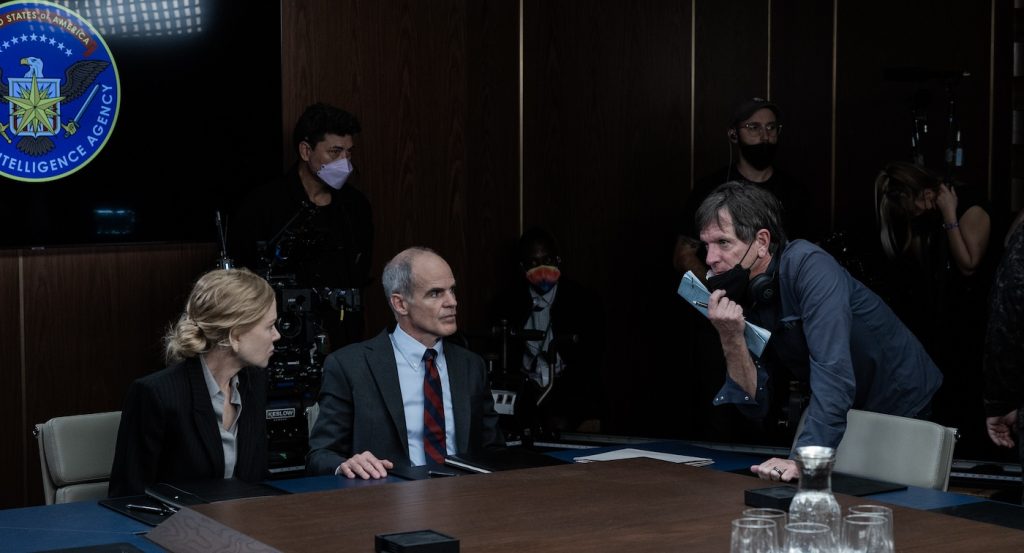
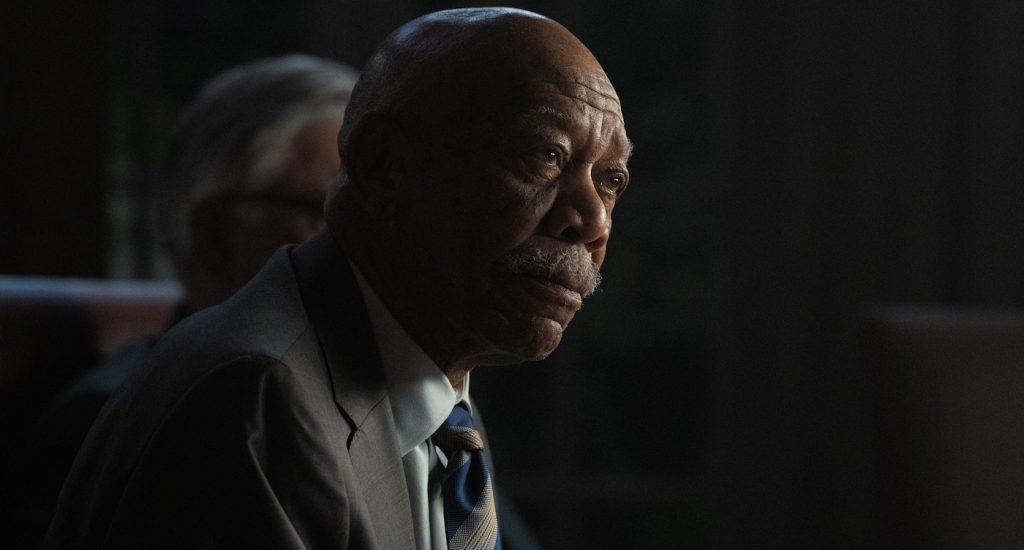
For instance, in a meeting in the White House Cabinet Room in Cameron’s Episode 106, Morgan Freeman’s Secretary Mullins listens to an obviously bogus explanation by one of Joe’s counterparts, Kyle (Thad Luckinbill), and appears to begin responding in support of Kyle’s explanation, before ripping him a new one for his B.S. “With that, during the first couple of rehearsals with Morgan, I could see the direction where he was lighting up to that moment,” Cameron says. “And, after a few rehearsals, we tried a couple of other possibilities, different exchanges around the room. And it was evident that his first choice was the right choice.”

Morgan Freeman as Secretary of State Mullins In Special Ops: Lioness, episode 6, season 1, streaming on Paramount+, 2023. Photo Credit: Luke Varley/Paramount+

Sometimes, dialogue can be filled with so much technical military jargon and instructions that it can be difficult for the audience to follow. In Episode 105, for instance, Kidman’s character delivers a rapid explanation to the San Antonio local authorities of the many complex steps the team will take.  “She’s explaining the backbone of the operation and giving them the opportunity to step up to support or step aside – but it’s going to go her way.  But it’s really about the subtext, not the details,” Cameron explains. “There’s a layer of dialogue, and then the reality of the meaning. By telling them something a particular way, she’s giving them an opportunity to step away or show support and take the credit for it later. She’s the puppeteer. She knows exactly the outcome of this conversation.”

With such amazing talent in front of his camera, Cameron sometimes just how to allow the actor’s performance to drive his approach. In Episode 105, Saldaña delivers what is probably the series’ longest scene – and one of its most emotionally poignant. On a return from the field, she takes some time to have an important talk with her teenage daughter, Kate (Hannah Love Lanier), one which brings incredible healing to their difficult relationship. “Zoe’s giving 17 years of motherhood in eight minutes. She’s afraid this might be the last time she’ll see her again,” Cameron explains.

He was concerned about the length of the scene, so he contacted Taylor Sheridan and asked, “How do we sustain an audience with this eight-minute scene and not crack people because it’s so intense?” Cameron recalls. And Taylor’s response? “I wouldn’t worry about it. There’s a version of the scene where we just cut to Joe looking at Kate in the bed, and she doesn’t say anything. And it should be as emotional as the eight minutes of dialogue.” Cameron then did away with dozens of takes of coverage and just let the camera roll.  “I’m gonna sacrifice a number of setups and shots here. We’ll do eight or nine takes. And the actors wanted to do it all the way through. I later tried, in the edit, to find ways to truncate it to two or three minutes. But, invariably, I delivered the eight minutes, beginning to end.”

In many other series, such dramatic family scenes, intermixed with tough military action, might appear trite or forced. But between Sheridan’s writing and the powerful performances of the cast, it is anything but. “It’s really about understanding the writing and understanding the characters,” says Cameron. “Not only the arc of the story but the emotional arc of each character within the story. And that’s the fun for me, directing now. I’m so used to shaping things with cameras and light, and now, I’m trying to shoot things with scripts and actors. It’s a nice transition.”

Special Ops: Lioness is streaming on Paramount+

For more films and series from Paramount and Paramount+, check out these stories:

“Special Ops: Lioness” Cinematographer & Director Paul Cameron on Taylor Sheridan’s International Thriller

“Killers of the Flower Moon” Star Lily Gladstone Takes Center Stage in New Video

“Killers of the Flower Moon” Star Robert De Niro the Focus of New Character Video

Featured image: L-R Austin Hébert as Randy, Zoe Saldana as Joe with director Paul Cameron for Special Ops: Lioness, episode 5, season 1, streaming on Paramount+, 2023. Photo Credit: Greg Lewis/Paramount+

“Special Ops: Lioness” Cinematographer & Director Paul Cameron on Taylor Sheridan’s International Thriller

As director of photography, Paul Cameron has shot such disparate films and series as Man On Fire, Collateral, Déjà Vu, Pirates of the Caribbean: Dead Men Tell No Tales, and Westworld.  He has worked with a slew of top-tier directors, including Michael Mann, Tony Scott, and Jonathan Nolan. Now, for Paramount+’s acclaimed limited series, Special Ops: Lioness, Paul Cameron – as he did with Westworld – worked both as a cinematographer and director.

Created and written by award-nominated screenwriter and actor Taylor Sheridan, Lioness stars Zoe Saldaña as Joe, the head of a CIA Special Operations unit called Lioness, which recruits and puts into force female operatives who infiltrate terrorist organizations to eliminate specific high-value targets. Here, she recruits a tough Marine, Cruz Manuelos (Laysla De Oliveira), sending her inside the family of an important Middle Eastern oilman, Asmar Al Amrohi, known for funding terrorist organizations, in the hope she can eliminate him.  Cruz is backed by a raucous but sharp Quick Response Team (QRT), also under Joe’s command, who quickly come to take on Cruz as one of their own.


The cinematographer of a series’ first episode typically sets the show’s look, along with the director and production designer. In this case, Cameron did so with director John Hillcoat, the pair shooting the first two episodes together. There had been a last-minute change in showrunners for the series, with Hillcoat coming on board, quickly sending Cameron the script to see if he would be interested.

“I loved the concept of the show,” Cameron explains.  “Taylor generally writes for male characters, so I found this quite intriguing.  It felt like a great opportunity to delve into this darker female world.” 

Paul Cameron directing actor Laysla de Oliveira, as Cruz Manuelos in Ep. 5. Credit: Greg Lewis/Paramount+

With just three weeks to prep the show, the two began a fast, condensed prep period in August 2022.  “I love working with John. We worked like a think tank, working 20 hours a day, trying to figure out how to get this show up and running in three weeks,” setting up camp in Baltimore, which, among other settings, stood in for countless locations in nearby Washington, DC.

The production also shot in Morocco and Mallorca, Spain. The ISIS compound seen in the first episode was shot at a location in Marrakesh, as was the first meet between Cruz and her target, Aaliyah (Stephanie Nur), Amrohi’s daughter, filmed in the city’s new upscale Rodeo Drive-like shopping area, Q Street, subbing in for Kuwait City. The show’s wedding sequences were filmed at a beautiful house on the ocean in Mallorca. Additional sets were also built in Mallorca, including the White House Cabinet Room, seen in several episodes. Beach scenes representing The Hamptons were shot at Rehoboth Beach, Delaware, 120 miles from Baltimore.

When Cameron and Hillcoat started, there were no other directors selected. Anthony Byrne was soon brought in to direct two episodes (103 and 104), which were shot by cinematographer Eric Koretz, with Hillcoat directing the final two episodes. That left two more to be assigned. “When I signed on and learned there were no other directors yet,” recalls Cameron, “I set up a call with Taylor right away and told him I would really love to direct a couple of these, and he agreed.”

Cameron assembled a capable team of camera operators, typically shooting three cameras for most scenes: Joe Cicio (A Camera), Kimo Proudfoot (B Camera), and James Ball (C Camera). Cameron had worked with Cicio on several feature films and had even tasked him as a second Unit DP on occasion. “He’s a very authentic person and knows the soul of the material,” Cameron states. “He has good instinct where to get the camera and can get it there.”  Though he had never worked with Proudfoot before, the DP appreciated his good sensibility about camera movement and staying with a shot when needed.

In Ball, a renowned Washington documentary cinematographer, Cameron found what he calls his “secret gun.” “It’s important for me to have somebody who not only can help find those key emotional moments, above what the A & B Cameras are getting but to take more chances and really get in there,” he explains. “Oftentimes, when you have two or three cameras, people overlap and tend to like the same shot. If I’m busy as a DP or as director, I need a C Camera to really keep going, like a bull terrier, until I find the shot,” perhaps a look back or glance from an actor, in reaction, that the others may not catch.  “That’s the kind of emotional shot I hope to get.”


There was very little second Unit work, he says, but what there was got handled by second Unit director Jeff Dashnaw, who was also one of the show’s stunt coordinators. Second unit cinematography was handled by George Billinger III, whom Cameron greatly admires.  “When you have a second unit on a streaming show, there’s so little prep time. And they get thrown into a situation so quickly where they’re being asked to match the look of a show with extreme lenses and a photographic style they might not be accustomed to.  And George was able to slide in and do it.”

Because of his training with the likes of Tony Scott, Cameron says his approach to coverage is different from the way most cinematographers tend to shoot. “With Tony, I learned to just be fearless with cameras and put them in places I think are emotionally appropriate and not necessarily coverage-oriented,” he explains.  Looking for a shot, say, with a steep angle, a little too close, to make it just the right level of uncomfortable if the scene calls for that. “It’s a matter of what makes it feel right, as opposed to matching focal lengths on lenses and distances, which many shows do.”

Paul Cameron on set of Westworld with Jonathan Nolan. Courtesy Warner Bros.

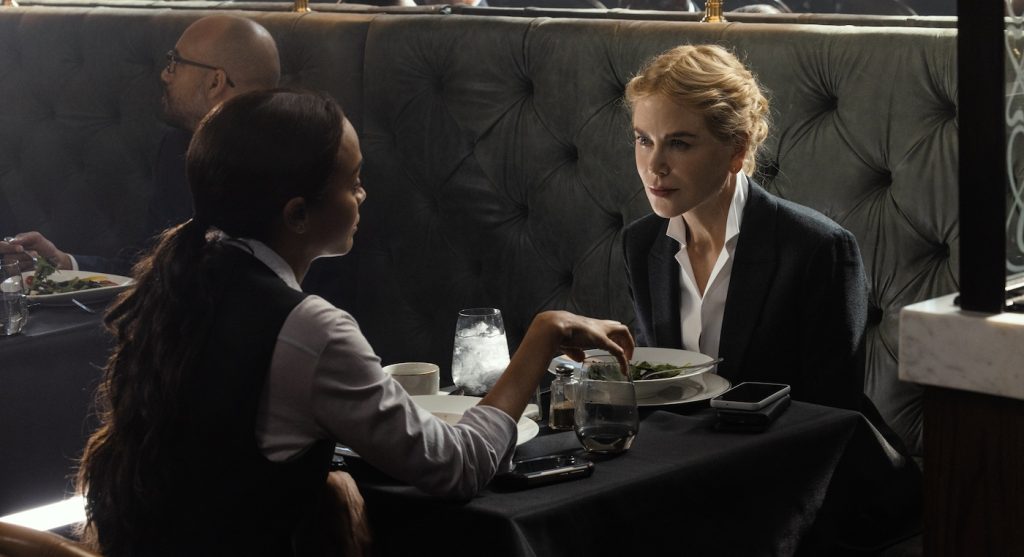
For example, in the show’s second episode, Joe and Kaitlyn are meeting in a restaurant, common in Washington, where strangers often overhear important policy conversations, and Joe is truly revealing herself to her boss. Cameron photographed the pair as seen through a stained glass divider. “It’s an eavesdropping thing,” he explains. “We purposely sat them near that corner so they could have this conversation. I wanted it to give the viewer an uncomfortable experience, watching a conversation of someone revealing themselves that way.”

Zoe Saldaña and Nicole Kidman’s characters confer in a popular Washington restaurant. Credit: Greg Lewis/Paramount+

While Cameron and Hillcoat originally considered using a large format camera, like the Sony Venice or the Arriflex Alex LF, the two settled on the popular Alexa Mini LF for most of the production.

For lenses, Hillcoat didn’t want to see any lens built after 1980, so Cameron gathered an eclectic set for the shoot, including Canon K35s and Zeiss uncoated Super Speed lenses (with both rear end and no coating).  “They all react so differently. The K35s have a great softness on large format, falling off on the edges really nicely.  The uncoated lenses have different qualities of halation [spreading of light beyond the source] and blooming and flaring.  So if there’s something bright, the image just blooms a little, or the top halates a little bit.”

To develop the look of the show, he and Hillcoat did as many directors and cinematographers do, creating a lookbook of hundreds of photos from feature films and journalistic images, representing the look and feel they wanted to create. Part of that involved allowing for the use of multiple cameras by placing most lighting above rather than putting lighting instruments on the floor. “I took bolder chances so I could move multiple cameras around a room,” he explains.

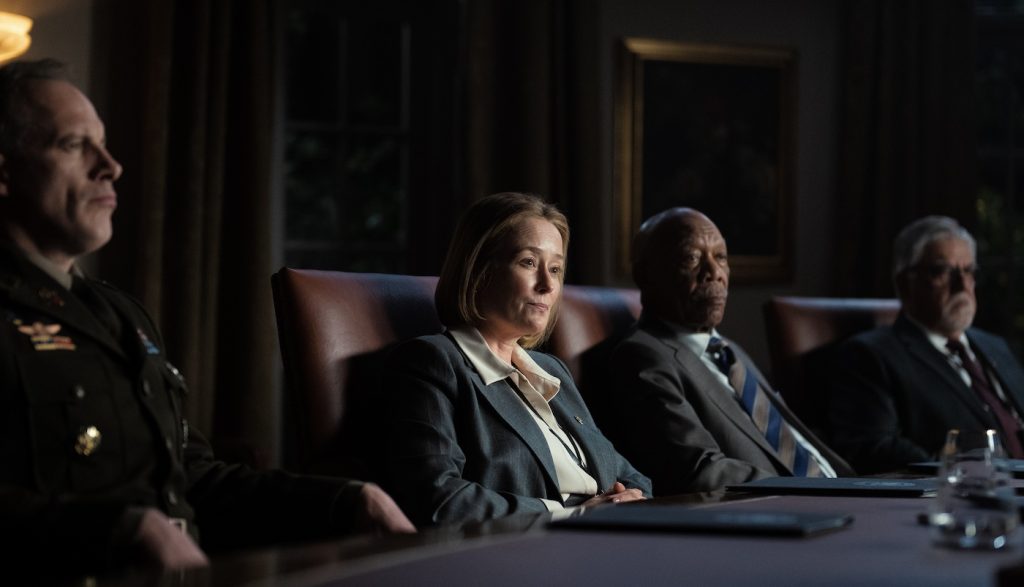
L-R Charley Tucker as Army Joint Chief, Jennifer Ehle as Chief of Staff Mason, Morgan Freeman as Secretary of State Mullins, and Bruce McGill as NSA Advisor Hollar In Special Ops: Lioness, episode 6, season 1, streaming on Paramount+, 2023. Photo Credit: Luke Varley/Paramount+

As is common with a Paul Cameron show, the image is often very dark, lit by light coming in windows, if at all, and perhaps a few practical lights on set to make it feel real.  When important, high-stakes meetings take place, for instance, the setting is often dark, with just the characters’ faces drawing the viewer’s attention.

“I just can’t help lighting and shaping faces with light,” he explains. “I love having these environments dark, with these faces popping off the background. When Joe interviews Cruz in the first episode, inside a barracks during the daytime, the interior is barely lit, save for some light coming in from windows behind them as they talk, the pair almost visible just as silhouettes. “Because that’s the level of discomfort Cruz experiences there and the way she stands up to Joe. In a scene like that, you want to have some kind of emotional impact on the image. It might feel darker – the falloff on the face is greater, and you barely see the eyes, but there’s eyelight in there.  You just see them staring at each other.”

Actress Laysla de Oliveira (Cruz) in the barracks set, darkly lit by Cameron. Credit: Lynsey Addario/Paramount+

In the show’s second episode, Cameron was called upon to shoot one of the most difficult – and disturbing – scenes in the series, one in which Joe secretly puts Cruz through a yet-tougher version of a training known as S.E.R.E. – survive, evade, resist – where she appears to have been kidnapped by unknown assailants.  They attempt to break her with beatings and torture – so that Joe can find out where Cruz’s true breaking point is.

The sequence was shot, for the most part, with three cameras. “They’re constantly trading off for different moments, racking focus at different points. So I’m constantly choreographing three cameras,” Cameron says. In a way, it’s a classic fight shoot, he says, taking advantage of his many years shooting fight sequences and working with renowned stunt coordinators Jeff Dashnaw and his wife, Tracy Keehn-Dashnaw.


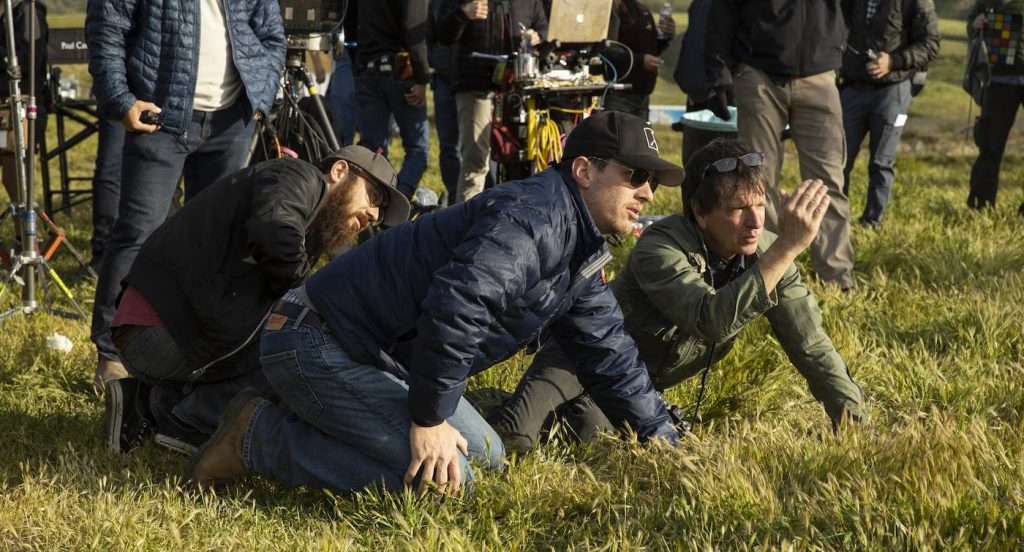
“It starts with a quick conversation with them, ‘This is what we want this fight to feel like,’” he explains.  They’ll craft the fight and film it, showing it to Hillcoat and Cameron for comment.  “John and I will look at it, and it’ll be a great three-minute fight, but it might not have a particular impact, editorially.  We’re looking at it together in terms of how you build your edit. And where to get that camera to make a particular punch work or be more impactful or more brutal or violent. That’s the goal in a fight.”  For placing cameras, Cameron will watch to see where the stunt coordinator is standing.  “Where they’re standing, watching the fight, is usually where the camera wants to be,” he notes.

In part two of our feature, Paul Cameron talks about how he applies both what he knows from being a cinematographer and what he learned from his directing mentors to his role as director on “Special Ops: Lioness.”

For more films and series from Paramount and Paramount+, check out these stories:

“Killers of the Flower Moon” Star Lily Gladstone Takes Center Stage in New Video

“Killers of the Flower Moon” Star Robert De Niro the Focus of New Character Video

“Killers of the Flower Moon” Character Video Reveals Leonardo DiCaprio’s Ernest Burkhart

Featured image: Zoe Saldana as Joe in Lioness Season 1 streaming on Paramount+, 2023. Photo Credit: Lynsey Addario/Paramount+

Greta Gerwig Reveals “Barbie” Joys, Anxieties, and Teases Next Project

Greta Gerwig was on hand in London on Sunday to give a special talk at the BFI London Film Festival, interviewed by none other than Succession creator Jesse Armstrong. As you are no doubt well aware, Gerwig’s Barbie is a historic success, becoming Warner Bros.’s most successful film in its 100-year history, a mammoth achievement. Barbie made an astonishing $1.4 billion at the global box office, becoming the highest-grossing film by a solo female director and the number-one movie of 2023.

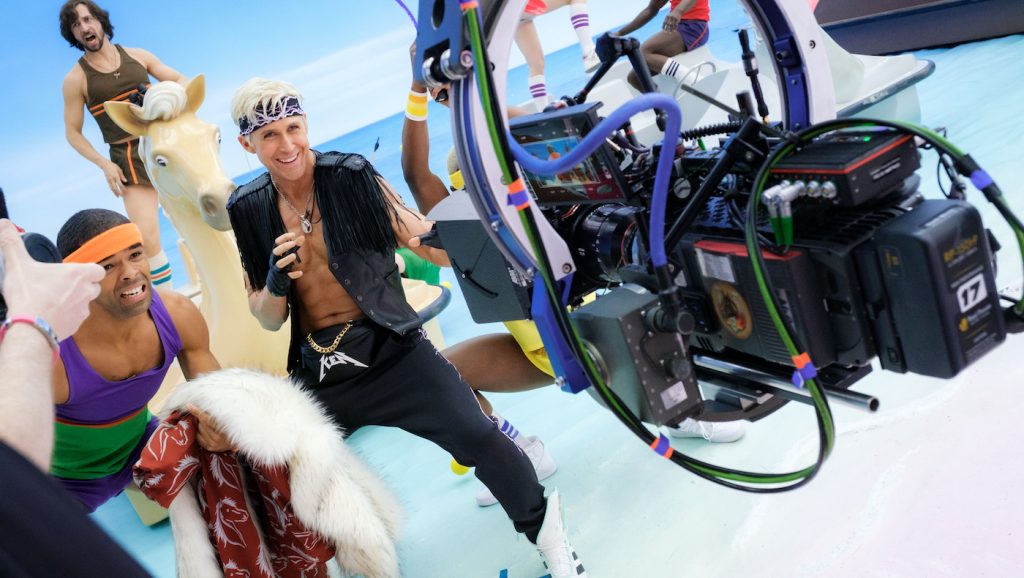
Gerwig co-wrote (alongside Noah Baumbach) and directed this original look at Mattel’s iconic doll (played, of course, but Margot Robbie, who also produced the film) as she endures a series of existential crises and goes searching for the source of ennui in the real world. The film, which featured a bevy of Barbies and Kens, including Ryan Gosling as Barbie’s travel partner and wannabe boyfriend, also included one major musical and dance sequence, “I’m Just Ken,” which Gerwig revealed to the audience in London was a major source of anxiety for her.

Even before Gerwig filmed the “I’m Just Ken” sequence, she told the audience that she’d had to explain what her goal with it was during a big meeting.

“It just said in the script, ‘And then it becomes a dream ballet, and they work it out through dance,’” Gerwig said to Jesse Armstrong. “There was a big meeting that was like, ‘Do you need this?’ And I was like, ‘Everything in me needs this.’ They were like, ‘What do you even mean? What is a dream ballet?’ And I was like, ‘A dream ballet? Where do I begin!’”

L-r: KINGSLEY BEN-ADIR and RYAN GOSLING on the set of Warner Bros. Pictures’ “BARBIE,” a Warner Bros. Pictures release. Photo Credit: Jaap Buitendijk

Once it was time to start shooting the sequence, Gerwig’s nerves didn’t subside.

“That sequence, in particular, was just filled with choices that thrilled me and made me so happy, but then I’d be driving home at the end of the day and thinking… ‘Oh no!’”

Gerwig cited one of the most iconic singing and dance numbers in film history as a source of inspiration—and comfort.

“I was like, if people could follow that in Singing in the Rain, I think we’ll be fine. I think people will know what this is. So that was the big reference point,” she said. “Even though everything felt right to me and was giving me so much joy in the way we were doing it, it was also like, ‘Oh no, this could be just terrible, but now I’m committed.’”

The song was one of the film’s most beloved moments, hit Billboard’s Hot 100 list, and amassed 5.2 million U.S. streams in its opening week. Gerwig also admitted that during the film’s opening weekend, when it premiered on July 21 on the very same day as Christopher Nolan’s Oppenheimer, which gave the world the Barbenheimer phenomenon, she would go to theaters in New York and stand in the back to gauge people’s reactions to the film.

“I went around to different theatres and sort of stood in the back and would then also turn up the volume if I felt it wasn’t playing at the perfect level,” she claimed. At one such screening, she heard one woman howl with laughter over the joke about the Proust Barbie, one of the numerous specific one-liners she inserted in the film. “And I was like: ‘That joke was for you!’”

Gerwig said she’s currently at work on her next project, although not without fresh trepidation.

“I’m working on something right now, but I’m in the writing process, and it’s hard, and I’m having nightmares,” she said. “I’m having recurring nightmares.”

For more on Barbie, check out these stories:

“Barbie” Surpasses “Star Wars: The Last Jedi” and is Now Available on Streaming

“Barbie” is About to Become the Biggest Hit in Warner Bros. History

“Barbie” Casting Directors Allison Jones And Lucy Bevan on Populating Barbie Land

“Barbie” Hair & Makeup Artist Ivana Primorac Conjures Personality From Plastic

Featured image: Caption: (L-r) MARGOT ROBBIE, ANA CRUZ KAYNE, Director/Writer GRETA GERWIG and HARI NEF on the set of Warner Bros. Pictures’ “BARBIE,” a Warner Bros. Pictures release. Photo Credit: Jaap Buitendijk

“Story Ave” Writer/Director Aristotle Torres Brings the Bronx to the Big Screen

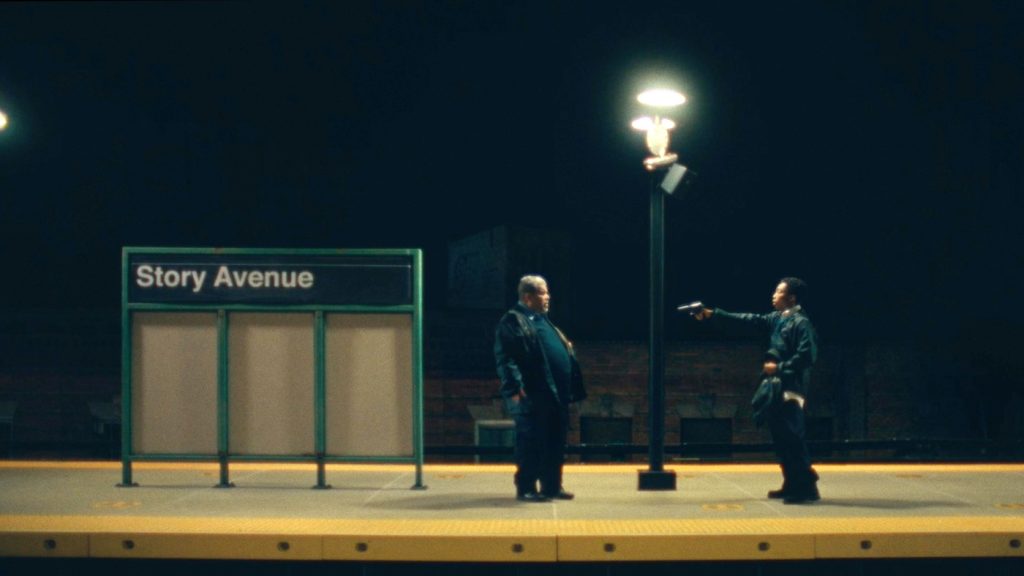
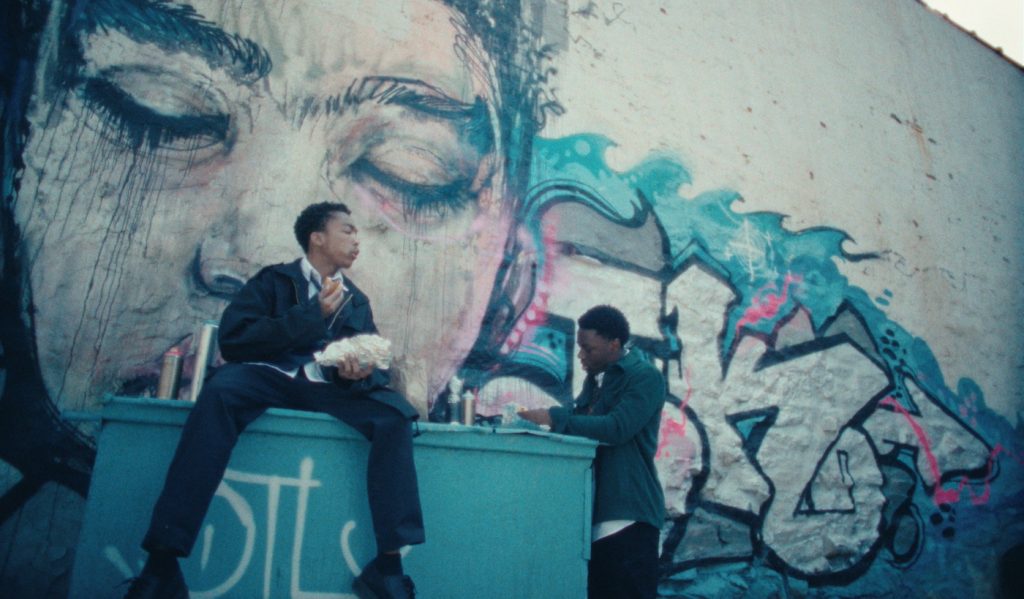
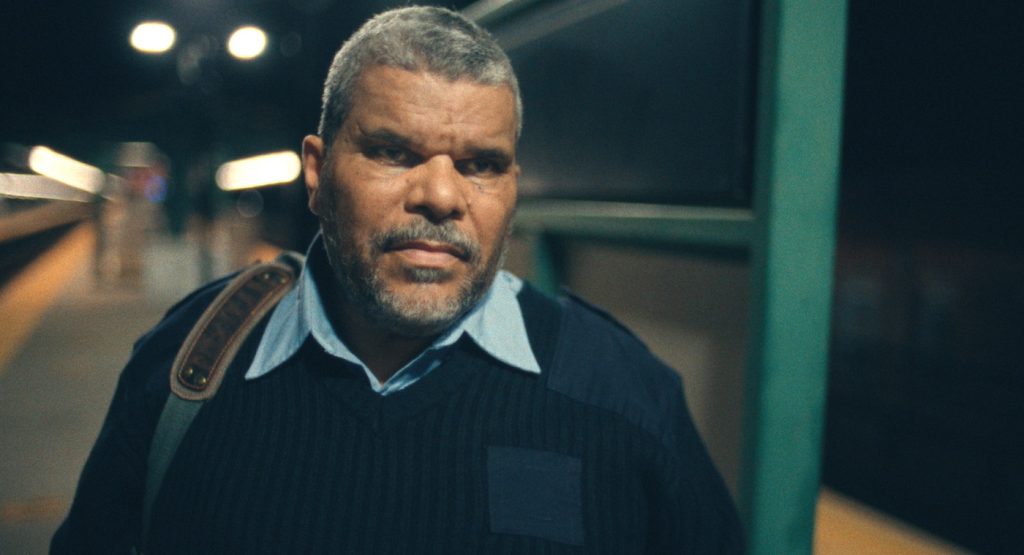
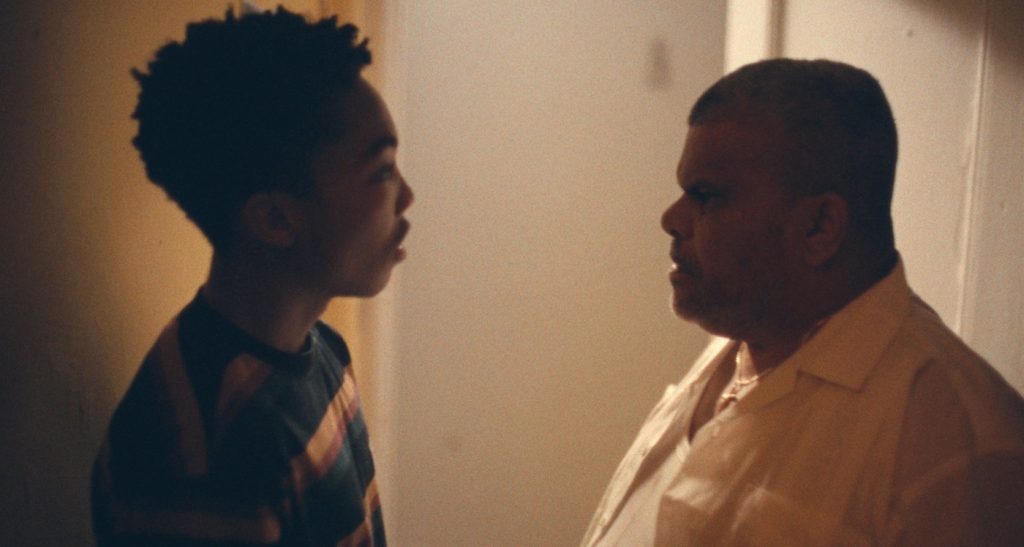
Writer/director Aristotle Torres‘ feature debut, Story Ave, is centered on Kadir (Asante Blackk), a bright teenager from the South Bronx with a gift for visual arts filled with promise. But when Kadir’s younger brother dies, the loss amplifies the pressure cooker of modern teenage life—the demands of school, the expectations of family—and specifically the life of a kid living life in the Bronx, where an entire world of opportunity and danger is just a few steps out of your front door. Soon enough, Kadir seeks out a new kind of family in a graffiti gang, and to prove himself, he tries to rob an MTA employee named Luis Torres (Luis Guzmán). Luis knows stick-up kids, he tells Kadir—and he’s not one of them. The encounter ends up changing both of their lives.

Luis Guzmán and Asante Black in “Story Ave.” Courtesy Kino Lorber.

“Guzmán and Asante were the heart that kept us going,” Torres says. Luis Guzmán is, of course, one of the most beloved character actors in the business, but for Story Ave, he was always Torres’ first and only choice. “The only role that I knew for a fact I needed, that I wrote for this actor, I couldn’t make the movie without Luis Guzman. He was my first point of attack,” he says. Asante had a big role in Ava DuVernay’s When They See Us, and Torres rounded out the rest of the cast with nimble performers like Melvin Gregg, Cassandra Freeman, Coral Peña, Curtiss Cook Jr. Then there’s Alex R. Hibbert, who starred as a young boy in Barry Jenkins’ seminal Moonlight. 

“Alex coming from Moonlight and Asante from When They See Us, those two young men are so poised,” Torres says. “If I were that poised at twenty years old, my god, my life would be so different. [Laughs].  They’re so mature and wise beyond their years and very grounded. They understand their purpose from a very young age.”

We spoke with Torres about crafting his moving feature debut.

Let’s start with what drew you to this story?

I’m really proud that my film explores the subculture of graffiti in an emotional way. I think we’ve seen it portrayed as a backdrop or tool for character development, but it’s rarely ever explored in a way where you understand the nuances of the world. At the same time, it’s more so than a movie about graffiti; it’s a movie about the family you choose versus the one you’re born into. And any opportunity to contribute to the conversation of people of color, graffiti artists specifically, and how they’re viewed as vandals rather than artists. It was also an opportunity to showcase the Bronx in a way that contradicts the negative stereotypes about what that place is. These are the things that kept me going and writing the script in an impossible amount of time and kept going when I was rejected by every financier and production company. I knew what my mission was, and the mission was much more important than just making a movie—it was representing this world that made me who I am.

Asante Blackk and Alex R. Hibbert in “Story Ave.” Courtesy Kino Lorber.

Walk me through the scriptwriting process for you.

So we had a little bit of a tumultuous but serendipitous entryway into writing this script. I initially wrote a short in 2017, and it didn’t get into any of the A-tier festivals, but it got into a lot of regionals. My objective at the time was to make it a play. I was talking to Lin Manuel-Miranda’s people about doing a derivative of the short, which is just the robbery and the diner scene. I thought it could live in a really unique way on stage. Then Sundance reached out to me and was like, ‘We saw this short; we think it’s great.’ They were talking to me about the Sundance Lab—the Holy Grail, right?—and they were like, ‘Our application process has closed, but if you can get us a draft in two weeks, we’ll consider it.’  At the time I was directing Starbucks’ first campaign ever, it was a two million dollar campaign and the biggest job of my career, a six-figure paycheck. I just remember saying to my ex-girlfriend, ‘I can’t write the script in two weeks. I’m not prepared for my moment.’ I had to email them back and say, look, I’m so honored and humbled by this offer, but I can’t do it.

Understandable reaction. Two weeks is extremely fast.

To their credit, they had more belief in me and the story than I did at the time. They were like, ‘No, we’ll fast-track you to the final round, which will give you five weeks to write it. We really believe in it. But your first draft will be up against everyone’s fourth draft, so it’s a long shot. You probably won’t get in, but if you want to take the risk, here’s the code.’ And I quit the Starbucks job and started. That’s how I had to write the script in five weeks.

Luis Guzmán in “Story Ave.” Courtesy Kino Lorber.

Let’s talk about getting your script in front of your future cast…

I couldn’t make the movie without Luis Guzman. He was my first point of attack. My reps at WME and Lighthouse could not get in touch with Guzman. His reps were like, ‘He’s not doing Indies right now. He’s not looking for this kind of role.’ No hyperbole; it was eighteen months of just waiting for a yes or no. Then, I was DJ’ing for this big promoter, Ruben Rivera, in New York City, who’s also an actor, and one day, I saw him and Guzman curtsied at the Knicks game. I DM him, and I’m like, ‘Dude, I’ve been trying to get in touch with this guy for eighteen months. I hate to ask, but I just need him to read this script.’ And forty-eight hours later, literally, I was on FaceTime with Guzman, and he was crying.

Oh my god.

He was like, ‘I have to do this movie.’  Sometimes rejection is rejection, and sometimes rejection is just a test to see how badly you really want it. If I just listened to my reps, it would be another actor in that role, and it would be a different movie, and it wouldn’t be the movie I set out to make. So, my stubbornness played in my favor. [Laughs]

Asante Blackk and Luis Guzmán in “Story Ave.” Courtesy Kino Lorber.

He is one of those guys that truly everyone loves.

Every time we’re in a screening together, as soon as he gets on the screen, everyone laughs. Everything he does, people laugh. And I’m always texting him like, ‘I hate you. You’ve ruined my movie.’ [Laughs]. There’s just a sense of familiarity you get with him, especially who this movie is made for. We grew up with Luis Guzmán; he’s almost like a distant uncle. There’s a certain level of comfort he brings not only to the protagonist, Kadir, but to the audience. What he brings to the film is invaluable.

Tell me about the production process.

The hardest thing I’ve ever done. By far. We’re an indie. We’re the little engine that could. We shot in twenty days, with two days of pickups months later. It’s just a grind, man. There are about six or seven scenes in the diner where Luis and Kadir build a rapport with each other. That was thirteen pages of dialogue, and we did all of it in one night. We averaged anywhere between seven to nine pages a day. I’m so grateful for my actors because we just didn’t have the time to explore and discover, so if they weren’t as phenomenal as they are, I don’t know how I ever could have done this film. The reality of the shooting schedule is you have twenty minutes to get the scene, and if you don’t get it, there’s no scene.

And you shot in New York, obviously.

We did, primarily in the Bronx, a little bit in Manhattan in Queens. I hope this movie can showcase the most beautiful and diverse textures that are in the Bronx. They were really welcoming of us, we made sure catering was done from local restaurants, and we tried to get as many background actors from the community as possible. They embraced us, and we embraced them, and it was a really cool experience. I’m honored I get to represent this community and these people. And the biggest validation I’ve gotten so far is from real people from my community who don’t get to see themselves depicted this way. Saying, ‘I’ve never felt so seen. I’ve never felt so safe to be vulnerable in a room full of people.’ It’s just like the highest honor you can receive.

Cassandra Freeman in “Story Ave.” Courtesy Kino Lorber.

Any particular moments during production that stand out to you looking back?

I’d say filming the diner scene, getting thirteen and a half pages shot in one overnight. Even though we’re shooting the scenes back to back, you’re seeing them at different points in the story where the characters are at a different emotional place, so the blocking and grammar have to match that emotional point in the story. And there are only so many ways to shoot two people talking to each other. And doing that for fourteen hours straight is a really tall ask. And then the location—above the diner, there was a pool hall, and when we went to scout it, it was during the day, and it wasn’t opened. Then, when we went to shoot it, they were playing music at concert levels. Thank god that Luis Guzman, the national treasure he is, was able to go up there and talk to them. But you know, every hour, they’d put the music back on. Whether I realized it or not in the moment, all those elements are true to New York City. I think it added to the performance because all the frustrations are the frustrations you feel at that moment. Maybe I’ll do another movie and be on a soundstage, and I’ll have a PA blast some music to annoy us. [Laughs].


Featured image: Luis Guzmán and Asante Black in “Story Ave.” Courtesy Kino Lorber.

“Fair Play” Writer/Director Chloe Domont Makes a Killing on Male Fragility

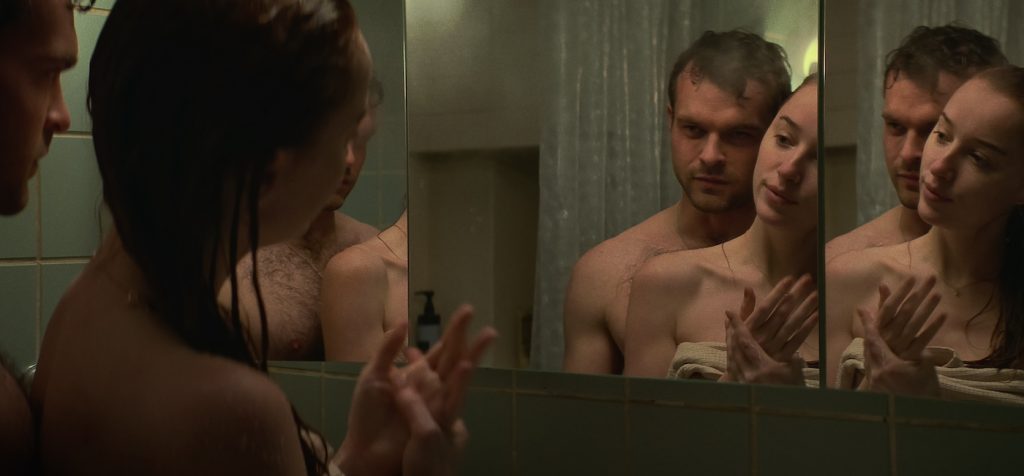
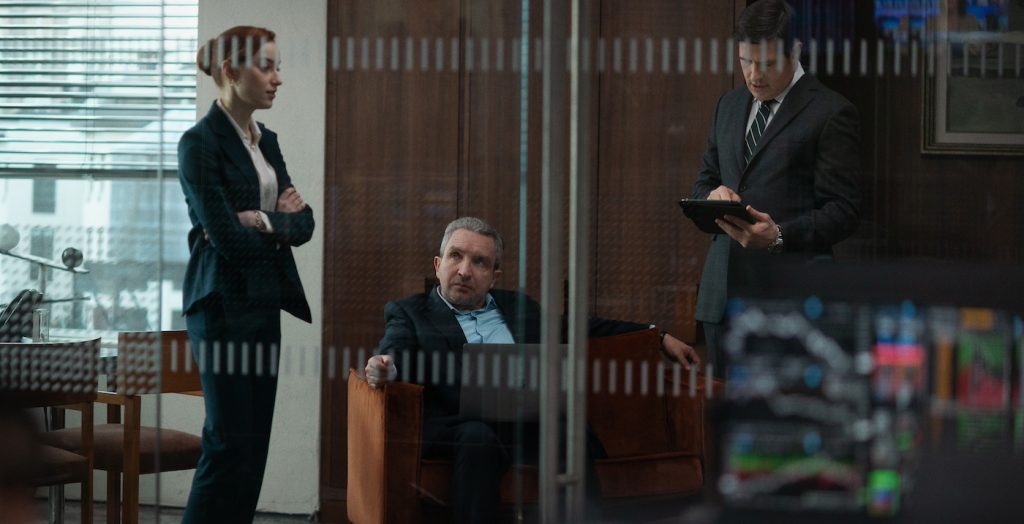
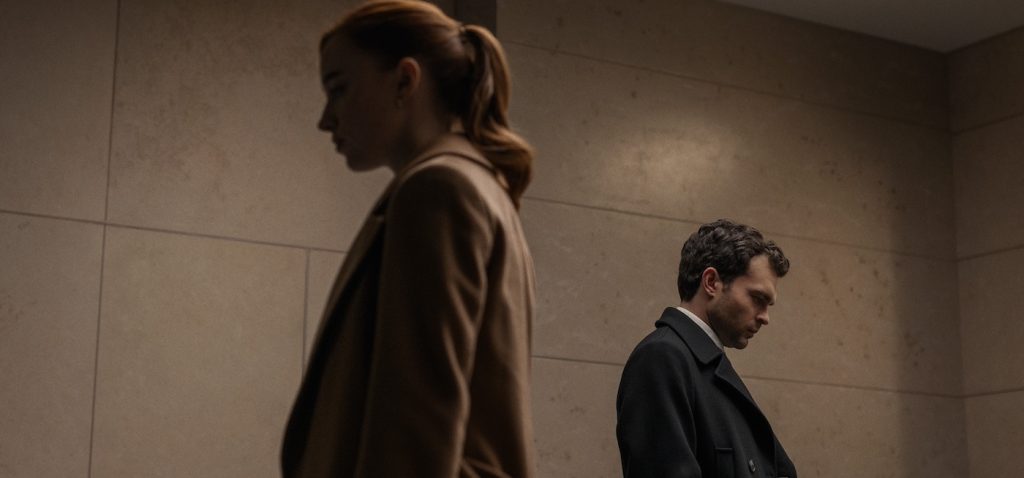
Fair Play, writer/director Chloe Domont‘s feature debut, is somehow both an old-school erotic thriller and a shrewd, scalpel-sharp dissection of how far we have and have not come with gender equality in the workplace and in the headspace of men, even those who consider themselves allies.

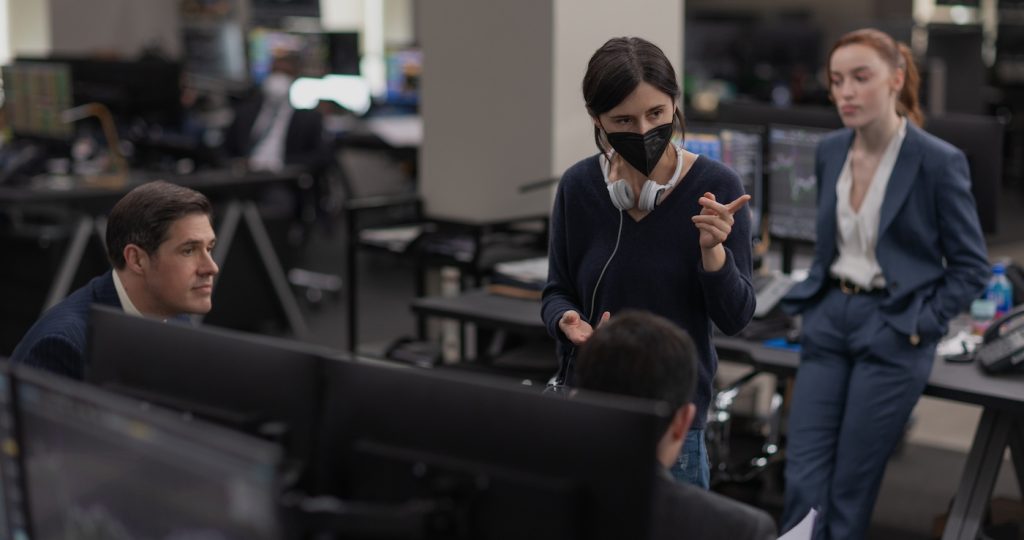
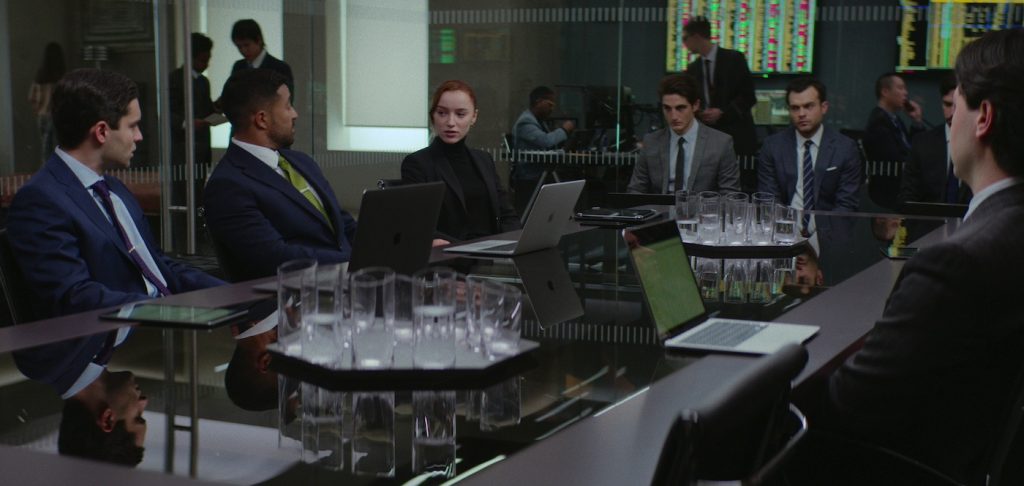
The film is largely set at the hedge fund One Crest Capitol, where Emily (Phoebe Dynevor) and Luke (Alden Ehrenreich) are low-level but promising analysts trying to take the next step in their careers. The vibes at One Crest Capitol are deeply dog-eat-dog, with the only trappings of a more enlightened age evidenced by a policy against intra-office romance. This is why Emily and Luke keep their engagement a secret, and all seems to be going to plan until one of the firm’s PMs (portfolio manager) is unceremoniously fired—he takes his rage out on a couple of computer monitors—and a promotion for Luke to fill the role seems nigh.

Only it’s the smarter, savvier Emily who gets the gig, turning the erotics depicted between the couple in the film’s early going into the thriller Fair Play becomes. While Luke plays at being both supportive and excited about Emily’s promotion, things between them go from tense to terrifying.

Domont explains how she crafted one of the finest erotic thrillers in years by setting out not to make a female revenge fantasy but rather an exploration of that most exquisitely fragile of constructs—the male ego.

Can you tell me about researching the hedge fund world?

I had a bunch of friends in that world, and they put me in touch with some hedge fund guys, and basically, it started with me taking them out for drinks and getting some of them drunk and asking basic questions, like, take me through your day from the moment you get up to the moment you go to bed. Even the mundane stuff.  I wanted a full picture of what the day-to-day is like. Then, I asked about tensions and dynamics between an analyst and a PM. What are the most frustrating moments you’ve experienced with your superior? How do you treat someone who’s beneath you? Once I had a good grasp on it, I took a pass on writing a draft, then I shared it with them and got some notes on authenticity.

The finance jargon feels authentic, as does the poisoned relationships between all the men at One Crest Captial.

Actually, I felt like the finance jargon was the easy part; the harder part was, ‘Do I have a story that people will care about watching?’ [Laughs]. The harder part was crafting the drama and how the conflict would escalate and create this ballooning tension that you don’t know when it’s going to pop, but once it does, it turns into a dogfight. By far, the most challenging part of writing it was figuring out the pace, the tone, and the rhythm.

Fair Play, behind the scenes L to R: Rich Sommer as Paul, Chloe Domont, writer and director and Phoebe Dynevor as Emily. Cr. Slobodan Pikula / Courtesy of Netflix

Was the pacing pretty well baked into the script, or did you find it while in the production and editing process?

Everything was pretty much there in the script. I even put camera directions in the script. I really worked on trying to fully realize every element of filmmaking before we went into shooting because I thought, this is my one shot, you know? Working in television was an amazing boot camp experience for me leading up to my first feature; you always have to cut shots, and you have to know what you have to protect at all costs and what you’re willing to sacrifice. But also, when you get on set, I think the most exciting thing about filmmaking is that you can rehearse it in a certain way and know exactly where your camera is going to be, but then the magic of filmmaking is something unexpected always comes up.

Your script is so tight that I’m sure there are lots of actors who could have done it justice, but I’m curious what you think about why they seemed so perfectly tailored to Alden Ehrenreich and Phoebe Dynevor. 

Individually, they’re each such strong, versatile actors that I think they can do anything, but when you put two people together, the stars have to align. Their chemistry was just instant. The film really lives and dies off their chemistry. I remember early on, we’d rehearsed, and it felt electric in many ways, but until you get to shooting, you’re a little bit nervous if that chemistry is going to come through on camera. But I remember we shot the bathroom scene where they’re recently engaged, and they’re slow dancing, and the way they look at each other, it was just so magnetic. I knew at that moment that I had a movie.

Fair Play. (L to R) Alden Ehrenreich as Luke and Phoebe Dynevor as Emily in Fair Play. Cr. Courtesy of Netflix

There are such subtle moments where Luke is trying to do right by Emily and applaud her promotion, but there’s this simmering resentment that we can feel growing inside him. How did you shape those?

What I tried to do with the character and what Alden brought to Luke is he represents a certain generation of men who are caught in the middle between wanting to adhere to a modern feminist society but still having been raised on traditional ideas of masculinity. That doesn’t make him a bad guy at all. He adores Emily because she’s ambitious. He adores her because she’s talented, because she’s a killer; that’s why he’s attracted to her. But at the same time, on some level, you know he was raised under more traditional ideas of gender roles. It’s that conflict that he starts to internalize and doesn’t know how to deal with, and that’s something I wanted to show—how problematic it becomes when someone doesn’t know how to deal with something. But, again, he genuinely is happy for her, but he’s hurt because he thought [the promotion] was his. He has this idea of who he’s supposed to be, the kind of man he’s supposed to become. This sudden flip throws him for a loop in a way he’s not prepared for. I think it’s tough for anyone to think you’re up for a job and your partner gets it, but then, what I’m exploring here are some of these ingrained power dynamics that I think we still haven’t quite figured out yet.

Fair Play. (center) Phoebe Dynevor as Emily and (center right) Alden Ehrenreich as Luke in Fair Play. Cr. Courtesy of Netflix

Your film is set in the aftermath of #MeToo in one of the most male-dominated, nakedly zero-sum capitalist professions. There’s one moment, in particular, when Eddie Marsan’s character Campbell, the big boss, savages Emily in a brutally sexist way that I was hoping you could unpack.

It’s an animal kingdom, you know? It’s every man for himself. I think the #MeToo movement never hit the finance world. There’s a certain level of power and money that you can’t touch. I think people definitely treat each other with more respect, but at the same time, what I wanted to show with Eddie’s character when he finally lashes out at Emily is that this is someone who hired her because he sees her value regardless of her gender and genuinely thinks she’s the best person for the job, and in that way, he’s her champion. But, as soon as she slips, then her failure is through the lens of gender. And I think that’s a double standard that a lot of women face in every industry. Yes, there are these male champions out there that believe in you and support you, but as soon as slip, you f**ked up because you’re a woman. I wanted to show that in the most cutting way.

Fair Play. (L to R) Phoebe Dynevor as Emily, Eddie Marsan as Campbell, Rich Sommer as Paul in Fair Play. Cr. Slobodan Pikula / Courtesy of Netflix

And she absorbs it after some initial shock and keeps pressing on at Crest Capital.

That’s why I had him say it again. The look of shock on her face, like, what did you just call me? And he’s like, yeah, I can say whatever the f**k I want. You don’t like it? Leave. And that’s how it is.

[Spoilers below]

Can you explain how you set up Luke’s spectacular flameout at the office when he attempts to undermine Emily to his final, even more desperate and awful act at home?

In the scene with Campbell when she has to choose how to deal with [Luke’s treachery] and save face at that company because Luke throws her under the bus, Campbell gives her his thirty thousand view of the world, which is this— ‘It doesn’t f**king matter. It’s all about the money. Just move on from it. I don’t care who you kill, I don’t care who you f**k, just do it on your time.’ So she’s sitting on that idea that accountability doesn’t matter, and watching this new woman come in, and Emily’s on the other side of what she’s experienced, this abuse, and she knows everything this young woman is going to go through, that’s what’s in her head when she’s faced with Luke for one final confrontation.

Fair Play, behind the scenes Eddie Marsan as Campbell Cr. Sergej Radovic / Courtesy of Netflix

What did you want to bring across in that final confrontation between Emily and Luke? 

For me, the ending was always about Emily reclaiming the power that Luke takes away from her. The film always had to escalate to the sexual assault scene in the bathroom because the only way for Luke to reclaim the power in the relationship at that point is through physical dominance. The only way for Emily to reclaim the power again is through physical force as well because this is a man who refuses to be held accountable. So, it had to go to these places for me because I set out to make a thriller about power dynamics on the ugliest level. Sexual assault is not about sex; it’s about power. Then, when it does occur, what’s Emily going to do about it? She tries to confront him on his inability to face who he is. He’s a man who cannot own up to his own weakness and cannot face his own failures, and it causes so much destruction. For me, the last scene is not about female revenge; it’s a scene about holding a man accountable. A man who refuses to be held accountable. The whole movie builds up to the line where Luke finally mutters the words, “I’m nothing.” Once he finally does that, once he’s finally the man who acknowledges his own inferiority, his own weakness, his own failure, that’s the resolution of the film. Ultimately, this is not a film about female empowerment; this is a film about male fragility.

Fair Play. (L to R) Alden Ehrenreich as Luke and Phoebe Dynevor as Emily in Fair Play. Cr. Sergej Radovic / Courtesy of Netflix

For more on big titles on Netflix, check these out:

Julia Roberts, Mahershala Ali & Co Seek Refuge at the End of the World in “Leave The World Behind” Trailer

“Reptile” Director Grant Singer on His Slithery Mystery Feature With Benicio Del Toro

“May December” Trailer Reveals Natalie Portman and Julianne Moore in Todd Haynes’ Twisty New Film

Featured image: Fair Play. (L to R) Alden Ehrenreich as Luke and Phoebe Dynevor as Emily in Fair Play. Cr. Sergej Radovic / Courtesy of Netflix

Official “Night Swim” Trailer Unveils Blumhouse’s Deep Dive Into Madness

When the horror maestros over at Blumhouse call you into the pool for a swim, you know you’ll be taking that dip at your own risk.

The official trailer for writer/director Bryan McGuire’s Night Swim has arrived, based on the 2014 short film by McGuire and Rod Blackhurst, and boasts a killer cast to turn their inspired short into a proper horror feature. Wyatt Russell (The Falcon and the Winter Soldier, Black Mirror) stars as Ray Waller, a former major league baseball player whose degenerative illness has forced him into an early retirement. Yet that doesn’t keep Ray from dreaming of a way back to the big leagues. So, Ray, his wife Eve (the always welcome and recent Oscar-nominee Kerry Condon, The Banshees of Inisherin), their teenage daughter Izzy (Amélie Hoeferle, The Hunger Games: The Ballad of Songbirds and Snakes), and young son Elliot (Gavin Warren, Fear the Walking Dead) move into a new home. The home has a beautiful pool. What could possibly go wrong?

What Ray hopes will happen is that the pool in the backyard, so inviting, so glorious, will help him in his physical therapy and get him back out onto the field. To his defense, the pool does look pretty inviting. Unfortunately for Ray and the family, the pool is actually the liquid locus of some seriously sinister forces, the portal from which the home’s horrific pass passes through.

Night Swim boasts not only the aforementioned cast and the imprimatur of Blumhouse but also horror master James Wan as a producer. The first trailer offers a little taste of the madness to come. Swim at your own risk.

Check out the trailer below. Night Swim arrives in theaters soon:

For more on Universal Pictures, Peacock, and Focus Features projects, check out these stories:

“SNL” Returning With Pete Davidson Hosting the Season 49 Premiere

“Oppenheimer” Has Reached Another Milestone for Christopher Nolan

Christopher Nolan’s “Oppenheimer” is the Highest-Grossing Biopic Eve

Christopher Nolan’s “Oppenheimer” Reaches New Milestone

Featured image: Amélie Hoeferle as Izzy Waller in Night Swim, written and directed by Bryce McGuire.

“007: Road to a Million” Trailer Reveals James Bond-Inspired Reality Show Led by Brian Cox

It goes without saying that Brian Cox would be excellent in a James Bond movie. But, considering we’re waiting for a new actor to be cast in the role, we’ll settle for Cox hosting 007: Road to a Million, a new reality series that puts real people on a James Bond-like adventure with the chance to win a £1,000,000 prize.

Yet Cox is playing a character here—he’s “The Controller,” the mastermind behind the game that sends pairs of people dashing, a la James Bond, all over the world searching for clues and testing their mental and physical acuity. The Controller decides where the pairs go, what questions they must answer, and what they must do. He watches their every move, “reveling as his often merciless and punishing plans unfold in front of him,” as Prime Video’s synopsis describes. Sounds a lot like Cox’s now iconic Succession character, Logan Roy, doesn’t it?

The new series comes from the producers behind the James Bond films, including Barbara Broccoli, so you can be sure the game is steeped in as much Bondian intrigue as possible. The challenges, the locations, Cox’s all-seeing Controller, and the quality of the production will all feel as 007 as possible. And the tension will build with each question as the amount of money to be won or lost rises every step of the way.

007: Road to a Million will take the competitors and viewers on a world tour, from the Scottish Highlands to a remote Chilean desert, from the twisting alleyways and canals of Venice to the beautiful Caribbean coastline of Jamaica. Nine pairs of people will do their level best to channel James Bond as they puzzle their way across the globe, with none other than Brian Cox watching their every move.

Check out the teaser below. 007: Road to Million streams on Prime Video on November 10:

For more on Amazon Prime Video, check out these stories:

“Air” Costume Designer Charlese Antoinette Jones on Designing the Near-Jordan World of 1980s Nike

“A Million Miles Away” Co-Writer/Director Alejandra Márquez Abella on Capturing a Dream Come True

“Red, White, & Royal Blue” Co-Writer/Director Matthew Lopez on Crafting a Modern Love Story

“Swarm” Production Designer Sara K. White on Creating Fractured Spaces for the Celebrity-Obsessed

Featured image: Brian Cox in “007: Road to a Million.” Courtesy Prime Video.

“SNL” Returning With Pete Davidson Hosting the Season 49 Premiere

With the writer’s strike officially over and negotiations to end the actor’s strike in full swing, hopes are high that things are returning to normal in the entertainment industry. And nothing can make things feel back on track like a fresh season of Saturday Night Live beginning in the fall. This makes the news that SNL has lined up beloved former cast member Pete Davidson as host for the season 49 premiere feel extra promising. Who better to invite us back into hoodie season than Pete Davidson?

SNL will return on October 14 with Davidson and musical guest Ice Spice. One unusual aspect of season 49 is that the entire cast is returning, a rarity for a show that often sees at least one or two cast members head off to work on TV or film projects. Davidson was set to host last season, but then the strikes started and scuttled those plans. SAG-AFTRA has released a statement that clarified that any performer who appears on SNL is not crossing the picket line, which means that the legendary sketch show will be able to go full steam ahead for the season.

The returning cast are Michael Che, Mikey Day, Andrew Dismukes, Chloe Fineman, Heidi Gardner, Punkie Johnson, Colin Jost, Ego Nwodim, Kenan Thompson, and Bowen Yang. James Austin Johnson and Sarah Sherman have been promoted from featured player status, and Chloe Troast has been added as a featured player.

By the time Davidson, Ice Spice, and the SNL gang deliver their premiere episode, the actor’s strike negotiations will have been well underway, so who knows, maybe they’ll be over by the time Bad Bunny takes the stage at 8H to host the second episode of the season. It’s fall, the temps are set to drop, the cozy vibes will begin in earnest, and SNL will be back in full swing. In an otherwise topsy-turvy world, this is as comforting as it gets.

For more on Universal Pictures, Peacock, and Focus Features projects, check out these stories:

“Oppenheimer” Has Reached Another Milestone for Christopher Nolan

“Oppenheimer” Cinematographer Hoyte van Hoytema on Making History With Christopher Nolan

“Oppenheimer” Production Designer Ruth De Jong on Helping Christopher Nolan Build the Bomb

“The Exorcist: Believer” Trailer Unleashes David Gordon Green’s New Installment in Iconic Horror Franchise

Featured image: Pete Davidson as Scott Carlin in The King of Staten Island, directed by Judd Apatow.

“Killers of the Flower Moon” Star Robert De Niro the Focus of New Character Video

There is no director alive better at depicting the dual nature of a certain type of man, one who makes the sign of the cross with one hand while holding a pistol with the other, than Martin Scorsese. With Killers of the Flower Moon, Scorsese has turned his attention to the tortured souls of two men in particular, Ernest Burkhart (Leonardo DiCaprio) and his uncle, William Hale (Robert De Niro). The film, adapted from David Grann’s sensational 2017 book of the same name, is centered on a series of grisly murders of Osage Nation members in Oklahoma at the turn of the 20th century. The Osage had become rich thanks to the discovery of oil on their land, and this made them targets for men like Hale and Burkhart, the former manipulating the latter into helping him pry the money from the Osage through marriage or, if need be, through murder.

“William King Hale is an extraordinary character,” Scorsese says at the top of a new video devoted to De Niro’s character. “He was respectful on the one hand and a murderous thug on the other.” The video follows previous installments looking at DiCaprio’s Ernest Burkhart and Lily Gladstone’s Mollie Kyle, the Osage woman Ernest falls in love with and marries. This union between Ernest and Mollie is precisely the kind of soft power that Hale advocates for, a bloodless way to take the Osage’s money. “We mix these families together, and that estate money flows in the right direction,” Hale says in a previous trailer. “It’ll come to us.”

“William Hale wanted to take control of Osage wealth and territory at all costs,” DiCaprio says in the new video. “[He was] exploiting and manipulating them.”

“And if necessary, do away with them,” Scorsese adds. “Almost as if it was for their own good.”

In his long, illustrious career, Scorsese has taken a hard look at men like Hale, who believe in their hearts they are owed something, who believe their own spin that they are God-fearing and good men who occasionally have to do awful things for the greater good. And Scorsese has exposed men like Ernest Burkhart, who allow themselves to be manipulated, often against their own interests, to do the bidding of men like Hale. In Killers of the Flower Moon, Scorsese and his co-writer Eric Roth made sure to focus not only on these two white men but on the Osage people themselves. The film is a crime saga, a tragedy, and a historical epic all in one. It’s the story of America.

Check out the character video below. Killers of the Flower Moon arrives in theaters on October 20:

For more on Killers of the Flower Moon, check out these stories:

“Killers of the Flower Moon” Character Video Reveals Leonardo DiCaprio’s Ernest Burkhart

“Killers of the Flower Moon” Star Lily Gladstone Takes Center Stage in New Video

“Killers of the Flower Moon” Trailer Unveils Martin Scorsese’s Star-Studded Epic

Featured image: Robert De Niro and Jesse Plemons in “Killers of the Flower Moon,” premiering October 20, 2023 on Apple TV+.

New “Joker: Folie à Deux” Image Finds Joaquin Phoenix Soaked But Serene

Joker: Folie à Deux co-writer and director Todd Phillips has taken to Instagram to share a new photo from the upcoming sequel and to take a moment to reflect on the fact that it was four years ago when Joaquin Phoenix and Phillips unleashed their twisted character study of the iconic supervillain of them on all the screen. The original Joker arrived on the big screen on October 4, 2019, immediately announcing itself as something entirely different in the world of movies derived from the comic book universe. It was the first live-action theatrical film within the Batman umbrella to receive an R-rating, for starters, and had its premiere at the Venice Film Festival, where it took home the top prize, the Golden Lion. From there, it went on to conquer not only the box office but become a centerpiece of conversation within the film world and the broader culture. Joker was a film you couldn’t ignore, and Phoenix’s performance was unlike anything we’d seen in a superhero movie, or in this case, a supervillain movie. He went on to win an Oscar for Best Actor.

The new image from the sequel finds Phoenix’s deeply unstable Arthur Fleck enjoying a rain shower. He’s surrounded by a colorful assortment of umbrellas (and the faceless, broad-shouldered men carrying them) but goes without, his face turned to the heavens and bearing a look of inner peace. The last time we left Arthur at the end of Joker, he’d just (extremely belated spoiler alert) gone on a killing spree in Gotham and, in the process, became a folk hero to the downtrodden, poverty-stricken, and deeply pissed-off denizens of the crime-ridden metropolis. Having taken on the alter ego of the Joker, Arthur appeared on Murray Franklin’s (Robert De Niro) TV show and shot the man dead on live TV. Gotham exploded in an orgy of violence, which included the murders of two of its most prominent citizens, Thomas (Brett Cullen) and Martha Wayne (Carrie Louise Putrello). You might have heard they have had a son. The film ends with Arthur locked up in a mental asylum, and there’s an insinuation there that he kills the psychiatrist working with him—it’s not shown, but he has bloody footprints as he leaves a session with her, and we see him being chased shortly thereafter.

How Phillips and his co-writer Scott Silver advance the story from here is anybody’s guess. We know some key things about Folie à Deux; the main one, of course, is the arrival of Lady Gaga as Harley Quinn. We also know that the title Folie à Deux refers to a medical term for two or more people suffering from the same or similar mental disorder; presumably, this would be Arthur and Harley. We also know the film has been teased as a musical and includes the return of Zazie Beetz as Sophie Dumond and the arrival of powerhouse performers like Brendan Gleeson and Catherine Keener. After that, however, is pure speculation. Phillips has been keeping us updated with the occasional photo, but the script will be kept in Arkham Asylum for the foreseeable future—Joker: Folie à Deux isn’t due in theaters until October 4, 2024.

Check out the new image here:

For more on Joker: Folie à Deux, check out these stories:

“Joker 2” Director Todd Phillips Shares Photos of Lady Gaga & Joaquin Phoenix as Sequel Wraps shared madness.

First “Joker 2” Image Reveals Return of Joaquin Phoenix’s Arthur Fleck

Brendan Gleeson on Why He Joined “Joker 2”

Lady Gaga Releases “Joker 2” Teaser Hyping Upcoming Musical Mayhem

Featured image: Caption: JOAQUIN PHOENIX as Arthur Fleck in Warner Bros. Pictures, Village Roadshow Pictures and BRON Creative’s “JOKER,” a Warner Bros. Pictures release. Photo Credit: Niko Tavernise