This is how Elizabeth Zott (Brie Larson) looks at her skill in the kitchen, not as a chore or a duty or even an art form, but as, well, a lesson in chemistry. Elizabeth is a lab tech, a talented one, who is on the cusp of a scientific breakthrough when she’s summarily fired. The problem for Elizabeth is this is the 1950s, and young women are not the types of people her male bosses want, or think they need, achieving scientific success. With her dreams dashed, Elizabeth is left to try to piece together a way to do what she loves, science, while keeping a roof over her head. That’s when she receives a very strange offer—does she want to host a cooking show?
Lessons in Chemistry tracks Elizabeth’s journey from budding scientist to initially reluctant host of “Supper at Six,” where she teaches a country of maligned, overworked housewives about more than just how to create the perfect soufflé. Elizabeth’s stealth mission is to school all the women watching, and eventually, the men, too, in lessons on science and on the perils of devaluing half of society based on their gender.
In her first TV role in a decade, Larson is joined by Lewis Pullman (Top Gun: Maverick) as her former colleague (and potential romantic partner) Calvin Evans, one man who values her intellect and sees her as an equal. They’re joined by Aja Naomi King, Stephanie Koenig, Kevin Sussman, Patrick Walker, and Thomas Mann. Seven-time Emmy nominee Lee Eisenberg serves as showrunner.
The series is based on Bonnie Garmus’s novel of the same name. Check out the trailer below. Lessons in Chemistry arrives on Apple TV+ on October 13.
Here’s the official synopsis from Apple TV+:
Set in the early 1950s, “Lessons in Chemistry” follows Elizabeth Zott (played by Larson), whose dream of being a scientist is put on hold in a patriarchal society. When Elizabeth finds herself fired from her lab, she accepts a job as a host on a TV cooking show, and sets out to teach a nation of overlooked housewives — and the men who are suddenly listening — a lot more than recipes.
For more stories on Apple TV+ series and films, check these out:
Do not travel with us to a galaxy far, far away if you haven’t watched episode five of Ahsoka.
Okay, now that we got that bit of galactic business over with, let’s take a quick look at the major moments in Ahsoka’s fifth episode. The conflict between the titular rebel Jedi (Rosario Dawson) and Baylan Skoll (Ray Stevenson), Shin Hati (Ivanna Sakhno), and their fellow malcontents was put on the back burner as our hero took a heady trip into the past. After tangling with Baylan at the climactic end of episode four and coming out on the losing end of a lightsaber duel, Ahsoka was sent tumbling into the frigid, heaving ocean, presumably left for dead (of course, we knew better). Meanwhile, her former padawan Sabine Wren (Natasha Liu Bordizzo), in an attempt first to save Ahsoka’s life and then to find their long lost friend Ezra Bridger (Eman Esfandi), gave Baylan the navigation tech he needed to find the dangerous Grand Admiral Thrawn. The end of episode four revealed the return of Anakin Skywalker (Hayden Christensen) standing before Ahsoka. They appeared to be reuniting in the World Between Worlds.
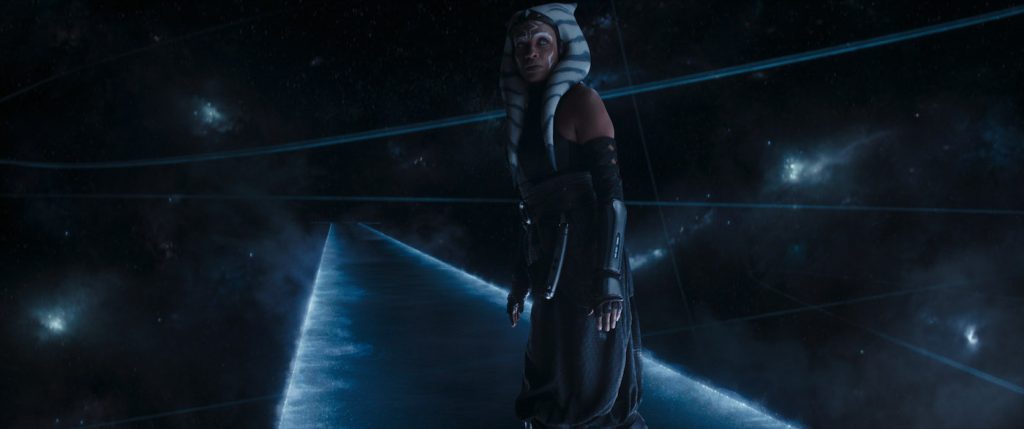
Episode five was written and directed by series creator Dave Filoni, and it picked up right where episode four left off, with Anakin standing before Ahsoka in the World Between Worlds, donning the all-black look he wore during Star Wars: Revenge of the Sith, the same age as he was then. What was evident the longer we got a look at this version of Anakin was that this wasn’t his Force ghost, those bluish, hazy figures we’ve seen when Obi-Wan Kenobi or Yoda have returned to impart wisdom. The reasons Anakin looked whole are unclear, but it seems safe to assume it has to do with their location. The World Between Worlds is a hub, so to speak, made up of the Force, which connects every moment of space and time together. It’s where someone schooled in the ways of the Force can move back and forth through time.
As is the case in more or less every time travel story ever told, the ability to travel into the past comes with a huge, bright red warning label, and that’s as true for Jedis as it is for Marty McFly (or Loki); if you alter things that happened in the past, you can and will mess up a bunch of things in the present and future. Ahsoka is understandably confused as to why her former master is standing there, and he tells her that he’s returned to complete her training. He breaks the news that she lost her lightsaber duel with Baylan Skoll. Although she doesn’t want to fight him, Anakin forces his former padawan’s hand by telling her she’s got a simple choice: “Live or die.” They start to duel.
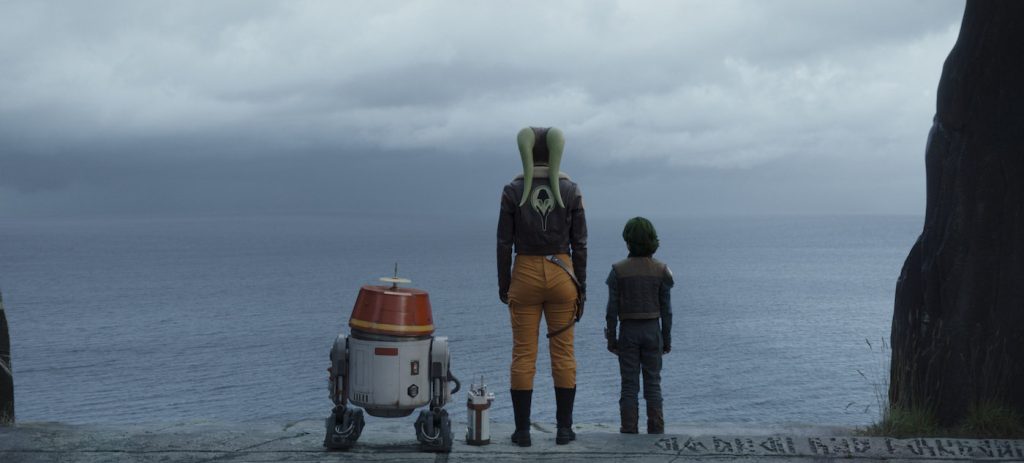
Back in the real world, Hera (Mary Elizabeth Winstead), her son Jacen (Evan Whitten), and their team are searching for Ahsoka and Sabine. Jacen is Force-sensitive and can hear something in the waves—a lightsaber duel.
Back in the World Between Worlds, it almost looks as if Ahsoka has the upper hand on Anakin, but then he teaches her a fresh lesson. Anakin obliterates the starry bridge she’s standing on, and Ahsoka falls into her past. She’s just a young girl (played by Barbie‘s Ariana Greenblatt) caught up in the Clone Wars, fighting beside Anakin in one of her first missions during the Battle of Ryloth. This is the most direct, vivid link yet to another animated Star Wars classic, Clone Wars, bringing these two characters together in live-action.
Young Ahsoka is confused and horrified by what she sees around her. She doesn’t want to keep fighting, but Anakin isn’t having it. He tells her either she learns to be a soldier or she dies. Ahsoka starts to see the thin veil that separates Anakin from the grotesque Sith Lord he would become begin to slip.
In her next time jump, Ahsoka’s a few years older, a much better fighter, and is now at the Siege of Mandalore, leading a mission to take the planet back from Darth Maul. She’s got her iconic double white lightsabers going, and she’s officially a rebel now, having left the Jedi order and her training under Anakin. In a brief moment, we get one of the episode’s big cameos when Temuera Morrison returns. He played Jango Fett in the Star Wars prequels and later became Boba Fett in the Disney+ miniseries The Book of Boba Fett—here, he’s playing the clone Captain Rex, Ahsoka’s friend during the animated Clone Wars.
Anakin returns, and they argue some more about her legacy. Anakin wants her to see that every Jedi carries the knowledge and wisdom that was passed onto them from their master, and so and so forth, through time. But to Ahsoka, her legacy is one of perpetual death and war.
“You’re more than that,” Anakin tells her. “Because I’m more than that.”
“You are more, Anakin,” young Ahsoka says, “but more powerful and dangerous than anyone realized.”
These words unleash the red-eyed Anakin, the Sith side of his personality. He unsheathes his red lightsaber and goes after Ahsoka again.
They continue fighting, now with Ahsoka returned to her present-day form. There’s a brief moment where her eyes glow yellow, like a Sith, as she crosses over to the Dark Side to conquer Anakin. Yet when she finally gets the best of him and has the opportunity to strike him down, she pulls back. She returns to herself. So does Anakin.
“There’s hope for you yet,” he tells her, then vanishes.
Back in the regular world, Jacen has helped locate Ahsoka, and she’s pulled out of the water. Therefore, the mission to find Sabine, Ezra Bridger, and Grand Admiral Thrawn continues. Yet Anakin’s final lesson remains shrouded in mystery, fitting for that most mysterious of Jedis. Anakin seemed pleased that Ahsoka conjured her anger and hurt and almost, but not quite, went over to the Dark Side completely to defeat him. But, she spared him and returned to herself, and proved that she was more than her past, that she could make new and better decisions in her present. That’s a luxury Anakin no longer has, but he is a man who can appreciate a person not wanting to be defined by their worst deeds and the darkest parts of their past.
Check out a taste of Ahsoka’s battle with and against Anakin Skywalker here:
For more stories on 20th Century Studios, Searchlight Pictures, Marvel Studios and what’s streaming or coming to Disney+, check these out:
Writer/director Gareth Edwards (Godzilla, Rogue One) is as comfortable with massive stakes as he is with heady sci-fi stories populated with complex characters. With The Creator, he’s tackling both as he turns his attention to our growing unease with the rapid expansion of artificial intelligence in a film that puts a human face on the algorithms of doom.
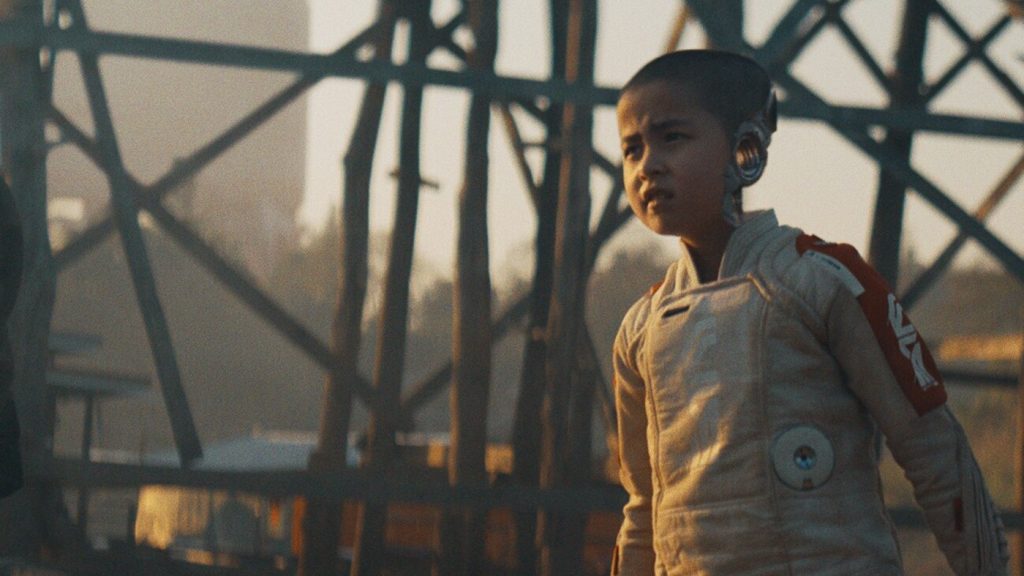
The final trailer for The Creator introduces us to the owner of that face, a little girl named Alphie (Madeleine Yuna Voyles), who is far from your average elementary school student. Alphie is a humanoid robot powered by artificial intelligence that is believed to be the ultimate weapon of mass destruction. She was created by the architect of a robot rebellion against humanity that began with a nuclear detonation in Los Angeles and has led to an outright war between humanity and the robot world.
Joshua (John David Washington), an ex-special forces agent grieving his wife’s disappearance (Gemma Chan), is recruited to take Alphie out. Joshua leads a team across enemy lines into AI-controlled territory to destroy the weapon and end the war. That’s when he meets Alphie, and his mission becomes desperately muddled by the realization she is, in essence, only a child.
Joining Washington, Voyles, and Chan is a top-notch cast that includes Ken Watanabe (Inception), Allison Janey (I, Tonya), and Sturgill Simpson (Dog). Edwards directs from a script he co-wrote with Chris Weitz, his collaborator from Rogue One: A Star Wars Story.
Check out the final trailer here. The Creator hits theaters on September 29:
“You made a good choice coming back here,” William Hale (Robert De Niro) says to his nephew, Ernest Burkhart (Leonardo DiCaprio), at the start of the second trailer for Martin Scorsese’s Killers of the Flower Moon. “The Osage are the finest, wealthiest, and most beautiful people on God’s earth.”
Hale refers to the fact that the Osage Nation in Oklahoma were the lawful landowners of property that contained massive oil reserves discovered during the turn of the 20th Century. This made the Osage fabulously wealthy, and it also made them the targets of legions of people like Hale, who wanted, by whatever means necessary, to pry that oil money from them. When Hale called them the finest, wealthiest, and most beautiful people on God’s earth, only one portion of that statement really mattered to him.
The new trailer reveals the outline of Hale’s plan, which includes his nephew. He asks Ernest if he likes women, and Ernest tells him it’s his weakness. “We mix these families together, and that estate money flows in the right direction,” Hale says. “It’ll come to us.”
We know, however, that marrying into the Osage Nation isn’t the only way white people like Hale will try to chisel the oil money from them. Scorsese’s film, adapted from investigative journalist David Grann’s best-selling 2017 book of the same name, tracks a series of brutal murders of Osage Nation members. The new trailer reveals the extent of the wanton killing and the horrific toll it takes on the Osage people. While Grann’s book was centered on Tom White, a former Texas Ranger who came to Oklahoma to investigate the murders (he’s played in the film by Jesse Plemmons), Scorsese and his screenwriter Eric Roth altered the focus of their story from the virtuous White, coming to Osage Nation to solve a crime, to both the perpetrators of the crime and on the Osage themselves.
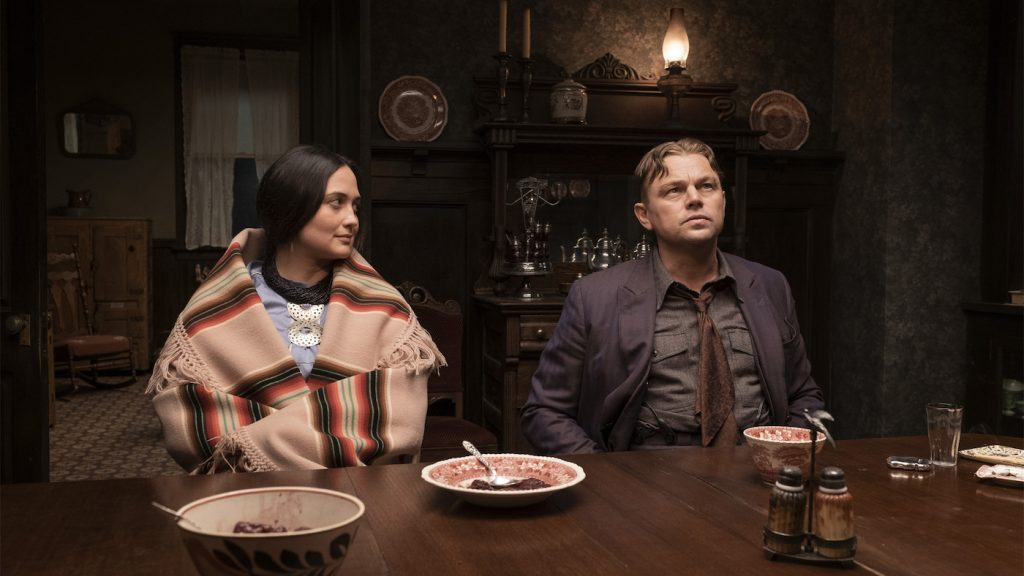
The focus is centered on the relationship between Ernest and Mollie (Lily Gladstone), a member of the Osage Nation whom Ernest eventually marries. The love between the two complicates the larger scheme afoot and pits Ernest’s heart against his Uncle’s mercilessness.
Lily Gladstone and Leonardo DiCaprio in “Killers of the Flower Moon,” coming soon to Apple TV+.
Speaking with Deadline, De Niro explained how the shift in focus helped bring his character into sharper focus:
“It made the most sense to show what’s going on in that world, the dynamic between the nephew and the uncle,” De Niro told Deadline. “I don’t know if you would call it the banality of evil or just evil, corrupt entitlement, but we’ve seen it in other societies, including the Nazis before WWII. That is, a depressing realization of human nature that leaves people capable of doing terrible things. [Hale] believed he loved them and felt they loved him. But within that, he felt he had the right to behave the way he did.”
Check out the new trailer here. Killers of the Flower Moon arrives in theaters on October 20:
For more on Killers of the Flower Moon, check out these stories:
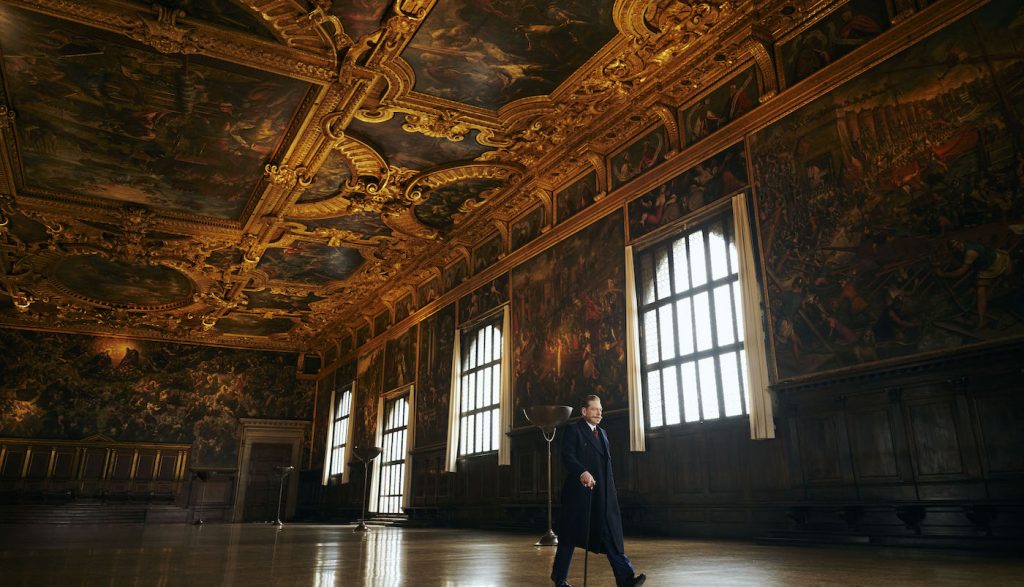
There’s a chilling haunt in Kenneth Branagh’s latest Agatha Christie adaptation of famed detective Hercule Poirot that will make the hair on the back of your neck tingle.
Following the success ofMurder on the Orient Express andDeath on the Nile, this third whodunit sinks into darker waters and unravels a tale along the canals of Venice where the crime solver is asked by friend and author Ardiane Oliver (Tina Fey) to attend a séance with her to prove that the medium (Michelle Yeoh) performing the spiritual ritual is a fake. The disturbing events that follow inside the palazzo owned by Rowena Drake (Kelly Reilly), who tragically lost her daughter Alicia (Rowan Robinson) to an unexplained death, become a puzzle only Poirot can piece together.
Tasked with bringing the cryptic aura of A Haunting in Venice to life was production designer John Paul Kelly (The Theory of Everything). The test was creating an authentic palazzo in marvelous albeit sinister detail that would take center stage for the moody story set in post-World War II Italy.
In reading the script (written by Michael Green and based on Christie’s “Hallowe’en Party”), Kelly tells The Credits there was an undeniable horror-filled tone – one that’s partially shaped by the palazzo. “There’s a prominence to the palazzo on screen and its relevance to the story,” Kelly says. “It becomes a character and almost sits alongside the actors as a potential culprit. That was massively exciting and challenging as well.”
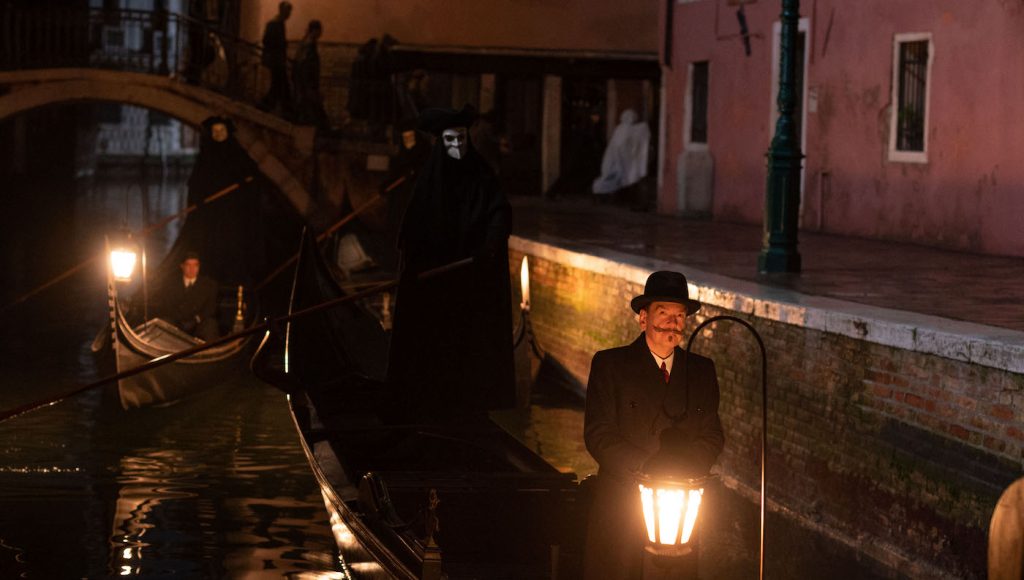
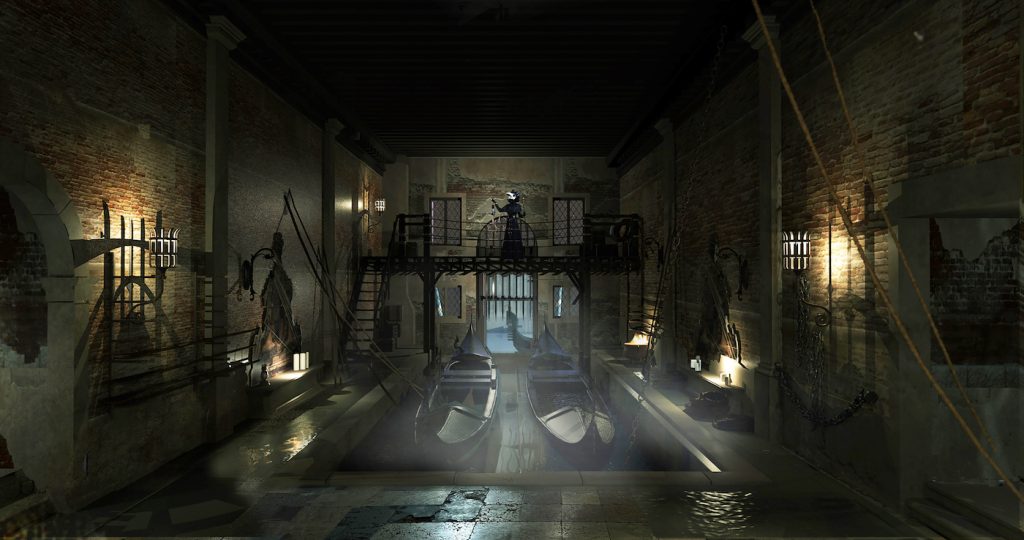
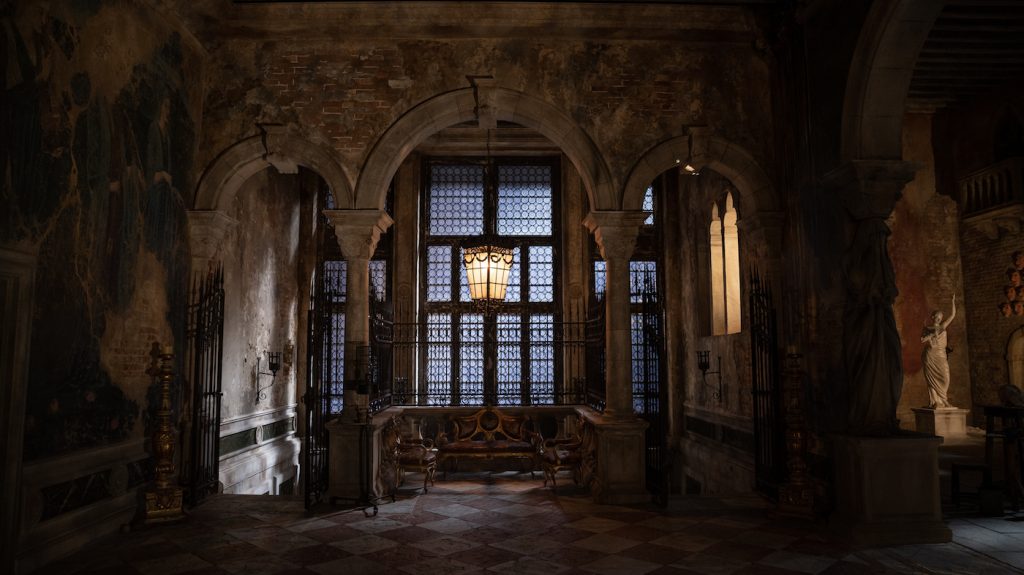
Early on, Branagh and Kelly scouted the slumbering waterways of Venice, stepping into many of the enchanting palazzos in the small city. Their eyes set on filming in one (or more) of them, but complex script elements pushed them to build their own at Pinewood Studios outside of London. In conceptualizing the set builds, Kelly meticulously tuned into the historical style. “There’s a consistent layout with the palazzos. There’s the boathouse, or cabana, where you bring in the gondola on the lower floor, and then upstairs is the piano nobile where all the impressive stuff happens, then a living floor above that,” he explains. “We added a few dimensions – secret passages and long corridors – and embellished it a bit, but we stayed true to the Venice architecture.”
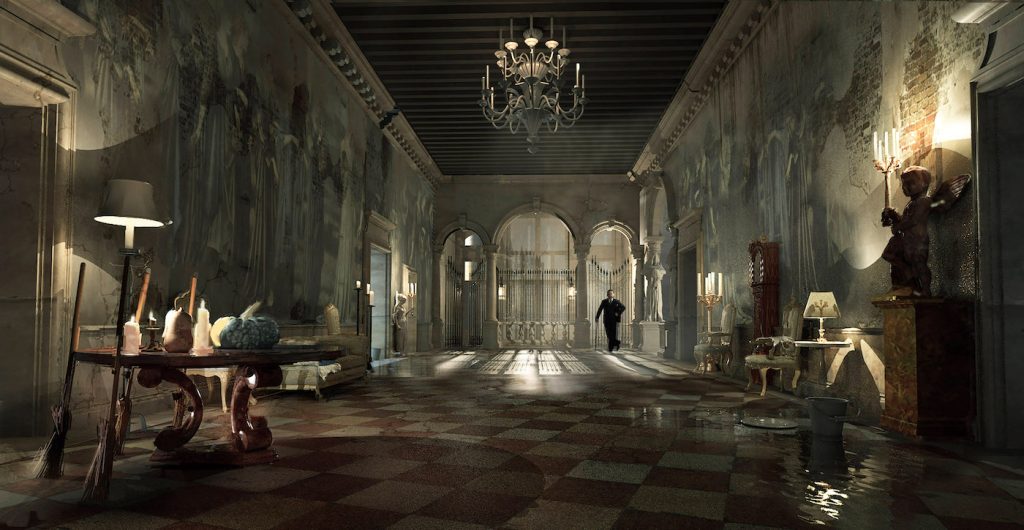
Since the film takes place in almost one location, Kelly created spaces that showed variations in color palette, texture, and mood. Each room required layers and layers of history on its walls. Fresco paintings were overlaid onto decaying plaster, which revealed bricks and dampness behind them. The sets were elaborate and painstaking, but the decoration avoided clutter. “Celia Bobak has been Ken’s set decorator for decades, so she knows him well, which was a huge advantage,” says Kelly. “Like me, Celia is really into historical accuracy, and she was determined that the world we created was believable. We started with a much fuller world and then stripped it back gradually, bit by bit. We ended up with a full environment but minimally dressed.”
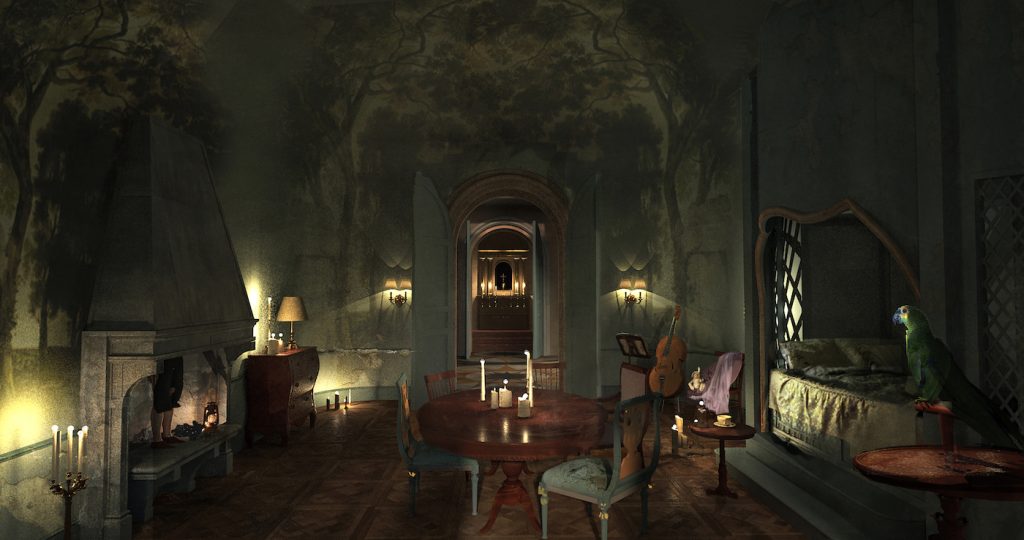
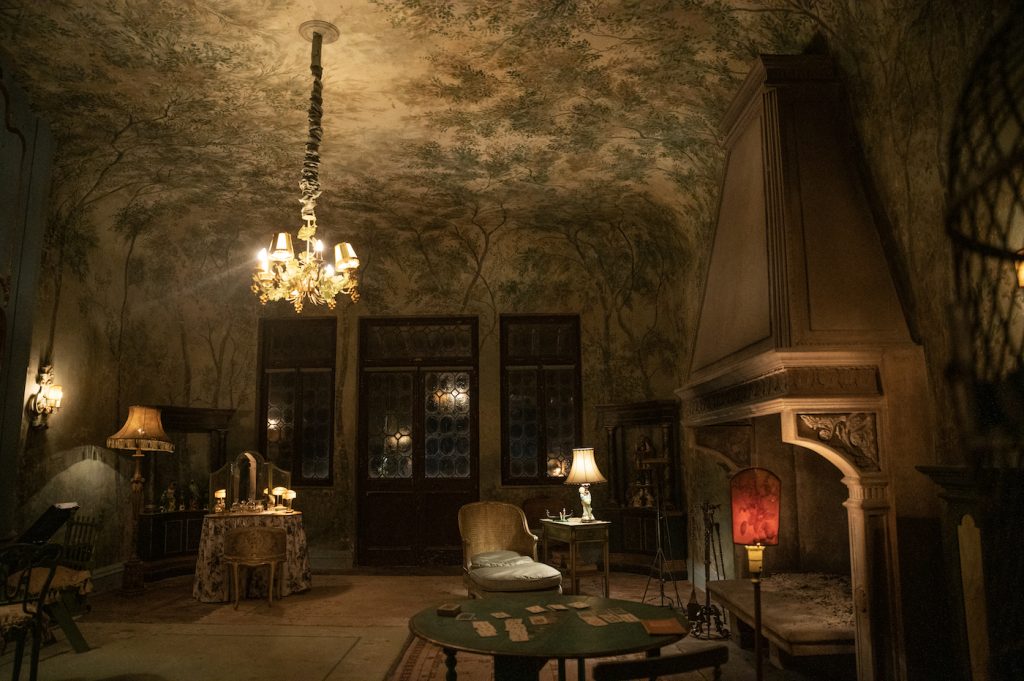
Extra attention was given to Alicia’s bedroom, which was left alone after her death. It’s decorated with delicate touches of tables, lamps, chairs, a bed, and a large stone fireplace. Unique to the space are the darkly painted trees on the walls. “One of the early photographic references that Ken really liked was this bird trapped in a cage,” notes Kelly. “That led to the idea of an enchanted forest. This kind of confusing space where the child was not quite sure what was real and what was in her imagination. The design evolved gradually, but it became clear that it would feel like a very different environment.”
Originally, the séance Hercule attends along with the ensemble cast of suspects that includes actors Kyle Allen, Camille Cottin, Jamie Dornan, Jude Hill, Ali Khan, Emma Laird, and Riccardo Scamarcio, was supposed to be shot inside Alicia’s bedroom. In a happy accident, it was swapped for the corridor leading to the room. The corridor design has a white and burnt orange checkered tile floor and steely color palette walls – a mix of teals and grays that create an almost underwater color scheme. “Ken liked the corridors, and he came up with his idea to create a cruciform séance with Mrs. Reynolds (Michelle Yeoh) in the middle. We were always trying to challenge the rule of what horror should be and hopefully find an original slant on it. This was one of those moments.”
If you’re going to see Brie Larson’s return as Captain Marvel, why not see it on the biggest screen possible? The new IMAX spot for The Marvels poses that exact question, teasing Larson’s return as arguably the mightiest of all the Avengers in director Nia DaCosta’s upcoming film. Only in The Marvels, Carol Danvers, a.k.a. Captain Marvel (Larson, of course), will no longer be a solo act (no offense to Nick Fury, who has certainly been on her side from the beginning)…now, thanks to some strange cosmic voodoo that happens when the good Captain goes to explore an anomalous wormhole, her powers get mixed up with two other formidable young women. When one woman unleashes her power, she immediately switches places with one of the others. It’s a tricky bit of business, and it’ll give The Marvels a unique twist.
Those young women, you might have learned in previous trailers, are her estranged Niece, S.A.B.E.R. astronaut Captain Monica Rambeau (Teyonah Harris), and a young girl from Jersey City named Kamala Khan (Iman Vellani, reprising her role from Disney+’s Ms. Marvel). These three very different but equally courageous women will need to join forces to take on a Kree revolutionary named Dar-Benn (Zawe Ashton), who has a bone to pick with Captain Marvel. They’re going to have to learn to be a team, which is made doubly difficult by the little snafu that zaps them hither and tither anytime they use their powers.
Samuel L. Jackson returns as Nick Fury, and he’s joined by Park Seo-joon, Zenobia Shroff, Saagar Shaikh, Mohan Kapur, Jessica Zhou, and Caroline Simonnet.
Higher. Further. Faster. These three words have long been the motto of Captain Marvel, but now that she’s part of a super-team, she’s added another—together.
Check out the new IMAX spot below. The Marvels soars into theaters on November 10.
Another weekend, another major milestone passed. Greta Gerwig’s Barbie has danced past Rian Johnson’s Star Wars: The Last Jedi in its eighth weekend at the box office, yet another incredible feat for the movie that can seemingly do it all. Barbie is no longer winning the box office belt every weekend (this past weekend, that honor went to The Nun II), but its most recent haul pushed it up to $620.27 million domestically, which edges out The Last Jedi, which brought in $620.18 million at the domestic box office.
And now, for the few people around the country who didn’t watch Margot Robbie become the iconic Mattel doll with a sudden case of existential dread, you’ll be able to catch Barbie at home. While the film is still in theaters, it’s now officially available on streaming services as of 12 a.m. ET on Tuesday, September 12. You’ll be able to stream the movie for a 48-hour rental at $24.99, or you can own it for $29.99 on participating platforms.
It goes without saying now that Barbie is a legitimate cultural phenomenon, the kind of movie that seems like such an implausible mega-blockbuster until it seems like its success was inevitable. Opening on the same day as Christopher Nolan’s Oppenheimer and thus bringing Barbenheimer into the cultural lexicon, both films proved that audiences are hungry—very hungry—for original films by passionate, daring filmmakers. Barbie has become the highest-grossing film in Warner Bros.’s 100-year history, to name just one massive record. Nolan’s Oppenheimer has done remarkably well, obliterating expectations, especially considering it’s a three-hour biopic about the father of the Atomic bomb. (The streaming date for Oppenheimer hasn’t been locked down yet, but you can expect to wait a bit longer for it).
Whether you’ve seen Barbie in the theaters once, twice, or more, you can now track her journey with Ken from Barbie Land to the real world (and back again) from the comfort of your own home. Or, catch it in theaters one last time while it’s still there.
Featured image: Caption: (L-r) RYAN GOSLING, MARGOT ROBBIE and Director/Writer GRETA GERWIG on the set of Warner Bros. Pictures’ “BARBIE,” a Warner Bros. Pictures release. Photo Credit: Jaap Buitendijk
A Los Angeles native and longtime Lakers fan, production designer Richard Toyon had a good idea of how the HBO series Winning Time: The Rise of the Lakers Dynasty should look. After all, he was there when it originally happened.
Opening in 1979, season 1 saw Jerry Buss (John C. Reilly) buyingthe Lakers and drafting rookie sensation Earvin “Magic” Johnson (Quincy Isaiah) in the quest for a championship.Season 2 coversthe turbulent years following the 1980 win, delving into Magic’s clash with coach Paul Westhead (Jason Segel), the growing rivalry between the Lakers and the Boston Celtics, and its rising star Larry Bird (Sean Patrick Small).
As the series wraps up this Sunday (September 17), The Credits chatted with Toyon to discuss design challenges, the secrets to capturing the 1980s, and the day Jeanie Buss visited the set.
What was your focus heading intoseason 2?
We knew that some sets had to evolve and enlarge. We knew Pickfair was on the horizon and going to be an endeavor. Fortunately, most of our department heads returned. There were many moving parts, but it was very satisfying to recreate that era. Even though you know the Lakers’ record — who was going to win, who was going to lose — the challenge was to immerse the viewer into that space.
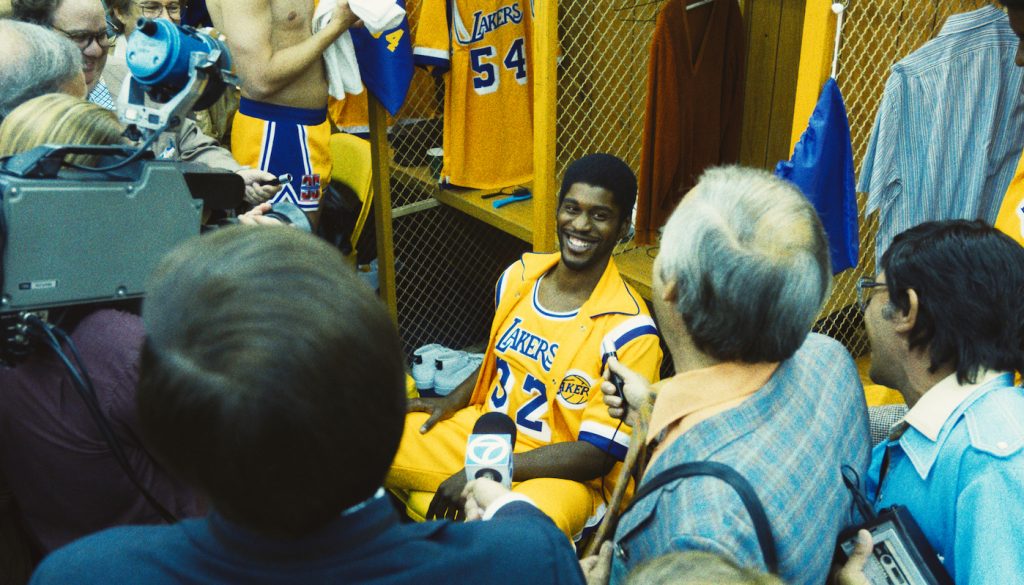
Quincy Isaiah. Photograph by Warrick Page/HBO
What adjustments were made?
In the first season, the big question was how we were going to reproduce the Forum. We didn’t have access. The stages available at Los Angeles Center Studios were all the same size. The question was, can one fit a natural NBA floor and have stands around it? My first order of business was to figure that out. You could — albeit not as big as you might want.
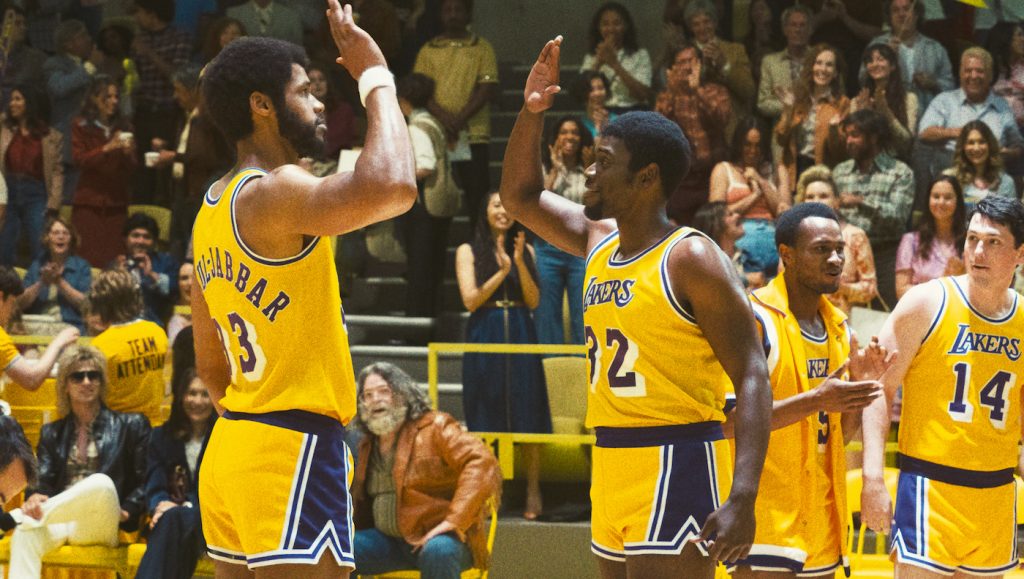
Solomon Hughes, Quincy Isaiah. Photograph by Warrick Page/HBO
That changed in season 2?
We moved to Warner Bros. for season 2. The stage was maybe fifteen to twenty percent larger. It gave us the ability to curve stands around the sides and create a tunnel system with direct interaction with the court. That was key to making the basketball work for the directors.
Jason Segel. Photograph by Warrick Page/HBO
Did you make any other changes to how you built the court?
We used a company that specializes in creating NBA and NCAA floors. We graphically laid it out, and they built the floor. We had all the colors of the real Forum floor. But that’s all we had. We had to build new stands, a whole new tunnel system, and all that surrounds it. It took about ninety days to construct.
Adrien Brody. Photograph by Warrick Page/HBO
You mentioned Pickfair. (Jerry Buss bought the estate in 1980.) Talk about recreating that.
Pickfair was this fabled structure in Beverly Hills. It started as a hunting lodge, and then Douglas Fairbanks bought it for Mary Pickford after they married. They upgraded and renovated it. In all, it had about forty-three rooms. Obviously, we couldn’t build forty-three rooms. I had to boil down the script’s actionand design the essence of Pickfair. I create a layout with a certain largeness that we’d be able to build. That was also at Warner Bros. It took a number of people a long time to create.
L-r: Quincy Isaiah, John C. Reilly, DeVaughn Nixon. Photograph by Warrick Page/HBO
How did you set about recreating this legendary estate?
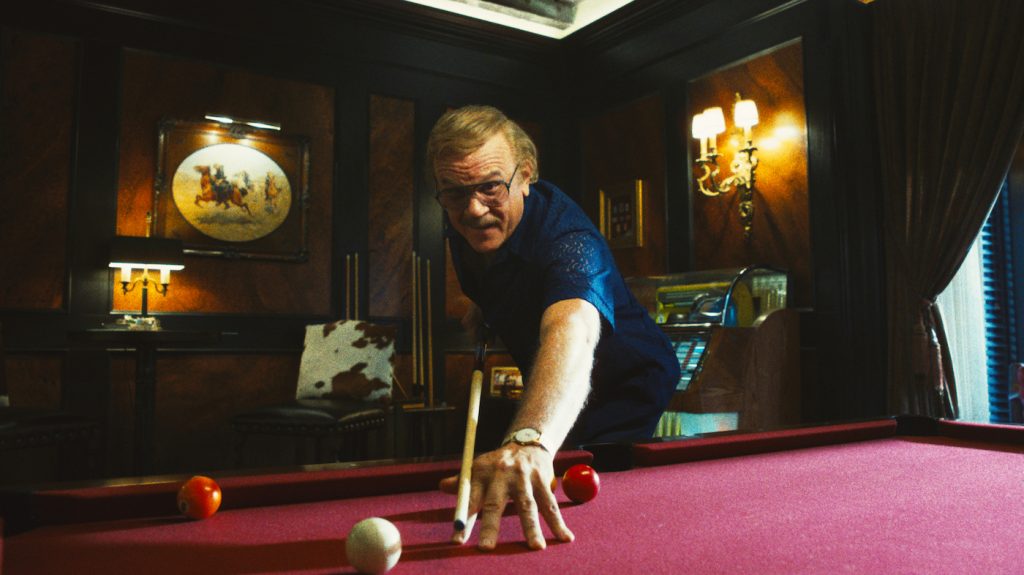
We went to a number of architectural archival sources and found maybe twenty to twenty-five photos. The architect of record who renovated Pickfair had created a white paper. Some of those photographs were available. But there were not a whole lot, and certainly none from the Buss era. Jerry Buss was all about stylizing himself as a second coming of Hugh Hefner. The Pickfair game room was a homage to his attempt to create that persona. But we only had a description and some video snippets of what it was like. From that, we created this masculine environment. We also built a living room, a dining room, and a kitchen. We had this long hallway. The stairway that led up to the bedrooms was very specific. Because we had such tall actors, the camera was always looking up. The ceilings became important. Whenever you’re looking at the Pickfair scenes, you see a lot of ceilings. Thank goodness we paid attention to this.
John C. Reilly. Photograph by Warrick Page/HBO
Did you consider filming at Pickfair?
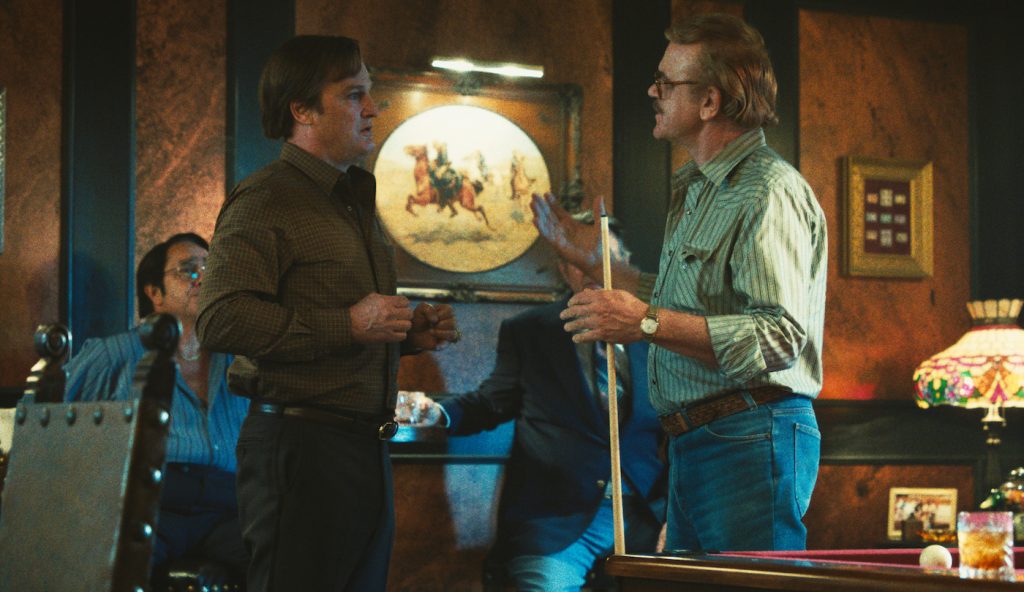
Jerry Buss sold the estate to Pia Zadora and her husband. In short order, they ended up razing it. The only thing that’s left is the gates. In episode four, Paul Westhead goes to meet Jack McKinney (Tracy Letts) at the Hamburger Hamlet. The restaurant used to have actors’ photographs on the walls. We placed Pia Zadora’s behind Jack McKinney. That’s one of our Easter eggs.
How did you give season 2 that 1980s feel?
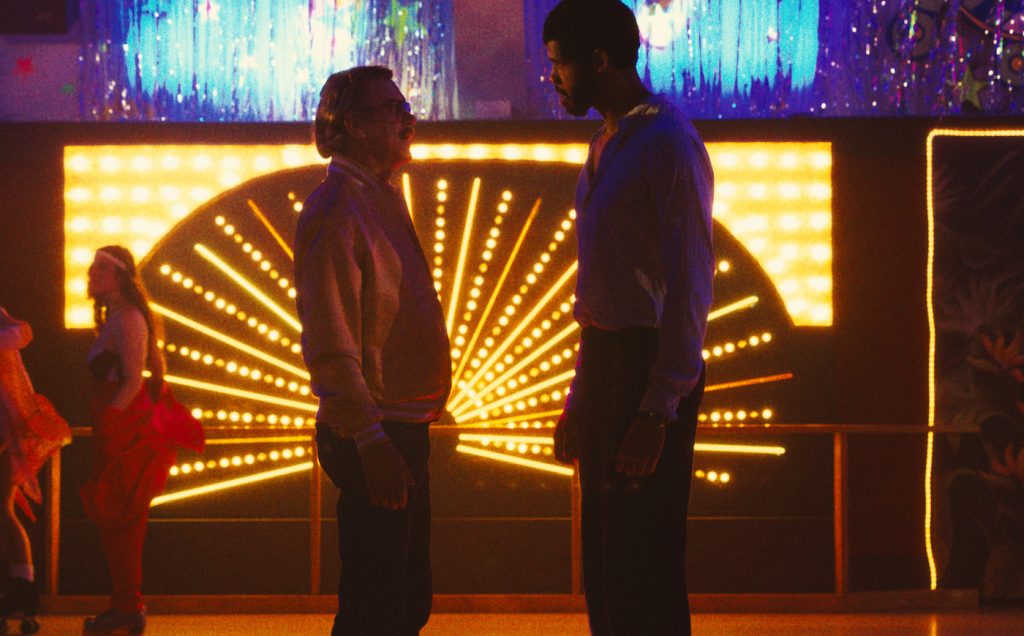
We go from 1980 to 1984. Los Angeles’s design was changing so much. The 80s were always kind of searching for its true self. There were a lot of outlandish colors, a dissolution of graphic standards, and even a change in architecture to postmodernism. We wanted to make sure we didn’t blow our wad in the first scene. You saw a progression – our colors becoming brighter, more Miami Vice — turquoise, peaches, magentas. We took into account what our costume designer (Emma Potter) was putting on our actors so they weren’t contrasting with the background or falling into it. Light sources were important. I worked with the director of photography (Todd Banhazl) to figure that out. When you see the Forum Club for the last time, it’s completely changed. That set has all built-in lighting. In season two, we were able to expand the design — really push things. You see Chasen’s restaurant in the first season. That was the last gasp of the red leather restaurant, where you would get a good steak and a stiff drink. The 80s began pulling that idea apart. Those longtime institutions were going away. New things were coming on. In season two, we went to a roller rink.
John C. Reilly and Solomon Hughes. Photograph by Warrick Page/HBO
What stands out most about your Winning Time efforts?
We have a great team. We knew season onewould be difficult. All the department heads were talking to each other, collaborating to create this world. In season two, it felt like we were firing on all eight cylinders — costume, props, production design, cinematography — all working together. You felt it. There’s an old saying that a designer’s job is to hold up every frame of film, and the second your fingertips go into the frame, you’ve done too much. When I’m watching Winning Time, I feel we stayed just below the frame.
Is there an ethos to the way the show is constructed? You’re capturing these larger-than-life figures, many of whom are still alive.
The entire series is done with great reverence towards that period of time, the team, those players, and Jerry Buss. It was never intended to deride anybody. It’s intended to tell the story. It’s a pivotal time in the NBA and in Los Angeles. I get comments on Instagram and Facebook like, “Man, this show is fantastic, and I’m not even a Lakers fan,” which is great because this is who you want to hook. To see that they are coming along on this journey is really gratifying. In the beginning, we didn’t have the Lakers support. Eventually, they came around, and Jeanie Buss herself visited our Pickfair set. She choked up as she walked through. She said the game room furnishings were exactly how her dad had it. She thought the stairway was lovely. She told us, “I sat at the bottom of that stairway many times, waiting for my dad to talk to him.” That, I think, was my favorite moment. It was validation.
For more on Winning Time, check out these stories:
The first teaser for director James Wan’s upcoming Aquaman and the Lost Kingdom gives us a glimpse at one of the chief antagonists looking to take out Arthur Curry (Jason Momoa). That would be David Kane (Yahya Abdul-Mateen II), better known as Black Manta, the former rogue special forces officer who Aquaman left for dead—after killing his father, no less—in the first Aquaman. Black Manta survived his encounter with Aquaman, barely, and has been building himself and his high-tech suit into ferocious fighting form ever since. He’s got a new weapon to help him on his quest for vengeance, the Black Trident, which will make him an even more formidable adversary.
“I’m going to kill Aquaman and destroy everything he holds dear,” Manta promises in the new teaser. The man certainly means what he says. The Lost Kingdom will find Aquaman looking for help from another powerful individual who was determined to kill him, his brother Orm (Patrick Wilson), who ended the first film imprisoned after his failed attempt to crush Aquaman and claim the throne of Atlantis. The two brothers will have to join forces to take on Black Mantha and the terrific force that the Black Trident unleashes.
Joining Momoa, Abdul-Mateen II, and Wilson are Amber Heard as Mera, Nicole Kidman as Atlanna, Temuera Morrison as Tom Curry, Dolph Lundgren as King Nereus, Jani Zhao as Stingray, Vincent Regan as Atlan, and Randall Park as Dr. Stephen Shin.
Aquaman and the Lost Kingdom will be the last film to bow for DC Studios that doesn’t carry the direct imprimatur of new bosses James Gunn and Peter Safran.
Check out the teaser here. Aquaman and the Lost Kingdom hits theaters on December 20.
Here’s the official synopsis:
Having failed to defeat Aquaman the first time, Black Manta, still driven by the need to avenge his father’s death, will stop at nothing to take Aquaman down once and for all. This time Black Manta is more formidable than ever before, wielding the power of the mythic Black Trident, which unleashes an ancient and malevolent force. To defeat him, Aquaman will turn to his imprisoned brother Orm, the former King of Atlantis, to forge an unlikely alliance. Together, they must set aside their differences in order to protect their kingdom and save Aquaman’s family, and the world, from irreversible destruction.
All returning to the roles they originated, Jason Momoa plays Arthur Curry/Aquaman, now balancing his duties as both the King of Atlantis and a new father; Patrick Wilson is Orm, Aquaman’s half-brother and his nemesis, who must now step into a new role as his brother’s reluctant ally; Amber Heard is Mera, Atlantis’ Queen and mother of the heir to the throne; Yahya Abdul-Mateen II is Black Manta, committed more than ever to avenge his father’s death by destroying Aquaman, his family and Atlantis; and Nicole Kidman as Atlanna, a fierce leader and mother with the heart of a warrior. Also reprising their roles are Dolph Lundgren as King Nereus and Randall Park as Dr. Stephen Shin.
For more on Aquaman and the Lost Kingdom, check out these stories:
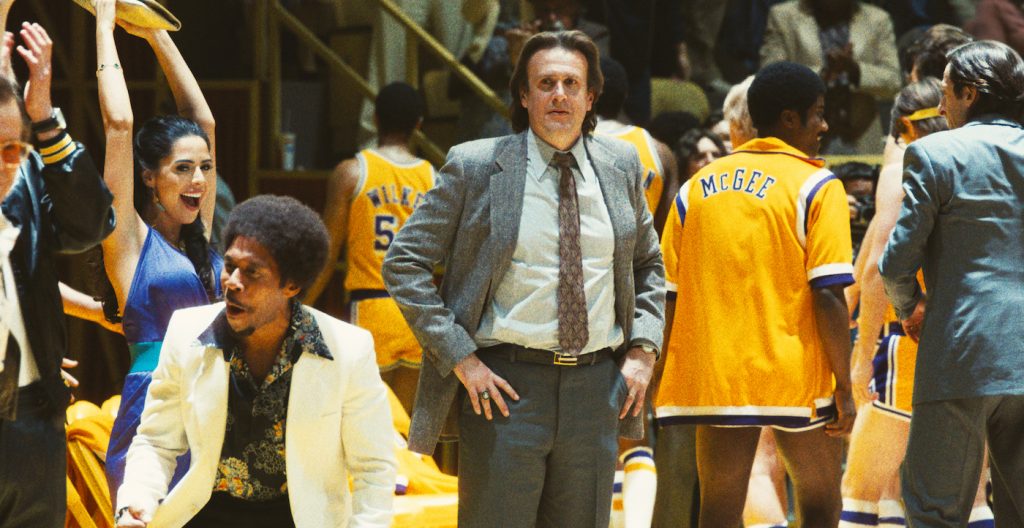
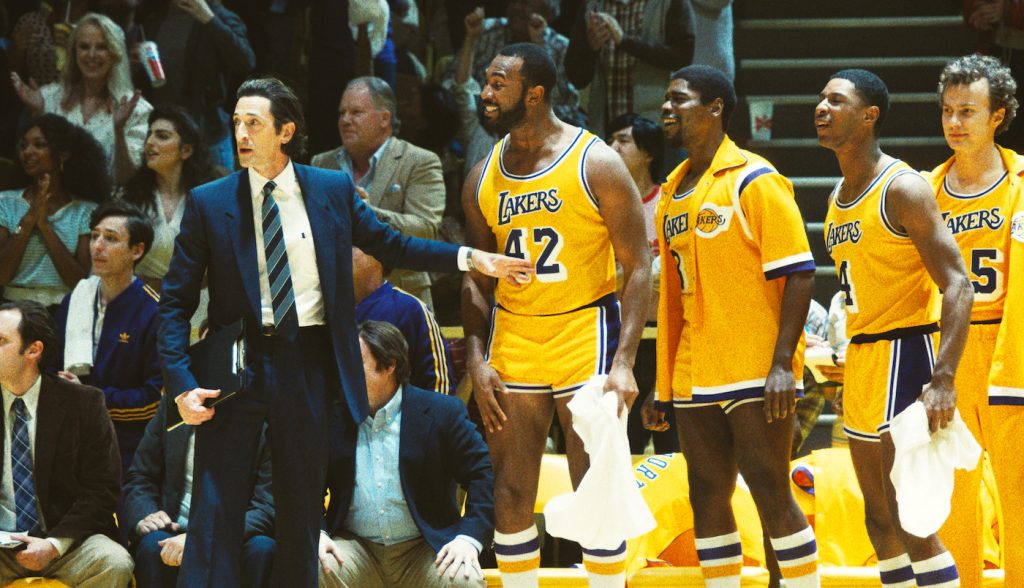
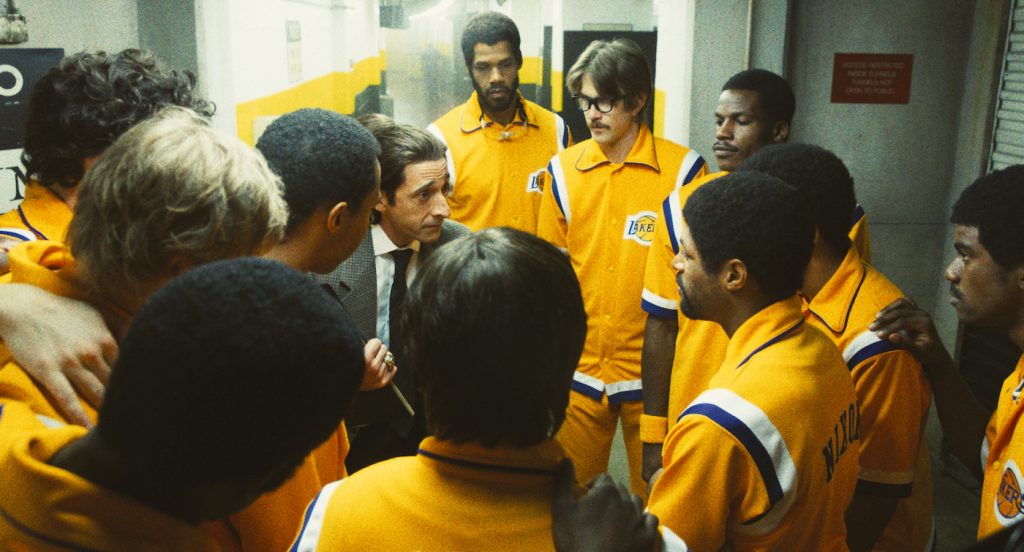
In all their gold and purple splendor, the Lakers are back for a second season of HBO’s Winning Time, which tracks the rise of the team’s path to glory during the late 1970s and early 1980s. The show’s first season focused on Magic Johnson’s (Quincy Isaiah) rookie season and the team’s unlikely title win. This time around, the returning champs get off to a rocky start, with Magic out with a knee injury, tension between coaches Paul Westhead (Jason Segal) and Pat Riley (Adrien Brody), and a general sense that Magic, Kareem Abdul-Jabbar (Solomon Hughes), Norm Nixon (DeVaughn Nixon), and the rest of the players need to rediscover their footing as a team.
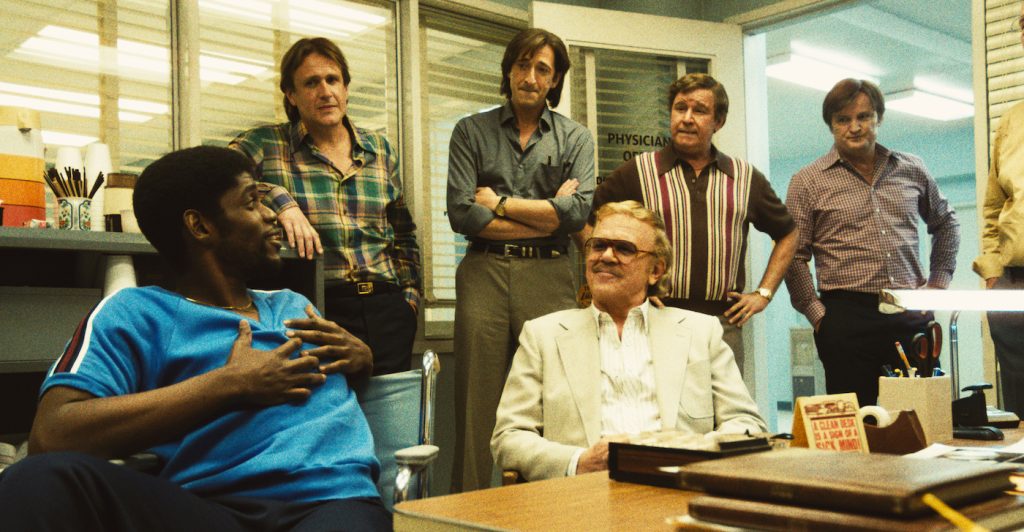
It’s a time of transition — for Riley, as he emerges as a dominant coaching force, for Jerry Buss’s (John C. Reilly) offspring, gifted with sports franchises of their own, and for the season’s wardrobe. “One of the things I was most excited about with this season was how we were going to transition more into the eighties,” said costume designer Emma Potter (True Detective, Perry Mason). “I had started talking early on with our DP Todd [Banhazl] about what we could do in terms of color and shine and texture.” Potter and her core team of 30 to 35 people (plus many more for arena shoots when the costume design department was tasked with dressing up to 1200 people) subtly bring the team and their coaches, girlfriends, cheerleaders, plus owner Buss and his family, into the next decade, outfitting them between late seventies pieces with hints of the eighties to come. “Those moments, where people are trying to figure out how to transition themselves, were super interesting to me,” Potter says.
L-r: Quincy Isaiah, John C. Reilly, DeVaughn Nixon. Photograph by Warrick Page/HBO
Among the costume designer’s stand-out characters to dress this season were Pat Riley, who we get to see in the Armani suits the real coach donned starting in the mid-eighties, and Jerry Buss’s daughter Jeanie (Hadley Robinson), who finds her footing as a sports franchise owner in her own right. “She’s the first woman who comes in wearing pants in the space — everybody else is still in their suits or dresses,” says Potter. However, the costume designer works by developing a rapport with all of the shows’ primary actors on how they should be dressed. We spoke with Potter about her one-on-one approach, building vintage Lakers uniforms and leaning into the series’ unusual cinematography to moor the characters’ wardrobes in another time.
Can you tell us about your approach to working closely with the actors on how to dress their characters?
I start each project and each season with a big visual library for each person. I’ll write a lot in there about what I imagine will happen to them and how it will be reflected in their costumes. It’s a way for me to open the door and talk. John C. Reilly and I were able to sit down, look at those images, start to see where things were shifting as he moved into the eighties, and discuss how we imagined he might push that even further. I like being able to bounce ideas off each other because, at this point in the second season, they’re inhabiting that character themselves. They’ve been able to ruminate on what they think these people should look like as they move through the time period. In those discussions, something unusual always comes out of it, and I think it allows more depth to be able to collaborate.
L-r: Quincy Isaiah, Jason Segel, Adrien Brody, John C. Reilly, Spencer Garrett, Jason Clarke. Photograph by Warrick Page/HBO
What’s a particular look that arose out of these ongoing conversations?
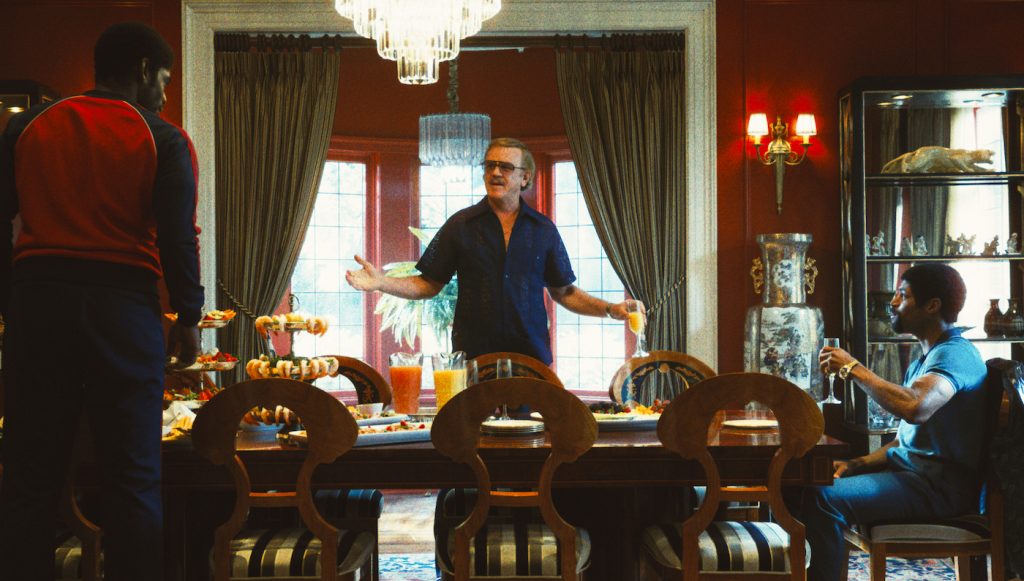
I think a big one would be John and the tracksuits. We talked about this idea that when [Buss] got a new love interest, maybe he dived a little more into the eighties. We talked about the idea of athletic wear coming into everyday clothing and the exercise fads that were going around. Out of that came that shiny gold polyester tracksuit that we get to see him wearing when he’s having his Happy Meal with Magic. And that was not a direction I thought we’d go in, but through those conversations, it really started to feel right for the character. I loved the juxtaposition of beautiful, old Pickfair surroundings and this modern tracksuit that he’s wearing.
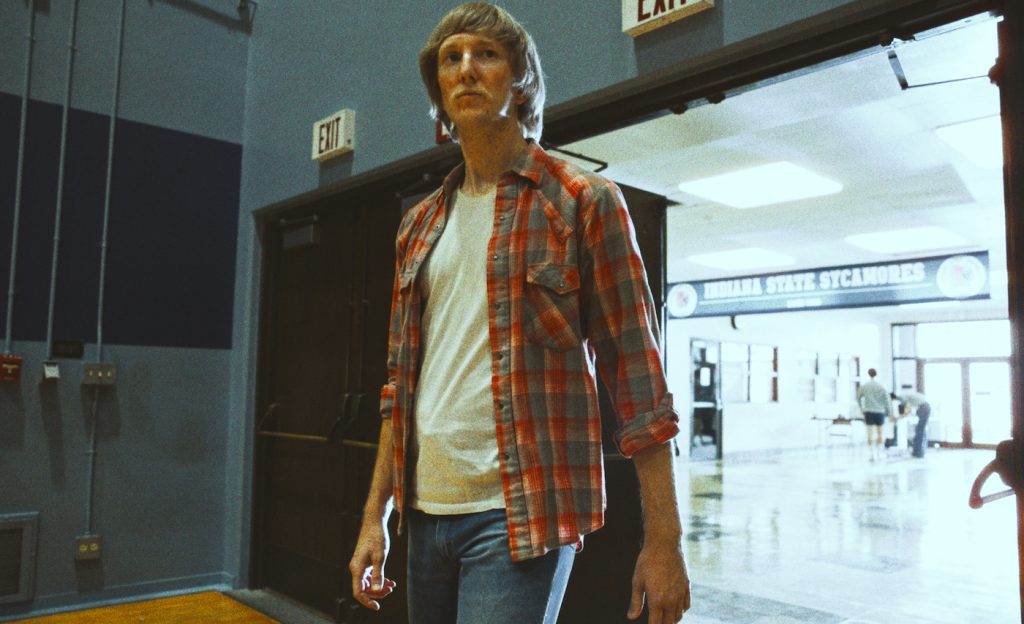
This season, we also get a sense of Larry Bird’s roots, down to playing in front of a college recruiter while wearing jeans.
I loved that detail. That was something that was in the script that had come out of the research that Max [Borenstein, co-creator] and the writing team had done. There’s an amazing documentary about Magic and Bird, and you find a couple of fantastic photographs from when these people were very young, and between all of it, you can put together a picture of what it might have been. That episode was eye-opening in a way; it gave a lot of humanity to that character.
Sean Patrick Small. Photograph by Warrick Page/HBO
Were the ‘Magic is Back’ t-shirts, which so upset his character, based on a real moment?
They had made pins. In our script, it had these t-shirts, as well as the pins, to expand upon it. So that was a t-shirt I had custom-made.
L-r: Joey Brooks, Quincy Isaia. Photograph by Warrick Page/HBO
What else did you have to build?
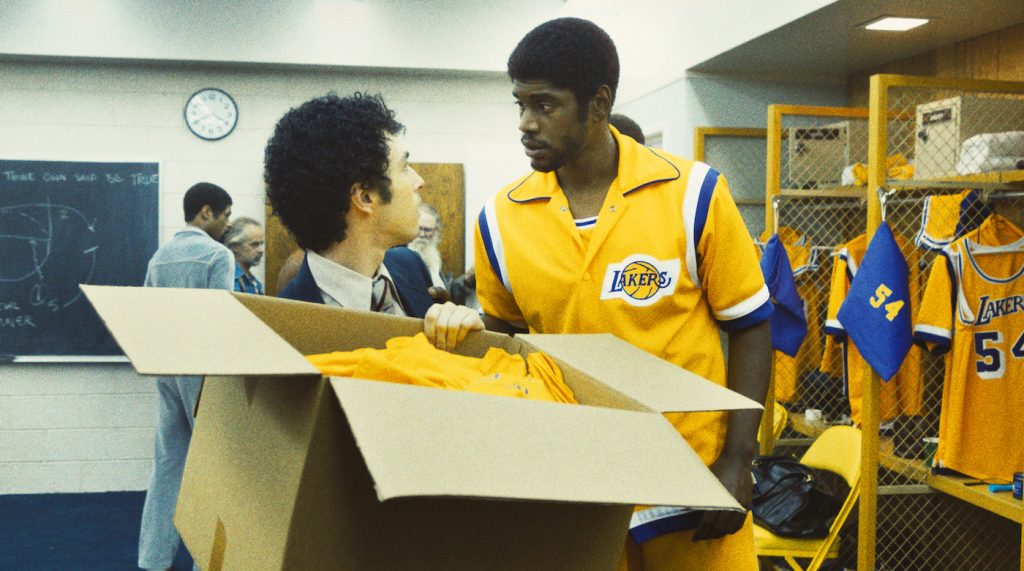
All the uniforms are built from scratch, and even some of the fabrics were made for us to be able to build the uniforms from scratch. All of the Laker Girls were built from scratch as well, and then for characters like Dr. Buss, Kareem, and Magic, everything was pretty much is custom-made, except for Dr. Buss’s jeans, which were vintage. Then there are characters like Pat Riley or Jerry West, where it’s a nice combination of custom-made suiting and shirting mixed with vintage knits or vintage accessories. Then, a lot of the women are sourced vintage clothing from the era.
Adrien Brody, Solomon Hughes. Warrick Page/HBO
I’ve heard sourcing clothing from that era can be difficult, as it hasn’t often held up well.
It’s a huge process that we start months before we shoot, and we’re still continually doing it throughout the shoot. You have to find the thing that’s right for the character, it has to be in the right size, and then it has to be in good enough condition that it looks like it was pretty new when they bought it. There are a couple of upcoming knits that Jerry West has that I found in New York months before we even started the project. They were in perfect condition, they were going to fit him perfectly, and it’s just kind of wild to still be able to find that stuff. Then you mix that with your custom-made clothing, which adds such a nice layer to the characters.
L-r: Jason Clarke, John C. Reilly. Photograph by Warrick Page/HBO
The show’s cinematography has a distinct vintage look. Does that affect your process?
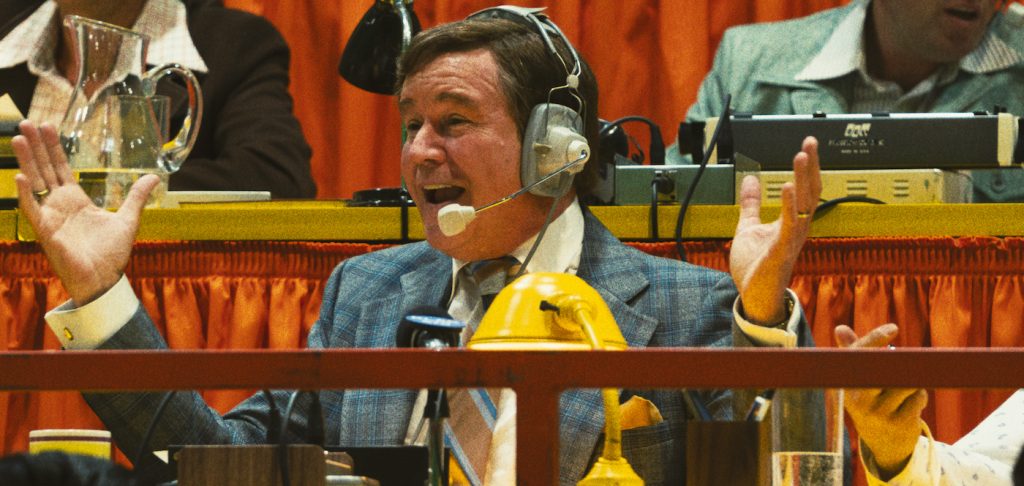
I think working with Todd has been one of my favorite collaborations. I would often take fabrics to him to shoot and see what would work. I learned very quickly that certain colors render differently, or patterns get lost, and the details I’m seeing might not come through. It was an ongoing process to make sure what we were making or leaning into would be seen on-screen in the way that I imagined it. You know when you see these old videos of the games, and there are these sports commentators, and some part of their outfit is vibrating on-camera because the patterns are too tight? That was something we decided to lean into. So there were moments for Chick Hearn [played by Spencer Garrett] and some of the other commentators where we intentionally wanted to do that, which was fun and unusual to me, but it meant taking a lot of fabrics over and checking, is this moiré-ing? Does this make him look crazy?
Spencer Garrett. Photograph by Warrick Page/HBO
Those arena moments sound like a massive undertaking, even if they’re only a small part of the show.
It’s always interesting to step back and realize what a team of people it takes to achieve all of that. There’s an entirely separate team within my team that makes all of the uniforms happen. There’s a team within my team that’s responsible just for getting the Laker Girls put together. When you’re seeing those arena moments, and it’s cut so quickly, and it’s such an energetic scene, you’re just getting these flashes, so all of that work becomes texture on the screen. But I can sit back and remember how much detail we paid to each little piece that’s within that. I think it all adds to the dynamic energy of the show.
For more on Winning Time: The Rise of the Lakers Dynasty, check out these stories:
When news broke that Hugh Jackman was reprising his role as Wolverine for Deadpool 3, all felt momentarily right in the superhero world. Jackman was returning to the character that made him an international superstar (yes, despite Wolverine’s noble death in James Mangold’s 2017 film Logan), and he was doing so just as Reynolds’ mouthy, hilarious Deadpool was himself becoming a proper member of the Marvel Cinematic Universe. Deadpool 3 will be the first film in the franchise to fall directly under the MCU banner after Disney’s acquisition of 21st Century Fox was completed in March of 2019. The stars had aligned, and these two superstars were finally going to take their years-long routine of ribbing each other online and via video into a proper feature film.
Deadpool 3 director Shawn Levy is opening up about just how much of Jackman’s presence we can expect in the film. Levy, who co-wrote the film with longtime Deadpool scribes Paul Wernick and Rhett Reese, as well as with Reynolds himself, Zeb Wells, Lizzie Molyneux-Logelin, and Wendy Molyneux, told Collider that we can prepare for a “two-hander,” a movie that’s centered on these two strikingly different superheroes and the superstars who play them.
Speaking at the Toronto International Film Festival before the world premiere of his limited series All the Light We Cannot See, Levy told Collider that the chatty Deadpool will be fully sharing the stage in the third film with the reticent, tough-as-nails Wolverine.
“You have two major movie stars together in a movie playing their most iconic signature roles – that is director heaven,” Levy told Collider. “So the story, the tone, the movie itself leans into that gift of having Deadpool and Wolverine co-starring in a movie for the first time. So, we’re definitely not running away from that.”
Levy also reiterated that the film will be “raw, audacious,” and a first for any movie containing Wolverine, R-rated. Considering how raw Logan was, it will be very intriguing to see what Wolverine can do when he’s free to tap into the full extent of his rage, not just physically but verbally. You can be almost certain that Deadpool, despite having clamored for real Marvel involvement for years (he’s mocked the X-Men openly, but it’s always been clear he desperately wanted to be a member), will bristle at sharing the spotlight with the world’s most famous mutant. Considering the longstanding tradition in the Deadpool franchise for the character to break the fourth wall, we should probably expect a lot of hilarious, catty asides at Wolverine’s expense.
Newcomers to the franchise include Jennifer Garner, who reprises her earlier role of Elektra, and Emma Corrin and Matthew MacFayden in undisclosed roles. Returning stars include Morena Baccarin as Vanessa, Shioli Kutsuan as Yukio, Brianna Hildebrand as Negasonic Teenage Warhead, Stefan Kapici as Colossus, Rob Delaney as Peter, Karan Soni as Dopinder, and Leslie Uggams as Blind Al.
There are whispers that other Marvel characters might make an appearance, including Ian McKellen’s Magneto, Patrick Stewart’s Professor X, and Owen Wilson’s Mobius.
Apple TV+ has revealed the first teaser trailer for their upcoming series Monarch: Legacy of Monsters, which continues exploring the Titans featured in Legendary’s Monsterverse films, those colossal monsters that include Godzilla and King Kong, and Monarch, the shadowy organization that tracks them.
Monarch: Legacy of Monsters is led by the father and son duo of Kurt and Wyatt Russell, with a story spanning three generations and centered on two siblings who are following in their father’s footsteps to unearth their family’s connection to the Monarch organization, that secretive cabal that has been keeping tabs on the various Titans. The two most well-known Titans are the aforementioned Godzilla and King Kong, but they’re hardly the only beasts worth keeping an eye on. Others include Mothra, King Ghidorah, Rodan, Scylla, Behemoth, and more.
The Russells play the same man—Lee Shaw—portrayed by Wyatt Russell as a young man in the 1950s and then by Kurt Russell in the show’s present. Shaw is the key individual who holds secrets that are a major threat to Monarch. The series is set after the events in 2014’s Godzilla.
The cast also includes Anna Sawai, Kiersey Clemons, Ren Watabe, Mari Yamamoto, Anders Holm, Joe Tippett, and Eliza Lasowski.
Monarch: Legacy of Monsters was co-developed by Matt Fraction (Hawkeye) and Chris Black (Outcast, Star Trek: Enterprise), with Matt Shakman (WandaVision) helming the first two episodes.
Check out the trailer below. Monarch: Legacy of Monsters stomps onto Apple TV+ on November 17:
For more stories on Apple TV series and films, check these out:
The father of the zombie movie’s final film will finally see the light of day (and the dark of night).
George Romero’s Twilight of the Dead will be directed by Brad Anderson and produced by multi-platform company Roundtable Entertainment, The Hollywood Reporter scoops. Roundtable had recently announced a partnership with the Romero estate to get the master’s final film to the big screen. Production is expected to begin later this year.
Twighlight of the Dead will be the seventh and final installment of Romero’s Living Dead franchise, which began with his iconic 1968 film Night of the Living Dead. The last film Romero directed in the franchise was 2009’s Survival of the Dead. Each film is mainly centered on various groups of people trying to survive the zombie apocalypse, a mutating, evolving catastrophe.
Romero and Paolo Zelati wrote the treatment for Twilight of the Dead, and the script was penned by Robert Lucas, Joe Knetter, and Zelati.
“George Romero’s 1968 classic Night of the Living Dead may have been the first real horror movie I ever saw, and its shock value, its keen social relevance, and even the means by which it was made were all hugely inspirational to me,” Anderson told The Hollywood Reporter. “This too is a zombie movie in which limbs fly and heads roll, but one that is also about social transformation, one that asks the question: What is it to be human? It is also a horror movie with “heart” and, dare I say, hope.”
Details about the story are being kept in a crypt, but we’ll share more when we hear more.
For more big upcoming films, check out these stories:
Featured image: A line of undead ‘zombies’ walk through a field in the night in a still from the film, ‘Night Of The Living Dead,’ directed by George Romero, 1968. (Photo by Pictorial Parade/Getty Images)
The reboot of the 1994 film starring the late Brandon Lee has landed at Lionsgate, which will be handling domestic distribution for the feature. The film is a re-imagining of the beloved character created by writer James O’Barr and first published by Caliber Comics in 1989. The comic grew an impassioned fan base and was later turned into the cult classic 1994 film directed by Alex Proyas and starring Brandon Lee in his final film appearance. Lee plays Eric Draven, a musician resurrected from the dead to seek vengeance against the gang that murdered his finacée. Yet the production was rocked by tragedy when a prop gun fatally wounded Lee. Although he had filmed most of his scenes, the movie still required some rewrites, effects, and a stunt double to complete. The movie was ultimately released by Miramax (it was initially a Paramount film) and was dedicated to Lee and his fiancée, Eliza Hutton. Lee was the son of the legendary Bruce Lee, who passed away when Brandon was eight.
The new film was directed by Rupert Sanders (Ghost in the Shell) and stars Bill Skarsgård (John Wick 4, It) as Eric Draven. Skarsgård is joined by FKA Twigs, Danny Huston, Laura Birn, Sami Bouajila, and Jordan Bolger. The script comes from Zach Baylin and Will Schneider.
“The original film left an indelible mark on our culture that lives on,” said producers Victor Hadida, Molly Hassell, and John Jencks in a joint statement. The late Samuel Hadida and the late Edward R. Pressman also produced. “We are thrilled to bring a new adaptation for today’s audiences that respects this legacy. Rupert has masterfully brought new dimensions to create a contemporary universe for this timeless saga of undying love, and we can’t wait to share this vision with film audiences.”
“We appreciate what The Crowcharacter and original movie mean to legions of fans and believe this new film will offer audiences an authentic and visceral reinterpretation of its emotional power and mythology,” said Charlotte Koh, Lionsgate executive VP of acquisitions and co-productions.
For more on big upcoming films, check out these stories:
Featured image: PARK CITY, UTAH – JANUARY 27: Bill Skarsgård of ‘Nine Days’ attends the IMDb Studio at Acura Festival Village on Location at the 2020 Sundance Film Festival – Day 4 on January 27, 2020 in Park City, Utah. (Photo by Rich Polk/Getty Images for IMDb)
A new special look at The Creator, from writer/director Gareth Edwards (Godzilla, Rogue One), zeroes in on the face of a war between human beings and artificial intelligence. That face, distressingly, belongs to a little girl, Alphie (Madeleine Yuna Voyles), who reveals, with just a slight turn of her head, to be anything but your average youngster.
She is, in fact, a humanoid robot, lit up by artificial intelligence, and she’s the target of an assassination that Joshua (John David Washington) is tasked with carrying out. Yet, as the special look reveals, and previous trailers explained, Joshua’s mission will be muddled in the extreme when he decides that killing Alphie isn’t the answer to the escalating tensions between the human and artificial worlds.
Concerns over AI, long a staple of sci-fi stories, have become headline news. You’ve possibly read these stories yourself, innewspapers, magazines, or Reddit threads, or listened concerns about AI via podcasts, or perhaps you saw Tom Cruise battle a rogue AI in Mission: Impossible – Dead Reckoning Part One. The point is that while AI has always been in vogue in the realm of sci-fi, now, it’s a growing concern for world governments.
The human world assigns Joshua the mission to take out Alphie because they believe she’s the AI that dropped a nuke on Los Angeles and that she’s only just getting started wiping out humanity. Joining Washington and Voyles is a stellar cast that includes Gemma Chan (Eternals), Ken Watanabe (Inception), Allison Janey (I, Tonya), and Sturgill Simpson (Dog). Edwards directs from a script he co-wrote with Chris Weitz, his collaborator from Rogue One: A Star Wars Story.
Check out the special look here. The Creator hits theaters on September 29:
Reviews are starting to pour in for writer/director Ava DuVernay’s latest film, Origin, which recently had its world premiere at the Venice Film Festival. DuVernay’s latest is centered on the life and work of author and journalist Isabel Wilkerson, specifically on her astonishing, Pulitzer Prize-winning 2020 book “Caste: The Origin of Our Discontents.” Wilkerson’s book was as ambitious in scope as it was scorching to read, centered on her theory that linked racism in the United States to the caste system, most obviously evident in India but also, in Wilkerson’s telling, the very basis for Nazi Germany’s planned obliteration of the Jewish population. It was the must-read book of 2020, a monumental feat that was simultaneously brilliant, heartbreaking, and profound.
This material seems an almost impossible challenge to turn into a narrative feature film, yet it didn’t daunt the ever-ambitious, undoubtedly brilliant DuVernay, who proved with Selma and When They See Us that she’s especially adept at tackling monumental history and sprawling, interconnected systems of abuse with verve, vigor, and command. With Origin, DuVernay set herself the challenge of depicting Wilkerson’s life (she’s played by Aunjanue Ellis-Taylor), both her challenges as a writer and her emotional and romantic life, as she pieced together her theory of American racism.
“To distill Wilkerson’s ideas, DuVernay looks at the personal events that propelled the author to write Caste, shaping Origin as a process film,” writes Lovia Gyarkye in The Hollywood Reporter. “This intimate vantage point also offers a tender love story — one brought to life by passionate and committed performances from Aunjanue Ellis-Taylor and Jon Bernthal.”
TheGuardian‘s Peter Bradshaw wrote, “This is a film with strength and purpose.”
More reviews will arrive in the coming days, but let’s take a peek at what some of the critics are saying now:
‘Origin’ Review: Ava DuVernay’s Monumental Look at ‘Caste’ Frames America’s Most Difficult Conversation https://t.co/3aJ81rUheQ
I’ve seen half a dozen movies good enough to warrant a spot on my year-end Top 10 premiere out of the Telluride/Venice fests in recent days. But here’s the one that surprised me most … because how do you adapt CASTE? Ava DuVernay does it brilliantly! https://t.co/gSCIzytUAB
ORIGIN moved me to tears. Ava DuVernay’s gripping script is an fusion of protagonist Isabel Wilkerson’s novel which investigates caste systems and the tragedies of her personal life. I found the final twenty minutes so immensely emotional. #venezia80https://t.co/YhVmcDtICO
ORIGIN: Ava DuVernay’s made a smart and ambitious film of ideas—ideas that can change the world. It’s rich and expansive, and a rare thing in its approach to reframe the conversation around race. My review: https://t.co/0pRR3rbK7j
Featured image: VENICE, ITALY – SEPTEMBER 06: Director Ava DuVernay attends a photocall for “Origin” at the 80th Venice International Film Festival on September 06, 2023 in Venice, Italy. (Photo by Andreas Rentz/Getty Images)
One of the most sought-after tickets in town at the Telluride Film Festival was for writer/director Jeff Nichols’ (Loving, Midnight Special) latest film, The Bikeriders. The first trailer unleashes Nichols’ vision of a motorcycle club in the 1960s that functions as a large, unruly family, a criminal enterprise, and the cauldron from which dreams and nightmares are brewed.
The film is centered on Benny (Austin Butler), a member of the club the Vandals, being groomed, so to speak, to take over one day from the leader, Johnny (Tom Hardy). The only thing Benny might like more than riding is Kathy (Jodie Comer), who sweeps into his life and marries him five weeks later. Their relationship is the central engine of The Bikeriders, with plenty of action and danger swirling around them at all times as the Vandals’ ambitions grow and the scales of their crimes follow suit.
Eventually, Kathy wants Benny to quit riding with the Vandals as their activities become more violent and dangerous, but it’s the one thing Benny can’t seem to offer her.
Nichols wrote the script based on Danny Lyons’s 1968 book of the same name, which detailed the lives of the Chicago Outlaws Motorcycle Club. Joining Butler, Comer, and Hardy are Michael Shannon, Mike Faist, Norman Reedus, and Boyd Holbrook.
Bikeriders hits theaters on December 1.
Here’s the official synopsis:
From writer-director Jeff Nichols (Loving, Midnight Special, Mud), 20th Century Studios and New Regency, The Bikeriders is a furious drama following the rise of a fictional 1960s Midwestern motorcycle club through the lives of its members, starring Jodie Comer (Killing Eve, The Last Duel), Austin Butler (Elvis) and Tom Hardy (Mad Max: Fury Road, The Revenant).
For more big films coming out of Telluride and the Venice Film Festival, check out these stories:
The first trailer for director David Yates’ Pain Hustlers has arrived, revealing a crime drama centered on Liza Drake (Emily Blunt), a single mother whose desperation to provide a better life for her kid lands her at a pharma startup with less-than-noble aspirations.
The trailer gives us a glimpse of Liza’s start at the startup, which operates out of a Florida strip mall and which she’s determined to dominate. Her grit and gusto make her a star in short order, but what does it mean to be a star in a criminal enterprise? The company is busy marketing a brand new opioid that is sold as relief medication for cancer patients, but the problem is it’s the very drug that will be at the dark heart of the opioid epidemic that will rock the United States, the result of ruthless greed winning out over the concern of the damage opioids are doing to millions of people, in just about every community in the country. Yet for Liza, thoughts of collateral damage are far from her mind as her rising star at the company leads to her being able to provide the kind of life for herself and her daughter she’d never imagined was possible.
Blunt’s co-stars in the film include Chris Evans, Catherine O’Hara, Andy Garcia, Jay Duplass, Chloe Coleman, and Brian d’Arcy James. Yates, the man behind the last four Harry Potter films and all three Fantastic Beasts features, directs from a script by Wells Tower.
Pain Hustlers will be making its world premiere at the Toronto Film Festival on September 11.
Check out the trailer below. Pain Hustlers hits Netflix on October 27:
For more on big titles on Netflix, check these out:
With the 80th Annual Venice Film Festival still going and the venerable Telluride Film Festival bowing this past Sunday, reviews for some of the fall’s most intriguing releases are starting to pour. Buzz, big acquisitions, and just a hint of good feelings, even hope, can be felt. Greek auteur Yorgos Lanthimos wowed with his twisty take on a female Frankenstein’s monster, Poor Things, starring a stellar Emma Stone. Ava DuVernay made history in Venice with Origin, her look at the life and work of Pulitzer Prize-winning author and journalist Isabel Wilkerson, becoming the first Black woman director in competition in the festival’s 80-year history. David Fincher’s The Killer offered a lurid yet still surprisingly humorous look at the life of an assassin starting to question when everything went wrong. Bradley Cooper’s biopic Maestro, centered on the iconic composer and conductor Leonard Bernstein (Cooper) and his decades-long relationship with his wife, the actress and activist Felicia Montealegre Cohn Bernstein (Carey Mulligan), has come in for enthusiastic reviews. The list goes on. And on. While things are very clearly in flux in the entertainment industry with the dual WGA and SAG-AFTRA strikes, this deluge of quality films from passionate filmmakers can make even the most pessimistic movie critic or fan imagine a brighter future.
This brings us to Richard Linklater, a writer/director who knows how to bring a good time, even when he’s dealing with characters a little less than morally sound and stories that dip into the queasier precincts of human behavior. Linklater’s latest, Hit Man, is very close to being the polar opposite of Fincher’s The Killer, with Linklater’s tale lifted from a true story and molded by the writer/director into something even better than true, something winning.
Hit Man centers on Gary Johnson (Glen Powell), a part-time teacher who works as a tech consultant for the New Orleans Police Department, helping them record sting operations. Without a lick of training, Gary’s asked by the NOPD at the last minute to go undercover and impersonate a contract killer. Gary takes the role and then, Gary takes to the role. He’s good at pretending to be a killer. Very good. Soon, Gary becomes the NOPD’s go-to guy when it comes to impersonating a man, in various guises, accents, and wardrobes (whatever the situation calls for), who will kill for money. The desk jockey becomes an undercover agent, a dream many a dweeb can relate to.
Linklater’s film is based on a 2001 Texas Monthly article by Skip Hollandsworth—the same journalist who inspired Linklater to write his 2011 film Bernie, starring Jack Black as a caretaker who turns into a killer. In Hit Man, Linklater has Powell, a standout in Top Gun: Maverick as the cocksure pilot Hangman, credibly playing a dorky guy who begins to live out his wildest fantasies without ever actually having to hurt anybody. Then, he meets Madison (Adria Arjona), a beautiful, bereft young woman who wants to off her abusive husband. Now Gary’s in a bind—he plays the kind of man who can help Madison, but he’s not that guy, right? He’s the guy who lures people like Madison into handcuffs, but what happens when he falls for one of his marks? What happens if he actually wants to commit the crime?
It’s a killer premise, and it’s surely a must-see in Linklater’s hands.
Here’s a quick glance at what some of the critics are saying:
‘Hit Man’ Review: Richard Linklater’s Sexy Comedy Makes a Star Out of Glen Powell https://t.co/zu68H5R02o
‘Hit Man’ Review: Glen Powell Teams With Richard Linklater For A (Sort Of) True Comedy Noir Thriller Romance That Hits The Target – Venice Film Festival https://t.co/q5yUXr9Ojz
‘Hit Man’ Venice Review: Richard Linklater turns the twisting true story of ‘fake assassin’ Gary Johnson into a funny, confident crowdpleaser says Fionnuala Halligan. #Venezia80https://t.co/TndP8pP7aE
Featured image: VENICE, ITALY – SEPTEMBER 05: Director Richard Linklater attends a photocall for “Hit Man” at the 80th Venice International Film Festival on September 05, 2023 in Venice, Italy. (Photo by Victor Boyko/Getty Images)
With the 80th Venice International Film Festival still underway and the Telluride Film Festival just wrapping this past Sunday, some of the year’s most eagerly anticipated films have had their world premieres recently. Michael Mann’s racing epic Ferrariblew the doors off Venice, while Ava DuVernay made history at the fest by becoming the first Black U.S. director in the film’s 80-year history to have a film in the main competition, her sweeping look at the life and work of author and journalist Isabel Wilkerson in Origin. In Telluride, Colman Domingo astonished with his performance as Bayard Rustin in Rustin, while Gael García Bernal got equally enthusiastic praise playing a gay Lucha Libre wrestler in Cassandro.
These are just a few of the standouts at the two festivals—there were many more—yet if you had to attempt to gauge the buzz coming out of Venice and Telluride, you could make a solid argument for the Greek auteur Yorgos Lanthimos’s wild, lusty film Poor Things, featuring a go-for-broke performance by Emma Stone (who reunites with Lanthimos after their Oscar-lauded 2018 hit The Favourite.) Stone plays Bella Baxter, a young woman brought back from the dead who goes on a world tour of female empowerment and liberation that would make Frankenstein’s monster rethink his approach to a second life.
It was one of the most enthusiastic responses to a film some Venice festgoers have ever seen. At different points during the post-screening ovation, the audience was chanting “Yorgos, Yorgos” #Venezia80https://t.co/TlreuYUlUR
Co-starring Willem Dafoe as Dr. Godwin Baxter, the man who brings Bella back to life, and Mark Ruffalo as the libertine lawyer Duncan Wedderburn who takes Bella on wild, often unhinged adventures, Poor Things has had rapturously received screenings at both Venice and Telluride and already has Oscar prognosticators predicting big things for Stone, Lanthimos, Dafoe, Ruffalo, and the talented craftspeople, including cinematographer Robbie Ryan and production designers Shona Heath and James Price, all of whom have pieced together this delicious tale of Victorian frights and delights.
It’s been a strange festival season, of course, with the dual strikes of the WGA and SAG-AFTRA roiling Hollywood and leaving most stars unable to promote their films. Yet the strength of the movies that played at both Venice and Telluride has left the critics and writers who cover the industry for a living feeling something strange—hope. Poor Things was one of the films that galvanized those in attendance to think, well, maybe things can be made whole again, as the quality of filmmaking on display left so much to treasure.
Here are a few of the reactions to Poor Things, which is slated for a December 8 release:
#PoorThings left me dazzled and grinning this morning. I’ve struggled to connect with Yorgos Lanthimos’ work in the past because of its lack of interest in emotional reality but it’s so compassionate and emotionally rich and I can’t wait to see it again 🍎 pic.twitter.com/v1zKOYe9aS
Yorgos Lanthimos lands a 8-minute #venezia80 standing ovation — the biggest of the festival so far — at the world premiere of #PoorThings. And the clapping would have gone on even longer if Emma Stone had been in the theater. pic.twitter.com/lVcJNEOPWH
#PoorThings Yorgos Lanthimos and Emma Stone deliver their best film to date. It’s visually delicious and wildly entertaining. Emma is pitch-perfect and remarkable as Bella on a journey of liberation and equality. Obsessed with the awe-inspiring costume and production design. pic.twitter.com/Z7VY1dcYlq
In “Poor Things,” the wild new comedy from Yorgos Lanthimos that premiered at the Venice Film Festival, Emma Stone plays a sexually questing woman with the mind of an infant. https://t.co/mIw1TUKX1X
‘Poor Things’ Review: Emma Stone Is Stupendous as a Reanimated Woman Reinventing Herself in Yorgos Lanthimos’ Fantastical Odyssey https://t.co/Aj8utKuO0V
❝Poor Things is brought to vivid life by star Emma Stone’s energetic embrace of Bella’s persona, the universally excellent supporting performances and Lanthimos’ wild determination to surprise us, whether by using four different lenses in a scene, painting the sky red or all… pic.twitter.com/DTe4sKenCS