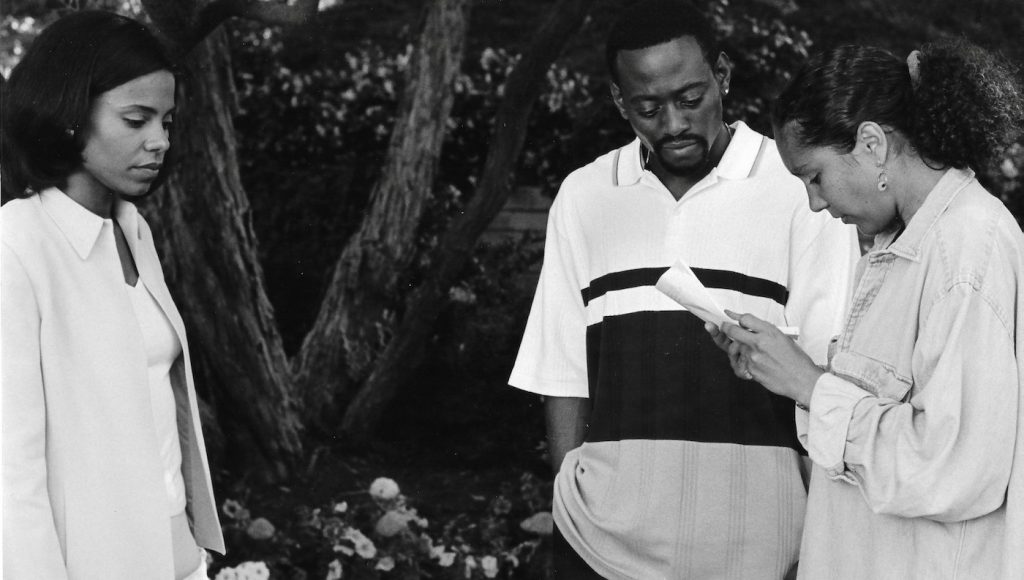
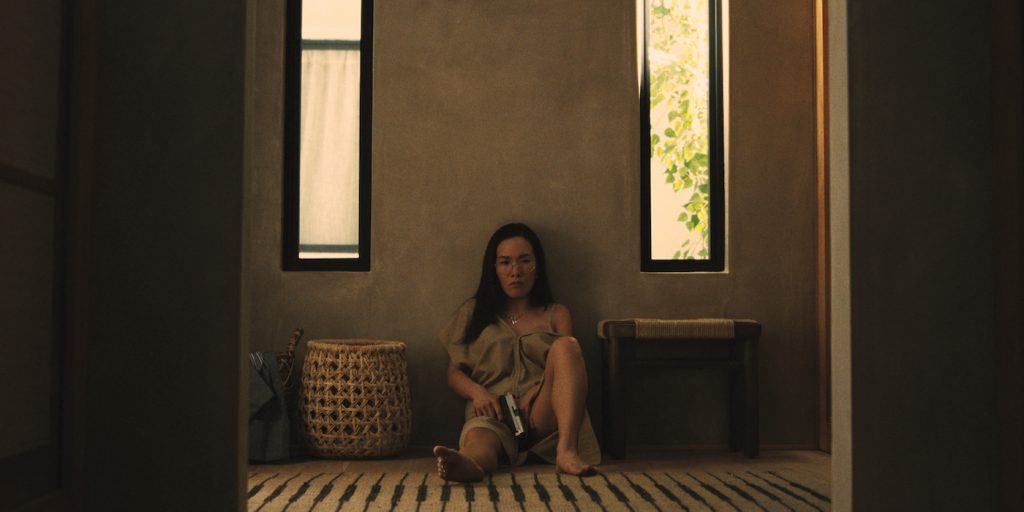
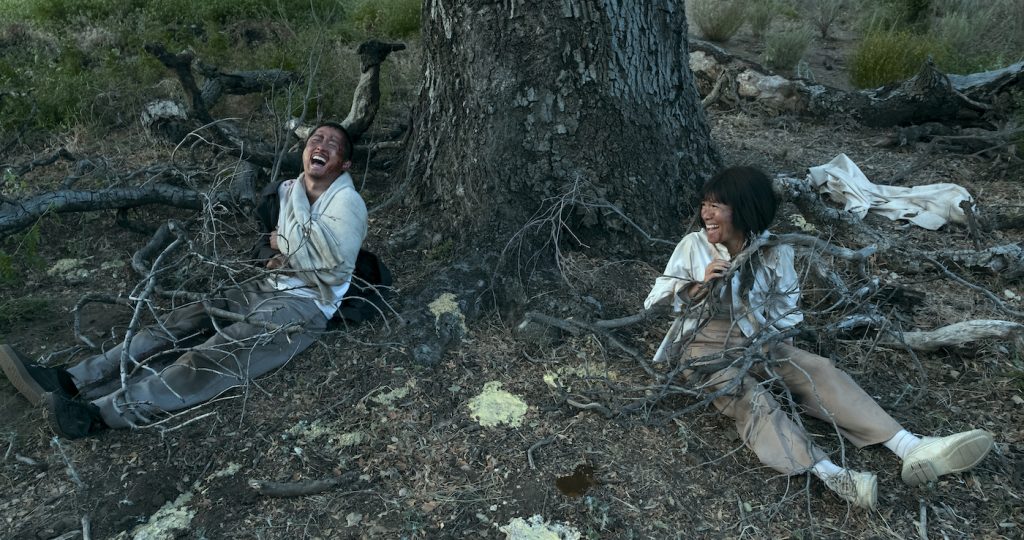
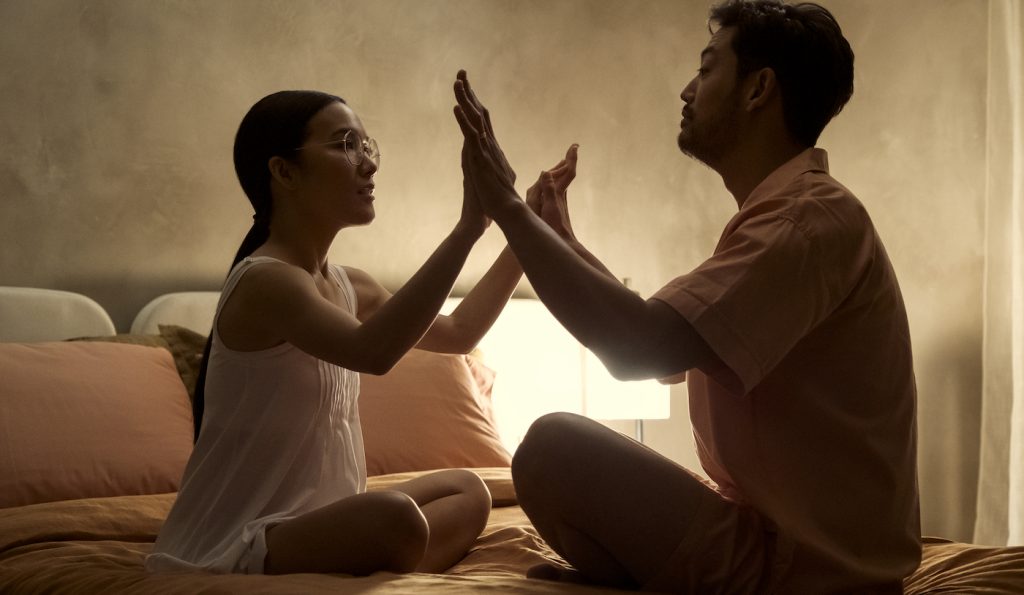
Ava DuVernay’s latest film, Origin, is having its world premiere at the Venice Film Festival on September 6, yet powerhouse indie studio Neon has already acquired worldwide rights to the film. Now, Neon has revealed the first look at the film centered on the life of “Caste” and “The Warmth of Other Suns” author and journalist Isabel Wilkerson, played by Aunjanue Ellis-Taylor. The marriage of auteur and material couldn’t be a better fit, as the Selma and When They See Us director brings a bracing vision and moral clarity to her work, the same of which can be said about the brilliant Wilkerson.
Origin is inspired by Wilkerson’s astonishing, Pulitzer Prize-winning book “Caste: The Origin of Our Discontents,” which came out in 2020 and became an instant must-read. The trailer gives us a glimpse at Wilkerson’s life as she works on her momentous book, threading the various strands and themes that Wilkerson wove throughout her book.
DuVernay’s career has been no less hard-fought and brilliantly executed. She’s the first Black woman director in competition in Venice’s 80-year history, and with Origin, she’s presenting a work she also wrote and produced. “While grappling with tremendous personal tragedy, Isabel sets herself on a path of global investigation and discovery,” the film’s Venice press notes read. “Despite the colossal scope of her project, she finds beauty and bravery while crafting one of the defining American books of our time.”
Joining Ellis-Taylor in the cast are Audra McDonald, Jon Bernthal, Vera Farmiga, Nick Offerman, Black Underwood, Finn Wittock, Connie Nielsen, and Jasmine Cephas-Jones.
“I’ve known Ava for a long time, and my love and admiration for her and her work goes back further, even before Middle of Nowhere,’” said Neon’s CEO and founder Tom Quinn in a statement, referring to DuVernay’s 2012 film. “I’m truly humbled that it is this movie which has finally brought us together. She has always been a gifted storyteller, and her mastery of her craft shines through in this deeply personal and inspired adaptation of Isabel Wilkerson’s book and dramatization of her remarkable life. Origin proves once again that Ava remains one of the most groundbreaking and essential filmmakers of her generation.”
Check out the trailer for Origin here. No release date has been set yet.
Featured image: VENICE, ITALY – SEPTEMBER 03: Ava DuVernay attends the amfAR Gala Venezia 2023 presented by Mastercard and Red Sea International Film Festival on September 03, 2023 in Venice, Italy. (Photo by Kristy Sparow/Getty Images)
It was only a matter of time before Barbie officially became the highest-grossing movie of 2023. Co-writer/director Greta Gerwig’s pink-hued colossus of a film did just that this past Labor Day Weekend, strutting past the animated blockbuster The Super Mario Bros. Movie and claiming 2023’s top spot for itself.
It’s yet another astonishing feat in a summer of them for Gerwig’s spirited, soul-searching mega-hit, which centered on a seemingly perfect Barbie (Margot Robbie) suddenly finding herself plagued by thoughts of death and then, even worse, flat feet. These twin disasters lead Barbie on a voyage into the real world—thanks to a little guidance from Weird Barbie (Kate McKinnon), where she and Ken (Ryan Gosling) discover that their idealized Barbie Land is a pale echo of the gnarly, oft-cruel reality faced by the kids (and adults) who play with their namesake dolls.
Barbie has now made $600 million at the domestic box office and $1.38 billion worldwide. It’s not only the biggest hit of the year, it’s also the highest-grossing film in Warner Bros.’ 100-year history, having passed Harry Potter and the Deathly Hallows Part 2.
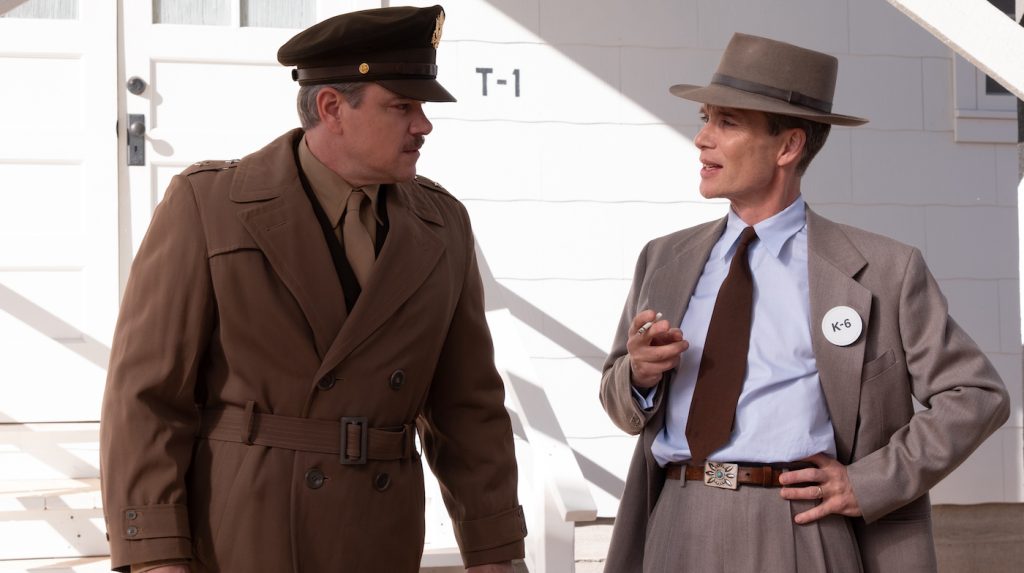
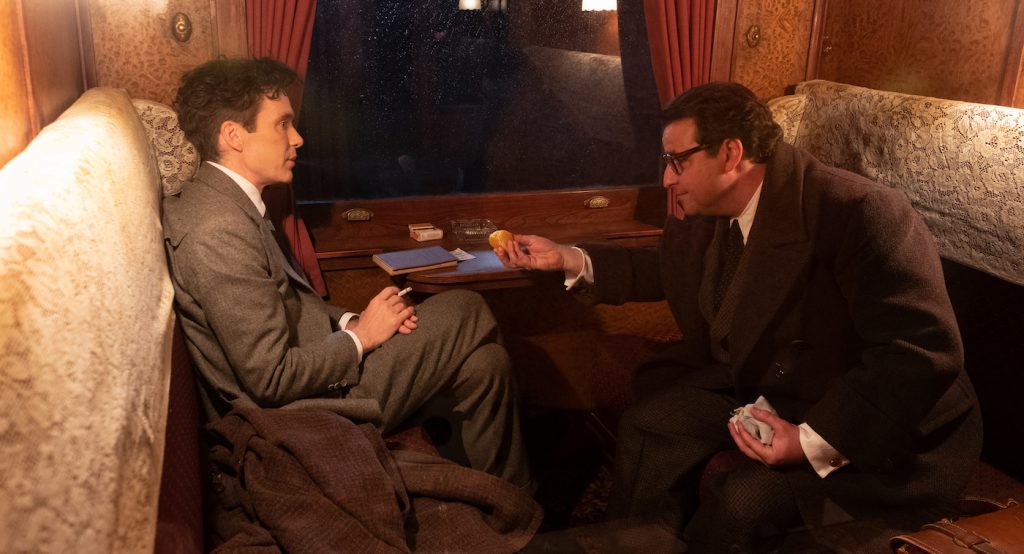
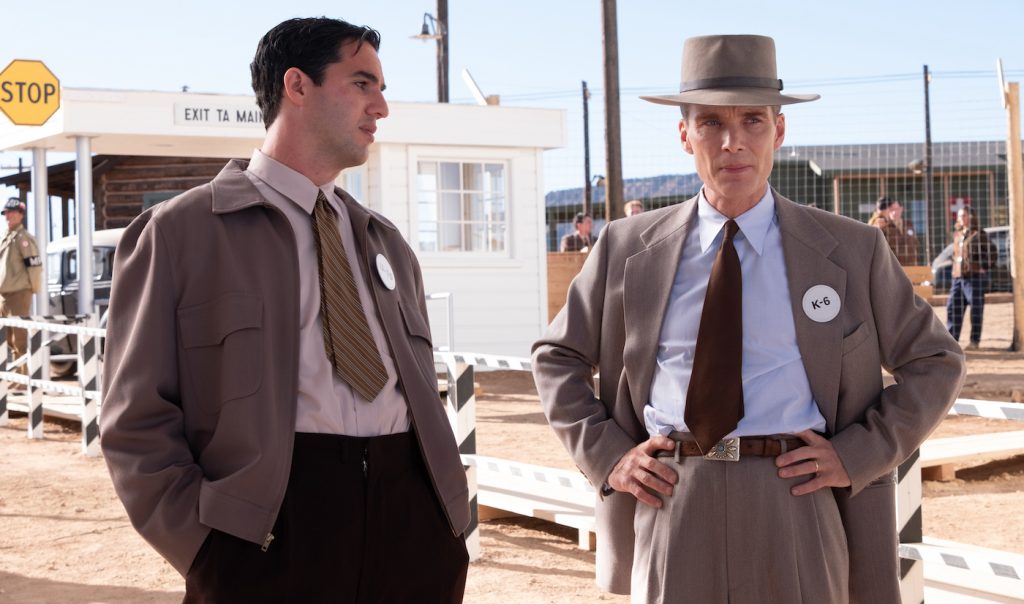
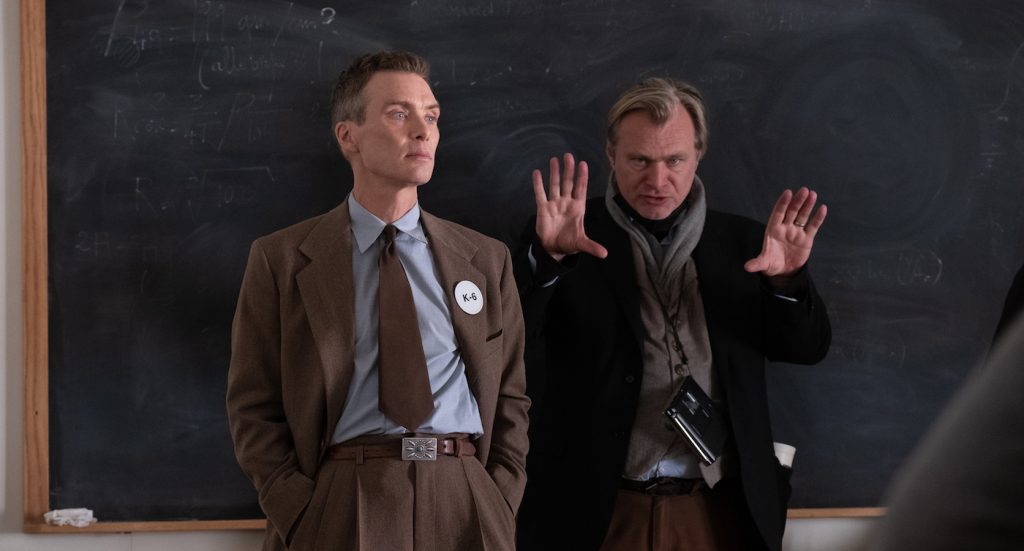
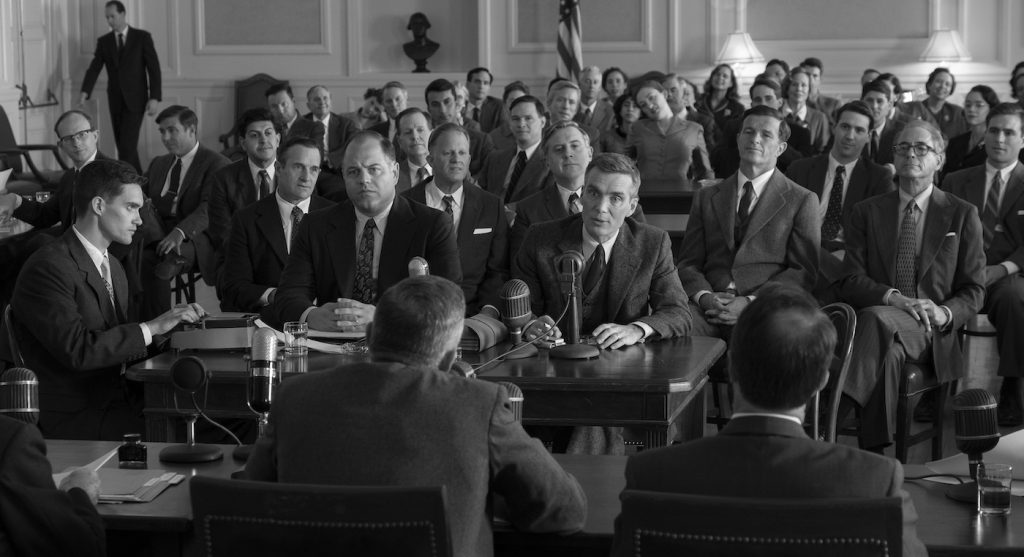
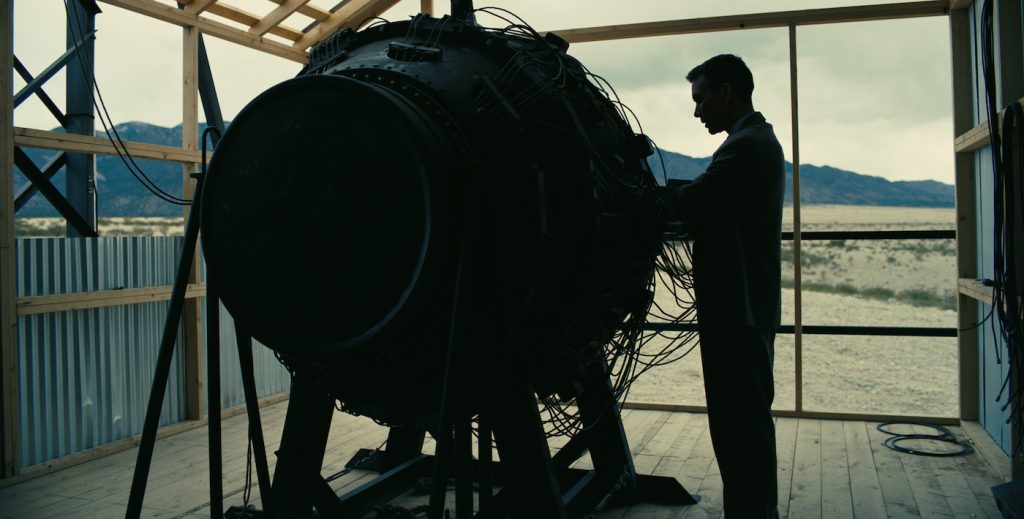
Gerwig’s gargantuan success with Barbie meant that the film also passed another legendary Warner Bros. title, Christopher Nolan’s The Dark Knight, yet the two filmmakers are linked as well by co-delivering the Barbenheimer phenomenon. Nolan’s brilliant Oppenheimer debuted on the same day as Barbie, July 21, and both films did something astonishing this summer—they became massive blockbusters without being part of an existing franchise. Nolan’s three-hour biopic about J. Robert Oppenheimer (Cillian Murphy), the father of the atomic bomb, is hardly the usual fare that dominates the summer box office, yet Oppenheimer has been a massive success, earning more than $300 million domestically and over $850 million worldwide. It’s Nolan’s third biggest film ever, behind only The Dark Knight and The Dark Knight Rises.
So Barbie reigns supreme in 2023, while Nolan’s masterpiece outperformed even the most optimistic of projections. Two deeply original filmmakers delivered deeply personal, almost comically disparate films (on the same day!), and audiences rewarded their passion.
Featured image: Caption: MARGOT ROBBIE as Barbie in Warner Bros. Pictures’ “BARBIE,” a Warner Bros. Pictures release. Photo Credit: Courtesy Warner Bros. Pictures
The trickster god of the MCU is returning this fall. While Marvel Studios’ TV schedule is in flux, with pending new series including Echo, Agatha: Coven of Chaos (now titled Agatha: Darkhold Diaries), and What If…? all receiving new release dates due to the simultaneous strikes, Loki season 2 will be the one MCU show to arrive this fall.
A new teaser gives us a taste of what’s time to come, as our favorite antihero, Loki (Tom Hiddleston), wrestles with his newfound status as the multiverse’s most frequent flier. Constantly yanked through the past, present, and future, Loki’s paths and many pasts, presents, and futures converge in spectacular, sometimes catastrophic ways. The clever teaser asks us to consider just how exhausting it must be for Loki, who has had a rough go of it (completely his fault, by the way) since he was turned over to the Time Variance Authority for his many crimes.
Set after the events in Avengers: Endgame, season one found the God of Mischief going from being a ward of the Time Variance Authority into a perpetual escapee as he went on a series of increasingly dangerous capers, all of which presented Loki with bizarre permutations of himself, calling into question everything he thought he knew. Season two will continue to play in the multiverse as Loki, his buddy Mobius (Owen Wilson), and his paramour (of sorts) Sylvia (Sophia Di Martino) find fresh adventures awaiting them in their timeless corner of the MCU.
Joining the cast in season 2 are Oscar-winner Ke Huy Quan, Kate Dickie, Rafael Casal, and more.
Check out the teaser below. Loki season 2 arrives on Disney+ on October 6.
For more on Loki Season 2, check out these stories:
The Equalizer trilogy is a wrap. For the latest and supposedly final addition to the franchise, filmmaker Antoine Fuqua and his crew take Robert McCall (Denzel Washington, Fuqua’s longtime collaborator) to Southern Italy. Once again, this man of deep compassion but with an unparalleled gift for violence is tasked with protecting underdogs in a small seaside town on the Amalfi Coast under the bloody thumb of the mob.
It’s a lean, mean thriller that leans into Washington’s gravitas, the beauty of the environs, and Fuqua’s ability to build tension. The director behind Training Day, Brooklyn’s Finest,and Southpaw gives the action a lasting sting by making the stakes increasingly personal. Robert McCall was searching for peace, and he thought he found it in Southern Italy, among a people he grew to care for. When that’s threatened by the Camorra, McCall does what he does best, even if he came to Italy to escape the violence of his past.
Fuqua takes screenwriter Richard Wenk’s story of a man torn between the dark and the light and paints a vivid picture of a man caught between two extremes. “I have fun,” he told us. “I try to be authentic to the moment, but I actually have fun. Every time I watch a cut, I sit in a theater with popcorn and a Coke, and I’m laughing. It’s fun. That’s what it’s about. You have to remember that.”
We spoke to Fuqua about re-teaming with Washington, crafting the final chapter in Robert McCall’s saga, and more.
You got to make your spaghetti western and your aging samurai story. That was your vision, right?
Exactly. It’s written all over the all-black costumes and with the lighting, know what I mean? The efficiency of the killing, how quick it is, it’s like a sword. It’s just boom, boom, boom. But it’s a little darker.
As violent as the movie is, the imagery in Italy’s churches is far more violent.
More violent man. You look at the Caravaggio, and you got St John’s head cut off, and I went to the Caravaggio Museum in Naples. It’s vicious, man.
Was faith a crucial part of this story for you?
Absolutely. That’s when you see all the religious symbols and him going to the church, trying to keep the faith. It is difficult today to hold onto that faith even when you’re doing something so violent, and you find yourself starting to slip onto the other side a bit. How do you get back to the light?
What conversations did you have with Denzel about the physicality this time? He’s still quick, but the movie acknowledges the toll his body has taken over the years.
We talk about that stuff when he is working with the stunt coordinators and everybody. I always tell him it has to be something he can do. If he was a trained killer at that age, what would he do? He’s much more stealthy and quiet about how he gets to you than walking in the room with the Russians [in the first movie].
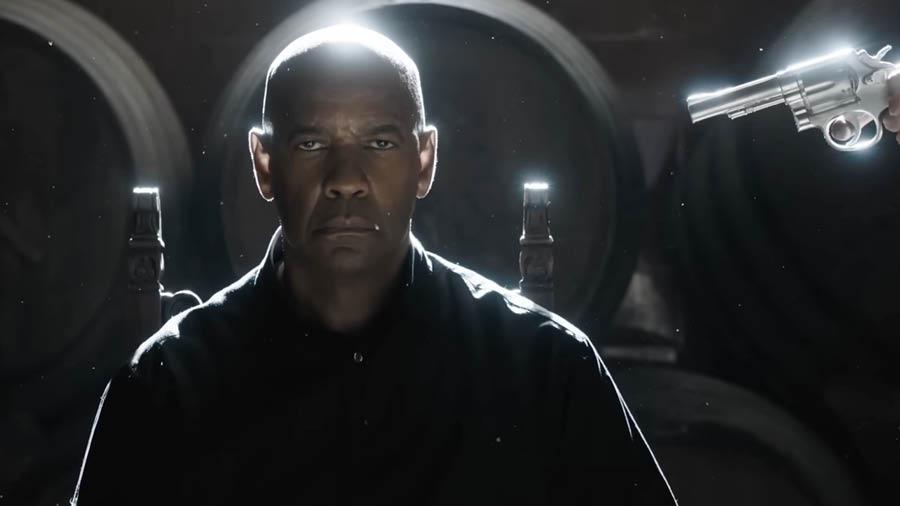
Cinematographer Robert Richardson shot McCall’s introduction in this movie beautifully. The smoke and the light reminded me a little of Tony Scott.
I was thinking more [about the painter] Giotto. Bob’s brilliant, by the way, but when Bob and I first saw that light, it was kind of there when we scouted, but then he really had this vision of the light. When we had McCall sitting in that black and all the elements floating around, it felt like a religious painting, and that’s where it came from.
Denzel Washington in “The Equalizer 3.” Courtesy Sony Pictures.
What were some of your earliest conversations with Bob about what you wanted to achieve?
I know we didn’t want it to look like a postcard, so it was about trying to find the beauty, but still in the darkness, still gritty. And Bob started putting together images and sending me images when he would go out. Bob doesn’t sleep. I would get images from Bob at three or four in the morning, and I’m like,” Why are you waking me up?” And he’s like, “The sunlight is coming.” He captured all this stuff, and then we played around with it. It was almost black and white with the colors that were coming out, what it looks like right when you go there, the whitewash walls when you come into those tunnels, and then there’d be a little bit of blue somewhere, an old blue that’s probably been there forever.
Did you both talk about cinematographer Oliver Woods’ work on the previous films?
God rest Oliver. No, I see each movie as a separate film with the same character arc, but we never discussed any other films. It had to be something on its own separate from those, especially being the final one in this location.
Is it really the final one?
Yes. Don’t hold me to that, though. You’ll bring it up next time I see you.
[Laughs] Fair enough. The story is lean this time, mostly focusing on character and mood. How was it finding that patient but ultimately steady pace?
A lot of it is in the editing. We shot all the things we needed, and then it was in the editing, just trying to find that rhythm and pace, when you hold a little longer, and when to get this going. It was never really long. The longest it was, maybe a little over two hours, and then it was just chiseling away.
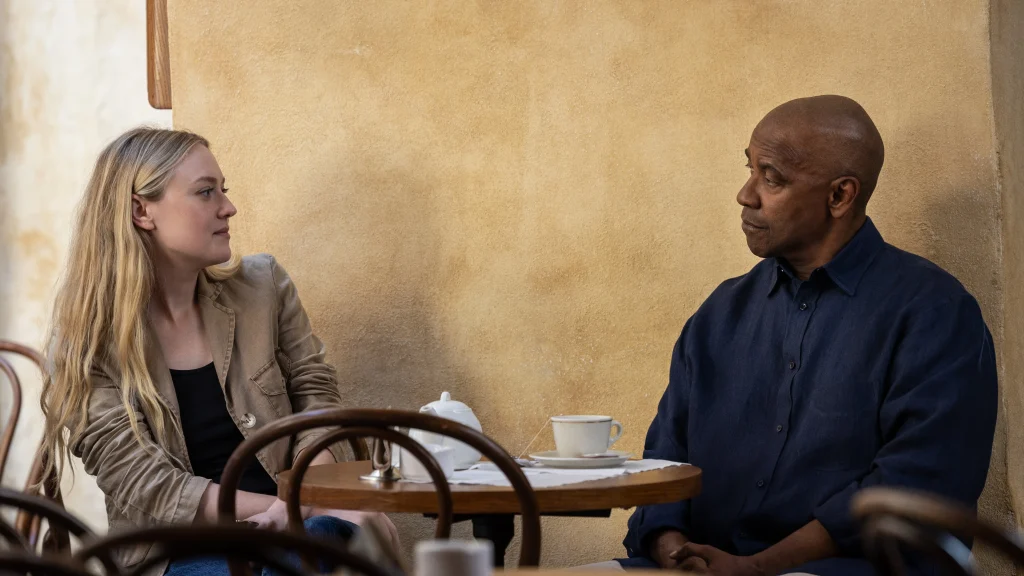
Dakota Fanning and Denzel Washington in “The Equalizer 3.” Courtesy Sony Pictures.
Throughout your career, have you sensed that audiences expect a faster-paced film?
Yeah. There’s this sort of formula at times, and that’s not always fair to the audience because they have more patience than we think. They enjoy particular actors and particular situations, and they enjoy watching it unfold. They like a little more mystery without being told everything. Don’t tell ’em everything. There’s a tendency to want it faster, faster, faster, but I like to give the audience a slow burn. All my films are really a slow burn. Training Day is a slow burn, and the first Equalizer is a slow burn. That’s where I like to live. It builds.
How’s it editing a Denzel Washington performance? Does he give you a lot of options?
No, he gives you what we discuss in the script and then some. I know Denzel, he’s in the moment so that Denzel will do something descriptive, and we’ll work it, and then he’ll do something completely different because I’ll say to him, “I like when you did this X, Y, and Z.” He’ll go, “Okay, what did I do again?” Because he’s in the moment, and sometimes I realize I’m never going to get that again because he’s so in that moment. It’s special. Sometimes, I’m surprised at what he’ll do, so we explore those things when I get to the editing bay with Conrad Buff.
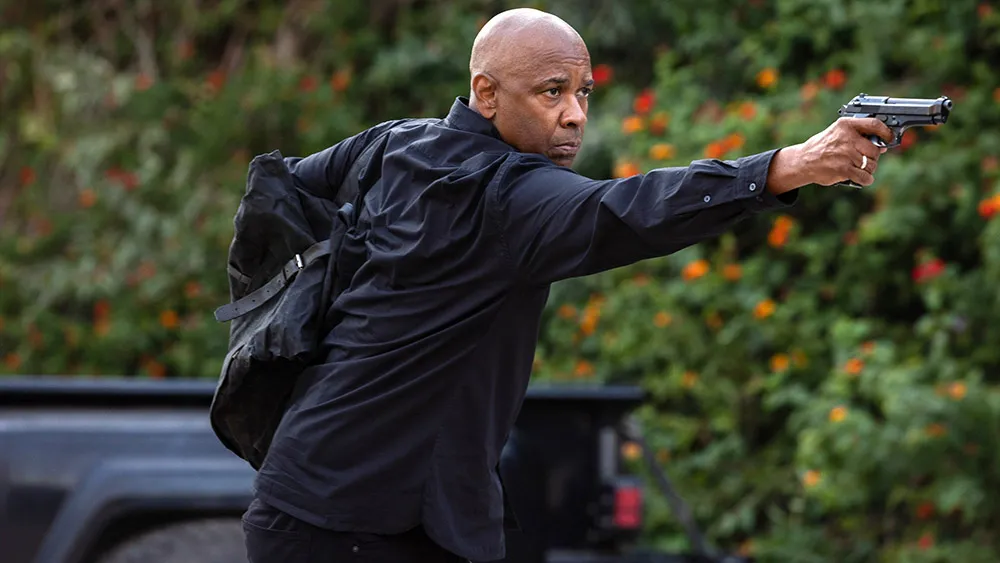
Denzel Washington in “The Equalizer 3.” Courtesy Sony Pictures.
For more upcoming films from Sony Pictures, check out these stories:
Featured image: LAS VEGAS, NEVADA – APRIL 24: <> attends the Sony Pictures Entertainment presentation during CinemaCon, the official convention of the National Association of Theatre Owners, at The Colosseum at Caesars Palace on April 24, 2023 in Las Vegas, Nevada. (Photo by Ethan Miller/Getty Images)
Jo McLaren is a longtime stunt professional who has worked on a slew of hit films and TV series, lending her talents to hits as disparate as Titanic, Dr. Who, and the Sherlock Holmes, Harry Potter, and Avengers franchises. As an in-demand stunt coordinator, she has kept productions safe while creating some of the most inimitable action sequences in the business.
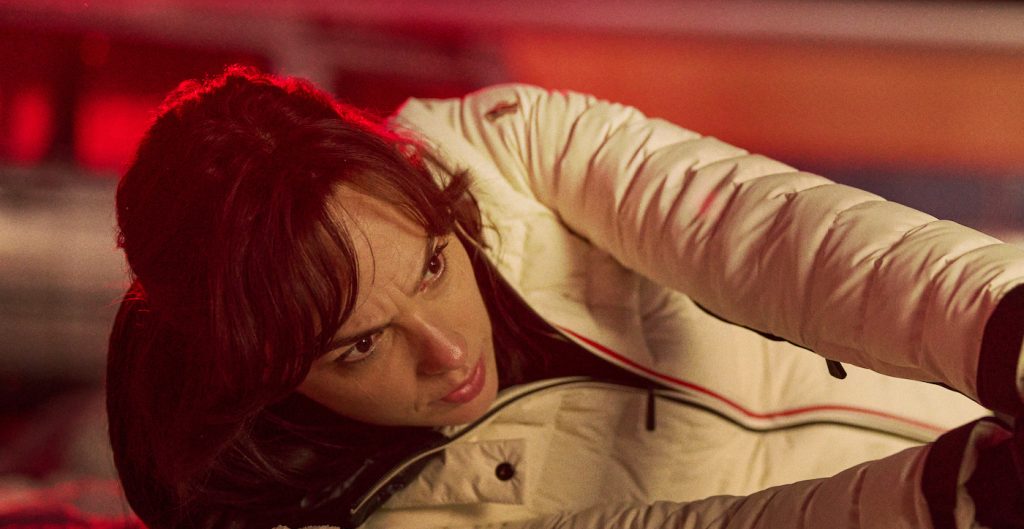
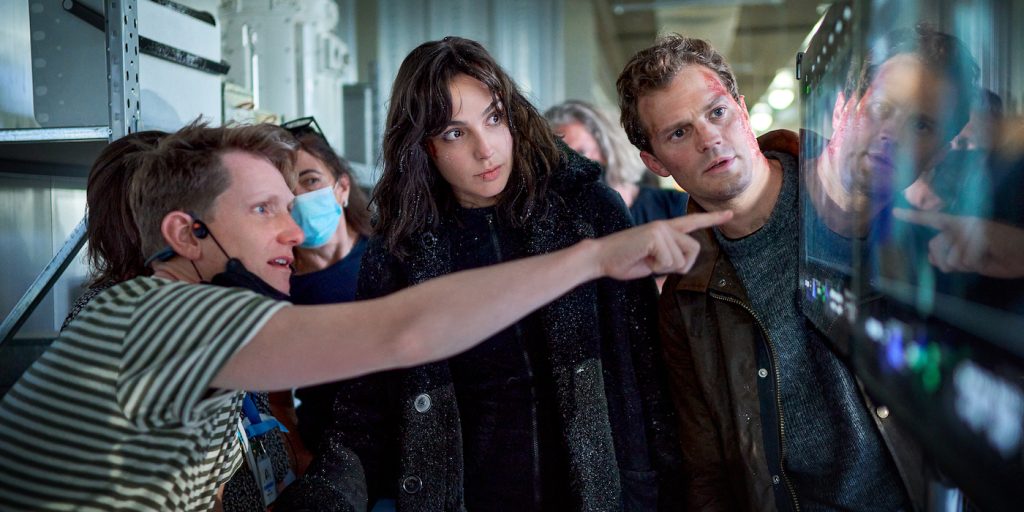
Her newest project is Netflix’s Heart of Stone, starring Gal Gadot as Rachel Stone, a brilliant intelligence operative working for a shadowy peacekeeping organization tracking and dismantling global threats. Stone is embedded in an MI6 unit led by agent Parker (Jamie Dornan), playing the role of a computer expert untrained in combat or armaments. When her unit gets targeted by assassins, she unleashes her many talents and skills to keep them safe while neutralizing a dangerous plot putting the whole world at risk.
McLaren partnered with Gadot, director Tom Harper, and a slew of stunt professionals from across the globe to make the action in Heart of Stone believable yet bold enough so that Rachel Stone is more than a match for other those legendary cinematic operatives, James Bond and Ethan Hunt.
McLaren spoke to The Credits about working with Wonder Woman herself, as well as collaborating with extreme sports stunt coordinator JT Holmes and stunt driving expert Rob Hunt.
Director Tom Harper wanted the action in Heart of Stone to feel exciting but also always within the realm of possibility. How’d you help him achieve that?
Tom and I spoke at length, not just the two of us, but with the second unit director, Rob Alonzo, and the other creatives. Tom was very keen on making the best action we could, really dynamic, fast, and exhilarating but believable. So everything we did, we questioned, “Do we believe it? Would this actually happen? How would somebody be able to survive this, really?” Gal was having to fight mainly bigger, stronger men, so we had to make sure that we believe that. We made all her fight styles technical, so she would have technical prowess over whoever she was fighting.
Part of making it believable is building the action around character and story development. What is an example of how that translates in the action sequences with Gal’s character?
When they’re in the safe house, and she has a great, gritty fight with The Blond [Jon Kortajarena], we wanted her to use the environment and be clever about it, and she really uses the space there to her advantage. It’s a bit of cat and mouse, and she uses the mirrors and reflections and things she can find within her environment. Not only does she have technical skills, but she’s a woman about to take on a guy twice her size. She has to use her brain, look around, and find what will give her the advantage and ways of protecting her colleagues.
All done in what is essentially a normal apartment.
We had a fantastic set, where we had all these wonderful separate rooms that interlinked, and you’d have different viewpoints from her and from The Blond, where you can see how she could outwit him by going out one window and coming in another door. She’d come up behind him, using everyday objects as weapons. We are very much with her emotionally and physically in the fight.
Frying pans!
And fridge doors! We had a lot of fun with that fight.
What was your role as stunt coordinator in terms of collaborating with the coordinators in different locations and withextreme sports stunt coordinator JT Holmes?
The coordinators in different locations were not so much part of the creative. That was down to myself, our director Tom, JT, and the second unit director Rob Alonzo. We had wonderful guys around the world that had the title of stunt coordinator, and they were there to help me by bringing fantastic local talent to set, as opposed to helping me create the action. JT and I worked very closely together because of what happens in some of the aerial stuff, and on the slopes, I had to recreate that on a blue screen for close-up wire stuff. My fight coordinator, choreographer, assistant stunt coordinator, and stunt doubles were a really close-knit team. We were at the action helm, but it was very much a team effort. Add to that all the fantastic folks all over the world; it was like a big, collaborative family.
What can you say about the scenes in the Italian Alps? It had to be freezing!
Right. In the Alps, we were working a lot on the slopes and up on the glacier, so we had many night shoots because the slopes are open during the day. We had a lot of small timeframes to get sequences done. It was a huge amount of planning before each day. We had a war room where we’d go and work out each shot for the day, so it would be super-efficient when we got onto the mountain. We had to allow for high winds and bad weather, which can change things on a dime when you’re dealing with freezing temperatures. That itself was a huge challenge, as was getting any kind of equipment up the mountains, but it was also very exciting. Creating action and working in a real environment is what we all love to do most, going to locations instead of working in CG. Everybody was just fantastic.
What was your role in terms of working with Gal and her stunt double?
Gal is brilliant. She’s done a lot of action movies, so she has this great muscle memory, and she’s also such a quick learner. She’d come to a stunt rehearsal and pick up the choreography really quickly, and she brings not just all that physical presence but also her fantastic performance and character to whatever action has been created.
We had a few because we have different units running. With the extreme sports stunts, JT worked with Gal and stunt double Karen Lewis. For the stunt work I did, all the fights and wire work, we had her normal stunt doubles, Stanni (Bettridge), and Eniko (Fulop). They were the two doubles that I worked with really closely. They did the majority of the stunt work that Gal didn’t do herself. She loves to do stunts, but there are some stunts insurance just won’t let her do.
What about the sequence in the van? Stunt driving is its own animal requiring specific expertise.
We had some of the best drivers in the world. Rob Alonzo designed a lot of the car sequences. He has fantastic creative ideas. Then I brought in the best car guy in the UK, if not the world, Rob Hunt. That whole sequence ran so smoothly because of the brilliance of both Rob Alonzo and Rob Hunt. I do a lot with the main unit on that particular sequence in Lisbon, then go over to the second unit because it’s so much fun being around all the car stuff. I got talent from all over the world, a lot of UK guys and girls, including the brilliant stunt driver Nellie Burroughes, who doubled Gal in the van and drove and jumped it. She’s a tough cookie because when you’re inside a van like that, it’s not designed for that kind of punishment. It’s reinforced, but you still get thrown around. Her execution of precision driving was brilliant.
It all starts with the director, but you’ve got to have the right stunt folks to keep it safe and as dramatic as it looks onscreen.
Absolutely. It’s all in the planning and preparation and getting the right people in under Tom’s guidance. I rate him as one of the best directors I’ve ever worked with. He believes in the power of collaboration. Also, Rob Alonzo is the best second-unit director because he was a fantastic stuntman and stunt coordinator, and he brings all that knowledge and experience to his action sequences. I’ve learned so much from him. I never stop learning, and the international talent made it such an amazing journey. I’m proud of them all, and I think you see all their work shine onscreen.
Heart of Stone premieres on Netflix in the US August 11th.
For more on big titles on Netflix, check these out:
*It’s our annual “Best of Summer” look back at some (not all) of our favorite interviews from the past few months. This non-comprehensive look back includes the Barbenheimer phenomenon and the wonderful interviews that followed those two history-making films, chats with the talented folks behind Mission: Impossible, Spider-Man: Across the Spider-Verse, our profile of MPA Creator Award Recipient and filmmaker extraordinaire Gina Prince-Bythewood and more.
How do you turn a human into a doll? Or, let’s reverse that—how do you turn the most iconic doll ever made into a human? These were the intermingled questions makeup and hair designer Ivana Primorac had to answer for co-writer and director Greta Gerwig’s history-making new film Barbie. Reader? She succeeded.
Primorac has worked on a slew of excellent, disparate projects, from the Winston Churchill biopic The Darkest Hour to HBO’s brilliantly executed crime series Mare of Easttown to Netflix’s magisterial The Crown. She first worked with Gerwig on Little Women, her critically acclaimed adaptation of Louisa May Alcott’s novel, and now adds Gerwig’s critically acclaimed imagining of the near-perfect world of Mattel’s iconic doll falling apart to her CV. Her job required working with countless wigs, custom eyebrows, body paint, hordes of lipstick, and body waxing—we’re looking at you, Kens.
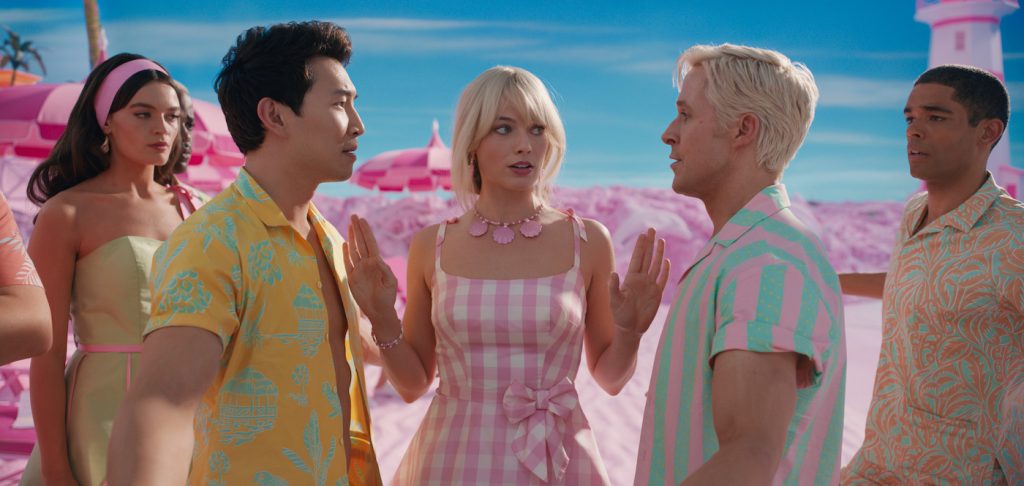
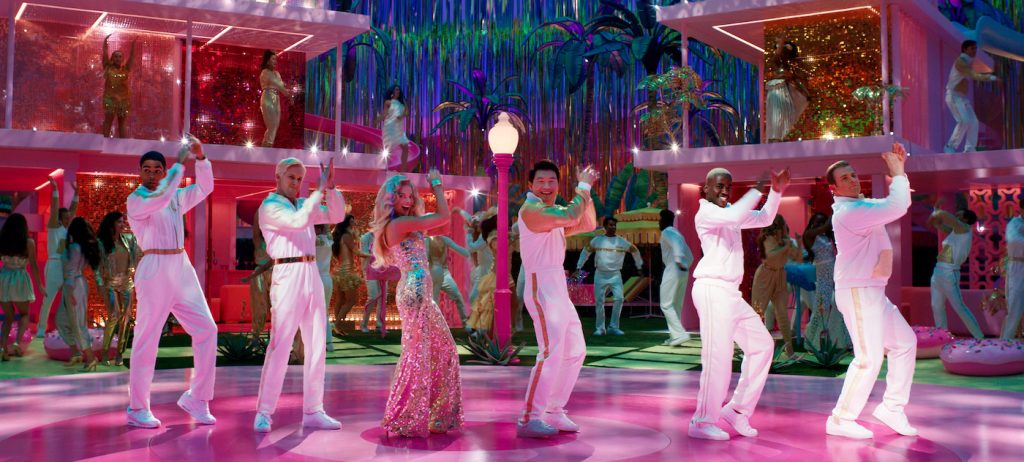
Caption: (L-r) EMMA MACKEY as Barbie, NCUTI GATWA as Ken, SIMU LIU as Ken, MARGOT ROBBIE as Barbie, RYAN GOSLING as Ken and KINGSLEY BEN-ADIR as Ken in Warner Bros. Pictures’ “BARBIE,” a Warner Bros. Pictures release. Photo Credit: Courtesy Warner Bros. Pictures
“I think in any creative process, you go through every possibility, [which was the case] when we were trying to figure out what defines a doll versus a human,” Primorac says. “We discovered that the scale and proportion of the Barbie world is slightly out of whack. The ceiling of the Dreamhouse is just above her head, and her lipstick and toys are slightly too large. But in a kid’s imagination, it’s incredibly perfect and beautiful. So we started working on the fun proportions and scale and very quickly realized there is no plastic hair, and the skin doesn’t have to look plastic.”
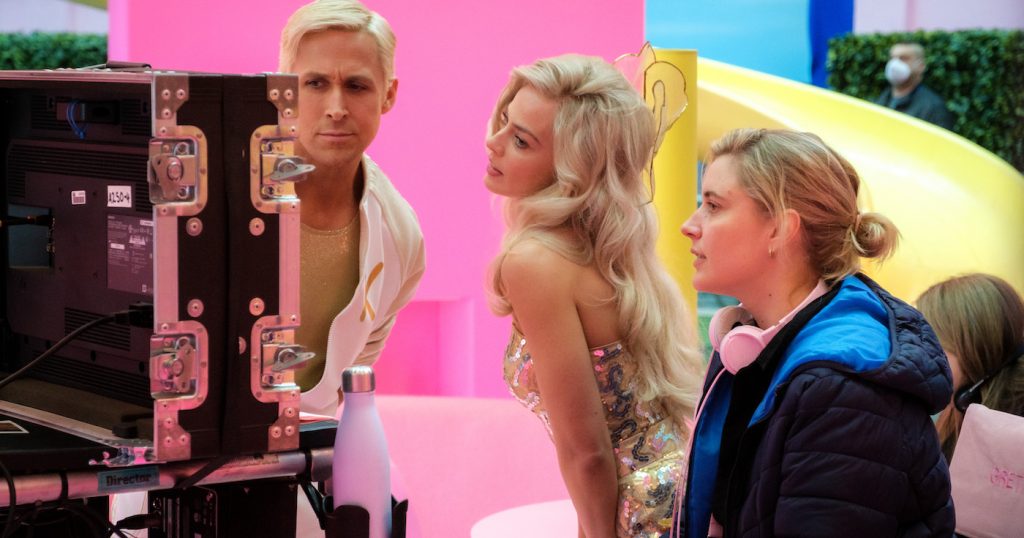
Caption: (L-r) RYAN GOSLING, MARGOT ROBBIE and Director/Writer GRETA GERWIG on the set of Warner Bros. Pictures’ “BARBIE,” a Warner Bros. Pictures release. Photo Credit: Jaap Buitendijk
The plan shifted towards defining what looks beautiful for each Barbie and Ken individually. “Instead of uniformity, we came to the individuality of every doll. So every single doll, every character, had to be designed individually. Each Barbie represents the best version of herself. So every actor had to be turned into the best version of themselves, and that would turn them into a doll,” says Primorac.
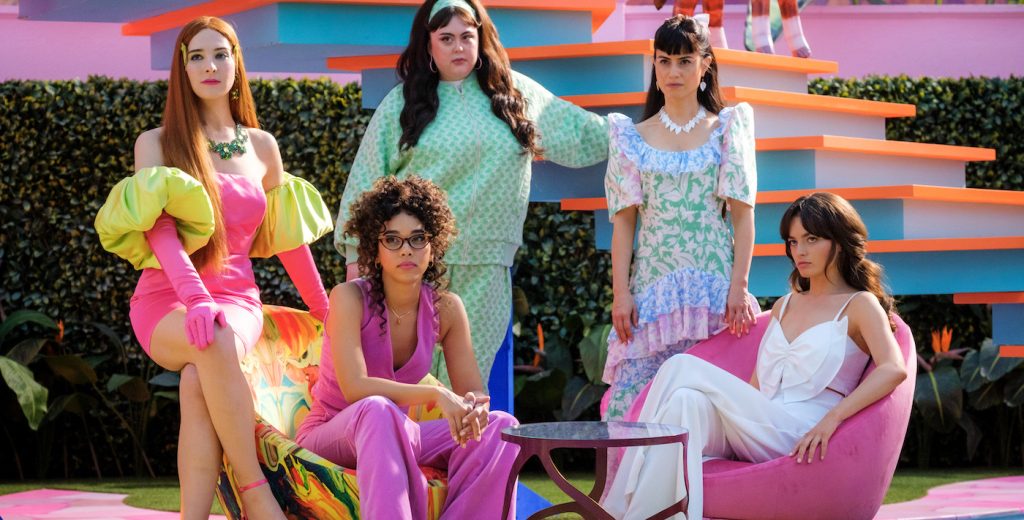
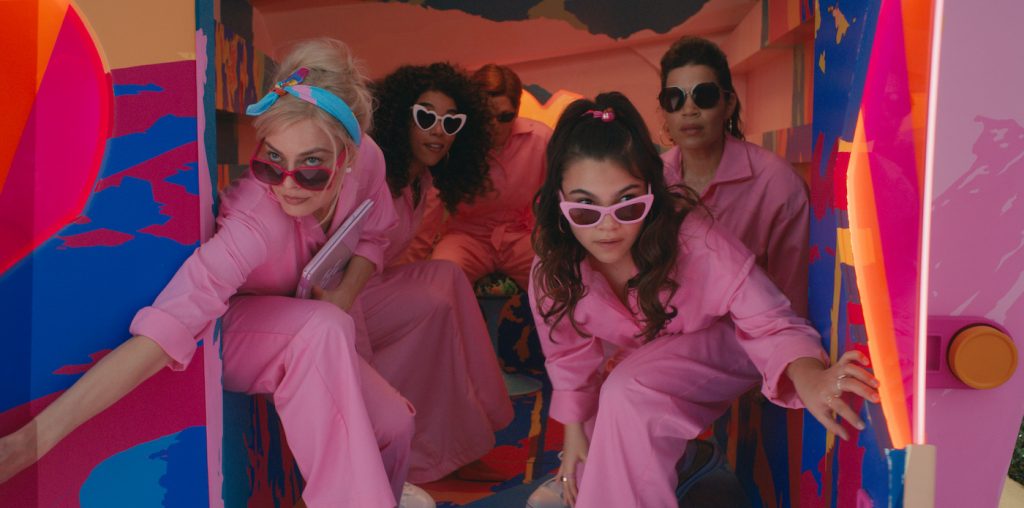
Caption: (L-r) HARI NEF as Barbie, ALEXANDRA SHIPP as Barbie, SHARON ROONEY as Barbie, ANA CRUZ KAYNE as Barbie, and EMMA MACKEY as Barbie in Warner Bros. Pictures’ “BARBIE,” a Warner Bros. Pictures release. Photo Credit: Jaap Buitendijk
Prep began a year before filming began with close collaboration among Gerwig, production designer Sarah Greenwood, and costume designer Jacqueline Durran. Toy maker Mattel provided the team with the entire Barbie archive, and Primorac also bought a number of vintage Barbie books for reference. Of crucial import to Primorac’s styling was the discussions she had with cinematographer Rodrigo Prieto. “Without Rodrigo, I don’t think I could have done this film,” she admits. “We tested a lot of different finishes and different makeup. For example, we had to find the kind of body makeup that wouldn’t come off on clothes. Every time I had any problems, he was the first person I could consult.”
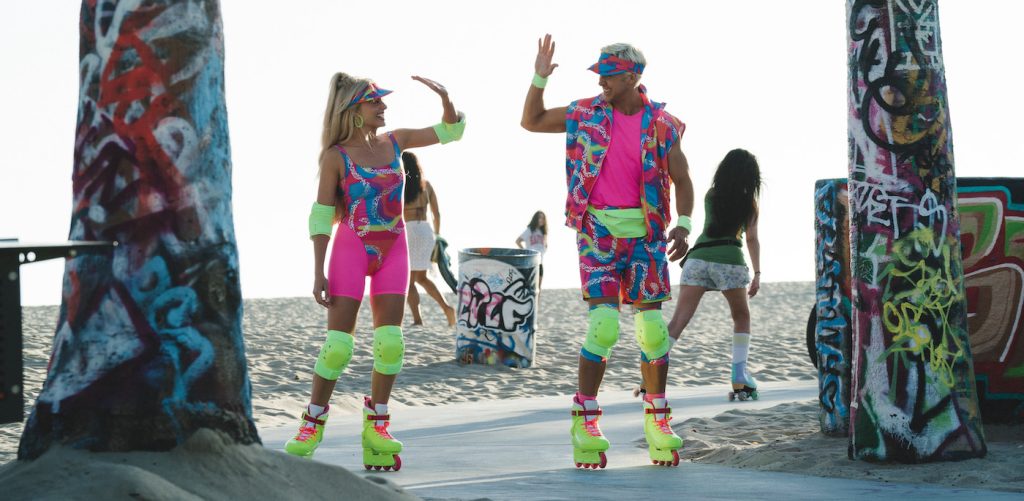
Caption: (L-r) MARGOT ROBBIE as Barbie and RYAN GOSLING as Ken and in Warner Bros. Pictures’ “BARBIE,” a Warner Bros. Pictures release. (PRESS KIT). Photo Credit: Atsushi Nishijima
Prieto’s biggest hurdle was neutralizing the colorful world of Barbie Land so that the actors’ skin or hair didn’t look pink and that the surroundings wouldn’t transfer onto their wardrobes or bodies. Once the cinematographer chose the lenses and filters (Barbie was shot on the ARRI Alexa 65 with Panavision System 65 lenses), Primorac could then establish the hair and makeup techniques for each Barbie and Ken. Oh, and Ken’s friend Allan (Michael Cera) – one of several discontinued dolls that appear in the movie.
Margot Robbie, of course, plays Barbie, referred to as “Stereotypical Barbie” in the movie. She’s the O.G. Barbie, the one that debuted in 1959 with a striped black and white swimsuit, blonde hair, hooped earrings, blue eyeshadow, and red lipstick – a look that was recreated for the opening sequence (one that ingeniously riffed on the iconic prehistoric “Dawn of Man” sequence in Stanley Kubrick’s 2001: A Space Odyssey). Primorac rekindled the magic using standard yellow hair dye straight from the box. “We created it identically to the color of the doll with the blue eyeshadow and lipstick. It makes the image exact and slightly retro,” she says.
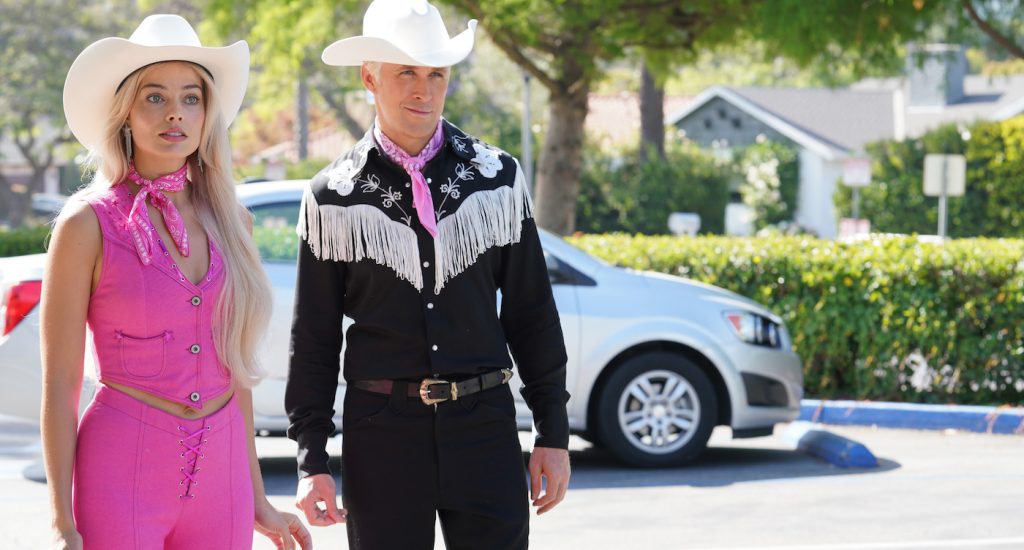
When the story shifts into Barbie Land and Barbie is in her Dreamhouse living her best life, her hair was altered to compliment Ken (played by Ryan Gosling). “We had to match the blonde of Margot and Ryan, so they looked nice together,” notes Primorac. The costumes Robbie wore also shifted the hair color, which was maintained using different wigs. The wardrobe changes included a cute pink gingham dress, a hip-hugging gold disco jumpsuit, a matching plaid tulle-like skirt and top, and a head-turning pink western outfit complete with a denim vest, flare jeans and cowboy hat. “We had to adjust her hair according to the lighting setups and costumes. So I was dipping the wigs in different toners at night to suit what was going to happen the next day,” says Primorac. “It was a laborious process keeping the hair the nicest kind of Nordic blonde that would suit Margot’s makeup and costumes.”
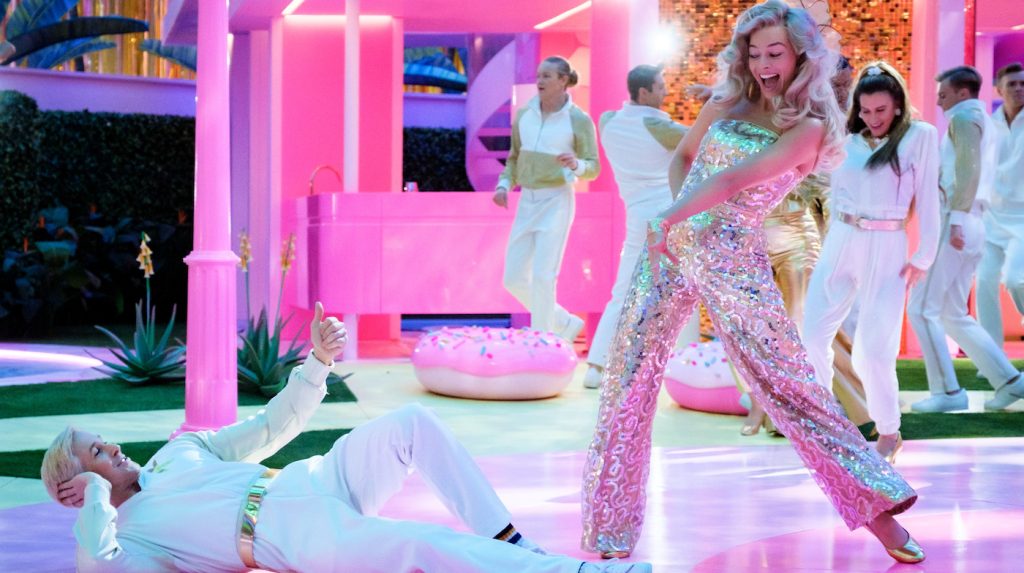
-Caption: (L-r) RYAN GOSLING as Ken and MARGOT ROBBIE as Barbie in Warner Bros. Pictures’ “BARBIE,” a Warner Bros. Pictures release. Photo Credit: Jaap Buitendijk-Caption: (L-r) MARGOT ROBBIE as Barbie and RYAN GOSLING as Ken and in Warner Bros. Pictures’ “BARBIE,” a Warner Bros. Pictures release. Photo Credit: Dale Robinette
Seventeen different Barbie and Ken characters make up the main cast, including Barbies played by Issa Rae, Alexandra Shipp, and Emma Mackey, and Kens played by Simu Liu, Kinglesy Ben-Adir, and Scott Evans. For each, body makeup avoided the plastic look you’d find on dolls and instead focused on “evening out the tones” around the knees, elbows, behind the ear, and heels. A look that Primorac suggests is unnatural to humans. For the majority of recreations, Primorac stylized individual looks that represented each actor. For smaller roles or the discontinued dolls, Primorac created exact replicas. The likes of Midge “Pregnant Barbie” (Emerald Fennell), Mermaid Barbie (Dua Lipa), Merman Ken (John Cena), and Sugar Daddy Ken (Rob Brydon) were drawn up to match the original dolls.
Caption: (L-r) MARGOT ROBBIE as Barbie, ALEXANDRA SHIPP as Barbie, MICHAEL CERA as Allan, ARIANA GREENBLATT as Sasha and AMERICA FERRERA as Gloria in Warner Bros. Pictures’ “BARBIE,” a Warner Bros. Pictures release. Photo Credit: Courtesy Warner Bros. PicturesCaption: (L-r) KINGSLEY BEN-ADIR as Ken, RYAN GOSLING as Ken, MARGOT ROBBIE as Barbie, SIMU LIU as Ken, NCUTI GATWA as Ken and SCOTT EVANS as Ken in Warner Bros. Pictures’ “BARBIE,” a Warner Bros. Pictures release. Photo Credit: Courtesy of Warner Bros. Pictures
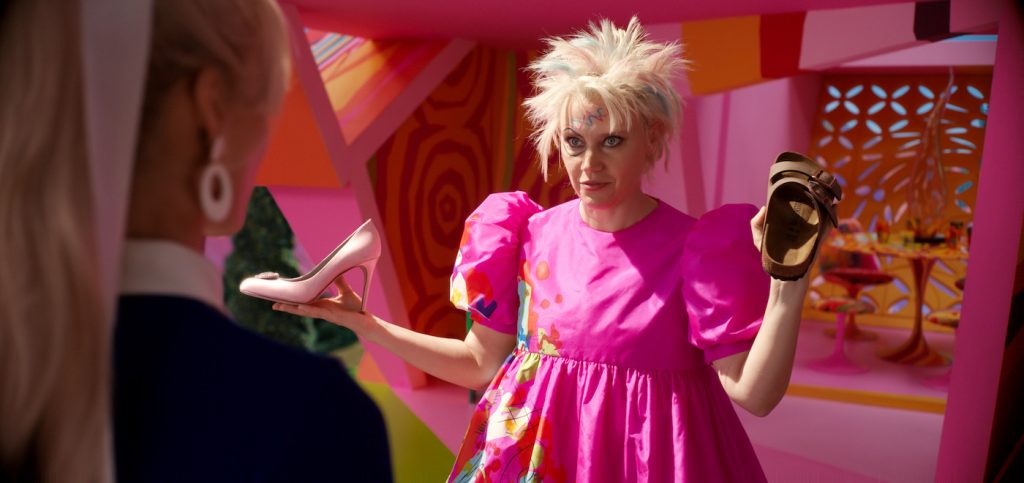
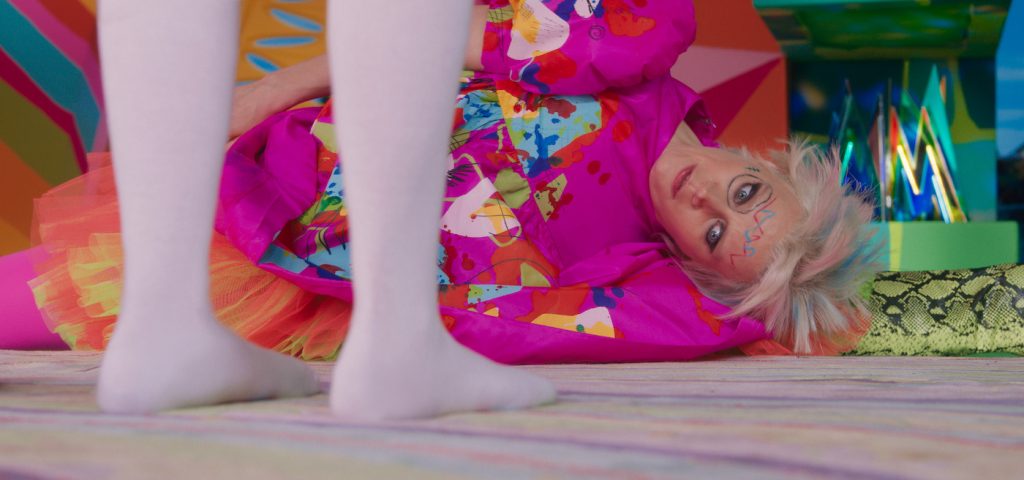
One particular challenge for Primorac was the Barbie played by Kate McKinnon, dubbed “Weird Barbie,” a doll that was played with too much. “It was the hardest character to pinpoint because every time it became too punk or too fashionable,” she says. McKinnon’s Barbie has wildly chopped hair, drawings on her face, and is seemingly always in splits – a reference to Barbie dolls that would get thrown into a toy box and land with their legs splayed. “Her hair was made three times from scratch until we found what you see in the film. Conceptually, we thought of Totally Hair Barbie. Then we thought that kids would start chopping at her hair, so it has short bits and long bits. Then she had makeup underneath, and then the Sharpie marks came on top. It took a while to layer that look, so it looked like the kids took it too far and tossed her aside.”
Caption: (L-r) MARGOT ROBBIE as Barbie and KATE MCKINNON as Barbie in Warner Bros. Pictures’ “BARBIE,” a Warner Bros. Pictures release. Photo Credit: Courtesy of Warner Bros. PicturesCaption: KATE MCKINNON as Barbie in Warner Bros. Pictures’ “BARBIE,” a Warner Bros. Pictures release. Photo Credit: Courtesy Warner Bros. Pictures
Throughout the process, Primorac says she never felt like she was on a big-budget movie. “Greta is immersed with everyone, and you get to discuss everything together. She is so smart in what she wants to achieve. Story, to her, is the most important thing, no matter the size of the movie. She is a master at that and makes herself always available.”
And now, Gerwig has made history, thanks in no small part to the time and attention she gave to her talented collaborators like Primorac.
Featured image: Caption: (L-r) ANA CRUZ KAYNE as Barbie, SHARON ROONEY as Barbie, ALEXANDRA SHIPP as Barbie, MARGOT ROBBIE as Barbie, HARI NEF as Barbie and EMMA MACKEY as Barbie in Warner Bros. Pictures’ “BARBIE,” a Warner Bros. Pictures release. Photo Credit: Courtesy of Warner Bros. Pictures
Being a superhero can be a lonely job, especially if you’re the type of superhero that Captain Marvel (Brie Larson) is. Only Thor (Chris Hemsworth) has had a similar responsibility: keeping a watch on all the trouble brewing deep in the cosmos, to say nothing of returning to Earth when things go pear-shaped there, too. Yet Captain Marvel, aka Carol Danvers, also has the loneliness of having had her memory erased by the Kree, so at the start of director Nia DaCosta’s The Marvels, Carol’s gone off in search of a way to repair those memories and get back all that she’s lost.
The new trailer reveals some fresh footage of the story that’s been teased in previous peeks at DaCosta’s film. Carol’s plans are severely thrown out of whack when she goes to explore an anomalous wormhole lined to a Kree revolutionary (Zawe Ashton’s Dar-Benn) and her superpowers get all tangled up with the abilities of a young girl from Jersey City named Kamala Khan (Iman Vellani, reprising her role from Disney+’s Ms. Marvel), as well as her estranged Niece, S.A.B.E.R. astronaut Captain Monica Rambeau. It was Monica’s mother, Maria (Lashana Lynch), who was Carol’s best friend and flying partner. But in Carol’s absence, Maria passed away. Her daughter Monica, meanwhile, was snapped into dust by Thanos and then blipped back. Let’s just say her feelings about Captain Marvel have cooled in the interim. The three of these very different but powerful women now find their abilities all mixed up, and they’ll need to figure out a way to work together to untangle this mess and save the planet simultaneously—a tall order.
Higher. Further. Faster. These three words have long been the motto of Captain Marvel, but now that she’s part of a super-team, she’s added another—together.
Check out the new trailer here. The Marvels soars into theaters on November 10.
Here’s the official synopsis:
In Marvel Studios’ “The Marvels,” Carol Danvers aka Captain Marvel has reclaimed her identity from the tyrannical Kree and taken revenge on the Supreme Intelligence. But unintended consequences see Carol shouldering the burden of a destabilized universe. When her duties send her to an anomalous wormhole linked to a Kree revolutionary, her powers become entangled with that of Jersey City super-fan Kamala Khan, aka Ms. Marvel, and Carol’s estranged niece, now S.A.B.E.R. astronaut Captain Monica Rambeau. Together, this unlikely trio must team up and learn to work in concert to save the universe as “The Marvels.”
The film stars Brie Larson, Teyonah Parris, Iman Vellani, Zawe Ashton, Gary Lewis, Seo-Jun Park, Zenobia Shroff, Mohan Kapur, Saagar Shaikh, and Samuel L. Jackson. Nia DaCosta directs, and Kevin Feige is the producer. Louis D’Esposito, Victoria Alonso, Mary Livanos and Matthew Jenkins serve as executive producers. The screenplay is by Nia DaCosta and Megan McDonnell and Elissa Karasik.
*It’s our annual “Best of Summer” look back at some (not all) of our favorite interviews from the past few months. This non-comprehensive look back includes the Barbenheimer phenomenon and the wonderful interviews that followed those two history-making films, chats with the talented folks behind Mission: Impossible, Spider-Man: Across the Spider-Verse, our profile of MPA Creator Award Recipient and filmmaker extraordinaire Gina Prince-Bythewood and more.
As it is, Tom Cruise’s new Mission: Impossible movie (now playing) runs a hefty two hours and forty-three minutes, but what people see in theaters actually represents a very slimmed-down version of the original cut that director Christopher McQuarrie screened for his friends. “It ran four hours,” says Cruise’s go-to editor Eddie Hamilton. “We watched it in a screening room with 40 people, and it was two and a half hours to Venice. Then we had snacks and came back for the last hour and a half.”
Hamilton, who earned an Oscar nomination for Cruise’s Top Gun: Maverick and cut previous Mission: Impossible entries Rogue One and Fallout, faced an embarrassment of riches in the Dead Reckoning Part One rough cut. High-energy performances, eye-popping stunts, and locations like Abu Dubai, Rome, Venice, and Norway filled the screen. For the seasoned editor, the challenge came in streamlining all that footage into the summer popcorn movie that has so far grossed $370 million and critical acclaim.
Speaking from his home in London, Hamilton explains the tricks of the trade he used to reckon with Dead Reckoning‘s car chases, motorcycle stunts, and multiple character arcs.
Dead Reckoning throws many plates up in the air — new villains, old villains, the “cruciform key” Macguffin, Ethan Hunt’s gang, plus the addition of Hayley Atwell’s new pickpocket femme fatale character Grace. How do you balance all that plot information with emotional beats?
That’s the push-pull we deal with every single day. Especially on a long movie like this, you have to make sure that there’s no air. We discussed it all the time with Chris McQuarrie being like: “I’m feeling air, I’m feeling air.” I’ve been working on the movie for three years, I’ve watched it 700 times and seen it iterate day after day, compressing, compressing, compressing.
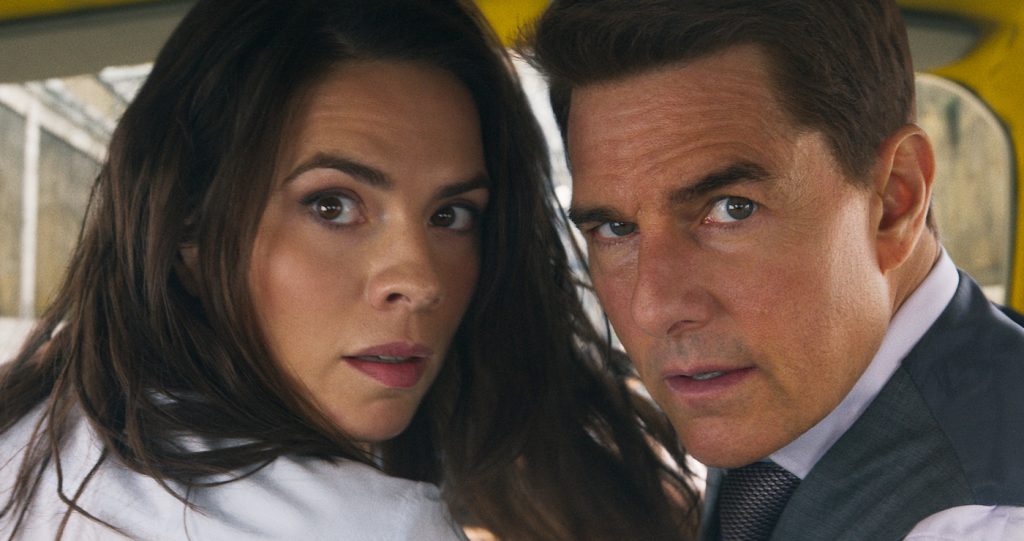
Hayley Atwell and Tom Cruise in Mission: Impossible Dead Reckoning Part One from Paramount Pictures and Skydance.
You like to keep things moving.
But you can get to the point where you compress it too much. Right at the end of the movie, Ethan Hunt’s talking to the henchwoman Paris, where she’s lying there going, “Why did you spare my life?” We did an ultra-tight version of that scene where I cut all the air out. I came back the next day and watched it again with Chris. We went, “Woah. There’s no emotion at all. I don’t feel anything. It’s just information,” And information is the death of emotion.
The movie’s first big set piece at the airport introduces Hayley Atwell’s character Grace, plus multiple bad guys, surveillance cameras, cutbacks to Luther and his laptop, and you’ve got Benji racing around trying to find a ticking bomb, and Ethan Hunt’s in the middle of it all. That’s a lot of moving parts!
The airport scene was filmed partially at a real airport in Abu Dhabi. It was phenomenally difficult, but Chris doesn’t worry too much about figuring everything out on the page or even on set. The actors give us a lot of flavors, he collects the ingredients, and then we bake the cake in the editing room. That sequence took weeks of work. We had to intercut between Luther and Ethan and Grace and Paris and the buyer while also making sure the graphics on Benji’s laptop are designed so that your eye is guided around the screen. The first time never works. We throw it all out, and it still doesn’t work. It’s an evolutionary process. Honestly, I was working on that scene for two years.
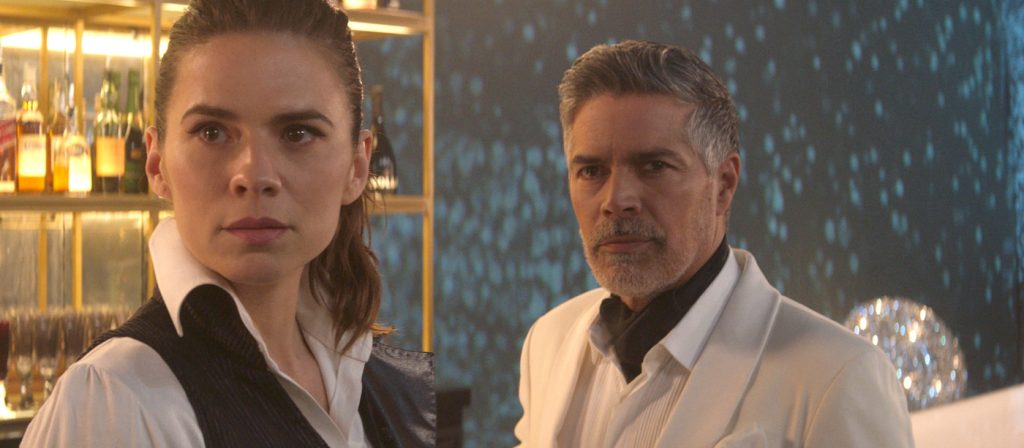
Hayley Atwell and Esai Morales in Mission: Impossible Dead Reckoning Part One from Paramount Pictures and Skydance.
Complex sequences seem to have become part of Mission: Impossible’s DNA.
If you think back to the opera scene in Rogue Nation, there’s all this cross-cutting to keep each character “alive,” so it’s similar in that way to the airport sequence. Chris likes to challenge himself with complicated sequences because he knows that when we sit together in the edit, we will refine it until we eventually get there.
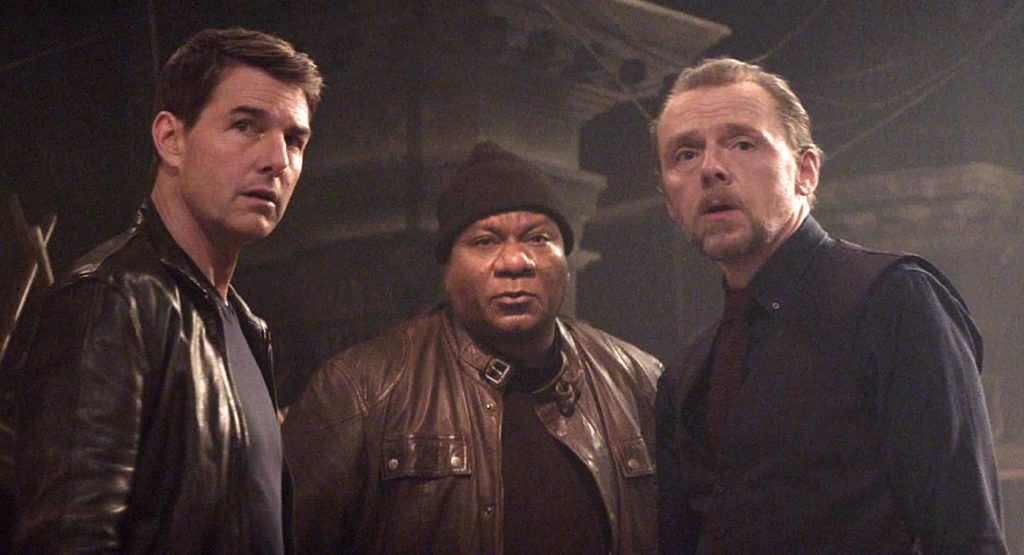
Tom Cruise, Ving Rhames and Simon Pegg in Mission: Impossible Dead Reckoning Part One from Paramount Pictures and Skydance.
Can you give an example of what it means to “refine” the raw footage?
It often involves going back and getting little close-ups of people, little bits of information. Or in the case of Hayley Atwell, she was finding her character every day. Is Grace scared? Confident? Flirty with Tom? Wily? There were times when she was a bit too confident, a bit smug, and we dialed that down. We modulated Hayley’s performance all the way through.
Tom Cruise and Hayley Atwell in Mission: Impossible Dead Reckoning Part One from Paramount Pictures and Skydance.
Were you present on set to make edits during production?
Yes, some of the time. I’d have a feed on my iPad, and on day two of the production, I’m working on day one footage, knowing it’s going to be rough and everything’s going to change. But you’ve got to start somewhere. I went through dailies and watched everything. We had 780 hours of footage on this movie.
The car chases in Rome looked phenomenal. How did you piece that footage together?
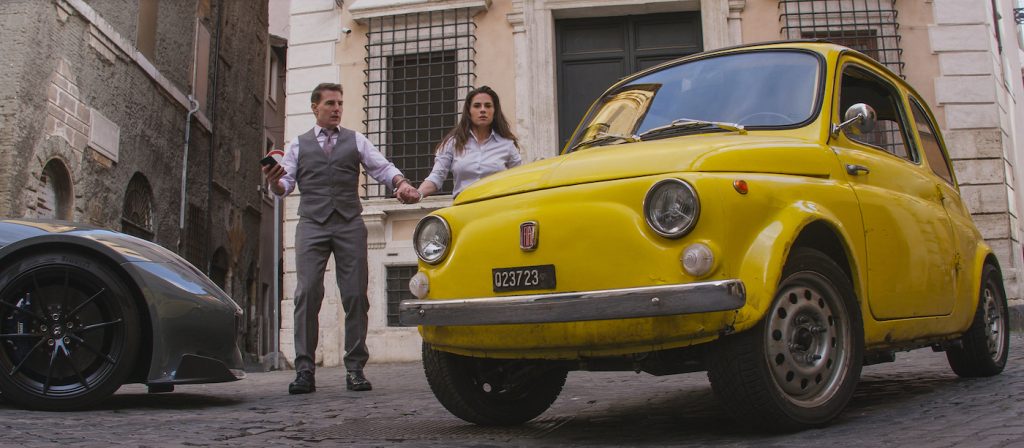
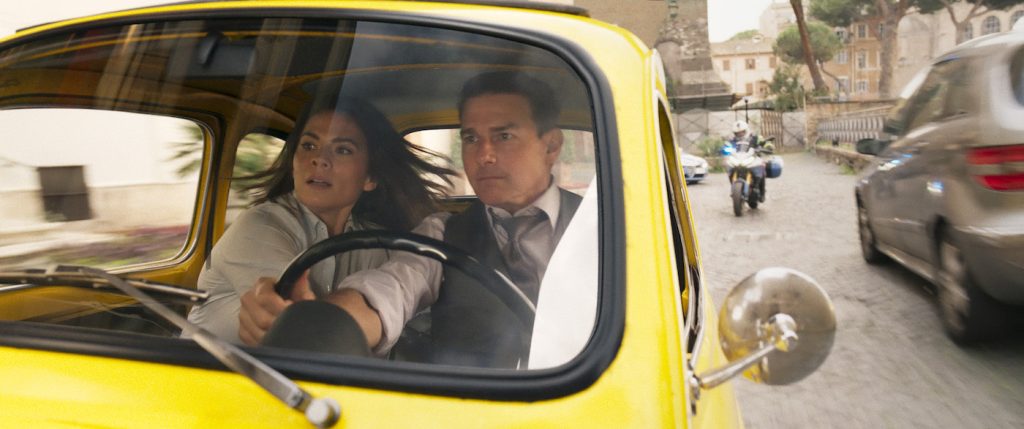
I’m thrilled with the way it turned out, but the Rome sequence took weeks of careful work to make sure [the action] landed correctly. You have to understand that Tom Cruise and Hayley Atwell are in a two-shot the entire time. You’re not cutting to create chemistry — you’re allowing their behavior to play out in a two-shot. One of our touchstone movies was What’s Up Doc.
Hayley Atwell and Tom Cruise in Mission: Impossible Dead Reckoning Part One from Paramount Pictures and Skydance.
The screwball comedy with Barbara Streisand?
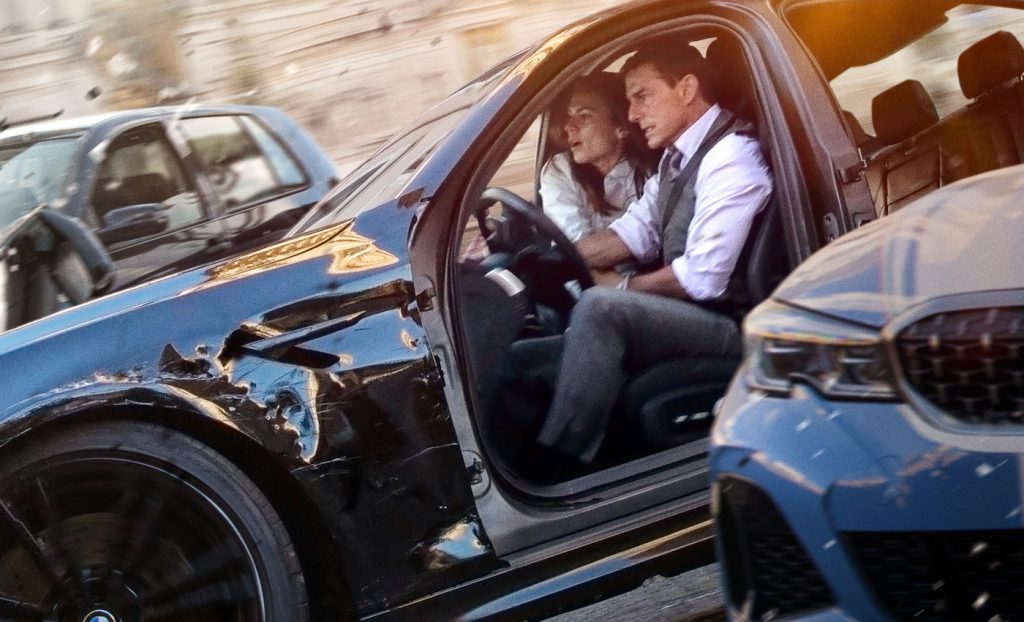
Yeah. Chris loved that film and really embraced that approach in the Fiat and, before that, the BMW chase where Ethan’s handcuffed to Grace, and he’s driving one-handed. We filmed so much cool stuff but ended up compressing it because we kept getting feedback from the audience that it was just too long. Tom would always tell us, “You’ve always got to leave the audience wanting more,” so that became our mantra. We said, “Okay, we’re going to dive back into the chase sequence and take out more until it’s the right length.” Chris and Tom listen to the audience very carefully. They want to make mass entertainment for people in every country on the planet.
Hayley Atwell and Tom Cruise in Mission: Impossible Dead Reckoning Part One from Paramount Pictures and Skydance.
Can you talk a bit more about editing the action in Rome so it would track for an audience?
The trick is any time you cut to Tom and Hayley reacting in the car, you can then jump to any location without losing the audience, apart from locals. We cut to Ethan, and he turns right; we’re in a different part of the city, and who cares? Sometimes we’d take one chase and combine it with another one, and you don’t even notice that we’re in two different parts of the city. So we do cheat. But we’re constantly trying to keep this dynamic energy going with pressure from the other characters and the gags while we’re balancing all of that with Tom’s precision driving, where he carefully knocks over scooters or drives into some tiny alley. We cut out quite a bit of cool stuff, so we’re going to do a deleted shots reel for the DVD where you can see all these bits in a montage.
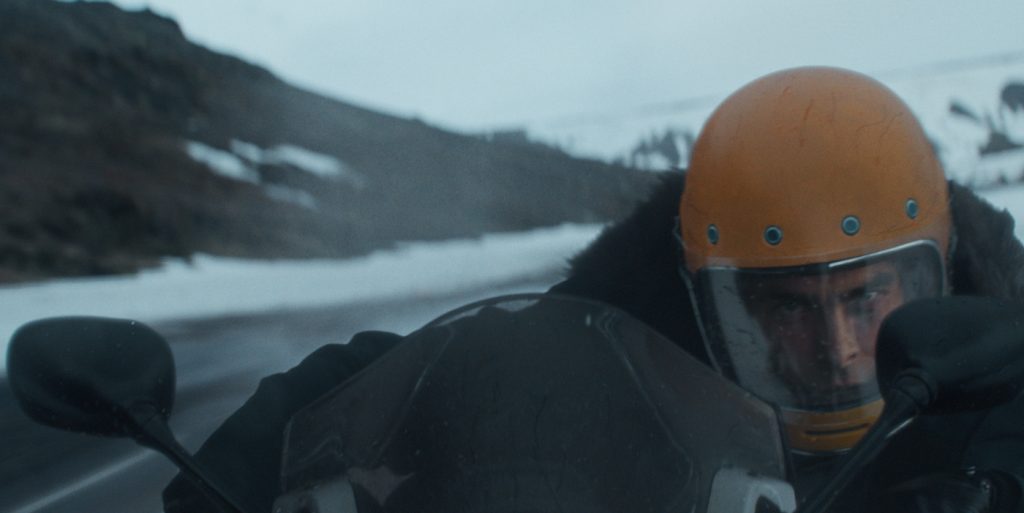
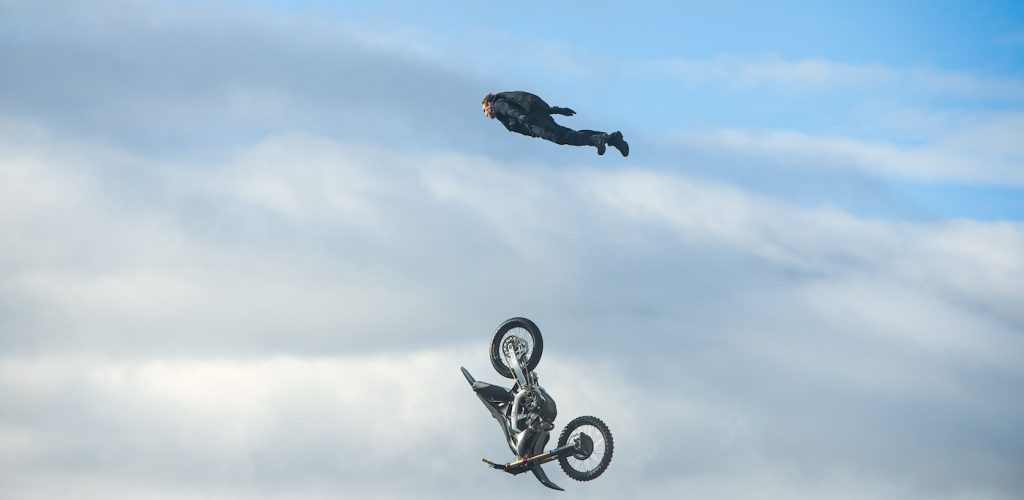
For the grand finale, you’ve got Tom Cruise and his motorcycle flying through the air to land on a speeding train – – pretty spectacular. Were you on set when they shot that?
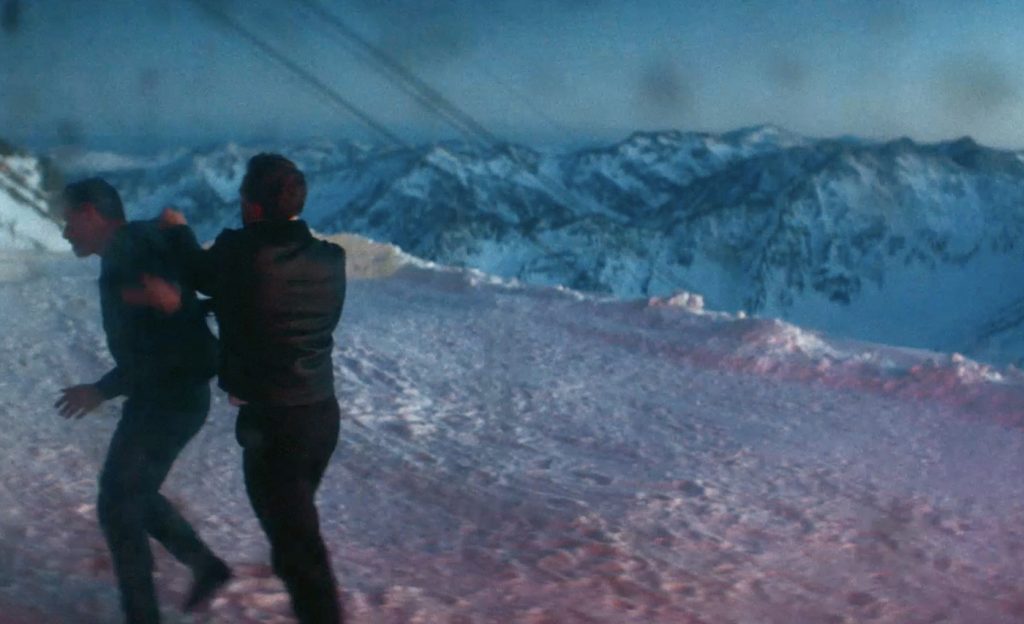
Yeah. In September 2020, I was in Norway when they filmed the jump, but it’s always about the emotional state, isn’t it? Because it doesn’t matter if someone does a stunt if you don’t have an emotional connection to the characters and the stakes, and why people are doing what they’re doing. How much of the story do we see before we see Ethan on the motorbike? How often do we cut to Grace and the White Widow on the train? To get all those pieces balanced correctly, you have to work really hard to make everything smooth and emotional, so you’re not bumped off the ride.
Tom Cruise plays Ethan Hunt in Mission: Impossible Dead Reckoning – Part One from Paramount Pictures and Skydance.Tom Cruise in Mission: Impossible Dead Reckoning Part One from Paramount Pictures and Skydance.
You clearly place a premium on paring the story down to its essence.
You have to be utterly ruthless. Even in the last week of the edit, I’d say to Chris, “We’ve got to cut this; we’ve got to cut that.” This was stuff that Chris was very fond of, but he was like, “If it can go, it must go.” It’s the art of getting the maximum amount of story into the minimum amount of screen time. That’s what you’re aiming for. That’s the holy grail.
For more on Mission: Impossible – Dead Reckoning Part One, check out these stories:
*It’s our annual “Best of Summer” look back at some (not all) of our favorite interviews from the past few months. This non-comprehensive look back includes the Barbenheimer phenomenon and the wonderful interviews that followed those two history-making films, chats with the talented folks behind Mission: Impossible, Spider-Man: Across the Spider-Verse, our profile of MPA Creator Award Recipient and filmmaker extraordinaire Gina Prince-Bythewood and more.
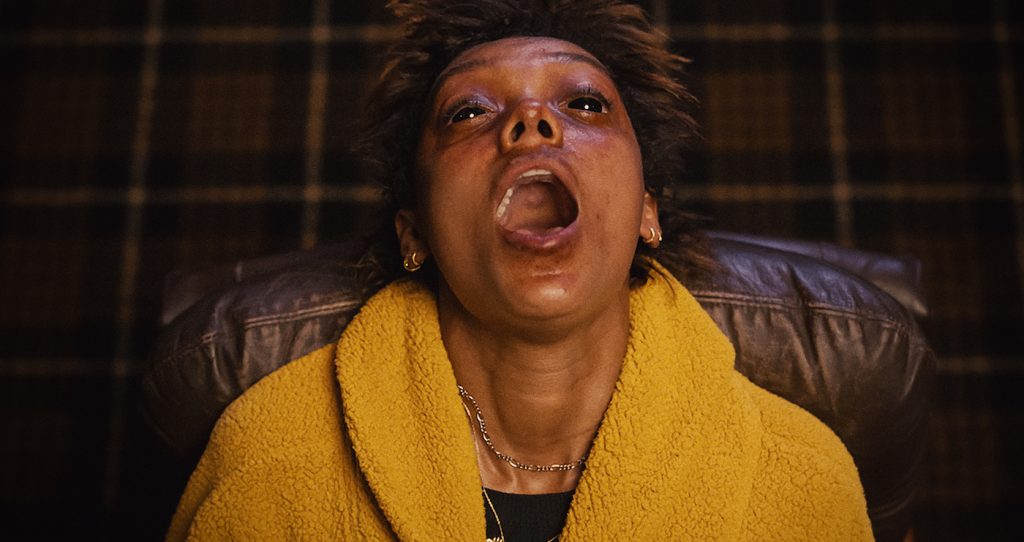
Danny and Michael Philippou do not pull their punches in their chilling feature film directorial debut Talk to Me. Having honed their craft over years making short films, the twins crafted a horror movie that screams with confidence and passion, where not a single scare seems to miss the mark. There’s a reason the powerhouse mini-major studio A24, behind some of the best horror films of the last decade, got behind these two.
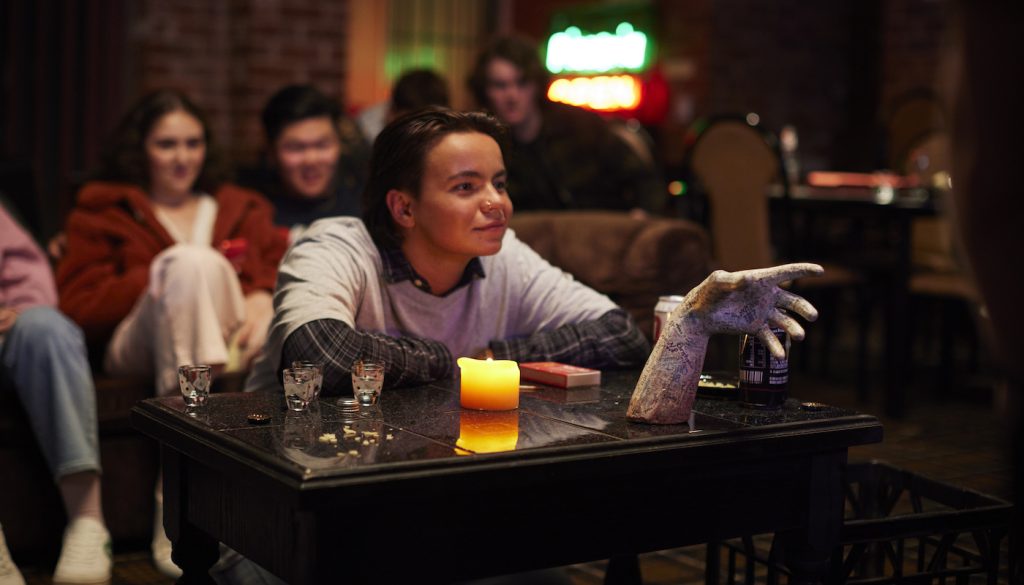
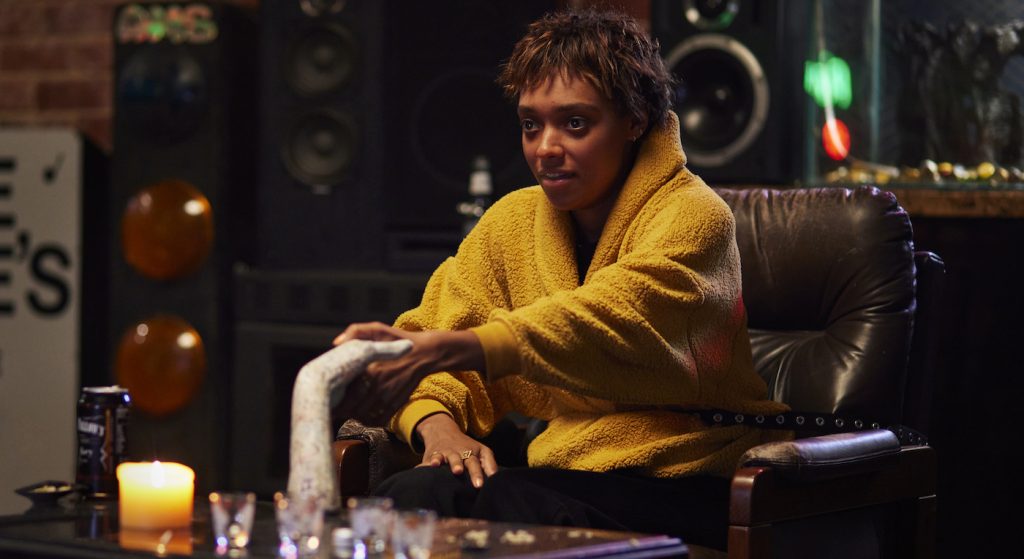
Talk to Me is led by a young woman Mia (Sophie Wilde), grieving over her mother’s death, who is part of a group of friends who figure out how to commune with the dead. The recipe to conjure spirits is surprisingly straightforward—shake an embalmed hand, welcome a spirit inside, and experience the other side. What if once a spirit is conjured, it doesn’t leave? As Mia grieves the mysterious loss of her mother, she finds out the hard way what happens when you make contact with the spirit world.
Talk to Me is a delightfully sinister and visceral experience, arguably the year’s most unsettling, unstinting horror film. Danny and Michael Philippou talked to The Credits about crafting their unholy vision, a sensual feast of horrors that the late, great William Friedkin would have admired.
Often in film, it’s what you don’t show that’s scarier, but here, what you do show is scarier. Was that an intention?
Danny: For the most part, we knew we wanted to build up to those scenes of horror and not shy away from it while we’re doing it. And so, it’s not all the way through the film that we’re showing this really extreme imagery. But once things happened, we didn’t want to bat an eye.
Michael: Show the consequences of the actions that these kids are making.
Danny: On top of that, there was a sequence we shot that was initially two and a half minutes; we had to cut it down to 15 seconds because it was too much. That trip to hell never would’ve gotten past the sensors.
Michael: Even when we were watching it, we were like, ‘This looks like a different movie.’ We suddenly ventured into some interesting, very violent territory.
(L-R) Zoe Terakes Credit: Andre Castellucci
Even with all the intensity, there are horrors that are subtle, as well. For example, the sound design and the score work in a way that’s almost as ruthless as the visuals. How did you accomplish that?
Danny: Michael was so OCD with sound and music. He did a temp score for the entire movie. He was in every sound session giving brutal notes. It was like, “Oh, my God. Let the person work, Michael.”
Michael: When we’re mixing manually, when they bring things down, certain tracks, I can hear it. I’m like, ‘Can we not do it manually? Because I can hear that drop too quickly.’ So, I’m really annoying, I guess, but I have a certain vision in my head, especially with merging the sound and music. I wanted them both to be equal and not have music buried under sound or sound buried under music. We’re having them both work in sync with each other, which wasn’t easy to do.
Danny: The biggest shout-out to our sound designer, Emma Bortingnon. Every time that we’d give Emma a whole bunch of notes, she’d go away, do a pass and then bring it back. And it’d be like, “Whoa, listen to this.”
Michael: And a shoutout to our composer, Cornel [Wilczek]. We actually had to redo the music for a few different reasons, and Cornel came in last second and saved us. Man, I would send so many notes, and he’d get them all. It was amazing work.
(L-R) Sophie Wilde Credit: Matthew Thorne
What originally happened with the score?
Michael: The music didn’t work the first time around, so we were able to really focus on the sound design and really nail out the sound of the possessions and atmosphere. And then, the second mix was implementing the music cohesively. So, it was a blessing in disguise, but I can’t wait for the next movie to start music earlier in pre-production.
This movie doesn’t hit you over the head with rules, but did you both have rules for yourselves?
Danny: We had the thickest mythology that breaks down every single rule. All the backstories of the spirits the kids connected to and why those kids are connecting to them. We broke that all down, but we wanted the kids to be in over their heads. We didn’t want there to be some expert that can explain things and didn’t want there to be an easy out.
Any rules for yourselves for how you went about filming?
Michael: We wanted it all to be grounded in Mia’s point of view, so you never see a spirit outside of what Mia sees.
Danny: Another subtle, small thing that we did is remove every single lens flare from the film except for in the dream sequence that Mia has. That’s the only lens flare that we have in the film to help differentiate one world from the other. Just subtle things like that.
Michael: Camera movements. The way things look in the possessions is different from how it looks standard. Finding that visual language was invaluable. And then also, through sound, you can communicate so much. You don’t need to do it visually. Different ways of saying things without saying them.
Danny: And then, there’s subtle sound design and music things that we had tied to each demon as well. Once this certain demon is connecting with Mia, there’s a certain sound that underlays that.
Michael: And even how they died, that’s incorporated all into the soundscape as well. Man, it was such an amazing experience, and we learned so much. Because usually, just trying to do it ourselves is one thing, but then, doing it with professionals and having those conversations, your mind blows over with all these ideas.
(L-R) Sophie Wilde Credit: Courtesy of A24
Did you both talk through how Talk to Me would be interpreted and what message people would take away from it?
Danny: I like leaving that stuff up to interpretation. I know what it means to me and what we’re saying, but I like hearing everyone’s take on it. So, I don’t want to explain too much, but I think you can interpret it anywhere that you want.
Michael: It was like witnessing a tragedy leading up to a car crash.
Danny: And I was a bit in a dark head space when I was writing some of this stuff, and that’s just expressing it and putting it on the page. And some of that sadness is in there.
Michael: You’re a sad man. Get this guy a therapist.
(L-R) Sophie Wilde Credit: Courtesy of A24
[Laughs] Well, the passion shows in the movie. Did you both have conversations about loss and how to express it best creatively?
Danny: We lost our grandfather, who helped raise us. Our parents weren’t home that much. And he passed away when we were thirteen, in our house on Christmas day. It’s pretty insane. It was a hole ripped out of your life a little bit, and you’re looking for something, anything to fill it with.
Michael: So much of the film is about connection. Mia is having every ounce of intimacy stripped away from her throughout the film. Some people say that she’s an unlikable character, but I really empathize with Mia.
(L-R) Sophie Wilde Credit: Courtesy of A24
She has PTSD, and sometimes, you make unreasonable choices when you’re experiencing it.
Michael: Especially without the right guidance as well. You can get into the wrong crowds when you’re trying to fill a certain hole. You can get led down a different path.
We have some good news for all the folks who couldn’t snag a ticket to Taylor Swift’s rapturous, record-shattering stadium tour through the U.S.—a filmed version of Swift’s tour, Taylor Swift / The Eras Tour, is coming to theaters across the United States this fall, on Friday, October 13th, no less.
Given the mega-popularity of Swift, AMC Theaters has promised that the concert film will play at every single one of its U.S. locations at least four times a day, from Thursday through Sunday, for its initial run. You can also catch Swift the way so many of her fans see and hear her—as the biggest superstar on the planet—by seeing Taylor Swift / The Eras Tour on premium screens via AMC’s IMAX screens and Dolby Cinema locations.
Cinemark and Regal screens will also be showing the concert film. Cinemark will be showing the movie at all their U.S. theaters beginning on October 13 and running each subsequent weekend through November 5. Regal Cinemas will show the film in its theaters in the U.S., while Cineplex will screen it in around 150 theaters around the country. More theaters and theater chains will likely be added.
Here’s how Swift broke the news to her legion of fans:
The Eras Tour has been the most meaningful, electric experience of my life so far and I’m overjoyed to tell you that it’ll be coming to the big screen soon 😆 Starting Oct 13th you’ll be able to experience the concert film in theaters in North America! Tickets are on sale now at… pic.twitter.com/eKRqS8C7d1
AMC also issued a statement that seems entirely reasonable given the alacrity that Swifties possess when it comes to jumping on tickets to see her perform:
“AMC is also aware that no ticketing system in history seems to have been able to accommodate the soaring demand from Taylor Swift fans when tickets are first placed on sale. Guests wanting to be the first to buy their tickets online may experience delays, longer-than-usual ticket-purchase waiting-room times, and possible outages. AMC is committed to ensuring any delays or outages are addressed as quickly as possible,” the company said in a statement.
Check out the trailer here:
Featured image: GLENDALE, ARIZONA – MARCH 17: (Editorial use only and no commercial use at any time. No use on publication covers is permitted after August 9, 2023.) Taylor Swift performs onstage for the opening night of “Taylor Swift | The Eras Tour” at State Farm Stadium on March 17, 2023 in Swift City, ERAzona (Glendale, Arizona). The city of Glendale, Arizona was ceremonially renamed to Swift City for March 17-18 in honor of The Eras Tour. (Photo by Kevin Winter/Getty Images for TAS Rights Management)
*It’s our annual “Best of Summer” look back at some (not all) of our favorite interviews from the past few months. This non-comprehensive look back includes the Barbenheimer phenomenon and the wonderful interviews that followed those two history-making films, chats with the talented folks behind Mission: Impossible, Spider-Man: Across the Spider-Verse, our profile of MPA Creator Award Recipient and filmmaker extraordinaire Gina Prince-Bythewood and more.
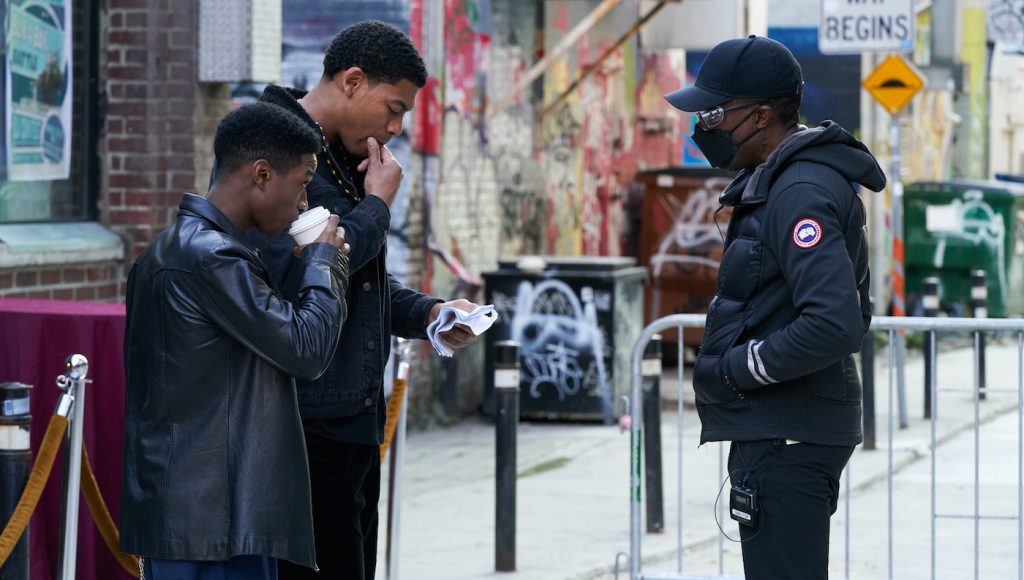
When he returned to feature filmmaking, writer/director Clement Virgo followed his instincts. Since his last feature, Poor Boy’s Game (2007), Virgo has been directing TV, working more or less nonstop. He’s directed episodes of Empire, Netflix’s Dahmer- Monster: The Jeffrey Dahmer Story, and OWN’s megachurch drama Greenleaf. He was thinking about getting back into features when a friend handed him a copy of David Chariandy’s novel “Brother,” about two Trinidadian immigrants in the Toronto suburb of Scarborough during a smotheringly hot summer in 1991.
“I just knew I had to make it,” Virgo says. “I knew the feelings in the novel, and I knew a way into it.”
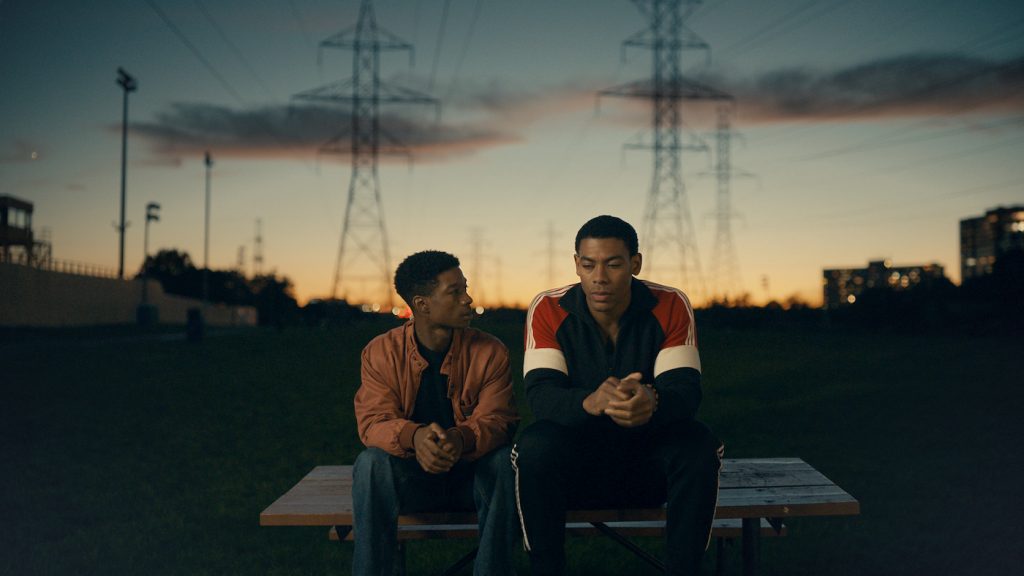
Virgo’s adaptation is a gorgeously wrought, quietly powerful return to filmmaking. He marshalls all of his gifts and his years of experience to tell the story of two brothers, Francis (Aaron Pierre) and Michael (Lamar Johnson), deftly teasing out their story along three separate timelines, covering some twenty years of their life in Scarborough to a staggering climax, complete with a gorgeous coda. Brother stays with you—the performances, the recurring motifs, the soundscape (both composer Todor Kobakov’s score and the hip hop that’s such a huge part of Francis’s life), the specificity. In Virgo’s hands, the whole thing appears effortless, the mark of an artist who focuses his efforts on the right things.
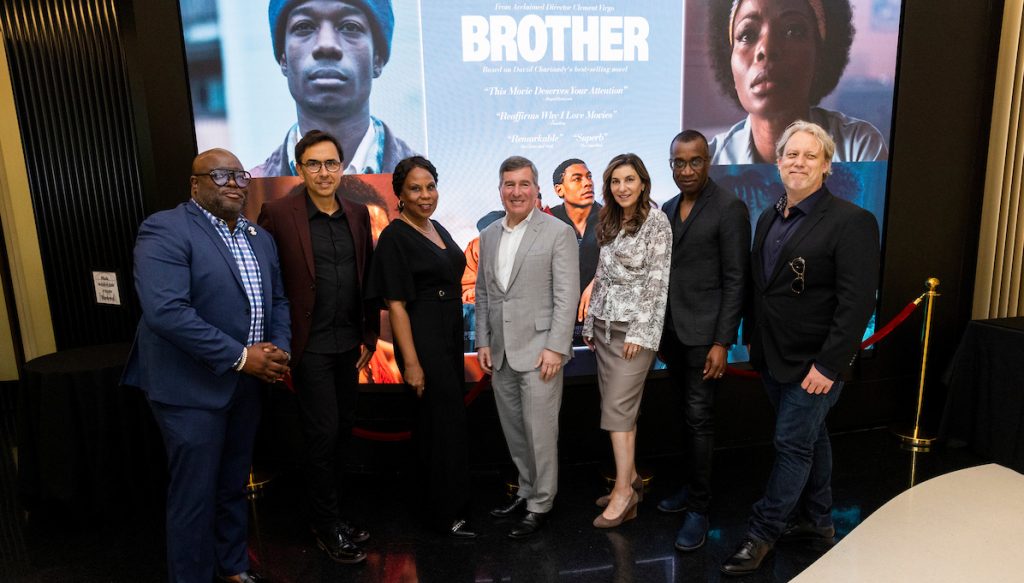
Clement screened the film at a Motion Picture Association event this past May in Washington, D.C., co-hosted by the Canadian Embassy, in recognition of the MPA’s partnership with the Black Screen Office. We spoke to Virgo about returning to filmmaking with such an assured, devastating new movie, why specificity creates intimacy between a viewer and a film’s subjects and more.
L-r: John Gibson (Vice President, External and Multicultural Affairs, MPA), Damon D’Oliviera (Partner/Producer, Conquering Lion Pictures), Joan Jenkinson (Executive Director, Black Screen Office), Charles Rivkin (Chairman and CEO, MPA), Wendy Noss (President, MPA-Canada), Clement Virgo (Director), Aeschylus Poulos (President/Producer, Hawkeye Pictures)
It was one of those novels that just spoke to me. Like a lot of artists, you don’t know why you’re drawn to something, but this spoke to me in a visceral way and caught me at a time when I wanted to go back to being a filmmaker. I knew the feelings in the novel, and I knew a way into it.
You thread three storylines in such a subtle way, and I’m curious how difficult that was at the scripting stage.
I was very conscious of trying to do something structurally new for me. The great thing about attempting that is that I’m not the first person to try it. I went back and looked at certain films that I thought were very successful at it. I looked at The Godfather Part II, which had that parallel storyline between the father and son. I looked at Manchester by the Sea, which I thought was a beautifully structured film. I find screenplays are really about structure, and once I found the architecture for the story and how each moment and each timeline influences the next and informs what we just saw, I had it. Filmmakers have been playing with structure and time since Orson Welles and D.W. Griffith.
The performances you get from Aaron Pierre and Lamar Johnson are so powerful. As someone who has worked with actors for decades now, I’d love to hear how you managed your relationship with them.
In terms of process, I think every actor has a different methodology for how they work. One of the great things about working in television is that sometimes you haven’t had a chance to meet the actor, and the first time you do is on set. If it’s an ongoing series, you even haven’t cast them, so you don’t have a rapport. So you have to figure out very quickly what they need and what motivates them, and how to be a great audience for them. The great actors are very creative, and if you stay open to that, you get great ideas from them. They make the character so much richer than what you’ve written on the page. And Aaron Pierre and Lamar Johnson brought great ideas to Francis and Michael.
And how were you a good audience for them?
It was to try to help guide them in a subtle way. It’s a cliche, but it’s really a collaboration; it’s trying to be thoughtful and emotionally intelligent about how to inspire, when to push, when to leave them alone, when to encourage, and when to shut up. It’s all the things that you do in any relationship, you’re trying to figure out how to be a good partner and collaborator.
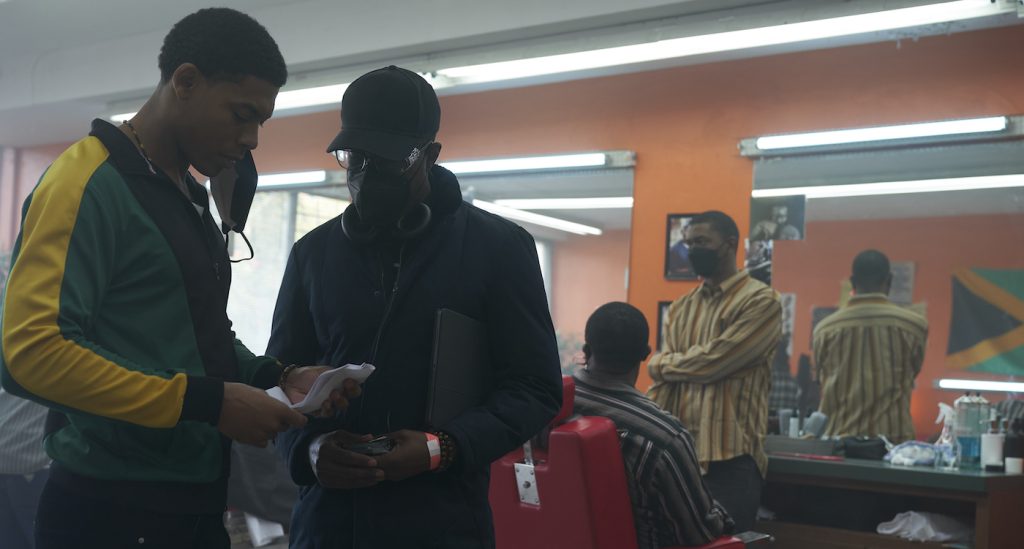
L-r: Aaron Pierre and Clement Virgo on the set of “Brother.”
Your film manages to show, often through the unspoken physicality of how Francis and Michael go through the world, the impact of all the forces arrayed against them—the police, their relationship with their hardworking but often absent mother (a wonderful Marsha Stephanie Blake), their being Jamaican immigrants in a Toronto suburb. I’m wondering how much of that direction and how much is pure performance?
I think it’s really a bunch of different things. It’s cinema in terms of what is the image saying? What are you communicating with that image? What’s the body language, what’s the behavior telling you or not telling you? And how do I, as an audience member, interpret that image? The films that I love communicate through pure cinema. I think that’s the difference between television and film. I just read something that Christopher Nolan said about cinema that’s really interesting. He said that a lot of people think cinema is about plot, but it’s really an audiovisual experience. I thought about that for hours after because it’s true. As a filmmaker, what you’re trying to do is communicate a feeling, a tone. You’re trying to immerse the audience in an experience. Everything is story.
L-r: Lamar Johnson, Aaron Pierre, and Clement Virgo on the set of “Brother.”
Every constituent part within a film is telling one story?
The costumes are story. The set design is story. The lighting is story. You’re trying to communicate non-verbally and have the audience feel something and take something away from the film. How Aaron Pierre walks into a room, what he’s wearing, is the camera with him and subjective, or is it watching him and slowly moving in? It’s all the language and tricks of cinema. Sometimes that stuff is intuitive. You don’t know why you do it. I think most writers and filmmakers, most artists, actually, are trying to create meaning out of their own lives. It’s kind of impossible to hide who you are in your work.
L-r: Lamar Johnson and Aaron Pierre in “Brother.” Credit: Guy Godfree
You made one crucial change in your adaptation, switching the brothers from Trinidadian to Jamaican immigrants. Can you talk about that a bit?
I didn’t want to have to think about it. I didn’t want to intellectualize it, I just wanted to make choices in the moment that felt intuitive. I think that’s the hardest thing, as an artist and a writer, is to get to a place where it’s just pure impulse and instinct. With my background, being born and growing up in Jamaica, I didn’t have to think about the details, I just had to recall and try to communicate and be as specific as I could. I’ve never been a schoolboy in Paris in 1963, but when you see The 400 Blows, it’s so specific to that experience you recognize your own humanity in that story. I’m trying to communicate a collective humanity, and the more specific I am to my own experience, the more it will hopefully translate, and you’ll see your own humanity in my story.
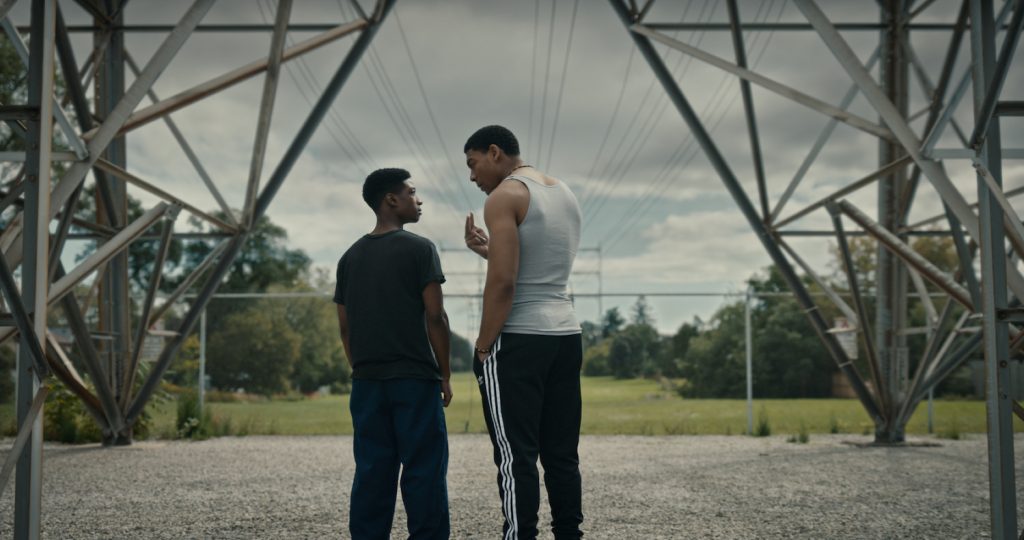
Let’s end with the recurring motif in Brothers, which is Francis and Michael climbing the electrical tower. Can you tell me about filming that?
We filmed it here in Toronto, there’s a decommissioned hydro tower weigh station where there’s no electricity. We got permission from the provincial government to go in and be able to shoot there. We couldn’t climb the tower for real, so it’s a combination of the real space and what we built on our own and with CGI to create that sense of height and jeopardy. But that image is how DavidChariandy starts his novel, and I thought it was a beautiful metaphor for the brothers to use that as a visual motif. I’m assuming the audience is going to think something dreadful is going to happen when they’re climbing that tower, but of course, you try to twist that expectation. They get to the top, and it’s like looking out into the future. It’s a MacGuffin, like Rosebud in Citizen Kane or the Lost Ark in Raiders of the Lost Ark; when an object or piece of architecture has meaning in a film, I always find that quite powerful. Like in Mad Max: Fury Road, the image of Charlize Theron falling to her knees in the middle of the desert after that long journey, with the wind blowing sand around her. When I make a film, I think in images.
Lamar Johnson and Aaron Pierre in “Brother.” Credit: Guy Godfree.
Featured image: L-r: Lamar Johnson and Aaron Pierre in “Brother.” Credit: Guy Godfree
*It’s our annual “Best of Summer” look back at some (not all) of our favorite interviews from the past few months. This non-comprehensive look back includes the Barbenheimer phenomenon and the wonderful interviews that followed those two history-making films, chats with the talented folks behind Mission: Impossible, Spider-Man: Across the Spider-Verse, our profile of MPA Creator Award Recipient and filmmaker extraordinaire Gina Prince-Bythewood and more.
There isn’t an Oscars category for casting directors (yet), but the Emmys have recognized the foundational importance of the people who find actors with the talent and the chemistry to create magic on screen. Without casting directors, a lot of your favorite moments onscreen would likely never have happened.
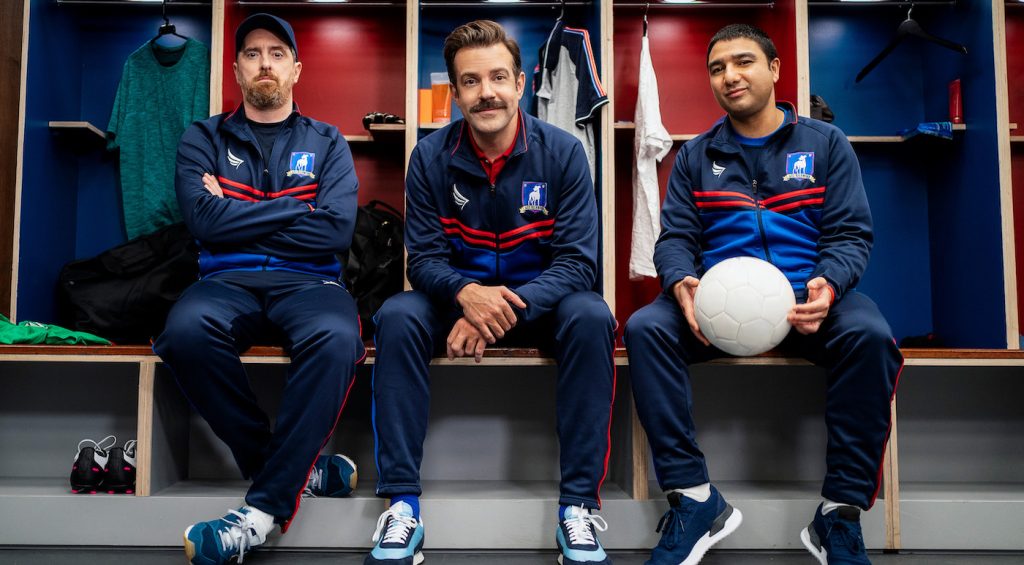
In an interview with The Credits, two-time Emmy winner and current nominee Theo Park, nominated for her stellar work on Ted Lasso, talked about how she became a casting director, her favorite scene from the hit Apple series (which garnered 21 Emmy nominations in total), which Ted Lasso actor made an immediate impression, which one had to be persuaded to take the job, and which one never had to audition at all, despite having no background in comedy.
I don’t think children grow up and say, “Someday, I want to be a casting director.” So, how did you find yourself in that job?
I think a lot of us casting directors are failed actors, some ex-actors, or at least people who have aspired to be an actor. And that’s what I did. I wanted very much when I was a child to be an actor. And then, when I got into my teens, I realized that it’s really hard to be an actor, but I still had a passion for performance.
So you kept performing?
I did film at university. And became an agent after working in television for a bit. But realized when I was an agent that it wasn’t quite creative enough. We were looking after fabulous actors but not really being involved in the creative process. So, I flipped it. Instead of selling actors, I decided to buy them. And I was really lucky. I just landed a really fabulous job helping out a casting director in London called Nina Gold. I was her assistant for a few years, and she taught me wonderfully. And I’ve been on my own for about eight years now.
Theo Park
What is the most important quality that a casting director has to have?
Probably an understanding of actors and their work and their craft and what they go through to create a performance. I think having had that background; it has definitely put me in good stead.
So, does it begin with you sitting down with the showrunner and talking about the characters and what they’re looking for?
Yes, absolutely. You’re normally sent a script. And in the case of Ted Lasso, I was sent the pilot script, so that gave me a good idea of the world. And then you talk to the creatives. In this instance, it was Jason Sudeikis, and he talked me through all of the characters, who was going to be a regular, and who were the important characters that we needed to focus on. And then we’d talk about their arcs because I’d only read one script and a lot of it hadn’t been written yet. And then I’d go away and come up with some ideas, and then we’d talk again.
Brendan Hunt, Jason Sudeikis and Nick Mohammed in “Ted Lasso” season two, now streaming on Apple TV+.
What about when you’re actually taping a performer?
When it’s a taping situation, as in the creatives are either out of the country or already shooting, and they can’t meet a whole load of actors in the flesh, we will get people to just audition with us. And then I might be a bit more selective and only send Jason half a dozen of the best people. And he and the creatives get to choose the pick of the bunch.
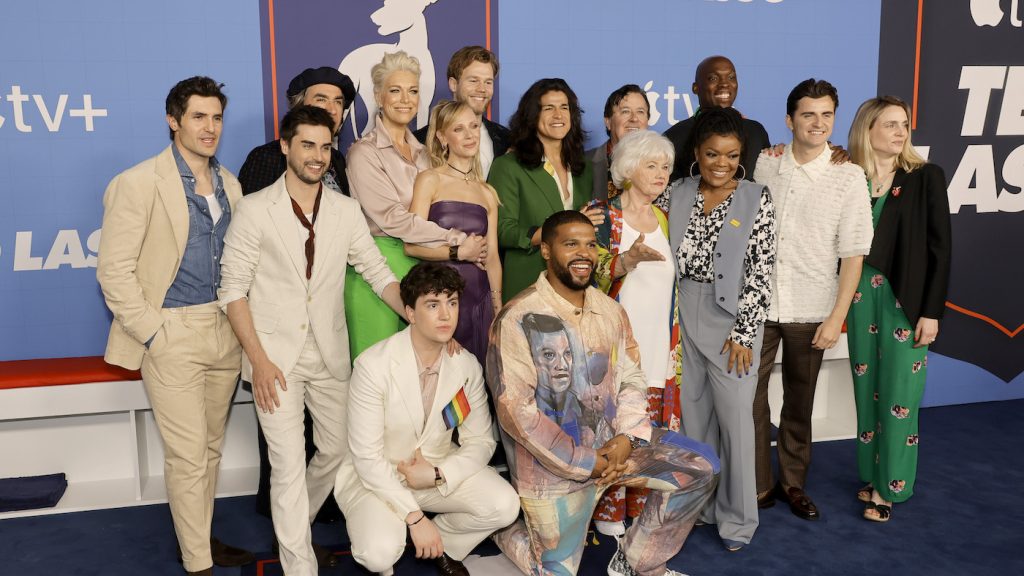
NORTH HOLLYWOOD, CALIFORNIA – JUNE 10: (L-R) Phil Dunster, Stephen Manas, James Lance, Hannah Waddingham, Charlie Hiscock, Juno Temple, David Elsendoorn, Cristo Fernández, Kola Bokinni, Annette Badland, Jeremy Swift, Yvette Nicole Brown, Moe Jeudy-Lamour, Billy Harris, and Theo Park attend Apple TV+’s “Ted Lasso” Season Three FYC at Saban Media Center on June 10, 2023 in North Hollywood, California. (Photo by Kevin Winter/Getty Images)
If you’ve read just the script for the first episode, do you have some idea about the arcs that some of these characters are going to have? Because even through the first season, I don’t think we would have guessed where the characters played by Toheeb Jimoh or Nick Mohammed were going.
No, we didn’t. For Toheeb’s character, Sam Obisanya, I didn’t know anything about what was going to happen; apart from that he needed to have this lovely warm glow, a lovely positive energy to him. And that matched Ted in a way. And Toheeb came in, and you look at him, and he’s just so beautiful. And the warmth just exudes from him, doesn’t it? So, he was easy. Everyone just said, “Well, he’s it.”
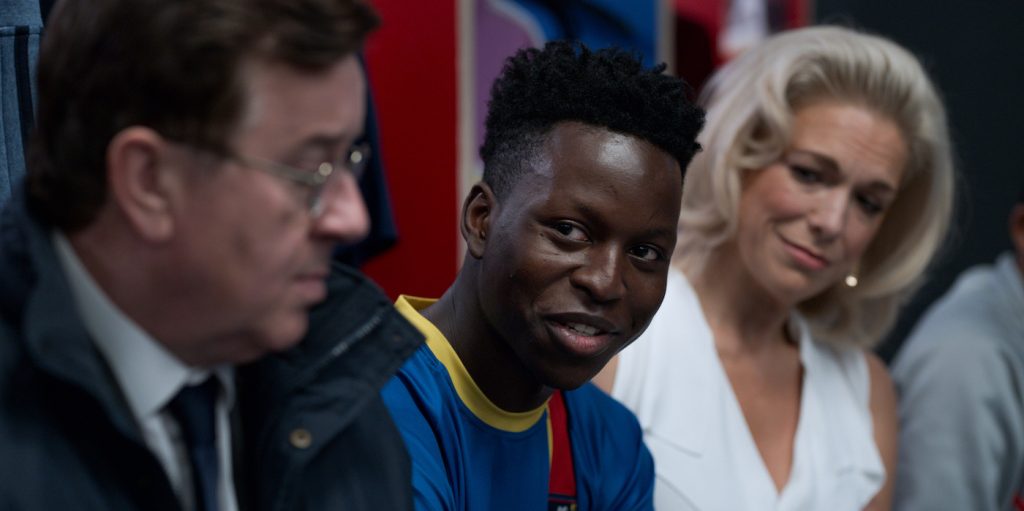
Jeremy Swift, Toheeb Jimoh and Hannah Waddingham in “Ted Lasso,” now streaming on Apple TV+.
But for Nick Mohammed and Nate, yes, Jason did talk me through the arc of his character, certainly for Season One. Because we actually had to persuade Nick Mohammed to come in for it. He didn’t want to come in for it originally because he felt it was too similar to a slightly downtrodden character that he’d played in his own show, Intelligence, a wonderful comedy show that he did with David Schwimmer. And so, we were able to tell Nick, “This is different; there is this character arc.” And he gave it a go and totally nailed the audition.
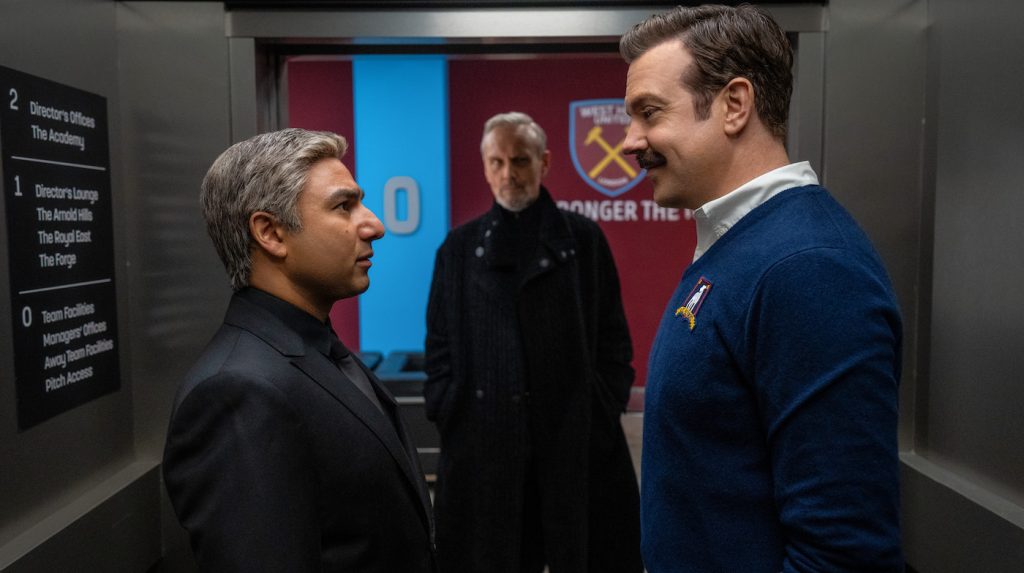
Nick Mohammed and Jason Sudeikis in “Ted Lasso,” coming soon to Apple TV+.
I have read that Juno Temple, who plays Keely, had not done comedy before. What brought her to the role?
I’m a massive fan of hers. I’ve seen all of her work. I think she’s exceptional. She was actually Jason’s idea. And we all thought behind the scenes, “Oh, gosh, would she ever do this? Would she ever sign up for further seasons on a TV show when she’s such an indie film darling?” But he persuaded her. She didn’t have to audition. He knew she had it in her. He’s very, very good at casting, I have to say, Jason is. He always makes the right choices.
Just as in real-life football, the team in the Ted Lasso cast had tremendous diversity.
Yes, this is set in the world of Premier League football. There are people from all over the world playing in Premier League football clubs. So, that was really important from the start. Is it a challenge? No. It’s just exciting. It’s exciting to be able to cast different people everywhere within the show.
Cristo Fernandez in “Ted Lasso,” now streaming on Apple TV+.
I’m fascinated by accents. Was everyone using pretty close to their own accents, or was there a lot of accent work?
What is quite funny is that one of the things that Jason said to me is, “I want people to be playing themselves. I don’t want any accents. I want to really believe these people. We should just be casting close to type.” But ultimately, nobody’s really using their own accent. Nick Mohammed is using an accent. Juno Temple is using an accent. Toheeb is using an accent. Billy Harris [Colin] is using an accent. Billy Harris is not from Wales. He is from Essex.
Did Jason realize this?
I wonder if a lot of it slipped under the radar slightly, and Jason didn’t really know that everyone was working so hard on their accents. Because it’s quite subtle, especially in the UK. A lot of the accents are very subtly different to maybe an American audience.
What about Hannah Waddingham as Rebecca?
Hannah Waddingham’s accent, what she’s doing for Rebecca, is very close to her. But she’s able to do anything. She’s a real chameleon. She can do any accent under the sun.
Tell me a movie that you think is especially well cast.
I absolutely love Bridesmaids. It’s my favorite movie. Well, after When Harry Met Sally. Both are cast exceptionally. But Bridesmaids, Oh, my gosh. Every single performer in that film is incredible and hysterical. It’s perfection. It really is.
What makes you laugh?
There’s a scene in Ted Lasso I rewatch quite a lot, Season Two, Episode Three when he turns into Led Tasso. The sequence is the funniest sequence in the whole of the three seasons, and I rewind it and watch it again and again. Just comedy genius. I loved him doing that because it was just a throwback to the absolute pure comedy bones that that man has. I just loved it.
For more stories on Apple TV series and films, check these out:
Legendary director Michael Mann (Heat, Collateral, The Insider) has been thinking about making Ferrari for decades, and now, at long last, Mann’s meticulously crafted epic about Enzo Ferrari (Adam Driver) is here. Ferrari, which is set to have its world premiere at the Venice International Film Festival this week, has dropped its first trailer.
In this nearly wordless 90-second glimpse, it’s 1957, and we’re behind the wheel of one of Enzo Ferrari’s namesake racecars as it barrels along one of the most dangerous races in the world, the brutal 1,000-mile sprint across Italy called the Mille Miglia. Ferrari is in crisis—his son, Dino, has died a year earlier; his marriage to Laura (Penelope Cruz), the woman who helped him build the Ferrari factory, is strained from the loss and from his relationship with his mistress, Lina Lardi (Shailene Woodley). With the Mille Miglia coming up, Ferrari’s team needs to win big, but the cost of their obsession could be life and death, as the notoriously deadly race has already taken lives before.
Ferrari will cover one of the most infamous catastrophes in racing history, when one of Ferrari’s racecars blew a tire during the Mille Miglia, and the driver, plus nine spectators, died in the ensuing crash. The disaster turned into a legal battle as Ferrari and the tire manufacturer were charged with manslaughter. Ferrari was filmed primarily in Brescia, Italy, where the Mille Miglia race took place.
Ferrari also stars Patrick Dempsey as racecar driver Piero Taruffi, Jack O’Connell as driver Peter Collins, Sarah Gadon as Linda Christian, and Gabriel Leone as driver Alfonso de Portago.
Mann adapted the script alongside the late Troy Kennedy-Martin from Brock Yate’s 1991 biography “Enzo Ferrari – The Man, The Cars, The Races, The Machine.”
Check out the trailer below. Ferrari hits theaters on Christmas Day.
Here’s the official synopsis:
It is the summer of 1957. Behind the spectacle of Formula 1, ex-racer Enzo Ferrari is in crisis. Bankruptcy threatens the factory he and his wife, Laura built from nothing ten years earlier. Their volatile marriage has been battered by the loss of their son, Dino a year earlier. Ferrari struggles to acknowledge his son Piero with Lina Lardi. Meanwhile, his drivers’ passion to win pushes them to the edge as they launch into the treacherous 1,000-mile race across Italy, the Mille Miglia.
Featured image: Adam Driver is Enzo Ferrari in Michael Mann’s “Ferrari.” Courtesy NEON.
Martin Scorsese’s Killers of the Flower Moon, easily one of the most eagerly anticipated films of the year, has decided against a limited release in early October in favor of a simultaneous global release later that month.
Apple Studios announced that Scorsese’s historical crime drama, based on investigative journalist David Grann’s masterful 2017 book, will premiere worldwide on October 20, with a streaming release on Apple TV+ at some point after that. Scorsese’s film stars his longtime collaborators, Leonardo DiCaprio and Robert De Niro, along with Lily Gladstone, Jesse Plemmons, Tantoo Cardinal, John Lithgow, Brendan Fraser, Cara Jade Myers, and more.
Apple Studios didn’t specify exactly why they’ve made the decision to eschew the limited release and opt for a global release, but the obvious culprit is the SAG-AFRTA strike that has affected actors’ ability to promote their films. Without stars like DiCaprio, De Niro, and rising star Gladstone able to promote Scorsese’s latest, a single wide release should make for a bigger splash and give the Oscar-hopeful plenty of buzz rather than an initial limited release.
Killers of the Flower Moon is centered on a series of murders by white settlers of members of the Osage Nation of Oklahoma, whose land lies on massive oil fields and who have become, practically overnight, some of the wealthiest people in the country. Scorsese’s sweeping crime saga was met with a nine-minute standing ovation when it had its world premiere at the Cannes Film Festival, where Gladstone came in for special attention for her stunning portrayal of Mollie Burkhart, an Osage Nation member who marries Ernest Burkhart (DiCaprio), one of the white settlers at the center of the murder mystery.
Killers of the Flower Moon is already considered to be a major player come awards season, and its global release, now in the middle of a fall movie season in major flux, will be one of the most keenly watched releases of the year.
For more on Killers of the Flower Moon, check out these stories:
*It’s our annual “Best of Summer” look back at some (not all) of our favorite interviews from the past few months. This non-comprehensive look back includes the Barbenheimer phenomenon and the wonderful interviews that followed those two history-making films, chats with the talented folks behind Mission: Impossible, Spider-Man: Across the Spider-Verse, our profile of MPA Creator Award Recipient and filmmaker extraordinaire Gina Prince-Bythewood and more.
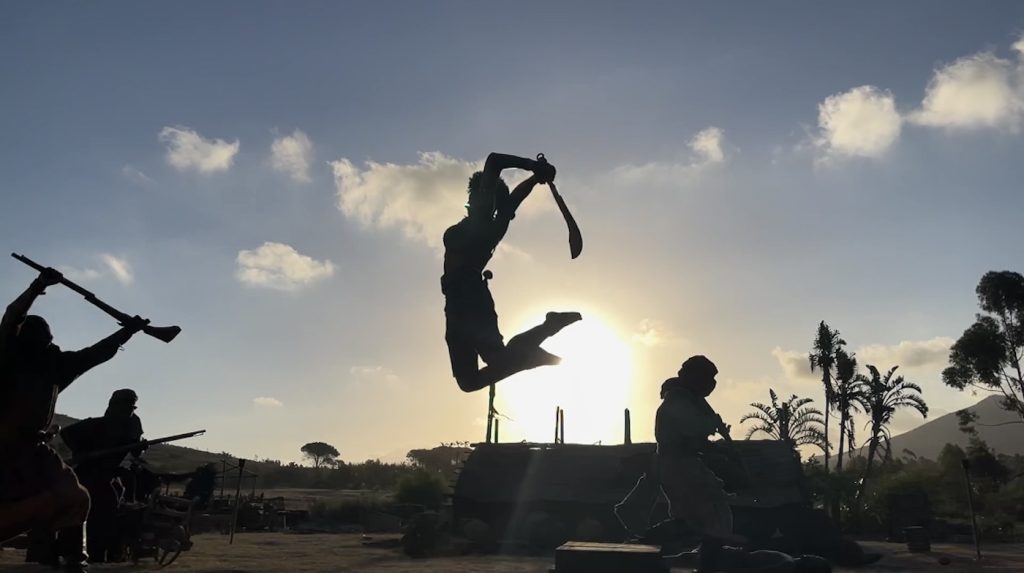
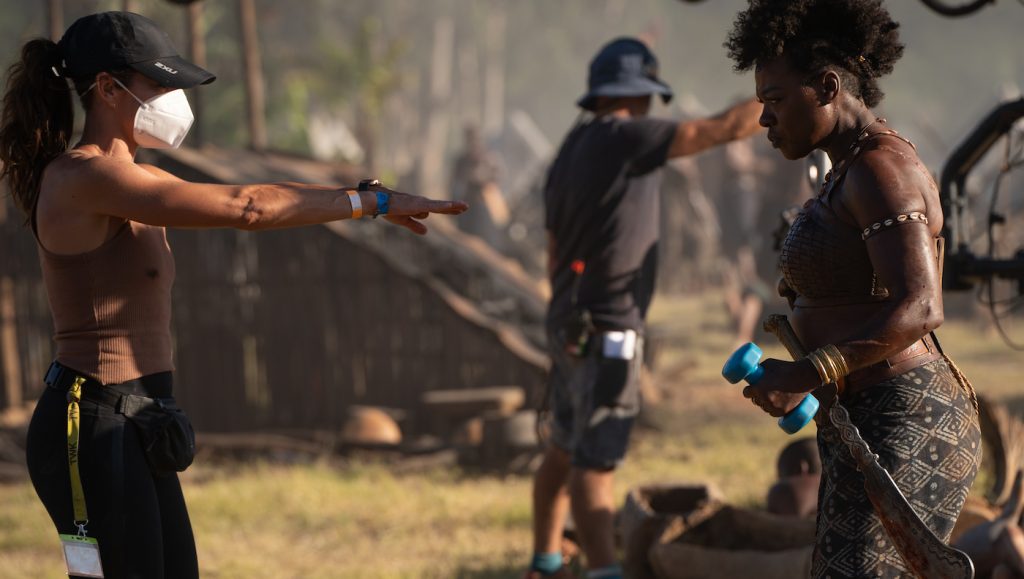
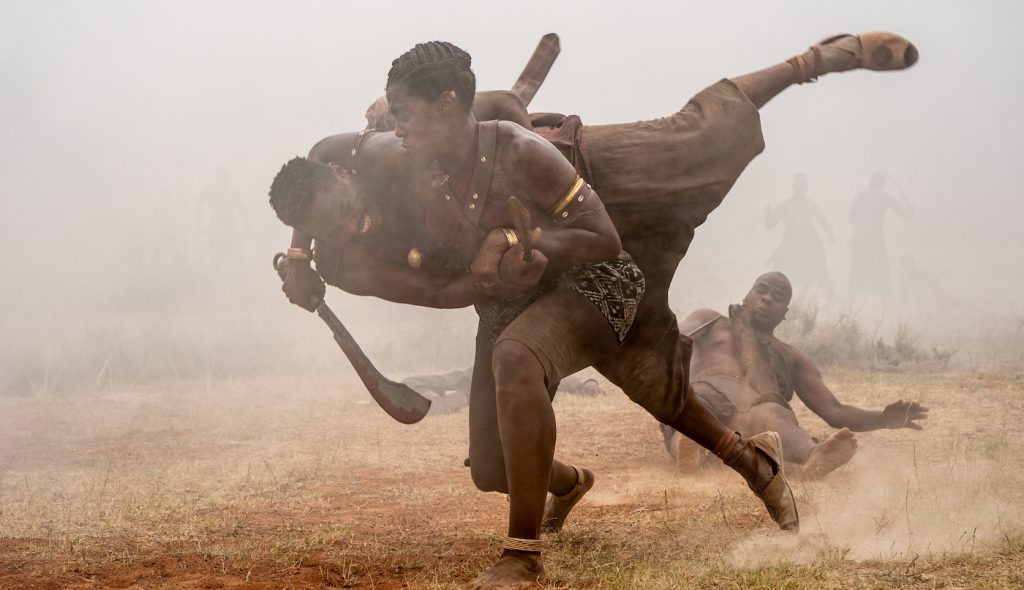
An elite force of female soldiers, the Agojie, is all that stands between the African Kingdom of Dahomey and the combined forces of the Oyo Empire and Mahi people. The Oyo and Mahi plan to raid Dahomey villages and sell their captives to European slavers. We open on a Mahi village where raiders heat their machetes over a fire at night. Their leader hears something in the tall grass surrounding them and quiets his men, standing to get a better look. A flock of birds burst from the grass. The men laugh. Their leader is paranoid. All is well, and their raid will go off as planned.
A moment later, the leader of the Agojie, Nanisca (Viola Davis), rises from the grass, followed by her fellow female soldiers. It’s an ambush. And despite it taking place at night before we’ve met Nanisca and her elite force, the action is framed by someone who knows exactly where she wants her camera to be, exactly whose story she’s telling, and exactly what the purpose for every beat is.
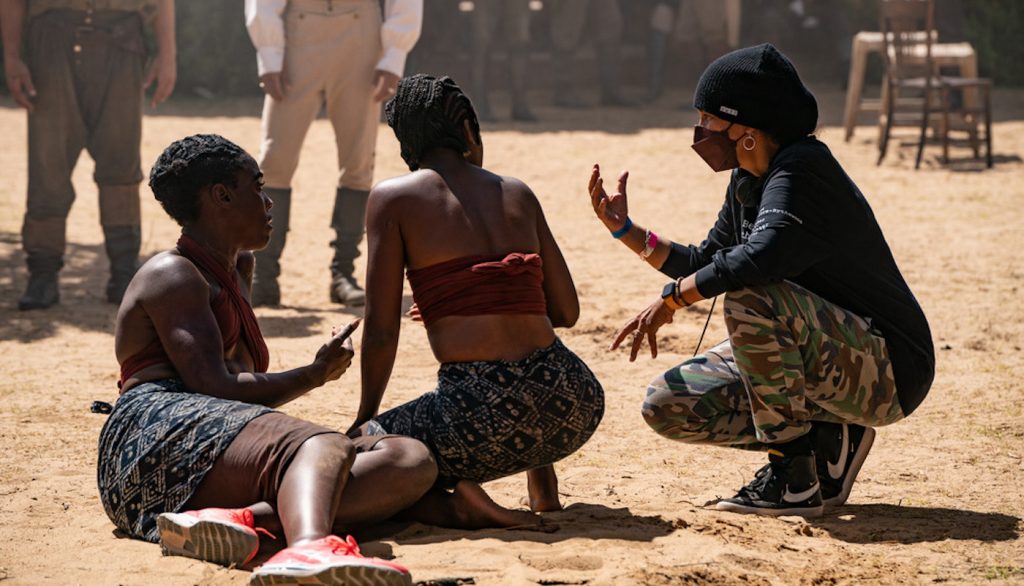
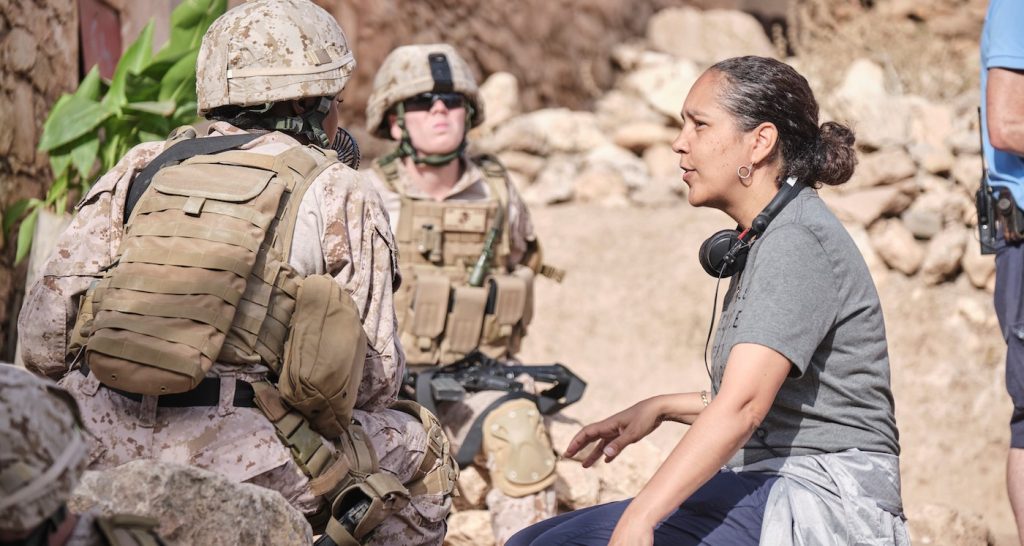
We’re 90 seconds into the beginning of director Gina Prince-Bythewood‘s The Woman King — her second brilliantly conceived and executed action epic in a row, following her 2020 movie The Old Guard, an adaptation of a graphic novel that tracked a team of immortal mercenaries led by Charlize Theron’s Andy and joined by KiKi Layne’s Nile. With The Woman King, Prince-Bythewood once again centered the action on women, only the degree of difficulty was significantly higher for reasons technical (larger cast, larger crew, more complicated set pieces), global (Covid-19), and professional (the film had been delayed for years over concerns that its predominantly Black female cast would not attract audiences). Yet Prince-Bythewood once again deployed her immense gifts for crafting visually coherent, emotionally resonant action sequences, an ability shaped by the fact she’s a former top-tier athlete herself. Few directors better understand that action has to be legible to be enjoyable, but to make great action, each moment, each beat, each punch, and each kick have to be supercharged by the personalities, histories, and heartbreaks of the combatants involved.
For this reason and many more besides, Gina Prince-Bythewood is the Motion Picture Association’s 2023 Creator Award recipient, having created a thrilling body of work that has consistently reframed whose stories get told and who gets to tell them. From her breakout hit Love & Basketball in 2000, through The Secret Life of Bees (2008) and Beyond the Lights (2014), Prince-Bythewood has gravitated toward intimate stories that, occasionally, as of late, happen to take place on an epic scale. You can’t separate her vision when shaping an action sequence from her years as an athlete, nor can you separate her action movies from her early, intimate, personal films.
L-r: Sanaa Lathan and Gina Prince-Bythewood on the set of “Love & Basketball” in 2000. Courtesy New Line Cinema.
Prince-Bythewood has approached every film with a mantra. “I see a connection between [all my movies] in terms of the stories I want to tell, which I call intimately epic,” she says. “It doesn’t matter what size canvas I’m working with; you have to care about the character’s story first.”
One of the reasons Prince-Bythewood is one of the best action directors working is she understands on a visceral level what it takes to compete, what it feels like to believe you can and will defeat your opponent, and what it requires to achieve that. She can make a large-scale scene of hand-to-hand combat flow as beautifully and cogently as she made an offense flow on the basketball court when she was running point.
“All the lessons you learn from sports, especially as a girl, are things that are normally not encouraged or thought of as assets for girls,” Prince-Bythewood says. “To learn that aggression is good, to learn that ambition is good, to learn how to outwork everybody, to learn to have stamina, to learn to leave it all out on the floor, I’ve been able to take that to sets when I’m a director to pull the team together, to inspire and lead, and hopefully encourage them with my vision. These are all things I learned on the court and on the track.”
L-r: Queen Latifah, Gina Prince-Bythewood, and Jennifer Hudson on the set of “The Secret Life of Bees” in 2008. Courtesy Searchlight Pictures.
Crucially, for The Woman King, Prince-Bythewood also excelled in the ring as a kickboxer after college.
“To be able to know what a good punch looks like, what a good kick looks like, the intensity of when you’re in a ring and what it means when you’re facing an opponent, the intention behind your swings and kicks — those were all things I was able to talk to the actors about,” she says.
As incredible as the women in Prince-Bythewood’s The Woman King cast were — Viola Davis, Thuso Mbedu, Lashana Lynch, Sheila Atim, and more — she knew she was going to ask them to do things they’d never done before. She and her team — fight and stunt coordinator Danny Hernandez, fight choreographer Jénel Stevens, and lead cast trainer and nutritionist Gabby Mclain — built them into a cohesive fighting unit, one brutal day of training at a time.
Jenel Stevens on set of “The Woman King.” Courtesy Sony Pictures
“I knew I didn’t just want my actors to learn the moves; I needed them to really do it because I think that’s the best way to film action,” Prince-Bythewood says. “The question was, how can I build athletes? So I talked to my team, Danny Hernandez, my incredible fight and stunt coordinator who’s also a martial artist, and Gabby Mclain, who was in charge of building up their bodies so that they could withstand [the training], and we built athletes to see what they could do.”
Gabriela Mclain and Viola Davis training during “The Woman King.” Courtesy Sony Pictures.
They could do a lot, it turns out. The cast went through a grueling training regimen that began months before Prince-Bythewood shot a single frame, and they continued training once they were on location in South Africa. At one point Prince-Bythewood had them training six days a week, including morning sprints for an hour and a half, martial arts training with Hernandez, and two hours of strength training with weights.
“It was a really beautiful thing to see women who hadn’t been in touch with that part of themselves overcome so much of the negative self-talk that had been built up over time to realize the way you do one thing is the way you do all things,” Prince-Bythewood says. “That’s something you learn from sports as well. For them to see their bodies get stronger, to see their swagger increase, to see the way that they walked into a room, the confidence, all of that was built in the gym. Because I’d been through it myself, I knew that’s what it would do.”
But what about the practicalities of her profession, the technical aspects of turning a melee into a meaningful moment of violent catharsis? How does she find the poetry within all those bodies slashing and slamming into each other? How does she avoid the trap that so many directors seem to fall into, where the camera seems to move as hyper-kinetically as the action, and the viewer is left dazed and a little defeated by the scene?
“Building and shooting the action sequences in The Woman King, I could be right there with Danny [Hernandez] saying, ‘I didn’t believe that; she really needs to have intent.’ Talking to the actors, I could say, ‘You’re not just swinging a machete, you’re swinging it through flesh and bone, you have to have an intent, so what is your intent?’” she says. “And that changes the way that people swing.”
Camera placement is key. Prince-Bythewood has honed her skill as a visual storyteller by remaining committed to the emotional beats that make a physical showdown meaningful.
“First and foremost, it starts with the fact that as a director, I’m the first audience, so I need to understand the scene, I need to be able to follow the story, and then it’s my job to tell that story,” Prince-Bythewood says. “I put the camera where I feel like I can watch the action, follow the action, and care about the action. We always start with, ‘What is the character doing? What is this revealing about the character? What is the story of this moment? Honestly, I equate it to a love scene. I love doing love scenes, and it’s the same concept. It has to have a story, it has to be character-based.”
L-r: Lashana Lynch, Thuso Mbedu and director, Gina Prince-Bythewood.
Caring about the emotional state of a character is as crucial for a director to succeed as it is for a viewer to lose themselves in a story. It’s why you watch The Old Guard and feel so caught up in the initial terror and fury of KiKi Layne’s Nile as she fights Charlize Theron’s Andy on a cargo plane (an all-time great action sequence). Or why, in The Woman King, you find yourself drawn to each of the main characters within a given action set piece and know not only who they are by how they fight, but why they fight that way.
Gina Prince-Bythewood on the set of “The Old Guard.” Courtesy Netflix.
“If you take Lashana Lynch’s character Izogie, the very first time you meet her says so much about her as a character,” Prince-Bythewood says. “The fact that she uses her nails as a weapon, the intensity in her face. We talked about a feral abandon with the way she fights where she’s trying to humiliate her opponent to get back at all the trauma she’s experienced. This is opposed to Viola’s character Nanisca, who’s a general and has this brutal efficiency and shows no emotion. That tells you a lot about her. That’s the fun part, building these scenes and knowing you want them to look cool and have cool moves, but you have to have an intent, a story, and a character behind those moves for an audience to care.”
Lashana Lynch stars in THE WOMAN KING. Courtesy Sony Pictures.
Prince-Bythewood has followed her own instincts and interests, from athletics to film, from smaller intimate films to action epics, yet there’s been a remarkable consistency in all her work, no matter the scale, a genuine interest in the interiority of the characters she depicts.
“I truly believe that the first thing you come out with should tell the world who you are as an artist and tell Hollywood who you are as an artist,” she says about that crucial first movie. “I also believe everyone has a story only they can tell, and that’s what’s going to separate you. It’s something I had to learn — I really thought the way to break in was to mimic the things that were successful. People want fresh stories. Fresh perspectives. It took me a second to get there, but also, it takes courage to say, ‘My story is meaningful enough that millions of people will want to see it.’ [Laughs] Whether that’s courage or swagger, it goes back to that athlete mentality. When I walk on the court, I am the best person on it.”
It’s hard enough to write a personal story, harder still to share it, and perhaps hardest of all to hear no. Prince-Bythewood knows from this experience.
“You have to have that to be able to sit down and write a personal story and believe that others will care. That’s a hard thing to do, and there will be times where you’ll lose confidence and certainly, for me, I kept thinking [about Love & Basketball], ‘Who’s going to care about a story about a Black girl who wants to be the first woman in the NBA?’ But I believed in it so much that it kept getting me back into the chair, even after every single studio and production company turned down that film. It was soul-crushing to put something on the page that you believed in so much, that was a personal story, and to be told essentially, your voice doesn’t matter, your story doesn’t matter. But that never made me question the story, it was just a hard thing to push through. But overcoming no is something you have to learn in this industry because you just need that one yes. I was so, so fortunate to get that yes from Sundance, which changed the trajectory of my career.”
L-r: L-r: Sanaa Lathan, Omar Epps, and Gina Prince-Bythewood on the set of “Love & Basketball” in 2000. Courtesy New Line Cinema.
Prince-Bythewood credits having a great support group of filmmakers and friends. Her biggest rock, however, is her husband Reggie Rock Bythewood, who she’s collaborating with on Genius: MLK/X, which is focused on the relationship between Martin Luther King Jr. and Malcolm X. She and her husband will serve as Executive Producers under their production company Undisputed Cinema.
“My husband is my biggest champion and my biggest support and my favorite writer,” she says. “So on those days where you’re on the floor, there’s somebody saying, ‘Get up, keep fighting.’ That’s supremely important.”
As for the MPA Creator Award, she says it speaks to something she’s believed since she was working on Love & Basketball.
“The thing I’m excited about with the MPA Creator Award is what I’m being honored — that those who make film and television can change the world. That’s how I approach the work even 23 years later; I’ve never let go of the knowledge of the power of film and how it literally can change lives and change perception and shift culture. So, to be honored for that, to know that people are seeing that in my work, that it’s not just about entertaining but I am actually trying to say something to the world — it’s incredibly meaningful.”
For more on Gina Prince-Bythewood, check out these stories:
*It’s our annual “Best of Summer” look back at some (not all) of our favorite interviews from the past few months. This non-comprehensive look back includes the Barbenheimer phenomenon and the wonderful interviews that followed those two history-making films, chats with the talented folks behind Mission: Impossible, Spider-Man: Across the Spider-Verse, our profile of MPA Creator Award Recipient and filmmaker extraordinaire Gina Prince-Bythewood and more.
Beef creator Lee Sung Jin (Dave, Undone), who goes by Sonny Lee, reached out to production designer Grace Yun (Past Lives, Ramy, Hereditary) to share his vision of the series that pins Danny Cho (Steven Yeun), a failing contractor, and Amy Lau (Ali Wong), a self-made entrepreneur, against one other following a heated parking lot altercation. “I was impressed from the start, and our exchange felt really fun and effortless,” Yun shares with The Credits.
The dark comedy unravels through ten episodes and asks the question: How far are you willing to go to ruin the life of a complete stranger? For Danny and Amy, there are no limits. In conjuring the visual style of the Netflix show, Yun was inspired by the duality of characters, drawing from their inner struggles and public personalities, a motifcostume designer Helen Huang pulled from as well.
Below, Yun shares how each of their character attributes played into designing the homes of Danny and Amy.
The material of Beef is deliciously chaotic yet also beautiful in its own way. Was there anything you and Sonny referenced in terms of creating the overall visual style?
Sonny sent me his “holy grail” formula: Thirty-five percent Sopranos/Paul Thomas Anderson flawed character comedy, plus thirty-five percent Netflix binge-ability/White Lotus water cooler moments, plus thirty percent Ingmar Bergman/Hirokazu Koreeda warm melancholic pathos.
Fantastic.
I thought it was highly ambitious but wanted to help go for it! Visually, we wanted to ground the story in a world that felt real and believable but with moments that veered surreal as the narrative progressed. It was also important for the world to feel like Los Angeles. We shot the majority of the show in LA locations, but Danny’s apartment and Amy’s house were stage builds. Cinematographer Larkin Seiple and I worked together to create a parched, sunbaked color palette to reference the unrelenting Los Angeles sun.
Was there anything else you and Larkin Seiple discussed to guide the visual style?
Beyond our sun-baked look, we talked pretty much every day about upcoming scenes, especially if we were planning to do something extra for a tonal shift. Episode ten was a fun experience, it was the last week of shooting almost all exteriors in a park, and the challenge was to hide all the walking paths and signage with overgrown greens at a moment’s notice. We had to work closely together to create those compositions that hopefully don’t read like a public park.
Amy’s home has a Le Corbusier vibe to it. Modern, bespoke with a monochrome palette. Was there a driving force behind its look that connected it to her character?
Sonny described Amy as someone who works incredibly hard for her ambitions but at the cost of being honestly herself. So we wanted her home to represent the great effort she puts into her presentational side, yet still have the darker mood of her inner self. Her curated aesthetic needed to touch almost every element in her home and Koyohaus [her business]. We talked about her house being a cage of her own making, so we leaned into that motif with the floor plan, wood slats, and concrete-colored walls. Another important feature was restricting views of the sky.
On the flip side, Amy’s workplace has its unique feel. How did you want to separate her business from her home life through design?
Koyohaus is all about Amy being successful in business, so we wanted it to feel brighter and more vibrant than her home space. The light wood motif is there but in a grid wall pattern with pink desert images on a white wall backdrop. The design approached Koyohaus as Amy’s version of a gallery space for plants. She’s drawing from the trend of taking care of plants as if they are beloved pets. The setup she has is trying to sell a millennial minimalist bespoke lifestyle; each plant is like a unique sculpture in a wabi-sabi pot of the client’s choosing (within 4 colors and 4 shapes). Accessories like hand-woven brooms and blown glass bottles with plant nutrient elixirs add to the aesthetic lifestyle branding.
Danny’s apartment he shares with his brother Paul (Young Mazino) has such a stripped-down, lived-in vibe. Did Sonny have any specific thoughts about the appearance?
Sonny reminisced that Danny’s apartment felt like his first apartment in Los Angeles, and that became the early inspiration. From here, there were many layers we wanted to convey in terms of mood and lifestyle. We wanted the apartment to look like Danny’s DIY attempt to convert the space into a two-bedroom but with an unfinished look to represent his lack of motivation to complete his goals. Other layers hope to show his resourceful mentality of saving construction supplies, sentimentality like the Korean folding table and older mismatched furniture that give it a collected, frugal feel. It’s been a while since he had enough to spend on new furnishings.
When establishing the look of a television series versus a film, are there different things you have to consider from the start?
Mostly it’s in how we prep. TV is usually a much shorter prep time, juggling many episode timelines in one shooting block, and often we don’t have all the scripts written. So you have to stay adaptable and ready to pivot at any moment. Creatively, I find having strong themes and concepts that carry through the entire season is helpful to keep the look in bounds.
For more on big titles on Netflix, check these out:
*It’s our annual “Best of Summer” look back at some (not all) of our favorite interviews from the past few months. This non-comprehensive look back includes the Barbenheimer phenomenon and the wonderful interviews that followed those two history-making films, chats with the talented folks behind Mission: Impossible, Spider-Man: Across the Spider-Verse, our profile of MPA Creator Award Recipient and filmmaker extraordinaire Gina Prince-Bythewood and more.
When Chris Nolan wrapped Tenet in 2919, actor Robert Pattinson gave him a book of J. Robert Oppenheimer speeches as a parting gift. That tome led Nolan to Kai Bird and Martin J. Sherwin’s “American Prometheus: The Triumph and Tragedy of J. Robert Oppenheimer.” For the next three years, Nolan used the Pulitzer Prize-winning biography as the foundation for what critics are hailing as his most mature, emotional work.
Oppenheimer stars Cillian Murphy (Peaky Blinders) as the brilliant physicist who was tapped to run the Manhattan Project, the United States ultimately successful effort to build the atomic bomb. Oppenheimer and his team developed the weapons of mass destruction that were dropped on Nagasaki and Hiroshima. Nolan told The Credits that he thinks, despite never publicly apologizing or expressing any guilt over the horror his weapons caused, “all of his actions from 1945 onwards are the actions of somebody truly suffering under an immense weight of shame and guilt.”
Several months before he started filming, Nolan called Oscar-winning composer Ludwig Göransson. “Chris never talks about what he’s working on,” says Göransson, who previously scored Tenet. “The phone call is out of the blue. ‘Hey, I’ve got a script—do you want to read it tomorrow?’ I had no idea what to expect. I go over and read the script. It was a jaw-dropping moment like you’re watching the world through Oppenheimer’s eyes, living the world through his mind. And I realized that’s what the music needs to do. It needs to channel the whole spectrum of his emotions. That was a big challenge: How do you put all these different types of emotions into the music?”
The answers can be heard in Göransson’s intense orchestrations for Oppenheimer, co-starring Matt Damon, Emily Blunt, and Florence Pugh, among others. Göransson, who spoke to The Credits about his Black Panther: Wakanda Forever music, talked about how he collaborated with his violinist wife, skipped traditional percussion, and faced one of the biggest challenges of his career by setting imagery of atomic particles to music.
With Black Panther, you cited the singer Baaba Maal as a key inspiration. In creating the music of Oppenheimer, did you also have someone like that who helped focus your efforts?
Yeah, it was actually my wife Serena Göransson.
How so?
She’s a very accomplished violin player, and one of Chris’s first ideas for the music was that he wanted solo violin to portray the character of Robert Oppenheimer. Especially since it’s a fretless instrument, the violin can go from the most melodic, romantic tone to a neurotic horrific manic vibrato within a split second, so I worked a lot with Serena on this. Experimenting with Serena and doing this music together was a great opportunity.
The string section produces this signature motif that sounds like something the layman might call a “smear.” What do you call that effect?
I would call it string glissandos. It’s these micro-tonal glissandos where one violin goes down, and maybe two go up to create a kind of cluster. You hear violins in horror movies played in this way, but I talked to Chris about this: what if you take that idea and play [the glissando] with the most romantic, beautiful tone? You can tell the audience that something horrific is about to happen and kind of dive down [imitating the ominous “smear” glissando], but then you land on a beautiful note, a haunting note. That is what we wanted to embellish about Oppenheimer’s personality. His confidence is pretty high, but he also has some inner demons.
Having worked on Tenet and now Oppenheimer, what’s it like collaborating with Chris Nolan?
Chris has a crystal-clear image of what he wants to achieve and how he wants to get there. That being said, he’s incredibly open to my input, so there’s this exchange of ideas that allows us to push the boundaries of what we can do. And one thing that makes the work so successful is that he invites me into the project early on.
L-r: Ludwig Göransson and Christopher Nolan. Courtesy Universal Pictures.L to R: Emily Blunt (as Kitty Oppenheimer) with writer, director, and producer Christopher Nolan and Cillian Murphy (as J. Robert Oppenheimer) on the set of OPPENHEIMER.
How early?
For about three months before he started production, I’d meet with Chris once a week and show him about ten minutes of [new] music. By the time he went off to shoot the film, Chris already has three hours of my music.
The music at this point would be in demo form, right?
Yes. Maybe the first months, it was just violin experiments, going into the studio with Serena and recording this microtonal “smear.” In the second month, I started writing themes on piano, violin, strings, and harp. I’d record these melodies and textures as demos.
During pre-production, did you get to see any concept art or visual information?
A couple of weeks after I read the script, Chris invited me to a screening at an IMAX theater to watch visual effects he’d made with Andrew Jackson, experiments with atoms swirling around, and that kind of stuff. I go into this darkened theater and get hit in the face with fluorescent lights and things I’d never seen before. It had a big impact on me: “I want the music to sound like that.”
Once Nolan started principal photography, did you get dailies or any footage of what he’d been capturing?
No. Sometimes I’d get a phone call, “Hey, this one piece we worked on, can you change the ending to an up note, or can you add a minute to this or put more tempo on it?” After three months of shooting, Chris gets back and goes into the editing booth with Jennifer Lame, and they start cutting the movie. They used all the existing music I had written.
Wow! All those music cues you created during pre-production wound up in the rough cut?
Yeah. When I see the rough cut, all my music was already in there, which is great because most filmmakers put together a first cut using a temp score that takes music from already existing movies. I think that creates difficulties down the line because you’re taking [musical] DNA from a world that already exists. It seems to me not a very creative way to work.
Where did you record the final score?
We took two hours and fortysomething minutes of music to the scoring stage at Warner Brothers and recorded it in five days with the Hollywood Studio Orchestra, which has some of the best musicians in the world. At its peak, we were 40 string players, eight horns, three trombones, one tuba, three trumpets, and a harp.
All those instruments but no percussion?
No drums. One of the first things Chris and I talked about is that we didn’t want to have any sense of military nuance to Oppenheimer’s character because that’s not where he’s coming from. We didn’t want that [drum sound] to drive his character at all.
L to R: Matt Damon is Leslie Groves and Cillian Murphy is J. Robert Oppenheimer in OPPENHEIMER, written, produced, and directed by Christopher Nolan.
Did you use other methods to get that driving feel typically provided by percussion?
We had footsteps, we had the stomping, we had the bomb going off — so much more of a visceral experience. It was cool to see how the music and the sound design went hand in hand with each other. Also, we had the cellists use a technique called collegno, where they [rotate] their bows and use them like sticks, which creates a percussive sound during the nuclear reactor sequence. And then there’s this metallic ticking, which sounds like someone’s tapping a pencil on the bomb — that’s one of our musicians hitting a little metallic thing, almost like a cup.
What was the most challenging piece of music to record?
The piece of music with the atoms swirling. I never thought we’d be able to record that in one continuous take because there are 21 tempo changes. But my wife has been sitting in on these recording sessions for twenty years, and she knows the musicians. She said, “I think you can do it; We just have to give them a different type of click in their headphones so when they record, they get the new tempo before it happens.” On the third day, we gave the musicians a different click in their headphones, and they did the whole piece of music in one take with all those tempo changes.
It must be exciting to hear this huge orchestra of world-class players performing your music live.
One of my favorite parts of the process is seeing how it all comes alive. When you have forty or fifty people in a room together, creating this ambiance in the air — it’s something that’ll never be replaced by computers. The music changed when we started recording with live musicians. They made everything so much more dynamic.
Featured image: L to R: Matt Damon is Leslie Groves and Cillian Murphy is J. Robert Oppenheimer in OPPENHEIMER, written, produced, and directed by Christopher Nolan.
Blue Beetle is the groundbreaking first Mexican-American addition to DC Studio’s roster. Helmed by Angel Manuel Soto (Charm City Kings), written by Gareth Dunnet-Alcocer (Miss Bala), and propelled by a winning cast that will win your heart, Blue Beetle propels us into an action-packed origin story that unabashedly champions the family ties that characterize Latino communities.
Meet Jaime Reyes (pronounced Hi-meh Ray-yes), portrayed by Xolo Maridueña (Cobra Kai). Fresh out of college, he comes back to the fictional Palmera City to find the challenges of gentrification tugging at his family’s core. While pursuing a job at Kord Industries, he stumbles upon a coveted scarab named Kahdi-Ja (voiced by Becky G) — an otherworldly relic that thrusts him into extraordinary powers.
Pre-Blue Beetle, embracing Hollywood’s superhero tales was, to me, a stretch. Flying aliens with laser-shooting eyes? Sure, no problem. But secretive young (even teen!) heroes smoothly juggling a secret life, constantly absent from home, all while hiding an arsenal and flashy outfits from their families? That was way too fantastical. At least, to me, a Mexican. The truth is that very little remains under wraps in a traditional Mexican household.
In fact, Angel Manuel Soto, of Puerto Rican descent, emphasized that this was a cornerstone of the film’s creation. “Good luck trying to keep a secret from your Latino family,” he said in an appearance on CBS Mornings.
My excitement for Blue Beetle soared ever since I first saw it. Of course, everyone in the family would be involved in Jaime’s adventure! Of course! ¡Así somos! This emphasis on family ties is just one of the aspects of Latinidad that Soto masterfully conveys throughout Blue Beetle.
The Reyes family is led by father Alberto, played by one of Mexico’s most prominent actors, Damián Alcázar (Narcos). Elpidia Carrillo (Guillermo del Toro’s Cabinet of Curiosities), the first Mexican actress of indigenous descent to have achieved a prolific career in Hollywood, is Rocio, the mother.
Rising star Belissa Escobedo (Hocus Pocus 2) is Jaime´s sister, Milagro. Two luminaries, George Lopez (George Lopez) andAdriana Barraza (Babel), complete the Reyes household. They respectively bring to life rowdy Uncle Rudy and not-quite-what-you-imagine grandma Nana. Topping the band of good guys, we have Jenny Kord, played by Brazilian star Bruna Marquezine.
On the opposing side, we see Susan Sarandon as Jenny’s aunt, Victoria Kord—a villain with appalling manners towards Latinos. Alongside her henchman, Conrad Carapax, played by Raoul Trujillo from Sicario, she’s determined to go to any lengths to realize her sinister plans involving the Scarab.
When it comes to infusing the film with authenticity, Soto has shared with numerous sources that “both the creators and the actors wanted to have the freedom to be freely Latino, of not having to explain our Latinness.” They succeeded.
The film is thoroughly seasoned with allusions to Latin American pop culture and family habits. There’s a pitch-perfect depiction of a Latino household where mothers would try to use Vick’s VapoRub to treat any and all ailments; the walls grace tons of family portraits, all under the steady gaze of “La Virgen De Guadalupe.” Pay special attention to the multiple references to the other Mexican bug superhero El Chapulín Colorado, also known as The Red Grasshopper.
As the Reyes family proudly embraces their Mexican heritage, the echoes of Mexican culture extend far beyond borders, resonating powerfully within the broader Latinx community. Soto adeptly captured this sentiment, confirming that shared experiences bring together diverse Latino communities. As Soto expressed to Cinemex, “A lot of the Mexican references are also very Puerto Rican and are also veryLatin.” A universal essence emerges —one that welcomes newcomers and old-timers alike into the embrace of the Reyes family.
The soundtrack is another standout in Blue Beetle. It’s so well curated it’s practically educational. It features the likes of Selena Quintanilla, Thalía, Ivy Queen, Calle 13, Soda Estéreo, Vicente Fernández, and Los Saicos. To get a taste of an inclusive, delicious Latino musical experience, go listen to it.
Blue Beetle shines as a vibrant testament to representation and inclusivity. From its electrifying action to its heartfelt family connections, this film takes us on an exhilarating ride where Latinx culture and superhero universes collide.
For more on Warner Bros., HBO, and Max, check out these stories:
*It’s our annual “Best of Summer” look back at some (not all) of our favorite interviews from the past few months. This non-comprehensive look back includes the Barbenheimer phenomenon and the wonderful interviews that followed those two history-making films, chats with the talented folks behind Mission: Impossible, Spider-Man: Across the Spider-Verse, our profile of MPA Creator Award Recipient and filmmaker extraordinaire Gina Prince-Bythewood and more.
Visually, the sequel continues to marry artistic styles to make it feel as if a comic book has come to life, but this time around, there is more of it. A lot more. The story is bigger, more villainous, and a heck of a lot more Spider-y. Thankfully, the emotional arc doesn’t get lost in the multiverse – it’s only Miles who physically gets trapped and tries to sling and swing his way out. The new story brought in a fresh trio of directors (Joaquim Dos Santos, Kemp Powers, Justin K. Thompson) and behind-the-scenes creatives to reinvigorate the success of the original.
“They wanted something entirely fresh,” says character designer Kris Anka about the approach to the visual language. “The whole thinking was just because the animation of the first film was good doesn’t mean it can’t be better.” Anka was one of several character designers on Across the Spider-Verse and oversaw the creation of Miguel (voiced by Oscar Isaac), a Spider-Man-like superhero responsible for producing the multiverse travel technology that has Miles and Gwen (voiced by Hailee Steinfeld), along with new characters, Spider-Punk Hobie (voiced by Daniel Kaluuya) and Jessica Drew (voiced by Issa Rae) fighting a portal-jumping “villain of the week” named Spot (voiced by Jason Schwartzman).
Spider-Man 2099 (Oscar Isaac) and Miles Morales (Shameik Moore) in Columbia Pictures and Sony Pictures Animation’s SPIDER-MAN: ACROSS THE SPIDER-VERSE.
Anka spent around 15 months in creating Miguel, adding new layers to the suit design and silhouette of the character. “Depending on how close you are to him, you see different layers of detail. At the macro level, it’s this simple red, black, and blue design, but as you get closer, there’s patterning on everything,” says Anka. The designer added layers of cultural specificity to Miguel’s suit. “I went on a deep dive into Mesoamerican patterns and tried to find ways to add culture to the suit.” In using textiles and familiar patterns, the design language was grounded in something tangible instead of arbitrarily conceived.
Jessica Drew (Issa Rae) and Miguel O’ Hara (Oscar Isaac) in Columbia Pictures and Sony Pictures Animations’ SPIDER-MAN™: ACROSS THE SPIDER-VERSE.
“Another aspect the directors had coming into the film was that Miguel was intentionally giving himself his powers. It wasn’t a bite or an accident, but he was actively doing this,” notes Anka. “Miguel’s entire persona is that he’s willfully doing all this, and he takes things seriously. He puts in the work compared to someone like Peter Parker [voiced by Jack Quaid], who has a naturalistic body and attitude. Miguel had to be the opposite, where everything is designed, and everything Miguel is doing is with intent. It was about trying to find a balance and a look that suggests Miguel takes this way too seriously.”
Miguel O’ Hara (Oscar Isaac) clashes with Vulture (Jorma Taccone) in Columbia Pictures and Sony Pictures Animations’ SPIDER-MAN: ACROSS THE SPIDER-VERSE.
In creating how Miguel moved on screen, head of character animation Alan Hawkins took inspiration from the character Stringer Bell (Idris Elba) from the hit television series The Wire. “He [Stringer] has this really interesting posture,” notes Hawks. “He looks like a tough guy, but there’s a slouch to him. It feels like he’s burdened by the weight of responsibility, but still seems like he’s aggressive. That nature inspired Miguel’s posture for most of the film.”
For Hobie, a very English (and cool) punk version of Spider-Man, Hawkins and the team used mixed frame rates in his design to make him feel chaotic and inconsistent. “The jacket he wears is on 4s, but his body is sometimes on 3s, and his guitar is even lower,” says Hawkins. The 4s and 3s Hawkins is referring to are the number of individual drawings for each second of animation based on a 24 frames per second timeline. Animating on 1’s means there are 24 individual drawings for each second of animation – the action is fast and fluid. Animating on 2’s has 12 drawings, 3’s there’s 8, and 4’s has 6 drawings. The lower the number (3, 4…), the slower the animation can look. Having Hobie’s body and jacket on different animations delivered a juxtaposed style that matched his rocker personality.
Hobie Brown/Spider-Punk, voiced by Daniel Kaluuya. Courtesy Sony Pictures.
Miles, now slightly older, saw a refresh to his look (based on models by Omar Smith) that combined new fabrics and reflective patterns to a black suit that has a red stripe down the side and different-sized Spider-Man logos on the front and back to differentiate him while in motion. “We wanted that immediate read for the audience,” notes Anka. In animating Miles, the team referenced the first film to pose his eye and get the angle of his cheeks right. Gwen saw subtle changes in her costume, adding different hints of pink to her suit.
However, the biggest hurdle was creating a near-infinite number of Spider-Man found in the so-called Spider Society – the central “lounge” (created by Miguel) for all the Spider-Man traveling through the multiverse. For the climatic sequence that has Miles being chased by every single society member, the animation team aimed to make it as interesting as possible, creating different looks to avoid repetition. The edge-of-your-seat scene is packed with action and well-placed humor that even sees a T-Rex version of Spider-Man chomp on screen.
Though Across the Spider-Verse immerses you with a visual style where any frame could be used as a promotional poster, the guiding light for the creative team was the emotional beats of the story. “Animation is hard, and making a strong acting choice is different from a strong animation choice. Something the movie has always strived for was good acting and not good animation,” says Hawkins. “We ignored animation. It was the tool we were using, but we thought about how a real person acts who is feeling these complex layers of emotions. We wanted to inject that into each one of our characters.”
Spider-Man: Across the Spider-Verse is in theaters now.
For more on Spider-Man: Across the Spider-Verse, check out these stories:
Featured image: A visual development image featuring Pavitr Prabhakar, aka Spider-Man India, Gwen Stacy and Miles Morales fighting The Spot in the city of Mumbattan on Earth-50101 – a kaleidoscopic hybrid of Mumbai and Manhattanfor Columbia Pictures and Sony Pictures Animations’ SPIDER-MAN™: ACROSS THE SPIDER-VERSE.
*It’s our annual “Best of Summer” look back at some (not all) of our favorite interviews from the past few months. This non-comprehensive look back includes the Barbenheimer phenomenon and the wonderful interviews that followed those two history-making films, chats with the talented folks behind Mission: Impossible, Spider-Man: Across the Spider-Verse, our profile of MPA Creator Award Recipient and filmmaker extraordinaire Gina Prince-Bythewood and more.
Oppenheimer is a colossal achievement. Christopher Nolan’s film is an exquisitely calibrated epic, brimming with ambition and ingenuity, appropriate for its titular protagonist, J. Robert Oppenheimer (Cillian Murphy), the brilliant physicist who led America’s Manhattan Project during World War II. Nolan and his crew, including production designer Ruth De Jong (Nope), reached for the stars and succeeded in their quest for a pure, tangible vision in presenting one of the most important and dangerous minds of the 20th century – the father of the atomic bomb.
In the brisk and often unnerving three-hour epic, J. Robert Oppenheimer is in a race against the Nazis. The American government enlists him to help them build a weapon of mass destruction, despite his affiliations with communism, which will plague him years after the war. Oppenheimer, both careful and careless in his quest to prove his theory correct, becomes a celebrity when his team succeeds—at a remarkably swift pace— and their achievements a vision of unprecedented horror when America dropped two bombs on Hiroshima and Nagasaki, Japan. As Oppenheimer famously quoted from the Bhagavad-Gita after the successful testing of the bomb, “I am become death, destroyer of worlds.”
In a narrative that spans decades, Nolan brings Oppenheimer’s inner life to the screen, revealing his thoughts, dreams, and nightmares. The critical and commercial success of Oppenheimer, now extending its run in IMAX theaters due to popular demand, is a credit not only to Nolan but to the incredible crew he assembled to achieve his masterpiece, including Ruth De Jong and her masterful design work.
For a movie that’s about obsession, it didn’t call for it in the process of making it. During a recent interview with The Credits, De Jong reveals the modern touches in the unconventional, idiosyncratic summer blockbuster and why working on Oppenheimer was likely not at all what you might have imagined it to be.
In the case of Oppenheimer, you have to capture both the period and the protagonist’s point of view in these environments. How’d you balance that?
I think there was freedom. I mean, Chris and I wanted to be correct to the periods and bring people right there to that time, to that place. There was no obsession with that from Chris’ standpoint; he was always interested in pushing modernity in the sense that if it was the 1920s, but we were shooting a car that was built in 1931, he’d like the way the 1931 car looked. I’m paraphrasing, but he was like, “I almost find it too distracting because it’s almost like we’re in 1925, and here’s this very boxy, early Americana vehicle when I don’t want to be distracted by that. I wanna make this film timeless with the overarching period correctness, but not to the degree that it’s distracting the film.” I felt very much the same way.
L to R: Emily Blunt (as Kitty Oppenheimer) with writer, director, and producer Christopher Nolan and Cillian Murphy (as J. Robert Oppenheimer) on the set of OPPENHEIMER.
So you were encouraged to depart from the period?
I think a lot of period films can be so full of period objects screaming what moment in time it is. We tried to do the opposite and make it as timeless as possible and peel back and simplify—less is more. There was some specificity where we honed in on it was the creation of the atomic bomb that you see throughout the entire story. Recreating that to its exact specs, the Trinity Tower, everything else, of course, all the houses were in the ilk of the period, but there wasn’t an obsession. I mean, we got to shoot in Oppenheimer’s house, his actual house, but all of that, you take a little bit of creative freedom because you’re never gonna find the absolute exact chair Oppenheimer was sitting in.
L to R: Cillian Murphy is J. Robert Oppenheimer and David Krumholtz is Isidor Rabi in OPPENHEIMER, written, produced, and directed by Christopher Nolan.
There’s not a single CGI shot in the film. How’d that impact your work? Was it kind of comforting knowing your work wouldn’t be altered in post-production?
It was great because I’m not a fan, either. It’s usually like, “Oh, all you need to do is build this, and don’t worry, we’ll extend this and do this and that.” How it affected our work was we had to be smart with the budget. We had to build enough, but not too much, but enough to make it feel like the town was growing and evolving. I just was smart about building every single building that we did 360 degrees, so you could shoot behind it, in front of it, on the side of it. Chris and [cinematographer] Hoyte [van Hoytema] took full advantage of that. I think it was liberating knowing there was no CGI because you had to do everything on camera, and it created an entirely immersive experience for the cast.
L to R: Benny Safdie is Edward Teller and Cillian Murphy is J. Robert Oppenheimer in OPPENHEIMER, written, produced, and directed by Christopher Nolan.
As you said, the job didn’t require obsessiveness, but were there any details you did obsess over?
Early on, I got too engrossed or ingrained in the actual research. We had an incredible researcher, Lauren Sandoval, who did a magnificent job and had so many inroads to the Library of Congress, and the US government, getting all declassified documents as well as all these archives across the country and the world. She was speaking to libraries in England and France and all over the place. We had just incredible photography that a lot of us had never seen before, Chris included. You’re going, “Well, look at the chalkboard behind Oppenheimer and look at this thing.” I remember at one point, Chris was just like, “Ruth, let it go. I’m selling popcorn; I’m not making a documentary.” [Laughs]
L to R: Cillian Murphy (as J. Robert Oppenheimer) and writer, director, and producer Christopher Nolan on the set of OPPENHEIMER.
[Laughs] That’s a great way of putting it.So, you could be more interpretive of the time, if that makes sense?
It is almost a dream back to the past. There were certain things, like telephones and water fountains, that looked like they were from the 1800s. I would say, “It’s from 1935.” Chris would be like, “Get it out of here,” because it became too kitsch. We wanted almost to be utilitarian. There was a 1970s water fountain, and he was like, “No one will notice. No one.” The minute you start to draw attention and start to dress every corner, it becomes too obnoxious.
OPPENHEIMER, written and directed by Christopher Nolan. Melinda Sue Gordon/Universal Pictures
How’d you approach the bomb and its surroundings? Who were your closest collaborators for that section of the film?
We were all under such a crunch to do this epic movie for very little, you know, and everyone’s like, “Oh, you’re on a Nolan movie?” And I’m like, “No, I might as well be on an indie movie. This is not comfortable. We don’t have cash flowing to pay for things, and we have to be smart about our decisions.” And you know, Chris is like, I only really need to see a couple of bits. Like, when Ciillian’s up in the shed and looking at the atomic bomb, there were just some moments that were very important to Chris, but when I got together with Scott Fisher from special effects, and Guillaume [DeLouche], our prop master, it was like, we have to build this entire bomb.
Cillian Murphy is J. Robert Oppenheimer in OPPENHEIMER, written, produced, and directed by Christopher Nolan.
So, again, he could shoot it 360?
It doesn’t make any sense just to build a piece of it to save some money. This is the main character of the entire film. Chris told us no, but we did it anyway. I think he is forever grateful because then it changed; he ended up following the evolution of this thing getting created, and it became more integral. It was areas like that where we tried to be smart about what we wanted to feature and why, and that just felt so important. Chris didn’t say no because he didn’t want us to build it. He was just trying to help us with our budget. He’s like, “Look, I can be smart on my end and figure out ways to shoot around it.” But we knew at the core; we’re not gonna limit him in that way. That’s not fair.
Oppenheimer is in theaters now.
For more on Universal Pictures, Peacock, and Focus Features projects, check out these stories: