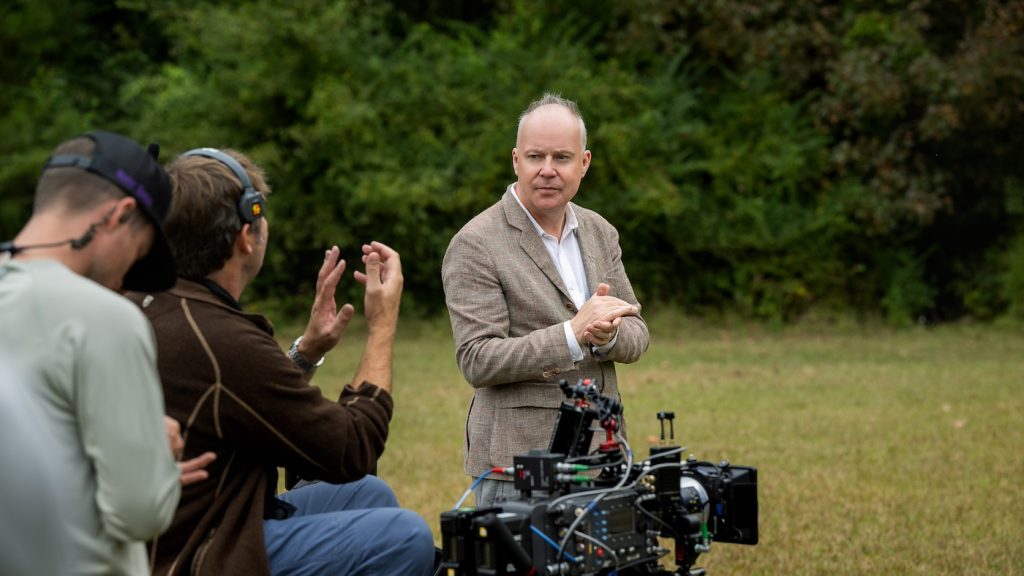
Deadpool 3 director Shawn Levy is not the first—or even the four hundredth—director to be inspired by Star Wars, but he’s in a particularly fortuitous position to deploy his inspiration to spectacular effect. Levy’s upcoming Marvel Studios film, which finds Ryan Reynolds’ titular antihero mixing it up with Hugh Jackman’s Wolverine (resurrected for the new film despite dying in James Mangold’s 2017 epic Logan), is the franchise’s first film under the Marvel banner. Levy also happens to be working on a Star Warsproject, one in which he’s said that Lucasfilm president Kathleen Kennedy has implored him to create a meaningful Shawn Levy story in the Star Wars galaxy rather than try to change his storytelling voice to suit some platonic ideal of a Star Wars film. So, the man is deeply invested in the Star Wars world.
As Levy explained to Esquire, he found himself recalling a specific, iconic Star Wars moment while working on Deadpool 3 and was compelled to share the scene with his collaborators in the middle of filming. Levy describes his memory of seeing Return of the Jedi in 1983 and how one moment in particular created “pin-drop silence” in the theater. That moment was the showdown between Luke Skywalker and Darth Vader. It’s the scene in “which Luke is hiding from Vader in the Emperor’s room, and Vader gives the speech that ends with ‘If you will not turn to the dark side, then perhaps your sister will,’” as Levy said to Esquire.
This moment stuck with Levy for decades. In the middle of making Deadpool 3, it came back to him. Levy explained:
“For one key scene in the movie, I said to my stunt and action team, ‘Guys, this is the Jedi moment.’ I pulled up that scene of Vader and Luke on my phone and restudied how it was photographed, how it was blocked, the framing, the tempo. The keen Star Wars fan will see the shot in my Deadpool movie that was inspired by a moment that I saw in a theater decades ago. That’s a forever memory. And that’s a treasure.”
Deadpool 3 is currently about halfway through filming, although it was paused on account of the writer’s and actor’s strikes. As negotiations continue on the actor’s strike this week, there’s hope a resolution is coming soon and productions far and wide, including Deadpool 3, can begin.
Ryan Gosling takes a beating and keeps on kicking in the first trailer for David Leitch’s The Fall Guy. Gosling plays Colt Seavers, a capable stuntman who ends up working on a film by Jody Moreno (Emily Blunt). Colt and Jody had a fling once, and despite Jody’s insistence there is nothing between them, it seems fairly evident they’ve got enough chemistry to provide her film with all its pyrotechnics.
While Colt and Jody try to put their past behind them and get on with the business of showbusiness, a problem arises on Jody’s set—the star of her film (and the man Colt is doubling), Tom Ryder (Aaron Taylor-Johnson), goes missing—thus, Colt is deployed to go track Tom down and save the film. The stuntman becomes the leading man.
Yet Colt’s problems compound when Tom turns up dead, and he finds himself in the middle of an action movie with no safety harness, no wires, and very real danger.
The Fall Guy is inspired by the 1980s TV series of the same name, and with David Leitch at the helm, a former stuntman himself and the man behind the action in Bullet Train, Deadpool 2, Atomic Blonde, and more, you know it’s not going to skimp on the insane action. Leitch directs from a script by Drew Pearce.
Joining Gosling, Blunt, and Taylor-Johnson are Hannah Waddingham, Winston Duke, Teresa Palmer, Stephanie Hsu, and Lee Majors.
Check out the trailer below. The Fall Guy hits theaters on March 1, 2024:
For more on Universal Pictures, Peacock, and Focus Features projects, check out these stories:
The first domestic Japanese Godzilla film in seven years is stomping toward theaters in the U.S. The trailer for Godzilla Minus One reveals writer/director Takashi Yamazaki’s vision for a new Godzilla film, as the iconic kaiju surfaces from the depths of the ocean and unleashes his fury on post-war Japan.
Godzilla Minus One is the 37th installment in Toho’s venerable franchise, with Yamazaki crafting a period piece that looks at what happens to Japan as it’s recovering from the horrors of World War II and is suddenly faced with a new adversary, “baptized in the horrific power of the atom bomb.”
It’s a decidedly different Godzilla from the previous incarnations we’ve seen in the American-made Godzilla vs. Kong (2021) and Godzilla (2014) in that this kaiju does not seem like a misunderstood protector of the natural order. Instead, it appears to be more an incarnation of vengeance, even war itself. And that’s before it unveils its atomically charged powers.
Yamazaki is a brilliant VFX artist and CG animator in his own right, having worked on The Great War of Archimedes and Lupin III: The First. This is the third time he’s set his sights on the most iconic movie monster of them all, having deployed Godzilla in Always: Sunset on Third Street 2 (2007) and Godzilla the Ride (2021).
Godzilla Minus One recently closed the Tokyo International Film Festival and stars Ryunosuke Kamiki, Minami Hamabe, Yuki Yamada, Munetaka Aoki, Hidetaka Yoshioka, Sakura Ando, and Kuranosuke Sasaki.
Check out the trailer below. Godzilla Minus One hits theaters on December 1.
For more stories on big upcoming films, check these out:
The apes talk in the very first trailer for Kingdom of the Planet of the Apes. We know what you’re thinking—well, sure, they also spoke in the last Planet of the Apes movie, director Matt Reeves’ excellent 2017 trilogy capper War for the Planet of the Apes—but in director Wes Ball’s new film, they speak with a fluency and clarity that surpasses the humans they’ve displaced at the top of the food chain.
As has been the case since this venerable franchise was rebooted with Reeves’ Dawn of the Planet of the Apes in 2014, and only getting more pronounced, the digital effects and mo-cap performances of the people playing the apes are astonishing. In the new film, set years after the death of the valorous chimpanzee Caesar (Andy Serkis), the apes have built a complex kingdom, the cities of man are now overgrown (and perhaps more beautiful because of it), and human beings have been pushed to the margins. Kingdom of the Planet of the Apes is several generations removed from the reign of Caesar, and a new, less-than-noble ape leader is building a formidable empire in which compassion and kindness, especially for the once-dominant species on the planet, are signs of weakness to be crushed.
The new ape to root for in Kingdom is Cornelius (Owen Teague), Caesar’s son, no less, who now lives in a very different world than his father did. Humans are essentially feral in this new film; the apes reign supreme both physically and intellectually, and yet power struggles within the ape community and an alliance with a young human could change everything.
That young human is played by The Witcher‘s Freya Allan. The film’s cast also boasts William H. Macy, Dichen Lachman, Kevin Durand, Peter Macon, Sara Wiseman, and Neil Sandilands in the cast. Director Wes Ball made his name with The Maze Runner series, and he’ll bring his abilities with action set pieces and emotional stakes to bear on the new film.
Check out the trailer here. Kingdom of the Planet of the Apes arrives in theaters on May 24, 2024:
Here’s the official synopsis:
Director Wes Ball breathes new life into the global, epic, franchise set several generations in the future following Caesar’s reign, in which apes are the dominant species living harmoniously and humans have been reduced to living in the shadows. As a new tyrannical ape leader builds his empire, one young ape undertakes a harrowing journey that will cause him to question all that he has known about the past and to make choices that will define a future for apes and humans alike.
For more stories on 20th Century Studios, Searchlight Pictures, Marvel Studios and what’s streaming or coming to Disney+, check these out:
HBO chief Casey Bloys gave us some good news at a press conference on Thursday morning—the second season for Craig Mazan and Neil Druckmann’s stellar The Last of Us is expected to enter production in early 2024.
The critically acclaimed adaptation of the video game Druckmann created for Naughty Dog was one of the best series of 2023 (and the best video game adaptation of all time), turning its two leads, Pedro Pascal and Bella Ramsey, into bonafide stars. The gripping first season, which explored a fallen world in the aftermath of a mushroom-borne virus and the journey of two survivors, Joel (Pascal) and Ellie (Ramsey), across a ravaged America in search of a cure for the plague, was the year’s first major hit. It ultimately earned 24 Emmy nominations, including for best actor and actress noms for Pascal and Ramsey and Outstanding Drama Series.
The Last of Us isn’t on HBO’s 2024 slate, which means that we’re looking at a 2025 premiere for season 2. The first season was such a massive success that it was renewed for a second before the season 1 finale aired. Season 2 will be adapted by Mazin and Druckmann from the game’s sequel, “The Last of Us: Part II.” The dual writer and actor strikes put pre-production on hold, but Druckmann and Mazin had already outlined the second season, and Mazin had submitted the first episode to HBO before the writer’s strike began, as he explained to Entertainment Weekly:
With the writer’s strike over and negotiations between the studios and actors ongoing and gaining momentum, things are looking a little brighter in the entertainment industry right now. And although The Last of Us was one of the most relentlessly intense, decidedly dark series on TV, its return to production signals would signal even brighter days ahead.
For more on The Last of Us, check out these stories:
A new teaser for The Hunger Games: The Ballad of Songbirds & Snakes doubles as a listening party. The new look is set to Olivia Rodrigo’s “Can’t Catch Me Now,” a song that speaks to the situation that the film’s central figures will find themselves in.
The Ballad of Songbirds & Snakes is set 64 years before the events in the original Hunger Games and is centered on a young Coriolanus Snow (Tom Blyth) long before he became the merciless ruler of Panem. Here, Coriolanus is a member of the Academy, trying to turn his own family’s fortunes around, and is tasked with mentoring a young tribute from District 12 ahead of the 10th Annual Hunger Games. That young tribute is Lucy Gray Baird (Rachel Zegler), and their growing relationship will form the crux of the adventure in director Francis Lawrence’s upcoming prequel.
As the new teaser shows, this is a relationship that no one else wants to see thrive. Not Dr. Volumnia Gaul (Viola Davis), the head gamemaker who has crafted the most ingeniously entertaining and lethal games yet and expects all but one of the tributes to perish in spectacular fashion. And not the dean of the Academy and creator of the Hunger Games himself, Casca Highbottom (Peter Dinklage), who not so gently reminds Coriolanus that their job is to “turn children into spectacles, not survivors.” The young Coriolanus clearly wants Lucy to survive, which is funny considering in a couple of decades, he’ll be all too happy to sacrifice two “tributes” (read, children) from each district to the games.
Yet the feelings between the young Coriolanus and Lucy are real, and they promise to prove to be a defining moment in both their lives and have larger implications for the future of Panem.
Other important characters you’ll get to know in the film are Lucretius “Lucky” Flickerman (Jason Schwartzman), Coriolanus’s Academy classmates Clemensia Dovecote (Ashley Liao), and Sejanus Plinth (Josh Andrés Rivera).
Check out the new teaser below. The Hunger Games: The Ballad of Songbirds & Snakes opens on November 17 in a theater near you.
For more on The Hunger Games: The Ballad of Songbirds & Snakes, check out these stories:
Featured image: Tom Blyth as Coriolanus Snow and Rachel Zegler as Lucy Gray Baird in The Hunger Games: The Ballad of Songbirds and Snakes. Photo Credit: Murray Close
The first trailer for Dan Hartley’s documentary David Holmes: The Boy Who Lived has arrived, revealing the story of the titular young man who was once Daniel Radcliffe’s stunt double, starting with the very first Harry Potter film, Harry Potter and the Sorcerer’s Stone, back in 2001. David Holmes was the perfect person to double Radcliffe—a gifted teenage gymnast from Essex, England—he began working alongside Radcliffe when the young actor was only eleven and just starting out his long run as Harry Potter. Holmes and Radcliffe went on to form a significant bond over the course of seven films and countless hours on set together, working through increasingly intricate stunts as Harry Potter grew older, the stakes in the film became bigger, and the action became more complicated. Then, a tragic accident while filming Harry Potter and the Deathly Hallows: Part One in 2010 left Holmes paralyzed. It’s how Holmes responded to that accident, the bond between the two young men, and Holmes’ remarkable strength of spirit that forms the crux of Hartley’s doc.
David Holmes: The Boy Who Lived boasts footage shot over the last decade, including Holmes’ incredible stunt work on the Harry Potter series, interviews with Holmes, Radcliffe, family, friends, former crew members, and more. For Potter-heads and for those of us who need a story of resilience, friendship, and community in troubled times, David Holmes: The Boy Who Lived is the film you need right now.
Check out the trailer below. David Holmes: The Boy Who Lived premieres on Max on November 15.
For more on Warner Bros., Max, and more, check out these stories:
When it was announced that Hugh Jackman was reprising his role as Wolverine for Deadpool 3, the first question was, but how? The Wolverine we all knew and loved definitely died in James Mangold’s masterful 2017 film Logan, in which an aging, sick Wolverine pulled off his last heroic act and sacrificed himself saving the life of the young mutant Laura (Dafne Keen), who had her own adamantium claws and was created using his DNA. So, while fans were thrilled that Jackman was reprising his most iconic role and doing it alongside his buddy and verbal sparring partner Ryan Reynolds, the question remained of how it was possible and whether Deadpool 3 existed in an entirely different universe than Logan.
Now, Shawn Levy himself has put the question to rest. Speaking with BroBible, Levy explained that the Deadpool 3 team has nothing but reverence for Mangold’s film. In fact, he said that Logan is canon:
“I have always said that I can’t wait for Deadpool 3 to come out because all I want to do is give interviews alongside Ryan where we talk about our reverence for the movie Logan. Logan is canon. We love Logan. That happened. I want the world to know, as the producer and director, all of us share a deep love and respect for Logan, every aspect of how it’s crafted, and all the events that take place.”
The question remains just how Levy, Reynolds, and the Deadpool 3 team actually contend with the events in Logan. One very obvious answer is that Deadpool 3 is very likely set before the events in Logan, which took place in 2029 during a 25-year drought of zero mutant births. Logan delivered an absolute masterclass in gritty superhero storytelling, with stakes so high that not one but two iconic X-Men perish. Even if it’s as simple as the events in Logan taking place in the future when Deadpool 3 begins, it’s still in the minds of fans. That reality, and the fact that Levy and the rest of the Deadpool 3 team love Mangold’s movie, makes how they approach handling Wolverine’s arc in their movie so intriguing. Considering Deadpool 2 played around with time travel and MCU’s own multiverse approach to storytelling, there’s even a chance that Deadpool 3 and Logan directly interact.
Deadpool 3 is currently slated for a May 3, 2024 release, but that’s not set in stone. They’ve shot and edited half of the film but had to pause during the strikes. Once those are over, everyone will get back to work, and perhaps Deadpool 3 will make its original date.
Gen V, the quick-footed spinoff to Prime Video’s debauchery-filled superhero satire The Boys, mimics its collegiate environment in its primed-for-combustion filming style. In the inaugural season’s penultimate episode, titled “Sick,” the main characters are confronted with institutional roadblocks and a boiling fervor on campus regarding supe rights.
“What I think the writers have done so beautifully and brilliantly in The Boys and Gen V is they’ve taken current issues and put the superhero spin on them to make social commentary,” Shana Stein, the episode’s director, said in an interview.
Leading up to the finale (the series has already been renewed for a second installment), the dark secret of Godolkin University is revealed right before its gatekeepers are eliminated. Protagonist Marie (Jaz Sinclair) attempts to enlist the help of conniving politician Victoria Neuman (Claudia Doumit) to take down the inhumane supe prison lab called The Woods, despite her having an agenda of her own. Meanwhile, Asa Germann’s Sam experiences what it’s like to be a normal student — before falling prey to a radicalizing group on campus.
“We had a gazillion hundred extras out there — that was very old school, very low-tech,” Stein said of filming the episode’s frenetic town hall. “It was the first AD and I on stage acting out for the audience how to react to everything.”
We spoke to Stein about Gen V’s “common DNA” with The Boys and what makes the series pop on its own. This conversation has been edited for length and clarity.
How does your approach to this spinoff compare to the predecessor of The Boys?
I’m a huge, huge fan of The Boys. In my prior experience, I did a show that we had multiple spinoffs of. So I was familiar with focusing on the DNA, and then there’s the new twist on it. It’s a combo platter of giving them more of what they want and then something new and unexpected, which I think the writers and producers did such a great job of delivering. It’s got all of the shock and humor and horror, and yet with these younger supes. In The Boys, where it was this big reveal that they were given Compound V, that information already exists here. Now they’re just trying to be supes living their best supe lives. There’s a lot of innocence there, and there’s a lot of hope in them still — it hasn’t been beaten out of them yet.
By the time I came on, they’d already established certain things [about] the look of the show. And they all were really great about communicating the stuff that they wanted to continue. The music is different — it doesn’t have the punk rock that The Boys [has]. It’s got more of a younger, college, more contemporary feel. A lot of the shooting style is similar, although it’s in different lensing. But [there’re] so many more supes that are good guys. Marie, who we’re on our hero’s journey with her … is she gonna change the world, or is the world gonna change her?
How much did you look to the comics that inspired Gen V versus balancing that with other coming-of-age college stories?
[The writers] did such a great job of taking the best stuff from the source material and then also letting it have its own life. I have watched all of The Boys — I want to say three times. I also looked at the original comics as well, which are now all up in my teenage son’s room. This is one of the things I absolutely love about the show: they don’t shy away from politics, they don’t shy away from challenging issues. It deals with some of the mental health issues that people go through, particularly young women in high school and university, with eating disorders and cutting and finding your power. It’s really complicated material that the writers have given us to play with. And I was so grateful to have such really incredibly talented, adept actors that could take it on. Episode 7 is a really emotional episode for a lot of the characters. As a director, it was really fun to work with the actors to bring that to life and give them the space to do their magic.
With this penultimate episode, you’re tying in a lot of the lore from The Boys: We see characters like Victoria Neuman and Grace Mallory. Could you talk about your approach to making sure every plotline is given space? How closely did you work with the writer Chelsea Grate?
Chelsea was wonderful. She was a great partner. She was on set with me every day, and I had her do a lot of prep as well. Michele [Fazekas] and Tara [Butters], the showrunners of the season, were great, and Eric [Kripke] is the master of the universe, and he’s also incredibly reachable. So I feel like if ever there’s a thing that’s a team sport, it’s making serious television. My job as a visiting director is to try to get their vision on the screen.
What were your collaborations like with VFX, and what was your approach to blocking those shots? I wanted to focus specifically on the montage with Sam, where he’s experiencing this childlike joy in discovering college life.
Asa is so lovely and such a wonderfully talented actor. It was such a joy seeing that scene when he was just alone and discovering in Emma’s room, and it was just us and the cameras — that was one of my favorite things to shoot just because we had so much fun with a different moment of the childlike discovery. Then, going to the outside, how he ends up getting involved with the Supe Lives Matter thing, it’s not initially because of that or any kind of alignment ideologically, it’s just because it’s fun, and the kids are out there.
Asa Germann (Sam). Credit: Brooke Palmer/Prime Video
When you talk about blocking, anything that’s stunts or VFX, we prep the hell out of it. First, we discuss it, we concept it, then start to shot-list it, and we’ll walk through what sets we have. When appropriate, we’ll storyboard it, and then I’ll go back and shot-list again. On The Boys and Gen V, they do a pre-vis process, which is wonderful because then everybody can see what we’re thinking. And so when we go on the day, it’s as efficient as possible, and I make sure that the producers are getting the footage that they want. So it’s a lot of communication and a lot of preparation and planning. With the sled coming down the hall, we had to try different things like the rigs that we use. I always say the action is math. It’s this plus this plus this equals your sequence.
“Gen V” Episode 7 director Shana Stein behind the scenes. Courtesy of Prime Video.
Going off of that, the town hall scene is such a pressure cooker environment that requires a lot of movement and coordination across teams. What were your favorite aspects of filming that?
Yeah, that was pretty crazy. We had a very limited amount of time, we had a ton of extras, and we had four cameras; we had it organized by shot lists, and that one we didn’t have a pre-vis on. We had a gazillion hundred extras out there — that was very old school, very low-tech. It was the first AD and me on stage acting out for the audience how to react to everything. We needed our 400 extras to all respond in unison. So Joanna [Moore], the truly amazing first AD, was over there, and I was pantomiming it out for them. It was like ‘Fight, fight, fight, fight, fight. Sonic boom! Sonic boom!’ and the whole crowd would turn. Then ‘Laser eyes! Laser eyes!’ That was so much fun. We just had a blast. We just act the fool. We’re the luckiest people alive. We get to play make-believe for a living. I’m eternally grateful. It was a dream come true.
Was there anything that challenged or colored your experience as a director shooting this particular episode?
It just reinforced for me what a team sport it is. I was so excited to come on; I was everybody’s biggest cheerleader. I just tried to create a safe space for everybody to do their job and to bring their best work. Gen V is its own thing within this universe, and it’s got its own tone and allowing that to be there and embracing the differences, and then celebrating also that common DNA.
For more on Amazon Prime Video, check out these stories:
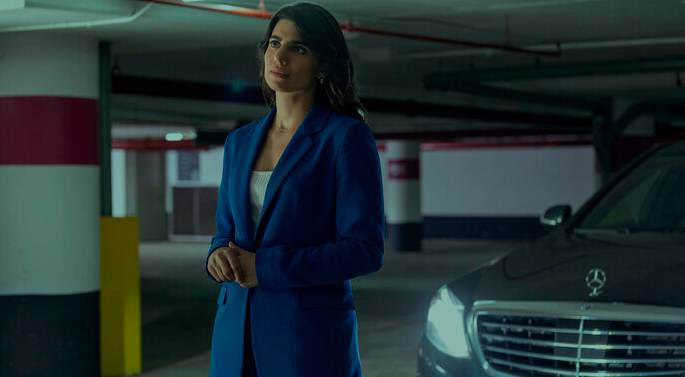
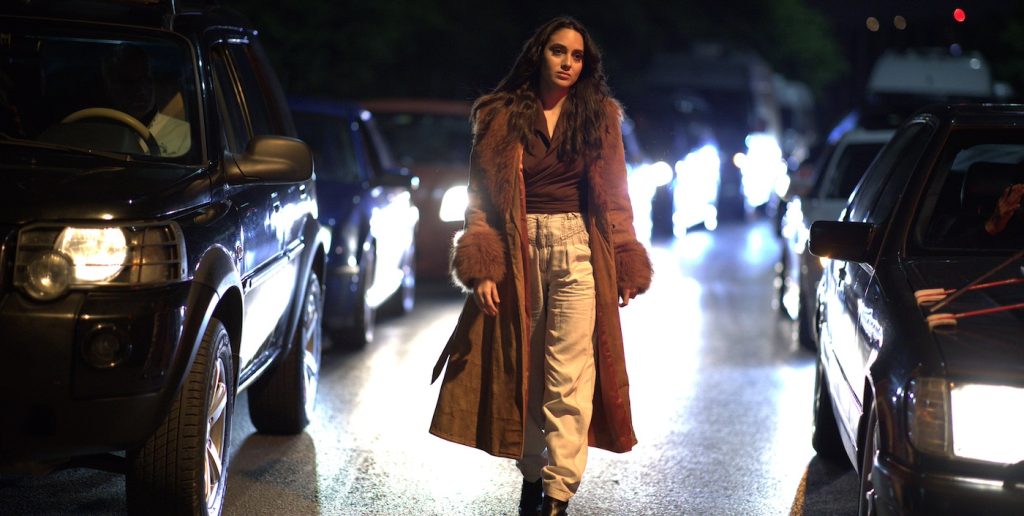
The Persian Version won both the Audience Award and the Waldo Salt Screenwriting Award in the U.S Dramatic Competition at Sundance this year, and for good reason. The film is a feel-good dramedy that combines stories of traditional Iranian culture with those of the Iranian American experience with a decidedly modern touch. The story follows Leila (Layla Mohammadi), a queer Iranian American working to keep her parents and many brothers who love her at a distance while navigating her ever more complicated personal life. The story highlights the complicated bond between Leila and her mother, Shireen (Niousha Noor), whose sacrifices—many for her family—include many secrets about her own past trauma from Leila. As intense as some aspects of the story are, audiences have embraced The Persian Version, which is a fun, dance-filled, and joyous ode to a modern Iranian American family.
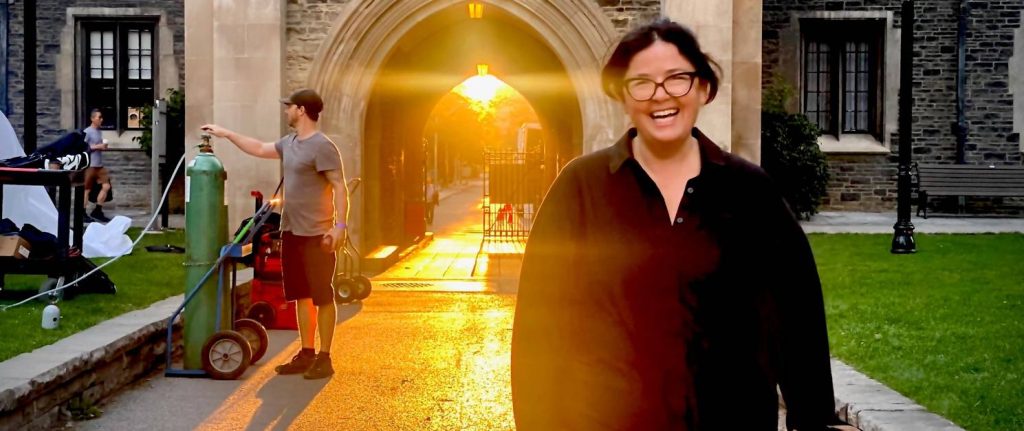
Much of the film is based on the life of writer/director Maryam Keshavarz, who herself was the only girl in a family with seven boys. It is in the specificity of her story that The Persian Version thrives because viewers from all over the world have found a connection in some aspect of the family ortheir cultural traditions.
The Credits caught up with Keshavarz at the Middleburg Film Festival. She reveals how she crafted a story that has found appreciation from such a wide audience and shares how the cast and crew grew to feel like family.
Your film is so filled with joy, and as you said, you were moved and struck by the sense of joy your family was able to find, even in difficult times. Can you speak to a few of the ways you injected your film with that joy and some of the responses you’ve gotten from audiences?
Honestly, I was really only interested in making this film if I could show that element of our culture and of my family. Growing up, every time you heard the word Iranian, it was somehow related to terrorism, and it just was not my experience as an Iranian American growing up here. It was just so skewed. I always say, when I introduce the film, “I’m sorry, you get to spend two hours with my family, for better or for worse.” The greatest aspect of showing this is having people who are Irish saying, “It’s just like my family,” or having people who are Mexican-American, or Vietnamese, or German, or whatever, who are different than their family for some reason, or they had issues with their mom, really relating to the film.
In a way, families across cultures are similar in crucial ways…
It is so important to me to show that we’re not so different. If you’ve never interacted with or seen people who are different than you, you can so easily dehumanize them, and so many bad things can result from that. If you feel close to a people, there’s just such a humanity and a connection that can happen. What I wanted to do with this film was create a connection, and I thought the joy and fun in our culture could really bring people in. Within our community, people are so proud because they’ve never gotten to see themselves in a light that they feel is so truthful. It’s been quite emotional, showing it to non-Iranian and Iranian families in the United States.
The movie shows both Iranian and Iranian-American characters, which is rare.
That’s never been done. There are lots of films from Iran, which has great cinema, from Kiarostami to Farhadi to Dariush Mehrjui, who unfortunately was killed recently. You have great Iranian American filmmakers, like Ramin Bahrani or Desiree Akhavan, but there was never anything that connected our two worlds. One of the ways to show our journey as Americans is to honor where we come from.
Silence is both a strength and a weakness, depending on how and when it’s used. Can you talk about your use of silence in the film?
Silence is really a theme in the film. American culture is so much about therapy and about posting everything we do. We overshare in many ways. The thoughts I had around silence are that when you go through a very difficult time, sometimes not rehashing it, putting that trauma in a box, and moving forward is such an important element of older generations. That’s especially true for my parents and the baby boomer era. In every part of the world, they’ve experienced such great traumas, and that’s how they’ve been able to move forward. I thought that was such an interesting concept and how that was handed down to me. Through the filming, I explore different moments in which silence plays an important part. There’s a lot of verbosity and playfulness in the lead character, who not only tells you about her family but about where she comes from between Iran and America, as a playful interplay of her biculturalism, but also, a lot of the film relies on those things that are not said, and in the moments that are so quiet. It’s a play between that, particularly in the mother’s backstory, when we go back to Iran. In that section, there’s very little dialogue. I also play a lot with the environment and silence and how you deal with trauma, even as it’s happening.
Layla Mohammadi as LEILA in THE PERSIAN VERSION. Photo credit: Yiget Eken. Courtesy of Sony Pictures Classics.
There’s some great choreography in the movie, and it gives the feeling that not only the characters are close, but everyone in the production became close during filming. Is that true?
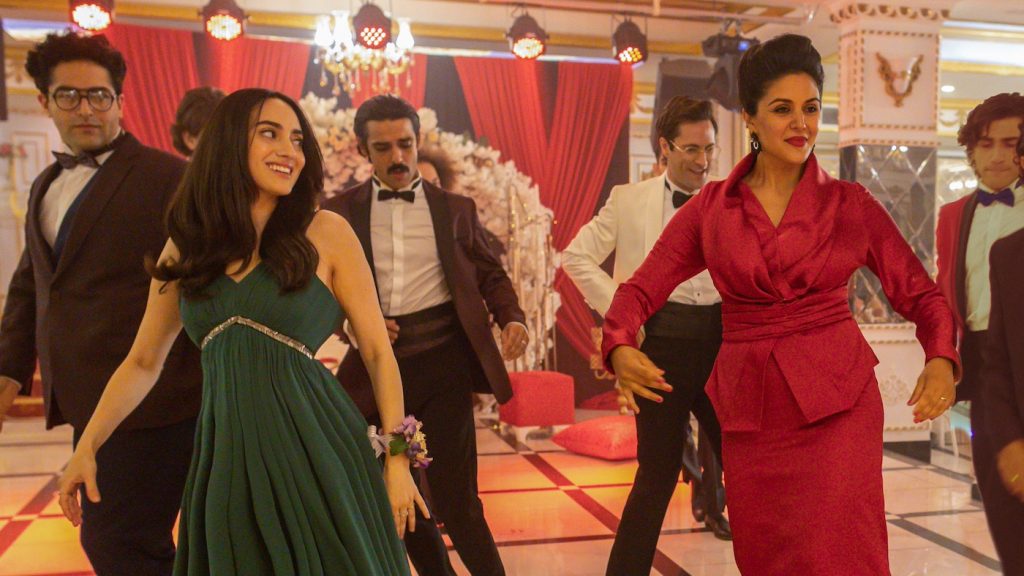
There are some things that we had our choreographer do, especially the “Girls Just Wanna Have Fun” sequence, and that’s because that has a lot of dancers and was rehearsed for a week or two. Then, for another scene, the actress Niousha Noor said, “I have an idea. This is a family that’s so tight. They would have their own dance. Can we show you something?” She had choreographed, taped, and sent this dance to the brothers, and they were all dancing on their days off together and practicing. When they came to show it to me, they had rehearsed it for a week. I thought it was so fun. Niousha, the actress who plays the mother, had done all that. That’s why, if you notice in the film, that dance scene is mostly in one shot. There weren’t many cuts at all because we knew ahead of time with the choreography would be, so we planned it. And it was really fun because we thought it told the story of the family dynamic in a really nice way.
Layla Mohammadi as LEILA, Niousha Noor as SHIRIN in THE PERSIAN VERSION. Photo credit: Yiget Eken. Courtesy of Sony Pictures Classics.
There’s also a powerful catharsis around trauma as part of the arc of your story.
Right. In the end, by speaking the name, there’s a moment where the trauma ends because we’re able to literally name that trauma. And with naming it, it brings new life. It goes from something dead that’s festering in some ways to something alive that can create hope. The name at the end of the film, Arezou, means hope. Arezou is a wish, actually, in Persian. It has many meanings, but Arezou is the concept of hope and a wish combined together. I wanted to leave the audience with that idea at the end.
The aspect of The Persian Version that goes back and forth between Iranian life with the mother’s story and Iranian American life with the daughter really opens up awareness about similarities and differences within families and within cultures.
I wanted that backstory, why people come to the US, to be really prevalent in this film. You look at your parents, and you judge them and wonder why they can’t be more modern. We don’t even practice empathy towards our own parents, but we expect our parents to practice empathy towards us as the next generation. We can never understand who we are unless we look at our parents’ journeys and see them as people. I think of my mother at 14 or my dad at 19, and in that light, everything shifts. You can really understand how trauma affects people’s lives and how it becomes ingrained in the next generation. So much of this film is about acknowledging that and finding a way to move beyond it. For me, this film was a practice in empathy, and I think that’s something this country needs right now desperately. We’ve become so fractured, and we judge and hate people we’ve never met. This film is to challenge you within your own family not to do that, and not to do that also within the greater landscape of American culture.
The Persian Version is in select theaters now nationwide.
For more upcoming films from Sony Pictures, check out these stories:
Featured image: Bijan Daneshmand as ALI REZA, Niousha Noor as SHIRIN, Chiara Stella as YOUNG LEILA in THE PERSIAN VERSION. Photo credit: Yiget Eken. Courtesy of Sony Pictures Classics.
How can Hollywood — and the world, for that matter — carry on without Meg Ryan? For someone whose fame blazed like a supernova, her absence has been felt. Ryan’s last movie was the bittersweet 2016 coming-of-age drama Ithaca, which she directed, and her last lead roles were 2008’s The Women and 2009’s little-seen comedy Serious Moonlight. Since then, she has mostly disappeared from the public eye. As Ryan tells it, she stepped away to pursue other interests, including spending time with her two kids.
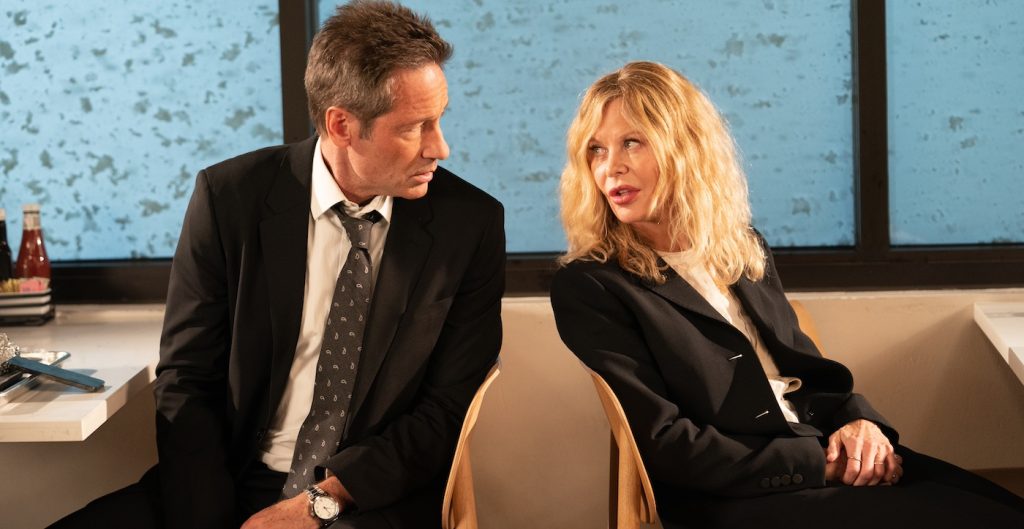
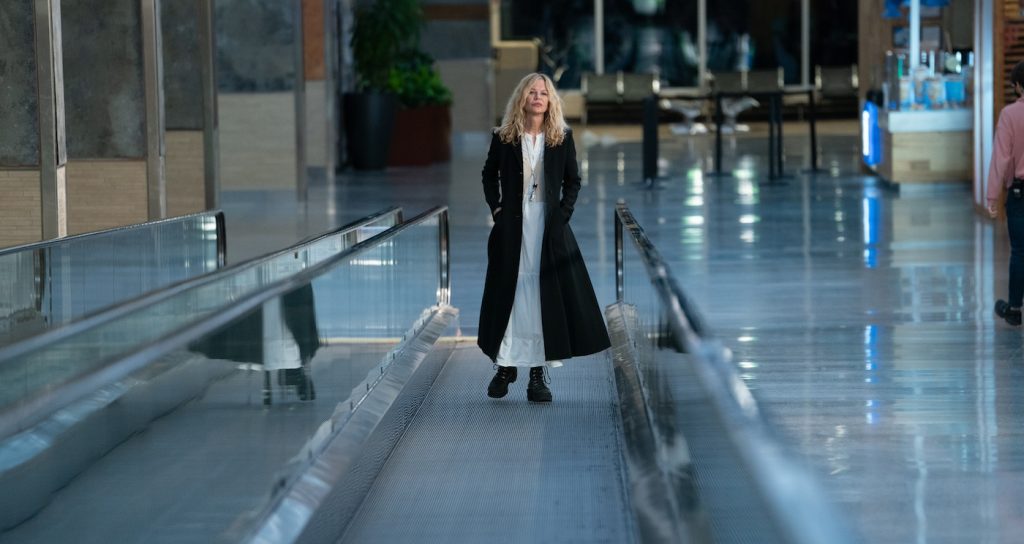
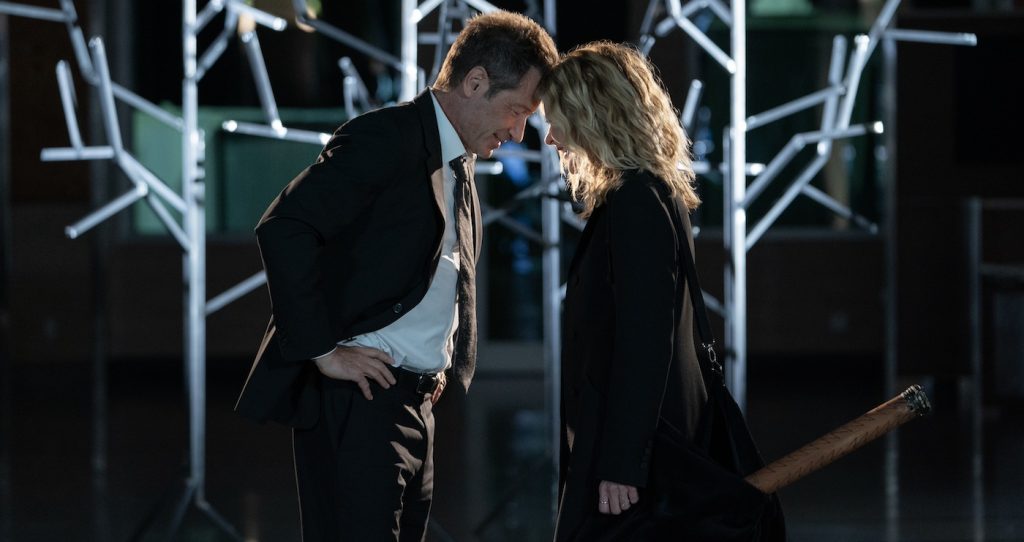
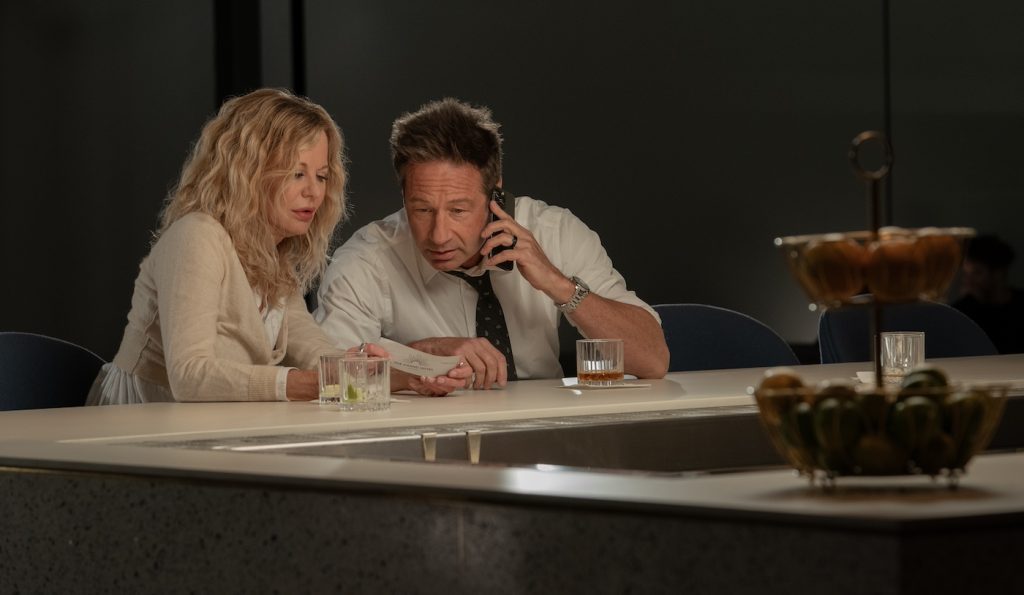
Everyone loves a comeback, which brings us to What Happens Later, Ryan’s first film in eight years. Adapting a play by Steven Dietz, Ryan pulled quadruple duty: She directed, co-wrote, produced, and starred opposite David Duchovny. They play Willa and Bill, college sweethearts who reunite when they find themselves stranded in the same airport during a winter storm. With nowhere for them to go, What Happens Later is effectively one long conversation between the two exes. They catch up, rehash old history, and swap observations about weathering the passage of time. The surrounding airport carries a touch of magical realism, with loudspeaker announcements and billboards responding to Willa and Bill as they wait out their flight delays. The movie isn’t a traditional romantic comedy, but it does recall the twinkly charm that Ryan perfected in When Harry Met Sally…, Sleepless in Seattle, You’ve Got Mail, and Kate & Leopold.
Over Zoom, Ryan talked about ending her Hollywood hiatus, the surging appreciation for the once-controversial In the Cut, and how she used What Happens Later to pay tribute to the most important director of her career.
At what point did you decide to dedicate this film to Nora Ephron?
Almost the whole time, I thought about her. I am so grateful to her in general. But the idea of dedicating it to her came in the end. We had to ask the DGA to approve putting her dedication before my credit. It just felt like exactly the right thing to do. This is a piece of work that says, “I was paying attention, lady, and thank you because my life is full of blessings.” And I have to say, the DGA unanimously voted for us to be able to have that credit.
I’m sure it wasn’t a hard vote on their part. Do you feel like you evoke Nora in your directing style?
I don’t think I’ve done enough even to have a style. Serving this story was about trying to get it on its feet and not have it feel small. The directorial imperative was to make it have scope because it’s such a small and distilled story. Only two people talk. It wasn’t a big budget, so we had to pay a lot of attention to how that magical environment would be created on a shoestring. Those are big choices to make in the beginning: to shoot in a museum, to let the magic come from the reflections on the floor or the snow outside. We took away signs. We created a liminal environment. You will never see a gate number. None of that is really happening in the environment, and the ways to evoke that that we had control over were very basic, very lo-fi. It had to do with how the airport was talking to them.
David Duchovny and Meg Rey in “What Happens Later.” Courtesy Bleecker Street.
The airport you create for this movie is a little bit removed from reality, but any airport is like a cocoon. It has its own rules, its own resources, and you are away from the outside world. What did that setting allow you to capture in terms of these characters and their unexpected reunion?
You’re right; it’s a natural liminal space. That was the original setting of the play, so the filmmakers took that idea and extended it as far out as we could. The airport has sentience, in a way. It was messaging them. The airport, as a larger force, has their good at heart. The airport always says yes. The airport’s imperative is that they always connect, which is an E.M. Forster quote: “Live in fragments no longer.” It’s a time machine, too. Time is very different in an airport. You’re very disoriented, and yet you’re also comforted by the unanimity of the way most airports in the world look. I remember going to an airport in Seoul, and I was seeing people get married there. The architecture of it was so beautiful. Some of these airports all over the world are actually beautiful. Of course, some regional airports in our country are not. But it’s possible to have a beautiful space there. And it’s romantic.
Meg Ryan. Courtesy Bleecker Street.
Everything that happens in an airport has a little bit of kismet to it.
You’re not in charge.
Given that it’s been eight years since you last made a movie, were you only interested in doing something that you were able to write and direct yourself?
No. This sort of came along. It was reactive, mostly to the pandemic. I had time to write and do this. Actually, I felt like the first movie I did; at the end, I was like, “Oh, I want to do this again because I’m starting to understand the tools that are at my disposal as a storyteller.” During the pandemic, I rented a house, and there was one book there. It was Sapiens [by Yuval Noah Harari], and it was talking about how what human beings have in common is this quirk in our brain that has to do with holding abstract ideas and holding stories — it’s essential. There was no big plan, to be honest. It was a story that came along that seemed possible to do.
What kind of scripts have you been sent over the last several years?
Some rom-coms, some stories about children because of Ithaca, some adaptations of books. But what I really learned from this is that you just have to love it. It’s three straight years. It’s a giant commitment, and I can’t imagine doing it and not loving the story. The best part is being around other artists, all operating at the top of their game.
There’s a dance sequence with David set to the Lightning Seeds song “Pure.” How did you land on that song?
The Lightning Seeds song came to us through our musical supervisor. I think it’s only been used in one movie since the ’90s, and it made us all dance in our chairs. That scene is all about them being free and the airport giving them that song after it’s been giving them all this terrible music.
David Duchovny and Meg Ryan. Courtesy Bleecker Street.
All those inferior cover songs.
And I have to say a shout-out to Sheryl Crow and Alanis Morissette and Tom Petty. All those estates really trusted us with messing up their great music.
There’s a moving conversation between Willa and Bill in the airport bar where they talk about worrying that nobody wants to hear from them anymore now that they’ve aged. What struck me is whether that sentiment is autobiographical for you, especially within the context of Hollywood and the business as you’ve experienced it.
I don’t know that I think about it so much in terms of Hollywood, really. She goes, “We’re old, and we’re mute, and we’re savaged by the pharmaceutical giants.” And it’s so lame how she’s like, “I don’t accept my fate.” But it’s a little lament. He says, “Just when you get old enough to have something interesting to say, nobody wants to hear it.” I guess that just feels true. The world moves on, which it should. But you can get good at something after a long time, and then it’s no longer of use. It’s outrageous. I personally don’t feel all that sad about it. I don’t feel any kind of dead end. I hope that’s not what the movie says. It’s just a kind of lament.
Meg Ryan and David Duchovny. Courtesy Bleecker Street.
When The Power of the Dog came out a couple of years ago, there was a widespread reappraisal of In the Cut. A lot of people talked about how misunderstood and underrated it was. I wonder if you noticed that and what it means to you.
Well, I’m just happy to say that Jane [Campion] is a friend of mine. She is so brave. She would say when we were making that movie that it was about grief, and a grief of hers that was particular. At that time, it was a grief of New York. New York was still shrouded in post-9/11 stuff. The buildings had black draping on them. To her, she was also grieving the idea of romance. She felt, at that time, let down by the sort of Arthurian mythology — you know, knight-in-shining-armor mythology that just doesn’t have anything to do with anything anymore. She’s a great person to have as a friend because she thinks so deeply. I was talking to Jane a little bit about this before we shot this movie. I said, “It’s going to be so beautiful because it’ll be snowing outside. We’ll have this liquid environment inside but frozen outside.” And she goes, “Meg, it’ll be beautiful because you and David will connect.” That’s the value of an artist. She’s that extraordinary. She could distill something, and it really was true: No matter how beautiful that our movie looks, and I think it does look really beautiful, the soul of it is all in the connection these two people have.
Does it mean something to you, though, to have people reacknowledging that film in particular?
If I really were aware of that, I would feel proud. I’m very proud of that movie. I just don’t read so much about it. I’m proud of working with her, of course. I love Mark [Ruffalo] in that movie. I love the darkness of that movie. That movie made me feel, maybe for the first time ever, that I was an actress. How it’s received in the world is not my affair. Even this little one: We’re just blowing up a balloon, and now it’s not ours anymore. It’s yours.
Featured image: Meg Ryan in “What Happens Later.” Courtesy Bleecker Street.
A superhero and a superfan become a superteam—this would be one way of summing up the vibe in The Marvels. In a brand new clip for co-writer/director Nia DaCosta’s upcoming film, we get to see firsthand what happens when Carol Danvers, aka Captain Marvel, goes from a solo act to a team player. Well, sort of. Carol’s got her hands full as she fights off some Kree revolutionaries who mean her nothing but harm, but this time, she’s got the pint-sized powerhouse who also happens to idolize her, Kamala Khan (Iman Vellani, reprising her role from her Disney+ series Ms. Marvel) fighting alongside her. Well, again, sort of. Carol and Kamala are both on the same side, but every time they use their powers, they switch places.
The reason for this temporal oddity is something we’ve learned from previous trailers. When Carol goes to check out an anomalous wormhole in space, her powers end up getting all mixed up with not only Kamala Khan but also Carol’s estranged niece, S.A.B.E.R. astronaut Captain Monica Rambeau (Teyonah Harris). Going forward, these three find that with their powers comes the great responsibility of figuring out the suddenly new setting they’re transported to. It’s a tricky bit of business, and it’ll give The Marvels a unique twist.
These three very different but equally courageous women will need to join forces to take on a Kree revolutionary named Dar-Benn (Zawe Ashton), who really doesn’t like Captain Marvel and threatens to tear down Carol and everyone and everything she holds dear.
Samuel L. Jackson returns as Nick Fury, and he’s joined by Park Seo-joon, Zenobia Shroff, Saagar Shaikh, Mohan Kapur, Jessica Zhou, and Caroline Simonnet.
Higher. Further. Faster. These three words have long been the motto of Captain Marvel, but now that she’s part of a super-team, she’s added another—together.
Check out the clip below. The Marvels soars into theaters on November 10.
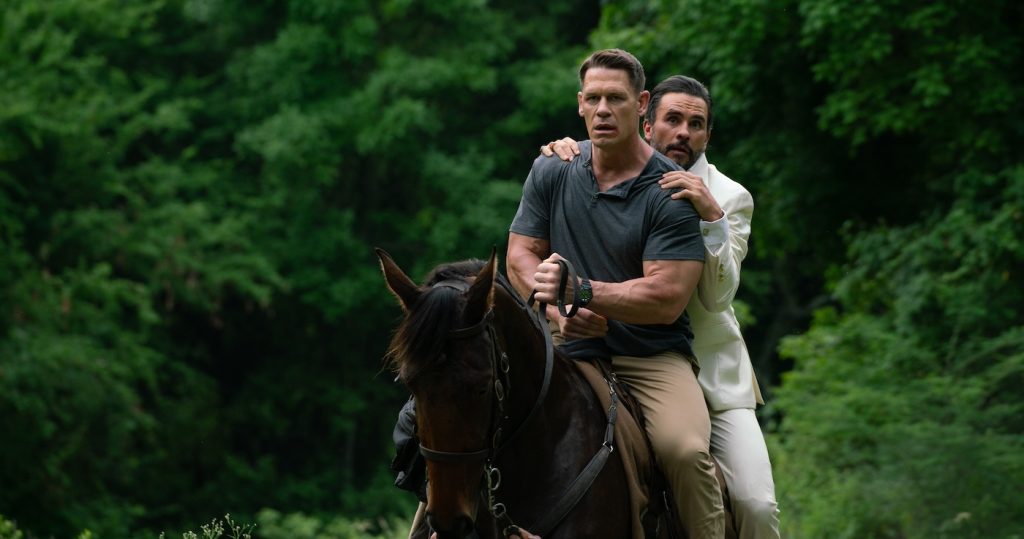
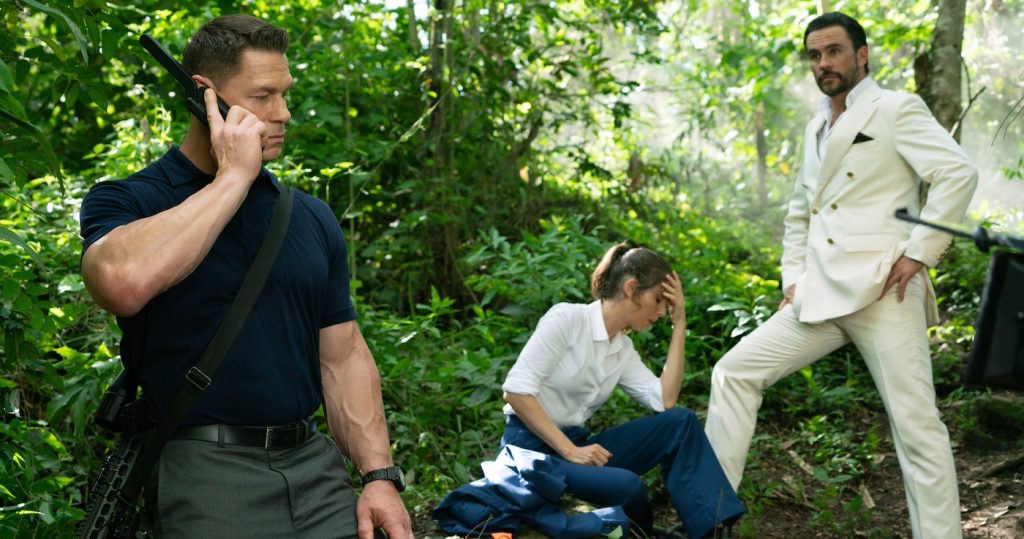
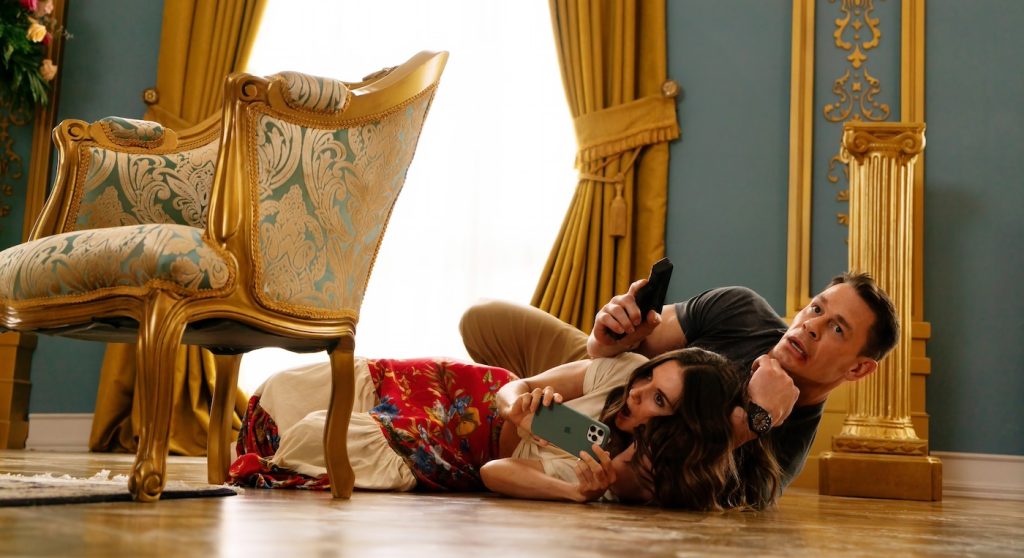
It sounds like the setup to a sketch: a washed-up journalist, a peacocking dictator, and a bored ex-Special Forces guy walk into a coup… That may be the premise of the action-comedy Freelance (in theaters now), the first feature film from long-time Jimmy Kimmel Live writer Jacob Lentz, but the punchline isn’t what you’d expect. Mason Pettits (John Cena) is a frustrated lawyer who gets a call from an old military buddy turned private military contractor, Sebastian Earle (Christian Slater), to provide security to a journalist, Claire Wellington (Alison Brie), trying to get a derailed career back on track. Her lifeline is an exclusive interview with the supposedly ruthless dictator Juan Venegas (Juan Pablo Raba) of a fictional country called Paldonia. Venegas turns out to be pretty fun—for a dictator. Mason and Claire are like oil and water. The three of them are stuck together in an SUV when masked shooters block them in on a bridge in the middle of the jungle. The shooter’s target is Venegas, but everyone in this ill-matched group has to work together to make it out alive.
L-r: John Cena and Juan Pablo Raba. Courtesy Relativity Media.
When Lentz started writing, he began with Mason, a character inspired by a friend and an unrelated, serendipitous kick reading about PMCs. The idea for Venegas came out of the same set of books, “and the more I thought about him, the more I thought, this is a person who’s alternately funny and horrible, but maybe not as horrible as we want him to be,” said Lentz. Venegas’s character is an unexpected source of comic relief, but it’s even more of a surprise when (spoiler alert) Claire and Mason do not get together. “It came up a few times, and I was just like, that’s what always happens,” the writer said. “What if it’s not about the action hero getting the girl?” Instead, Mason earnestly hopes to repair his relationship with his wife (Alice Eve), while Claire is focused, to the point of risk of life and limb, on getting her scoop. The pair just have to make it through the coup.
L-r: John Cena, Alison Brie, and Juan Pablo Raba. Courtesy Relativity Media.
To do that, there’s hand-to-hand combat, a helicopter that has to be taken down, and horses on which to flee. Director Pierre Morel (Taken, Peppermint) favored practical stunts over visual effects, an outcome Lentz was aiming for while he was still in the writing process. “I think anyone paying attention would have to admit that every movie has some preposterous part to it,” he said, but with so much of the action in Freelance performed practically, “I got really lucky. I think the film is better for it, and I’d give a lot of that credit to Pierre and his team.”
L-r: John Cena, Alison Brie. Courtesy Relativity Media.
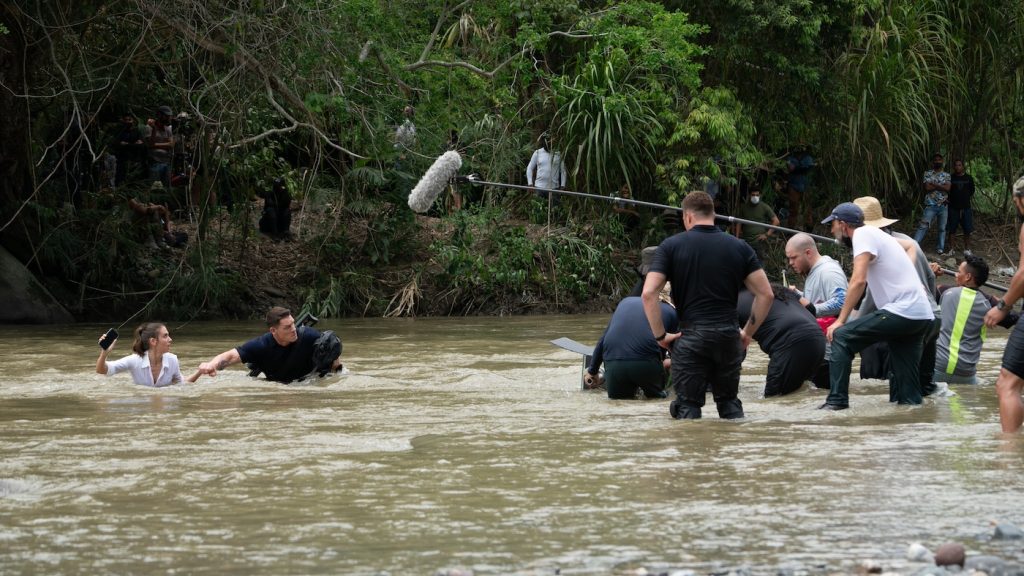
Fully invented is the nation of Paldonia, the name of which was workshopped by Lentz and the film’s producers. A fake country is reminiscent of 2022’s Top Gun: Maverick, in which an enemy nation-state that’s never named has to be defeated at all costs. “I don’t know if it’s a trend,” said Lentz, of relying on fictional or anonymous realms. He avoided setting Freelance in a real country to avoid casting aspersions on a real place. Filming in Colombia with a sizable local team, he asked some of the crew if they would have minded if Paldonia was instead called Colombia. “They generally said no, we wouldn’t have really cared, but we like that it’s a pretend country,” he said
Filming in Colombia. Courtesy Relativity Media.
Before writing his first feature, Lentz was a writer for late-night television. “The big things I credit Jimmy Kimmel Live with for ultimately getting this movie made was that you just have to do the work and be nice about it,” he said. And, of course, humor is humor, and Mason, Claire, and Venegas’s fight to make it out alive is not without laughs, whether absurd (Venegas’s entire partnership with Paldonia’s political left) or slapstick (an awkward shower scene). Writing for late-night comedy encouraged Freelance’s funny side. “The show helped me become much more at ease at putting a joke somewhere,” Lentz said.
For more stories on new films and series, check these out:
Daredevil: Born Again is, apologies for the pun, born again. Marvel Studios has given the upcoming series a creative overhaul, bringing in a showrunner and new directors to retool the series, which was in mid-production in New York when it had to pause due to the writer’s and actor’s strike. The show had been under the direction of Chris Ord and Matt Corman, who were both the head writers.
The new showrunner stepping in is Dario Scardapane, who has a ton of TV experience and who worked on Netflix’s The Punisher, as well as Tom Clancy’s Jack Ryan for Amazon. Scardapane joins directors Justin Benson and Aaron Moorhead, the team that helmed two episodes of Loki season two and will direct the remaining episodes of Daredevil: Born Again. Benson and Moorhead made a name for themselves directing festival and cult films, including Synchronic, Spring, and Endless, often writing, acting, directing, producing, editing, and doing the visual effects on their films. Needless to say, they won’t have to cover all that ground working on a Marvel Studios show.
The first iteration of Daredevil lived on Netflix in the mid-2010s, with Charlie Cox playing the blind lawyer Matt Murdock, who becomes the titular superhero at night. The original Daredevil, including its spinoff The Punisher, were both visceral, at times brutal affairs, and this is the direction Marvel wants to take the new series. Some of the scenes and episodes that were shot already for Daredevil: Born Again will be kept while Scardapane writes new episodes and scenes, weaving in what was previously filmed.
Benson and Moorehead will helm the remaining episodes, while Corman and Ord will serve as executive producers.
Bringing in a showrunner to shape a series is new for Marvel. Previously, Marvel had approached their TV installments much the way they did their MCU films, but now they’re taking a more tried-and-tested approach.
Scardapane’s TV chops are considerable, including creating and producing NBC’s medical drama Trauma, serving as a consulting producer on F/X’s Peabody-award-winning crime drama The Bridge, and working on NBC’s political drama State of Affairs before he leaped into the streaming world as writer and executive producer on Punisher and writer and consulting producer on Amazon’s Jack Ryan.
For more on all things Marvel Studios, check out these stories:
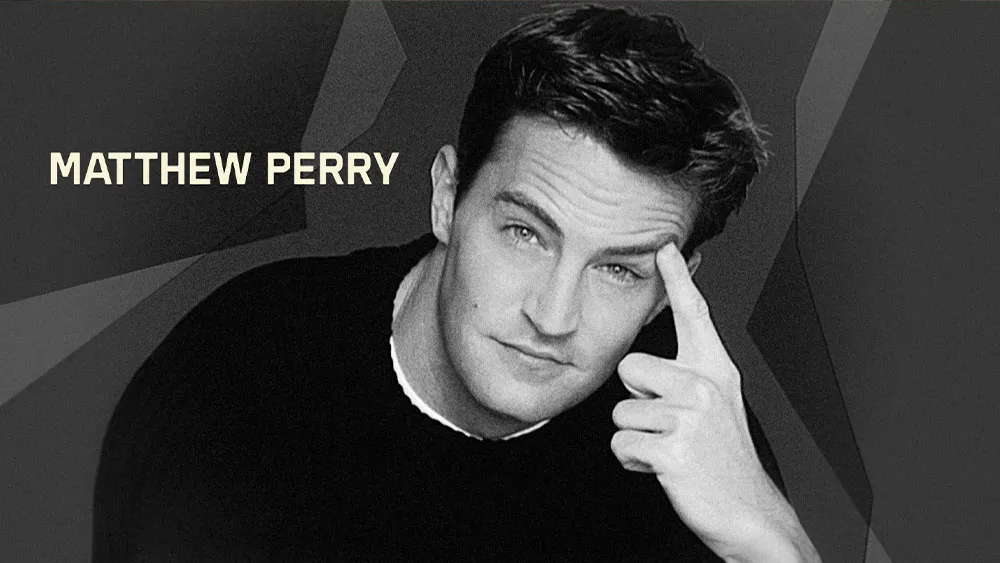
As you likely heard, Matthew Perry passed away this weekend at 54. Perry, who played numerous roles across his career, became a huge star playing Chandler Bing on NBC’s Friends, utilizing his peerless comedic timing and razor-sharp wit to immortalize a lovable, anxious character who helped make the series one of the biggest hits in TV history. Perry died this past Saturday night in his Los Angeles home, law enforcement sources told the Los Angeles Times.
Perry’s family shared a statement with People, “We are heartbroken by the tragic loss of our beloved son and brother. Matthew brought so much joy to the world, both as an actor and a friend…You all meant so much to him and we appreciate the tremendous outpouring of love.”
The Hollywood Reporter shared this statement from Warner Bros. TV, which produced Friends, “We are devastated by the passing of our dear friend Matthew Perry. Matthew was an incredibly gifted actor and an indelible part of the Warner Bros. Television Group family. The impact of his comedic genius was felt around the world, and his legacy will live on in the hearts of so many. This is a heartbreaking day, and we send our love to his family, his loved ones, and all of his devoted fans.”
“We are incredibly saddened by the too soon passing of Matthew Perry,” wrote NBC in a statement. “He brought so much joy to hundreds of millions of people around the world with his pitch-perfect comedic timing and wry wit. His legacy will live on through countless generations.”
This past Sunday night, Nick at Nite, which airs Friends, broadcast Matthew Perry: Thanks for Being a Friend at 10 p.m., which was then followed by fan-favorite episodes that featured Perry, as well as brand-new interviews with the star and behind-the-scenes moments from the set of the seminal series.
On Instagram, Selma Blair shared this tribute, “My oldest boy friend. All of us loved Matthew Perry, and I did especially. Every day. I loved him unconditionally. And he me. And I’m broken. Broken hearted. Sweet dreams Matty. Sweet dreams.”
Pertty’s co-star in the TV series The Odd Couple, Yvette Nicole Brown, wrote this, “Our #OddCouple family suffered a great loss today. The entire entertainment world has. I am too sad about the news to say more than this: @mattyperry4 was a sweetheart who deserved more peace in this life. 54 is too young to go. We love you, Matty! #RIPMatthewPerry.”
Alyssa Milano shared a clip of the pair on Who’s the Boss?, writing, “Matty was always the funniest person in the room. And the KINDEST. He was kind. Matty, remember when we used to go play bingo at that church in the valley? You made me laugh that painful kind of laugh. A cry laugh. You made me cry-laugh.”
Perry’s Friends co-star Maggie Wheeler, who played Chandler’s on-and-off girlfriend, wrote, “What a loss. The world will miss you Mathew Perry. The joy you brought to so many in your too short lifetime will live on. I feel so very blessed by every creative moment we shared.”
Mira Sorvino, who co-starred with Perry in 1994’s Parallel Lives, wrote on X, “Oh no!!! Matthew Perry!! You sweet, troubled soul!! May you find peace and happiness in Heaven, making everyone laugh with your singular wit!!!”
Saturday Night Live, which was hosted by comedian Nate Bargatze, showed this special tribute card of Perry at the end of Saturday’s show. Perry hosted SNL on Oct. 4, 1997, with musical guest Oasis.
Courtesy NBC
Here are a few more tributes:
In The Whole Nine Yards – Matthew Perry runs full force into a patio door – that and the scene that followed is one of the top comedic moments I’ve witnessed.
I told him so when I recurred on The Odd Couple. He smiled so big I thought he’d crack his face
This man brought so much joy and light to so many around the world. He was such a huge part of the Warner Bros. family and he will be greatly missed. Rest in peace, Matthew Perry. pic.twitter.com/GC6Nr5gN34
I’m heartbroken about the untimely death of my “son”, Matthew Perry. The loss of such a brilliant young actor is a shock. I’m sending love & condolences to his friends & family, especially his dad, John Bennett Perry, who I worked with on Flamingo Road & Falcon Crest. #RIPMatthewpic.twitter.com/QWMsBVJEAr
I want to leave Matthew Perry’s own words here as the way we remember him. There will never be another like him- he lit up so many hearts in so many ways. Godspeed to Paradise! pic.twitter.com/rUYSeD7tW0
The Walt Disney Company celebrated its 100th anniversary on October 16th. That’s a century’s worth of mythmaking and storytelling, from Snow White and the Seven Dwarfs (1937) to their upcoming animated feature Wish (hitting theaters on November 22), with a slew of iconic films, characters, a media empire, and theme parks across the world in between. The breadth of Disney’s reach is hard to overestimate. Take the company’s mascot, Mickey Mouse—Mickey is a global icon, immediately recognizable by people in every corner of the world. Disney’s contributions to the world of entertainment are staggering, and any reckoning with the output must begin with their animated films.
Dumbo, Bambi, Cinderella, Peter Pan, Lady in the Tramp, Sleeping Beauty, One Hundred and One Dalmations, The Little Mermaid, Aladdin, The Nightmare Before Christmas (this Tim Burton classic, one of the boldest Disney releases of its time, is having its own 30th year anniversary on October 29th), The Lion King…the list goes on. And on. And again, these are just some of their most celebrated animated films, a list that doesn’t include their Pixar movies, live-action films, television series, and more.
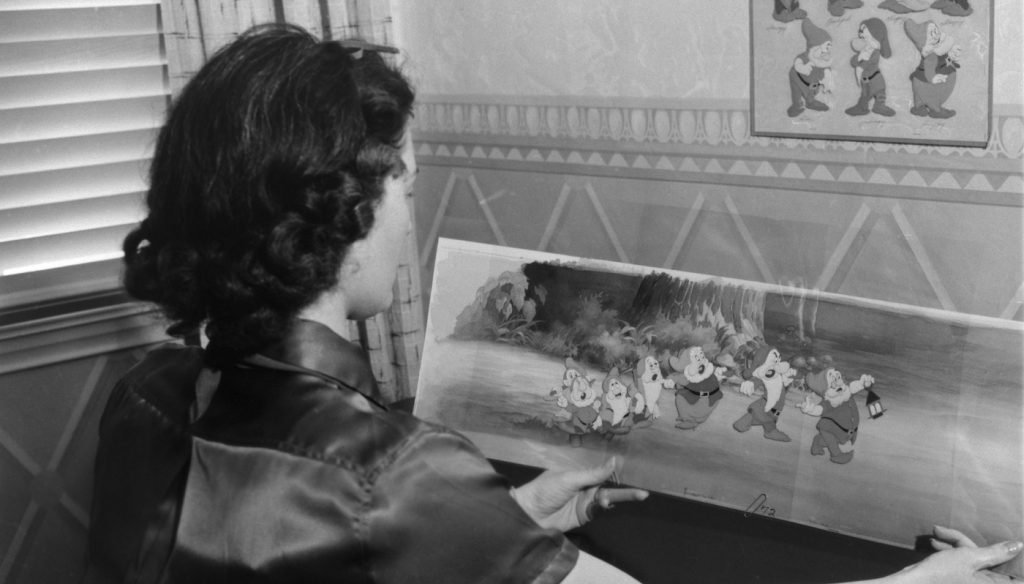
A black and white still depicting an Ink & Paint artist holding a painting of the Seven Dwarfs for Walt Disney’s animated feature Snow White and the Seven Dwarfs. Courtesy Walt Disney Archives, Photo Library.
This huge universe of dream weaving, all these foundational stories populated by characters we feel we know well enough to classify as family or friends, or in the case of the likes of Cruella de Vil, Maleficent, Ursula, Scar, or Captain Hook, like worthy if worrisome adversaries, began with a simple contract that hardly ran four pages long.
Walt Disney had tried to develop two earlier animation studios in Kansas City, both of which failed. So, he packed up and moved west to Los Angeles to try his luck in the movie business. He couldn’t find work acting or directing, so he turned to a pilot film he’d made in Kansas City and even convinced his brother, Roy, to leave behind a solid career in banking and form another animation studio together—the Disney Brothers Cartoon Studio.
When we interviewed Becky Cline, director of the Walt Disney Archives, she told us all sorts of magical stories about the props, costumes, photographs, and precious possessions that she and her team help catalog, care for, and lend out to current productions, curious museums and exhibits, and more. All of the assets in Disney’s vast archives are there because of that original contract. She explained this founding document in greater detail during Disney’s celebration of their centennial.
“The Walt Disney Company officially began on October 16, 1923, when Walt Disney signed a very simple contract in his uncle’s Hollywood home,” she said. “With this agreement, Walt and Roy Disney were able to produce and distribute a series of silent cartoons, the Alice Comedies. This opened a door to the development and production of 100 years of Disney magic that has enchanted the whole world.”
The contract was with Margaret Winkler, a New York cartoon distributor, at 4406 Kingswell Avenue in Los Angeles, where Walt was living. The contract was signed by Walt Disney, Winkler, her future husband and later distributor of Walt’s “Oswald the Lucky Rabbit” cartoon series, Charles Mintz, and Walt’s uncle, Robert Disney. The Alice Comedies were silent cartoons that the Disneys made between 1924 and 1927, centered on a real girl who went on magical adventures in a cartoon wonderland. Alice was played by Virginia Davis, and her animated cat, created by Walt Disney and Ub Iwerks, was named Julius. A mashup magical world of live-action blended with animation—it sounds like the Disney we still know today, 100 years later.
For more stories on 20th Century Studios, Searchlight Pictures, Marvel Studios, and what’s streaming or coming to Disney+, check these out:
In Pain Hustlers, the opioid crisis takes on a different tenor than that previously seen in hard-hitting dramas like Hulu’s limited series Dopesickand fellow Netflix’s own Painkiller. While still inspired by actual events, David Yates’ retelling of a “fascinating state of the nation” falls more in line with the big-bang type of storytelling akin to The Wolf of Wall Street and The Big Short.
“What that gave us was just license to play, and we could be a bit more subversive and playful, and the humor we could bring to the story felt [that] this movie would then depart from some of the other dramas that were being made in the opioid drama space,” Yates says.
Over the course of a year, Yates and Wells Tower completed a screenplay based loosely on Evan Hughes’ 2018 New York Times Magazinearticle about billionaire John Kapoor’s Insys, a company that reached obscene heights by incentivizing the overprescription of a dangerous fentanyl spray. Concurrently, Hughes was gathering fodder for his eponymous novel while attending Kapoor’s trial, which resulted in the disgraced founder’s eventual 66-month sentencing for his bribery.
“We knew at the very outset that we didn’t want it to be a beat-by-beat translation of Evan’s book,” said Yates, best known for his directorial work on the latter handful of Harry Potter films and subsequent Fantastic Beasts spinoffs. “We wanted to use Evan’s book as a starting point and to have the artistic license to build a world based on Evan’s book, and in that journey, we created the character of Liza Drake, someone we felt could carry this story and bring us into it in a way that felt universal and accessible.”
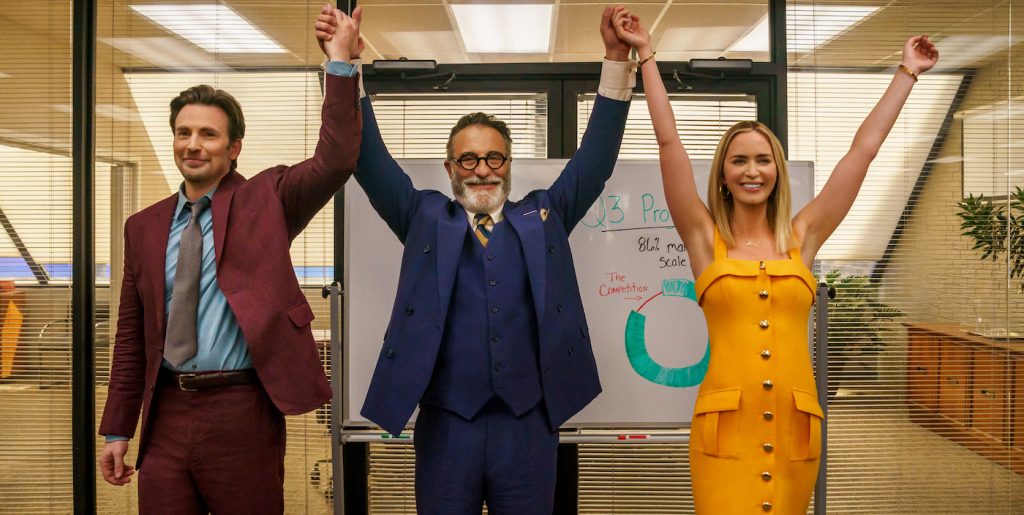
Portrayed by Emily Blunt, Liza Drake is a working-class single mother who, after a chance encounter with Chris Evans’ sleazy corporate man Pete Brenner at a strip club, enters the highly risky, highly rewarding, and highly dubious world of pharmaceuticals. As the upstart company lavishly expands, Liza is confronted with her daughter’s worsening medical condition, her erratic and eccentric boss, and the life-and-death fallout of the company’s elaborate kickback schemes.
Liza and Pete, Yates said, are composite figures inspired by several different real people.
“The fact that Liza is a single mum means that perhaps we have a bit more natural empathy for her in some regards,” Yates said. “We always wanted to explore this idea of a human being who’s undervalued, underappreciated, has a real challenge in her life to be accepted and to be acknowledged and to be respected, but she’s got this amazing superpower, which is empathy and the ability to look at someone and realize how to sell something to them and how to sort of manipulate them, really.”
For both Blunt and Yates, while it was important that the story unfolds through the lens of a woman acting out of desperation rather than greed, Liza is not a martyr nor a blindsided innocent victim.
“There is a fine balance,” Yates explained. “We do think that we wanted Liza to realize she was doing the wrong thing ultimately but still do it. That was an important part of the story for us. Emily, in particular, was very passionate about that; she didn’t want to have a character who was cleaner than clean, who was just a decent person. She was intrigued by a human being who was a bit dodgy.”
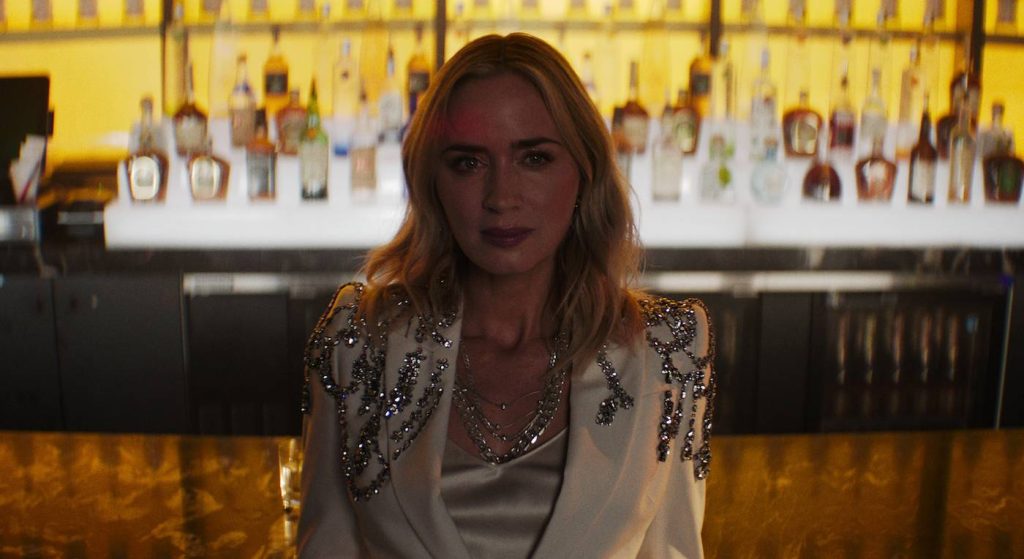
Emily Blunt in “Pain Hustlers.” Courtesy Netflix.
In a great departure from the work Yates is known for, Pain Hustlers — which had its initial premiere on Sept. 11 at the Toronto International Film Festival — thrives in chaos, reaching a fever pitch when the pharma company arrives at its calm-before-the-storm billion-dollar evaluation.
“I wanted the movie to feel relentless in its pace, in many ways reflecting the crazy pace of which this company went from this tiny outfit that was failing into this crazy huge IPO success story,” the director said. “We wanted to mirror that in the language of the film.”
As a result, the film employs numerous jump cuts and freeze frames, over which several characters narrate their thoughts. In one scene, Blunt’s character pauses to the tune of a cash register opening: kaching.
“When I was making Potter or when I was making Beasts, those movies naturally lend themselves to a very classical treatment, very elegant camerawork, gentle movement, very classic storytelling technique, whereas this story demanded something a little bit more bonkers,” Yates described.
With a “frenetic and fractured” cinematic style, Pain Hustlers is also supplemented by a pseudo-documentary element that hints at the story’s real-life inspiration and allows for medical jargon to be outlined in a concise manner.
“It was a way of giving context and also insight into how the characters were feeling too,” Yates said. “So it was a style that was baked in pretty early on in the way Wells was building the script.”
To match the film’s “propulsive” pace, Yates worked closely across the board with departments like music and costume to nail the film’s audiovisual language. Having previously collaborated with Colleen Atwood, Yates and the renowned costume designer worked to depict Liza’s evolution through costume.
“It was fun charting this journey of a woman going from poverty to riches, from feeling a failure in life to someone who was a huge business success, but all in a slightly blingy, bold, slightly off-color way,” Yates said.
But even as the film dramatizes one segment of a country’s epidemic, Yates stressed that the movie’s goal was to be as thought-provoking and moving as it is entertaining. To accurately and sensitively depict the serious subject matter, Yates and Blunt collaborated with the Georgia Prevention Project and spoke to victims’ loved ones. As the consequences of Liza and Pete’s actions are realized, the film’s tone matches the sobriety of the moment.
“The film starts to settle down in the final third as it gets a bit more serious, and we use fewer techniques to fly the story along as the consequences of what these characters are doing come home to roost and to rest,” Yates said.
For the filmmaker, Pain Hustlers is both a hell of a ride and a lesson that audiences can learn from: “I would hope that [people] watch the movie and they come away realizing the depth of the crisis but also ask questions next time they go to the doctors to get a prescription,” he said.
Pain Hustlers is now playing in theaters, with a Netflix debut set for Oct. 27.
For more on big titles on Netflix, check these out:
You can’t ask for an actor with more gravitas to supercharge your movie than Viola Davis. In a new clip for The Hunger Games: The Ballad of Songbirds & Snakes, Davis’s regal presence as Dr. Volumnia Gaul, the head gamemaker, commands a literal stage as she addresses a room full of new academy members. “How tantalizing to see all your shining young faces on this auspicious day,” Dr. Gaul says after a laugh so ominous you can practically see the blood freeze in the youngsters’ veins.
The new clip introduces us to Dr. Volumnia Gaul and Gaul to the new members as not only the head gamemaker, but the woman in charge of the war department and all its affiliated concerns. Hunger Games heads know that the gamemaker is the person responsible for crafting the treacherous, wickedly ingenious spectacle of carnage that takes place every year in Panem. The ostensible purpose of the games is to keep the peace among the districts by requiring every one of them to sacrifice two children to participate. Nearly all of them won’t come home, and their deaths will be brutal—by design—and televised. “I’ve broken free of my laboratory today to examine you,” Dr. Gaul says, “the leaders of the next generation. I won’t be around forever, after all.”
At this, Dr. Gaul introduces the dean of the Academy and creator of the Hunger Games himself, Casca Highbottom (Peter Dinklage), a man who seems almost pained by the thing he’s brought into the world. Among the young faces, we see one that will have not only a huge role to play here but in the future of Panem, a young Coriolanus Snow (Tom Blyth), who will find himself mentoring a young tribute from District 12, Lucy Gray Baird (Rachel Zegler). Their relationship will form the crux of the adventure in director Francis Lawrence’s upcoming prequel.
The Hunger Games: The Ballad of Songbirds and Snakes is set 64 years before the events in the original trilogy as Panem prepares for the 10th Annual Games. As the clip shows, the film will enjoy some of the finest actors working today as viewers are brought back to the world that made Jennifer Lawrence a superstar and that Lawrence, in turn, helped turn into a cultural phenomenon.
Other important characters you’ll get to know are Lucretius “Lucky” Flickerman (Jason Schwartzman), Coriolanus’s Academy classmates Clemensia Dovecote (Ashley Liao), and Sejanus Plinth (Josh Andrés Rivera).
The Hunger Games: The Ballad of Songbirds and Snakes arrives in theaters on November 17.
For more on The Hunger Games: The Ballad of Songbirds and Snakes, check out these stories:
This is how Nick Fury (Samuel L. Jackson) describes Carol Danvers, aka Captain Marvel, arguably the most potent superhero who ever fought alongside the Avengers (sorry, Thor) in this new The Marvels teaser.
“Captain Marvel is one of the most popular characters in the Marvel universe,” says Marvel Studios chief Kevin Feige. “One of the highlights of my career was introducing Brie Larson as Captain Marvel.”
The teaser then lets Captain Marvel herself speak about what it was like stepping into this iconic role. “Trying on the Captain Marvel suit for the first time was the most surreal experience of my life,” says Brie Larson. “I remember feeling this jolt in my heart. It had given me the most dynamic character that I’d ever had the chance to play. I want to bring the full scope of what Captain Marvel can be.”
“Carol helps me discover things about myself,” says Nick Fury himself, Samuel L. Jackson. “Nick helps her discover who she is.”
“I’m excited for fans to see Captain Marvel do something so different from anything she’s done before,” says The Marvels co-writer and director Nia DaCosta.
DaCosta’s The Marvels takes Captain Marvel, usually a lone operator keeping the universe safe and dropping in on Earth when needed, and puts her in a predicament that will require her to form a team. It’s not a choice Carol is really dying to make. Or, perhaps to put it more succinctly, it’s a choice Carol has to make if she wants to keep from dying, as well as protect all the other people in harm’s way.
The new film finds Carol Danvers becoming cosmically entangled with her estranged niece, S.A.B.E.R. astronaut Captain Monica Rambeau (Teyonah Harris), who was just a young girl who looked up to Carol in the original Captain Marvel and then appeared (as played by Harris) in WandaVision, and Kamala Khan (Iman Vellani, reprising her role from Disney+’s Ms. Marvel) a young girl from Jersey City who has gone from idolizing Captain Marvel to being her (very young) contemporary. When a cosmic mishap involving an anomalous wormhole that Carol was exploring conjoins these three superpowered women into a bizarre temporal trap (when one uses their powers, they switch places with another), things get complicated. The new team will need to learn how to harness their unique situation to take on a Kree revolutionary named Dar-Benn (Zawe Ashton), who has a bone to pick with Captain Marvel and the power, and the rage, to bring down everything Carol holds dear.
On the scene in The Marvels is, of course, Carol’s old pal Nick Fury (Samuel L. Jackson). The cast also includes Park Seo-joon, Zenobia Shroff, Saagar Shaikh, Mohan Kapur, Jessica Zhou, and Caroline Simonnet.
The official trailer for Bradley Cooper’s Maestro has arrived, giving us our most in-depth look yet at his look at the life of the legendary conductor and composer Leonard Bernstein (Cooper) and his lifelong relationship with actress and activist Felicia Montealegre Cohn Bernstein (Carey Mulligan). This epic love story, Cooper’s first directorial effort since A Star is Born, is based on a script he co-wrote with Josh Singer.
The trailer centers on both the lasting relationship between Leonard and Felicia, as well as the music that is central to their lives and his legacy. The trailer teases out the complexity of their relationship, the mercurial nature of this musical titan, his varied romantic tastes, and the way that his love of people was most vividly displayed by his commitment to music. “I love people so much that it’s hard for me to be alone,” Bernstein says at one point, “and music, it keeps me glued to life.”
Joining Cooper and Mulligan are Matt Bomer, Maya Hawke, Sarah Silverman, Michael Urie, Josh Hamilton, Scott Ellis, Gideon Glick, Sam Nivola, Alexa Swinton, and Miriam Shor. Produces include none other than Martin Scorsese and Steven Spielberg. Spielberg, of course, directed the recent film adaptation of Bernstein’s deathless West Side Story.
Check out the trailer below. Maestro hits select theaters on November 22 and Netflix on December 20.
For more on big titles on Netflix, check these out: