Best of 2023: Hit Makers Mark Ronson and Andrew Wyatt on Adding a Pop Punch to “Barbie” Soundtrack

*It’s our annual “Best of the Year” look back at some of our favorite interviews from the year. 

Before Barbie, before producing Bruno Mars and Adele, before winning an Oscar for co-writing Lady Gaga’s duet “Shallow” for A Star Is Born, Mark Ronson made a living in New York City as a deejay pulling from his encyclopedic knowledge of musical genres from many eras. Ronson’s talents earned wide acclaim when he co-produced Amy Winehouse’s breakthrough album “Back to Black” in 2006. Since then, Ronson and his frequent collaborator Andrew Wyatt have gained a reputation as studio-savvy hitmakers in collaboration with a wide range of high-wattage talent.

So it made perfect sense when filmmaker Greta Gerwig enlisted Ronson and “Shallow” co-writer Wyatt to oversee the music for Barbie and its companion “Barbie: The Soundtrack” album. Together, they produced the movie’s effervescent tunes featuring pop stars Charli XCX, Nicki Minaj, Haim, Sam Smith, Pink Pantheress, Khalid, and Billie Eilish. The result was 11 Grammy Award nominations.

Speaking from Los Angeles, Ronson and Wyatt talked about their love of 80s-era synths and the experience of being in the recording studio with Ryan Gosling as he belted out Barbie‘s big power ballad “I’m Just Ken.”


You guys usually write and produce songs for pop stars. What’s the difference between collaborating on an album with a singer versus the way you created music for the Barbie movie?

Mark: A lot of time we work with brilliant artists who come in with an idea: “I just broke up with my boyfriend, and I need to get this emotion out” or “I just came up with this funny line,” someone else delivers the inspiration to you. But sometimes you show up at the studio thinking, “What can I possibly say today that I haven’t said before?” When you get a script like Barbie, it’s so emotive; your brain goes to places it never would have gone, and that’s a real gift for a songwriter. As soon as Andrew and I read the script and had our initial conversations with Greta, music started to come out of us.

Greta Gerwig loved her Barbie dolls during the eighties. Did the music from that time period influence your sound?

Mark: Maybe in some ways. With the Cold War still happening, Reagan and so forth, the eighties were kind of the heyday of American triumphalism, so we naturally gravitated to that.

And that eighties synth feel seems to come through in bouncy numbers like “Hey Blondie” and “Speed Drive.”

Mark: 80s synths have never gone away; they just keep evolving in contemporary pop. The eighties mean so many things from Duran Duran to Herbie Hancock’s “Rocket,” but it also means some very rich scores from [film composers] Vangelis and Maurice Jaubert and David Grusin, who were like: “We’ve been using orchestras for 70 years; let’s try something else and see if we can get the same emotive-ness with these other instruments.” Greta loved the emotional wallop and the romance of the orchestra, but she also loved the more synth-y stuff. Andrew and I were just trying to play in this place where we could weave these things together.


Given your collective track record as producers and songwriters, was it an easy sell to get major stars like Dua Lipa, Nicki Minaj, and Billie Eilish on board with Barbie?

Mark: Greta was the easy sell. Especially with younger artists, they’ve grown up with Lady Bird and Little Women so everybody was excited to come to the table because of Greta.

Creatively, what came first?

Mark: Our first marching orders were to write a dance number because they were going to film it soon and were going into choreography rehearsals. With Dance The Night, Andrew and I have both worked with Dua [Lipa], and it seemed obvious: Who else is going to do the killer dance sequence like her? She put her whole boot through the genre of modern disco, so that was really exciting.


It’s incredibly catchy. Who else stands out?

Mark: Well, we didn’t produce every song. On “What Was I Made For?” we just did the string arrangement, but as soon as we heard the first demo from Billy [Eilish], we were like, “Wow, I can’t believe she watched twenty-five minutes of the film and cut right to the heart of Barbie’s experience.”


“I’m Just Ken” has turned out to be the movie’s big showstopper, with Ryan Gosling belting out this emotional power ballad. How did that song come together?

Mark: The Ken character got under our skin as soon as we read the script. Everybody can empathize with the loser. We were just trying to write something that made you feel for this guy, so one day, I was walking to the studio, and I thought of the line, “I’m just Ken; anywhere else, I’d be a ten.” I made a little chorus idea, sent it over to Andrew and he came up with the verse.

Greta Gerwig liked “I’m Just Ken” so much that she rewrote the script to make room for it in the third act. That must have been gratifying.

Mark: Yeah, of course. We’re working with Greta and with [Barbie co-writer] Noah Baumbach, who are kind of comic geniuses with words. So Andrew and I were like, “Oh, they think our words are good enough that we’re not going to ruin their movie if they literally change the entire third act to accommodate this thing.” When they sent us storyboards with our lyrics and a drawing of Ryan on the bed singing, you go, “Oh s***, this is real!”


What’s it like working with Ryan Gosling in the studio?

Andrew: Ryan’s a talented vocalist, so he was easy. I don’t think we did more than a couple of takes. We’ve been doing this stuff a long time, and sometimes, at the end of a session, you go, “Boy, I hope we can make this sound good.” Including my own vocals, I should say. But with Ryan, we just did a few takes, and the sound was already there. We were quite blown away.

Mark: Ryan was in the vocal booth behind this glass window. You don’t want to stare, but I’d look over occasionally and see that he was really far back from the microphone. First rule, producing 101, is to get the singer as close to the microphone as you can so you can go directly to the feeling. But I realized Ryan was singing as if it were both a mike and a camera. He used his whole body, kind of what opera singers did back in the day at Carnegie Hall. Ryan performed that song with every bit of Ken in him.

You recorded him in London?

Mark: Yeah, we went to London because we only had three hours to get this song done in between Ryan’s insane workouts and dance rehearsals. Later, we also recorded the other guys on Skype singing the background, “And I’m enough!” Andrew sang backgrounds, too

Andrew: That was fun.

In addition to all these soundtrack tunes, you also composed the score, which plays underneath that poignant scene when Margot Robbie’s “Barbie” meets Ruth Handler (Rhea Perlman), inventor of the Barbie doll. What were you aiming for in that sequence?

Mark: Greta was like, “I need to be crying here,” so we did probably like seventeen drafts of that thing until we got it right. The music couldn’t get in the way of dialogue, so we used a lot of synths and sound pads to swirl around it, and choirs, and the orchestra, and a glass harmonica, which is this beautiful droning instrument. We knew the emotional crux of the film was in some ways on our shoulders, so on our last pull-out-our-hair night, Andrew sat at the keyboard for the longest time, just watching this scene over and over.

L-r: Rhea Perlman and Margot Robbie in “Barbie.” Courtesy Warner Bros.

Tweaking the music until. . .

Mark: Tweaking until we were f***ing making ourselves cry.

For more on Barbie, check out these stories:

“Barbie” Casting Directors Allison Jones And Lucy Bevan on Populating Barbie Land

“Barbie” Hair & Makeup Artist Ivana Primorac Conjures Personality From Plastic

Pretty in Pink With “Barbie” Production Designer Sarah Greenwood & Set Decorator Katie Spencer

Featured image: Caption: (L-r) RYAN GOSLING as Ken and MARGOT ROBBIE as Barbie in Warner Bros. Pictures’ “BARBIE,” a Warner Bros. Pictures release. Photo Credit: Jaap Buitendijk

Best of 2023: Gina Prince-Bythewood, MPA Creator Award Recipient, Tells Her Story

*It’s our annual “Best of the Year” look back at some of our favorite interviews from the year. 

An elite force of female soldiers, the Agojie, is all that stands between the African Kingdom of Dahomey and the combined forces of the Oyo Empire and Mahi people. The Oyo and Mahi plan to raid Dahomey villages and sell their captives to European slavers. We open on a Mahi village where raiders heat their machetes over a fire at night. Their leader hears something in the tall grass surrounding them and quiets his men, standing to get a better look. A flock of birds burst from the grass. The men laugh. Their leader is paranoid. All is well, and their raid will go off as planned.

A moment later, the leader of the Agojie, Nanisca (Viola Davis), rises from the grass, followed by her fellow female soldiers. It’s an ambush. And despite it taking place at night before we’ve met Nanisca and her elite force, the action is framed by someone who knows exactly where she wants her camera to be, exactly whose story she’s telling, and exactly what the purpose for every beat is.


We’re 90 seconds into the beginning of director Gina Prince-Bythewood‘s The Woman King — her second brilliantly conceived and executed action epic in a row, following her 2020 movie The Old Guard, an adaptation of a graphic novel that tracked a team of immortal mercenaries led by Charlize Theron’s Andy and joined by KiKi Layne’s Nile. With The Woman King, Prince-Bythewood once again centered the action on women, only the degree of difficulty was significantly higher for reasons technical (larger cast, larger crew, more complicated set pieces), global (Covid-19), and professional (the film had been delayed for years over concerns that its predominantly Black female cast would not attract audiences). Yet Prince-Bythewood once again deployed her immense gifts for crafting visually coherent, emotionally resonant action sequences, an ability shaped by the fact she’s a former top-tier athlete herself. Few directors better understand that action has to be legible to be enjoyable, but to make great action, each moment, each beat, each punch, and each kick have to be supercharged by the personalities, histories, and heartbreaks of the combatants involved.

For this reason and many more besides, Gina Prince-Bythewood is the Motion Picture Association’s 2023 Creator Award recipient, having created a thrilling body of work that has consistently reframed whose stories get told and who gets to tell them. From her breakout hit Love & Basketball in 2000, through The Secret Life of Bees (2008) and Beyond the Lights (2014), Prince-Bythewood has gravitated toward intimate stories that, occasionally, as of late, happen to take place on an epic scale. You can’t separate her vision when shaping an action sequence from her years as an athlete, nor can you separate her action movies from her early, intimate, personal films.

L-r: Sanaa Lathan and Gina Prince-Bythewood on the set of “Love & Basketball” in 2000. Courtesy New Line Cinema.

Prince-Bythewood has approached every film with a mantra. “I see a connection between [all my movies] in terms of the stories I want to tell, which I call intimately epic,” she says. “It doesn’t matter what size canvas I’m working with; you have to care about the character’s story first.”

One of the reasons Prince-Bythewood is one of the best action directors working is she understands on a visceral level what it takes to compete, what it feels like to believe you can and will defeat your opponent, and what it requires to achieve that. She can make a large-scale scene of hand-to-hand combat flow as beautifully and cogently as she made an offense flow on the basketball court when she was running point.

“All the lessons you learn from sports, especially as a girl, are things that are normally not encouraged or thought of as assets for girls,” Prince-Bythewood says. “To learn that aggression is good, to learn that ambition is good, to learn how to outwork everybody, to learn to have stamina, to learn to leave it all out on the floor, I’ve been able to take that to sets when I’m a director to pull the team together, to inspire and lead, and hopefully encourage them with my vision. These are all things I learned on the court and on the track.”

L-r: Queen Latifah, Gina Prince-Bythewood, and Jennifer Hudson on the set of “The Secret Life of Bees” in 2008. Courtesy Searchlight Pictures.

Crucially, for The Woman King, Prince-Bythewood also excelled in the ring as a kickboxer after college.

“To be able to know what a good punch looks like, what a good kick looks like, the intensity of when you’re in a ring and what it means when you’re facing an opponent, the intention behind your swings and kicks those were all things I was able to talk to the actors about,” she says.

As incredible as the women in Prince-Bythewood’s The Woman King cast were — Viola Davis, Thuso Mbedu, Lashana Lynch, Sheila Atim, and more — she knew she was going to ask them to do things they’d never done before. She and her team — fight and stunt coordinator Danny Hernandez, fight choreographer Jénel Stevens, and lead cast trainer and nutritionist Gabby Mclain — built them into a cohesive fighting unit, one brutal day of training at a time.

Jenel Stevens on set of "The Woman King." Courtesy Sony Pictures
Jenel Stevens on set of “The Woman King.” Courtesy Sony Pictures

“I knew I didn’t just want my actors to learn the moves; I needed them to really do it because I think that’s the best way to film action,” Prince-Bythewood says. “The question was, how can I build athletes? So I talked to my team, Danny Hernandez, my incredible fight and stunt coordinator who’s also a martial artist, and Gabby Mclain, who was in charge of building up their bodies so that they could withstand [the training], and we built athletes to see what they could do.”

Gabriela Mclain and Viola Davis training during "The Woman King." Courtesy Sony Pictures.
Gabriela Mclain and Viola Davis training during “The Woman King.” Courtesy Sony Pictures.

They could do a lot, it turns out. The cast went through a grueling training regimen that began months before Prince-Bythewood shot a single frame, and they continued training once they were on location in South Africa. At one point Prince-Bythewood had them training six days a week, including morning sprints for an hour and a half, martial arts training with Hernandez, and two hours of strength training with weights.

“It was a really beautiful thing to see women who hadn’t been in touch with that part of themselves overcome so much of the negative self-talk that had been built up over time to realize the way you do one thing is the way you do all things,” Prince-Bythewood says. “That’s something you learn from sports as well. For them to see their bodies get stronger, to see their swagger increase, to see the way that they walked into a room, the confidence, all of that was built in the gym. Because I’d been through it myself, I knew that’s what it would do.”


But what about the practicalities of her profession, the technical aspects of turning a melee into a meaningful moment of violent catharsis? How does she find the poetry within all those bodies slashing and slamming into each other? How does she avoid the trap that so many directors seem to fall into, where the camera seems to move as hyper-kinetically as the action, and the viewer is left dazed and a little defeated by the scene?

“Building and shooting the action sequences in The Woman King, I could be right there with Danny [Hernandez] saying, ‘I didn’t believe that; she really needs to have intent.’ Talking to the actors, I could say, ‘You’re not just swinging a machete, you’re swinging it through flesh and bone, you have to have an intent, so what is your intent?’” she says. “And that changes the way that people swing.”

Camera placement is key. Prince-Bythewood has honed her skill as a visual storyteller by remaining committed to the emotional beats that make a physical showdown meaningful.

“First and foremost, it starts with the fact that as a director, I’m the first audience, so I need to understand the scene, I need to be able to follow the story, and then it’s my job to tell that story,” Prince-Bythewood says. “I put the camera where I feel like I can watch the action, follow the action, and care about the action. We always start with, ‘What is the character doing? What is this revealing about the character? What is the story of this moment? Honestly, I equate it to a love scene. I love doing love scenes, and it’s the same concept. It has to have a story, it has to be character-based.”

L-r: Lashana Lynch, Thuso Mbedu and director, Gina Prince-Bythewood.

Caring about the emotional state of a character is as crucial for a director to succeed as it is for a viewer to lose themselves in a story. It’s why you watch The Old Guard and feel so caught up in the initial terror and fury of KiKi Layne’s Nile as she fights Charlize Theron’s Andy on a cargo plane (an all-time great action sequence). Or why, in The Woman King, you find yourself drawn to each of the main characters within a given action set piece and know not only who they are by how they fight, but why they fight that way.

Gina Prince-Bythewood on the set of “The Old Guard.” Courtesy Netflix.

“If you take Lashana Lynch’s character Izogie, the very first time you meet her says so much about her as a character,” Prince-Bythewood says. “The fact that she uses her nails as a weapon, the intensity in her face. We talked about a feral abandon with the way she fights where she’s trying to humiliate her opponent to get back at all the trauma she’s experienced. This is opposed to Viola’s character Nanisca, who’s a general and has this brutal efficiency and shows no emotion. That tells you a lot about her. That’s the fun part, building these scenes and knowing you want them to look cool and have cool moves, but you have to have an intent, a story, and a character behind those moves for an audience to care.”

Lashana Lynch stars in THE WOMAN KING.
Lashana Lynch stars in THE WOMAN KING. Courtesy Sony Pictures.

Prince-Bythewood has followed her own instincts and interests, from athletics to film, from smaller intimate films to action epics, yet there’s been a remarkable consistency in all her work, no matter the scale, a genuine interest in the interiority of the characters she depicts.

“I truly believe that the first thing you come out with should tell the world who you are as an artist and tell Hollywood who you are as an artist,” she says about that crucial first movie. “I also believe everyone has a story only they can tell, and that’s what’s going to separate you. It’s something I had to learn — I really thought the way to break in was to mimic the things that were successful. People want fresh stories. Fresh perspectives. It took me a second to get there, but also, it takes courage to say, ‘My story is meaningful enough that millions of people will want to see it.’ [Laughs] Whether that’s courage or swagger, it goes back to that athlete mentality. When I walk on the court, I am the best person on it.”


It’s hard enough to write a personal story, harder still to share it, and perhaps hardest of all to hear no. Prince-Bythewood knows from this experience.

“You have to have that to be able to sit down and write a personal story and believe that others will care. That’s a hard thing to do, and there will be times where you’ll lose confidence and certainly, for me, I kept thinking [about Love & Basketball], ‘Who’s going to care about a story about a Black girl who wants to be the first woman in the NBA?’ But I believed in it so much that it kept getting me back into the chair, even after every single studio and production company turned down that film. It was soul-crushing to put something on the page that you believed in so much, that was a personal story, and to be told essentially, your voice doesn’t matter, your story doesn’t matter. But that never made me question the story, it was just a hard thing to push through. But overcoming no is something you have to learn in this industry because you just need that one yes. I was so, so fortunate to get that yes from Sundance, which changed the trajectory of my career.”

L-r: L-r: Sanaa Lathan, Omar Epps, and Gina Prince-Bythewood on the set of “Love & Basketball” in 2000. Courtesy New Line Cinema.

Prince-Bythewood credits having a great support group of filmmakers and friends. Her biggest rock, however, is her husband Reggie Rock Bythewood, who she’s collaborating with on Genius: MLK/X, which is focused on the relationship between Martin Luther King Jr. and Malcolm X. She and her husband will serve as Executive Producers under their production company Undisputed Cinema. 

“My husband is my biggest champion and my biggest support and my favorite writer,” she says. “So on those days where you’re on the floor, there’s somebody saying, ‘Get up, keep fighting.’ That’s supremely important.”

As for the MPA Creator Award, she says it speaks to something she’s believed since she was working on Love & Basketball.

“The thing I’m excited about with the MPA Creator Award is what I’m being honored — that those who make film and television can change the world. That’s how I approach the work even 23 years later; I’ve never let go of the knowledge of the power of film and how it literally can change lives and change perception and shift culture. So, to be honored for that, to know that people are seeing that in my work, that it’s not just about entertaining but I am actually trying to say something to the world — it’s incredibly meaningful.”

For more on Gina Prince-Bythewood, check out these stories:

“The Woman King” Director Gina Prince-Bythewood on Her Singular, Sweeping Historical Epic

Director Gina Prince-Bythewood on her Netflix Epic The Old Guard

To read last year’s profile of the Motion Picture Association’s Creator Award recipient, check this out:

MPA Creator Award Recipient Writer/Director Nikyatu Jusu on her Stunning Debut Feature “Nanny”

Featured image: L-r: Gina Prince-Bythewood and Sanaa Lathan on the set of “Shots Fired.” Courtesy Fox Network.

Best of 2023: “Succession” Costume Designer Michelle Matland Breaks Down the Roy Family’s Signature Looks

*It’s our annual “Best of the Year” look back at some of our favorite interviews from the year. 

Early this season on Succession, Waystar Royco executive Tom (Matthew Macfadyen) mocks the $2900 Burberry handbag carried by cousin Greg’s (Nicholas Braun) date as being “Ludicrously capacious…You could slide it across the floor after a bank job.” And in the show’s first year, Kendall (Jeremy Strong) bought a pair of $500 Lanvin sneakers to ingratiate himself with potential Silicon Valley investors, telling them, “I got these sneakers on the way down here because I thought you’d all be dressed like f*****’ Björk, and I wanted to make an impression.” But most of the time, the privileged anti-heroes of Succession reserve their trash-talk for personality flaws rather than fashion critiques.

Nonetheless, fans pay close attention to the clothes worn by Logan Roy (Brian Cox) and his offspring, with Instagram accounts like Successionfashion tracking the characters’ tops, bottoms, shoes, and accessories in granular detail.

Credit for Succession‘s singular brand of corporate chic goes to costume designer Michelle Matland, whose credits include The Girl on the Train along with Emmy-nominated work on Mildred Pierce and Angels in America. She’s dressed all four seasons of the show, eschewing primary colors to curate nuanced variations in black, navy blue, and beige silhouettes tailored to reflect each character’s particular strain of inner turmoil.

Matland deconstructs the Roy family wardrobe, from the late Logan Roy to the youngest, Roman, revealing where she found Logan Roy’s signature cardigan sweater, explains why Kendall Roy likes baseball caps, and more.

Sarah Snook, Jeremy Strong, Kieran Culkin David M. Russell/HBO ©2022 HBO. All Rights Reserved.

Logan (played by Brian Cox): In the season opener, he’s wearing this amazing double-breasted sweater with brass buttons. Of course, it’s a cardigan sweater, which became Logan Roy’s signature look, as if he’s so powerful, he doesn’t have to bother with a suit and tie. Where do you source those sweaters, and what did you have in mind for giving him this casual look?

The whole point of Logan is he never has to be anything other than his comfort zone. One of his original sweaters came from a tiny shop in a little upstate town called Livingston Manor. One side of the store had gorgeous men’s clothing, and the other side had kitchenware. We knew right away this was for Logan. It fit [Brian Cox] perfectly, it was strong, and it was immediately right. Logan Roy doesn’t have to dress up for anyone because he’s the man. He is who he is, and he maintains that through the seasons. He’s King Lear, and he’s staying King Lear.

L-r: Brian Cox and Matthew Macfayden. Photograph by Macall B. Polay/HBO

Kendall (Jeremy Strong): He likes baseball caps! What does that say about his character? And what are some other elements you’ve outfitted Kendall with that speak to persona?

The baseball cap was not an unconscious choice. It developed as a shell of protection. It fits his comfort zone as a way to hide and also as a way to set himself apart from the more formal culture associated with his position, his family, and his company. Kendall is very specific about what he wants — standard, iconic looks — and he has stuck with that throughout the series. One thing from last season, there was a Rashid Johnson necklace from the series called “Anxious Man,” which really says a lot and speaks to his character. And Kendall loves logos, especially if it’s a subtle, beautiful, understated logo. But he’s also gentle about getting those things and wearing them multiple times. It’s not like he’s looking into a logo designer; he just wants something very specific and character-driven.

Jeremy Strong. Photograph by Claudette Barius/HBO
Jeremy Strong. Photograph by Macall B. Polay/HBO

Shiv (Sarah Snook): She’s got one toe in the world of politics but also sees herself as a shrewd businesswoman. Her pantsuits evidently resonate with viewers. Who in the real world, if anyone, did you take as a reference for Shiv’s sense of style, and what personal qualities did you want to express?

When we began Season 2, we thought Shiv was someone who is very much embodying Katharine Hepburn. We wanted to establish a look that was high-waisted trousers and very simple, elegant, and flattering. We created a timeline where she was very classy and clean looking. And this last season, she was very comfortable in her own life, finally much more available. At one point, she was trying to be in the board room, but now she is less board room.

Sarah Snook. Photograph by Claudette Barius/HBO
Sarah Snook. Photo: David M. Russell/HBO

Roman (Kieran Culkin): He shows up in this season’s first episode wearing a pastel shirt and pants. He’s in L.A. with Shiv and Kendall, and that southern California vibe really contrasts with the New York shots of businessmen in their dark suits attending Logan’s birthday party. By contrast, Roman rarely wears a tie. What are you going for with that open-neck look?

Roman is the most casual uniformed guy on the planet. He is just moving through the room. He has no agenda at all with anyone; he’s simply his own beast. We have a closet for Roman, and Kieran will rummage through it for hours. He’s very personal in selecting, and that takes a lot of time.

Sarah Snook, Kieran Culkin, Jeremy Strong. Photograph by Claudette Barius/HBO
Jeremy Strong, Kieran Culkin, and Brian Cox. Photograph by Graeme Hunter/HBO

Connor (Alan Ruck): He’s always been a bit of an outsider. Do you deliberately dress him differently from the other three siblings?

He’s a presidential candidate now and dresses like one. Connor is much more professional and political than when the show first started. Connor has become official. There’s no particular meaning behind the vest itself.

Alan Ruck. Photograph by Macall B. Polay/HBO
Justine Lupe and Alan Ruck. Photograph by Macall B. Polay/HBO

Tom & Greg (Matthew Macfadyen and Nicholas Braun), aka “The Disgusting Brothers”: They exist outside the immediate Logan family but still play important roles in the story. You dress both characters in beautiful suits, and at times they almost look like twins. Was that intentional?

Yes, it’s intentional that they look similar. Greg is always following Tom, and we had every intention of giving them uniformity and showing this consistently.

Matthew Macfadyen and Nicholas Braun. Photograph by Macall B. Polay/HBO

What’s it like designing for creator Jesse Armstrong?

He is the most fabulous, collaborative, and involved person I’ve ever worked with.

Anything secrets to your success on outfitting one of the most fashionable series on TV?

I’ve been known from time to time to walk up to someone in the street and literally purchase the shirt off their back. I tend to source costumes from anywhere at any time. You might say I’m a 24-hour designer. And also, an important point that gets underestimated: through all my experiences over the years, the jewelry and the accessories, the scarves, earrings and necklaces, the rings — all of that is a constant treasure hunt and always pays off. You will be hard-pressed to find a character that isn’t wearing a distinctive piece of jewelry. I have drawers and drawers of jewelry; both refined and costume or personal pieces, and I don’t like them to go to set without something.

J. Smith Cameron and Kieran Culkin. Photograph by Macall B. Polay/HBO

For more on Succession, check out these stories:

“Succession” Writers Kept Shocking Death From Leaking By Using the Perfect Code Word

Inside the Shocking Death That Rocked “Succession” Episode 3

Inside the “Succession” Season 4 Premiere & Logan Roy’s Bummer of a Birthday

Featured image: Jeremy Strong, Sarah Snook, Kieran Culkin. Photograph by Claudette Barius/HBO

Best of 2023: “Rustin” Screenwriter Julian Breece on Giving a Legend his Due

*It’s our annual “Best of the Year” look back at some of our favorite interviews from the year. 

There are countless unsung heroes of the civil rights movement who will never get the recognition they deserve, yet it’s hard to imagine an overlooked figure more central to the cause and more courageous and capacious in spirit than Bayard Rustin. While historians are well aware of the impact Rustin had on the civil rights movement writ large and specifically the March on Washington, most Americans are not.

George C. Wolfe‘s Rustin (in theaters now) offers a course correction. Wolfe directs from a script co-written by Julian Breece, who has put ten years into shaping the story of a larger-than-life figure whose life went so largely unapplauded. Breece first heard about the project a decade ago and petitioned Oscar-winning screenwriter (and his co-writer on Rustin) Dustin Lance Black to give him a shot. Once onboard, Breece faced the challenge that every storyteller attempting to craft a biopic about a legend must surmount—how do you capture the essence of a figure so crucial and so complex into a single movie?

Breece’s approach was to focus on Rustin’s ingenious, tireless efforts to orchestrate the 1963 March on Washington. Rustin was not just a crucial architect of this defining moment in American history, but he was also a mentor to Martin Luther King Jr., and these dual roles gave Breece the backbone of his story, vividly showing how Rustin helped take the March on Washington from an impossible dream to King’s iconic “I Have a Dream” speech on the steps of the Lincoln Memorial.

“I grew up thinking whatever I did, I was going to have to be behind the scenes or in the shadows because I was queer, and I’m sure Bayard felt some of that as well,” says Breece. He was talking specifically about how Rustin, who was openly gay well before the March, was sidelined during portions of the civil rights movement on account of a whisper campaign about his sexuality. Eventually, King would stand shoulder-to-shoulder with his mentor, but it was the journey of getting to that moment on the steps of the Lincoln Memorial that Breece set his sights on.

We spoke with Breece about his decade-long pursuit of a script worthy of Bayard Rustin, Colman Domingo’s absorbing performance, and what he hopes audiences will take from Rustin’s life. We have the written portion of the interview below, as well as a shorter video version, too.


Tell me about this ten-year journey you went in researching and writing Rustin.

The year I found out about the project, in 2013, I was temping. I’d won some screenwriting awards coming out of grad school for a screenplay I’d written about the ball scene in New York, but none of that had translated into work, so I was still doing my spec scripts and working on a studio lot. My manager told me that Dustin Lance Black [Oscar-winner for his Milk screenplay] was producing a movie about Bayard Rustin, and he’s looking for a writer. At the time, it was still difficult to get into any rooms for features, particularly for Black writers. There weren’t a lot of us in the system in 2013.

Julian Breece

So, how did you get to Dustin Lance Black?

I wrote this super long letter to Lance explaining to him why I was so passionate about Bayard, who had been a hero of mine since I learned about him on my own—he wasn’t taught in any classes. I finally got a meeting with him after he saw a short I did at Out Fest, and he liked it. He read my work, and we hit it off. From there, I was off to research.

And what did your research entail?

I read everything I could get my hands on and actually moved to New York for three months because that’s where Bayard was based and where the people closest to him still live. And the Rustin Papers are in D.C. [at the Library of Congress]. But it was the one-on-one interviews that I did where I discovered the heart of the movie. I did about 19 hours of interviews with people who worked with Bayard and had close relationships with him. That was probably the most rewarding part of the research process.

How did you start to shape the story from this wealth of research material and all the hours of interview tape?

There was so much about Bayard’s life; it really could be a limited series. But I learned about Bayard in connection with the March on Washington and his relationship with Martin Luther King. You can’t do a movie about Bayard without centering the March on Washington, especially since it’s a culmination of the different parts of his career.

Did you look to any other biopics as a reference for what you were hoping to achieve?

As a student of film, there’s a place for cradle-to-grave biographical films, but I’m more attracted to films focused on the moment that made the person great. One of my favorite biographical films is Capote. I’d read the script over and over and over again. It’s so beautifully written. It really takes that moment when Truman Capote as we know him, all his flash and flair as a writer and public person, became great. It shows how his growth as an artist was also, in some ways, tragic. So, if I had to say there was a model for the way I looked at Rustin, it was definitely Capote.

There are so many moments that depict the way Bayard had of being in the world, his warmth and humor, his passion and hard-headedness. Who specifically did you interview that helped you flesh out his character?

I spoke to Rachelle Horowitz [played by Lilly Kay], who was one of Bayard’s assistants, for hours and hours. Then there was Walter Naegle, his partner, who was so generous and who has really been the person who’s carried the torch of Bayard’s legacy all of these years when it seemed like people didn’t want to know. He let me know the private Bayard, the Bayard behind the public face, behind the strength, behind the strong leader and organizer who everyone looked up to and wanted to follow, behind the Bayard who was charismatic and wonderfully flamboyant and captivating. Walter helped me know who he was in those vulnerable moments and how really felt about certain things, things that he may not have said publicly that hurt him.

RUSTIN (2023)
Lilli Kay as Rachelle Horowitz.
CR: Courtesy NETFLIX

You highlight so many crucial relationships Bayard had, and none more so than his relationship with Martin Luther King Jr. How did you approach their fondness for each other, as well as their falling out for a time?

What moved me the most when I learned about Bayard and King was that you have the most iconic, famous religious figure in modern history, aside from the Pope, who was mentored by a gay man. Mind-blowing. I think Bayard’s mentorship of King was the reason he was pushed out— the whisper campaign. Even though Bayard had helped mold King as a leader, it was like, ‘Well, now we can’t have you be associated with him at all.’ The lessons that Bayard taught King about bravery and leadership, we see that in the arc of King’s growth to becoming great, right at the moment before he stepped out onto that podium and made the greatest speech of all time.

Rustin. (L to R) Audra McDonald as Ella Baker and Colman Domingo as Bayard Rustin in Rustin. Cr. David Lee/Netflix © 2023

Rustin also makes a very moving point that it’s the relationships between people, rather than simply the greatness of any one individual, that get things done. I’m thinking of Bayard’s conversations with Ella Baker [played by Audra Macdonald], who spurs him on to get back into the game after the whisper campaign.

Ella Baker and Bayard provided that kind of support for each other. Him being queer, and her being a woman in the movement and being underestimated because of that. You understand why Bayard’s relationship with the women in the movement was so important and why he saw them in a way that male leadership didn’t. And Ella was able to see him in ways that the male leadership couldn’t afford to, too. The March on Washington was all about coalition building and relationships. That’s the only way that it happened, and I’m hoping that we can look at that now as a country and a world and just see the importance of intersectionality and being able to support each other’s causes, as opposed to everyone fighting for themselves. Things don’t change that way. Bayard Rustin knew that revolutionary change happens through relationships and coalition building.

Rustin. Colman Domingo as Bayard Rustin, Melissa Rakiro as Yvette, Ayana Workman as Eleanor, Jordan-Amanda Hall as Charlene, Jakeem Dante Powell as Norm in Rustin. Cr. David Lee/Netflix © 2023

Another thing you take away from Rustin is the tremendous courage Bayard had. To live openly as a gay Black man at that time and be a force of nature in the civil rights movement…it boggles the mind.

People loved Bayard Rustin. Like anyone else, he has his edges, his thorns, but he was a deeply generous, deeply gentle person. The reason why he was out in the thirties, forties, and fifties is because his belief in equality and truth ran that deep. He’s like, if I’m not living it, I can’t fight for it. I can’t live a lie and tell other people to tell the truth. He drew people to him because of that courage.

RUSTIN (2023) Colman Domingo as Bayard Rustin and Johnny Ramey as Elias. Cr: David Lee/NETFLIX

His charm comes through from the very first scene, when he’s being mocked by a young member of the civil rights movement, and by the end of the film, that same young man adores him. 

That was one of my favorite scenes to write. Showing Bayard coming back into the movement through the young people. You have to learn what’s going on. Even the old guard didn’t really know what was happening on the lower frequencies, but the young people who were on the ground knew. So Bayard’s relationship with that particular character, Blyden [Grantham Coleman], was a real relationship. Blyden’s a radical straight dude who, by the end, felt like Bayard was a badass. Who is more badass than Bayard Rustin? Who’s able to slay all of these dragons, say, ‘This is who I am, deal with it, come with it, I am going to fight on no matter what.’ I hope other people coming out of it feel that same way about Bayard.

Rustin is in theaters now and streams on Netflix on November 17.

Featured image: Rustin. (L to R) Jeffrey Mackenzie Jordan as Courtney and Colman Domingo as Bayard Rustin. Cr. Parrish Lewis/Netflix © 2023

Best of 2023: “Fair Play” Writer/Director Chloe Domont Makes a Killing on Male Fragility

*It’s our annual “Best of the Year” look back at some of our favorite interviews from the year. 

Fair Play, writer/director Chloe Domont‘s feature debut, is somehow both an old-school erotic thriller and a shrewd, scalpel-sharp dissection of how far we have and have not come with gender equality in the workplace and in the headspace of men, even those who consider themselves allies.

The film is largely set at the hedge fund One Crest Capitol, where Emily (Phoebe Dynevor) and Luke (Alden Ehrenreich) are low-level but promising analysts trying to take the next step in their careers. The vibes at One Crest Capitol are deeply dog-eat-dog, with the only trappings of a more enlightened age evidenced by a policy against intra-office romance. This is why Emily and Luke keep their engagement a secret, and all seems to be going to plan until one of the firm’s PMs (portfolio manager) is unceremoniously fired—he takes his rage out on a couple of computer monitors—and a promotion for Luke to fill the role seems nigh.

Only it’s the smarter, savvier Emily who gets the gig, turning the erotics depicted between the couple in the film’s early going into the thriller Fair Play becomes. While Luke plays at being both supportive and excited about Emily’s promotion, things between them go from tense to terrifying.

Domont explains how she crafted one of the finest erotic thrillers in years by setting out not to make a female revenge fantasy but rather an exploration of that most exquisitely fragile of constructs—the male ego.

Can you tell me about researching the hedge fund world?

I had a bunch of friends in that world, and they put me in touch with some hedge fund guys, and basically, it started with me taking them out for drinks and getting some of them drunk and asking basic questions, like, take me through your day from the moment you get up to the moment you go to bed. Even the mundane stuff.  I wanted a full picture of what the day-to-day is like. Then, I asked about tensions and dynamics between an analyst and a PM. What are the most frustrating moments you’ve experienced with your superior? How do you treat someone who’s beneath you? Once I had a good grasp on it, I took a pass on writing a draft, then I shared it with them and got some notes on authenticity.

The finance jargon feels authentic, as does the poisoned relationships between all the men at One Crest Captial.

Actually, I felt like the finance jargon was the easy part; the harder part was, ‘Do I have a story that people will care about watching?’ [Laughs]. The harder part was crafting the drama and how the conflict would escalate and create this ballooning tension that you don’t know when it’s going to pop, but once it does, it turns into a dogfight. By far, the most challenging part of writing it was figuring out the pace, the tone, and the rhythm.

Fair Play, behind the scenes L to R: Rich Sommer as Paul, Chloe Domont, writer and director and Phoebe Dynevor as Emily. Cr. Slobodan Pikula / Courtesy of Netflix

Was the pacing pretty well baked into the script, or did you find it while in the production and editing process?

Everything was pretty much there in the script. I even put camera directions in the script. I really worked on trying to fully realize every element of filmmaking before we went into shooting because I thought, this is my one shot, you know? Working in television was an amazing boot camp experience for me leading up to my first feature; you always have to cut shots, and you have to know what you have to protect at all costs and what you’re willing to sacrifice. But also, when you get on set, I think the most exciting thing about filmmaking is that you can rehearse it in a certain way and know exactly where your camera is going to be, but then the magic of filmmaking is something unexpected always comes up.

Your script is so tight that I’m sure there are lots of actors who could have done it justice, but I’m curious what you think about why they seemed so perfectly tailored to Alden Ehrenreich and Phoebe Dynevor. 

Individually, they’re each such strong, versatile actors that I think they can do anything, but when you put two people together, the stars have to align. Their chemistry was just instant. The film really lives and dies off their chemistry. I remember early on, we’d rehearsed, and it felt electric in many ways, but until you get to shooting, you’re a little bit nervous if that chemistry is going to come through on camera. But I remember we shot the bathroom scene where they’re recently engaged, and they’re slow dancing, and the way they look at each other, it was just so magnetic. I knew at that moment that I had a movie.

Fair Play. (L to R) Alden Ehrenreich as Luke and Phoebe Dynevor as Emily in Fair Play. Cr. Courtesy of Netflix

There are such subtle moments where Luke is trying to do right by Emily and applaud her promotion, but there’s this simmering resentment that we can feel growing inside him. How did you shape those?

What I tried to do with the character and what Alden brought to Luke is he represents a certain generation of men who are caught in the middle between wanting to adhere to a modern feminist society but still having been raised on traditional ideas of masculinity. That doesn’t make him a bad guy at all. He adores Emily because she’s ambitious. He adores her because she’s talented, because she’s a killer; that’s why he’s attracted to her. But at the same time, on some level, you know he was raised under more traditional ideas of gender roles. It’s that conflict that he starts to internalize and doesn’t know how to deal with, and that’s something I wanted to show—how problematic it becomes when someone doesn’t know how to deal with something. But, again, he genuinely is happy for her, but he’s hurt because he thought [the promotion] was his. He has this idea of who he’s supposed to be, the kind of man he’s supposed to become. This sudden flip throws him for a loop in a way he’s not prepared for. I think it’s tough for anyone to think you’re up for a job and your partner gets it, but then, what I’m exploring here are some of these ingrained power dynamics that I think we still haven’t quite figured out yet.

Fair Play. (center) Phoebe Dynevor as Emily and (center right) Alden Ehrenreich as Luke in Fair Play. Cr. Courtesy of Netflix

Your film is set in the aftermath of #MeToo in one of the most male-dominated, nakedly zero-sum capitalist professions. There’s one moment, in particular, when Eddie Marsan’s character Campbell, the big boss, savages Emily in a brutally sexist way that I was hoping you could unpack.

It’s an animal kingdom, you know? It’s every man for himself. I think the #MeToo movement never hit the finance world. There’s a certain level of power and money that you can’t touch. I think people definitely treat each other with more respect, but at the same time, what I wanted to show with Eddie’s character when he finally lashes out at Emily is that this is someone who hired her because he sees her value regardless of her gender and genuinely thinks she’s the best person for the job, and in that way, he’s her champion. But, as soon as she slips, then her failure is through the lens of gender. And I think that’s a double standard that a lot of women face in every industry. Yes, there are these male champions out there that believe in you and support you, but as soon as slip, you f**ked up because you’re a woman. I wanted to show that in the most cutting way.

Fair Play. (L to R) Phoebe Dynevor as Emily, Eddie Marsan as Campbell, Rich Sommer as Paul in Fair Play. Cr. Slobodan Pikula / Courtesy of Netflix

And she absorbs it after some initial shock and keeps pressing on at Crest Capital.

That’s why I had him say it again. The look of shock on her face, like, what did you just call me? And he’s like, yeah, I can say whatever the f**k I want. You don’t like it? Leave. And that’s how it is.

[Spoilers below]

Can you explain how you set up Luke’s spectacular flameout at the office when he attempts to undermine Emily to his final, even more desperate and awful act at home?

In the scene with Campbell when she has to choose how to deal with [Luke’s treachery] and save face at that company because Luke throws her under the bus, Campbell gives her his thirty thousand view of the world, which is this— ‘It doesn’t f**king matter. It’s all about the money. Just move on from it. I don’t care who you kill, I don’t care who you f**k, just do it on your time.’ So she’s sitting on that idea that accountability doesn’t matter, and watching this new woman come in, and Emily’s on the other side of what she’s experienced, this abuse, and she knows everything this young woman is going to go through, that’s what’s in her head when she’s faced with Luke for one final confrontation.

Fair Play, behind the scenes Eddie Marsan as Campbell Cr. Sergej Radovic / Courtesy of Netflix

What did you want to bring across in that final confrontation between Emily and Luke? 

For me, the ending was always about Emily reclaiming the power that Luke takes away from her. The film always had to escalate to the sexual assault scene in the bathroom because the only way for Luke to reclaim the power in the relationship at that point is through physical dominance. The only way for Emily to reclaim the power again is through physical force as well because this is a man who refuses to be held accountable. So, it had to go to these places for me because I set out to make a thriller about power dynamics on the ugliest level. Sexual assault is not about sex; it’s about power. Then, when it does occur, what’s Emily going to do about it? She tries to confront him on his inability to face who he is. He’s a man who cannot own up to his own weakness and cannot face his own failures, and it causes so much destruction. For me, the last scene is not about female revenge; it’s a scene about holding a man accountable. A man who refuses to be held accountable. The whole movie builds up to the line where Luke finally mutters the words, “I’m nothing.” Once he finally does that, once he’s finally the man who acknowledges his own inferiority, his own weakness, his own failure, that’s the resolution of the film. Ultimately, this is not a film about female empowerment; this is a film about male fragility.

Fair Play. (L to R) Alden Ehrenreich as Luke and Phoebe Dynevor as Emily in Fair Play. Cr. Sergej Radovic / Courtesy of Netflix

For more on big titles on Netflix, check these out:

Julia Roberts, Mahershala Ali & Co Seek Refuge at the End of the World in “Leave The World Behind” Trailer

“Reptile” Director Grant Singer on His Slithery Mystery Feature With Benicio Del Toro

“May December” Trailer Reveals Natalie Portman and Julianne Moore in Todd Haynes’ Twisty New Film

Featured image: Fair Play. (L to R) Alden Ehrenreich as Luke and Phoebe Dynevor as Emily in Fair Play. Cr. Sergej Radovic / Courtesy of Netflix

Best of 2023: “Ahsoka” Cinematographer Eric Steelberg on Lensing a Rebel Jedi’s Journey Through Time & Space

*It’s our annual “Best of the Year” look back at some of our favorite interviews from the year. 

For Ahsoka cinematographer Eric Steelberg, lensing the latest live-action Star Wars series was a dream come true. Growing up in thrall to George Lucas’s original trilogy, Steelberg would find himself on set while filming the new series, surrounded by massive spaceships both practical and virtual (the latter thanks to Industrial Light & Magic’s LED immersive soundstage the Volume), astonished by his own job.

“You’re sitting there trying to figure this out and tell the story because it is a job, but then what you’re watching takes you aback. Like, I can’t believe we’re doing this,” Steelberg says.

The new series, the first live-action Star Wars show to spring from one of the franchise’s animated series (Star Wars: Rebels), follows its titular heroine, the rebel Jedi Ahsoka Tano (Rosario Dawson), and the return of a terrifically powerful adversary (Grand Admiral Thrawn, played by Lars Mikkelsen, who also voiced him in Rebels) in the aftermath of the fall of the Galactic Empire. Ahsoka’s allies are chiefly her former padawan Sabine Wren (Natasha Liu Bordizzo), her trusty droid Huyang (voiced by David Tennant), and General Hera Syndulla (Mary Elizabeth Winstead). Along with Thrawn, her chief antagonists are the formidable Baylan Skoll (the late Ray Stevenson), his protege Shin Hati (Ivanna Sakhno), and an assortment of bad guys, from droids to assassins, all working in concert to aid the return of Thrawn. Oh, and then there’s the thrilling arrival of Anakin Skywalker (Hayden Christensen, reprising his role), who featured prominently in episode 5, “Shadow Warrior,” as he and Ahsoka tangled and tumbled through their past together in a deeply satisfying trip down memory lane.

We spoke to Steelberg about fulfilling a lifelong dream, from lightsaber duels to speeder bikes and all manner of Star Wars-styled action in between.

As a Star Wars fan, which I imagine so many of the folks working on Ahsoka are, what was it like taking on the responsibility of stepping into arguably the most storied franchise of them all?

It’s a lot of responsibility to take on. What if my fandom doesn’t translate through my work? At the same time, that amount of excitement and fear turns into healthy creative fuel.

Ahsoka has narrative overlap with The Mandalorian, but it’s a grander, more expansive story. Can you talk about the look and feel of the series?

The Mandalorian set the bar very high from what’s to be expected from a TV version of Star Wars. Your barrier for entry is already higher than I’ve ever experienced. And you’ve got the expectations of fans from the movies. I understand wanting the same level of quality. If we’re doing live-action, we’re doing live-action, and I don’t care what the budget is. All that matters is the final result. So people want those big, sprawling epic stories. They want high production value. They want a certain look. So that’s how I went into the project; we’ve all got the expectations of movie-level quality visuals, the technical expectations that were established in The Mandalorian and The Book of Boba Fett and Obi-Wan Kenobi. So how do we achieve that but make it feel different?

(L-R): Sabine Wren (Natasha Liu Bordizzo) and Ahsoka Tano (Rosario Dawson) in Lucasfilm’s STAR WARS: AHSOKA, exclusively on Disney+. ©2023 Lucasfilm Ltd. & TM. All Rights Reserved.

How did you?

I started with Dave Filoni in prep about how we expand upon those expectations technically and creatively. We referenced the movies—both the originals and the more recent ones—and then it was a lot of references to Akira Kurosawa movies, which was a well-documented influence on both George Lucas and Dave. There are tonal things, letting things play out in wide shots that give it a sense of scale. That was our jumping-off point. Then, it was working with our art departments on what we could create that would show on screen in the best way possible. And this is a different story, based on the Star Wars: Rebels animated series. There are influences, even shots, taken from that. And then, for me, it’s also about how you capture that feeling of this being Star Wars?

(Center): Rosario Dawson on the set of Lucasfilm’s AHSOKA, exclusively on Disney+. ©2022 Lucasfilm Ltd. & TM. All Rights Reserved.

How would you describe a shot that feels like Star Wars?

Honestly, it comes down to a kind of gut feeling because some of its editing, some of its production design, some of its framing, and some of its lighting. Also, Star Wars is always widescreen, right? And what kind of screen? It’s always anamorphic. So that’s the most basic version, the visual starting point. From there, looking at the cinematography, for me, it’s the original three movies. That’s what I grew up on. That’s what I fell in love with. I’m always thinking of parallel moments in the original movies we can reference. At the same time, those movies were made in the late 70s and early 80s, so how do you keep that very polished, formal lighting style with the expectations of a modern audience that wants energy and pace? So that was just taken on a scene-by-scene, episode-by-episode process. But overall, it’s very composed, more classically lit, there’s no handheld camera work, everything is very deliberate. Everything is very planned and very designed. 

(L-R): Ahsoka Tano (Rosario Dawson) and Marrok (Paul Darnell) in Lucasfilm’s STAR WARS: AHSOKA, exclusively on Disney+. ©2023 Lucasfilm Ltd. & TM. All Rights Reserved.

Dipping into your episodes that have aired, can you pull out a sequence or moment that stood out for you?

The things that are classic Star Wars are the things that really got me. Sabine on a speeder bike going down the highway. That was amazing to try and give that an energy and realism I felt like we hadn’t seen before. And then the lightsaber fights, like the end sequence between Shin [Ivanna Sakhno] and Sabine—I was like, Oh my God, I’m shooting a lightsaber fight. This is amazing, and I can’t screw this up.

Sabine Wren (Natasha Liu Bordizzo) in Lucasfilm’s STAR WARS: AHSOKA, exclusively on Disney+. ©2023 Lucasfilm Ltd. & TM. All Rights Reserved.

Even though this is the career you’ve chosen and worked hard at for years, it must still be surreal to go from being a fan of Star Wars to filming a lightsaber duel.

Just being in the cockpit of a spaceship, you know? Having those Star Wars conversations about rebels and shooting in the hangar bay and having these Star Wars ships around, which we did in the Volume in our virtual environment. It’s incredible. It doesn’t get old. You’re sitting there trying to figure this out and tell the story because it is a job, but then what you’re watching takes you aback. Like, I can’t believe we’re doing this; we’re adults playing with lightsabers, but being very earnest and serious about the best way to do it. It’s really hard, and it’s really fun. And there’s a tremendous amount of pride you get from doing something you have such an affinity for.


Ahsoka also benefits from having great villains—it’s very easy to root for Ahsoka, Sabine, Hera, and the droid Huyang [David Tennant]—but then you’ve got these great antagonists in the late Ray Stevenson as Baylan Skoll and Ivanna Sakhno as Shin.

We do. The casting is phenomenal. All the actors are not only perfect in the roles, but all good people, fun to be around, and love their characters. In Star Wars, the villains are sometimes more fun than the protagonists. Ray was fantastic. Phenomenal. Nobody else could do that role. One of my favorite things about my job is I love working with actors. I love watching actors really get into their characters. Ray would be like, ‘How was it?’ And you’d say, great! And you’d hesitate and say, ‘You know, we just missed this one look,’ but you don’t really want to say anything because they did such a good job. And you think maybe you can just work around it, but Ray would say, ‘What do you guys need?’ We’d show him, and he’d just nail it.

(L-R): Ahsoka Tano (Rosario Dawson) and Baylan Skoll (Ray Stevenson) in Lucasfilm’s STAR WARS: AHSOKA, exclusively on Disney+. ©2023 Lucasfilm Ltd. & TM. All Rights Reserved.
(L-R): Sabine Wren (Natasha Liu Bordizzo), Shin Hati (Ivanna Sakhno) and Baylan Skoll (Ray Stevenson) in Lucasfilm’s STAR WARS: AHSOKA, exclusively on Disney+. ©2023 Lucasfilm Ltd. & TM. All Rights Reserved.

There’s a begrudging respect between Baylan and Ahsoka, which reads almost like an intimacy that, so far, has made this a fun series.

I was really proud of episode four. It was really very challenging. Over half of the episode is lightsaber fights, and how do you keep that interesting? But we did. I remember in prep, I read the three or four scripts that were ready, and I remember thinking, ‘My God, how are we going to do this?’ It’s so complex, and what was being asked visually was off the charts for me. You might as well have said let’s actually shoot in space; it was so different from anything I’d ever done, too. I’d done some second unit in The Mandalorian season two, but I’d never done anything like this. But for everyone involved, the fact that it was Dave Filoni asking for it, it might as well have been George Lucas. It’s Dave’s creation, and he’s such a smart, talented, nice person that you want to give him everything he wants as a director. He’s so likable, he’s such a nice guy, you just have this desire to make him happy. Everybody was like, we have to figure this out.


It must help that everybody involved is such a huge Star Wars fan.

It’s funny, my crew and everybody else [on set] acts very professional while we’re working, and then you find out when you’re done that you’ve got these big Star Wars geeks with you. They’re like, “I didn’t want to say anything, but I was really needing out when we did this or that.” These are ultra huge fans, but if you weren’t a huge fan, you’d never make it through this because it’s the hardest work I’ve ever done. The level of passion and skill that you get from people is mind-blowing. It’s not even like playing with the All-Star team; it’s like being on the Olympic team. 

Ahsoka is streaming on Disney+

For more on all things Star Wars, check out these stories:

Donald Glover’s “Lando” Series Will be a Movie Instead

A Battle Through Time With & Against Anakin Skywalker in “Ahsoka” Episode 5

“Ahsoka” First Reactions: Rosario Dawson And Natasha Liu Bordizzo Shine in Latest “Star Wars” Series

Featured image: (L-R): Marrok (Paul Darnell) and Ahsoka Tano (Rosario Dawson) in Lucasfilm’s STAR WARS: AHSOKA, exclusively on Disney+. ©2023 Lucasfilm Ltd. & TM. All Rights Reserved.

Best of 2023: “Poor Things” Costume Designer Holly Waddington on Bringing Yorgos Langthimos’ Ecstatic Vision to Life

*It’s our annual “Best of the Year” look back at some of our favorite interviews from the year. 

Before costume designer Holly Waddington got started on Poor Things, Yorgos Lanthimos gave her a visual reference: inflatable pants. The futuristic-seeming trousers made by London College of Fashion graduate Harikrishnan buck the movie’s late-19th-century setting, which encouraged Waddington to ignore the norms of time and space. No material would be too anachronistic, no fit too audacious. “I designed a whole series of things based on this idea of inflation and compression,” she says. “It was quite wild what I came up with in response to that.” 

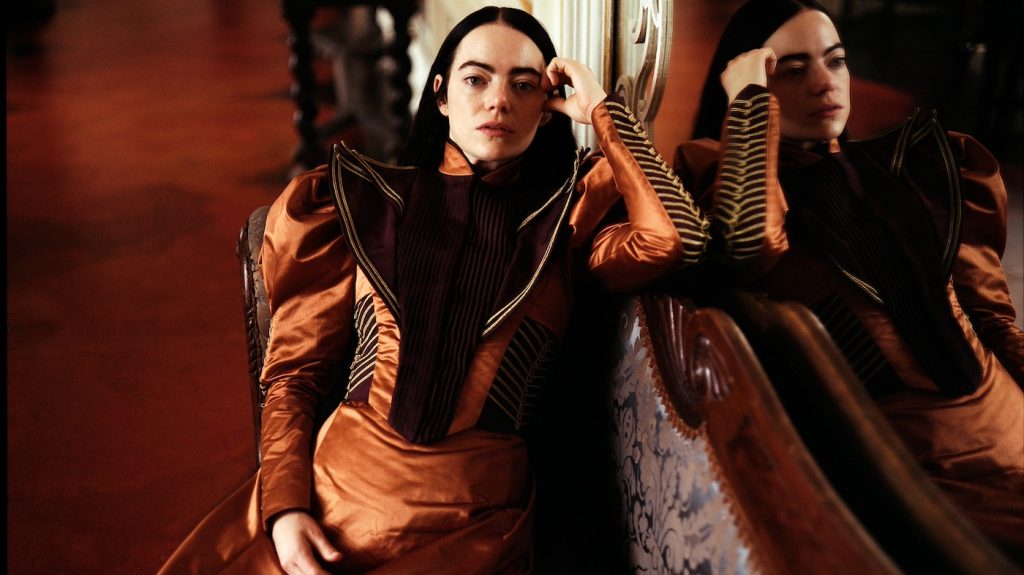
Waddington’s eclectic clothing aligns perfectly with Poor Things‘ eclectic story. The Frankenstein riff, adapted from Alisdair Gray’s 1992 novel of the same name, follows Bella Baxer (Emma Stone) as she discovers language, sex, and societal expectations anew. Bella has been reanimated with a childlike brain thanks to a slightly mad Victorian scientist (Willem Dafoe) who sets out to observe her body and mind gradually synchronizing. Bella’s wardrobe is key to her growth. The movie introduces her in what often look like baby-doll dresses, but her fashion becomes more sophisticated as she explores the world and develops unadulterated ideas about how to live in it. 

After those inflatable pants jump-started Waddington’s initial brainstorm, her work zigged and zagged as the rest of the movie fell into place. Now an Oscar contender for the film, Waddington, whose past credits include Lady Macbeth and Hulu’s The Great, was able to blend a medley of sensibilities into one eye-popping palette. 


Did you know from the outset how hyper-saturated a lot of Poor Things‘ colors would be?

I had this whole journey of exploring these lung-shaped sleeves and plasticity — things that breathe and deflate. Then we had a series of meetings on Zoom, and it was really only at that point that Yorgos showed me what they’d done in the art department. I knew it was going to be rich and elaborate because I was already a big fan of [production designer] Shona Heath’s fashion work. But I was absolutely overwhelmed when I was given this bible, which was this massive, absolutely incredible 200-page document full of descriptions and references and beautiful concept work. Then, I really had something to work with. 

Emma Stone in POOR THINGS. Photo Courtesy of Searchlight Pictures. © 2023 Searchlight Pictures All Rights Reserved.

How much of what you developed independent of that bible is what we see in the film?

A lot of it shifted because I was really encouraged by Yorgos to just go big. What we ended up with had a lot to do with texture — big textures in the clothing, things that felt organic, things that felt inflated. That manifested itself in the sleeves but not in the way that I had delivered it in this early rendition. 

What did it look like at first?

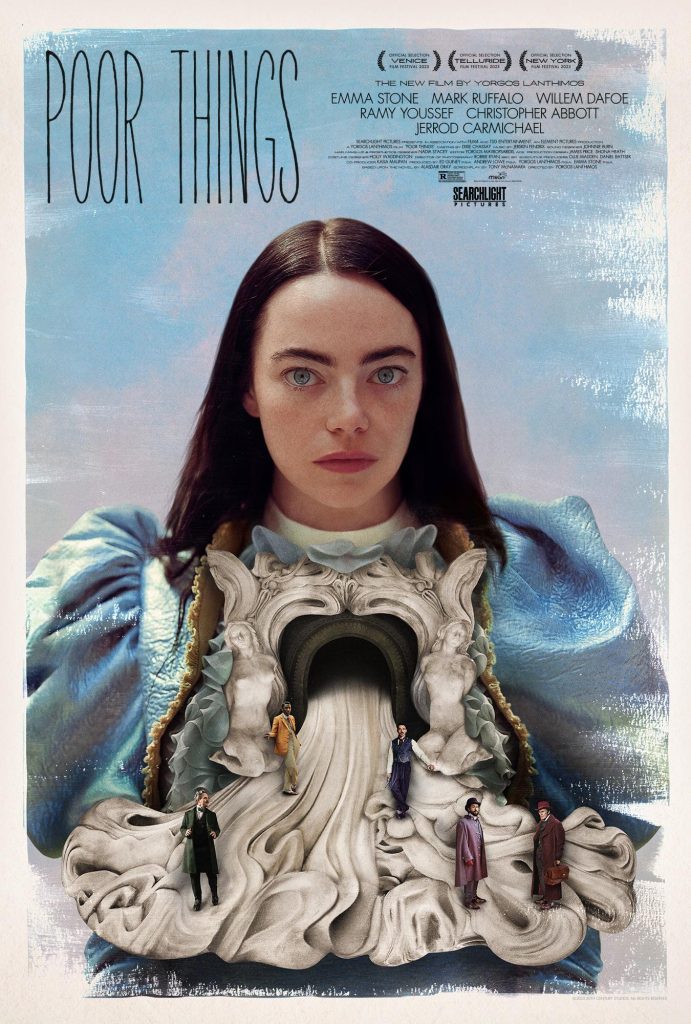
In the beginning, all the big sleeves were for the men. I had a lot of ideas to begin with. It was quite grotesque originally, but Yorgos zoomed in on these images I had of these 1890s sleeves. That was very much his choice — but for the women, not the men, and specifically for Bella. I think he made a very good choice there because those sleeves are incredibly empowering to wear. They really emphasize her otherness. They also transpose into these richly textured fabrics. They feel like a sea creature. 


She has an otherworldliness about her because of how her brain functions. As there are in children, there’s a bit of animalistic behavior going on. 

Yes. He was very clear about that.

What other kinds of references did that 200-page document contain? I’d assume Victorian, steampunk, and modish stuff from the ’60s.

No steampunk. I know a lot of people have described the work as being steampunk, but we were actually asked not to look at steampunk at all. I don’t think it’s an aesthetic Yorgos is particularly drawn to. But yes, definitely ’60s: André Courrèges, Pierre Cardin, Paco Rabanne, and designers who were doing that whole space-age thing. We referenced astronauts and going to the moon. I was lifting little bits from these designers, like the peep-toe boots that Bella Baxter wears. André Courrèges’ had zips up the back, so we merged that with the Victoria bootie. 

Emma Stone in POOR THINGS. Courtesy of Searchlight Pictures. © 2023 Searchlight Pictures All Rights Reserved.

Were there any paintings or films referenced in that book?

Paintings, yes. Loads of stuff. And I had masses of stuff, too. I had lots of Otto Dix paintings and German expressionist paintings. The colors often came from those pictures, as well as John Singer Sargent and other things. One of the references that Yorgos had come up with was [Austrian painter] Egon Schiele, this scratchy drawing of a Victorian girl with incredibly long black hair. I’ve heard that production designers were given lists of films, but I didn’t have that. 

Emma Stone in POOR THINGS. Photo by Yorgos Lanthimos, Courtesy of Searchlight Pictures. © 2023 Searchlight Pictures All Rights Reserved.

Did you make everything from scratch, or did you find vintage and archival stuff?

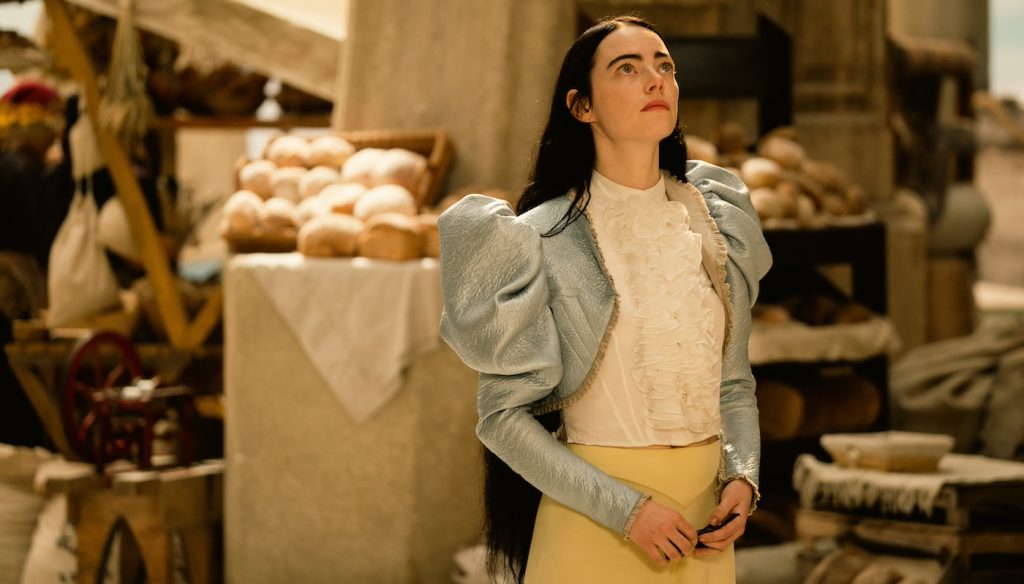
For the principals, everything was made. There are pieces where I might have found something original, and then I looked at it and designed a version of it. An example would be the little frilly ivory thing that she wears underneath a few of the outfits. She wears it quite often. Nowadays, we’d call it a sleeveless blouse. The Victorian women called them modesty pieces. They filled the empty space around the neck and the chest because you’d only expose that part for evening wear in those days. They’re like bibs, and I quite like having that as a thing that she’d wear. As soon as you start going down that route of making everything, if you try to pepper in an original Victorian thing, it looks historical. It doesn’t sit well within the textures. 

Emma Stone in POOR THINGS. Photo by Atsushi Nishijima. Courtesy of Searchlight Pictures.© 2023 Searchlight Pictures All Rights Reserved.

How much did you use period-appropriate fabrics? I assume you didn’t have to. 

I didn’t, but some of the fabrics are really period-appropriate. Some of the bodices and that blue dress at the beginning, and the wool jacket are made in traditional fabrics that you’d use if you were doing a period drama. You can never fully recreate these things, but it’s striving for what the Victorians would have used. But then there were many other fabrics that were not typical of the period. I used a lot of polyurethane and latex. A lot of the blouse fabrics are very light, contemporary silks that have been woven in interesting ways. Madame Swiney [the brothel owner played by Kathryn Hunter] wears this dressing gown that we had woven by a British company to look almost like varicose veins. And Baxter [played by Dafoe] wears a smoking jacket that is quilted and woven in a very modern way. I was mixing and matching. 

Ramy Youssef and Willem Dafoe in POOR THINGS. Photo by Yorgos Lanthimos. Courtesy of Searchlight Pictures.© 2023 Searchlight Pictures All Rights Reserved.

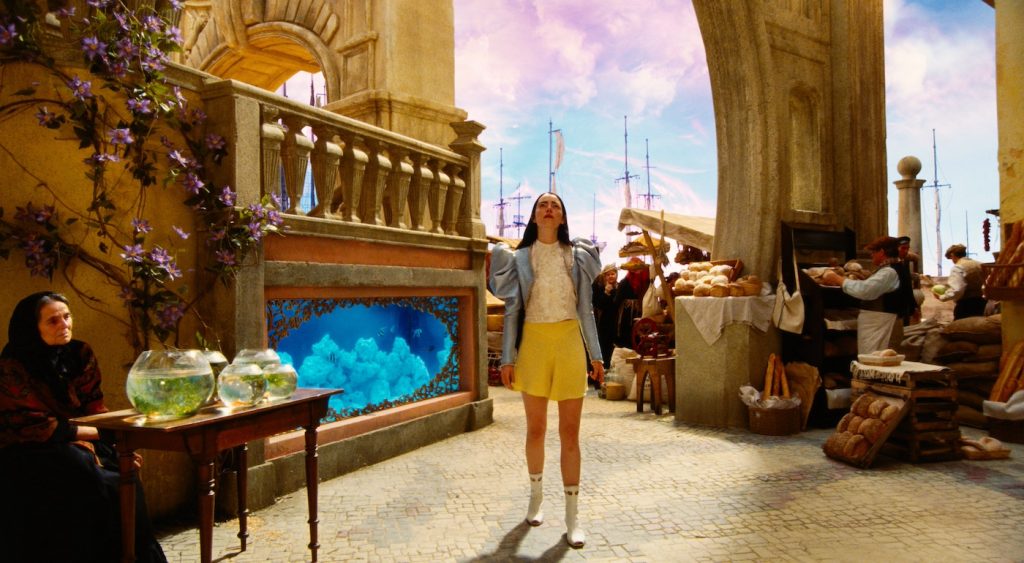
Once Bella sets out on her adventures through Lisbon and Paris, the visual palette becomes very rich and hyper-saturated. The clothes are all these vibrant yellows and baby blues. Were those shades informed at all by the ornate sets or the overly lit skies? 

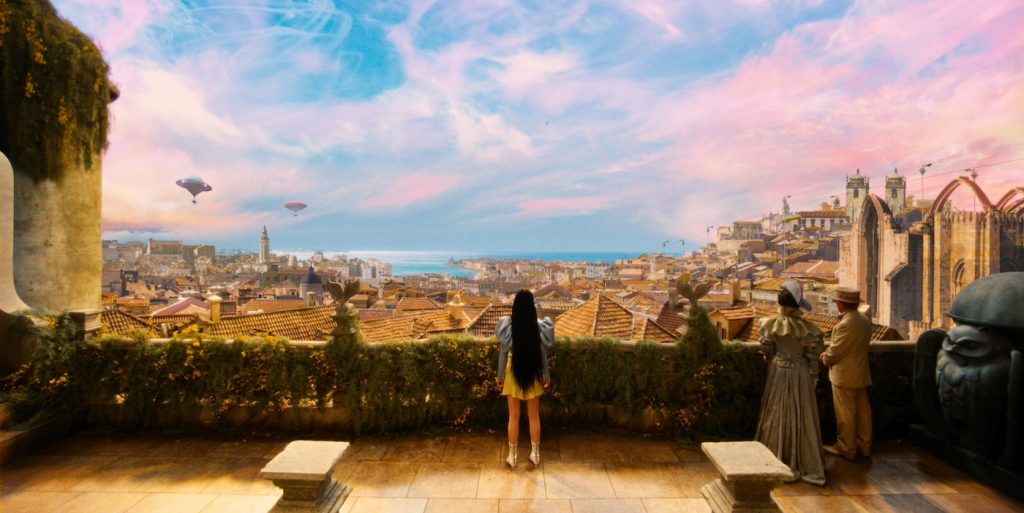
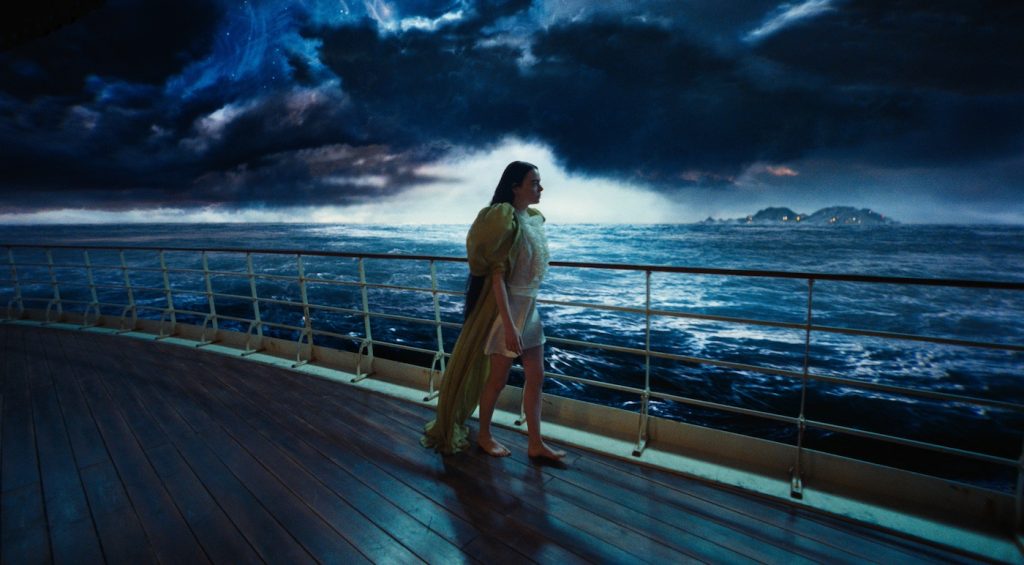
To a large degree. But if I’m truly honest, I think I’m choosing colors based ultimately on what is right for Bella. I wasn’t thinking, “Oh, I must dress her in yellow because this set has lots of yellow in it.” When she arrives in Lisbon, the world has only been black and white. We didn’t know that as creators. That was a very late decision, although we think Yorgos probably knew the whole time. In Lisbon, the whole world is like an explosion of color. I was very much wanting to align my costume choices so those yellows and golds felt like colors that belonged in that world. There’s a softness to them at that point. They’re still very childlike. With the black hair, her wearing a lot of yellow felt like a bold choice. Yellow and black are nature’s warning colors. Wasps and bees are black and yellow, and in the urban world, caution tape is yellow. She is not to be ignored, and I wanted her to be incredibly conspicuous. 

Emma Stone in POOR THINGS. Photo Courtesy of Searchlight Pictures. © 2023 Searchlight Pictures All Rights Reserved.

What was the most decadent outfit to design?

The wedding dress, in terms of how much I was asking of my team. The cutters had to do a lot because it’s made of flimsy nothingness, really. It’s fabrics that are hard to work with because they’re so light. It’s a layer of organza followed by a layer of millinery netting, which is basically plastic, followed by a layer of cotton tulle, and then it has these bands of nylon that are wrapped in the flimsiest habutai silk. And then the sleeves had to be inflated like balloons with no visible structure inside them. They needed to look like clouds. It’s quite decadent in its labor, but it doesn’t necessarily look like the most decadent thing. 

Emma Stone in POOR THINGS. Photo by Yorgos Lanthimos, Courtesy of Searchlight Pictures. © 2023 Searchlight Pictures All Rights Reserved.

Did anyone reference Frankenstein at all?

I started reading it when we were working on the film, but I quickly stopped. Have you read Frankenstein recently? It’s quite dense. We were not having conversations about Frankenstein at all, which is interesting when you look at what we came up with. The black hair is quite Gothic. Yorgos works more instinctively. 

Poor Things is in theaters on December 8.

Featured image: Emma Stone in POOR THINGS. Courtesy of Searchlight Pictures. © 2023 Searchlight Pictures All Rights Reserved.

Best of 2023: “Barbie” Casting Directors Allison Jones And Lucy Bevan on Populating Barbie Land

*It’s our annual “Best of the Year” look back at some of our favorite interviews from the year. 

Since its release last month, Greta Gerwig’s Barbie has been hailed as a marvel of a balancing act between sincerity and hilarity. On top of the nuanced script, Barbieland is populated by a Barbie and Ken of every stripe, for every type, despite dozens of characters who share a mere two first names (plus the singular Allan). Stereotypical Barbie (Margot Robbie) and her dependent Ken (Ryan Gosling) were early commitments to the Warner Bros. project, but for co-casting directors Allison Jones (Curb Your Enthusiasm, Lady Bird) and Lucy Bevan (The Batman, Belfast), casting the wild melange of supporting doll roles meant combing through audition tapes of a who’s-who roster of actors thrilled at the chance to be immortalized as two of pop culture’s most iconic plastic figures.

aption: (L-r) MARGOT ROBBIE as Barbie, ALEXANDRA SHIPP as Barbie, MICHAEL CERA as Allan, ARIANA GREENBLATT as Sasha and AMERICA FERRERA as Gloria in Warner Bros. Pictures’ “BARBIE,” a Warner Bros. Pictures release. Photo Credit: Courtesy Warner Bros. Pictures

The actors needed to be funny, of course. But what set apart the audition tapes (more on that anachronism in a moment) was a pure and well-rounded earnestness. “The thing that Greta did always stress was that none of these people were sarcastic or winking at the camera. They were really Kens and Barbies,” Jones explained. In addition to being able to land a comedy beat, the actors needed to be sincere, truthful, and guileless. There were certain scenes we used to audition, and the fine line between the comedy and sincerity of those characters is a difficult balance,” Bevan said.


Because casting took place during Covid, Jones and Bevan reverted back to the use of taped auditions. “Huge actors went on tape with only seeing a few pages of dialogue,” Jones said, and since “everybody was Barbie in the script,” the pair wound up working in reverse, sending the tapes they liked on to Gerwig, who then identified particular talent for different Barbies and Kens. “She really made the characters for who she liked best in different auditions,” Jones said, designating Issa Rae as President Barbie, for example, and looking for Ken’s arch-rival Ken by seeking out the actor who would be best to “beach off” with Gosling’s character.

Caption: (L-r) EMMA MACKEY as Barbie, NCUTI GATWA as Ken, SIMU LIU as Ken, MARGOT ROBBIE as Barbie, RYAN GOSLING as Ken and KINGSLEY BEN-ADIR as Ken in Warner Bros. Pictures’ “BARBIE,” a Warner Bros. Pictures release. Photo Credit: Courtesy Warner Bros. Pictures
Caption: ISSA RAE as Barbie in Warner Bros. Pictures’ “BARBIE,” a Warner Bros. Pictures release. Photo Credit: Courtesy Warner Bros. Pictures

Before it became a go-to quote in the Barbie fandom lexicon, rival Ken’s challenge — “I’ll beach you off any day, Ken” —  was one of the film’s audition lines. “Those scenes were fun to audition,” said Bevan. “Some of the Kens would take off their t-shirts, and we were like, no, no, you don’t need to take off your t-shirt. But Simu [Liu] just nailed that [line] in the film.” Allan required some demystifying. Jones used pictures of different Allan dolls owned by a Barbie collector friend, sending them out to agents to shed light on this previously unknown resident of Barbieland, now immortalized by Michael Cera. “Im so happy that in perpetuity now hes like an icon for being Allan,” Jones joked.

Caption: (L-r) ISSA RAE as Barbie, SCOTT EVANS as Ken, SIMU LIU as Ken, EMMA MACKEY as Barbie and NCUTI GATWA as Ken in Warner Bros. Pictures’ “BARBIE,” a Warner Bros. Pictures release. Photo Credit: Courtesy Warner Bros. Pictures

Since the film’s release, the internet has teemed with anecdotes of beloved comedic actors who wanted to be in Barbie but aren’t. It’s not because they aren’t funny enough. “It’s rather a boring reason, actually,” Bevan said. “On a movie like this, it was a hugely ambitious shoot and a complicated schedule, and you can have brilliant ideas, and people’s availability either does or doesn’t work.” Thanks to strict Covid rules in the UK, where most of the film was shot, and the scale of the project, even smaller roles required a three-month commitment. So, no gossip there.

Caption: (L-r) RYAN GOSLING, MARGOT ROBBIE and Director/Writer GRETA GERWIG on the set of Warner Bros. Pictures’ “BARBIE,” a Warner Bros. Pictures release. Photo Credit: Jaap Buitendijk

Even auditioning was a commitment, given Barbie‘s closely-guarded script. Bevan and Jones got to read it in its entirety, of course, but were limited to sending the actors’ sides (short script excerpts). “And now you have to send things through websites where you have to go through layers of passwords to get to the sides,” said Jones, of the effort actors went through to tape themselves. “So it was very secretive. I don’t think anybody knew quite how good it was,” she added. But just as Gerwig has become a name who can draw in movie-goers no matter the project, so too is the director for the actors themselves.“We weren’t allowed to send the script to anybody. So people did a lot of it on faith,” Jones said. “Everybody wanted to work with Greta, for good reason.”


For more on Barbie, check out these stories:

Historic Success of “Barbie” has Made Greta Gerwig Highest-Grossing Female Director Ever Domestically

“Barbie” and Greta Gerwig Make History Again

“Barbie” Hair & Makeup Artist Ivana Primorac Conjures Personality From Plastic

Pretty in Pink With “Barbie” Production Designer Sarah Greenwood & Set Decorator Katie Spencer

Featured image: Caption: (L-r) ANA CRUZ KAYNE as Barbie, SHARON ROONEY as Barbie, ALEXANDRA SHIPP as Barbie, MARGOT ROBBIE as Barbie, HARI NEF as Barbie and EMMA MACKEY as Barbie in Warner Bros. Pictures’ “BARBIE,” a Warner Bros. Pictures release. Photo Credit: Courtesy of Warner Bros. Pictures

Best of 2023: How the “Spider-Man: Across the Spider-Verse” Visual Team Created a Mesmerizing Multiverse

*It’s our annual “Best of the Year” look back at some of our favorite interviews from the year. 

When Spider-Man: Into the Spider-Verse was released five years ago, its web of 2D and 3D animation became a box office hit and went on to win the Oscar for best animated feature. Incredibly, the return of Miles Morales (voiced by Shameik Moore) in Across the Spider-Verse has lived up to the hype, earning over $270 million worldwide in ticket sales (at the time of publication).

Visually, the sequel continues to marry artistic styles to make it feel as if a comic book has come to life, but this time around, there is more of it. A lot more. The story is bigger, more villainous, and a heck of a lot more Spider-y. Thankfully, the emotional arc doesn’t get lost in the multiverse – it’s only Miles who physically gets trapped and tries to sling and swing his way out. The new story brought in a fresh trio of directors (Joaquim Dos Santos, Kemp Powers, Justin K. Thompson) and behind-the-scenes creatives to reinvigorate the success of the original.

“They wanted something entirely fresh,” says character designer Kris Anka about the approach to the visual language. “The whole thinking was just because the animation of the first film was good doesn’t mean it can’t be better.” Anka was one of several character designers on Across the Spider-Verse and oversaw the creation of Miguel (voiced by Oscar Isaac), a Spider-Man-like superhero responsible for producing the multiverse travel technology that has Miles and Gwen (voiced by Hailee Steinfeld), along with new characters, Spider-Punk Hobie (voiced by Daniel Kaluuya) and Jessica Drew (voiced by Issa Rae) fighting a portal-jumping “villain of the week” named Spot (voiced by Jason Schwartzman).

Spider-Man 2099 (Oscar Isaac) and Miles Morales (Shameik Moore) in Columbia Pictures and Sony Pictures Animation’s SPIDER-MAN: ACROSS THE SPIDER-VERSE.

Anka spent around 15 months in creating Miguel, adding new layers to the suit design and silhouette of the character. “Depending on how close you are to him, you see different layers of detail. At the macro level, it’s this simple red, black, and blue design, but as you get closer, there’s patterning on everything,” says Anka. The designer added layers of cultural specificity to Miguel’s suit. “I went on a deep dive into Mesoamerican patterns and tried to find ways to add culture to the suit.” In using textiles and familiar patterns, the design language was grounded in something tangible instead of arbitrarily conceived.

Jessica Drew (Issa Rae) and Miguel O’ Hara (Oscar Isaac) in Columbia Pictures and Sony Pictures Animations’ SPIDER-MAN™: ACROSS THE SPIDER-VERSE.

“Another aspect the directors had coming into the film was that Miguel was intentionally giving himself his powers. It wasn’t a bite or an accident, but he was actively doing this,” notes Anka. “Miguel’s entire persona is that he’s willfully doing all this, and he takes things seriously. He puts in the work compared to someone like Peter Parker [voiced by Jack Quaid], who has a naturalistic body and attitude. Miguel had to be the opposite, where everything is designed, and everything Miguel is doing is with intent. It was about trying to find a balance and a look that suggests Miguel takes this way too seriously.”

Miguel O’ Hara (Oscar Isaac) clashes with Vulture (Jorma Taccone) in Columbia Pictures and Sony Pictures Animations’ SPIDER-MAN: ACROSS THE SPIDER-VERSE.

In creating how Miguel moved on screen, head of character animation Alan Hawkins took inspiration from the character Stringer Bell (Idris Elba) from the hit television series The Wire. “He [Stringer] has this really interesting posture,” notes Hawks. “He looks like a tough guy, but there’s a slouch to him. It feels like he’s burdened by the weight of responsibility, but still seems like he’s aggressive. That nature inspired Miguel’s posture for most of the film.”


For Hobie, a very English (and cool) punk version of Spider-Man, Hawkins and the team used mixed frame rates in his design to make him feel chaotic and inconsistent. “The jacket he wears is on 4s, but his body is sometimes on 3s, and his guitar is even lower,” says Hawkins. The 4s and 3s Hawkins is referring to are the number of individual drawings for each second of animation based on a 24 frames per second timeline. Animating on 1’s means there are 24 individual drawings for each second of animation – the action is fast and fluid. Animating on 2’s has 12 drawings, 3’s there’s 8, and 4’s has 6 drawings. The lower the number (3, 4…), the slower the animation can look. Having Hobie’s body and jacket on different animations delivered a juxtaposed style that matched his rocker personality.

Hobie Brown/Spider-Punk, voiced by Daniel Kaluuya. Courtesy Sony Pictures.

Miles, now slightly older, saw a refresh to his look (based on models by Omar Smith) that combined new fabrics and reflective patterns to a black suit that has a red stripe down the side and different-sized Spider-Man logos on the front and back to differentiate him while in motion. “We wanted that immediate read for the audience,” notes Anka. In animating Miles, the team referenced the first film to pose his eye and get the angle of his cheeks right. Gwen saw subtle changes in her costume, adding different hints of pink to her suit.


However, the biggest hurdle was creating a near-infinite number of Spider-Man found in the so-called Spider Society – the central “lounge” (created by Miguel) for all the Spider-Man traveling through the multiverse. For the climatic sequence that has Miles being chased by every single society member, the animation team aimed to make it as interesting as possible, creating different looks to avoid repetition. The edge-of-your-seat scene is packed with action and well-placed humor that even sees a T-Rex version of Spider-Man chomp on screen. 


Though Across the Spider-Verse immerses you with a visual style where any frame could be used as a promotional poster, the guiding light for the creative team was the emotional beats of the story. “Animation is hard, and making a strong acting choice is different from a strong animation choice. Something the movie has always strived for was good acting and not good animation,” says Hawkins. “We ignored animation. It was the tool we were using, but we thought about how a real person acts who is feeling these complex layers of emotions. We wanted to inject that into each one of our characters.”

Spider-Man: Across the Spider-Verse is in theaters now.


For more on Spider-Man: Across the Spider-Verse, check out these stories:

“Spider-Man: Across the Spider-Verse” Composer Daniel Pemberton Reveals a Few Score Secrets

A 14-Year-Old Whiz Kid Animated a Scene in “Spider-Man: Across the Spider-Verse”

“Spider-Man: Across the Spider-Verse” Producers Tease Live-Action Miles Morales & Animated “Spider-Woman”

“Spider-Man: Across the Spider-Verse” Review Round-Up: Web-Slinging Bliss in Truly Epic Sequel

Featured image: A visual development image featuring Pavitr Prabhakar, aka Spider-Man India, Gwen Stacy and Miles Morales fighting The Spot in the city of Mumbattan on Earth-50101 – a kaleidoscopic hybrid of Mumbai and Manhattanfor Columbia Pictures and Sony Pictures Animations’ SPIDER-MAN™: ACROSS THE SPIDER-VERSE.


Best of 2023: Christopher Nolan on Exploding Myths & Exposing Humanity in “Oppenheimer”

*It’s our annual “Best of the Year” look back at some of our favorite interviews from the year. 

Robert Oppenheimer (Cillian Murphy) stares wide-eyed into the pond spread out in front of him; his last conversation with Albert Einstein (Tom Conti) on the potential catalytic effects of the atomic bomb has rendered him speechless. The music swells as the screen fades to black — the final scene of Christopher Nolan’s highly-anticipated Oppenheimer.

L to R: Tom Conti is Albert Einstein and Cillian Murphy is J. Robert Oppenheimer in OPPENHEIMER, written, produced, and directed by Christopher Nolan.

A “singularly dramatic moment in history” — That’s how Nolan describes the motivation behind his desire in telling the story of Robert Oppenheimer. 

“This moment in which Oppenheimer [and] the key scientists in the Manhattan Project realized they could not completely eliminate the possibility of the chain reaction from the first atomic detonation, that first test that would destroy the world,” Nolan says. 

It was that specific moment in history, Oppenheimer’s reckoning with the possible world-ending consequences of his actions, that guided Nolan’s storytelling.

OPPENHEIMER, written and directed by Christopher Nolan

“His story is one of the most dramatic ever encounters, full of all kinds of twists, and suspense, things that you couldn’t possibly deal with in any kind of fictional context,” he explains. “So I really got hooked on the idea of trying to bring the audience into his experience…what he went through, make his decisions with him…try and arrive at a telling of his story that would invite understanding rather than judgment.”

Moral ambiguity is a theme Nolan frequently explores in his films, and Oppenheimer tackles that tenfold. But Nolan says he’s not here to tell us whether or not Robert Oppenheimer was a good person but rather to walk the audience through his decision-making.  

L to R: Robert Downey Jr is Lewis Strauss and Cillian Murphy is J. Robert Oppenheimer in OPPENHEIMER, written, produced, and directed by Christopher Nolan.

“Humans, individual flaws, and the tension between his aspirations and his brilliant intellect telling him what he should be doing, and his inability to live up to those things, or his blindness to where some of these things might take him,” Nolan explains of his creative process. “That’s what creates interesting tension in the story.”

When stripped raw, Oppenheimer, at its core, is a story with an age-old message: If you play with fire, you’re going to get burned. And it tells us as much in the opening shot: billowing flames, hundreds of feet high, encompass the entirety of the screen, the words of the great story of Prometheus overlaying the fire. 

“We haven’t made a documentary; we’ve made a dramatic interpretation of his life,” Nolan says. “You’re looking at a character who was very careful. But everything he said about the bombings of Hiroshima and Nagasaki—it was very precise, never apologized. He never acknowledged any guilt as relating to his part and what had happened. And yet, all of his actions from 1945 onwards are the actions of somebody truly suffering under an immense weight of shame and guilt.”

L to R: Florence Pugh is Jean Tatlock and Cillian Murphy is J. Robert Oppenheimer in OPPENHEIMER, written, produced, and directed by Christopher Nolan.

After Hiroshima and the death of Jean Tatlock (Florence Pugh), there’s a scene in the film where Oppenheimer is slumped against the trunk of a tree, spiraling into an all-consuming panic. Kitty Oppenheimer (Emily Blunt) shakes her husband and says, “You don’t get to sin and then play the victim.” 

OPPENHEIMER, written and directed by Christopher Nolan

Nolan doesn’t confirm his personal feelings on Oppenheimer’s morality, and when asked if this scene is meant as an interpretation of Kitty’s feelings in that part of her life or an interpretation of the audience’s feelings toward the character, he says it’s all of the above.

“There are times when the writing wants to synchronize with or guide the audience’s particular expectations or interpretations,” he explains. “But I think what’s most successful is when it synchronizes sort of seamlessly with the feelings and emotions of the character in the moment.”

L to R: Emily Blunt (as Kitty Oppenheimer) with writer, director, and producer Christopher Nolan and Cillian Murphy (as J. Robert Oppenheimer) on the set of OPPENHEIMER.

Oppenheimer is immensely detailed — an attribute characteristic of Nolan’s filmmaking style, along with intricately woven storylines. No apple goes unnoticed, no close-up without intent. In Oppenheimer, it’s the hanging of bed sheets on the clothesline to dry that become one of the most profound metaphors in the film and serves as an almost unspoken language between Robert and Kitty. 

L to R: Cillian Murphy is J. Robert Oppenheimer and Emily Blunt is Kitty Oppenheimer in OPPENHEIMER, written, produced, and directed by Christopher Nolan.

“I came across this fact in the book, this notion that because [Robert] couldn’t talk directly to anybody about the success or failure of the test, they came up with this code relating to change in his life,” Nolan explains. [Oppenheimer was based on the Pulitzer Prize-winning biography “American Prometheus: The Triumph and Tragedy of J. Robert Oppenheimer” by Kai Bird and Martin J. Sherwin.] “The sheets make up a bit. And I wanted to bring it together in a visual sense. For me, Kitty Oppenheimer is one of the most interesting characters in the film—one of the most interesting characters of Oppenheimer’s real-life story—their relationship was complex. So I love the idea of a coded message between them that only they can understand.”

Kitty Oppenheimer was a brilliant scientist in her own right, and Nolan says that during her time at Los Alamos (the creation town of the atomic bomb), she was “given very little to do,” so the sheets also symbolize her domestic experience. 

“It was very frustrating [for her] and caused a lot of problems,” he says. “So, for me, it was the coming together of all of those different things.”

L to R: Emily Blunt is Kitty Oppenheimer and Cillian Murphy is J. Robert Oppenheimer in OPPENHEIMER, written, produced, and directed by Christopher Nolan.

During his 32-year marriage to Kitty, Robert Oppenheimer had a long history of affairs, a fact not left out of Nolan’s retelling. One of Oppenheimer’s most famous lines in history is when he quoted part of the Hindu scripture Bhagavad Gita: “Now I am become Death, the destroyer of worlds,” after witnessing the first detonation of the atomic bomb. In Nolan’s version, that line comes during a sex scene with Jean Tatlock (Florence Pugh). 

“I wanted to destabilize the context in which that quote normally appears,” he says. “Oppenheimer was very controlling of his image in his public statements. He was extremely self-conscious, very, very aware of the theatricality of his persona, and used that to further a lot of causes he espoused, the things he was worried about. And I wanted to present this in a new way that would cut through that.”

Like many of Nolan’s films, Oppenheimer shuffles between past and present — between the creation of the atomic bomb and the two security hearings beginning in 1954 about Oppenheimer’s affiliation with the Communist party. Beyond the use of black-and-white scenes to depict the timeline of the hearing, Nolan says the color shifts serve another purpose.

“You’re looking for a subtle way, a clearer way of shifting between the intensely subjective storytelling in the cover sequences,” Nolan explains. “And then the more objective view very often provided by Robert Downey Jr., as his character, Lewis Strauss.”

L to R: Robert Downey Jr is Lewis Strauss and Cillian Murphy is J. Robert Oppenheimer in OPPENHEIMER, written, produced, and directed by Christopher Nolan.

Oppenheimer is in theaters now.

For more on Oppenheimer, check out these stories:

The Barbenheimer Phenomenon Was Real, and Historic

“Oppenheimer” Review Round-Up: One of the Best Biopics Ever Made

Christopher Nolan’s “Oppenheimer” Called “Best and Most Important Film This Century” By Another Film Legend

Featured image: L to R: Cillian Murphy (as J. Robert Oppenheimer) and writer, director, and producer Christopher Nolan on the set of OPPENHEIMER.

Best of 2023: How “The Color Purple” DP Dan Laustsen Made Visual Music

*It’s our annual “Best of the Year” look back at some of our favorite interviews from the year. This interview with “The Color Purple” cinematographer Dan Laustsen more than qualifies, and, with the film opening wide in theaters today, it feels like a fitting Christmas Day post. Happy Holidays!

Danish cinematographer Dan Laustsen has been shooting movies for forty years, earning two Oscar nominations along the way for his contributions to Guillermo del Toro’s films The Shape of Water and Nightmare Alley. Director Blitz Bazawule, on the other hand, had never made a major Hollywood motion picture before helming The Color Purple (opening Dec. 25). But together, director and cinematographer melded their talents to resounding effect to create a sumptuous-looking movie musical based on Alice Walker’s 1971 novel.

“This is Blitz’s first big movie, but that doesn’t matter,” Laustsen says. “He has a very sharp eye, and I’m here to help make the movie the way the director wants. Blitz had the vision, so we tried to bring that to the screen.”

Previously adapted as a movie drama and a Broadway musical, this version of The Color Purple, starring Fantasia Barrino, Taraji P. Henson, and Colman Domingo, offers song, dance, and intensely dramatic sequences to tell the story of a family in Georgia suffering abuse and heartbreak before ultimately emerging triumphant through the redemptive power of love.

Laustsen, speaking from Los Angeles, explains how he used southern sunlight and a shrewd selection of camera gear to differentiate dialogue-driven drama from musical sequences.


We talked to you a few years ago about your work on The Shape of Water, which includes a fantasy musical sequence, but The Color Purple marks the first time you’ve shot a full-blown musical, right?

That’s correct. I’ve never done a musical before. I knew the “Color Purple” story, but what is the reality of the story, and what is the music? That was difficult for me to bring into my head. I had long conversations with Blitz where it became more and more about a realistic world splitting into this fantasy world. It should not just be something where our characters are walking down the street, and then they start to sing.

Cinematographer DAN LAUSTSEN on the set of Warner Bros. Pictures’ bold new take on a classic, “THE COLOR PURPLE,” a Warner Bros. Pictures release. Photo by Ser Baffo

So, how did you achieve these two distinct looks through your cinematography?

The drama world is very much [feeling like] the southern states of America with warm light coming through the windows. We went much more realistic camera-wise, lens-wise, and color-wise.

(L-r) FANTASIA BARRINO as Celie and TARAJI P. HENSON as Shug Avery in Warner Bros. Pictures’ bold new take on a classic, “THE COLOR PURPLE,” a Warner Bros. Pictures release. Photo by Ser Baffo

In the singing world, we went more wide angle and moved the camera a little bit more, which I think brought the joy of music onto the screen. Also, the color palette gets a little more rich in the singing world.

Caption: (L-r) TARAJI P. HENSON as Shug Avery, FANTASIA BARRINO as Celie and DANIELLE BROOKS as Sophia in Warner Bros. Pictures’ bold new take on a classic, “THE COLOR PURPLE,” a Warner Bros. Pictures release. Photo Credit: Courtesy Warner Bros. Pictures

What kind of camera rig did you use for The Color Purple?

We used an Alexa LF Mini and shot on Signature Prime lenses with a diffusion filter behind the lenses. I like the Signature Primes because they’re very clean, and very one-to-one. Then, you can put a diffusion [filter] behind the lens. We also used a fair amount of smoke.

(L-r) TARAJI P. HENSON as Shug Avery and FANTASIA BARRINO as Celie in Warner Bros. Pictures’ bold new take on a classic, “THE COLOR PURPLE,” a Warner Bros. Pictures release. Photo by Eli Ade.

The Color Purple opens with an overhead shot of a man on a horse playing a banjo. It’s quite striking. How did you guys decide on this image to introduce the story?

That was Blitz’s idea in the storyboards: he wanted to start with the top shot. It looks easy, but I’m very much into preparation. We rehearsed it so many times at the studio backlot with a guy on a horse that we knew exactly where to put the chassis and the base of the crane so we could keep the camera moving when we got to the location.

(L-r) Director BLITZ BAZAWULE and COLMAN DOMINGO on the set of Warner Bros. Pictures’ bold new take on a classic, “THE COLOR PURPLE,” a Warner Bros. Pictures release. Photo by Eli Ade.

The warm Georgia sun brightens your unbroken opening shot that leads to the two little girls singing on a tree branch. Natural light also adds a joyous feeling a little later to a beach sequence where young Celie and her sister Nettie sing a duet. How did you capture that?

We filmed that in Savannah, Georgia. When you shoot on a beach, you can not bring a bunch of stuff in because the sand is so soft. We shot some of that on a Technocrane and also used a Steadicam, which gave us more flexibility to chase those girls as they were playing around. It was like a small ballet. We’d spent a lot of time on blocking and the scene those girls were very aware of the camera.

Caption: (L-r) PHYLICIA PEARL MPASI as Young Celie and HALLE BAILEY as Young Nettie in Warner Bros. Pictures’ bold new take on a classic, “THE COLOR PURPLE,” a Warner Bros. Pictures release. Photo Credit: Photo Courtesy Warner Bros. Pictures

Midway through the movie, Taraji P. Henson makes a grand entrance as blues singer Shug, the local girl-made-good. How did you treat her return to town in the fancy car?

You’re starting with this close-up and then going to a big wide shot in one take. That’s challenging because the close-up has to be a beauty shot, and then the wide shot has to feel atmospheric. We used 18K Aputure [lighting] and put steel blue lights. I’m a big fan of steel blue instead of blue blue for the night feeling. That’s something we did on Shape of Water and Nightmare Alley with Guillermo del Toro.

TARAJI P. HENSON as Shug Avery in Warner Bros. Pictures’ bold new take on a classic, “THE COLOR PURPLE,” a Warner Bros. Pictures release. Photo by Lynsey Weatherspoon

In a later night-time sequence, Shug looks every inch the conquering hero when she arrives by boat at this riverside nightclub. You wanted to conjure this romantic, larger than life vibe?

It has to be like that. Shug is like the release, coming to take Celie away from this dark world she’s in, so when we see Shug in the car and then in the boat, she has to look like a fairy tale queen. The costumes were red and the contrast color was steel–blue from behind. I thought it was very beautiful.

TARAJI P. HENSON as Shug Avery in Warner Bros. Pictures’ bold new take on a classic, “THE COLOR PURPLE,” a Warner Bros. Pictures release. Photo Courtesy Warner Bros. Pictures

What exactly is steel blue versus just plain blue?

Steel blue is blue-green – – there’s more cyan. You see a lot of it right now, but the first time I used steel blue was when we did Mimic 100 years ago [laughing] with Guillermo del Toro. It’s a very beautiful color and works as a nice contrast between the skin tones.

COLMAN DOMINGO as Mister in Warner Bros. Pictures’ bold new take on a classic, “THE COLOR PURPLE,” a Warner Bros. Pictures release. Photo by Ser Baffo.

You’ve been making movies since the eighties, whereas director Blitz has worked with Beyonce and directed an indie film, but he’s never made a Hollywood motion picture before. How did you find common ground?

The first time Blitz called, he asked me what movies I liked, and I said I Am Cuba.  It’s a black and white movie from 1962 filmed in Cuba by a Russian DP. Everything is shot very wide angle and there’s [a lot of] movement in the camera. Blitz said, “I love that movie too.” It had nothing to do with The Color Purple, but somehow we both felt that was how our movie should feel. It was interesting to start with something so far away and come back to where we are now with The Color Purple.


This movie has many characters, 15 songs and several decades worth narrative, yet it feels very cohesive. It sounds like you and Blitz collaborated well together.

Blitz is a very clever, very original director. He wants a movie where the light and the camera are moving to tell the story. It wasn’t like he was thinking yellow and I was thinking blue. We were synching right away, even when he was in Altana and I was in Copenhagen during Covid.

(L-r) FANTASIA BARRINO and TARAJI P. HENSON on the set of Warner Bros. Pictures’ bold new take on a classic, “THE COLOR PURPLE,” a Warner Bros. Pictures release. Photo by Eli Ade.

In fact, you wound up filming The Color Purple during the Pandemic. That must have been stressful.

It was a super difficult three or four weeks. We had to shoot the Easter dinner scene five times because people were getting Covid all the time. We’d have to shut down, take the lights away, come back again. But when you see the scene, you don’t feel that because Blitz knows how to get the actors and everyone else aligned.

(L-r) Cinematographer DAN LAUSTSEN and Director BLITZ BAZAWULE on the set of Warner Bros. Pictures’ bold new take on a classic, “THE COLOR PURPLE,” a Warner Bros. Pictures release. Photo by Ser Baffo

For more on Warner Bros., Max, and more, check out these stories:

“Superman: Legacy” Update: James Gunn Teases Superman’s Costume, Miriam Shor Joins Cast

New “Aquaman and the Lost Kingdom” Trailer Focuses on Black Manta’s Brutal Mission

James Gunn Confirms Nicholas Hoult Will be Lex Luthor in “Superman: Legacy”

Featured image: A scene from Warner Bros. Pictures’ bold new take on a classic, “THE COLOR PURPLE,” a Warner Bros. Pictures release. Photo Courtesy Warner Bros. Pictures

Best of 2023: “The Color Purple” Costume Designer Francine Jamison-Tanchuck’s Stunning Creations

*It’s our annual “Best of the Year” look back at some of our favorite interviews from the year. This interview works doubly well as “The Color Purple” is in theaters today. Merry Christmas!

There’s a famous line in Alice Walker’s 1982 novel The Color Purple that goes: “I think it pisses God off if you walk by the color purple in a field somewhere and don’t notice it.” It’s a message that even God can become annoyed when people overlook the wonderful things he creates. One such creation is what the character of Celie represents. “She’s a beautiful flower and a beautiful person that’s being trampled on,” costume designer Francine Jamison-Tanchuck tells The Credits. “Alice’s novel is about how none of us should feel unworthy or made to feel that way.”

(L-r) TARAJI P. HENSON and FANTASIA BARRINO with Director BLITZ BAZAWULE on the set of Warner Bros. Pictures’ bold new take on a classic, “THE COLOR PURPLE,” a Warner Bros. Pictures release. Photo by Eli Ade

Director Blitz Bazawule (Black is King) reimagines the iconic story about self-realization and the unbreakable bond of sisterhood in the rural South that was once a Spielberg film (1985) and a Tony Award-winning musical. For its costumes, Jamison-Tanchuck curated an ensemble of handmade garments, vibrant jazz club attire, and traditional African garb spun from Kente cloth, details of which span multiple decades beginning in the early 1900s. Her previous work includes Coming to America, Glory, The Negotiator, Roman J. Israel, Esq. as well as the original The Color Purple, but this project is the apotheosis of her sensibilities, blending tactile textures, stirring colors, and bespoke silhouettes in illustrious style.

Caption: (L-r) PHYLICIA PEARL MPASI as Young Celie and HALLE BAILEY as Young Nettie in Warner Bros. Pictures’ bold new take on a classic, “THE COLOR PURPLE,” a Warner Bros. Pictures release. Photo Credit: Photo Courtesy Warner Bros. Pictures

“Blitz and I were constantly speaking of the color and how we would like to start it for this journey,” she says. The designer began dressing a young Celie (Phylicia Pearl Mpasi) and her sister Nettie (Halle Bailey) in crisp white cotton dresses as a display of innocence. The color reappears when the two make their way back to each other as adults. Separating their lives is a controlling, curmudgeon of a man named Mister (Colman Domingo), who makes Celie (portrayed by Fantasia Barrino as an adult) his wife and pushes Nettie away from her.

COLMAN DOMINGO as Mister in Warner Bros. Pictures’ bold new take on a classic, “THE COLOR PURPLE,” a Warner Bros. Pictures release. Photo by Ser Baffo.
(L-r) FANTASIA BARRINO as Celie and TARAJI P. HENSON as Shug Avery in Warner Bros. Pictures’ bold new take on a classic, “THE COLOR PURPLE,” a Warner Bros. Pictures release. Photo by Ser Baffo

Period, tattered clothing in muted colors dot Celie’s marriage with Mister, but the subdued palette becomes more colorful through the eras, making an entrance when Shug Avery (Taraji P. Henson), a strong, unafraid singer, visits. It’s then the color red becomes an inspirational motif for Celie, first being introduced in an eye-popping dress Shug wears during her fiery Juke Joint performance.

(L-r) FANTASIA BARRINO and TARAJI P. HENSON on the set of Warner Bros. Pictures’ bold new take on a classic, “THE COLOR PURPLE,” a Warner Bros. Pictures release. Photo by Eli Ade.

Shug’s complete ensemble has a floor-length red coat with fur accents, red gloves, a feather headdress, and diamond-encrusted heels and is accessorized with a peacock hand fan. The dress itself has a fitted bodice drizzled in a delightful pattern of jewelry and three tiers of beads hanging along the bottom, reflecting a 1920s style. “I call it the cocoon coat because Shug is almost wrapped around in it like the cocoon of a butterfly. It’s another statement before we see the dress,” says Jamison-Tanchuck. “Then she takes it off, exploding with this outfit. To me, it was a special moment. That’s Shug in her glory.”

TARAJI P. HENSON as Shug Avery in Warner Bros. Pictures’ bold new take on a classic, “THE COLOR PURPLE,” a Warner Bros. Pictures release.Photo by Ser Baffo

Researching the Roaring Twenties was key to the dazzling look. “I ended up seeing how entertainers dressed in the early and mid-20s, and some of them wore see-through outfits and were pretty risqué in that era. So it wasn’t a far leap for me to have the slit on Shug’s dress go so high up,” says Jamison-Tanchuck. “She was able to move freely as she was dancing, and the outfit was able to shine in the darkness.”

Celie begins to step out from her shell thanks to Shug, a growing bond that permeates throughout the film. “Shug is the spark of life for Celie,” says Jamison-Tanchuck. “When Shug gives her a dress to wear at the Juke Joint as her guest, that opens up a world of loving feelings and something in Celie that she was worth something to someone and to herself.” The color purple is introduced into her wardrobe when she’s finally had enough of Mister. When Celie becomes a shop owner, red returns as a nod to Shug’s influence during a musical number inside the store.

Caption: (L-r) TARAJI P. HENSON as Shug Avery, FANTASIA BARRINO as Celie and DANIELLE BROOKS as Sophia in Warner Bros. Pictures’ bold new take on a classic, “THE COLOR PURPLE,” a Warner Bros. Pictures release. Photo Credit: Courtesy Warner Bros. Pictures

It’s here we see Mister, a man who took his insecurities out on someone else, turn a page, offering a few kind words, and purchasing a pair of flamboyant pants Celie cannot sell. “When Celie left, Mister realized that she was a really intricate part of his life,” says Jamison-Tanchuck. “When he visits her to be friends or to resume the relationship, he thinks he was doing Celie a good turn by buying the trousers she couldn’t sell. My idea was to make the trousers shorter in length and a little bit flooded. Blitz and I liked this shiny, scaly-looking fabric. It’s very reptilian.”

COLMAN DOMINGO as Mister in Warner Bros. Pictures’ bold new take on a classic, “THE COLOR PURPLE,” a Warner Bros. Pictures release. Photo Courtesy Warner Bros. Pictures

When Celie reunites with Nettie (portrayed by Ciara as an adult) in the glowing backdrop of a majestic tree surrounded by tables, the actors wore white and cream colors with nods to African culture. “Blitz was an amazing inspiration because he is Ghanaian, and he has a wonderful friend who is also from Ghana who I conferred with and had meetings about how this would work in this particular era,” she continues. “Of course, the Kente cloth has been around for thousands of years, so you cannot go past that. We used that in the wraps and kept it simple and natural and less color so we could show off the beautiful quilt Celie worked on all those decades.” Besides the cultural significance of the costume design, whites were chosen to recall when Celie and Nettie were young women playing on a beach. “It was a moment for Celie to be united again with her beloved sister. They are back, almost with that pure love that they had, and it never ended,” says Jamison-Tanchuck.

A scene from Warner Bros. Pictures’ bold new take on a classic, “THE COLOR PURPLE,” a Warner Bros. Pictures release. Photo Courtesy Warner Bros. Pictures

The Color Purple arrives in theaters on December 25. 

For more on Warner Bros., Max, and more, check out these stories:

How “The Color Purple” DP Dan Laustsen Made Visual Music

“Superman: Legacy” Update: James Gunn Teases Superman’s Costume, Miriam Shor Joins Cast

New “Aquaman and the Lost Kingdom” Trailer Focuses on Black Manta’s Brutal Mission

Featured image: TARAJI P. HENSON as Shug Avery in Warner Bros. Pictures’ bold new take on a classic, “THE COLOR PURPLE,” a Warner Bros. Pictures release. Photo Courtesy Warner Bros. Pictures


“All of Us Strangers” Cinematographer Jamie Ramsay on Lighting a Lonely Life

Based on Taichi Yamada’s 1987 novel Strangers, writer and director Andrew Haigh’s All of Us Strangers takes place between a barren tower block in London, where Adam (Andrew Scott) leads a solitary existence, and his childhood home in the suburbs, where he frequently visits his parents, who died thirty years earlier. In London, Adam spends his days alone, until his neighbor Harry (Paul Mescal) appears outside his door, proffering whiskey. The closer the two men get, the more preoccupied Adam becomes with his parents (Claire Foy and Jamie Bell), with Harry’s initial appearance seeming to trigger Adam’s first visit back to his old house. Mum and Dad, frozen in both style and attitude from approximately the early 1990s, are thrilled to see their son again and to learn he’s become a writer. Subsequent visits, as they discover that he is gay, admit their own parenting faults, and react in confusion as Adam begs them not to go out on the night of the car crash that took their lives, are much tougher.

Whether these encounters take place in Adam’s mind or represent an earth-spirit crossover realm is open to interpretation.“You know what’s funny?” asked Jamie Ramsay, the film’s cinematographer, “so many people have come up to me and asked me about this. There are so many little conspiracy theories — is Adam also stuck in the middle world? Did Harry ever exist? And that’s the beauty of it.” Having left behind Australia for London, Ramsay leaned into his own experience of loneliness for inspiration — I thought, whats a more beautiful way for me to exorcise this grief than to channel it through making this movie?” — and then worked to visually separate Adam’s London present and his suburban past using different technical tools.

Director Andrew Haigh and cinematographer Jamie Ramsay on the set of ALL OF US STRANGERS. Photo by Chris Harris. Courtesy of Searchlight Pictures. © 2023 Searchlight Pictures All Rights Reserved.

Ramsay lit Adam’s childhood home and the suburbs with incandescent lighting and neon tubing that may not have been intentionally from the late 1980s and early 1990s, but given the film’s shooting schedule during a post-Covid flurry of industry activity, we really had to struggle to put our package together. To be honest with you, I think our lighting package actually was vintage, but still beautiful,” he said. To set Adam’s contemporary life apart from his journeys back into childhood settings, the cinematographer shot against an LED wall with a digital backdrop and matched the natural shifting of exposure outside Adam’s apartment. The effect is realistic and a bit cold and feels a world away from the light, dreamy aesthetic at home with Mum and Dad.

Andrew Scott in ALL OF US STRANGERS. Photo by Chris Harris. Courtesy of Searchlight Pictures. © 2023 Searchlight Pictures All Rights Reserved.
Jamie Bell and Claire Foy in ALL OF US STRANGERS. Photo by Chris Harris. Courtesy of Searchlight Pictures. © 2023 Searchlight Pictures All Rights Reserved.

“Any sort of decisions that we decided to take were led primarily by our director Andrews interest in keeping everything as quiet as possible,” Ramsay said, and so when we return to Adam’s past, he simply arrives, stepping into the halcyon lighting of his parents’ kitchen. “For me, having that ethereal presence of a spirit that washes through the windows and wraps around the characters was just a way to put this home in this idyllic position, which is, I think, how we often position memory and good moments in our lives,” Ramsay said.

Claire Foy and Andrew Scott in ALL OF US STRANGERS. Photo Courtesy of Searchlight Pictures. © 2023 Searchlight Pictures All Rights Reserved.

Quiet in dialogue as well as in spirit, the cinematographer felt at ease responding to whole scenes devoid of chatter, using linear, more guarded camera movement in Adam’s contemporary life, which becomes more organic and reactive as the walls between his past and present start to break down. “When its layered and nuanced like this, its much easier for me to develop a sense of honesty with how the camera responds and how the scene feels and looks,” Ramsay said. The cinematographer stays tightly focused on the characters, keeping the audience close to Adam and Harry as their relationship deepens and as Adam reestablishes a family dynamic with his parents, winding up nestled between them in bed.

Jamie Bell, Andrew Scott and Claire Foy in ALL OF US STRANGERS. Photo Courtesy of Searchlight Pictures. © 2023 Searchlight Pictures All Rights Reserved.

“The obvious thing to do is to frame characters in big wides and leave them really small in the frame. But if I thought about it logically, loneliness is experienced from the inside out,” said Ramsay, who instead conveys the isolated nature of Adam’s life by staying close. The effect keeps the audience in Adam’s bubble, seeing only what he sees. And having seen no one, save for Harry and the ambiguous presence of Mum and Dad, you come away with the sense that for Adam, there isn’t anybody else out there.

Paul Mescal and Andrew Scott in ALL OF US STRANGERS. Photo by Chris Harris. Courtesy of Searchlight Pictures. © 2023 20th Century Studios All Rights Reserved.

All Us Strangers is in select theaters now.

Featured image: Paul Mescal and Andrew Scott in ALL OF US STRANGERS. Photo Courtesy of Searchlight Pictures. © 2023 Searchlight Pictures All Rights Reserved.


“Dr. Death” Showrunner, Executive Producer & Stars on Season 2

In the second season of the celebrated Peacock series Dr Death, the show takes on another doctor featured on the hit Wondery true crime podcast, “Miracle Man,” Paolo Macchiarini. The story is of the world-renowned surgeon (played here by Edgar Ramirez) celebrated for his groundbreaking work in regenerative medicine and organ transplantation, but ultimately disgraced by his misconduct, dangerous practices, and web of deceit.  

His rise and fall are, in part, influenced by the romantic relationship Macchiarini built with reporter Benita Alexander (Mandy Moore), who first covered and brought his story to a wider audience, then broke a cardinal rule in journalism by becoming intimate with her source. The doctor’s duplicity extended beyond his practice and medical research to lies in his relationship with Benita. She eventually connected with whistleblowers inside the medical community to stop Macchiarini and his surgeries, which were leading to fatalities across the world. 

For the second season of Dr. Death, writer and producer Ashley Michel Hoban took over from first season showrunner Patrick Macmanus, who serves as executive producer on season two. The Credits spoke to Hoban and Patrick Mcmanus, as well as three of the series stars, Gustaf Hammarsten, Ashley Madekwe, and Luke Kirby, who play doctors Anders Svensson, Ana Lakshmi, and Nathan Gamelli on the show. Their three characters are an amalgamation of the many doctors who worked with Macchiarini but came to realize his research and medical practice were not only flawed, but dangerous. 


Ashley Michel, you listened to the Wondery podcast a number of times to imbue this season with the spirit of the true story. What struck you as being essential to connecting audiences to the story we see?

Ashley Michel Hoban: Yesim’s story, I think, for most people, and certainly for me, hit on a different level. It was Yesim Cetir, the Turkish girl who had tracheal surgery and went through so much. The more I listened to her story, the more I think I got a sense of what the other doctors were going through around her, witnessing her journey, and trying to make sense of how it happened while it was happening. That became incredibly important, particularly to the whistleblower story, particularly to Luke Kirby’s character. In the story, these doctors are an amalgamation of different people because there are so many doctors that helped take down Paolo Macchiarini that we had to combine them into multiple characters, but the way that patient specifically affected him and his character became a real tentpole for the whole season.

Gustaf, what was your experience working with Ashley Michel as showrunner? 

Gustaf Hammarsten: She was fantastic because we could collaborate, work with her, and talk to her at any time during the process. She was always inviting us to offer our take on what we were doing, and asking if we had any input, then would absorb this information and sometimes add an element to the story, which was wonderful.

DR. DEATH — “Like Magic” Episode 201 — Pictured: (l-r) Gustaf Hammarsten as Dr. Svensson, Edgar Ramírez as Dr. Paolo Macchiarini — (Photo by: Scott McDermott/PEACOCK)

Ashley, there’s a powerful chemistry between the three characters that eventually band together as whistleblowers. Was that also the case with your three actors? 

Ashley Madekwe: Yes! I had an instant camaraderie with Gustaf and Luke, but it felt like the scenes were written that way. Also, on one of our first days, we were all waiting while they were shooting a big crowd scene, and we started talking, and we started talking at a deeper level immediately, getting to the meat of the conversation and putting the world to rights.  

DR. DEATH — “Tarantela Telaraña” Episode 204 — Pictured: (l-r) Ashley Madekwe as Dr. Ana Lasbrey, Luke Kirby as Dr. Nathan Gamelli, Edgar Ramírez as Dr. Paolo Macchiarini, Alisha Erözer as Yesim Cetir — (Photo by: Scott McDermott/PEACOCK)

Ashley Michel, this season has some pretty intense surgery scenes. 

Ashley Michel Hoban: We had lots of practice in season one doing surgeries. I do think we get a lot more graphic this season. We have way more blood and way more rats. We did want it to feel very real, so we had an incredible special effects makeup team and a really wonderful visual effects team that helped get us over the finish line for those surgical scenes. We also had this awesome surgical technical advisor who was always on set and has been a part of it since season one. 

Gustaf, Ashley, and Luke, all three of you observed surgeries as part of preparing for your roles. How did that impact your performances? 

Ashley Madekwe: I think they were really important, so when we were doing our surgery scenes, we could be in the moment. There’s an element of being slightly removed from it because when you’re there and the patient is on the table, they are completely draped, so the only thing that’s exposed is the area that’s going to be operated on. It’s almost like you’re not looking at a person. 

Luke Kirby: It was remarkable how innocuous it felt. I had to keep reminding myself that there was a patient there. I know a surgeon in those moments really does have to zone in on the mechanics of the body, not the preciousness and precariousness of life. It really put me in touch with the tightrope that a surgeon has to walk in those rooms. 

Ashley Madekwe: Surgery is a real mix between the aggressive and the delicate. 

Ashley Michel, can you talk about the arc the whistleblowers have in terms of shifting from working with Dr. Macchiarini to calling him to account and the importance of this to the second season?  

Ashley Michel Hoban: One of the themes we were trying to hit this season is the idea of one person’s voice having a ripple effect around the world bigger than they could have imagined. The way Benita and the whistleblowers come together personifies that because without each other, their stories couldn’t have gotten where they needed to go. Without Benita’s article, and without the report the whistleblowers turned in, Paulo would not have been held accountable for his actions. So that was important to show even though these people are standing up against one of the most powerful medical institutions in the world, their individual voices have this huge effect.

Luke Kirby: It feels nice to address regret. I think a lot of people let themselves feel guilty about something for the rest of their lives, but actually, being in the space where you address a regret with someone, I think, is a better practice.  There’s a difference between living with guilt, where you never have to really do anything, and you can just feel guilty for the rest of your life, versus actually identifying it as a regret, then you can learn from it and address it, stand on your own two feet, say you made a mistake, and try to fix it. That’s a good human path, I think.

Ashley Madekwe: All three of these characters have regrets and are guilty of making mistakes and doing the wrong thing. What’s really nice is all three go on this journey and get to the right place, the righteous place eventually, at the cost of their own careers.

Gustaf Hammarsten: And they need each other to do that because each of us, at a certain point, feels guilty and knows it’s wrong, but we motivate and support each other to take action and make a difference, even at the risk of our careers. These characters find strength together for something very hard to do alone. I have so much respect for the whistleblowers who have to do all it alone. 

DR. DEATH — “Compassionate Uses” Episode 207 — Pictured: (l-r) Gustaf Hammarsten as Dr. Svensson, Luke Kirby as Dr. Nathan Gamelli, Ashley Madekwe as Dr. Ana Lasbrey — (Photo by: Barbara Nitke/PEACOCK)

Patrick, Littleton Road Philanthropy, which is an extension of your production company, as well as other resources, are mentioned before the end credits on the show.  Tell us about that and what your hopes are around having a greater impact in the community. 

Patrick Mcmanus: I put all of the credit for Littleton Road Philanthropy at the doorstep of the women who run it, my wife, Ioli Filmeridis, as well as my sister Kelly Mcmanus Funke, who is the president of the company. All I said to them was, “I think we should do more. I don’t think it should just be about telling stories.” My wife has a background in nonprofit development, and she and Kelly ran with it. What we are attempting to do with our social action campaigns is “edutainment.” We recognize the fact that we’re entertaining first. The reason we have these jobs is to bring stories to life, but we genuinely believe there’s a larger reason for doing these. Season one was about patient safety. For season two, the theme is “Safe Two,” and we call it that because this new story talks not just about the necessity of protecting patients but also about the necessity of protecting people who want to speak up against the system. 


Dr Death season two is now streaming on Peacock

For more on Universal Pictures, Peacock, and Focus Features projects, check out these stories:

“The Holdovers” Screenwriter David Hemingson on His Tetchy Yet Tender Tale of Chosen Family

Ryan Gosling Takes a Beating in First “The Fall Guy” Trailer

Family, Friends, and Fellow Stars Remember Matthew Perry

Featured image: DR. DEATH — “Worth The Risk” Episode 202 — Pictured: Edgar Ramírez as Dr. Paolo Macchiarini — (Photo by: Peacock)


“Maestro” Editor Michelle Tesoro on Orchestrating the Epic Bernstein Love Story

To tell the story of composer Leonard Bernstein’s (Bradley Cooper) courtship with Costa Rican-American actress Felicia Montealegre Cohn Bernstein (Carey Mulligan), Cooper, who also directed, and his editor, Michelle Tesoro (The Queen’s Gambit, When They See Us) varied the technical aesthetic throughout Maestro. As the couple first gets to know each other at a party, followed by wooing one another on stage at an empty theater, the early days of their unusual love affair are told through a tight aspect ratio and in black and white. Later in Lenny’s life, the film opens up to a cinematic aspect ratio and a more contemporary approach to color.

Maestro. (L to R) Carey Mulligan as Felicia Montealegre and Bradley Cooper as Leonard Bernstein (Director/Writer/Producer) in Maestro. Cr. Jason McDonald/Netflix © 2023.
Maestro. (L to R) Bradley Cooper as Leonard Bernstein (Director/Writer) and Carey Mulligan as Felicia Montealegre
in Maestro. Cr. Jason McDonald/Netflix © 2023.

“Bradley had this idea from the very beginning to compliment the way you might come across real photos and footage of them at different points in their lives,” Tesoro said of the film’s liberal use of different visual techniques. “The same with the aspect ratios: they reflect the time period which they represent.” As the pair’s relationship takes off within the confines of New York parties, theaters, and flirting at the park, Tesoro explained that the 1:33 aspect ratio also worked for Cooper thanks to “the dynamics between the foreground and background,” which best represented the story at that time — Lenny and Felicia weave their lives together within a midcentury New York creative existence.

Maestro. (L to R) Carey Mulligan as Felicia Montealegre and Bradley Cooper as Leonard Bernstein (Director/Writer/Producer) in Maestro. Cr. Jason McDonald/Netflix © 2023.
Maestro. (L to R) Bradley Cooper as Leonard Bernstein (Director/Writer/Producer) and Carey Mulligan as Felicia Montealegre in Maestro. Cr. Jason McDonald/Netflix © 2023.

Even though Bernstein was either gay or bisexual — Maestro avoids labeling him as either while not shying away from depicting his many other love affairs — his early romance with Felicia, as both their careers take off, feels completely charmed. “One of my favorite transitions that Bradley and I created in editing is the one where a young Felicia is receiving applause, and we cut mid-bow to Lenny receiving an even bigger applause at Carnegie Hall,” she said. The editing choice heightens the exhilaration of their love and success while foreshadowing what’s to come — Felicia’s relegation to a role mainly as wife and mother and Bernstein’s distraction from his family by his extraordinary professional accomplishment.

Maestro. (L to R) Soloists Isabel Leonard and Rosa Feola with Bradley Cooper as Leonard Bernstein (Director/Writer/Producer) in Maestro. Cr. Jason McDonald/Netflix © 2023.

Even though the story highlights Bernstein’s artistic evolution over half a century, Maestro is not intended as a biopic. Instead, the composer’s career progress is conveyed by hearing it, through his Broadway tunes and classical conduction and his time at home, working things out on a piano. But the film’s emphasis on music didn’t affect Tesoro’s process any more than it usually would. “Editing itself is a musical aesthetic, telling cinematic stories with rhythm,” she said. “For this film, it went hand-in-hand.” When Bernstein reaches particular musical pinnacles, like conducting a heart-stopping opera in a cathedral, the editor lets us join the audience onscreen and simply watch the conductor in one of his most glorious professional moments. “It’s hard to cut away when the story is happening all in the frame — in the wonderful performances, in the camera work, in the production design and costumes. Why cut to something else when the magic is happening right in front of you?” she asked.


For Cooper and Tesoro, what mattered most was the dynamic between the Bernsteins. The couple grows apart, conveyed most acutely at Thanksgiving in Manhattan while the Macy’s Thanksgiving Day Parade floats past their window, an absurd backdrop to their strained argument, and they come back together, most painfully when Felicia is diagnosed with cancer. Bernstein works through it all, but on-screen, that comes second. “There is only one story we wanted to tell, that is the love story of Lenny and Felicia,” Tesoro said.


Maestro is playing in select theaters and streaming on Netflix now.

Featured image: Maestro. (L to R) Bradley Cooper as Leonard Bernstein (Director/Writer) and Carey Mulligan as Felicia Montealegre in Maestro. Cr. Jason McDonald/Netflix © 2023.

Searching for That Ferocious “Ferrari” Sound With Supervising Sound Editor Tony Lamberti

How eager was Tony Lamberti to work on Michael Mann’s latest feature? Let’s just say the director had Lamberti, a Formula 1 enthusiast, at Ferrari.

The Oscar-nominated (Inglourious Basterds), Emmy-winning (John Adams) audio engineer got his first peek at the feature about Enzo Ferrari and his iconic racing legacy back in 2015. Overseeing a mix update on Mann’s crime thriller Blackhat, Lamberti encountered Mann’s dream project during a visit to the director’s office.

“He had all the materials out for Ferrari,” remembers Lamberti during a recent Zoom conversation. “He had tons of research. He showed me some of the build sheets and said, ‘I’m going to have to build these cars from scratch because I need them for the rigors of production. I need to put cameras on them and drive them hard.’”

Photo from the set of FERRARI. Photo Credit: Eros Hoagland

Lamberti knew a key element of Mann’s vision would be the roar of the engines during the racing sequences. And to the expert ear, that meant recreating sounds from over 60 years ago.

Set during the summer of 1957, Ferrari sees the renowned carmaker, played by Adam Driver, at a tumultuous moment in his life. His company is on a crash course with bankruptcy. The death of his son Dino has driven a wedge between Ferrari and his wife Laura (Penélope Cruz), who is also his business partner. Adding to their tension is Enzo’s wartime romance with Lina (Shailene Woodley). They had a son, and Ferrari now divides his time between his two families.


Working with Lamberti were some of the best audio experts in the business. Bernard Weiser (Ted Lasso, True Detective) shared sound editorial duties with Lamberti. Oscar-winner Lee Orloff (Terminator 2: Judgment Day) served as sound mixer. Lamberti and Andy Nelson, whose 24 Academy Award nominations include wins for Les Misérables and Saving Private Ryan, handled the re-recording mixes.

“These are all longtime Michael collaborators,” continues Lamberti. “Once he finds people that get his methodology and aesthetics, he likes to stick with them. Andy gave me some great advice leading up to Blackhatand I’ve carried that through all my work with Michael. Lee has frequently collaborated with Mann. Bernard was also on Blackhat. It just made sense to put this team together, and it worked out fantastic.”

Adam Driver as Enzo Ferrari in crowd Photo Credit: Eros Hoagland.

Previous productions had taught Lamberti that Mann would want a rudimentary sound mix as the film was being cut. Weiser and Orloff concentrated on dialogue recording. Lamberti and Nelson assembled the temp dubs. Lamberti estimates four of these mixes were generated during the process.

As valuable as these initial mixes were, they were missing one crucial sound — the actual cars. The Ferraris and Maseratis (Ferrari’s chief competitor) replicated for filming were fitted with 4-cylinder turbo motors. These compact engines were great for withstanding multiple takes and long shoot days but lacked the iconic tones of the originals. 

“It was a rude and crude sound edit,” continues Lamberti. “We made the most of the production sound for screening purposes, knowing that we’d be doing recording sessions with the real cars later.”

Racing through the streets in “Ferrari.” Photo Credit: Eros Hoagland.

Lamberti, together with Mann and stunt coordinator Robert Nagle, mapped out a frame-by-frame strategy for the cars. Every upshift and downshift was noted. No corner acceleration or deceleration was overlooked. With cues in hand, Lamberti set about creating a sound that would not only awe audiences but also wow racing aficionados. Topping the latter was Mann, an experienced racer himself.

“Michael is dedicated to authenticity,” says Lamberti. “That was the edict from a sound perspective. We wanted racing drivers watching these scenes to believe that this actually happened in 1957.”


To do so, Lamberti had to hunt down two classic Ferraris and a Maserati that could be raced and recorded. Little did he realize the search would take him around the world and ultimately lead to a member of one of rock’s most famous bands.

Lamberti and Ferrari co-producer Maggie Chieffo started putting out feelers. Locating the cars turned out to be the easy part. Persuading the owners to allow them to be mic’d up and run at high speeds was another matter entirely.

“American collectors and museums were helpful, but these cars can be worth tens of millions of dollars,” explains Lamberti. “There are a lot of considerations. The insurance people get concerned. Nobody wants these pieces of art damaged.”

A period correct, 1957 two-seater V12 Ferrari was located in Los Angeles. Its owner, a successful real estate investor, showed interest, so Mann screened the rough cut for him to seal the deal. It did just the opposite. The investor thought the 4-cylinder engines sounded great and couldn’t understand the need to put his car — worth an estimated $20 million — at risk. 

Adam Driver is Enzo Ferrari. Photo Credit: Lorenzo Sisti.

The quest for a Ferrari 801 also hit a dead end. Rarer than a unicorn, the only one known to be in existence is in the Ferrari Museum in Maranello, Italy. Having just finished a costly renovation on it, the museum wanted it to stay put.

The Revs Institute in Naples, Florida, had a 1955 Ferrari-Lancia D50 in its collection. The predecessor to the Ferrari 801, it plays a feature role in the French Grand Prix scene depicted in the movie. Revs agreed to Lamberti’s recording request but then came the snag. When the museum curator asked more about the car in the film, he realized the car in its collection was two years older. The engine would sound noticeably different. 

Ferrari’s savior turned out to be musician Nick Mason. A founding member of Pink Floyd, Mason had used his success as its drummer to finance his true passion — motor racing. In addition to competing in such races as Le Mans, Mason owns some of the world’s most classic autos. “The guy is legendary in the car collecting world. He has like a stable of 50 cars,” says Lamberti. “Holly Mason, his daughter, runs the collection for him.”

The Masons had actually been one of Lamberti’s first calls. “We knew we had to record the Maserati 250 F1 from Nick Mason’s collection because it’s the actual car in the movie,” says the sound designer.

Adam Driver as Enzo Ferrari yellow Photo Credit: Lorenzo Sisti.

The Masons agreed, and it turned out to be the start of a beautiful relationship. After the Revs Institute lead didn’t pan out, its curator suggested Lamberti reach out to prominent English businessman Anthony Bamford. Another classic car collector, he had a D50A in his collection. As luck would have it, Holly was a friend and was able to arrange with Bamford to have it available for a recording session.

Holly then got Lamberti over the finish line when the search for a V12 Ferrari kept hitting speed bumps. A deeper dive into the Mason collection uncovered a 1953 Ferrari 250 Mille Miglia PF V12 Coupe. Turns out, it had raced in the 1953 Mille Miglia, Ferrari’s climatic race. How could Lamberti resist? “Holly Mason was really fantastic.  She ended up being Ferrari’s hero,” he says.

The field recordings were done by sound engineer Chris Jojo at a private track in the UK. “We had a couple of mics in the engine bay, one near the intakes, one near the headers,” explains Lamberti. “We had mics in the cockpit. We had two sets of mics on the tailpipes to record in stereo. That’s where the magic happens.”

And happen it did.

“We’d been listening to these little 4-cylinders for months and months,” remembers Lamberti. “The first time Michael started hearing the real engines in the mix, he was like, ‘Oh my God, it sounds so glorious, it completely changes my perspective.’” 

Patrick Dempsey as Piero Taruffi Photo Credit: Lorenzo Sisti.


Ferrari is in theaters on December 25.

Featured image: Adam Driver as Enzo Ferrari. Photo Credit Lorenzo Sisti


Gael García Bernal on His Showstopping Performance in “Cassandro”

Gael García Bernal has played a political revolutionary, an eccentric symphony conductor, an animated trickster, and a victim of a beach that makes you age years in hours, but he’s never made as much noise in one film as he does in Cassandro, where Bernal had to rile up crowds of thousands as the eponymous lucha libre star. Cassandro, a Texas native known outside the ring as Saúl Armendáriz, became an unlikely wrestling champion in Mexico by flaunting his flamboyance. As his success in the movie grows, so does the braggadocio that Bernal exhibits. 

Bernal, who has carved out a reputation as one of his generation’s finest actors, tends to take on less showy roles. His work in films like Y Tu Mamá También, Babel, No, and Old can be intense, but most of Bernal’s performances don’t require the same over-the-top razzmatazz. Maybe that explains why the Oscars continually overlook his globetrotting work. 

As awards season unfolds, Cassandro is making a bid for recognition. It has another heavy hitter in director Roger Ross Williams, who previously profiled Armendáriz for The New Yorker Presents and has also directed The Super Models and Life, Animated. The Amazon movie was released during the Screen Actors Guild strike, so Bernal can finally promote his transformative performance. 


Roger Ross Williams has said he didn’t want you to spend a ton of time with Saúl before production began. Is that what you would have chosen too?

The nature of this was a free interpretation of the life of Cassandro. You have to amalgamate certain elements and bring in different things that are not really part of the life story of the real Saúl. Saúl came up with the character of Cassandro, so we had to come up with our own Cassandro as well. If I needed to talk to Saúl about what he did, most of the information was out there. He had done documentaries. The other thing is that, unfortunately, before starting to shoot, he had a health situation that took him out for a little while. I talked to him, and then we saw each other on the last days of shooting. That was really beautiful. 

Gael García Bernal in Cassandro. Photo: Courtesy of Prime Video © AMAZON CONTENT SERVICES LLC

In the time you did spend with him, or in any of the research that you did, was there something you picked up from him that helped you understand what it feels like to be in the ring, receiving the energy of the room and having to feed it back to the crowd? 

That detail, in a way, is something that you can experience only by doing it. The wrestling training helped a lot. It was six months of physical conditioning and then two months of wrestling training before starting to shoot. That was incredible because it’s such a difficult sport that also includes the performative aspect. You have to give a good show, no? But one of the many things I learned through Cassandro is that you start from the surface, and then you start to understand a little bit more about the character. You start to walk like the character, start to internalize the character, and start to put the costume and the makeup together. There is also something very interesting that I want to be very faithful to, which is the life of the border culture. On the Mexican border, there is that duality that resembles what happens as a wrestler. You cross a line to become someone else, and that someone else is more of who you want to be. The border culture is incredible because they’re born with a situation that is horrendous on a sociological level. They’re born with a stupid wall right in front of them. They have to overcome it to live there and not acknowledge this human division. The community is so strong there. They’re vanguards in the sense of where humans are at right now. 


During those wrestling sequences, were you performing for a full arena? I can’t imagine drumming up that energy in an empty room.

The problem is that it’s very difficult to fill in a full room. The last wrestling match was shot at a stadium that seats 70,000 people. We had like 2,000 people, which is quite a lot, but in that place it feels like there’s no one. But they participated, and it was fantastic. Most of them grew up with lucha libre, and they knew what to do. 

Gael García Bernal and El Hijo del Santo in Cassandro. Photo: Alejandro Lopez Pineda © AMAZON CONTENT SERVICES LLC

Was there a specific moment when you connected to the character after first seeing yourself in one of the wrestling outfits and the full makeup? 

I worked with María Estela Fernández, who’s a fantastic costume designer that I’ve worked with for many, many years, and Itzel Pena, who is an incredible makeup artist. We’re a film family. One year before starting to shoot, we started to try out stuff. It was a little-by-little process, but it was better to start with the complete extreme and tone it down. We also had to play with the practicalities. I cannot wrestle with heavy eyelashes or a wig. It was impossible, so it had to be my hair. Once you put elements together, something incredible happens. Also, the accent and the pluma — the feather. In queer Spanish slang, it’s like, “Let’s train the feather” or “Let’s get the feather.” 

Gael García Bernal in Cassandro. Photo: Courtesy of Prime Video © AMAZON CONTENT SERVICES LLC

Over the years, your interest in making Hollywood movies seems to have waxed and waned. What do you make of the offers you’re getting at this point in your career? 

It’s an interesting time, no? When I started to work, Mexican cinema was at its lowest point. There were only six films done that year when I made Amores Perros. And 50 years before, there were like 200 films made each year. Little by little, it started to get back. Among the many opportunities that allowed me, the most important one was that I’m able to play in Spanish and to perform with bigger dimensions and more complexity. English-speaking studio movies were an option as a nice alternative, but I also worked in Spain, Argentina, Brazil, Chile, Peru, France, and Italy. After COVID, the film experience has changed. Who knows where this will lead for me or for anyone. 

Your breakthrough involved a handful of cool, edgy movies that people really responded to: Amores Perros, Y Tu Mamá También, The Motorcycle Diaries, and Bad Education. When you’ve done all those movies in relatively quick succession, is it hard to settle for things that don’t reach the same highs? 

It’s very difficult to replicate that experience, but I had that feeling on No with Pablo Larraín, which was the first time we worked together. It brought me back to that joy. Before, I used to love it, but I was very innocent. This time, there was no innocence. It was a pure, mature joy. That gave me a little bit of inner energy. I don’t know how many dog years a good film gives you. There are great films I’ve done that haven’t had the success or attention they deserve, and on the other hand, I’ve done some other films that haven’t been transcendental in terms of me being part of them. My experience is always different from the outcome. It’s hard for me to look at it from the outside. 

Have you enjoyed the bigger phenomenons, like performing a Coco song at the Oscars or making something as meme-friendly as Old

When something comes out, you end up belonging to that film rather than the film belonging to you. I don’t control it anymore, but it’s fantastic. I love how diverse everything can be, like doing Werewolf by Night. The Marvel experience was great because it was touching on an angle and a world that I have never tapped into, this fantasy-horror kind of thing. I had a lot of fun doing it, but at the same time, the complete opposite would be me participating in a small film or directing a film in Mexico. I love being able to experience that range. 

Which directors are still on your wish list?

I would love to work again and again and again with Pablo Larraín. We’ve done three films together now, and it’s such a joy to work with him. I would love to work again with Alfonso Cuarón, who’s like my brother and maybe the most talented filmmaker around. I’m still tapping into a curiosity I’ve always had, which is that sometimes, the further away the film can take me, the better. There is this wonderful director named Stephan Komandarev. He’s from Bulgaria, and he’s got a great film called Blaga’s Lessons that I recommend. It’s really, really amazing. I don’t even know him, but working with him would be fantastic. 

For more on Amazon Prime Video, check out these stories:

“Saltburn” Cinematographer Linus Sandgren on Creating a Fluid Painting for Emerald Fennell

New “Taylor Swift: The Eras Tour” Extended Version Trailer Arrives Ahead of Streaming Debut

Amazon’s “Spider-Man Noir” Series Taps “The Punisher” Showrunner Steve Lightfoot

Featured image: Gael García Bernal in Cassandro. Photo: Courtesy of Prime Video © AMAZON CONTENT SERVICES LLC

“The Chi” Producer/Directors Deondray Gossfield and Quincy LeNear Gossfield on Shaping Lena Waithe’s Sharp Showtime Series

The Chi directors/producers Deondray Gossfield and Quincy LeNear Gossfield are living proof of the collaborative spirit. They live and work together (they’re married), and when they directed episode 4 in season 5, “On Me,” in Lena Waithe’s coming-of-age Showtime series, the talented creator recognized she’d found two collaborators who could take on a larger role for season 6. That meant both directing and producing.

We were already fans of the show before we started working on it, so we didn’t need much hand-holding as far as the characters were concerned,” Deondray says. “It was so exciting to be let in on the story arcs as they were being fleshed out in real-time.” 

The Chi is, naturally, set in Chicago, following residents of the South Side and their interconnected, often extremely challenging lives. Waithe’s series is often compared to David Simon’s era-defining HBO series The Wire, which offered a pointillist snapshot of life in Baltimore, although The Chi is often a more tender portrayal, if no less clear-eyed about the challenges its characters face. The series is led by a deeply talented ensemble cast, including Lynn Whitfield, Jacob Lattimore, Luke James, Jason Weaver, and Jill Marie Jones.

We spoke to the Gossfields about their working relationship, their philosophy for creating great TV, and how their duties, and skills, naturally blur and flow.

Photo Credit: Elizabeth Sisson/Paramount+ with SHOWTIME

What was your research process like coming into The Chi in season 5, with such a rich cast of characters and so many established storylines to carry forward?

Deondray: We were already fans of the show, so we already knew the history of all the characters and where they might be going; however, we did rewatch the entire series to remind ourselves of the evolution of the show. Visually, The Chi has had several aesthetics that were specific to each season, but there were always some signature looks and a directorial style that permeated throughout. We wanted to know what our creative boundaries were, what might be too much or too off the mark, and how performances varied and crescendoed from season to season. We were trying to see what tools were already in our toolbox and which ones we could add while preserving the integrity and energy of the show.

Quincy: We created a spreadsheet for each of the main and supporting characters and tracked their story arcs and relationships with photos. We also created a document with bullet points and synopsis per episode for all four seasons before we met with our showrunners and our former producing director. We may have over-prepared, if there’s such a thing. We really wanted to be able to speak confidently about the series. We were pretty much plugged into the world of The Chi pretty deeply in season five, so coming into season six as producers, we were ready. We did our homework.


How would you describe the way you handled episode four of season 5, “On Me,” which included a lot of major plot points and shifts?

Deondray: We used the same methods we used when breaking down scenes and applied them to the entire episode. Every scene is a short story with a beginning, middle, and end. Every character within a scene has a transition in tone with a mini story arc. We separated all the storylines within the script as if they were individual short films and broke down where each character started within those storylines and where they ended up. We directed each storyline as if they were standalone, which helped us keep track of them even as they existed within a whole episode. In addition, we found ways to thematically tie them all together to give the episode a story arc as a whole. When you break something down this deeply, you know it like the back of your hand and can maneuver and pivot with ease.

Quincy: We also like to focus on what’s not being said. What people don’t say is actually what motivates their behavior. People rarely say what they really mean. When we are breaking down the script, we are also looking at the emotional and psychological underpinnings of the story. We even write between the lines what’s not being said, and that really helps us tune into the heart of the script. We love pretty, cool, and slick visuals and things that push the art form, but not every moment requires all that jazz. Yet, every moment requires you to capture the story’s core. The story has to remain the ultimate goal, and then we look for ways to visually represent the story creatively.


How did you approach season six? Were there specific aesthetic changes you thought were necessary as the storylines evolved? 

Deondray: There were lots of conversations around pivotal plot points for the season, but mostly, it was about elevating the show in general. Lena really liked what we did with our episode on season five and wanted us to apply those same aesthetics and sensibilities to season six. We took all that information and began to work out what the look and tone would be for the season with our DP, Nathan Salter. All the camera work and directing were so deliberate to create intentional visual and performance arcs for the season based on all the early conversations we had with Lena and the Showrunners in pre-production.

Quincy: What I remember most was, “Don’t screw this up!” Lena was putting a lot of trust in us to take on this position. We directed one of the most talked about and loved episodes of season five, and Lena strongly felt that we had captured the essence of what she wanted for The Chi moving forward. It didn’t hurt that we also left a great impression on the cast and crew. It’s not often that a director(s) directs one episode and comes back the following season as the producing director. It’s a big ask, and Showtime wanted to make sure we could tackle it and were the right fit.

Alex Hibbert as Kevin in THE CHI, ìHouse Partyî. Photo credit: Elizabeth Sisson/SHOWTIME.

What’s your co-directing style like? Do you each tackle different parts of the production, complementing each other’s skill sets?

Deondray: Quincy and I are equally yoked when it comes to skillsets, so we have a very intensive prep process where we audition all of our ideas for each other. We each break down the script separately, mark it up, and then come together to discuss it. About 98% of our individual ideas overlap and require no further discussion. The remaining 2% get auditioned. It can end up being a very obvious win over the two different approaches to a scene, or it can be hours of refining and making strong cases for each idea, sometimes even getting them storyboarded or shooting a mock sequence on our iPhones. The better idea usually wins out in the end, or they’re equally as good, so we pick the easiest one to execute. By the time we arrive to set, we are on the exact same page, so our team and cast are never confused about what we want. We take turns giving directions on set. It really just depends on who has the most energy that day. One of us may be really high energy that morning and start to fade by lunch, so the other will take the lead until we wrap. It’s a tag team.

Quincy: Folks like to say we play good cop/bad cop, or they call us mom and dad on set. I think those roles are interchangeable, but we naturally just flow together like Yin and Yang. We were both professional actors in our early careers, so we understand the language of actors. We also both have degrees in psychology, and understanding people is important, whether it be the desires, needs, and wants of our cast or the motivation of the characters they are playing. Being a student of human behavior really comes in handy as a director. Another thing that we love to do is to audition our ideas visually. I am a visual artist and photographer, and we both have experience as cinematographers. Deondray has edited most of our indie projects, so we use a combination of storyboards, photos, and video to work out some ideas that may seem difficult. We’ll pull out our iPhones, stage a scene, shoot it, and edit together. When we finally talk with our DP, we can communicate our ideas more effectively because they can see what our goal is.

(L-R): Zaria Imani Primer as Lynae, Ahmad Ferguson as Bakari, Michael V. Epps as Jake, Judaeía Brown as Jemma, Shamon Brown Jr as Papa and Kennedy Amaya as Kenya in THE CHI, ìReUpî. Photo credit: Elizabeth Sisson/SHOWTIME.

What’s your process like for working with actors? Do you have rules of thumb you return to time and again, or is it different with every performer?

Deondray: Working with actors is our favorite part. Quincy and I started as actors, so we speak their language. There are some things that are universal: be collaborative, listen, leave room for imagination, and be open, but I would say most of what it takes to be an effective director is being able to hone in on each actor’s specific needs. Some need short-hand notes that allow them to fill in the gaps. Some need to have their motivations broken down so that they can understand them from a personal place. Others need constant, real-time feedback, while some prefer to marinate with the script, make choices, and then confer with you about their choices to see if they are on the mark. I think the best work happens when there is a mutual fluidity between the actors and the director. Each of you may have done the homework and painstakingly come up with motivations and emotional arcs that may not work once you get on set and have to adjust to your surroundings or the way another actor in the scene interprets a line. When a new, incredible layer is discovered in those moments, it’s your job as the director to cultivate and enhance it, and the actor’s job to let this affect them and respond to it.

QUINCY: One of the biggest things you can do as a director is to gain your actor’s trust, not by manipulation, but by really caring about them as people and performers by being empathetic. Being an actor can make one feel very vulnerable. Actors have to tap into many sensitive emotions, anger, sadness, fear, etc. and are often physiologically reproducing those states for the camera. Not to mention, there are physically intimate and sexual situations that may also be required. You cannot treat people like puppets or cattle who are only there to do as told. We want our actors to feel protected and in good hands. They know that we have their backs and share a common goal to make them their best, but never at the expense of their humanity. Not everyone works that way, but maybe things need to change. 

(L-R): Jacob Latimore as Emmett and Birgundi Baker as Kiesha in THE CHI, “One of Them Nights”. Photo credit: Elizabeth Sisson/SHOWTIME.

The Chi season 6 returns to Showtime in 2024. You can watch the first eight episodes of the series on Paramount+.

For more recent interviews, check out these stories:

“The Color Purple” Costume Designer Francine Jamison-Tanchuck’s Stunning Creations

“American Fiction” Writer/Director Cord Jefferson on Cutting to the Heart of the Matter

“Wonka” Production Designer Nathan Crowley on Creating a Chocolatier’s Whimsical World

Featured image: Deondray Gossfield and Quincy LeNear Gossfield. Photo Credit: Elizabeth Sisson/Paramount+ with SHOWTIME

“Wonka” Production Designer Nathan Crowley on Creating a Chocolatier’s Whimsical World

For production designer Nathan Crowley, whose impressive list of credits includes The Dark Knight, The Greatest Showman, and First Man, creating director Paul King’s deliciously appetizing Wonka musical was an exploration of “whimsical, nostalgic, and romantic” visuals inspired by Roald Dahl’s book Charlie and the Chocolate Factory. “I’m used to doing practical films, and with Wonka, we had to find the realism of Roald Dhal and what that looked like. Our realism is his fantasy,” Crowley tells The Credits.

Crowley first considered the fictional town in which Willy Wonka, splendidly portrayed by actor Timothée Chalamet, comes ashore to sell his delicious chocolates. “The city is sort of the best of Europe, and we are trying to take parts of it and mix them together without them being noticed,” says the production designer. “Good design goes semi-unnoticed, and it just plays with the story and the characters live in that space without question.”

A scene from Warner Bros. Pictures and Village Roadshow Pictures’ “WONKA,” a Warner Bros. Pictures release. Courtesy of Warner Bros. Pictures

Warner Bros. Studios Leavesden was home to the 21-week production where dozens of sets spanned multiple soundstages, a backlot, and an airport hangar, along with filming at ten practical locations, including St. Paul’s Cathedral, Sutton Bridge, and Lyme Regis’ harbor. Crowley intertwined architectural styles from France, Germany, Belgium, Netherlands, Czechia, and Switzerland to build the massive town.

Caption: TIMOTHÉE CHALAMET as Willy Wonka in Warner Bros. Pictures and Village Roadshow Pictures’ “WONKA,” a Warner Bros. Pictures release. Photo Credit: Courtesy of Warner Bros. Pictures

At its center is a 900m x 900m (2952ft x 2952ft) square that took eight months to complete. Twelve shops, two restaurants, two outdoor dining areas, a food market, and a florist fill out the square, which features an enchanting fountain. A labyrinth of cobblestone streets leads to the docks, Mrs. Scrubitt’s (Olivia Coleman) laundry warehouse where Willy is forced to work off his debt, the cathedral (inspired by St. Paul’s and Prague churches), and the Galeries Gourmet, home to the famed chocolate shops of Slugworth (Paterson Joseph), Prodnose (Matt Lucas), and Fickelgruber (Mathew Baynton) reside.

The world of “Wonka,” which production designer Nathan Crowley helped create. Photo Credit: Courtesy of Warner Bros. Pictures

Crowley built the town in sections as a way to influence the lighting and visual effects. “You want to make it the right size cinematically for the camera lens,” he says. “If you have a real town square, it might be too big, and you might not be able to understand all the moments. Fortunately, Warner Bros. was willing to let us build the whole town square and the Galeries Gourmet, so I could really use every piece of stylization and architecture that I wanted in a much more creative way.”

The world of “Wonka,” which production designer Nathan Crowley helped create. Photo Credit: Courtesy of Warner Bros. Pictures

Blues, yellows, and greens were infused into the chocolatier shops of Slugworth, Prodnose, and Fickelgruber, whose signature colors are also part of their costume design, while other Galeries Gourmet shops had windows filled with delectable treats and drinks. Willy’s chocolate shop was a separate stage built and inspired by his childhood memories. “There’s a backstory that he grew up with his mother on a canal boat on a river with a beautiful weeping willow tree,” notes Crowley. “His mother created this safe, wonderful space, and Willy’s store is a reflection of this childhood memory that he holds dearly.”

Caption: TIMOTHÉE CHALAMET as Willy Wonka in Warner Bros. Pictures and Village Roadshow Pictures’ “WONKA,” a Warner Bros. Pictures release. Photo Credit: Courtesy of Warner Bros. Pictures

Crowley started by designing a curved cherry blossom chocolate tree, which is reached from a delightful pink walkway. Below is a mouthwatering ground made of chocolate and a garden of edible roses, flowers, mushrooms, and lollipops. Creamy blue theatrical waves wrap the tree while a chocolate barge moves along a candy river that features a boat reflecting his childhood. “We couldn’t do the chocolate river yet because it’s his first chocolate shop. We wanted that to be part of the factory,” notes the production designer. Topping it off, the entire tree rotates in a sky of pink cotton candy clouds. “Visual effects got these giant turntables to rotate the tree in this corkscrew motion that gave us some movement for the song number,” adds Crowley.

The young Willy Wonka’s whimsical world was created in large part by production designer Nathan Crowley. Photo Credit: Courtesy of Warner Bros. Pictures

Looking back on the project, Crowley says, “You can do a film purely with visual effects, but you lose the journey of creativity in building a set and how you can change it like a piece of sculpture. I love building sets because of the process of building them and the way they change. You don’t draw an illustration and build that illustration. You art direct it, and, with the director, it becomes more than the idea. With Wonka, it’s successful at being whimsical and joyous. And I think we can all do with a bit of that right now.”


Wonka arrives is in theaters now.

For more on Wonka, check out these stories:

“Wonka” Costume Designer Lindy Hemming on Dressing the Joyous World of a Budding Chocolatier

“Wonka” Early Reactions: Timothée Chalamet is a Charisma Factory in Paul King’s Winning Confection

Featured image: Caption: (L-r) TIMOTHÉE CHALAMET as Willy Wonka and HUGH GRANT as an Oompa Loompa in Warner Bros. Pictures and Village Roadshow Pictures’ “WONKA,” a Warner Bros. Pictures release. Photo Credit: Courtesy of Warner Bros. Pictures


“American Fiction” Writer/Director Cord Jefferson on Cutting to the Heart of the Matter

Writer/director Cord Jefferson’s narrative feature debut, American Fiction, has become one of the most talked about films this awards season, and for good reason. Adapted from Percival Everett’s 2001 novel Erasure,” the satirical drama won the audience award upon its debut at the Toronto Film Festival, with a number of subsequent fests following suit, and was recently named one of the top ten films of 2023 by the AFI. The film follows Monk Ellison (a superb Jeffrey Wright), a Black professor and novelist fed up with the literary establishment’s take on the Black experience. He channels his frustration by writing a novel under a pseudonym that pushes outrageous racial stereotypes, only to have it published and celebrated as a great work of literature. 

Wright brings Monk to life in all his complexities, and his work is a joy to watch, but the film is as much about family, friendship, and acceptance as it is about Blackness in art and culture, and those around him are crucial to his story arc. Monk has complicated relationships with his mother Agnes, played by Leslie Uggams, his newly out gay brother Cliff (Sterling K Brown), and his sister Lisa (Tracee Ellis Ross), an overworked doctor. His interactions with colleagues, too, are contentious. His agent, Arthur (John Ortiz), wants to see him succeed without leaving all the money on the table. Monk silently judges Sintara Golden (Issa Rae) for her wildly successful novel that takes place in the ghetto and is written in African-American Vernacular English. The film benefits from the ensemble cast as much as it does from Wright’s exceptional performance. 

The Credits spoke to Cord Jefferson about American Fiction just after it won the Audience Award at the Middleburg Film Festival. He recalls the challenges of getting it to the screen, making some of the film’s most memorable scenes, and the importance of a diversity of voices in art that becomes part of popular conversation.


The film is based on “Erasure,” which was released in 2001, but in some ways, the issues are even more relevant now. How did the book call to you? 

I worked as a journalist for about eight years before I started working in film and television, and towards the end of my career, I started getting a lot of requests to write about Trayvon Martin or Michael Brown being killed or some racist thing that somebody said, as if this was the only thing I had to offer. So when I got into film and television, I was excited because I thought finally I had no restrictions. I could write about space aliens or unicorns and not be bound by the realities of the world. Then, people would come to me asking me to write about this slave or that crack dealer or gang member. I still felt bound to this very specific, limited viewpoint of what life looks like. When I came across this book in December 2020, these were ideas that had been swirling around in my head for decades.  People always talk about feeling seen or having something that speaks directly to them, and when I read this novel, it honestly felt like somebody had sat down and written Cord Jefferson a book, so I immediately leaped at the opportunity to try to adapt the script and direct the film. This was the first thing ever in my career that I wrote just on spec because I felt so passionately about the project. 

Writer/director Cord Jefferson on the set of his film AMERICAN FICTION. An Orion Pictures Release. Photo credit: Claire Folger. © 2023 Orion Releasing LLC. All Rights Reserved.

This film asks lots of big questions, but one that Monk struggles with is “What is art, and who gets to make it?” 

The scene that gets most at what you’re talking about is the scene towards the end where Sintara meets Monk, and they have a conversation about their ideology when it comes to their artistic process. The reason I really love that is because when I was reading the novel, I was very excited for the scene in which Monk was going meet this author he’s reviled for so long, and it never came. That scene is not in the book. When I sat down to adapt the screenplay, I knew that was one of the scenes I really wanted to put in there. What I love about that conversation is that there is no right or wrong answer. I wrote the scene, and I still don’t know who I agree with more. I think human beings have a problem with this, but Americans especially have a problem with this, that the answer to these questions sometimes is there is no answer. There is no right or wrong, and that can be frustrating. People want to see the world as being binary, black and white, right or wrong, or good and bad, but there is no answer to “what is art” or what the best way is to approach art. 

Issa Rae stars as Sintara Golden and Nicole Kempskie as Sintara’s moderator in writer/director Cord Jefferson’s AMERICAN FICTION. An Orion Pictures Release. Photo credit: Courtesy of ORION Pictures Inc. © 2023 Orion Releasing LLC. All Rights Reserved.

Or what’s acceptable or not acceptable to create. 

There’s another question to ask. Artists tend to direct their anger at other artists when they feel like they’re making art they don’t like or that has bad politics, or is doing a disservice to a group of people. Why not direct that ire at the people in control of what is being seen? Why are the people atop these systems in which these people are operating making the decisions? Artists on the ground are just working within institutions and systems created far before they ever got into making art. Why are the people atop these corporations and institutions and systems greenlighting only the things they’re interested in? They’re the ones who have their hands on the purse strings. People creating within that system are just trying to be heard and show another perspective while getting some of that money. Creative life and artistic life is a hard life. With so much distraction, now more than ever, it’s difficult to make your way, get your work out, feed yourself, and have your voice heard as an artist. Far be it for me to criticize another artist for doing what they need to do to have their voice heard. 


For artists, art is hard enough to create without bringing the gatekeepers into the equation. 

Right. So the question is, why are the people we are working so hard to impress so specifically interested in a very, very narrow, limited perspective on people’s lives? This movie follows a Black man, but I have Mexican friends who ask why every story coming out of Mexico has to be about drug cartels or somebody fleeing their miserable circumstances in order to reach the promised land that is the United States of America. And why is there always a weird orange-y brown wash on every shot that’s in Mexico? There are a lot of people who just feel let down that the breadth and depth of their life is not being represented in the media they consume.

One of the most beautiful aspects of the film is the arc with brothers Cliff and Monk, and Sterling and Jeffrey are great at bringing that to life.

To me, those two finding their way back together is a beautiful and important love story. I knew that just in the casting, Jeffrey was going to play Monk. He’s very prickly, he’s antagonistic and pugnacious, and he fights with his students, his colleagues, his family, and his romantic partners. Casting Sterling, who is charming, has the most natural effervescence in the world, and is just a bundle of joy as soon as you see him, I knew that it was going to be a perfect foil for Jeffrey. What you want out of that is you want Monk to melt in front of some people. 

Jeffrey Wright stars as Thelonious “Monk” Ellison and Sterling K. Brown as Cliff Ellison in writer/director Cord Jefferson’s AMERICAN FICTION. An Orion Pictures Release. Photo credit: Courtesy of Orion Pictures © 2023 Orion Releasing LLC. All Rights Reserved.

Monk does that with his sister Lisa, too. 

Exactly. That’s why it was important to cast Tracee Ellis Ross, too, who is also just incredibly buoyant. The idea was to cast these people who felt like they could elicit smiles and laughter out of Monk, this character who doesn’t laugh or smile easily.  In fact, he doesn’t want to do those things because, to him, it means he’s dropping the guard he’s built up around himself.  I have two older siblings, and despite the ups and downs in our relationship, they still know me better than practically anybody on earth. So even in the worst of times, they know how to elicit a laugh or smile from me because we have this deep relationship. I think seeing Monk, who is so quick to alienate himself, be around these people who know his weak spots and vulnerabilities because they’ve seen him for decades now was, to me, incredibly important. Having Cliff and Monk as the oil and water, butting heads, who nonetheless find their way back to each other, that was the beautiful love story in American Fiction.

Tracee Ellis Ross stars as Lisa and Leslie Uggams as her mother Agnes in writer/director Cord Jefferson’s AMERICAN FICTION. An Orion Pictures Release. Photo credit: Claire Folger © 2023 Orion Releasing LLC. All Rights Reserved.


American Fiction is in theaters now.

For more recent interviews, check out these stories:

How “The Color Purple” DP Dan Laustsen Made Visual Music

“The Color Purple” Costume Designer Francine Jamison-Tanchuck’s Stunning Creations

Featured image: Erika Alexander stars as Coraline and Jeffrey Wright as Thelonious “Monk” Ellison in writer/director Cord Jefferson’s AMERICAN FICTION. An Orion Pictures Release. Photo credit: Claire Folger. © 2023 Orion Releasing LLC. All Rights Reserved.