Ke Huy Quan Talks Drawing from Personal Experience to Play “Loki” Season 2 Standout Ouroboros

Ke Huy Quan was driving when he got a call from Marvel Studios president Kevin Feige two years ago. Having just seen Quan’s (eventually Oscar-winning) turn in the record-breaking A24 epic Everything Everywhere All At Once, Feige — with whom Quan had crossed paths on 2000’s X-Men, working as assistant action choreographer in his first job out of college — offered him the role of the quirky, diligent Ouroboros on Loki Season 2.

“He spent a long time talking about how great that movie is, said some really flattering things about my performance, which got me really emotional … My eyes were watering, and I couldn’t see where I was going,” Quan recounted in an interview with The Credits.

The Academy Award winner, who made his feature film debut as a child actor in 1984’s Indiana Jones and the Temple of Doom, burst back onto the scene in 2022, sweeping awards season with his supporting role in the Michelle Yeoh action-dramedy vehicle. Having been a longtime fan of the Marvel Cinematic Universe since its inaugural Iron Man, Quan said that joining the franchise occupied the highest spot on his wish list since his return to acting.

Ke Huy Quan as O.B. in Marvel Studios’ LOKI, Season 2, exclusively on Disney+. Photo courtesy of Marvel Studios. © 2023 MARVEL.

“Every time [Feige and I] talked about X-Men or any Marvel characters, he would always have this big smile on his face, and he was really energetic and very enthusiastic, talking about this universe. So, little did I know that I would have to wait only 22 years to work with him,” Quan said, chuckling.

A month or so later, Quan was flown out to London, where he would join Tom Hiddleston and Owen Wilson on set at Pinewood Studios. “I remember that meeting vividly,” he said. “Even though I was meeting them for the first time, [I’d] seen the show and Tom Hiddleston’s Loki on the screens for so many years, so instantly I felt there was this connection I had with them, so I couldn’t help but [jump] up and [give] them a big hug. I think I scared them, but that was how enthusiastic I was about joining not only the MCU but also the Loki family.”


Like many viewers, Quan devoured the first season of Loki on Disney+ amid the pandemic and thought it was “one of the best television shows ever.” His casting as O.B. was the first he didn’t have to audition for, and Quan said he felt somewhat daunted stepping into the role, excited as he was, because of the responsibility he felt to the series’ creatives and fans. Quan felt the pressure at the reading rehearsal — which he had never partaken in before — on his first set day.

“I was, like, jumping over the lines. My line reading was really clunky. It was bad,” he said. “And I told them I was so embarrassed, and I said, ‘Tom, oh my God, I’m sorry, I’m not prepared for this, but I promise you I will be.’ And on the first day of shooting — after the first shot — Tom came up to me and [said], ‘Ke, that was incredible.’ Hearing it from him, because he is Loki and that’s his show, and getting that encouragement from Tom meant the world to me. I had the most amazing time.”

(L-R): Wunmi Mosaku as Hunter B-15, Owen Wilson as Mobius, Tom Hiddleston as Loki, Eugene Cordero as Casey, and Ke Huy Quan as O.B. in Marvel Studios’ LOKI, Season 2, exclusively on Disney+. Photo by Gareth Gatrell. © 2023 MARVEL.

O.B. is a devoted Time Variance Authority engineer who has quietly and diligently ensured the organization’s smooth operation 24/7 for the past 400 hundred years. Following the catastrophic timeline destabilization in the Season 1 finale, O.B.’s wealth of knowledge proves instrumental in helping Loki, Mobius (Wilson), and the team restore the TVA.

As a new character in Season 2, Quan said he wasn’t certain how to approach the role at first, taking meetings with the writers, showrunner Eric Martin, and Hiddleston to see how they envisioned O.B. But it wasn’t until another full-circle moment that it fully clicked for Quan: Stepping onto the Roger Moore stage, where the Ouroboros set had been built, the actor realized O.B. could be a Variant of his character from The Goonies — Data, who was an ardent fan of James Bond, portrayed by Moore.


“That was when I was very clear on how to play him,” Quan said. “And I wanted to bring that passion and that enthusiasm — Data loves being part of the gang.”

Apart from this fictional connection Quan had to the character, the actor channeled a significant portion of his personal story into his portrayal of O.B. Since his triumphant second act, Quan has been vocal about his struggles to reach success as an actor — from his beginnings in the U.S. as a refugee to losing health insurance for not meeting SAG-AFTRA requirements after filming EEAAO. In Episode 5 of Loki’s sophomore season, it’s revealed that Ouroboros is a Variant of A.D. Doug, a PhD-level engineer and aspiring science fiction writer who refuses to give up on his dreams, opting to self-publish his novels and sneak them onto bookstore shelves in hopes of gaining a readership.


“I think it is that determination, that passion, that not willing to give up, that perseverance, [continuing] to do something nobody really cares about,” Quan said. “Nobody cares about what he wants — that I really resonated with.”

He added, “And also, he just loves what he does. It’s the same thing: Every time I’ve walked on a movie set, I wanted to remember how hard it is to be here and maintain that sense of gratitude … It was a true gift playing him.”

(L-R): Tom Hiddleston as Loki, Sophia Di Martino as Sylvie, Ke Huy Quan as O.B., Owen Wilson as Mobius, and Eugene Cordero as Casey in Marvel Studios’ LOKI, Season 2, exclusively on Disney+. Photo by Gareth Gatrell. © 2023 MARVEL.

Now, in consideration for an Emmy for the role, Quan is positively beaming at the opportunity to discuss his love for Loki and O.B., following the secrecy necessitated around taking on a Marvel project and its premiere during the joint WGA and SAG strikes last year.

“When we finished the show, I was so happy and so proud of what we [had] created. I remember thinking, ‘Oh my gosh, I can’t wait for the show to come out and tell the entire world how happy we are.’ And I was really excited, and of course, when it came out and not being able to promote it and meet with the fans and talk about the show — that was hard. And I can only watch it like everybody else on Disney+ while keeping my mouth shut. It was not easy. So it feels really good to be able to do this right now,” he said, adding that the fan reception “brings a big smile to my face.”

Quan, who finds it an “honor” to be a part of the FYC conversation, has remained true to his origins. With upcoming films Electric State (from The Avengers directors the Russo brothers) and With Love, the actor said he is vigilant about approaching every project with the same immense gratitude and humility he has carried from childhood.

“It is so cool, I gotta tell you. For the longest time, I always worried about [whether] I would ever get another opportunity to act again. So, ever since Everything Everywhere, everything has just been incredible. My phone works now, and it rings. I get emails from my agents. I get to meet with some of our industry’s most incredible and talented people.”

Conducting this interview just a few days out from wrapping filming on With Love, where he is No. 1 on the call sheet for a big studio picture for the first time, Quan’s world is a whirlwind. “I just got back to LA, we shot the entire movie in Canada,” he said. “It’s a big action movie. And I still have bruises on my body. It was a very physically demanding movie. And I could not be more happy.”

Some days, he said, he still can’t believe it: “It’s very surreal … I’ll be in a meeting and I would hear, ‘This producer, this filmmaker says we would love to work with you.’ Even just that sometimes feels really foreign to me.”

When talking about what the future might have in store for him as a performer, Quan’s vision is simple: to work with “great people” who inspire him. “I have a long list of people I’m trying to check off,” he said.

“I don’t ever want to forget what it was like, because it helps me maintain this sense of gratitude,” Quan said of his journey back to the screens. “Every time I walk on a movie set I want to have that same feeling that I had when I was a kid and also when I did Everything Everywhere All At Once. I was just so hungry for that, and I want to always remember that. I don’t want to take anything for granted.”

Featured image: Ke Huy Quan as O.B. in Marvel Studios’ LOKI, Season 2, exclusively on Disney+. Photo by Gareth Gatrell. © 2023 MARVEL.

“3 Body Problem” Production Designer Deborah Riley on Melding Sci-Fi & Period Perfect History

Netflix’s adaption of the first book in Liu Cixin’s hit Remembrance of Earth’s Past trilogy, 3 Body Problem, is more than science fiction. Facing a slew of inexplicable suicides, a group of scientists and friends begin to uncover the future arrival of an alien race, the San-Ti, and learn of the Cultural Revolution-era events in China that set this gradual but hostile takeover in motion.

3 Body Problem. (L to R) Yu Guming as Yang Weining, Zine Tseng as Young Ye Wenjie in episode 101 of 3 Body Problem. Cr. Courtesy of Netflix © 2024

The series is primarily set in contemporary London and the English countryside, with the goings-on of today explained through period flashbacks to Beijing and rural China in the 1960s. With Game of Thrones showrunners David Benioff and D.B. Weiss, along with Alexander Woo (True Blood, The Immortal Life of Henrietta Lacks) at the helm, 3 Body Problem is as visually arresting as it is plot-driven, with particular attention paid to the show’s period elements as well as the immersive, virtual reality game the San-Ti use to communicate with their chosen earthlings.

3 Body Problem. (L to R) Jess Hong as Jin Cheng, Tom Wu as Count of the West, Eve Ridley as The Follower in episode 102 of 3 Body Problem. Cr. Courtesy of Netflix © 2024

The show opens during a struggle session in Beijing in which a young scientist, Ye Wenjie (Zine Tseng), sees her professor’s father murdered. “I think thats something people underestimate—how difficult that was,” said production designer Deborah Riley (Riley previously worked with Benioff and Weiss on Game of Thrones). Visual images from the Cultural Revolution, particularly in color, are rare. “We were very fortunate because we had Derek Tsang, who was our director for those first two episodes, and he was our guiding light through all of that,” Riley said. She also worked with art director Chapman Kan and several graphic artists to ensure the show’s scenes of this side of history were authentic. At the same time, it was important “that they be something horrifying enough for Ye Wenjie to then tell the aliens to come,” she said.

3 Body Problem. Episode 101 of 3 Body Problem. Cr. Courtesy of Netflix © 2023
3 Body Problem. Zine Tseng as Young Ye Wenjie in episode 102 of 3 Body Problem. Cr. Courtesy of Netflix © 2024

After her father’s death, Ye Wenjie is arrested and consigned to hard labor. An astrophysicist, she’s taken to a secret facility where the military is trying to contact extraterrestrial life. “Thats actually my favorite set of the whole season,” Riley said of the location, which was built on a mountain range in Spain. The huge dish the lab used to signal the universe was created by visual effects, but the base and interior were built.

3 Body Problem. (L to R) Yang Hewen as Bai Mulin, Zine Tseng as Young Ye Wenjie in episode 101 of 3 Body Problem. Cr. Courtesy of Netflix © 2023

“We were very careful to make sure the facility looked like it worked,” the production designer said, to the extent that she and the art director created a user guide and floor plan of the set and set decorator Andrew McCarthy traveled to Budapest to find Cold War-era buttons, lights, and oscilloscopes. The trickiest aspect wasn’t the rooms full of machines but the small output device with which Ye Wenjie responds to alien contact. “In the dark corners of the internet somewhere, I actually found a keyboard that was similar to our QWERTY keyboard, which was based on stroke order. It was really embarrassing, because the Chinese guys just laughed at it and said, well never be allowed back in China if you use that, that is terrible,” Riley said. They went around and around, finally landing on a numeral keypad with an accompanying manual that Ye Wenjie uses to convert numbers to characters. “And its now become a kind of iconic scene, I guess, of her pressing send,” Riley said.

3 Body Problem. Zine Tseng as Young Ye Wenjie in episode 102 of 3 Body Problem. Cr. Ed Miller/Netflix © 2024

In 2024, thanks to the San-Ti, the technology at hand advances considerably. Looking for help with their mission on Earth, select scientists receive a personalized headset, their entry to an immersive game where they must solve the conundrum the alien race faces. The showrunners wanted the headset to be completely seamless. “When you pick it up and look at it, to us in 2024, we would have absolutely no idea how it works. Theres no power source, no cables, no jacks, no nothing,” Riley said. “To book readers, the mirror finish is something you understand later. But it caused an awful lot of trouble to VFX, as you can imagine, because the mirror was reflecting the crew and the lights and everything else. So every time you see a headset, just think of the work that those guys had to do.”

3 Body Problem. Liam Cunningham as Wade in episode 103 of 3 Body Problem. Cr. Courtesy of Netflix © 2023
3 Body Problem. John Bradley as Jack Rooney in episode 102 of 3 Body Problem. Cr. Courtesy of Netflix © 2024

Once inside the game, whether Jin (Jess Hong) and Jack (John Bradley) are in Shang Dynasty China, Kublai Khan’s palace, or Pope Gregory VIII’s cathedral, the sets needed to be grounded in reality. Riley and her team built the intricate balcony at Kublai Khan’s palace and shot it at Wells Cathedral in Somerset to represent the papal era. “I felt very sacrilegious, I have to say, asking the person responsible for the cathedral if we could remove all of the stations of the cross,” the production designer joked. The canopy the pope sits under was a build, which the crew brought back to Shepperton Studios to singe and burn later. “Obviously, all the fire sequences were visual effects, and there was no horse. No part of the building was harmed in the process,” Riley said.

3 Body Problem. Episode 103 of 3 Body Problem. Cr. Courtesy of Netflix © 2024
3 Body Problem. (L to R) Jess Hong as Jin Cheng, John Bradley as Jack Rooney in episode 103 of 3 Body Problem. Cr. Ed Miller/Netflix © 2024

Outside major locations like the virtual reality game, Cultural Revolution-era China, and Judgment Day, the massive ship where the San-Ti’s followers await their arrival (which Riley referred to as an achievement of all the series’ departments coming together), no set is too small to be overlooked, seen best in MI6 officer Wade’s (Liam Cunningham) stark offices. “The showrunners were very particular in wanting Wade to have a very clean, simple, Steve Jobs-like environment where theres no clutter whatsoever. Andrew, the set decorator, and I tried putting in various other pieces of furniture, but it was all taken out,” Riley said.

3 Body Problem. (L to R) Liam Cunningham as Wade, Benedict Wong as Da Shi in episode 103 of 3 Body Problem. Cr. Courtesy of Netflix © 2024

In Wade’s first windowless, creepily modern space, he and Clarence “Da” Shi (Benedict Wong) make decisions that will change the course of human history. When the project to save Earth moves to a secret location (shot at the 17th-century mansion Bramshill House), Wade’s office vibe repeats, only now surrounded by moulding and tapestries. “He still had the same setup of a big room, single desk, and him, waiting. And Liams the kind of actor who knows how to use those kinds of spaces, so it was actually quite fun to see,” Riley said.

As a counterpoint, the spaces where Jin, Saul (Jovan Adepo), Will (Alex Sharp), and Auggie (Eiza González), drink, live, and hang out are deliberately low-key and relatable. In particular, Jin’s apartment is warm and modest, unlike any other space on the show. “For the storylines and for us to invest in these people, it seemed important to tell the truth of them,” Riley said. “Shes a regular person whos caught up in this mess.”

3 Body Problem. Jess Hong as Jin Cheng in episode 102 of 3 Body Problem. Cr. Ed Miller/Netflix © 2024

Featured image: 3 Body Problem. Eiza González as Auggie Salazar in episode 103 of 3 Body Problem. Cr. Courtesy of Netflix © 2024


“Shōgun” Editors Aika Miyake and Maria Gonzales on Cutting Mariko’s Heroic Path

The first season of Justin Marks and Rachel Kondo’s masterful Shōgun was an expertly paced slow-burn drama that plunged viewers into 17th-century Japan with a passionate obsession with the rigors and wonders of the period and location. The new Shōgun shifts its center of balance from the swashbuckling but woefully out of his depth British pirate Blackthorne (Cosmo Jarvis) to his Japanese captors. Blackthorne has washed ashore on a land in the midst of a tectonic power shift, with Ishido Kazunari (Takehiro Hira) plotting his takeover in Osaka while the brilliant but taciturn Lord Yoshi Toranaga (star and producer Hiroyuki Sanada) strategizes a way to keep the peace and, if possible, his own head in the process. He entrusts the brilliant, emotionally bruised Lady Mariko (Anna Sawai) to act as his translator to the “Anjin,” their name for Blackthorne, whom Toranaga sees as a potential key chess piece in his eventual move against Ishido.

All of this plays out over a perfectly paced 10-episode arc, easily one of the most captivating seasons of television this year. While editors Aika Miyake and Maria Gonzales are quick to point to the embarrassment of riches they had to work with—sensational performances, an incredible story, period-perfect details—it was their work, alongside fellow editor Thomas A. Krueger, that gave the rebooted Shōgun its perfect, haunting shape.

We spoke to Miyake and Gonzalez about what it was like cutting a series with an ensemble that included so many memorable performances and pacing a story that never felt rushed or halting but moved with its own brilliant, brutal logic.

Maria Gonzales and Aika Miyake.

What conversations were you having with showrunner Justin Marks about your approach to pacing the series?

Maria: Maybe a week before they started shooting an episode, we have these tone meetings, which for Justin are kind of legendary on his shows because they can go for hours or even sometimes a couple of days. Justin is a cinephile, so we hear a lot about movies that inspired him and what TV shows inspired him, but there’s no specific talk about pace. I think for both Aika and me, once we started getting the footage, you just sort of let the footage guide you on what it wants to be.

Aika: A funny thing about our show is that we have Japanese and English, and Japanese tends to take twice as long to be said. So I looked at the subtitles in the initial cut, and they just sat there for a long time. So I remember the moment realizing I had to cater to both Japanese and English audiences and strike a good balance so the Japanese subtitles weren’t too fast and the English subtitles weren’t too slow—that contributed to pacing. And to add to Maria’s point, we had so much great stuff that it could feel like, “I don’t want to let it go,” but you have to make difficult decisions. And Justin and the studio allowed us to experiment.

How do you make those difficult decisions about cutting sequences and scenes you love?

Maria: So initially, we do our cut, and then we work with the director of the episode for several days on their cut. And for the most part, the directors cut very few scenes. Once we get to Justin, a lot of the really big decisions get made. There was a lot of back and forth, and some lovely scenes in the first episode had to go because you’re weighing your options and asking, “Am I getting the same emotion from this other scene?” We also had lovely scripts and all the work that Justin, Rachel [Kondo], and the writers did to establish these really dynamic characters. And casting did a phenomenal job, like casting Tadanobu Asano as Yabushige. So it was just an embarrassment of riches for us when those dailies started coming in, so it was our job to give its due and do it justice. It’s inherent that information will repeat, but to Justin’s credit, he never wanted to dumb the show down for the audience. There was a trust that the audience was in on the ride and would get it.

Aika: I want to add something to what Maria said about the repetitiveness of emotions or information. We identify if two lines are actually doing the same thing, so when something felt really repetitive, I’d explain to Justin that’s why I just took this line out. We had that freedom to explore, and I really appreciated getting that space. I remember in episode 8, the initial cut was a hundred minutes or so, and I remember the shift where we had a lot of Ochiba [Fumi Nikaidô] scenes at the beginning of the episode, but while we started editing the whole thing, episode 6 was more about Ochiba, and that was doing enough of her story that we didn’t have to come back to it in episode 8. When I took it out, it felt so right. I watched episodes 5 through 8, and the flow made sense at that point.

(Spoiler alert) An interesting element of the series is that Toranaga is a step ahead of everyone, including the viewer, throughout the season. This is especially true in episode 8, when his number two guy, Toda [Tokuma Nishioka], commits seppuku in what appears to be despair at Toranaga’s decision to give up.

Aika: My understanding was there were spies everywhere. In episode 2, one of the Kosho working for Toranaga turns out to be a ninja coming to kill Blackthorne. So, understanding the world and everyone’s a spy, I understood that Toranaga had to have a poker face in that scene with Toda. Once you understand that, you understand the acting choices that Hiroyuki Sanada makes. He’s almost a guide for me to pick out the good parts and build the story. Especially the scene with Toda committing seppuku. In my first cut, I missed this close-up of Hiromatsu and Toranaga staring at each other. Toranaga flinched a little bit, and Hiromatsu realized he was doing it for real. That was something that director Emmanuel Osei-Kuffour said, “This has to be in this scene.” I understood then the way the scene was built, and that moment was so crucial. Hiromatsu didn’t exactly understand what Toranaga was doing, but he trusted him enough that he must die today. That was a huge, huge moment.

“SHŌGUN” — Pictured: Tokuma Nishioka as Toda Hiromatsu. CR: Katie Yu/FX
“SHOGUN” — “Abyss of Life” — Episode 8 (Airs April 9) Pictured: Hiroyuki Sanada as Yoshii Toranaga. CR: Katie Yu/FX

Maria: I think the way Hiroyuki Sanada performs, there’s no real choice to make on our part. It’s not like we were going through a variety of takes and trying to make sure he stayed consistent; he was very consistent. He knew what this role was. So, between him and the writing, I think it was kind of inherent to the project.

Aika: The funny thing about that scene is it’s the most emotional we see Toranaga, and he’s really holding back.

Maria: It’s the only time really in the show he’s emotional, there and a little bit toward the end when Mariko dies, but for the most part he’s very consistent and on his mission.

Let’s end with Mariko, who is such an amazing character. You could argue that among all these fascinating characters, she ends up becoming the one we root for the most. I’d love to hear about what it was like cutting Anna Sawai’s amazing performance.

Maria: We’re so lucky to have Anna on the show. Most of my work was with her in episodes 1 and 4. For me, her introductory scene in 1 was one of my favorite scenes that I cut. This is when she comes to Fuji [Moeka Hoshi]’s aid. Her husband has made a misstep, and now he needs to commit seppuku and end his bloodline, and she’s holding her baby and not wanting to let it go. Mariko comes in and handles the situation, and right from the get-go, even though it’s a brief scene, so much of who she is is established in this scene. She shares a past with Fuji, that she too wants to die, she’s such a complex character. For me, as a woman cutting a character that is so complex, torn between her duty to protect her family name, her duty toward Toranaga, and her love for John Blackthorne, it just made all the scenes I had with her multilayered. Even in episode 4, which was the love story development between her and John Blackthorne, almost every scene is imbued with such complexity and tries to explain her loyalty toward her culture, but she is also torn with this love interest. You don’t always get such complex female characters.

“SHOGUN” — “Anjin” — Episode 1 (Airs February 27) Pictured: Moeka Hoshi as Usami Fuji. CR: Katie Yu/FX
“SHOGUN” — “Anjin” — Episode 1 (Airs February 27) Pictured: Anna Sawai as Toda Mariko. CR: Katie Yu/FX

Aika: I have an easy answer [laughs]. So, in episode 9, I’m credited as an additional editor. I had an opportunity to do a female point-of-view cut. Thomas [Krueger] did an amazing job, and then Justin came to me later in the process and asked me to have a look and add a female point of view to the edit. At that point, episode 8’s intensity had been so high, and episode 9 needed a tweak to get it above that. So, I mainly touched on Mariko’s scenes, including when she’s fighting. A year after our job was finished, I looked back, and the scene in which I felt I contributed the most as a woman and a Japanese woman was Mariko’s fighting scene. That sequence was almost completely recut. The original choreography wasn’t long enough for us to feel like it was as intense as necessary. It felt like it needed more intensity when I watched it, so I tried to make it longer. If you look closely, she throws the naginata (the long staff with a blade at the end), and the guy catches it—that only happened once in the choreography, but if you watch the edit, you see it twice because I’m using the same choreography from different angles to make it seem like the fight was longer. I added Blackthorne and Ochiba watching and a sound layer underneath so that the sequence feels longer and more intense. Then I added Mariko’s scream at the end. I wanted to speak to the female point of view where we want to fight and we have the rebellious spirit. The writers said Mariko has this punk personality [laughs]. I relate to that and the frustration of being a woman and finding a way to fight. I really wanted Mariko to give everything in that scene.

For more on Shogun, check out stories about the lush costume design by Carlos Rosario, the high-tech take on ancient gagaku instrumentation from composers Atticus and Leo Ross and sound engineer Nick Chuba, and the fatally stylish, no-moves-wasted samurai swordplay created by stunt coordinator Lauro David Chartrand-DelValle.

Shogun is streaming now on Hulu.

Featured image: “SHOGUN” — “Crimson Sky” — Episode 9 (Airs April 16) Pictured (C): Anna Sawai as Toda Mariko. CR: Katie Yu/FX

“House of the Dragon” Renewed for Season 3 Ahead of Season 2 Premiere

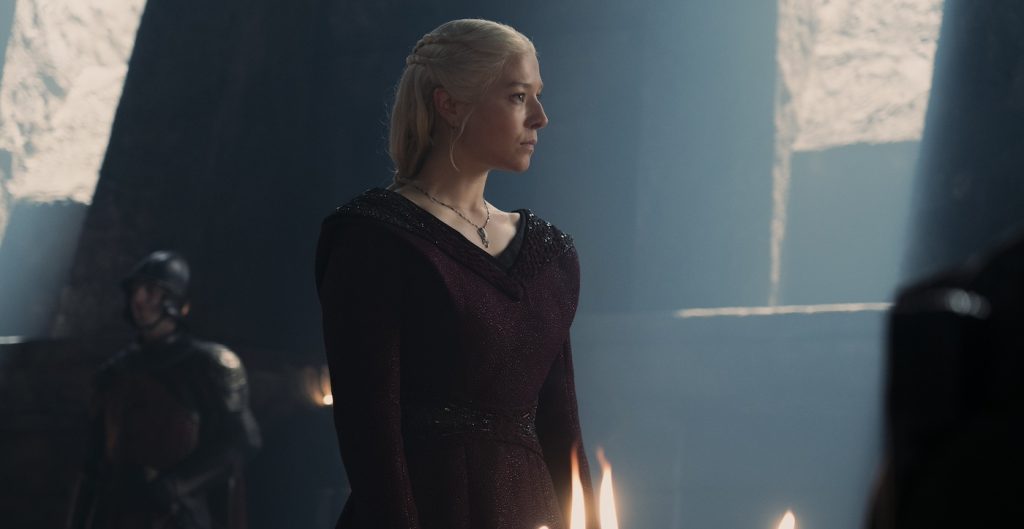
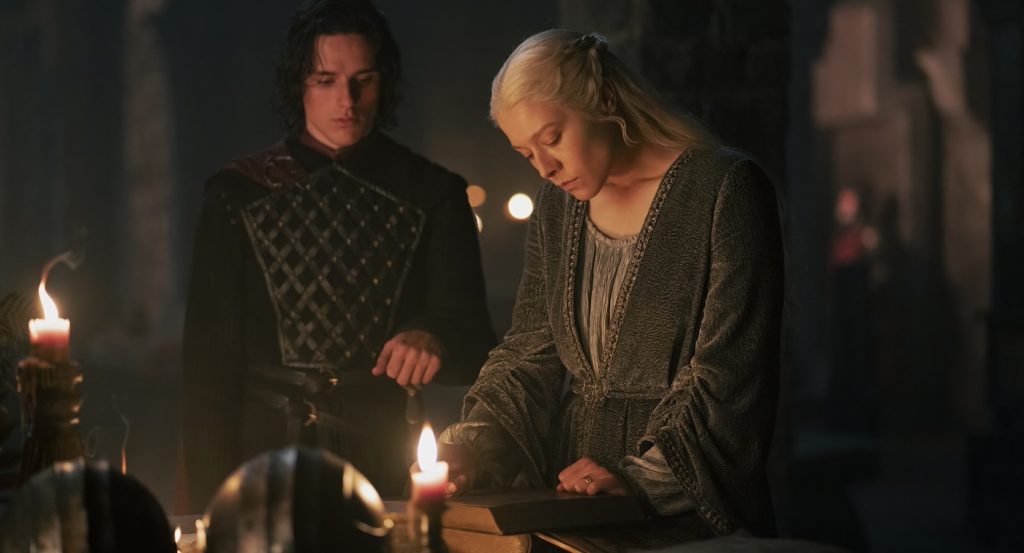
House of the Dragons season 2 hasn’t premiered yet—that happens on June 16—but that didn’t stop HBO from topping up the successful Game of Thrones spinoff for another season. Showrunner Ryan Condal and his co-creator, author George R. R. Martin, have no doubt been plotting and planning for a third (and fourth, and fifth?) season already.

The drama centered on the scheming Tagaryen family has been renewed for season 3, proving that HBO’s first GoT spinoff to make it through the creative gantlet and onto air is a major hit. It took the entirety of season 1—which earned nine Emmy nominations, including for Outstanding Drama, and two Golden Globes, winning for Best Drama—before the series was renewed for a second run, so this fresh renewal days before the season 2 premiere is telling.

Matt Smith and Emma D’Arcy in “House of the Dragon.” Courtesy HBO.

When House of the Dragon premiered, it drew the largest premiere audience in HBO and HBO Max history. Season 1 pulled in an average of 29 million viewers per episode, linearly and on streaming. The series is based on Martin’s book “Fire & Blood” and has masterfully followed the drama within House Targaryen as family members turn on one another in a battle for power and, of course, the Iron Throne. The series is set 200 years before the events in Game of Thrones, in an era where the Targaryens have ruled the Seven Kingdoms for a century.

“George, Ryan, and the rest of our incredible executive producers, cast, and crew have reached new heights with the phenomenal second season,” said HBO’s programming and drama series chief Francesca Orsi in a statement. “We are in awe of the dragon-sized effort the entire team has put into the creation of a spectacular season two, with a scope and scale that is only rivaled by its heart. We could not be more thrilled to continue the story of House Targaryen and watch this team burn bright again for season three.”

House of the Dragon alums returning for Season 2 include Emma D’Arcy, Olivia Cooke, Matt Smith, Eve Best, Steve Toussaint, Fabien Frankel, Ewan Mitchell, Tom Glynn-Carney, Sonoya Mizuno, Rhys Ifans, Harry Collett, Bethany Antonia, Phoebe Campbell, Phia Saban, Jefferson Hall, and Matthew Needham.

Newcomers include Gayle Rankin as Alys Rivers, Freddie Fox as Ser Gwayne Hightower, Abubakar Salim as Alyn of Hull, Simon Russell Beale as Ser Simon Strong, Clinton Liberty as Addam of Hull, Jamie Kenna as Ser Alfred Broome, Kieran Bew as Hugh, Tom Bennett as Ulf, Tom Taylor as Lord Cregan Stark and Vincent Regan as Ser Rickard Thorne. 

While House of the Dragon soars, HBO has another Game of Thrones spinoff in the worksKnight of the Seven Kingdoms, based on Martin’s books “Tales of Dunk and Egg,” which are centered on Ser Duncan the Tall and his squire, Egg. Martin also announced that a pilot script for the spinoff series Ten Thousand Ships is being penned by Pulitzer Prize-winning playwright Eboni Booth.

For more on House of the Dragon, check out these stories:

“House of the Dragon” Season 2 Timeline Revealed

“House of the Dragon” Season 2 Unleashes Two Trailers, Plenty of Dragons, and War

“House of the Dragon” Season 2 Trailer Coming Tomorrow

Featured image: Photograph by Courtesy of HBO

“Inside Out 2” Screenwriter Dave Holstein on Anxiety Taking Center Stage

In Inside Out 2 (in theaters June 14), Riley (voiced by Kensington Tallman) is off to hockey camp in the summer before high school, no longer the little girl we remember from the sensational introduction we got nine years ago in Inside Out. Riley is now a 13-year-old tween in the liminal zone of adolescence, with a host of new emotions presenting themselves for the first time. So when the sirens go off again in the Headquarters of Riley’s brain, a new console is installed so these fresh emotions can join the original quintet from Pete Docter’s 2015 film. Joy (Amy Poehler), Sadness (Phyllis Smith), Anger (Lewis Black), Fear (Tony Hale), and Disgust (Liza Lapira) get repressed in favor of new emotions, including Ennui (Adèle Exarchopoulos), Envy (Ayo Edebiri), and Embarrassment (Paul Walter Hauser).

Key to the nearly impossible task of living up to the astonishment of the first film while forging a new emotive path was screenwriter Dave Holstein, who picked up the baton from Inside Out scribe Meg LeFauve and sprinted, fueled by the film’s most prominent new emotion, Anxiety (Maya Hawke), into dazzling new territory in the sequel. Working with director Kelsey Mann, Holstein leaped into the formidable but fecund Pixar Process (and across the Sarchasm—you’ll understand when you see the film) and made the most of the opportunity.

We spoke to Holstein about leveling up to Pixar’s high bar, what it’s like to write for comedic geniuses like Amy Poehler, and how he learned to love the challenge of scripting a movie that spoke to children and adults.

I’d love to hear about your writing process from the beginning when you mapped out the story for the sequel.

There was a strong desire not to retread the first movie and find something that felt resonant for today. I think anxiety really hit home. Anxiety is not a feeling you can destroy. There’s a certain lesson in learning to live with anxiety that had to feel different than living with sadness, you know, and that was sort of the original challenge of the piece; how to make it new and exciting and also give everyone what they love from the first film.

Was anxiety always the emotion you’d be exploring in the sequel? 

We cycled through a few different ones. As with anything at Pixar, you’re constantly iterating to ensure you have the best possible collection of 800 puzzle pieces. But we all just went through this thing called COVID, and anxiety is not really an enemy you can defeat. It’s kind of something you have to learn to live with, and it felt like maybe there was a resonance to the anxiety that we’ve all experienced. I think there’s something important to the phrase: every pain needs a name. It just becomes a lot easier to talk about, especially with children, so that was a big part of anxiety as opposed to, say, shame or guilt, which were totally valid in other ways to play with antagonists. That’s how we kind of hatched that egg.


Tell me about the vaunted Pixar iteration and ideation process. I’m curious what that’s like as the writer from the inside.

Yeah. I mean, it’s like they come to you, and it’s like, “So you’ve written screenplays? Have you written screenplays inside a dishwasher?” I think that that’s always been my feeling is that you’re thrown into a process where everyone is constantly in all three stages of filmmaking at once—writing, shooting, and editing— and you’re constantly working in different parts of the movie and trying to make sure the pylons all build to something.

Writing a script inside a dishwasher sounds difficult.

It’s a very specific process because it’s a lot of pages. I think I wrote upwards of 750 pages on this movie. I guarantee you I have at least 11 drafts in my folder of the most important scenes in this film. It’s not even that hard to write a scene; there are plenty of great scenes, but the hard part is how they fit with everything around them. I kept trying to imagine myself doing the same process with a live-action film, and it doesn’t really work like that. There are just too many boxes to hit in a Pixar film.

INSIDE OUT 2 – FEELING ENVY – Featuring Ayo Edebiri as the voice of Envy, “Inside Out 2” releases only in theaters June 14, 2024. © 2024 Disney/Pixar. All Rights Reserved.

Pixar films are well regarded for operating at multiple levels and truly appealing to the entire family, including adults without children. 

There are so many levels it has to work on, both comedically and emotionally. It has to work on two different eye lines—for the adults and the kids. It has to make you feel something. It has to make you laugh. It has to make you want to watch it again. It has to make you want to see it in the theater. People say 3-dimensional chess. I think it’s like 8-dimensional backgammon. I’ve done a lot of different intense pipelines, I mean, I created a show for Jim Carrey that went for two years, so I’ve gone through different versions of insanity, you know? This was a very specific brand of great, but it was a lot of work.

How do you know when you’ve gotten it just right? Or can you ever truly know that until the movie is in theaters?

Yeah, I mean, that’s the thing you’re searching for the whole time. It’s not necessarily the moment when someone is crying, but it’s the moment when you feel something so emotional that it just puts you in a place. You want people to watch this film and say, “That really hit,” because that’s what we associate with Pixar. When you’re given the keys to Pixar kingdom and the tools and budgets they have, you feel this necessity to swing really, really, really hard, you know? And that doesn’t just mean more laughs per page. It means, “Can we figure out the secret to life in the next 94 minutes?”


That’s a lot of pressure, and the fact that you’re literally writing a film about anxiety adds to it.

You’re like, damn it, I’m in this self-fulfilling prophecy of a script. But if there’s nothing that can go horribly wrong, it’s kind of boring. This is what I signed up for.

What’s it like writing for animation? Does it change anything for your approach to crafting a satisfying story arc?

You know, it’s funny. I try to think about it as a drama first and just write adult stuff to see how I can find that sort of center lane. There’s a scene I’m very proud of where Joy breaks down. She’s like, I’m sick of being Joy all the time. You have these great actors like Amy Poehler who can do that, and you want to give these characters different shades. I think the trap in a film where you have Joy, Anger, Sadness, etcetera is that Joy, Anger, and Sadness are only happy, angry, and sad. And I think that what’s sort of fun is to dimensionalize characters that are so inherently one note, which is the same in a live-action, dramatic script. You’re always trying to find what feels like a real moment.

JOY AND ANXIETY — Disney and Pixar’s “Inside Out 2” returns to the mind of freshly minted teenager Riley just as a new Emotion shows up unexpectedly. Much to Joy’s surprise, Anxiety isn’t the type who will take a back seat either. Featuring the voices of Amy Poehler as Joy and Maya Hawke as Anxiety, “Inside Out 2” releases only in theaters Summer 2024.© 2023 Disney/Pixar. All Rights Reserved.

And I imagine it’s different writing alongside artists and animators.

The trick is just writing visually. I don’t think there’s a line of dialogue in the script that’s more than two horizontal lines on the page. You start to see the math of what you’re doing, and most of what has to be conveyed has to be conveyed with the eye. When I started writing on network sitcoms, being in a joke room was like a whole different muscle to train your brain. And I think that’s the jump for me—up at Pixar, you’re sitting in a room of a dozen story artists with pens in their hands, and I’m trying to speak their language so that I can convey what’s in my head to their head—it’s a totally a translation event.

How much are the film’s stars in your head when you’re writing their characters? Are you writing in a particular way to suit Amy Poehler’s gifts, for example?

It’s great writing a sequel when you can have Disney+ open in the background and play a scene from the first movie just to get their voices. But what’s really fun and kind of unexpected is when we were recording, that writer’s brain kind of fires up, and you start to hear new lines and feed them new ideas because their cadences or where they’re headed comedically is inspiring something. I was kind of surprised that we found on the day a line that’s 20% better than what was written, you know, or 20% darker in a lot of cases, frankly, with Phyllis [Smith, as Sadness] and Lewis [Black, as Anger]. A lot of those ended up in the movie. Like in the first movie, when Sadness says something like, “I loved that movie where the dog died,” I was like, Oh, we can do that. It’s totally dark, but it works.

Considering Anxiety is the big new character, what was it like when you finally heard Maya Hawke performing the role?

She really knocks it out of the park. Maya Hawke is phenomenal. Her interpretation of Anxiety is dimensionalized. She’s had a great rhythm. She’s one of the only characters I could write more than two lines of dialogue for. I could give her a big chunk, and she would sell it really well. And she wanted tongue twisters. She wanted what Jim Carrey wanted: a lot of verbal marbles to chew on, and that was really fun because I like a challenge, and she was really good at it.


And about another newcomer, Ayo Edebiri, as Envy?

Oh man, Ayo’s great. She’s such a born voice performer as well. She’s so funny, and she gave her character so many levels. I think because her character was so short she felt she had to have moments where she was up here and then down here. She was really fun to watch; she would go off on these riffs, which were like full monologues. And I would just sit there in awe. She’s the real deal. She’s really funny.

What does it feel like to be at the end of the road and have the film finally coming out?

[Holds up a toy version of Anxiety.] That’s kind of what it feels like, you know?

Inside Out 2 is in theaters on June 14.

For more stories on 20th Century Studios, Searchlight Pictures, Marvel Studios and what’s streaming or coming to

Disney+, check these out:

Giving the “Abbott Elementary” Teachers a Glow Up With the Hair & Makeup Maestros Moira Frazier and Constance Foe

“The Acolyte” Composer Michael Abels on Scoring a “Star Wars” Story Unlike Any Before It

“Deadpool & Wolverine” Director Shawn Levy Eyed for Next “Avengers” Film

Featured image: Ayo Edebiri as the voice of Envy, “Inside Out 2” releases only in theaters June 14, 2024. © 2024 Disney/Pixar. All Rights Reserved.

“BRATS” Director Andrew McCarthy on Reuniting With the Iconic Brat Pack

It’s fair to say the youth movie genre in the 1980s was defined by the Brat Pack, the group of young actors who appeared together in such classics as Pretty in Pink, The Breakfast Club, and St. Elmo’s Fire. They are famously familiar: Emilio Estevez, Rob Lowe, Demi Moore, Molly Ringwald, Ally Sheedy, and Andrew McCarthy, among others. What is less well known is the profound impact that moniker, coined by then New York Magazine writer David Blum, had on them personally and professionally. As McCarthy, whose feature documentary, BRATS, explores the label and its ripple effect, notes, “The paradox is that we hated it and the public loved it. To them, it represented something different than it represented for us.”

In BRATS, McCarthy, now an established director and award-winning travel writer, reconnects with some of his fellow Brat Packers after several decades to discuss the aftermath of the branding. He also gleans surprising insight from many industry figures and Blum. His documentary is raw and revealing as it traces the actors’ journey from resenting the term to embracing it.

The Credits spoke with McCarthy about the idea that sparked BRATS, the logistics of meeting up with his former co-stars, and the film’s ending, which is certain to resonate with fans of the genre. Edited interview excerpts follow.


You write about the Brat Pack in your memoir, Brat: An ’80s Story. Did you always plan to follow up your book with a film?

I had no intention. It never occurred to me to make a film about it. If you read it, then you know, it’s just very subjective about my experience. What I was interested in was that I’m a result of my beliefs about what happened then, not other people’s beliefs of what happened then. The life I’ve lived is an outgrowth of the way I reacted to all that. But then, when I finished the book because it was a seismic event in all our lives and I’d never talked to any of them since, I thought it would be really interesting to see how it had affected their lives. I knew we all hated it at the beginning, and I wanted to see how that changed over time.

Andrew McCarthy in Central Park. Courtesy ABC/Hulu.

Did you map it out at the outset, or did it evolve as you were filming?

Well, it certainly evolved. I mean, I can’t even recall what it started as. All I knew I wanted to do was be utterly transparent the whole time with it. I just wanted it to be like a homemade movie, like you’re with me, I’m going to do this, and we’ll see what the hell happens. The shock I had from it was how much affection we all had for each other when we saw each other again. That was a big surprise to me, and so that changed the way the film eventually ended up being because you just have to follow the story.

Emilio Estevez in BRATS. Courtesy ABC/Hulu.

BRATS is a road movie of sorts. How many crew members did you travel with? And when did you shoot it?

We started in March of ’22, and I filmed about 10 or 11 days over a year because you just can’t call up Rob, Demi, and Emilio and get them all in the same afternoon, as much as you would like to [laughs]. I would get a crew, but like for me and Ally, it was just me and Ally; I had my iPhone, I rented two cameras that day, and she said I can talk to you today, like OK, I can’t get a crew today but I’ll be up in an hour, and I set up everything myself. And so it was just me and her at her apartment. With other people, I had a crew. I had two cameramen and multiple cameras, and each time, we’d set the cameras up and just walk away because I wanted multiple different angles. There was also a sound man and probably a PA helping us. That was it. There were no lights, there was no makeup crew, and there was nothing like that.    

Demi Moore in BRATS. Courtesy ABC/Hulu

I found it interesting that you see David Blum, who wrote the article. He didn’t think the label was negative or would have the ramifications that it did on all of you personally. You also speak with a lot of other industry figures, including Kate Erbland, Laura Shuler Donner, and Malcolm Gladwell. Did their positive takes change your perception in a good way? And why was it important for you to include them? To lend some balance?

Yeah, of course, you just want some reality check. You want perspective. To meet David, finally, I think that was really an interesting experience, for me and for him. He had never met any of us before. He’d been keeping up with all our careers. He knows more about what everyone’s doing than I certainly did. He knew he affected our lives in a deep way. He knew we didn’t like him. And so I tip my hat to him for agreeing to meet me.

I love the ending, by the way!

[Laughs] Well, I mean, it’s such an iconic Brat Pack moment with Judd pumping his fist, you know, stick it to the man. It’s so great. How else could it have ended? It wasn’t my idea. My editor [Tony Kent] did it, and when Tony put the song on there, I’m like, OK, done, we’re done here.

I believe Rob Lowe remarked that the youth movie genre made shows like Glee and Friends possible. Do you agree?

When Rob said that, I was like, really, dude, that’s a bit self-congratulatory. But what I didn’t understand before I started doing the documentary was that movies were not aimed at kids until the ’80s. They were aimed at adults, and then Hollywood realized that with the few youth movies they’d made, kids were going six or seven times to see them. So almost overnight, there was this seismic change in Hollywood about who was in movies, and we were the beneficiaries of that. And then David Blum comes along and just throws this really zingy tag on it and categorizes us. And so it was putting a label on this cultural shift that was happening. So, I don’t think it’s that far off. What is Friends but St. Elmo’s Fire, except in New York and not Washington? We were certainly at the forefront of that.

Rob Lowe in BRATS. Courtesy ABC/Hulu

What do you want the audience to take away?

Well, I think naturally, for most people, it will come down to nostalgia, but then I hope they walk away with something very different. You go, yeah, I had my walk down memory lane, but actually, I’ve got an interesting perspective on things now and maybe how that reflects on their own lives. I’m fascinated by how we look at things one way and know it to be the case, and then, in time, we look at it from 180 degrees the other way and know that to be the truth. I hope they come away with, huh, there’s a bigger thing involved here than just cool music and funny hairdos. 

BRATS premieres on Hulu on June 13.

Featured image: (L-R) Actors Rob Lowe and Andrew McCarthy.

How the “Bridgerton” Costume Designers Dialed up the Romantic Fantasy in Season 3

In the Bridgerton universe, imagination is key. One of the reasons the show skyrocketed in popularity since its season one debut is that it’s a romance and a period drama reimagined. It’s a romance set in a royal world with diverse characters, whimsical clothing, and orchestral covers of modern-day pop hits that give the period trappings a modern sensibility.  

And what better way to sell a romantic, fantastical world than through the detailed costuming created by Bridgerton costume designers John Glaser, George Sayer, and Dougie Hawkes?

“The producers and the writers allowed us to veer even further away from the actual period and become a little more fantasy, a little more fashiony [this season],” Glaser says. “We broke as many rules as we could.”

Glaser describes this season as a bit more of a “rom-com.” The audience is familiar with the characters by now, and the two leads, Colin and Penelope, have been teased as a will-they-won’t-they? couple since the first season. 

Bridgerton. (L to R) Luke Newton as Colin Bridgerton, Nicola Coughlan as Penelope Featherington in episode 306 of Bridgerton. Cr. Liam Daniel/Netflix © 2024

In season one, we were introduced to the primary family houses categorized by color palette: Bridgerton blue and Featherington orange. In season two, Kate Sharma (Simone Ashley) is mostly seen in different violet hues. But in season three, costume coloring got a bit more complex. 

“The audience knows the characters,” Glaser says. “They know the families and that allowed us to not have to follow such strict — I call them Disney color rules. We could break out and become a little more realistic in the colors.”

Bridgerton. Emma Naomi as Alice Mondrich in episode 306 of Bridgerton. Cr. Liam Daniel/Netflix © 2024

This year, it’s Penelope Featherington who is the season’s diamond — the former wallflower turned leading lady that, until now, was only ever seen in some painfully bright, citrus gown. 

Bridgerton. (L to R) Nicola Coughlan as Penelope Featherington, Luke Newton as Colin Bridgerton in episode 307 of Bridgerton. Cr. Liam Daniel/Netflix © 2024

“We used colors that were good for her skin tone and hair color,” Glaser says. “Also, if you look at her fabrics they’re layers of blues, greens, pinks—so you’re not really sure what color it is. And that’s because people who watch the show look at color and see easter eggs, and we didn’t want to foretell the story.”

Bridgerton. (L to R) Luke Newton as Colin Bridgerton, Nicola Coughlan as Penelope Featherington in episode 306 of Bridgerton. Cr. Liam Daniel/Netflix © 2024

Nicola Coughlan’s starring role this season has caused somewhat of an antiquated media frenzy around her body. But the truth of the matter is that Penelope has never looked better. She absolutely lights up the screen this season, and online audiences are eating it up.

“The colors that Penelope is wearing — even though she is more mature, more powerful — allows her to still be a wallflower,” Glaser says. “She’s not sticking out. Color is no longer telling her story. She’s telling her story.”

Bridgerton. (L to R) Nicola Coughlan as Penelope Featherington, Claudia Jessie as Eloise Bridgerton in episode 306 of Bridgerton. Cr. Liam Daniel/Netflix © 2024

When designing costumes for a show like Bridgerton, Glaser says they turn to “modern paintings” for inspiration. 

“Like Andy Warhol, we use [Robert] Motherwell, Serjeant [Painter],” he says. “And we always say the same thing with our research that it may be modern research, it may be actual period research, or painting, but we use certain things because we extract the Regency period…and that’s how we mix things all together.”

Bridgerton. (L to R) Hugh Sachs as Brimsley, Golda Rosheuvel as Queen Charlotte in episode 306 of Bridgerton. Cr. Liam Daniel/Netflix © 2024

“We’ll have that under bust line which is very much part of the Regency period,” adds Sayer. “But then we might take it in, smooth it out, and move it. We moved the line once and we added another line underneath.”

This season’s leading man is Colin Bridgerton. Fresh off the boat from his travels abroad, Colin has a revived perspective on life, and a dashing, new wardrobe to match. 

“With Colin, especially, you’ve seen him since season one and season two quite pure and quite soft in his color palette,” Hawkes says. “And I always yearned a bit to escape from that color range. So to give him that transformation… He’s an incessant traveler anyway, after each season he’s on an adventurer. So it was time to make him an ultimate adventurer and come back a fully fledged man, rather than still a boy.”

Bridgerton. (L to R) Luke Newton as Colin Bridgerton, Simone Ashley as Kate Sharma, Jonathan Bailey as Anthony Bridgerton in episode 307 of Bridgerton. Cr. Liam Daniel/Netflix © 2024

Hawkes says with the men it’s almost easier to adhere to more traditional Regency era styles.

“[We] used a lot of contemporary fabrics and contemporary designers…but it has a grounding in silhouette to authenticity, historically,” he says.

This season’s other Bridgerton family lead has a bit of a different look. Inspired by Hollywood starlets like Grace Kelly and Catherine Hepburn, Francesca Bridgerton has a reserved elegance about her. 

Bridgerton. (L to R) Hannah Dodd as Francesca Bridgerton, Victor Alli as John Stirling in episode 303 of Bridgerton. Cr. Liam Daniel/Netflix © 2024

“We used a lot of sheer fabrics this year because it helps make things a little mysterious,” Glaser says. 

According to Sayer, Francesca is feminine but not “in your face.” She maintains all the class of her elder sister, Daphne, but with an air of mystery. But it wasn’t Francesca that presented the biggest challenge for costuming this season.

Very true to her character, Claudia Jessie (Eloise Bridgerton) became the problem child this season. After accidentally breaking her wrist on set, the costume designers were faced with a new task: how to hide a modern-day cast in Regency-era garb.

Bridgerton. Claudia Jessie as Eloise Bridgerton in episode 201 of Bridgerton. Cr. Liam Daniel/Netflix © 2022

In a few scenes, Eloise is seen wearing a muff so that the team would be able to hide her cast.

“It was a tricky one because it’s summer and you don’t wear muffs,” Glaser says. “And some people have noted that the muff looks very light and thin, and that’s all because she couldn’t have any weight on her arm. So it’s like a piece of tissue paper wrapped around.”

Bridgerton. (L to R) Nicola Coughlan as Penelope Featherington, Claudia Jessie as Eloise Bridgerton in episode 301 of Bridgerton. Cr. © 2023

Because Jessie wasn’t able to put her arm into most of her outfits for the show, the costuming team had to redo much of her clothing — adding “frills and fluff” to confuse the eye and divert attention from her wrist. 

“And then we split open the sleeves on her green embroidered coat…so she could actually get into the coat,” adds Sayer. 

As seasoned veterans in the industry, Glaser, Sayer and Hawkes have all experienced their fair share of costume mishaps. 

Bridgerton. (L to R) Claudia Jessie as Eloise Bridgerton, Luke Thompson as Benedict Bridgerton in episode 301 of Bridgerton. Cr. Liam Daniel/Netflix © 2024

“If you look carefully, she’s standing in certain ways, and she’s got a scarf draped over her, or she’s behind a chair,” Glaser says.  The rest of this season’s magical looks will appear with the release of the second half of season three on Thursday. 


For more on big titles on Netflix, check these out:

First “Knives Out 3” Image Finds Daniel Craig’s Benoit Blanc With Long Locks

Richard Linklater on the Killer Chemistry in his Romantic Comedy “Hit Man”

Andrew Scott Joins Daniel Craig in Rian Johnson’s “Knives Out 3”

Featured image: Bridgerton. (L to R) Nicola Coughlan as Penelope Featherington, Luke Newton as Colin Bridgerton in episode 306 of Bridgerton. Cr. Liam Daniel/Netflix © 2024

“Paddington in Peru” Trailer Finds the Beloved Bear on an Amazonian Adventure

The beloved British bear is back on another adventure in Paddington in Peru.

The marmalade-devoted bear is finally back on the scene after a 7-year hiatus since Paddington 2, the third film in the critically acclaimed series. In the new film, directed by Dougal Wilson, Paddington (voiced by Ben Whishaw) heads back to Peru to visit Aunt Lucy (voiced by Imelda Staunton), who is now living at the Home for Retired Bears. Paddington’s trip to visit Aunt Lucy turns into a proper adventure when he and the Brown Family end up on a thrilling journey into the Amazon rainforest.

The third film has new faces (and voices), including Olivia Colman’s The Reverand Mother, a nun who can shred on the guitar, and Antonio Banderas’ boat captain Hunter Cabot. Hugh Bonneville returns as Mr. Brown, with Emily Mortimer stepping in to voice Mrs. Brown.

Director Dougal Wilson spoke at the trailer launch and said that the third film will explore Paddington’s origins and how he came to be rescued and live in London. “There’s a lot of missing information about what happens before that, and we thought for the third film it would be very appropriate for him to return to Peru, but this time taking his London friends and community with him and have an adventure there and, in doing so, fill in some of the missing pieces.”

Check out the trailer below. Paddington in Peru hits theaters on January 17, 2025.

Here’s the official synopsis:

Paddington in Peru brings Paddington’s story to Peru as he returns to visit his beloved Aunt Lucy, who now resides at the Home for Retired Bears. With the Brown Family in tow, a thrilling adventure ensues when a mystery plunges them into an unexpected journey through the Amazon rainforest and up to the mountain peaks of Peru.

For more upcoming films from Sony Pictures, check out these stories:

How “Bad Boys: Ride or Die” DP Robrecht Heyvaert on Creating the Ride of a Lifetime

“Venom: The Last Dance” Trailer Reveals Symbiote Battle Royale

George Clooney and Brad Pitt Are on the Hunt in First “Wolfs” Trailer

Animation Director Jason Boose on Creating a Madcap “Garfield” for a New Generation

Featured image: “Paddington in Peru.” Courtesy Studio Canal. 

“Knuckles” Composer Tom Howe on Scoring the Speedy Warrior’s Paramount+ Debut

Composer Tom Howe constructed the score for Paramount+’s superpowered new series Knuckles, putting the warrior Knuckles the Echidna from the Sonic the Hedgehog universe at the center of the action.

He’s like Sonic, but more fun, more attitude, and probably more fun to have a beer with or go out for dinner with,” Howe says of the titular character. Howe also benefited from an added element that made the sound of Knuckles so appealing—the voice of Knuckles himself, played by Idris Elba. “Idris Elba’s voice is fantastic, with a sort of gravitas. It helps the character a lot. Knuckles is so committed to being a warrior. He has that superhero quality. The fact that he’s so into it gives it believability, but it also play as a comedy or be straight as well. I think he’s a great character.”

In an interview with The Credits, Howe talks about mixing genres and tones in the series, recording in the legendary Abbey Road studio, the inherent music of Idris Elba’s voice, and making friends with the cast of Ted Lasso.

Where did you grow up, and what was the first instrument that you played?

I grew up in England, and the first instrument I played was the piano. My dad played the piano, organ, guitar, and drums, and my parents sang in a choir, so I was exposed to church music early on. Piano was the first thing I learned, and then I took up guitar at about eight or nine, and clarinet, and I did a lot of singing choirs and things.

How did you start piecing together the score for Knuckles?

Well, it’s challenging. I started by coming up with thematic ideas for the different characters. I spent a lot of time thinking about the Knuckles character, obviously the star of the show. What I ended up with is actually a very simple tune, but it took me a long, long time to get there. The score can be very heroic, but at the same time, you can hear a couple of notes of it with a comedy cue. There’s a lot to contend with in this show. Even the episodes jump around. You go from the end of episode one, when they’re in a bowling alley, to having a full-on fight, which looks very much like a video game. They’re jumping around, there are lasers. And in episode three, you’re at a family dinner. In episode four, you’re in a musical.


That’s a tremendous amount of variety for a single series.

In episode one, Knuckles initially runs up the hill, and you see this huge landscape shot of green hills before he runs down and takes out the workmen. Obviously, a big landscape shot like that can have a big, wide-scale sound. But when you’re in a family dinner with just three people and Knuckles, it won’t take the same kind of palette. So, you’ve got to feel your way around that and work out what the picture can take and what’s suitable for the characters in the story. So that made it very fun. But as a composer, there are a lot of different things to deal with, and you don’t want to over-egg a pudding.

L-R: Knuckles (voiced by Idris Elba) and Hudson as Ozzy in Knuckles, episode 1, season 1, streaming on Paramount+, 2024. Photo Credit: Paramount Pictures/Sega/Paramount+.

Knuckles is voiced by Idris Elba, who has that fabulous voice that’s its own kind of music. How does that help you with what you’re creating? 

It really helps. His voice reminds me of David Attenborough. There is a lot of talking, the voice is very low, and a lot of the music is sitting above that. There’s very little going in the bottom end of that except for the action cues within that episode.


There are a lot of special effects in this show. When do you enter the process? Do you get the script or storyboards, or are you actually looking at the final visuals?

I get a complete picture, but it’s forever changing in length, and this scene’s now over here, or that bit that was there is now gone completely. It’s an ever-moving thing until they lock it down. If you work on a drama, they may change the edit, but fundamentally, the shots are the shots. But when you’ve got an animated character like Knuckles, in any of the scenes he’s in, when the special effects shots come in, it will all be a little bit longer or a little bit shorter. It may only a frame here and there, but when you start doing that over a number of sequences, all the music timings will have to move around.


I get an early picture to look at, and that’s when I’ll have a conversation with the filmmakers. We’ll talk about what a particular scene needs, whether it needs music, and if it does, what the music is doing, what the mood behind it is, or what the intention behind it is. I then start trying to kind of put things down, but at that point, it is an ever-moving thing. Every time you move forward, you have to go backward and fix something. I remember in episode six when Knuckles was in the last battle there, and Wade gave a fantastic speech. What I actually see is Wade standing in front of a blue screen. Giving a great performance is challenging enough, but to do it when you’re on your own is really difficult, I’m sure.

There’s a very varied selection of surprising needle drops on the soundtrack. In the first episode alone, you have Edith Piaf and A Tribe Called Quest.

Matt Biffa selected those in collaboration with the filmmakers. Toby Ascher, one of the producers, was also very involved.

What’s the most fun about writing for Knuckles? 

The breadth of the palette that you get to play with. If you have a dark drama project, all of the music is going to be in that world. There are not many projects where you can jump around like that and still keep a throughline in terms of melody and instrumentation choice. Episode four has a lot of electric guitars in it, but the others don’t. Episode three has a lot of solo violin and mandolin, but not a lot of the others do. It is a lot of fun to put on these different hats while trying to thread a needle and make it sound like one thing.


Are there individual musicians playing all these parts, or are you creating it on a synthesizer?

I do a demo here in my studio; any pianos, guitars, if there are drums, I will play those here. I have a setup that allows that. But for Knuckles, a lot of it was orchestral, particularly in the big action moments. So, I went to Abbey Road for four episodes and AIR Studios in London for two episodes with an orchestra. And it’s all played and recorded for real, which obviously gives it a quality that can’t be obtained by samples as well as when you get all the musicians together.  

What’s your next project?

 I’m finishing a David Attenborough series for the BBC and then starting Shrinking season 2 for Apple.

You worked with the Shrinking people on Ted Lasso, too, right?

Yes, of all the things I’ve ever worked on, Ted Lasso was unusual because it went on a long time and because I was involved on some of the things on set as well. I became very friendly with all the actors and filmmakers, and that carries on to this day. I actually had dinner with Nick Muhammad two nights ago, just the two of us in the pub. He’s a fantastic violin player, and I’m also friends with Phil Dunster and Hannah Waddingham. I see Jason Sudeikis when he is in town. So that’s been a lovely thing to be a part of.

Knuckles is streaming on Paramount+

For more films and series from Paramount and Paramount+, check out these stories:

Chris Hemsworth Eyeing Role in “Transformers” and “G.I. Joe” Crossover Movie

Devastation & Determination in a New “A Quiet Place: Day One” Featurette

How the Animation in John Krasinski’s “IF” Came to Live Seamlessly Among Live-Action

Featured image: Knuckles (voiced by Idris Elba) in Knuckles, episode 6, season 1, streaming on Paramount+, 2024. Photo Credit: Paramount Pictures/Sega/Paramount+.

James Gunn Reveals Another New “Superman” Image

Back in early May, we got our first look at David Corenswet as Superman, and now it appears that Superman writer/director James Gunn has revealed an image of the Kent Family farm, where the young Kryptonian is raised.

Gunn is one of the most active and open filmmakers when it comes to sharing images and updates from his films. He’s been keeping up that level of engagement ever since he took over DC Studios with co-chief Peter Safran and began working in earnest on Superman. Gunn shared the image of what appears to be the Kent Family farm on his Threads account, and he hasn’t refuted the comments to the post that suggests as much.

You can decide for yourself what iconic Superman location this is, but to us, it screams a farm outside of Smallville, Kansas. (Even if it was shot in, say, Ohio.)

Courtesy James Gunn.

The Superman cast has been growing by leaps and bounds lately. Mikaela Hoover and Christopher MacDonald have just signed up as Cat Grant and Ron Troupe, two members of the Daily Planet staff. They join recent addition Beck Bennett, who’s also playing a member of the Planet team. These three follow the recently added Neva Howell and Pruitt Taylor Vince, playing Martha and Jonathan Kent, respectively. Corenswet leads, of course, as Clark Kent/Superman, and he’s joined by Rachel Brosnahan as Lois Lane. The ensemble also includes Nicholas Hoult as Lex Luthor, Wendell Pierce as Perry White, Sara Sampaio as Eve Teschmacher, Edi Gathegi as Mr. Terrific, Skyler Gisondo as Jimmy Olsen, Anthony Carrigan as Metamorpho, Isabela Merced as Hawkgirl, María Gabriela de Faría as The Engineer, and Gunn’s longtime collaborator Nathan Fillion as Guy Gardner.

Superman is set to fly into theaters on July 11, 2025

For more on Superman, check out these stories:

James Gunn’s “Superman” Brings “Saturday Night Live” Alum Beck Bennett Aboard

James Gunn’s “Superman” Coming to IMAX Next Summer

James Gunn’s “Superman” Finds its Martha Kent in Neva Howell

James Gunn’s “Superman” Casts Crucial Role of Jonathan Kent

Featured image: David Corenswet is Clark Kent/Superman in “Superman.” Courtesy James Gunn/Warner Bros.

Andy Serkis Unveils “The Lord of the Rings: The War of the Rohirrim” Footage at Annecy

As promised back in mid-May, the first look at The Lord of the Rings: The War of the Rohirrim was unveiled at the Annecy International Animation Film Festival on Tuesday by none other than Andy Serkis. Serkis, of course, was one of the stars of Peter Jackson’s original Lord of the Rings trilogy, and his time playing Gollum has not come to an end (more on that later). For the War of the Rohirrim unveiling, Serkis moderated a panel about New Line Cinema and Warner Bros.’ upcoming anime epic, which treated festivalgoers to 20 minutes of the film. 

The War of the Rohirrim is based on a brief portion of J.R.R. Tolkien’s “The Lord of the Rings” and is centered on Hèra (voiced by Gaia Wise), the daughter of the legendary Helm Hammerhand (Brian Cox), a mighty king of Rohan, tracks the Hammerhand family’s attempts to protect their lands from the Dunlendings. Serkis promised that fans were “gonna go nuts for this,” as he himself is a fan of the film—he didn’t work on it, but his Lord of the Rings future is mighty busy. Serkis channeled his iconic character to priase the upcoming anime film—”There is only one word to describe a movie with Lord of the Rings and anime at the same time, and that is precious.”

The panel included the film’s director, Kenji Kamiyama (Blade Runner: Black Lotus and Ghost in the Shell: Stand Alone Complex TV series), producers Philippa Boyens and Joseph Chou, and Warners executive Jason DeMarco. DeMarco reflected on the challenge of combining The Lord of the Rings world with anime.

“We did not want to make an animated version of a Peter Jackson film,” he said. “We wanted to make a Kenji Kamiyama anime feature film that lives within that world. And that’s a difficult, difficult task that requires a lot of delicate balancing between two types of filmmaking that haven’t really collided like this before.”

Image by Winson Seto. Courtesy Warner Bros.

The War of the Rohirrim is set roughly two centuries before the events in “The Hobbit” and “The Lord of the Rings” and will include the creation of Helm’s Deep, the fortified gorge in the White Mountains that was a major setting in Tolkien’s work and the middle film in Peter Jackson’s LOTR trilogy The Two Towers. The script comes from Phoebe Gittins and her writing partner, Arty Papageorgiou, and is based on a draft from Jeffrey Addiss and Will Matthews.

“I’m in awe of the creative talent who have come together to bring this epic, heart-pounding story to life, from the mastery of Kenji Kamiyama to a truly stellar cast,” Boyens told Variety back in 2022.

The connection between the new anime film and Jackson’s creative team includes Oscar-winning makeup and visual effects artist Richard Taylor and Oscar-winning art director Alan Lee. Tolkien illustrator John Howe is also involved. The film is slated for a December 13, 2024 release.

Serkis also teased his upcoming live-action feature Lord of the Rings: The Hunt for Gollum, which he will star in and direct, with Peter Jackson executive producing.

Featured image: Helm Hammerhand. Image by Winson Seto. Courtesy Warner Bros.

“Shakespeare but with football”: Director Matthew Hamachek Unpacks “The Dynasty: New England Patriots”

Director and executive producer Matthew Hamachek calls The Dynasty, the 10-part docu-series now streaming on Apple TV+, “Shakespeare but with football.”

He’s not overstating it. As Dynasty charts the rise and fall of the six-time Super Bowl champion New England Patriots over the course of 20 years, dazzling on-field highlights are deftly layered with the documentary’s themes of male ego, betrayal, the price of success, and the corporatization of sports at the expense of players. The result is textured, riveting drama designed to appeal even to viewers with little interest in football.

Bill Belichick and Tom Brady in “The Dynasty: New England Patriots,” now streaming on Apple TV+. Courtesy of the New England Patriots.

“If you are making something for fans, then you’re probably not getting to the core of what story is because that’s just hagiography,” says Hamachek, who co-directed and produced the Emmy-winning, two-part HBO documentary Tiger, which delivered a similar revealing look at the rise, fall, and epic comeback of golf legend Tiger Woods. A veteran editor, his credits include the acclaimed documentaries If a Tree Falls, Gideon’s Army, and the Oscar-nominated Cartel Land.

The Dynasty offered a unique creative opportunity, he says. “I felt it was important that this would be an unvarnished telling of the New England Patriots story and that it would not come from any one person. It wasn’t going to be [head coach] Bill Belichick’s story or [quarterback] Tom Brady’s or [team owner] Robert Kraft’s story. I wanted to let the 70-plus people we interviewed tell it from their perspective. And we had to get into all of it: Spy Gate, Deflategate, Aaron Hernandez …. At its core, this is a human story; to tell a human story, we have to get into all of it, including the fact that it fell apart at the end.”

Bill Belichick in “The Dynasty: New England Patriots,” now streaming on Apple TV+. Courtesy of the New England Patriots.

Hamachek and his team over two-plus years examined more than 30,000 hours of video footage and audio files from the Patriots organization’s archive. Although much of the material was covered in series writer Jeff Benedict’s bestselling book of the same title, the documentary, which is nominated for a Critics Choice Real TV Award in the Best Sports Show category, goes deeper. Besides never-before-seen footage, Hamachek and his crew conducted 70 new interviews with former players, coaches, sportswriters, family members, and NFL officials for a more detailed story.

Drew Bledsoe in “The Dynasty: New England Patriots,” now streaming on Apple TV+.

From the opening episode, “Backup Plan,” the series traces how the New England Patriots evolved from a struggling team to a powerhouse franchise. The episode’s climax is the devastating knee injury that sidelined star quarterback Drew Bledsoe, one of the series’ candid on-camera interviews, and the ascension of backup quarterback Tom Brady. As coach Belichick takes the risk of sticking with the untested, sixth-round draft pick Brady, the episode builds suspense leading to the famous “Snow Bowl” win against the Oakland Raiders in episode 2.


By the time a dynasty is established, the Patriots have become the New York Yankees of the NFL: no longer a scrappy underdog but a soulless machine with a struggle for control between Brady and Belichick. The Dynasty doesn’t shy from covering controversies; besides accusations of cheating in Spy Gate and Deflategate, episode 6, “At All Costs,” details the miscalculation of signing the troubled Aaron Hernandez. The theme of fathers and sons echoes throughout the series, nowhere more tragically than Kraft’s unwavering belief in Hernandez until the player was charged with murder.

In conducting the face-to-face interviews, it probably helped that Hamachek, who grew up in Washington, DC, wasn’t a Patriots fan. “I wasn’t sitting on the couch with my dad when I was 12 years old remembering this team,” he says. “It was more like, ‘You tell me what was important.’”

Covering two decades of on and off-field drama was a tall order, and Hamachek credits the Dynasty team of editors led by Dan Koehler for the layers of storytelling. Information from the interviews often changed the direction of the narrative, and sometimes an entire episode had to be recut, he says. “It was a great group. They fell in love with the process and wanted to get it right even when [the story] was constantly shifting and moving around. Everybody bought into the idea to make it as perfect as we could. There were a lot of 3 and 4 a.m. nights.”

Rob Gronkowsi in “The Dynasty: New England Patriots,” now streaming on Apple TV+.

Some of the most entertaining and insightful commentary comes courtesy of former players, including Bledsoe, Adam Vinatieri, Tedy Bruschi, Rob Gronkowski, Ty Law, Danny Amendola, Julian Edelman, Randy Moss, and Malcolm Butler, who offers candid thoughts on the controversial penultimate episode “Breaking Point” in which Belichick inexplicably failed to play Butler in a big game.

Sports journalists Howard Bryant and Michael Holley, who wrote his own book on the Patriots, are particularly insightful. Sportswriter Nora Princiotti offers a unique perspective on the tenure of quarterback Jimmy Garoppolo, who replaced a suspended Brady following Deflategate, musing that their ensuing rivalry was possibly as much about good looks and charisma as it was about talent.

The on-camera interviews are particularly revealing, especially Hamachek’s questioning of tight-lipped Belichick, who emerges as the drama’s villain, communicating volumes with his body language, facial expressions, and silence.

Bill Belichick in “The Dynasty: New England Patriots,” now streaming on Apple TV+.

“It was important, especially in Belichick’s case, that if he didn’t want to answer, that the editors leave it in to show that he did have the chance to comment and that there wasn’t something else he said we weren’t showing. It was important to give him the opportunity to comment on the record,” Hamachek says.

He credits the Dynasty crew for its preparation and research prior to the interviews. “We had 50-plus people working on the archives, so when [subjects] sat down in the chair, we could say things like, ‘Do you remember this particular moment in the locker room?’ It showed them that we had done our homework, which is one of the comments Bill Belichick made after his interview. He came up to me and said, ‘It’s very clear how well-researched you are,’” Hamachek says. “Coming from Bill Belichick, that’s as good a compliment as you could possibly get.”


For more stories on Apple TV+ series and films, check these out:

Brad Pitt and George Clooney Finally Reunite in First “Wolfs” Teaser

Jake Gyllenhaal is Caught in a Deadly Affair in “Presumed Innocent” Trailer

Can You Hear the Fear? How Sound Shapes the Daring Missions of “Masters of the Air”

Featured image: Bill Belichick, Tom Brady and Robert Kraft in “The Dynasty: New England Patriots,” now streaming on Apple TV+. Courtesy of the New England Patriots.

“The Wild Robot” Starring Lupita Nyong’o & Pedro Pascal Reveals Stunning Footage at Annecy

DreamWorks Animation and Universal Pictures unveiled the first footage of writer/director Chris Sanders’ The Wild Robot on Tuesday at the Annecy Animation Festival, drawing laughter and tears from the festivalgoers.

The upcoming animated film stars Lupita Nyong’o, Pedro Pascal, and Kit Connor and was adapted by the three-time Oscar nominee Sanders from Peter Brown’s novel. Sanders and his Wild Robot team are still working on the film, which is set to hit theaters on September 20. The Wild Robot is centered on ROZZUM unit 7134, better known as Roz (voiced by Nyong’o), the titular robot who ends up marooned on a wild island filled with animals but no one and nothing like Roz. Roz must learn how to form a connection with the islands’ animal inhabitants and eventually try to support a little orphaned gosling who will need to fly off for the fall migration. 

Sanders revealed The Wild Robot‘s opening section for the Annecy crowd, which drew lots of emotion from the audience as Roz explored the wild island. The next portion revealed Roz and the goose Brightbill (Connor) as the gosling grows up, which drew both tears and a standing ovation.

Sanders told the crowd that what he and his team were going for with the look of The Wild Robot was the “analog warmth and soul” of hand-drawn animation. “We start by doing these inspirational paintings,” Sanders explained, aiming for a final film that looks indistinguishable from this initial artwork. As for Peter Brown and his novel, Sanders said, “His guiding principle was that kindness can be a survival strategy.”

The cast includes Bill Nighy, Stephanie Hsu, Mark Hamill, Catherine O’Hara, Matt Berry, and Ving Rhames. 

Check out the trailer below. The Wild Robot premieres on September 20.

For more on Universal Pictures, Peacock, and Focus Features projects, check out these stories:

The First “Wicked” Trailer Arrives on the Wings of Flying Monkeys

Third “Downton Abbey” Movie Will Star Paul Giamatti

Riding the Storm of the Century in the New “Twisters” Trailer

“The Fall Guy” Stunt Designer Chris O’Hara on Helping Create Ryan Gosling’s Gonzo Performance

Featured image: The Wild Robot poster. Courtesy Universal Pictures.

First “Knives Out 3” Image Finds Daniel Craig’s Benoit Blanc With Long Locks

Knives Out 3 has officially begun filming.

To be accurate, the third installment in Rian Johnson’s whodunit franchise is actually called Wake Up Dead Man: A Knives Out Mystery, and Johnson took to X to share the first image from the set—Daniel Craig’s delightfully dandified sleuth Benoit Blanc is now sporting some long locks. Craig’s Blanc is, as always, dressed to the nines, wearing a three-piece suit and holding a hat. He looks ready to take on the next case, which Johnson promised is Blanc’s most dangerous yet.

The third Knives Out film will once again boast an incredible ensemble. This time around, Craig is joined by Josh O’Connor (recently seen steaming up the screen alongside Zendaya in Challengers),  Andrew Scott, Glenn Close, Kerry Washington, Mila Kunis, Jeremy Renner, Josh Brolin, Daryl McCormack, and more.

Johnson is, of course, keeping mum about the plot to Wake Up Dead Man, but we did get a teaser of the title two weeks ago:

Johnson is clearly having the time of his life with this franchise, getting to play in the whodunit sandbox which he has pointed out is vast and offers plenty of room for invention.

Wake Up Dead Man is due in theaters and on Netflix sometime in 2025.
 

For more on big titles on Netflix, check these out:

Richard Linklater on the Killer Chemistry in his Romantic Comedy “Hit Man”

Andrew Scott Joins Daniel Craig in Rian Johnson’s “Knives Out 3”

“Thelma the Unicorn” Director Lynn Wang on Marshaling the Magic of Brittany Howard’s Voice

Netflix’s Production of “One Hundred Years of Solitude” is a Bold Showcase of Latin American Culture

Featured image: Daniel Craig in “Knives Out 3.” Courtesy Rian Johnson/Netflix.

Giving the “Abbott Elementary” Teachers a Glow Up With the Hair & Makeup Maestros Moira Frazier and Constance Foe

As summer shimmers just ahead and another school year wraps up, we take time now to reflect on the fire looks our teachers were serving. The educators at Abbott Elementary gave it their all through two semesters of change. As they navigated celebrations and setbacks, this season was filled with transformations guided by Hair Department Head Moira Frazier and Makeup Department Head Constance Foe.

Janine Teagues’ (Quinta Brunson) relentless optimism and dedication to her students saw a major payoff when her big ideas caught the attention of the school district. She was recruited for a fellowship, stepping into a more visible professional role. In light of a recent breakup and job offer, Frazier and Foe elevated Janine’s look to take her into the community leadership position.

QUINTA BRUNSON. (Disney/Gilles Mingasson)

“Me and (series creator) Quinta [Brunson] were like, we envision Janine going on YouTube trying to figure out how to style curly hair. What do I need to do? What products do I need to use? That’s why this year, you see her hair a little bit more manageable. It looks a lot more defined in her curl pattern,” Frazier noted. “That middle part just brings more dominance and confidence to her, which is why we ended up doing it that way. It sets a high standard and makes a statement for her.”

The sparkly new glint in Janine’s eye doesn’t just come from her excitement over new school initiatives. She also started playing with bolder makeup products. According to Foe, mixing in metallics was the biggest change in Janine’s routine.

TYLER JAMES WILLIAMS, QUINTA BRUNSON. (Disney/Gilles Mingasson)

“We started doing little jewel tone eyeliners, and when I tell you it was so dark to the naked eye, it was black,” Foe explained. “But when you start to see it in the light, it was like an emerald or an amethyst, and it would match what she would have on, and she was more cognizant of what she was doing this time instead of just, ‘Ok, I’m going to school,’ and she just put on lip-gloss and her regular black or brown eyeliner. She actually spent time in the mirror and said, ‘Ok, I’m ready for the day.”

Abbott’s flamboyant principal, Ava Coleman (Janelle James), also leveled up her look. Although she typically favors style over substance, a summer endeavor steered her in a new direction. After a trip to the halls of Harvard and completing an unrelated professional course, she adopted a more academic style.

“For Ava’s character, we wanted to touch on a little bit of texture and more quality this season,” Frazier said of Ava’s wigs. “This season, when she steps into her role as principal, it’s being taken a little more seriously because of this whole, ‘I went to Harvard’ thing. Even though it was online, she wanted to be taken more seriously. So that’s why we’re seeing a bit of toned-down Ava but with a bit more of a statement. Because there’s no more of a statement than to have a middle part, straight down, all the way, exaggerated, 30 inches. It’s still Ava, but it reads that ‘I’m being taken seriously.’”

JANELLE JAMES (9:00-9:32 p.m. EST), on ABC. (Disney/Gilles Mingasson)

Frazier is a one-stop shop, producing every wig used on the show, including guest actors. She makes a full lace wig in five to seven days with only the highest quality lace and 100% human hair. With cameras reaching 8K resolution, she has to be careful that the lace is not visible to the human eye, or it will be picked up on screen.

“Literally, if there’s any repairs that need to be done, I’m getting it done in a day,” Frazier revealed. “Every guest cast got my high-quality ventilation because I can ventilate a hairline in a day. So, when we had Tatyana Ali, who came in to play ‘Ava 2.0’, I sat there and did her hairline the day before she played on the episode, and I had to do it that day. When she came in the following day, she had a brand-new wig that matched her exact hairline.”

JANELLE JAMES, TATYANA ALI. (Disney/Gilles Mingasson)

In the emotional and revealing episode “Mother’s Day,” Frazier leaped into a new level of wigs for the show. Several of the Abbott colleagues agree to spend the holiday at a drag brunch where hairstyles are famously maximized and competitively flawless.

“I really, really loved how the queens came through with the hair, the makeup, the wardrobe,” Frazier beamed. “Everything just felt so right. It looked absolutely amazing and read beautifully onscreen, even in the 8K cameras. I’m very, very proud of that work. I’m proud of the structural design that I did on that. It was a beautiful enhancement to see it all play out between myself, my team, Dustin Osborne and Christina Joseph, and our guest hair stylist who came on to help put the wigs on because we can’t do everybody.”

SHEA COULEÉ, CHRIS PERFETTI.(Disney/Gilles Mingasson)
SYMONE, CHRIS PERFETTI, DONZELL LEWIS. (Disney/Gilles Mingasson)

Glamorous entertainment icon Sheryl Lee Ralph shines as Barbara Howard, the principled and orderly matron of the school. The Emmy winner has alluded to the transformative nature of her wig as she embodies her character.

“Based on the interviews Sheryl has been doing, the wig is a character in itself,” Frazier explained. “Barbara doesn’t show up until we put the wig on. Once the wig was on Sheryl Lee Ralph, she became Barbara Howard. We made that wig like that because so many people you know have that exact hairstyle. They have that exact personality, and that exudes that type of character. Everyone has a Barbara in their life, whether they’re an aunt, a cousin, a friend of a friend, even a grandmother.”

SHERYL LEE RALPH. (Disney/Gilles Mingasson)

Barbara’s makeup look is timeless and impeccable. Even through the trials of corralling a room full of messy kids all day, she never has a smudge or smear. Foe said that Ralph brings her own vision of the character to the table.

“Miss Sheryl and I collaborated on her look, and we came up with her classic look of grace,” Foe said. “She always has that cut crease, but it’s like the pretty Black girl cut crease. Then she has a mauve lip, or her bold browns and reds go with her cardigans. She really does have a hand in it.”

In the mid-season episode “Panel,” Foe’s greatest challenge was concealing rather than highlighting. Teacher Gregory Edie’s arms are famously admired among his coworkers, but when he bears it all, makeup must cover actor Tyler James Williams’ many tattoos. In a heated basketball match with the students, Foe’s team had to make sure that his real-life ink didn’t show through.

TYLER JAMES WILLIAMS, LISA ANN WALTER, JANELLE JAMES, CHRIS PERFETTI, SHERYL LEE RALPH. (Disney/Gilles Mingasson)

“[Tyler] has tats from his fingers all the way, everywhere,” Foe revealed. “All on the insides of his arms, all on his forearms, on his chest, on his neck. I came up with the perfect formula of color to match his arms. I was talking with lighting to ensure that lighting in our trailer matched the set so that once he left our trailer, he looked exactly the same on set and was natural. It literally took me about an hour to cover both arms and his chest area when he played basketball. I had to shellac him, for lack of better terms, with tattoo cover because he was going to be sweating. I had to make sure it didn’t run off.”

TYLER JAMES WILLIAMS, ZACK FOX. (Disney/Gilles Mingasson)

Of course, the heart of Abbott Elementary is the students, but that makes for a lot of young actors for Frazier and Foe to prep each day. Both department heads are hands-on and involved in making sure that everyone looks ready to learn.

“We go through each and every kid, make sure there is no Cheeto dust on their fingers or their faces,” Foe teased. “Making sure they have lotion, making sure there’s no ice cream or anything. We have said they can’t have donuts anymore because we have little icings everywhere.”

Both teams are dedicated to ensuring that each child is camera-ready and looks appropriate for the scenes.

“I wanted to make it feel very authentic,” Frazier noted. “If you ever really pay attention to the background, you’ll see a lot more braids, twists, and child hairstyles because these kids are not the kids you see on Instagram. These kids are kids, and that’s what we’re trying to bring back that playful era so that they can remain children.”

That includes being cognizant of the script, including location.

“You’ve gotta remember, this is in Philly. This is not in California. Children are not going to come out with a wash-and-go set when it’s 20 degrees outside. I’m from Ohio, so I would like to know. My mom is not sending me out with a freshly washed head so I can catch a cold, as she would say. Don’t nobody got time to take off work because you got sick,” Frazier laughed.

Abbott Elementary is available to stream on Hulu.

Featured image: TYLER JAMES WILLIAMS, QUINTA BRUNSON. (Disney/Gilles Mingasson)

“Bad Boys: Ride or Die” DP Robrecht Heyvaert on Creating the Ride of a Lifetime

In the fourth time around for Will Smith and Martin Lawrence’s wise-cracking Miami detectives, Bad Boys: Ride or Die, now in theaters, earns its summer popcorn movie bonafides with loads of goofy banter and antic action sequences. Helmed by Belgian-Moroccan directors Adil El Arbi and Bilall Fallah. Ride or Die follows Mike Lowery [Smith] and Marcus Lawrence [Lawrence] as they do battle with a sadistic criminal mastermind named McGrath (Eric Dane) and corrupt cops.

As always, cinematographer Robrecht Heyvaert helps Arbi and Fallah bring the story to life. He’s shot every one of their movies since the trio first met as teenagers at a film school in Brussels. “We know each other very well,” says Heyvaert. “I can tell in three seconds, just from a look or a hand motion, what they want. Then it’s up to me to explain that to the rest of the gang, which potentially might be 50 crew members.”

Speaking from the London area, where he’s prepping a new movie, the Brussels-based cinematographer discusses using nonstop camera movement to capture Ride or Die in all its eye-popping, trash-talking glory.


Building on the hyper-kinetic style originated by Michael Bay back in 1995, the camera never stops moving in Ride or Die. Literally, cameras move from side to side every moment of screen time, circling around the actors, going in close, or pulling back. How did you arrive at this dynamic approach to camera movement?

The original tagline during pre-production, I think, was “Bad Boys: On the Run.” The idea embedded in the story is that Will and Martin are always on the move, so the camera should always be on the move as well, without it feeling weird or wrong. In most cases, the camera movement goes hand in hand with the blocking, characters going from A to B to C to D, wherever. On top of that, we have a lot of push-ins or pull-outs to emphasize the drama or the spectacle. And more than the previous one, Bad Boys for Life, there’s way more handheld here, for dialogue and even action [scenes]. We thought it would be fun for a blockbuster of this size to go down and dirty, take the camera in hand, move it around, and get close to people’s faces.

The bright color palette contributes to Ride or Die‘s high-energy feel in the spirit of Michael Mann’s Miami Vice. What colors did you want to accentuate for Ride or Die?

Looking at contemporary Miami, the colors that most attracted us were the bright pinks and blues. In the night shots, we really pushed the envelope on the pink. In fact, I think pink might be my favorite color now. On shooting days, it’s the low golden sun that you see almost every day in Miami, especially during the golden hour.

Will Smith and Martin Lawrence star in Columbia Pictures BAD BOYS: RIDE OR DIE. Photo by: Frank Masi

What were some of your references cinematically?

For this movie, where we push everything slightly further than reality, we were inspired by classic eighties and nineties cinema, like Tony Scott movies [Top Gun and True Romance], which always have this golden sun with strong backlight and high contrast usually combined with long focal [lenses]. We really embraced that golden feel. In short, I would say our credo was neon-soaked nights and golden sun days.

Will Smith and Martin Lawrence star in Columbia Pictures BAD BOYS: RIDE OR DIE. Photo by: Frank Masi

What kind of gear did you use to capture all that color and movement?

The main cameras were Alexa 35 and Sony Venice. We combined those modern digital cameras with Panavision G series cameras. They’re lightweight and perfect for handheld action scenes but also give you that classic anamorphic feel with the wide-angle perspective.

What about lenses?

Working with Panavision, we adjusted the lenses and all the other optics so that when you get a streak of light that would normally be a horizontal blue line, in Bad Boys every streak line is pink. Panavision did a great job tweaking the coating on the lens glass so we could really embrace the pink.

Martin Lawrence stars in Columbia Pictures BAD BOYS: RIDE OR DIE. Photo by: Frank Masi

You also used something called the SnorriCam, which was invented by a couple of guys from Iceland who call themselves the Snorri Brothers. How does it work?

You have the actor wear a harness with a camera attached. The first time I heard about SnorriCam was in Darren Aronofsky’s Requiem for a Dream. In Ride or Die, we pushed it a step further and adjusted the rig in such a way that we could go from a frontal shot of an actor and then the camera swings around so you’re really [seeing things] in their point of view, almost like video game. It took some physical strength because the rig is quite heavy, about thirty pounds, Will and Martin pulled it off.

Will Smith and Martin Lawrence star in Columbia Pictures BAD BOYS: RIDE OR DIE. Photo by: Frank Masi

When do your SnorriCam shots show up in the movie?

In the final piece, when Will and Martin’s characters enter Gator Land, we start with a long shot frontal on Will. Then the camera whips around, and you look over his gun. He tosses it to Martin’s character, who catches the gun, and the camera [POV] attaches to his body. It’s not a very long sequence, but I hope it’s iconic.

You enjoy an unusually tight relationship with Live or Die directors Adil El Arbi and Bilall Fallah. How do you deal with having two directors that you need to answer to? Is there a division of labor?

It’s a good question, but I don’t really know the answer. They cross over all the time within days or scenes. One day, I’ll be talking mainly to Bilall because he knows the angles, and halfway through the scene, Adil will step in and say, “Let’s do it this way.”

Directors Adil El Arbi and Bilall Fallah on the set of Columbia Pictures BAD BOYS: RIDE OR DIE. Photo by: Frank Masi

Martin Lawrence and Will Smith look like they’re having fun. What’s it like filming these guys?

It’s amazing watching them do their thing, especially with the comedy when they’re free-styling. Obviously, there is a script, but for every single take, they’ll come up with new lines or better lines or add a joke. We always have many cameras rolling simultaneously because once Will and Martin start free-styling, it might only happen once, so you’d better get it. That’s always a little stressful for me to make sure three, four, five, and six cameras are in the right position because you have to be ready and on edge when that spark of genius comedy comes to life.

Will Smith and Martin Lawrence star in Columbia Pictures BAD BOYS: RIDE OR DIE. Photo by: Frank Masi

On the action front, what was your favorite Ride or Die scene to film?

The sequence I had the most fun shooting was the crashing helicopter. It’s a very contained set, almost like we were filming a mini-submarine movie. Making a big action piece in a tiny environment is really challenging, and you also have to keep that camera moving. We used a rig with a speed rail built into the ceiling that could transport the camera back and forth, allowing us to move the camera really fast from the back of the chopper to the front and vice versa.

People are flying all over the place!

We needed to capture the moment where the characters fall from back to front at twenty miles an hour and then the moment when the guy’s parachute is being sucked out of the chopper. Choreographing all that action in sync with special effects took a lot of storyboarding, meetings, and prep to tell the story beats in a clear way.

Will Smith and Martin Lawrence star in Columbia Pictures BAD BOYS: RIDE OR DIE. Photo by: Frank Masi

You also have to deal with that giant cage imprisoning Mike’s murderous son Armando (Jacob Scipio).

That cage weighs about half a ton, but we still needed to keep things energetic and keep the camera shaking like it would in a real crashing helicopter—or so I assume. I’ve never been in a crashing helicopter.

Helicopter crashes, shootouts, movie stars, Miami—for a kid from Belgium, does it sometimes feel a little surreal when you find yourself making a big Hollywood movie?

Any kid on the planet would think it’s surreal. Belgium is a small country that does not have a big film industry, so growing up there and now getting the chance to collaborate with the cream of the crop of the American film industry feels like a blessing.


Featured image: Will Smith and Martin Lawrence star in Columbia Pictures BAD BOYS: RIDE OR DIE. Photo by: Frank Masi


Richard Linklater on the Killer Chemistry in his Romantic Comedy “Hit Man”

In Richard Linklater‘s latest film, an irresistibly sexy romantic comedy that’s also a bit of a noir, a giddy satire on the hitman genre, and a screwball quasi-whodunit, the one constant is a vibe that is decidedly and effusively all Linklater. Glen Powell, a rising star who has been Linklater’s longtime collaborator through a string of roles dating back to 2006’s Fast Food Nation, plays Gary Johnson, a professor of psychology and philosophy at the University of New Orleans who is as passionate about Nietzsche as he is dispassionate about the affairs of his own life. Based on a true story written by Skips Hollandsworth for Texas Monthly and adapted (with generous tweaks) by Linklater and Powell, Gary’s pleasantly low-wattage life—tidy apartment, a Honda Civic, a pair of cats named Ego and Id—gets put under the hot lights when his tech consultancy work for the New Orleans Police Department turns into a last-minute job going undercover to pose as a contract killer.

Hit Man. (L-R) Director and Co-Writer Richard Linklater with and Co-Writer Glen Powell as Gary Johnson. Cr. Matt Lankes / Netflix © 2024

This brings Gary into the orbit of some delightfully sketchy characters—few directors alive give their actors, even ones in single scenes with a few lines—quite as much loving attention as Linklater. The oddballs and misfits Gary comes into contact with as he continuously tweaks and tailors his hitman personae to match the clientele are both a running gag and a solid case for why Linklater is one of the best directors of actors working today.

But then Gary comes into the orbit of Madison (Adria Arjona), a beautiful, emotionally battered young woman who wants to off her abusive husband. Up until now, Gary (via a knockout performance from Powell) has been having the time of his life duping would-be killers into the clutches of the NOPD, but with Madison, it’s different. There’s chemistry: abundant, immediate, intellectual, and physical. There’s a snap to their every interaction, a syncopation of rhythms. Gary is willing to bend the rules to keep Madison out of harm’s way and, inevitably, into his arms. The question becomes how far Gary will go to protect her and how far Madison is willing to go to protect them both.

In Linklater’s able hands, working with some of his most trusted allies like cinematographer Shane Kelly and editor Sandra Adair, Hit Man sizzles from start to finish and proves Gary’s beloved Nietzsche may have been right when he wrote, “There is always some madness in love. But there is always some reason in madness.”

Linklater explains the methods to his madness below.

I’d love to start with your casting process. Glenn and Adria have abundant onscreen chemistry, but the entire cast, down to people with single scenes, really pops. Can you describe the process of working with casting director Vicki Boone?

Yeah, well, casting is the crucial moment, isn’t it? You’re dead in the water if you get the wrong person in there, so that’s always been such an intuitive, important process, and you just kind of know them when you see them, and I’ve loved partnering with Vicki because she loves actors. She just has a feel for them, and we explore this together. She’s just an enthusiast. You gotta love actors and see the possibilities in people.

Hit Man. (L-R) Austin Amelio as Jasper, Sanjay Rao as Phil and Retta as Claudette in Hit Man. Cr. Brian Roedel/Netflix © 2024

It looks like the camera really loves each and every one of these goofballs. Is that something you talked about before with your cinematographer, Shane Kelly? Or is it at this point, because you guys have worked together for so long, that it’s kind of a shorthand?

It’s a shorthand. I just think it’s an attitude that pervades the movie. The tone is set by the director, of course. We respect these people, even though they’re desperate sad sacks making huge mistakes in their lives. We have respect for the actors, too. We rehearse a lot, and we try to think through our parts and really bring our best to them so that the actor finds that character in them.

Hit Man. (L to R) Glen Powell as Gary Johnson and Richard Robichaux as Joe in Hit Man. Cr. Netflix © 2024

One moment that stood out was when Gary was undercover as a German hitman with red hair and freckles, and the guy he was talking to has a really deep Cajun twang. Was that exchange as fun to film as it was to watch?

Absolutely. The actor Glenn is working with is Richard Robichaux, who I have worked with a lot. He’s actually from Louisiana. He kind of tweaked up the Cajun accent a bit, but it was like these two guys are from other planets. Gary even asks him, “Where are you from?”And Richard’s character is looking at him thinking, “You’re from Mars, maybe? Some other planet,” you know? That character Gary is playing then, we called him Dean, the orange-haired, strange-accented, freckled guy. Every department, from hair, makeup, and costumes, everybody just pushed it to the max here. It was still grounded, but way, way out there. We had fun.

Hit Man. (L-R) Adria Arjona as Madison and Glen Powell as Gary Johnson in Hit Man. Cr. Netflix © 2024

The spark between Glenn and Adria is potent. I haven’t seen a movie like this in a while that focuses on two people with tremendous chemistry who take so much pleasure in it. What was it like capturing that on camera?

Yeah, I always refer to this as kind of like my 80s throwback movie where people really had sex and they were driven by passion and it got them in trouble. And, you know, one of these kinds of movies they don’t supposedly make much anymore. You get the right people in there like Glen and Adria; they’re such charismatic, vivacious people, and they’re both smart and funny. It was just fun to work with them. But you can’t create chemistry. They either have that or they don’t. But you can kind of nurture it. You can give it room to articulate itself and find a new level. But you can’t – you can’t fundamentally create it. It’s like it’s hard to create funny people—people are funny or they are not. It was easy with Adria and Glenn. They’re there already, you know.

Hit Man. (L to R) Adria Arjona as Madison Masters and Glen Powell as Gary Johnson. Cr. Courtesy of Netflix

There was a snap to their banter. Hit Man just seemed like a movie that would be fun to make.

Oh yeah. And that fun started in the workshop rehearsals that I do, and the way we process the script, touch it up constantly, keep pushing ourselves and each other, and make each other laugh. So yeah, it’s a process, but it was really fun. Every bit of it was joyful.

You’re a veteran screenwriter as well as director, but I’m curious how difficult adapting this story from Skip Hollandsworth’s Texas Monthly piece was, considering you have several surprising twists you and Glen, your co-writer, created, which I imagine is not an easy thing to nail.

It was fun to be able to do that. Most of my stuff is character-based, which doesn’t really rely on that. I often make fun of it, it’s like, “Well, plot twist, that hat’s artificial.” Your life doesn’t give you that many plot twists. So it was fun to actually go into that world and create plot twists. I wanted to do it well. I wanted to really go with it and make it work. I don’t want a lot of holes in the story. I don’t want people asking questions. I want it to be tight, tight, tight, and I want to get it perfect and keep going. It was great to have those classic twists. Cinema, it’s got good roller coaster potential.

Hit Man. (L to R) Co-Writer Glen Powell as Gary Johnson with Adria Arjona as Madison on the set of Hit Man. Cr. Brian Roedel / courtesy Netflix

I want to ask about the pacing. You’ve worked with your editor, Sandra Adair, for a long time, and Hit Man moves at such a fun, screwball pace, yet it doesn’t draw attention to itself. Again, is this just shorthand between you and Sandra at this point, or were you talking about this before you started filming?

We share the same postproduction brain, that’s for sure. She can just look at my footage and go, “I know what you’re thinking.” In general, this one we actually did move things around in post, it took a little more finagling than usual. Usually, my films have this A-Z quality, and they don’t deviate that much. In this one, we kind of moved some things around and paced things out a little differently. It was more tweaking; I didn’t do reshoots or anything, but it was a little more time-consuming than usual. But I’m not surprised, given the tone and the genre we were working in, because, especially with the performances, I’m always going for this kind of effortless vibe.

That effortless vibe is another hallmark of your career and your way with performers specifically.

Sometimes, that works to the detriment of the actors, like people think they’re just improving or it’s not really acting because they just seem real. We all know what gets rewarded is when you just see the effort and the big stuff. But I’m typically not that interested in that. There is some big stuff here, but it’s the story we’re telling. It’s pretty crazy.

Another thing that stood out was that here was a New Orleans-set movie without a single shot of Bourbon Street…

Yeah. Thank you. I made a film in Paris and you never see the Eiffel Tower. Someone can eat a normal meal in Louisiana and not have it be some exotic Cajun dish, and people don’t all have these Cajun accents. There’s not voodoo and alligators everywhere. They’re just great people. New Orleans is full of big characters. But yeah, every shot doesn’t have to take place in the French Quarter. You know, we never stepped foot in the French Quarter.

There are some great diner scenes in this movie.

The real Gary Johnson loved Denny’s. New Orleans happened to not have many Denny’s. I don’t know if we could have gotten them on a corporate level anyway; I’m not sure they’d want to be associated with murder deals. But yeah, he liked meeting in little diner-type places that felt real, you know?

Hit Man is playing in select theaters and now streaming on Netflix.

Featured image: Hit Man, (L to R) Adria Arjona as Madison, director & co-writer Richard Linkletter, co-writer Glen Powell as Gary Johnson, and director of photography Shane F. Kelly. Cr. Brian Rondel / Courtesy of Netflix

Michael B. Jordan Offers “I Am Legend 2” Update

I Am Legend 2, the sequel to Will Smith’s 2007 hit, is very much in the works, but don’t just take our word for it.

Michael B. Jordan recently told People that Akiva Goldsman, who wrote the original film, and Mark Protosevich are writing the script for the sequel. Jordan will join Smith in the follow-up.

“We’re still working on the script and getting that up to par,” Jordan told People. “It doesn’t have a release date or anything like that. I’m not sure exactly where we’re going to be filming that one, but I’m really excited to get in front of the camera with him. Being somebody that I’ve looked up to for a really long time, to be able to work with Will is something I’m really looking forward to. I’m really excited.”

I Am Legend was directed by Francis Lawrence (The Hunger Games franchise) and featured Smith as virologist Robert Neville, the last man standing in a New York City that’s been devastated by a man-made plague that turned humans into ravenous, murderous mutants. Smith’s Neville wasn’t merely trying eke out an existence and stay out of sight, he was a man on a mission, working on a cure while trying to reconnect with any other survivors. While he might have been the loneliest man in New York, he at least had one trusted compatriot, his dog, Samantha, a German Shepherd that was his sole companion and protector—that is, if you don’t count the mannequins that Neville talked to (it’s hard to stay completely sane in that situation).

Last month, Smith told Entertainment Tonight that the sequel is was looking good. “[We have some] really solid ideas… I think [Michael and I are] going to make it on screen together. That dude is the truth, so I would love to do that,” he said.

Smith gave another update at the Red Sea International Film Festival earlier in the year, revealing that the sequel would work off the alternate ending to the 2007 film in which Robert Neville survives. In the original film released into theaters, that wasn’t the case.

“I have a call with Michael B. Jordan tomorrow. We’re really close, script just came in,” Smith said at the festival of the sequel. “You have to be a real I Am Legend buff to know this, but in the first theatrical version, my character dies, but on the DVD, there was an alternate version of the ending where my character lived. We are going with the mythology of the DVD version. I can’t tell you anything more, but Michael B. Jordan is in.”

On tap next for Jordan is the film he’s working on with his longtime collaborator Ryan Cooger. Although not much is known about the project, what we do know is very exciting—an original story, one that could kick off a franchise, and that was the subject of an intense bidding war. We’re in.

For more big stories about upcoming films and series, check out these stories:

“Jim Henson: Idea Man” Editors On Making a Documentary the Muppets Creator Would Have Made Himself

“Furiosa” Composer Tom Holkenborg Takes us on a Wild Musical Ride

Pioneering Producer Auchara Kijkanjanas on Animating Thailand’s Entertainment Industry

Featured image: LOS ANGELES, CALIFORNIA – JANUARY 06:Michael B. Jordan attends the LA Community Screening Of Warner Bros Pictures’ “Just Mercy” at Cinemark Baldwin Hills on January 06, 2020 in Los Angeles, California. (Photo by Frazer Harrison/Getty Images)

James Gunn’s “Superman” Brings “Saturday Night Live” Alum Beck Bennett Aboard

Longtime Saturday Night Live star Beck Bennett has joined the cast of James Gunn’s Superman, which is currently filming in Atlanta.

Bennett is the latest cast member to join Gunn’s reboot of DC’s most iconic character (Batman fans will disagree), following the recently added Neva Howell and Pruitt Taylor Vince, playing Martha and Jonathan Kent, respectively. The film stars David Corenswet as Clark Kent/Superman and Rachel Brosnahan as Lois Lane. It features a huge ensemble that includes Nicholas Hoult as Lex Luthor, Wendell Pierce as Perry White, Sara Sampaio as Eve Teschmacher, Edi Gathegi as Mr. Terrific, Skyler Gisondo as Jimmy Olsen, Anthony Carrigan as Metamorpho, Isabela Merced as Hawkgirl, María Gabriela de Faría as The Engineer, and Gunn’s longtime collaborator Nathan Fillion as Guy Gardner.

The Hollywood Reporter hears that Bennett will be a part of the reporting team at the Daily Planet, run by Wendell Pierce’s Perry White, which also includes Clark Kent and Lois Lane on staff. Bennet was a fixture on SNL for eight seasons, from 2013 to 2021, and recently appeared in Jerry Seinfeld’s Netflix comedy Unfrosted. 

Gunn’s Superman will be released next summer on screens worldwide, including on IMAX, an appropriate venue considering Gunn is filming Superman entirely in IMAX. Superman will be the biggest film to come out of DC Studios in years and the first marquee feature from Gunn and Peter Safran’s new version of DC, which will unify all titles across film and TV under a new vision for the studio. Superman is the first film out of the gate for Gunn and Safran’s opening slate, titled “Chapter 1: Gods & Monsters.” 

Corenswet becomes only the fourth person to play Superman on screen, joining Christopher Reeve, who played him from 1978 to 1987, beginning with Richard Donner’s iconic Superman—which Gunn is clearly inspired by, considering he lopped Legacy off his own title—Brandon Routh in a 2006 reboot, and most recently, Henry Cavill for Zack Snyder’s film, beginning with Man of Steel in 2013 and through Batman v. Superman and Justice League

Superman hits theaters on July 11, 2025.

David Corenswet is Clark Kent/Superman in “Superman.” Courtesy James Gunn/Warner Bros.

For more on Superman, check out these stories:

James Gunn’s “Superman” Coming to IMAX Next Summer

First Look at “Superman” Revealed: Behold David Corenswet as The Man of Steel

James Gunn’s “Superman” Finds its Martha Kent in Neva Howell

James Gunn’s “Superman” Casts Crucial Role of Jonathan Kent

Featured image: HOLLYWOOD, CALIFORNIA – JANUARY 10: Beck Bennet attends the LA premiere of ‘The Unicorn’ at ArcLight Hollywood on January 10, 2019 in Hollywood, California. (Photo by Emma McIntyre/Getty Images)

“The Acolyte” Composer Michael Abels on Scoring a “Star Wars” Story Unlike Any Before It

Fans of Star Wars have been eagerly anticipating their newest live-action series, The Acolyte, which features all-new characters in a tense and action-filled story that explores the light and dark sides of the force, as well as many grey areas in between. Set in the High Republic era that leads into Episode 1: The Phantom Menace, The Acolyte is the creation of Russian Doll writer/producer/director and lifelong Star Wars fan Leslye Headland. A mystery thriller at its core, the plot centers on a former Padawan (Amandla Stenberg) and her Jedi Master (Lee Jung-jae) reuniting to investigate a series of crimes that put them both at risk as forces become ever more dangerous and sinister. 

This new story in the Star Wars universe offered an exciting opportunity for Pulitzer Prize-winning 21st-century composer and Emmy and Grammy-nominated recording artist Michael Abels. Abels wanted to balance the lush orchestral quality of more traditional Star Wars music with the edgy, sound design inspired style fans of his work on Jordan Peele’s films Get Out, Us, and Nope will recognize.

Speaking with The Credits, Abels talks about crafting percussive heavy fight sequences, how to score a coven of alien witches, and the notes you can expect to hear when the lightsabers are unleashed.  


What were some of your early discussions with Leslye Headland about creating this score? 

This is a new Star Wars story. It’s all new characters and takes place centuries before any of the other stories we’re familiar with, so it was important to both tell these characters’ stories and introduce them to people, but also to let people know that this is the Star Wars we all know and love. So Leslye and I talked a lot about the balance between the expected and the unexpected and how to extend the tradition and enhance it in the ways Leslye had in mind. We decided pretty quickly we wanted to have a very lush orchestral score that had big music because that’s really what the Star Wars world is known for, but then also make sure that we are telling the story of these characters and take the music where it needs to go as they have their own journey.

Mae (Amandla Stenberg) in Lucasfilm’s THE ACOLYTE, exclusively on Disney+. ©2024 Lucasfilm Ltd. & TM. All Rights Reserved.
In terms of sticking to Star Wars tradition or going further afield, what might audiences hear? The fight scenes, for example, are much more percussive.

Right. There are a lot of fight sequences that are very martial arts inspired, and if you look at some of the Jedi philosophy, there’s a certain Eastern aesthetic in some of the philosophy of the Jedi. That was something that Leslye really leaned into in the characters, so the music we use for those scenes is not particularly harmony-forward but rather percussion-based. We wanted those sections to feel very different sonically than the rest of the Star Wars world. When starting the score, one of my jumping-in points was in the very percussive battle sequences and figuring out what worked for the characters that were going to fight in that specific way. There are also some terror elements that are meant to be pretty edgy, so even though the context can be very orchestral, at the same time, it’s very dissonant. 


The themes created for this particular Star Wars series are presented a bit differently. 

Some of them you can identify with characters, but that isn’t how I created them in this case. I identify them with the emotion in the plot that the character is experiencing. For example, there’s an aspiring Jedi, and when you feel her sense of wanting something greater and morally fulfilling, you hear this theme. On the one hand, it feels like her theme, but it sometimes occurs when her mentor, Sol, is also onscreen. It’s more a theme based on noble aspiration. Then, another theme is more meant to represent evil as it rears up from the depths or of the growth or expansion of evil. It’s not attached to a particular scene or character but is part of how the story unfolds. So, the cues are more based on the emotion happening onscreen instead of when we might be seeing a certain character’s face. 

(L-R): Mae (Amandla Stenberg) and Master Sol (Lee Jung-jae) in Lucasfilm’s THE ACOLYTE, exclusively on Disney+. ©2024 Lucasfilm Ltd. & TM. All Rights Reserved.
That’s a definite departure from what we might be used to, instead of something like “Darth’s Theme.” 

Right. Leslye wanted it to be a melodic score with identifiable themes because that’s something we love about Star Wars, but there’s a literary theme at work in The Acolyte, a storytelling theme of moral ambiguity. That’s a fresh take that Leslye really wanted to explore in depth in an episodic way. It’s possible in this series that one’s alliances will shift. The story is deliberately told from different characters’ perspectives, and you see that good versus evil is a little more complicated than how it might present itself. So, not every theme is used for every character, but the idea is that it might have been a possibility in the right situation. The approach I took was that a noble theme could be used for a character that we haven’t thought of as very noble because that’s a major feature of how we hope audiences watch this series. 

Witches are a fairly recent addition to the Star Wars canon. How did you approach scoring the coven introduced in The Acolyte

Even before the percussion, that was actually where I started because these witches are a very important element to the story, but also, there’s a logistical reason I started there, which is that they perform the music on camera. That means it has to exist before they shoot it instead of being created in post-production. The music is mostly women’s voices because the coven is all women, so that seemed natural, and even though they represent an alien culture, it is very multicultural because it’s meant to feel like a culture of spirit that’s not of this world. So we deliberately made sure we had a range of vocals from throughout the world, and that each singer had an ability so they could sing riffs that were distinct to their cultural backgrounds, then I wrote music that allowed all those styles to coexist. The words are right from the script: “The power of one, the power of two, the power of many.” Then, once it had been shot, I added some percussive elements because the scene is a ritual, and it had to feel supernatural, but it also had to feel ceremonial in a way that felt tribal. 

(Center): Mother Aniseya (Jodie Turner-Smith) in Lucasfilm’s THE ACOLYTE, exclusively on Disney+. ©2024 Lucasfilm Ltd. & TM. All Rights Reserved.
What can fans look forward to as they watch the whole season? 

For one thing, there’s solo violin, and as it turns out, Amandla is a talented violinist, so it felt predestined. I wish I’d known that about her so she could have played those solos, but it felt like a clear psychic connection through the score. There are also some battle scenes coming up with lightsabers, and I looked at the fight scenes as two types, the ones with lightsabers and those without them. The lightsaber fights have a giant brass sound that Star Wars is known for in its more heroic moments.

(L-R, front row): Yord Fandar (Charlie Barnett), Jedi Padawan Jecki Lon (Dafne Keen) and Master Sol (Lee Jung-jae) in Lucasfilm’s THE ACOLYTE, exclusively on Disney+. ©2024 Lucasfilm Ltd. & TM. All Rights Reserved.
As not only a composer but also a Star Wars fan, what was the best moment for you while creating The Acolyte

When we were making the music for the coven, I felt it was really important to be on set because they might need me as a consultant—at least, that was my pitch. Fortunately, they bought that line, and I got to come on set. That was super fun, even though it was on a freezing night shoot in London in January. It was fantastic. I was never so happy to be so uncomfortable.

New episodes of The Acolyte premiere every Tuesday in the US and every Wednesday in the UK on Disney+.


Featured image: (L-R): Jedi Master Indara (Carrie-Anne Moss) and Mae (Amandla Stenberg) in Lucasfilm’s THE ACOLYTE, exclusively on Disney+. ©2024 Lucasfilm Ltd. & TM. All Rights Reserved.