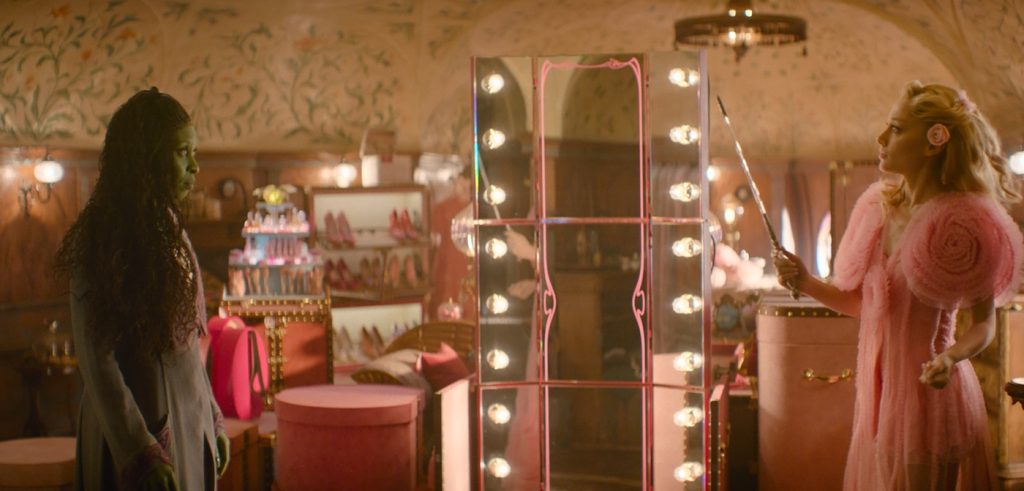
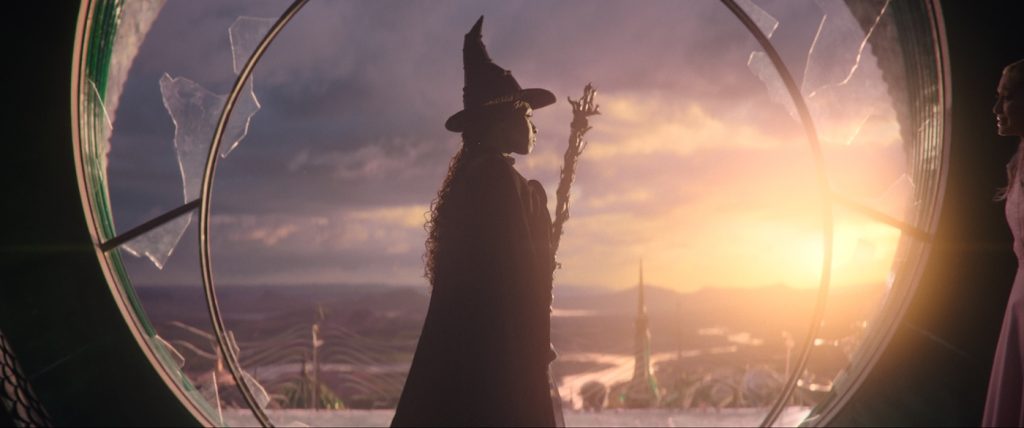
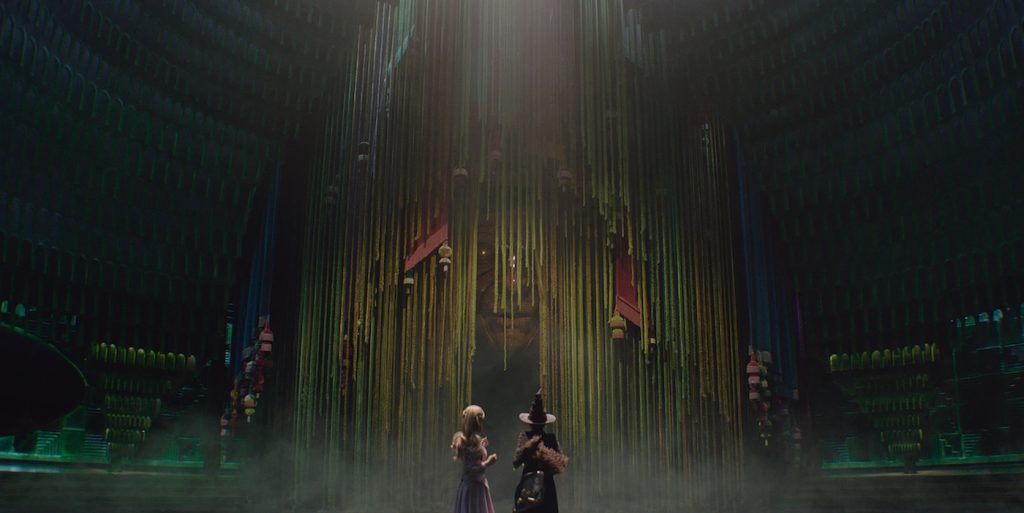
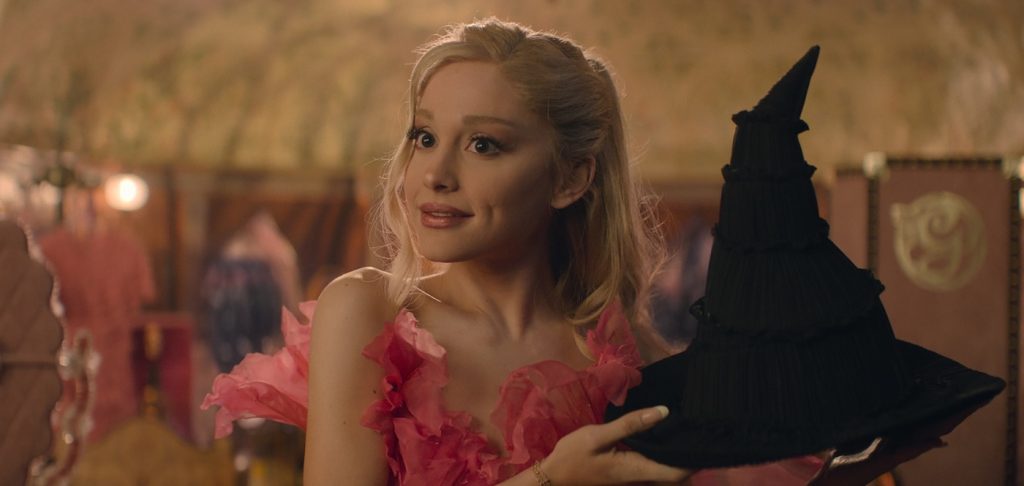
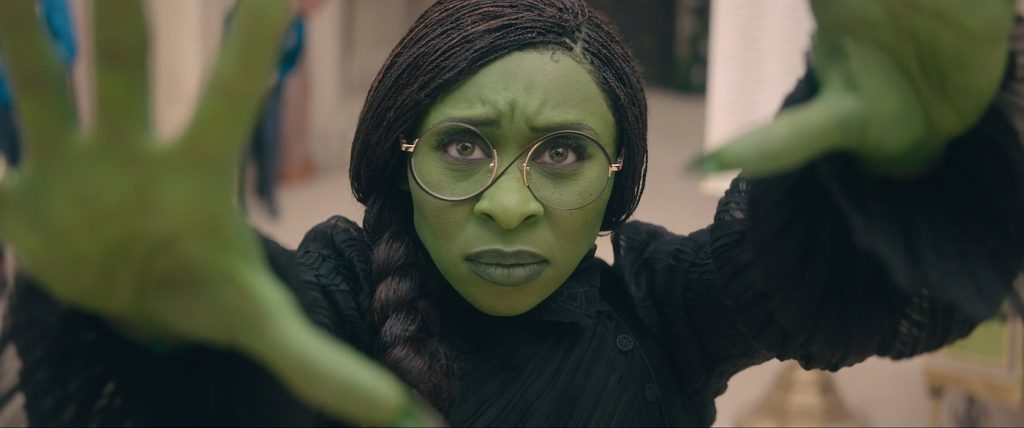
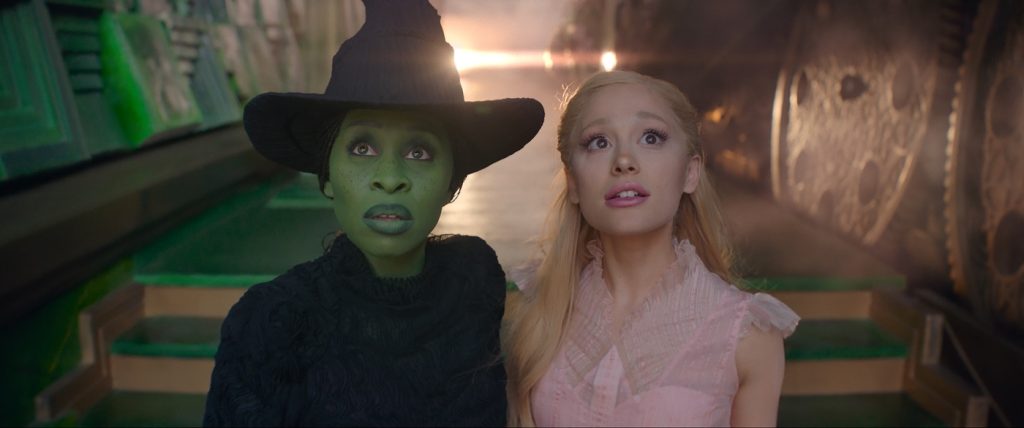
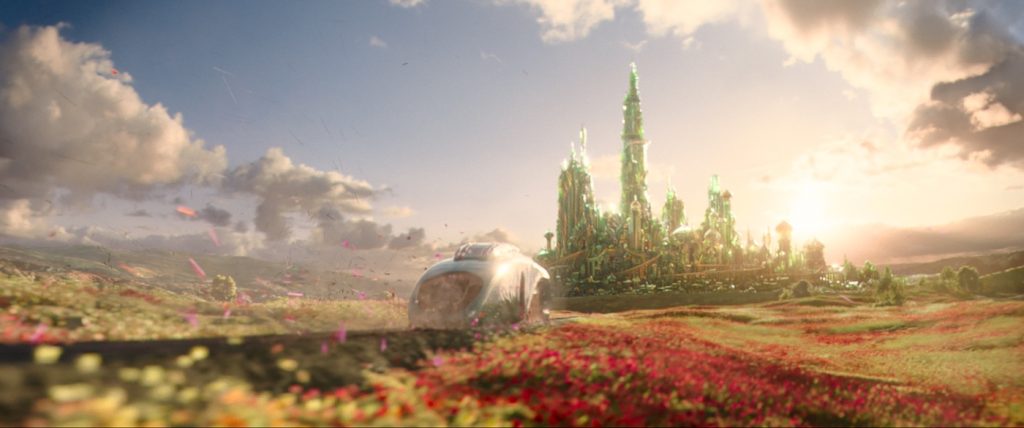
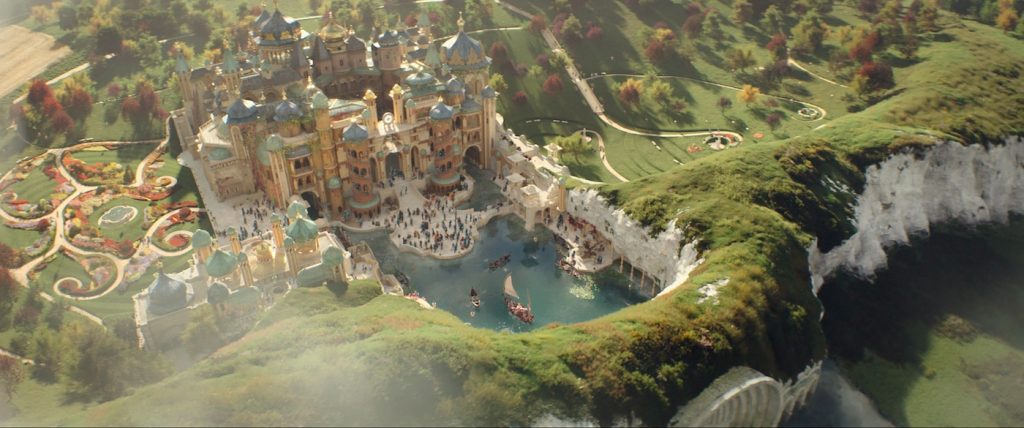
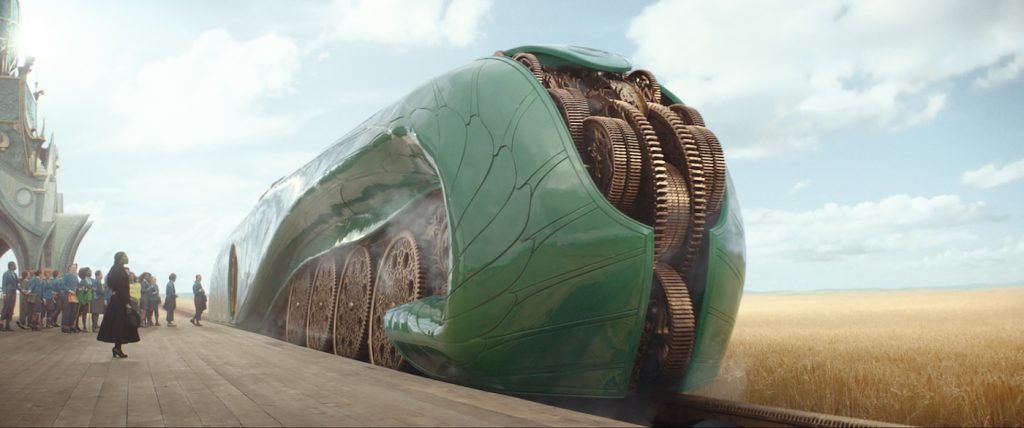
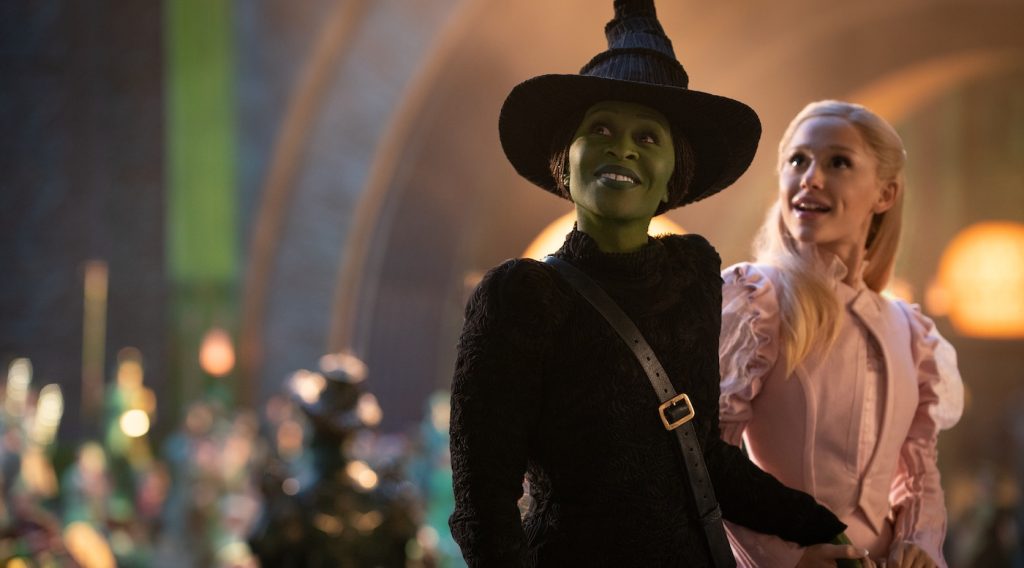
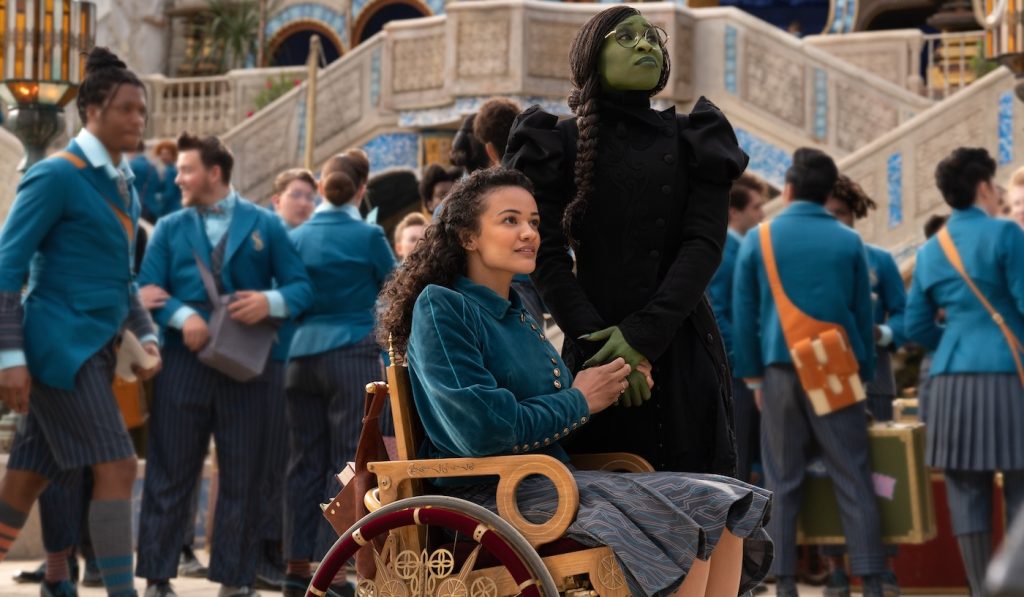
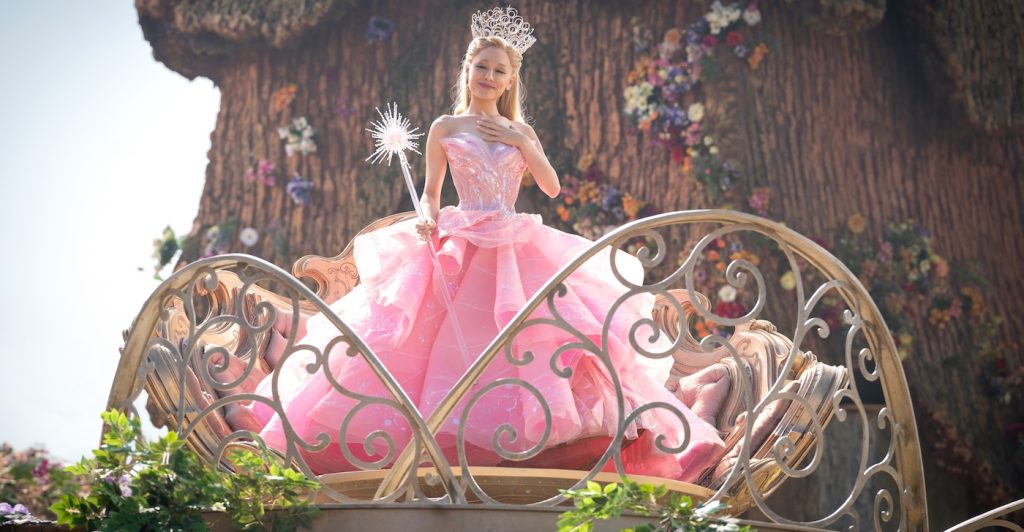
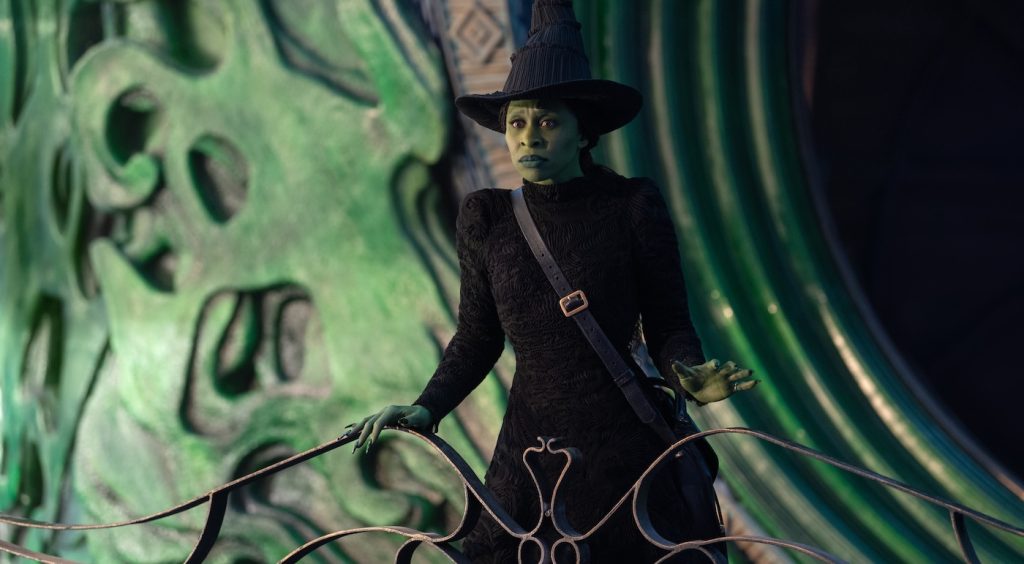
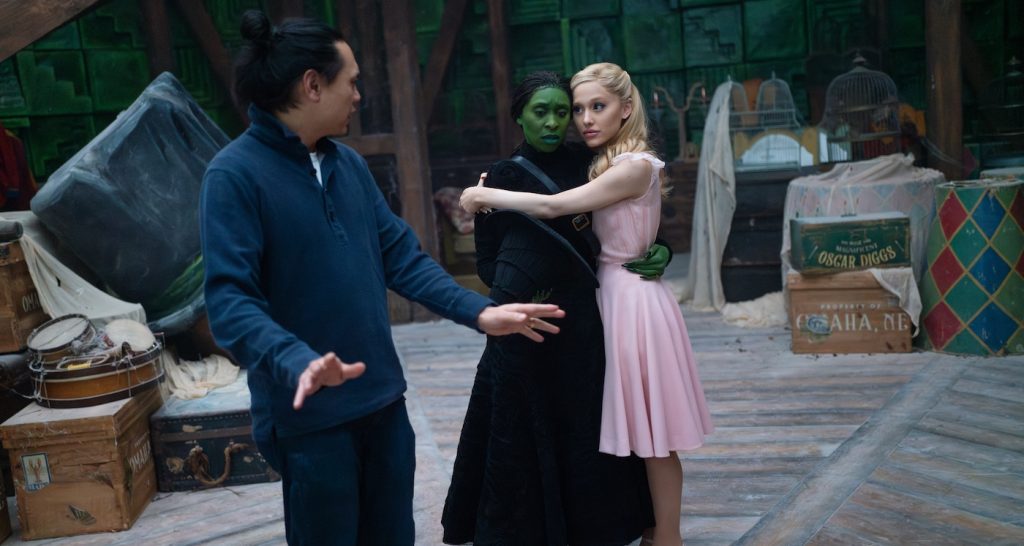
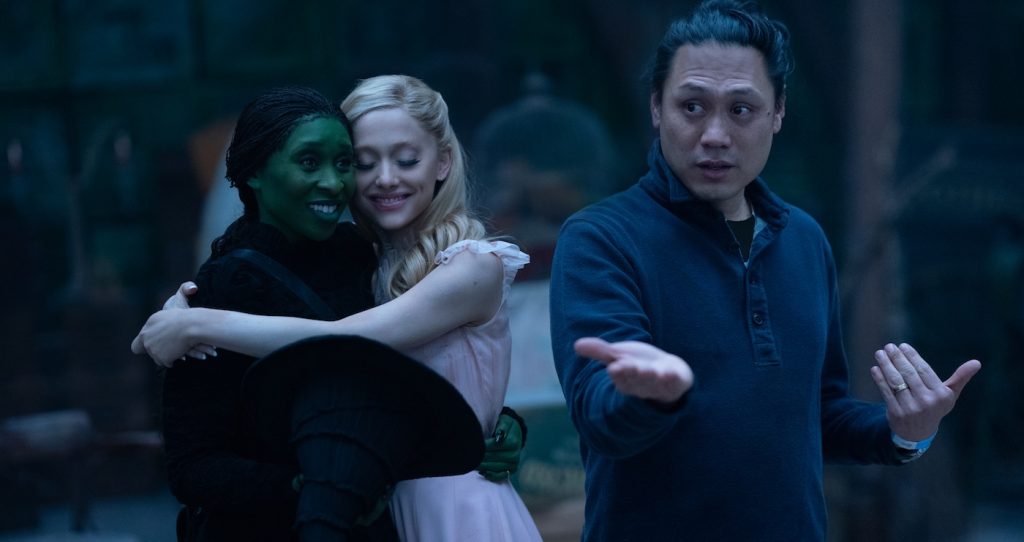
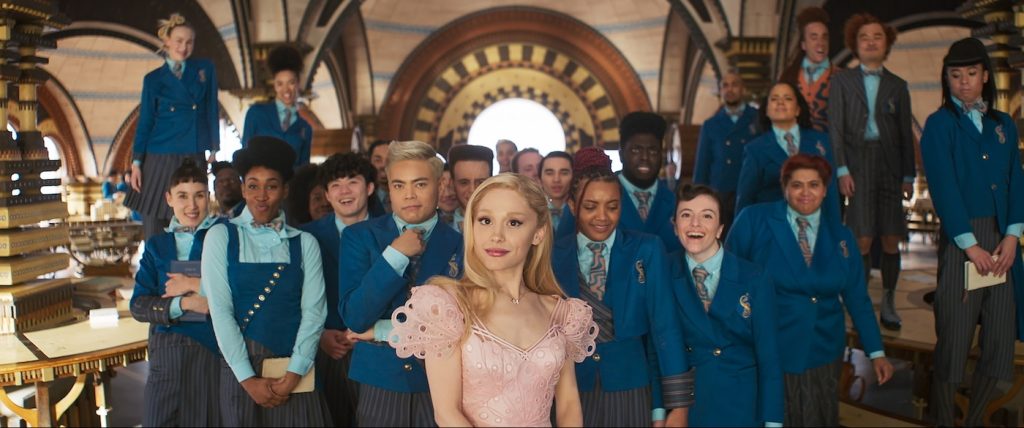
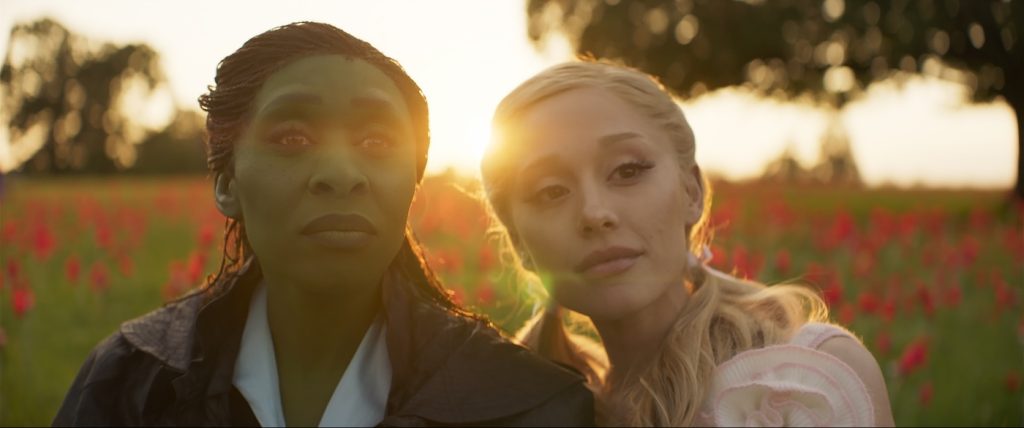
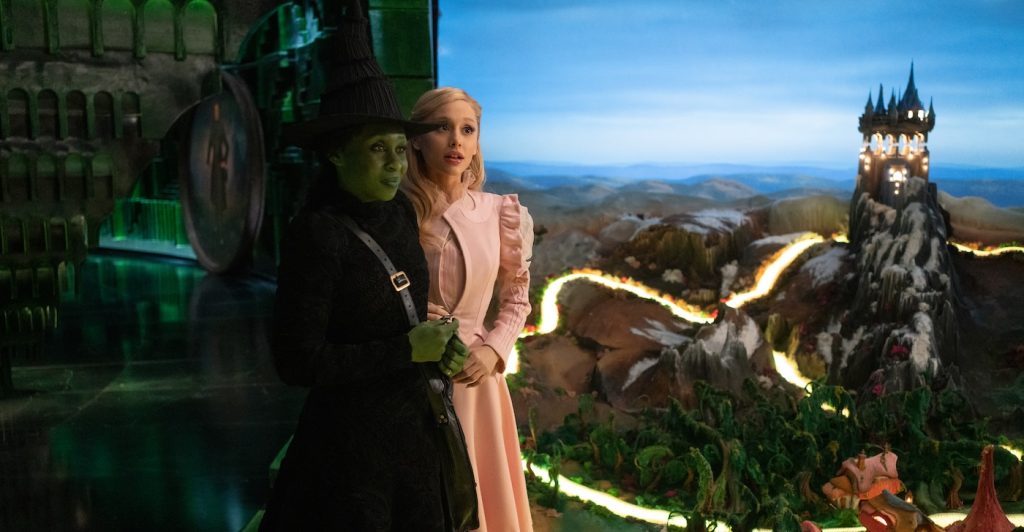
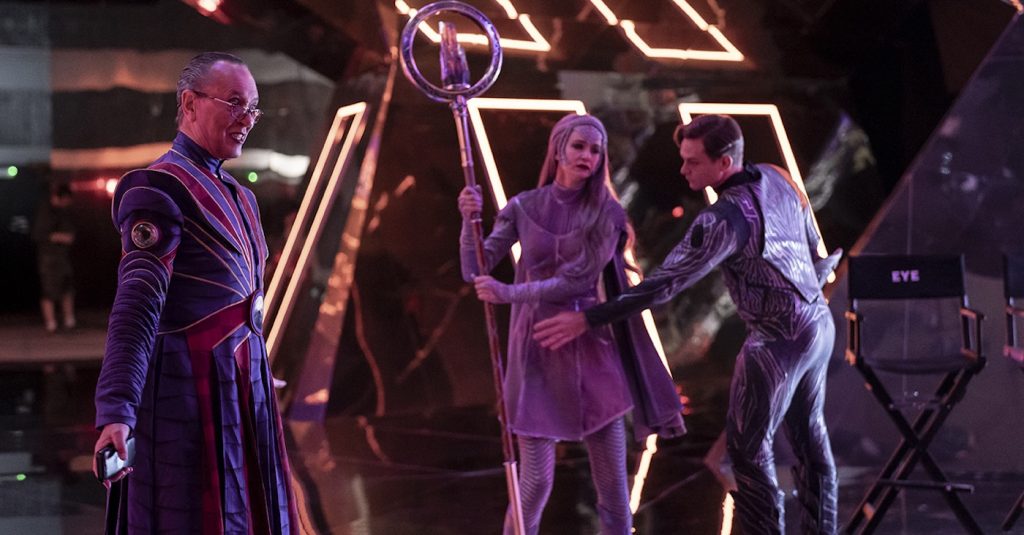
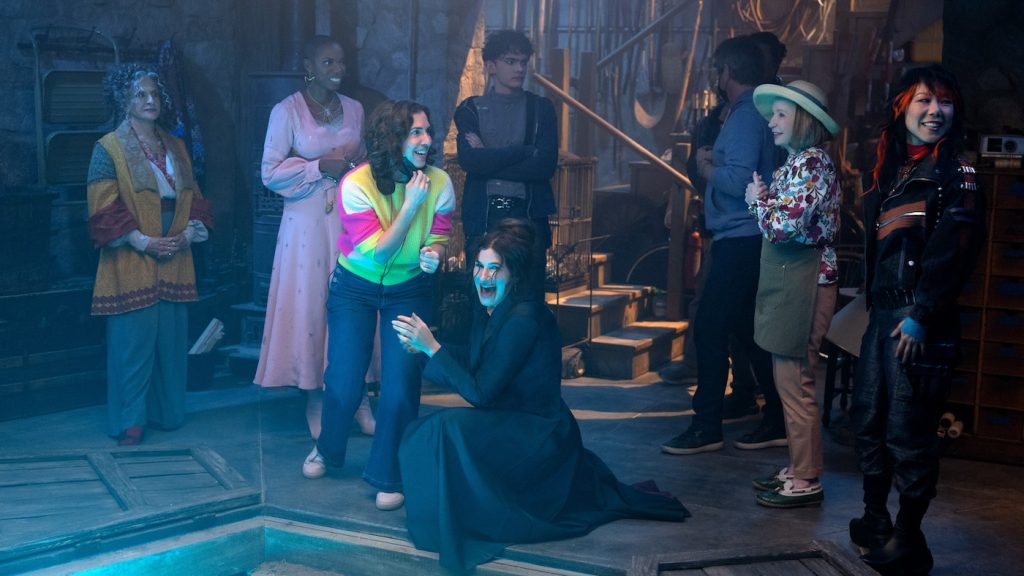
We’ve heard some of the iconic musical numbers that director John M. Chu has in store for us with his adaptation of Wicked, which will unleash the singing chops of superstars Cynthia Erivo (Elphaba) and Ariana Grande (Glinda), as well as a stellar cast that includes Jonathan Bailey (Fiyero), a young man with singing ability to spare. Those tunes include showstoppers “Popular,” “Dancing Through Life,” “The Wizard and I, “What is this Feeling?” and “Defying Gravity.” Now, Universal has also unveiled a bunch of new images from the film, which gives us a closer look at Elphaba and Glinda’s momentous adventure in Oz.
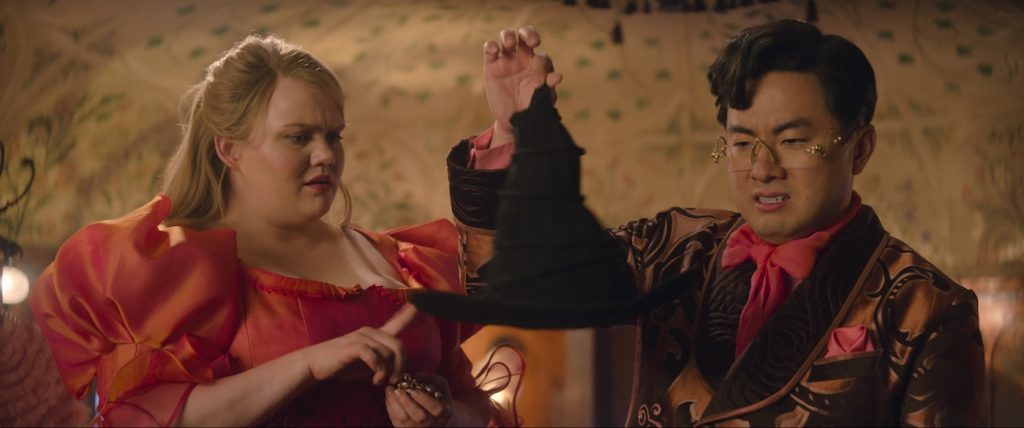
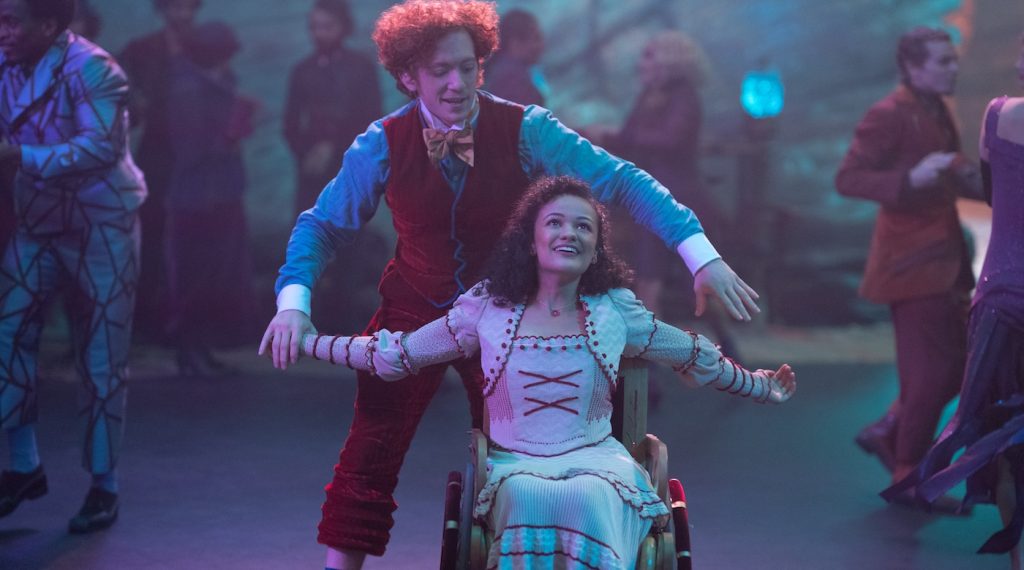
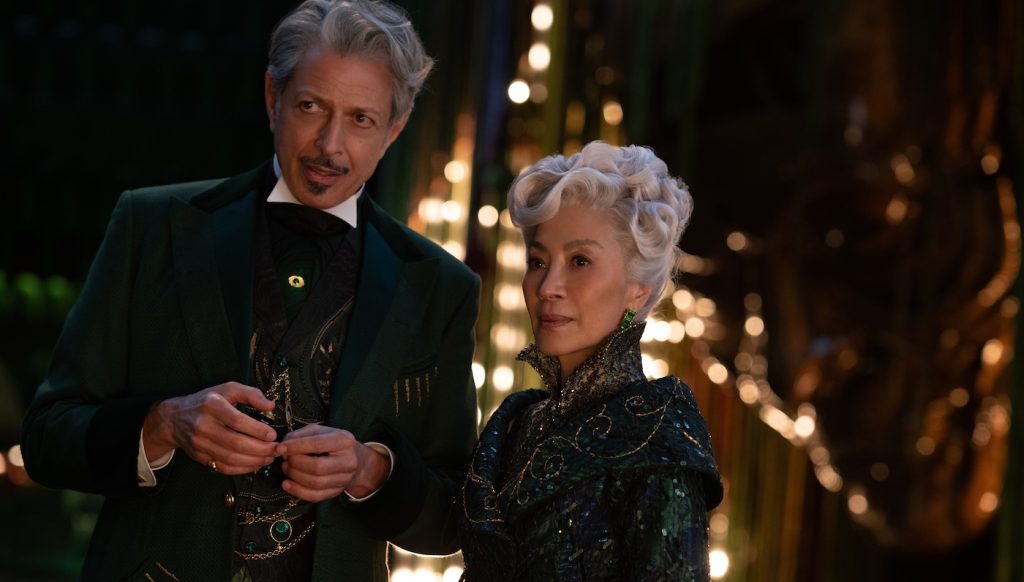
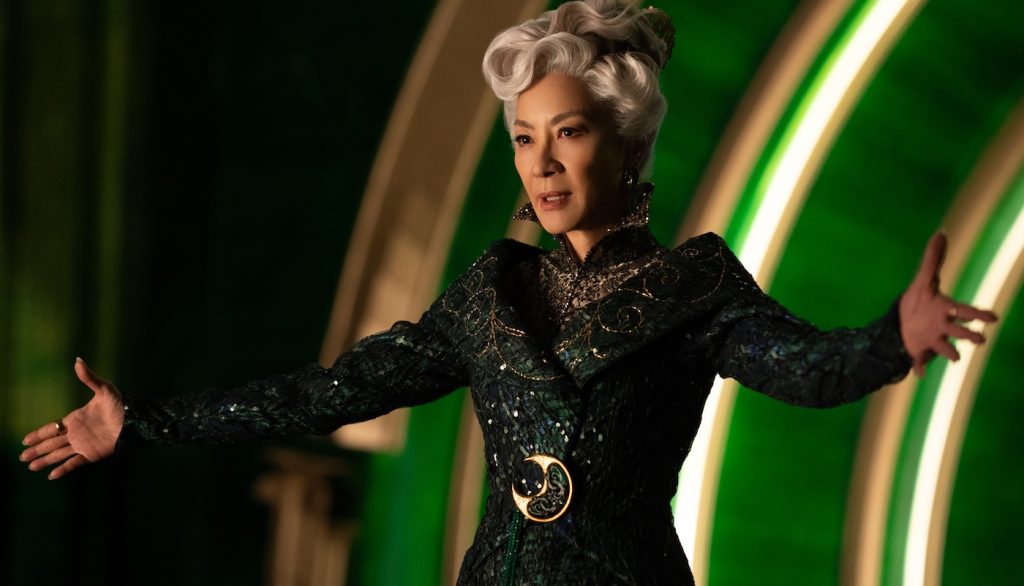
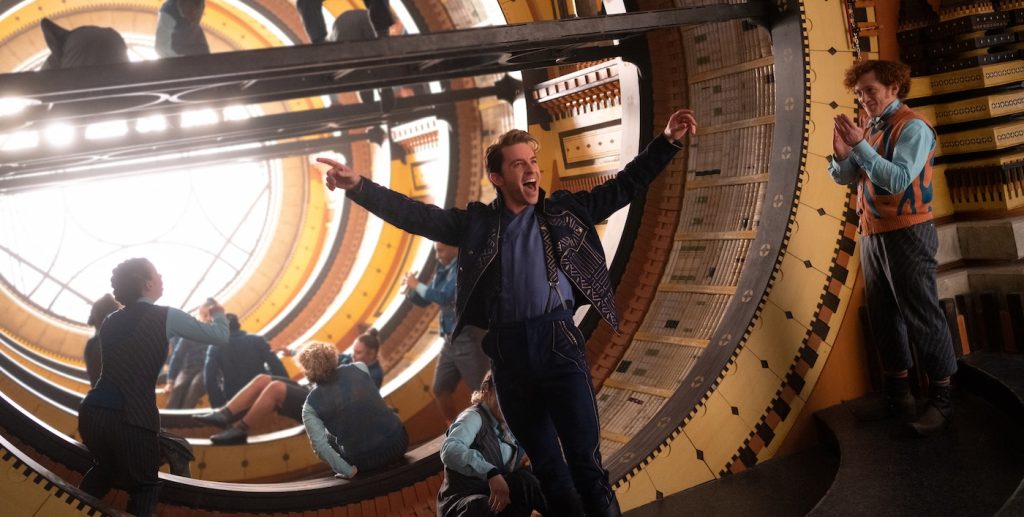
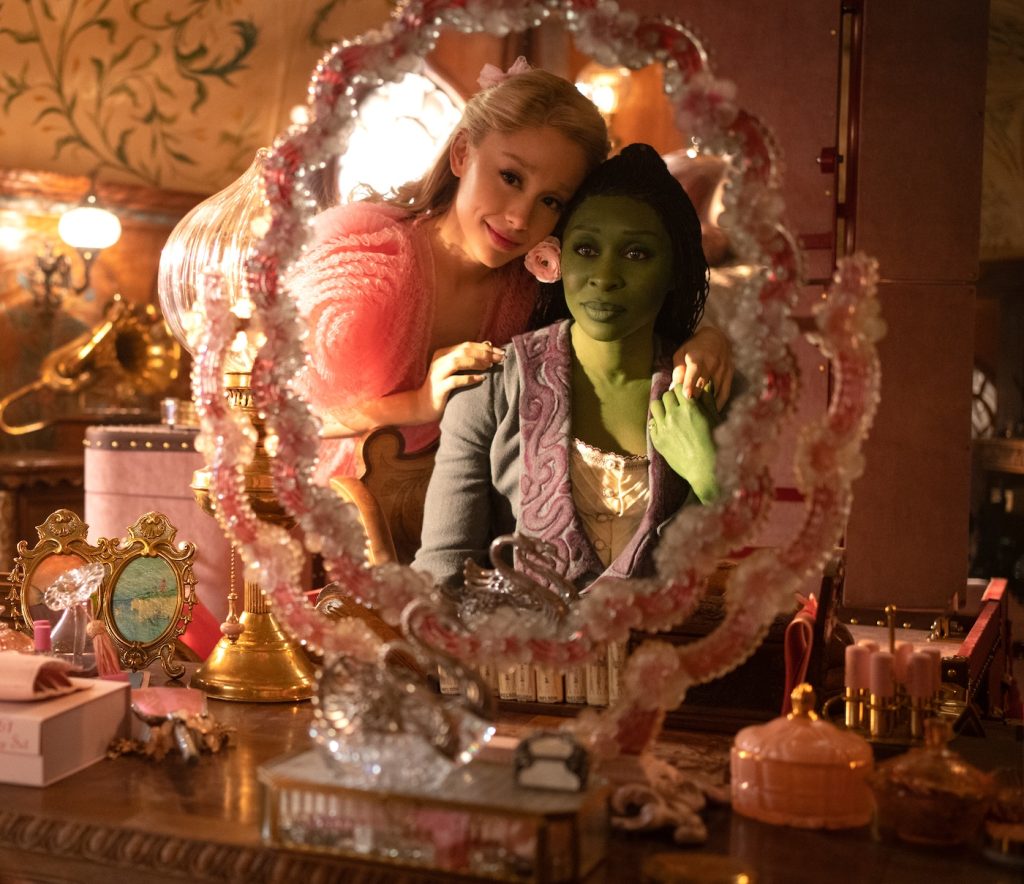
The new images include looks at the budding friendship between Elphaba and Glinda, Fiyero—a love interest of both Elphaba and Glinda—belting out a musical number, Michelle Yeoh’s Madame Morrible, the headmistress of Shiz University where Elphaba and Glinda meet, Marissa Bode’s Nessarose, Elphaba’s younger sister, Bronwyn James’ Shenshen and Bowen Yang’s Pfannee, Glinda’s friends at Shiz U., and Jeff Goldblum’s Wizard of Oz.
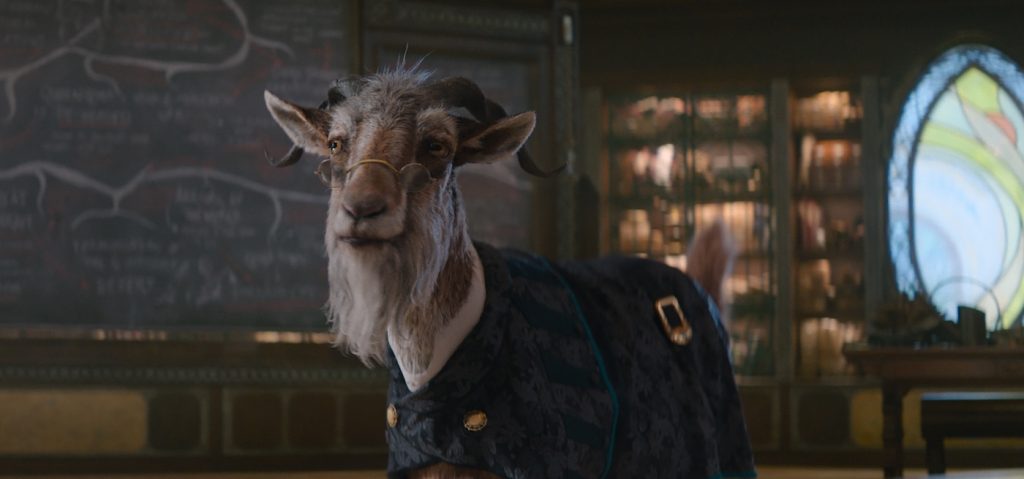
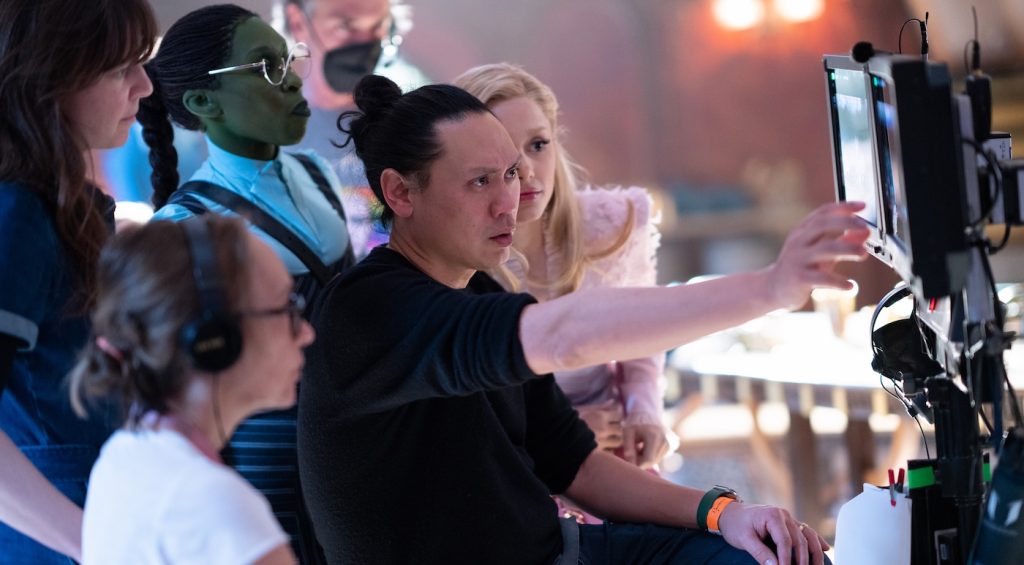
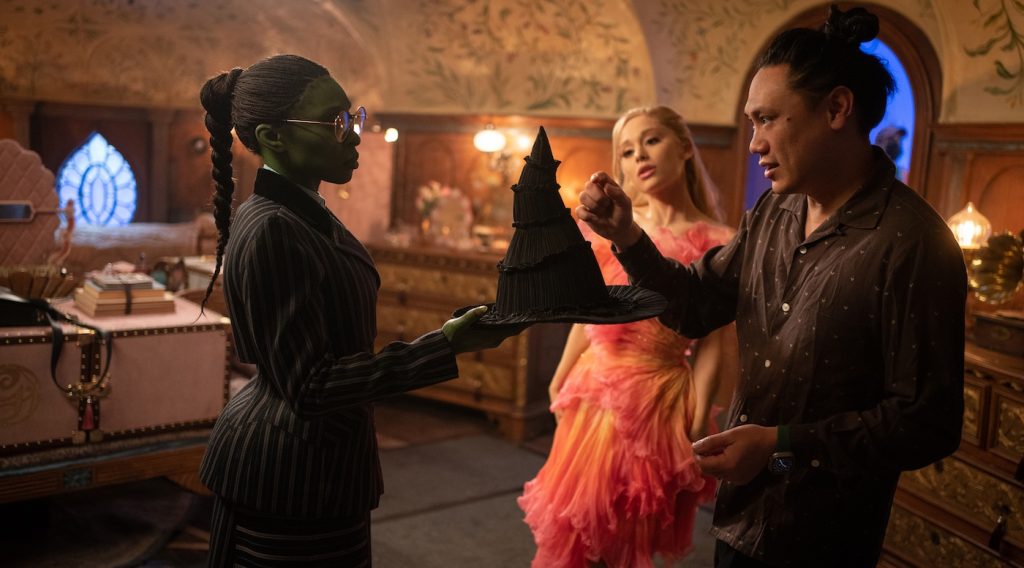
There’s more, including some behind-the-scenes shots of Chu and his stars on set and a wonderful shot of Dr. Dillamond, voiced by Peter Dinklage, a talking goat and university professor.
Wicked is the first big-screen adaptation of the juggernaut Broadway show (which itself was based on Gregory Maguire’s book) and reveals the world of Oz before Dorothy dropped in and changed everything. The adaptation will boast all the power ballads that rocked the Broadway stage and will enroll us at Shiz University, where Elphaba and Glinda cross paths and form an unlikely but profound friendship, one that will change both of their lives forever.
Wicked will enchant theaters on November 22. Check out the photos below.
L to R: Cynthia Erivo is Elphaba and Ariana Grande is Glinda in WICKED, directed by Jon M. ChuCynthia Erivo is Elphaba in WICKED, directed by Jon M. ChuWICKED, directed by Jon M. ChuAriana Granda is Glinda in WICKED, directed by Jon M. ChuL to R: Bronwyn James is Shenshen and Bowen Yang is Pfannee in WICKED, directed by Jon M. ChuCynthia Erivo is Elphaba in WICKED, directed by Jon M. ChuPeter Dinklage voices Dr. Dillamond in WICKED, directed by Jon M. ChuL to R: Cynthia Erivo is Elphaba and Ariana Grande is Glinda in WICKED, directed by Jon M. ChuThe Emerald City in WICKED, directed by Jon M. ChuShiz University in WICKED, directed by Jon M. ChuWICKED, directed by Jon M. ChuL to R: Cynthia Erivo is Elphaba and Ariana Grande is Glinda in WICKED, directed by Jon M. ChuL to R: Marissa Bode is Nessarose and Cynthia Erivo is Elphaba in WICKED, directed by Jon M. ChuAriana Grande is Glinda in WICKED, directed by Jon M. ChuCynthia Erivo is Elphaba in WICKED, directed by Jon M. ChuL to R: Director Jon M. Chu with Cynthia Erivo (as Elphaba) and Ariana Grande (as Glinda) on the set of WICKEDCynthia Erivo is Elphaba, Ariana Grande is Glinda and Director Jon M. Chu on the set of WICKED, from Universal PicturesCenter L to R: Cynthia Erivo (as Elphaba), Director Jon M. Chu, and Ariana Granda (as Glinda) on the set of WICKEDEthan Slater is Boq and Marissa Bode is Nessarose in WICKED, directed by Jon M. ChuL to R: Jeff Goldblum is The Wizard of Oz and Michelle Yeoh is Madam Morrible in WICKED, directed by Jon M. ChuMichelle Yeoh is Madame Morrible in WICKED, directed by Jon M. ChuJonathan Bailey is Prince Fiyero in WICKED, directed by Jon M. ChuL to R: Cynthia Erivo (as Elphaba) and Ariana Grande (as Glinda) with Director Jon M. Chu on the set of WICKED.L to R: Ariana Grande is Glinda and Cynthia Erivo is Elphaba in WICKED, directed by Jon M. ChuAriana Granda is Glinda in WICKED, directed by Jon M. ChuL to R: Cynthia Erivo is Elphaba and Ariana Granda is Glinda in WICKED, directed by Jon M. ChuL to R: Cynthia Erivo is Elphaba and Ariana Grande is Glinda in WICKED, directed by Jon M. Chu
A new Wicked teaser has arrived on a pair of monkey wings and musical notes, boasting a bunch of the iconic songs that fans of the Broadway Musical adore and are clamoring to see on the biggest screen possible when director John M. Chu’s adaptation hits the big screen.
The new teaser dives right into the music, with Grammy-winning, multiple-platinum superstar Ariana Grande’s Glinda clapping her hands and calling out, “Everyone, I have an announcement!” That announcement, for Wicked fans that is, is that tickets are now on sale, and who better to get that message across than Grande and her equally award-laden, multitalented co-star Cynthia Erivo, playing Elphaba, the eventual Wicked Witch of the West. You want to get people excited for your movie? Unleash these two super-talents on some of Wicked’s most beloved musical numbers.
In order of appearance, the tunes you’ll hear in the teaser are “Popular,” “Dancing Through Life,” “The Wizard and I, “What is this Feeling?” and “Defying Gravity.” Previous teasers and trailers have included “Popular” and “Defying Gravity,” but the rest are new.
It is no surprise that Erivo and Grande can sing, dance, and act, but so, too, can Jonathan Bailey. He plays Fiyero, a former Arjiki prince, and is both Glinda’s and Elphaba’s love interest in the story. The man has serious pipes.
Chu’s Wicked is the first big-screen adaptation of the juggernaut Broadway show, which was based on Gregory Maguire’s book and tells the story of what actually happened before Dorothy dropped into Oz and changed everything. As this teaser makes clear, Wicked won’t skimp on the power ballads that rocked the Broadway stage and will take us onto the campus of Shiz University, where Elphaba and Glinda cross paths and an unlikely but profound friendship blossoms. That eventually leasd to a life-changing encounter with Wonderful Wizard of Oz (Jeff Goldblum), which will set off a course of events that, as we know, will become the stuff of legend in The Wizard of Oz.
Joining Erivo, Grande, and Bailey are Michelle Yeoh as Madame Morrible, Ethan Slater as Boq, and Bowen Yang as Pfannee.
Wicked will enchant theaters on November 22. Check out the new teaser here:
Christopher Nolan and Universal had quite the collaboration with Nolan’s Oppenheimer, the critical and commercial smash hit that was nominated for 13 Oscars and won 7, including Best Picture, Best Director for Nolan, Best Actor for Cillian Murphy, and Best Supporting Actor for Robert Downey Jr. Now, Deadlinescoops that Nolan and Universal are reteaming for the director’s next feature, with plans for an Imax release on July 17, 2026.
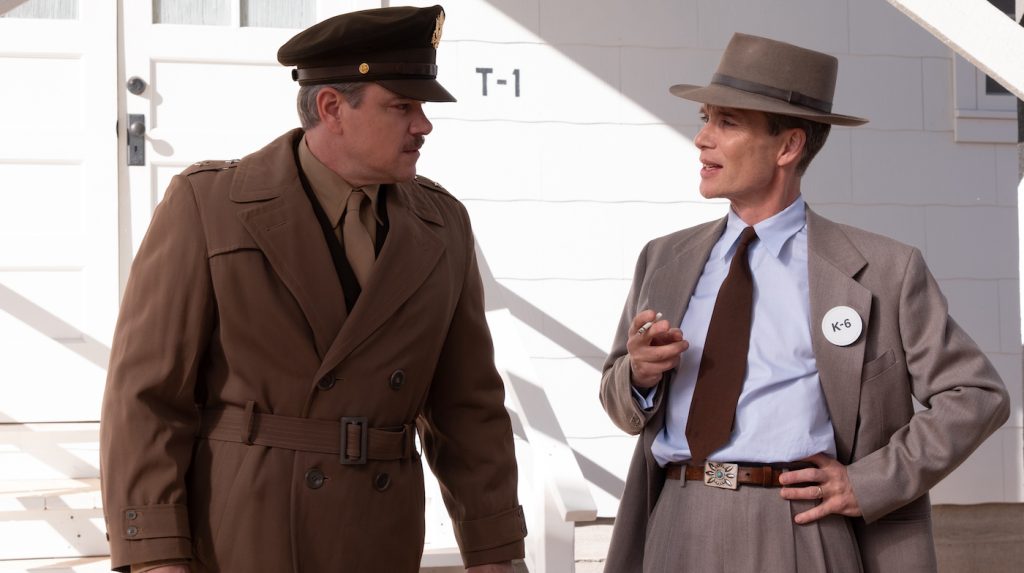
Deadline‘s scoop includes the nugget that Nolan is eyeing one of his Oppenheimer stars, Matt Damon, as his lead. Damon and Nolan have collaborated twice now; in Oppenheimer, Damon played Leslie Groves, the military man who helped arrange the Manhattan Project that Robert J. Oppenheimer led to build the atomic bomb. Previously, Damon had a brief but explosive role in Nolan’s emotional 2014 sci-fi epic Interstellar, where Damon played Dr. Mann, an astronaut marooned on a brutally cold planet orbiting a black hole called Gargantua. When Matthew McConaughey and his team arrive, Dr. Mann’s true intentions for his distress signal are revealed.
L to R: Matt Damon is Leslie Groves and Cillian Murphy is J. Robert Oppenheimer in OPPENHEIMER, written, produced, and directed by Christopher Nolan.
Nolan’s new project is a state secret, of course. Neither Nolan nor Universal has any comment, but the mid-July release date is similar to the sweet spot when Oppenheimer was released, as well as his 2010 mind-tripper Inception and his most beloved contribution to the superhero world, his 2008 film The Dark Knight.
We’ll share more details about Nolan’s upcoming project when we hear them.
For more on Universal Pictures, Peacock, and Focus Features projects, check out these stories:
“You tramped all the way from Minnesota,” says Edward Norton’s Pete Seeger at the opening of the official trailer for A Complete Unknown. “Why is that?”
“I wanted to catch a spark,” comes the answer from a young man named Bob Dylan, played here by an appealingly understated (if still undeniably charismatic) Timothée Chalamet. A Complete Unknown, from director James Mangold and written by Mangold and Jay Cocks, follows one of the most influential and iconic musicians ever produced in the United States, but crucially, aims to capture not Dylan’s entire epic life (at least, up to now), but his early, transformative years in New York City.
The trailer introduces us to a young Dylan finding his way in NYC and meeting some of the era’s most talented performers, both already in demand and those on the rise. One of the most crucial relationships Dylan establishes at that time is with another extremely gifted singer/songwriter, Joan Baez (Monica Barbaro), who at one point says, “Your songs are like an oil painting at the dentist’s office,” to which she replies, “You’re kind of an a**hole, Bob.”
Another important Dylan relationship explored in A Complete Unknown is with his girlfriend, Sylvia Russo (Elle Fanning), a version of his real girlfriend at the time, Suze Rotolo. A Complete Unknown will track Dylan/Baez/Russo’s love triangle and capture the mounting pressure on young Dylan as he begins to resist the desires of the public and the music industry. “Two hundred people in that room, and each one of them wants me to be somebody else,” Dylan says at one point. “I wish they’d just let me be.” When asked what he wishes they’d let him be, he replies, “Whatever it is they don’t want me to be.”
The new trailer also touches upon one of the most seminal moments in 20th-century music history, when Dylan shocked the folk music world by plugging in an electric guitar during his 1965 Newport Folk Festival performance. This did not go over well with many Dylan supporters and festival organizers, although the decision changed Dylan’s life and the music industry as a whole.
A Complete Unknown includes moments that Dylan fanatics will recognize immediately, including his early performances at Cafe Wha? and Hotel Chelsea. The songs, however, will be recognizable to just about everyone, including “A Hard Rain’s a-Gonna Fall” and “Girl From the North Country.”
The cast also includes Boyd Holbrook as Johnny Cash, P. J. Byrne as Harold Leventhal, Scoot McNairy as Woody Guthrie, Dan Fogler as Albert Grossman, and Will Harrison as Bob Neuwirth.
Check out the full trailer below. A Complete Unknown rambles into theaters on Christmas Day.
For more stories on 20th Century Studios, Searchlight Pictures, Marvel Studios and what’s streaming or coming to
Will Smith and Michael Bay are reuniting for another breathless action movie.
Smith and Bay are in talks to reteam for the Netflix actioner Fast and Loose. Bay will direct Smith in a movie about a crime boss suffering from amnesia after an attack. The catch? This underworld kingpin slowly starts to learn that he’s actually a CIA agent. The script comes from Eric Pearson, Chris Bremmer, Jon Hoeber, and Erich Hoeber. Deadlinewas the first to scoop the story.
The film was initially slated to be helmed by another director with major action chops—David Leitch—but Leitch ultimately left the project to work on his ode to stunt performers, The Fall Guy, with Ryan Gosling and Emily Blunt.
Smith and Bay go way back—they first collaborated on the 1995 action-comedy Bad Boys, in which Smith joined Martin Lawrence as a pair of haggling, heroic Miami cops. Smith and Lawrence have recently reprised the character, with last year’s Bad Boys: Ride or Diebeing their most recent effort.
Ride or Die was a hit, and Smith’s return from the infamous Oscars slap heard around the world in 2022, the year he won his first Oscar for his performance in 2021’s King Richard. After Ride or Die, Smith was in talks to star in the sci-fi feature Resistor, based on novelist Daniel Suarez’s 2014 book “Influx” for Sony, which follows physicist Jon Grady after he and his team discover a device that can reflect gravity that eventually falls into the wrong hands, but has exited the project. Smith was also planning to star in Sguar Bandits, aBoston-set crime thriller from Sicario: Day of the Soldado filmmaker Stefano Sollima, which he and his production company, Westbrook, are still looking to produce.
Bay has taken a brief break from directing. His last time behind the camera was for Universal’s potent, tightly wound film Ambulance, starring Jake Gyllenhaal and Yahya Abdul-Mateen II. He is, of course, famous for bringing the world of Transformers to the big screen back in 2007, jumpstarting a mega-franchise that includes seven live-action features and this year’s critically acclaimed animated film Transformers: One.
For more on big titles on Netflix, check these out
Featured image: L-r: MEXICO CITY, MEXICO – MAY 31: Will Smith poses during a photoshoot for the movie ‘Bad Boys: Ride or Die’ at Angel de la Independencia on May 31, 2024 in Mexico City, Mexico. (Photo by Hector Vivas/Getty Images). NEW YORK, NEW YORK – SEPTEMBER 17: Michael Bay attends the “Transformers One” premiere on September 17, 2024 in New York City. (Photo by Jamie McCarthy/Getty Images)
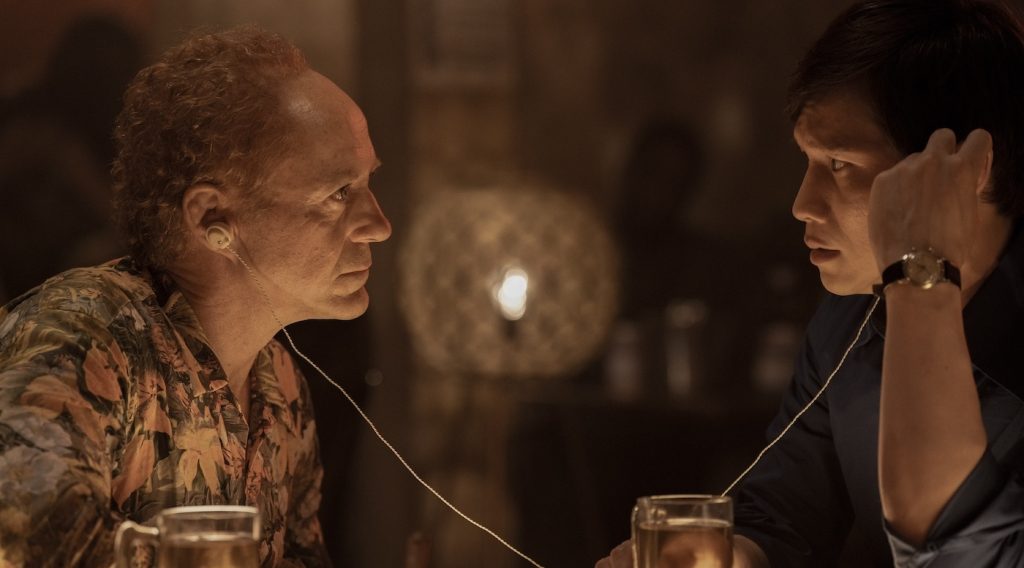
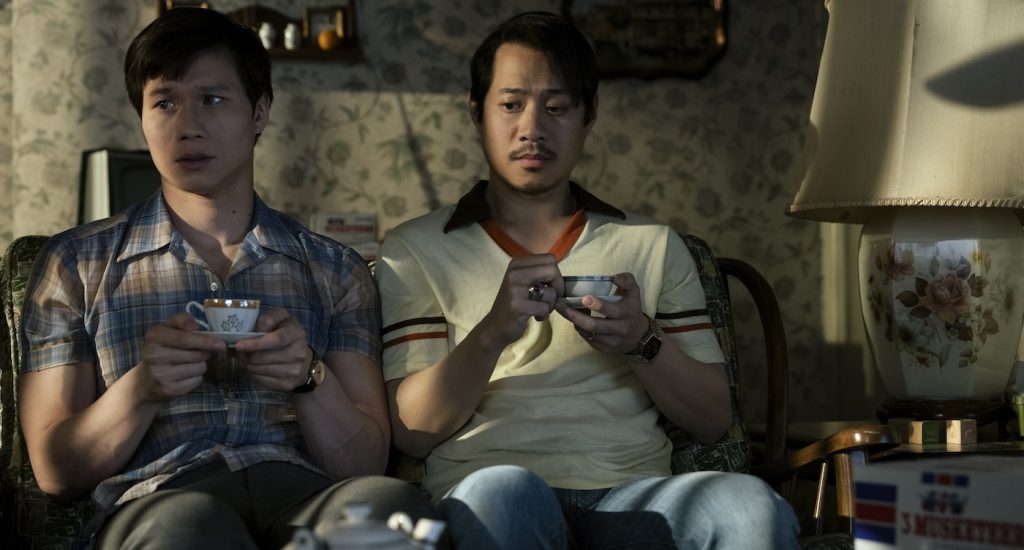
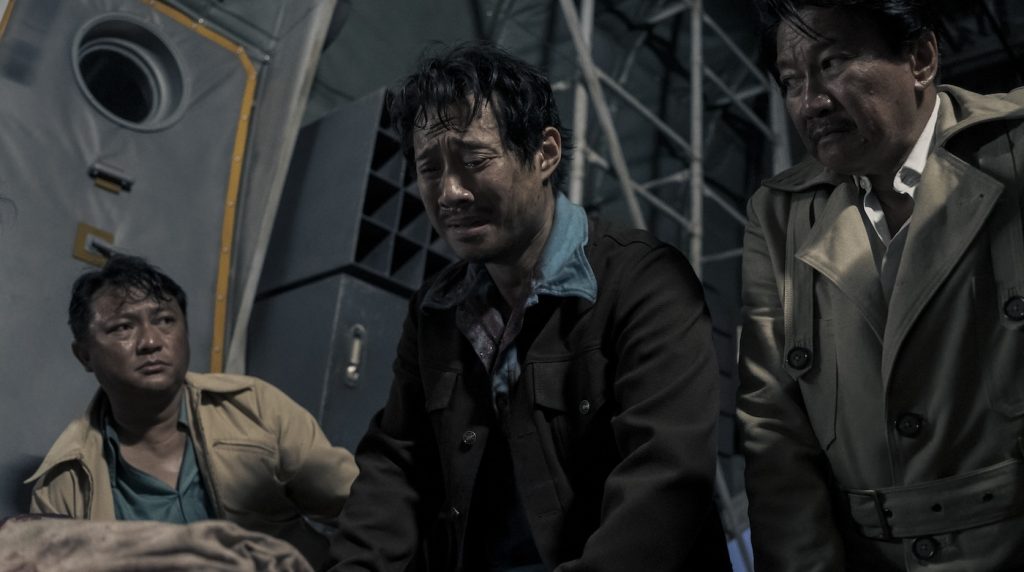
Casting director Jennifer Venditti had one of Hollywood’s great chameleons to work with when she was putting together the pieces for HBO’s limited series The Sympathizer. Robert Downey Jr. plays a quartet of characters in Park Chan-wook and Don McKellar’s adaptation of Viet Thanh Nguyen’s 2015 Pulitzer Prize-winning novel as the Oscar-winning performer is in a constant swirl of dramatic action among performers less well-known but all of them entirely game.
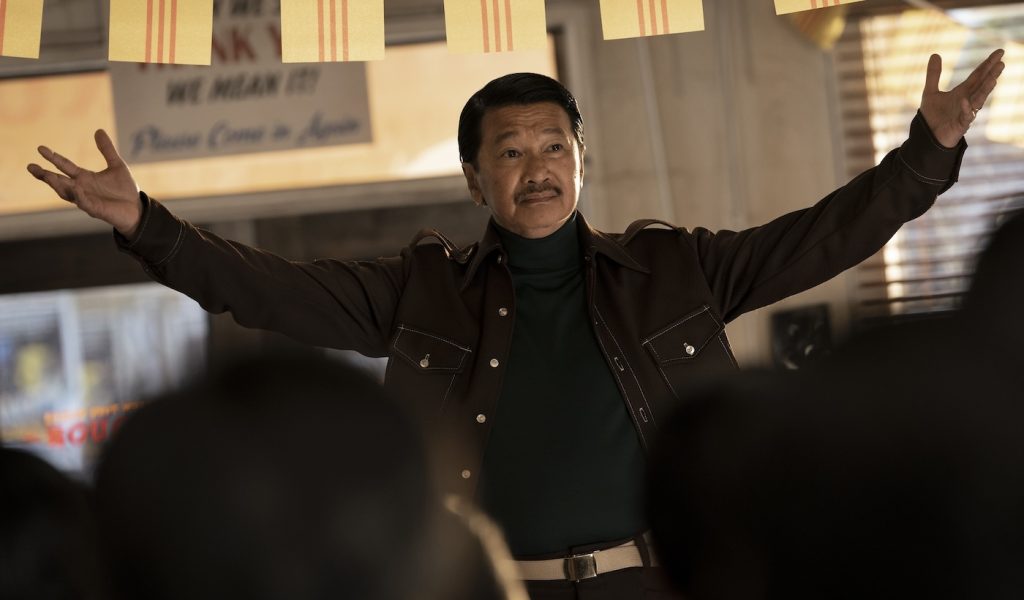
The show follows the twisting journey of Captain (Hoa Xuande), a communist operative working as a mole in South Vietnam’s army who ends up escaping to the U.S. alongside his nominal boss, the General (Toan Le). The Captain ends up in California, where he remains embedded in a South Vietnamese refugee community where he monitors and reports to the Viet Cong. It’s a fitting city for the Captain to make a new home—a town built on illusion; the Captain interacts with a bevy of Americans in various positions to aid and potentially abet his machinations. One of those is a CIA operative named Claude (Downey), whom the Captain met in Vietnam; while in the U.S., the Captain comes into contact with ingratiating California congressman Ned Godwin (Downey) and the filmmaker (Downey again), a bearded 1970s auteur.
Hoa Xuande and Roberty Downey Jr. Photograph by Hopper Stone/HBO
Surrounding Xuande, Le, and multiple Downeys is a rotating cast of scene-stealing performers, each perfectly calibrated to the series’ twisty, darkly comedic tone. Venditti, a seasoned casting director who has populated some of the most memorably offbeat casts in recent memory, including two standout films in 2019, the Safdie Brothers’ Uncut Gemsand director Alma Har’el’s Honey Boy, put her years of experience to work when she populated one of the year’s most satisfyingly diverse and delicious series. Venditti takes us through her intuitive process.
When you take on something like The Sympathizer, which comes from award-winning source material, are you taking any cues from Viet Thanh Nguyen’s novel?
Good question. When A24 first contacted me, I had not read the book, but my casting associate, Alan Scott Neal, said it was his favorite book. So he was the person that really was like, “Oh my God, we have to do this. This is amazing.” And so I read the script. I was obviously a huge fan of director Park and had worked for HBO and A24 before, so it seemed like a no-brainer. But the first way in was the script for me, and then I read the book. Then, there were really detailed conversations with director Park and co-showrunner Don McKellar about their visions because they both had very clear ideas of how they envisioned these characters coming to life. Then it’s the process because you can have these ideas of what you’re looking for, and then the process shows you and materializes things in a way you might not have seen.
What materialized for you during the casting process?
Like with Bon [Fred Nguyen Khan], director Park really wanted someone with a physicality to them. Fred had done stunts and martial arts, so you talk about it, and as you look and search and people show up, you start to put it all together. That’s my favorite part of the process: learning about it and then letting it go and allowing the mystery of the search to bring things together. Fred and Hoa had such good chemistry; things like that are very cool when they happen.
oa Xuande, Fred Nguyen Khan. Photograph by Hopper Stone/HBO
So, in a sense, the project reveals what it wants to be.
And it’s interesting, I’m really not that kind of person. One of the things I do like is discoveries, and one of the reasons they might have reached out to me for this is because they knew I was going to have find a lot of people, we weren’t going to find everyone from traditional casting because of the requirements of the script. So there’s some part of me that really likes the mystery and discovery rather than just going with people I already know.
Phanxinê, Fred Nguyen Khan, Toan Le. Photograph by Hopper Stone/HBO
HBO and A24 both have really solid track records for casting really interesting ensembles, whether it’s Mare of Eastown
HBO cares so much about casting; it’s so important to them. So they’re very much involved in the process, and A24 is great like that two, they both have really good taste an they’re great at supporting the process and letting you do what you do best, but they also have great notes. You look forward to their notes because you’re seeing so many people. It’s great to get feedback from people you respect who really take it seriously and have such a good eye as well.
Obviously, for American audiences, you’ve got one of the biggest stars in the business in Robert Downey Jr., not only in the series but in multiple roles. Then you’ve got Sandra Oh, another amazing performer, and then you’ve got all these folks who are lesser known but who more than hold their own. What’s it like mixing these two worlds of performers?
I have a chapter in my book [“Can I Ask You A Question?”] about this called “The Alchemy of Casting,” I do think there’s something beautiful about what happens when you take someone who’s so grounded and clear and experienced in knowing where a scene is going to go and then you take someone with less experience, there’s wild alchemy about that where there’s something about the person who’s not as experienced make it more alive for the more experienced performer, and then the experienced person grounds the other person. And as intimidating as you might think it is for a newcomer to be across from Robert Downey Jr., across the board, what everyone has said is working with him, he’s so generous, he makes you so comfortable, he’s so intuitive, he can feel when you’re not feeling good about it, and he can help drop into that with you and put you at ease.
Is there a specific pairing you’re thinking of?
For example, Toan Le, who plays the General, his story is amazing. He has all these scenes with Robert Downey Jr. and he kills it. People say you’re only as good as your scene partner, and I think Robert being that good lends to the other person. Toan was someone who had wanted to act since he was young, and in his 20s, he’d been in plays, but there just weren’t roles for Vietnamese actors. So he got a day job as a graphic designer for years, and he saw our open call and sent in a tape, and then became a series regular. People always think that only happens for young people and that people aren’t taking risks like that later in life, and he went for it. He’s a great example of someone who really held their own, and Robert really leaned in and supported them.
Toan Le. Photograph by Hopper Stone/HBO
This type of live wire alchemy is really present in many of the movies you’ve cast, especially in the Safdie brothers’ Uncut Gems and Good Time.
It’s magic. When I was young, I didn’t really watch movies or TV; I was obsessed with people-watching, and the Safdies were the same way. A lot of the people that I work with enjoy that, too. For this project, if we could have just found everyone by reaching out to an agency, then we would have done it, but for this project, we had to search high and low because of all the diversity that wasn’t easily available at our fingertips. It was definitely intimidating, but there’s something about aliveness that lends to the magic on the screen. Sandra, too, and everyone said the same about her. We were lucky to have these gracious actors who created a safe space for the newer performers.
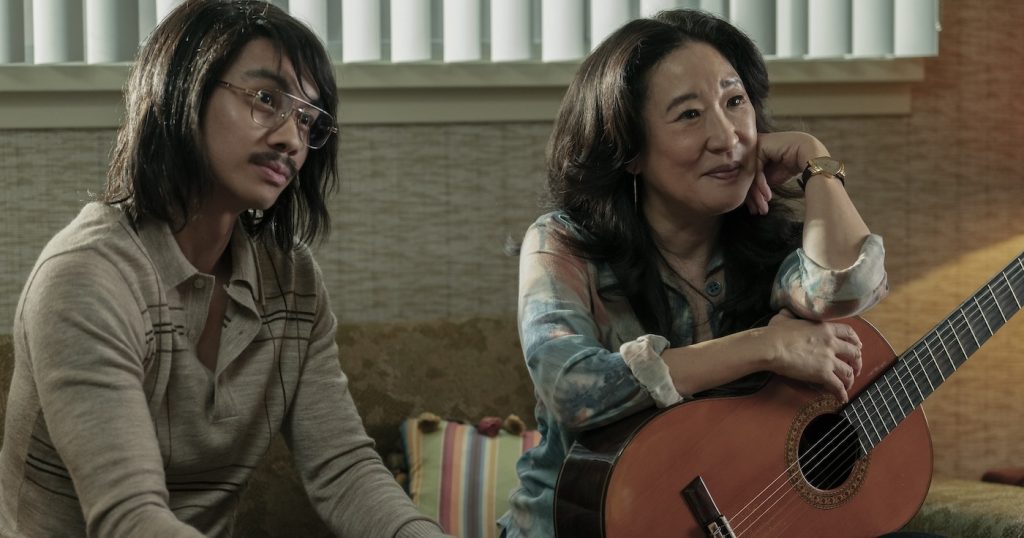
Alan Trong, Sandra Oh. Photograph by Hopper Stone/HBO
The Sympathizer is also about performance in a way…
Yeah, it’s meta because the idea is everyone’s an actor in their real lives. Do you know what I mean? This meta thing, I’m casting people to be human to portray a character, but we’re all doing that in our real lives as well.
How long do you feel like it took for you to feel comfortable just knowing during an audition, okay, this is working, or these two people have the right chemistry?
I think sometimes chemistry readings are necessary, but then, Robert Downey Jr. could have chemistry with a dead person [laughs]. Let’s not get it twisted. I’m not really worried about him having chemistry with anyone. There are certain things, like Hoa as the Captain and Fred as Bon, that was kismet in a way. We cast Fred first, and we had no idea that they knew each other and they’re best friends in real life. The beauty of this project is that the cast is so in love with each other. They all have such deep friendships, it happened on set, and it’s continued since then. It’s really cool when it translates past the project. There are a lot of things that are intuitive, and sometimes there are processes where you’re really trying to make it work, and this was one where it was really natural, and everyone seemed to have a really meaningful connection with each other. This was a shared experience to be a part of something so personal and to come together and connect on a deeper level.
For more on Warner Bros., DC Studios, Max, and more, check out these stories:
Gotham has never looked quite so seedy and dangerous as it does in HBO’s excellent The Batman spinoff series The Penguin. Shot in and around New York City (unlike previous films in the Batman universe, which have utilized international locations and cities that are not New York to recreate Gotham), The Penguin picks up in the aftermath of the Riddler’s bombing of the city at the end of The Batman, paralyzing large swaths of the cities and leaving whole neighborhoods in ruin. While Batman apprehended the Riddler, another net effect of the Riddler’s war on Gotham was that he took out Carmine Falcone (played in the film by John Turturro), leaving a power vacuum at the top of Gotham’s underworld. Into these dangerous waters swims Oz/Cobb, aka the Penguin (Colin Farrell reprising his role from The Batman), committed to outwitting and outmaneuvering the halfwits running the Falcone family and other wannabe power players in Gotham’s vast, unruly, ununified crime syndicate.
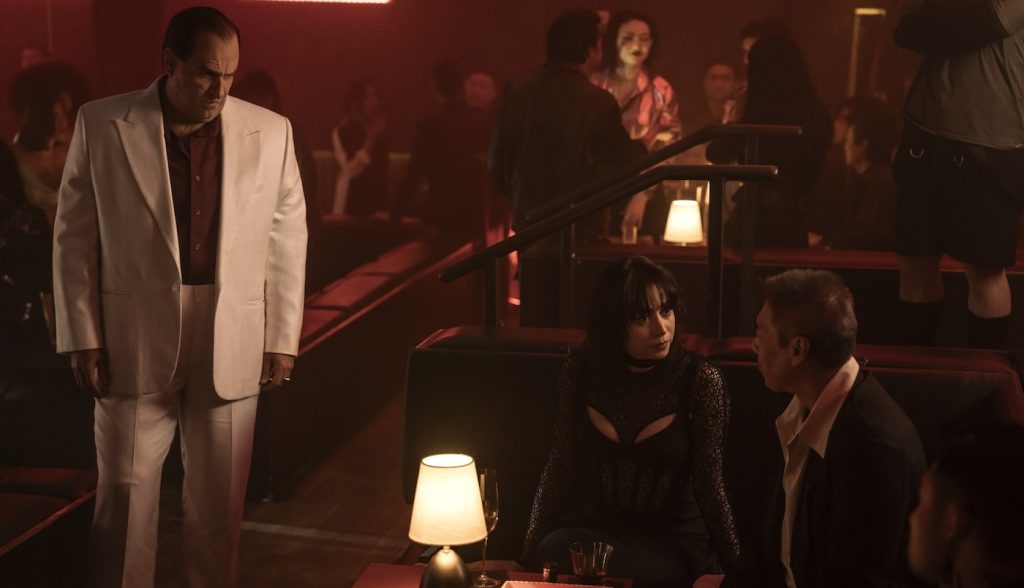
Colin Farrell, Cristin Milioti, Francois Chau. Photograph by Macall Polay/HBO
Yet as The Penguin moved into last night’s third episode, “Bliss,” Oz had struck a shaky alliance with one formidable potential adversary—Carmine’s daughter Sofia Falcone (a dynamite Cristin Milioti). The second episode ended with the two of them agreeing to work together to wrest control of Sofia’s family’s business from her uncle in the aftermath of her brother Alberto’s murder. Oz is hoping that Sofia remains unaware that he’s the one who did Alberto dirty, and episode three delves further into the murky waters of Oz’s plan, with their fragile alliance tested to the breaking point.
“Bliss” not only mucks around in Oz and Sofia’s tortured pasts, but it also maintained an eye on Victor Aguilar (Rhenzy Feliz), the young man Oz forced into servitude. Victor has become Oz’s driver, helpmeet, and oft-threatened surrogate son. He’s also one of the peoples’ whose lives was totally upended by the Riddler’s attack.
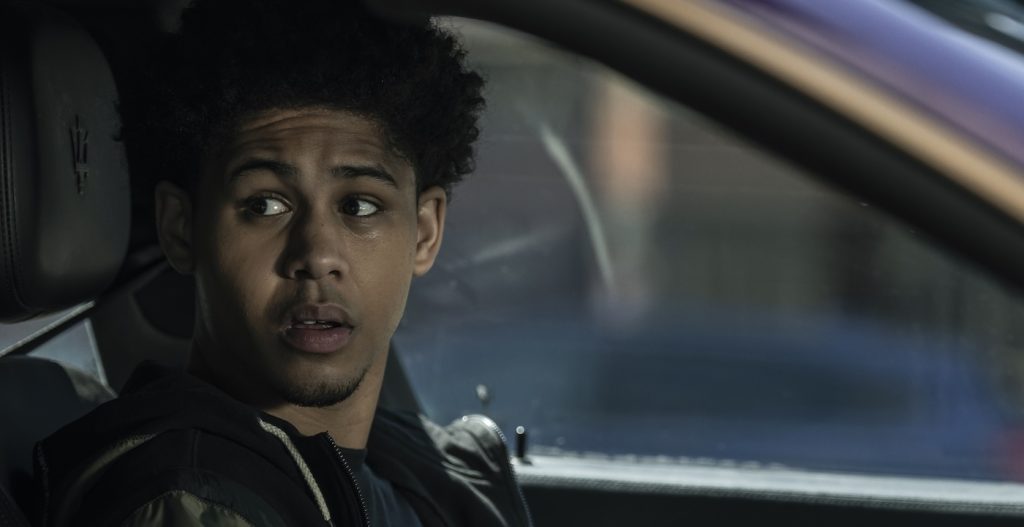
Rhenzy Feliz. Photograph by Macall Polay/HBO
Creator Lauren LeFranc has done a masterful job creating a deliciously demented, superhero-free Gotham in which the bad guys seem to be the only ones making moves. Episode 3 was written by Noelle Valdivia from a story developed by LeFranc and directed by Craig Zobel. It was also the first episode in the series to take us back to The Batman and the carnage and chaos the Riddler unleashed, giving us a better understanding of what regular folks like Victor and his family suffered at the hands of that madman’s attack.
A new “Inside the Episode” video from Max gives us a deeper dive into how this installment was crafted, with LeFranc explaining the importance of Victor to the series, Rhenzy himself discussing his character, with thoughts from Farrell, Zobel, and more.
Check out the video here. The Penguin airs on HBO on Sundays at 9 pm.
The City of Brotherly Love is about to show you that its motto can mean meaningful television. Two of the most beloved Philly-set comedies of all time officially have a crossover episode coming—It’s Always Sunny in Philadelphia and Abbott Elementary are about to share a comedic universe.
The revelation came via some teasing social media posts from the two people who would have a say in such a decision—It’s Always Sunny creator and star Rob McElhenny and Abbott creator and star Quinta Brunson. McElhenney posted an image of himself, Sunny co-star Charlie Day, and Brunson outside of the Warner Bros. studio lot for Abbott.
McElhenney wasn’t done there—on Instagram, he shared a shot (in Instagram stories) of Sunny‘s beloved Danny DeVito and Abbott‘s Tyler James Williams and William Stanford Davis.
While McElhenney has been teasing the possibility of a Sunny/Abbott crossover on social media before, Brunson wasn’t giving up anything until Variety‘s “Awards Circuit” podcast, where she revealed the crossover was actually happening. Pressed on whether her show was crossing over with that other, beloved Philadelphia-set comedy, she wouldn’t reveal any details, but she did explain the thinking behind the crossover:
“I’m excited to just shake things up in this way,” she told Variety. “I love TV, everyone knows that, but I love TV moments, and I miss those big TV moments. I remember how exciting they were. Anything I can do with Abbott to help keep that culture alive of fun TV, I will do. So I think this is going to be fun TV.”
The idea first hatched in February, when McElhenney was talking about the now infamous and massive fail of an event, “Willy’s Chocolate Experience,” which was an unlicensed “experience” held in Glasgow based on Charlie and the Chocolate Factory that was an experience in that it confused and ultimately angered paying customers—it was held in a thinly decorated warehouse that so disappointed visitors the police were eventually called in. It was this insane scenario that lots of Sunny fans thought was the type of lunacy that the Sunny gang at Paddy’s Pub would conceive of, but McElhenney had an even better idea.
Abbott Elementary‘s fourth season is right around the corner, with the series returning on October 9 at 9:30 p.m. on ABC. As for It’s Always Sunny in Philadelphia, McElhenney’s long-running, totally insane Philly-set show is currently working on the 17th season, with filming slated to start later in the fall.
Featured image: L-r: LOS ANGELES, CALIFORNIA – JANUARY 15: Rob McElhenney, winner of Outstanding Unstructured Reality Program for “Welcome To Wrexham,” poses in the press room during the 75th Primetime Emmy Awards at Peacock Theater on January 15, 2024 in Los Angeles, California. (Photo by Frazer Harrison/Getty Images); LOS ANGELES, CALIFORNIA – JANUARY 15: Quinta Brunson, winner of the Outstanding Lead Actress in a Comedy Series award for “Abbott Elementary,” poses in the press room during the 75th Primetime Emmy Awards at Peacock Theater on January 15, 2024 in Los Angeles, California. (Photo by Frazer Harrison/Getty Images)
On Swift Horses director Daniel Minahan has long admired the work of cinematographer Luc Montpellier. “He shot Tales From the Loop, which is one of the best series I’ve ever seen. And [the 2022 film] Women Talking is just a feat of design and performance. So I said to him, ‘Your work is so beautiful and so controlled; I really want to mess it up.’”
Minahan was determined that from the music to the set design to the photography, On Swift Horses, which recently had its world premiere at the Toronto International Film Festival, would avoid sentiment and nostalgia in its depiction of queer characters living in the shadows in 1950s America. “I did not want that veil between the characters and the audience. I wanted to put the emotion in the foreground,” he says.
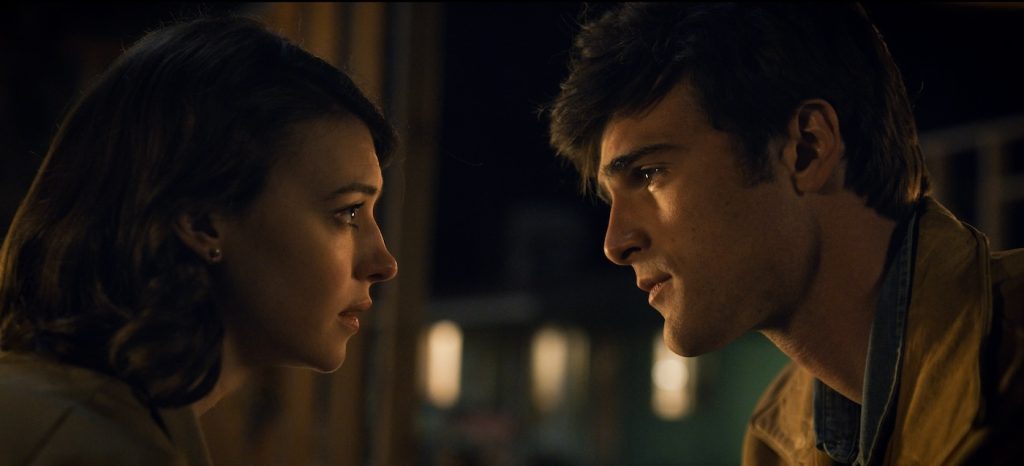
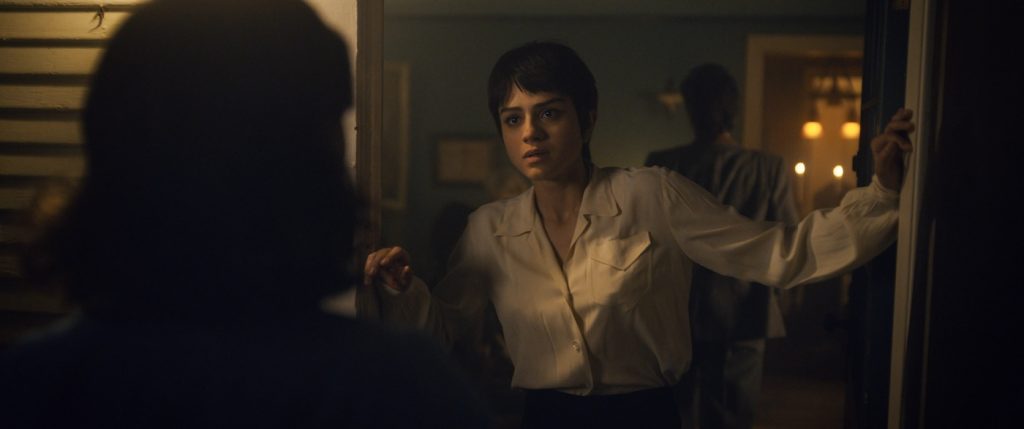
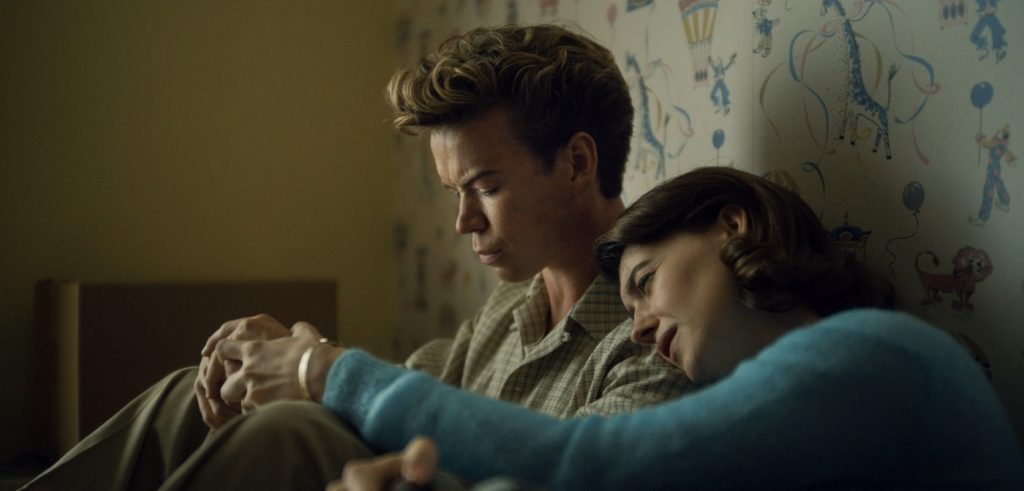
Based on Shannon Pufahl’s 2019 novel, On Swift Horses centers on a seemingly conventional newlywed, Muriel (Daisy Edgar-Jones), and the bond she develops with her brother-in-law, Julius (Jacob Elordi), a mysterious gambler, as both undertake parallel journeys of risk, romance, and self-discovery. Muriel explores another side to her sexuality with Sandra (Sasha Calle), her neighbor in San Diego, while Julius finds passion with fellow gambler Henry (Diego Calva) in Las Vegas.
“It was important to us to not romanticize the period,” says Montpellier. “It’s easy to slip into tropes of romanticism. You needed to feel you were in the room at that time with the characters so you can connect with them. The question became, ‘How do I create a window into the time?’ There were no words then to describe these passions, as LGBT people discovered things.”
Sasha Calle in “On Swift Horses.” Courtesy Black Bear.
To achieve a sense of intimacy, immediacy, and freedom in the motel rooms, casinos, and bars where desire is uncovered and explored, Montpellier shot with a handheld camera to distinguish these from the film’s other, more formal scenes.
Montpellier wanted his camera “almost to be an actor, to create a strong poetic, visual point of view to bring up the context. I don’t want to get in the way of that. I’m proud when the audience reacts to a look that Muriel gives to Julius, and suddenly, you know something is going on. I’m trying to keep an eye open to all of that,” he says. “For the way those scenes are lit, I was leaning into naturalism and honesty with the goal that you felt you were in the room.”
To achieve the mix of light and shadow in the interior scenes, Minahan suggested that Montpellier study not other films but photographs and paintings.
“I did not want to imitate other films,” says Minahan. “The trick of the script is that it has all the tropes of melodrama and noir in this romantic story, and I wanted to find that for ourselves. I wanted to make sure we were not making a pastiche from a fifties film even though that might be fun.” Rather than films from the 1950s, he says, “We looked at documentary photography by Gordon Parks and Bruce Davidson and paintings I admired from the period. Luc and I started sending each other stuff. When he sent me an image from a painter I collect, John Koch, it was one of those moments when I knew I’d chosen the right person to collaborate.”
Will Poulter and Daisy Edgar-Jones in “On Swift Horses.” Courtesy Black Bear.
One particularly memorable scene in the film shows the influence of those visual artists. In the foreground, Julius and Henry are enjoying a close moment in dim light, while in the distance behind them, an atomic test bomb explodes into the night sky above the Las Vegas desert.
“I think of it as the best first date ever, a drink and a bomb,” laughs Minahan. “That image is the cover of the novel; it puts the story in that time period. The visual effects team was so great, but at first, the blast was really big. I said no, the characters would be melting! So they made it 75 miles away in the distance.”
Montpellier looked at “so many images of atomic blasts and people watching with goggles, scarily close,” he says. “It was a kind of innocence. The explosion mimics the fire inside; it’s a symbol of the time, and so it’s a great metaphor. A lot of visual effects were used, but it was also important for me to have practical lighting effects on set so the actors could cue off that. There was a huge lighting rig and wind machine. I wanted to give them what they needed in order to create an environment that allowed them to do their best work.”
The atomic bomb is also symbolic of a complex, post-war era when progress also meant destruction and when the American dream worked for some but certainly not for all. “People were not free in a lot of ways,” says Montpellier. “I love working with filmmakers who want to bring the human condition to light. Dan was so collaborative in beautifully crafting this unconventional love story.”
Featured image: Diego Calva and Jacob Elordi in “On Swift Horses.” Courtesy Black Bear.
One expects Max Minghella to cite the influence of his father, the late director Anthony Minghella (The English Patient, The Talented Mr. Ripley), on his acting and directing career. But it’s Minghella’s mother, Carolyn Choa, who gets the shout-out for her impact on his new film, the body horror comedy Shell, starring Elisabeth Moss and Kate Hudson.
“My mother worked for the British Board of Film Classification from 1984 to 1994, which [like the Motion Picture Association] decided whether a film was PG or R. She’d come home and tell me a bedtime story based on what she read that day. This was when the mid-budget studio movie was most prominent in the marketplace, and it had a tremendous influence on my subconscious and on me as a filmmaker,” says Minghella over Zoom while at the Toronto International Film Festival, where Shell had its world premiere just two weeks after Minghella wrapped the film.
Minghella calls Shell “the kind of high-class popcorn entertainment that doesn’t get made anymore. We have these big-budget, tentpole kinds of movies or smaller films designed for prestige and to win awards, and not much in the middle.”
Despite the sci-fi/horror plot about Samantha Lake (Moss), an actress who tries to stay young by undergoing mysterious medical treatments at a wellness center run by high-powered CEO Zoe Shannon (Hudson), Minghella was drawn to the campy aspects of the script, which he read while in post-production on his first film, Teen Spirit (2018).
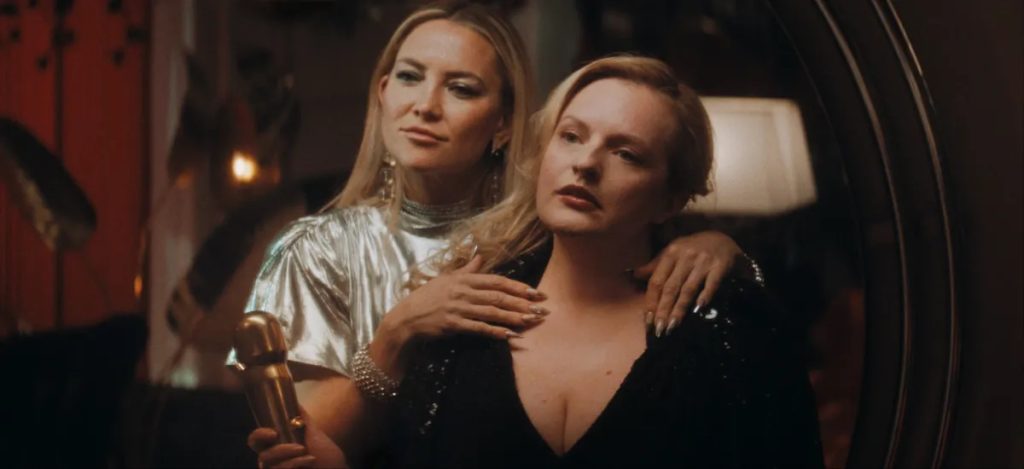
Kate Hudson and Elisabeth Moss in “Shell.” Courtesy Black Bear.
“I always saw the movie as a comedy, first and foremost, and a love letter to a period of film history I actually love. It’s a borderline parody of those movies,” he says. “Teen Spirit was a very personal movie; melancholic and introverted and European, all the things that I am. Coming out of that experience, I yearned for something extroverted and American. I love all kinds of movies; it’s my blessing and my curse, I suppose, to be so broad-based, so I was excited about these characters and a movie that existed in this space.”
One can spot traces of those movies all over Shell, from Paul Verhoeven and Brian De Palma, certainly, but even further back, to Alien,The Exorcist, and even Psycho. But along with the visual flair and jump scares, there’s a substantive story about body image and self-worth and the lengths many will go to achieve eternal youth, beauty, and relevance.
“I am turning forty next year. All of us contemplate mortality, vanity, and age,” says Minghella. “It is a totally universal theme. Yet, I am completely allergic to messages in films. I loathe films that are didactic or moralistic. I want to explore ideas without making judgments, and I hope Shell is filled with rich ideas without saying much too loudly.”
As an actor with a long list of credits but best known for The Handmaid’s Tale, it’s perhaps not surprising that Minghella’s cast, especially Moss and Hudson, deliver such memorable performances. Minghella says he wanted both stars from the start.
“I am a nightmare with casting. If my producers were here, they’d tell you that I am very particular. I don’t audition or meet actors. I try to conjure in my head the person I think is right for each role.” On set, he says, his directing style is to give each actor “space to explore, have fun, and feel safe to fail. I think that’s my job. I have been lucky on two movies that I got the actors I wanted. A lot can go wrong when you’re making a movie, but I feel so lucky to at least have the people I wanted saying these words, and they are so gifted they give you more than you can possibly imagine.”
Even though Minghella has worked with Moss for years on The Handmaid’s Tale, he admits he was hesitant to approach her about starring in Shell.
“My biggest fear was that she’d say yes just out of some obligation to do it. Then she started to introduce the notion of working together, and by the fifth time, I said, ‘I do have a script you’d be perfect for.’ I’m so happy she nagged me because now I can’t imagine anyone else as Samantha; I’m amazed by how funny she is. It’s quite a complex comedic performance in its physicality and I had not seen her do that before.”
Rapport and professionalism helped with a tight, low-budget shoot. “It often felt we were trying to squeeze a square peg into a round hole with limited financial resources and time. It always comes down to the cast and crew in the end,” says Minghella, citing Shell DP Drew Daniels as “one of the most extraordinary technicians you’ll come across. He works quickly and without pretension.”
“Lizzie Moss can deliver a perfectly calibrated performance in one take, so it allows you to move faster. I’d rather have more time to explore, but you simply can’t.” He had just three hours to shoot the film’s climactic car chase, for instance, with two hours needed to set up the crash. “Everything needed to be perfect, from the focus puller to the stunt crew. It is a miracle we have a movie, and I am so grateful to so many people for it.”
Featured image: TORONTO, ONTARIO – SEPTEMBER 09: Max Minghella of ‘Shell’ poses in the Getty Images Portrait Studio Presented by IMDb and IMDbPro during the Toronto International Film Festival at InterContinental Toronto Centre on September 09, 2024 in Toronto, Ontario. (Photo by Gareth Cattermole/Getty Images for IMDb)
Arguably the greatest actor of his generation is getting back in front of a camera again.
Daniel Day-Lewis has officially unretired after seven years away to perform in his son Ronan Day-Lewis’s directorial debut, Anemone, from Focus Features and Plan B. The father isn’t just coming back to act in his son’s film—they co-wrote it together—a story about, fittingly, the nuanced relationships of fathers, sons, and brothers and the dynamics of familial bonds. Anemone also stars Samantha Morton, Sean Bean, Safia Oakley-Green, and Samuel Bottomley.
This is Daniel Day-Lewis’s first time in front of a camera since Paul Thomas Anderson’s slow-burn Phantom Thread in 2017. It was ahead of the release of Phantom Thread that he announced his retirement without making a big to-do about it, saying simply he was “grateful to all of his collaborators and audiences over the many years” via a spokesperson.
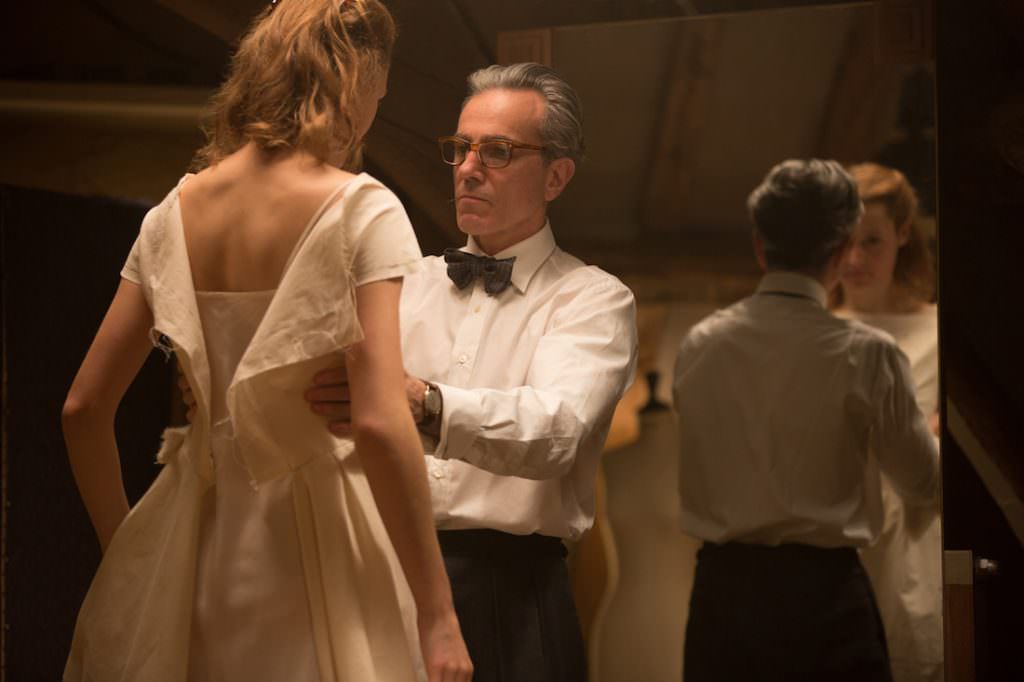
Vicky Krieps stars as “Alma” and Daniel Day-Lewis stars as “Reynolds Woodcock” in writer/director Paul Thomas Anderson’s PHANTOM THREAD, a Focus Features release. Credit : Laurie Sparham / Focus Features
“We could not be more excited to partner with a brilliant visual artist in Ronan Day-Lewis on his first feature film alongside Daniel Day-Lewis as his creative collaborator,” Focus Features chairman Peter Kujawski said in a statement. “They have written a truly exceptional script, and we look forward to bringing their shared vision to audiences alongside the team at Plan B.”
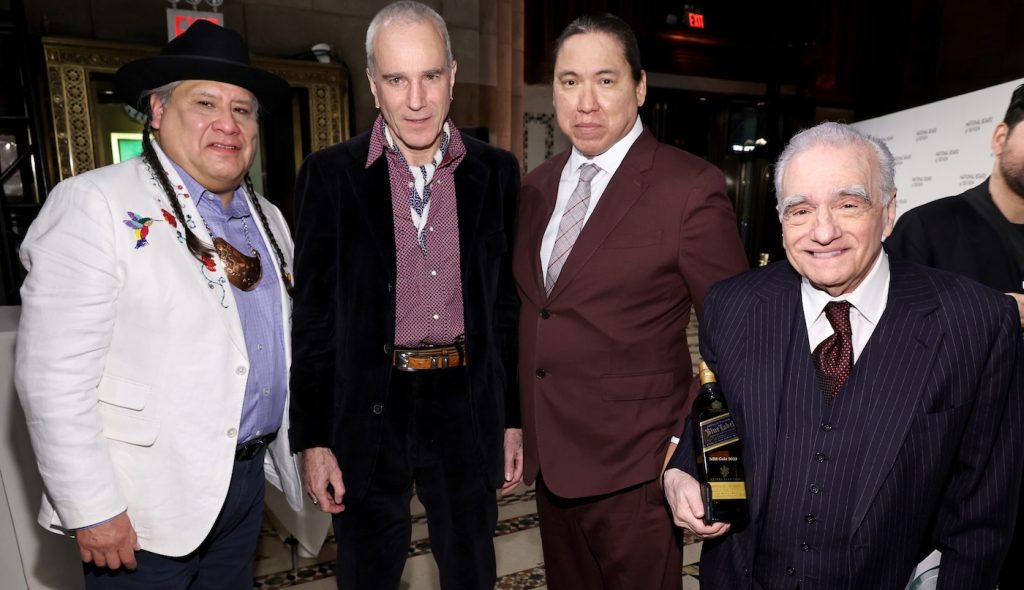
Earlier this year, Daniel Day-Lewis reunited with his Gangs of New York director Martin Scorsese at the National Board of Review Awards, where the chatter about his possible return was ignited with a shout-out from Scorsese himself: “We did two films together, and it’s one of the greatest experiences of my life,” said Scorsese while accepting the directing honors for Killers of the Flower Moon. “Maybe there’s time for one more. Maybe! He’s the best.”
NEW YORK, NEW YORK – JANUARY 11: (L-R) Yancey Red Corn, Daniel Day-Lewis, William Belleau and Martin Scorsese attend the National Board Of Review 2024 Awards Gala at Cipriani 42nd Street on January 11, 2024 in New York City. (Photo by Jamie McCarthy/Getty Images for National Board of Review)
Ronan Day-Lewis is 26, a filmmaker and a painter, with a debut international solo exhibition opening on October 2 in Hong Kong before traveling to New York and Los Angeles. In his father, he’s getting the only man to ever win three Best Actor Oscars—for Jim Sheridan’s My Left Foot, Paul Thomas Anderson’s There Will Be Blood, and Steven Spielberg’s Lincoln—and who was nominated for two more, Scorsese’s Gangs of New York and Jim Sheridan’s In The Name of the Father.
The Anemone creative team includes costume designer Jane Petrie (The Crown), production designer Chris Oddy (The Zone of Interest), and cinematographer Ben Fordesman (Love Lives Bleeding).
For more on Universal Pictures, Peacock, and Focus Features projects, check out these stories:
Featured image: Daniel Day-Lewis poses in the press room at the 18th Annual Critics’ Choice Movie Awards held at Barker Hangar on January 10, 2013 in Santa Monica, California.
With three Oscar nominations under his belt, animation auteur Chris Sanders knew a good story when he saw it the minute his daughter brought home Peter Brown’s children’s book “The Wild Robot” back in 2016. Sanders, who’d worked on The Lion King and later helmed How to Train Your Dragon, Lilo & Stitch, and The Croods, appreciated the tragi-comic tale centered on robot Roz (voiced in the film by Lupita Nyong’o) after she washes up on the shore of a remote island populated with wild animals.
Some four years later, Sanders learned that DreamWorks had acquired the book, and he signed on to spearhead the big-screen adaptation, which opened Friday to near-unanimous raves. “In some cases, we had to trim away characters, and in other places, I actually added some complications where I felt things were getting maybe a little too linear,” Sanders says, describing his light touch adaptation. “But it was always in service of Peter’s wonderful story.”
Speaking from his home in Los Angeles, Sanders discusses the emotive power of geese migration, Bambi, and the real-life inspiration behind The Wild Robot‘s enchanted island.
What was your biggest challenge in turning Peter Brown’s universally acclaimed children’s book into The Wild Robot movie?
Keeping the core of Peter’s story intact. When we had our first conversation, Peter revealed the thing he had on his mind when he was writing “The Wild Robot” was the idea that kindness could be a survival skill. I immediately wrote that down and thought, “Okay, this needs to be memorialized on screen.” I put that in the screenplay as a line that Fink the Fox says, and it comes directly from our very first conversation with Peter.
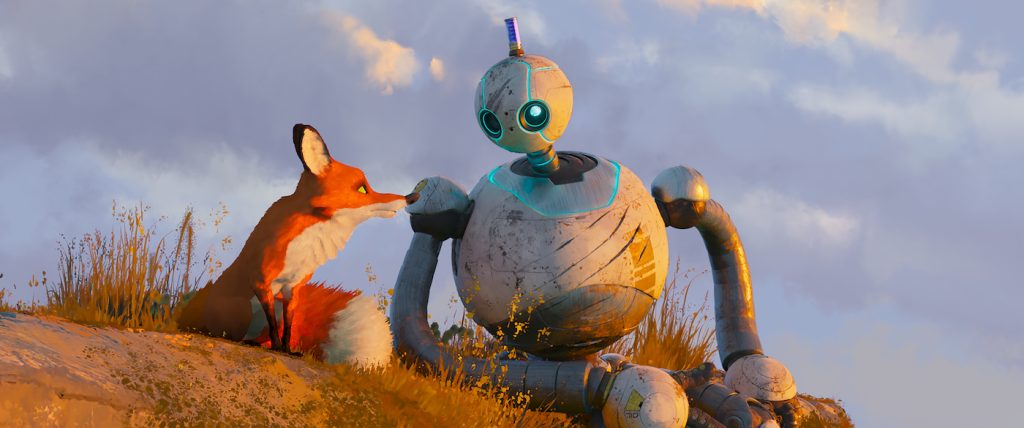
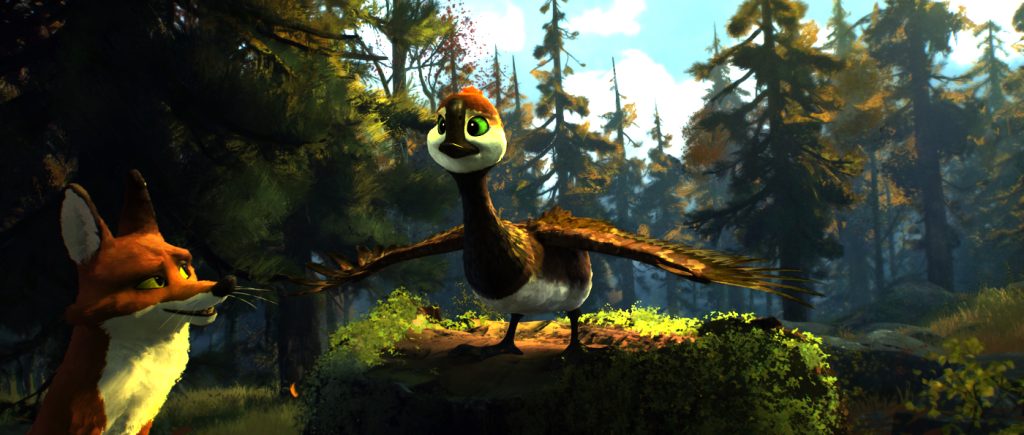
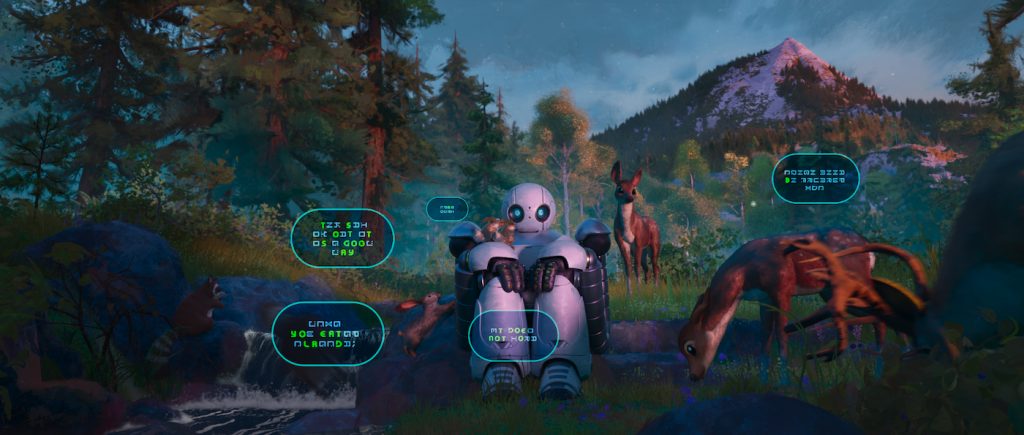
(from left) Fink (Pedro Pascal) and Roz (Lupita N’yongo) in DreamWorks Animation’s Wild Robot, directed by Chris Sanders.
Yet the movie begins not with kindness but with feral, predatory chaos. When Roz first arrives, we see the animals giving her a hard time. Was it important to portray nature as an adversarial environment?
Absolutely. There had to be real life and death consequences for this story to work. For example, if Gosling Brightbill [voiced by Kit Connor] had stayed on the island, he wouldn’t have made it through the winter. He would starve. Peter’s book has some heavy themes, and we have to preserve and even magnify them for the big screen.
The voice actors infuse their animal characters with a ton of personality, but maybe the most surprising talent is Lupita NYong’o as the robotic Roz. She won an Oscar for 12 Years a Slave. A few weeks ago, she starred in a very serious post-apocalyptic drama, A Quiet Place: Day One.And now she’s an animated robot—how did that happen?
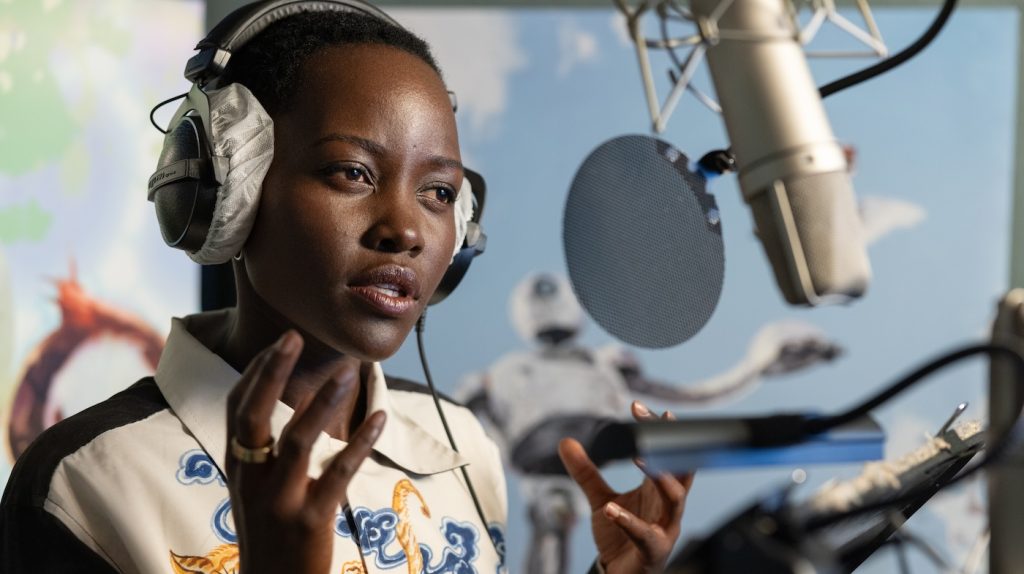
Our casting director, Christi Soper, suggested Lupita. Even though she wasn’t going to be on screen, Lupita took this as seriously as she would any role, deconstructing Roz to understand how her mind works. Roz is very intelligent, but there are serious gaps in what she knows, so she has a particular way of seeing things. Finding that amusing, charming angle for Roz was very much a collaboration, which progressed from a couple of Zoom calls to our in-person meetings in the recording studios.
Lupita Nyong’o voices Roz in DreamWorks Animation’s The Wild Robot, directed by Chris Sanders.
Lupita initially delivers her Roz lines in a stiff that we associate with digital assistants like Siri and Alexa. How did you two arrive at that tone?
Lupita was very much thinking about voices like Siri and Alexa when she created what we called an “engineered optimism.” I liken it to somebody who’s coming to a party, and they’re a little bit nervous, so their voice goes like this (switching to a high voice): “Hi, I’m Chris! How are you!” (back to regular voice). Lupita created this sound, which I daresay stressed her voice a little bit to create this upbeat, hopeful quality that Roz has right out of the box.
As the story progresses, Roz changes, and so does her voice.
Roz’s voice becomes more like Lupita’s, and the pattern of her speaking changes as well. At a certain point, Roz begins to use contractions, so there are very subtle things going on. It was fascinating to watch an actor of Lupita’s caliber shape her character.
The fox, the possums, the bear, and the geese are wildly entertaining. on top of that, you have this lush forest, which becomes a character unto itself. What real-life references inspired the look of this island?
We all felt the island would probably be on the northwest coast of North America, given the creatures. Our production designer, Raymond Zibach, looked at Olympia National Park [in Washington] to study the foliage, which is wet and has a lot of ferns. We painted those plants in the background.
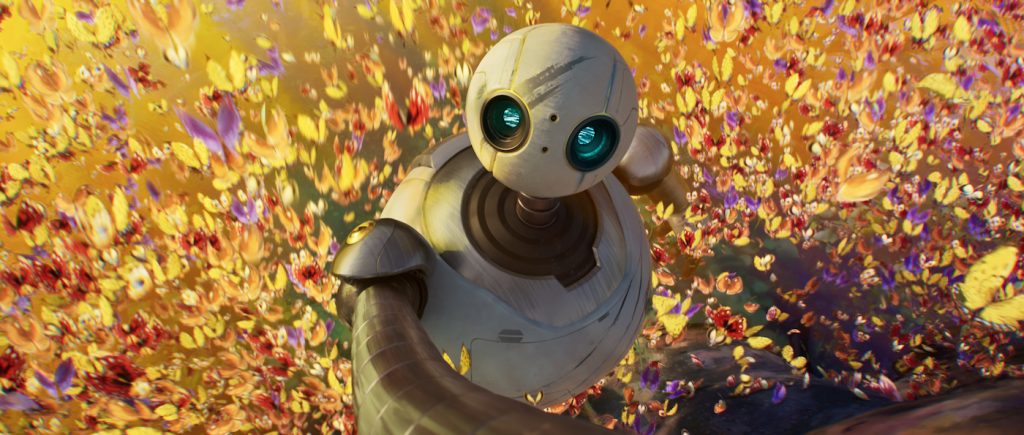
Roz (Lupita N’yongo) in DreamWorks Animation’s Wild Robot, directed by Chris Sanders.(from left) Fink (Pedro Pascal) and Brightbill (Kit Connor) in DreamWorks Animation’s The Wild Robot, directed by Chris Sanders.
Your team’s rendering of this forest-island environment evokes a richness reminiscent of classic Disney movies like Bambi. What were you aiming for visually?
You said the magic words: All of us here are big fans of [Disney animator] Tyrus Wong’s style employed for Bambi. It’s one of the most immersive environments I’ve ever seen, and it shows what human beings can do when they paint environments. Of course, Hayao Miyazaki was a big inspiration with films like My Neighbor Totoro, where fantastical things come out of the forest. We aspired to get that same kind of exciting, whimsical vibe for The Wild Robot.
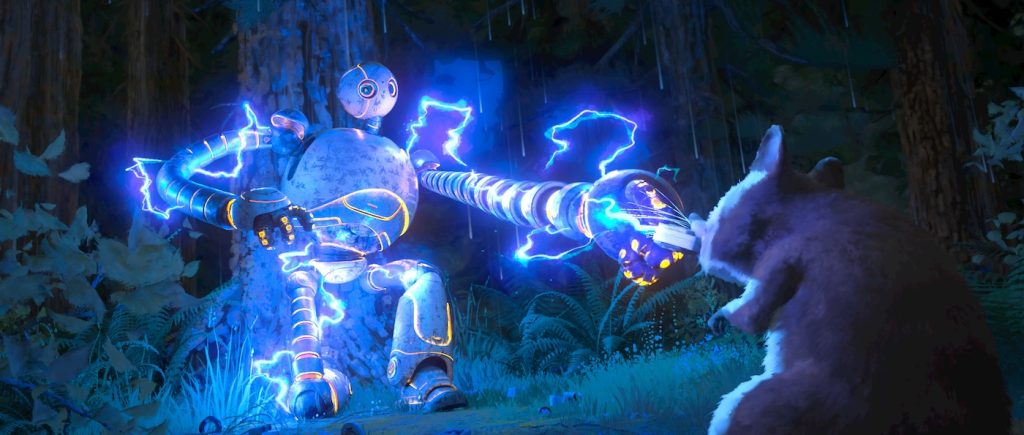
Roz (Lupita Nyong’o) in DreamWorks Animation’s The Wild Robot, directed by Chris Sanders.
So how did you achieve that painterly look?
We fought very hard to create a technology that allowed us to actually paint these environments rather than covering [CGI] geometry in texture. We were able to create matte paintings, which made a huge impact on the visuals. Every sky is painted.
Just to be clear, when you say “painted” you mean…
We’re painting things digitally with a stylus but there’s nothing being generated by a computer. It’s an impressionistic style we adopted for this film, not unlike the washes they did for Bambi, where blades of grass are maybe just a brush stroke with a blob of color hovering above them. Not everything is razor-sharply described, if that’s a word — I just created a new word for your article! It’s not 100 percent described and the same thing with Wild Robot. If you look at our high, wide shots, the forest and the trees are not described in crazy detail on the ground so your eyes don’t get stuck looking there. But it still plays as believable.
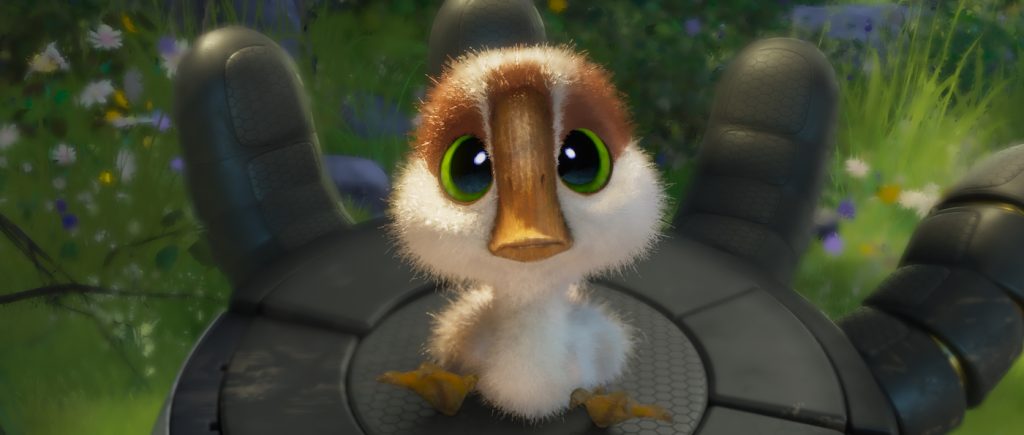
Brightbill (Kit Connor) in DreamWorks Animation’s The Wild Robot, directed by Chris Sanders.
SPOILER ALERT
Midway through the movie, Roz says goodbye to Brightbill the Gosling, whom she’s raised from birth. It’s a very emotional seven-minute geese migration sequence complete with soaring music, the thrill of lift-off, the bittersweet farewell, the big sky. How did you put it all together?
I [story] boarded that section myself because I saw some things in my head that were very specific. If you raise a gosling, there’s built-in heartbreak at the end of that road because if you do a good job, it’s eventually going to fly away. Roz has been single minded on this goal of getting Brightbill into the air, so I was interested in showing how, when he takes off, everything catches up with her emotionally. At that moment, Roz does something very un-robotic and starts running because she’s desperate to see that gosling one last time. She’s literally running toward a cliff. It was interesting to show how the physical landscape mimics the emotional landscape.
Music underscores nearly every scene in this film. You must have collaborated closely with composer Kris Bowers?
Kris came on very early in the process. I’m a big believer that music is one of the heaviest lifters as far as emotions and story moments. In the script, I’d build zones where there is no talking so Kris doesn’t have to worry about ducking under or around a bunch of dialogue. For the migration sequence, I asked Kris to ignore the visuals and just write a great piece of music. I said “When you’re done, we’ll sweep in behind you and cut the visuals to match the music.”
The Wild Robot dramatizes this touching transformation of an AI entity into a sentient being. Did you and your team actually use AI to help make the movie?
No AI really came into this. The funny thing is, the advances we made engineering-wise to paint environments curiously allowed us to make a more hand-made, human-made film than previous films I’ve worked on in CG. This is a movie about a learning robot who’s probably running some version [of AI], but when Peter wrote his novel back in 2016, that was not a thing. It’s interesting to see how this conversation has risen just as we were finishing the film.
Roz (Lupita Nyong’o) in DreamWorks Animation’s The Wild Robot, directed by Chris Sanders.
You started writing your Wild Robot script in 2020. After all these years, how does it feel to come out on the other side of this massive collaboration?
I’ve never worked on a production that ran so smoothly. Everyone on the crew, every animator, every effects artist, and every engineer exceeded what they needed to do, which makes me wonder if that’s because of the movie’s message – the idea of kindness. When our animators finished their characters, they’d ask, “Are there any more shots available for me?” They wanted it to go on. The level of devotion and love poured into The Wild Robot is, I think, evident on screen.
For more on Universal Pictures, Peacock, and Focus Features projects, check out these stories:
Featured image: (from left) Roz (Lupita Nyong’o), Brightbill (Kit Connor) and Fink (Pedro Pascal) in DreamWorks Animation’s The Wild Robot, directed by Chris Sanders.
How delicious is the concept for The Franchise, HBO’s new series from Veep creator Armando Iannucci, Succession writer Jon Brown, and Oscar-winning director Sam Mendes? Well, first, take a second glance at that list of creators, and then consider that Warner Bros., the home of Superman and Batman (via DC Studios), is behind a biting comedy about the superhero movie business. Yet The Franchise isn’t here to besmirch the cinematic universes conjured by Marvel and DC, but rather delight in just how much crazier and less controlled the art and architecture of creating those universes really is.
The Franchise follows the crew of a major superhero movie franchise that is struggling to find a place within the rough-and-tumble world of comic-inspired film universes. Led by Himeseh Patel as Daniel, the first assistant director of the film whose job is “to keep the actors from killing themselves,” The Franchise will follow him and his fellow crewmembers as they try to keep their cinematic universe from falling out of orbit. Daniel works side-by-side with Daniel Brühl’s director, Eric, whose concerns are a little less on point than Daniel’s (the fact that someone else on set is wearing an “indoor scarf,” for example, which is obviously reserved solely for the director). Billy Magnussen co-stars as one of the franchise’s actors, Adam, alongside Richard E. Grant’s Peter, both of whose superhero shenanigans barely merit mention compared to what’s happening off-screen.
As The Franchise‘s logline puts it, the series aims to “shine a light on the secret chaos inside the world of superhero moviemaking, to ask the question — how exactly does the cinematic sausage get made?” Yet, as a profile the show on The Hollywood Reportermade clear, the series also highlights how hard the cast and crew work on these films and how much of themselves they pour into it. “The beating heart of the show has more to do with the ADs, PAs, the script supervisors, line producers and crew who actually make films and get no public praise for it,” Mendes told THR.
The cast also includes Aya Cash as Anita, Jessica Hynes as Steph, Lolly Adefope as Dag, Darren Goldstein as Pat, and Isaac Powell as Bryson. Check out the trailer below. The Franchise arrives on October 6.
For more on Warner Bros., Max, and more, check out these stories:
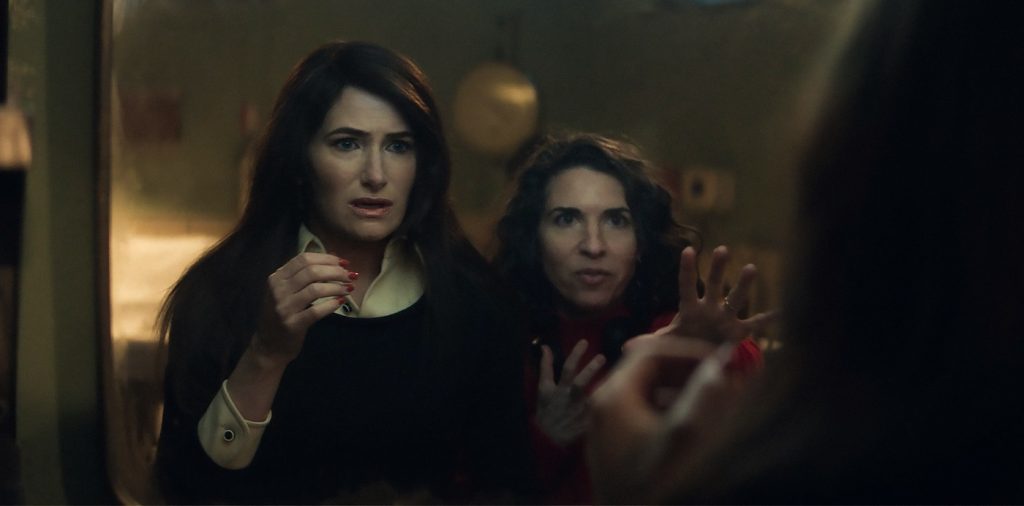
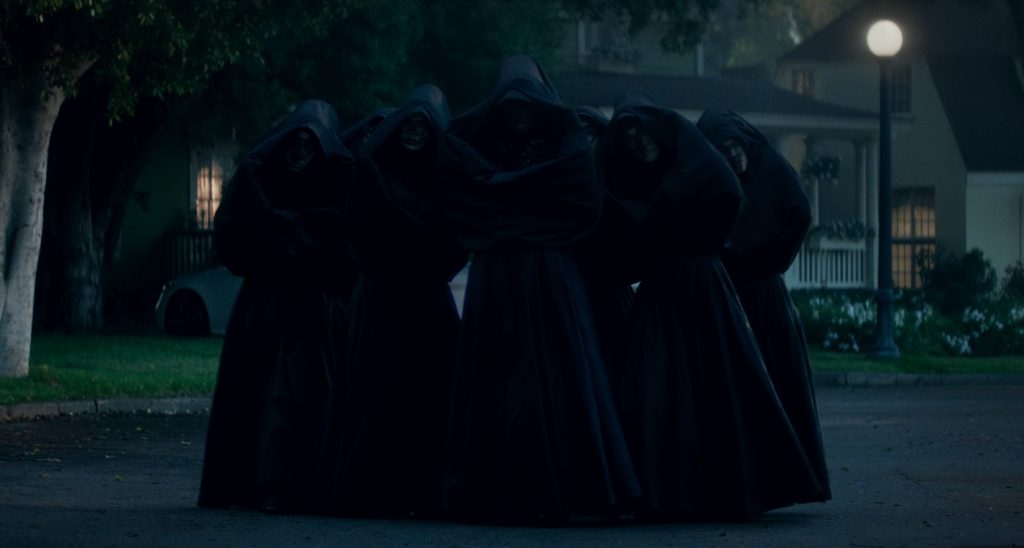
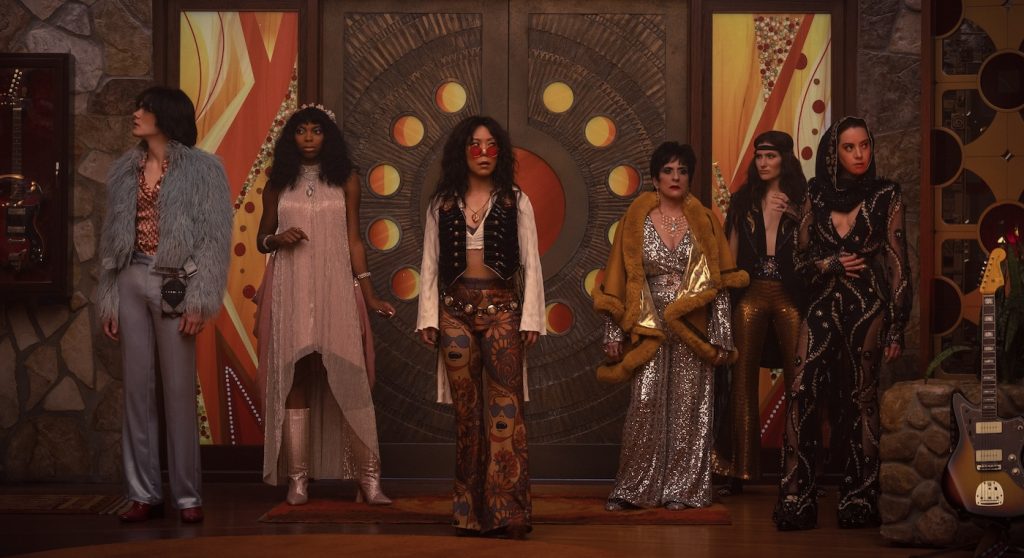
Agatha All Along creator Jac Schaeffer explores the witchy side of the Marvel Universe just in time for Halloween. The timing of the show’s release is a happy accident for Schaeffer, who also directed the first two episodes. In bringing the titular witch, Agatha (Kathryn Hahn), back fromWandaVision, Schaeffer and her team have made a series with a playful spookiness centered on an irresistible Hahn, the dynamo who has been stealing scenes her whole career and found herself in the unexpected starring role on a Marvel Studios series.
Following the events of WandaVision, Agatha isn’t the powerful witch she once was, having been bested and stripped of her powers by Wanda (Elizabeth Olsen) in the climactic showdown that ended that series. When reintroduced, she’s trapped in her mind and living out a European police procedural. Once she snaps out of the procedural drama and returns to reality, she’s horrified to find herself powerless. With a trusty sidekick, Teen (Joe Locke), she assembles a team of witches for a journey on the arduous, dangerous Witches’ Road to regain her powers.
Schaeffer, who also created WandaVision, introduces new elements in the Marvel universe, spoke with The Credits about her influences for Agatha All Along, building witchcraft mythology, and her sensational cast.
In the opening credits, there’s the joke, “Based on the Danish series, Wandavisdysen.” Was that a gag on the page?
The main titles were written into the script; that was always the thing. In fact, the original concept on the page had the skip intro button that you could press, but the idea was that it wouldn’t work because you always get bewitched by main titles if they’re really good. But the idea of it being based on the Danish series was because the editor on that episode, Jamie Gross, used The Killing main titles for a temp before we had made ours.And then when it was time to do ours, I was like, “Well, we have to do it based on the Danish series because that’s what they do in The Killing.” I’ve to say it is one of my top five favorite jokes in the whole show. It really tickles me.
WandaVision was a departure from the Marvel aesthetic. Given the world of witchcraft in Agatha All Along, how’d you want to continue to evolve from that style?
From what I’ve witnessed during my time at Marvel, they’re interested in that. They want it all to fit together, but they want each property to have its own distinct style, color, and feeling. There was definitely room for that. The road itself was hard because you don’t want to go too dark. It also went hand in hand with the notion of how scary it is in terms of ages and audience. We were finding a line.
Were you inspired by Walt Disney and witches from the Disney library? They weren’t afraid to scare kids, and I’d say the same about your witches.
We did, in a larger sense, of how witches are framed in the older Disney canon, the binary of the princess and the evil witch. So, that definitely factored into our early ideating because the whole show is an examination of what it means to be a witch in terms of the stereotype and then what it means authentically. But that’s lovely that you felt that. I would also guess that that also has to do with the practical side of it. There’s a real texture to the show. At least for me, seeing the witches in the real environment has that Grimm’s fairy tale essence to it.
Did you and your visual effects supervisor, Kelly Port, always want to use as many practical effects as possible?
Early on, we were like, “This is not a CGI show,” and Kelly wanted that as well. It was Mary Livanos’, the executive producer, idea. Our touchstones were everything from The Wizard of Oz through The NeverEnding Story, Dark Crystal, The Craft, and The Witches of Eastwick. We were already in this zone, which then became a point of pride for us. It also has an added layer, this discovery where we were like, “Agatha’s power has been taken from her. No power for Agatha, no CG for the show.” It felt aligned with the Marvel ethos.
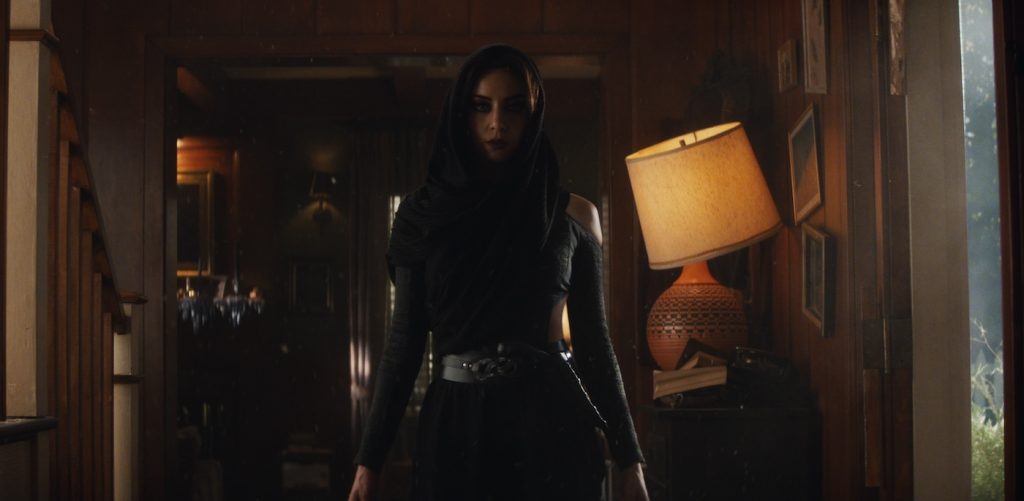
In the pilot, did you want the house fight scene between Agatha and Rio (Aubrey Plaza) to really set the tone for the action ahead in the series?
Yes. It’s a Marvel show, so there is always a burden for action and some level of violence that is part of the Marvel universe. It’s not something that I always wrote before coming to Marvel. That wasn’t where my mind always went. Although I guess sci-fi is always where I’m at, and there’s always going to be some sort of action in a sci-fi story. But what we were trying to convey with that sequence is the fact that Agatha is powerless. She’s got no blasts and no telekinesis, and if she has no telepathy, then it’s fisticuffs, right? It’s going to be nails and teeth and hair. Also, the relationship between Agatha and Rio is so intimate and so charged that we wanted this close-quarters fight that indicated that they’re at each other’s throats, but also maybe want to make out. We wanted that froth at the top of the show.
As someone with an independent background, how do you want to bring an indie spirit to a production as big as Agatha All Along?
When I hear indie, what that means to me is that we have a “we can solve this” attitude. Give me a pack of gum and a match, and I’ll figure this out. It’s a concert! Just kidding, it’s a public restroom. Even at the Marvel scale, there will be a million things you’re told you can’t have, and then you have to make it work. I think the other indie spirit sensibility is the centering of POVs that don’t normally get the spotlight. It’s certainly the case for this show. All I want to do is tell the stories of women, women from all places and of all ages and all circumstances. And so, that’s part of what I brought to this.
You have great “getting the band together” sequences, like in a classic heist movie. How did you want to define those women as quickly and as substantially as possible?
You’ve nailed it. It is so challenging, but that is the goal. I love heist movies. I love Oceans 11 so much. The economy with which 11 characters are introduced, holy moly, masterclass. Agatha and Teen pick up three characters and a fourth. It’s technically a half-hour show, maybe a little bit longer, but there’s limited real estate. So it is not only the words on the page, it is the casting, which is vital. Ninety percent of your job is done if you cast the right people. Then, it’s the wardrobe, and [costume designer] Daniel Selon’s work did so much to enhance and to create a shorthand for who these characters are. And then, of course, John Collins’ production design. Each space tells a story and establishes the beginning of a thread that will follow throughout the show.
Did you and the writers now have a book of rules for all the witchcraft in the show?
The notes from the room would melt your brain. Because this character has very little presence in the comics, we were originating from scratch a lot of who she is, and then we were assigned the task of defining witchcraft in the MCU. What classic notion of witches do we want to carry forward? How do we want to innovate? What are the ways in which Marvel witches are different? Then, we put them in an environment that required an enormous amount of world-building and rules. Then, because they are on a mission, how do we paint them into a corner over and over again and then get them out of it? Yeah, I’m tired just remembering all of that [Laughs].
For more stories on 20th Century Studios, Searchlight Pictures, Marvel Studios and what’s streaming or coming to
For stunt coordinator George Cottle, it started on a warm summer’s day in Los Angeles. He and director Jon Watts were shooting an episode of Star Wars: Skeleton Crew when Watts mentioned a film idea he was developing to star Brad Pitt and George Clooney. Watts asked Cottle if he’d like to be involved.
“I’ve done three Spider-Man’s with him. I love the way he works,” says Cottle says. “There are a handful of directors who really stand out to me. I love being on set with them. I don’t care what it is. It could be a remake of the Teletubbies. Jon is definitely one of those guys.”
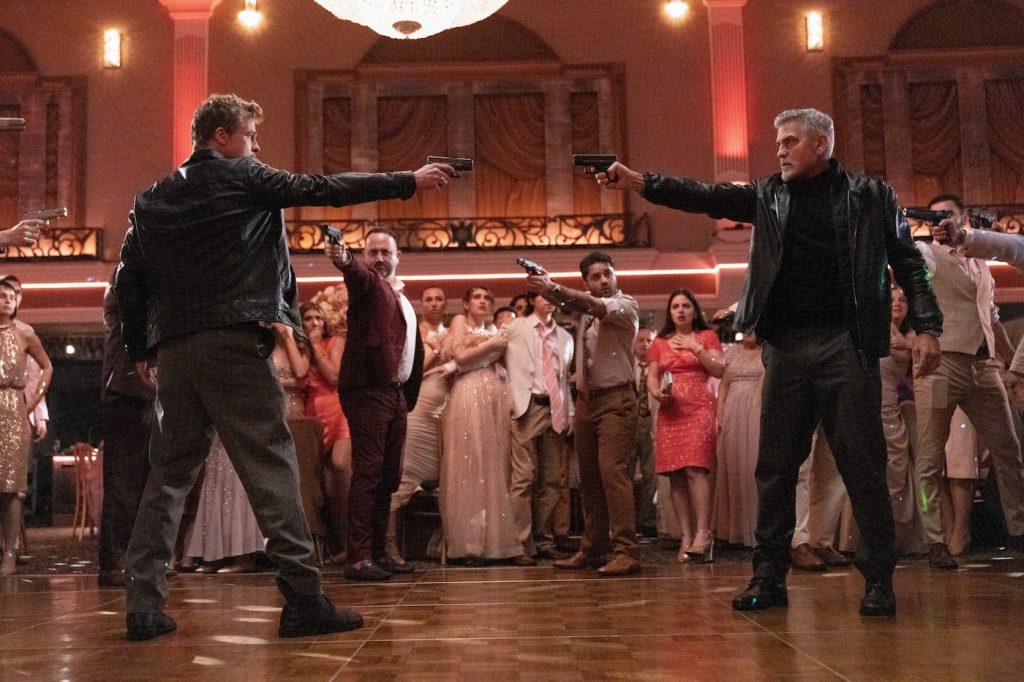
And just like that, Cottle became the supervising stunt coordinator for Wolfs. Streaming on Apple+ TV after a one-week theatrical run by Sony Pictures, the action/comedy stars Pitt and Clooney as two professional fixers who are inadvertently both hired to clean up the same murder scene. Then complications arise. The victim (Austin Abrams) turns out to be very much alive and in possession of a huge stash of drugs. The two lone wolves must join forces to stave off a gang looking to finish the hit and retrieve the drugs.
With a resume that runs the gamut from Christopher Nolan’s Oscar-winning Oppenheimer and sci-fi head trip Inception to superhero franchises like Nolan’sThe Dark Knight and this blockbuster Deadpool & Wolverine, Ryan Coogler’s Black Panther and the aforementioned Spider-Man trilogy —Homecoming, Far From Homeand No Way Home— Cottle thought a lighthearted actioner might be a nice change.
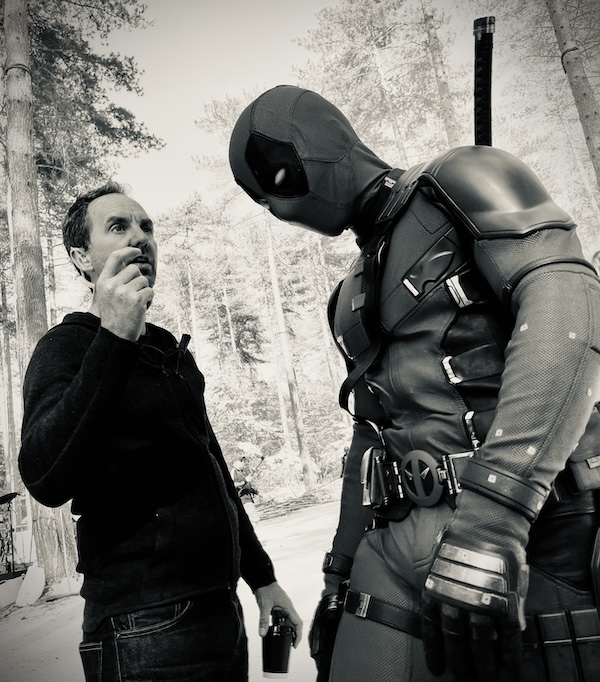
George Cottle with Deadpool stunt double Alex Kyshkovych. Courtesy of George Cottle/Marvel Studios
There was one small detail. Watts hadn’t written a script yet. That didn’t bother Cottle. He reasoned that if it were good enough for Clooney and Pitt, it was good enough for him. Besides, being involved early has its advantages. “Jon would text or call me and be like, ‘Hey listen, if we did this. Do you think we could do it for real?’ And I’d be like, ‘Yeah. We could put the actors in a rig and have the car slide up,’” Cottle remembers. “And he’s like, ‘Great! That’s what we’re doing.’”
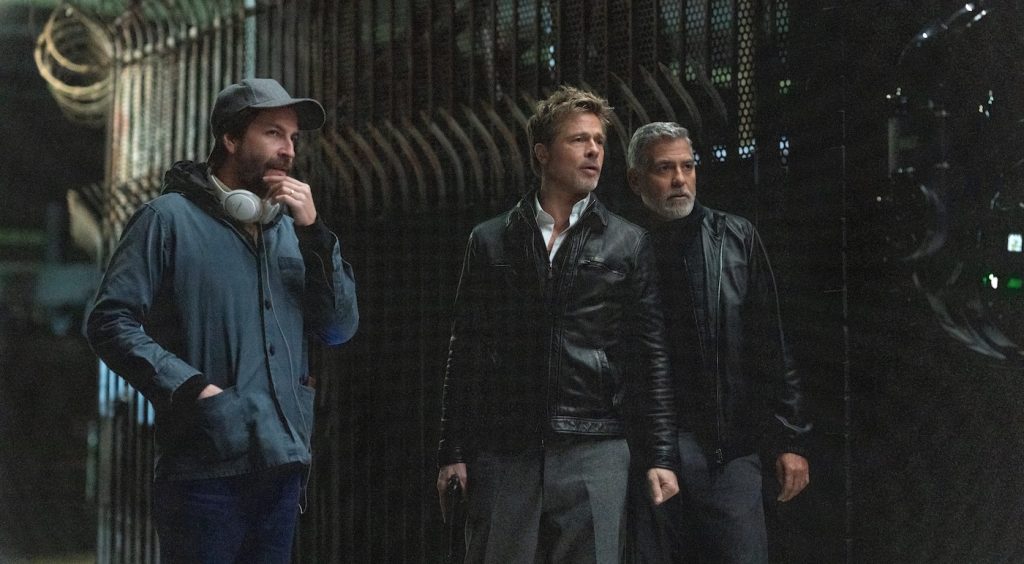
Filmmaker Jon Watts with Brad Pitt and George Clooney in “Wolfs,” now playing in select theaters and streaming on Apple TV+.
Then, as Wolfs’ start date drew near, Cottle realized weather would be a factor. “Hang on. This just came to me. We’re shooting this in New York right?,” Cottle asked Watts. “He’s like, ‘Yeah.’ And I’m like, ‘In January?’ He’s like, ‘Yeah.’ And I’m like, ‘And the whole thing takes place at night?’ He’s like, ‘Yeah. It’s gonna be great.’ So I was like, ‘Okay… well… I’m too deep in now.’”
Chilly thoughts aside, Cottle was excited that New York was serving as his stunt canvas. “The energy is truly unlike any other city. New York is so electrifying,” he continues.
Watts, an NYU alumni and current resident, took full advantage of his home base. Wolfs showcases the city, especially during an action-packed chase. Abrams’ character (simply known as “The Kid”) makes a break for it, and the ensuing pursuit spans a lot of NYC real estate.
“George is chasing him in the car. Brad’s on foot. And Austin is running for dear life to get away,” explains Cottle. “It is so fun because we’re actually in New York. We weren’t trying to shoot Atlanta or New Jersey or wherever for New York. We got incredible permission to be on the streets. Chinatown, the Brooklyn Bridge, running Austin through all of these incredibly iconic places.”
Upping the comedy quotient, the entire sequence takes place with Abrams only wearing briefs. “One of the big heroes of this movie is young Austin,” continues Cottle. “New York City is telling everybody to get off the streets because it’s so cold and we’re running this poor kid and his stunt double through the streets in a pair of tighty-whities.”
A showstopping moment comes when the car accidentally hits the kid. Flipping upside down, he sails lengthwise over the car and lands perfectly on his feet behind the vehicle. Though Cottle had never attempted a gag like this before, he was game for the challenge when Watts told him the idea. “I’m like, ‘Don’t make me answer you now. Let me think about how we would achieve it and I’ll get back to you,’” Cottle replied.
And pull it off they did. “We put together a really good plan,” continues Cottle, crediting the entire crew for its successful execution. “Larkin (Seiple), our DP, really helped us work around the rigging and the lighting. We had to shoot at a much higher frame rate to get the slow motion that Jon wanted. There were many layers that we didn’t do in the street. It was a multiple pass process and it’s pretty bloody funny.”
Cottle is also complimentary of Clooney and Pitt’s stunt acumen. Watts’ goal was to put the stars in as much action as possible. That meant having Clooney and Pitt front and center for car chases, shootouts and fights. The A-listers continually rose to the challenge.
“They just get it,” says Cottle. “They have this ability, the bandwidth, to take in so much information and still act on top of that. I think that when somebody is so good at something, they make it look easy. That’s what’s truly fascinating about working with them.”
Brad Pitt and George Clooney in “Wolfs,” now playing in select theaters and streaming on Apple TV+.
As an example, Cottle cites a gag where Clooney effortlessly dips a luggage cart to hook a body bag onto it. “We came up with this idea, and he walked in, watched somebody do it, and was like, ‘Okay, I got it. Where’s the camera?’”
Pitt was the same. Watts devised a move that sees the BMW Clooney is driving pivot 180 degrees and slide up to the sidewalk. As it comes to a stop, Pitt opens the door, steps out, and walks away without missing a beat. After working out the details with a stuntman, Pitt was brought on set. He watched a rehearsal and immediately got it. And he proved it by doing four flawless takes. “He’s incredibly coordinated, incredibly physical, and has a great understanding of his body,” adds Cottle.
When Cottle learned Clooney was a car and motorcycle fan, he was the logical choice to be in the driver’s seat. “He’s a very good driver, actually. Surprisingly so,” says Cottle. “I know he’s a bit of a petrolhead. As soon as I hear that, I find it a little bit easier.”
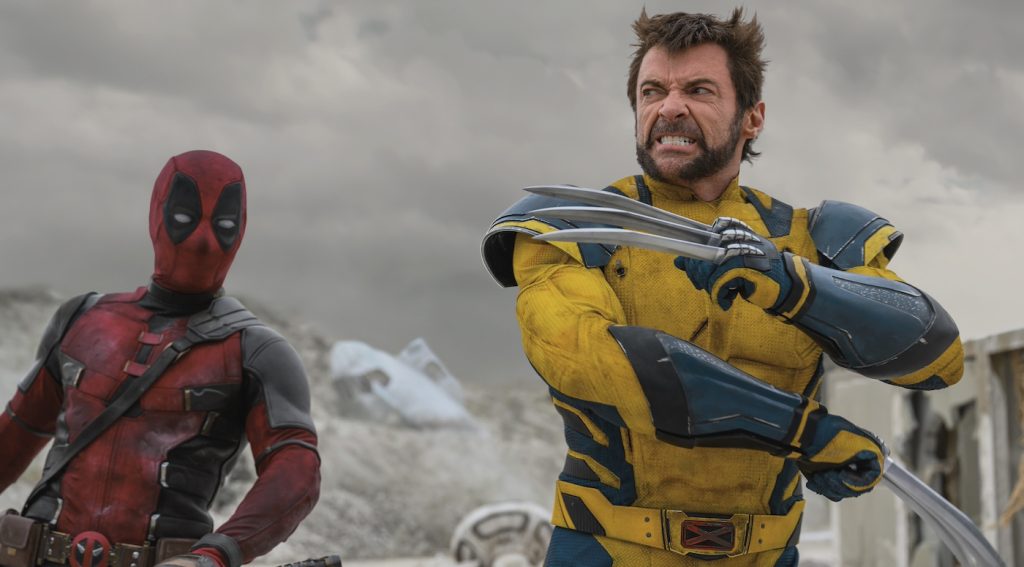
Clooney and Pitt weren’t the only high-profile duo Cottle has recently put through their stunt paces. After Wolfs wrapped, he took Ryan Reynolds and Hugh Jackman through this summer’s blockbuster Deadpool & Wolverine.
“There’s a lot more violence, fights and superheroes and all of that kind of thing,” says Cottle. “I know that sounds crazy, but the most fun for me was leaning into the violence. The vast majority of movies I’ve done over the last decade were PG-13. You’re limited on headbutts. You can’t see blood. All the small things you have to do to keep a PG-13 rating. Deadpool was the polar opposite. We were allowed to lean into that, especially with the comedy aspect. It was just so fresh. I really pushed the team.”
That meant pushing the film’s stars, Ryan Reynolds and Hugh Jackman as well. “What Ryan and Hugh had to learn, all of that was next level. There was so much more going on, and they both nailed it,” says Cottle. “That was my first time with Hugh, and I think the only time I’ve seen an actor pick up choreography as fast is Tom Holland from the Spidey films or John David Washington in Tenet. It was beyond impressive.”
Though vastly different in terms of stunt challenges, Cottle believed in many ways, the films share a similar vibe. They were both loads of fun. January winter aside, Cottle had a ball filming Wolfs. He credits Watts. “I love the way he is with actors, the little jokes and silly humor, his ability to get them to a place where they understand exactly what’s going on,” Cottle says. “And Brad and George were the perfect combination to bring all of those elements together. The chemistry between them is incredible. It was mesmerizing to watch.”
Wolfs is streaming on Apple TV+.
For more stories on Apple TV+ series and films, check these out:
The great Maggie Smith passed away on Friday, September 27, at the age of 89. Her astonishing career on stage and screen played out over seven decades, as she became one of Britain’s most beloved, recognizable, and prolific performers and a two-time Oscar winner to boot—she’s one of the few actresses to win both a Best Supporting Oscar and Best Actress Oscar. Her sons Toby Stephens and Chris Larkin shared this statement with the BBC said on the day of her passing: “It is with great sadness we have to announce the death of Dame Maggie Smith. She passed away peacefully in hospital early this morning, Friday 27th September. An intensely private person, she was with friends and family at the end. She leaves two sons and five loving grandchildren who are devastated by the loss of their extraordinary mother and grandmother.”
Smith’s renown wasn’t limited to the United Kingdom, of course—her admirers were global, and her reach was expanded with a memorable role as Professor Minerva McGonagall in the Harry Potter franchise. Smith also starred in California Suite (where she won the Oscar for Best Supporting Actress), Downton Abbey, The Bext Exotic Marigold Hotel, The Prime of Mis Jean Brodie (which earned her second Oscar for Best Actress), Gosford Park, A Room With A View, and many, many more critically acclaimed films.
Her fellow stars have shared how much of an impact Smith made their lives, including Harry Potter star Daniel Radcliffe, who first met Smith when he was an even smaller kid than he was on the first day of filming Harry Potter.
“The first time I met Maggie Smith, I was 9 years old, and we were reading through scenes for David Copperfield, which was my first job. I knew virtually nothing about her other than that my parents were awestruck at the fact that I would be working with her,” Radcliffe said in a statement. “The other thing I knew about her was that she was a Dame, so the first thing I asked her when we met was ‘would you like me to call you Dame?’ at which she laughed and said something to the effect of ‘don’t be ridiculous!’ I remember feeling nervous to meet her and then her putting me immediately at ease. She was incredibly kind to me on that shoot, and then I was lucky enough to go on working with her for another 10 years on the Harry Potter films. She was a fierce intellect, had a gloriously sharp tongue, could intimidate and charm in the same instant, and was, as everyone will tell you, extremely funny. I will always consider myself amazingly lucky to have been able to work with her and to spend time around her on set. The word legend is overused, but if it applies to anyone in our industry, then it applies to her. Thank you Maggie.”
Radcliffe was joined by many other colleagues, who were also often admirers, including fellow Harry Potter alum Emma Watson, who played Hermione Granger in the series. On Instagram, Watson wrote, “When I was younger, I had no idea of Maggie’s legend – the woman I was fortunate enough to share space with. It is only as I’ve become an adult that I’ve come to appreciate that I shared the screen with a true definition of greatness. She was real, honest, funny and self-honouring. Maggie, there were a lot of male professors, and by God, you held your own. Thank you for all of your kindness. I’ll miss you.”
The Harry Potter cast continued singing Smith’s praises, including Rupert Grint, who played the third member of the trifecta, Ron Weasley, Harry and Hermione’s best friend. Grint wrote on Instagram, “She was so special, always hilarious and always kind. I feel incredibly lucky to have shared a set with her and particularly lucky to have shared a dance. I’ll miss you Maggie.”
Oscar-winner Viola Davis wrote of Smith on Instagram, “The end of an era of the sheer definition of what it means to be an actor. You created characters that clung to us, moved us, entertained us……made us look within. You defied the expectations of age….crossed generations. You were greatness personified Dame Maggie Smith.”
Downton Abbey creator Julian Fellowes shared this statement with The Hollywood Reporter: “Maggie Smith was a truly great actress, and we were more than fortunate to be part of the last act in her stellar career. She was a joy to write for, subtle, many-layered, intelligent, funny and heart-breaking. Working with her has been the greatest privilege of my career, and I will never forget her.”
Her co-star in Downton, Hugh Bonneville, shared this with THR: “Anyone who ever shared a scene with Maggie will attest to her sharp eye, sharp wit and formidable talent. She was a true legend of her generation and, thankfully, will live on in so many magnificent screen performances. My condolences to her boys and wider family.”
Michelle Dockery, who played Lady Mary in Downton, said, “There was no one quite like Maggie. I feel tremendously lucky to have known such a maverick. She will be deeply missed, and my thoughts are with her family.”
Featured image: English actress Maggie Smith, UK, 8th March 1974. She is appearing in the stage comedy ‘Snap!’ at the Vaudeville Theatre on the Strand in London. (Photo by Evening Standard/Hulton Archive/Getty Images)
Two iconic Batman supervillains look to be getting their own film in what could be an epic bad guy team-up film.
With writer/director James Gunn’s Superman done filming and currently in post-production, Gunn and Peter Safran’s DC Studios has arguably the biggest name in all of comics leading off their upcoming slate, titled Chapter 1: Gods and Monsters, which includes both feature films and TV series. The only other DC superhero who can rival Superman in popularity and import is Batman, and Gunn and Safran have not one but two Batman movies upcoming—Matt Reeves Batman Part II, officially under DC’s Elseworlds banner, and a reboot of the character in The Brave and the Bold, which is based on Grant Morrison’s comic that explores Bruce Wayne and his son, Damian, who ends up becoming Batman’s sidekick, Robin. Yet Gotham and Batman’s murky world is bigger than just Batman, of course. The Hollywood Reporterscoops that two classic Batman supervillains, Bane and Deathstroke, will be getting their own film.
Bane, as played by Tom Hardy, was one of the key antagonists in Christopher Nolan’s trilogy-capping The Dark Knight Rises. The hulking, haunted supervillain was almost too much for Christian Bale’s Batman in that film, breaking his back and banishing him to a living hell underground. In the new film, Bane will be joined by the no less lethal Deathstroke, who was played by Joe Manganiello in the director’s cut of Zack Snyder’s Justice League, where he finds out Batman’s identity from Lex Luthor. THR reports that the script is being written by Captain America: Brave New Worldscribe Matthew Orton.
Bane joined Batman’s Rogue’s Gallery in 1990, dreamed up by writer Buck Dixon and artist Graham Nolan. It was in the classic storyline “Knightfall” that Bane broke Batman’s back and made himself one of the most marquee villains in Batman’s world. In Christopher Nolan’s film, Bane is a creature of the brutal subterranean prison, the Pit, where he spends most of his life learning how to master his formidable strength while being taught by the League of Shadows. He’s got superhuman strength, but it also causes him immense suffering, requiring him to huff analgesic gas from a mask.
Deathstroke first came on the scene on the pages of the comics in 1980, and the super assassin became a popular villain. Created by writer Marv Wolfman and artist George Perez, he’s leaped over to the screen in the live-action Titans series and Manganiello’s cameo. There has been talk about Deathstroke getting his own film from The Raid director Gareth Evans, but it hasn’t come to pass.
DC Studios has another major Batman villain preparing to appear on the screen, of course—Joaquin Phoenix’s Joker is dancing and singing his way back on the big screen in Joker: Folie á Deux, on October 4. Meanwhile, on the small screen, there’s The Penguin, an excellent spinoff series from Matt Reeves’ The Batman, featuring Colin Farrell’s waddling villain.
Featured image: LONDON, ENGLAND – FEBRUARY 22: A Bane costume from the 2012 Dark Knight Rises film worn by Tom Hardy and designed by Lindy Hemming is on display at the DC Comics Exhibition: Dawn Of Super Heroes at the O2 Arena on February 22, 2018 in London, England. The exhibition, which opens on February 23rd, features 45 original costumes, models and props used in DC Comics productions including the Batman, Wonder Woman and Superman films. (Photo by Jack Taylor/Getty Images)
James Gunn’s Superman might have wrapped filming this past July, but new revelations about the cast are apparently still possible. Deadlinescoops that Alan Tudyk, no stranger to epic sci-fi and action films (he voiced the beloved droid K-2SO in Rogue One: A Star Wars Story and reprised the role in Tony Gilroy’s excellent Disney+ series Andor), is involved in Superman. This marks the second collaboration between Tudyk and Gunn, with the versatile actor voicing the villain Doctor Phosphorus in Gunn’s upcoming animated series Creature Commandos on Max. Nearly a decade ago, Gunn appeared in an episode of Tudyk’s Vimeo series Con Man, which aired from 2015 to 2017.
PASADENA, CALIFORNIA – JANUARY 11: Alan Tudyk of “Resident Alien” speaks during the NBCUniversal segment of the 2020 Winter TCA Press Tour at The Langham Huntington, Pasadena on January 11, 2020 in Pasadena, California. (Photo by Amy Sussman/Getty Images)
Superman is the first major effort out of Gunn and Peter Safran’s new-look DC Studios. The duo is committed to creating a unified slate of feature films, TV shows, and video games for the DC banner. The upcoming film, featuring David Corenswet as Clark Kent and Rachel Brosnahan as Lois Lane, reboots the Man of Steel and sets the stage for the first phase of Gunn and Safran’s retooled DC slate, which they’re calling Chapter 1: Gods and Monsters.
Tudyk joins Nicholas Hoult as Lex Luthor, Skyler Gisondo (Jimmy Olsen), Sara Sampaio (Eve Teschmacher), Edi Gathegi (Mister Terrific), Terence Rosemore (Otis), Anthony Carrigan (Metamorpho), Isabela Merced (Hawkgirl), Nathan Fillion (Guy Gardner), María Gabriela de Faría (The Engineer), Wendell Pierce (Daily Planet editorPerry White), Beck Bennett, and Frank Grillo (Rick Flag Sr).
Tudyk can next be seen in one of the biggest upcoming releases of the year, voicing Hei Hei in Disney Animation’s Moana 2, due out on November 27. As for Superman, Gunn’s feature is set to fly into theaters on July 11, 2025.
Ana de Armas is ready to take her place in the John Wick universe, one brutal takedown of a would-be assassin at a time. The first trailer for Ballerina finds our new heroine, Eva Macarro (de Armas), as she begins training as an assassin in the traditions of the Ruska Roma. Ballerina is set during the events of John Wick: Chapter 3 – Parabellum, and recently benefited from longstanding John Wick mastermind director Chad Stahelski. stepping in to assist director Len Wiseman punch up new action sequences shot in 2024.
Wick has been one of the most successful action franchises of the past decade, with Keanu Reeve’s be-suited bada** first appearing on the big screen back in 2014 when his doleful hitman was trying to get out of the game, but was pulled back in when some very ill-advised home invaders killed his beloved dog, Daisy. That first kinetic action flick spawned an entire universe, with Reeves appearing in three more films—in the last, John Wick: Chapter 4, he met his fate in a final standoff with Donnie Yen’s Caine.
Because Ballerina is set between John Wick 4 and 4, Reeves can have a cameo in the film. Ana De Armas has proven herself eminently capable of handling action; she was stellar as a young CIA operative in Daniel Craig’s last turn as James Bond in No Time To Die. Here, she’s joined by Anjelica Huston, Gabriel Byrne, Norman Reedus, Catalina Sandino, Wick patriarch Ian McShane, and the late great Lance Reddick.
Wiseman directs from a script by John Wick: Chapter 3 – Parabellum scribe Shay Hatten.
Check out the trailer below. Ballerina dances onto screens in 2025.
For more on the John Wick universe, check out these stories:
We’ve got our first look at The Last of Us season 2, and it’s a taut, tense glimpse at one of television’s most compelling series next move. The trailer opens with Pedro Pascal’s Joel Miller and newcomer Catherine O’Hara as the two sit for what appears to be a therapy session. Heaven knows Joel needs it—the last time we saw him, he was seeing red in a brutal, vengeful bloodbath at a hospital where his charge, Ellie (Bella Ramsey), was moments away from being dissected.
Speaking of Ellie, we see her in her new home in the mountains, safely secured there by Joel and his rampage to free her. While our survivors look to be in a better position than they were at any point last season, the sense of security bleeds away at the one-minute mark. We see one of the infected—at one of the later, more terrifying stages of mutation—crawling toward an unsuspected potential victim.
The trailer, set to a particularly haunting version of Pearl Jam’s “Future Days,” picks up five years after the events of the first season. That means the hard-earned peace that Joel and Ellie have found will be that much more tragic to give up. “Joel and Ellie’s collective past catches up to them,” the official description reads, “drawing them into conflict with each other and a world even more dangerous and unpredictable than they left behind.”
Season two featuers a bunch of talented newcomers: Kaitlyn Dever as Abby, Isabela Merced as Dina, Young Mazino as Jesse, Ariela Barer as Mel, Tati Gabrielle as Nora, Spencer Lord as Owen, Danny Ramirez as Manny, and Jeffrey Wright as Isaac.
Why was the trailer released today? Good question—in the terrifying world of The Last of Us, September 26 was the day when the cordyceps virus outbreak first exploded in the original game by Naughty Dog.
Check out the trailer here. The Last of Us returns in 2025.
For more on The Last of Us, check out these stories: