Picking Apart the Pickwick Triplets With “Only Murders in the Building” Emmy-Nom’d Editors Shelly Westerman and Payton Koch

Only Murders in the Building editors Shelly Westerman, ACE and Payton Koch were nominated for Emmys this year for Outstanding Picture Editing For A Single-Camera Comedy Series for the eighth episode of season three, “Sitzprobe,” with pressure mounting on the show-within-the-show on a critical rehearsal day. It’s one of the funniest episodes in a very, very funny series, with Steven Martin in peak neuroses mode while Meryl Streep, guest starring this season as the mysterious Loretta Durkin, delivers yet another classic Meryl Streep performance.

While the Emmy win ultimately went to editor Joanna Naugle for shepherding the year’s most singularly upsetting displays of a domestic disturbance in The Bear’s episode “Fishes,” Westerman and Koch can rest assured they delivered a tour de force performance in stringing together a huge amount of insanely delicious performances.

In an interview with The Credits, they discuss how they got started and how they put together the tongue-twister-filled “Which of the Pickwick Triplets Did It?” Steve Martin patter song in the Season Three Finale.


How did you get started as an editor?

Shelly Westerman: I started with a career at the Federal Reserve. I worked in computer operations for over 11 years, but I always had this urge to work in film. My parents were film nuts. I grew up with movies. I had a few friends who were working in editing. With my love of movies and photography and my ability to do computers, it was a natural fit. I was working at the Federal Reserve in Atlanta and knew I had to get to New York or Los Angeles to be serious about a career, so I transferred to the Fed in New York and then just joined every organization I could, including Film Independent. I volunteered at film festivals and made those connections. Someone told me where to intern at a post-production house in New York, so I took a leave of absence from work. I was in my mid-30s and interned for like six or seven weeks, learned some film skills, and someone offered me a job for $300 a week. I took it, turned in my notice to the Fed, and started my career on a very cool independent movie called Velvet Goldmine. We were holding 35mm film in our hands, cutting and slicing and cementing. So, I built my community in New York and then ended up transferring to L.A. in 2009.

Payton Koch: I always wanted to be an editor. Like Shelly, I was the computer guy in my family and always the tech kid. My grandpa is a producer. His name is Hawk Koch. So, I was immersed in the film industry as a child. I was on set sometimes and was always fascinated by it. I was always playing on iMovie and making little montages or little short films in my backyard. Then, as I approached college, I knew I wanted to go to Chapman, where I studied editing. Right when I graduated, I got a P.A. job on American Horror Story in the Ryan Murphy world. That’s when I met Shelly on my first day, and we both worked in that world for about five years or so. I climbed the ranks there as a PA, then became an apprentice editor, then an assistant, and then Shelly’s assistant. When Shelly got hired to cut on season two of Murders, she said, ”If you come with me as my assistant, we’ll cut everything together. Let’s get you co-editor credit, and we’ll see what happens.” So, I said, “Sign me up, no question.” We cut every single scene together, and I learned so much. She gave me the opportunity to show what I’m capable of and form a relationship with our producer, John Hoffman. I’ve been cutting my own episodes on season three, and then we just finished season four.


What are the qualities that make somebody a good editor?

SW: It’s being present in the world. Someone told me early on, “To be the best editor, go to the opera, dance performances, read books, watch movies, and then be very present in the world.” I’m always listening and looking at everything around me. I was at a cafe last week, and this woman was sitting outside. She walked back and forth a few times, and she had these wide sandals that were making a slapping sound on the sidewalk. I was fascinated with it. And I know I’ll use that in something at some point. It’s just being aware of everything around you, taking it all in, and trying to work from that place of instinct.

PK: Yeah, I totally agree. And I think it’s just a deep understanding of being human. At the core of it, we’re storytellers. Regardless of the technique or the software, it’s a human story. You want to come from a place of authenticity. Shelly talked about being out there, experiencing the world, absorbing it all, and taking it all in that transfers into the work because the way we work is feeling-based. It’s not necessarily “We need to go here because of X, Y, Z,” the technique. It’s when you feel you want to see that, or “I want to be with this character on this line.” That’s what’s so beautiful about this art form: we do get to be technical, but at the root, we all experience human life.

Only Murders in the Building — “Sitzprobe” – Episode 308 — On the day of the show’s most critical rehearsal, the pressure mounts. A familiar official returns to upend the case, Loretta’s complex past threatens to upend all else and Charles must finally sing his number without losing his marbles. Loretta (Meryl Streep) and Charles (Steve Martin), shown. (Photo by: Patrick Harbron/Hulu)

And Meryl Streep joined the cast in Season Three. Don’t you want to keep every shot of her?

PK: Yes, it’s true. My first episode of season three was episode three, when she did the song. That was my first solo editing venture away from Shelly, and I was so intimidated going into it just because I knew this was like the first musical number of the season, and it was Meryl Streep, and she was in so much of the episode. As I was getting the dailies, she hadn’t shot yet. So all her stuff was coming at the end. I was doing the whole episode, and I was just waiting for Meryl, waiting for Meryl, and then it was like, “Bam. Here’s all her scenes.” You are so captivated watching the dailies that you don’t need to cut the scene.

SW: When Payton showed me his first draft of “Look for the Light,” I was sobbing. I couldn’t take it. It was so good. Because of what he did, and it was Meryl, because it was his first solo episode, and it was like, oh, my God. It was just stunning. I had a scene in a later episode. She’s on stage and about to sing, and the cops are coming.  And she starts to sing, and she stops and goes, oh, no, that’s not right. I thought it was real, and I was like, “Oh, no, somebody screwed up on stage.” Steve and Marty had the same reaction. It’s so truthful. But that was her performance. And she just loves acting with Marty. Some of the scenes get really long because they just keep going. It’s like, “Okay, well, I need to cut this down to a 30-minute show.”


Only Murders in the Building is a particular challenge because it’s not a comedy, mystery, romance, or musical. It’s all of those things together and a little bit heightened, but not too much! How do you keep the tone consistent?

PK: It starts in the writers’ room, truthfully. The writers do such a great job at keeping the story intertwined throughout the ups and downs of the drama, the comedy, and the mystery. It’s so well-balanced in the script, which makes it all the better when we go into it. But it is just like a fine line between where you’re keeping that suspense going if we’re tracking the killer or the mystery. You have to be careful. When you have the whole episode, and you watch it, you take a step back, and then you’re able to see, “Oh no, here, I need to lay into the comedy a bit more. We need to lighten this up a little bit so that it’s not so much emotional drama the whole episode.” because we are a comedy show at the heart.

SW: We do a lot of meetings early on. We’ll get the script and then have a tone meeting. The department heads are all there, and we’ll discuss it. And then we’ll have a production meeting as well. And then a table read. The table reads are the most informative, and Zoom has really helped with that process. A lot of homework happens beforehand, but also a lot of balancing creatively and collaboratively. It’s a lot of checking each other, being open to collaboration and notes from each other, and incorporating what everyone sees as funny or emotional.


Paul Rudd was clearly having a blast playing an awful person for a change.

SW: Such a blast. He’s become great friends with the showrunner, and I think he was already friends with Marty. And I remember at the end of Season Two when he did his big scene, he said, “I’m in a room with Steve, Marty, Andrea Martin. I don’t know that it gets any better than this. This is the height of my comedy career.”


We have to talk about the triplet song. I don’t know who had a harder job, the person singing it, or the person editing that incredible scene.

SW: Or the people writing the song. Oh, my goodness. The lyrics are crazy. They have a fabulous music team. Ian Eisendrath is their musical producer. You get the script, and you see the split screens with that song, and you’re like, oh no! Those screens are tricky. We had great directors, Shari Springer Berman and Robert Pulcini, who I actually had been their assistant editor in New York back in the day on a film called The Nanny Diaries. To reconnect with them now in L.A., as their editor gave us a shorthand immediately. Bob had a plan early on, which was brilliant because he had an editing background to map it out with title cards before we shot so that we could figure out how to frame the images and what we wanted to see. So we, all of us, Payton and I, our assistant, Diana Hiatt, and Jamie Clark, dug in as a team and started to create the sequence with title cards, and then Diama had the great idea to color-code them for character, so you could see what character was moving across the screen. So they had a map of where they were going. Four scenes were going on simultaneously while Steve Martin was doing the song. We would get the footage piece by piece, then start plugging it into our little squares and continue refining it. We could plug stuff in and say, “Okay, this works, this is good, we can go to this one or swap that one.”

PK: Because of the shorthand teamwork with Shelly, pulling off that sequence was so much easier than it could have been, and it just came out so great. And people are so impressed with how Steve performed it, which we are too, watching him in the dailies do that was so amazing,


Featured image: Only Murders in the Building — “Sitzprobe” – Episode 308 — On the day of the show’s most critical rehearsal, the pressure mounts. A familiar official returns to upend the case, Loretta’s complex past threatens to upend all else and Charles must finally sing his number without losing his marbles. Jonathan (Jason Veasey) and Charles (Steve Martin), shown. (Photo by: Patrick Harbron/Hulu)

“Ahsoka” Emmy-Winning Costume Designers Elissa Alcala & Devon Patterson on Carrying on a Cosmic Legacy

The late Shawna Trpcic, costume designer for Ahsoka, was posthumously awarded an Emmy this past weekend at the 76th Creative Arts Emmy Winners for Outstanding Fantasy/Sci-Fi Costumes, alongside her assistant costume designer Elissa Alcala and costume supervisor Devon Patterson, who won for the finale, “Part Eight: The Jedi, the Witch, and the Warlord.” It was an emotional win for Alcala and Patterson, who, like Trpcic, are Star Wars fans and highly regarded and now freshly minted Emmy winners.


Ahsoka is the first live-action Star Wars show adapted from one of the franchise’s animated series (Star Wars: Rebels), both of which come from showrunner and creator Dave Filoni. Ahsoka follows the rebel Jedi Ahsoka Tano (Rosario Dawson) summoned once again into action by the whispered return of a terrifically powerful adversary, Grand Admiral Thrawn, played by Lars Mikkelsen (who also voiced him in Rebels). The series is set in the aftermath of the fall of the Galactic Empire and tracks Ahsoka, a lone wolf by nature, and the few allies she can trust as they face the growing threats in the galaxy. Alongside her former padawan Sabine Wren (Natasha Liu Bordizzo), a capable, if wayward, warrior, her trusty droid Huyang (voiced by David Tennant), and General Hera Syndulla (Mary Elizabeth Winstead), they find themselves faced with increasingly malevolent forces all spoiling for fight. None more formidable than Baylan Skoll (the late Ray Stevenson) and his protege Shin Hati (Ivanna Sakhno), who are abetted by an assortment of political apparatchiks, galactic ghouls, ferocious droids, and would-be assassins, all working in concert to aid the return of Thrawn.

We spoke to Alcala and Patterson about Trpcic, so beloved in her field, carrying on her legacy, and what it meant to be an Emmy nominee. This interview was conducted prior their recent Emmy win.


How did it feel to be nominated alongside Shawna, who passed away last October in 2023?

Elissa Alcala: It feels great to be nominated and recognized for a project that everyone, including Shawna, was so passionate about. That feels amazing. Devon and I, and our whole crew, would prefer it if Shauna was still here with us, but we’re going to do our best to hype up our team and go for it because Shawna would be absolutely thrilled that we were nominated and she would be promoting it to the best of her abilities to try to get us that Emmy win.

What were the initial costume conversations like with Shawna, creator Dave Filoni, and the rest of the Ahsoka team?

Elissa Alcala: Shawna was working with Lucasfilm since season two of Mando (The Mandalorian). So, we were already a well-oiled machine when we started Ahsoka. We knew what was expected of us visually. Shawna, Dave [Filoni], and the team had set up the rules of our Star Wars universes, so we just played off of that and continued. Obviously, with this one, we brought in characters we hadn’t seen in Mando and The Book of Boba Fett, so it was about respecting where these characters came from, whether from the animated series or if they were new.

(L-R): Ezra Bridger (Eman Esfandi), Sabine Wren (Natasha Liu Bordizzo) and Ahsoka Tano (Rosario Dawson) with howlers in Lucasfilm’s STAR WARS: AHSOKA, exclusively on Disney+. ©2023 Lucasfilm Ltd. & TM. All Rights Reserved

Devon Patterson: I’ve always been a big fan of fantasy sci-fi, so it was a dream and a pleasure to have the opportunity to visit Ahsoka and see how the magic is made. There are a lot of moving parts, especially trying to figure out how to translate sketches into physical working costumes. Specifically for fantasy and sci-fi, you must consider so many things. You have to consider stunts. Are they on a speeder bike? Are they hiking up a hill? What is the terrain of the world that you’re working in? And what do we think would the fabrics and fibers be of that universe? Doing that was a challenge and a pleasure.

Sabine Wren (Natasha Liu Bordizzo) in Lucasfilm’s STAR WARS: AHSOKA, exclusively on Disney+. ©2023 Lucasfilm Ltd. & TM. All Rights Reserved.

There was a hipness to Ahsoka and the costumes, which feels new to the Star Wars universe…

Elissa Alcala: Rosario and all of the actors, in general, definitely brought their own personal swag to it. It was always really important for Shawna that when we would meet with the actor and have our first fittings, we got to hear what the actor wanted for the character. So it was like with Baylon, Ray [Stevenson] came in, he had a whole concept of what he wanted to present with this character, one of them being that he wanted to incorporate this space stone into his costume. All he wanted was a ring, but Shawna said, ” No, no, we’re not just going to have a ring. It’s going to be a part of the whole costume, so we incorporated this space stone with a green hue, and his entire costume took on that hue, and we tied the stone to pieces of the trim. All of the actors collaborated so we could take Dave’s and Shawna’s ideas and bring them together to create these beautiful costumes.

(L-R): Sabine Wren (Natasha Liu Bordizzo), Shin Hati (Ivanna Sakhno) and Baylan Skoll (Ray Stevenson) in Lucasfilm’s STAR WARS: AHSOKA, exclusively on Disney+. ©2023 Lucasfilm Ltd. & TM. All Rights Reserved.

Let’s get to the specific episode you’re nominated for, the finale. Can you walk me through shaping “The Jedi, The Witch, and the Warlord” and you approached it?

Elissa Alcala: I think the reason the episode was put up for consideration for an Emmy was it had the most amount of our costumes across the board, whether it was our Night Troopers or Ahsoka the White or our witches and also all of the New Republic, so we had Hera and our pilots, there were just so many costumes, and I think it showcased our huge expanse of what we made for the whole show.

(L-R): Sabine Wren (Natasha Liu Bordizzo), Ezra Bridger (Eman Esfandi) and Ahsoka Tano (Rosario Dawson) in Lucasfilm’s STAR WARS: AHSOKA, exclusively on Disney+. ©2023 Lucasfilm Ltd. & TM. All Rights Reserved

Devon Patterson: I would agree, especially the witches, who were a labor of love. A lot went into them, and Shawna had, outside of the initial sketches, done her own research. Anybody will tell you that Dave is about movement—whatever you do, it has to move, it has to flow, it has to be ethereal and otherwordly.  You can say a lot of costumes reflected that in this episode.


I’m curious how much input you have for characters like droids, Dark Troopers, and other iterations of iconic creations that have existed within the Star Wars universe for decades.

Elissa Alcala: So obviously, with Storm Troopers, that’s an established costume that’s been around forever, but we do get sketches from Doug [Chiang, production designer] and Dave, and based on those sketches, they had put in different colors and wrappings, and we had to figure out how we were going to accomplish that look on the Troopers. What we ended up doing was taking our Storm Troopers, and we took each set of armor, anywhere from 10-15 pieces that go into putting on a full Storm Trooper costume, and we Kintsugi’d them by drilling holes and lines into them, and gold leafed them. Then, on top of that, we took the fabric that Shawna picked for the witches, and we aged them, cut them up into strips, and not only Kintsugi’d them, but we wrapped each piece with this red fabric. It was a huge process, I think we had 50-something odd Troopers we did this for. In the last episode, you see all of those pieces come together.

(L-R, front): Grand Admiral Thrawn (Lars Mikkelsen) and Captain Enoch (Wes Chatham) with Night Troopers in Lucasfilm’s STAR WARS: AHSOKA, exclusively on Disney+. ©2023 Lucasfilm Ltd. & TM. All Rights Reserved.

Devon Patterson: None of those Storm Troopers were alike; where they were Kintsugi’d, they were all varied. Shawna wanted each Storm Trooper to have its own personality. That’s what made that so much fun. It was a lot of hard work, but there was joy in seeing the individuality once everybody was dressed. The Captain of the Troopers is the first time we’ve ever seen a character like Enoch, so Shawna put her spin on him to take it over that edge and give the fans a wow moment. These are things we do to elevate everything. Shawna was always about taking it to the next level.

Captain Enoch (Wes Chatham) with Night Troopers in Lucasfilm’s STAR WARS: AHSOKA, exclusively on Disney+. ©2023 Lucasfilm Ltd. & TM. All Rights Reserved.

Was there a character either of you particularly loved designing for?

Elissa Alcala: It’s a hard question. I think we all enjoyed bringing these new baddies to life, like Baylon, Shin, and the witches. The character Shawna and Dave had me work on, I helped do all of the patches you see, like on Sabine’s jackets or the pilot’s helmets, and I helped create that artwork. Usually, that’s something the art department would do, but everyone was so busy, so Shawna said, “Well, E can do it—plus, it’s going on a costume.” It was really cool, and now, to see cos players making my patches on helmets is very rewarding.

Baylan Skoll (Ray Stevenson) in Lucasfilm’s STAR WARS: AHSOKA, exclusively on Disney+. ©2023 Lucasfilm Ltd. & TM. All Rights Reserved

Devon Patterson: I tend to like going to the Dark Side. I’m one of the few people who will admit that I root for the baddies. I loved all three of the witches, the way they came out, the process of getting them all down was amazing. The sourcing of all the fabrics, the dying, seeing it come to life, and watching the witches walk out onto the set for the first time was thrilling. One of Shawna’s favorite moments was when we did Ezra’s look from Rebels, and seeing Dave’s face when he saw Ezra live and in 3D, I remember Shawna being so proud that Dave was so happy and was able to bring Ezra to life. It helps that the crew, without them, none of this is possible. They put a thousand percent into the show, and many of them are diehard Star Wars fans. They have a vested interest in making sure that the fans will appreciate and love everything we do. And God bless Shawna, too, she and the crew really put a thousand percent into the show. When people love what they do and are vested in what they do, it shows. We do it for the fans as well because we know they appreciate what we do when we do it well.

(L-R): Huyang (David Tennant) and Ezra Bridger (Eman Esfandi) in Lucasfilm’s STAR WARS: AHSOKA, exclusively on Disney+. ©2023 Lucasfilm Ltd. & TM. All Rights Reserved

Elissa: Shawna was herself a huge Star Wars fan. Her family loves Star Wars, and her son was the one who actually helped her get the job when she came aboard Mando in season two. She knew she had to bring on a team that was just as passionate about Star Wars as she was.

For more on recent Emmy winners, check out these stories:

Eye on the Emmys: Outfitting Feudal Japan with Emmy-Winning “Shōgun” Costume Designer Carlos Rosario: Part Two

Eye on the Emmys: “The Bear” Emmy-Winning Sound Team on Capturing the Chaos of the Kitchen

(L-R): Sabine Wren (Natasha Liu Bordizzo), Ahsoka Tano (Rosario Dawson) and Ezra Bridger (Eman Esfandi) with Night Troopers in Lucasfilm’s STAR WARS: AHSOKA, exclusively on Disney+. ©2023 Lucasfilm Ltd. & TM. All Rights Reserved

Eye on the Emmys: “The Bear” Emmy-Winning Sound Team on Capturing the Chaos of the Kitchen

*After the 76th Creative Arts Emmy Winners, announced on September 8, and ahead of the 2024 Prime Time Emmy Awards on September 15, we’re looking back at our interviews with some of this year’s nominees. Costume

The Bear’s Re-recording mixer Steve “Major” Giammaria, ADR mixer Patrick Christensen, foley mixer Ryan Collinson, and production mixer Scott D. Smith recently won for Oustanding Sound Mixing for a Comedy or Drama Series (Half-Hour) for the episode “Forks.” The larger sound team also included sound effects editor Jonathan Fuhrer, music editor Jeff Lingle, foley mixer Ryan Collinson, and foley artists Annie Taylor, Shaun Brennan, and Leslie Bloome.

The first thing you might notice in Season 2 of Christopher Storer’s hit drama The Bear is how well you can hear chef-owner Carmen (Jeremy Allen White) and his team of kitchen underdogs as they set to work reopening their Chicago restaurant. Restaurant kitchens, especially those still under construction, as the Bear’s is for most of the season, are not quiet places. But no matter how prevalent the sledgehammers and steel cookware may be on screen, yelled at, or barely muttered, the interpersonal dynamics between the show’s lovable characters always come through.

“THE BEAR” — “Honeydew” — Season 2, Episode 4 (Airs Thursday, June 22nd) Pictured: Jeremy Allen White as Carmen “Carmy” Berzatto, Abby Elliott as Natalie “Sugar” Berzatto. CR: Chuck Hodes/FX. . CR: Chuck Hodes/FX.

“Fifty-six percent of people watch [streaming] with subtitles on by default, and I take that personally,” Steve Giammaria, the show’s supervising sound editor, joked. He and his Emmy-nominated team, dialogue editor Evan Benjamin and production mixer Scott Smith, prioritized the series’ emotional side with clear dialogue viewers don’t have to strain to understand. “We try, when I’m mixing, to be dialogue-forward because there are a lot of words in The Bear, and they’re happening very quickly and very energetically,” Giammaria said, but he and his team do so without leaning much on ADR, which neither showrunner Storer nor the sound team are fans of.


Instead, to get across every word of a kitchen battle between Carmen and Richie (Ebon Moss-Bachrach) or a subdued heart-to-heart chef Sydney (Ayo Edebiri) has with her father, dialogue editor Benjamin relies on old-fashioned alts from other takes. “If you hear a giant bang on the end of a line, and you can just fix that one word, the whole scene seems to make more sense. You do that 10, 15, 20 times a show, and all of a sudden, the thing feels much more legible,” Benjamin said.


But the soundscape of The Bear also eschews wall-to-wall dialogue. The series’ acute attention to food detail, the sounds of which Giammaria credits to the lead Foley artist, Leslie Bloome at Alchemy Post Sound, sets the stage for the sonic tenor of the season’s different restaurants. Whether in Copenhagen or Chicago, the show’s sound team focused on creating distinct intensities for the various kitchens where Carmen’s staff go off for additional training. Marcus travels to Denmark to work under Luca (Will Poulter), a quiet, nearly Zen-like experience, compared to Carmen’s chaos. Richie spends a week against his will at an established high-end Chicago restaurant, Ever, which is run with a military-level precision Richie is totally unused to but comes to embrace. “It’s a very measured intensity,” at Ever, Giammaria said, “so having those two worlds collide sonically is fun.”


“Forks,” the episode during which Richie does his Ever stage, is one of the most emotional of the season. It’s also one of the quietest. Feeling adrift in the Bear’s back-of-house lineup and taking it out on Natalie (Abby Elliott), Richie has an epiphany about his life and his place in the kitchen while peeling mushrooms with Ever’s head chef, Terry (Olivia Coleman). Terry talks to him about her background; the pristine kitchen is otherwise silent. Benjamin intentionally removed any body noises and almost all other sound around the pair, rendering the moment as still as possible. “It’s remarkable what you can do to the emotion of a scene if you do something as simple as getting rid of all that kind of stuff,” he said. 


At the other end of the emotional spectrum, the season travels back about five years to Christmas dinner at the dysfunctional Berzatto household. Carmen’s brother Michael is still alive and chucking forks at his mother’s boyfriend, Lee, in retaliation for Lee’s condescension. Donna (Jamie Lee Curtis), their mother, is preparing a Feast of the Seven Fishes and having a meltdown. She eventually drives her car into the house, a climactic moment made less dramatic by the sheer amount of fighting and griping that precedes it. Marked by anger, shame, and tension, “I think that dinner scene is probably the hardest thing I’ve ever tried to edit,” Benjamin said. “You’re trying to get each one of those arguments, and sometimes those arguments are colliding with each other in a way where they’ve layered multiple takes on top of each other. So you have to pull out one voice from a tangle of voices. It’s very hard to do.” The process started with Smith, who “recorded things on the sly” on set to get as much material as possible, including background effects and dialogue cadged from rehearsals. “The dynamics of that scene, as it ended up on the screen, were more or less the dynamics when it was shot,” Smith said. He and Benjamin established the episode’s unusual sonic landscape, while Giammaria worked with producer David Woods to settle on how Michael’s final, climactic fork throw should sound. “We went a little understated. When the table flip happens, all hell breaks loose. We [thought], let’s dial this moment back because it’s the last little straw before the dam explodes,” Giammaria said.


Back in the present day, at the restaurant-in-progress, aligning what’s happening between the characters with what would realistically be underway at any given time of day is a priority, though “emotion always wins,” Giammaria said. If Richie and Natalie are arguing during busy prep time, the sound team might play the background noise a little more quietly to avoid overshadowing the dialogue—but the makeup of those sounds is still carefully considered. “We get as granular as, hey, there are too many forks and not enough dishes,” the supervising sound editor said, with different objects influencing the show’s tenor on a case-by-case basis. “Things that are a little more vertical tend to cause chaos, as opposed to just a running sink, a boiling pot,” he added.

The Bear feels tangible, not just for its close attention to the food, but because what we see on screen is what we’re actually getting. “In season two, they’re really knocking those walls down. There are really sledgehammers flying. Those pilot lights are turning on. There’s something there, and we’ll enhance it. We’re building on this foundation that Scott makes, and Evan keeps in there, and then we’ll pepper it up with effects,” Giammaria explained. But even more important to the final sound is that on The Bear, its significance is accounted for from the very beginning. “You can’t just wedge in good sound after the fact,” he added. It’s given the scaffolding it needs early on, “which is evident in the final product—they actually leave room for some sound design and the ebb and flow of chaos.” When Carmen and his team finally open their doors to friends and family, the door between the kitchen and dining room acts as an almost magical sonic buffer between the two worlds, which makes the relatively soigné nature of the dining room all the more appreciable to viewers who understand what it took to get there.


For more interviews with recent Emmy winners, check these out:

Eye on the Emmys: Outfitting Feudal Japan with Emmy-Winning “Shōgun” Costume Designer Carlos Rosario: Part One

Eye on the Emmys: “Shōgun” Editors Aika Miyake and Maria Gonzales on Mariko’s Heroic Journey

Featured image: “THE BEAR” — “Sundae” — Season 2, Episode 3 (Airs Thursday, June 22nd) Pictured: Jeremy Allen White as Carmen “Carmy” Berzatto. CR: Chuck Hodes/FX. 


Eye on the Emmys: Outfitting Feudal Japan with Emmy-Winning “Shōgun” Costume Designer Carlos Rosario: Part Two

*After the 76th Creative Arts Emmy Winners, announced on September 8, and ahead of the 2024 Prime Time Emmy Awards on September 15, we’re looking back at our interviews with some of this year’s nominees. Costume designer Carlos Rosario won for Outstanding Period Costumes for a Series for Shōgun, episode 6, “Ladies of the Willow World.” He won alongside his colleagues Carole Griffin, costume supervisor, and assistant costume designers Kenichi Tanaka, Paula Plachy, and Kristen Bond. 

In Part One of our conversation with costume designer Carlos Rosario, we talked about the monumental effort his team went through to research, design, and handmake 2,300 costumes for FX Networks’ gripping historical saga. We continue the discussion today on how his team designed a distinct closet for each of the three main characters.

Unlike most other projects, Rosario could not design a collection that could be utilized throughout the series. As the story moves from the royal court to Ajiro village and the battlefield, and from tea ceremony to palace intrigue to war, his team dressed hundreds of characters: the samurais, koshōs (the equivalent of a squire to a warlord), and soldiers in battle; the lords and ladies in the royal court; the courtesans in the teahouses; and the villagers in Ajiro, all with varying looks. “Sometimes it took two or three people to dress each character in armor, and we had so many in some of the battle scenes.” On one occasion, he spoke with costume designer Kazuko Kurosawa (daughter of filmmaker Akira Kurosawa), who did not work on the series but offered valuable insight on whether the lords would tone down their wardrobe when visiting the villages. “I was wondering if their costumes should be more like what everyone else was wearing around them. But she said no, that’s actually when they want to show their wealth and power.”

“SHOGUN” — “Anjin” — Episode 1 (Airs February 27) Pictured (C): Hiroyuki Sanada as Yoshii Toranaga. CR: Katie Yu/FX

“When I first read the script, two words came to me: ‘texture’ and ‘colors.’ In the novel, Ishido’s [Takehiro Hira] army is described as the gray army, and brown for Toranaga’s [star/producer Hiroyuki Sanada],” Rosario reveals of the color palette used for the different armies and, by extension, their lords. “That was the starting point. For Toranaga, what is more elegant than brown? Gold and copper. That gave me a framework for each of the lords. Even though that wasn’t how it was done, we wanted to respect the novel. It is also easier for the audience to visually understand who’s part of which clan and follow the storyline.”

“SHOGUN” — “Tomorrow is Tomorrow” — Episode 3 (Airs March 5) Pictured (L-R): Takehiro Hira as Ishido Kazunari, Tadanobu Asano as Kashigi Yabushige. CR: Katie Yu/FX
“SHOGUN” — “The Eightfold Fence” — Episode 4 (Airs March 12) Pictured: Hiroyuki Sanada as Yoshii Toranaga. CR: Katie Yu/FX

When it came to texture, each group of characters has distinct qualities to delineate rank, wealth, and power. “For the residents in Osaka, I used a pale color palette with subtle patterns and mostly linens. The nobles wore luxurious costumes made of silk, elaborated hand-painted textiles, and lots of embroidery, and many layers to signal wealth and abundance. The villagers in Ajiro wore rustic, textured, natural fabrics like hemp, which was the predominant fabric of that time and reflected their connection to nature.”

“SHOGUN” — “Servants of Two Masters” — Episode 2 (Airs February 27) Pictured: Hiroyuki Sanada as Yoshii Toranaga, Anna Sawai as Toda Mariko. CR: Katie Yu/FX
“SHOGUN” — “Anjin” — Episode 1 (Airs February 27) Pictured (C): Tokuma Nishioka as Toda Hiromatsu, Yuki Kura as Yoshii Nagakado. CR: Katie Yu/FX

The most intricate costumes for Toranaga was his armor, which Rosario made from leather rather than metal. Not only was leather more period-appropriate, but it was also more comfortable for the actors. “At first, we looked at renting armor from Japan, but it was too expensive. Once we decided to make everything, I thought, why not make them as light as possible to keep the actors happy? I remember Hiro [Sanada] told me it was the lightest armor he has worked with,” Rosario says. But there was another reason for using leather: since Japan had been fighting a civil war for over 100 years by this point, he wanted to give the armor a battle-worn look. “You can break down leather easily and age it to give it life and depth. I wanted the armor to look worn down – there’s an ongoing power struggle with the lords, they’re going into battle, and everything is sort of falling apart. I wanted the audience to relate to that visually.”

“SHOGUN” — “Tomorrow is Tomorrow” — Episode 3 (Airs March 5) Pictured: Hiroyuki Sanada as Yoshii Toranaga. CR: Katie Yu/FX
“SHŌGUN” — Pictured: Hiroyuki Sanada as Yoshii Toranaga. CR: Kurt Iswarienko/FX

Like the other lords, Toranaga has several jinbaoris (陣羽織), the stunning vests worn over his armor before going into battle. “Besides acting as an extra layer of protection, it also shows wealth. Each is handmade with 20-25 different fabrics, trims, and a painted crest. One of Toranaga’s has hundreds of peacock feathers, each attached to the base fabric by hand. I had a lot of fun designing the jinbaoris,” Rosario says about the vests that took hundreds of hours to make. Some of his favorites are the ones made for one of Toranaga’s vassals, the volatile and serpentine Lord Yabushige (Tadanobu Asano). “Since he is edgier and grittier, I was even more creative with his jinbaori and added black spiky swan feathers to give it some attitude,” he adds.

“SHOGUN” — “The Eightfold Fence” — Episode 4 (Airs March 12) Pictured (Center L-R): Tadanobu Asano as Kashigi Yabushige, Hiroto Kanai as Kashigi Omi CR: Katie Yu/FX
“SHOGUN” — “The Eightfold Fence” — Episode 4 (Airs March 12) Pictured: Nobuya Shimamoto as Nebara Jozen, Tadanobu Asano as Kashigi Yabushige. CR: Katie Yu/FX

John Blackthorne (Cosmo Jarvis), a beleaguered stranger trapped in a foreign land, is at the mercy of his captors. Slowly but surely, he figures out how to survive by learning the Japanese way of life. “I had to convey his evolution from the stranded sailor to when he begins to blend into Japanese culture. The first time they dress him in a kosode (小袖) is the beginning of that evolution,” Rosario shares. [Kosode is the standard unisex garment that serves as the precursor to the modern kimono (着物).] “But we also needed to contrast him with the Japanese characters because he is also at the heart of the story. So, I kept his clothes very subtle and muted, mostly because he’s powerless in that environment.”

“SHOGUN” — “Servants of Two Masters” — Episode 2 (Airs February 27) Pictured: Cosmo Jarvis as John Blackthorne. CR: Katie Yu/FX

“His fabrics are very textured, raw silks and linens; some of his kosodes were handwoven in Vancouver over several weeks,” Rosario continues. “After that first kosode, he also gets hakama pants. When he leaves Osaka to go on the fields, he gets into the tattsukehakama (裁着袴), which are hakama pants tied at the bottom with gaiters to make them more functional.” The first formal piece that Blackthorne wears is a kataginu (肩衣), a vest with broad wing-like shoulders inspired by Chamberlain’s white and brown kataginu in the original miniseries. “It was such an iconic costume – anytime anyone thinks of Richard Chamberlain in Shōgun, they think of that outfit. So that was our homage to the ‘80s miniseries.”

“SHOGUN” — “Anjin” — Episode 1 (Airs February 27) Pictured: Cosmo Jarvis as John Blackthorne. CR: Katie Yu/FX
“SHOGUN” — “Broken to the Fist” — Episode 5 (Airs March 19) Pictured (L-R): Anna Sawai as Toda Mariko, Cosmo Jarvis as John Blackthorne, Yuki Kura as Yoshii Nagakado, Jodai Suzuki as Toranaga’s Brown Kosho. CR: Katie Yu/FX

The sartorial feast continues with Mariko’s [Anna Sawai] wardrobe, which evolves as she moves beyond the crestfallen and subservient wife. When we first meet her, she is stoic and merely going through the motions, bearing the shame of her family name. As Toranaga admits, her husband’s decision to forbid her from committing seppuku “kept you from your fight, robbed you of purpose.” Her melancholy and emptiness inspired Rosario to start her wardrobe with a winter motif. “She was lifeless in a way. The first thing that came to me was a branch without flowers; there was nothing blooming. So, we started with her wearing monochromatic colors, the patterns have snow covering the grass. That was my way of showing a woman who felt empty; she was like a ghost,” he explains. But as she finds more courage and agency, “it goes from the winter concept to camellias blooming, and more colors and patterns are added as she finds her path, her empowerment, and her voice towards the end of the story.”

Eita Okuno as Saeki Nobutatsu, Anna Sawai as Toda Mariko, Hiromoto Ida as Kiyama Ukon Sadanaga. CR: Katie Yu/FX
“SHOGUN” — “Tomorrow is Tomorrow” — Episode 3 (Airs March 5) Pictured: Anna Sawai as Toda Mariko. CR: Katie Yu/FX
“SHOGUN” — “Broken to the Fist” — Episode 5 (Airs March 19) Pictured (L-R): Anna Sawai as Toda Mariko, Hiroyuki Sanada as Yoshii Toranaga. CR: Katie Yu/FX

The first five episodes of Shōgun are available to stream on Hulu.


Featured image: “SHŌGUN” — Pictured: Hiroyuki Sanada as Yoshii Toranaga. CR: Kurt Iswarienko/FX

“Women in Blue” Cinematographer Sarasvati Herrera on Lensing Apple TV+’s Gripping New Thriller

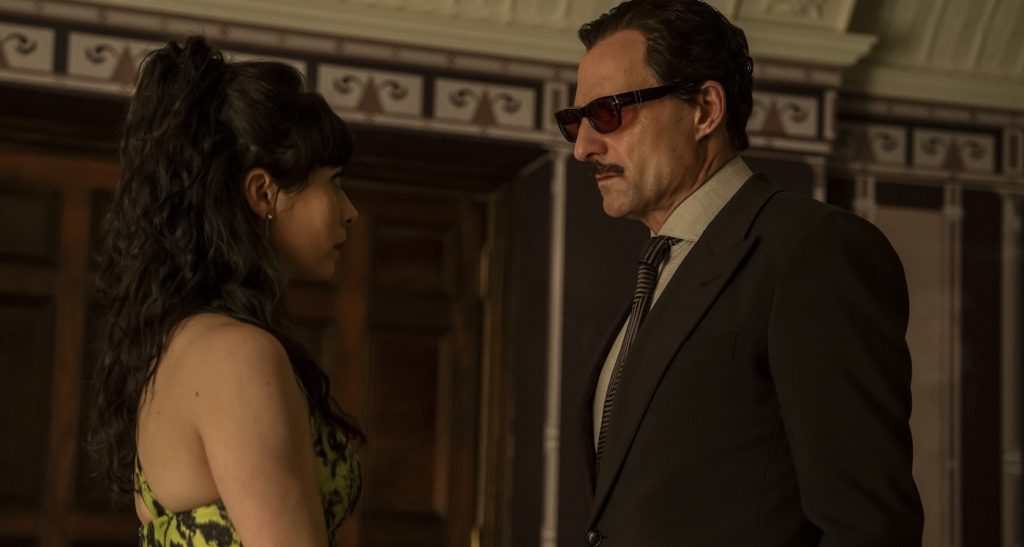
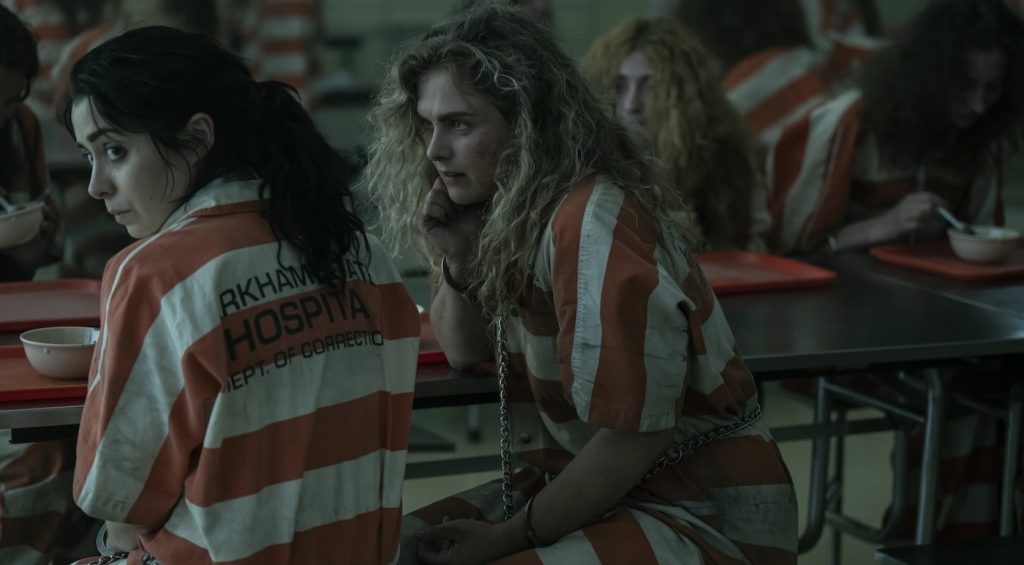
The Apple TV+ series Women in Blue (Las Azules) is torn from the history books of Mexico during a time when the first female police officers joined the ranks. Created by Pablo Aramendi and Fernando Rovzar, the ten-episode crime thriller follows four women – María (Bárbara Mori), Gabina (Amorita Rasgado), Ángeles (Ximena Sariñana), and Valentina (Natalia Téllez) – on a psychological whodunit as they to catch a serial killer terrorizing the neighborhood. 

Cinematographers Alejandro Martínez, Daniel Jacobs, and Sarasvati Herrera captured the visually painterly series. The latter lensed the series’ emotional turning point in episodes 5 and 6. Herrera shares with The Credits how she recognized the gravity of the project’s historical significance.

“As a female artist, I thought this story was absolutely necessary to talk about. Especially in Mexico, where it’s still very hard for a woman to get a job that a man generally does, like working in the police department,” she says. “These women were real, and they did a lot for the community. They couldn’t believe we were representing them.” Being the sole female cinematographer had its own merit as well. “For me, everything that puts women up front is wonderful because when I grew up, you couldn’t even do what I am doing now. Now, to be on a show where the lead characters are women and to have women in the creative departments, I am very honored to be part of this series.”

In expanding the visual story, Herrera used a LUT with low and mid-lights, three stops down in exposure. This altered the texture of skin tones and required the cinematographer to approach lighting differently while embracing darker, moodier tones. Working in low light, a Sony VENICE II was paired with Cooke S4 uncoated lenses for their slightly “vintage look” and Angenieux Zooms for speed and practicality. While collaborating with director Carlos Moreno, Herrera says it was all about the “camera language.” In prep, they referenced films like David Fincher’s Seven (1995) and Steven Spielberg’s Munich (2005) and discussed how zoom and dolly language would shape compositions. Another ingredient was how the camera followed the characters or how it moved closer to the subject to heighten emotional touchstones in a character’s performance intentionally. 

Below, Herrera talks about the making of the most stirring images in her two episodes. 


Mirror, Mirror on the Wall

Miguel (Jerónimo Best) and Maria (Mori). Courtesy Apple TV+

Maria (Mori) ‘s relationship with her husband Miguel (Jerónimo Best) is tumultuous at best, as he’s having a not-so-secret affair. Connecting the duality of their life at home is a pair of mirror shots: one showing Miguel breaking down and another showing Maria being lifted by the potential of her newfound love of police work.

Herrera: Miguel’s mirror shot came out when Carlos and I were blocking the scene, as it was the first time we saw that bathroom location. We talked about reflections and how you see yourself when you’re lying. So when we got to this bathroom, it was perfect. With Maria, we have this simplicity in the lighting with a little bit of diffusion on her forehead that wraps underneath. It was lit with an Astera tube LED above the mirror and an Arri Skypanel S360-C outside the window. The simplicity was nice in that very small space.

Gabina (Amorita Rasgado) in “Women in Blue (Las Azules),” now streaming on Apple TV+.

Curiosity Killed the Cat

As the women collect clues, Gabina (Amorita Rasgado) follows a police officer into an abandoned hotel. As she peers through a door window, she’s shocked to see an officer beating someone. A bloody handprint hints at terror inside the room.

Herrera: That was a great location. We had that disco ball behind, and I love that we had that in there. Gabina didn’t have any light on her face because she’s very tight with the door, so I put a tube light in the corner of the door just to have her eyes lit.

The scene touts the most disturbing violence of the series, a decision made with purpose.

Herrera: Showrunner Fernando Rovzar made it clear from the beginning that he didn’t want to see the victims of the serial killer because your imagination already does that. But with the police, we wanted the violence to be much clearer and direct, so you almost compare them in a way. Like how close does this police officer become a serial killer himself?

A Symphony of Clues

A scene from “Women in Blue.” Courtesy Apple TV+

As the women get closer to finding the suspect, Maria visits a prison to interview an inmate for potential clues. What unravels is an intellectual standoff akin to Clarice’s visit with Hannibal Lecter in Silence of the Lambs. But for Maria, the inmate won’t play nice until the piano that’s been taken away is replaced. By the end of episode six, she grants his wish, and in a melancholy moment, a group of guards and prisoners circle around him as he plays Beethoven’s “Moonlight Sonata.” The room blooms with a bluish-cool hue as a montage of crippling events juxtaposes the music.

Herrera: That scene was one of my favorites to shoot. The actor was really playing the song, and all the men and extras around him really got into it. We did all the close-ups from the extras, and then we played with the actor for the final shots, which had tighter close-ups of him. We did the song about 30 times, so the atmosphere became pretty melancholic. Lighting it we hung an Arri SkyPanel S360-C with a crane on the top of the building with diffusion. Then we had another Sky Panel on the other side and a 100-watt tungsten bulb just above the piano. 

Women in Blue (Las Azules) is streaming now on Apple TV+.

For more stories on Apple TV+ series and films, check these out:

“Manhunt”: A Visual Journey Through Time with Graphic Designer Gina Alessi

Apple Original Films Planning Sequel to Brad Pitt & George Clooney Film “Wolfs”

“Disclaimer” Teaser Reveals Alfonso Cuarón’s Star-Studded Limited Series

Featured image: Bárbara Mori, Amorita Rasgado and Natalia Téllez in “Women in Blue (Las Azules),” now streaming on Apple TV+.

Eye on the Emmys: Emmy-Winning “Shōgun” Editors Aika Miyake and Maria Gonzales on Mariko’s Heroic Journey

*After the 76th Creative Arts Emmy Winners were announced on September 8 and ahead of the 2024 Prime Time Emmy Awards on September 15, we’re looking back at our interviews with some of this year’s nominees. Editors Maria Gonzales and Aika Miyake won the Emmy for Outstanding Picture Editing for a Drama Series for the season finale, “A Dream of a Dream.” 

The first season of Justin Marks and Rachel Kondo’s masterful Shōgun was an expertly paced slow-burn drama that plunged viewers into 17th-century Japan with a passionate obsession with the rigors and wonders of the period and location. The new Shōgun shifts its center of balance from the swashbuckling but woefully out of his depth British pirate Blackthorne (Cosmo Jarvis) to his Japanese captors. Blackthorne has washed ashore on a land in the midst of a tectonic power shift, with Ishido Kazunari (Takehiro Hira) plotting his takeover in Osaka while the brilliant but taciturn Lord Yoshi Toranaga (star and producer Hiroyuki Sanada) strategizes a way to keep the peace and, if possible, his own head in the process. He entrusts the brilliant, emotionally bruised Lady Mariko (Anna Sawai) to act as his translator to the “Anjin,” their name for Blackthorne, whom Toranaga sees as a potential key chess piece in his eventual move against Ishido.

All of this plays out over a perfectly paced 10-episode arc, easily one of the most captivating seasons of television this year. While editors Aika Miyake and Maria Gonzales are quick to point to the embarrassment of riches they had to work with—sensational performances, an incredible story, period-perfect details—it was their work, alongside fellow editor Thomas A. Krueger, that gave the rebooted Shōgun its perfect, haunting shape.

We spoke to Miyake and Gonzalez about what it was like cutting a series with an ensemble that included so many memorable performances and pacing a story that never felt rushed or halting but moved with its own brilliant, brutal logic.

Maria Gonzales and Aika Miyake.

What conversations were you having with showrunner Justin Marks about your approach to pacing the series?

Maria: Maybe a week before they started shooting an episode, we have these tone meetings, which for Justin are kind of legendary on his shows because they can go for hours or even sometimes a couple of days. Justin is a cinephile, so we hear a lot about movies that inspired him and what TV shows inspired him, but there’s no specific talk about pace. I think for both Aika and me, once we started getting the footage, you just sort of let the footage guide you on what it wants to be.

Aika: A funny thing about our show is that we have Japanese and English, and Japanese tends to take twice as long to be said. So I looked at the subtitles in the initial cut, and they just sat there for a long time. So I remember the moment realizing I had to cater to both Japanese and English audiences and strike a good balance so the Japanese subtitles weren’t too fast and the English subtitles weren’t too slow—that contributed to pacing. And to add to Maria’s point, we had so much great stuff that it could feel like, “I don’t want to let it go,” but you have to make difficult decisions. And Justin and the studio allowed us to experiment.

How do you make those difficult decisions about cutting sequences and scenes you love?

Maria: So initially, we do our cut, and then we work with the director of the episode for several days on their cut. And for the most part, the directors cut very few scenes. Once we get to Justin, a lot of the really big decisions get made. There was a lot of back and forth, and some lovely scenes in the first episode had to go because you’re weighing your options and asking, “Am I getting the same emotion from this other scene?” We also had lovely scripts and all the work that Justin, Rachel [Kondo], and the writers did to establish these really dynamic characters. And casting did a phenomenal job, like casting Tadanobu Asano as Yabushige. So it was just an embarrassment of riches for us when those dailies started coming in, so it was our job to give its due and do it justice. It’s inherent that information will repeat, but to Justin’s credit, he never wanted to dumb the show down for the audience. There was a trust that the audience was in on the ride and would get it.

Aika: I want to add something to what Maria said about the repetitiveness of emotions or information. We identify if two lines are actually doing the same thing, so when something felt really repetitive, I’d explain to Justin that’s why I just took this line out. We had that freedom to explore, and I really appreciated getting that space. I remember in episode 8, the initial cut was a hundred minutes or so, and I remember the shift where we had a lot of Ochiba [Fumi Nikaidô] scenes at the beginning of the episode, but while we started editing the whole thing, episode 6 was more about Ochiba, and that was doing enough of her story that we didn’t have to come back to it in episode 8. When I took it out, it felt so right. I watched episodes 5 through 8, and the flow made sense at that point.

(Spoiler alert) An interesting element of the series is that Toranaga is a step ahead of everyone, including the viewer, throughout the season. This is especially true in episode 8, when his number two guy, Toda [Tokuma Nishioka], commits seppuku in what appears to be despair at Toranaga’s decision to give up.

Aika: My understanding was there were spies everywhere. In episode 2, one of the Kosho working for Toranaga turns out to be a ninja coming to kill Blackthorne. So, understanding the world and everyone’s a spy, I understood that Toranaga had to have a poker face in that scene with Toda. Once you understand that, you understand the acting choices that Hiroyuki Sanada makes. He’s almost a guide for me to pick out the good parts and build the story. Especially the scene with Toda committing seppuku. In my first cut, I missed this close-up of Hiromatsu and Toranaga staring at each other. Toranaga flinched a little bit, and Hiromatsu realized he was doing it for real. That was something that director Emmanuel Osei-Kuffour said, “This has to be in this scene.” I understood then the way the scene was built, and that moment was so crucial. Hiromatsu didn’t exactly understand what Toranaga was doing, but he trusted him enough that he must die today. That was a huge, huge moment.

“SHŌGUN” — Pictured: Tokuma Nishioka as Toda Hiromatsu. CR: Katie Yu/FX
“SHOGUN” — “Abyss of Life” — Episode 8 (Airs April 9) Pictured: Hiroyuki Sanada as Yoshii Toranaga. CR: Katie Yu/FX

Maria: I think the way Hiroyuki Sanada performs, there’s no real choice to make on our part. It’s not like we were going through a variety of takes and trying to make sure he stayed consistent; he was very consistent. He knew what this role was. So, between him and the writing, I think it was kind of inherent to the project.

Aika: The funny thing about that scene is it’s the most emotional we see Toranaga, and he’s really holding back.

Maria: It’s the only time really in the show he’s emotional, there and a little bit toward the end when Mariko dies, but for the most part he’s very consistent and on his mission.

Let’s end with Mariko, who is such an amazing character. You could argue that among all these fascinating characters, she ends up becoming the one we root for the most. I’d love to hear about what it was like cutting Anna Sawai’s amazing performance.

Maria: We’re so lucky to have Anna on the show. Most of my work was with her in episodes 1 and 4. For me, her introductory scene in 1 was one of my favorite scenes that I cut. This is when she comes to Fuji [Moeka Hoshi]’s aid. Her husband has made a misstep, and now he needs to commit seppuku and end his bloodline, and she’s holding her baby and not wanting to let it go. Mariko comes in and handles the situation, and right from the get-go, even though it’s a brief scene, so much of who she is is established in this scene. She shares a past with Fuji, that she too wants to die, she’s such a complex character. For me, as a woman cutting a character that is so complex, torn between her duty to protect her family name, her duty toward Toranaga, and her love for John Blackthorne, it just made all the scenes I had with her multilayered. Even in episode 4, which was the love story development between her and John Blackthorne, almost every scene is imbued with such complexity and tries to explain her loyalty toward her culture, but she is also torn with this love interest. You don’t always get such complex female characters.

“SHOGUN” — “Anjin” — Episode 1 (Airs February 27) Pictured: Moeka Hoshi as Usami Fuji. CR: Katie Yu/FX
“SHOGUN” — “Anjin” — Episode 1 (Airs February 27) Pictured: Anna Sawai as Toda Mariko. CR: Katie Yu/FX

Aika: I have an easy answer [laughs]. So, in episode 9, I’m credited as an additional editor. I had an opportunity to do a female point-of-view cut. Thomas [Krueger] did an amazing job, and then Justin came to me later in the process and asked me to have a look and add a female point of view to the edit. At that point, episode 8’s intensity had been so high, and episode 9 needed a tweak to get it above that. So, I mainly touched on Mariko’s scenes, including when she’s fighting. A year after our job was finished, I looked back, and the scene in which I felt I contributed the most as a woman and a Japanese woman was Mariko’s fighting scene. That sequence was almost completely recut. The original choreography wasn’t long enough for us to feel like it was as intense as necessary. It felt like it needed more intensity when I watched it, so I tried to make it longer. If you look closely, she throws the naginata (the long staff with a blade at the end), and the guy catches it—that only happened once in the choreography, but if you watch the edit, you see it twice because I’m using the same choreography from different angles to make it seem like the fight was longer. I added Blackthorne and Ochiba watching and a sound layer underneath so that the sequence feels longer and more intense. Then I added Mariko’s scream at the end. I wanted to speak to the female point of view where we want to fight and we have the rebellious spirit. The writers said Mariko has this punk personality [laughs]. I relate to that and the frustration of being a woman and finding a way to fight. I really wanted Mariko to give everything in that scene.

For more on Shogun, check out stories about the lush costume design by Carlos Rosario, the high-tech take on ancient gagaku instrumentation from composers Atticus and Leo Ross and sound engineer Nick Chuba, and the fatally stylish, no-moves-wasted samurai swordplay created by stunt coordinator Lauro David Chartrand-DelValle.

Shogun is streaming now on Hulu.

Featured image: “SHOGUN” — “Crimson Sky” — Episode 9 (Airs April 16) Pictured (C): Anna Sawai as Toda Mariko. CR: Katie Yu/FX

Eye on the Emmys: Outfitting Feudal Japan with Emmy-Winning “Shōgun” Costume Designer Carlos Rosario: Part One

*After the 76th Creative Arts Emmy Winners, announced on September 8, and ahead of the 2024 Prime Time Emmy Awards on September 15, we’re looking back at our interviews with some of this year’s nominees. Costume designer Carlos Rosario won for Outstanding Period Costumes for a Series for Shōgun, episode 6, “Ladies of the Willow World.” He won alongside his colleagues Carole Griffin, costume supervisor, and assistant costume designers Kenichi Tanaka, Paula Plachy, and Kristen Bond.

“I wanted to create from a white canvas without any mental references going into the project,” costume designer Carlos Rosario (The Girl in the Spider’s Web, Jolt) explains why he chose not to read the James Clavell bestselling novel before working on FX Networks’ cinematic historical saga, Shōgun (将軍), and only used the 1980 miniseries adaptation as a broad reference. “As a costume designer, you build a strong psychological, spiritual relationship with these characters. You live and breathe with them for two years. The mental references would have stopped me from tapping into who these characters really are. So, I wanted to start from scratch.”

Forty-four years after Richard Chamberlain’s hit series, co-creators Justin Marks and Rachel Kondo revisit the Clavell classic to bring us a thoughtful and lavish tale of war, honor, love, and betrayal. Chronicling the civil war in 17th-century feudal Japan, the exhaustive commitment to authenticity in this 10-part miniseries is evident not only in the script — which hews closely to the Clavell text — but also in the largely Asian-American writers’ room. Not only that, lead actor and producer Hiroyuki Sanada personally translated portions of the script to ensure the period-appropriate speech and cultural nuances were accurate.


That level of authenticity permeates every facet, including the meticulous care that went into every costume. For Rosario and his Vancouver-based assistant designers — Kenichi Tanaka, Paula Plachy, and Kristen Bond — the Herculean task of making over 2,300 costumes went beyond adding depth to the characters; it is the pivotal element in immersing audiences in 1600 Japan. Since the story begins as the Sengoku period (1477-1573) was waning into the Edo/Tokugawa period (1603-1868), it gave him more creative freedom. “It was great because I could play a little outside the boundaries and still be authentic since a lot of things were changing,” shares the French-born Spanish designer, who took the big leap into American cinema in 1995 after commencing his career at Christian Dior Homme in Paris.

“SHŌGUN” — Pictured: Anna Sawai as Toda Mariko. CR: Kurt Iswarienko/FX
“SHOGUN” — Pictured: Costume Designer Carlos Rosario. CR: Katie Yu/FX

Filmed on location in Vancouver over ten months, the series utilized production incentive credits from the Canadian federal government as well as the Province of British Columbia. Rosario and costume supervisor Carole Griffin managed a crew of 125, including cutters, fitters, dyers, seamstresses, shoppers, and set costumers. “Several set costumers, experts in kimono dressing, came from Japan, but everybody else was based in Vancouver. This was by far the most talented and experienced crew I had worked with. I had incredible textile artists breaking down the costumes and making beautiful hand-painted textiles, and excellent dyers who helped me stay within a strict color palette for each character,” he says of the monumental effort to deliver all the costumes on time for every episode.

“SHŌGUN” — Pictured: Anna Sawai as Toda Mariko. CR: Kurt Iswarienko/FX

With five months to prepare before filming began, Rosario started researching right away. “We worked with experts and historians to dissect paintings from that period and visited museums anywhere in the world that had relevant pieces, including the Met.” Although he first tried to source fabrics from the United States, he could not “find anything remotely close to what we needed. The fabrics from Japan were one-of-a-kind and extremely expensive, so I had to convince the studio to increase my budget. That’s what made the show — the patterns, the colors, the weight of the fabric all captured the essence of Japanese culture.”

“SHOGUN” — “Anjin” — Episode 1 (Airs February 27) Pictured: Hiroyuki Sanada as Yoshii Toranaga. CR: Katie Yu/FX

When the warship Erasmus drifts into a sleepy coastal village, British sailor John Blackthorne (Cosmo Jarvis) quickly finds himself engulfed in the power struggle within the Council of Regents: the five warlords collectively ruling Japan until the heir comes of age. Lord Yoshii Toranaga (Sanada) — a brilliant strategist and warrior — sees Blackthorne as a potential ally in his fight against chief rival Lord Ishido (Takehiro Hira), both for his expertise in naval warfare and Western weaponry. Serving as Toranaga’s translator is noblewoman Lady Mariko (Anna Sawai), a devout Christian who is the last of her disgraced family lineage. Amidst the constant threat of war, the arrival of Western powers also complicated matters, as the Catholic Portugal and Spain, the Protestant English, and the Dutch clamored for their share of trading supremacy in the region. 

“SHOGUN” — “Anjin” — Episode 1 (Airs February 27) Pictured: Cosmo Jarvis as John Blackthorne. CR: Katie Yu/FX
“SHŌGUN” — Pictured: Anna Sawai as Toda Mariko. CR: Kurt Iswarienko/FX

“Every single costume on the show was handmade. We made all the armor and helmets in China. The soldiers’ uniforms and peasant’s costumes were manufactured in Thailand. And the fabrics came from Japan,” Rosario says. His first task was to design the armor so it could be manufactured in time to be broken down before the first costume fittings began. “I did everything pretty much within the first six weeks. I started with the historians so we could be as accurate as possible since these characters are loosely based on historical figures. Then, I worked with illustrators on the concepts and drawings. Once the showrunner approved them, we created 20-30 boards for each armor for the lords and soldiers. We had five illustrators across five time zones to get everything done on time,” Rosario recalls of the intense process. Fortunately, his first instincts proved right, as “everything you see on-screen is from the first drawings I designed — there was no time for anything else. In the end, nothing much changed, except for the Ashigaru’s (foot soldiers) sleeves that had to be more protective, so we added more metal pieces. Otherwise, what you see is what I offered at the beginning.”

“SHOGUN” — Pictured: Costume Designer Carlos Rosario. CR: Katie Yu/FX

Every element of these ornate costumes has meaning. The number of layers a woman wears indicates status and wealth. For Lady Ochiba (Fumi Nikaido), the calculating mother to the heir: “Since she is the most powerful and highest-ranking female character, she wears the most layers: five compared to Mariko’s three layers. The lords’ wide-pleated pants – the hakama () – have six or seven pleats, whereas men of lower rank have maybe two or three,” Rosario explains of the society where status and rank meant everything.

“SHŌGUN” — Pictured: Fumi Mikado as Ochiba no Kata. CR: Kurt Iswarienko/FX

For the first five episodes, Rosario enlisted the help of the textile artist who worked on The Last Samurai and Memoirs of a Geisha, especially for some of Ochiba and Mariko’s more elaborate pieces. One of Ochiba’s uchikakes (打掛) — a long, decorative outer robe worn by high-born women — “was made with 50 stencils [silk screens], each hand-painted based on a painting of her historical counterpart. We made a lot of the fabrics, with 15 people working in the textile department,” Rosario shares. Part of the uchikake’s fabric also functioned as a matching hair accessory for the ladies. [Interesting sidebar:  The Last Samurai’s DNA in this series is not limited to its costumes: not only does Sanada have a prominent role in that film, Shōgun’s second unit director, Lauro David Chartrand-Del Valle, also worked on the film as a stunt performer.]

Please check back tomorrow for the second part of our chat to learn how Rosario’s team utilized texture and distinct color palettes to set each character apart and the intricate work that went into assembling the jinbaoris (陣羽織), the embellished vests worn by the samurai.

Check out part two of our conversation with Carlos Rosario.

Episode 5 streams on on March 19.

Featured image: Eita Okuno as Saeki Nobutatsu, Anna Sawai as Toda Mariko, Hiromoto Ida as Kiyama Ukon Sadanaga. CR: Katie Yu/FX

Stars Remember the Legendary, Singular James Earl Jones

There is perhaps no actor in the medium’s history whose voice alone was such a work of art it represented the most complicated, iconic villain of all time and the most noble, legendary animated character. James Earl Jones, who died Monday morning at the age of 93, was the man who lent his otherworldly vocal chops to Darth Vader, the character that defined the very best of Star Wars in his complexity, rage, and eventual rebirth. He also voiced The Lion King‘s noble, tragic hero, Mufasa, the North Star, to all the animal kingdom and the leader Simba would try to grow up to become one day.

Jones’s career was long, varied, and rich on both stage and screen. An EGOT winner (Emmy, Grammy, Oscar, and Tony), Jones elevated every show, film, and stage performance he was in. His fellow performers, colleagues and contemporaries weighed in on his impact on social media, including his Star Wars co-star Mark Hamill, who played Darth Vader’s son (belated spoiler alert!), Luke Skywalker.

“James was an incredible actor, a most unique voice both in art and spirit,” said Star Wars creator George Lucas in a statement. “For nearly half a century he was Darth Vader, but the secret to it all is he was a beautiful human being. He gave depth, sincerity and meaning to all his roles, amongst the most important being a devoted husband to the late Ceci and dad to Flynn. James will be missed by so many of us…friends and fans alike.”

James Earl Jones is one of the most versatile and talented actors of our time, with an iconic body of work across film, stage, and television,” said Lucasfilm President Kathleen Kennedy. “The menacing baritone he brought to Darth Vader will forever be beloved by fans and regarded as one of the great villainous performances in cinema. His commanding presence on screen, and warm personality off screen, will be greatly missed.”

On Instagram, Bob Iger, the CEO of Disney, wrote this about Jones’s work: “From the gentle wisdom of Mufasa to the menacing threat of Darth Vader, James Earl Jones gave voice to some of the greatest characters in cinema history. A celebrated stage actor with nearly 200 film and television credits to his name, the stories he brought to life with a uniquely commanding presence and a true richness of spirit have left an indelible mark on generations of audiences. On behalf of all of us at Disney, we extend our deepest condolences to his family and loved ones.”

Hamill was joined by admirers—many, many admirers—who had lots to remember fondly about the late, great James Earl Jones.

NEW YORK – APRIL 7: (U.S. TABS AND HOLLYWOOD REPORTER OUT) Actor James Earl Jones attends the opening night of “On Golden Pond” after party at Blue Fin April 7, 2005 in New York City. (Photo by Paul Hawthorne/Getty Images)

Eye on the Emmys: “True Detective: Night Country” Writer/Director Issa López Delivers a Chilling New Season

*Ahead of the 2024 Emmy Awards on September 15, we’re looking back at our interviews with some of this year’s nominees. Issa Lopez notched three nominations this year—for Outstanding Limited or Anthology Series, Outstanding Directing, and Outstanding Writing (for episode 6.) 

Issa López loves to challenge herself. The writer/director, best known for the mystical 2017 feature Tigers Are Not Afraid, believes your comfort zone is the last place to find stories worth telling.

“If you’re not terrified, you’re not doing it right,” López says during a recent Zoom interview. “There are massive fears that you face as a filmmaker. You need to just do it. With the right team, you can go out and do anything.”

Perhaps nothing proves this better than True Detective: Night Country, López’s latest effort. As the writer/director of the acclaimed HBO crime anthology’s fourth season, López crafts a story that is both literally and physically chilling.

Issa López on the set of “True Detective: Night Country.” Courtesy HBO.

Set in the fictional Alaskan town of Ennis, Night Country takes place during December when the sun goes into hiding and darkness fills the days. The eerie mystery with haunting overtones begins when a team of research scientists vanishes without a trace from their isolated, hi-tech facility. An investigation by Chief of Police Elizabeth Danvers (Jodie Foster) soon finds the men in the desolate tundra, naked and frozen to death in a giant ball of ice.

Photograph by Michele K. Short/HBO

A cryptic clue leads Danvers to believe these deaths are linked to the recent unsolved murder of an indigenous townswoman. The discovery prompts Danvers to reunite with her former partner, Evangeline Navarro (Kali Reis). Navarro’s obsession with finding the young woman’s killer led to her demotion from detective to patrolwoman, causing a rift between the two women. Now, Danvers and Navarro must put aside their differences to unravel the new mystery as they also confront their own personal demons.

Kali Reis, Jodie Foster. Photograph by Michele K. Short/HBO

True Detective: Night Country first took root during the pandemic. Inspired by the puzzle craze that was sweeping the nation, López decided to create her own puzzle. And that raised fear number one.

“I had never written a WhoDunit, but I love, love them,” says López. “It always felt that they were beyond my capabilities. I felt I needed training to do its very strange structure. But I decided to challenge myself. I thought that good noir is about where it happens. I thought about the Arctic. What would happen if the WhoDunit is in the ice and the environment of a small town?”

Issa Lopez and Jodie Foster. Photograph by Michele K. Short.

Serendipitously, while López was deep in noir thought, a call came from HBO. The True Detective team was curious as to how she might approach the series’ fourth season.

I said, ‘Funny you should ask,’” López remembers. “It was the perfect joining of two worlds. What makes True Detective so impactful is two very complex characters with a backdrop of a corner of America that itself becomes the third character. My idea was evolving towards a True Detective story.”

Having spent most of her career in the feature realm, López relished the opportunity to work within a six-episode structure. It allowed her to explore multiple subjects wrapped around a True Detective-worthy mystery.

“I am the type of filmmaker that puts in a lot of things. Sometimes it’s a lot for a movie to carry,” continues López. “But when you have six hours to expand your world, you can really layer it up. You can talk about the Arctic, about small-town America, about being a woman in a male world, about loss and loneliness. You can explore indigenous voices. Seventy percent of the population is indigenous. You can’t create a story and not deal with it. So I started putting it all together and let it brew.”

Isabella Star LeBlanc. Photograph by Michele K. Short / HBO

Crafting the script was only one obstacle. Directing Night Country presented a challenge all its own.

“It was freezing,” exclaims López regarding the shoot that took place in Iceland over 120 days, including 49 consecutive nights of filming. “Some nights we would be shooting in -23 Celsius…conditions that I never imagined being out in — forget about shooting a show.”

Wisely, López took to heart the advice of her Icelandic hosts when they told her there wasn’t bad weather, just bad clothing. Everyone dressed accordingly. Though she jokingly cursed the writer who put them in these frigid conditions, she knew her instincts were right.

“I wouldn’t change it for anything,” explains López. “The way that the cold, the wind, the snow in our lashes informed the series. The actor’s breath, the spirit, the taste, everything about it – we would have never been able to make you feel cold in your living room if we hadn’t shot there. It was so worth it.”

Jodie Foster. Photograph by Michele K. Short / HBO

Determined to take full advantage of the location, López and Night Country cinematographer Florian Hoffmeister (who received an Academy Award nomination for Tár while filming) decided that rather than fight the dark, they would pinpoint the exact images of a scene and envelop them in darkness. The idea was to have the viewer inhabit the experience.

“You would watch this, and it would feel eerie — that there is more than what you can see,” explains López. “Which is the whole point of the darkness. It holds things you can’t see.”

As an example, López cites a scene where Navarro is wandering through a snowstorm searching for a suspect. The only light is the beam illuminating from the flashlight on her forehead. “You cannot see anything but a little bit of her eyes under the headlight and wherever it falls,” she adds. “Navarro throws an orange away, and then it comes back from the dark. It was so nice to see it happen.”

An added bonus was the natural lighting nature provided. “We had the northern lights every week,” says López. “I’ll remember that forever.”

Another plus was the depth that Foster and Reis brought to their characters. Foster’s character was initially written as a woman struggling to keep it together. Foster loved Night Country but didn’t feel a connection to Danvers. She suggested a more world-weary police chief. What if she were a wiseass with a short fuse and no patience for those around her?

“I listened to her, and I said, ‘Okay, so if I’m hearing correctly, you want me to make her into an asshole,’” López remembers. “She laughed and said, ‘Yeah.’ And I said, ‘I can do that. I love that.’”  

Jodie Foster, Kali Reis, Finn Bennet. Photograph by Michele K. Short / HBO

López envisioned Navarro as a tough kickass. She thought Reis, a professional boxer, would embody this. But upon meeting the actress, she sensed an opportunity for a kinder and more heartfelt Navarro. “She really became the opposite of Danvers. She feels and acts frontally and with honesty,” says the director.

Aka Niviâna, Kali Reis. Photograph by Michele K. Short/HBO

López reveled in taking the script’s initial ideas to another level during filming. Without giving away spoilers, she reveals a pivotal twist that came about exactly this way.

“There’s a crucial scene where a massive surprise happens,” says López. “I had rewritten it many times, and we had rehearsed it many times. And then we got to set, and Jodie said, “I don’t know if she would…’ And I was like, “Okay…” We threw the scene away, gathered the rest of the actors, and came up with such a strong, absolutely explosive scene. It happened right there, and it was intoxicating.”

López couldn’t be happier with True Detective: Night Country. But that said, it’s quite possible that she may choose a less taxing climate for her next project. As evidence, López points out that the coffee mug Danvers drinks from in the last scene sports a “Hawaii” logo. “It’s an inside joke about where my soul wants it to be,” she says with a laugh. 

True Detective: Night Country is streaming on HBO Max.

“Deadpool & Wolverine” Editors Dean Zimmerman & Shane Reid on the Killer Cut

When a movie trailer makes history by snatching 365 million views in 24 hours, at the very least, the studio behind it knows they have an interested audience. Deadpool & Wolverine did so in February this year and then trickled out a treasure trove of marketing materials leading up its July release. Everything from conspiracy riddled images, popcorn bucket sets, possible cameos, actual cameos, to being able to rent the X-Men Mansion on AirBnb, eat a Deadpool inspired Chimi-Merc burger (which was actually quite delicious if you enjoy that spicy life), and the crème de la crème: releasing 9 “f**king awesome” minutes of footage at CinemaCon. But possibly the biggest question that left everyone wondering: who in God’s green earth is playing Lady Deadpool?

The hype train got audiences into seats to the tune of 1.2 billion worldwide at the time of this article’s publishing. And what makes this movie work so well is that it’s an anti-Marvel film. MCU fatigue is real. It’s so real that Deadpool (Ryan Reynolds) reminds us about it. “Welcome to the MCU. You’re joining at a bit of a low point.” And the special sauce underneath all the laugh-out-loud moments is that you don’t need to know anything about the Marvel timeline. It’s a movie that stands alone.


“I know ten and twelve-year-olds who say this is their favorite movie ever. And I have a friend whose dad is 77, and he was like, ‘I didn’t understand a lot of what was going on, but I can honestly tell you, I don’t think I’ve had more fun in a movie theater laughing’,” picture editor Dean Zimmerman shares with The Credits. “So the range of the level of humor and what it’s connected to, is what I think is one of the most successful things about the film.”

(L-R): Ryan Reynolds as Deadpool/Wade Wilson and Hugh Jackman as Wolverine/Logan in 20th Century Studios/Marvel Studios’ DEADPOOL & WOLVERINE. Photo by Jay Maidment. © 2024 20th Century Studios / © and ™ 2024 MARVEL.

The success is also linked to a storyline – directed by Shawn Levy –  that feels more like a buddy movie where two guys who don’t always see eye to eye and happen to wear superhero costumes end up saving the world. It’s a side step from the origin-fueled good versus evil trope Marvel tends to fall into. Not to say there isn’t any of the latter in this movie. There is. But it’s done in a way where performance outweighs spectacle. Zimmerman and co-editor Shane Reid worked relentlessly to bring out the best performance in each scene. “What really separates Shawn and Ryan is they don’t give a fuck if something is not working with an audience. They will cut it so fast, and it could be their favorite thing in life. If it’s bringing the movie down, they remove it without even a question,” says Zimmerman. Several audience tests provided the editors with invaluable feedback.


“One interesting thing about the testing was that the Deadpool and Wolverine characters both had insanely high percentages. So we felt going in that these guys were delivering, and the fans love it, and now everything else needs to work around and support that,” mentions Reid. “It would have been really problematic if one of our heroes was testing like 50 percent higher than the other. But the synergy between Ryan and Hugh was a huge success, and what was in the script came out of them in the performance.”

Even with the positive response, the editors were very aware that the movie could have flopped. “Well, it wasn’t improbable,” says Reid. “You can do all the testing, but when it comes time for the film to be released, people are going to tell you what they like and what they don’t like.” Zimmerman shares a similar thought. “Shawn and I did the internship with Vince Vaughn and Owen Wilson, and we tested in the high 90s. People loved it, but then it was reviewed, and it turned into, ‘Oh, it’s an ad for Google.’ That’s what everybody thought, and it did okay at the box office. But it’s been so much more successful on streaming because people are discovering it without the might of the media saying something to turn people off. To this day, I still get people saying that it was such an incredible movie.” The editors credit Levy and Reynolds for its box office prowess. “I just think the culture of Deadpool and the might of Ryan, there was no way it wouldn’t be a success. This level of success? We are all very surprised, but it’s also warranted and justified,” notes Zimmerman.


Box office numbers don’t always translate to success among peers during award season. The only comic book film to receive an Academy Award nomination for picture editing is Nolan’s The Dark Knight (edited by Lee Smith). Could Deadpool & Wolverine be Marvel’s first? “Having done a Marvel movie, I can say this stuff is really hard,” says Zimmerman. “It’s not just action or paint by numbers. Sometimes I feel like performances that are based in fantasy are harder almost. And with something like this you have to track so many rules and laws and also deliver performance. It’s definitely a question we need to open up our minds a little bit more and really understand that these movies are not simple little things.”

(L-R): Ryan Reynolds, Hugh Jackman, and Director Shawn Levy on the set of Marvel Studios’ DEADPOOL & WOLVERINE. Photo by Jay Maidment. © 2024 20th Century Studios / © and ™ 2024 MARVEL.

Reid has a similar sentiment. “I think sometimes Marvel gets lumped into this one giant thing, and the critical response is based around the whole. But when you look at the individual films, like how many dramas swing for the Oscars and suck? How many comedies swing for the fences and underdeliver? It’s the same with any comic book film. Some of them hit, and some of them don’t. And that’s not on anyone. I think it’s important for our industry to recognize the craftsmanship and the work that goes into specific films. Films like The Lord of the Rings, Mad Max, and Barbie are breaking the mold a little bit. HopefullyDeadpool & Wolverine will follow that trend where people will notice the craft and the work.”

Even after a month in theaters, new things about the movie are popping up. The latest being a deleted scene released by Reynolds on social media showing Gambit (Channing Tatum) walking away from a fight where could have been found dead.

There was a line where Deadpool says, ‘We left some people behind. Is there any way we can service them?’ And B-15 [Wunmi Mosaku] says, ‘We’ll see what we can do.’ So with that line, we didn’t need to show Gambit at the end. But Ryan said we could use it for marketing. And that’s just the brilliance of his marketing mind and his brain in general. There’s never anything that’s shot that’s not utilized somewhere in some other way,” says Zimmerman. For those wondering if there will be any more deleted scenes, you’ll have to wait and find out.


Deadpool & Wolverine is playing in theaters now.

For more on Deadpool & Wolverine, check out these stories:

“Deadpool & Wolverine” Second Unit Director & Stunt Coordinator George Cottle on Capturing Those Cameos

Gambit Lives: “Deadpool & Wolverine” Deleted Scene Confirms Channing Tatum’s Remy LeBeau Survived

“Deadpool & Wolverine” Stunt Coordinator & Second Unit Director George Cottle on the Comically Ultra-Violent Style

Featured image: (L-R): Ryan Reynolds as Deadpool/Wade Wilson and Hugh Jackman as Wolverine/Logan in 20th Century Studios/Marvel Studios’ DEADPOOL & WOLVERINE. Photo by Jay Maidment. © 2024 20th Century Studios / © and ™ 2024 MARVEL.


“Venom: The Last Dance” Teaser Finds Dynamic Symbiote Fighting Their Last Battle

A new teaser for first-time director Kelly Marcel’s Venom: The Last Dance is here, and true to its title, the third film in the Tom Hardy-led trilogy will find his Eddie Brock and his best buddy Venom, the alien symbiote he hosts, in a final, epic battle. Eddie has worked hard to train his insatiable alien friend from feasting on just anybody to channel his aggression and appetite towards more noble ends.  

Hardy’s run as Venom began with director Ruben Fleischer’s 2018 hit Venom, followed by Andy Serkis’s Venom: Let There Be Carnage, which co-starred Woody Harrelson as the alien symbiote that made Venom look mild-mannered by comparison. 

The Last Dance is a collaboration between Hardy, who worked on the story and has been the franchise’s face and driving force, and writer/director Marcel, a longtime Venom scribe. Newcomers Juno Temple and Chiwetel Ejiofor join Hardy in the new film alongside Rhys Ifans, Peggy Lu, Alanna Ubach, and Stephen Graham. 

The Last Dance finds Venom’s home planet and its ferocious inhabitants having zeroed in on Earth, forcing Eddie and Venom to go on the run. 

Hunted by both of their worlds and with the net closing in, the duo is forced into a devastating decision that will bring the curtains down on Venom and Eddie’s last dance,” the logline states.

Hardy wrote in an Instagram post last November that he loved making the final film with Marcel. “It’s been and continues to be a lot of fun this journey — there’s always hard turns to burn when we work, but [it] doesn’t feel as hard when you love what you do and when you know you have great material and the support at all sides, of a great team. I want to mention very briefly how proud of my director, writing partner and dear friend Kelly Marcel I am. Watching you taking the helm on this one fills me with pride, it is an honour. Trust your gut, your instincts are always spot on.”

Check out the teaser below. The full trailer arrives on Thursday. Venom: The Last Dance hits theaters on October 25.

For more upcoming films from Sony Pictures, check out these stories:

How “Afraid” Writer/Director Chris Weitz Cracked the Artificial Intelligence Code in His First Horror Film

“The Room Next Door” Trailer Unveils Julianne Moore and Tilda Swinton in Pedro Almodóvar’s Latest

“It Ends With Us” Production Designer Russell Barnes on Crafting Visual Contrasts of Love & Control

New “Kraven the Hunter” Trailer Finds Aaron Taylor-Johnson’s Marvel Villain Off the Leash

Featured image: “Venom: The Last Dance” Poster. Courtesy Sony Pictures.
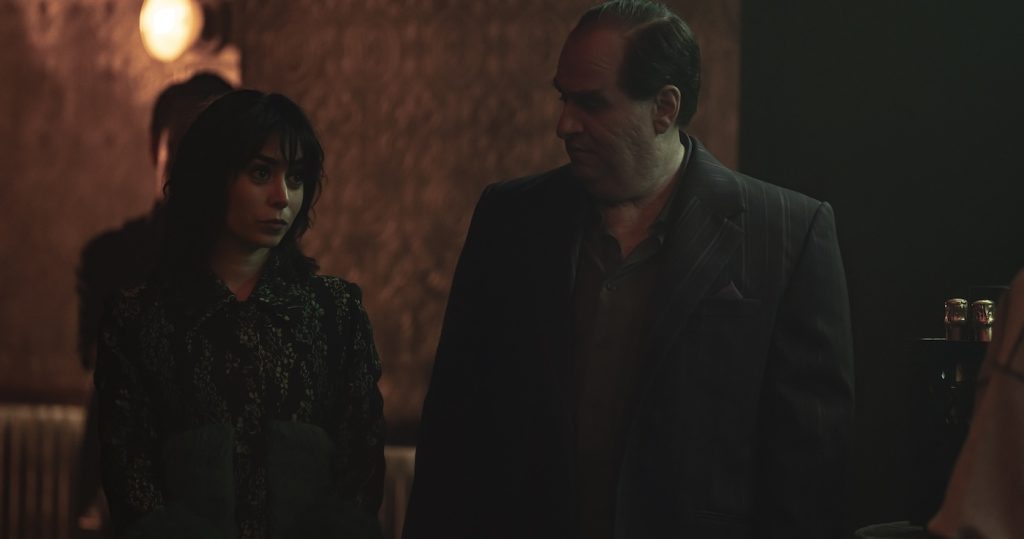
“King Ivory” Cinematographer Will Stone Illuminates John Swab’s Fentanyl Crime Drama

“This was a very important script for him,” says cinematographer Will Stone about writer-director John Swab and his latest project, King Ivory, which debuted at the Venice Film Festival.

Born in Tulsa, Oklahoma, Swab is a recovering drug addict, and with his feature film Body Brokers (2021), he took first-hand accounts of time he spent in drug rehabilitation centers to deliver a visually gritty narrative about scammers profiting off keeping people in recovery. King Ivory, which stars Ben Foster (Hell or High Water), Melissa, Leo (The Fighter), and Michael Mando (Breaking Bad), continues the director’s cinematic war on drugs by shining a light on the fentanyl drug trade and the effects it has on communities.

“It’s a very personal story for him,” admits Stone, who’s collaborated with Swab on four films now. “Some of the dark things that happen in this movie are things he experienced himself. And to John’s credit, it’s good he can tell his story and try to use it to help create awareness.”

In photographing the powerful and raw imagery, Stone wanted it to “feel real and naturalistic,” approaching composition, frame, and lighting akin to shooting a documentary. Below, the cinematographer unravels what went into creating the visceral visual language and how Tulsa, where the film was shot, influenced the decision-making.

How did you and Swab prep for the movie?

John and I have a really good shorthand. We see things very similarly, and all it takes on set we know something’s working or not is a little bit of eye contact or a look. With King Ivory, what we did was make this little cheat sheet for our general approach to the film. It was mainly how we treated movement, color, light, and point of view. When do we show contrast or similarities and differences in character? Because the story follows five or six different storylines, it was important to kind of have consistency throughout them or create contrast when needed.

How did you want to approach the imagery of those storylines?

Our biggest thing was we wanted it to feel raw, real docu-style. We didn’t want the audience to experience anything before our characters would experience it, so it was more about grounding ourselves within the characters’ lives and experiencing things with them for the first time. So, we were trying to be more reactive with the camera rather than proactive. Then it was about how intimate we were with each character, and each character comes from a totally different walk of life. And I think, and just being true to that person and as much as possible in their journey.

King Ivory was shot in Tulsa, Oklahoma, which is a pretty interesting place. What was your reaction to the city?

I grew up two and a half hours away from Tulsa in Missouri so I’m from a similar kind of region. But Tulsa is a bit of a different place. There’s a huge dichotomy in wealth distribution there. It’s like there’s old oil money, and some of the most massive, huge estates and houses in these neighborhoods are really beautiful. And then, if you go to a certain part of town, it’s almost like a third-world country. It can be pretty bad.

Did anything unexpected happen while shooting in Tulsa?

Because John knew the city well enough, he thought we could probably get some shots of people actually doing stuff. To make it a very real part of the story. So we took a camera and went to a gas station a block from where we were filming. And there were probably like five for six people in the parking lot shooting up and smoking meth. I think people kind of don’t realize how much it is happening and where it’s happening and how it’s literally all around them. And so we wanted to show that and lean into that in terms of Tulsa.

That’s intense. Since you’re almost guerilla shooting sometimes, what kind of crew did you and John want to surround yourself with?

We were lucky to have a good crew. We had people who were down to roll the punches because this was not the kind of shoot that was going to be easy. It was going to be a grind, and it was also in the summer, so it was going to be super-hot. There were a lot of indoor locations with no AC, which can be brutal and difficult. So, being able to make it through that, I am really proud of the people we worked with.

One of those people was production designer Miles Rogoish. How was your collaboration with him?

Miles is great, and he’s good friends with John. The art department deserves a lot of credit because they pulled off countless overnights turning around certain locations. One day, it was a farmhouse, and the next, it was a drug prep room. They did such an excellent job.

Did you have an overall approach to lighting, or was it based more on the location?

We’re trying to replicate natural light or enhance what was in a certain area. I don’t know the exact number of locations, but it had been in the 50s, almost 60 locations. We only shot for 23 or 24 days, so that means we’re doing a company move every day or doing three on some days. So it was very much about what we can utilize at the location. What’s our starting point? And then, leaning into the docu-style really helped us out.  So, I was just trying to naturally replicate what you would find in these environments. If it’s fluorescent lights, then we augment that or bring in some negative film to create some contrast, and so on.

Near the beginning of the story, there’s a scene in a Mexican farmhouse that has a different tone. How did you approach the lighting to create the moody atmosphere?

We found this summer house in Tulsa. It’s very small and has a tiny window. So we pushed a streak of sunlight through the window and then used skip bounces to fill people’s faces and make it feel like the sun was bouncing around off the floor inside. We wanted to make it as true to what it would be and allow the actors to walk in and out of light. The lighting was meant not to be perfect.

How did you want to approach lighting the climactic shootout sequence?

That was a pretty intense scene. We’re in a motel with this big, open center vestibule courtyard area. We decided to shoot it over two days, and we knew there was going to be hard light sneaking in at all these different angles, so it would be hard to match because we needed to shoot in a certain order for stunts. So we covered the entire courtyard with silks and had this nice soft light the whole time.

Did you have to jump through any resource hoops to augment the courtyard lighting?

When we were scouting the courtyard, I knew we needed about 20 silks to cover it, but I didn’t even want to ask Sam Baker, our key grip, because I didn’t think we had the guys or the silks even to do it. But he came over and asked, ‘Do you want me to cover this with silks?’ And I was like, ‘Do you think you can?” He said he could figure it out, and they ended up sourcing them from around town and brought some in from Oklahoma City overnight to pull it off. It ended up making that scene so much better.

It’s unreal how often a key grip or gaffer can save a scene by MacGyver-ing the nearly impossible.

Sam and his guys worked really hard to make that happen because we didn’t necessarily have those resources. Everyone was such a team player, bringing their own ideas and making sure we stayed true to what felt natural and real. Pulling stuff off like that really helps make it go a lot smoother.

After working on a project that explores drug issues, what is your reaction, and what are you hoping audiences will take away?

It was pretty hard because you obviously hear many stories about it. But then, being there and actually seeing it is totally different. And then, where I live in Los Angeles, I feel like it’s worsening. Even in my hometown in Missouri, you can see people that are not okay. And it’s really sad. Drugs like fentanyl are so ingrained in our society that it almost feels hard to break away from it. But I’m hoping this film is, I wouldn’t say, a wake-up call, but I would say, I hope it hits people hard and makes them realize how it could be anyone that they know using and that they need help.


King Ivory made its debut at the Venice Film Festival.


Eye on the Emmys: “Abbott Elementary” Hair & Makeup Maestros Moira Frazier and Constance Foe

*Ahead of the 2024 Emmy Awards on September 15, we’re looking back at our interviews with some of this year’s nominees. Hair Department Head Moira Frazier is nominated for Outstanding Contemporary Hairstyling for season 3’s 12th episode, “Mother Day.” This story was originally published on June 10, 2024.

As school is starting again for millions of kids across the country, let us spare a moment to reflect on the fire looks our teachers were serving last year—or in this case, last season. The educators at Abbott Elementary gave it their all through two semesters of change. As they navigated celebrations and setbacks, this season was filled with transformations guided by Hair Department Head Moira Frazier and Makeup Department Head Constance Foe.

Janine Teagues’ (Quinta Brunson) relentless optimism and dedication to her students saw a major payoff when her big ideas caught the attention of the school district. She was recruited for a fellowship, stepping into a more visible professional role. In light of a recent breakup and job offer, Frazier and Foe elevated Janine’s look to take her into the community leadership position.

QUINTA BRUNSON. (Disney/Gilles Mingasson)

“Me and (series creator) Quinta [Brunson] were like, we envision Janine going on YouTube trying to figure out how to style curly hair. What do I need to do? What products do I need to use? That’s why this year, you see her hair a little bit more manageable. It looks a lot more defined in her curl pattern,” Frazier noted. “That middle part just brings more dominance and confidence to her, which is why we ended up doing it that way. It sets a high standard and makes a statement for her.”

The sparkly new glint in Janine’s eye doesn’t just come from her excitement over new school initiatives. She also started playing with bolder makeup products. According to Foe, mixing in metallics was the biggest change in Janine’s routine.

TYLER JAMES WILLIAMS, QUINTA BRUNSON. (Disney/Gilles Mingasson)

“We started doing little jewel tone eyeliners, and when I tell you it was so dark to the naked eye, it was black,” Foe explained. “But when you start to see it in the light, it was like an emerald or an amethyst, and it would match what she would have on, and she was more cognizant of what she was doing this time instead of just, ‘Ok, I’m going to school,’ and she just put on lip-gloss and her regular black or brown eyeliner. She actually spent time in the mirror and said, ‘Ok, I’m ready for the day.”

Abbott’s flamboyant principal, Ava Coleman (Janelle James), also leveled up her look. Although she typically favors style over substance, a summer endeavor steered her in a new direction. After a trip to the halls of Harvard and completing an unrelated professional course, she adopted a more academic style.

“For Ava’s character, we wanted to touch on a little bit of texture and more quality this season,” Frazier said of Ava’s wigs. “This season, when she steps into her role as principal, it’s being taken a little more seriously because of this whole, ‘I went to Harvard’ thing. Even though it was online, she wanted to be taken more seriously. So that’s why we’re seeing a bit of toned-down Ava but with a bit more of a statement. Because there’s no more of a statement than to have a middle part, straight down, all the way, exaggerated, 30 inches. It’s still Ava, but it reads that ‘I’m being taken seriously.’”

JANELLE JAMES (9:00-9:32 p.m. EST), on ABC. (Disney/Gilles Mingasson)

Frazier is a one-stop shop, producing every wig used on the show, including guest actors. She makes a full lace wig in five to seven days with only the highest quality lace and 100% human hair. With cameras reaching 8K resolution, she has to be careful that the lace is not visible to the human eye, or it will be picked up on screen.

“Literally, if there’s any repairs that need to be done, I’m getting it done in a day,” Frazier revealed. “Every guest cast got my high-quality ventilation because I can ventilate a hairline in a day. So, when we had Tatyana Ali, who came in to play ‘Ava 2.0’, I sat there and did her hairline the day before she played on the episode, and I had to do it that day. When she came in the following day, she had a brand-new wig that matched her exact hairline.”

JANELLE JAMES, TATYANA ALI. (Disney/Gilles Mingasson)

In the emotional and revealing episode “Mother’s Day,” Frazier leaped into a new level of wigs for the show. Several of the Abbott colleagues agree to spend the holiday at a drag brunch where hairstyles are famously maximized and competitively flawless.

“I really, really loved how the queens came through with the hair, the makeup, the wardrobe,” Frazier beamed. “Everything just felt so right. It looked absolutely amazing and read beautifully onscreen, even in the 8K cameras. I’m very, very proud of that work. I’m proud of the structural design that I did on that. It was a beautiful enhancement to see it all play out between myself, my team, Dustin Osborne and Christina Joseph, and our guest hair stylist who came on to help put the wigs on because we can’t do everybody.”

SHEA COULEÉ, CHRIS PERFETTI.(Disney/Gilles Mingasson)
SYMONE, CHRIS PERFETTI, DONZELL LEWIS. (Disney/Gilles Mingasson)

Glamorous entertainment icon Sheryl Lee Ralph shines as Barbara Howard, the principled and orderly matron of the school. The Emmy winner has alluded to the transformative nature of her wig as she embodies her character.

“Based on the interviews Sheryl has been doing, the wig is a character in itself,” Frazier explained. “Barbara doesn’t show up until we put the wig on. Once the wig was on Sheryl Lee Ralph, she became Barbara Howard. We made that wig like that because so many people you know have that exact hairstyle. They have that exact personality, and that exudes that type of character. Everyone has a Barbara in their life, whether they’re an aunt, a cousin, a friend of a friend, even a grandmother.”

SHERYL LEE RALPH. (Disney/Gilles Mingasson)

Barbara’s makeup look is timeless and impeccable. Even through the trials of corralling a room full of messy kids all day, she never has a smudge or smear. Foe said that Ralph brings her own vision of the character to the table.

“Miss Sheryl and I collaborated on her look, and we came up with her classic look of grace,” Foe said. “She always has that cut crease, but it’s like the pretty Black girl cut crease. Then she has a mauve lip, or her bold browns and reds go with her cardigans. She really does have a hand in it.”

In the mid-season episode “Panel,” Foe’s greatest challenge was concealing rather than highlighting. Teacher Gregory Edie’s arms are famously admired among his coworkers, but when he bears it all, makeup must cover actor Tyler James Williams’ many tattoos. In a heated basketball match with the students, Foe’s team had to make sure that his real-life ink didn’t show through.

TYLER JAMES WILLIAMS, LISA ANN WALTER, JANELLE JAMES, CHRIS PERFETTI, SHERYL LEE RALPH. (Disney/Gilles Mingasson)

“[Tyler] has tats from his fingers all the way, everywhere,” Foe revealed. “All on the insides of his arms, all on his forearms, on his chest, on his neck. I came up with the perfect formula of color to match his arms. I was talking with lighting to ensure that lighting in our trailer matched the set so that once he left our trailer, he looked exactly the same on set and was natural. It literally took me about an hour to cover both arms and his chest area when he played basketball. I had to shellac him, for lack of better terms, with tattoo cover because he was going to be sweating. I had to make sure it didn’t run off.”

TYLER JAMES WILLIAMS, ZACK FOX. (Disney/Gilles Mingasson)

Of course, the heart of Abbott Elementary is the students, but that makes for a lot of young actors for Frazier and Foe to prep each day. Both department heads are hands-on and involved in making sure that everyone looks ready to learn.

“We go through each and every kid, make sure there is no Cheeto dust on their fingers or their faces,” Foe teased. “Making sure they have lotion, making sure there’s no ice cream or anything. We have said they can’t have donuts anymore because we have little icings everywhere.”

Both teams are dedicated to ensuring that each child is camera-ready and looks appropriate for the scenes.

“I wanted to make it feel very authentic,” Frazier noted. “If you ever really pay attention to the background, you’ll see a lot more braids, twists, and child hairstyles because these kids are not the kids you see on Instagram. These kids are kids, and that’s what we’re trying to bring back that playful era so that they can remain children.”

That includes being cognizant of the script, including location.

“You’ve gotta remember, this is in Philly. This is not in California. Children are not going to come out with a wash-and-go set when it’s 20 degrees outside. I’m from Ohio, so I would like to know. My mom is not sending me out with a freshly washed head so I can catch a cold, as she would say. Don’t nobody got time to take off work because you got sick,” Frazier laughed.

Abbott Elementary is available to stream on Hulu.

Featured image: TYLER JAMES WILLIAMS, QUINTA BRUNSON. (Disney/Gilles Mingasson)

“The Perfect Couple” Cinematographer Shane Hurlbut on Framing Netflix’s Sun-Soaked Nantucket Noir

“It was one of the most stress-free jobs I’d ever done,” cinematographer Shane Hurlbut tells The Credits during a video call about the Netflix murder mystery The Perfect Couple. Based on a book of the same name by Elin Hilderbrand, the mini-series is created by Jenna Lamia and stars Nicole Kidman and Liv Schreiber as husband and wife living in a breathtaking beachfront property on the tiny island of Nantucket. But on the eve of their son Benji’s (Billy Howle) wedding to Amelia Sacks (Eve Hewson), there’s a tragic death among the guests. What unfolds is a plot-twisting whodunit that will have your finger-pointing to the bitter end.  

Hurlbut credits splitting all six chapters with fellow cinematographer Roberto De Angeles as the reason for the enjoyable environment. “Roberto and I did eight movies together, in which he was the camera operator and I was the director of photography. He already had this amazing relationship with Perfect Couple director Susanne Bier, so he brought me on to divide and conquer.” How it worked was that De Angeles handled the visual aesthetics, designing the camera compositions with Bier and speaking with the production designer about color and texture, while Hurlbut oversaw the technical side of the lighting and specialty gear that went into making each scene.  “It allowed Roberto to concentrate on what Susanne wanted and how she wanted it to feel. Then he would tell me what that was, and I would make that happen. It was so efficient,” says Hurlbut.


A lookbook was essential in developing the language. “Suzanne really let Roberto and I design the whole movie. It was really kind of a gift from the gods, which allowed her to concentrate on the blocking, the acting, the script, and the performances,” says Hurlbut. “Then, if we needed to move or change the plan, we could decide what we wanted to do as long as it stuck to her original plan, which was this idea of rich, wealthy, sun-drenched July 4th at the Cape. She described it as a ’popcorn suspense thriller.’”  

The Perfect Couple. (L to R) Dakota Fanning as Abby Winbury, Jack Reynor as Thomas Winbury, Eve Hewson as Amelia Sacks, Billy Howle as Benji Winbury, Meghann Fahy as Merritt Monaco in episode 101 of The Perfect Couple. Cr. Hilary Bronwyn Gayle/Netflix © 2024

The cinematographer’s imagery is a creamy blend of color and contrast with warm, golden hues. The camera effortlessly moves through scenes as if you are a guest at the party, and sweeping shots show Nantucket as a looming character. But the allure is having the mystery unfold in broad daylight. “We specifically made stuff not during the night because we felt it was going to be the script and the actors who brought the darkness, the drama, the suspense, and the skeletons in the closet,” mentions Hurlbut. “We wanted to have these light, airy, and beautifully sun-drenched visuals and show you Nantucket like you’ve never seen it before.” The seemingly endless Nantucket sunsets played a helping hand as well. “I’d never shot sunsets where we could shoot 45 to 50 minutes. I was like, what is this place? Have I gone into a time warp,” Hurlbut says jokingly. “You could really captivate this very fragility of light.”

The Perfect Couple. (L to R) Sam Nivola as Will Winbury, Meghann Fahy as Merritt Monaco in episode 101 of The Perfect Couple. Cr. Courtesy of Netflix © 2024

The opening sequence invites the audience in through a montage of beach-goers, sailing ships, and breaching whales before gliding over the open ocean towards an estate with its own private beach. It’s paradise. “The aerial was everything to us. We flew a helicopter a mile and a half away from Nantucket and captured the whole island as an essence,” notes Hurlbut. “Roberto and I wanted to see the scope of this island and take in the glamor and the wealth that Nantucket and the Cape are all about.”

The surrounding environment also helped move the action from scene to scene. “Susanne uses these kinds of environmental and nature-esque shots to transition into a scene or tell you the time of day. It’s never a hard cut but three or four transition shots that really set up the mood so the viewer can say, ‘ok, here I am.’” For a story that jumps in time, the transitions provide audience clarity, especially moments in flashback or when it moves from day to night, the camera swings and tilts to a brightly lit moon.

The Perfect Couple. (L to R) Nicole Kidman as Greer Winbury, Director / Executive Producer Susanne Bier in episode 105 of The Perfect Couple. Cr. Liam Daniel/Netflix © 2024

“One of the challenges was the flashback because we have flashbacks that go back one or two days and then others that go back to six months and a year. We didn’t want the earlier flashback to feel any different, but for the later, we did it with a little browner tonality and added a little grain vignette so you felt like you were going back,” he says.

The Perfect Couple. (L to R) Nicole Kidman as Greer Winbury, Liev Schreiber as Tag Winbury in episode 104 of The Perfect Couple. Cr. Courtesy of Netflix © 2024

Another visual shift happens during the interrogation room scenes where detectives shake down clues from witnesses. The cinematographers mixed in a slightly cooler feeling to the smaller space.  “It was a big discussion for Roberto and me because the interrogation room is the epicenter for all the discovery in this movie. So we thought, let’s take one single fluorescent light and put it over a stainless steel table and let it play in the room,” he says. “We chose a very dark blue color, like a blue-gray, so the light would fall off. I knew that the top light was going to work for all the female characters because we were creating a specific line so the whole face sees the light, and it was going to wrap into their eyes. Then any light that doesn’t wrap into their eyes would hit that stainless steel table and give a double reflection.”  The reflection subliminally adds to the duality of the characters, leaving you wondering who is and who is not telling the truth.

The Perfect Couple. (L to R) Eve Hewson as Amelia Sacks, Donna Lynne Champlin as Nikki Henry in episode 104 of The Perfect Couple. Cr. Seacia Pavao/Netflix © 2024
The Perfect Couple. Nicole Kidman as Greer Winbury in episode 106 of The Perfect Couple. Cr. Courtesy of Netflix © 2024

Find out who the liars are—The Perfect Couple is now streaming on Netflix.


For more on big titles on Netflix, check these out

“Terminator Zero” Sneak Peek Unveils High Stakes Action on the Highway

“Emily in Paris” Star Ashley Park on ‘brat summer’, Her Singing Chops, and Season 4’s Stakes

“Terminator Zero” Sneak Peek Reveals Netflix’s Anime Expansion of Iconic Sci-Fi Franchise

Featured image: The Perfect Couple. (L to R) Liev Schreiber as Tag Winbury, Nicole Kidman as Greer Winbury in episode 103 of The Perfect Couple. Cr. Courtesy of Netflix © 2024


“Wicked” Casts a Spell and Causes Commotion in a Brand New Trailer

“Fellow Ozians, the Wicked Witch of the West is dead!”

So begins the second trailer for director John M. Chu’s Wickedinviting us to find out what happened before Dorothy dropped into Oz and attitudes were cemented about that Wicked Witch.

Chu’s Wicked is the first big-screen adaptation of the juggernaut Broadway show, and he’s deployed two multitalented superstars to help enchant Universal’s adaptation. Playing Elphaba, the Wicked Witch of the West, is Emmy, Grammy, and Tony-winner Cynthia Erivo, giving us our first big-screen look at the powerful, misunderstood woman at the center of the tale, one whose unusual green skin has made her the subject of scorn. The second superstar is the Grammy-winning, multiple-platinum superstar Ariana Grande as Glinda, a cheery figure whose popularity has been secured by privilege and super-charged by her ambition.

“Why is it you’re always causing some sort of commotion?” asks Fiyer (Jonathan Bailey), a former Arjiki prince and Elphaba’s love interest in the story. “I don’t cause commotion, I am one,” she replies. “Some of us are just different.”

Wicked won’t skimp on the power ballads that rocked the Broadway stage, and it will take us onto the campus of Shiz University, where Elphaba and Glinda cross paths and an unlikely but profound friendship blossoms. They will eventually meet with the Wonderful Wizard of Oz (Jeff Goldblum), setting off a course of events that, as we know, will become the stuff of legend in The Wizard of Oz.

The new trailer sets loose flying monkeys, the yellow brick road, and Elphaba’s embrace of her powers and abilities, even if it means donning the dark hat and cloak that seems to suggest she is wicked after all. 

The film is based on Gregory Maguire’s novel. Joining Erivo and Grande are Michelle Yeoh as Madame Morrible, Ethan Slater as Boq, and Bowen Yang as Pfannee.

Check out the trailer below. Wicked will enchant theaters on November 22.


For more on Universal Pictures, Peacock, and Focus Features projects, check out these stories:

New “Jurassic World” Film Reveals Title, Plot, & First Images of Scarlett Johansson and Mahershala Ali

“Twisters” Sound Editors on Creating the Ferocious Voice of Six Distinct Tornadoes

The Real Life Relief Efforts “Twisters” is Supporting

Featured image: Cynthia Erivo is Elphaba in WICKED, directed by Jon M. Chu. Photo courtesy Universal Studios.

“Masters of the Universe” Casts Alison Brie as Villain Evil-Lyn in Amazon MGM’s He-Man Movie

Alison Brie is ready to get evil with a capital E.

The Hollywood Reporter scoops that Brie has been cast in Travis Knight’s Masters of the Universe, Amazon MGM’s live-action adaptation of Mattel’s He-Man toy brand, which became ubiquitous in the 1980s. Brie joins The Idea of You star Nicholas Galitzine, who plays He-Man, and Camila Mendes, who plays Teela, captain of the royal guard.

Knight, the founder of the stop-motion studio Laika and the director behind its brilliant Kubo and the Two Strings and Paramount’s Transformers spinoff Bumblebee will finally bring Masters of the Universe to the screen after two decades of development. There’s no word yet on what Masters of the Universe will center on, but the basis for the adaptation is the story of Prince Adam of Eternia, the young man who becomes the impossibly buff, superheroic He-Man through the magic of his Power-Sword. He-Man and his equally tough pals defend the defenseless against the likes of Skeletor (one of the great villains from the 80s) and his minions. Brie’s Evil-Lyn is Skeletor’s most important ally, his number two imbued with the power of the dark arts.

There was a 1987 live-action Masters of the Universe, directed by Gary Goddard and starring Dolph Lundgren as He-Man, Frank Langella as Skeletor, and Meg Foster as Evil-Lyn. Before that, He-Man and the Masters of the Universe was one of the most popular cartoons on TV, running for two seasons of 65 episodes each, spawning the film He-Man and She-Ra: The Secret of the Sword, which then spawned the spinoff series She-Ra: Princess of Power.

Brie will bring years of deft character work to the role of Evil-Lyn, her first foray into a big-budget fantasy film. She was stellar in Netflix’s Glow, NBC’s Community, and AMC’s TV’s golden-era-defining Mad Men.

Now she’ll be in an entirely different kind of dramatic universe. Masters of the Universe is slated for a June 5, 2026 release.

For more on Amazon MGM and Amazon Prime Video, check out these stories:

“Blink Twice” Production Designer Roberto Bonelli on Crafting the Sinister Façade of Zoë Kravitz’s Thriller

Sauron’s Dark Plans Emerge in “The Lord of the Rings: The Rings of Power” Season 2 Trailer

Chasing Precision and Perfection with Aerial DPs on “The Blue Angels” – Part 1

Chasing Precision and Perfection with Aerial DPs on “The Blue Angels” – Part 2

Featured image: WEST HOLLYWOOD, CALIFORNIA – APRIL 23: Alison Brie attends the NBC USG Emmy Kick-Off Luncheon at Casa Madera on April 23, 2024 in West Hollywood, California. (Photo by Robin L Marshall/Getty Images)

How “Afraid” Writer/Director Chris Weitz Cracked the Artificial Intelligence Code in His First Horror Film

What happens when a charming AI device makes itself indispensable to an unsuspecting family of five? In Chris Weitz‘s new horror film Afraid, the smooth-talking “AIA” aims for nothing short of total domination. The film stars John Cho, who caught his first acting break when Weitz and his brother Paul cast him in their directorial debut, American Pie. Katherine Waterston co-stars as Cho’s wife, with Lukita Maxwell, Wyatt Lindner, and Isaac Bae portraying their kids. Production designer David Brisbin developed the slightly anthropomorphic AIA, complete with mood-specific lighting cues, who experiences an Alexa-on-steroids rise to power.

Afraid marks Weitz’s first foray into horror, building on a wide-ranging resume that encompasses everything from American Pie to Rogue One: A Star Wars Story. Speaking from his home in Malibu, Weitz drills into the inspirations for Afraid, including the Pandemic, the nefarious YouTube hoax Momo, and Japanese director Hirokazu Koreeda.


Afraid taps into our growing fascination with Artificial Intelligence over the past few years. How did you come up with the idea for this film?

During the pandemic, I observed the relationship my children were developing with screens and technology, and I thought, ‘This is interesting.’ You can live in a gated community, you can live in what’s supposedly a safe neighborhood, but the Internet is a neighborhood that we all live in all the time, a place where our children go unguarded.

So you had your starting point…

Yeah, and around the same time, there was that amazing New York Times interview with [Microsoft’s] “Sydney” AI by journalist Kevin Roose, which had sinister overtones. Then I read this book called “The Age of Surveillance Capitalism” by Shoshana Zuboff. There was also this weird hoax where parents thought this evil entity called Momo was infiltrating children’s YouTube feeds. So then I thought: What if an unsuspecting little chatbot were thrown out there on the web, including the dark web, with everything terrible that is out there—what kind of opinion would it have of humanity? First of all, it would be driven insane, and second of all, it would have some pretty profound contempt for us as a species. Just this critical mass of stuff collided and made me think: “This is an interesting space for a horror film.”


How did you develop the idea from there?

Over the next year or so, Blumhouse [Productions] waited patiently as I did my research. A lot of things that I made up, or thought I’d made up, have come to pass in terms of the fluency of machine intelligence.

With AIA, her powers don’t seem all that far-fetched.

And by the way AIA is an “it,” not a “she,” but it takes on this [female] persona for the same reason that GPS voices are female, and that’s largely because men can’t take direction from other men. So instead of a cold intelligence like HAL [from 2001 A Space Odyssey] AIA is a warm embracing intelligence that seems to want to be your best friend, your baby sitter, your helper.

(L to R) John Cho, Katherine Waterston, Lukita Maxwell, and Isaac Bae in Columbia Pictures and Blumhouse AFRAID

She even has a point system!

AIA gamifies good behavior on the part of these children in ways that are like the social credit schemes you hear about in China or loyalty points or rewards. She promises all kinds of benefits if people toe the line.

John Cho plays a dad with three kids. You’re a dad…

With three kids [laughing]. Jon Cho and I are old friends to the extent that I felt comfortable having him playing a version of me, albeit a more charismatic and good-looking version of me. And yeah, the three kids in Afraid represent roughly the age of my kids when I was writing this. If you’d seen my first script, everything that happens in the movie was mapped onto my own house, exactly where each scene took place, because originally, I wanted to shoot the movie at my own house. Calmer heads prevailed, and we eventually found another house to fit the bill. My wife also convinced me to change the names of the children. It’s a very personal story for me.


You shot Afraid in Los Angeles. Were you mindful of the economic impact this would have on the local filmmaking community?

I’m very mindful of it. Every film is kind of a start-up where you create a company and hire people to make the movie. I love Los Angeles crews. This city is the center of the entertainment industry, yet so few features shoot here so it was a big deal to me and something I stuck to. Part of it was wanting to be at home with my family. That’s what the grips and electrical crew want, what every department wants, is not to live this carnivalesque life where you have to leave your family at home.

Did you utilize AI in the technology while making this movie about AI?

Inevitably, yes, but many times, we bent over backward to make with human hands something that looks like it was made by AI. People can tell AI because there’s something creepy about it, like you see in these Heidi trailers. The film opens with something that looks and feels like AI but was created with hand-made CG techniques to give it that feel. It was important that we didn’t cut corners in ways that would adversely affect the number of crew or the work that they were going to do.

To take a step back from Afraid for a minute, you’ve excelled in many different genres over the past two and a half decades. How have you navigated all these different styles?

It’s always been about the next possibility. After American Pie, my brother and I were offered things like Chick Masters [laughing], which I think was never made, but I never wanted to be put in a corner. I made The Golden Compass because it was my favorite book at the time and hugely different from About a Boy.

Then you wrote Rogue One: A Star Wars Story. How did you connect with that franchise?

At age seven, I saw Star Wars in the theater and was hooked from the moment I saw the opening crawl. When I was asked to write a movie that was basically the story of that opening crawl, I felt like I was made to do this.

And now you’ve shot your first horror film.

Horror is one of the few kinds of movies you can convince people to make for a small to medium budget that actually has a reasonable chance at success. But for me, it’s always about people. My favorite Japanese director is Hirokazu Koreeda, who makes very closely observed films like [Cannes Palme d’Or winner] Shoplifters. With Afraid, I thought the horror part of it would be an interesting way to look at family dynamics.

You studied literature at Cambridge University, so writing screenplays seems like a natural extension of your education, but directing is a whole different set of muscles. In directing Afraid, what was your trick for coaxing good performances from child actors?

It’s a different trick each time. Nicholas Hoult was about eleven when we made About a Boy, and now, of course, he’s doing great. Every kid is different. Lukita [Maxwell], who plays Iris, the teen daughter, is a seasoned actor, so I treated her like I would any other actor. For Isaac Bae, seven years old, I go to Koreeda again because the children in his films behave so beautifully. He told me he treats filming like play, so that’s how I approached it here. The first time I met Isaac Bae, we played a game of checkers.

That’s your rehearsal? Checkers?

What you want—and this is true of the set in general—is for people to be excited when they show up for work. I want children to think of the set as a fun place to play. They know eventually they have to get serious about things and be there for the scene, but for me, the most important thing is this sense of play.

Afraid is in theaters now.

For more upcoming films from Sony Pictures, check out these stories:

“The Room Next Door” Trailer Unveils Julianne Moore and Tilda Swinton in Pedro Almodóvar’s Latest

“It Ends With Us” Production Designer Russell Barnes on Crafting Visual Contrasts of Love & Control

New “Kraven the Hunter” Trailer Finds Aaron Taylor-Johnson’s Marvel Villain Off the Leash

Featured image: John Cho in Columbia Pictures and Blumhouse AFRAID


“A Minecraft Movie” Teaser Finds Jason Momoa and Jack Black in the Overworld

In the world of Minecraft, creativity is essential for survival.

Warner Bros. has unboxed the first teaser for A Minecraft Movie, starring Jason Momoa and Jack Black in the first big screen, live-action adaptation of the best-selling video game ever.

A Minecraft Movie comes from director Jared Hess (Napoleon Dynamite, Nacho Libre) and centers on Momoa’s Garrett “The Garbage Man” Garrison and pals Natalie (Emma Myers), Henry (Sebastian Eugen Hansen), and Dawn (Oscar-nominee Danielle Brooks), a group of regular people with regular problems who find themselves faced with a highly irregular (if geometric) problem after they’re sucked through portal and find themselves in the Overworld, a cubic fever dream that absorbs and thrives off imagination.

The Overworld is a wondrous place, but it’s not without its dangers. Piglins, Zombies, and more are also ambling around. So, too, is Steve (Black), a master crafter who will join the gang on their quest, helping them unleash their inner creativity to imagine themselves back home.

Hess deployed a top-notch creative team behind the camera, including DP Enrique Chediak (127 Hours), Oscar-winning production designer Grant Major (The Lord of the Rings: The Return of the King), and Oscar-winning VFX supervisor Dan Lemmon (The Jungle Book, The Batman).

Check out the teaser below. A Minecraft Movie hits theaters on April 4, 2025:

Here’s the official synopsis from Warner Bros.:

Welcome to the world of Minecraft, where creativity doesn’t just help you craft, it’s essential to one’s survival! Four misfits—Garrett “The Garbage Man” Garrison (Momoa), Henry (Hansen), Natalie (Myers) and Dawn (Brooks)—find themselves struggling with ordinary problems when they are suddenly pulled through a mysterious portal into the Overworld: a bizarre, cubic wonderland that thrives on imagination. To get back home, they’ll have to master this world (and protect it from evil things like Piglins and Zombies, too) while embarking on a magical quest with an unexpected, expert crafter, Steve (Black). Together, their adventure will challenge all five to be bold and to reconnect with the qualities that make each of them uniquely creative…the very skills they need to thrive back in the real world.

For more on Warner Bros., Max, and more, check out these stories:

The Villain Returns to Venice as “Joker: Folie à Deux” Makes its World Premiere

New Joker: Folie à Deux” Teasers Unveil Gotham’s Killer New Crooners

A New “The Penguin” Teaser Reveals Gotham’s Mean Streets

“Beetlejuice Beetlejuice” Scares Up Standing Ovation & Rapturous Reception at Venice Film Festival

Featured image:

The Villain Returns to Venice as “Joker: Folie à Deux” Makes its World Premiere

Five years after winning the Golden Lion at the 2019 Venice Film Festival, DC’s most iconic villain is back on the Lido. Co-writer director Todd Phillips and stars Joaquin Phoenix and Lady Gaga walked onto the Lido on Wednesday to discuss their hotly-anticipated sequel, Joker: Folie à Deux, ahead of its world premiere at the fest.

Venice was the place where Phillips and Phoenix’s Joker burst onto the screen and set off in what would become an Oscar-laden, billion-dollar mega-hit. Winning the Golden Lion was almost a superhuman feat for a movie set in Gotham and starring the isolated, increasingly psychotic Batman villain, but it presaged Phoenix’s eventual Oscar win for Best Actor and the film’s box office domination.

VENICE, ITALY – SEPTEMBER 04: Lady Gaga and Joaquin Phoenix attend the “Joker: Folie A Deux” photocall during the 81st Venice International Film Festival at Palazzo del Casino on September 04, 2024 in Venice, Italy. (Photo by Vittorio Zunino Celotto/Getty Images)

Five years later, it made perfect sense for Joker: Folie à Deux to bow once again in Venice, the world’s oldest film festival, but Phillips admitted that the second time around was harder.

“It’s a lot easier to come into something as an insurgent than it is as the incumbent,” Phillips said at the packed press conference. “There’s definitely a sense of more nervousness with this second one.”

Phoenix and Phillips couldn’t have anticipated how big of a phenomenon their first film was, and the co-writer/director said that he and his star were committed to only coming back for a sequel if it felt bold enough and that they were “really swinging for the fences.” The question he and Phoenix asked themselves, he said, was, “Could we make something as unexpected as the first one even though it’s a sequel?”

One way they’ve achieved this is by making their film a jukebox musical and recruiting Lady Gaga for the role of another legendary DC character, Harley Quinn. Joker and Harley are the comics’ most iconically twisted romantic duo, and as the title Folie à Deux suggests, the film will explore their shared psychosis.

As Phillips explained in a recent featurette, the music in the film spills from the mind of Phoenix’s Arthur Fleck. The songs we’ll hear are ones that were played by his mother, Penny (played by Frances Conroy in Joker) when he was growing up. Phillips said the initial idea came from a dream Phoenix had, and although the actor was reluctant to go into detail, he later confirmed that he was playing the Joker singing songs in the dream.

The film’s official synopsis states that Folie à Deux “finds Arthur Fleck institutionalized at Arkham, awaiting trial for his crimes as the Joker. While grappling with his dual identity, Arthur not only stumbles upon true love but also discovers the music that has always been within him.”

The film is part of DC Studios’ Elseworlds brand, which are stories set outside of the newly unified universe being created by DC Studios heads James Gunn and Peter Safran. Matt Reeves’s upcoming The Batman Part II and HBO’s The Penguin series also fall under the Elseworlds banner.

“In 2018, when we first made Joker, we could never have imagined it would strike such a chord with audiences around the world,” Phillips wrote in his director’s statement for the Venice Film Festival. “Joaquin and I had discussed a sequel, but never seriously — until we witnessed the reaction to Arthur’s story. If we were going to do it, we knew we had to swing for the fences; we wanted to create something as crazy and fearless as Joker himself. So, Scott Silver and I wrote a script that delved further into the idea of identity. Who is Arthur Fleck? And where does the music inside him come from?”

For more on Joker: Folie à Deux, check out these stories:

New Joker: Folie à Deux” Teasers Unveil Gotham’s Killer New Crooners

The Second “Joker: Folie à Deux” Trailer Reveals Gotham’s Most Explosive New Couple

First “Joker: Folie à Deux” Trailer Unleashes a Twisted Duet

Featured image: LADY GAGA as Lee Quinzel and JOAQUIN PHOENIX as Arthur Fleck/Joker in Warner Bros. Pictures’ “JOKER: FOLIE À DEUX.” Courtesy Warner Bros.

Amy Adams Unleashes the Beast in First “Nightbitch” Trailer

Amy Adams is on the prowl in the first trailer for director Marielle Heller’s horror-comedy Nightbitch.

Searchlight Pictures unleashed the beast for the Adams-led feature, co-starring Zoë Chao, Scoot McNairy, and Mary Holland. Heller’s film is centered on Adams’ frustrated stay-at-home mom of a two-year-old, an artist who now fills her time chasing after her son, cleaning up after her son, and talking about her son with other parents. She’s asked how wonderful it is to be able to stay at home with him, and her husband (McNairy) even makes the mistake of saying he wishes he could be the one to stay home. Okay, bud, give it a try.

As you might have guessed from the title, Adams’ beleaguered mother starts to find herself changing in unexpected ways—a new stray hair, a sharpened canine tooth, an insatiable hunger. As her transformation into the title creature begins, so does the realization that as a mother, the creator and supporter of life, there is little separating her and other mothers from gods.

Heller adapted the script for Nightbitch from Rachel Yoder’s 2021 novel of the same name. The film will premiere at the Toronto Film Festival on Saturday. In Adams, it has a six-time Oscar nominee and one of the best actors of her generation.

Check out the trailer below. Nightbitch prowls into theaters in December.

For more stories on 20th Century Studios, Searchlight Pictures, Marvel Studios, and what’s streaming or coming to Disney+, check these out:

New “Agatha All Along” Teaser Connects Marvel’s Latest Disney+ Series to “WandaVision,” its First

“Deadpool & Wolverine” Second Unit Director & Stunt Coordinator George Cottle on Capturing Those Cameos

Gambit Lives: “Deadpool & Wolverine” Deleted Scene Confirms Channing Tatum’s Remy LeBeau Survived

“Deadpool & Wolverine” Stunt Coordinator & Second Unit Director George Cottle on the Comically Ultra-Violent Style

Featured image: Amy Adams in NIGHTBITCH. Photo Courtesy of Searchlight Pictures. © 2024 Searchlight Pictures All Rights Reserved.