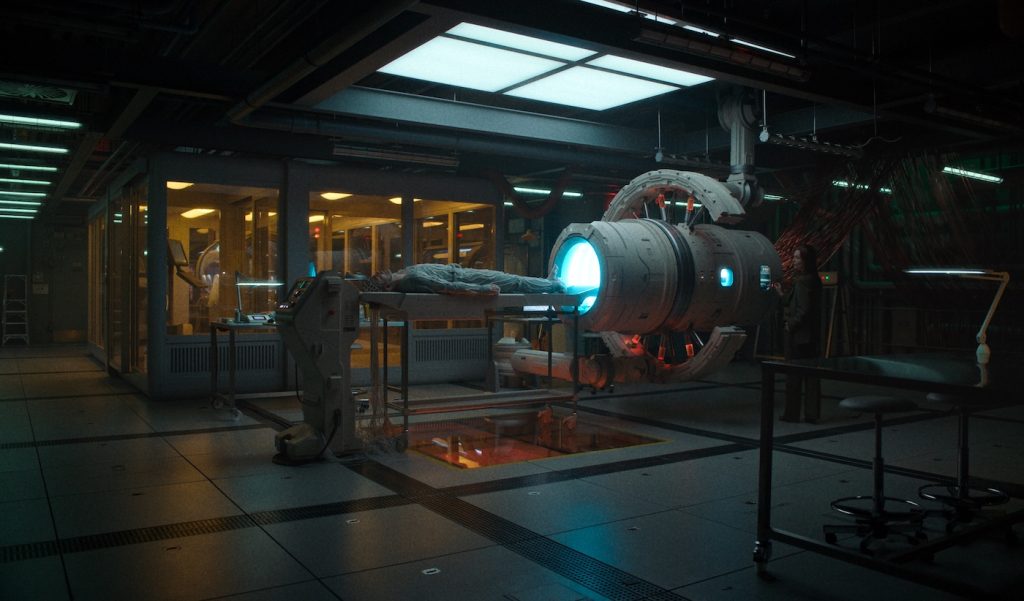
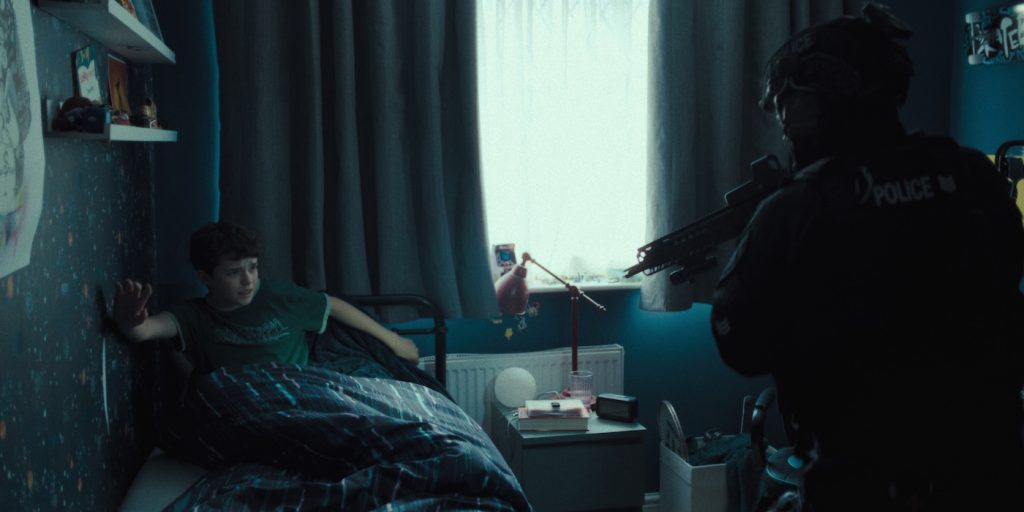
“I came with you to a be a part of something,” Cassian Andor (Diego Luna) says at the top of the official trailer for Andor season 2. In season 1, our titular hero started out wanting to be anything but, yet he was swept up in events far larger than them himself, and are leading him on his fateful path to eventually being a part of the team that steals the Death Star plans—a team that paid the ultimate price in their successful mission that was the heart of the 2016 film Rogue One.
The trailer for season 2 reintroduces us to our rag-tag group of rebels, including Forest Whitaker’s Saw Gerrera, a grizzled, longtime warrior who factors in huge to events both in Andor and plays a big part in the heist at the heart of Rogue One. Here, too, is Genevieve O’Reilly’s Mon Mothma, a member of the Galactic Senate and a secret Rebel Alliance operative, serving as the civilian leader in the long struggle against the Empire. We also get a moment or two with Stellan Skarsgård’s Luthen Rael, an antiques dealer by day, a skilled rebel spy at night. Perhaps Cassian’s closest ally, and the person for whom he would likely give up everything for, is Adria Arjona’s Bix Caleen, a mechanic whose loyalty and fearlessness proved crucial to both Cassian and the rebel cause.
The forces allayed against the rebels are massive and malicious—another returning face from Rogue One is Ben Mendelsohn’s Orson Krennic, a major part of the Death Star project as the Imperial Director of Advanced Weapons Research and one of many who want to see the rebellion strangled before it can be fully born.
Check out the official trailer for season 2 below. Andor returns to Disney+ on April 22.
For more on all things Star Wars, check out these stories:
Moving halfway around the world to live and work in a different culture and language presents inevitable challenges, but there is also a wealth of opportunities available to those who leave the familiar behind and immerse themselves abroad. This was the case for Taiwan-born and raised producer Hsinyi Liu, who learned the joys available to those willing to make the leap when she relocated to London more than two decades ago.
In an attempt at a compromise between her family’s expectations of a financially stable career and her own creative impulses, she earned a BA in advertising and dutifully entered the industry, but frustration soon crept in. “I realized I didn’t want to spend my whole life watching soy sauce commercials,” quips Liu.
Choosing the UK over the US partly because of the lighter financial burden of being able to complete a post-grad course in one year, as well as thinking London was “really cool,” Liu took an MA in Film Studies at Queen Mary, University of London. Being alone in a new country was daunting, but it also gave her the freedom to define herself. “It was liberating because I realized I could be anyone I wanted to be.”
But there was an unexpected linguistic hurdle. Liu had grown up studying American English, but she struggled to understand the locals in London, which made her wonder, “Did I learn this language?” Even after a couple of years, she wasn’t completely tuned in to the various British accents and colorful, expansive slang. Drop a New Yorker into South London, and she, too, might need a minute or two to parse exactly what is being said by the folks beside her at the pub. Early jobs as a second or third assistant director involved the additional difficulty of requests coming in over a crackly radio, sometimes leaving Liu nonplussed and relying on other crew members to translate.
However, language was instrumental to one of Liu’s first big breaks. Mandarin fluency helped land her work on Nick Broomfield’s 2006 film Ghosts (Cannes Directors’ Fortnight and Sundance nominee), based on the story of 23 illegal Chinese immigrants who died picking shellfish on the English coast. “I had to pretend to be an illegal immigrant and go into massage parlors, nightclubs, gangster hangouts, Chinese churches, everywhere, to cast real people for the film,” Liu explains. That was followed by giving instructions and translating on set, as well as working on the editing and publicity. “It gave me a full view of the filmmaking process.”
With no industry connections, Liu adopted the approach of trying her hand at nearly everything that she could. Bilingualism was again a boon for her work on Asif Kapadia’s Far North (2007), a thriller starring Michelle Yeoh and Sean Bean set in the Arctic Circle. Despite the pleasure of working closely with Yeoh, it was a fairly tough shoot. “We lived on a ship for two months in Svalbard, north of Norway. I’ve never been that cold in my life. We were seeing the Northern Lights every night, and by the end of it, I got tired of it,” she recalls with a laugh.
Casting duties on post-apocalyptic horror 28 Weeks Later (2007) were followed by AD work on She, A Chinese, filmed in London, and City of War, the Story of John Rabe, shot in China and Europe. Both released in 2009, Liu got acting credits for both films, being asked to appear by the respective directors after working on rehearsals, and got to appear opposite Steve Buscemi in the latter. Another memorable project with a distinctly British flavor was The Inbetweeners (2011), a hit spinoff from a successful TV comedy that set a UK comedy opening weekend box office record. Based on four teenagers’ Mediterranean holiday, Liu found herself casting hundreds of Essex partygoers, even spray-tanning the extras after they’d been flown out for the shoot. “I’m this Taiwanese woman walking into Essex nightclubs [Essex is to London as New Jersey is to New York], and people were just like, ‘What are you doing here?’”
Asked to stay on as a production coordinator after her casting duties, the film proved a career turning point. Liu wondered if she had spread herself too thinly by taking on so many different jobs but believes it ultimately worked to her advantage. “At the time, I worried that I hadn’t worked my way up in a single discipline, but now I see that understanding how people are thinking in every department has made me a better production manager.”
She began working as a freelance line producer in 2012, with her career shifting towards television, much of it for the BBC and Channel 4. It was in 2016 that what Liu says is “probably my favorite script of all time” landed on her desk in the form of Phoebe Waller-Bridge’s Fleabag. It also punctuated her life outside work, with the series arriving around the same time as her daughter and season 2 coming shortly after maternity leave. Another high-profile project she worked on during that period was Stephen Frears’ Amazon/BBC series A Very English Scandal, starring Hugh Grant and Ben Whishaw.
Juggling motherhood and freelance producing had Liu longing for a little more stability. When that arrived in the form of an offer to join leading UK independent production company Sister as a production executive in 2019, she jumped at the chance. There, she was responsible for projects including acclaimed true crime black comedy Landscapers for HBO/Sky and BAFTA-winning hospital drama This Is Going to Hurt starring Ben Whishaw for BBC/AMC. That was followed by her appointment as head of production at Steve Coogan’s Baby Cow Productions, where she worked on the hit comedy Changing Ends and the upcoming feature The Ballad of Wallis Island starring Carey Mulligan. In 2023, Liu took on the same role at Me & You Productions, where she now manages multiple high-end TV dramas, including I Am Ruth, the BAFTA-winning drama starring Kate Winslet, and its upcoming sequel.
Returning to the country of her birth, Liu joined the pitching conference at the Taiwan Creative Content Festival in November as a panelist and mentor. Having grown up on the cinema of Wong Kar Wai and Ang Lee, she enjoyed reconnecting with Asian filmmaking sensibilities. “What I love about Asian storytelling is that it allows for more breathing space. It’s not always about moving the story forward with every scene. The industry there also feels more genre-fluid, mixing family drama with sci-fi, comedy, and mystery in ways you don’t often see in the West. There’s a freshness to it.”
Being back in Taiwan also reminded Liu of its potential as a shooting location and for bringing Chinese-language stories to a wider audience, unencumbered by the creative constraints that can hit productions on the mainland.
Other formative influences during her younger years in Taiwan were Japanese manga and anime, particularly Studio Ghibli. Animation is one of the few things Liu hasn’t tackled, and along with “a VFX-heavy production,” it remains on her bucket list.
Television production in the UK is currently experiencing a slowdown, redolent of the pandemic, which brought mental health issues among industry folk to the fore, notes Liu. Having made her own way in London, far from her family and with little guidance available, she understands how challenging life in the business can be. “I’m glad to see the change in the industry in terms of the emphasis on diversity and inclusion, which didn’t exist when I started. I’m getting to a point where I could probably help people. If I can, I’d be very happy to give back.”
Featured image: L-r: Phoebe Waller-Bridge in Fleabag, courtesy Amazon Studios; Hsyinyi Liu; Carey Mulligan in The Ballad of Wallis Island, courtesy Focus Features.
After the last episode in season 3 of Mike White‘s The White Lotus, when Sam Rockwell parachuted into the storyline and delivered one of television’s most unexpected monologues in perhaps the medium’s history (a stretch? if so, not by much), episode 6 had a lot of narrative momentum. White’s cosseted guests this year, whether their troubles are of a dangerously anguished variety (looking at you, Walton Goggins’ Rick) or one of a brutal (but earned) reckoning with the law (possibly Rick again, but definitely Jason Isaacs’ Tim), are nearing the point in the season when the other shoe—or gun—must drop.
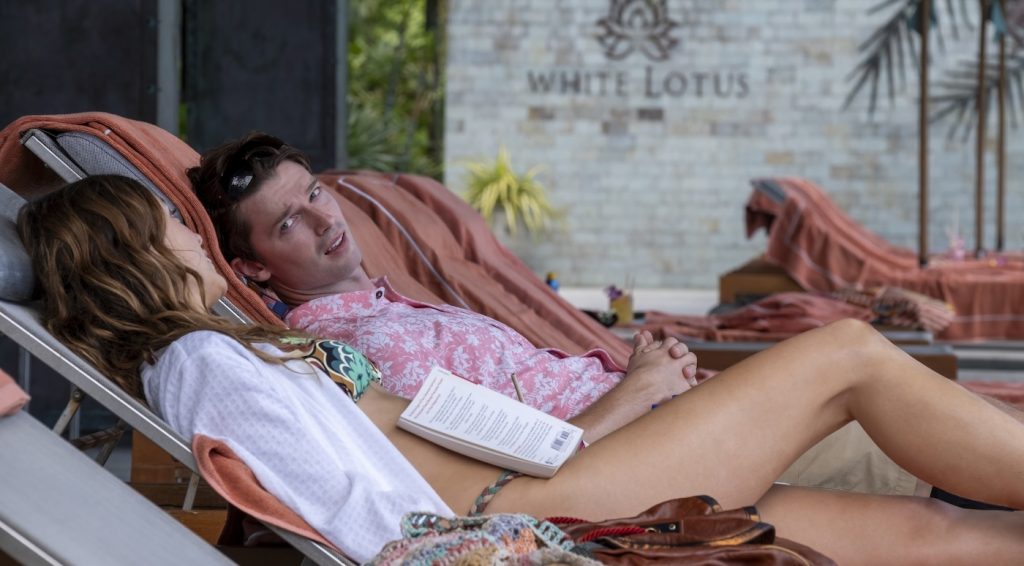
This seems to be the case, too, for Saxon Ratliff (Patrick Schwarzenegger), the swaggering simpleton whose entire sum of wisdom gained in a quarter century of life is that people yearn to be told what to do. This is coming from a spoiled rich kid who works for his daddy, a rich kid who still remains unaware of how much trouble daddy’s in, how badly that will work out for Saxon himself, and just how little he actually knows about the world at large. He discovers, to his literal disgust, a little bit more about what he’s capable of in episode 6, and it sends him scrambling to the toilet for a proper wretch.
Aimee Lou Wood, Charlotte Le Bon, Patrick Schwarzenegger, Sam Nivola. Photograph by Fabio Lovino/HBO
Episode 5, “Full Moon Party,” found the Ratliff brothers staying on Greg/Gary’s (Jon Gries) boat after they dropped the rest of the guests, including Greg/Gary and the Ratliff partners, plus sister Piper (Sarah Catherine Hook), off at the resort. Saxon and Lochlan (Sam Nivola) stay onboard with Chelsea (Aime Lou Wood) and Chloe (Charlotte Le Bon) to rage, which includes taking drugs, going to the Full Moon Party, and, eventually, having a threesome with Chloe. Not that either brother remains much—they both claim to have blacked out—but there are threads of memory they both start piecing together in episode 6, and they’re unsettling. After dismissing Chelsea’s reminder that the brothers made out as just goofing around, Chloe arrives poolside to remind Saxon that they did a lot more than that together. Cue Saxon hustling for the toilet.
Aimee Lou Wood, Patrick Schwarzenegger. Photograph by Fabio Lovino/HBO
“There’s some sensationalism, but then there’s also the stuff behind the wall of the character and what he’s dealing with in the conflict of what just happened,” Schwarzenegger told The Hollywood Reporterabout Saxon and Lochlan’s menage a trois. “What is that going to do to who he thinks he is? His thoughts on, what is it like to be a man? What is a man? What makes all these different things that he thought he stood for in the episode and the days before?”
“Mike [White, creator] does a great job with my character with that scene, but also in past seasons of always bringing something that is really fun and outrageous and sparks a conversation that gets people talking, but also has to do a lot with the pilgrimage of the characters’ story and where he’s going,” Schwarzenegger continued. “And here, especially with the relationship Saxon has with his little brother. There’s always more than what just meets the eye of the shock value on the screen.”
“We really trusted Mike,” Nivola told THR, “because there’s always a very shocking, crazy, intense moment in every season. It’s never just for the sake of being shocking; it always serves the story. And that [incest] scene is really the inciting incident for where our relationship goes next. It’s a great storytelling tactic. Going into this, we really trusted Mike because he’s a fucking badass and a genius.”
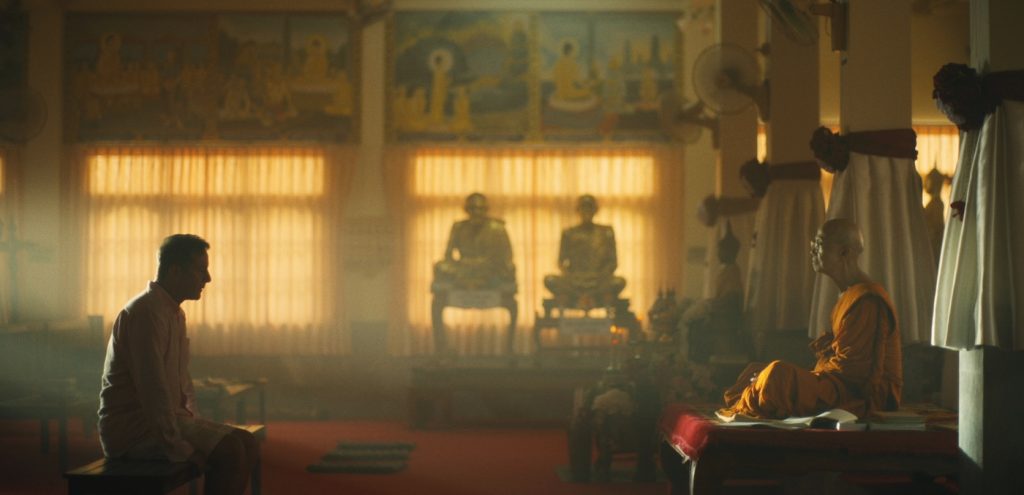
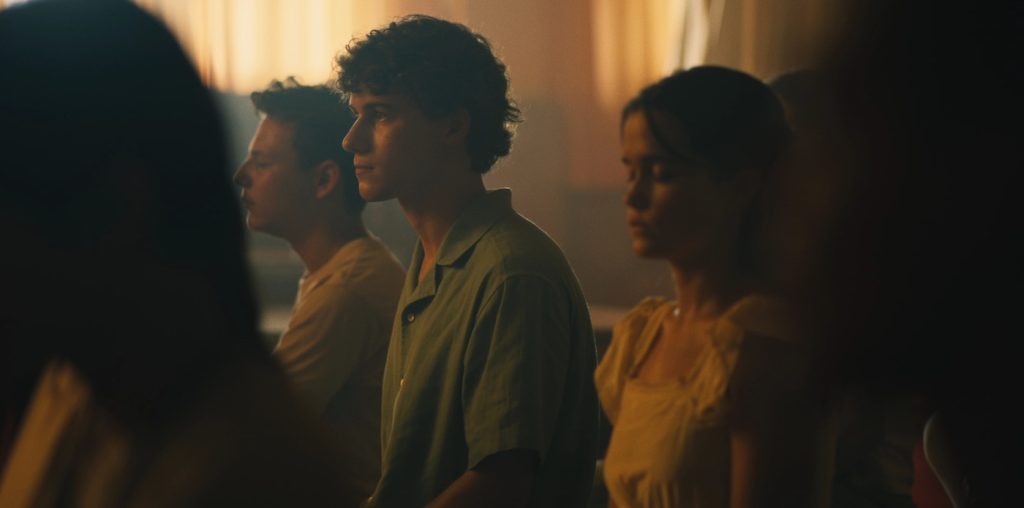
While her brothers were approaching their own spiritual reckoning, Piper was searching for one a lot less salacious and a whole lot more guided and wholesome, courtesy of the Buddhist monastery she hopes to join. So Piper, her parents Tim and Victoria (Parker Posey), along with a hungover Lochlan, head into town for a trip to the monastery so her parents can vet whether or not the place is actually a “cult,” as Victoria has worried. To Victoria’s surprise, Tim is on board with the monastery, and the leading monk being fully above board after he has a sit-down with the monk and gets a quick spiritual cleanse.
Jason Isaacs, Suthichai Yoon. Photograph courtesy of HBO.
Victoria is still not sold, however, and she comes up with a bargain she feels fairly safe she’s going to win; Piper can return to the monastery for a year if she can handle staying there that night and getting a taste of what it will really be like to sleep there. Lochlan, still not completely under the sway of his morally adrift older brother, says he’ll stay with her, too.
“Mike kept telling me, ‘She’s the most normal, the grounded one.’ He really didn’t want her to be a brat,” Hook tells THR. “We had already gone down that road in season one. So we wanted to keep her vulnerable. And she’s also harboring this secret about why she’s really in Thailand. So there were a lot of different instructions for Piper, and a lot for me to juggle.”
Sam Nivola, Sarah Catherine Hook. Photo courtesy of HBO.
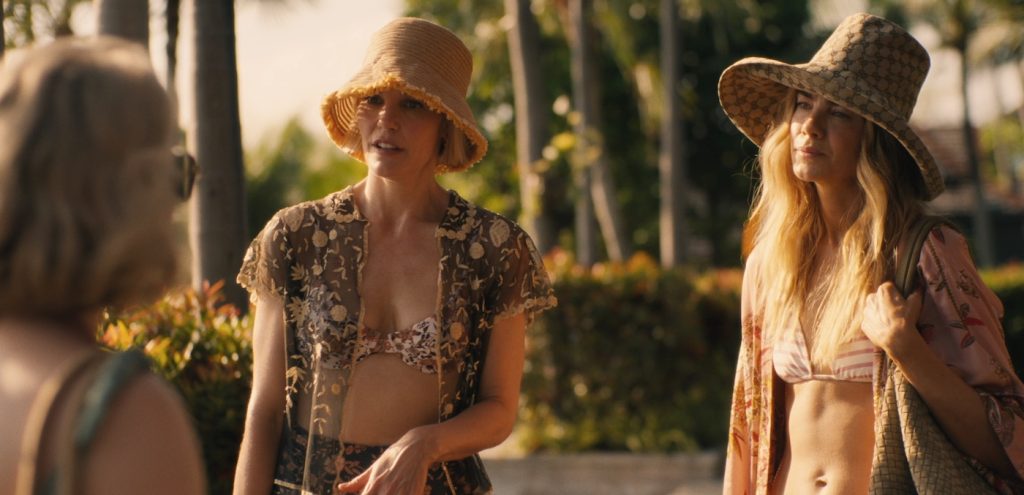
As for the trio of traveling girlfriends, Laurie (Carrie Coon) has just about had it with Jaclyn (Michelle Monaghan) once she learns Jaclyn hooked up with Valentin (Arnas Fedaravicius) from Kate (Leslie Bibb). The three gossiping friends are turning on each other, bit by bit, even though they’re still trying to maintain the facade that they’re just as tight as they’ve always been and that their dynamic is fun rather than a retread of all things that annoyed them about each other back in high school. Laurie’s outright disdain for Jaclyn at this point—accusing her of dangling Valentin in front of her only to have planned, all along, to take him for herself, leads to fights with both Jaclyn and Kate. Laurie appears to be reaching the “IDGAF” point with this friendship, and with only two episodes left, she might just burn the shaky edifice of their bond right to the ground. That is, unless one of them ends up being a victim of the gunshots we know are coming.
Carrie Coon, Leslie Bibb, Michelle Monaghan. Photograph by Courtesy of HBO
Belinda’s (Natasha Rothwell) son Zion (Nicholas Duvernay) has finally arrived, just in time to catch his mom in bed with Pornchai (Dom Hetrakul). Zion is a good sport about it, heck, he’s even happy for his mom, but we know what Zion and the rest of the White Lotus staff and guests are about to go through, so his arrival is also the beginning of the endgame. And while it seems unlikely that Mike White would set his murderous narrative sights on Belinda as the victim this season, her run-in with Greg/Gary, who invites her to his house for a dinner party, reminds us that she’s definitely in danger.
Nicholas Duvernay. Courtesy of HBO
The episode, titled “Denials,” ends with our sad-eyed Rick and his old buddy Frank (Rockwell) headed to the fateful meeting with the man Rick believes killed his father, the White Lotus, Thailand owner Jim Hollinger (Scott Glenn), with Frank posing as a big shot Hollywood director. Whether or not Rick goes through with actually killing the man (he promised Frank he wouldn’t even bring the gun), or finds out new information about what happened to his dad, or, as one of the hottest bits of speculation has it, finds out that Jim Hollinger is his dad, is one of season 3’s most important questions.
Sam Rockwell, Walton Goggins. Courtesy of HBO.
The pieces are falling into place. The reckoning is nigh. And sweet Gaitok (Tayme Thapthimthong) has retrieved the missing gun from the Ratliff residence and is learning how to shoot. What could possibly go wrong?
Tayme Thapthimthong. Photograph by Fabio Lovino/HBO
Featured image: Patrick Schwarzenegger. Photograph by Fabio Lovino/HBO
The evening before my conversation with Jonathan Black, a co-founder of the Connecticut Film and TV Alliance (CTFTVA), he was attending a hearing in Hartford. The Finance, Revenue, and Bonding Committee was listening to public testimony on Connecticut Governor Ned Lamont’s proposed film tax credit cut from 30% to 25%, a move that could strike a devastating blow to the state’s film and television community.
Black, a Georgia native, has roots in Hollywood, producing over 50 film and television shows before moving to the Nutmeg State during the pandemic with his wife, Lauren, who was born and raised in Newtown, Connecticut, to raise their two children. The couple are the producing partners behindChair 10 Productions, and together, have over 50 years of experience in “soup-to-nuts production services,” from budgeting, planning, hiring union crew, and everything in between. After making Connecticut their home, they noticed the film community was a patchwork of production facilities and crew.
“I knew if we were going to make a major impact and bring larger productions and studios here, we needed to bring the entire state together,” said Black. With help from Ed Cohen, who serves as co-founder and co-chair alongside Black, they formed the Connecticut Film & TV Alliance, a 501(c)3 organization focused on connecting filmmakers, building the state’s entertainment industry, creating jobs, and educating the next generation of filmmakers. When asked how Gov. Lamont’s tax cut could affect the community, Black said, “Cutting the credit would decimate the film and television industry in the state. We would lose tens of thousands of jobs and hundreds of millions of dollars in economic development, not to mention millions in tax revenue across a multitude of different taxes that could come in from these productions.”
Heather Elliott-Famularo, a digital media and arts professor at the University of Connecticut, said the tax reduction “would have significant negative consequences for the state’s film and digital media industry. This year, we have 357 undergraduates total in our program at the Storrs and Stamford campuses, 79% of which are CT residents. Our students love our great state and want to find their careers and establish their future here in Connecticut. And as a state institution, I believe it is our obligation to provide them career opportunities and help build that pipeline.” Famularo is an acting board member of the Connecticut Film & TV Alliance.
University of Connecticut, Dodd center for human rights image.
According to Lamont’s latest budget proposal, the 5% cut would yield the state 9.2 million in 2026 and 17.1 million in 2027, increasing the state’s general fund by $368.1 million the first year and $594.7 million in 2027. This is even as the Department of Economic and Community Development Commissioner Daniel O’Keefe estimated that every $1 in tax credit generated over $5 in economic impact. Over the past five years, he claimed the program has brought in a net $30 million in state tax revenue, far outpacing the alleged savings.
Incentive history
Connecticut’s film tax incentive was established in 2006 during the late Governor Jodi Rell’s time in office and championed by former speaker of the house turned lobbyist Jim Amann. Since then, it has disbursed $1.86 billion to film and television productions, and as of 2024, Connecticut is one of 37 states, along with Washington, D.C., Puerto Rico, and the Virgin Islands, with an incentive program.
Connecticut hasthree incentive programs: the digital media and motion picture tax credit, the film infrastructure tax credit, and the digital animation and production company tax credit. Each incentive has its requirements to qualify. The motion picture credit is widely used and broken into tiers based on production costs. For expenditures between $100,000 and $500,000, up to 10% can be claimed. From $500,000 to $1 million, it’s 15%, and above $1 million, it’s currently 30%. The infrastructure credit is simplified, with a 20% tax incentive after a minimum spend of $3 million.
Lamont has proposed to eliminate the digital animation program, a move the Department of Economic and Community Development (DECD) alsorecommends, as no credits have been issued under the program since September 2016.
Since its inception, the tax credit has been met with opposition, audit inaccuracies, and criticism, mainly over the uncertainty of its financial benefits. In 2019, DECD reported an estimated loss of $58 million per year from 2010 to 2019, or $585 million during that time. Then, in 2023, representatives introduced a bill to “phase out” the incentive. A year later, representatives introducedHouse Bill 5110 to eliminate the tax credit completely. Outspoken members of the filmmaking community halted both attempts. However, the 2024 DECDannual report suggests the program is providing a positive net value for the state. Over $171 million in tax credits were issued for $570.8 million spent by qualified productions in the state, while an estimated 3,820 new jobs were created in the same year.
George Norfleet, the director of CT’sfilm, television, and digital media office, said, “The program supported $900 million in economic activity in 2024, generating over $5 of economic output for every $1 of credit issued. These statistics reinforce the revenue positivity of this effort and strengthen the rationale to keep the program in place going forward.”
When asked about the program’s outlook for 2025, he added, “Our industry-targeted tax incentive programs have been crucial to the recruitment of major digital media companies consolidating and relocating significant operations to the state. The incentives have further served to encourage the expansion of these same companies’ production activity, thereby generating state revenues that, but for the tax credit, would not otherwise have been realized.” According to the Motion Picture Association’s own data, Connecticut’s film industry was directly responsible for 10,640 jobs and $1.61 billion in wages in 2022.
Misconceptions
Often misunderstood is how production companies use the tax incentive. “Naysayers think the tax credit is put in their pocket as part of their profit margins. It’s really not,” said Black. “They actually work it back into their budgets, and I think it’s important for lawmakers to understand that the tax credit cycles right back into the state again.” Film tax incentives can also be sold to insurance companies to reduce state tax liability, or corporations can use them to offset corporate tax.
Maximizing the tax credit is how Chair 10 is able to bring new productions to Connecticut.
“There are certain things that we do not have in the state and we have to be honest with that. But what we do tell producers is that not only do they get a good tax credit but there’s a network of supportive towns willing to bring business into their communities. And then, on top of that, there is a great crew base dying to work,” explained Black. “For example, if a producer comes in and asks for 30 shooting days, there could be some navigation depending on their budget. So if initially, they’re only able to afford 25, with the 30% tax credit, we can factor that into the budget and now afford 30 days. But we can also hire more crew and more special effects, and things like that. Every bit of the tax credit is used.”
Time is another potential point of confusion. The idiom ‘Rome wasn’t built in a day’ is quoted for a reason. Investing in new opportunities doesn’t happen overnight. It can take a decade or more to build a healthy network of people and a strong infrastructure. Connecticut was doing well in the early years of its tax credit. However, when former Gov. Dannel Malloytightened incentives to fix the state’s growing fiscal crisis, larger film productions skipped over the state.
“When they tweaked the credit, it really put a lot of water on the fire that was brewing. At that point, everybody left and went to Georgia, and Georgia kept growing, building massive soundstages, crew bases, and infrastructure. Now look at where they are at,” noted Black. According to recent data, Georgia is only second to California in terms of soundstage space, with an estimated $2.8 billion in production spending in 2024 alone.
“We were near the pinnacle of that opportunity then, and that sort of cut the legs off. But we’ve been slowly trying to dig our way back up to the top. I feel like last year, 2024, was a banner year for all of us. If we keep pumping in the attitude of support, we could be actually looking at major soundstages and a lot of major television shows in a few years.”
Building a future
A 25% tax incentive would put Connecticut at a disadvantage compared toneighboring states. At the time of publishing, New Jersey offers 35%, New York 30%, Rhode Island 30%, and Massachusetts 25%. Black suggested that none of Chair 10’s clients would want to shoot in the state and would take their business elsewhere. “It does not bode well for us to say that we are the #MakeItHere state while discouraging small businesses from making anything here in the state,” he said.
It’s not only the business side that Black fears will suffer but the infrastructure and education that’s been implemented over the years. “The CT Film and TV Alliance has an educational committee that works with the universities and provides educational opportunities to teach people how to advance their careers. It also puts together opportunities for them to learn and pitch,” he said. Harboring in-state programs is an invaluable resource for residents, especially for those unable to afford out-of-state tuition in places like California, New York, or Georgia. “We had a conference last November that 400 people attended. Part of that was not only a teaching tool but also a networking opportunity,” Black added. “This is really a grassroots effort in all our local communities. Part of why this alliance was made was to get people involved and help towns become film friendly, which would have an economic impact on their communities.”
Infrastructure is another key element. Companies like NBCUniversal, ESPN, and WWE are staples in the state. WWE made Connecticut home before the introduction of tax incentives and opened new headquarters in 2023. Major League Soccer moved into the same facility in early 2025. “Our mission is to bring in bigger clients like Bob Yari or major studios to showcase not only what Connecticut can do but how we treat people. And that is like family,” said Black. Yari is known for being an executive producer on Taylor Sheridan’s hit series like Yellowstone, Tulsa King, Lioness, and Landman. In 2024, Yari was part of the producing team behind Summerhouse, a Vietnam War film written and directed by Ed Kaplan and photographed by cinematographer Shelly Johnson, the current president of the American Society of Cinematographers (ASC). Chair 10 was a producing partner on the film, providing production services, and it was reported that more than 125 cast members and crew were hired during its production in Connecticut.
“The alliance is not only supporting political action and helping communities but also helping to grow the industry and build the infrastructure,” said Black. “I hate to say this, but people think infrastructure is a building. That’s part of it, but infrastructure is actually people. People build sound states and build a crew. So it’s important we build an infrastructure of strong people.”
Black is hopeful lawmakers will have patience. “There are people who want to move back to Connecticut and who moved to New York or New Jersey because of work. So we need to keep the tax incentive at 30% so work doesn’t disappear. Do we need to tweak it and make it better? Sure. I love what Chairwoman Maria Horn [Finance, Revenue and Bonding Committee] said, that we don’t need to be in an arms race with states. Connecticut can make its own identity that fits our needs as a state and still be highly competitive in the marketplace. That’s our goal with the political action committee: to develop a tax credit system that benefits the state but also protects and respects the taxpayers’ dollars. But we also have to understand that we’re growing, and you don’t want to stunt that growth, but I think we’re on the cusp of making a major break.”
“Our job is to make a great product that can be distributed all over the globe. And if you look at it that way, you understand that you have to take care of your employees. You have to take care of yourself. You have to take care of work-life balance, and that’s something else that’s important to us. Something that means a lot to me as well is helping Connecticut grow so families can grow. And the way that people can buy homes and invest in their communities. I live here with my kids, and I love Newtown. I love Connecticut, and I get to shoot in my backyard,” Black said.
One day after Warner Bros. announced the official title for Paul Thomas Anderson’s mysterious new movie starring Leonardo DiCaprio, One Battle After Another, the studio dropped the first teaser.
While you won’t glean much from this brief 21-second blast, you will at least get a sense of the mood of Anderson’s latest. It couldn’t be further from his last film, Licorice Pizza, his dreamy look back at the San Fernando Valley of the 1970s (where and when Anderson grew up), exploring young love, the exuberance of youth, and the ephemerality of our teenage dreams.
One Battle After Another, on the contrary, appears to be as true to its title as Licorice Pizza was to its own—we open with DiCaprio seated outdoors and sipping a beer, then being forced to cover his ears while his very pregnant companion (Teyana Taylor) fires an automatic rifle in a wide-open Western space. That gunfire continues to play over images of DiCaprio’s character running, Taylor’s character walking down a road, a baby in a crib, and then the words, “What are you gonna do about this baby?” That’s immediately followed by the sound of a firearm being cocked and actress Chase Infiniti taking her turn at the outdoor firing range, backed by a bunch of women in what appear to be nun’s habits. What in the world is going on here?
These images are followed by more violence and roughness—Sean Penn briefly strongarms Infiniti’s character at the 13-second mark, and Penn says the teaser’s final words: “Just when you think you’ve got a handle on things.”
Anderson directs from an original script he wrote and is working once again with his favorite composer, Jonny Greenwood, the polymathic musician who once played in a little band called Radiohead. Joining DiCaprio, Taylor, Infiniti, and Penn are Regina Hall, Benicio Del Toro, Wood Harris, Alana Haim (one of the stars of Licorice Pizza), and D.W. Moffett.
One Battle After Another was recently moved from an August release date to September 26, putting it squarely in the window usually reserved for awards hopefuls. Considering Anderson’s pedigree and the incredible cast and crew he’s got, it’s immediately one of the most intriguing films on the fall schedule.
The film was shot on location in California, with additional on-location filming in El Paso, Texas. Anderson
Check out the teaser below. One Battle After Another arrives on September 26.
Featured image: Leonardo DiCaprio in “One Battle After Another.” Courtesy Warner Bros.
We finally have some clarity—a keyhole’s worth—about Paul Thomas Anderson’s mysterious new film starring Leonardo DiCaprio.
Warner Bros. announced on Wednesday that Anderson’s film has gotten a slight bump in its release schedule from August 8 to September 26. This moves the film from the summer blockbuster season into the typical awards contender release window. This would make sense for an Anderson film, given how singular and lauded the auteur’s work is, from his most recent release, Licorice Pizza,to Phantom Thread and his more or less flawless There Will Be Blood.
There’s more—Anderson’s film, which stars Leonardo DiCaprio and co-stars Sean Penn, Benicio Del Toro, Regina Hall, and Teyana Taylor, finally has a title: One Battle After Another. The little known about Anderson’s movie is that it’s an American crime thriller. Anderson’s no stranger to crime stories, given that There Will Be Blood was a kind of Godfather of the oil boom era in the early 20th century American West, and his Inherent Vice was an adaptation of Thomas Pynchon’s stoner detective novel.
While Anderson’s One Battle After Another is easily one of the most anticipated films of the fall now, another movie people are excited about, Maggie Gyllenhaal’s The Bride!, will now be premiering a little later than expected, moving from this September to March 6, 2026. Gyllenhaal’s film features Christian Bale as Frankenstein’s monster and Jessie Buckley as Frankenstein’s bride, co-starring Penélope Cruz, Annette Bening, and Gyllenhaal’s partner, Peter Sarsgaard. The film is inspired by James Whale’s 1935 film Bridge of Frankenstein, which was itself adapted from Mary Shelley’s iconic 1818 novel “Frankenstein.”
Gyllenhaal’s fresh take on Frankenstein’s monster isn’t the only film set to play with this deathless gothic tale—Guillermo del Toro’s got his own Frankenstein film, starring Jacob Elordi as the monster, Oscar Isaac as Dr. Frankenstein, Christoph Waltz as Dr. Pretorious, and Mia Goth as Elizabeth, Dr. Frankenstein’s fiancé due this November, from Netflix.
For more on Warner Bros., DC Studios, Max, and more, check out these stories:
Featured image: CANNES, FRANCE – MAY 23: (EDITORS NOTE: Image has been digitally altered) Leonardo DiCaprio attends the screening of “The Traitor” during the 72nd annual Cannes Film Festival on May 23, 2019 in Cannes, France. (Photo by Vittorio Zunino Celotto/Getty Images)
Ana de Armas has entered the John Wick universe, so it’s fitting her character, Eva Macarro, faces off against the man himself. At the 1:45 mark in this new trailer, Eva and John have a snowy encounter in which neither are backing down. The reason Wick is alive here despite having met his fate in John Wick: Chapter 4 is because Ballerina is set during the events of John Wick: Chapter 3 – Parabellum.
Eva has officially begun her training as an assassin in the traditions of the Ruska Roma. Keeping things well within the world of Wick, director Len Wiseman directs from a script by John Wick: Chapter 3 – Parabellum scribe Shay Hatten. Eva’s got skills not even Wick possessed—she was a ballerina, after all, hence the title—and her thirst for vengeance is even greater than his initial motivation, which was, if you recall, avenging his dog Daisy.
Ballerina bows two years after Chapter 4, which proved the popularity of the franchise by becoming its biggest hit yet. The Wick universe is expanding in all directions, including forward, with a fifth installment in the flagship franchise (however, Reeves has insisted he’s not going to reinhabit the character again). Reeves has been Gun Fu fighting since 2014 when his doleful hitman was trying to get out of the game, but then the Daisy nightmare happened. Reeves appeared in three more films, with Chapter 4 proving to be his last, thanks to a noble end at the hands of Donnie Yen’s Caine.
Ana De Armas is more than ready for the role—she was aces as a young CIA operative in Daniel Craig’s last turn as James Bond in No Time To Die. She’s joined by Anjelica Huston, Gabriel Byrne, Norman Reedus, Catalina Sandino, Wick patriarch Ian McShane, and the late great Lance Reddick.
Check out the new trailer below. Ballerina dances onto screens in 2025.
Featured image: Ana de Armas as Eve and Keanu Reeves as John Wick in Ballerina. Photo Credit: Courtesy of Lionsgate
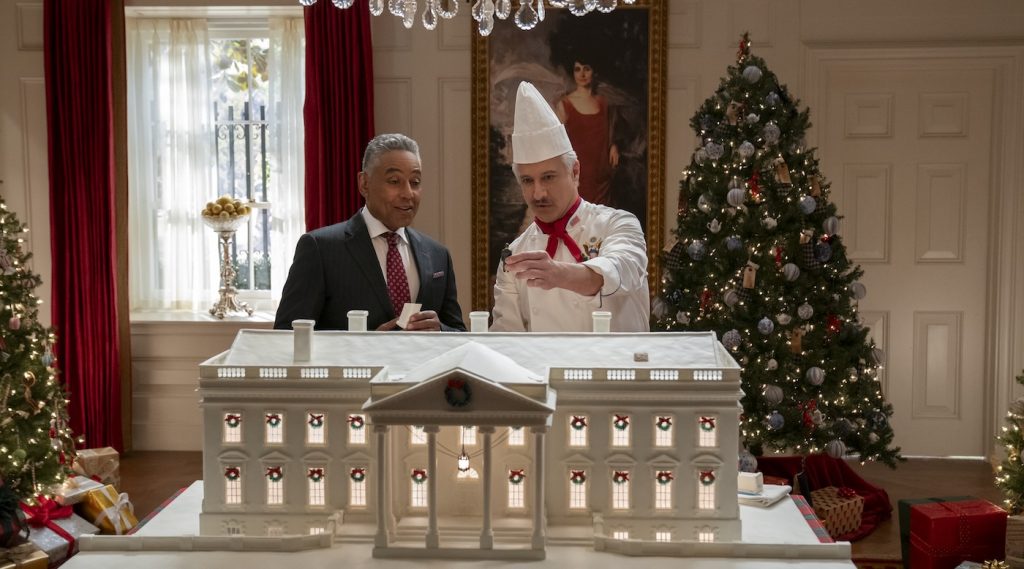
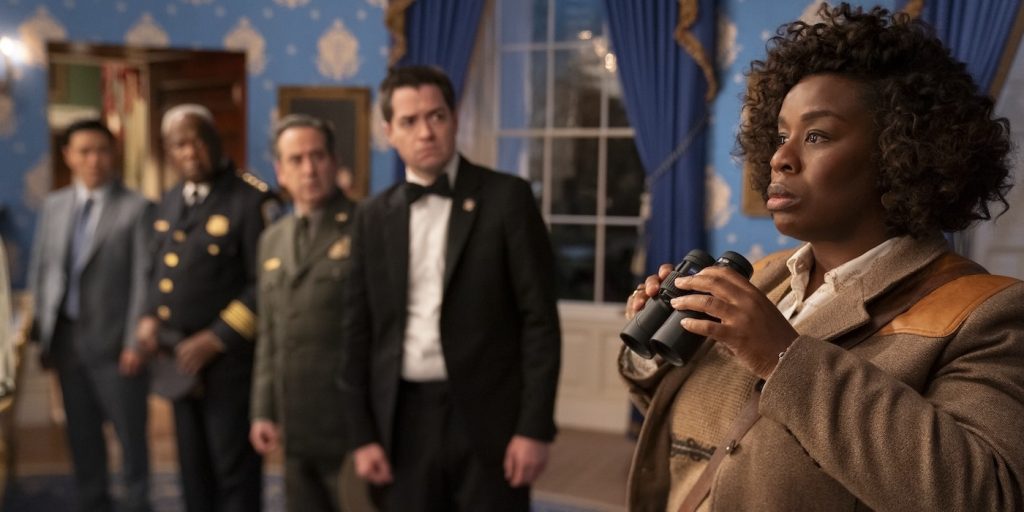
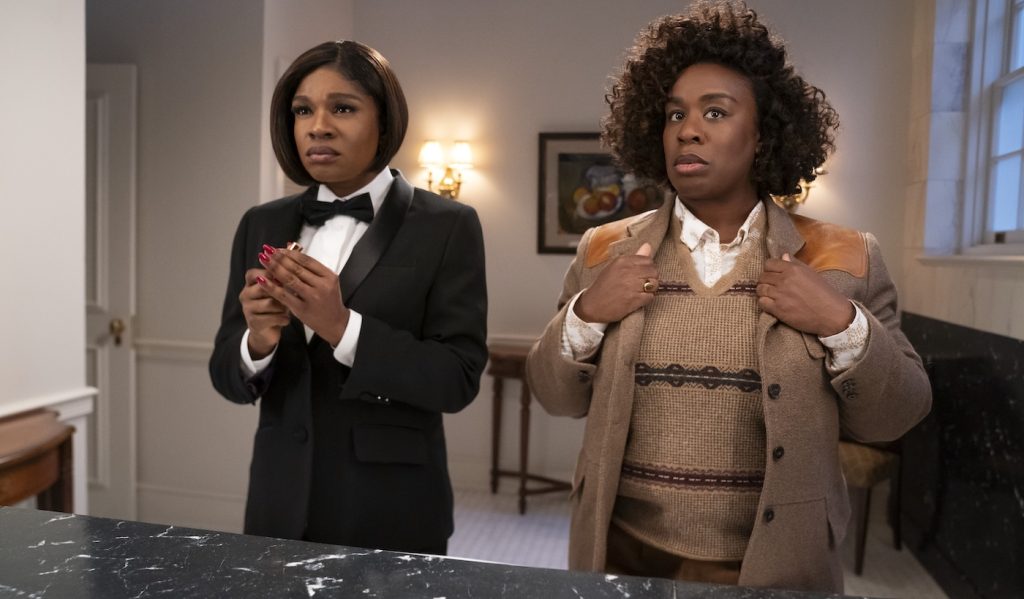
The Residence, produced by Shondaland for Netflix, is the much-anticipated whodunnit that is Shonda Rhimes’ second show set in the White House. The first, of course, was another beloved, Kerry Washington-led Scandal, which dealt in the shadowy world of Washington’s Olivia Pope, the queen of fixers. Now Rhimes and her collaborator Paul William Davies return to 1600 Pennsylvania Avenue to follow Uzo Aduba’s Cordelia Cupp, a world-famous detective and obsessive birder, a quirky, intense, self-assured genius who is about to take on the case of a lifetime.
The case is a murder that takes place in what’s supposed to be one of the most secure buildings on Earth. What’s more, the murderer is in the White House, too. For Cordelia, this means she’s not only got a crime to solve, but she’s got to solve it amid some of the most influential people in the United States, some of whom have no intention of aiding her investigation. The whole thing feels a bit like the love child of Wes Anderson and The Cohen Brothers.
The Residence features a delightful ensemble cast that includes Giancarlo Esposito, Jason Lee, Randall Park, Ken Marino, Al Franken, and more. It was inspired by former White House correspondent Kate Anderson Brewer’s book The Residence: Inside the Private World of the White House. She researched ten administrations and interviewed dozens of butlers, maids, chefs, engineers, and other staff members who made the White House run every day.
Davies is perhaps the perfect person to lead the new series—his previous work includes, crucially, Scandal, where he was astory editor, producer, and writer, and the creator of For the People, another Rhimes collaboration, this one set in the Southern District of New York Federal Court. He’s haunted the halls of power before, and he and his stellar cast and crew are now prepared to deliver a high-stakes whodunit in and around the Oval Office. He used elements from Brower’s book in his storytelling and in developing the fictional characters woven through the show’s 8 episodes.
The Credits spoke to Davies about what it took to bring this multi-tonal murder mystery to the small screen, the singularity of Uzo Aduba’s Cordelia Cupp, and the incredible team he assembled in Los Angeles.
I know the inspiration for your show is Kate Anderson Brewer’s book. Are any of the characters or stories loosely based on the folks she talks to for the book?
Nobody is based on any one person. There were definitely inspirations for certain folks. There is a family, I think, the Ficklin family, that has had nine people over the generations who worked in The White House, and some of them even had the same name, John Ficklin. I use that reference for the three George McCutcheons, and that’s one thing that comes from Kate’s book I thought would be fun to use. There’s also a rivalry between the executive pastry chef and the executive chef that harkens back to a tense relationship around the time of the transition from Bush to Clinton. I liked the idea that these two had their domains in the kitchen, and they stopped talking for a while. Also, in terms of little bits of story and the president’s fixation with the shower, LBJ was obsessed with both the water temperature and the water pressure in the shower and was maniacal about it. He had to have it incredibly hot and with intense pressure, like a fire hose. He put one of the engineers who worked in The White House under a lot of pressure to get his shower right, and that’s in Kate’s book. I thought that was amazing, so I used some of that.
Those are great. In terms of character, how did Cordelia Cupp come together?
Of course, my two biggest inspirations are Sherlock Holmes and [Hercule] Poirot, because I grew up reading them, and David Suchet’s Poirot, to me, is so iconic. I loved his meticulousness, and Cordelia has that, but she’s still very much her own person. I don’t even know if she and Poirot would get along, but I do love the detail and iconic nature of those detectives. The birding thing was very important to me, and I had this notion early on with Cordelia of her using silence a lot. I’ve known people in my life who are like that, and that is both who they are and also a tool, in a way, and that converged with the birding. A big part of a birder’s life is being patient and quiet, waiting for things to come. I also liked the idea that she was somebody who was totally comfortable in what other people would think would be uncomfortable situations. To me, that’s a fascinating part of her. Sometimes, it goes back to the silence, but it’s not just that. I don’t want to sound all mystical about it, but she just kind of wrote herself. I just kind of came up with it long before Uzo came, and yet, of course, Uzo is a genius. There is no Cordelia Cupp without her, and she brought so much to it and is my total creative partner in it. We both really wanted her to be a detective that you remembered well.
Yeah, it was all LA with an LA-based crew, and they were amazing. François Audouy, our production designer, is someone I had not worked with before, but when I hired him, he was really passionate about doing this in LA with the LA craftspeople. He was really excited about it. We built all the sets and shot at Raleigh Studios in Hollywood. We also shot stuff down in Palos Verdes for some of The White House exteriors and lawns, and there’s a gardening shed we go to. We used part of Palos Verdes Botanical Gardens for when Cordelia goes birding, and we used that for Ecuador, and it turned out great.
Were there particular companies or collaborators you were particularly impressed with?
In terms of the LA crew, there were some great folks that our set decorator, Halina Siwolop, drew upon from her vast network. The head of our props team, Trish Gallaher Glenn, who is a legend in the industry, also has a huge network in LA, including the crew that built the set that became Ecuador. We built part of that at Raleigh, like the birding hut, on the lot, and we had this incredible greens team. All are local LA.
The editing on The Residence is essential to the storytelling and tone. It must have required a lot of nuance.
I had four editors, and they were extraordinary. Ali Greer, who worked on Barry and Hacks and Portlandia, is an amazing editor. Hacks and Barry are both multi-tonal shows, very funny, and very different than The Residence. Ali is really great with comedy, obviously, but also things that have more than one tone and pace. She edited the pilot and episode 3. Heather Capps did 2 and 4. We also had Roger Nygard, who’s got a great comedic background and did Curb Your Enthusiasm and Veep, and John Daigle, who did Episode 5. They’re all really good comedic editors but also experts at subtle, textured comic editing. Ali really got us off to a great start. I really think she got who Cordelia was and the pace of it. They worked together. It was really important to me that even though these are individual episodes, it’s like an eight-hour movie cut into segments. It required that the editors all think about the show as part of a collective project and to be able to talk to each other. The level of collaboration was extraordinary.
All episodes of The Residence are streaming on Netflix on March 20.
The White Lotus delivered arguably the most surprising cameo in its three-season run this past Sunday night when Sam Rockwell appeared as Frank in episode 5, “Full-Moon Party.” Frank is an old friend of Walton Goggins’ Rick, who meets him in Bangkok to offer Rick a little help with his dark mission to settle an old score. In the process, Frank added a revelation that gave the season an unexpected jolt.
Before leaving the resort for Bangkok, Rick finally revealed his reason for taking his girlfriend Chelsea (Aimee Lou Wood) to Thailand in the first place— he tracked his father’s killer to The White Lotus resort in Ko Samui. While Rick’s not entirely clear on the exact details of his father’s demise, he tells Chelsea he was a do-gooder who arrived in the country years ago in an effort to help people and, in so doing, ran afoul of Jim Hollinger (Scott Glenn), the current owner of The White Lotus, Thailand. Rick’s dad went missing and was never found, and years later, while his mother was on her deathbed, she told Rick the name of his father’s killer. Like many of the other pampered, perturbed guests at the resort, Rick came to The White Lotus on his own spiritual retreat of sorts, but his notion of finding peace likely means killing Jim.
This is what brings Frank into the picture—he meets Rick at a nice hotel to hand over a gun, and the old friends repair to the bar for a drink and to catch up. Frank surprises Rick by ordering camomile tea rather than whiskey or bourbon, and that’s when Frank takes his old friend on a trip down memory lane to reveal just how he got sober and why.
Walton Goggins, Sam Rockwell. Photo courtesy of HBO.
Creator Mike White has written no small amount of incredible monologues in this series, giving performers like Jennifer Coolerdige, Murray Bartlett, Theo James, Aubrey Plaza, and more plenty of amazing moments when they get to unleash their inner demons (whether or not they’d describe them that way is another matter). Yet no performer has gotten to waltz into the series mid-season, entirely unexpected (hats off to all involved for keeping Rockwell’s appearance a secret), and rip off a monologue like this. Frank reveals to Rick that he came to Thailand for the same reason lots of middle-aged white men do—the young “Asian girls.” But Frank’s pursuit of pleasure quickly spiraled out of control, so much so that he started to see something about himself that shocked him; he wanted to be one of these girls. The monologue is too compelling and specific to recap it here; you simply have to watch it yourself.
Frank’s patient, unguarded admission to his old friend floors Rick, who can do little more than nod. In a series in which White has consistently spotlighted the way men objectify women and, in the case of Greg (Jon Gries), exploited them for their money, Frank’s confession was both shocking and oddly satisfying as if, finally, at least one man was coming clean.
In real life, Rockwell has been partnered with season 3 regular Leslie Bibb for almost 20 years. His cameo is directly related to their relationship, as Bibb revealed recently to CNN, and it was not something that had been planned for months in advance. “That came in last minute, like maybe two weeks before they were going to film it. So, it was very last minute,” she told CNN. “I said to them when they offered it to him, I was like, ‘If he doesn’t do it, don’t get mad at me. And Mike’s like, ‘I’m not going to get mad at you.’”
Bibb revealed to Andy Cohen on Bravo‘s Watch What Happens Live that Rockwell was filming in South Africa but was able to make the trip to Thailand to shoot his scene.
“I ran lines with him,” Bibb told Andy Cohen on the show. “I think that monologue is iconic, and I think it’s really what the whole season is about — what Mike’s really saying there.”
When Bibb read the scene, she thought it was the best thing she’d ever seen on television, as he told CBS Mornings. Bibb plays Kate, part of a trio of friends, along with Laurie (Carrie Coon), and Jaclyn (Michelle Monaghan), who have come to The White Lotus on Jaclyn’s dime (she’s a famous actress) to do some catching up of their own. Thus far, five episodes in, they’ve effectively gossiped about each other, pairing off into duos to question the life choices and attitudes of whichever the lone third happens to be at the time.
“I felt like it was what Mike was really trying to talk about for the show,” Bibb told CBS Mornings about Rockwell’s monologue. Bibb thinks that if Kate, Laurie, and Jaclyn could find a way to do what Frank did, maybe they’d be able to open up to each other. “Hey, this is what’s happening in my life, I’m having problems in my marriage, I’m drinking too much, I’m doing this, whatever,’ they wouldn’t be gossiping about each other because they would immediately put the shield down, they would be vulnerable. And he comes in, and he’s like, here’s my truth, and he’s unapologetic.”
The first five episodes of season 3 of The White Lotus are streaming on Max. New episodes arrive on Sundays at 9 p.m. ET. It has already been renewed for a fourth season.
Featured image: Sam Rockwell in The White Lotus. Courtesy of HBO.
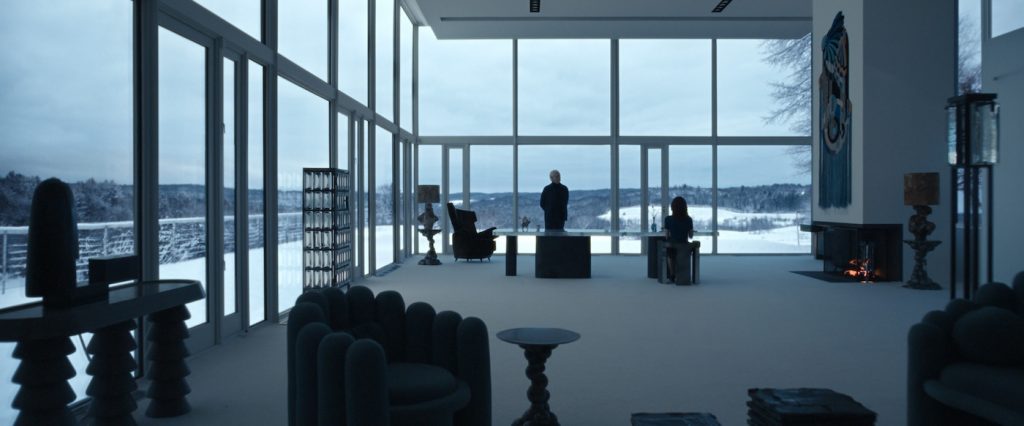
Severance earned 14 Emmy nominations the first time around, and after a three-year hiatus, the show has reignited fan frenzy as it builds toward the Season 2 finale streaming Friday [March 21] on Apple TV +. Again, bifurcated employees and their bosses (Adam Scott, Britt Lower, Patricia Arquette, John Turturro, Zach Cherry, Tramell Tillman and Christopher Walken) navigate the tortuously fascistic world of Lumon Industries, which severs employees from their civilian selves — but now, the “outies” are fighting back.
To sustain the show’s spookily spare aesthetic, showrunner/creator Dan Erickson and executive producer/director Ben Stiller bolstered their original team, including production designer Jeremy Hindle,with new behind-the-scenes talents, including French cinematographer David Lanzenberg. Emmy-nominated for shooting Tim Burton’s moody Netflix series Wednesday, Lanzenberg paired with German DP/ director Uta Briesewitz (Stranger Things) on episodes six and nine.
From his home in Los Angeles, Lanzenberg talks about filming in upstate New York, borrowing camera moves from a 1965 spy movie, and meeting Prince during his pre-Severance early days in L.A.
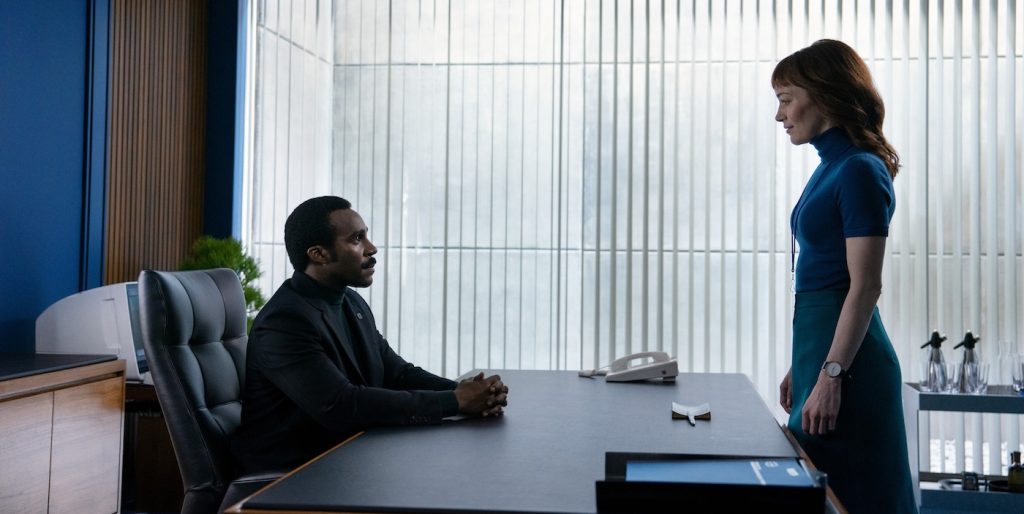
So much of Severance takes place against stark white punctuated with big blocks of primary colors, especially blue. The wardrobe, the wall colors, and, in your ninth episode, even the wintery exteriors all share this very pared-down palette. How did you arrive at those color choices?
The palette itself was something that Ben Stiller and [cinematographer] Jessica Lee Gagné designed, and yes, we have many shades of blue throughout the episodes. I was just a blip on a fast-moving bicycle but we were given a very strong list of references and ideas as to what the framing of the show should be.
Severance L to R: Zach Cherry and Merritt Wever Photo: Apple TV+
What were some of those references?
One film I’d never seen before is The Ipcress File, an amazing 1965 movie with Michael Caine. It was a good guide for us because, in television, coverage can get very boring very quickly. But The Ipcress File was unorthodox in the way it used very long shots to get into coverage, which of course, you have to for dialogue scenes. It’s all right there in the blocking and compositions, with the camera very much taking a point of view.
Severance L to R Michael Siberry and Britt Lowry Photo: Apple TV+
You filmed wintry landscapes in Episode 9, like when Cobel meets Mark in the forest, by featuring black trees and white snow infused with this blue tint. Did you use filters to get that tone?
Back in the day when we shot on film, we definitely would have committed to the look with filters, but this time around, we used Sony CineAlta VENICE digital cameras and followed one LUT [Look Up Table] — I call it film stock — which gave us the parameters within which to shoot the show. For Severance, the palette was very blue, very cold.
Many scenes in Severance involve two people talking, and you frame these conversations in such fresh ways, especially through the use of negative space. In the dinner conversation between Burt and Irving, we see a character’s face on one side of the frame, maybe a fireplace in the background, and everything else is dark.
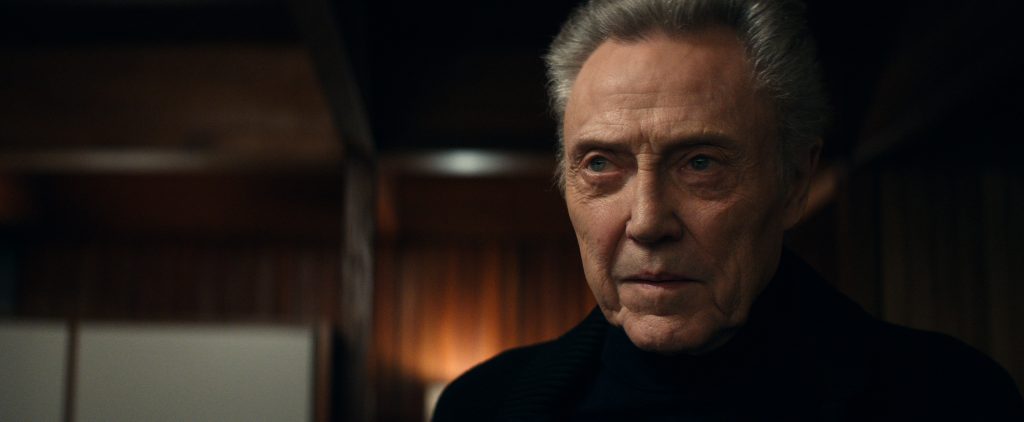
I had the biggest smile on my face, lighting Chris Walken and John Turturro because they’re such exquisite actors. We had to be nimble with the cameras and not too fussy with lighting. We used a practical light on the dinner table that you can see in the wide shots, which was brought to us by our set decorator, David Schlesinger. We decided to use that light as our main source. Uta and I then found the angles that would be interesting within the Severance world where there would be a lot of dark.
Christopher Walken Photo: Apple TV+
The camera work and lighting underscore the characters’ isolation in this scene and many others.
It’s definitely not the documentary style you find in some shows where camera placement doesn’t matter as long as you capture the mouth to show the dialogue. Here, there’s such specificity and attention to detail, which I loved. There’s a scene with Helly when she’s in the bathroom with Mark, just the simple focus pull shows her loneliness. When you have two people talking but you’re also able to feel emotion with the camera, that can go very far.
In Episode 9, drone footage conveys this wintry landscape with overhead shots of country roads and snowy forests. How did you manage that?
We had an amazing drone team. Some of those exteriors in the wintertime are majestic, almost painterly at times. I remember sitting at home here in L.A. after doing [episode] 206 when I got a call saying they needed cutaway footage of the winter right away. We had a location manager in New York who also owns a consumer-level drone, so he filmed looks of the area, and then we brought in professional crews to do the final.
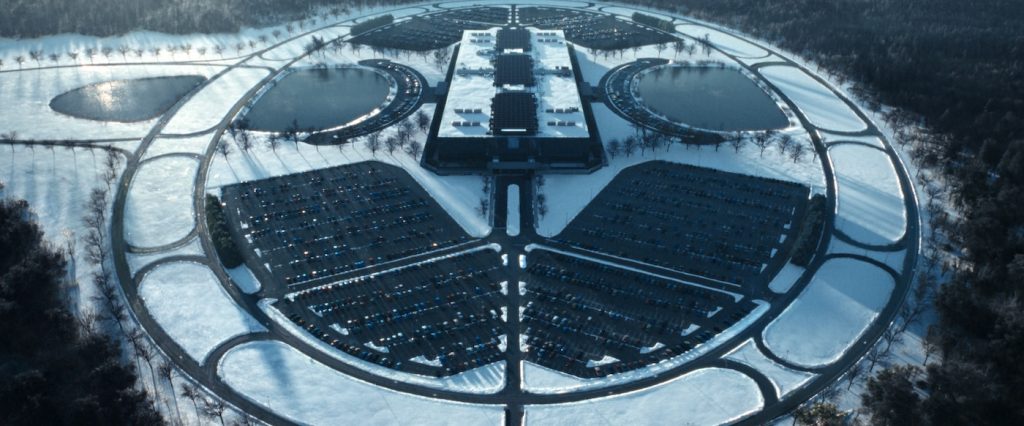
Lumon Industries headquarters Photo: Apple TV+
You filmed on location, mainly in New York, right?
The Lumon headquarters we filmed at the old Bell Labs in New Jersey, but most of the locations were in upstate New York, which is really beautiful. We shot soundstage stuff in the Bronx.
The upstate locations included the small towns of Kingston, Beacon, Hudson, Ossining, Nyack, and Utica, which provided that magnificent old railroad station as the setting for Irving’s departure. Do you feel it’s important to shoot locally for a story of this nature?
I think it’s extremely important, and these days, unfortunately, things seem a little bit twisted at times. I did some additional photography just now for a show that was supposed to take place in North Carolina, and instead, eight weeks before going to camera, they said, “No, you have to shoot in Australia and make it look like North Carolina” to save money. They had the hardest time, and in the end, I think it cost them more money because they had to do additional photography, and the show ended up being kind of a disaster. As much as possible, I would suggest that if the story’s about L.A., it should be shot in L.A. If New York is a character, try as much as you can to shoot it there.
There’s an instantly identifiable precision to the Severance look, encompassing production design, wardrobe, and cinematography. To make sure your scenes locked in to that aesthetic, did you and Uta work from a shot list?
We had a good, disciplined process where Uta would talk about the blocking and we’d know where the cameras would be, but we did not storyboard or shot list—that’s not Uta’s thing. There were key frames that we wanted but when it came down to the performances themselves, we respected what the actors came up with and [filmed] what happened on the day.
Severance L to R: Tramell Tillman and Britt Lowry Photo: Apple TV+
Your compositions sometimes bring to mind the portraits of Spanish artist Caravaggio in that both his paintings and your shots use shadow to evoke emotion.
It’s always very important for me to take a beat before rolling to look at the frame. I generally start with something wide, so I’ll take a step back and ask myself “Is there enough negative space, is there enough darkness, is there enough shade? Does it feel right?” There always needs to be a balance.
If we can go off tangent for a moment, after you moved from France to Los Angeles, you were invited in the early 2000s to work with Prince on a short film. What was it like meeting Prince?
It’s eleven thirty at night, I’m in bed with my girlfriend at the time and I get a call from the producer I knew saying, “You need to meet Prince right now” Boom! I put my pants on, drive over to this party. I’m introduced to Prince and I swear to you. Prince was not walking. He was gliding. It was the strangest thing. He only said to me, “What kind of music are you into?” I said “French house music.” He nodded his head and walked away.
That was it? No chit-chat?
Prince was a man of very few words. But you had to pay attention.
Fans certainly pay close attention to Severance. What counts for you as a favorite bit of experimentation that people may or may not have noticed.
In a scene for episode 206, [production designer] Jeremy [Hendle] brought half of that kitchen from Lumon offices to Mark’s apartment because we were going back and forth between two worlds. We matched the cuts, matched all the angles — I love those surreal moments, taking a page out of the madness of [Spanish surrealist filmmaker] Luis Buñuel. It opens muscles in your brain.
Zach Cherry, Britt Lower and Adam Scott in “Severance,” now streaming on Apple TV+.
All the actors in this show are accomplished but this season, Tramell Tillman as Lumon boss Milchick stands out. Do you have a favorite Milchick scene?
One of my favorite scenes is in 206 when Milchick looks at himself in the mirror and says, “Grow.” Trammell’s performance was so strong; we thought he deserved something very specific, so we took a page—again I don’t have any original thoughts[laughing]—from [2009 French thriller] Enter the Void, where the actor’s looking at himself in the mirror and the camera is basically him, but it’s a body double mimicking his actions. We didn’t have much time that night, but we achieved a shot that I’m very proud of.
You parachuted into Severance universe for two episodes and survived to tell the tale. What’s your takeaway?
It was really exciting to realize that television doesn’t have to be middle of the road. We were able to think outside the box with influences and references, and it was great to have Ben Stiller, somebody who has one vision, and you answer to that one vision. It’s not a democracy.
The poster on the wall behind you reads “La Coupole”?
That’s a restaurant in Paris. If you like oysters, I highly recommend it.
Severance season 2 is currently streaming on Apple TV+.
Featured image: Severance L to R: Sarah Bock, Adam Scott, Britt Lower Photo: Apple TV+
Colin Farrell is no stranger to DC Studios—he has delivered hours and hours of scene-stealing work as Oz Cobb, first in Matt Reeves’ The Batman and then in Max’s critically acclaimed spinoff series The Penguin. His performance as Gotham’s most cunning criminal in The Penguin delivered Farrell a SAG Award, Golden Globe, Critics Choice Award, and Saturn Award. Now, he’s circling a different kind of project for DC as he’s in talks to star in Luca Guadagnino’s Sgt. Rock, a World War Two action film based on the comic book character.
Farrell’s involvement comes after the previous star circling the project, Daniel Craig, stepped out of contention in favor of potentially joining Greta Gerwig’s Narnia adaptation for Netflix.
Sgt. Rock will feature the titular, impossibly tough commander of Easy Company, a combat unit that faced off against the Nazis in Europe. The character was created by Robert Kanigher and Joe Kubert in 1959 and went on to become one of the longest-running comics from DC. Sgt. Rock has almost been sent into cinematic duty several times over the years, with both Arnold Schwarzenegger and Bruce Willis as potential stars.
Guadagnino is a fascinating choice to lead the film, a well-respected auteur whose most recent reek is the Daniel Craig-led Queer and the Zendaya-starring tennis scorcher Challengers.
DC Studios is now being run, as you’re likely well aware, by James Gunn and Peter Safran. Gunn’s first film for his new studio, Superman, is due in theaters this July. By casting Farrell, the pair would once again redeploy an actor who portrayed one notable character in a DC Studios project into another role. Jason Momoa, who played Aquaman for years before Gunn and Safran came in a reconfigured and reimagined the studio, will be playing the antihero Lobo in the upcoming Supergirl: Woman of Tomorrow.
For more on all things DC Studios, check out these stories:
Featured image: VENICE, ITALY – SEPTEMBER 05: (EDITORS NOTE: Image has been converted to black and white.) Colin Farrell attends “The Banshees Of Inisherin” red carpet at the 79th Venice International Film Festival on September 05, 2022 in Venice, Italy. (Photo by John Phillips/Getty Images)
The underdog hero of Bong Joon Ho’s Mickey 17 is sweetly naive everyman Mickey (Robert Pattinson), a failed macaron shop owner on the run from a bloodthirsty creditor in the year 2054. Mickey finds a way out of his predicament, but it’s bleak—he signs up as an Expendable, a human test subject for a space mission whose sole purpose is to die in not one but many gruesome experiments, having turned over the rights to his DNA to be infinitely reprinted for any and all of the mission’s needs.
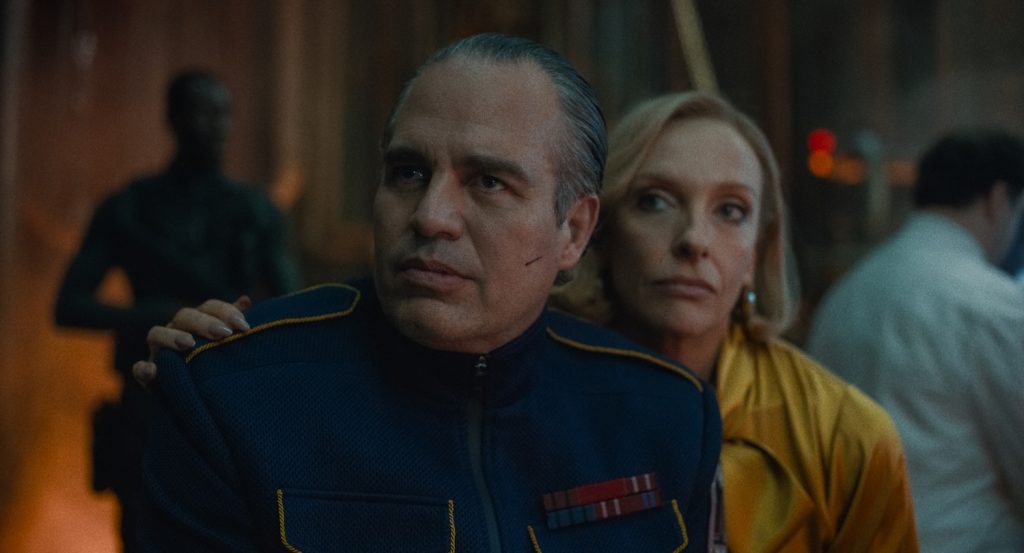
The ship Mickey finds himself on is headed to Niflheim, a far-off planet that failed politician Kenneth Marshall (Mark Ruffalo) and his sauce-obsessed wife, Ylfa (Toni Collette), intend to colonize. Kenneth is a charlatan, a cut-rate cult leader whose flock seems, at best, only halfheartedly in his clutches. Nevertheless, his adherents’ life on the spaceship is obsessively micromanaged, and Mickey, in his various iterations, lives a particularly dreadful existence of tests, death, and reprinting, though he does have a genuinely loving relationship with his girlfriend, Nasha (Naomi Ackie).
The ship lands on Niflheim, which is inhabited by a race of inscrutable creatures whom the mission christens Creepers. With a vaccine—concocted at Mickey’s expense—rendering the plane’s atmosphere safe for humankind, the mission continues along the lines of what Mickey signed up for until Mickey 18 inadvertently gets printed out while number 17 is still alive. So-called multiples are banned, and the snafu puts the two Mickeys in a kill-or-be-killed situation right as the ship’s crew are preparing mass entry onto the creepers’ planet.
The spaceship the Marshalls command is both technical and rudimentary, a believable vessel for a leader who couldn’t make it back on Earth. The film’s most high-tech elements are reserved for the Human Printer, demonstrably the most specialized tool in the mission’s arsenal. We had the chance to speak with Fiona Crombie (The Favourite, Cruella), the film’s production designer, about her process behind the conception of this vast ship, how she arrived at and put together the menacing central incinerator known as the Cycler, the challenges of creating practical landscapes for a far-away planet, and more.
How did you come up with the particular aesthetic to make the ship seem older and more worn?
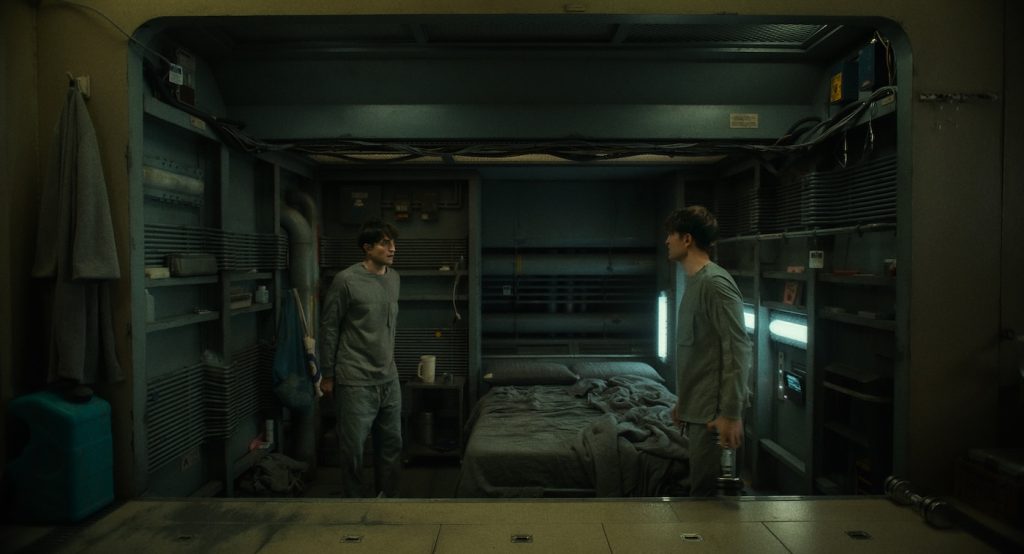
When I met Director Bong for the first time, I put together images, and they were all kind of messy. I suppose what I was really attracted to was functional vessels. I looked at cargo ships, I looked at naval craft—not the exteriors, but what happens when you’re inside them walking through the corridors, and they’re really narrow and low. Nuclear submarines were something we talked about because you’re basically operating around the crucial part of the vessel. I had this vision, in a fantasy version of sci-fi, that was so amazing and sleek, and actually, what I ended up wanting to do was make it feel functional, non-aesthetic, and like some of the furniture has been decommissioned.
Photo Credit: Courtesy of Warner Bros. Pictures
That non-aesthetic aesthetic works really well to support what’s happening onboard the ship.
For me, there is something very recognizable about that, even though it’s on a spaceship in the future. It’s something that’s not a massive departure, so therefore, the character dilemmas and what’s happening also feel like it’s not too far away from us. Our logic was that you don’t reinvent things that work. A cup is a cup; a pen is a pen. Again, the aesthetic is relatable. And then, Director Bong wanted it to be that almost rust-proof gray. What that did for me was that I became really interested in all the graphics. There are a lot of color pops with graphics and signage everywhere—danger of death; watch out, you might trip—because all these people on the ship are being hyper-managed. We looked at ways for color to come in in the details.
Color also makes a statement in Kenneth and Ylfa’s living quarters. How did you design that space?
A lot of the references were from the 1960s. We got into the idea of this sunken space. What we did, practically, was repurpose the real bedrooms that we used for the other characters because we didn’t have the stage space to be constantly building. I actually joined two bedrooms together, and we painted it pink. I had this great reference of the spiral staircase with the fur for treads, and that started the ball rolling. Of course, Ylfa thinks she’s a culinary genius, so the kitchen was really important. With my set decorator [Alice Felton], we talked a lot about this idea that you’d move to a foreign land and bring all your spoils, all the things you think are of value. As you go into this land you don’t even know, you’ve already decided what is still precious or important. As an Australian, it made sense to me, what happened with colonization, this imposition of architecture and dress.
Mark Ruffalo and Toni Collette in “Mickey 17.” Courtesy Warner Bros.
How did you deal with scale inside the ship? You get the sense that it’s enormous. Was that intentional?
Yes, absolutely. I remember doing a plan for Director Bong, so there was a journey. This is where they’re living; they come through here, and this is where the containers are. What it takes to create a Cycler is a huge amount of machinery and electronics, and that would actually take up the bulk of the ship. There’d be a big engine, basically, that everybody has to live around and maneuver around. So, something that looks enormous may have very little living space. We built the walkways very deliberately to make it feel like you’re going around something. There are almost no straight lines.
Caption: (L to r) ANAMARIA VARTOLOMEI, ROBERT PATTINSON and director BONG JOON HO on the set of “MICKEY 17,” a Warner Bros. Pictures release. Photo Credit: Jonathan Olley
Was any one aspect of the interior more challenging than the others?
I think the Cycler was very complicated—understanding what a Cycler is, but also, how to present that. I remember going through quite a lot of processes with Director Bong, where we arrived at the idea that this was not exceptional. It’s not otherworldly. It’s an incinerator. Yes, it feeds matter up to the human printer, but at the end of the day, it’s where your trash goes. Because we didn’t have a lot of stages, we built the cafeteria, the long corridor, and the committee room next to the Cycler. While they were shooting there, we were trying to build the massive Cycler set. Every time they were doing a take, people were going, quiet please, quiet please. That was the most complicated, both conceptually and logistically.
The high-tech focal point of the ship is the human printer. What was your inspiration there?
Like everything in the film, we looked at real-world versions. We looked at MRIs and X-ray machines. We also wanted it to have the texture of an old computer, so it has that old IBM computer color and a slightly pimply surface. It’s nice to touch, actually. It does have practical elements because we needed Mickey to come out. There’s movement in it. The idea was that it was almost like a camera lens focusing. And then all the tubes, they were running something that was supposed to look disgusting.
Caption: ROBERT PATTINSON as Mickey 17 in “MICKEY 17,” a Warner Bros. Pictures release. Photo Credit: Courtesy of Warner Bros. Pictures
Did director Bong Joon Ho’s penchant for storyboarding become a part of your process?
I remember being told very early on to look at the storyboards because that will tell you he doesn’t deviate. But when I say that, he doesn’t impose, either. He is constantly communicating as things are evolving with the design. We provided a lot of information really early, whether it was the translator device, the shape of a room, or anything that we were in the process of designing. Director Bong was always involved; he was always given that information, so the storyboards were very reflective. He’s drawing the things we’ve designed, and he was always asking questions, so there was a constant exchange of information. Some of the sequences that were really complicated were the ice caves, and that was done through the boarding.
How was the process of creating the Niflheim landscapes?
The big open area was very easy. But the caves were hard to do because we had real materials, and there’s a limit to what you can get. It took a lot of testing and lighting. We were throwing glue and salt, putting in paint, spritzing, and trying to get it to have an otherworldly, really vivid quality, but we also knew the effects team was going to take it over.
Caption: A scene from “MICKEY 17,” a Warner Bros. Pictures release. Photo Credit: Courtesy of Warner Bros. Pictures
Does the world inside and outside the ship look how you hoped?
It does. I always watch the rushes, so there’s never any real mystery. But the thing is, when you’re watching the rushes, you’re watching the takes for Mickey 17 or 18, and I’m actually watching what happens around them, so seeing Robert’s performances cut together was a complete surprise. In the rushes, I couldn’t really tell what was going on, but seeing it cut together was just extraordinary.
Featured image: Caption: (L to r) ROBERT PATTINSON as Mickey 18 and ROBERT PATTINSON as Mickey 17 in “MICKEY 17,” a Warner Bros. Pictures release. Photo Credit: Courtesy of Warner Bros. Pictures
The first reactions to Disney’s Snow Whiteare here, and the scuttlebutt is that director Marc Webb and his stars Rachel Zegler (Snow White) and Gal Gadot (the Evil Queen) have delivered one of the best live-action remakes to date. This is quite the turnaround after a few shaky weeks leading to the film’s premiere, with the online chatter surrounding Snow White having to do with everything but the film itself.
The early takes on the film especially call out Zegler’s performance, writing that her phenomenal singing chops are on full display here. She is no doubt one of the magical powers that Webb and the Snow White team were counting on to make this latest adaptation sing. The original Snow White, released in 1937, is arguably one of the most important films in Disney’s long, rich animation history, helping launch the brand into the global phenomenon it is today.
The film’s music comes from Dear Evan Hansen and The Greatest Showman songwriters Benj Pasek and Justin Paul. It boasts a screenplay from Barbie writer/director Greta Gerwig and Erin Cressida Wilson—all top-tier talent.
The film’s rollout had been subdued due to some fervor online stirred up in a few comments made years apart. It began two years ago when Ziegler upset some very online Disney fans by suggesting the new live-action remake was going to require more of Snow White than the original 1937 version did, where the prince saves her. When some fans took offense to that, Zegler had this to say:
“I interpret people’s sentiments towards this film as passion for it and what an honor to be a part of something that people feel so passionately about. We’re not always going to agree with everyone who surrounds us, and all we can do is our best.”
More recently, a post she made after Donald Trump won re-election caused a minor stir among conservatives and MAGA supporters (she later apologized), as did her stance on wanting freedom for Palestine. Gadot has been on the other side of that particular divide. As an Israeli citizen, she’s been vocal about her support of her home country. The two stars did present at the Oscars, but for the most part, they’ve been promoting the film separately until they came together for the premiere in Los Angeles.
It appears the results of their collaboration have borne some sweet, unpoisoned fruit.
Snow White will be released in theaters on March 21. Let’s examine some of the early reactions.
Despite the bob being all over the place, #SnowWhite is quite charming! The message lands well, the critters are adorable, and Rachel Zegler and her enchanting voice are stunning. It almost got a full tear out of me, and I’ve never cried in my entire life. pic.twitter.com/l1M8jwL1Gx
Rachel Zegler is a shining supernova in #SnowWhite, beautifully embodying the graceful, gentle nature of the OG Disney princess. It’s a visual feast with show-stopping new musical numbers and, of course, dozens of enchanting animated animals. The screenplay wisely gives its… pic.twitter.com/yQ4euqIzLu
Despite becoming an internet punching bag Disney’s remake of Snow White is actually mostly successful! Rachel Zegler is an absolute star, (most of) the new songs are catchy and beautifully performed, and the visual palette is sumptuous and vibrant. Gal Gadot had beautiful gowns.
The biggest surprise of 2025 is that the most “controversial” and most hated film of the year is actually a decent live-action remake.#SnowWhite is not only one of their best live-action remakes in years, but it’s also a film that recaptures the magic of the 1937 movie. Rachel… pic.twitter.com/9LiuAPRb61
— Christopher Rates It 🦦 (@LuminousDagger) March 16, 2025
Well, Disney has had the last laugh with #SnowWhite – after YEARS of backlash, they’ve produced one of their strongest ever remakes. Rachel Zegler is an enchanting lead, all the story tweaks work well for a modern audience and, after 88 years, it’s a reimagining that makes sense. pic.twitter.com/zr9zWHPp9w
I may regret saying this but #SnowWhite is solid. I really enjoyed the musical numbers, particularly the opening one and the Queen’s evil bop. Zegler was great in the lead role, and Gadot was fun. It’s really the CGI dwarves that let the film down. The choice is baffling. pic.twitter.com/mERKrMYc44
This year’s SXSW film festival in Austin blew into town with a considerable tailwind of enthusiasm for the Lone Star state’s film and TV future. Every state in the union can claim unique cultures, geographies, and mythologies, but there’s no disputing that Texas looms very large in our collective cultural imagination. It’s a state that takes very seriously the notion that it’s really a country.
Texas’s hold on our imagination is evident in how many great films and TV series are set there (whether they’re actually filmed there or not—we’ll get to that in a second), from the classics like John Ford’s The Searchers (1956), George Stevens’ Giant (also 1956), Arthur Penn’s Bonnie and Clyde (1967), and Tobe Hooper’s genre-defying Texas Chainsaw Massacre (1974), which celebrated its 50th anniversary last year and stands as one of the most unnerving, subtly brilliant horror movies ever made. Then there’s the more modern Texas classics, like Richard Linklater‘s Slacker (1990), which sent a camera rambling through Austin on a seemingly aimless but entirely moving snapshot of the city, and his deathless Dazed and Confused (1993), which for many people defines not only the cinematic era in which it came out, but the 1970s and the universally fraught experience of going to high school, whether you’re from Eastport, Maine or Anchorage, Alaska. Speaking of high school, Peter Berg’s Friday Night Lights (2004) is another beloved piece of Texas cinematic history. Meanwhile, the Coen Brothers’ instant classic No Country for Old Men (2007) has nothing to do with high school but is every bit as brutal.
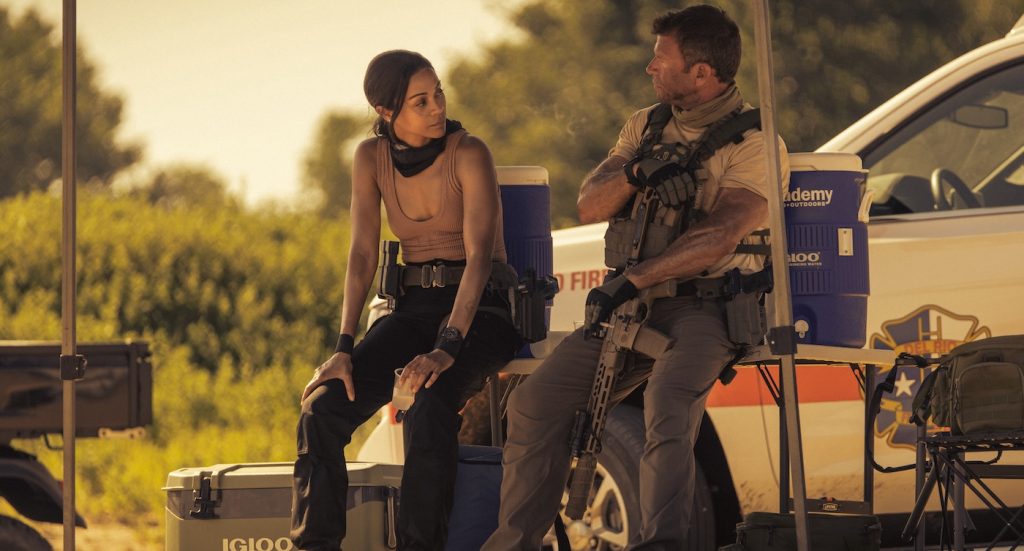
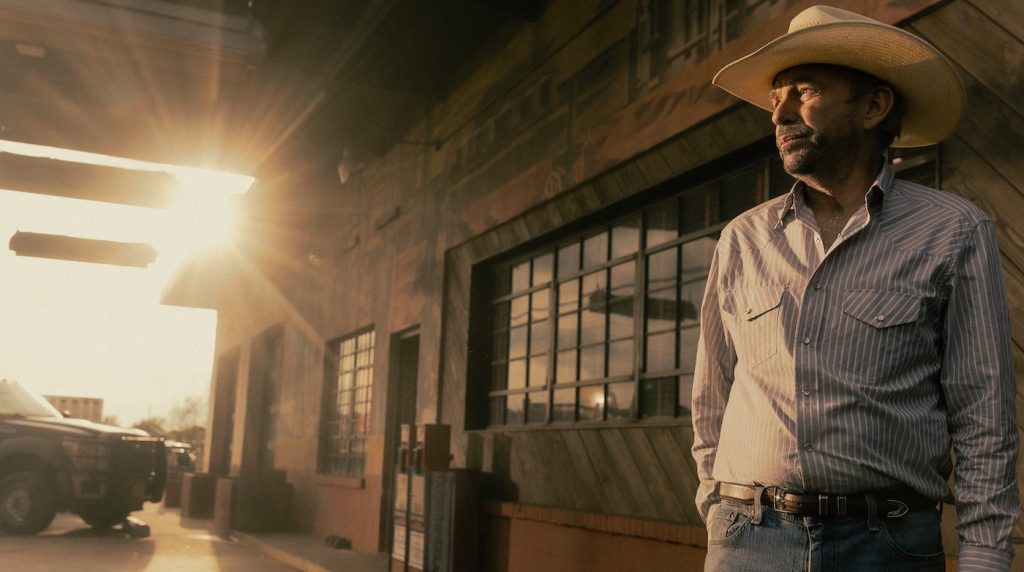
Now, Texas is on the cusp of turning its natural appeal and rich cinematic history into something even more profound—a sustainable hub for the film and television industry. This would allow Texas to truly flex its creative muscles and become a powerhouse in the industry, the way other states (Georgia comes to mind) with competitive tax incentives have. The economic impact large-scale productions have on local communities, not just big cities like Austin, Houston, and Dallas, but smaller towns and rural communities, is very real. Take just one of Taylor Sheridan’s recent shows, Lioness season 2, which generated $133 million and 2,200 local jobs in 73 days of filming, $30 million of which was spent with local Texas businesses—restaurants, caterers, rental cars, hotels, lumber, construction, dry cleaners and more. Turning Texas into a proper entertainment hub would mean that when Sheridan, the most prolific Texan working today, writes another film like his “love poem” (his words) to his home state, the 2016 film Hell or High Water (directed by David Mackenzie), it wouldn’t have to be shot in New Mexico.
L-R Zoe Saldana as Joe and Taylor Sheridan as Cody in Lioness, episode 1, season 2, streaming on Paramount+, 2024. Photo Credit: Lauren Smith/Paramount+
This was the subject of the panel the Motion Picture Association hosted at SXSW this year—how to harness the considerable enthusiasm for giving Texas stories a Texas backdrop, as stars like Matthew McConaughey, Woody Harrelson, Renée Zellweger, Billy Bob Thornton, and Dennis Quaid have all recently implored. Our panelists were Adriana Cruz, the Executive Director of the Texas Economic Development & Tourism Office, Paul Jensen, a Naval Academy graduate and Navy pilot who has carved out a successful career in the industry as both an advocate (he was the Executive Director of the Texas Media Production Alliance) and filmmaker himself, (his doc, Love Ya, Bum! premiered at SXSW this year), and Jeremy Latcham, the producer of big recent hits like Dungeons and Dragons: Honor Among Thieves and the former Senior Vice President of Production and Development at Marvel, where he helped create the Marvel Cinematic Universe, producing early hits like Iron Man, Iron Man 2, The Avengers, and Spider-Man: Homecoming.
L-r: Jeremy Latcham, Adriana Cruz, and Paul Jensen.
Cruz, who knows the raw numbers of how film and television production impacts communities possibly better than anyone else in the state, comes at the issue from a data-driven, legislative implementation standpoint, and has seen firsthand what a production can really do.
“I think there’s a great interest right now in the state legislature for the moving image industry…part of it is an understanding that production can take place in a very diverse range of cities and communities,” she says. “It’s not just Dallas and Austin that benefit, but Waxahachie, and deep East Texas, and West Texas, and all of the different communities in between.”
“I think there’s something very unique and iconic to the Texas personality,” says Jensen, a native Philadelphian who moved to the state years ago. “It’s a can-do personality. This is the type of place where people roll up their sleeves and say, ‘I’m going to make this happen.’ That’s intoxicating. As a filmmaker and someone who wants to tell stories, this is the place to do it. If we’re at a place where there’s a level playing field, Texas will absolutely win because of that spirit.”
For Latcham, an Oklahoma native who has worked on some of the biggest films of the last two decades, Texas was where he wanted to be. (It also helped that his wife, a Texan from Houston, went to the University of Texas.)
“I was feeling a disconnect between the broader Hollywood ecosystem and what the audience was after,” Latcham says. “I felt a real need for another cultural hub in the country, and Texas is the obvious spot for that. It has the most diversity in terms of cities and landscapes, and it feels like there’s stories to be told about Texas and from Texas. And so it was, ‘how do I move here, and how do I find a way to empower that?’ My goal is to be able to make movies here.”
Before she was appointed to her current position, Cruz was working in economic development at the Greater San Marcos Partnership, in Hays and Caldwell County, both between Austin and San Antonio. San Marcos, Cruz points out, is where Richard Linklater’s Boyhoodfilmed—which was shot, incredibly, over the course of 12 years between 2002 and 2013—and it was in Lockhart where HBO’s The Leftoverswas shot.
“The economic impact of these productions in these smaller communities is really, really compelling,” Cruz says. “We did an economic impact analysis for our two county footprints that we provided to our state legislators. A production coming to a small, rural community, like The Leftovers bought all the lumber in that lumberyard in 40 days. They made their year in one, 40-day production. It’s the caterers, the restaurants, the lumber yard, the carpenters, and the local economy that benefits when a production comes into town.”
“This is an industry that’s motivated by incentives,” Jensen adds. “We don’t get to practice economics in a laboratory, this is the real world, and if we want this industry and the benefits of this industry, there’s 39 other domestic programs that we’re competing against…these are high-paying jobs that are able to essentially be floating factories that inject into 180 film-friendly communities all across the state.
The numbers don’t lie. The Texas Moving Image Incentive Program (TMIIIP) is a reimbursement for the funds spent in the state, and Cruz has the figures to back up why advocates for the industry, like Jensen and Latcham, have a great case to make.
“For every dollar of grant, it results in $4.69 spent locally within the state of Texas,” she says. “That’s a really great return on investment from an economic perspective. We’re seeing these productions that are being filmed in different, diverse parts of the state, whether that’s Landman(recently renewed for a second season) in West Texas, Bass Reeves in East Texas, The Chosen up in North Texas…and I’m just going through TV series.”
Billy Bob Thornton as Tommy Norris in season 1, episode 7 of Landman streaming on Paramount+. Photo credit: Emerson Miller/Paramount+.
Cruz has had key allies in the state government, including Lt. Governor Dan Patrick and Senate Finance Chair Joan Huffman, whose support could help Texas boast one of the top film and TV industry programs in the country.
“One of the things that I think is so important is to have a program big enough to keep multiple crews working year-round,” he says. “In order to have really great crews, we need crews that are working every day. I remember this executive walking onto one of the Marvel sets one day, and he looked at the director and he goes, ‘The least experienced member of the crew.’ Because a director spends three years trying to get a movie made, then they shoot for 35 days, and then they go to the edit. They don’t do it every day, but a grip, an electrician, a carpenter, a plasterer, a hair or makeup or prosthetics person, if they’re good they work every single work day that they can.”
Jensen pointed out that not only do productions bring immediate economic benefits to communities across the state, but there are after-effects that carry on longer after a particular production has wrapped.
“Hope Floats was shot [primarily] in Smithville, Texas, which still has ‘The Home of Hope Floats with Sandra Bullock’ on their water tower,” Jensen says. “Film tourism is a huge piece of this….we used to call it the Waco effect, you used to drive as fast as you could from Dallas to Austin on 35, but the show came around, Magnolia Entertainment, and all of sudden people are going to Silos Bakery and experiencing Waco in a new way because of content that was created there.”
Texas is big in ways literal and metaphorical. It has mountains, deserts, coastal marshes, pine forests, it has vast plains and river valleys, and, throughout all of this varied topography, it has a wealth of cultures, which in turn have a wealth of stories to tell. If you asked someone in Tokyo or Tehran or Toronto if they had an idea of Texas in their head, they’d likely conjure an image from a film or a TV show. And if Texas were a country, which many Texans believe it is, it would be the 8th largest economy in the world. As Cruz said during her testimony before the Texas Senate Finance Committee, Texas is the top exporting state. “The moving image industry allows us to export perhaps our most important commodity—our Texan culture.”
British actor Stephen Graham is so reliably intense he played Al Capone for Martin Scorsese in Boardwalk Empire, stared down Al Pacino in The Irishman, executive producer and co-starred in the bare knuckle boxing drama A Thousand Blows, and earned the prestigious Officer of the Order of the British Empire (OBE) award for his contributions to UK television. Now he’s co-written the acutely tense Adolescence (streaming on Netflix on March 13), a four-part series that centers on Graham’s character Eddie Miller, the bewildered father of a 13-year-old boy who’s been charged with killing a female classmate after he was bullied on social media.
Director Philip Barantini filmed each episode as a single unbroken take, coaxing taut performances from veteran actors, including Erin Doherty and Ashley Walters, both of whom worked with Graham on A Thousand Blows. But the series’ most explosive star turn comes from teenaged newcomer Owen Cooper as the rage-filled Jamie.
Barantini, a former actor (Band of Brothers, Chernobyl) teamed with DP Matt Lewis to meticulously prep the shoot with production designer Adam Tomlinson, who built models and miniature action figures that enabled filmmakers to choreograph all the action in advance.
Speaking from London, Barantini, who earlier directed Graham in the drama Boiling Point, talks about his attraction to one-take storytelling and explains how he steered 14-year-old Owen Cooper toward one of the year’s most spellbinding acting debuts.
You filmed each episode of Adolescence in a single unbroken take. Why?
I didn’t ever want the one-shot to be at the forefront of the show as a spectacle, like, ‘Look how clever we are,’ but there are just many distractions nowadays and we’re all so used to watching TV or film even at home with one eye on the screen, and one eye on the phone. With Adolescence, I wanted the audience to go on an immersive journey that unfolds in real time just as it’s unfolding for the actors in real time. [The single-take] creates a tension and forces a perspective on the audience to where they can’t look away, even if they feel anxious or awkward. [The one-shot] doesn’t lend itself to all genres, but for this show, we wanted to dip the audience in for an hour, and we pull them out. The next time, it’s a few days later or 13 months later, and it’s up to the audience to figure things out for themselves. ‘Hold on, where are we now?’ So that’s the why.
What about the “How?” Three out of four Adolescence episodes move through multiple locations and shift focus among numerous characters with no cuts. How did you coordinate all of that?
By filming each episode like a choreographed dance. It took extensive planning and rehearsals, not just with the actors and myself. We had to bring in certain pieces at certain times, and the dance is moving, and then you bring in this part, and then you bring in that part [swirling his hands around in the air]. Yes, I’m dancing with my hands! So we plan all of that way in advance and made each episode in three-week blocks.
What kind of process took you through each of these “blocks”?
When we get to set the first week, we rehearse with the actors and gently ease into it beat by beat, slowly getting to the end of the episode. Then we go back to the beginning and do it again, stopping and starting, tweaking as we go along.
Second week we do tech rehearsals with every single member of the crew, all of the extras, everybody’s there because again, it’s like a dance and everybody has their part to play so they need to be watching at all times. And then, the final week is shoot week. Everyone comes on set at 10 in the morning, in costume, makeup, everything. I call action. An hour later, I call cut. By then, most of my work had been done in prep and rehearsal. I watch it play out live, but as soon as I call action, I can’t stop it.
Since you’d spend only one hour to capture an entire episode in a single take, why did you need a full week to film each show?
Because we’d shoot each episode twice every day! We’d have an hour in the morning. Then a three-hour break to give notes, then we’d come back in the afternoon and shoot it again. By the end of the week, we’d have ten [versions] of the same episode. We’d choose which one we wanted to go with. Sometimes, it was really difficult to decide, but for me, it’s always about performances. If the audience is focusing on the one-shot or what the set looks like or the costumes or anything like that, then I feel we’ve lost the viewer.
This 13-year-old was just arrested on suspicion of murder, flipping his family’s life upside down.
The actors’ performances in Adolescence make it easy to forget the technical achievement. Stephen Graham, in the final episode, for example, takes Eddie on a wildly emotional journey from a man enjoying his birthday breakfast to a sobbing heap of humanity.
SPOILER ALERT
Stephen’s magnificent. He doesn’t pay attention to what he’s doing himself but soaks up his environment and listens to everybody else. In that episode, Eddie’s trying to hold it together for his family, his family’s trying to hold it together for him, but we witness them all falling apart. At the very end, Eddie is exhausted and emotionally drained and so is Stephen. One of the notes I gave Eddie’s wife Manda (Christine Tremarco), and Stephen as well, is that when Jamie makes the phone call [from jail], imagine that your child has been a life support machine for all this time, and that phone call is the doctor telling you that they’re going to switch the machine off. Now you have to get out of the van and go into the house with that. And certainly Stephen’s reaction. There was not a single one of us who had a dry eye. It was gut-wrenching.
Stephen Graham landed precisely in that dark place at the 58-minute mark every morning and every afternoon for five days in a row – that’s impressive. But the big discovery in Adolescence has to be Owen Cooper as young Jamie, who cycles through a frightening range of emotions within the confines of the interrogation room while being questioned by a child psychologist. You must have rehearsed the heck out of that scene!
The amazing thing about Owen is, he’s never acted before.
He didn’t come to us with any preconceptions about how he should be acting, so I was able to give Owen the freedom to just be natural and in the moment. Erin Doherty, who played Briony, is such a reactive actor that early on, I said to her “I’m not going to give you any notes. I’m going to give all the notes to Owen” because I knew whatever he did, she would react to it naturally in the moment.
What was it like directing a kid who had no professional training?
Owen came to the set on day one of rehearsals, and he was completely off the book. He knew all his lines and didn’t need the script, which blew me away. I was like, “Okay, we’re good here.” I just needed to jump in the boat with him, like we have one oar each, and I’ll guide him in a way that is also Owen guiding himself.
How did it feel when you came out the other end of this hyper-focused method of TV making?
For me as a filmmaker, Adolescence is the most collaborative experience I’ve ever been a part of. We hope it sparks conversations between parents, teachers, adults, and children because we want the show to almost be holding up a mirror to society in terms of what’s happening to young boys, certainly in our country, but globally as well.
In a big bit of casting news, Stranger Thingsstar Sadie Sink is joining Tom Holland in the fourth installment of Holland’s run as Peter Parker. Deadlinereports that while Sink’s role is not yet known to the public, they’ve gone ahead and posited an intriguing possibility—that she will play legendary X-Men mutant Jean Grey. This would make sense given the fact that the X-Men are now officially a part of the MCU, with Hugh Jackman’s Wolverine having made a grand entrance in Deadpool & Wolverine. The last time we’ve seen Grey onscreen, she was portrayed by Game of Thrones star Sophie Turner. Before that, in Jackman’s era in the X-Men, she was played by Famke Janssen.
Sink has made a big impact in Stranger Things, where she’s played Max Mayfield since season 2 and will be a big part of the series’ final fifth season. Given that Deadline reports her role is a big one, it’s likely this is just the beginning for Sink in the MCU.
The plot details for Spider-Man 4 are, of course, unknown for now. In the previous film, Spider-Man: No Way Home, a trifecta of Peter Parkers—Holland’s version, Andrew Garfield’s version, and Tobey Maguire’s version—all appeared together in a multiverse spanning epic that required Holland’s Spider-Man to essentially reset the memories of everyone he loves, including Zendaya’s MJ, so he could restore order to his universe and keep his identity hidden. It was a bittersweet ending; Peter saved the day, but essentially lost everyone he loved.
Shang-Chi and the Legend of the Ten Rings director Destin Daniel Cretton is taking over for Jon Watts to helm the fourthquel, which is due in theaters on July 31, 2026.
For more on all things Spider-Man, check out these stories:
And by “John Wick,” we might not necessarily be referring to the man himself, as played by Keanu Reeves in the first four films. By all accounts, Reeves’ nearly indestructible assassin died a noble death at the end of the last installment, John Wick: Chapter 4. We knew we’d be given another glimpse at the man in the upcoming spinoff, Ballerina, which stars Ana de Armas as Eva Macarro as she begins training as an assassin in the traditions of the Ruska Roma. Ballerina is set during the events of John Wick: Chapter 3 – Parabellum, which made it possible for Reeves to have a cameo in the film. Director Len Wiseman helms Ballerina, with a little help from longstanding John Wick mastermind director Chad Stahelski, who provided some punch-ed up new action sequences.
Speaking with Comicbook.com, Lionsgate EVP and head of Global Products and Experiences Jennifer Brown confirmed that John Wick 5 is officially in the works.
“Up next, of course, is Ballerina, which is our first spin-off movie and [we] can’t wait for that to release to the world. Of course, we’ve announced we’re working on a fifth John Wick film. I think there are more spinoffs to come, a TV series, a video game. We’ve shared that we’re developing a fifth John Wick film. [John Wick] may be [dead]. We are all on bated breath waiting to find out.”
So yes, John Wick himself might not return for the fifth installment, but the flagship franchise will carry on. How the fifth Wick will carry on the titular assassin’s legacy is anyone’s guess, especially considering the man who offed him in Chapter 4, Donnie Yen’s Caine, is getting his own spinoff movie (Yen might even direct that film.)
As for a surprise Reeves resurrection, it’s best not to put any emotional investment there. Reeves has stated that he loved playing the role, but it took a considerable toll on him physically and returning for another go-round at 60 years old (yes, it’s shocking, he looks so much younger) might be too much.
Reeves fans, and we are legion, need not worry about not seeing him soon—he’s got another action film, BRZRKR, from director Justin Lin, that’s based on a comic from Matt Kindt, adapted by screenwriter Mattson Tomlin.
For more on all things John Wick, check out these stories:
For all intents and purposes, Ellie (Bella Ramsey) is a normal kid. She likes comic books. She’s bright but mischievous. She’s learning how to stand up for herself, but she also craves guidance and mentorship. She’s tougher than she looks, but she’s still just a kid.
That’s about where normalcy ends for Ellie, who has the both the blessing and the curse of being the one person alive in the world of The Last of Us who is immune to the virus that turns human beings into flesh-eating zombies in the wake of a cordycepts-borne plague that turned the planet into a living hell. One of HBO’s most compelling new series, the first to arrive in a post-Game of Thrones world that had the makings of a genre-defying blockbuster, returns for season 2 on April 13. To that end, they’ve supplied a new video reminding us what Ellie’s been through in her long, tortuous journey from normal kid living in a deeply unusual world into a potentially humanity-saving pawn in a dangerous game being played by survivors of the cordycepts outbreak.
We see Ellie enjoying kid things, like her fateful day at the mall with her friend Riley (Storm Reid) from season 1, which ends in tragedy. She loses Riley during an attack by the infected, and gets bitten herself. Ellie assumes she’s a goner, but some kind of self-made serum within her keeps her alive (her mother, who died during childbirth, had been infected, granting Ellie immunity somehow). This revelation turns Ellie from a kid trying to survive in a post-apocalyptic world to the subject of great interest to competing factions of survivors. Ellie’s eventually detained by a faction led by Marlene (Merle Dandridge), who informs her she’s got a greater purpose “than any of us could have ever imagined.” This leads Ellie to be entrusted to Joel (Pedro Pascal), who needs to escort her on a highly dangerous cross-country trip for unknown purposes until the end of season one.
We see Ellie and Joel’s journey, which puts them into contact with people they’ll get to know and lose, and a numberless army of infected, all at various stages of mutation, who have been turned into mindless hunters of the uninfected.
Season 1 was never less than a totally riveting zombie thriller, but it was also a moving portrait of the lengths people will go to protect the ones they love. While Joel initially refers to Ellie as nothing more than “cargo,” eventually, she becomes his family, and he becomes hers, and their evolving friendship becomes the defining, most essential element of the series. It’s what turned a great zombie thriller into a truly great show, period. It was also a big reason why Pedro Pascal, already a rising star, became a bonafide one, and Bella Ramsey proved she’s one of the most talented performers of her generation.
The Last of Us returns to Max for its season 2 premiere on April 13. Check out the new featurette here:
For more on The Last Of Us, check out these stories:
The self-destructive but oh-so lovable comedy team are back for season 4.
Max’s Emmy-award winning series Hacks has dropped its official trailer ahead of its April 10 premiere, with Jean Smart’s Deborah and Hannah Einbinder’s Ava finding themselves at a crossroads, and, to Ava’s detriment, no doubt, in each other’s crosshairs as they try to pull off something unprecedented. Lucia Aniello, Paul W. Downs, and Jen Statsky’s whip-smart comedy enters its fourth season with Deborah and Ava trying to get their late night show off the ground and to make TV history in the process. That is, if they can stand each other long enough to pull it off.
The series will kick off on April 10th with two episodes, followed by one a week for four weeks afterward. Then, on May 15, there will be another two-episode night, followed by two consecutive shows on May 22 and 29. This release schedule is necessary because the Emmy eligibility deadline for 2025’s shows is May 31.
Joining Smart and Einbinder in the cast are aforementioned co-creator Paul W. Downs, Megan Stalter, Carl Clemons-Hopkins, Mark Indelicato, Rose Abdoo, Dan Bucatinsky, Helen Hunt, Tony Goldwyn, Kaitlin Olson, Jane Adams, Lauren Weedman, Christopher McDonald, Poppy Liu, Lorenza Izzo, Johnny Sibilly, Paul Felder, Polly Draper, Luenell, and Aristotle Athari. Season four also boasts a slew of guest stars, including Julianne Nicholson, Michaela Watkins, Bresha Webb, Robby Hoffman, Eric Balfour, Danny Jolles, Gavin Matts, Grover Whitmore, III, Holmes, Jasmine Ashanti, Katy Sullivan, Matt Oberg and Sandy Honig.
Check out the official trailer below.
For more on Warner Bros., DC Studios, Max, and more, check out these stories:
Recently, Florence Pugh, one of the stars of Marvel’s upcoming antihero epic Thunderbolts, said the Marvel Cinematic Universe installment was very unlike your average MCU addition. In fact, Pugh told Empire that Thunderbolts feels much more like an indie film.
“It ended up becoming this quite badass indie, A24-feeling assassin movie with Marvel superheroes,” Pugh told Empire.
This isn’t just one of the film’s marquee names trying to give her movie an edge at the box office. In fact, given the creatives involved behind the camera, it sounds more like a plain statement of fact, even though the movie comes from one of the largest studio juggernauts in the world, Marvel, which itself is nested under the largest studio in Disney.
Let’s examine who’s behind Thunderbolts to flesh out Pugh’s statement. The director is Jack Schreier, the helmer of A24 produced, Netflix’s distributed gangbusters dark comedy Beef. He worked from a script co-written by Beef creator Lee Sung Jin, The Bear‘s Joanna Calo, and longtime Marvel scribe Eric Pearson. Then there’s the crop of talent from critically acclaimed A24 films, including cinematographer Andrew Droz Palermo from The Green Knight, Minari editor Harry Yoon, and Everything Everywhere All At Once composer Son Lux.
Jake Schreier told Empire he was advdised to make “something different.” He added, “There’s a certain amount of that Beef tone in it, that does feel different. There’s an emotional darkness that we brought to this that is resonant, but doesn’t come at the expense of comedy.”
The Thunderbolts team is made up of Pugh’s Black Widow butt-kicker Yelena Belova, her dad, David Harbour’s Alexei Shostakov/Red Guardian, and a slew of Marvel villains who have just enough moral flexibility to do good. Or, at least, be a little better than the even worse guys. Those include Sebastian Stan’s Bucky Barnes/Winter Soldier (although to be fair, he’s been a good guy for a while now), Hannah John-Kamen’s Ghost (from the first Ant-Man), Olga Kurlyenko’s Taskmaster (from Black Widow), and Wyatt Russell’s John Walker (from The Falcon and the Winter Soldier). They’ve been assembled (pun intended) by Julia Louis-Dreyfus’s Valentina Allegra de Fontaine, previously revealed as a kind of bad guy recruitment sage in The Falcon and the Winter Soldier.
Then, the film’s marketing is decidedly different from that of previous MCU films. In this minute-long teaser, the cast is introduced as stars from Midsommar (Pugh, despite having starred in previous Marvel films and shows), A Different Man (Sebastian Stan, despite having starred in previous Marvel films and shows), and You Hurt My Feelings (Louis-Dreyfus, again, who starred in a previous Marvel series), from the writers of Beef, the cinematographer of The Green Knight, and the production designer of Ari Aster’s horror masterpiece Hereditary (Grace Yun, also from Beef and Past Lives). Tell this doesn’t look like an indie Marvel film:
Thunderbolts hits theaters on May 2, 2025, and has a chance of giving the cinematic universe an entirely different, offbeat feel. So far, it looks promising.