From Sound Mixers to Cinematographers, Industry Artisans Back Federal Film Incentive
Production sound mixers, cinematographers, composers, visual effects supervisors, and other film and television artisans are voicing support for the newly introduced Motion Picture, Television, and Entertainment Revitalization Act, arguing that a federal incentive could help keep productions, jobs, and investment in the United States.
Industry professionals and the many businesses in big cities and small towns that support film and television production have long advocated for a measure like this, but the effort took on fresh urgency after last Thursday. That’s when a bipartisan group of Senators and Representatives in Congress introduced the Motion Picture, Television, and Entertainment Revitalization Act – a proposed federal film and television production tax incentive that could deliver high-quality jobs to American workers and strengthen the United States’ competitiveness as a destination for filmmaking. The move comes amid mounting pressure from labor unions, guilds, studios, trade associations, and industry leaders who recently launched the U.S. Film & TV Production Coalition.
The group released a study by consultancy Olsberg•SPI, commissioned by the Motion Picture Association (MPA), that laid out the potential positive impacts of a robust incentive: generating an additional $250 billion in total gross value for our economy and supporting an average of 143,500 additional, full-time equivalent jobs each year, in all 50 states, over the next ten years. The initiative comes at a time when more film and television productions are leaving the country in search of better tax incentives and less red tape to get productions off the ground.
For below-the-line artisans, a federal incentive couldn’t come soon enough. If you’re looking for a way to supercharge domestic production – and the opportunities that accompany it – this is the top answer. And plenty of members of the creative workforce agree.
“This bill could significantly change the landscape for the American film and television industry,” says four-time Oscar-nominated production sound mixer Steven Morrow, whose work includes the Los Angeles-based production La La Land, Bradley Cooper’s A Star Is Born, and James Mangold’s Ford v Ferrari. “It has become increasingly difficult for our industry to remain competitive in today’s global economy, and productions have been moving substantial amounts of work – and the jobs that come with it – outside the United States.”
Two-time Oscar-winning sound veteran Mark Mangini, who’s behind the blockbusters Mad Max: Fury Road, Blade Runner 2049, and Dune: Part One, says, “This bill will have a meaningful impact for the U.S. film industry. It has been sad to watch a homegrown industry disappear before our eyes as foreign tax credits lure productions to other countries, creating vast swaths of unemployment throughout the American film community.”
Cinematographer Natalie Kingston, the first female to win an Emmy for narrative work on Apple TV’s Black Bird – predominantly shot in Louisiana – agrees. “I’m really encouraged by the possibility of a federal film and television tax incentive. I’ve seen firsthand how often the decision of where to shoot ultimately comes down to economics. We have incredible crews, craftspeople, and production infrastructure here in the U.S., but we’re competing with countries that offer substantial national incentives. A federal credit that works alongside existing state incentives could really help level that playing field and keep more productions and jobs here at home.”
The report on this proposal – which used data from the Congressional Budget Office, Bureau of Labor Statistics, ProdPro, FilmLA, and MPA to compile its findings – backs their statements, noting that without the incentive, America’s share of global production will continue to see a gradual decline, reaching 25% for film and 29% for TV by 2035. With the incentive, it assumes that trend will make a U-turn and increase to 65% for film by 2030 and 2032 for TV. In other words, a federal tax credit could significantly impact an industry that’s seeing numbers wane due to international competition. Between 2017 and 2026, 65 countries offered national incentives. Behind-the-scenes creatives are witnessing job losses up close.
Emmy-nominated composer Chanda Dancy-Morizawa, known for Lawmen: Bass Reeves and Whitney Houston: I Wanna Dance with Somebody, says, “I’ve been a part of the L.A. film scoring community for over 22 years, and I have witnessed firsthand the evaporation of production and postproduction work for many in our field, particularly in the area of recording live musicians and orchestra. Colleagues that I have worked with for years are leaving the state and the entire industry altogether due to the dearth of work opportunities; opportunities that have been sent overseas where costs can be much cheaper. A federal film and television tax incentive would bring an incredibly important tool in the effort to get back more film production and postproduction work for local talent.”
Five-time Emmy winner Christian Sprenger, the cinematographer behind the hit series Widow’s Bay, Mr. & Mrs. Smith, and Atlanta, says the loss of industry jobs feels all too familiar. “Film productions going overseas in search of cheaper production costs is absolutely a classic case of American jobs being lost due to domestic inflation. Any federal incentive that helps keep U.S. film production jobs in the U.S. is a massive win for our industry, for the U.S. job market, and for our country as a whole.”
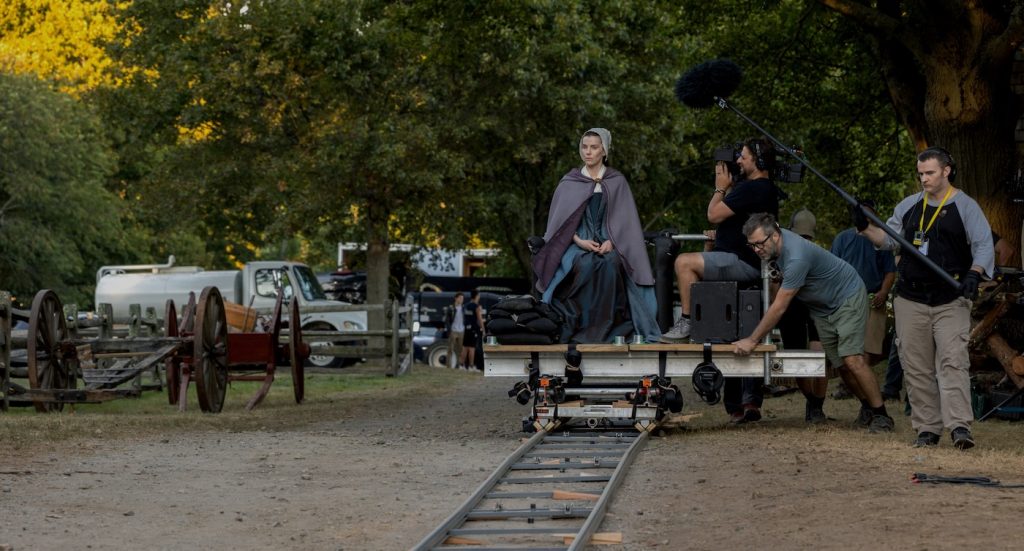
State-level incentives are doing their best to keep productions in the U.S. As of August 2026, 39 states have active film and television incentive programs. Yet some are seeing numbers decline. The Georgia film office reported 280 total productions spent roughly $2 billion from July 1, 2025 to June 30, 2026. This is down from last year and far below the over $4 billion spent in 2022.
The same report said California lost the most film industry jobs over the same time period, a decline of roughly 13,000 jobs, despite remaining the country’s largest film job market. FilmLA also reports an overall decrease in the number of production shooting days since 2024. However, the recent Version 4.0 of the California Film & TV Tax Credit Program is showing signs of improvement. According to FilmLA data, in the second quarter of 2026, the television category is up 34.4%, posting 1,607 shooting days versus 1,196 in quarter one. Industry workers in the Golden State hope those numbers will rise even more with the California Post-Production Tax Credit, a bill that would offer a tax credit of 35% to 50% for qualified post-production expenses on eligible motion pictures. The California Assembly passed AB 2319, which Governor Gavin Newsom signed into law on September 19.
“We’ve been lobbying for some relief here because it’s really hard in California,” says John Knoll, an Oscar-winning visual effects supervisor at Industrial Light & Magic, the renowned company behind the Star Wars franchise. “You would think the California tax for filmmaking would help us, but what we have seen in practice is that the California tax incentive maxes out their spend while they’re shooting, so there’s no money left by the time they get to post. And when they do get to post, they want to do this the cheapest way possible, and they’ll claim a tax credit in Canada, Australia, London, or somewhere else that’s offering it. We’re not afraid of competition, but it’s a super un-level playing field right now.”

Aaron Becker, the director of Filmograph, the company behind many eye-catching main title sequences as seen in Euphoria, Wednesday, Cape Fear, Coyote vs Acme, Backrooms, and the upcoming Spaceballs: The New One, says, “As company owners and employers of those in the field of post-production here in California, we take the passage of AB 2319 very seriously, and hope that it helps bring jobs back to the state, which the industry desperately needs.”
A federal tax production incentive would do more than level the playing field for the U.S. industry. It would impact the broader economy. Olsberg•SPI data suggests that, with the incentive, an extra $125 billion could be spent on U.S. productions and $133.1 billion in additional labor income from 2027 to 2035. The potential impact would be felt by everyone from studios to businesses on Main Streets across the country.
Darrell Alexander, the founder of COOL Music, remains hopeful. “After much advocacy within the industry, the possibility of the approval of the federal film incentive currently being drafted by Congress is a vital glimmer, with the potential to revitalize the home of motion pictures. We’re optimistic that the many timeless film scores yet to be written could come to life with the support of this necessary legislation, ensuring that America remains the home of Hollywood.”
Property Master Guild President Jeffrey Johnson shares a similar sentiment. “Our industry is made up of uniquely skilled crew members, real people with families and financial obligations. Every small business and corporation is affected by the loss of income from these American workers. It is a vital industry rooted in blue-collar work ethic and focus. It’s a part of the fabric of the U.S. identity. The competition is ruthless, and we should no longer sit in the corner of the ring on our stool and sweat. Any assistance from the federal government to stem the flow of projects out of the country is appreciated. As president of an international guild, I am always concerned about the experiences of film and TV artists around the globe. I have worked all over the world with amazing people. As a 33-year film veteran living in the U.S., I want to preserve one of our country’s vital industries for future generations of creators and communities.”
Morrow adds, “This bill represents an opportunity to begin rebuilding an industry that has provided good jobs and supported communities across the country for generations. I don’t see a reason not to support incentives that encourage American productions to be made here, employing American workers and keeping that economic activity in the United States. I’m grateful that Washington is listening to our industry during a very difficult time, and I hope Congress recognizes the urgency of the situation and moves this legislation forward.”
Featured image: L-r: HOLLYWOOD, CALIFORNIA – SEPTEMBER 14: Christian Sprenger attends Apple TV+’s Primetime Emmy Party Red Carpet at NYA WEST on September 14, 2026 in Hollywood, California. (Photo by Monica Schipper/Getty Images); BEVERLY HILLS, CALIFORNIA – JUNE 07: Chanda Dancy attends the Paramount +’s “Lawmen: Bass Reeves” FYC Event at Wallis Annenberg Center for the Performing Arts on June 07, 2024 in Beverly Hills, California. (Photo by Araya Doheny/Getty Images); BEVERLY HILLS, CA – FEBRUARY 04: Steve A. Morrow attends the 91st Oscars Nominees Luncheon at The Beverly Hilton Hotel on February 4, 2019 in Beverly Hills, California. (Photo by Dan MacMedan/Getty Images); LOS ANGELES, CALIFORNIA – JANUARY 06: Natalie Kingston poses with the Outstanding Cinematography for a Limited or Anthology Series or Movie award during the 2024 Creative Arts Emmys at Peacock Theater on January 06, 2024, in Los Angeles, California. (Photo by Frazer Harrison/Getty Images).