
Inside “Widow’s Bay” Episode 6: DP Christian Sprenger on Building Tension With Light, Shadow & Silence
TV buffs will tell you the concept of a “bottle episode” was coined by producer Leslie Stevens on the sci-fi series The Outer Limits. The 1964 episode “Controlled Experiment” is among the earliest to depict the idea, which typically confines a story to a single setting while limiting cast and effects – all in an effort to save production cost (and time). But its restrictiveness did more than aid the bottom line. It added intrigue. Confining the action creates a claustrophobic sense of intimacy in which the characters cannot escape their environment or each other. A few of the most memorable episodes to follow the rules have been Seinfeld’s “The Chinese Restaurant,” West Wing’s “17 People,” and Mad Men’s “The Suitcase.”
“That’s what the money is for!”
Today, bottle episodes have evolved more into a form of creative expression than a budgetary tool, and for the sake of argument, their definition has become muddied, literally. For purists, The Sopranos “Pine Barrens,” Game of Thrones “Blackwater,” and The Last of Us ‘Long, Long Time” may not fit in the bottle episode boxing ring. But, instead, they are stand-alone episodes.
No matter what you prefer to call them – cinematographer Christian Sprenger is becoming a master of the niche.
His most famous work, Atlanta’s “Teddy Perkins,” which follows Darius (Lakeith Stanfield) as he visits an eerie pianist – portrayed by series star Donald Glover wearing heavy prosthetics, a wig, and whiteface – to pick up a free piano, only to uncover a deeply disturbed man traumatized by his father’s obsession with musical perfection. Sprenger visualized long takes and carefully composed symmetry to trap both the character and viewer inside the unsettling story. Sprenger won an Emmy for that 2018 episode and earned two more for Atlanta, which often made every episode feel like a stand-alone.
Born in Florida (shout out Publix), he grew up in the Chicagoland area making home movies on VHS and experimenting with 8mm film. Sprenger admits studying cinematography was nearly an afterthought, only connecting the pieces when attending the wrong college orientation. The gaffe resulted in a switch from a VFX major to cinematography at Columbia College Chicago. It was during film school that he was introduced to the likes of Jean-Luc Godard, Spike Lee, and David Lynch, who sparked his artistic side. Since making Los Angeles his home, he’s photographed The Last Man on Earth, Baskets, GLOW, Station Eleven, and Glover’s Mr. & Mrs. Smith. But none more important along that journey than meeting producer-director Hiro Murai, who is among the finest visual auteurs in TV today.
Their relationship grew from a chance meeting on a Nokia phone commercial before working together on the Atlanta pilot in the summer of 2015. Since then, they’ve collaborated on over 50 episodes of television. Their latest is Apple TV’s Widow’s Bay, a slow-burn horror centered on a small New England island town with a reputation for supernatural disasters that threatens its survival. It stars Stephen Root, Kate O’Flynn, and Matthew Rhys as the town mayor trying to boost tourism (and hide the fact that the island may be haunted).
In preparation for the 10-episode series, Sprenger tells The Credits that it was unlike anything they had done before. “We had about eight scripts from the beginning and outlines for the last two episodes, so we understood the broad scope of the show. And we very much felt that we were making a show you couldn’t easily point towards something else as a reference. It’s a good thing, but it makes producing it very complicated because you can’t say we’re making this meets this.” Sprenger not only served as cinematographer, splitting the series with DP Cody Jacobs (eps 4, 5, 7, 8), he was also a producer – a credit rarely given to cinematographers.
“Because of my relationship with Hiro, on previous projects, I would fill in for others who might have been unavailable. I would step in early for prep, going kind of above and beyond what a normal DP would be doing,” he says. “Hiro very graciously offered [the producer role] on this one, and I really enjoy being involved in a greater creative capacity. It allows me to get in on the ground floor and have conversations about how to build this machine and execute it all the way through post.”
The two saw Widow Bay’s storyline paralleling early Spielberg, Coen brothers, and shows like The Twilight Zone. “Hiro kept going back to this idea that he wanted it to feel more like classical cinema, even down to how it was lit and color-corrected. We wanted a lot of very intentional static coverage and very slow methodical pacing as ground rules,” notes Sprenger, who photographed images with the Arri Alexa 35 paired with Olympus Zuiko OM and Ancient Optics’ Tamashii lenses.
But those rules were broken for episode 6, “Our History,” a stand-alone episode set in the 1700s, directed by Ti West (X, Pearl, MaXXXine), which reveals the origin of the town’s disturbing dark secrets. “Cody Jacobs and I created a master reference book for what the show was, but then I had a whole separate look book just for episode six,” notes Sprenger. “Ti and I were able to discuss different references and develop the look.” One change from the series visual style was the technical approach.
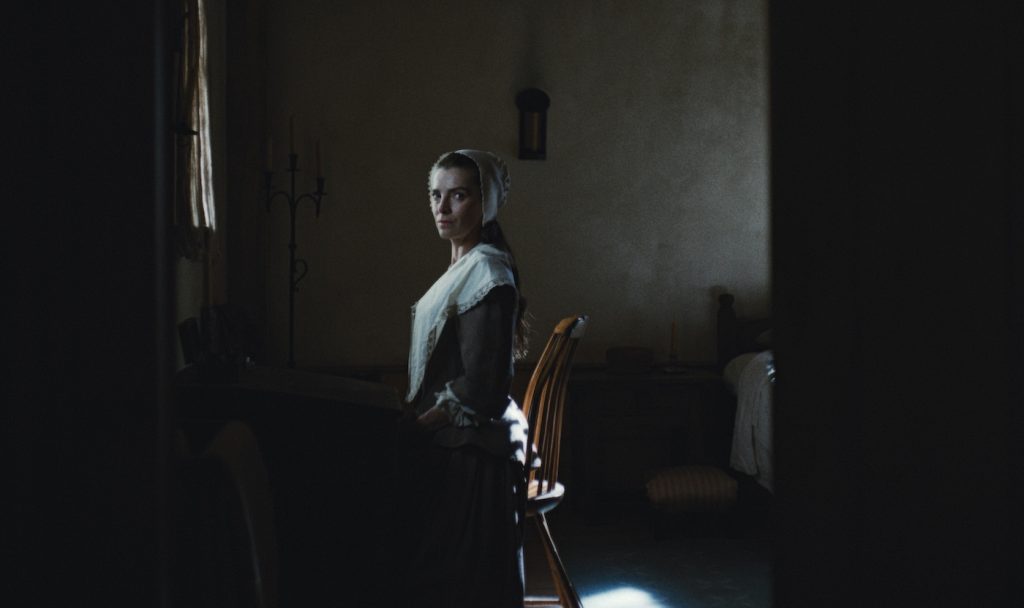
“We decided to shoot in a different aspect ratio and on the Alexa 265, which is a medium-format camera to give it some gravitas and make it feel different,” he says. The cinematographer also switched to ASC Todd-AO lenses, originally manufactured in the 1950s, which had recently been restored in collaboration with the American Society of Cinematographers and Zero Optik for large-format photography. Widow’s Bay was the first production to use the vintage lenses in four decades.
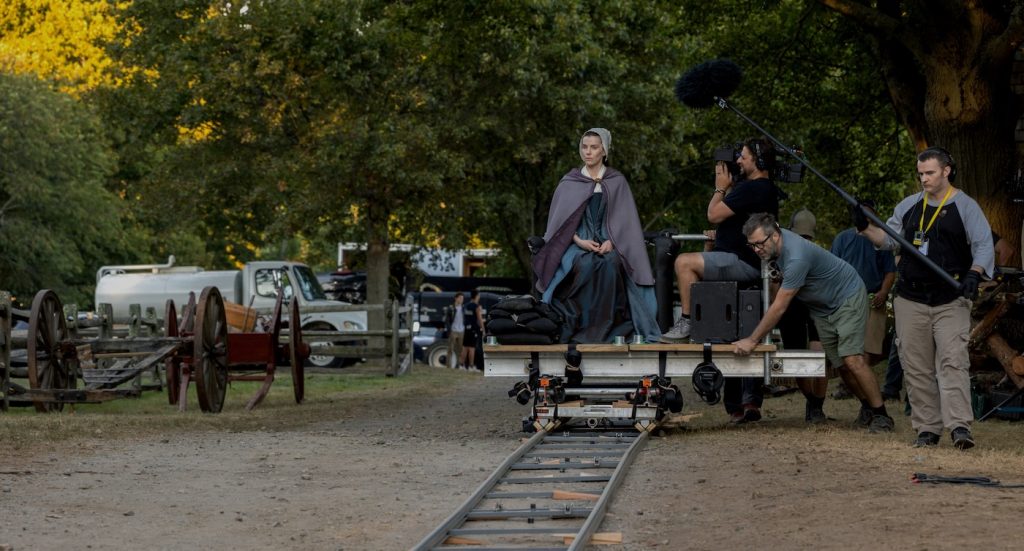
Those decisions underscored the period style, which stars Hamish Linklater and Betty Gilpin in an arranged marriage in which Gilpin’s Sarah Warren cares for the home and her husband’s four children, who are not her own. As everything unravels, she discovers her new husband may not be the man she wants to love. “The global concept of the episode was to experience the world from her perspective. We had a lot of conversations about the coverage and how the spine of a scene would be very close physically with Sarah, and observe what she’s observing. That informed our lighting and how we would block scenes,” says Sprenger.
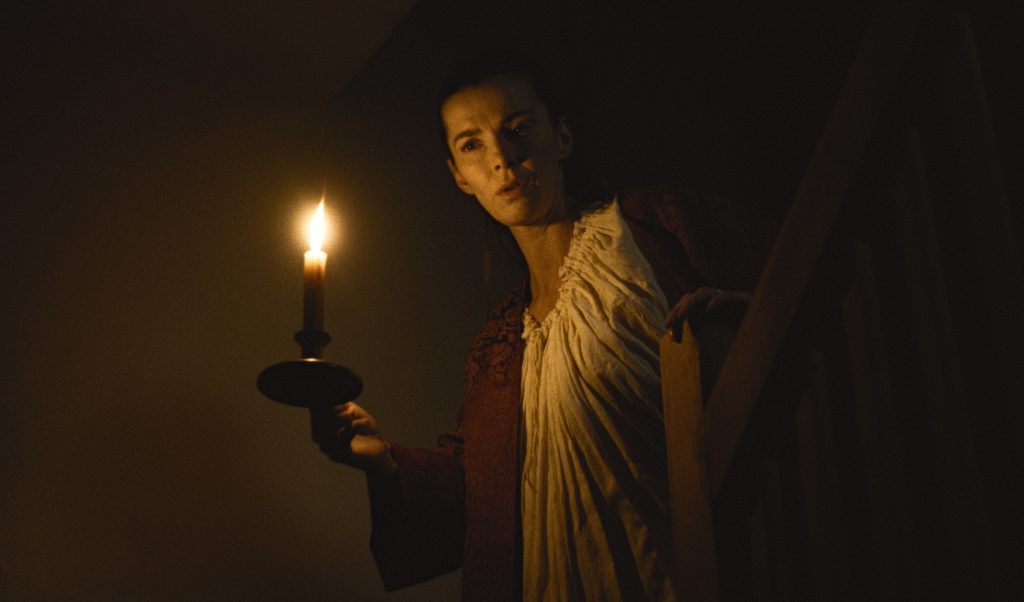
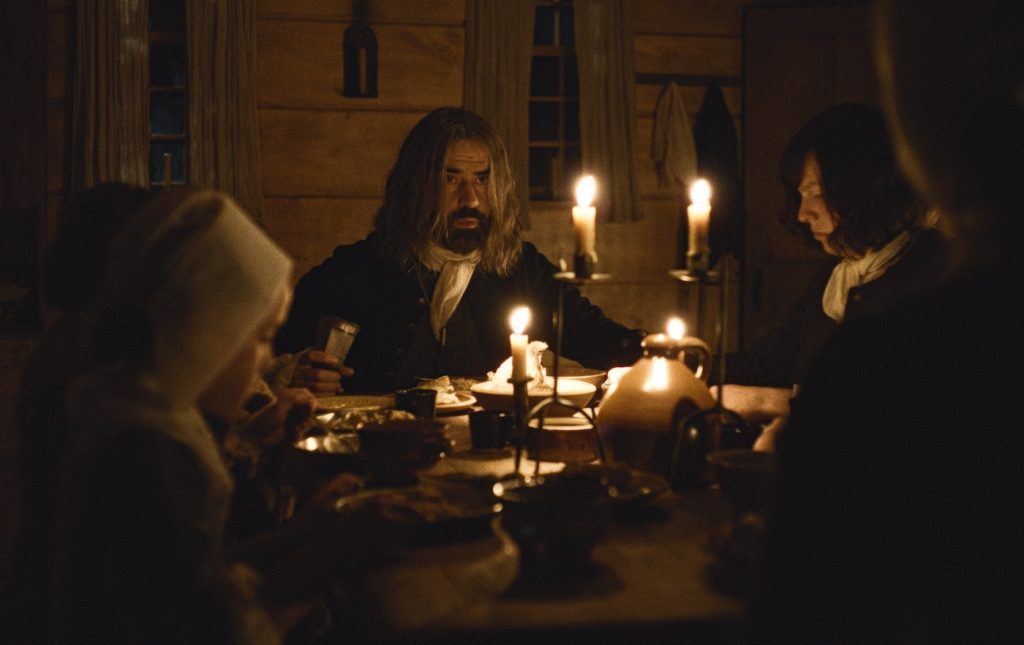
Tension was sculpted through a handheld frame, with most of the episode set in a small cabin under flickering candlelight, heightening the sense of unease. “One of the first questions we had to answer was how we were going to light the set because it was essentially a wooden box with tiny windows,” he says. “What I proposed was to rely on the placement of candles and the fireplace, but we didn’t want to artificially cheat where the light from the fireplace was coming from. So we had to come up with blocking that was based on the fireplace being in a fixed position.”
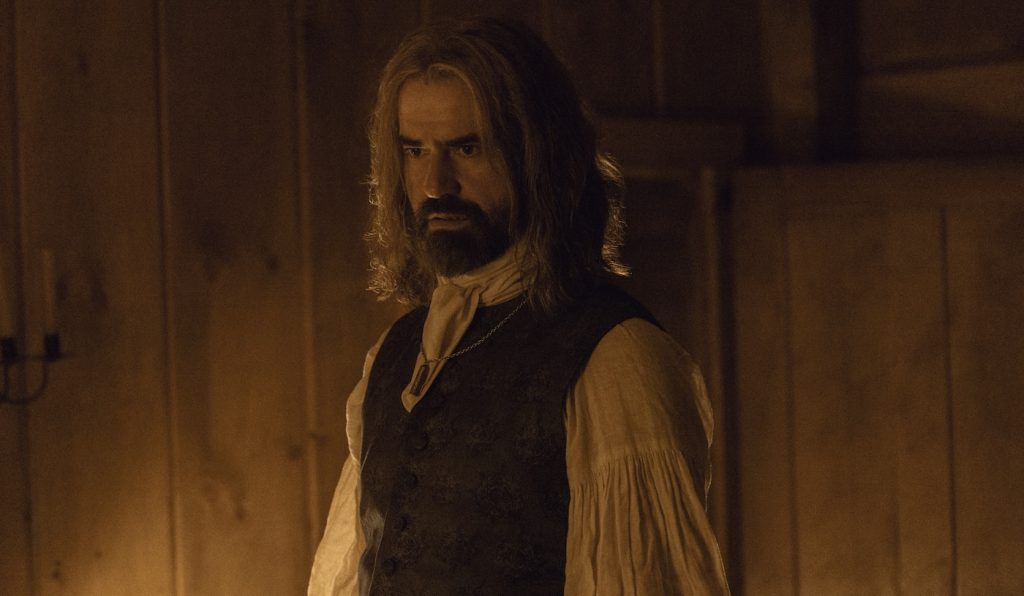
To augment the lighting, the art department—a team that included production designer Steve Arnold and prop master Morgan Kling—made different period-accurate lanterns, candlestick holders, and fixtures that could be mounted on the wall or overhead. “Ti has a cinematography background and understands lighting and blocking, so he is very smart about finding a good place for Betty to stand or how she is going to move within a scene,” Sprenger notes. “We approached everything on a shot-by-shot basis, where we’d plan exactly where the key light was coming from, and then we’d place little points of light around to reveal parts of the room.” The approach was key for scenes where Sarah first meets the children, a climactic candlelit dinner, and Sarah walking around the cabin at night carrying a single candle.
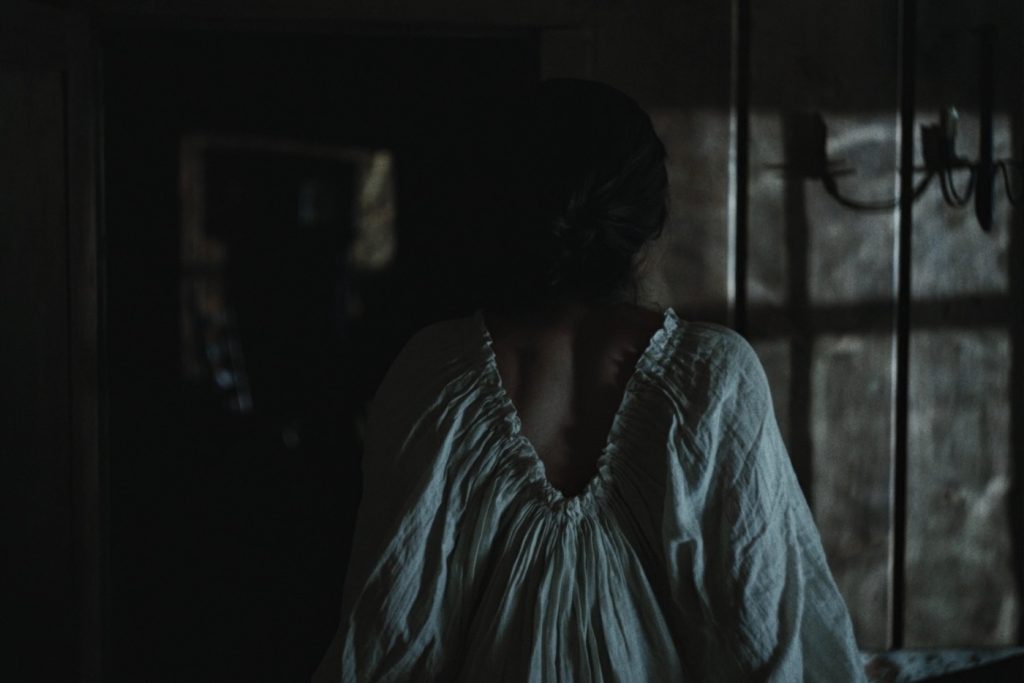
In one of the more intense moments, the camera lands on Sarah’s back, her face obscured in shadow, and only her white nightgown can be seen. “What’s so special about Ti is he really is a master of anticipatory tension,” says Sprenger. “He came up with moments where we really sit and stew in the audience’s nervous anticipation. And with this shot, we pushed behind her almost like it’s the perspective of what’s about to happen.”
Color also played a part in distinguishing the stand-alone episode. “We built the look of the show based on initial film tests, translating the look with our color scientists at Harbor Picture Company into digital. So we had a very specific LUT with some very strong blues and red saturation that made the environment look very lush,” he says. “For the 1700s, we wanted to change the LUT, so it wasn’t as lush but felt a bit more bleachy and sedated.”
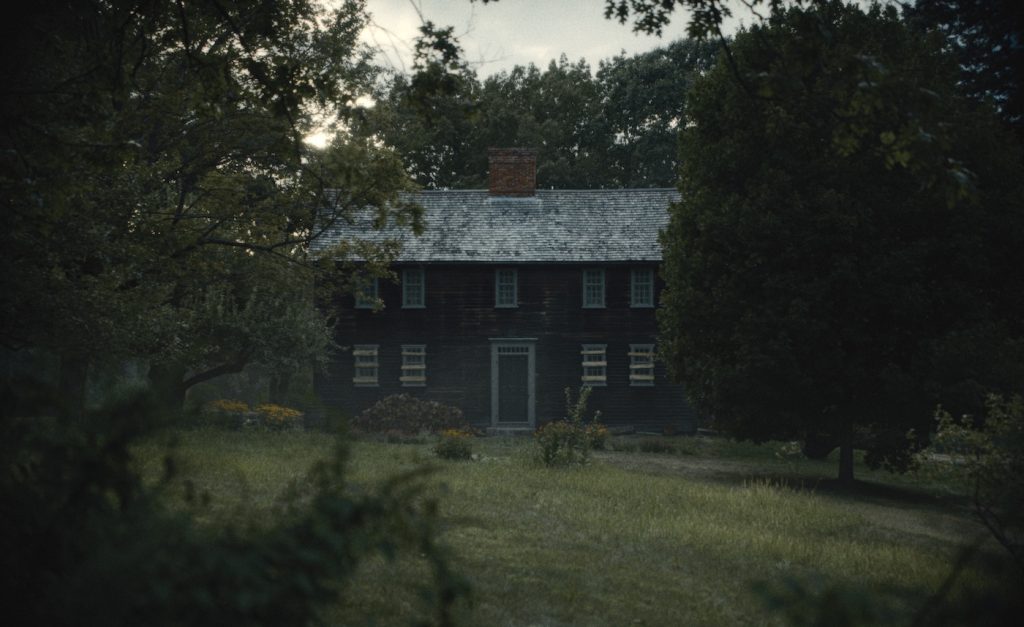
While most of the interior work was shot on stage at NE Studios in Devens, Massachusetts, the cabin exterior was a real location and depicted in the series as a historical museum. Scenes outside the cabin took on a more natural lighting approach, with daytime colors being cooler and a bit muted. “Because there’s a lot of natural lighting in this episode as well, I didn’t want anything to feel like we were artificially juicing the saturation,” notes Sprenger. The juxtaposition only heightened the intensity of the cabin interiors. “You’re really working with shadow as much as you’re working with light,” says the cinematographer. “It was an incredible experience to combine new technology, vintage lenses, and classic techniques to bring this one together.”
Widow’s Bay is now streaming on Apple TV.
Featured image: Betty Gilpin and Hamish Linklater in “Widow’s Bay,” now streaming on Apple TV.