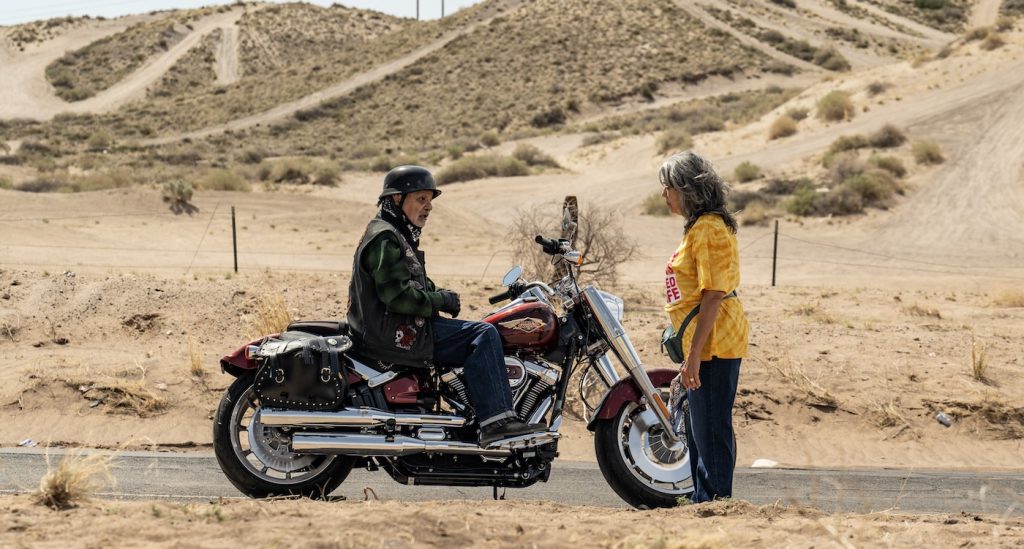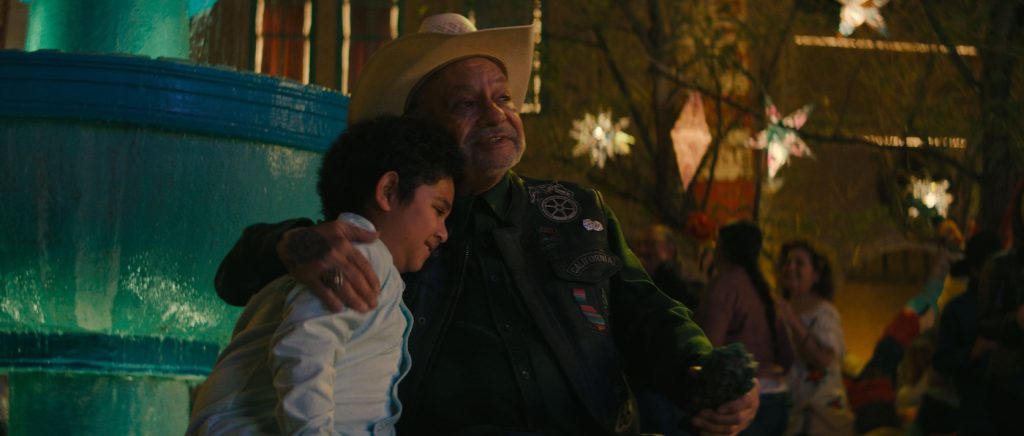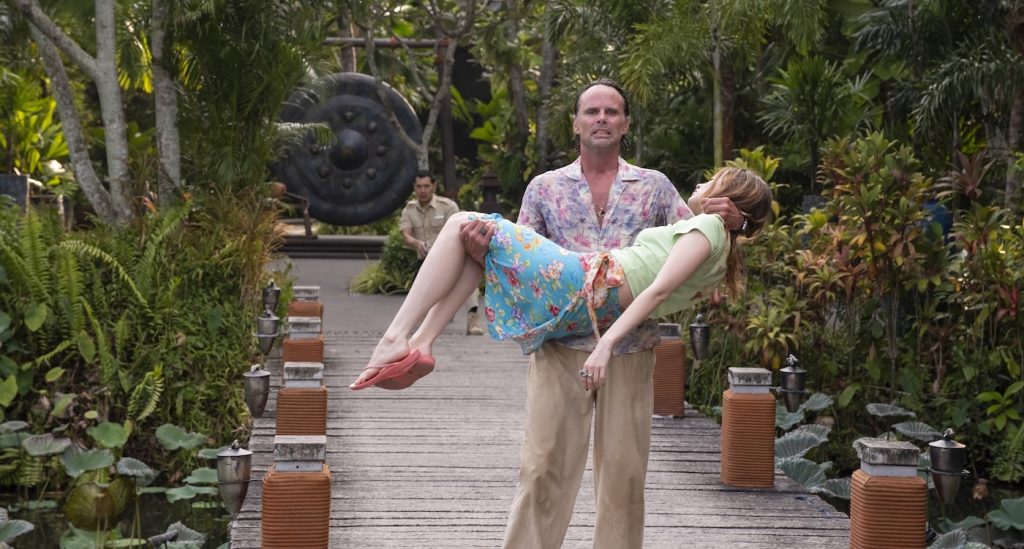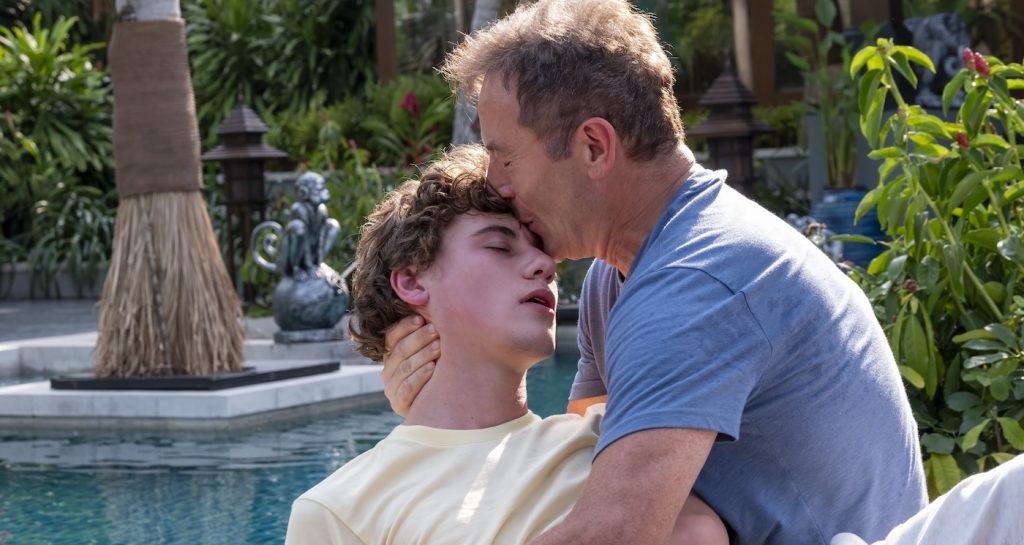
SXSW 2025: 11 Intriguing Film & TV Premieres Highlight a Big Time Festival Lineup

Hello from Austin!

This year’s SXSW Film & TV Festival is extra star-studded and jam-packed with exciting titles. This is due, in large part, to the fest not coinciding with the Oscars, as it has for the past few years. As always, SXSW is chock-a-block with screenings—an adventurous and inexhaustible attendee has 111 films and 17 series to choose from—and some very big stars and a ton of intriguing filmmakers and TV creators are on hand to showcase their work.

One of the stars calling Austin home for the next few days is one who calls it home, period, and that’s Texas native Matthew McConaughey, who recently released a very clever campaign about the need for Texas stories to have a Texas backdrop (the state has the chance to create a tax incentive that rivals Georgia and other competitive states), teaming up with Woody Harrelson to riff off their True Detective characters and chemistry, with a little help from Dennis Quaid, Renée Zelwegger, and Billy Bob Thornton. McConaughey is joined by Nicole Kidman, Paul Rudd, Seth Rogen, Ben Affleck, Kurt Russell, Laurence Fishburne, Blake Lively, Anna Kendrick, Issa Rae, Ramy Youssef, Jacob Elordi, Kate Mara, André Holland, Zazie Beetz, Sadie Sink, Daisy Ridley, David Oyelowo, Annaleigh Ashford, Dennis Quaid and Jenna Ortega. So yeah, the lineup of stars is massive.

The films and series these stars are here to promote, and the huge offering of indies, documentaries, comedies, horror films, and more makes this year’s festival especially exciting. Here is a brief, non-comprehensive list of some of the premieres we’re tracking.

Another Simple Favor 

Director Paul Feig reunites with Anna Kendrick and Blake Lively in this follow up to their 2018 collaboration, which followed a widowed single mother named Stephanie (Kendrick) and her very non-conventional bestie, Emily (Lively) and the dark secrets Stephanie uncovers about Emily’s past. That film ended (spoiler alert) with Stephanie in jail for double homicide, so it’ll be interesting to find out how in the sequel, Emily is not only out of jail, but she’s marrying a successful Italian businessman in Capri, and Stephanie’s headed to her wedding.

The Age of Disclosure

Dan Farah’s documentary comes at the right time for UFO enthusiasts—sorry, they’re now called UAP, for unexplained aerial phenomena—considering the weirdness that was the recent New Jersey drone situation and the revelation that U.S. Air Force pilots had, on camera, experienced run-ins with aerial phenomena they couldn’t classify or understand. Farah’s doc features 34 senior U.S. Government insiders, including figures in the intelligence and military communities, who claim there’s been an 80-year cover-up of the existence of non-human intelligent life and a space race between powerful nations to reverse-engineer uncovered technology from these beings. Freaked out yet? Same. Can’t wait.

The Baltimorons

The Duplass brothers’ career started here in Austin twenty years ago, when their film The Puffy Chair ushered in a new era of barebones filmmaking that captures the can-do spirit of the fest. Now, Jay Duplass is back with Baltimorons, his solo feature directorial debut that’s centered on a Christmas Eve mishap that strands newly sober Cliff (Michael Strassner) and his [checks notes] emergency dentist Didi as they adventure through Baltimore.

Clown in a Cornfield

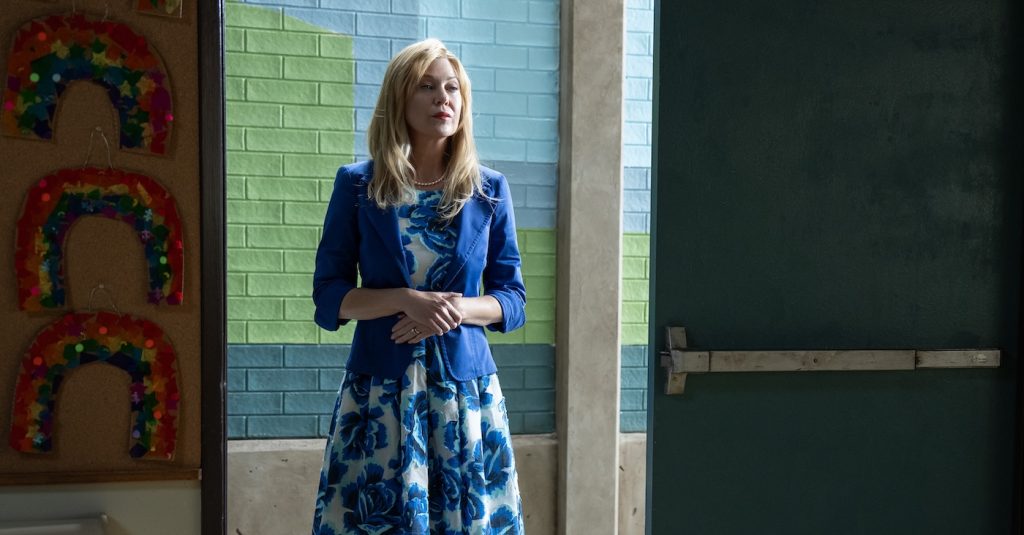
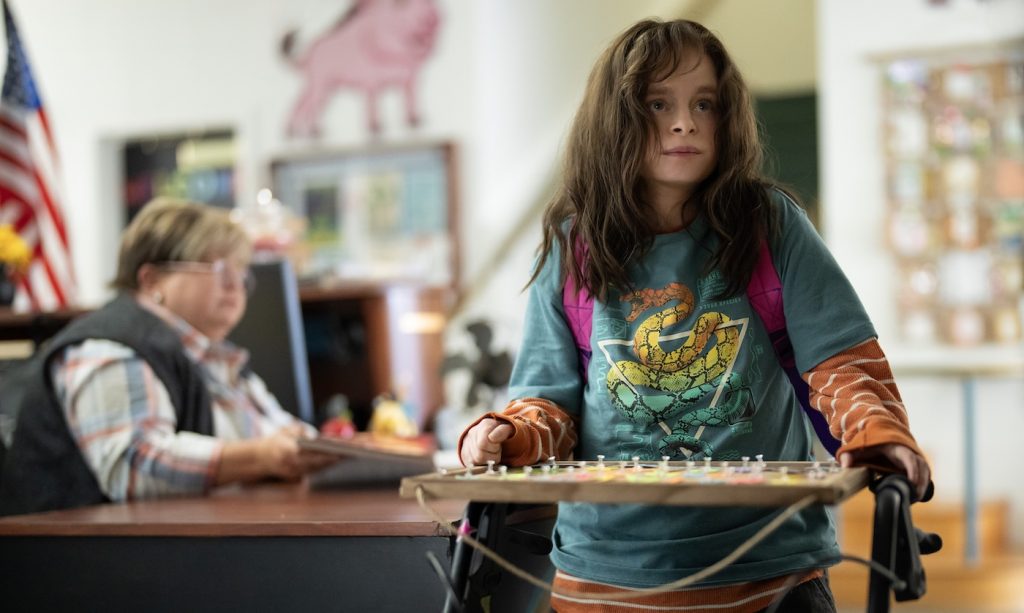
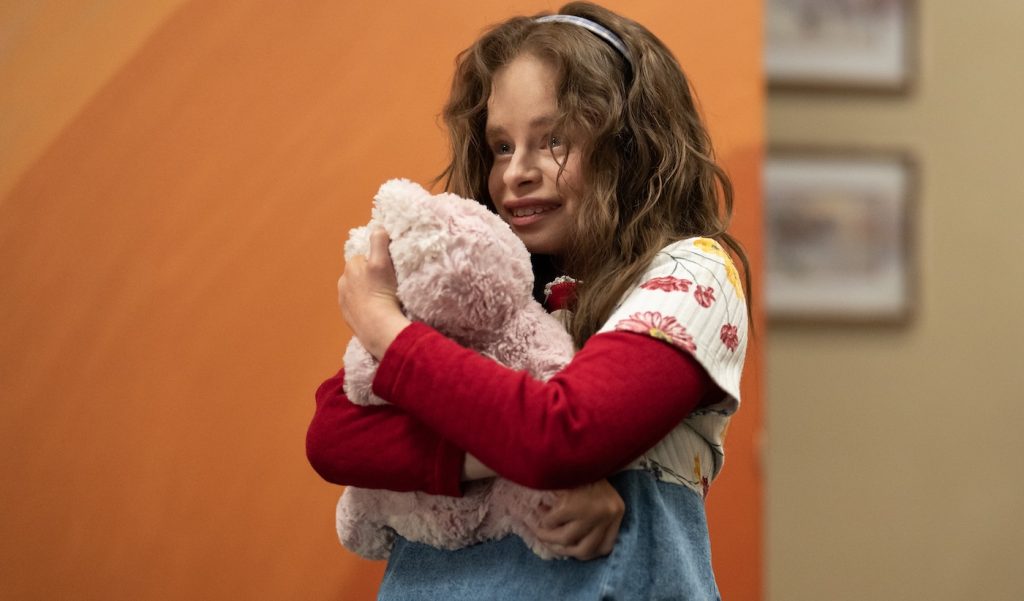
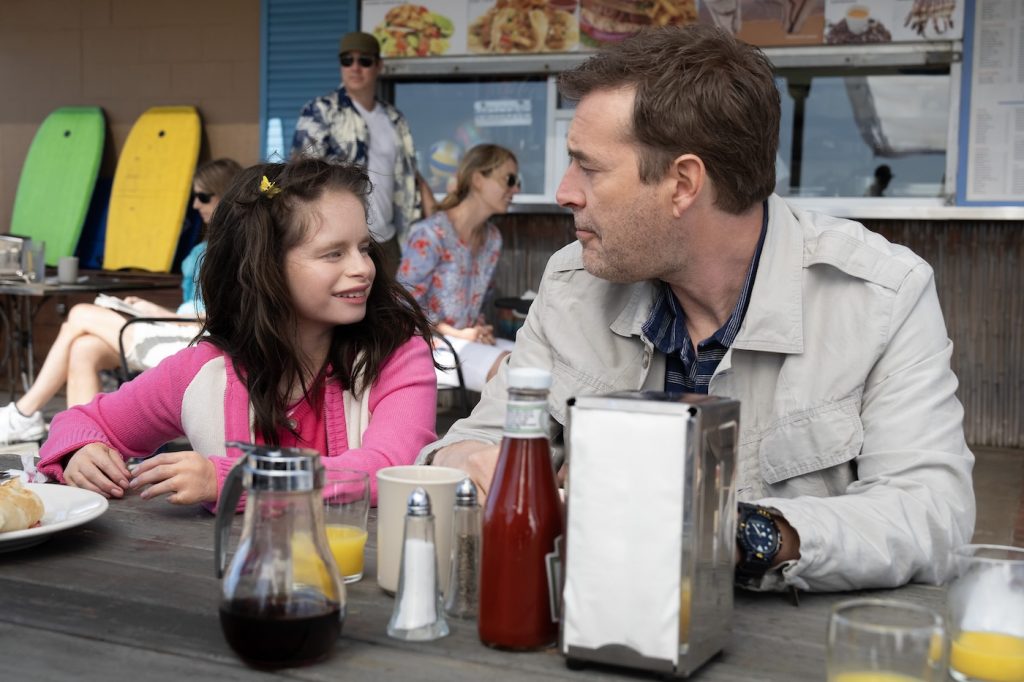
Eli Craig’s adaptation of Adam Cesare’s novel definitely has the top title of the fest. But folks are very, very excited for Clown in a Cornfield for much more than its direct, Snakes on a Plane-level name. Craig’s film follows a young girl (Katie Douglas) and her stepdad (Aaron Abrams) after they move to a small town to try and start over. They do start over, inside a living nightmare, when Frendo the clown arrives. The film comes from the production company behind Smile, and it aims to be the horror movie that captures this year’s festival dark heart.

Death of a Unicorn 

Writer/director Alex Scharfman’s Death of a Unicorn has all the makings of a hit—it’s got an insane but perfect premise (it’s right there in the title), a crazy good cast that includes Paul Rudd, Jenna Ortega, Anthony Carrigan, Richard E. Grant, Téa Leoni, and Will Poulter, and it comes from A24, the powerhouse studio behind too many hits to mention. The gist is Rudd and Ortega are Elliot and Ridley, a father and daughter duo who accidentally run over a unicorn while driving to a weekend retreat hosted by Elliot’s billionaire boss, Odell (Grant.) The unicorn then becomes an object of fascination to Odell, who wants to exploit whatever magic the it possesses for his own benefit. Yes please.

Drop

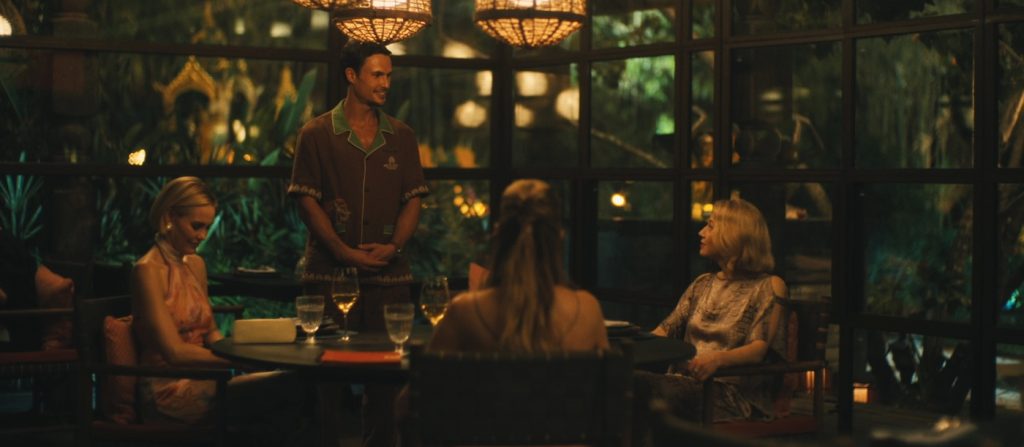
After breaking out in The White Lotus season two, Megan Fahy stars in Christopher Landon’s thriller as a widowed mother named Violet whose first date in years takes a terrifying turn. While dining with her date at a fancy restaurant, Violet starts getting a series of increasingly unhinged and terrifying drops to her phone, which give her instructions on what to do, and any noncompliance means they’ll kill her daughter. Dark. Landon works with horror super-producer Jason Blum and Michael Bay on what should be a thrill ride.

The Dutchman

Andre Gaines updates Amiri Baraka’s 1964 play in his adaptation The Dutchman, starring André Holland as Clay, a 45-year-old businessman riding the New York subway when he meets the younger Lula (Kate Mara), who has designs on him that could unsettle his entire life. In Baraka’s play, Clay is a young Black man seduced and taunted by Lula, an older white woman, but Gaines has not only flipped their ages, he’s expanded their worlds, which now includes Clay’s wife Kaya (Zazie Beetz) and their couples counselor, Dr. Amiri (Stephen McKinely Henderson) to complicate Baraka’s original play in ways minor and major.

Happy Face

CBS Studios’ drama is inspired by a true story, a twisted one at that. Happy Face is centered on the relationship between Keith Hunter Jesperson (Dennis Quaid), known as the Happy Face Killer, and his daughter Melissa (Annaleigh Ashford), who haven’t spoken since he went to prison for killing eight women. Decades later, Melissa finally faces her father to try and exonerate a man who is on death row for a crime she’s convinced her father committed. The series comes from Good Fight‘s team of Robert and Michelle King and Jennifer Cacicio.

Holland

Nicole Kidman stars as Nancy Vandergroot, a woman living the perfect Midwestern life in Holland, Michigan, when she begins to suspect her husband, Fred (Matthew MacFadyen) is hiding something terrible. Enlisting the help of her colleague, Dave (Gael García Bernal), Nancy and Dave start to unpack what’s really going on in their perfect little town. Mimi Cave directs from a script by Andrew Sodroski, which topped the Black List more than a decade ago.

The Rivals of Amziah King

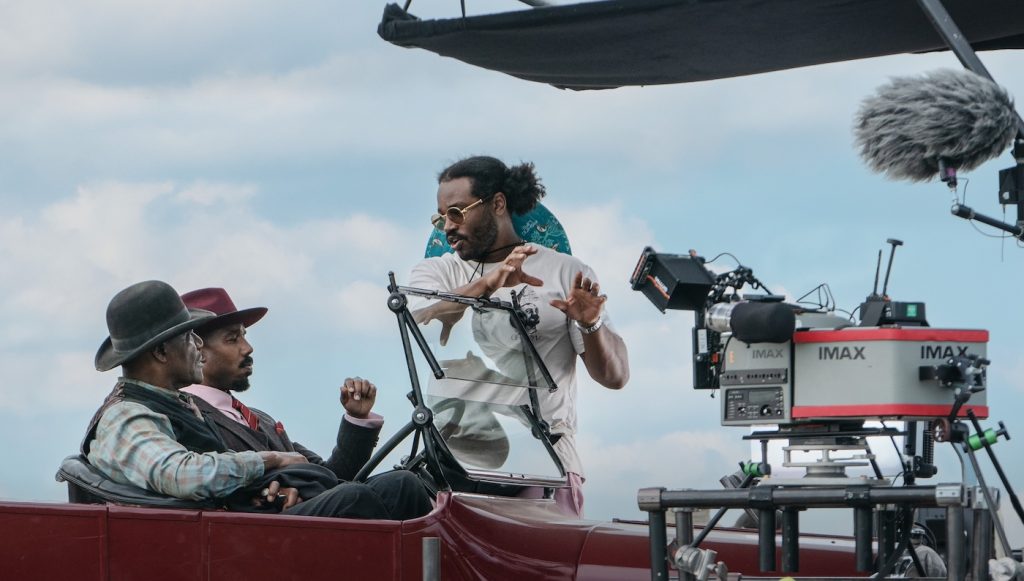
Matthew McConaughey stars as the titular Amziah King in this thriller set in rural Oklahoma, a bluegrass musician and honey-processor who reunites with his foster daughter (newcomer Angelina LookingGlass) and invites her into the family business. Although processing honey sounds bucolic and peaceful, Amziah has fierce rivals who aren’t messing around. They’re joined by Kurt Russell, Cole Sprouse, and Jake Horowitz, in a film directed by Andrew Patterson, the director of the incredible sci-fi thriller The Vast of the Night. 

The Studio

Apple TV+’s The Studio is one of the buzziest TV series coming to Austin, and it’s easy to see why. Series co-creator Seth Rogen plays Matt Remick, a green film executive whose love for the movies is pitted against his job to make them profitable, which requires him to say yes to films that he feels are trash and no to movies that have a heart. The cast includes Catherine O’Hara, Kathryn Hahn, Ike Barinholtz, and Chase Sui Wonders, and includes guest stars like Martin Scorsese (!) and Steve Buscemi playing themselves. For movie buffs and those who like to poke fun at Hollywood while gobbling up all that it creates, The Studio looks irresistible.

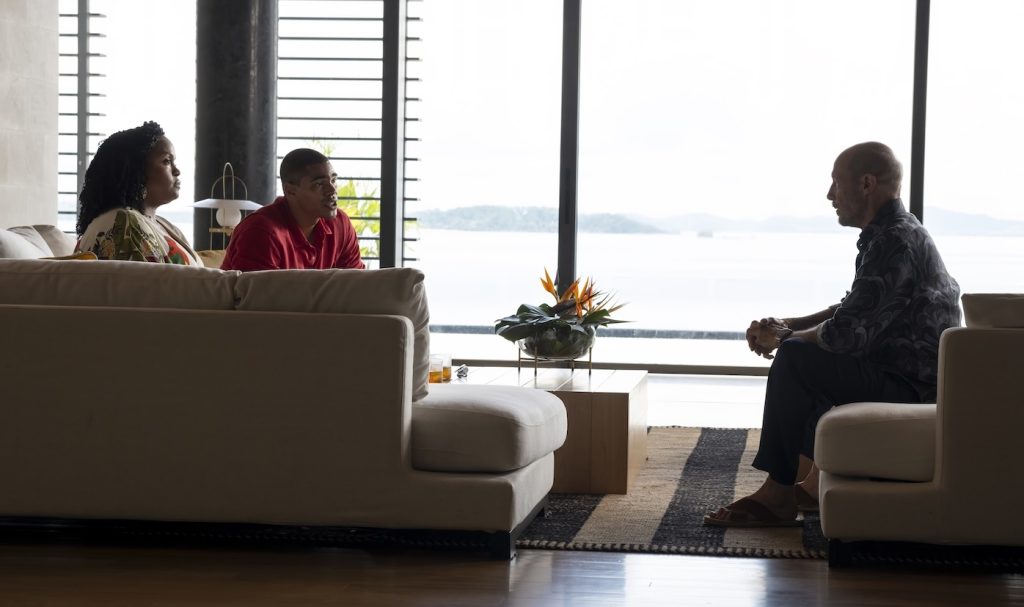
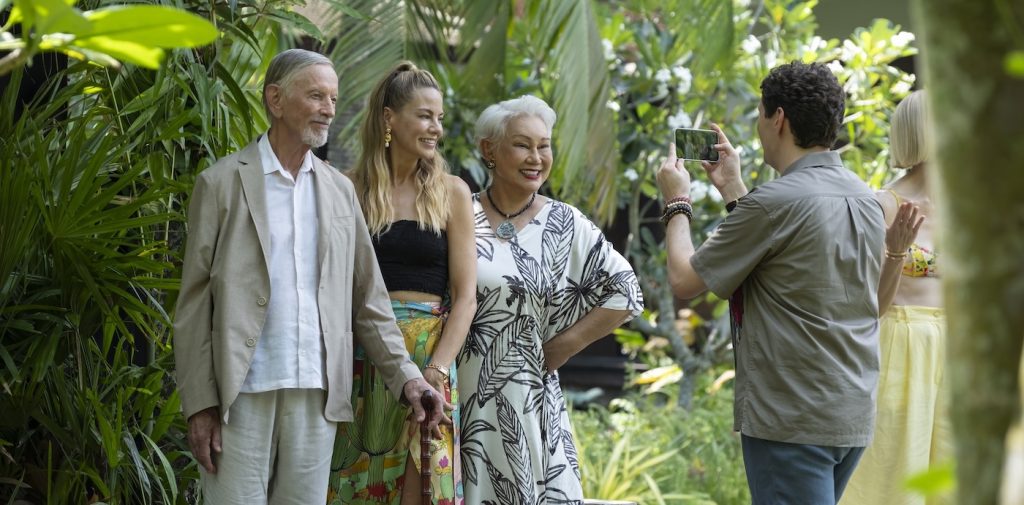
Featured image: Seth Rogen in “The Studio,” Courtesy Apple TV+. André Holland and Kata Mara in “The Dutchman.” Courtesy UTA Group. Megan Fahy in “Drop.” Courtesy Universal Pictures.

From Wings to Stars: Costume Designer Gersha Phillips on Redesigning Captain America

Gersha Phillips is no stranger to the kind of immediately recognizable costumes that tell a viewer immediately what world she’s in, like the intergalactic looks and Starfleet designs she crafted for the recent Star Trek feature Section 31 and the Star Trek series Discovery and Strange New Worlds. Skewing to the realism side of the closet, Phillips has designed the duds for My Big Fat Greek Wedding 2 and director Gina Prince-Bythewood’s historical epic The Woman King. However, for her first Marvel project, Phillips entered an entirely different kind of sartorial world for director Julius Onah’s Captain America: Brave New World. Not a world, in fact, but a universe—the MCU.

The latest chapter in the Captain America series features Sam Wilson (Anthony Mackie) wielding the iconic red, white, and blue shield and a suit capable of more than just flight. As the new Cap, he’s dropped into a political conspiracy that reaches the highest echelons of power, involving President Ross (Harrison Ford) and a villain working in the shadows and working out some longstanding beefs. Adding an emotional element to the high-stakes, Sam is also dealing with the framing of his friend and a former super soldier, Isaiah Bradley (Carl Lumbly).

Phillips recently spoke with The Credits about the challenges and joys of entering the MCU for Sam Wilson’s for stand-alone feature as Captain America.


What was it like entering the Marvel Cinematic Universe on a film that is a bit more grounded than some of the spacier, wilder installments?

With the way Julius was approaching it, he wanted it grounded. We knew that we wanted to push the look a little because it’s set in 2026, so it’s a year ahead. When we were shooting it, it was two or three years ahead, which made us think about how to approach it. What that makes you do, especially in the world of government, is keep things cleaner. One thing I do remember from my first meeting with Julius was that the movie he referenced from my work was Narc, which is from the beginning of my career. Once he said that, I knew he wanted something real and a sense of immediacy.

Gersha Phillips.

This is your first Marvel production, so what was new about the experience?

Being my first time with Marvel, the pressure was on to deliver and make something great. Most designers do not make the suits themselves, but because I come from Star Trek, we took on the journey of learning how to make them and trying to make them more comfortable for the actors. I really wanted to take that on and do it ourselves.

Captain America/Sam Wilson (Anthony Mackie) in Marvel Studios’ CAPTAIN AMERICA: BRAVE NEW WORLD, exclusively on Disney+. Photo courtesy of Marvel Studios. © 2024 MARVEL.

The movie is largely set in Washington, D.C., which is a city that is buttoned up and business-suited. You got Harrison Ford almost always in a dapper suit as President Ross. How did the political world influence your choices for the President? 

I did a half-season of House of Cards, so I had a bit of a pre-journey through that world. You look at everything. For Harrison as the president, we had a lot of conversations about his look. He didn’t want to appear like an “old president.” He wanted to look clean and hip, but he’s particular and precise about his costumes. Our first fitting was a journey. At the beginning, I thought, “Oh no,” but by the end, we had found common ground.

(L-R): Prime Minister Ozaki (Takehiro Hira), Captain America/Sam Wilson (Anthony Mackie), and President Thaddeus Ross (Harrison Ford) in Marvel Studios’ CAPTAIN AMERICA: BRAVE NEW WORLD. Photo courtesy of Marvel Studios. © 2024 MARVEL.

What common ground did you find?

Harrison loves Paul Smith suits. They make a very thin suit with a thin leg. I felt his leg should have been a little fuller and his whole silhouette a bit wider. What we ended up doing was using two suits to make one suit style. We took pants from a smaller size and paired them with a jacket from a bigger size to achieve the look I wanted. That was our little journey and the hack we used to make it work for him. We also had a whole color palette for the movie where we didn’t want to show much red. We included little hints of it, mostly in the president’s costume. When we first see him, he has a stripe in his tie. 


Since it’s pivotal to the story, what did you hope to achieve with Isaiah Bradley’s wedding suit? 

We aimed for a tactile feel, but one element that falls slightly outside that world is Isaiah Bradley’s wedding suit. I wanted it to feel very old, as though he had kept it very carefully because it was precious to him. They didn’t want it to look too broken down or aged, but technically, it could have been in pieces by now. So, we kept it relatively fresh, which is my only little angst in the movie. 

He looks beautiful in it. 

Carl is such a wonderful man, and I loved that look. It was special to do that with him. I got over it sooner or later [Laughs]. I’ve only seen the movie once, and when you watch it, you see all your issues and problems. It also brings back all the journeys of those problems. 

Such as?

One day, when we were building our suits, it was the first time they were going on camera. Anthony and Danny [Ramriez] were in them, and we were so behind in building them, that we were up for over 20 hours trying to finish the suits that day. It was a crazy ordeal to get them ready for the cameras on the first day. We managed to fix everything, but the problem with building these suits is that there’s a lot of experimentation, and sometimes, you don’t get enough time to work it through. 

(L-R) The Falcon/Joaquin Torres (Danny Ramirez) and Captain America/Sam Wilson (Anthony Mackie) in Marvel Studios’ CAPTAIN AMERICA: BRAVE NEW WORLD. Photo by Eli Adé. © 2024 MARVEL.

How do you solve that problem?

In the first couple of weeks of shooting, Anthony was not available to us. Danny wasn’t available to us as much as we needed. You need a good body double. We ended up finding somebody and padded them out to make that work so we could have more fittings. You could do a fitting twice a day, literally as you’re building, which is what you need. We had these bodies for Anthony’s body, things they had made for other iterations in Cap movies, but neither of them were the size he is today. They were in very awkward positions, which also prevented the costume from sitting the same way on the body. 


No matter the size of the production, costume designers are always under immense pressure. How do you stretch every dollar?

When budgeting, especially with labor, we were tight. We had to figure it out. You form the budget. You read the script, break it down, and set priorities. Marvel has a big warehouse full of costumes that we could pull from for background characters, especially in the White House scenes. I wanted to spend more money there, but we couldn’t and put more of the budget into the lead characters’ costumes. The suits alone are around $250,000 each. We barter with our producers about how many multiples of each suit were needed. Anthony had five to six of his, plus two to three for the stunt performer.

What did you learn from the early fittings?

In fittings, we pull tons of options and try different looks to see what works best for the characters and actors. We also have to consider how their bodies change. Danny was getting very fit and losing weight. Anthony was doing what Anthony does. Harrison stays the same. Shira [Haas] lost some weight due to stunt training. Carl dropped a bit, too.

So many variables, right? 

When you’re doing a film like this, the multiples are crazy. Anthony’s costume section on the truck took up two bays. There were multiples of all these suits – a flying suit, a hero suit that we didn’t want to touch for when he looks good, a dirty version of the hero suit, and so on and so forth. It’s a massive undertaking, even though, when I think about the other Marvel movies, this one is smaller because there aren’t as many characters. It’s a more concise movie, but still, it has a big footprint. 

Captain America: Brave New World is in theaters now.

For more on Captain America: Brave New World, check out these stories:

“Captain America: Brave New World” Composer Laura Karpman Crews a New Beat for a New Cap

Red Alerts & Cherry Blossom Brawls With “Captain America: Brave New World” Production Designer Ramsey Avery

Featured image: Anthony Mackie as Sam Wilson/Captain America in Marvel Studios’ CAPTAIN AMERICA: BRAVE NEW WORLD. Photo by Eli Adé. © 2024 MARVEL.

Dream Team Reunite: Tina Fey & Tracy Morgan to Collaborate Again on NBC Comedy

“Here’s some advice I wish I would’ve got when I was your age. Live every week like it’s Shark Week.”

This was one of the immortal lessons delivered by Tracy Jordan (Tracy Morgan) on Tina Fey and Robert Carlock’s 30 Rock, a show now firmly situated in the firmament of great comedy series. Do you have a friend—or friends—who still regularly quote from 30 Rock? Re-watching Fey and Carlock’s consistently hilarious NBC comedy is shocking for two reasons: 1) How absolutely chock-a-block each and every episode is with jokes that land, and 2) How perfect a vehicle it was for the many talented people in both its main cast, recurring roles, and cameos. Fey, Jack McBrayer, Alec Baldwin, Jane Krakowski, Scott Adsit, Sherri Shepherd, Judah Friedlander, and Keith Powell to namecheck some of the main cast. Chris Parnell, Rachel Dratch, Salma Hayek, Dean Winters to call out some of the recurring characters. The cameos were legendary—Carrie Fisher, Matt Damon, Peter Dinklage, Jon Hamm, Elaine Stritch, Steve Buscemi, Steve Martin, and Isabella Rossellini are included. But if you had to choose one performer who fit the mold most perfectly, you’d be hard pressed to do better than Tracy Morgan. As Tracy Jordan, the reckless, ribald star of 30 Rock‘s SNL-like sketch-comedy show TGS With Tracy Jordan, Morgan had found a home for his matchless physical comedy and brilliant line readings.

That was a long wind-up to the news delivered in the headline of this article—Morgan and Fey are reuniting for a single-camera comedy pilot at NBC, written by Sam Means (30 Rock, Girls5Eva) and Carlock (30 Rock), where he’ll play a disgraced former football player trying to rehabilitate his image. Morgan will executive produce alongside Fey, Carlock, and Means. This is NBC’s first pilot order of the season.

Director Rhys Thomas (Saturday Night Live) will direct and executive produce the pilot—it is currently untitled—for Universal Television. While the pilot is the first that NBC has ordered this season, they’ve got several shows in development and have renewed two of their four comedies, St. Denis Medical and the Reba McEntire-led Happy’s Place. The future of Night Court and Lopez vs. Lopez has yet to be announced.

Morgan has another show in the works, he’s starring in CBS’s Crutch, a spinoff of their series The Neighborhood, which will run on Paramount+. If the NBC pilot gets picked up for a series, he’ll be able to star in both shows.

While this isn’t quite the 30 Rock spinoff series that fans have been dreaming for, it’s still exciting to hear that Morgan will once again get a chance to star in a show from 30 Rock‘s braintrust. What Tracy Jordan said is true of Tracy Morgan, and will once again be on display in the new pilot: “My genius is alive, like toys when your back is turned.”

For more on Universal Pictures, Peacock, and Focus Features projects, check out these stories:

First Image From Christopher Nolan’s “The Odyssey” Reveals Matt Damon as Odysseus

“Conclave” Oscar Nominee Peter Straughan on Scripting a Devilishly Good Vatican Thriller

“Conclave’s” Oscar-Nominated Costume Designer Lisy Christl on the Fashion of Faith

“Jurassic World Rebirth” Trailer: Scarlett Johansson & Jonathan Bailey Try to Survive a New Era of Dinosaurs

Featured image: NEW YORK, NEW YORK – NOVEMBER 06: Tracy Morgan performs onstage during the 17th Annual Stand Up For Heroes Benefit presented by Bob Woodruff Foundation and NY Comedy Festival at David Geffen Hall on November 06, 2023 in New York City. (Photo by Mike Coppola/Getty Images for Bob Woodruff Foundation)

From “Elf” to “Blue Bloods”: Veteran Producer Santiago Quiñones on the Unique Advantages of Filming in New York

Santiago Quiñones was a co-executive producer on Blue Bloods, CBS’s long-running police procedural that followed the Reagan family through their dynastic run within the NYPD. Quiñones, a born and bred New Yorker, joined the show assuming that, like previous projects, he might be moving on after a little while for another opportunity. Instead, he stayed for a decade, which kept him home alongside his family as his children grew and his colleagues became extended family members.

“I remember when I first started, I was very much like ‘I don’t want to make any friends here’ because I didn’t know how long I’d be there,” Quioñones admits. “That’s the way production is: you’re there for a little bit of time, and then you go away. I didn’t want to get too attached. I’ve had a string of that, having worked abroad on a lot of projects. It was very profound in that way.”

Quiñones has had a long, fruitful career, working both at home and abroad on projects as sturdy as Blue Bloods andas far-flung and epic as Alejandro G. Iñárritu’s Oscar-winning The Revenant, where he was a production manager for the Argentina portion of the shoot. He’s also worked on some of the most beloved New York films of the past quarter century, including Elf, 13 Going on 30, and You’ve Got Mail. 

As Quiñones moves on after Blue Bloods, he remains in a New York state of mind even as he pursues potential projects abroad. He’s the co-chair of the New York Film and Television Production Industry Council and he’s committed to doing his part to ensuring that New York remains a hub of production. Last week, Quiñones joined the Second Annual MediaMKRS Summit in the city, which brought together 200 industry leaders, employers, union officials, educators, and policymakers to discuss the future of media in the state and the importance of building an inclusive workforce and infrastructure to keep it vibrant and strong. For his part, he was there to talk about how the film and television industry can impact the New York and New Jersey region and why a single series like Blue Bloods can be an engine of positive economic impact and a workforce multiplier, employing thousands of people to play their part in creating the series we’re watching at home. Set designers, camera operators, electricians, caterers, grips, construction workers, and all the businesses the series relies on, from launderers to coffee shops, are absolutely necessary to keep any series or film going.

We spoke to Quiñones about his career thus far, the challenges and joys of filming in the greatest city in the world, and why one of the most iconic moments from Elf had everything to do with a single, simple location change.

Let’s start with the end of your Blue Bloods run, which I know has been an emotional time for you since the last time we spoke.

It’s not only a great privilege to be able to wrap something that went on for so long, but honestly, it was also incredibly sad. Just as fantastic as it was to have been on it, it was really sad to see my crew, who had become family, go away. It became so real when we finished wrapping the stages and all that was gone. I kept saying to myself, ‘We’ll never have those moments back in those places again.’ So it was really hard. And the cast, too, and the writers, it’s ten years of my life. I remember when I first started, I was very much like ‘I don’t want to make any friends here’ because I didn’t know how long I’d be there. That’s the way production is: you’re there for a little bit of time, and then you go away. I didn’t want to get too attached. I’ve had a string of that, having worked abroad on a lot of projects. It was very profound in that way. To amplify all of this, my daughter was going away to college, and I know that there are bigger problems in the world, and it’s so hard to explain what that’s like, but it was unique and I’ve never experienced that before.

And as a New Yorker, too…

As a New Yorker, I feel like in every episode, I got to flex what I know best, and it’s New York. I don’t want to take credit for all the location work that our location manager did, but I know that I pushed for the production value that New York has. In one of the first conversations I had with [executive producer] Leonard Goldberg, I said, ‘This is who I am, and this is what I’m going to bring to you,’ and he loved the idea that I promised to bring production value to New York. He called me after the first episode I produced and said, ‘Wow, you really delivered on that.’ That’s always been my mission when I’m producing something, or location managing, is to bring the production value wherever I am. The location is really the other character.


On your panel during the MediaMKRS Summit, you said something very funny and true—no one would pretend that it’s easy to film in New York, nothing in New York comes easy, but there’s just no other place that can match it. Can you speak to the challenges and opportunities that New York offers?

I could try to explain it, but some of it has become so embedded in who I am that it’s hard to do without getting verbose. The wide perspective is that although it’s hard, the great thing about shooting in New York is that it fills the camera. There’s something about that, having scouted in New York and photographed it extensively, it’s just brings pleasure to the eye. You can fill the frame so richly in New York. And the energy. You can’t match the energy in the background, you can’t match the energy of the traffic, you can’t match the energy of the performance an actor gives because they’re standing in that environment, that all gets into the performance of whatever we’re doing. It’s such a pleasure to watch the process of it, from the very start when you’re scouting it, and the shooting of it, and then the watching of it after it’s done. It’s there. From the eyes all the way through.

(L-R): Ian Quinlan as Luis Badillo and Vanessa Ray as Officer Eddie Janko. Photo: CBS ©2023 CBS Broadcasting, Inc. All Rights Reserved. Highest quality screengrab available.

I always think about my friend who lives in the East Village who stood for a minute at a taco truck before realizing it was part of a set.

That’s funny. We were once rehearsing a three-card Monte scene in Times Square for Monk when one of the police officers came up and arrested our actor because it was a no-tolerance zone for three-card Monte. We just had to explain the situation. He didn’t see the rehearsal going on. The officer was terribly embarrassed. Sometimes, we’re too real.

You said something really striking on your panel about shooting 13 Going On 30 in New York City right after 9/11 and having to decide how to show the skyline, and you decided to show it as it is.

We had this discussion in the scout van, which I consider the creative incubator for the director, the designer, the location manager, and the producers. It’s where we drive around New York looking at locations, and it’s really a crucible for the creative process. So we were talking about how to frame the skyline. Should we embrace it, should we avoid it, should we go to get the Empire State Building? But the classic shots are really downtown and seeing the downtown skyline. We decided to embrace it.  The movie was warm when the world seemed very bleak, and it was a love story. It was the right time to frame New York and the right way to do it. It’s one of the many pleasures of my career.

Between You’ve Got Mail, 13 Going on 30 and Elf, you’ve really got some of the most beloved New York-set movies of the last quarter century to your name.

I’ve gotten really lucky. The funny thing is there are so many more that I turned down over time because I wasn’t available, like The Dark Knight, which I couldn’t do; I always kicked myself. But I’ve gotten really lucky. During the hard times, it’s good to reflect on your career if you have those things. Now I look at them in a romantic way, but they were really hard. Elf was a really, really hard movie to make. We shot in New York during Christmas time, and we were a big movie, so shooting a movie during the holidays with that kind of footprint was really difficult. You’ve Got Mail was hard for many reasons. But what made that wonderful was Nora Ephron. Nora really loved New York, so I feel like we bonded that way.

She’s a New York legend.

Yeah, and we had that affinity for New York because I’m a New Yorker through and through, and I love New York. When you get people like that into that crucible in that van, you can riff with them about ideas because they know them. In Serendipity, I wanted to show glimmers of new New York, which at the time was the planetarium and had this warm, orange glow. This fit in with what I talked to the designer about, keeping that warm granite movie, like in the Waldorf Astoria, and we kept looking for that. Those are the things that get you through it.

I’m struck by the fact you actually shot Elf in New York City during Christmastime.

Elf was just funny. I kept fighting for Park Avenue, nobody wanted to move over there, and we’re doing the montage where Will Ferrell’s elf is skipping around town and he runs into Santa on the street—that actually was a real person that looked like Santa walking down the street. But it was on Park Avenue where I’d been driving everybody to go to because I just think there’s such a romance about it.


Wait, that Santa wasn’t an actor?

No. He was a real guy just walking down the street. But the fact that it timed out, for all the times that I asked them to shoot on Park Avenue!

So that was totally improvised by Will Ferrell?

Yeah!

For more stories set and shot in New York, check these out:

“Anora” Cinematographer Drew Daniels on an Old School Approach to Modern, Misguided Love

How “Anora”‘s DP & Production Designer Brought a Deconstructed Cinderella to New York

How “The Penguin” Production Designer Kalina Ivanov Helped Bring Gotham Back to New York City

Featured image:

“Captain America: Brave New World” Composer Laura Karpman Crews a New Beat for a New Cap

The Academy Award-nominated composer Laura Karpman is now a consistent voice in the Marvel Cinematic Universe. She scored Ms. Marvel, The Marvels, and What If? Now she adds Captain America: Brave New World to her impressive resume, which also includes American Fiction and Lovecraft Country.

In the tradition of Captain America movies, a conspiracy is afoot. As Sam Wilson (Anthony Mackie) unravels a mystery involving President Ross (Harrison Ford), villains operating in the shadows, and the introduction of the big-brained mind-controller, The Leader (Tim Blake Nelson), he fights his own personal battle to determine if he’s ready to carry the red, white, and blue shield. For Karpman, the score had to communicate the government intrigue, comic book thrills, and Wilson’s internal battle.

Recently, Karpman spoke with The Credits about how she approached Wilson’s fight, the influence of New Orleans, and the more offbeat choices she wanted to make in director Julius Onah’s Captain America: Brave New World.


You’re a fencer. Given your experience with fighting, how does that influence how you score action scenes?

The whole thing about film scoring is that it’s about empathy, and you have to empathize with what characters are going through. Before fencing, I think I could write really good action music, but I had a sense of working through my own hesitation. When you’re attacking, you might think it’s just about running into somebody, but it isn’t. That doesn’t work. You have to be smarter. I think that really relates to this particular project because Sam, of course, is not a super soldier. He’s got to use his wits, his skill, and a little help from the Wakandans to do what he needs to do. That helps me create a real sense of empathy for what this character is going through.

The drums especially provide drive to the action. Which drummers did you play with?

I started out with New Orleans drumline percussion. I got a drumline together, wrote a lot of rhythms, and we went into the studio before I wrote a note of music for this movie. Soon after, I went to the UK and recorded English musicians playing the same rhythms, performing really basic military beats. The idea was to combine the swing and swagger of New Orleans in combination with the straight Military feeling you’d get with more traditional playing. So, I started with percussion, and that was really the beginning. 


How did that influence what came next?

It wound up in places I didn’t expect. I thought we’d use it for the hero moments, the Sam stuff and all that, but it really informed everything. The whole conspiracy music started with the really tight drumline. At first, it was almost like their fingers on the drums, then they picked up brushes, and then, went into the sticks. There was a rhythm we recorded in the UK that later became the foundation for the Stearn music, though we messed with it electronically. It was recording rhythms, then deciding where to keep them acoustic and where to manipulate them electronically. 


Electronic manipulation is just right for Stearns, whose intro track sounds so alien. How did you emphasize his presence throughout the story?

Strangely, I went and got my mother’s analog radio and found that place between channels where you get squeals and static. That became a huge part of his sound. You can hear it, really, dialing in and out. The idea was for how Stearns uses sound to manipulate and taunt his victims.


Any other unconventional tools or instruments you used for the score?

We used little wind-up toys for the conspiracy theme, as well, because we wanted something that was tight, in your face, and intense. For The Marvels, I went to a prop house and rented space junk – actual pieces from spaceships – and used them as percussion. In every project, you look for what works well and where you can push boundaries. For this score, I had an upright piano, and I had the piano tuner come over and tune all the F notes out of tune. They are radically out of tune. We recorded that and transposed it down two or three octaves. It became this massive, scary sound that you wouldn’t ecognize as an out of tune piano.


So creating flaws to create the effect?

Sometimes a lot of music evolves out of the flaws, out of the things that you don’t expect. Sometimes even when I’m just recording instruments around the house, recording something, manipulating it electronically, it causes it to do something else that winds up cool. 

For a Marvel film, what are some of the conversations you have about the balance between sound effects and score?

Before the final stage, the music is mixed, and I work with two unbelievably gifted engineers, Peter Cobbin and Kirsty Whalley. They did Deadpool, a lot of Marvel films, and American Fiction. They have a cool way of bringing out every layer in my music so you can hear everything. When we get to the stage where you’re dealing with sound effects and music, Marvel works with someone I absolutely adore – Lora Hirschberg. She’s incredible. She has big ears and knows exactly how to do this. Honestly, there are very few notes at that point.

When you’re in a room with a lot of creatives, as a composer, what do you find is the best way to communicate your ideas?

You strive to listen to what everyone has to say and then try to make sense of it all. A lot of times, people are saying the same thing but don’t realize it. With music, that happens a lot. Some filmmakers feel insecure talking about music, though that wasn’t the case with this group. Kevin [Feige] and Julius [Onah] are well-versed musically and know what they want.


What does the best note look like?

The best notes are character notes. I remember one scene at the end of the prison sequence with Isaiah, when Sam is there. The question was whether we wanted to emphasize Isaiah’s trauma in that moment or lean into his anger. 

When speaking with Kevin Feige and Julius Onah, what’s paramount to communicate about your vision? And what are the elements you really don’t need to explain?

The percussion element, for example, was something I just went ahead and did. I didn’t know if it would work, so I didn’t want to say, “Oh, I think we should go record New Orleans percussion, and it’ll be like this or that.” It’s almost over-promising. I wanted to do it first for my own musical curiosity. The first meetings for Marvel projects usually focus on themes and sounds without picture. It’s a long-term vision for what the characters’ music might sound like, either by putting the theme through different paces or just presenting it as you see it.

How else did jazz influence your Captain America score?

I always find my way into jazz. The opening of the film has a bassoon solo, right? I knew I wanted to bring that back in the end credits, coming out of the Kendrick Lamar song. But I didn’t want to simply repeat the bassoon solo. So, I called up Elena Pinderhughes, one of my favorite collaborators and a phenomenal jazz flutist. She played on American Fiction and The Marvels as well. I asked her to play this a little jazzy – not too much, just a little. So, when you hear that theme return, it’s Elena playing it. Instead of the classical bassoon sound from the beginning of the film, it has a bit of swing. It feels jazzier. A little sexier.

For more on Captain America: Brave New World, check out these stories:

Red Alerts & Cherry Blossom Brawls With “Captain America: Brave New World” Production Designer Ramsey Avery

Anthony Mackie & Harrison Ford Take us Behind the Scenes of “Captain America: Brave New World”

Featured image: Captain America/Sam Wilson (Anthony Mackie) in Marvel Studios’ CAPTAIN AMERICA: BRAVE NEW WORLD, exclusively on Disney+. Photo courtesy of Marvel Studios. © 2024 MARVEL.

“Anora” Completes Its Cinderella Story With Fairy Tale Oscars Night

The 97th Oscars ended up being a true fairy tale story for writer/director Sean Baker’s Anorawith Baker capping an already magical night after winning Oscars for Best Original Screenplay, Best Editing, and Best Director—in which he gave a rousing acceptance speech defending the unparalleled experience of the theater experience—by seeing Anora take the top prize, Best Picture. For good measure, Anora‘s Cinderella herself, Mikey Madison, had what was probably the biggest upset win by besting Demi Moore for the Best Actress award.

While Anora was the belle of the ball, one that began in earnest during last May’s Cannes Film Festival where it was awarded the fest’s top honor, the Palme d’Or, there were a lot of other moving moments during the telecast. Taking place only weeks after the greater Los Angeles area was devastated by wildfires in early January, host Conan O’Brien had members of the LA Fire Department come on stage for their richly deserved praise, and, in a nice twist, had them deliver a few jokes that proved these heroes also have comedic timing.

It was a big night for firsts as well. Wicked‘s costume designer Paul Tazewell became the first Black man to win an Oscar for Best Costume Design. Despite the controversy that has swirled around Emilia Pérez, Zoe Saldaña became the first Dominican-American to win an Oscar after she scooped up the award for Best Supporting Actress. Walter Salles’ incredibly moving I’m Still Here gave Brazil its first Oscar win in the Best International Feature category. And finally, Flow‘s win for Best Animated Film was the first Oscar win for Latvia.

22 years after winning an Oscar for Best Actor for The Pianist, Adrien Brody was back on the stage to accept the award again, once again for a monumental performance as a Holocaust survivor in Brady Corbet’s appropriately monumental The Brutalist. He was up against some fine actors giving great performances—Colman Domingo for his moving performance in Sing Sing, Timothée Chalamet’s chamelonic turn as a young Bob Dylan in A Complete Unknown, and Ralph Fiennes and Sebastian Stan, playing a Cardinal in Conclave and a sinner in The Apprentice, respectively.

A few other notable moments were Kieran Culkin’s Oscar win for Best Supporting Actor for his exuberant, funny turn in Jesse Eisenberg’s A Real Pain, followed by an acceptance speech that involved extracting a promise of a larger family from his wife, who was laughing in attendance, thinking what, we cannot know.

An epic dual performance from Ariana Grande and Cynthia Erivo opened the show. The Wicked stars began by taking turns on stage, with Grande first singing “Somewhere Over the Rainbow,” from The Wizard of Oz, and then Erivo following that with a solo performance of her own, pulling off Diana Ross’s “Home” from The Wiz. Then the two met on stage to deliver Wicked‘s anthem, “Defying Gravity,” opening the telecast with a proper jolt of good, old fashioned star power.

HOLLYWOOD, CALIFORNIA – MARCH 02: (L-R) Cynthia Erivo and Ariana Grande perform onstage during the 97th Annual Oscars at Dolby Theatre on March 02, 2025 in Hollywood, California. (Photo by Kevin Winter/Getty Images)

Here’s your full list of winners:

Best picture
Anora

Best Actor
Adrien Brody, The Brutalist

Best Actress
Mikey Madison, Anora

Director
Sean Baker, Anora

Best Supporting Actress
Zoe Saldaña, Emilia Pérez

Best Supporting Actor
Kieran Culkin, A Real Pain

International Film
I’m Still Here

Documentary Feature
No Other Land

Original Screenplay
Anora, Sean Baker

Adapted Screenplay
Conclave, Peter Straughan

Original Score
The Brutalist, Daniel Blumberg

Original Song
“El Mal” from Emilia Pérez

Animated Film
Flow

Visual Effects
Dune: Part Two

Costume Design
Wicked, Paul Tazewell

Cinematography
The Brutalist, Lol Crawley

Documentary Short Film
The Only Girl in the Orchestra

Best Sound
Dune: Part Two

Production Design
Wicked

Makeup and Hairstyling
The Substance

Film Editing
Anora, Sean Baker

Live Action Short Film
I’m Not a Robot

Animated Short Film
In the Shadow of the Cypress

For our interviews with Oscar nominees, take your deep dive here!

Featured image: HOLLYWOOD, CALIFORNIA – MARCH 02: (EDITORS NOTE: Image has been converted to black and white) Mikey Madison attends the 97th annual Oscars at Ovation Hollywood on March 02, 2025 in Hollywood, California. (Photo by Emma McIntyre/Getty Images)

Brazilian Sociologist & Film Expert Ana Paula Sousa on the Power & Promise of the Oscar-Nominated “I’m Still Here”

One of the most striking scenes in Walter Salles’ I’m Still Here does not depict any of the violence instilled by the military regime that ruled Brazil for over two decades; nor does it show the despair of having a loved one vanish without a trace, while those so obviously responsible unashamedly deny any involvement.

Rather, it is the scene where Eunice Paiva (Fernanda Torres) is being photographed with her children for an article in the national magazine Manchete. The outlet is covering the efforts of the Paiva family to find out the fate of their husband and father, Rubens (Selton Mello), almost eight years after his disappearance. When the photographer asks the family not to smile, to convey the sorrow of their situation, Eunice unapologetically intervenes: “What do you mean ‘don’t smile’? Yes, we’re going to smile. Smile, children!”

They do smile, but not with the intent of brushing off their pain. As Eunice says to the magazine, “my children and I are tired of punching the tip of the knife.” It is, instead, a smile of resilience, and of defiance. And precisely therein lies the power of the film, of the eponymous book that inspired it, and of the real-life Paiva family’s fight for justice. “What is universal [about this film] is this feeling of family, injustice, and the strength to carry on, always, despite everything — preferably with a smile on your face,” says Ana Paula Sousa, a Brazilian sociologist and film expert, in conversation with The Credits.

I’m Still Here is not the first, and certainly won’t be the last, movie about Brazil’s military dictatorship. But its theatrical release at the end of last year was timely. Sousa argues that the polarized political situation across the world may have helped making it the global success that it is. But it is at home in Brazil where the magnitude of its impact could be truly felt.

With each generation that fades away, so does the memory of the violence and oppression of the regime. Sousa, a professor of Film Studies at a university in Sao Paulo, says that many of her students in their early twenties didn’t know facts about the period that the film recreates. But when Fernanda Torres won the Golden Globe for her magnificent performance, people across Brazil set off fireworks — literally. Torres herself said, with incredulity, that the mood was like the World Cup. The army of young Brazilians on social media has helped increase the film’s visibility. And I’m Still Here will certainly have helped increase the visibility of a crucial time in history that risks being forgotten. Now, Torres herself is an Oscar nominee in the Best Actress category, while the film is doubly honored with nominations for Best Picture and Best International Feature.

So, what happens to Brazilian cinema now? It may be early to tell, but being named the Country of Honour at this year’s Cannes Film Festival might be a sign of the future – one of persistent international acclaim. The Oscar nominations that followed only strengthen the argument that Brazil’s cinematic future is bright. For a nation with a stunning cinematic legacy, but that is so often misconstrued as simply “a country of parties, of joy,” as put by Sousa, this is certainly an inspiring and deserving trajectory.  

We speak with Sousa about the impact of the film and what it means in the broader context of Brazilian culture and politics.

What kind of cultural impact do you think I’m Still Here has made in Brazil? Do you see it as evidence of a revived interest in examining these issues through film and art in general?

The film’s impact is evident, and I would even say unprecedented – at least considering the last 20 years. In addition to the less tangible impacts, such as the rise of a certain pride towards our cinema and the awareness, especially on the part of the younger generations, of what the dictatorship was, we have measurable impacts. The biggest of these, in my opinion, was the growth in the market share of Brazilian cinema domestically. Although, in the 2000s, the average market share of Brazilian films ranged from 10% to 15%, after the pandemic we experienced a vertiginous drop, down to levels of less than 2%. The premiere of I’m Still Here in November 2024 finally put us back on an upward curve, and we closed 2024 with a market share of just over 10%. Premieres that followed, such as O Auto da Compadecida 2 and Chico Bento, also benefited from the wave of interest triggered by I’m Still Here. 

Given your areas of expertise, how do you think a film like I’m Still Here can impact an individual? For someone who lived through the coup, as well as for the younger generations who might gain a better appreciation of their family and their country’s past.

Brazilian cinema has had, especially in the 21st century, a significant number of films about the dictatorship. One of them, Four Days in September (1997), was nominated for an Oscar for Best International Film, and another, The Year My Relatives Went on Vacation (2006), made the short list for the category. In other words, audiences over the age of 40 who follow Brazilian cinema have a sense of the dictatorial period that was also shaped by the films. So, for this section of the public or for those who lived through that period, I’m Still Here doesn’t bring any news about our historical past. But it does make us relive that past in a powerful way, and with a very particular and intense emotional charge. For younger people, the film has also been a revelation in the historical sense. I teach at a film school, ESPM-SP, and some students have told me that they had no idea that our dictatorship had been like that. For all audiences, the film brings something very important politically: it shows the roots of our violent present and establishes a non-explicit link between yesterday and today.


And do you see, then, a connection between I’m Still Here and the Oscar-nominated Brazilian documentary The Edge of Democracy?

That’s for sure. They are two films that show the fragility of our institutions and our democracy. There could even be characters in common in both films.

On a practical level, what do you think the film community can bring to Brazil economically? Then, on a more personal or emotional level, do you believe in the power of film as something that can truly break down barriers, national, political, religious, economic, to allow people to see each other’s commonalities? 

We have an expression in Portuguese: “One swallow doesn’t make a summer.” So it’s clear that, on its own, I’m Still Here wouldn’t be able, as if by magic, to change the history of Brazilian cinema, which has been marked by cycles, slumps and great difficulty in existing in a market that has been set up, since its inception, to receive foreign films. That said, I believe that the achievements of this production could mark a new phase for the sector. At this year’s Berlinale, we had 13 productions and a Silver Bear, and Brazil has just been chosen as the Country of Honor at the Cannes Film Festival – a clear effect of I’m Still Here. Economically, the film demonstrates that, in order to compete for space in the arena of the most powerful world cinema, you have to work with a reasonable budget – many films in Brazil are made with five hundred thousand dollars, and this has an obvious impact on a movie’s career. Another possibility that seems concrete to me is that the film will facilitate new international co-productions. Although the business model for I’m Still Here is completely atypical by Brazilian standards, as it didn’t use public funds or tax benefits, I think this “production engineering” has a lot to teach us. Finally, of course, I believe in the potential of cinema to break down barriers and create greater empathy between different nations. You, in the United States, discovered this almost a hundred years ago!

Paiva family and friends in ‘I’m Still Here.’ Image: Alile Onawale. Courtesy of Sony Pictures Classics

You are an expert in film, as well as a doctor in sociology. How have these two subjects come together throughout your career? How do they relate?

My doctoral thesis, on Brazilian film policy since the creation of the National Film Agency (Ancine) at the beginning of the 21st century, is more sociological than cinematographic. I set out to show how agents in the sector mobilize to articulate policies for production, distribution and exhibition. As a journalist, I’ve worked a lot as a film critic, and I’ve also done a lot of curatorial work, but I’ve always found it fascinating to understand the complexity involved in the adventure of making a film. I think that without the sociological perspective I would be just another film critic and, without the love of films, I wouldn’t have the generosity necessary to understand the social articulations involved in the production of a film – including the political struggle.


You wrote an excellent article based on research by Lilia Schwarcz, “How does Brazil see itself?” Do you believe I’m Still Here has influenced the national archetype?

Somewhat along the lines of what Lilia said, I think the movie exposed the roots of our violence – social, institutional and physical. For a long time, we have been shrouded in the haze of the idea that we’re a country of parties, of joy, of the “way things are” and fed by the illusion that we’re the “country of the future.” I’m Still Here shows that perhaps we are still the “country of the past,” in the sense that we need to deal with our old problems, including torture and slavery. But it’s interesting to think that the lightness of the initial part of the movie also represents us as a nation, as a “spirit.” But the movie makes it clear that that’s not all we are.

And do you see a connection between I’m Still Here and the Oscar-nominated Brazilian documentary The Edge of Democracy?

That’s for sure. They are two films that show the fragility of our institutions and our democracy. There could even be characters in common in both films.

Why do you think I’m Still Here has been so successful in the US and Europe? Is it a universal story?

I can’t deny that this success surprised me. When I saw the movie for the first time, I didn’t think anything along those lines – “Oh, how will this movie communicate well abroad?” I did think about how well it could communicate with young Brazilians. I believe that the political issue, in the context of the rise of the extreme right, plays a role in this. But that obviously wouldn’t be enough. What is universal is this feeling of family, injustice and the strength to carry on, always, despite everything – preferably with a smile on your face.

Paiva family 2014 in ‘I’m Still Here.’ Image: Adrian Teijido. Courtesy of Sony Pictures Classics

How do you feel—as a film expert, a sociologist, and a Brazilian—seeing the film and Fernanda Torres receiving so much international acclaim?

It’s thrilling and exciting. I’ve known many of the professionals involved in this project professionally for over two decades. Nobody started yesterday. It’s a group of people who have dedicated their lives to Brazilian cinema. Seeing them in this place and seeing them leaving for Los Angeles this week makes me feel almost as if I’m going too (laughs). And, well, Fernanda Torres…I think we’re all a bit obsessed with her! Fernanda is a well-known, respected and admired actress, and suddenly we see that it’s not just us who think so: she has charmed people all over the world, not just for her phenomenal work in the movie, but for her appearances, her laugh-out-loud interviews and her charm. Her past work, especially her comedic work, has gone viral on the internet. Although her Oscar nomination came with a drama, she is a very, very good comedian, and these old roles are really very funny. I’ve also always followed her work as a writer and newspaper columnist and admired her intelligence. I confess that, when I think about these feelings, I see less the film journalist and the PhD in sociology and more a 51-year-old Brazilian woman, linked to the world of the arts, who is thrilled to see someone with her attitudes, trajectory and age gain such prominence and recognition.


Featured image: FERNANDA TORRES as Eunice in ‘I’m Still Here.” Image: Alile Onawale. Courtesy of Sony Pictures Classics


From “Day of the Jackal” to “Captain America: Brave New World”: DP Kramer Morgenthau Breaks Down 70s Thriller Inspiration

Sam Wilson returns in director Julius Onah’s Captain America: Brave New World, here to take on twin domestic threats. Sam (Anthony Mackie) and his sidekick (and replacement as the Falcon) Joaquin (Danny Ramirez) have been sent to Mexico to stop Sidewinder (Giancarlo Esposito) from making an illegal sale. Sam and Joaquin recover the items but lose Sidewinder. The pair then head home to train with Isaiah Bradley (Carl Lumbly), a former super soldier introduced in the Disney+ series The Falcon and the Winter Soldier, who was once experimented on by the government.

All three are invited to a White House summit, where Bradley appears to be possessed by an unknown force, along with other attendees, to try to assassinate the president, Thaddeus Ross (Harrison Ford). Bradley is apprehended by former Black Widow Ruth Bat-Seraph (Shira Haas), and Captain America, in the course of trying to help his friend, winds up capturing Sidewinder. Meanwhile, it’s revealed that a global arms race for adamantium is the foundation of everything that’s happening, with a mastermind quietly causing chaos. It’s Dr. Samuel Sterns (Tim Blake Nelson), who was once harmed by President Ross and is now paying him back in kind.

While Brave New World has the expansive action scenes fans of the MCU expect, the film also maintains a sense of reality, whether it’s a fresh, spring day in Washington, D.C., or a desolate entrance to a neglected prison. We spoke with cinematographer Kramer Morgenthau about injecting nervy realism into this world, the interesting cinematic references he shared with director Onah, and how they developed the look for the film’s crucial optogenetic lighting.


This film felt really fresh and energetic. How did the cinematography play into that?

The cinematography we were going for was a more grounded and naturalistic approach than some of the other films in this genre. Julius [Onah] and I really wanted it to feel real. We were inspired by 1970s paranoid thriller movies such as Day of the Jackal and the Pakula trilogy of films, including KluteAll the President’s Men, and The Parallax View. So, we did everything we could to make it feel textural and gritty, to give the movie its own visual style.

Sam Sterns’s lab in Camp Echo One is so creepily evocative. How did you light and shoot that?

Stern’s character was a lot of fun. He’s a great movie villain. He’s someone with whom we launched off the realism and into expressionism with his lab. Ramsey Avery, the production designer, did a beautiful job designing it. The lab is inside of a prison underground, so we want it to feel dark, mysterious, paranoid, and also claustrophobic. We used a lot of red light, hard shadows from shafts of light with fans, harkening back to film noir expressionist filmmaking. There was lots of experimentation with how shiny the surfaces could be, and just built this lab and atmosphere of this mad scientist working underground. He was somebody who was created by the state and is now working against the state, and had taken a prison and turned it into his weapon of revenge. It was a lot of fun to shoot, and have the mysterious entrance into it, then the confrontation with Sterns, and finally a lot of hand-to-hand combat to get out of the prison, [plus] designing all the lighting that is used to brainwash people, the optogenetic lighting. It was definitely one of my favorite sets to work in.

Captain America/Sam Wilson (Anthony Mackie) in Marvel Studios’ CAPTAIN AMERICA: BRAVE NEW WORLD . Photo courtesy of Marvel Studios. © 2024 MARVEL.

How did the lighting Sterns’ uses to take control of another character’s mind come about?

This was something Julius came up with, and I don’t know how much of it is scientific or pseudoscientific, but this blue light comes on the phones and forces people to become weaponized assassins. Sterns had been experimenting with it in this lab, and these LED lights are going off in flashes and sequences. There were these lights symmetrically based around the lab, which were his prototypes, and we used them during the sequence of hand-to-hand fighting as a way [to convey] that he’s been brainwashing the guards in the prison to fight against Sam, Captain America, and Joaquin, the Falcon.

When you’re shooting well-known places, like a version of the White House, how do you use the cinematography to make that look like the real deal for the audience?

It was very important to Julius that everything be based on what a real state event would be like, having the right guards, the right type of security, and the right set dressing. It was all based on deep research that Ramsey and Julius had done to see what would really be happening in this room. Then we took a little bit of license, where these almost sci-fi screens come down for the speech. It was all meant to look real. We shot in a reduced scale White House that Tyler Perry had built in his studios. It’s a standing building that he uses all the time. It’s a fake White House, which was kind of fun. The White House has so much mystique to it, but when you get to it, it’s a big building like any other, and you approach it like another movie location.

(L-R): Prime Minister Ozaki (Takehiro Hira), Captain America/Sam Wilson (Anthony Mackie), and President Thaddeus Ross (Harrison Ford) in Marvel Studios’ CAPTAIN AMERICA: BRAVE NEW WORLD. Photo courtesy of Marvel Studios. © 2024 MARVEL.
(L-R): Harrison Ford as President Thaddeus Ross and Anthony Mackie as Sam Wilson/Captain America in Marvel Studios’ CAPTAIN AMERICA: BRAVE NEW WORLD. Photo by Eli Adé. © 2024 MARVEL.

What’s your role when it comes to scenes that are heavily VFX influenced, like Celestial Island and the dogfight over Celestial Island, or Ross as the Red Hulk destroying the White House?

In those sequences that are visual effects heavy, it’s your role to integrate what you’re doing with the visual effects. Alessandro Ongaro and Bill Westenhofer were the supervisors. In those cases, you’re working off previews, which are animated versions of what the sequences are going to look like, and you want your lighting to integrate carefully into how it’s going to be in the final sequence. We study the previews and use them as a reference on set, as well as any kind of artwork they’ve done to show what the final effects are going to be, which is still in the R&D phase while you’re shooting. That kind of filmmaking is almost closer to shooting animation, in a way, because it’s all being worked out in a 3D animation software, and what you’re doing is a small part of a bigger piece. But that’s only for certain very visual effects-driven sequences, like the aerial battle and the big showdown at the end. A lot of the movie is not. We shot a lot on real locations.


Was there a location you particularly enjoyed?

The Japanese prime minister’s location was an 80s Brutalist convention center in Atlanta, which had great architecture.

Did your work on Thor: The Dark World influence your process on this film at all?

They’re very separate worlds. Thor was on another planet, based on Nordic mythology, but certainly, working in the Marvel Cinematic Universe and creating images for such a big, exciting canvas prepared me for doing this. Integrating with visual effects on such an intimate level was certainly preparation for what I did on this, but it wasn’t necessarily a big influence.

Featured image: Anthony Mackie behind the scenes of Marvel Studios’ CAPTAIN AMERICA: BRAVE NEW WORLD. Photo by Eli Adé. © 2024 MARVEL.

Bare-Knuckle Couture: “A Thousand Blows” Costume Designer Maja Meschede’s Knockout Designs

Editor’s note: Spoiler alert! This story discusses plot lines of A Thousand Blows Season 1.

The subtle storytelling of Maja Meschede’s costume designs is hiding in plain sight if you’re able to look away from the simmering drama of A Thousand Blows, a six-part series from Peaky Blinders scribe Steven Knight that follows Hezekiah Moscow (Malachi Kirby) and his brother Alec (Francis Lovehall), two Jamaicans immigrating to London during the late 1800s. Hezekiah has dreams of being a lion tamer but is hoodwinked by a circus conman, and with only a few pence in their pockets, the brothers resort to bare-knuckle boxing to scrape by. A chance encounter with the Forty Elephants, a gang of thieving women corralled by the droll wit of Mary Carr (Erin Doherty), further spirals uncertainty in their lives.

Knight gives viewers plenty to sink their teeth into (sorry, Mike Tyson), pairing a pulsing narrative that weaves the social class of London with complex characters whose names are torn from history books – Hezekiah, Alec, and the Forty Elephants among them, along with bare-knuckle boxer Sugar Goodson, brilliantly portrayed by Stephen Graham (who also serves as executive producer). Immersing the magnetic performances are moody textures, period wardrobe, and stylized regencycore hair and makeup. Meschede tells The Credits she had plenty of “design freedom” to express each character through costume.


When Hezekiah and Alec arrive in London, the customers dress them in outfits inspired by their native country. “When we first see them in the Victorian East End crowd I wanted them to really stick out. And as the color choice of Hezekiah’s first costume, I wanted it to subconsciously remind us of being in Jamaica, looking at the sea, the sand, and the light,” she notes. A straw hat added to the fish out of water feeling. “Nobody would wear such a straw hat in London because you don’t need that shelter from the sun,” she says. “I wanted Hezekiah’s costume to have this lightness. To feel like he just landed there and he has these hopes and dreams and no one will stop him.”


As Hezekiah becomes successful at boxing, his wardrobe evolves with him. “When he first arrives, he’s wearing linen and cotton. And then he manages to dress himself with his first winnings in a nice suit,” says Meschede. “I wanted him to conform at first because I think there’s an insecurity when you’re a stranger, a foreigner. But then later on, he expresses himself with more confidence.”

Malachi Kirby in “A Thousand Blows.” Courtesy Disney/Robert Vigalsky.

The costume designer admits there was plenty of work and research that went into the boxing matches featured in later episodes where the competitors fought with gloves. “I spoke to historians who specialize in Victorian boxing, and it’s hard to find anything original. We had so many fittings and had a special leather maker who made so many gloves for us. They had to look right; the weight, the thickness of the leather, the breakdown. The proportion of the gloves to make them work on a TV screen. They’re filled with horse hair, so we did quite a lot of tests,” Meschede explains. “And it’s really hard to make these gloves comfortable because of the way the thumb is cut, but the cast was totally on board supporting the costume and wearing them.”

Further thought went into detailing the four women of the Forty Elephants gang, played by Doherty, Hannah Walters, Darci Shaw, and Morgan Hilaire. “The characters are based on real women, and they’ve gone through a lot in their childhood and as teenagers. I’m sure life was extremely tough, but nevertheless, they found a way to survive. They found this group of women who became amazing thieves and very skilled. I wanted them to stand out,” Meschede notes. Period fashion provided the influence. “I looked at Victorian silhouettes, which I think are very powerful for recognition value and feeling like you’re in that time. Then, to express the rebelliousness of the characters, I used strong silhouettes and worked with brightly colored fabrics and patterns. I wanted them sometimes to really clash, to express this vibrancy, their power, and how they’re being really bold and confident.”

L-r: Morgan Hilaire, Hannah Walters, Erin Doherty, Nadia Albina, Caoilfhionn Dunne, Jemma Carlton. Courtesy Disney/Robert Vigalsky
Darci Shaw. Courtesy Disney/Robert Vigalsky.

Another consideration for the Forty Elephants was the class divide between the East End and uppity West End.  “Women of the East End at that time could have never afforded any silk, any lace, or anything handmade or custom made. So they really look almost out of place marching through the streets of the East End. I made sure the clothes looked used. They’re not perfect or brand new from a tailor, so they can melt into the background.” Garments were sourced from local UK vendors, handmade, or by altering existing period attire.

Erin Doherty. Courtesy Disney/Robert Vigalsky.

We’re introduced to the quartet early on in episode one in a scene where Mary screams in pain, clutching a baby bump among a crowd of concerned Londoners. However, it’s all a ruse, allowing the posse to pickpocket them – a scheme Hezekiah figures out from the jump. “When Mary pretends to give birth, they are kind of in cloaks and hiding away,” Meschede says. “I chose more subtle colors, but what we did was buy fabrics that were really bright, and then we dipped them. So you have vibrancy in the fabric, but it’s far more subtle. At the same time, we chose fabrics with really bold patterns that clash because I think that creates a wonderful energy that really stands out, but they can still blend into the rowd.”                                                                                                                                   

As the story reaches its climax in episode six, Hezekiah and Mary find themselves in a position to forever change their lives. Hezekiah is to fight boxing champion Buster Williams (Nathan Hubble), and the Forty Elephants use the crowded venue as their biggest score yet.

Malachi Kirby. (Disney/Robert Viglasky)

Meschede dressed the characters to reflect their character arc, with Mary wearing a show-stopping red gown. “There’s an evolution for each character. Some women become stronger and some women not,” she says. “And I don’t want to give too much away, but whoever didn’t feel like that, I faded the colors.” For Hezekiah, he reverts to his Jamaican roots, dressing in attire he wore when first arriving in London. The subtle touch brings the character full circle.


A Thousand Blows is streaming on Disney+ and Hulu, and Season 2 is already in the works.


Featured image: A THOUSAND BLOWS – “Episode 2” – After their brutal fight, Hezekiah finds himself firmly in Sugar’s sights. Mary steps up the plans for her heist and recruits the help of both Hezekiah and Lao. The Forty Elephants carry out a raid on Harrods, whilst Alec makes a new acquaintance. (Disney/Robert Viglasky)
STEPHEN GRAHAM, MALACHI KIRBY

Jon Bernthal Set to Return in a “Punisher” Standalone for Disney+

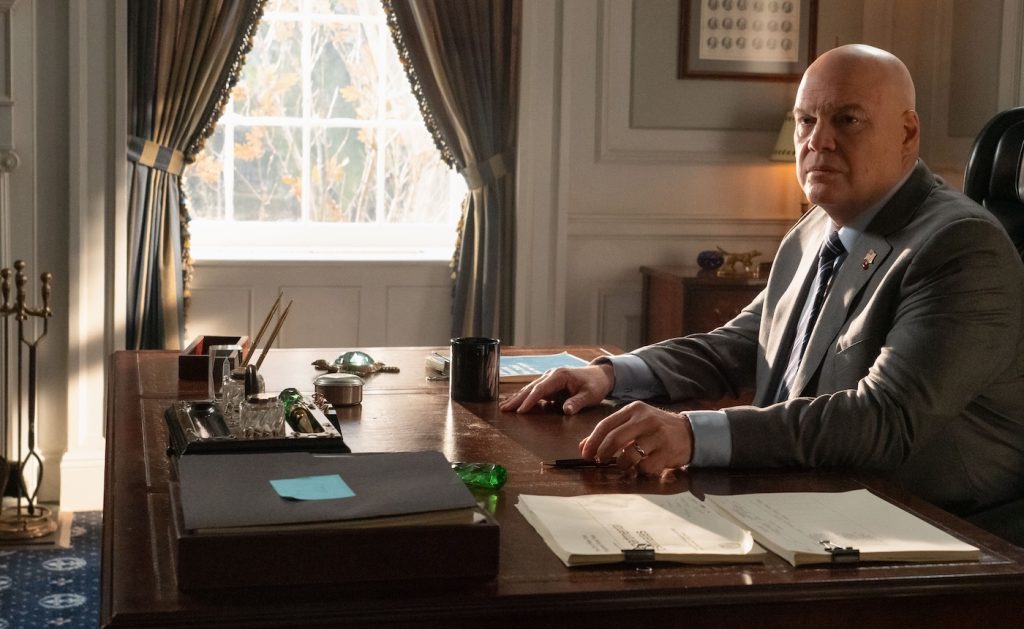
Jon Bernthal is ready to punish Disney+ (in a good way, folks) with more than just his upcoming role in Daredevil: Born Again

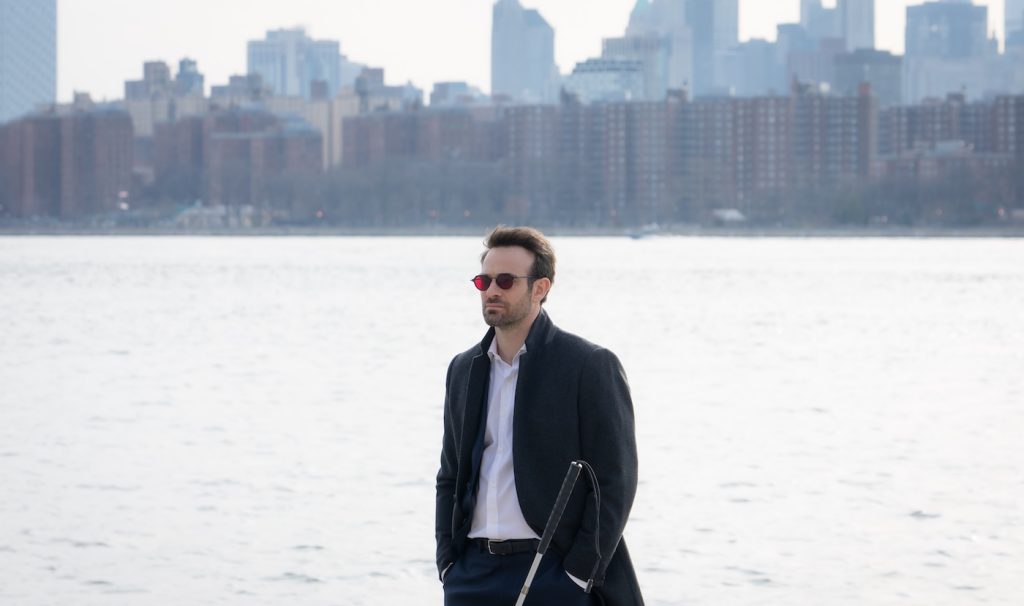
Bernthal’s inclusion in Marvel’s upcoming Daredevil series was manna from heaven for fans of his take on Frank Castle, the brutal antihero who exploded onto the scene in the second-season premiere of Netflix’s Daredevil, which starred Charlie Cox as Matt Murdock/Daredevil. Bernthal went on to lead his own stand-alone series on Netflix from 2017 to 2019.

The Hollywood Reporter confirms that Bernthal will now get his own standalone special as the Punisher on Disney+. He’ll co-write the series alongside Reinaldo Marcus Green, who will also direct. The special is slated to appear in 2026 alongside the second season of Daredevil: Born Again. 

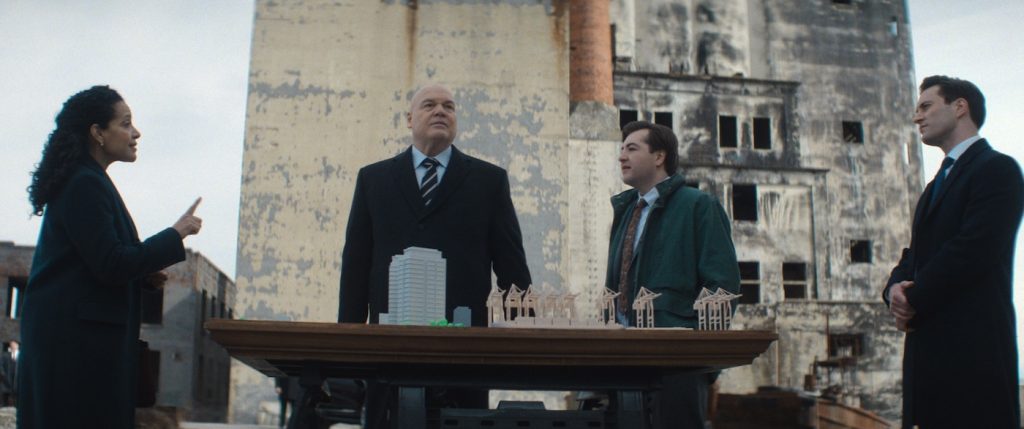
Bernthal’s Frank Castle was more than an equal match for Cox’s sight-impaired but dauntless superhero back in the Netflix days. While Vincent D’Onofrio’s Kingpin was the Big Bad in the original series and returns again in Born Again as Dardevil’s chief antagonist (now having moved up in the world), when Frank Castle appeared on the scene in Hell’s Kitchen, he was a one-man army taking down gangs with his military knowledge and relentless tenacity. Bernthal’s stint as the Punisher was too short-lived for many fans, but Frank Castle rises again.

First up, however, is Daredevil: Born Again, which features a few familiar faces from the Netflix years. Joining Cox, D’Onofrio, and Bernthal are former Daredevil cast members Deborah Ann Woll as Karen Page, Wilson Bethel as Bullseye, and Elden Henson as Foggy Nelson. Another alumnus from the original Daredevil is fight and stunt coordinator Philip Silvera, who serves as both stunt coordinator and second unit director for the new series.

There’s another connection to Bernthal and The Punisher in Born Again. As the first Marvel series on Disney+ to feature a showrunner (previous series were led by head writers and directors), Born Again is led by Dario Scardapane, a writer on the original The Punisher

Daredevil: Born Again streams on Disney+ on March 4.

Featured image: LONDON, ENGLAND – NOVEMBER 17: Jon Bernthal attends the UK premiere of “King Richard” at Curzon Cinema Mayfair on November 17, 2021 in London, England. (Photo by Jeff Spicer/Getty Images for Warner Bros.)

The Future of Batman at DC Studios Includes Giving a Surprising Villain His Own Film

When DC Studios co-chiefs Peter Safran and James Gunn delivered an update on their upcoming slate of films and TV shows at a screening room on the Warner Bros. studio lot in Burbank, they were revisiting the location of their first public reveal about their initial slate.

Two years ago, in January 2023, Gunn and Safran sat in the very same spot and updated the press on specifics for their new-look DC Studios. Yesterday, they came with a string of releases already under their belt, with the studio’s big kickoff movie, Gunn’s Superman, deep in the post-production process as it nears its July 11, 2025 release date.

With the David Corenswet-led Superman set to fly in a few months, production for director Craig Gillespie’s Supergirl: Woman of Tomorrow, starring Milly Alcock, at the halfway point, and the upcoming series Green Lanterns, led by stars Kyle Chandler and Aaron Pierre, entering production as well, there was plenty of action underway.

DC’s animated series Creature Commandos premiered on Max on December 5, 2024, while the live-action Peacemaker will debut its second season in August 2025.

But what about that other iconic DC Superhero, the one whose cape is black and who plies his trade in Gotham? Batman has been the most reliable and arguably beloved DC Studios superhero on the big screen for decades, beginning with Tim Burton’s 1989 classic Batman and through Christopher Nolan’s game-changing Dark Knight trilogy. The last time we saw Batman on the big screen, Robert Pattinson had taken up the cape and cowl in Matt Reeves’s critically acclaimed 2022 film The Batman. Gunn and Safran had answers about the future of the hero Gotham needs.

The official rollout of the new Batman will happen in Batman: The Brave and the Bold, which will be directed by The Flash helmer Andy Muschietti. Casting hasn’t begun on that film, so we’ll need to wait to see who becomes the official Bruce Wayne in Gunn and Safran’s unified DC Universe. With the success and acclaim of Reeves’ The Batman and the spinoff Max series The Penguin, which starred Colin Farrell’s scheming crime boss, this version of Gotham will exist independent of the unified DC Studios banner and exist, instead, under their Elseworlds banner. But The Batman Part II and a second season of The Penguin aren’t up first.

The first film Gunn and Safran confirmed was Clayface, with British director James Watkins (Speak No Evil) in talks to direct a film that is being billed as a “body horror” and would work as a pure horror movie for someone uninterested in DC’s canon of characters. The villain Clayface first appeared in Detective Comics in 1940 as a shape-shifting, clay-like villain who had once been an actor. After being exposed to radioactive protoplasm during the 1950s comics, he gained his shapeshifting powers.

The plan is to start shooting Clayface this summer. Who will play Clayface is another matter—he’s voiced by Alan Tudyk twice over in two animated series: Harley Quinn and Gunn’s Creature Commandos. But Gunn said Tudyk wouldn’t be playing the character in the live film.

As for The Batman Part II, Safran confirmed that Reeves hasn’t yet turned in a full script, but what they’ve read thus far is “incredibly encouraging.” The movie is slated for a 2027 release (initially, it was set to premiere in 2026). And will we see Colin Farrell reprise Oz Cobb in a second season of The Penguin? “We don’t know,” Safran said. “There are a lot of moving pieces — probably most important Colin himself.” It’s well-known just how grueling it is to become The Penguin, but perhaps the accolades and acclaim the series and Farrell’s performance have earned will get all the players back on the board.

Batman: The Brave and the Bold has a story “that is coming together nicely,” Safran said, and Gunn expressed his own increased focus on the film given how important Batman is to the DC universe. While Gunn confirmed that it was “very unlikely” that Pattinson would star as Batman in The Brave and the Bold, he left open the possibility that he might appear in a different film altogether.

“I wouldn’t rule anything out,” Gunn said. “He could show up in something else.”

Caption: ROBERT PATTINSON as Batman with the Batmobile in a scene in Warner Bros. Pictures’ action adventure “THE BATMAN,” a Warner Bros. Pictures release. Photo Credit: Warner Bros. Pictures/ ™ & © DC Comics

Featured image: Caption: ROBERT PATTINSON as Batman in Warner Bros. Pictures’ action adventure “THE BATMAN,” a Warner Bros. Pictures release. Photo Credit: Jonathan Olley/™ & © DC Comics

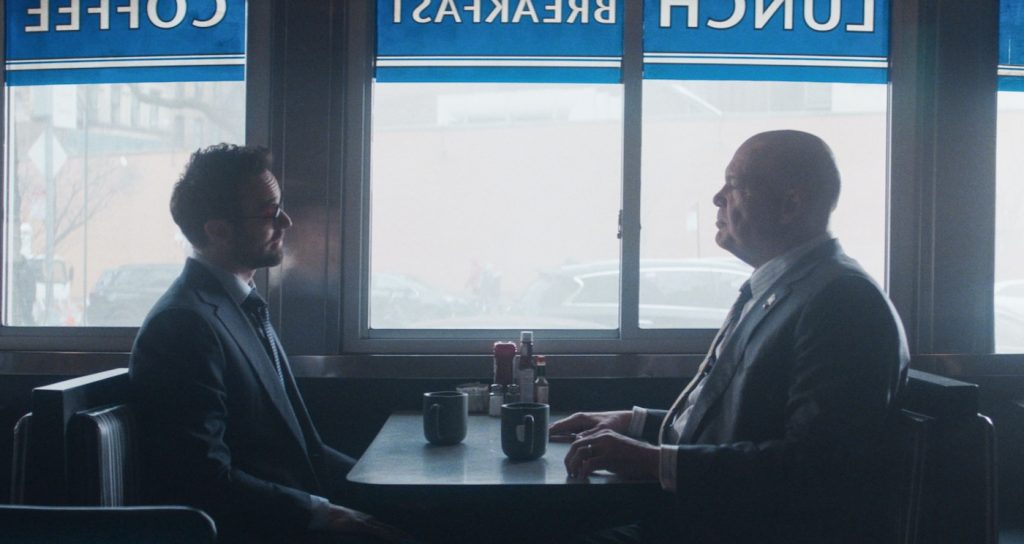
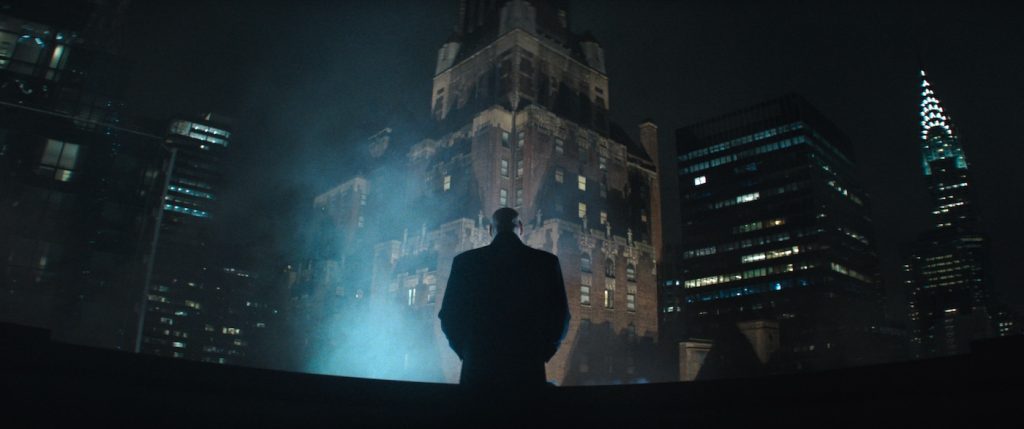
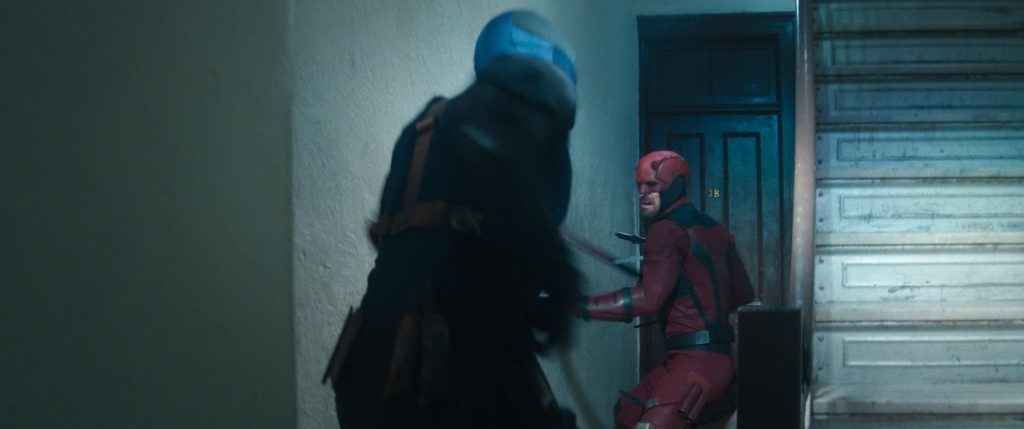
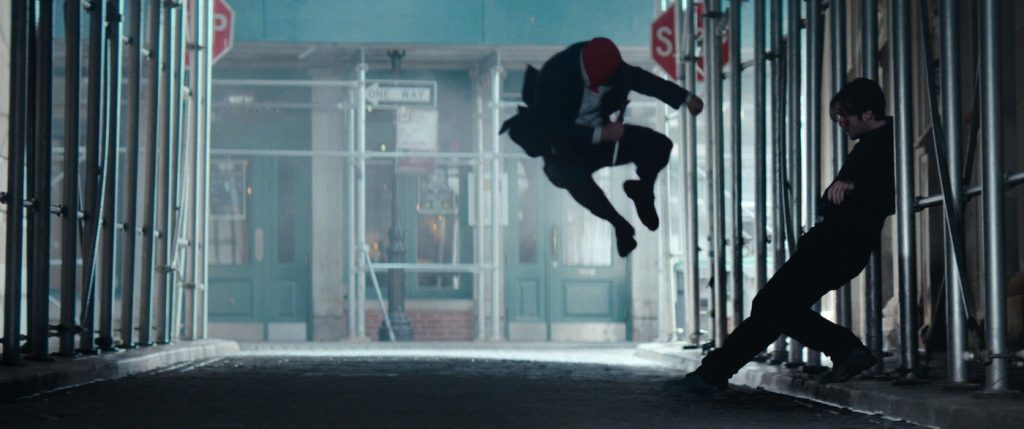
The Heart of Hell’s Kitchen: New “Daredevil: Born Again” Video Celebrates NYC Setting

“Daredevil is a New York superhero” are the first words we hear at the top of a new look at Daredevil: Born Again, which proudly (as any good New Yorker would) boasts about its Big Apple bonafides.

“You have this picaturesque view of the city; the backgrounds are the backgrounds…there are no green screens,” says executive producer Sana Amanat. “We made New York City a character.”

Another key collaborator in agreement that filming in New York City pays off in ways big and small is Matt Murdock himself, Charlie Cox, who says the city’s well-known energy adds to every shot. “The cars, the noise, the visuals, the people. It would be impossible to recreate,” Cox said. “It’s in the fabric of both of these men.”

The men Cox is referring to are his sight-impaired superhero and Vincent D’Onofrio’s brutal criminal super-boss Kingpin. The two are facing off for the first time since they clashed back when Daredevil was a Netflix series from 2015 to 2018. Since then, Matt Murdock had a brief, quite funny cameo in Spider-Man: No Way Home and a meatier role in She-Hulk: Attorney at Law, while D’Onofrio’s Kingpin has appeared in both Hawkeye and the spinoff series Echo. 

“The best thing about New Yorkers is they say whatever they want,” D’Onofrio says in the behind-the-scenes look. That includes, Cox reveals, regular New Yorkers addressing him as “DD” in the middle of a scene. 

Daredevil: Born Again will follow the grittier tone established in Echo, which was led by Alaqua Cox’s Maya Lopez and centered on her tortured past and her relationship with Kingpin. Born Again also includes one of Marvel’s most beloved antiheroes, Jon Bernthal’s The Punisher, as well as former Daredevil cast members Deborah Ann Woll as Karen Page, Wilson Bethel as Bullseye, and Elden Henson as Foggy Nelson. Another alumnus from the original Daredevil is fight and stunt coordinator Philip Silvera, who serves as both stunt coordinator and second unit director for the new series.

Check out the trailer below. Daredevil: Born Again streams on Disney+ on March 4.


Featured image: (L-R) Daredevil/Matt Murdock (Charlie Cox) and Wilson Fisk / Kingpin (Vincent D’Onofrio) in Marvel Television’s DAREDEVIL: BORN AGAIN exclusively on Disney+. Photo courtesy of Marvel Television. © 2025 MARVEL. All Rights Reserved.

From Acclaimed Ads to the Andes: Director Dougal Wilson’s Charming Feature Film Debut “Paddington in Peru”

Arguably the world’s most beloved (fictional) British immigrant, Paddington the Talking Bear arrived in London from South America in 2014 by way of the eponymous animated hit movie. Three years later, he returned for a sequel opposite Hugh Grant. This month, PG-rated Paddington in Peru (in theaters) continues the adventure as the marmalade-loving creature, based on Michael Bond’s children’s books and voiced by Ben Whishaw, returns to his native land in search of his beloved Aunt Lucy.

Trekking through the Amazonian rainforest, Paddington and his adoptive family (headed by Hugh Bonneville and Emily Mortimer) get sidetracked by Olivia Colman and Antonio Banderas’ shifty characters searching for the lost city of El Dorado.

Key players in the Paddington franchise braintrust, including animation director Pablo Grillo and VFX head Alexis Wajsbrot remained on board for this installment, but British director Dougal Wilson makes his feature film debut here on the strength of his quirky music videos and TV commercials. Wilson says, “I was flattered but very apprehensive — in fact I was terrified — because those first two films are held in such high regard.”

Speaking from Sydney, Australia, the site of his next project, Wilson explains how he and his team situated an animated bear within the mountains, rivers, and jungles of Peru.


The Paddington franchise had grossed nearly half a billion dollars worldwide when you were hired for Peru, yet you’d never directed a movie before. How did you get the gig?

Good question. I’d been quietly doing my day job—commercials and music videos—when the Paddington people approached me about doing the movie.

What was it about your shorts that convinced the producers you were their guy?

My stuff tends to be quite quirky, for want of a better word. In the UK, I directed commercials for a shop called John Lewis, which sometimes involved a CG character.  People tell me they have a deadpan charm to them, and maybe it’s too much to claim for a TV commercial, but they also had a bit of pathos. I did a commercial for Channel 4 about the Paralympics that had a lot of energy, so that maybe showed the producers that I could do chases and action scenes. I’ve also directed music videos, like the [puppet-action] one for Coldplay [Life in Technicolor]. With all those things combined, I guess the producers thought I could go from two minutes to 90 minutes. It was a bit of a leap of faith, and maybe they’d exhausted all their other options [laughing].

Director Dougal Wilson on set of “Paddington in Peru.” Courtesy Sony Pictures.

Unlike the first two pictures, Paddington is seen here mainly in South America rather than merry old England. How did you pull that off?

With great difficulty. I was very nervous about the story not being set in London because the first two movies provided a built environment where Paddington could be a fish out of water. Many of the set pieces and goofs are produced by that mismatch. We were now going to take that same character and put him inside a natural environment. To use a slightly tortured analogy, he’s a fish out of water who returns to the water but has forgotten how to swim. Somehow, that threw us into the idea that this could work.

Paddington in PADDINGTON IN PERU. Courtesy Sony Pictures.

What was involved in preparing for the shoot?

I traveled to Peru and Colombia with our location manager, Eddy Pearce, production designer Andy Kelly, and our DP, Erik Wilson. We looked at rivers and mountains and bits of forest. Then the film got delayed, and I stayed in Peru because I hadn’t spent any time in South America before. I went to Machu Picchu and Lima and traveled right into the rainforest, got a little motorized canoe, and went up an Amazon tributary to spend time in this reserve. It was fantastic. So, I got the country under my skin a little bit. The next year, we went back and did the film.


How did you place this animated character in the thick of what looks like an Amazonian rainforest?

The cost would have been prohibitive to have the full main unit and main actors in Peru, but we had the whole story very tightly storyboarded and pre-visualized, so we sent out the second unit. They filmed mountain backgrounds, shot the river with 360 cameras, went up into the Andes, had their Steadicams running down corridors [of Incan ruins] in Machu Picchu, and got all this information about the lighting. Then, they brought all these environments and backgrounds back to London. We prepared the foregrounds for our actors. With the help of our incredible VFX supervisor, Alexis Wajsbrot, we blended all this stuff together.


Paddington and the Brown family get tossed around on a riverboat trying to navigate ferocious rapids. The sequence looks very exciting, but it must have been complicated to create.

The riverboat sequence was one of the biggest challenges because filming our actors in a boat in the Amazon would have been nigh on impossible. So we constructed a boat on a big hydronic gimble in the middle of a backlot at Sky Studios Elstree in London.

No kidding!

We surrounded [the rig] with Chroma key [green] screens and added wind, water, and movement. The actors had to be strapped in harnesses, which were painted out later, because it was wobbly and windy. Since we weren’t really on a river, we were able to play with the performances, do multiple takes, and tweak the camera movements.

Paddington in PADDINGTON IN PERU. Courtesy Sony Pictures.

The action comes through strong.

It helps that this film has a slightly heightened storybook style. For Werner Herzog’s Aguirre Wrath of God, one of our references, they literally went to the river and put people on a raft! We weren’t quite as rock and roll as they were. Fitzcarraldo was also a big reference for us. But we were more in the storybook style of Indiana Jones and Hergé’s “Tin Tin” books, so we did have a license for our film to be a little heightened.

Who is Lauren?

Lauren Barrand is a smaller person, a fantastic actress in her own right, who dresses as Paddington and wears the hat and the coat when we’re blocking scenes. Off-screen, someone who sounds a bit like Ben Whishaw reads Paddington’s lines, and Lauren mimes to those lines. We shoot a few takes with Lauren, and then she steps out. By that point, we’ve established eyelines, and all the actors know what they’re doing. But I hope that’s not ruining the magic for anyone. That’s when Paddington himself comes out of the trailer, and we only have one take. He’s a very busy bear!

Paddington in PADDINGTON IN PERU. Courtesy Sony Pictures.

Which comes first with Paddington: the animation or Ben Whishaw’s recordings of the dialogue?

Ben actually comes afterward. Once we’ve shot and edited this [live-action] stuff, we take it to a sound studio in London, and Ben’s there. The animation is not fully done yet: Sometimes, it’s rudimentary or just a pose or, worse still, one of my drawings. Ben then has to imagine the wonderful animation that’s going to come. We film Ben’s face to inform the animation, but it’s not motion capture; I want to emphasize that. There are no green dots. We edit the bit of dialogue we want for that shot, which goes to Pablo and his team. They construct the animation around Ben’s performance, which is then swapped in with the live actors.


Ben Whishaw has this beguiling quality even when playing a hitman in the new Keira Knightley thriller Black Doves. What’s he like to direct?

I was blessed to have Ben do Paddington because he understands that we’ve shot the scene before he gets involved. He’s not precious whatsoever about doing a line slower or faster, putting a pause here, or emphasizing that word. Ben’s a great actor, and he has infinite patience.

You spent nearly three years helping to create this new Paddington story, which has already grosse $129 million overseas. Why do you think people respond so well to this character?

Paddington always assumes the best in everybody, which is, I think, a very endearing quality. He has a slightly childish innocence, especially in the way that Ben performs him and the way he’s been animated by the very clever Pablo Grillo and his team at Framestore. The design, the animation, the voice, the script, and the outlook all combine to present this lovely character who’s almost wise but, at the same time, very innocent. To me, that makes Paddington very watchable.

Paddington in Peru is in theaters now.

For more upcoming films from Sony Pictures, check out these stories:

Oscar-Nominated Producer Maria Carlota Bruno on Recreating a Transcendent Heroine in “I’m Still Here”

Issa Rae on the Importance of Filming “One Of Them Days” on the Streets of Los Angeles

“28 Years Later” Trailer Releases Hell in Director Danny Boyle’s Long-Awaited Zombie Thriller Sequel

Featured image: Paddington in PADDINGTON IN PERU. Courtesy Sony Pictures.

Red Alerts & Cherry Blossom Brawls With “Captain America: Brave New World” Production Designer Ramsey Avery

When Steve Rodgers (Chris Evans) passed the Captain America shield to Sam Wilson (Anthony Mackie), the former Falcon sidekick had big boots to fill. The same could be said for production designer Ramsey Avery in developing director Julius Onah’s Captain America: Brave New World, which has earned over $200 million worldwide at the time of publishing.

Avery, who touts decades of credits, including being on the art department teams of Guardians of the Galaxy Vol. 2 and Spider-Man: Homecoming, is no stranger to designing superhero settings. But what makes Brave New World visually appealing is how the environments look and feel real. Not to say VFX supervisors Bill Westenhofer (Life of Pi) and Alessandro Ongaro (The Adam Project) didn’t have heavy lifting to do. They very much did. But Onah’s film delivers themes of self-identity and reflection on a visually photorealistic platter over a feast of blue screen magic.

“One of the directives in this movie was that it had to be grounded. That was a big word. Our discussion of it was getting to a grounded characteristic, a gritty characteristic, a visceral characteristic where the audience felt it was super real. And so we tried as much as we could to do everything in camera,” says Avery.

For the story that sees Sam on a chase all over the world, including Mexico, West Virginia, and a climactic clash with U.S. President Thaddeus Ross (Harrison Ford) in Washington D.C., production was based in Atlanta, Georgia, at Trilith Studios, with additional time at Tyler Perry Studios and on location in D.C. to film its iconic landmarks. Among the dozens of sets Avery designed, he was tasked with replicating the White House, its Rose Garden, and D.C.’s Hains Point.

Below, he discusses those challenges, how color influenced design choice, and the best way to destroy a city.

Iconography

With Sam Wilson as the new Captain America, it was important to keep the iconic images of the character in familiar territory.

Anthony Mackie as Sam Wilson/Captain America in Marvel Studios’ CAPTAIN AMERICA: BRAVE NEW WORLD. Photo by Eli Adé. © 2024 MARVEL.

Avery:  In terms of the iconography specific to Captain America, all of that comes from Ryan Meinerding [head of visual development at Marvel Studios]. He and his department are responsible for developing that specific superhero imagery in interaction with the Marvel executives and the director. Then, in many cases, that has to go down to the costume designer to figure out how to make it real.  So, it’s hard for us in production design to take much specifically from that or the comic books because the MCU isn’t the comic books. There’s a different history going on and we’re not encouraged to dig too deep into all of that. What we were really interested in is what’s going on in Sam’s head, what’s his journey through this movie, and how do we show that in a visual narrative to the audience.

Self-Identity

The story’s emotional through-line has Sam finding his way as Cap, while President Ross is trying to escape a troubled past. Self-identity is a theme of the narrative, and the production designer infused visual motifs to support it. 

Avery: Both Sam and Ross are having a bit of an identity crisis and trying to figure out who they are, what they want to be, how they want to be perceived, and what they want to project. Talking with Julius and also the costume designer, cinematographer, and visual effects about how we’re going to convey all of that, we ended up in two general strokes. And one was to look at the volumes of the volumetric space of the storytelling.

At the beginning of the story, both characters are stuck in boxes of their own making. We looked for ways to craft environments that start off keeping them enclosed, such as smaller shapes or darker areas—things that make them feel more isolated in their worlds.

(L-R): Harrison Ford as President Thaddeus Ross and Anthony Mackie as Sam Wilson/Captain America in Marvel Studios’ CAPTAIN AMERICA: BRAVE NEW WORLD. Photo by Eli Adé. © 2024 MARVEL.

We see Ross at the very beginning of the movie making a big speech in New Hampshire in this huge space. But we find him first stuck backstage, back behind some glass, where we get that sense of that reflection playing towards him figuring out who he is and what he’s going to do. And even when he walks out on stage, he’s separated from the audience by those glass panels so that he’s still contained within his world. Similarly with Sam, in that fight sequence at the very beginning, one of the things that you can see is that it ends up getting enclosed in these darker, tighter spaces. So there’s a whole arc of that type of volume exploration where they detail their identities until the very end.


Story through Color

Production design shifted the color palette to inform emotion, with shades of blue hinting at control while warmer hues allude to disorder.

Avery: We did a whole color script for the movie and discussed the color, lighting, and composition of the scenes. We know that the Hulk is red, and the journey for Ross is from control to chaos, so we wanted to explore this idea of control to lack of control. We developed a color palette for the movie where blue represents things mostly in control or where people think they’re in control. Then we go through green to yellow to orange to red, where you lose control as you get to red. You’ll see in Sam’s office there’s more blue. There’s also blue in the room where Sam and Ross meet for the first time when they go into the East Room. That type of playing with color carried through the whole storyline.

A Rose Garden Showdown

During a speech in the White House Rose Garden, Ross loses his control over the Hulk, unleashing the red beast. Can Cap save the day?

Avery: We did a lot of research to figure out the Rose Garden. We looked historically at what different Rose Gardens were to say something about our Rose Garden and our Ross. We looked back to the Kennedy when there was this kind of aspirational sense of what the White House was trying to sell itself on. So we use some of that Rose Garden because that’s the same thing that Ross wanted – this idea about being aspirational and looking forward and keeping some optimism.

Then, we decided to build the Rose Garden true to size. We also studied Julius’s movie references, which were these 1970s political thrillers, and how those movies framed their shots. We looked at how we would use those really strong lines in the Rose Garden to give us a sense of strong framing and a sense of control. Then, when all hell breaks loose, we break all of the clean lines and those strong geometries.

We wanted to do as much destruction as we could practically, too. So when Hulk pulls out that column, a lot of that is a practical effect. The lectern that gets tossed is real, and the stage collapsing. All of those things are practical elements that then get enhanced. It brings that reality and makes it more grounded.


A fight among the Cherry Blossoms

A climatic sequence had the production designer re-creating Hains Point, which required a towering three-sided blue screen and help from the greens department.

Avery: The wish was to shoot in D.C., but for all kinds of reasons, it didn’t make sense. So it fell on the art department and talking with the director, DP (Kramer Morgenthau), and visual effects to sort it out. We went to Hains Point in D.C. and researched it. But the actual fight happens within about a two-thirds size of a football field set we built in the same place as the Rose Garden. There was a whole process of figuring out how to use the same footprint to make it look bigger than it really was. So, we rearranged light poles, cars, fences, and trees to figure out things logistically.

We actually filmed the destroyed version of Hains Point first, then the clean version. We first built the clean version and then built the destroyed version on top of the clean version. Then over a couple days we removed all the destructive stuff out, exposing the clean stuff underneath and put in new cherry blossom trees.

Captain America/Sam Wilson (Anthony Mackie) in Marvel Studios’ CAPTAIN AMERICA: BRAVE NEW WORLD, exclusively on Disney+. Photo courtesy of Marvel Studios. © 2024 MARVEL.


Captain America: Brave New World is in theaters now. 

Featured image: Red Hulk/President Thaddeus Ross (Harrison Ford) in Marvel Studios’ CAPTAIN AMERICA: BRAVE NEW WORLD. Photo courtesy of Marvel Studios. © 2024 MARVEL. 

Producer Joseph Patel Explores Sly Stone’s Life & Legacy in “Sly Lives! (aka The Burden of Black Genius)”

Prodigiously gifted songwriter/singer/arranger/producer/bandleader/keyboardist/guitarist Sly Stone gets his well-deserved close-up in documentary makers Joseph Patel and Ahmir “Questlove” Thompson‘s SLY LIVES! (aka The Burden of Black Genius). After earning an Academy Award for Summer of Soul, producer Patel and director QuestLove decided to deep-dive into the life and music of the man whose multi-racial band once thrilled hippies and Black audiences alike with ingenious funk-pop anthems including “I Want to Take You Higher,” “Dance to the Music,” “Everyday People,” “Stand!” “Thank you (Falettinme Be Mice Elf),” “Hot Fun in the Summertime,” “Family Affair,” and “If You Want Me to Stay.”

Stone, now 82, followed the 1967-1975 hit parade with several decades of drug abuse. “There have been books and amateur docs that reveled in Sly Stone’s downfall,” says Patel. By contrast, he explains, “We wanted to tell his story with empathy. Can you imagine being 26 years old, a Black artist headlining Woodstock, being on the cover of Rolling Stone, Black audiences and white audiences are both looking to you like you’ve solved race relations with your music? What kind of pressure that must have been for him!”

Sly Lives!, now streaming on Hulu after its Sundance Film Festival debut last month, presents rare concert footage interwoven with interviews featuring bandmates, members of Stone’s family, and contemporary Black musicians who now encounter the same kinds of pressures that Sly Stone faced in his heyday.

Speaking from his home in Brooklyn, Patel, who spent two and a half years on Sly Lives!, talks about how Sly Stone grappled with the burden of Black genius.


Archival footage in this film documents peak Sly Stone and his great band in such an exhilarating way, but then…

The movie intentionally starts out exhilarating and then gets sad, but hopefully, it ends on an optimistic note—he’s still with us!

Sly Stone seemed to be supremely confident on stage, so it’s surprising to learn in the film that he suffered from intense stage fright.

We talked to Sly’s former assistant slash girlfriend, Stephani Owens, about that. She’d say to Sly, “How can you be anxious? You do this all the time?” But then you also have [ex-girlfriend/singer] Ruth Copeland’s story where Sly’s at a venue, and he’s in the bathroom for an hour and a half, probably quelling his nerves with drugs because it’s so hard for him to walk on stage.

AHMIR “QUESTLOVE” THOMPSON (DIRECTOR & EXECUTIVE PRODUCER), JOSEPH PATEL (PRODUCER) – SLY LIVES! (Disney/Kelsey McNeal)

Sly Stone himself was not interviewed for this movie. Why is that?

We couldn’t interview him because of health concerns. Instead, we talked to artists like D’Angelo. When Ahmir played drums in his band on the 2000 Voodoo tour [named after the platinum-selling album], he witnessed D’Angelo struggling to come out on stage every night and perform “How Does It Feel” with his shirt off and a perfect body. D’Angelo hadn’t done an interview in 10 years, so for him to admit that he’d gone through feelings of shame and guilt and anxiety—that was jaw-dropping. Q-Tip knows what it’s like to have people expect you to do a thing you don’t want to do anymore. Andre 2000—all his fans want him to rap, but he’s like, “No, I know how this can go if I rap and my heart’s not in it. So I’m going to go play the flute.” These artists all sort of serve as proxies for Sly and this idea of the burden of Black genius.


Before the drugs took over, Sly Stone crafted incredibly catchy songs with fantastic arrangements. For music nerds, it’s a treat to hear him working with the Family Stone to perfect these tracks in the studio. How did you get ahold of that material?

Sony was very gracious in letting us into their archives so we could listen to studio sessions. When we pulled reels of Sly and the Family Stone recording their debut in ’67, it was fascinating to hear his confidence in directing the engineer and the band members. “Everyday People” take one — you hear Rose Stone at the piano, you hear Sly telling Jerry Martini and Cynthia Robinson, “Your horns aren’t right.” You hear him saying, “Do it again,” over and over. You can tell he hears the music in his head and has a singular creative focus on getting it right.


The documentary also highlights Sly Stone’s impact on Black artists like Chic leader Niles Rodger and Janet Jackson producers Jimmy Jam and Terry Lewis, who talk about sampling a guitar riff from “Thank you (Falettinme Be Mice Elf)” and using it onRhythm Nation.”

Our intent was not just to tell you that Sly was a great musician but to show you how he did it. What better way to do that then to have Jimmy Jam and Terry Lewis and Niles Rodger, musicians who are hitmakers themselves and were directly influenced by Sly, laying down the craft for you.


Ahmir interviewed many top Black artists for Sly Lives! Was it easy getting musicians to participate?

Yes and no. I can’t name names, but two artists canceled on us the day of or the day before their interviews. One of them called Ahmir at four o’clock in the morning and said, “I’m not coming.” I freaked out because we had the room, we had the crew, we’d spent this money, but Ahmir was like, “There’s a bigger idea here about people who self-sabotage because of their fear of success, and these artists are sort of living that in real-time.” One reason Ahmir wanted to make this film was to show his peers that Sly went through the same thing. Other artists go through the same thing. They don’t need to feel alone.

On the subject of self-sabotage, this film shows how drug use and isolation escalate when Sly moves from San Francisco to L.A. and holes up in the attic of this big BelAir mansion for hours at a time.

As Sly’s old manager Stephen Paley told us, he didn’t really need the band anymore, and you see it in the song titles. It’s not “We” and “Us” anymore; it’s “I” and “Me” song titles. What does that isolation do to people? [Writer/filmmaker] dream hampton says the biggest way people self-sabotage is by ruining relationships, and here we are seeing that play out on the screen.

You guys include Family Stone concert footage never seen before. Where did you find it?

We have two great archival producers, Matthew Van Deventer and Bianca Cervantes, who helped a lot. There’s also a pair of twins in the Netherlands who’ve been collecting Sly stuff for 35 years, a guy in Germany, a guy named Neal Austinson [Stone’s former road manager], who had stuff that hadn’t been touched in a decade. It was about ingratiating ourselves, talking shop, sort of proving our aim was true. Summer of Soul is a good calling card to have. Then we digitized all this and tracked down who owned the rights. The last thing got cleared only about two weeks before Sundance. This movie took two and a half years, and we used every ounce of that time frame


Black guitarist Vernon Reid, whose band Living Color, like Sly and the Family Stone, also appealed to white audiences, has the last word in this documentary. How did that come about?

I gave Vernon ten pages of homework, songs to listen to and videos to watch, so he really came prepared. We’d been circling around this idea of “Sly Lives!” as the title, partly because we weren’t sure he’d be alive by the time we finished. So after we’d interviewed Vernon, he said “I want to say one more thing.” We were like, “Cool.” And he goes into this monologue about how Sly Stone gave us so much, and then he ends by saying “Sly lives.” Ahmir and I looked at each other in the studio, and we were like, “Oh my god, Vernon just landed the plane for us on the title.

Sly Stone’s children add a personal dimension to the story. Did you enjoy listening to their insights?

One of my favorite lines in the movie is when Sly Stone’s daughter Novena said he likes pizzas with all the toppings and westerns and cars, “like a standard old Black man.” If you told 26-year-old Sly that he would be 82 and his daughter would describe him as a standard old Black man, he’d take that in a heartbeat.

You filmed in New York, Los Angeles, Sacramento, San Francisco, and Minneapolis. Were you mindful of how this project economically contributed to the filmmaking community, including the below-the-line crew?

Of course. It’s a miracle anything gets made and released into the world. That doesn’t happen unless you have an incredible team of people, in roles big and small, working towards a common goal. Movies are magic, and all of us are deeply appreciative that we get to do this for a living. I think a lot of us would do this work for free but it’s nice to get paid and to pay other people to be a part of it. 


Featured image: SLY LIVES! (AKA THE BURDEN OF BLACK GENIUS – “SLY LIVES! (aka The Burden of Black Genius)” examines the life and legacy of Sly & The Family Stone, the groundbreaking band led by the charismatic and enigmatic Sly Stone. The film captures the band’s rise, reign and subsequent fadeout while shedding light on the unseen burden that comes with success for Black artists in America. (Courtesy of Disney)

Be Still My Bursting Chest: “Alien: Romulus’s” Oscar-Nominated VFX Team on Finding Fresh Horror for the Franchise

Alien: Romulus Visual Effects Supervisor Eric Barba and FX Designer Alec Gillis bring the past and future together. Set between the events of Ridley Scott’s ferocious opener Alien and James Cameron’s muscular sequel Aliens, Barba, Gillis, and their team fused the tangible, practical horror and decay of the original films with a more modern, rock-and-roll sensibility. The viscerally immersive results earned the film an Academy Award nomination for Best Visual Effects. It’s part of a slew of horror films that were nominated for Oscars this year, a welcome coup for lovers of the often-overlooked genre (at least when it comes to awards season).

Barba, along with Nelson Sepulveda-Fauser, Daniel Macarin, and Shane Mahan, is nominated for Alien: Romulus. Director Fede Álvarez’s lean and mean interquel follows Rain Carridine (Cailee Spaeny) and her synthetic brother, Andy (David Jonsson), searching for a better life off their doomed and dreary planet. Along with a young crew, the two journey out into space to scavenge a derelict space station that, at first blush, seems empty. They turn out to be horrifically wrong

The monstrous aliens in Romulus might be familiar to fans of the franchise, but in the hands of Barba and Gillis, the terrors are fresh and the sequences vividly bold. The pair speak with The Credits about crafting a new chestburster for the ages, dazzling models, and a thrilling zero-gravity sequence.


Eric, a part of the beauty of the Alien franchise is always the brutishness and flaws in its technology—what doesn’t work, what isn’t slick. Were you looking to create flaws in post-production? 

Eric Barba: Absolutely. One of the reasons I pushed to make the miniature of the Corbelan [the main ship in the film] and the probe was because when a CG artist gets an amazing model from concept art, the way that model ends up coming out and getting textured and finished is very different than when a miniature model maker makes it. When a crew makes it physically with their hands and paintbrushes, putting all the tiny details on it, it just has a different feel. Those first two films had that in spades. If we were going to sit in between, we needed to lean on it. I called it going back to the analog future, and Fede was constantly pushing us toward that. 

Isabela Merced as Kay in 20th Century Studios’ ALIEN: ROMULUS. Photo courtesy of 20th Century Studios. © 2024 20th Century Studios. All Rights Reserved.

Alec, given the franchise’s history, how did you want to bridge Romulus between Ridley Scott’s Alien and James Cameron’s Aliens?

Alec Gillis: I worked on the second one when I was about 25, so this was a warm, fuzzy feeling for me. What we have to do, even though I’m in the practical world, is maintain the visceral feelings you got when you watched those two earlier films, but that we’ve upgraded the technology and the approach. We’re giving the audience something that doesn’t look like it was lifted out of one of those earlier movies. The work has advanced in all ways, in what I do and in what Eric does, so we want to make sure that while it has a callback to those movies, it is a contemporary film.


A very contemporary sequence is the zero-gravity set piece involving Rain shooting the Xenomorphs. Eric, how was that scene accomplished? 

Eric Barba: A lot of coffee, a lot of time, because each shot dictates a different technique. For example, for the elevator sequence, we built a two-story vertical set, and then we also built a five-story horizontal set. Imagine the whole elevator essentially on its side, with rigging and rails on the top to fly our actors. The actors would sit in the center of it, and then we’d bring in our cranes to shoot as much as we could. Then you have to add a Xenomorph, and in some cases, the Legacy team couldn’t get their animatronic in there. Depending on the set, we either had to add a CG Xeno or enhance practical elements. Certainly, we were always adding to what we shot – flying debris, making sure her hair was always floating around, whether practically or with CG. There are some CG bits in there where we have a full CG Rain and CG Andy, along with extensions for either side of the set. 

Cailee Spaeny as Rain Carradine in 20th Century Studios’ ALIEN: ROMULUS. Photo courtesy of 20th Century Studios. © 2024 20th Century Studios. All Rights Reserved.

The sets were constructed to make the viewer feel as claustrophobic as the characters. For the chestburster scene, it was such a tight space. How did that impact your work, Alec?

Alec Gillis: [Production designer] Naaman Marshall, what he came up with was claustrophobic. We walked in on the set, which they had already been shooting in, and  I looked around, going, “Are any of these walls wild?” It’s all steel. [A “wild” wall means that it can be moved easily.]

Eric Barba: It’s on a gimbal.

Alec Gillis: And it’s 20 feet in the air on a hydraulic gimbal. It’s going to feel claustrophobic. We spent a couple of days in advance of shooting that, clearing out some of the framework for [actor] Aileen Wu to sit down. She was below the steel deck with a fake body attached to her, and then we had to puppeteer the little guy. I had a bunch of puppeteers – people under the deck, moving controllers depending on the angle. It reminded me of the fun times I had on older movies. On Friday the 13th: Part IV, Jason gets the machete in his head and slides down it – it felt like we were in a cabin in Topanga with six of us all on top of each other. 

Aileen Wu as Navarro in 20th Century Studios’ ALIEN: ROMULUS. Photo courtesy of 20th Century Studios. © 2024 20th Century Studios. All Rights Reserved.

Eric Barba: It was like a small car, when you guys would come out, it’d be like clowns. They’d just keep coming. 

Alec Gillis: You could easily say, “Well, it’s just a chestburster. We’ve seen a chestburster a lot.” But we tried to put things into it that would make it more organic, more special, and more performative. In addition to that, we had an oversized chestburster as well. It was essentially double scale, with a double-scale chest piece of Aileen. Shoutout to Aileen Wu, who was a trooper in that scene. 

Alec Gillis: She played it beautifully, as did Isabela Merced. For me, my creatures depend on the way the actors react to them. If they’re not reacting, my creatures are multitudes less effective.


When you say a “more organic chestburster,” what did that entail? 

Alec Gillis: Smoothness of the mechanisms. Listen, nothing will ever beat the first chestburster sequence. Absolute genius. But if you analyze it, turn the sound off, and just look at it, you see they were working with the technology of the time. Now, we can use 3D design programs to create our mechanisms and smooth-moving parts. They’re still cable puppets – like a bicycle brake, when you squeeze it, it pulls a cable. We have joysticks and so on. The movements were much smoother than ever before. We also had some servo-actuated aspects, too. In our double-scale chestburster we had little lip snarls, arm movement, and a sack that pulled off of it.

Eric Barba: It changed color. That part was amazing.

Alec Gillis: Yeah, that was a fun one. I noticed that [Concept Designer] Dane Hallett had done some beautiful artwork of the chestburster. I looked at Dane’s illustration and thought, It’s black this time. That’s interesting. And Fede goes, “Yeah, but I want it to change from fleshy yellow to black.” And I said, “That’s a perfect place for a digital color change.” And he said, “You’re a practical effects artist, so you should really do this practically.” I went, “You’re right. We should figure that one out.” 

How’d you figure that one out?

Alec Gillis: We came up with a multilayered dome—a clear, flexible silicone with a paper-thin space between it and the body. We injected dark fluid into a cavity, then suctioned out the clear. You can go back and forth to create a pulsing effect. 

For more on Alien: Romulus, check out these stories:

Designed to Shred: How “Alien: Romulus” Costume Designer Carlos Rosario Stylized Horror

“Alien: Romulus” Costume Designer Carlos Rosario’s Retro Vision & Vintage Style Blends – Part One

Featured image: Xenomorph in 20th Century Studios’ ALIEN: ROMULUS. Photo courtesy of 20th Century Studios. © 2024 20th Century Studios. All Rights Reserved.

Electric Shock: How “A Complete Unknown’s” Oscar-Nominated Sound Team Re-Created Bob Dylan Going Electric

In the first part of our conversation with the Oscar-nominated sound team of James Mangold’s music biography A Complete Unknown, they talked about delivering an intensely music-centric film without using playback and differentiating between the soundscapes of 1961 New York, when Bob Dylan (an immaculate portrayal by Timothée Chalamet) first arrives in the city, and four years later towards the end of the film. Now, we continue the discussion with sound mixer Tod A. Maitland, supervising sound editor Donald Sylvester, supervising music editor Ted Caplan, and re-recording mixers Paul Massey and David Giammarco on how they recreated the famed 1965 Newport Folk Festival and kept the story feeling raw and real.


Let’s jump right into the 1965 Newport Film Festival, where Bob performed with electric instruments for the first time, and it was very controversial.

Caplan: They filmed that almost like a concert, which gives it so much life and authenticity. They did three 30-minute straight passes, starting with the Texas Work Song Group all the way until Timmy sings, ‘It’s All Over Now, Baby Blue.’ That’s all done live, filming with multiple cameras to pick up all the angles. It’s like capturing a real concert and cutting it together rather than doing a bunch of close-ups and catching everyone’s coverage separately. That gave it a real, authentic feel.

How did that raw feeling of being at a live show translate from the recordings to the screen?

Caplan: It’s such a tricky sequence because it has to have a build, but it also has to feel big and exciting right from the beginning. The real brilliance of what Paul [Massey] pulled off was to have it hit you hard from the beginning and still feel like it’s getting bigger, louder, and rowdier as it goes without hurting the audience. Using a mix of delays, EQs, and compression, he brought to life the space, intensity, and excitement of the music at Newport ‘65 in particular, but also throughout the movie. He does it seamlessly so it feels like they belong.


Massey: The first song, ‘Maggie’s Farm,’ needed to be the biggest and loudest performance in the film up to that point. But then he played two more electric songs that needed to be elevated and not flatlined. I didn’t want to do that simply with level, making them louder, so I increased the bass elements, emphasized the PA with reverbs and delays, and generally increased the intensity by changing the richness and colors of the instruments and vocals. This way, the mix didn’t need to get crazy loud, but the intensity of the performance was ramped up. Throughout this performance, the crowd and music had to play off each other, with most of the audience booing and shouting unfavorable comments to contrast Bob’s rebellion and desire not to be swayed from the music he wanted to play.

Timothée Chalamet and Monica Barbaro in A COMPLETE UNKNOWN. Photo Courtesy of Searchlight Pictures. © 2024 Searchlight Pictures All Rights Reserved.

What was it like to cut multiple live-to-camera performances into that one sequence?

Caplan: We need to give a lot of credit to our picture editors [Andrew Buckland and Scott Morris], who had to cut picture and sound with this. I worked with them to make sure we could tell the story and keep the music in time, which is tricky when you’re not using a click track. Usually, you have something very tight to work with, but since there’s so much flexibility in those tracks, it took a lot of detailed work sitting with them. They put together an amazing performance that feels seamless, even though we had to cut out a few verses to trim it down. It was important to make sure that it felt like you were there watching a live show and it wasn’t just a needle drop. We also had the crowds reacting, which Don can talk about.


Sylvester: It was a team effort to create these crowds in different situations. The story about Bob includes how the crowds responded to him, and there were a lot of different reactions to him throughout his career. The film shows his introduction to the world and how quickly they embraced and idolized him. A lot of these crowds were not on the set, so they had to be recreated. Luckily, because Tod [Maitland] gave us so many tracks to choose from, we had a good basis of what the actual crowds were doing on the set, so we could embellish that. We did it in many layers. We started with the practical crowds, the 200 people in the first few rows who were really there. Then, I added another layer with the loop group with 15-20 people, and we did multiple passes of that. But it’s never going to sound like 15,000 people. So, I needed Dave to bring out the three-dimensional library sounds of crowds to make it sound like what we’re expecting at that moment, which is not easy to do because there are a lot of crowds out there in the world. Dave, you can tell us how you found those crowds.


Giammarco: Tod gave us great recordings of crowds; that was the base. I separated what he had between positive reaction, negative reaction, and close-up groups, all of which would be supported by other effects of crowds. Then, I used a lot of that to pepper bigger crowds throughout. We manipulated those sound libraries to do what we needed. Sometimes the audience had a negative reaction in a close-up or a wide shot, another audience might be more enthusiastic. So, it was manipulating the crowds with some plug-ins and things and building it so we had big crowds for the big concerts, negative big crowds, positive big crowds, and close-up crowd reactions that I could raise, lower, move, or shift in the final mix. I had crowds of different sizes on different faders to control how that crowd could ebb, flow, and react. Then, Don’s crowd and group would be the topping that punctuated and accentuated what we were seeing. We tried to have authentic reactions that matched what we’re seeing on the screen.

For younger audiences who may not be as familiar with Dylan’s music, this film immerses the viewer in that world.

Maitland: It was kind of the same way on set. What Jim [Mangold] really wanted was to create an environment that was as real as possible for the actors. So, we had everything going on at the same time. Normally, for post-production, I would try to get all the different sound pieces separate, but Jim wanted this movie to be done as if it were a live show. For example, on the streets, we had those musicians playing ‘Puff, the Magic Dragon,’ the opera singer, a car going by, and people yelling in the streets. We even added sirens to create more energy. We also did that with the Cuban Missile Crisis scene. Terence put together a soundtrack that we played on set to go along with Walter Cronkite and the TV news to give the actors more of a feeling of panic. I know that made it much more difficult for my friends in post, but it created a really great environment. Normally, we’re always trying to get everything as clean as possible, but on this one, it was just about servicing the actors, which was very interesting.


Sylvester: That was one of our goals in creating this world from 1961-1965. Many people watching this film haven’t lived in that part of the world at that time. What we like to do is create a world that you’ve never been in, but you feel like you’re immersed in it. We were just creating the Village of 1961, the Village of 1964, or a concert that you’ve always wanted to attend. And now you’re in it! I’ve had a lot of people come up to me and say, ‘Wow, I grew up in New York, and I think your New York sounds great! It just sounds like what I remember.’ It’s in the way it’s been mixed; the way we put in the crowd sounds like I’m actually at the concert. This is what we’re trying to do—we want people to feel like they’re in the scene.

Maitland: What you guys did in post is really one of the best post jobs that I’ve seen. On some music-based films, the temptation is sometimes to make it bigger and shinier. Films that use the pre-records feel very polished and clean, whereas this film, as Don said, is very real. You feel like you’re there, and that was our goal. This movie stayed real; it stayed raw.

Nominated for eight Oscars this year, A Complete Unknown is playing in theaters and available on PVOD.

For more on A Complete Unknown, check out these stories:

“A Complete Unknown”: Orchestrating 60+ Live Performances for Oscar-Worthy Sound

“A Complete Unknown” Costume Designer Arianne Phillips on Channeling the Bob Dylan Mystique

Featured image: Timothée Chalamet in A COMPLETE UNKNOWN. Photo Courtesy of Searchlight Pictures. © 2024 Searchlight Pictures All Rights Reserved.

“The Substance” of Nightmares: Oscar-Nominated Makeup Effects Master Pierre Olivier Persin on His Terrifying Transformations

Since its release last fall, writer/director Coralie Fargeat’s body horror thriller The Substance has artfully shocked Academy Award voters to the tune of five Oscar nominations, including Best Picture, Best Director, and Best Screenplay. Outstanding Actress nominee Demi Moore portrays aging actress Elisabeth, who gets way more than she bargained for after injecting herself with a serum that makes her look younger in the form of lithe “Sue,” played by Margaret Qualley.

Filmed in France, Fargeat enlisted prosthetics makeup designer Pierre Olivier Persin to craft the shocking transformations. The Oscar nominee and his team largely eschewed CGI, instead relying on silicone and old-school analog tricks of the trade to conjure freakish incarnations of the film’s two stars.

Speaking from his home in Paris, Persin deconstructs “The Blub,” explains Demi Moore’s “Gollum” mutation, and describes how he smashed two characters into one hideously charismatic “Monstro” hybrid.

Spoilers below!


Demi Moore’s character gets old very rapidly, starting with one decayed index finger and progressing to a scene where she’s aged almost beyond recognition with a shock of white hair, knobby knees, and creaky bones. What were you going for there?

For Demi’s hair, we took inspiration from the mother, played by Ellyn Burstein, at the end of Requiem For a Dream, where she’s addicted to speed. Demi’s fully covered in this scene— neck, face, contact lenses, full wig, bald patch—but we tried to keep it subtle.

The real shocker comes when Elisabeth wakes up to find she’s become a bald, naked hunchback.

We called that the “Gollum” stage. Coralie asked for details like the crooked nose and the eyebrows [slanting down] 45 degrees, so she’s a mix between a witch and a hunchback. We wanted it to be realistic but with a fantastical touch.

What was the process for bringing “Gollum” to life?

We had Demi inside the makeup, and we also had a very skinny actress with fully prosthetic arms, especially for shots where you don’t see her face. And then, we used a stunt double with complete prosthetic makeup. You might see a close-up of Demi’s face. The next shot might be the skinny actress, then the stunt double slamming into the sink in the bathroom, then switching back to Demi. So, to answer your question, we had three “Gollums” – – that’s how we did it.

Demi Moore in “The Substance.” © MUBI & Working Title!
Gollum © MUBI & Working Title!

How long would it take to get Demi Moore into Gollum mode?

That first reveal of her full upper body when Demi sees herself in the mirror probably took six hours and thirty minutes. For the full body on the skinny actress, [it took] seven and a half hours. They were fully covered because the action showed Elisabeth falling down and fighting so I didn’t want to use a suit that would wrinkle. This was full silicone prosthetic makeup from head to toe, glued to the skin.

The hump itself sort of jiggles as she moves. How’d you do that?

We had the prosthetic appliance, then hollow space, and then the actress’s body, so when she’s moved around, the hump would go like [shaking motion] Woop woop. Same with the breasts; we wanted to try as much as possible to give them this jiggly flesh quality.


Old Elisabeth’s skin looks pretty awful at this point.

We, of course, painted on top of the translucent prosthetics, but we also used red wool.

Wait, wool?

Like what you make a jumper from. If you work the wool a little bit, you can put red yarn inside [the silicone] and make it look like horrible varicose veins on the back of the legs. The opaque wool made a nice contrast to the translucent silicone.

Warning – graphic images ahead

When The Substance shifts focus to Margaret Qualley’s “Sue” character, she’s lying unconscious on the floor when her back splits open from within. You had storyboards, you had full-body scans of Margaret—where did you go from there?

For Sue’s back ripping open, we made two silicone dummies laying on their sides. We raised the set so we could puppeteer the silicone dummies from inside to create that rippling effect. It was a mix of cable control mechanisms and puppetry by hand. We also had a very big back prosthetic that we glued onto a stunt double.

“Sue” on the floor with her back ripped open. © MUBI & Working Title!

Back mold for “Sue,” played by Margaret Qualley in “The Substance.” © MUBI & Working Title!

SPOILER ALERT

For the crazy grand finale, Elisabeth and Sue merge their bodies together and form “Monstro Elisasue.” What was the concept there, and how did you execute it?

The concept was a little bit like putting two bodies in a shaker — you start shaking and end up with a potato head on the whole body. Coralie’s script had the idea of putting Demi’s face on the back of the body, but I came up with the rest, like the arm facing backward. And Coralie said, “Since we are putting two characters into one monster, it should have four boobs.” But Monstro has seven boobs. One guy told me, “That makes no sense.” I said, “At this point, we don’t care! She could have eight!” It’s crazy time, so Monstro can have as many boobs as she wants.

Monstro mold. © MUBI & Working Title!

Monstro has a lot going on in terms of detail. Was that deliberate?

I really wanted every angle on Monstro to be interesting—the back of the head, the arm facing backward, the head twisting on the side. Also, we wanted her to be like a ballerina with a dancer’s feet, so she moves very nicely with this grotesque body. She’s not a monster that kills people or a zombie or an alien. She has this dramatic quality. Monstro was Coralie’s baby and my baby, too.

Working on monstro. © MUBI & Working Title!
Monstro mold. © MUBI & Working Title!

“Sue” is supposed to host a New Year’s Eve extravaganza, but instead, she morphs with Elisabeth into Monstro and staggers down a hallway spewing blood before she walks on stage to an audience of horrified people. How was that sequence actually performed?

All the close-ups were done on Margaret, and all the wide shots were done on the stunt doubles. When Monstro walks down the corridor with the blood going everywhere onto the walls, the stunt double had a trolley on wheels underneath her dress [for support] because the weight of the suit and the [recoil from] the blood rig was so heavy. Her real arm was sticking out against a VFX green screen, and we puppeteered as much as we could. I think we shot the scene twice, and it was done.

By the end, Elisabeth has been reduced to a puddle with a face that inches like a caterpillar down Hollywood Boulevard. Did you use CGI for that?

We called that The Blob, but we’re French, so we called it The Blub. We built a silicone puppet with rope and puppeteered the Blub on set. Demi’s crying and screaming — proper acting that you can’t get with a puppet — so we shot her [performance] live, and then the VFX people gave it an organic look. The face on Monstro’s back — Demi’s screaming face, the eyes, the tongue — all that was pure VFX.

The Blob. © MUBI & Working Title!

You and your team of 15 people spent 11 months collaborating with The Substance creator Coralie Fargeat. What’s she like to work with?

Coralie’s really demanding about each shot, not just prosthetics. Someone drinking a glass of water is filmed as if it were the most important thing in the movie. She makes no compromises. As we say in France, Coralie left no wounded down the road. You just kill everyone!

After spending all this time within the world of The Substance, what’s your takeaway about the story’s message to the world?

The two leading ladies are so harsh with themselves. Some people don’t understand why Sue and Elisabeth fight when they meet for the first time. “They could have a tea and chat.” But no, she hates herself. So for me, in a weird way, I think that’s what this movie is saying. “Love yourself. Be kind to yourself.”

For more interviews with Oscar-nominees, check these out:

“Conclave” Oscar Nominee Peter Straughan on Scripting a Devilishly Good Vatican Thriller

How Director Mohammad Rasoulof Shot his Oscar-Nominated “The Seed of the Sacred Fig” in Secret

No More Games: “September 5’s” Oscar-Nominated Writers on the Day Terror Took Center Stage

Featured image: Margaret Qualley, foreground, plays the younger version of Demi Moor’es Elisabeth, pictured in the poster on the wall. © MUBI & Working Title!

“A Complete Unknown”: Orchestrating 60+ Live Performances for Oscar-Worthy Sound

In one of this year’s tour de force performances, Timothée Chalamet’s Oscar-nominated portrayal of one of America’s greatest singer-songwriters took almost six years to perfect (partly thanks to COVD-19 delays in production). For director James Mangold’s music biopic, A Complete Unknown, Chalamet not only learned to play the guitar and harmonica for the film, but also mastered Dylan’s famously idiosyncratic style to deliver over 40 flawless live-to-camera performances as the narrative charts his meteoric rise after arriving in New York in 1961.

As Oscar-nominated sound mixer Tod A. Maitland reveals, “Working on this film is like recording a double album and a really complex film sound at the same time.” He joins four other members of the sound team who are also nominated for their splendid work: supervising sound editor Donald Sylvester, supervising music editor Ted Caplan, and re-recording mixers Paul Massey and David Giammarco.

We recently talked to the team about the Herculean feat of pulling off such an ambitious project and why they had to hide a microphone in Chalamet’s hair for some of the sequences.


How big is the sound team on a project like this?

Maitland: On the production side, it’s myself, the boom operator [Jerry Yuen], sound utility [Terence C. McCormack Maitland], and the Pro Tools operator. And also the executive music producer [Nick Baxter] and music supervisor [Steven Gizicki].

Sylvester: The rest of us are in post. I had three dialog editors [Russell Farmarco, Anna MacKenzie, and Robert Troy].

Giammarco: I had two sound effects editors [Eric A. Norris and Jon Title] and a legion of Foley editors/mixers and Foley Walkers who walked the show and performed the Foley. They do footsteps, hand claps, bang into walls, and all kinds of practical sound actions for what we see on the screen.

Sylvester: It’s also called sync to picture effects.

Giammarco: This movie was quite different because we needed a full soundtrack of sound effects for international versions, and Foley played a big part in that.

Sylvester: When we translate the film and have other actors re-voice, we remove Tod’s [production] track, so we have to replace them with identical sounds. “Fully-filled” means that anything we take away, we put back.

Caplan: I had an assistant music editor [Maggie Talibart] and also worked with Steven, Nick, and his music engineer. Nick was on this movie before we ever got into production. He did pre-record with everybody and found the songs with Timmy and Monica [Barbaro, who played singer-songwriter Joan Baez]. He was on set walking them through the performances, which was crucial.


This film is very unique with over 60 live-to-camera music performances. So, there isn’t as much separation between production sound and mixing/editing, right?

Caplan: Yes and no. Tod miked the performances so discreetly, and it’s not one mic capturing the whole thing. You’ve got vocal mics, guitar mics, band mics, separate mics for everybody, and the crowd mics, so there’s a lot of separation even though it’s all done at once. That immensely helped us have a lot more control in post so that we weren’t saddled with one track of comp performances.

Did you have to use playback while shooting any of the singing sequences?

Maitland: I’ve done 16 music-based films and never one that didn’t have playback, ear wigs, or timing mechanisms. This film was done entirely live—if you didn’t record it [during filming], it didn’t make it onto the film. For all the performance pieces, we had 42 period-accurate microphones. We also wanted a tapestry of sounds so that each venue had a different sound to it. I watched Timmy in rehearsals and realized he held the guitar the same way Bob did, which was very high up on his body. So, for scenes where he wasn’t performing at a venue, there was really no other way to mic him other than putting the microphone in his hair and inside the guitar and using ambient mics around that. It took some convincing to get Timmy and the hair department on board, but it worked out brilliantly!


Did you only have to put the mic in his hair for scenes that didn’t involve a concert or a music festival?

Maitland: When he was in the hospital room, cabin, apartment, or inside the Gaslight [Café], he didn’t have a mic in front of him. Those were incredibly challenging scenes to record. If the camera is far away, you need to have a microphone close enough to capture his voice and the guitar, but there was no way to put one on his body since the guitar would cover it. So going into his hair was the only way. And it worked out brilliantly because the microphone is on his forehead aiming down right past his mouth and towards the guitar.

Wow, that’s very cool! How was the sound quality from the vintage microphones?

Maitland: They were great! Microphones back then have a very different, mid-range sound. They didn’t have the fullness that microphones have now. So, they captured the sound of that period incredibly well.

Director James Mangold and Timothée Chalamet on the set of A COMPLETE UNKNOWN. Photo by Macall Polay, Courtesy of Searchlight Pictures. © 2024 Searchlight Pictures All Rights Reserved.

How did you create the soundscape of 1961-1965’s Greenwich Village in New York when Bob and Sylvie (Elle Fanning) were walking in the streets? It really feels like we’ve been dropped into Lower Manhattan during that era.

Caplan: We wanted contrast in those scenes. When Bob arrives on MacDougal Street at the beginning of the movie, it feels inspiring and alive. We had nine tracks playing overlapping, coming out of cars or stores and street hucksters. One of the pieces we used was by Moondog, a real street performer from that time who played on MacDougal Street. It was really fun to find a voice for the street musically that blended with all the stuff that Dave and Don did to bring it to life.

Massey: Jim wanted it to be alive and boisterous, with different sounds and music coming at Bob from all directions and spaces as he walked across the street. Each new sound attracted his attention and was mixed to show movement as he passed by—distant perspectives becoming close and then distant again, all from different sources and directions. Conversations, acoustic guitars, preaching, club music—it was an exciting and vibrant New York soundscape.

Timothée Chalamet in A COMPLETE UNKNOWN. Photo by Macall Polay, Courtesy of Searchlight Pictures. © 2024 Searchlight Pictures All Rights Reserved.

What about recreating the ambient sounds of the city for two very different periods?

Caplan: When he walks in [in 1961], there’s tambourines, acoustic guitars, soul music, blues music, so many styles that gave you this excitement about him arriving to a place that was alive and full of music. Then, in 1965, when we come back to MacDougal Street, it was a lot more aggressive. What was inviting seems a little more oppressive to him. You have Peter, Paul and Mary playing, the music out of clubs, and the opera music. It’s still an eclectic sound, but now, it feels oppressive because the world has become more stressful for him.

Massey: By 1965, Bob had become more confident, and the street was teaming with creativity. So, we wanted to have different music elements highlighted as he made his way down the street. Again, acoustic panning and using distant-to-close-up perspectives on people singing, sound effects, and music as he passed by. Several of the pass-bys had to be quick and at the moment to give way for the next event. Others could overlap, lingering in the distance from a block away.


Check back tomorrow for the conclusion of our chat to find out what it took to accomplish the climactic sequence that recreates the famed 1965 Newport Folk Festival.

For more on A Complete Unknown, check out these stories:

“A Complete Unknown” Costume Designer Arianne Phillips on Channeling the Bob Dylan Mystique

Featured image: Timothée Chalamet in A COMPLETE UNKNOWN. Photo by Macall Polay, Courtesy of Searchlight Pictures. © 2024 Searchlight Pictures All Rights Reserved.


First Image From Christopher Nolan’s “The Odyssey” Reveals Matt Damon as Odysseus

Matt Damon had a meaty role in Christopher Nolan‘s Oscar-winning Oppenheimer, playing Leslie Groves, the United States Army Corp of Engineers officer who directed the Manhattan Project, cherry-picking Robert J. Oppenheimer (Cillian Murphy) despite the government’s concerns about his loyalties. As great as Damon was, it was Murphy’s movie—he had the title role, after all—but now it seems it’s Damon’s turn. A new image released on X reveals that in Nolan’s latest, The Odysseus, Damon is playing the man himself, Odysseus, and he’ll be leading a mythically good cast.

Damon is joined by Tom Holland, Mia Goth, Zendaya, Anne Hathaway, Lupita Nyong’o, Robert Pattinson, Charlize Theron, Benny Safdie, Jon Bernthal, and John Leguizamo, all in undisclosed roles. It’s fun to guess who might play who (Charlize Theron as Penelope or Circe? Robert Pattinson as one of the vile suitors? Benny Safdie as Polyphemus?). We won’t know who’s who for a bit, but at least we’ve got this shot of Damon:

Homer’s 2,000-year-old epic follows Odysseus’s decade-long, torturous journey home following the Trojan War, when the hero is aiming to reunite with his wife Penelope and son Telemachus on his island of Ithaca but is stopped again and again by cruel fate, which in those times was controlled by powers a little less random. The cunning warrior is routinely thwarted by the Gods, who throw all manner of horrors his way. Odysseus eventually loses every member of his crew; the one-eyed Polyphemus eats some of them, others are killed in a battle with the Ciconians and Laestrygonians, and six are eaten by the six-headed monster Scylla. At one point, Odysseus is waylaid by the goddess Circe for a year on her island of Aeaea. As we’ve mentioned in the past, if you’re looking for a good, modern translation of the book, we suggest Emily Wilson’s “The Odyssey,” which is crystalline and vibrant—she writes it in iambic pentameter verse—yet still retains the subtle weirdness of Homer’s tale.

Nolan and his team, including his longtime cinematographer Hoyte van Hoytema, are using brand-new Imax film technology for the film, which will be shot on location in places like the Sicilian island Favignana, also known as “Goat Island,” where scholars believe Odysseus came ashore with his crew to feast on barbecued goats. Nolan will once again direct from a script he wrote and is producing alongside his wife and producing partner, Emma Thomas.

The Odyssey is Damon’s third collaboration with Nolan, after Oppenheimer and Interstellar.