
License to Reveal: Emmy Nominee Riz Ahmed on the Vulnerability Behind “Bait”
Riz Ahmed is addicted to vulnerable characters. His breakout role in The Night of is emotionally torn apart by the criminal justice system, a performance that earned him his first lead actor Emmy. In Rogue One, he plays an Empire defector trying to do the right thing. As a punk-metal drummer in Sound of Metal, he confronts hearing loss amid addiction, earning both Oscar and BAFTA noms. And just last year, he played Hamlet, the GOAT of grief and despair. “But I have that within which passeth show; these but the trappings and the suits of woe.” So where did the British actor turn next? Himself.
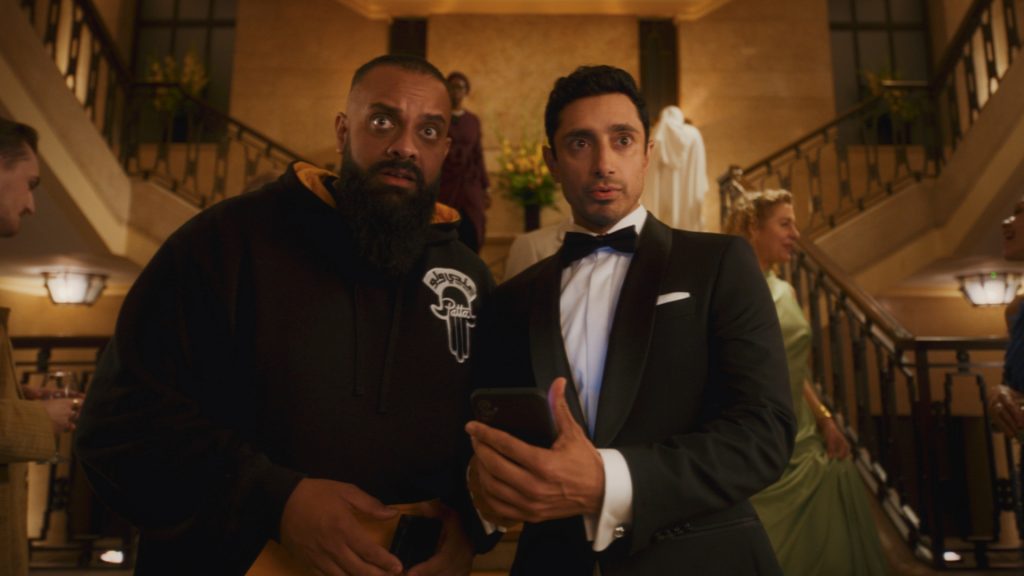
“I always feel like the most relatable work is the most specific and the most personal,” Ahmed tells The Credits over a video call in Malaysia while shooting The Big Fix with director Baltasar Kormákur. The Wembley native found that connection in Bait, a Prime Video limited series he wrote, executive produced, and stars in as Shah Latiff, a struggling actor on a shortlist to become the next James Bond. What starts off as an actor catching fame spirals into a deeply rooted story about identity, validation, cultural expectations, and family. But don’t worry, there are plenty of laughs too.
The multihyphenate (don’t forget his rap moniker Riz MC) drew on his own life to write the genre-defying escapade, admitting he “constantly wanted to back out” because the material felt so “personal and vulnerable” to him. Good thing for us he didn’t. In our conversation below, he talks about growing up in a British-Pakistani home, his late father, and a chance meeting that brought the series to the small screen.
Having already achieved this much in your career, was Bait a response to asking yourself what’s next?
I was reaching a point in my career where I felt very lucky to be doing some bigger movies, but they had somewhat felt a bit more impersonal for me in terms of the process, in terms of how much of myself I could bring to the work. And look, they were incredible and joyful experiences, but I felt the scary next step for me was trying to be more personal in my work.
What prompted that feeling?
I’m really inspired by shows like Fleabag and I May Destroy You, and I wanted to try and be bold in my own way and really map my psyche and share my own deepest vulnerabilities, insecurities, hopes, and fears. Probably the reason it took me 10 years to make Bait is because that’s a scary thing to do. And in many ways, that’s why this show is, I guess, the biggest thing of my life. It could have easily backfired or been seen as self-indulgent.
The response has been overwhelmingly positive, earning you another lead actor Emmy nom.
This show is such a love letter to my community, to my family, to my neighborhood, and to some of the fringe-worthy traumas that I’ve gone through in my life. You’ve got a hyper-specific world; it’s multilingual, and it’s a scrappy half-hour show, where a limited series often has a big budget and is hour-long. So there was a lot about this that felt like we were kind of punching above our weight. And it’s beautiful and shocking to be nominated for those reasons. It definitely is something I’m proudest of because these types of shows are hard to get greenlit. They’re hard to make, hard to do well, and even hader market and talk about. So it’s wonderful that people have connected with it.
Before we unpack details, what do you think are the key themes behind Bait?
The show is about something that I think we can all relate to, which is that life can sometimes feel like one big audition. We’re made to feel like we’re not good enough. So we’re trying to be something else. We use the symbol and the metaphor of James Bond to show we’re all playing a role. We put out this public version of ourselves on Instagram, LinkedIn, and at work. We put on this mask. It’s about how exhausting that can be to be constantly performing.
It’s also about where that road takes you. It takes you to a place where you feel like you’re losing your mind and tearing yourself apart, trying to please everyone, until you move from seeking validation from others to real self-love. It’s about journeying to self-love. I think that’s really what’s at the heart of the show.
How did you see the character Shah?
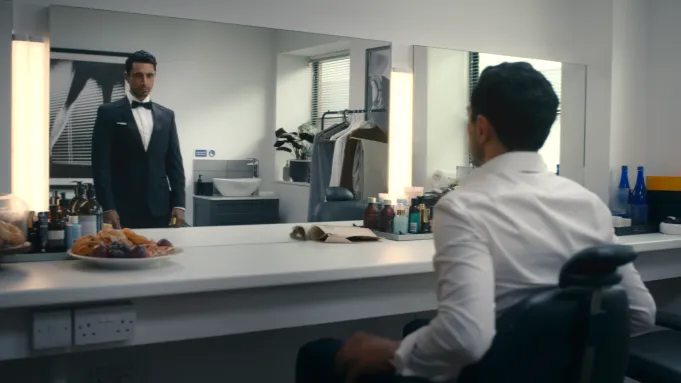
Shah’s story is the relationship to himself. He doesn’t think he’s good enough. He starts off the show berating himself in the mirror. And what he sees is him as something else… him as James Bond, him without his vulnerabilities and chaotic messiness and much more successful and desirable. So, it’s like how do you dramatize someone’s relationship with themselves? Well, often it is through them running away from themselves.
How much personal experience did you borrow from?
The locations we use: the house is modeled after the one we grew up in. The panic attack at the end of Episode 1 happened literally to me on that very stage supporting Wu-Tang Clan. My character gets jumped as a 10-year-old at the start of Episode 3. We filmed it at the same place I got jumped: the park behind my mom’s house. I felt that if I wanted to talk about something personal and make it relatable, I actually have to make it as specific as possible and really put myself out there.
Did that extend to other characters?
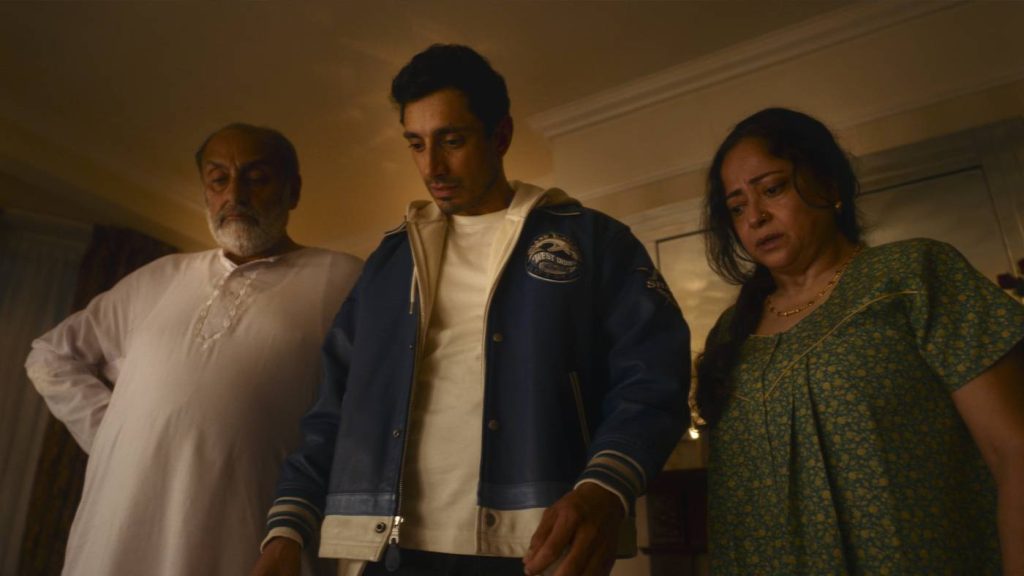
These characters are different from my family, but there are also elements of them that are drawn from my own experiences. My mom is quick-witted, sharp-tongued; you don’t mess with her. She’s dramatic, and she’s so proud of her kids. But she is also the first to threaten to tear them limb from limb. I wanted that kind of character from the mother, but the father character was interesting.
How so?
We had the initial idea of making him a disapproving religious dad. Then we met the actor Sajid Hassan who Zoomed me from Pakistan and was immediately just making fun of me. He was like, Riz, you look like a complete nerd. I’m so disappointed. I was like, what? And he was like, sorry, I can tone down my charisma to play the father of a nerd if I have to. It reminded me of how my dad made fun of me.
You recently spoke on your father’s passing.
It was something that I had been reflecting on recently and how much of my own dad’s humor and dry wit is in the show. He didn’t actually get to see the show himself which I’m very sad about. But my dad is that guy. He’s in front of the TV, watching Pakistani news, just riffing on it and throwing out dry one-liners. He was always kind of unimpressed with stuff and would put up a cheeky joke.
Sajid Hassan steals every scene. When he finds out Shah might be Bond he quips using him as a body double for sex scenes. You hit us with unexpected laughs quite well.
We were trying to find those juxtapositions of comedy and drama, and literally slapstick comedy. Life doesn’t take place in one genre, and certainly, that reflects my tastes and my own personality. I think sometimes it can be serious, intense. Often, I can be pretty goofy, so I just wanted to put it in there.
Each episode also plays with genre in surprising ways.
It’s a hard thing to try and pull off jumping between genres. And I think episodes three and four are good examples of something we were trying to do, trying to be quite bold. Speaking of episode three, I grew up around my parents watching these Indian soap operas where there’s always a big family gathering, and someone gets slapped at the end of it. And it’s like the most humiliating, awkward thing. And I thought, what if we did that? I wanted to pay homage to it. Could we pull it off but make it land in a way that feels raw? And so we really wanted to have a lot of fun taking that kind of swing between episodes.
Episode four is a standout. It begins with Shah “coincidentally” running into his ex-girlfriend Yasmin (Ritu Arya) but gradually becomes something much more emotionally revealing. What was the idea behind the ep?
I think when he tries to track down his ex and rekindle that and seek her validation, it’s just another example of him looking for love in all the wrong places, looking for people to tell him he’s good enough. So it was important to us in a way that he’s trying to seek approval from mainstream Britain, from his community in the streets, from online, from casting directors, from Sir Patrick Stewart, from his ex… It’s going to tear you apart. You’re trying to please everyone. You can’t please everyone. You can’t meet all these different versions of yourself. So it was important that at the end of that episode he’s left facing himself. He has nowhere left to hide.
Underneath all this is using the James Bond name. At the time, Barbara Broccoli had full creative control before relinquishing it in a joint venture with Amazon MGM Studios. How did you clear those rights?
The crazy thing is we had that baked in without knowing we had permission to use James Bond. I think we were like four scripts in and we still didn’t have permission. I remember my agents; everyone was like, yeah, she’s definitely not going to let you use that. To her credit, I emailed her, and we met up at a diner in Los Angeles, where I explained what I’m trying to do with the show. I gave her three scripts, and she loved them. She gave us her blessing, and I’m indebted to her. It’s the first time James Bond has been used this way.
The series ends on such a perfect final line. Did you always know that would be the one?
Yeah, that was a North Star. We knew that was the moment we had to build towards. And Ben Karlin, my co-showrunner, when we came to that last moment, we wanted to switch genres and tone and take a big swing with that episode just for our own enjoyment and pleasure and the kind of stuff we’re fans of. But also because it spoke to a character having an identity crisis, working out where he belongs.
All six episodes of Bait are available to stream on Prime Video.
Featured image: Riz Ahmed in “Bait.” Credit: Courtesy of Prime Copyright: Amazon MGM Studios