Cutting Deeper: Composer Volker Bertelmann on Finding the Tragic Heart of “Clayface”
Clayface commits to villainy with gusto. The new addition to the DC universe is a monster’s origin story, from famed actor to bloodthirsty monstrosity hellbent, or perhaps hellbendable, on revenge. It is a body-horror film scored with piercing strings and cellos, often layered to create sounds of terror that match the shape-shifting titular character’s descent into madness.
For James Watkins’ film, composer Volker Bertelmann leans into the tragedy and horror of Matt Hagen’s (Tom Rhys Harries) twisted fate. The rising star from Gotham is a rags-to-riches story, someone living his dream…until a mobster, Markos Szabo (David Dencik), and his goons brutally disfigure him. Without hope, the actor turns to Dr. Caitlyn Corr (Naomi Ackie) for experimental treatment. Initial success leads to instability, transformation, and an increasing loss of humanity.
The Academy Award-winning Bertelmann, who previously scored Conclave and All Quiet on the Western Front, wanted both gentle and violent hands on his string players. During a recent spoiler-rich interview, the composer spoke with The Credits about powerful hymns and club music.
Since Gotham is your playground here and you’re making a monster movie, how did you want to bring gothic and tragic sounds into Clayface’s theme?
When I heard I’m doing a film for Gotham, I knew exactly how that sounds, in a way. For me, it sounds tragic, but it also sounds big, sounds like a hymn, but the hymn is crying in a way. It’s a hymn that leans into tragedy at some point, but then it wants to blossom again. I tried to find a line where I can lean into darkness and light. That’s what I did the whole way through: find a balance between the two.
Your protagonist is an actor. Given his point of view and the movie industry component, how big and dramatic did that allow you to go at times?
When it started, I thought this was a classic Hollywood film in a way, and that obviously lets you work with strings and make it lush in certain areas, but also dark and melodic. At the same time, I obviously used a lot of synthesizers, specifically when the nanos are taking over. I was trying to create visceral sounds that slowly slip into your synapses and make you transfer into something else. Sound design with music, it’s like collages, I would call them. You have elements that you can come back to every time.
For example?
There’s this high violin whistle melody that comes in whenever you know a murder is about to happen in a few seconds or something, but you don’t know. You just hear this moment of this high melody creeping into your ear, and psychologically, that’s something I love.
You’ve got strings, but you also got some techno and synths in the score. Was techno or house music at all an influence for the final fight in the club?
I have a techno history and did a couple of techno records myself. I love electronic music. And so, sometimes when we have dance scenes or club scenes, I mostly say, “Well, let me do the club track because I have all the stems, and you can filter the bass drum, you can take things out, you can move it into something else.” In this case, we were lucky that, first of all, the club tracks were so good that I felt I didn’t have to do anything with that.
The score does take over at times, though.
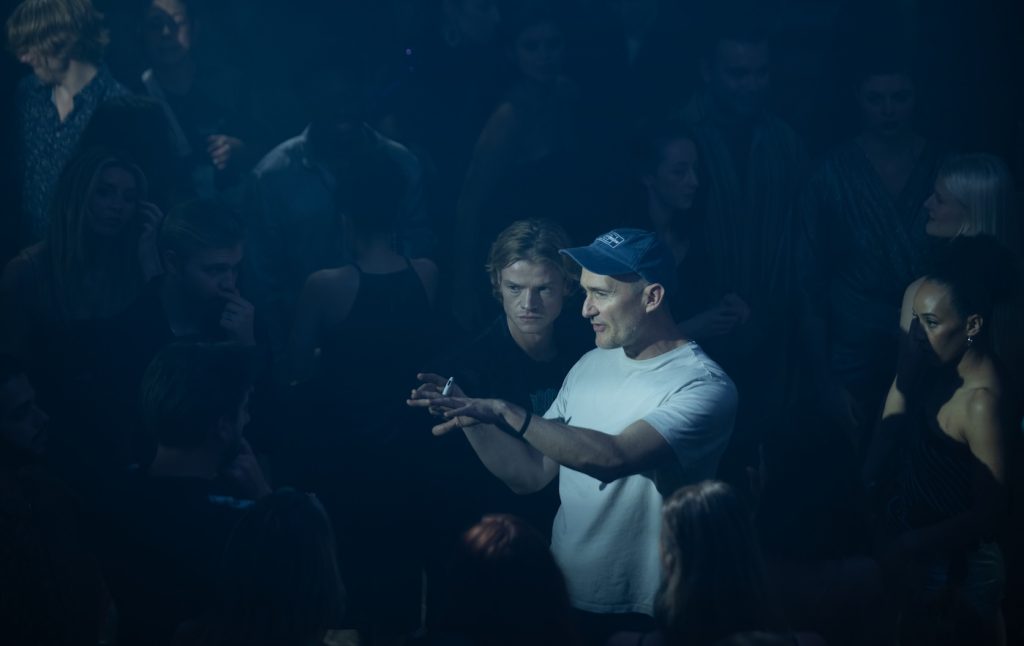
There were scenes where the club track somehow gets into the background, and the score should take over. What I did was compose on top of all the club tracks, scored all the way through, with brass elements. I even did this in one track on the soundtrack that is, in a way, the club track without the club tracks.
It’s the longest cue in the score, right?
The longest piece. It sounds obviously a little bit like, let’s say, a jazz brass band in a way, playing a little bit of R&B. But when you hear it in the scene, you know that there’s a wonderful house or R&B track underneath. The dance worked so well that I said, “Why don’t I just compose on top of it, and you can actually decide during the scene when you want to lean towards the score and when you want to lean towards the club track?” I would say toward the end, when we see them fighting on the floor, then it suddenly goes completely into the score.
By the end of the film, we see Matt truly become the monster. How did you want the score to support his final transformation?
With music, the main problem is, I would say, specifically the end. The end and the beginning are very important parts of the film in terms of music. Specifically, when a film has a lot of climaxes toward the end, you introduce new characters at the beginning, so you have new music coming with them, and at the end you have to shut down all the stories in a way. You have to find endings. And to make the endings not too repetitive, so it doesn’t sound like, “Oh, is that already the ending? No, no. Oh, is that the ending? No.”
How’d you bring it together?
That was a little bit of a challenge. A fantastic move by James and Jon Harris, the editor, was to use “If You Leave Me Now” at the beginning and then at the end. I was like, “This is a great idea.” Then James said, “But I would love to have it more in a kind of synthesizer, dystopian, dreamy way.” I’m a kid from the ’80s, so I have all the old synthesizers in my cupboard. I took them out, and I did a kind of very lush synthesizer arrangement. Jasmine, the singer with a wonderful voice, recorded that in London. When that was in there, suddenly I was relieved from finding too many endings, because then there was only the very ending for me.
When you saw the film’s final image, what did you want the music there to leave theatergoers with?
When I grew up in the small village in Germany, in our neighborhood, in the smallest village, I mean, with a thousand people, there was one of the most prolific cinemas in Germany that was doing a lot of films at that time. The first film I saw was Indiana Jones when I was a kid, and I saw a lot of Star Wars early on. So I grew up with that kind of fairy-tale film experience. You went out of the movies, and you were just like, “Wow.” You went home, bought a costume, and tried to play everything yourself, which was sometimes a little dangerous. [Laughs]
You wanted awe.
In general, as a kid, you were inspired, and that has never left me as an adult. So, ideally people go out of the cinema and they’re like, “Wow, it’s so much fun. You can talk with people, you can be in the pub, you can discuss things.” But at the same time, it’s not too depressing. And so, that’s entertainment. You want to be entertained on that level. My goal, in a way, was to find a clear and honest way of making music for an entertainment film that also resonates with people.
Clayface is in theaters now.
Featured image: Caption: TOM RHYS HARRIES as Matt Hagen in DC Studios’ “Clayface,” a Warner Bros. Pictures Release. Photo Credit: Photo Courtesy Warner Bros. Pictures