From “Hacks” to Horror: Hannah Einbinder on Finding Creative Kinship With Director Jane Schoenbrun
Coming off her four-year, Emmy Award-winning run on the HBO series and cultural phenomenon Hacks, Hannah Einbinder chose for her first film role Kris, a young queer filmmaker hired to direct a reboot of the Camp Miasma franchise in horror auteur Jane Schoenbrun‘s Teenage Sex and Death at Camp Miasma, set for theatrical release by Mubi on August 7.
Some might view that as an odd pivot. But for Einbinder, it’s in perfect harmony with how she’s steered her career so far.
“I was able to collaborate with people I deeply like, whom I am now able to share DNA with,” said Einbinder of both projects. “I am tied to Jane and [Hacks creators] Paul Downs, and Lucia Aniello and Jen Statsky for life, and that’s what I want — to feel connected to my collaborators, laugh and cry with them. I don’t want it to be transactional or about anything other than doing quality work that I feel a legitimate emotional connection to.”
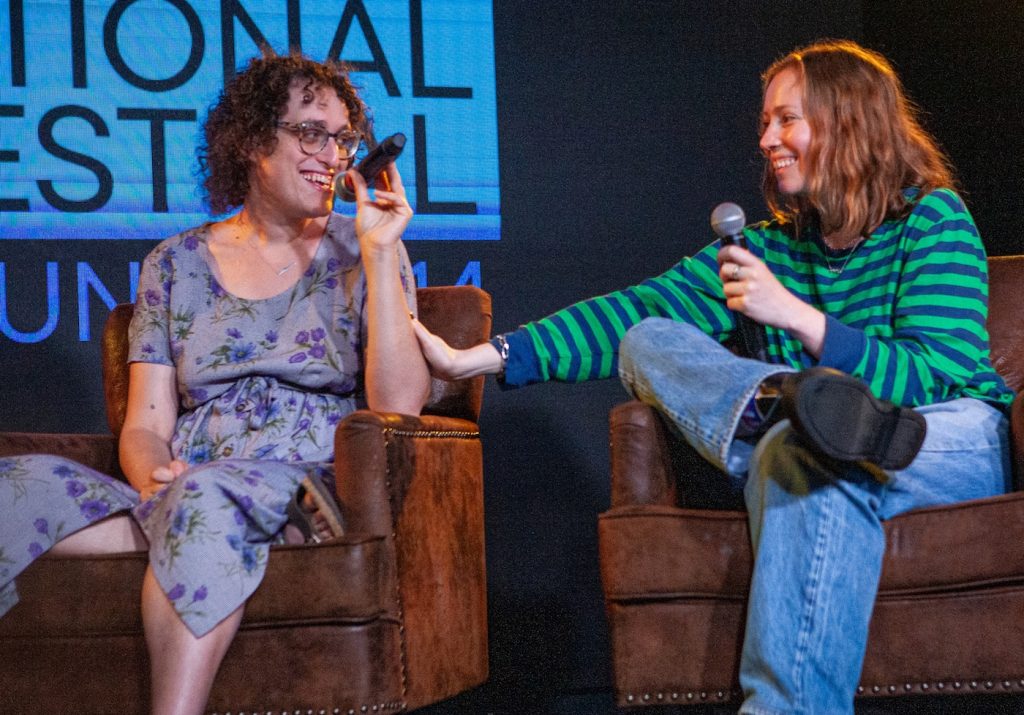
Einbinder and Schoenbrun shared the stage at the Provincetown International Film Festival in June, where they were hosted as PIFF Next Wave Honorees. The pair participated in a conversation, moderated by veteran producer and longtime PIFF supporter Christine Vachon, about their careers and Teenage Sex and Death at Camp Miasma, which screened in the festival.
Schoenbrun’s latest co-stars Gillian Anderson as the reclusive former actress Billy, who was the “final girl” in the original Camp Miasma. Einbinder’s director Kris is drawn to Billy as they work together on the reboot and, according to the film’s press notes, “descend into a frenzy of psychosexual mania,” which isn’t hyperbole if you’ve seen the trailer. Like their previous horror films I Saw The TV Glow (2024) and We’re All Going To The World’s Fair (2021), Schoenbrun’s latest is an audacious and affectionate homage to ‘80s and ‘90s horror and slasher tropes while also upending the genre as Schoenbrun, who is trans and nonbinary, filters it through a queer lens.
“I love slasher films. There’s an implicit queer lineage of gender deviance in horror fears and desires from Norman Bates [in Psycho] to Buffalo Bill [in Silence of the Lambs] that’s all fun to play with and also personal,” said Schoenbrun. “Growing up in the ’90s, that’s where I was seeing trans people. Buffalo Bill gets into your perception of yourself. Camp Miasma is a movie about learning to love yourself and being comfortable. It’s making the genre work for me, not against me.”
For Schoenbrun, coming out as trans is inextricably linked to their creative process and expression. “My previous life was in New York non-profit film distribution. I knew deep down I wanted to be a filmmaker, but lacked the confidence to do it. It was easier to support other filmmakers. It was so intertwined with gender stuff for me, but in 2019, I forced myself to work on my first film and faced my shame, anxiety, and fear. That led directly to my seeing myself as trans and coming out, and that completely unlocked everything. If I were going to make movies, I would need to be honest; it would need to be an authentic expression of myself.”
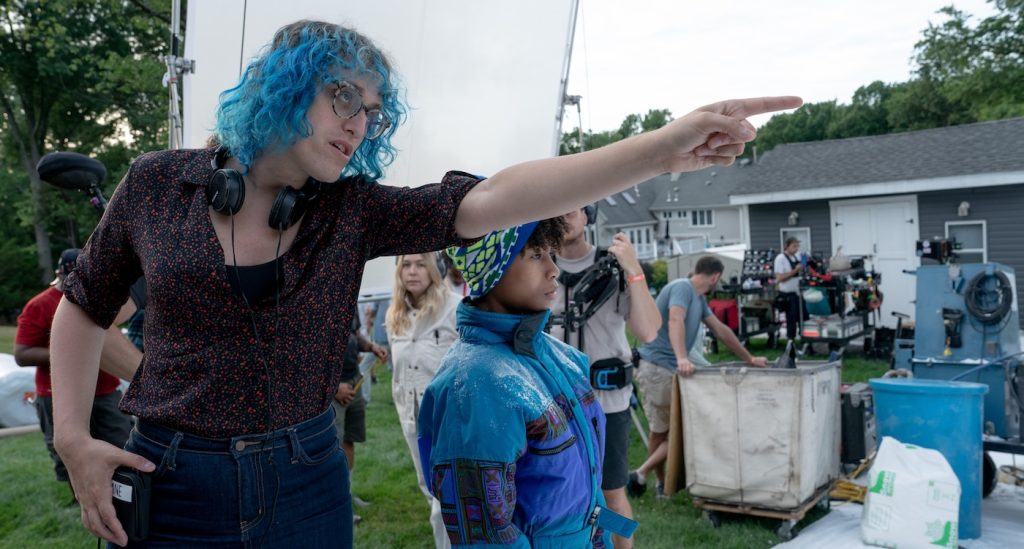
Schoenbrun is currently set to write, direct, and executive-produce Charles Burns’s acclaimed graphic novel Black Hole, about suburban teens in the ’70s, as a series for Netflix. “So many things were clearly indebted to that work where the horrific and romantic can kind of get confused,” Schoenbrun said. “It’s not a faithful adaptation but a jumping-off point. It’s the show that I wish existed when I was growing up.”
Just as I Saw The TV Glow paid homage to Buffy the Vampire Slayer, the TV show that Schoenbrun says helped them survive their teen years, Camp Miasma is rooted in camp sleepover slasher movies like Friday the 13th (1980) and its sequels.
Casting Armstrong was key to the movie’s symbolic and literal imagery. “I grew up on The X Files… it was a formative queer experience for me,” said Schoenbrun. “The movie plays with iconography. When Gillian enters, she’s like Marlene Dietrich. She’s down for that, and the movie is about interrogating that.”
Like Schoenbrun, Einbinder said she was nervous about meeting Armstrong and was effusive in her praise of Armstrong’s commitment. “She’s a gifted performer with a meticulous approach to work. She’s so disciplined yet has room for fun. She’s iconic, and it’s never lost on you,” she said.
Einbinder said Schoenbrun created a “safe place” for actors to play and explore. “Jane put time and energy into having deep conversations about the subject matter. There are some insane places the movie goes, and you access things that are painful. I felt I was so held. For me, as a comedian, that mind meld is really important. We were speaking the same language. If a difficult scene was coming up, we’d sit on a log in the woods and talk about what the scene was trying to portray and our experience with those emotions. It was everything you could want from an experience like this. We got to live the thing we were making. There’s so much love in the movie, and there was so much love in the process of making it.”
Featured image: US actress Hannah Einbinder poses during a photocall of the film “Teenage Sex and Death at Camp Miasma” at the 79th edition of the Cannes Film Festival in Cannes, southern France on May 13, 2026. (Photo by Sameer AL-DOUMY / AFP)