From Bogart to Bold Color: How DPs Darran Tiernan and Peter Deming Captured Nic Cage’s “Spider-Noir”
Director of photography Darran Tiernan knows his way around supervillain stories, having served as the primary cinematographer for The Penguin. He understands Depression-era crime drama, after filming the Perry Mason reboot set in 1930s Los Angeles. And now, drawing from both projects, he’s pulled off a choose-your-own cinematic adventure called Spider-Noir (streaming on Prime Video). The eight-episode series, filmed in Los Angeles and set in the 1930s, offers dueling versions of Nicolas Cage, channeling Humphrey Bogart, as Ben “Spider” Reilly, a private investigator who gets entangled with a femme fatale nightclub singer (Li Jun Li), a crime kingpin (Brendan Gleeson), a wise-cracking secretary (Karen Rodriguez) and a streetwise reporter (Lamorne Morris) along with a motley crew of fledgling superheroes (Abraham Popoola, Jack Huston).
For creator/showrunner Oren Uziel, it made aesthetic sense to shoot Spider-Noir in the style of Bogart’s Sam Spade detective movies—black and white. Tiernan explains, “We started from a black and white point, but very early on, the request was made to have a color version as well. We knew what we wanted in black and white because we’d already talked about that and had a wealth of beautiful black and white films to be inspired by. But what would those films look like in color? That was the question.”
Working with “True Hue” technology that emulates Technicolor’s hyper-saturated palette, filmmakers enlisted Oscar-nominated cinematographer Peter Deming to join the project for a couple of episodes. He reinforced the brooding Noir aesthetic by contributing the kind of foreboding visuals he’d mastered while shooting Mulholland Drive and Twin Peaks for the late David Lynch.
In conversation with The Credits, Tiernan and Deming talked about Spider-Noir‘s harmonic convergence of wardrobe, production design, and cinematography, as well as the thrill of capturing Nicolas Cage’s lightning-in-a-bottle unpredictability on the old Wizard of Oz soundstage.
Congratulations on Spider-Noir, it looks fantastic in black and white. It looks great in color.
Darran: Thank you.
How the heck did you do it?
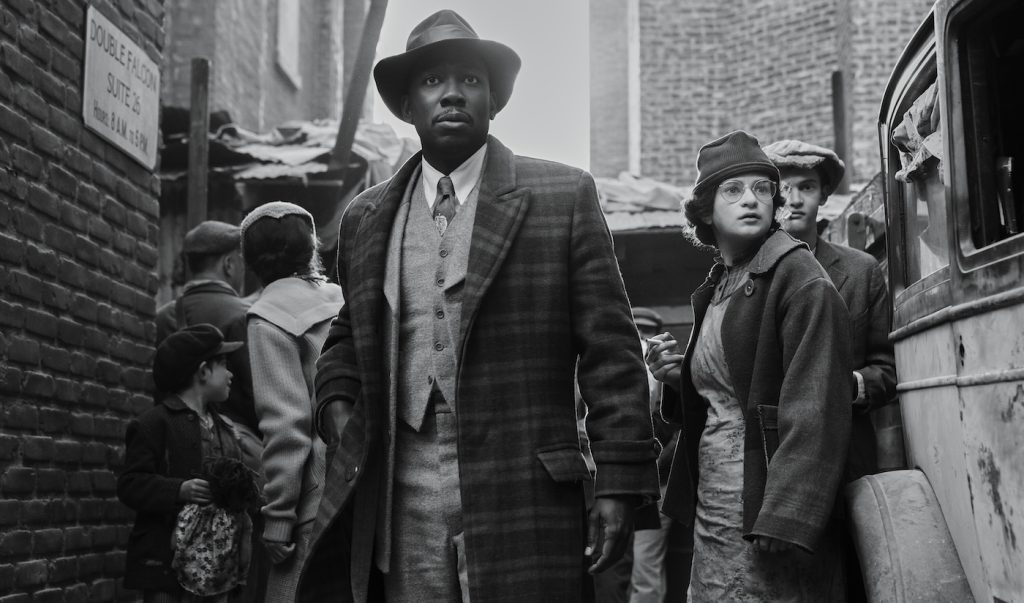
Darran: Rather than having a color image and turning it black and white, it was the reverse. ‘What could it be in color?’ We created two different lookup tables on the cameras, so we could go back and forth.
That must have required intensive collaboration with the costumes and production design departments?
Darran: The art department and Trayce Field’s costume department had cameras with lighting setups and high definition 4K monitors that allowed them to flick between the looks everybody had agreed upon. When Trayce did costume fittings, she would place the cameras and monitors in front of the actors. Then there would be constant discussion among our showrunner, ourselves, and Warren [Alan Young], our production designer. We would test all their colors and textures so we would know what things would look like when everything was pulled together.
That’s pre-production. How did it work when you got onto the set and started filming?
Darran: On set, all the monitors were [initially set to] black and white, apart from the [Digital Imaging Technician’s] DIT monitor. Peter might have done it differently, but for me, I’d watch black and white first, second, third take. Then on the fourth take, we’d check the color [version] in case something had to be fixed. But before we even rolled, I was flicking between the two versions. Everybody came prepared because they had done their research.
That flicking-back-and-forth approach certainly worked for Lamorne Morris’s reporter character, Robbie Robertson. In the color version, he’s wearing this very bright orange suit. For a broke reporter who eats ketchup and bread sandwiches, Robbie dresses really well.
Peter: I think that’s where all his money went.
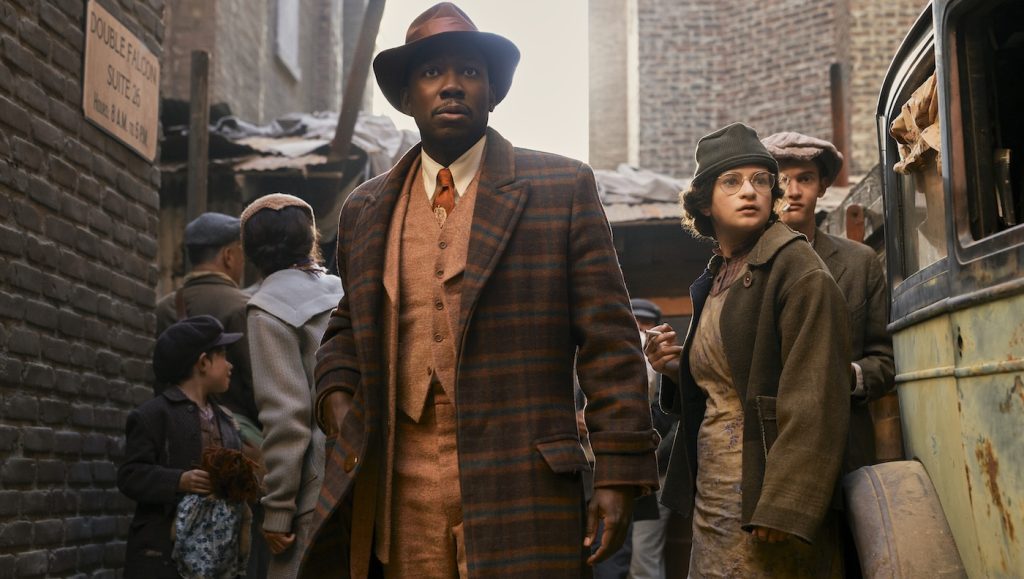
And yet this vivid suit also translates effectively as shades of grey in the “noir” version. Peter, were you prepared for this unusual back-and-forth when you came in to shoot episodes five and six?
Peter: I had the extreme benefit of seeing a lot of production that had already been done by the time I came in, so I was able to sort of absorb that. But also—and this kind of collaboration should happen on every project to make sure things aren’t clashing—Spider-Noir was next level. Sometimes you’re pushing the color to make the black-and-white work, and I don’t know if that was Oren’s edict for the color to be bold, because it certainly was very bold. The coordination [with other departments] outside of Darran’s eye or my eye was key.
Darran: I’ll tell you a story about when we shot two scenes a couple of months before principal photography, which every department homed in on and analyzed. For one scene with Reilly and Cat Hardy [Li Jun Li] in the hotel room, Warren Alan Young, our production designer, built the set and painted the wall lime green and kind of electric blue. I remember Oren and our director, Harry [Bradbeer], walking onto the set and just going, ‘This is too far.’ But once we switched the camera on and showed it to them on the monitor, they were like, “Oh, my God, it works!”
Peter: I was a little shocked, walking onto some of our sets and thinking, “That’s crazy.”
Darran: It looks different when you look at it with your own eyes, away from the monitor.
Peter: But in camera, it really did transport you.
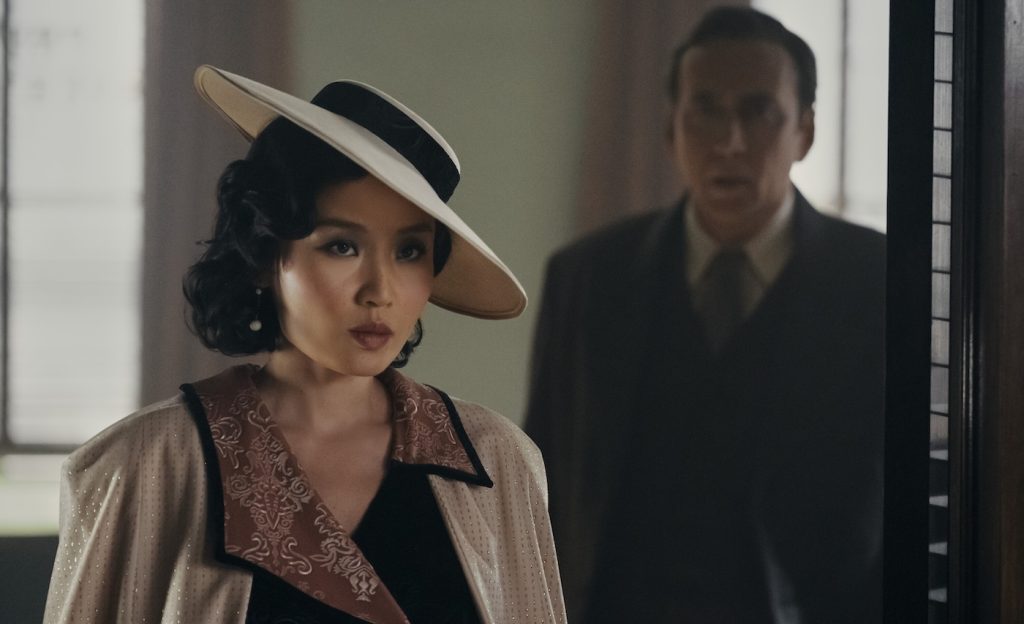
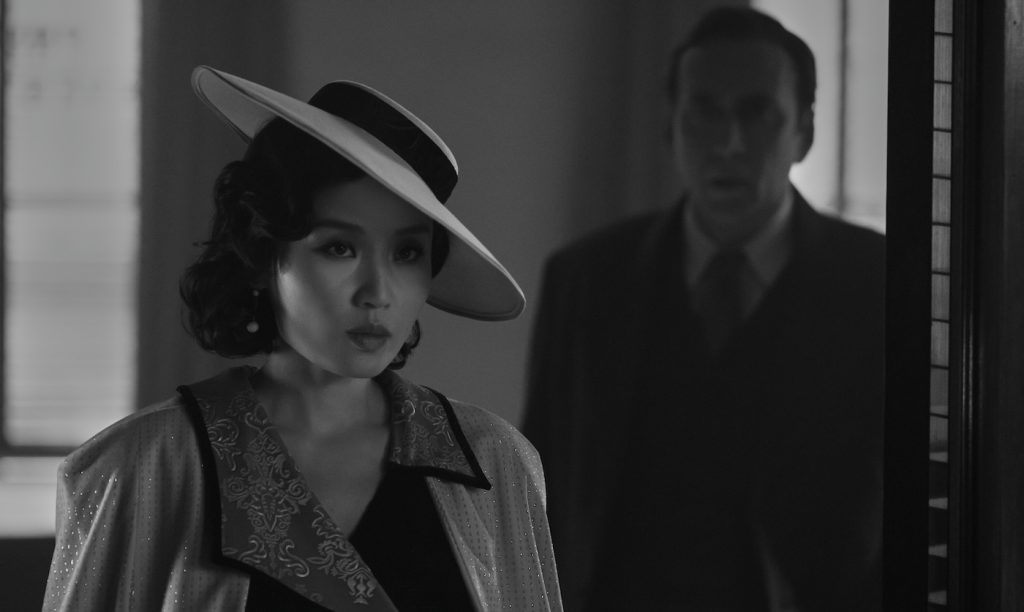
Spider-Noir employs so many signature film noir elements—light streaming through Venetian blinds, shadows, silhouettes, and low-angle shots. Which old movies were your touchstones?
Darran: Maltese Falcon [1941], The Third Man [1949].
Peter: For me, Third Man and Touch of Evil [1958], but also, a 1957 movie called The Sweet Smell of Success, because it was a black and white noir shot by James Wong Howe, who leaned into extreme lensing and angles. But having said that, these references are more of a nonspecific way of thinking about what the vibe is, what the feel is, rather than trying to copy anything.
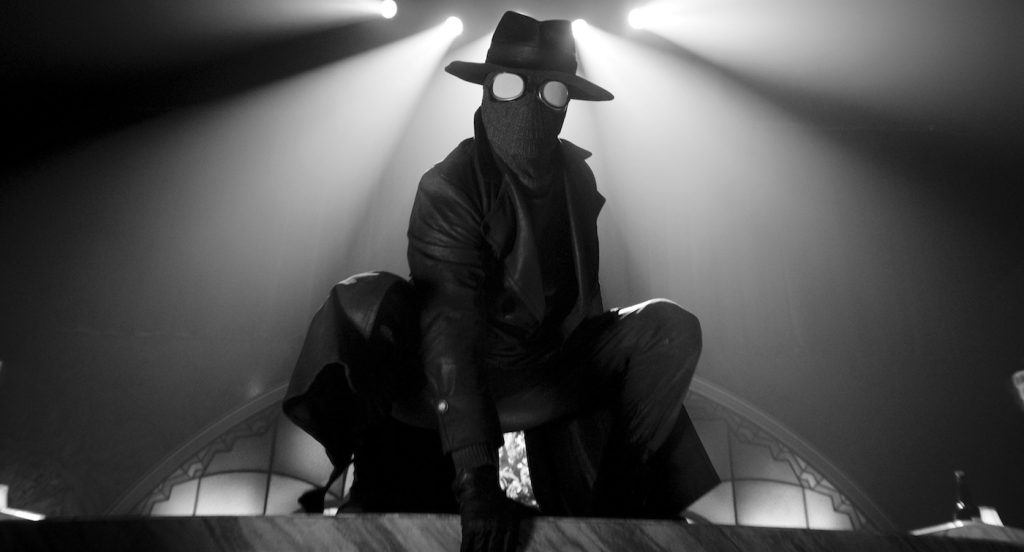
Nic Cage, one of the great American actors, must have been exciting to capture on camera.
Darran: With Nic, no two takes are the same.
What was your favorite Nic Cage experience?
Peter: Well, mine’s extremely personal. I was driving to work one day late in the shoot and got the news that David Lynch had passed away. I got to the set, and Nic and I looked at each other, shook our heads, and had a quick chat about it all.
Nic Cage, having been directed by David Lynch in Wild at Heart.
So later that day, we were doing the scene where he sneaks into the doctor’s office, and he’s talking to her. Suddenly, Nic started to go like this [Peter spreads out his fingers and shakes uncontrollably], which is right out of Twin Peaks. I was looking at the monitor, bowled over. Then we cut. He looked at me. I looked at him. I thought everybody would be going ‘What the f*** is he doing?’ But that made it into the show, and for me, it’s very poignant.
Darran: I didn’t know that, Peter. That’s beautiful.
Spider-Noir was filmed entirely in Los Angeles County. During a time when so much film and TV production has left town, it must have been heartening to shoot this big project locally.
Darran: Yeah. It has been a very tough couple of years, like, very hard. I’ve lived in Los Angeles for 15 years, and I feel like I’m part of the city. We shot in the historic backlots of all these beautiful studios in LA, we shot in downtown LA, and we had sets on what used to be the MGM lot where The Wizard of Oz was shot. You’re walking around surrounded by all this history. But it is very hard right now, so I hope people are inspired by seeing what we can achieve in L.A. and New York as well, where Peter lives. I hope more shows come back.
Featured image: Nicolas Cage (Ben Reilly/Spiderman) in SPIDER-NOIR. Photo: Aaron Epstein/Prime. © Amazon Content Services LLC