DP Jonathan Furmanski on Crafting the Voyeuristic Look of Peacock’s Keke Palmer–Led “The ’Burbs”
The original film, The ‘Burbs, came out to mixed reviews when it premiered in 1989, but since then, the black comedy starring Tom Hanks as Ray, a suburban dad suspicious of his odd new neighbors, has become a cult classic. As such, it’s an ideal vehicle for a streaming reboot, which Peacock just debuted, starring Keke Palmer as Samira, Ray’s successor in suburbia-driven mystery madness.
Samira, her husband Rob (Jack Whitehall), and their infant son have just moved into Rob’s childhood home, and life in their McMansion at the end of a scenic cul-de-sac looks idyllic, save for the decrepit Victorian house across the street. The wreck was once home to Rob’s childhood friend Alison, who mysteriously vanished as a teenager. The lack of closure around her suspected murder hasn’t been good for any of the residents of Hinckley Hills, but the unsolved case, coupled with the house’s sale to creepy new neighbor Gary (Justin Kirk), particularly draws in Samira, a former litigator on maternity leave. Directed by Nzingha Stewart and shot at Universal Studios in Los Angeles, The ‘Burbs is both an unsettling mystery-drama and a comedic foray into suburban voyeurism.
For cinematographer Jonathan Furmanski (I Love That for You, Good Boys), the original film’s balance of satire, silliness, and authentically scary moments inspired the reboot, as did the use of color in films like Nope and Get Out. Shooting on ARRI Alexa Mini LF paired with Panavision Panaspeed lenses, Furmanski created a vibrant yet naturalistic look for the series, which veers between a lighthearted nature of Samira’s friendships with her kooky neighbors and the group’s sinister discoveries surrounding Alison’s unsolved disappearance. We got to talk about aspect ratios, voyeurism, and studio shooting with Furmanski.
What were the advantages of the theatrical aspect ratio?
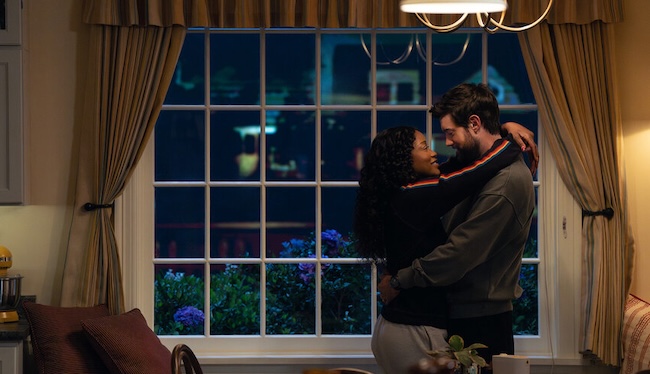
A big part of the experience of this show is the idea that everyone can always see each other. It felt like the wider aspect ratio meant that, when we were shooting someone close-up, we could have a house to the left, a house to the right, and a person in the foreground. This way, we’re constantly surrounding people with their neighbors, in good and bad ways. And then, it’s just really fun to compose a frame in 2.39:1.
You definitely get the sense there’s no privacy on this street.
That idea leapt into a lot of the decisions that we made. The production design team gave us oversized windows so we could see more of the neighborhood when we were shooting our interiors. We used these digital screens so we could position houses and other things outside the window, depending on what we wanted to see. I think sometimes we pushed reality a little bit, but it helped reinforce the dramatic impact of Samira’s feeling the pressure of this house across the street. She’s talking to Rob, but that house is still lurking in the background.
How did you use the camera to convey Samira’s emotions as she works on this case?
In the first half, we really wanted Samira to feel isolated. Part of that is her deep dive into something sinister happening across the street. But at the same time, there’s a part of the story where Samira is an African-American woman from the city who has come to a very non-diverse neighborhood, and what that experience is like for her. Keeping her alone as much as we could was something we tried to target. Then there are things we did with camera movement to get into her head, maybe there’s a small push in or out, we used zooms a lot as well, to reinforce that she’s trying to put this all together, even if she doesn’t have all the pieces to what she thinks is the puzzle.
What was your approach to the many nighttime scenes?
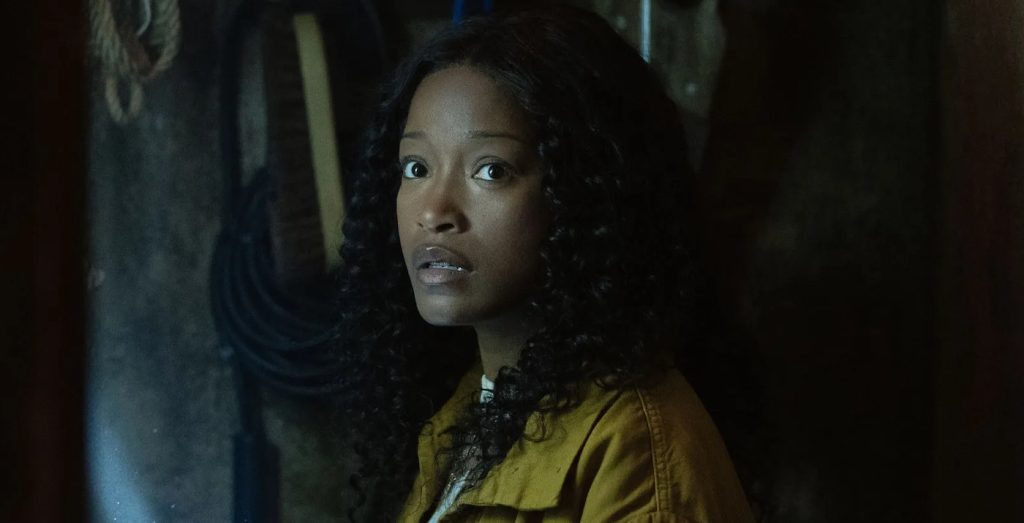
That was a conversation that Nzingha Stewart and I had in prep. This was something we pulled from Jordan Peele movies, and other movies as well—there’s a clear distinction between the moonlight and the warmer tungsten lights that come from all the house lights, and we tried to really lean into that discrepancy. It meant that we could have a fairly well-lit cul-de-sac, with light coming from almost every direction, but because there’s so much color contrast, it doesn’t feel flat.
There were also a few night shots that reminded me of Gregory Crewdson‘s photos.
I don’t remember talking about Gregory Crewdson in prep, but I’m a big fan of his work. The way he works, it’s a little trickier to use his aesthetic and approach in a motion picture situation without it turning into a VFX extravaganza, but I love that you clocked that. Maybe something subconsciously within me was trying to figure it out wherever I could.
How did you shoot the flashback scenes to Robert’s youth?
Because the flashbacks are only to 2005, we were mindful that it’s not that much of a change. From an audience’s perspective, there are still cell phones and the internet. All we did was a minor color tweak. We used a Kodachrome film emulation, which, instead of going in the direction of sepia, felt like an old photograph where the dye had saturated a little bit more. It feels more colorful and skews in a slightly different direction than the rest of the show.
You were shooting everything at Universal Studios in Los Angeles, right?
Our backlot was the same backlot where they shot the original film. We had Tom Hanks’s house, we had the Victorian house, and some of the others, which had changed over the years. But those two, thankfully, were not that different. Our stages were also at Universal, but they were just down the hill, so it was very easy for us to go back and forth.
How was working with the original locations?
Over the years, there are a million shows and commercials that have shot there — the new Ted [prequel] series, Desperate Housewives shot there. Everybody has done their own little rethink of it. The art department had to take the Victorian home and cycle it back, and make it look a little bit more creepy and dilapidated than it actually was, because most people want it to look newer and fancier and all that. We had to dress it down.
Did shooting everything in the studio work well?
It’s pretty great. I’d shot at studios a lot, but I’d never done a studio-based show before. At first, I was nervous about it, because it felt like 90% of our time was going to be spent here. I was concerned about how many different ways you can shoot that cul-de-sac over eight episodes with so many scenes and so many people and seeing in so many directions at the same time. It ended up being a fun challenge. On top of that, the efficiency of being there more or less full-time was unbeatable, especially for a show like this, which needed to move so quickly. We could be on the backlot in the morning, break for lunch, pack the trucks, and 15 minutes later, we’re on the stages. It was hard to beat how smoothly that enabled everything to go.
The cast is also amazing.
We had a dream cast. A big part of this show, for me, was doing as much work as I could while we were getting ready and then just trying to get out of the way as much as possible. Sometimes you have to be rigid with marks, but as much as possible, just say, if you feel like going over that way, that’s fine, too, which kept our operators on their toes, but ultimately gave a little bit more freedom for the actors to just explore, which I think is a big reason why those performances shine.
The ‘Burbs is now streaming on Peacock.
Featured image: Keke Palmer in “The ‘Burbs.” Courtesy Peacock.