“Wake Up Dead Man” Cinematographer Steve Yedlin on Framing Rian Johnson’s Darkest “Knives Out” Yet
When I walked into the theater to see Wake Up Dead Man, the third installment in Rian Johnson’s Knives Out series, I wasn’t thinking about the fact that I’d soon be talking to Steve Yedlin, the cinematographer behind the film’s meticulous, moody visual world. I was just excited by the thought of revisiting a universe that has become something like comfort food to me. I’ve watched Knives Out and Glass Onion more times than I care to admit publicly, and something about their combination of old-school craft, modern playfulness, and rapier wit keeps me coming back. What struck me about Wake Up Dead Man, though, was how distinct it felt: visually darker, more Gothic, threaded with a different flavor of tension, yet still unmistakably part of the same lineage.
Talking with Yedlin, it became obvious that none of this was accidental. What most people think of as visual magic was, in large part, the product of decades of collaboration between him and Johnson, a partnership as intuitive as it is highly technical. This isn’t a director-DP relationship so much as a shared language built over years of evolving together. And as Yedlin tells it, that evolution has been steady, continuous, and almost familial. “There’s never been any sort of break point or big change,” he told me. “It always just feels like going back and doing a Rian movie again, a ‘Rian family get-together.’” Even when working on a large-scale project like The Last Jedi, that dynamic didn’t shift. “It just always feels like going back for another ‘Rian family get-together.’”
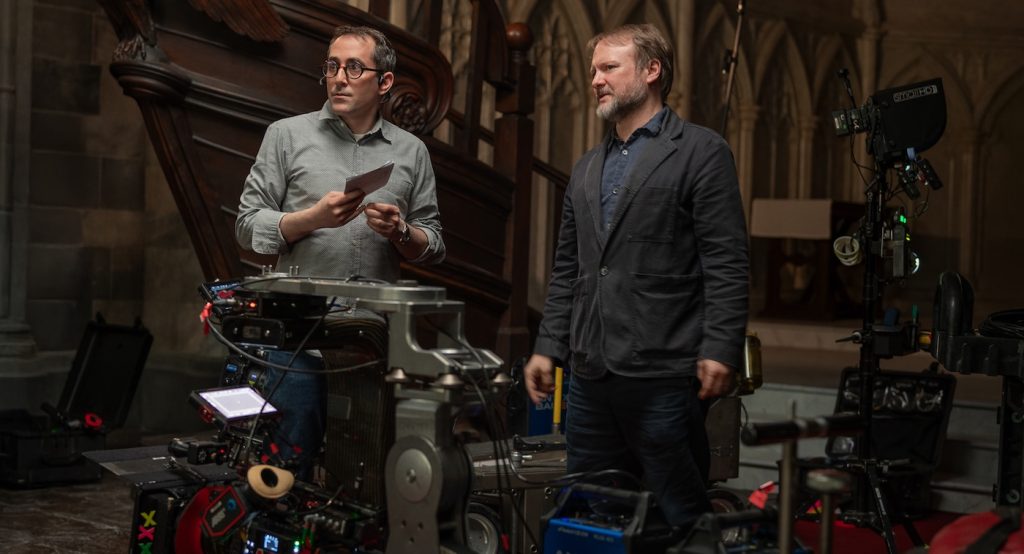
That sense of continuity doesn’t mean stagnation, however. Both artists have grown, both as people and as craftspeople. “Rian has always been fantastic,” Yedlin said, smiling. “He’s been one of my best friends since we were 17, 18 years old…And he’s just gotten, not just better and better at his craft, but he really makes it a journey. Just like he puts all the work into the movie being great, he puts work into making it a magical adventure for the whole cast and crew.”
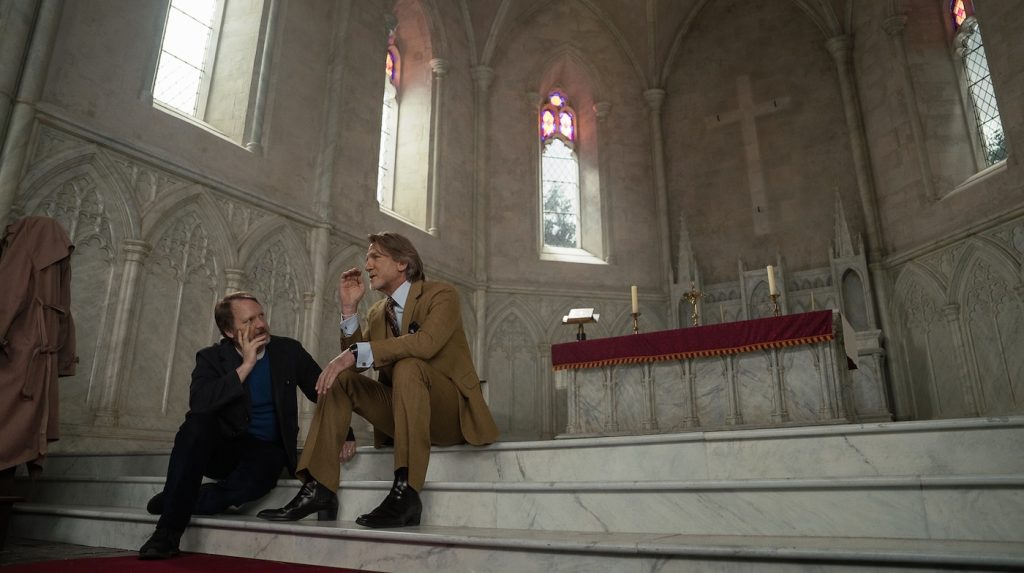
Wake Up Dead Man is imbued with that spirit of adventure from the script level. I was particularly curious about the film’s elaborate sun-and-shadow choreography, which features beams of light breaking through clouds, dimming mid-monologue, and returning at just the right emotional moment. This was one of the things that made the film feel so evocative and distinct from earlier entries, and I wondered when those ideas first came up. “Oh, I mean, right away,” Yedlin said. “He (Johnson) builds a lot of that stuff even into the script.” Sometimes those cues were explicitly written into scenes. Other times, Johnson had already decided exactly where he wanted naturalistic or symbolic shifts in light before the shot list even existed. “He also knew that he wanted to do it more than just those ones that had been very carefully planned in advance,” Yedlin explained. “He told me kind of first thing, when we first started talking about it.”
That early intentionality is no small thing when the technical demands are this enormous. In the film, the church and rectory sets function almost like characters themselves, their environments shifting dramatically in ways that are precise, repeatable, and subtly felt rather than flashy. Yedlin lit up describing the challenge of engineering all those transformations. “We kind of have every type of different feel,” he said. “Day, night, overcast day, sunny day, dusk, dawn, early morning warm light slicing in. And then we have the flashback that’s pointedly unrealistic, not evocative of a real time of day.” In other words, every lighting scenario imaginable, all of which had to be executed in a way that felt seamless.
Yedlin and his team approached the problem like a giant puzzle. “It was figuring out how to rig it all so we could do the changes,” he explained. That meant a combination of highly controlled rigging and Yedlin’s own custom light-control software, which allowed him to make subtle adjustments in real time. “The best interface is no interface,” he said, referencing a philosophy that clearly guides his process. “You don’t feel like you’re interacting with the mechanics of it. You’re just doing the creative thing and getting results, not thinking about the mechanics.”
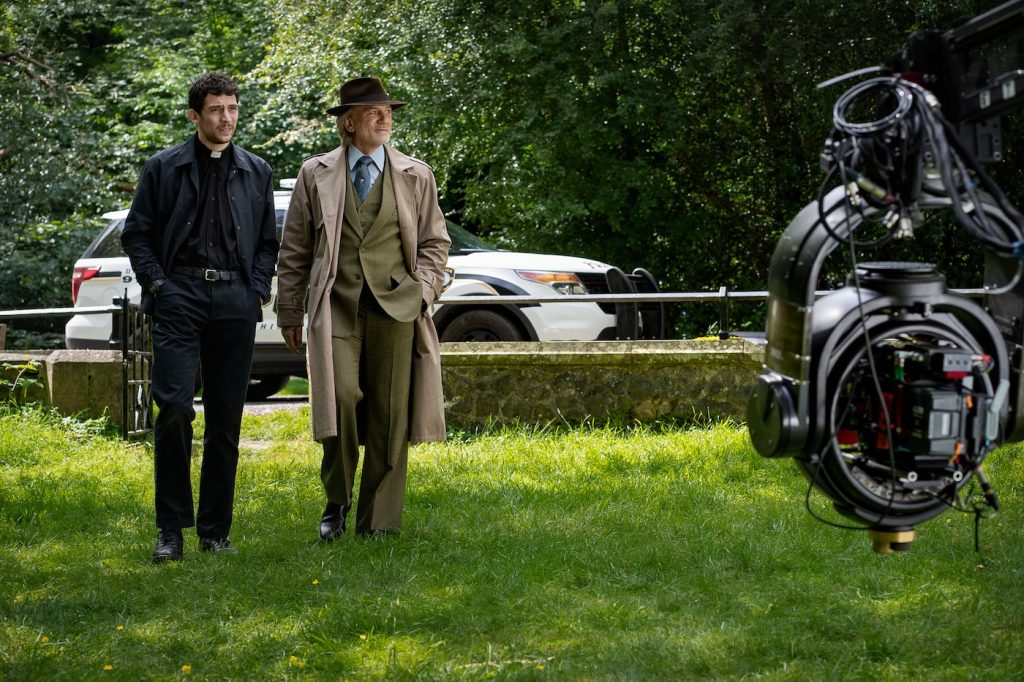
It struck me how that level of preparation actually freed the crew rather than constrained them. You’d think that shots as elaborate as the ones in Wake Up Dead Man would take significantly longer to set up, but Yedlin insisted that wasn’t the case. “Even some of the super complicated [shots]…didn’t really take any longer than shots that aren’t that complicated because of all the work that we had done in prep,” he said. “Once you have something you like, it’s perfectly repeatable. We can always write on this line, we can always start the cue, and it takes exactly this long for the sun to come out.”
The effect on the final film is stunning. There’s a lighting sequence early on, when Benoit Blanc (Daniel Craig) cloaks himself in philosophy and skepticism, that seems to move seamlessly with the dialogue. A cloud drifting, shadows falling, and a swell of light returning all occur within a single shot. I remember sitting in my seat thinking, Oh, this is so good. Hearing Yedlin describe it, I understood why it felt almost musically timed. That’s because it is.
From our conversation, it became clear that despite their precision, these visuals exist to be felt rather than noticed. Still, I had to ask about something I’ve always loved about these films. Each installment looks uniquely its own, yet the series maintains a cohesive identity. How did he and Johnson approach that balance on Wake Up Dead Man? “There’s no one weird trick,” he said, laughing at the idea of a formula. “It’s not like a novelist saying, ‘My idea for this novel is it’s going to be in all caps.’” Instead, they treat each shot the way a writer treats a sentence: with purpose, with context, and with emotional specificity. “If you’re actually designing the shots to tell this story, it’s going to look different from the other ones automatically.”
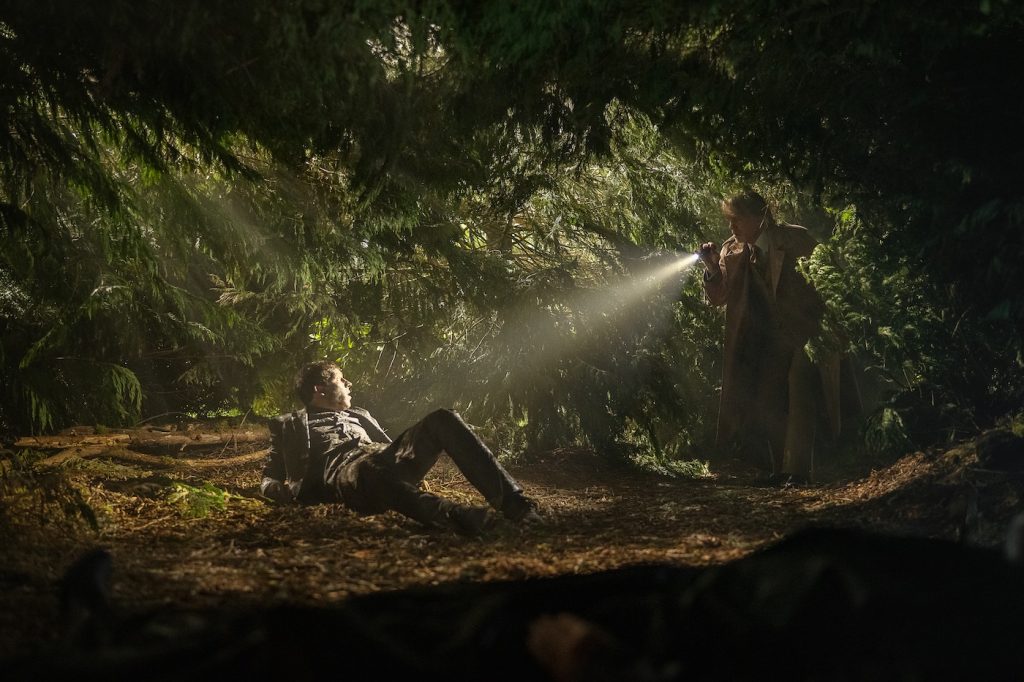
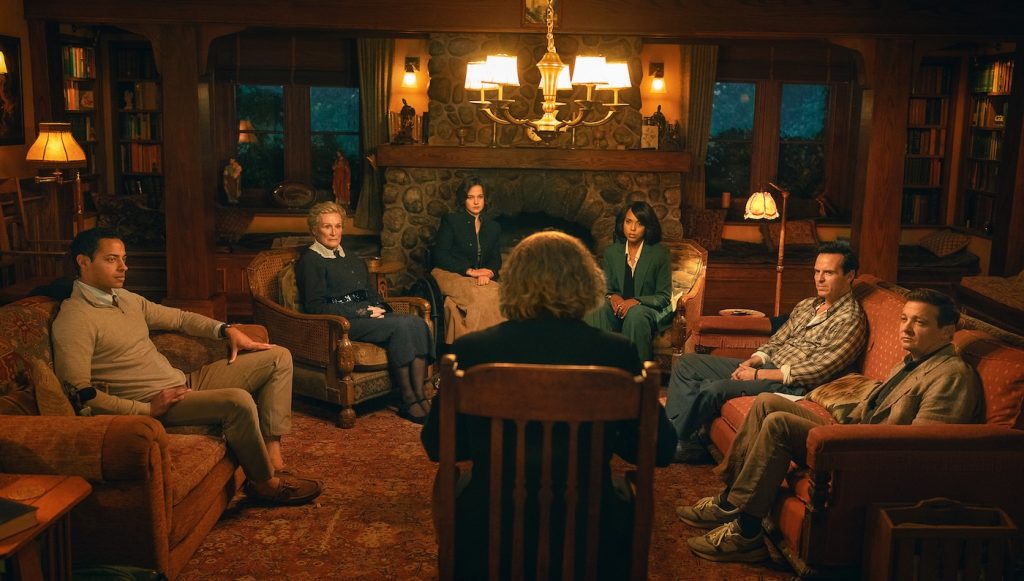
At the same time, some consistencies are inevitable. “Firstly, just because it’s us doing it,” he said. “It’s your personality…your brain doing the problem solving. So there’s going to be some aspect of the same sort of…you.” And he added that the ensemble nature of the Knives Out films presents recurring structural challenges. “You always end up with a couple of scenes where everybody’s kind of standing in a circle,” he noted. “All of these movie stars standing in a circle, a lot of dialogue…and the strong line of conflict between these two people. When you have those same things to problem-solve, you inevitably end up with at least similarities in the solutions.”
One of the most striking elements of Wake Up Dead Man is its tonal shift. It’s darker, moodier, more Gothic, and, in places, closer to a horror film than a traditional whodunit. Yedlin has experience in that arena. He’s worked on slashers and even collaborated with the late Tobe Hooper, a horror legend whose Texas Chainsaw Massacre remains one of my all-time favorite films. I was curious whether that background influenced his work on Wake Up Dead Man. “Yeah, but not directly,” he said. “It’s not like I’m doing exactly one thing we did on those, but those experiences inform everything, even if it’s a comedy, just because it’s where I learned so much.” Talking about Hooper, his expression softened. “Tobe was absolutely amazing. He was the first director I ever worked with who was really experienced, the first person with a whole career as a director. I always remember learning so, so much from him.”
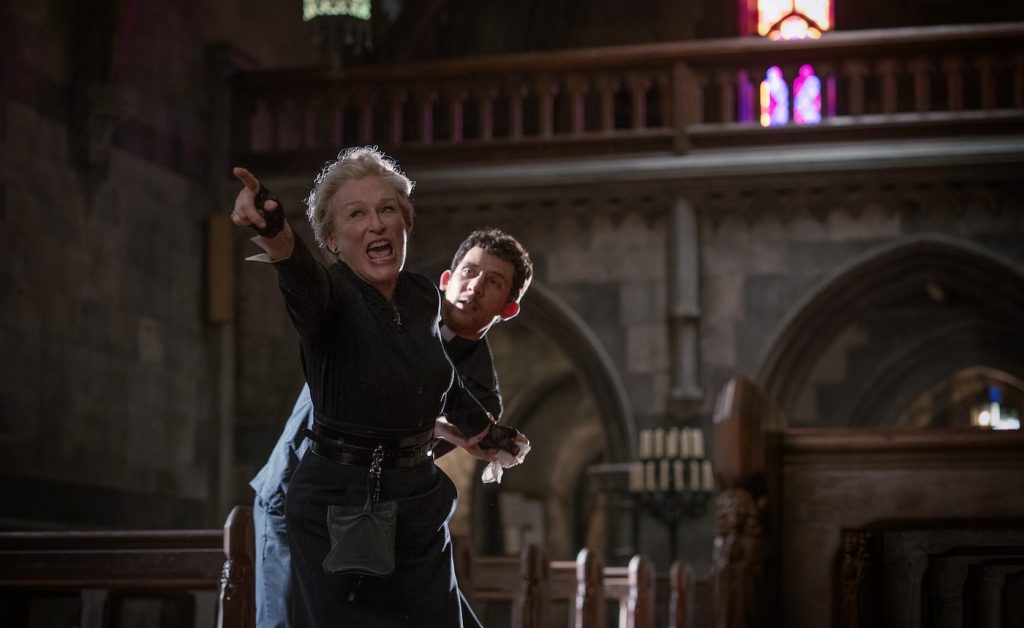
The cinematic language of Wake Up Dead Man, with its stylized lighting cues, haunted Gothic textures, and bold tonal swings, certainly echoes genre filmmaking. But what interested me most was how Yedlin manages to hold precision and spontaneity together at once, without sacrificing either. When I asked him about the balance, he actually changed the premise. “I don’t even know if those are opposites,” he said. “In a way, the precision is that we can finesse and improvise more. We’re not spiraling.” Because the technical foundations are so secure, he explained, the team can spend its time creatively rather than troubleshooting. “We can be finessing, making it better and better,” he said. “Even to the point where…I can be doing last little finesses even between banging the slate and action, or sometimes even sneaking them in while we’re already rolling.”
Precision, in Yedlin’s mind, is not rigidity. It’s the condition that allows for freedom.
That freedom was especially important on this film because of the scope of Johnson’s conceptual ideas, which Yedlin described as both specific and enormously evocative. “Rian always has big story and thematic ideas about lighting,” he said. “He already knows what he wants. It’s not me pitching him ideas.” Yet, at the same time, “he doesn’t micromanage me at all about how to do it. He trusts me to figure out how to do the conceptual thing.”
The result is a process without the usual friction. There’s no tug-of-war, no prolonged indecision, no competing visions. “He was making such a great movie,” Yedlin said. “Those ideas were themselves so big and evocative…baked into the fabric of the thing.” That clarity allowed them to devote all their energy to execution, from the massive church lighting system to the bold simplicity of the resurrection scene, in which a jarring floodlight punctuates the darkness. “We’re not spending time pitching ideas or wondering,” he said. “We know what we’re doing. So we can spend all of the time in prep, and then when we’re shooting, be really honing in on making that the best it can be.”
As our conversation concluded, I couldn’t resist asking Yedlin the question every Knives Out fan asks. What’s next for him and Johnson? He laughed and shook his head. “He’s told me the concept of the new one, but I don’t think I’m allowed to say it.”
Fair enough, I had to try.
What stayed with me after we parted wasn’t the secret of the next mystery, but the feeling I get talking to cinematographers: the realization that movies, especially beautiful movies, are held together by a thousand invisible choices, hours of unseen problem-solving, and the steady curiosity of people who love making images, not for show, but for story. Yedlin approaches cinematography with the mind of an engineer and the heart of a storyteller, and Wake Up Dead Man is one of those rare films where you can feel those layers at work even if you can’t see them.
Walking out of the theater after my first viewing, I remember thinking that this film feels different. After talking with Steve Yedlin, I understand exactly why.
Wake Up Dead Man is in theaters and streaming on Netflix now.
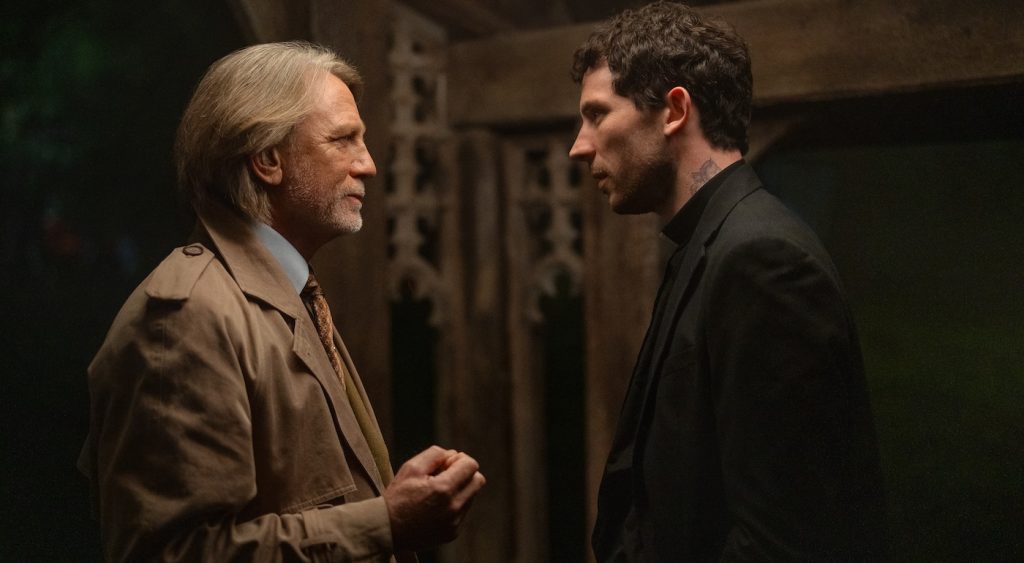
Featured image: Wake Up Dead Man: A Knives Out Mystery. (L-R) Josh O’Connor and Daniel Craig in Wake Up Dead Man: A Knives Out Mystery. Cr. Courtesy of Netflix © 2025