“F1” Stunt Coordinator & 2nd Unit Director Gary Powell on Training Brad Pitt to Drive 190 MPH on Real Grand Prix Tracks
Amassing over $630 million in global box office since its June release, director Joseph Kosinski and Brad Pitt’s racing drama F1: The Movie is Warner Bros’ second-highest-grossing film in 2025, and partly responsible for the legacy studio’s newly minted status as the first to cross the $4 billion mark this year. Following 2022’s box office juggernaut, Top Gun: Maverick, Kosinski reteamed with Maverick screenwriter Ehren Kruger and cinematographer Claudio Miranda for another adrenaline-pumping, nonstop thrill ride. In the cutthroat world of F1 racing, Pitt’s charismatic legend, Sonny Hayes, comes out of semi-retirement to take another shot at his ultimate dream while also salvaging his buddy Ruben’s (Javier Bardem) racing team. However, to do so, Sonny must find a way to work with cocky rising star and teammate, Joshua Pearce (Damson Idris), amidst a host of operational and financial quagmires.
A stunt veteran whose impressive resume includes Skyfall, Spectre, and Jason Bourne, second unit director Gary Powell had his work cut out for him on Kosinski’s ambitious goal of having actors behind the wheel going 190 mph on real Grand Prix circuits. “First and foremost, it was the vision of Joe, Brad, and Jerry Bruckheimer that the drivers did their own driving for real,” Powell says. “They didn’t use blue screen, but you’d never get the feeling in the cars or the visuals like you do when you’re physically driving cars that fast. The proof in the pudding is obviously Tom Cruise doing his own stuff in Top Gun: Maverick. If we do it for real, it’s going to be a better film. From the very start, we put the drivers in proper Formula Two racing cars to train them.”
Powell talked to The Credits about what it was like to follow the Grand Prix around the world for almost an entire year and shooting at the Silverstone Circuit in England in between live races.
Are car stunts your specialty, and how did you get into that?
I’ve done some pretty unusual things in very unusual vehicles, like I drove the tank in Golden Eye and a 50-ton crane in Terminator. The vehicle stuff is a lot of fun! And to be truthful, on this job with drivers like Luciano, Craig, and the others, it was pretty easy because they were so good.
Without watching the film, it’s hard to imagine actors like Brad and Damson really driving on the Grand Prix tracks at those top speeds.
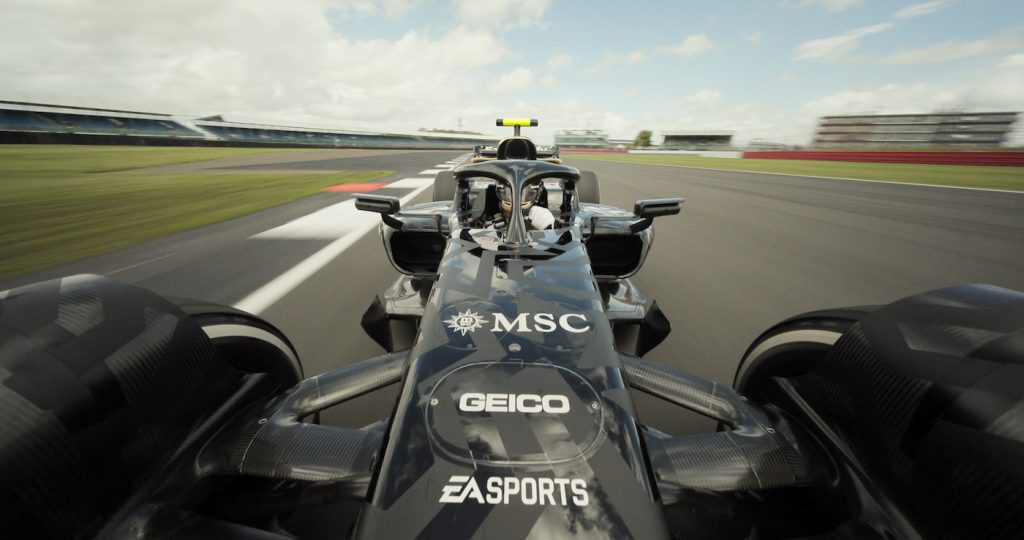
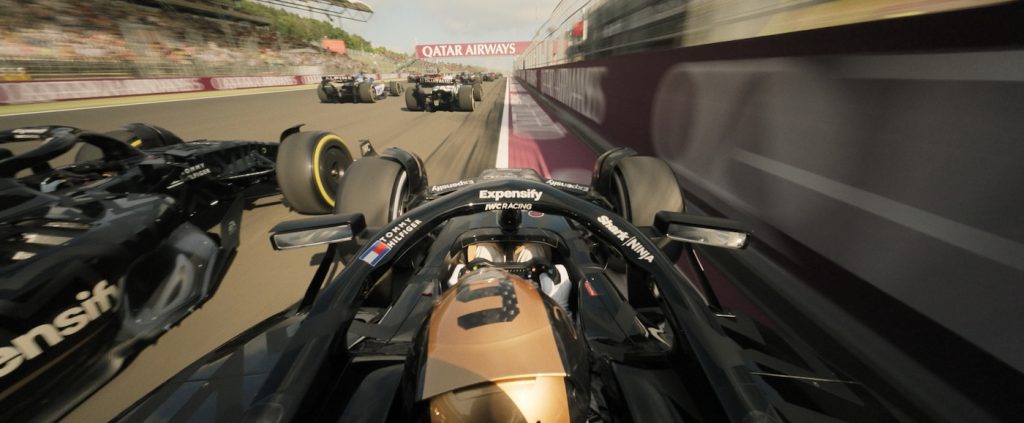
We had four cars all the same color. Every time you see the two actors driving, they were physically driving that car on that particular racetrack. We had stunt cars for crashes, but they did all their own driving. There was no cheating, no blue screen, no pod cars.
How did you train actors for something this intense and dangerous?
[Sequence choreographer and stunt double for Pitt] Craig Dolby and [lead sequence choreographer and stunt driver] Luciano Bacheta trained both actors. They started with a driving assessment in smaller cars, like the Radicals and GTR, around Willow Springs so that they could get used to the speeds. The braking is probably the biggest thing — it’s not so much the acceleration but how late you can physically brake into a corner. In a road car, you’d be braking 150 yards sooner than in a proper racing car. So, that was the thing that needed to be drummed into them.
Did you start with the simulators and Formula 3 cars?
Yes, we had simulators on set to work out some of the choreography. For a sequence where Brad’s in second place and going around the track, he moves to the inside, then pushes wide before another driver overtakes him and streams down the straight. All that stuff we could physically work out on the Sims, which means we didn’t need as much time on the track. Then, we’d bang out a few laps in rehearsal, tighten it up until we start shooting.
How long was the training and prep?
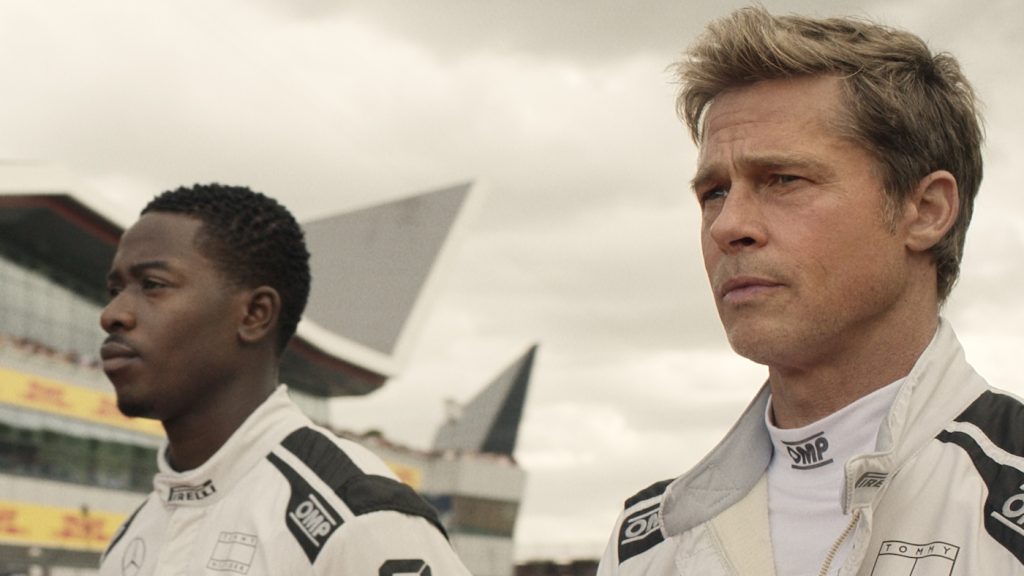
A few weeks, and throughout filming. We had a few weeks at Silverstone. Each time we went to a track, we’d get so many days with the actors so they could learn that track. It was a constant process. A lot of credit goes to Joe Kosinski for his vision. But a hell of a lot of it has to go to Brad and Damson too — at the end of the day, they are actors. Brad has a love for motorsport and motorbikes, but it’s a new thing for Damson. For them to do what they did at those speeds was truly impressive.
How big was your core team?
Luciano and Craig were the main drivers in some of the chasing cars, Ollie [Millroy], Oliver Webb, and Duncan Tappy, who we used as a camera guy as well. When we did the Daytona sequence, Pat Long helped guide Brad around that part of the circuit because it was all GT racing, and he is a Daytona 500 racing champion.
How did your team choreograph the races?
Joe would have a story idea and relied on ex-racing drivers like Luciano and Craig to translate it into racing stories. If you watch a real race, it can sometimes be quite boring. So, they spiced it up with what could really happen. There are a lot of scenarios that happen over the course of a Formula One season or a few years, but in our film, they all happen at once. The scene where the car hits the curb and flies up in the air, everyone was saying it was over-the-top and not believable, but that actually happened at a race. All the scenarios in the film really happened, just not all in one season.
While your team films on the ground, aerial DP Phil Arntz and his pilot Will Banks were coming at it from the air. How did you coordinate with the aerial team?
The camera cars cover the track and get close to the cars, but some shots work better from an aerial angle. Choreography and communication were key because we were going 190 mph at Daytona, so timing was everything. When the helicopter had to be at a certain place, we rehearsed so we could get the timing right. It was one big communication exercise — one can’t work without the other.
Were the racing cars also used as camera cars?
We had an LMP [Le Mans Prototype] car, which is like an Enduro car, and a Lamborghini, both with a camera mounted to them so we could get those speeds. You can get cars to go fast in a straight line, but racing cars can round corners so much faster.
The rehearsals must be so complex and detailed, because you’ve got actors who are not stunt drivers also going at 200 mph!
It really was quite easy because I had such good people around me. We had it all drawn up with toy cars out on a table. For the hero car, say Brad’s car, we’d plan out the cars that will interact with him, at what point on the track does the helicopter come in, and when does the camera car need to be behind, in front of, or beside him. It’s one massive communication exercise with the director, first AD, drivers, and special effects cameras.
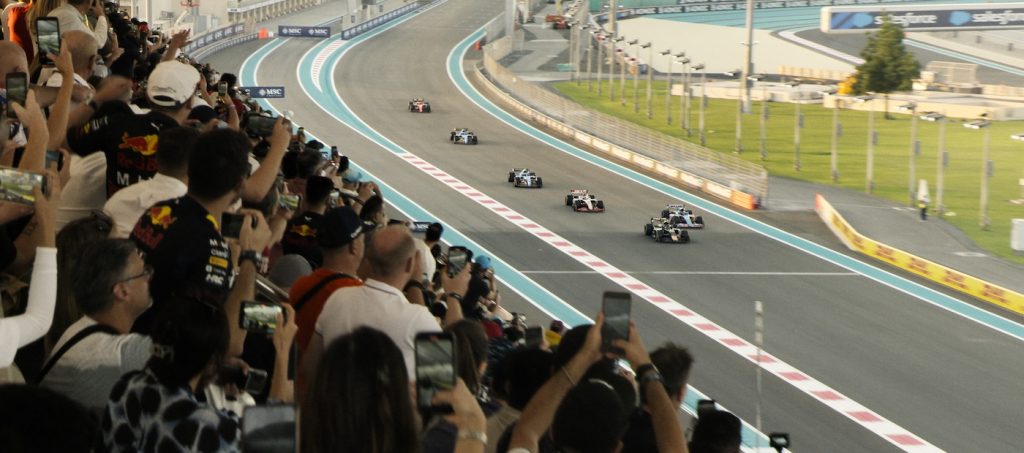
You followed the entire Grand Prix season that year, right? Was it difficult to mesh the chaos of a film crew with the chaos at the live races?
Full credit has to go to the Formula One organization for allowing us that level of access. We’re a very small fry in their world, but they gave us access to the pits and drivers, and even on race days, we were allowed to put our cars on the grid for warm-up laps. It wouldn’t have been achievable without that.
How much access to the tracks did you have?
We shot on practice days when the drivers were qualifying, and we got in between their sessions when the crowds were still there. On race day, we were in the pit with our cars next to all the proper teams, which was pretty amazing. We didn’t go on the track because it’s a live broadcast, and nothing can stop that show.
What was it like to shoot at the Silverstone race in the UK?
We were lucky enough to have access to Silverstone before the actual Grand Prix, where we worked out much of our choreography. We were given certain time slots, sometimes a 10-minute or 15-minute slot, and we had to maximize shooting during that time. We always had a game plan of what we needed to shoot and practice. The Silverstone event is absolutely massive, with around 300,000 people. On race day, helicopters land and take off every minute, carrying celebrities, and the pit walk is crammed with celebrities doing press. So, we just slot in and do our stuff. It’s pretty amazing to see the actual show and the infrastructure that goes into it. They build these mini buildings that are enormous hospitality units and leapfrog from race to race throughout the year. There’d be one at Silverstone, one at the next race getting put up, and the one at the previous race getting taken down. It’s pretty impressive to see this live show physically being flown around the world.
Check back tomorrow for the conclusion of our interview to find out how the climactic race in Abu Dhabi was shot and why the Las Vegas track turned out to be the most challenging one.
Available on PVOD now, F1: The Movie is streaming on Apple TV.
Featured image: Brad Pitt in “F1.” Courtesy Warner Bros.