How “Widow’s Bay” Turned a Mushroom-Fueled Nightmare Into an Emmy-Winning Soundscape
Creator Katie Dippold’s first season of Widow’s Bay for Apple TV+ was a smashing success. The series won an astonishing 14 Emmy Awards (out of 19 nominations), including Emmys for Dippold’s writing and Hiro Murai‘s direction. The series marries comedy and horror on an island that, despite its demonic nature, strives to be the next Martha’s Vineyard, at least according to Mayor Tom Loftis (Matthew Rhys, who won an Emmy for Lead Actor in a Comedy Series). Loftis tries to turn this backward idyll into a vacation destination and simultaneously reckon with the obstacle of a three-century-old curse; the island awakens, giving rise to murderous ghosts, violent storms, and creepiness of all kinds.
The show’s music received a host of honors, garnering wins for music supervision, sound mixing, composition, and sound editing. That last was for the season’s fifth episode, “What to Expect on Your Trip,” which sees Tom inadvertently drink a tincture extracted from the island’s potent psychedelic mushrooms, part of a desperate effort to decode and perhaps even throw off the secret curse bringing so much misery to his constituents. Much of Tom’s trip is told through sound and music—as he blacks out from one scene to the next, composer David Fleming’s score conveys the hapless mayor’s unpleasant journey. Editing pulls it all together, with the sound cutting in and out along with Tom’s consciousness.
We spoke with music editor Nate Underkuffler, part of the team awarded for the show’s unique sound editing, who explained how the music and sound departments joined forces on Episode 5, and how music supported the show’s cultural references and tied the season’s storytelling together.
How did the plot steer what you needed to do to make Episode 5 work?
Episode 5 is a terrific example of sound and music working together, because we had to try to sell this concept of the mayor, Tom Loftis, tripping on mushrooms for the majority of the episode, and pretty much all of that experience is from his perspective. We needed to make the audience feel like they’re tripping on mushrooms, and music and sound design played a big part of that—the hallucinatory feel of it, if what he’s seeing is real or if it isn’t. He fades in and out of this state of psychosis.
And that comes through via the sound. We never actually see him tripping, right?
It’s all done through old-fashioned editing, some camera effects, and music and sound. There was a lot of coordination between the sound team and the music team. When you’re trying to be surreal, those typical sonic boundaries are not so clear cut, right? Sometimes the footstep is stylized to the extent that it starts sounding like a percussion instrument, or the percussion instrument is stylized to the extent that it starts sounding like a footstep. And when you’re tripping on mushrooms, all of that can get intermingled into one surreal experience.
That’s a through-line of the show, right? The sound and music are layered together.
Sometimes the music is a little more traditional in certain respects. For example, Episode 6, which Dave [Fleming], our composer, won his Emmy for—that was a little more traditional, because we were taking place in the 17th century, but it was also horror, so anytime that spirit of the island is involved, all of the rules of traditional sonic experiences start to go out the window.
Did you have an overall plan for varying between jump-scare horror and other references for each episode?
We rode the line really carefully from episode to episode. A lot of the episodes are kind of homages to certain horror tropes or genres, with that Boogeyman episode being your classic slasher. It was a lot of conversations with Katie Dippold about how John Carpenter do we get? Or how much do we have all the music interrelated? There are obviously characters and settings that carry through the whole thing consistently, but at the same time, each episode’s a little self-contained. Katie generally didn’t want each episode to go full John Carpenter or full 17th-century Baroque classical-type music. She didn’t want us to go completely disaster movie for the storm episode later on. She generally wanted more of a cohesive consistency, but at the same time, those episodes do call for certain unique palettes.
How did that process look in terms of balancing both needs?
Sometimes for our composer, just as an experiment, I would cut in cues from earlier into later episodes. Dave is really good at manipulating one piece of music and morphing it into something else. Maybe you start with a cue that originated in Episode 1, but now, in Episode 6, it transforms into something slightly different that reflects the developing story, using the same thematic material and palette. But it was really Katie who directed to what extent we’re calling back to earlier episodes and then to what extent we veer into [certain] themes or concepts.
Patricia’s failed party episode really stands out for its music.
I have to give Dave a whole lot of credit. That was him zeroing in on the brilliant arc of the episode. Patricia [Kate O’Flynn] finds this very innocent self-help guide. As the episode goes on, there’s a descent into madness as the book works its curse of sorts on her. What seems very cut and dry at the beginning, with a lovely, pleasant orchestral synth piece for the book, Dave takes, cue by cue and scene by scene, and deconstructs it, then insidiously reconstructs it into something witchy and evil by the end. And then it’s that same DNA that’s in the final couple cues where everyone’s a zombie, it’s horrible, and things are on fire.
And what’s the process like for you, editing that?
It’s being aware of this overlying architecture. Whether he tells me or I can just hear it in the music, I identify that Dave has created this architecture from beginning to end, and then I have to honor that through all of the rocky bumps that the show-making process can entail, whether it’s picture changes or it’s notes, executing those while trying to maintain the integrity of the music in the way that’s going to serve the story. Just reflecting one day, I told Katie that I think the hardest part of my job is performing surgery on someone else’s baby. Dave writes this amazing piece of music, and then it’s given to me, someone gives a note, or there’s a picture change, and I have to start editing away at it.
In the season finale, how did you edit the music we hear alongside Tom’s conversation with Ruth that slowly builds up to the big reveal?
That last episode was a great, cool opportunity for some music editing, because it’s more of a slow burn, dramatic finale. We tried to pull in ideas from all the previous episodes and bring them together in a subtle way. For instance, Tom is trying to poison Ruth [K Callan], so I had the idea to call back to the poison plot music in Episode 6. Maybe we can help people make a subconscious connection by using a similar musical palette. Just trying to create this cohesion; that’s really fun. At the end of the day, it’s about trying to bring out the storytelling.
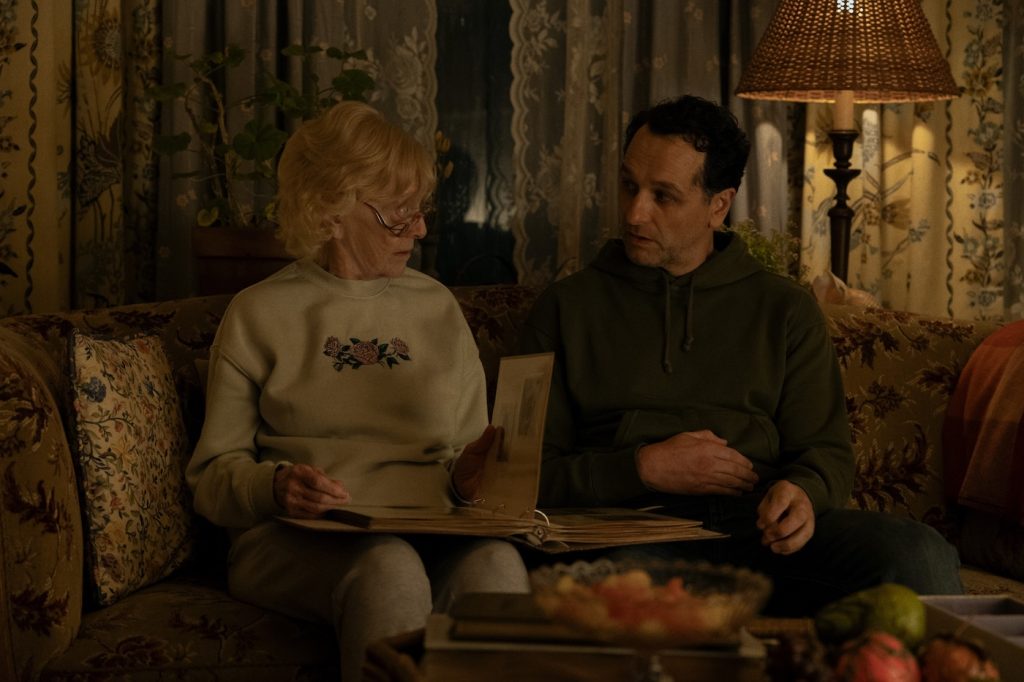
Featured image: Chris Fleming in “Widow’s Bay,” now streaming on Apple TV.