Foghorns, Ghosts & Gamba: Emmy-Nominated Composer David Fleming Conducts the Weird Wonders of “Widow’s Bay”
By the time Widow’s Bay creator Katie Dippold needed music for her haunted island horror-comedy series, she had already assembled a crackerjack cast and filmed the first two episodes. Composer David Fleming, fresh off last summer’s Superman movie, got the call. “Katie talked to me about this idea of feeling like you’re on a ride where the fun and the scary are not very far apart,” Fleming tells The Credits. “It’s a very specific brew, so I wanted to create a sonic world from elemental, tactile things like the wind and creaky old wood.”
That texture-driven approach earned Fleming an Emmy nomination for his contributions to Widow’s Bay, one of 19 nods for Apple TV’s new series.
Speaking from his home studio in Los Angeles, Fleming, who moved west from New York in 2009 to work with Hans Zimmer, explains how opera singers, conch shells and medieval violas helped evoke the spooky Widow’s Bay soundscape.
How did you get on the same page with Widow’s Bay creator Katie Dippold in terms of the show’s musical vibe?
We started the process with Katie giving me a rundown of the show, which you can’t really understand from a conversation.
On the contrary, you might be baffled.
I would be totally baffled, but it sounded intriguing. Then Katie showed me the first two episodes, and I just fell in love. She has this amazing barometer for what is right or wrong for the universe of her show. One thing that was very helpful is that she doesn’t like comedy music, and I don’t really like comedy music either. It was clear that we didn’t want to go there.
What did you come up with instead?
I suggested we define the music as an inextricable part of this mysterious, charming world where dread also lurks. The scary moments? We’ll find those. But my goal was that the music needed to be steeped in what the town is.
Namely, a quaint seaside village in New England.
Well, it’s not just any seaside New England village. The first thing you hear in the show is actually my wife Monica [Sonand]. She’s a trained opera singer, but for this particular cue, I wanted her to sing in a broken, ominous way, which is stacked up in dissonant clusters to evoke a foghorn. It’s warning you away but also kind of bringing you into this world, like a siren song.
You mention the wind. The music often has a kind of breathiness.
We used a lot of bass flutes on the score, some clarinet, lots of flutes, and even some conch shells.
Conch shells?
The conch shells didn’t become an idea until episode six, the colonial episode…
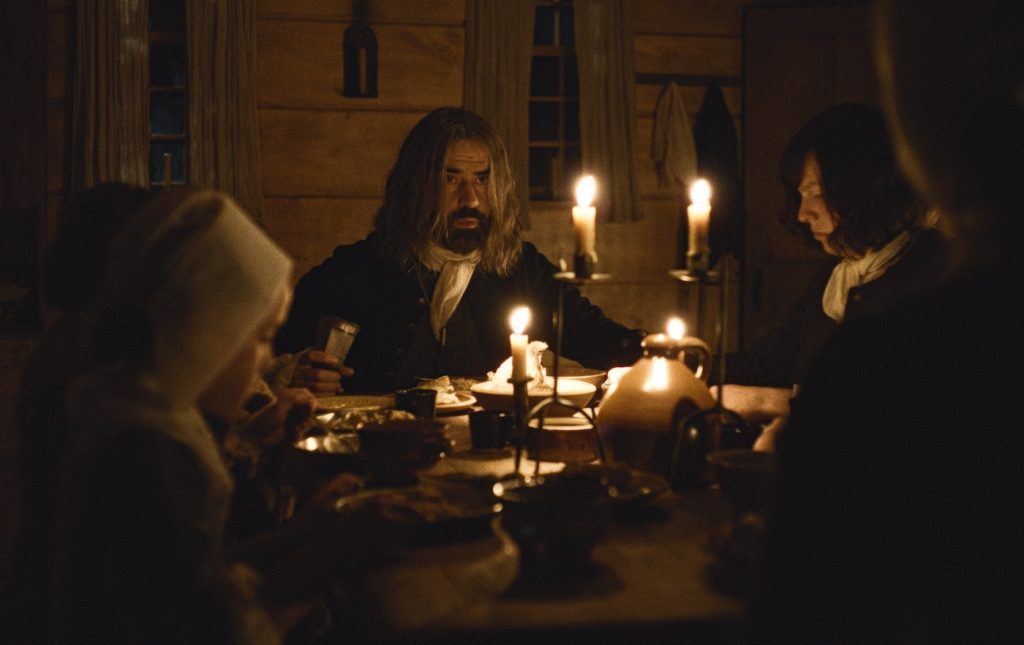
“Our History,” the flashback origin story set in 1702…
I used period instruments like the Viola da Gamba and the baroque cello that would be appropriate in that setting. At first, I thought the music would be used only for this episode, like a self-contained movie, but it strangely unlocked the back half of the show. Up until that, there were solo violins and solo woodwinds, but from episode six to the end, we started recording chamber strings and the music got a bit more orchestral.
And how do the conch shells figure into that?
By the time we get to the colonial episode, we realize there’s some ancient darkness that goes way back to pre-colonial times. You go: “Okay, it’s a beach town, so maybe there’s a shell, and maybe we develop that sound.”
The conch shell is used as percussion?
It’s “woo, woo, woo, woo, woo” [Fleming warbles] like a warning call. We got really excited by that sound and found a few places in episodes one, two, and three where the ink hadn’t quite dried, so we went back and added those conch shell sounds in there as well. They ended up representing this ancient aspect of the island. By its nature, there aren’t a lot of notes you can play on the conch shell, but we made it sort of rhythmic, and my friend Jake Boring played it.
You have a friend who knows how to play the conch shell?
Yeah. Jake plays all these amazing woodwinds and has a ton of wind instruments. He’s like, “Oh, I have a shell.” Again, it’s very limited as an instrument, but we found an evocative sound and just leaned into it.
In episode eight, the town’s resident “Boogeyman” chases Patrica – Kate O’Flynn – through the street, at night. The music accentuates his booming footsteps. Combined with this two-note moaning motif and high-pitched Psycho-like violins, your score goes full-tilt horror.
The Boogeyman episode is essentially our slasher movie where Katie said, “This is the one where we get to be a little cheeky.” For me, that meant drawing on the original Halloween, which has one of my favorite horror scores. The percussion sound is derived from an analog synthesizer, which is what Halloween director John Carpenter would have used. There are also some kettle drums, I think, and a lot of cellos going “dun dun dun dun” [singing low-pitched]. It’s the closest thing to a balls-to-the-walls action cue in the whole series.
That deep thumping sound hits hard in a primal kind of way.
The funny thing about that stomping sound is that music does so much heavy lifting in the Halloween and Friday the 13th movies. The killer’s walking very, very slow, so all of the momentum has to come from the music. I explained to Katie that we needed this relentless, driving feeling: “He’s catching up!” Otherwise, it’s just a guy walking slow.
And it totally works. On a tangent for a minute, you worked with film composing titan Hans Zimmer at his Remote Control Productions company on a lot of big movies. What did you take away from that experience?
I remember doing a cue for one of the Dune movies, a really crazy ten-minute piece which had three vocal key changes in the last minute. When I brought it to him, instead of being like, “Don’t you think that’s a bit much?” he was like, “I think we should do seven key changes!” One of the things I love about Hans Zimmer is that he will push something until it breaks and sometimes a little more. A lot of what I learned from him is this pursuit to make something better and more interesting than it needs to be.
Show business was booming when you arrived here in 2015. When you recorded the score for Widow’s Bay here in L.A., were you mindful of the impact a show like this can have on the local film music community?
Oh my god, of course I’m aware of it, and I’m really grateful, because we have some of the world’s best musicians, best engineers, best orchestrators. I also got to do Superman last year with the orchestra and choir in Los Angeles, which was such a privilege. I hope we see more of that, with post-production tax incentives coming back.
You’ve talked about the beginning and the middle of Widow’s Bay, musically. What about the finale?
That’s actually my favorite cue for multiple reasons. For one thing, it was Plan B because Plan A failed spectacularly. When Katie lovingly rejected it, I was forced to come up with a new one really fast.
What went into the cue you call “Come Back Soon!”?
I had already spent my thematic fog siren sound as the first cue of the season. Now I repeated it but with much more emotive string movement underneath. There’s also a bass flute motif and a repeated woodwind thing in 6/8 triple time, which, for me, feels like sending you off and saying, “This has been fun.” It was a little bit like writing a postcard and maybe a secret wish that we would get a season two, because at the time we didn’t know if the show would be renewed, so I was like, “This could be it.”
A fond farewell, but maybe not really.
Yeah. And then the credits music hits really hard with this big synth bass, which is my last chance to do something a little outlandish. The very last thing you hear is a little hint of the “Moonlight Sonata” arpeggio, which is me spending all of my remaining ammunition. Katie and director/executive producer Hiro Murai both got a kick out of the end-credits music because I was just having fun playing in the sandbox of this wonderful theme park.
Widow’s Bay will be back for season 2. Season 1 is streaming on Apple TV.
Featured image: Kate O’Flynn, Matthew Rhys and Stephen Root in “Widow’s Bay,” now streaming on Apple TV.