
How Production Designer Charles Wood Created Spider-Man’s Lonely New York for “Brand New Day”
Set four years on from Spider-Man: No Way Home, director Destin Daniel Cretton’s Spider-Man: Brand New Day depicts Peter Parker (Tom Holland) as exceptionally lonely, even for this particularly eternal coming-of-age superhero. In the last film, Spidey’s heroics necessitated pulling himself away from his best friend Ned (Jacob Batalon) and love interest MJ (Zendaya), both of whom no longer remember him. The separation torments Peter, who tracks his former buddies on social media as they graduate from MIT and move to New York, where, of course, Peter also lives.
As Spider-Man, Peter is still fielding calls from Detective Jean Dewolff (Liza Colón-Zayas) and working through his rivalry with Frank the Punisher (Jon Bernthal), but his loneliness is palpable here, too, as an unusually difficult-to-vanquish threat makes it clear that Spider-Man can’t fight every threat on his own. When he’s out of his suit, Peter crashes MJ and Ned’s housewarming party and buys bodega flowers for his Aunt May’s (Marisa Tomei) grave. In his suit, he starts to make mistakes as his trusty powers begin to betray him. But as he learns more about the threat facing the city, despite the risks, Peter realizes he needs to bring together his world above New York’s rooftops with the urban, grounded life of his loved ones below.
With Brand New Day set in New York but shot primarily in Glasgow and at London’s Pinewood Studios, production designer Charles Wood (Project Hail Mary, Avengers: Endgame) had his work cut out for him recreating New York from the ground up. We got to speak with Wood about the research and detail that went into crafting Spider-Man’s built environment across locations and an unusually extensive backlot, ensuring a texturally rich environment to hand off to visual effects that also precisely conveys where young Pete is in his emotional journey.
How did you use the production design to convey where Peter, MJ, and Ned are in their lives, four years after the events of the previous film?
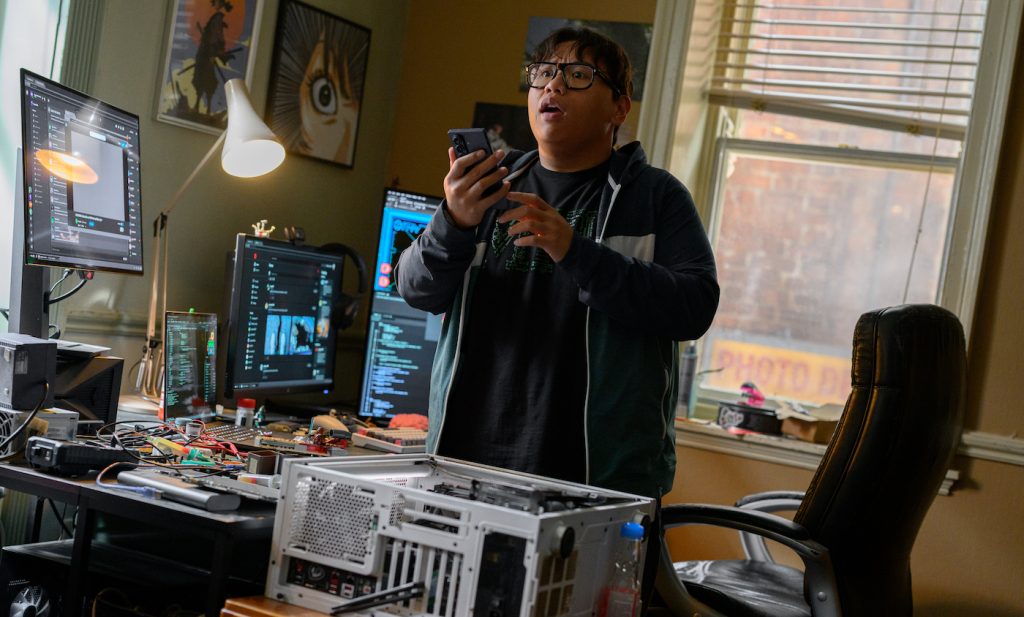
We went to New York; that’s the first thing we did. We spent many days wandering around and talked at great length about how Destin wanted to ground them back into this place. It wasn’t about the spectacle; it was about capturing the feeling of a neighborhood. We knew we’d have to recreate it all back in the UK, but the fact that we had to recreate it made one look at it in a very deep way. You had to notice everything, not just architecturally but also culturally, to make this world feel authentic and like a place of history.
What did recreating New York in the UK end up looking like?
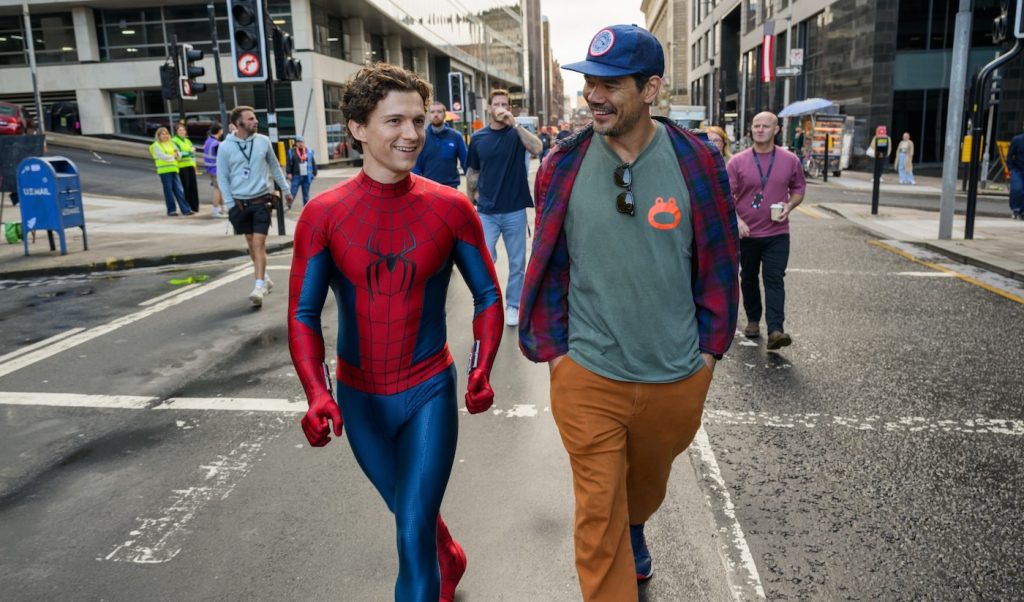
We [shot in Glasgow] for the big car chases, but everything else was built. What we ended up doing at Pinewood Studios was building a big backlot. We built a series of streets and alleyways, and we built quite high, 30 or 40 feet. It’s unusual to be able to build sets at that scale.
And in such detail—Peter’s favorite bodega is so realistic.
That wasn’t easy. Everyone says it’s just a bodega, but it really isn’t. You have all that nuance you want to try to capture, because you don’t want to get it wrong for the New Yorkers. I always had that in the back of my mind.
When we’re looking at interiors like MJ and Ned’s first post-college apartment, what are we seeing?
All of those interiors, the apartments, shops, the living areas were built because it’s difficult to find. It’s so nuanced. Even the shape of the bricks we made. They had to be New York bricks, not British bricks. Oddly, they’re a different proportion. Thanks to the studio for allowing us to do those things, and giving us the support to be able to do that. That doesn’t happen all the time.

How did you come up with the concept for Frank’s unusual abode?
When we tried to figure out where Peter Parker’s next apartment would be, we ended up going up the building. We put his apartment on top of his old apartment, in a sense. The idea was that he’d be shielded from the city, but he could observe it. It echoed his frustration and loneliness. He could only peek at what he couldn’t have. In England, there’s this great historical dock called Chatham, where a lot of our warships from the 18th and 19th centuries were built. I remember being in New York and seeing the Brooklyn Navy Yard. [Peter and Frank] share in their narrative the same level of separation. So we thought, why not put Frank somewhere on the other side of the river? We found this fantastic warehouse where they used to build submarines. We thought, let’s put him on a boat. We picked this early 20th-century coal barge, and built the interiors for it on a stage. We wanted to hold him in this strange world. It was all about him being able to look over the water back to the city.
How did you approach the Damage Control headquarters design?
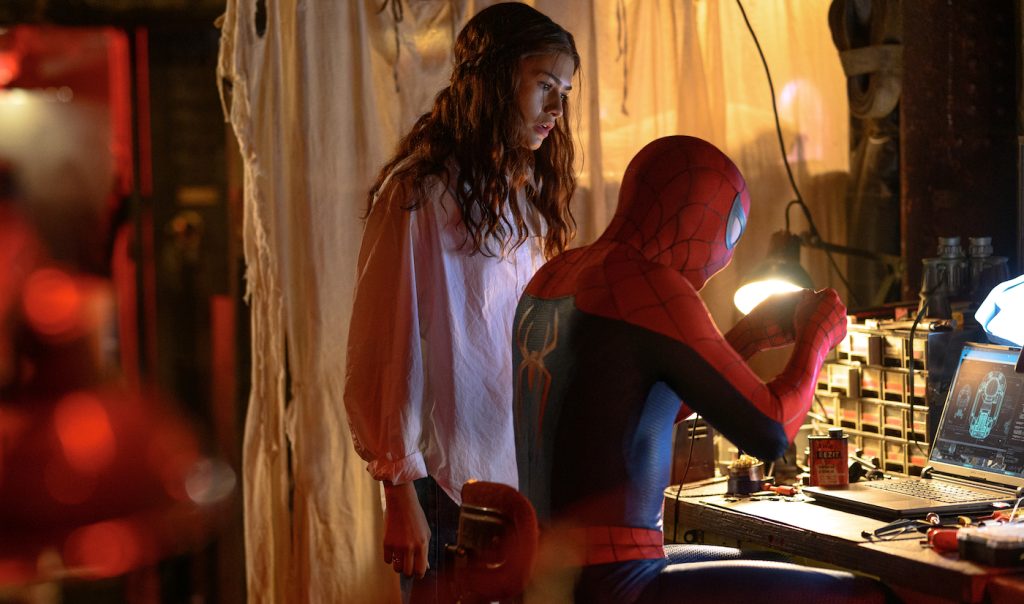
That was based on a building called Senate House, which is one of the more architecturally accurate to New York, larger-scale buildings. It was an obvious place to go. We wanted to give Damage Control a level of history, so that whoever this group is would be lost in the structure of this huge building. We always try to give a historical edge and stay away from the contemporary.
Is there a physical or built set that might surprise audiences?
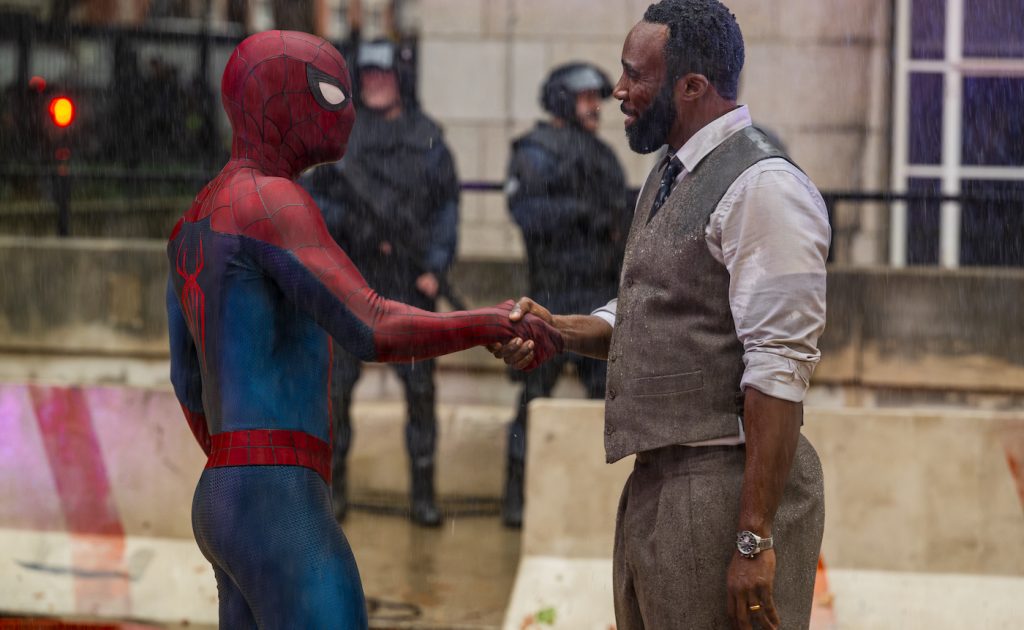
A lot of people presume the backlot is virtual, but it isn’t. All of the streets of New York were built. A lot of people were surprised that was an in-camera thing. Most of what we did was built, except the flying environments.
And when it comes to the flying environments, what does your role look like in terms of working with visual effects?
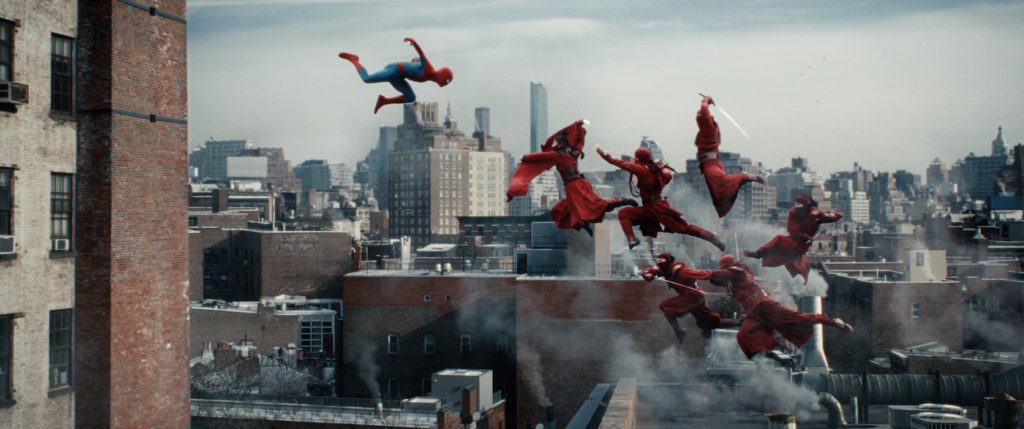
That starts on day one. I worked with [visual effects supervisor] Jerome Chen every day. These days, as an art department, what generally happens is we design and build the backlot three-dimensionally in a digital model, then we start doing all the set extensions, and then we hand over all of that to VFX. As you journey through the film, it’s a really important relationship with the VFX supervisor. All the stages where Spidey is running on buildings are practical spaces, but [Chen] obviously needs to take over from the point of jumping, so you have to be really careful with the lighting and texture. Whatever surfaces I set up for VFX have to also set a standard. Because if the standard is good, and the detail is good, it carries on into the effects world.
Spider-Man: Brand New Day is in theaters now.
Featured image: Tom Holland stars as Spider-Man in Columbia Pictures SPIDER-MAN™: BRAND NEW DAY. photo by: Courtesy of Sony Pictures