
Editing the Extraordinary: Sarah Broshar on Finding Humanity in Steven Spielberg’s “Disclosure Day”
“I try not to, it freaks me out to be on set honestly,” editor Sarah Broshar tells The Credits about her process for Disclosure Day, a new film from our favorite alien-obsessed director, Steven Spielberg, which stars Emily Blunt, Josh O’Connor, Colman Domingo, and Colin Firth. “I don’t want to be on set to see the drama or the behind-the-scenes so it’s fresh when I watch it.”
Broshar has been part of the Spielberg family since 2011’s The Adventures of Tintin as an assistant editor, before moving to the co-editing chair with longtime collaborator Michael Kahn on The Post (2017) and the subsequent Ready Player One (2018), West Side Story (2021), and The Fabelmans (2022). Disclosure Day marks her first solo act with the Close Encounters director, featuring meteorologist Margaret Fairchild (Blunt) and cybersecurity expert-turned-whistleblower Dr. Daniel Kellner (O’Connor) in an intense thriller about the existence of alien life. Trying to keep it under lock and key is a mysterious secret agency led by Firth’s Noah Scanlon. Opposite Firth’s Scanlon is Domingo’s Hugo Wakefield, who wants the world to know we are not alone. Though set in parts of Missouri, Maryland, and West Virginia, the production was shot in New Jersey and New York, with Brooklyn’s Steiner Studios as its soundstage home. Broshar had to weave a fast-paced chase narrative alongside the characters’ deepening emotional arcs.
In collaborating, Broshar suggests Spielberg is the best audience member. “He watches so many movies, he knows movies, he loves movies, and so when we cut or watch a scene, and it feels false or if we have an idea to make something more efficient, evocative, emotional, impactful, or tense, we’ll just stop and work on it. Usually, we don’t make it through five minutes of the movie, and we’ll spend all day working on something, but sometimes we’ll watch the movie twice in one day.” Her approach with Spielberg is somewhat traditional. The two will watch footage with the director providing feedback on specific takes before she puts a scene together. But Broshar says early feedback isn’t always available, leaving the editor open to mining a scene.
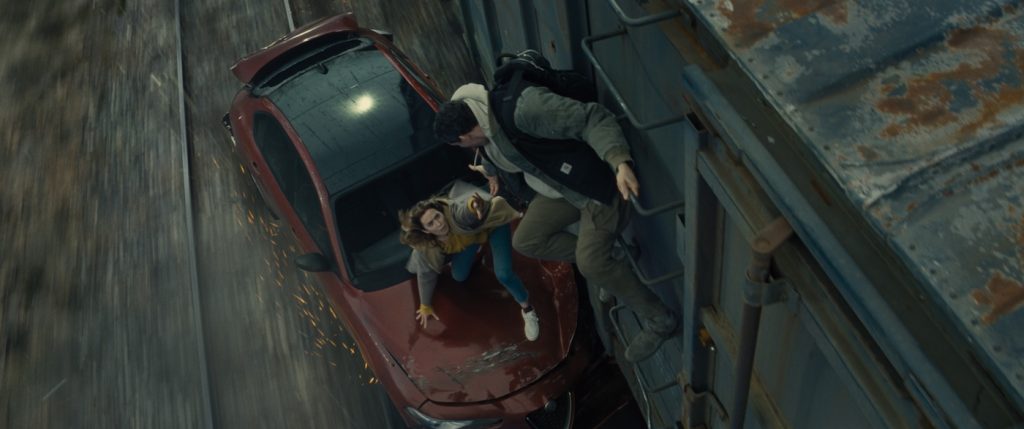
One such moment is a climactic sequence in which Margaret and Daniel are trapped in a car as it is dragged by a moving train. The two jump onto a railcar just before disaster strikes. The scene combined a practical railroad location in Cape May, New Jersey, and a set that included a 50-foot, 50,000-pound box car from a train museum in Kentucky for stage work at Steiner Studios. The life-threatening incident sends Margaret into shock. “That scene is so emotional, and she is so raw and vulnerable,” says Broshar of Blunt’s performance. “We were crying watching the dailies, and it was a really difficult scene to watch, but also, you could tell which parts of which shots were really working. You could feel the moments that were really effective in a wide shot, or when we wanted to definitely be close to her. Because her performance was so dialed in, after we did the initial cut, we may have looked at it a tiny bit more. She delivered that scene pretty much the way it is. It just had this life of its own.”
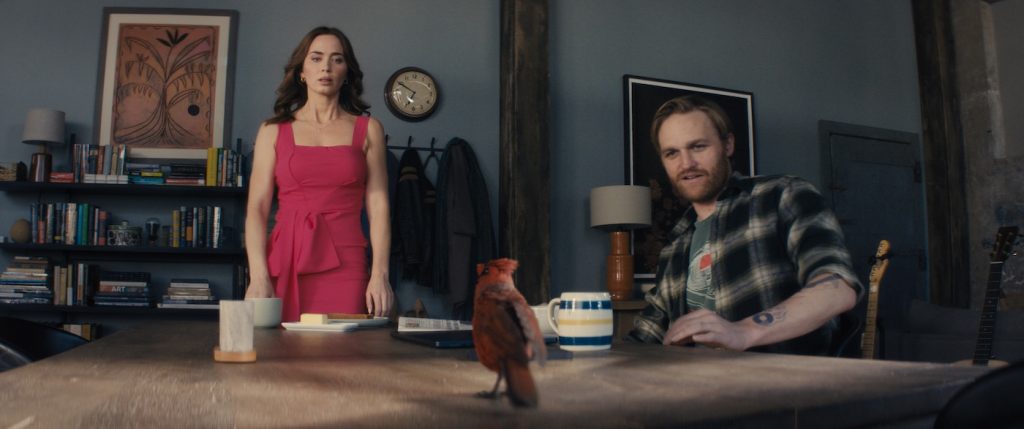
Blunt’s character is the emotional crux of the story. Margaret goes from an uncertain news personality to a person putting clues together from a fuzzy past. Developing her arc was key for the editor. “Her journey is so beautifully written and performed, you always know exactly where she’s at,” notes Broshar. Part of that journey is Margaret becoming a kind of vessel for the aliens, able to speak a language she’s never spoken before or look at someone and know everything about them. She’s omniscient in every sense of the word. Scenes show her speaking Russian to her boyfriend, Korean to a news guest, and getting out of a speeding ticket by reassuring the officer that her relationship will be okay. Broshar recalls Blunt’s performance turning on a dime. “The scene with the cop, we had maybe three takes of her close-up, sort of doing her thing, where she reads him and is translating his feelings and insecurities. They were all very good. Then the third take, it was like she’d snapped into this other dimension, and you’re like, oh wow. We had a lot of performances [from Blunt] like that.”
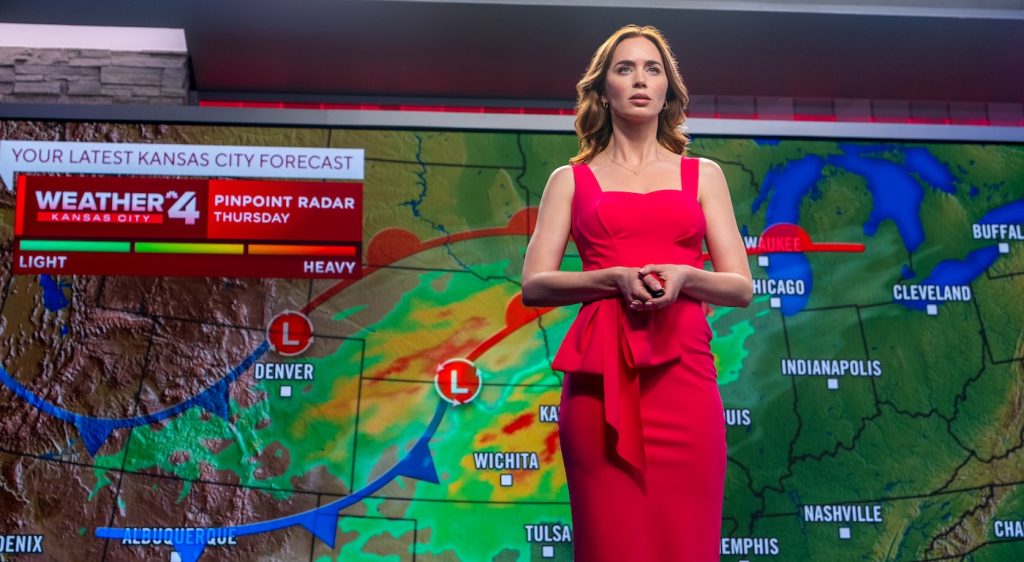
For the scene when Margaret speaks in an alien-tongue while delivering the weather on a live newscast, Broshar relied on an ADR session from the sound department overseen by supervising sound editors Gary Rydstrom and Brian Chumney. “They came to New York and recorded her [Blunt] in an ADR booth before the shoot. They had worked for a while developing her sound, so it was something she could perform and gave us the sound for playback on stage. We then cut the scene, and we ended up needing more audio to play the moment, which was no problem at all because they were able to fill it out.” Standing in for the television station was a building at the New Jersey Institute of Technology (NJIT) in Newark, transformed into a fully functional Kansas City KCXE television studio by production designer Adam Stockhausen. For later scenes set inside the control rooms of NBC News, they were shot in the actual studios at 30 Rockefeller Plaza in Manhattan, with performers played by news employees doing their real-life jobs.
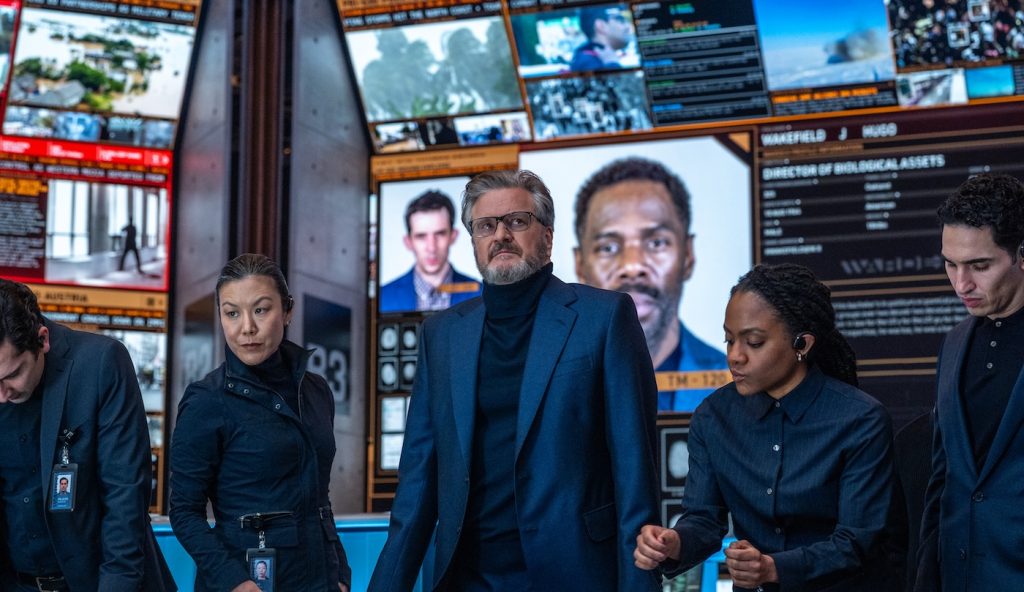
Another story element Broshar navigated was the polar-opposite opinions of Noah and Hugo – one believing alien life should be kept secret, the other wanting to expose it. The peak of their confrontation comes in a face-to-face conversation, a scene that asks the audience, “What side are you on?” A lot of people I’ve talked to say Hugo’s a good guy and Noah is a bad guy, but we always looked at Noah’s side very seriously when we put that scene together,” she says. “It was very challenging, as many dialogue scenes go, because they’re much longer on the page. Then, when you get it in the movie, you’ve got to find the heart but also keep it moving. We had great performances in the scene, but it was interesting to put together because of the unique camera angles we used for the dialogue. There was a lot of footage.” Helping her find the rhythm was a score from 94-year-old composer John Williams, who wrote and recorded the music over six months.
The experience left Broshar excited to see Spielberg write again. “One thing that I will say, after The Fabelmans, which he co-wrote with Tony Kushner and then with this movie, he wrote the story and David Koepp wrote the screenplay… I’m like, Steven, keep writing. It’s so great.”
Disclosure Day is in theaters now.
Featured image: Emily Blunt in DISCLOSURE DAY, directed by Steven Spielberg.