
DP Charlie Gruet on Turning Tracy Morgan’s Comedic Genius Into Docu-Style Gold in “The Fall and Rise of Reggie Dinkins”
If anyone has an answer to reviving the fading network sitcom, it’s Tracy Morgan. The beloved comedian hardly needs an introduction, and his 30 Rock character alone puts him on the Mount Rushmore of iconic Black television stars alongside the likes of Redd Foxx, Martin Lawrence, and Bernie Mac.
“Family, I’m thirsty! Who is in charge of my thirst?”
Or how about…
“Here’s some advice I wish I would’ve got when I was your age. Live every week like it’s Shark Week.”
With The Fall and Rise of Reggie Dinkins, Morgan plays a disgraced former NFL star attempting to rehabilitate his image after a gambling scandal. He hires an award-winning filmmaker, Arthur Tobin (Daniel Radcliffe), to document his comeback as he eyes induction into the NFL Hall of Fame. The unlikely pairing of Morgan and Radcliffe, combined with the show’s brilliant writing behind creators Robert Carlock and Sam Means, makes it must-watch TV.
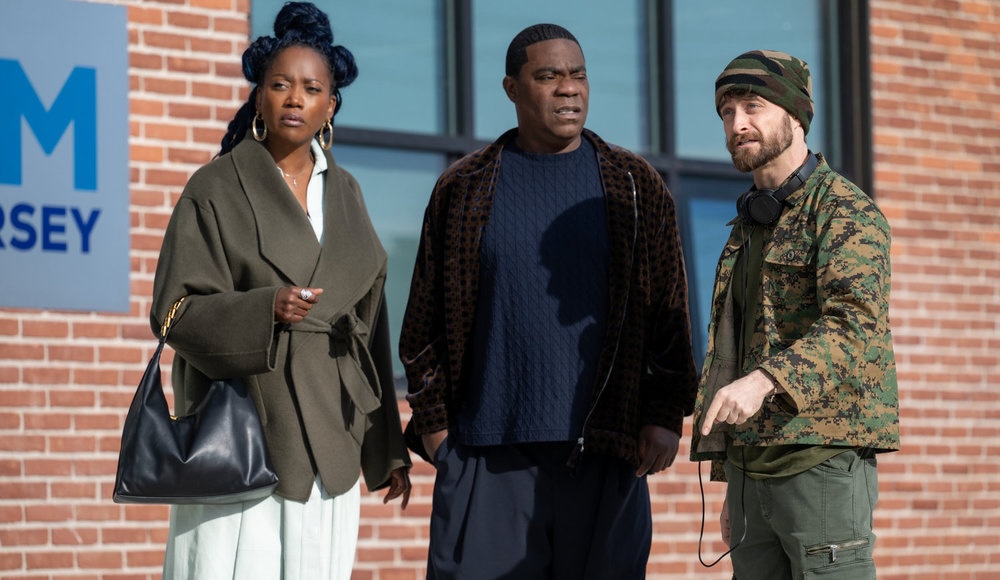
Helping bring the show’s visual style together was cinematographer Charlie Gruet, who photographed all 10 episodes of the first season. Gruet’s experience dates back to the early aughts, when he started in short films before landing work on shows like High Maintenance, Saturday Night Live, and Hulu’s Adults. When it came to The Fall and Rise of Reggie Dinkins, Gruet crafted distinct contemporary and documentary-inspired looks that immerse you in a world that feels lived-in and authentic.
Asked about the approach, he recognized the team effort. “I loved being able to craft the look along with gaffer Matthew Mendelson and key grip Brent Poleski. We really had a great team and set to work with, and the goal was to advance the story with a look as real as possible.”
Below, Gruet dives into how he established the tone, the challenges behind modern-day network television, the Megan the Stallion cameo, and his fondness for cats.
In the early 2000s, Tracy starred in the sitcom The Tracy Morgan Show, which taped on the CBS Radford lot. Coincidentally, I had a parking space across from him. Is he still driving that red Hummer?
I never saw him driving the Hummer, but I did see the Lambo!
Lambo? That’s a very nice upgrade. He was always such a delight and seemingly talked to everyone on the lot. How cool was it working with him?
Before the shoot, Tracy had dinner at his house for the cast, writers, producers, and me (somehow), and one of the stops on the house tour was the garage. Tracy loves his cars and aquariums. He was great to work with, always positive and inspiring.
How did that energy translate to the production?
He likes to make an entrance when he arrives on set, usually with some walk-in music. One day, he came to set blasting Phil Collins’ “In The Air Tonight,” and the entire cast and crew stopped and air drummed along with Tracy. He likes to create a family atmosphere.
That is amazing – he is an original. While on the topic of originality, pilots set the tone, style, and pace of a series. What did you and director Rhys Thomas talk about in terms of creating the aesthetic?
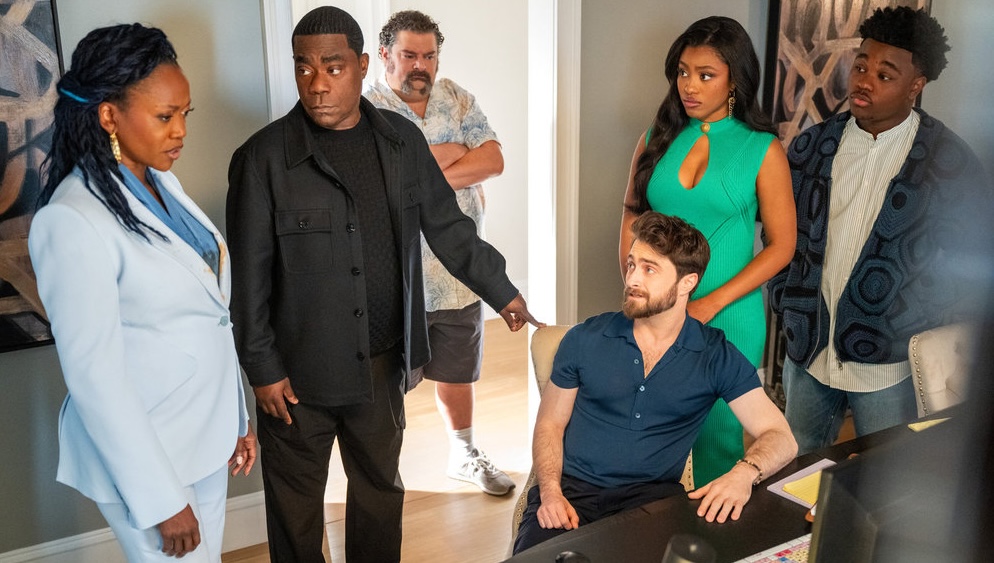
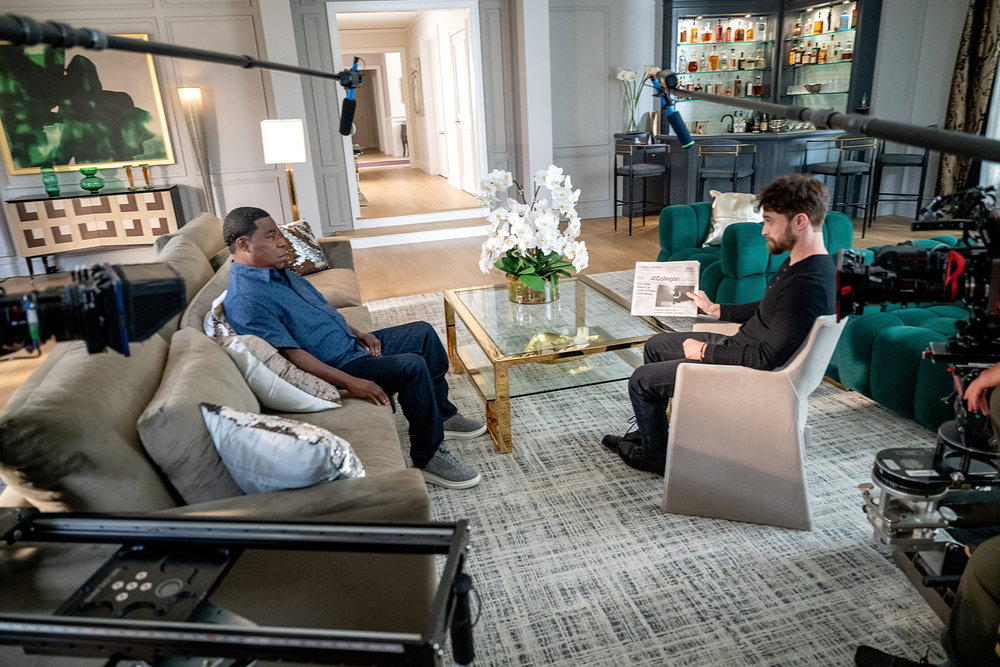
We definitely leaned into The Last Dance and other sports documentaries when we decided upon the look for the interviews. We wanted them to be more dramatic and staged to contrast the vérité work. I have a decent amount of doc experience, and Rhys is one of the masterminds behind Documentary Now, so we knew that we wanted to give a nod to sports docs like HBO’s 24/7 and Showtime’s All Access.
So how did you want to approach the vérité look in terms of camera coverage?
We mostly wanted to adhere to the idea that vérité scenes should be covered by the two cameras from their respective positions, meaning there would be no reverse shots or turnarounds. It also meant the characters would be in profile sometimes, or the camera would adjust during a line, which is typically something you try to avoid in scripted comedy.
That is a rare visual style, especially in a network sitcom, but it works very well. The same could be said for the decision to reveal the documentary crew.
Thanks. We wanted to catch pieces of the camera operators or boom ops to break the 4th wall. If you see a camera operator in the shot, that operator is filming the show. We didn’t use background actors with prop cameras—those are the actual camera operators! There was a limit to how much we could see because of regulations with labor and unions, but we tried to tease just enough to inform the audience that this is a documentary.
We also get to see the documentary footage Arthur Tobin (Daniel Radcliffe) is working on in raw, behind-the-scenes moments. How did you want to distinguish those visuals from everything else?
If anything was from a specific period, we used that era-specific camera to evoke an authentic feel. So we ended up filming with a Betacam SP, a Sony Handycam Hi8, a GoPro, an HDX-900, and a Sony PD-150. The look was a combination of cameras, lighting, frame rate – 59.94 and 29.97 for the past, 23.98 for the present – and resolution. The present was 6K, and the past was sometimes 480p, 720p, or 1080p. In concert with those old cameras, I used era-appropriate lighting.
How so?
For example, no large LED soft sources for the draft footage with Reggie. Or if something would have been lit with Par Cans, we used Par Cans – staying true to the tools of the time, we were able to achieve a different vibe.
To me, the show balances realism with stylization. How did you decide when to lean into each approach?
That’s a good question, and I think it always distills down to the story. I am constantly applying this mantra: How can we best support what this scene is trying to say in the bigger picture? I choose to lean into each approach based on how best to advance the story. If you stray from that, you can damage the flow of the narrative.
Can you give me an example?
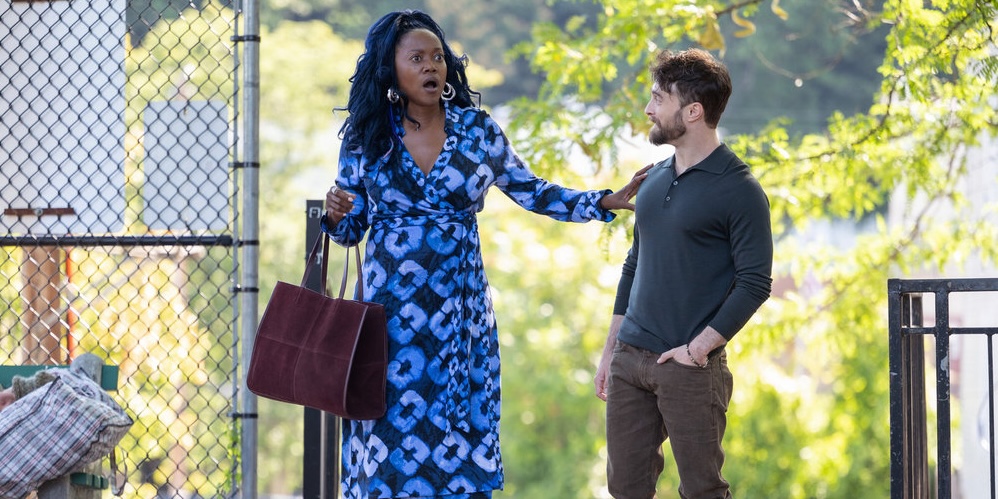
This show has these great moments where we cut away to a past event, something so outside the vérité world that we wanted to jar the viewer into understanding this is different. Within the Arthur Tobin filmed documentary footage, we would ask ourselves: is this a “found” or “vérité” moment, or did Arthur set it up or plan it? Examples of that would be the sit-down interviews, the “on the fly” interviews, or moments where Arthur, as filmmaker, is driving the narrative, like bringing Monica [Erika Alexander] to the old playground, or confronting Reggie about the Penn State prank.
Production design plays a big role in the world. How did you collaborate with the department and use color as a storytelling device?
With the use of window light being the prime source, we decided that a lot of Reggie’s house should feel light and airy. In some of those other, masculine places (Reggie’s office, living room), we went darker with the sets. Teresa and the entire art department created an elevated look inside Reggie’s house; he’s got money, so we tried to amplify that. Teresa made sure that we kept it “airy” feeling but still incorporated accent colors that felt elevated and not jarring.
How, if at all, does the show’s being on network television influence the vision?
Honestly, it was timing. Timing and pacing in the performances, and how the camera interacts with the cast to land a joke with the right timing. There is a specific (to the frame) requirement, unlike streaming, where a show could be around 27 minutes (+/- 5 minutes). This had to land exactly at a certain length.
The writers and director, along with the cast, worked efficiently to land the timing. The editors did a great job sculpting the pacing to meet the network’s timing requirements. I think I foolishly thought “This is network!—we’ll have a ton of time and money.” But that’s not the case; we were pretty lean, and there was no waste in time or equipment. It was a tight ship, but it ran really smoothly.
The opening sequence of episode 1 establishes Reggie’s world with a very controlled, almost claustrophobic visual style. How did you want to communicate that sense of confinement right away?
Rhys wanted the opening to easily convey a misdirect landing with Reggie literally saying, “I don’t like it, that’s a bummer.” So we leaned into the visuals, having an over-serious tone. Because some of it was period footage, we went with a 4:3 aspect ratio and had Reggie either surrounded by people in the frame or consuming the entire frame. There’s a bit of immediate world-building in that first sequence, so we wanted to add some scope while also maintaining the laser focus on Reggie so the “fall” would hit harder.
Episode 4 features several nighttime exterior scenes in which Reggie searches for a cat. Did you bring home any of the cats?
My family already has two cats, and I think that is plenty (I love cats, but my kids want more). There is a great line in this episode that my kids and I like to recite often to our own pets: “Who will eat you when you die in the tub?”
Morgan’s shows always seem to land fantastic guest stars. Megan Thee Stallion appears as a mail carrier in episode 5 and becomes an Arthur Tobin obsession. How did you want to frame his awkwardness around her to drive the narrative?
I felt that the physical dynamic between them was best conveyed in a two-shot. There is a significant height difference, and that played into the comedy of the scene. Their performances together were great, and Daniel’s awkwardness shines when juxtaposed with Megan’s presence in the same shot.
Looking at the finale, what was the most important visual idea you wanted to leave the audience with?
Authenticity. I want the viewer to believe that the footage of the Boobers commercial was real, that Sports Shouting is a real sports talk show, and that the vérité footage in Reggie’s world is being captured in the moment. Obviously, it’s not, but if I can transport the viewer instantly to a world they recognize, then the comedy from the performance and writing can have a greater impact.
The Fall and Rise of Reggie Dinkins airs new episodes on NBC and also streams on Peacock.
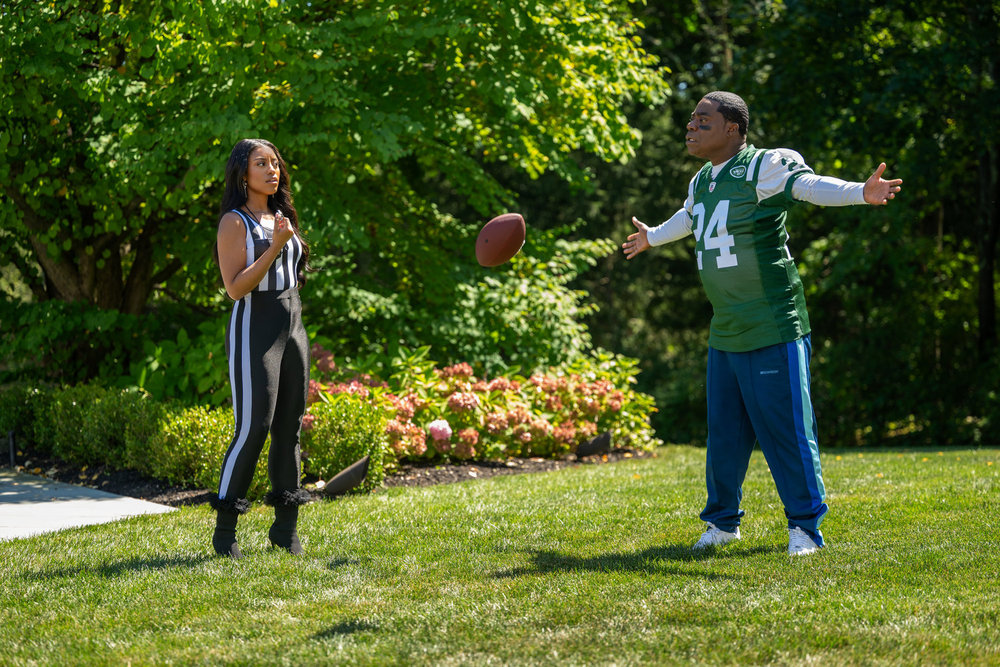
Featured image: The Fall and Rise of Reggie Dinkins — “Pilot” Episode 101 — Pictured: Tracy Morgan as Reggie Dinkins — (Photo by: Scott Gries/NBC)