“The Pitt” Cinematographer Johanna Coelho on Season 2’s Immersive 15-Hour ER Shift
From the moment I pressed play on The Pitt, it became immediately clear that this was not a conventional medical drama. The series plunges viewers headfirst into the relentless chaos of a hospital emergency room, where life-and-death decisions unfold in seconds, and human connection becomes both a lifeline and a liability. What struck me most wasn’t just the emotional intensity or the gripping performances, but the remarkable visual language. The camera drifts through crowded hallways, breathing alongside its characters, hovering anxiously at bedsides, and catching fleeting glances that hint at stories yet to come. It’s immersive, visceral, and deeply human.
That visual experience is largely the work of Johanna Coelho, the series’s sole cinematographer. Her approach is fluid, unobtrusive, and meticulously choreographed. It creates a sense of presence that pulls the audience directly into the narrative. In conversation, Coelho revealed just how much intention, collaboration, and precision go into making the camera feel like a silent resident moving among the ER’s perpetually busy staff. “We try really hard to be invisible,” she explained. “That’s really the visual I aimed for, is that you don’t realize what’s happening, but you keep watching it and see it as the characters are seeing it.”
The Art of Disappearing
One of The Pitt’s defining qualities is its ability to juggle multiple storylines within confined spaces without feeling visually overwhelming. Scenes are dense with activity. Doctors rushing past, patients being wheeled through corridors, hushed conversations, all unfold in the background, yet the frame never feels cluttered or chaotic. Achieving that seemingly effortless balance requires extraordinary choreography. “The camera moves a lot, but you don’t,” Coelho said. “The goal is that you don’t feel it too much. You just experience it as an immersive feeling. So it’s actually completely perfectly choreographed everywhere.”
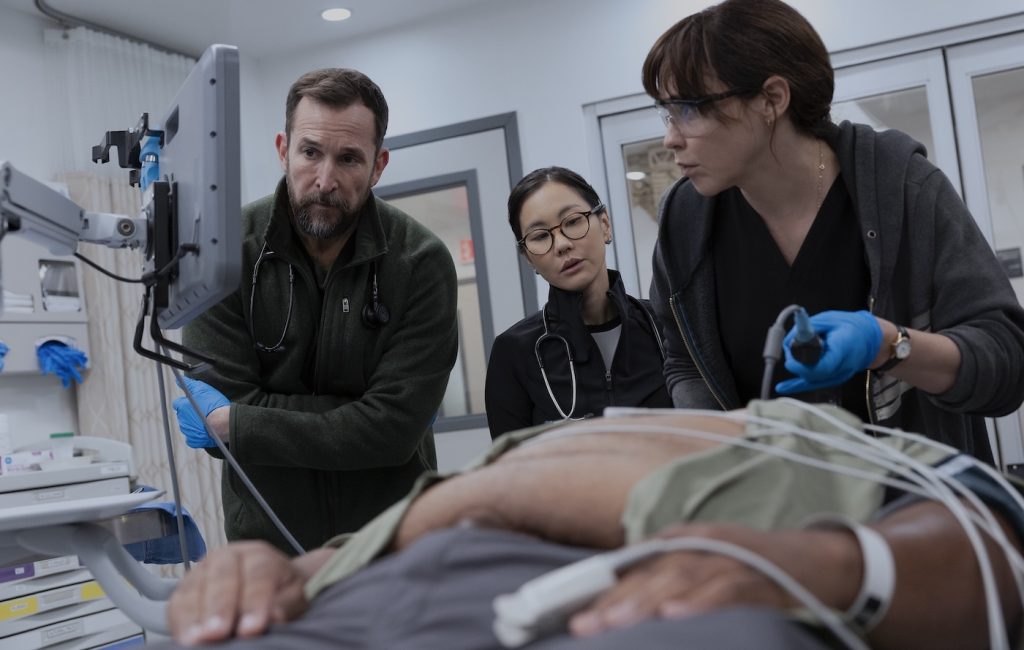
That choreography extends far beyond the main action. If you look closely, you’ll notice background characters who later become central figures, fleeting moments that gain new meaning in subsequent episodes, and subtle visual breadcrumbs woven into the fabric of the show. “There are all these moments as the characters pass through or walk through the ER that they are noticing something or someone in the background that will have an influence on the story later,” she noted. “It’s not an insert, like, ‘Look at this.’ It’s happening, and the character is watching it, but you might have to rewind if you really want to pay attention to it.” In this way, The Pitt rewards attentive viewing. Each frame is layered with narrative information, reinforcing the idea that in a real emergency room, every second contains multiple overlapping stories.
Handheld Intimacy
A major component of the show’s realism comes from its exclusively handheld camera work. Rather than relying on static compositions or elaborate dolly moves, Coelho and her team opted for a documentary-style approach that allows the camera to drift organically through the space. “It’s all handheld. The whole show is handheld,” she said. “We wanted this documentary feeling, like we’re really just experiencing a shift, following doctors and nurses inside the ER.”
To maintain control while preserving spontaneity, the production employed a specialized rig that combines the freedom of handheld with the stability of a Steadicam system. This allowed for dynamic movement, such as tracking backward, gliding sideways, and adjusting height mid-shot, without the jitteriness often associated with handheld footage. “You still get that sense of motion,” Coelho explained, “but you don’t feel the operator, and that was very important for us.” The result is a camera that feels like an unseen observer, never calling attention to itself, weaving seamlessly through the action.
Orchestrating Controlled Chaos
Some of the show’s most impressive moments come in extended sequences where multiple scenes unfold within a single, continuous shot. One standout example occurs early in the second season, when a seemingly simple conversation gradually morphs into a complex dance of characters, background action, and camera movement.
Coelho described the sequence in vivid detail. “It’s all these mini scenes in one big scene, and they have to be timed perfectly. So first of all, we are on this rig, not on the dolly or anything. So just rotating like this is not always easy without feeling too intense. But then you also have to coordinate the speed of that movement with the timing of the background actor moving, and then the actor comes and grabs the camera.” The shot unfolds as characters drift in and out of frame, conversations overlap, and new storylines seamlessly emerge. “There are a lot of backgrounds passing by and gurneys, etc. So it’s not only timing that with the actors, but also where the background crosses the camera.”
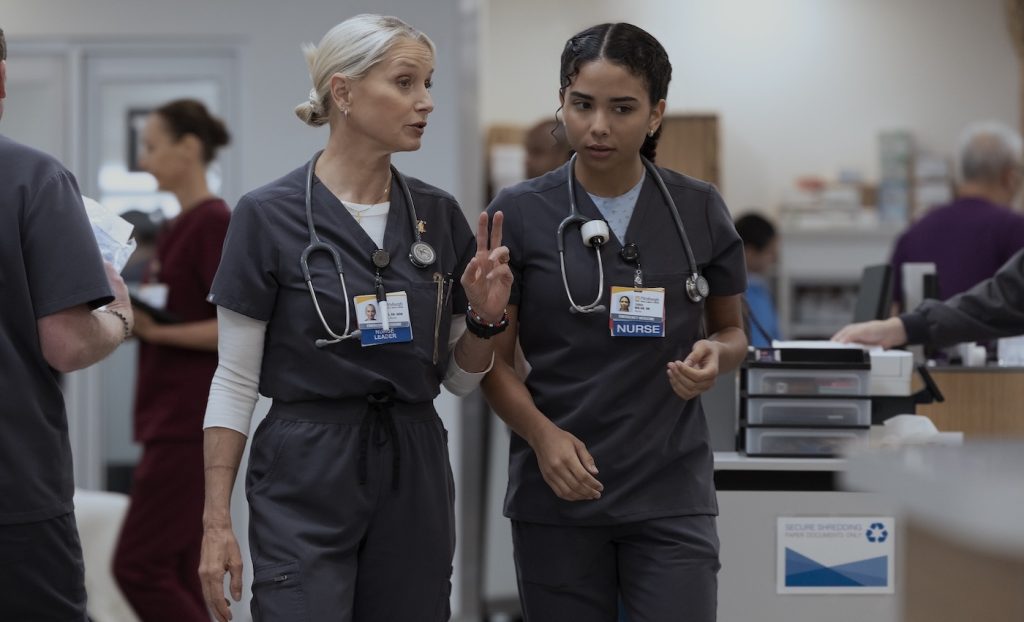
These moments are both the most challenging and the most rewarding. “There’s a lot of creativity,” she said, “and we work a lot with the background to make sure that everything coordinates together.” Watching these scenes, it’s easy to forget how technically demanding they are. The precision required to synchronize actors, camera operators, lighting cues, and background movement is staggering, yet the final result feels entirely organic.
Cinematic Influences: From Trenches to Trauma Bays
When conceptualizing the show’s aesthetic, Coelho drew inspiration from an unexpected source: Sam Mendes’s 1917. The film’s immersive, near-continuous camerawork served as a blueprint for how The Pitt could pull viewers into its world. “When I pitched for the show, the scripts were dragging you in,” she recalled. “I was like, ‘this needs to be immersion.’ I was thinking about 1917, when you’re in the trenches with the soldiers and the camera keeps following them.” The parallels between war zones and emergency rooms are certainly apparent. “The soldiers in the trenches are doctors in the ER, basically,” she said. “That’s kind of what it was.”
This conceptual framework shaped the show’s relentless forward momentum. Like soldiers advancing through enemy territory, the characters in The Pitt move from one crisis to the next, rarely afforded a moment of stillness.
Collaboration Across Departments
Maintaining visual consistency across multiple directors and writers was one of the production’s primary challenges and one of its greatest successes. Coelho was brought on as the sole cinematographer to ensure that the series would feel like a single, unbroken 15-hour shift. “It’s the main reason why they wanted to have only one cinematographer for the whole series,” she explained. “They wanted to make sure that the consistency of the feeling of a continuous 15-hour shift would stay throughout the series.”
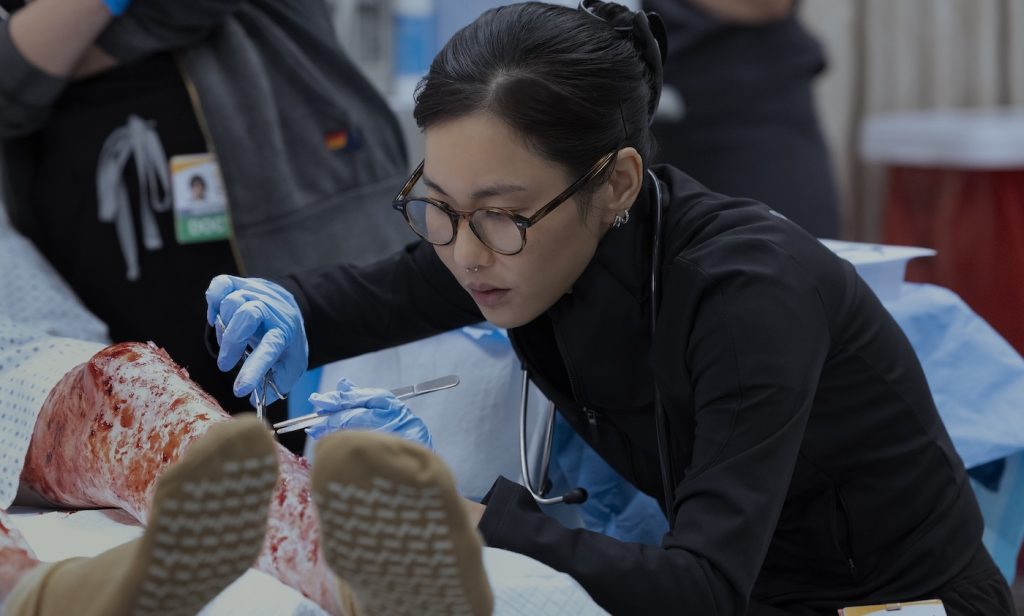
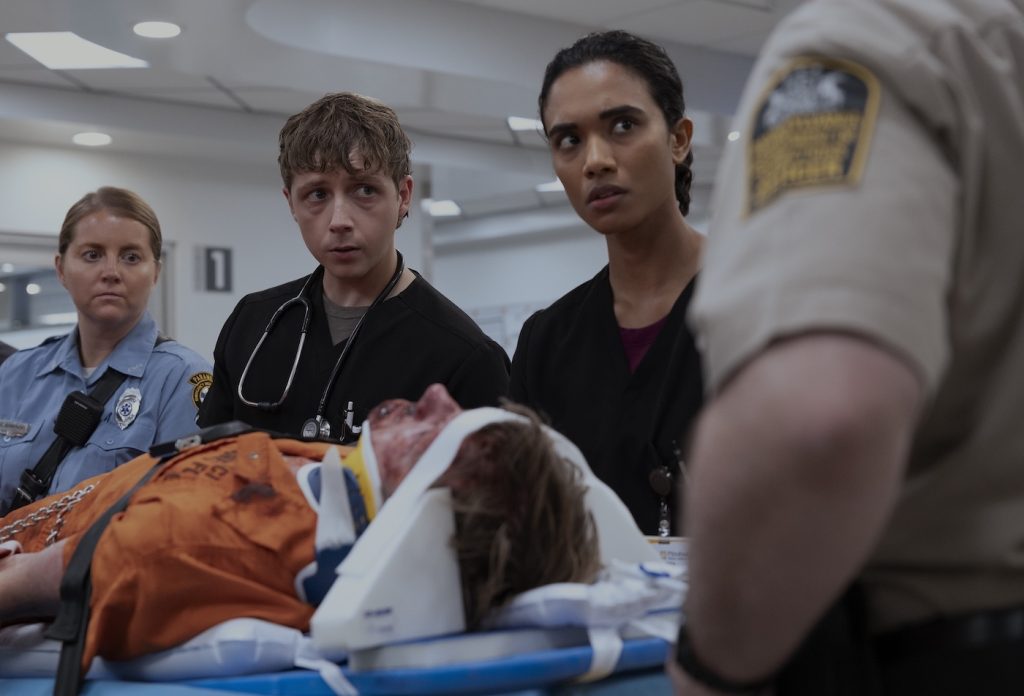
Her role required constant collaboration with directors, assistant directors, production designers, and makeup and prosthetics teams. Particularly in trauma scenes, where elaborate prosthetics come into play, careful planning is essential. “We always communicate about ‘what are the limitations of the prosthetic and what can we see,’” she said. “Sometimes they want us to shoot closer to the prosthetic first because it might get damaged as we keep doing the scene. So we need to get the details first, and then we’ll start backing up.” That coordination ensures both realism and efficiency, allowing the show to capture its most visceral moments without sacrificing safety or narrative clarity.
Practical Effects, Real Reactions
The prosthetic work on The Pitt is, frankly, jaw-dropping. As someone with a high tolerance for cinematic gore, I found myself wincing during certain sequences. “It actually looks like that on set!” Coelho laughed. “It’s like very few changes in visuals, almost nothing.”
One particularly memorable scene involves a patient losing the tip of his finger, complete with graphic close-ups of the surgical repair. “Sometimes, extremities are harder to watch,” she admitted (and I happen to agree.) “In season one, we have something with an eye…the plastic work is absolutely incredible.” More importantly, the realism extends beyond shock value. It reinforces the stakes of the environment and deepens the audience’s emotional investment.
Realism Through Restraint
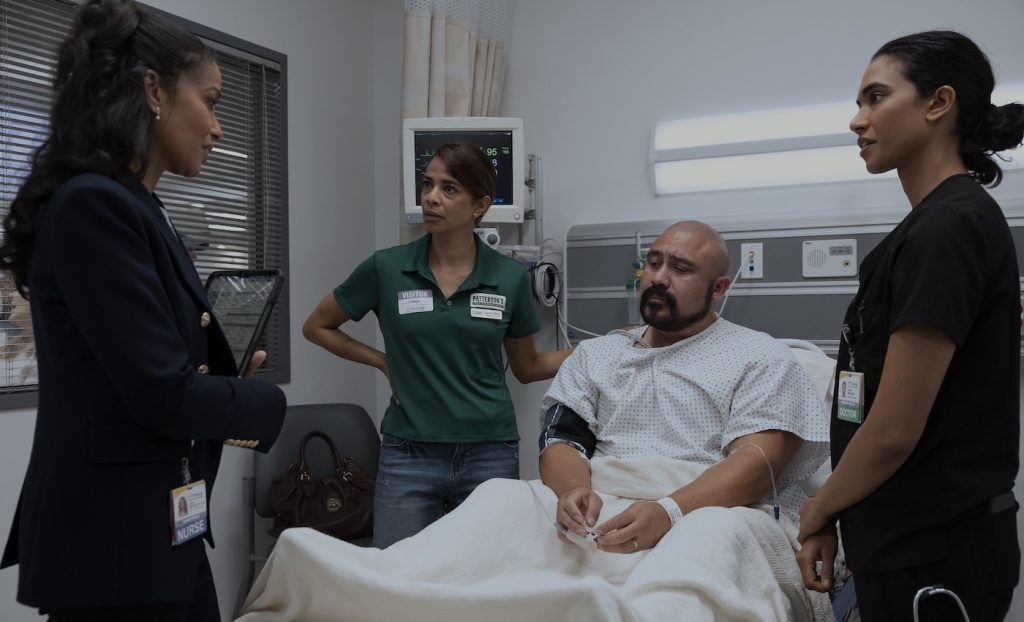
Despite its occasionally stylized compositions, The Pitt is grounded in strict rules of realism. The production’s 360-degree sets are fully enclosed on the Warner Bros. lot in Burbank, with lighting integrated into the ceiling and walls. There are no visible stands, flags, or traditional lighting setups. “There’s nothing on the ground,” Coelho said. “Everything is moving with us, and that’s what allows us to do this 360 and embrace that reality of a documentary.”
Even camera placement adheres to real-world logic. “We always think, ‘How close can we get?’ We’re really trying to get into the eyeline of the actor…we get stylized almost by accident.” This approach ensures that every shot is motivated by a character’s perspective rather than aesthetic indulgence.
Time, Budget, and Creative Problem-Solving
Like any production, The Pitt operates under tight constraints. Shooting nine to ten pages of script per day with limited hours requires a highly efficient approach. “We don’t do a master wide shot and then get in there,” Coelho explained. “It’s like, ‘Okay, whose character scene is this?’ And we follow that character around.” This strategy allows the team to capture maximum narrative information in minimal setups, preserving the show’s immersive flow.
Location shoots introduce additional challenges. Without the full control of the ER set, lighting becomes more complex, particularly during night scenes. “We had to approach it more with bouncing light,” she said. “We hid a big key source somewhere on the side we cannot see, and then we add ambience.” The goal is always to maintain the same visual language, regardless of the environment.
A New Way of Watching TV
Ultimately, Coelho hopes audiences walk away from The Pitt having experienced something fundamentally different. “There was a big fear when season one came out that it wouldn’t be for everyone,” she said. “Feeling so immersed in the show is sometimes unnatural. It can feel too intense.” But that risk paid off. “I think it’s giving people this new approach and experience to what TV can be. It’s almost like a VR experience, but it’s on your TV.”
That immersive quality allows viewers to forge deeper connections with the characters, sharing in their exhaustion, fear, hope, and resilience. “Sometimes it’s not about these big shots,” Coelho reflected. “It’s more about the simplicity of it and just having the experience of it in the middle.”
Living in the Moment
Watching The Pitt is an exercise in surrender, letting go of traditional expectations and allowing the camera to guide you through a world that feels urgent, intimate, and profoundly real. Johanna Coelho’s cinematography captures action, yes. But more importantly, it creates presence. It reminds us that behind every medical chart is a human story, unfolding in real time.
In an era of increasingly stylized television, The Pitt stands out for its commitment to authenticity. Its visual language doesn’t have to demand attention. It’s earned, moment by moment, heartbeat by heartbeat. And, in doing so, it offers a rare and unforgettable viewing experience.
Watch The Pitt, streaming now on HBO Max.
Featured image: L-r: Kristin Villanueva, Alexandra Metz, Noah Wyle, Sepideh Moafi, Taylor Dearden, Fiona Dourif(Warrick Page/MAX)