“No Other Choice” Writer/Director Park Chan-wook on His Killer Instinct
What lengths would you go to protect everything you hold near and dear to you? Would it be so far as to resort to murder? This is the intriguing premise behind Park Chan-wook’s latest film, No Other Choice. Taking his cues from Donald E. Westlake’s 1997 satirical thriller The Ax, the director of the acclaimed films Oldboy (2003) and Decision to Leave (2022) weaves a complex tale encompassing such themes as personal worth, family devotion, job identity, infidelity, and corporate callousness—and serves it all up with macabre comedy.
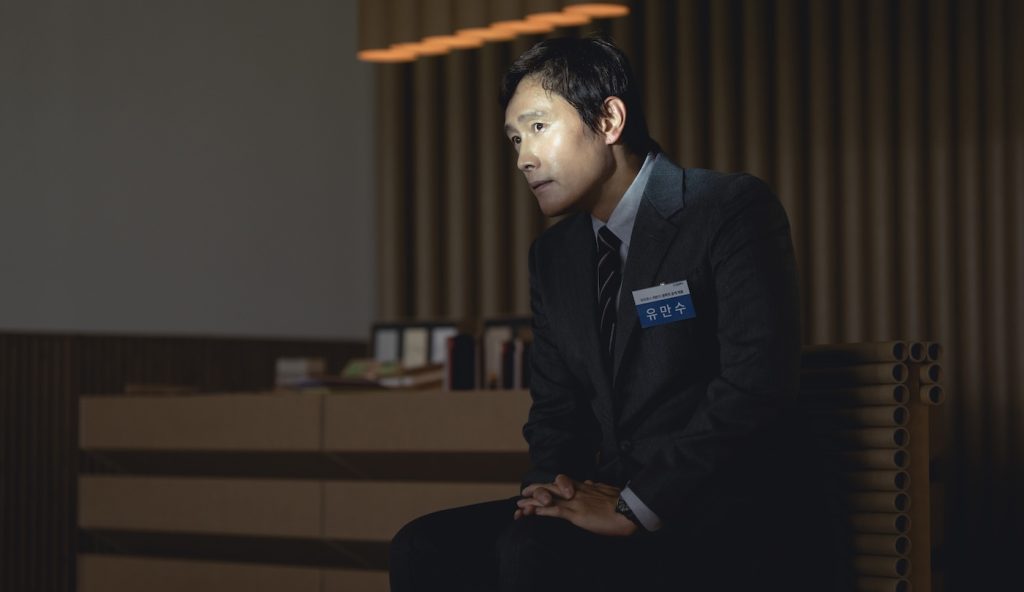
As No Other Choice opens, Man-su (Lee Byung-hun) believes he has achieved an idyllic life. He is an award-winning executive (Pulp Man of the Year!) for a Korean paper manufacturer. He has a loving wife, Miri (Son Ye-jin), a dutiful stepson, Si-one (Kim Woo-seung ), a daughter, Ri-one (Choi So-yul), a budding cello prodigy, and two frolicking dogs. The family lives in luxury in Man-su’s childhood home, which he bought and renovated to include a cavernous greenhouse for his passion for horticulture.
But soon, it all begins to collapse. Man-su’s company is bought by an American corporation, and he is fired as a result of the restructuring. Months of unemployment lead to drastic cuts in household expenses. Ri-one is unable to continue her costly music lessons. Man-su endures a painful toothache to avoid a dental bill. The dogs are shipped off to Miri’s parents. She takes a part-time job to make ends meet. As things get bleaker, the family is faced with selling their beloved home to survive.
Seeing his dignity slip away and fearing he is losing his family’s respect, Man-su hatches a dark plan. Eyeing an executive opening at another paper company, he concludes he’ll be a shoo-in for the job if he eliminates the competition. As his murderous plan to do just that unfolds, the question becomes — will it save or destroy his life and his family?
It’s a premise Park has been pondering for over a decade. No Other Choice began life in 2009 when the director initially discovered Westlake’s novel and announced his intention to turn it into a film.
“The brilliant irony of this plot captivated me,” Park said in a recent Zoom conversation through interpreter Jiwon Lee. “So that when I was adapting this, I didn’t necessarily take the dialogue from the novel, but I really tried to capture that same sense of irony in the movie.”
It turned out Park wasn’t the only one who had realized the novel’s cinematic potential. Greek/French filmmaker Costa-Gavras had adapted it in 2005 for the French film Le Couperet. The two filmmakers became friends, and Costa-Gavras, who owned the rights, agreed to let Park take a stab at his own interpretation. In a tribute to his fellow creative, Park dedicated No Other Choice to Costa-Gavras.
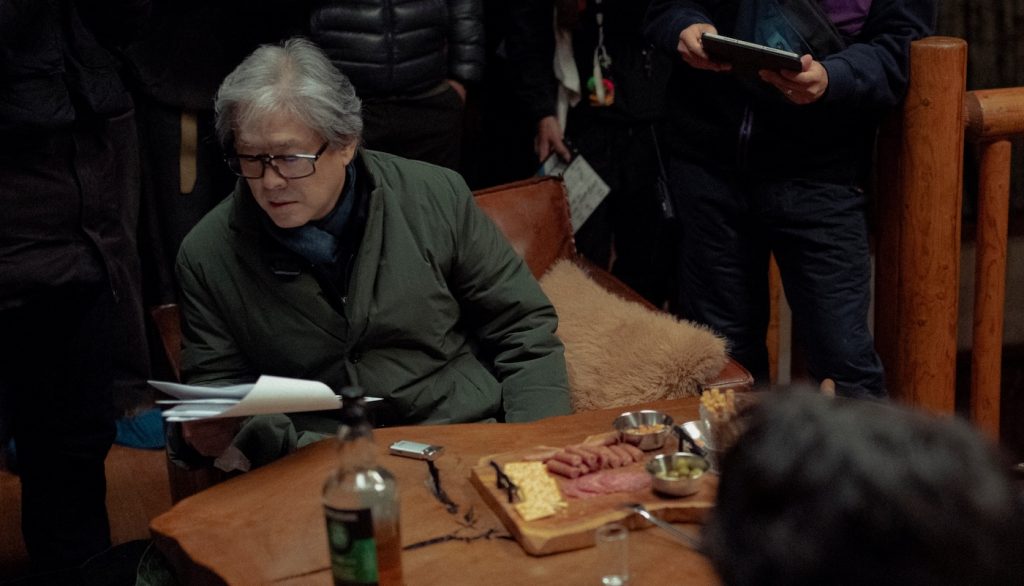
Park originally wanted to make the project his American film debut and joined forces with Canadian filmmaker Don McKellar to develop a screenplay. But as other projects arose, such as Stoker (2013), Bitter Sweet Seoul (2014), and The Little Drummer Girl (2018), No Other Choice got put on the back burner.
But it was never forgotten. And as Park continued to revisit the idea, he began to realize the themes he wanted to incorporate were perhaps as relevant to his country’s sensibilities. As the project evolved, Lee Kyoung-Mi and Jahye Lee joined in on the scripting duties and are credited, along with Park and McKellar, as screenwriters.
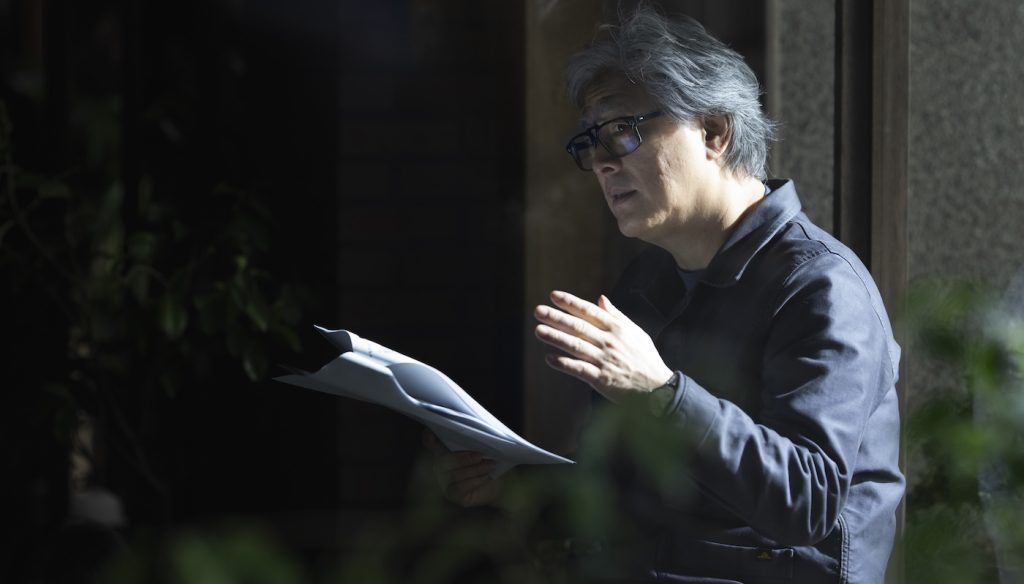
“My culture influences the issue of masculinity that Man-su goes through,” Park continues. “The idea of this person’s responsibility as a man, a husband, and a father, and that he’ll do whatever it takes to not lose that responsibility. That very sense of masculinity is very prejudiced…stuck in a box influenced by our culture. Korean society still has stronger traces of Confucian patriarchy. I was able to emphasize this with a Korean version.”
Even so, Park was confident that these beliefs would transcend borders. “At the end of the day, all of these elements came from the original novel, and since that was an American novel, this is present in other countries as well, he observes. “It could be relatable to audiences around the world.”
Park’s instincts were correct. No Other Choice has been critically hailed. It was nominated for three Golden Globes, including Musical or Comedy Motion Picture, Foreign Language Film, and an Actor in a Musical or Comedy nod for Lee. The film is also in the running for a Best International Film Oscar nomination.
One part of the story that Park wanted to build upon was the character of Miri. Initially, she comes off as a bit immature, self-absorbed and only concerned with material pursuits. As adversity hit, the writers made sure she rose to the occasion, ultimately playing a surprising role in the final outcome.
“When she’s faced with these difficulties, the audience is surprised to see her strength, her independence, wisdom and decisiveness. These were always within her,” explains Park. “And Son Ye-jin did a great job portraying all of these moments. It was a very hard task to achieve. Unlike the character of Man-su, Miri doesn’t get into big conflicts with the other characters. She only has a limited pool of expressions. Ye-jin delicately used the facial expressions that I wanted for the character. It was extremely helpful for the movie.”
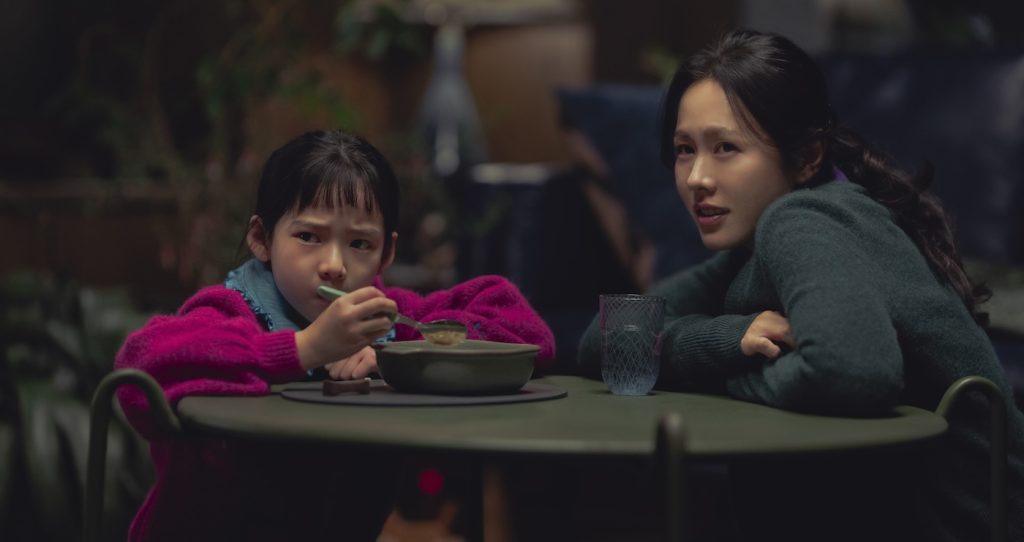
Though the story contains the darker aspects one has come to expect from the filmmaker, No Other Choice also presented Park the opportunity to tackle a film with comedic elements. Realizing how important humor was in the original novel, the director knew he had to layer in a lighter side to balance out the darkness.
“This is a story about someone who is fired and a story about a man who has lost his authority within his family,” says Park. “If you only focus on his sadness, or, since he was unjustly fired, his rage, I believed this would not provide a comprehensive view of the film or the character as well. You need to be able to portray how foolish and ridiculous these actions are to the audience. Only when you do will the audience feel a stronger sense of sympathy for the character.”
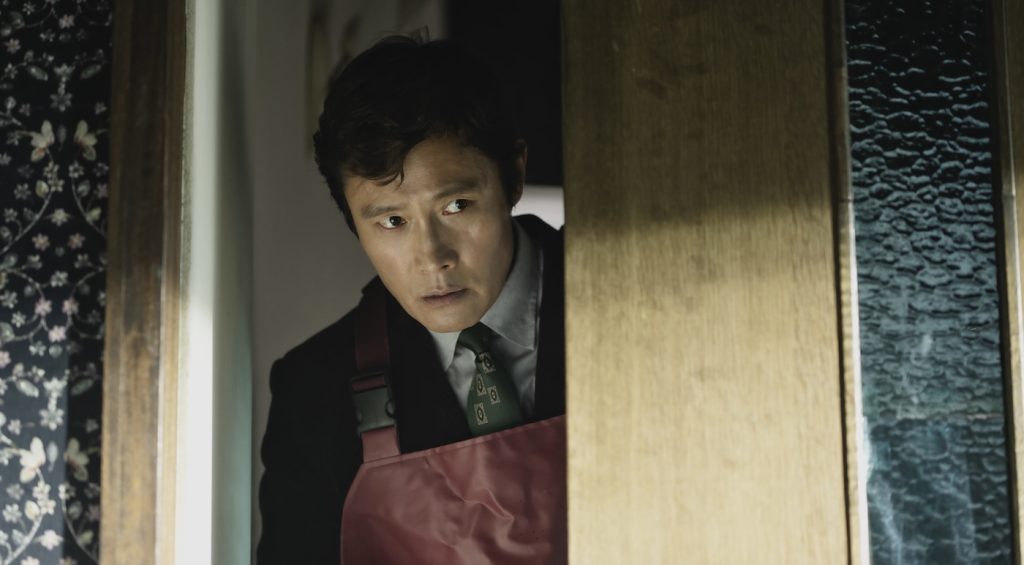
Park believes Lee was key to striking the right tone needed to make Man-su relatable. “He made me wonder how one individual could do so many facial expressions and keep the emotion hidden at the same time,” says Park. “Watching him do these quick changes of emotions, that varied in every moment, really added rich layers to the character that far exceeded my expectations.”
As an example, Park mentions one of his favorite scenes, where Man-su confronts Sun-chul (Park Hee-soon), a business colleague visiting his home, intending to kill him. As the two converse, they form a bond. Man-su’s plan is to get Sun-chul drunk, as it will be easier to murder him. A recovering alcoholic, Man-su tosses off the liquor in his glass as his new friend downs drink after drink. But as the revelry escalates, Sun-chul insists the two do bomb shots — a drink Man-su can’t discard. He realizes his sobriety must end if he wants to go through with the murder.
“He’s placed under very brutal circumstances,” says Park. “And the actors did a great job of portraying this difficult relationship. When Man-su drinks the bomb shot, he has potent feelings within him. He doesn’t want to go back to his past self as an alcoholic, while all this time, he’s craving the excitement of the alcohol he used to enjoy. So there are these paradoxical emotions of both guilt and freedom. Because this scene included all of those elements, it was very rich to me.”
No Other Choice is in select theaters now.
Featured image: Lee Byung-hun in “No Other Choice.” Courtesy Neon.