Busan 2026: Wētā FX CTO Kimball Thurston on AI’s Biggest Promise: Less Busywork, More Creativity
Kimball Thurston’s work as chief technology officer at eight-time Oscar-winning Wētā FX has put him at the cutting edge of filmmaking technology and in a unique position to assess the pros and cons of Artificial Intelligence.
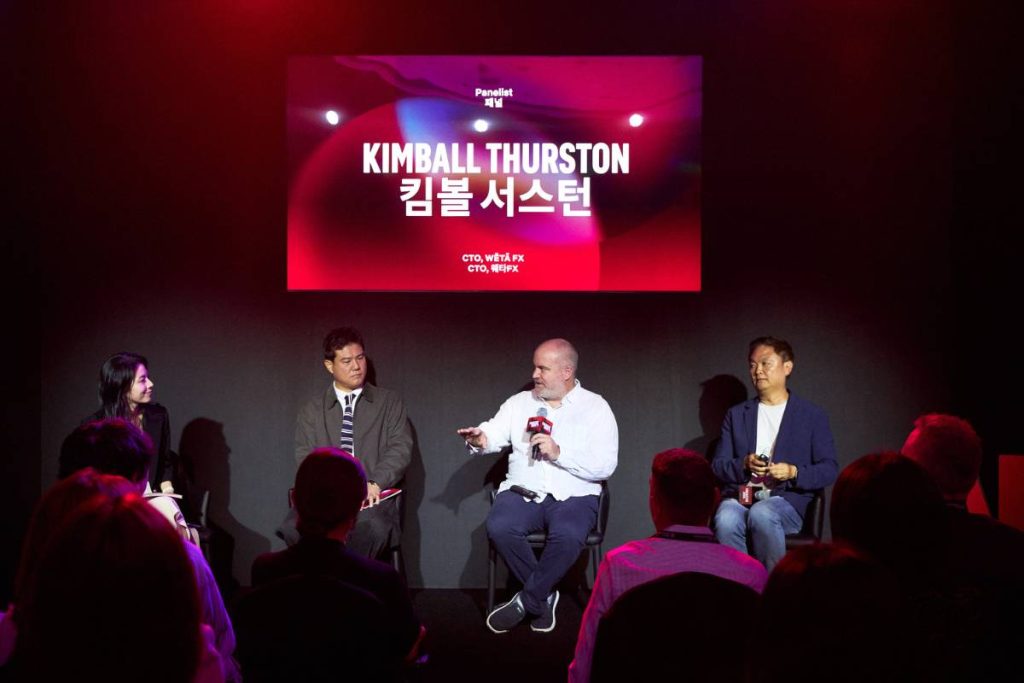
Speaking at Netflix’s annual Creative Asia event, co-hosted by the Motion Picture Association in partnership with the Busan International Film Festival, Thurston went to some lengths to explain how his team was currently using and exploring AI in their productions. But he was also quick to explain how the New Zealand-based Wētā FX sets a “people-first” parameter.
“I think the human touch is critical and necessary,” Thurston explained.
It was a common theme at this year’s panel – titled “Film Production and AI: New Tools, New Possibilities” – where Thurston was joined by Sung Q Lee, Netflix’s senior director of production for Asia-Pacific, and Korean filmmaker Kang Yun-sung, the director of The Outlaws and a front-runner in terms of adapting AI tools for filmmaking.
Much of the noise about AI’s use in film has so far focused on staggering amounts of money, with recent industry reports suggesting media companies’ AI spending would rise to $12.5 billion annually by 2029, up from $2.6 billion in 2024.
But, as the panel showed, most film companies have already either adopted or at least explored (or both) the technology.
All three panelists explained how their work now incorporated it, with Netflix’s Lee revealing his company had already tapped AI in around 300 titles.
“[AI] is being used in previsualization, production design, working out set-dressing concepts ahead of time, in editing and of course in VFX,” he said. “The question that matters to me isn’t ‘How much AI can we put into this title?’ but ‘What more can this title do with AI’s help?”
“By utilizing AI tools, we can give more opportunities and chances to the creative. And by fully unlocking its potential, we’ll be able to help them to achieve something that they could not have done in the past.”
Lee said AI was helping rathern than creating.
“All these technological changes and new tools have helped a great deal with the how—how we make what we make better. But they never decided the why—why we have to tell this story,” he said. “AI is the same. But when it comes to conveying emotion ultimately, a human has to touch it. AI can get many jobs done, but does it touch human emotion? The human touch is critical and necessary.”
Lee showed reels to show how AI had advanced, including one from Netflix’s VFX studio Eyeline that mashed up live action, VFX, and generative tools. There was also a crowd scene clip from Netflix India’s Glory.
Kang, meanwhile, brought a test clip for The Gulf of Aden, an action film made entirely with AI, using China’s Kling AI software. Last year, he collaborated with fellow Korean Kwon Han-seul to co-direct Run to the West, which they billed as Korea’s first fully AI-assisted feature film. The filmmaker believes the film was hampered because, by the time of its release, its tech already looked outdated, given AI’s rapid development.
“At the time, AI technology was at a really rudimentary, low level, so we mainly used it for compositing and making creatures,” he said. “And back then, even the creatures didn’t blend well with the footage we’d shot.” “In just a year, AI’s quality has reached the point where using it commercially is no problem at all.”
The Gulf of Aden is currently in production and will include scenes that, in a normal production, would have one day been curtailed, the filmmaker claimed. Going with AI for this one cut costs by around 40 percent, he said.
“When we calculated how much we’d save on The Gulf of Aden for financing, it came to a reduction of around 40 percent,” Kang said. “That’s not just from replacing CG and VFX. The shoot itself was streamlined, and that cut down our production time to some extent. Ideas that had been buried due to budgetary issues were able to be put back on the table.”
Thurston took some time to deal with specifics, explaining how Wētā FX’s “assistive AI” work “is basically not allowed to change the creative intent in any way.”
“It touches pixels, but it only fixes them,” he said. “It provides us very quickly with the visual images and visualizations. From the director’s or cinematographer’s perspective, it’s easy to spot errors and correct them. Our goal is to reduce simple, repetitive tasks.”
Both Kang and Thurston refuted any suggestion that AI imagery might one day replace actors. “No matter how much AI technology advances, actors are creators who deliver emotion and move the audience,” said Kang. “Even if AI acting becomes very sophisticated and imitates very precisely, emotion doesn’t come through because of its mechanical coldness.”
Thurston was more succinct. “Replace actors? No way,” he said. “We are audiovisual storytellers, and storytelling is studying the human condition.
In the end, Lee said, all technology needed human hands and minds to guide it.
“When we talk about human-centric, it’s not about substituting creativity, but ultimately it’s about supporting the creative,” he said. “When it comes to conveying emotion, ultimately a human has to touch it once more. I strongly agree that a human touch is absolutely essential.”
For more interviews with filmmakers and producers taking big swings in Asia, check out these interviews:
From Busan to the World: Hollywood and Korea Celebrate the Power of Global Storytelling
Local Stories, Global Audiences: Jon Wax’s Vision for Disney+ in Asia
“Shōgun” Star Takehiro Hira & “Tokyo Vice” Producer Alex Boden on Japan’s Cinematic Power
Featured image: “Run to the West” (CJ CGV)