“Lanterns” Editor Vikash Patel on Pace, Performance & Power Rings
Among film editor Vikash Patel‘s credits are beloved television series: the reality game show Top Chef, the Superman origin tale Smallville, the Psycho prequel Bates Motel, the newscaster drama The Morning Show, the crime thriller Ozark, and more. Recently, Patel revisited the DC Universe for the James Gunn-produced Lanterns, which follows two intergalactic cops vying for authority as they investigate an alien incursion in Nebraska.
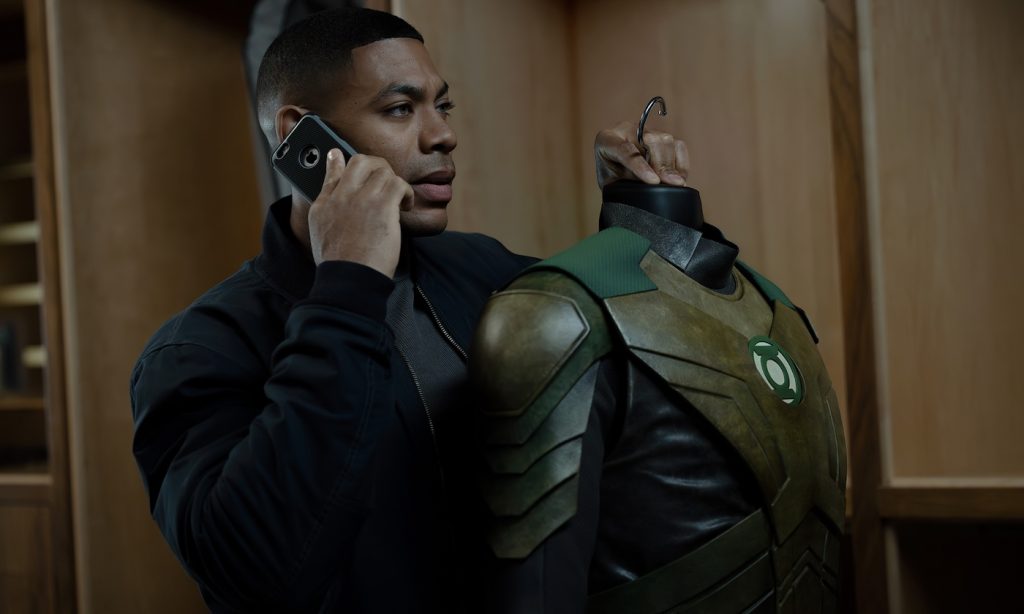
Hal Jordan (Kyle Chandler) holds the office of Green Lantern, wielding an energy-projecting ring to defend Earth from cosmic threats. Unfortunately, Hal’s unorthodox methods displease his overseers, the Guardians, so they secretly arrange for his replacement. Their prospect is John Stewart (Aaron Pierre), conditioned rigorously since childhood to feel no fear.
The Guardians order Hal to train John, ostensibly as a sidekick, but the irritated teacher and stoic student find themselves embroiled in a dangerous investigation. They must untangle a mystery involving an indignant sheriff (Kerry Kane), a local militia leader (Garrett Dillahunt), and the intergalactic criminal Sinestro (Ulrich Thomsen)—not to mention Hal’s past and John’s destiny.
Patel met with The Credits to talk about editing episodes 1, 2, 4, and 5, as well as working closely alongside showrunner Chris Mundy, with whom Patel collaborated on Ozark, to oversee editing on Lanterns. Patel shared insights on scenes like Hal’s interrogation of a suspected alien and John’s attempt to fly, which creates a bird that lingers even after John removes the Green Lantern’s ring. Looking back, Patel recalled being surprised to win an Emmy alongside Kevin Leffler and other editors from Top Chef in 2008, after The Amazing Race had won the category for three consecutive years. The interview closed with Patel’s remarks on the role of a film editor.
Note: This interview has been edited for length and clarity.
You’ve worked in a variety of genres. Does your approach as an editor change based on the type of series you’re making?
Every project you work on, you learn something new. For example, on Smallville, I learned how to work with visual effects. With Ozark, it was learning to get the audience to lean in with the drama. All these different projects fill your toolbox. The beauty of Lanterns is that it has the drama of Ozark, the comedy of The Morning Show, and the visual effects of Smallville.
What was it like to collaborate again with showrunner Chris Mundy?
It’s a fantastic collaboration. It’s like two friends working together. I have a lot of freedom. He trusts me so much that he lets me take the swings I want. That’s why he wants me to keep a watchful eye on Lanterns’ visual aesthetic, sound, and music to make sure it feels cohesive. As much as there were three editors on the project, it should feel like there’s one voice.
If you had to put a name to the aesthetic of Lanterns, how would you describe it?
Something that Chris imagined when he wrote the series was that this almost rapid-fire dialogue should take place, and then we should pause for the moment to let the comedy land. For example, in the interrogation scene from the pilot, the editing and dialogue almost step on each other. Then, you slow the pace down immediately. In episode four, when Hal and Sinestro are talking, there’s a lot of rapid-fire dialogue, and then it pauses. You’ll see that throughout the series, and that is something that we crafted together.
How did you develop your sense of pacing?
It’s very subjective. Sometimes, you watch performances, and you think, “That’s incredible. I don’t need to do anything. I don’t need to step in here because the rhythms of that character’s performances are right on point.” Sometimes, you think, “Maybe I should augment this because I can help build the arc and improve the storytelling.” It’s a tricky question, and I think it just comes from experience. If you had an episode or series all at one pace, I don’t think that works. The beauty of making it feel like a roller coaster is that it’s so much more engaging for the viewer.
I was impressed by the foot chase in the pilot. How did you put the footage together so that the audience could follow the action so precisely?
If I can’t follow the action, it’s frustrating. It’s important for me to track the action sequence and the geography. Characters need to clock the objective. You’ve got to see the lightbulb moment constantly. The foot chase was fun to cut because Aaron is so fast that it’s ridiculous! When I cut him in during that foot chase, I had to make sure the alien had some headway, because otherwise Aaron would catch him immediately.
How would you compare editing that chase to editing the chase on the highway through oncoming traffic in episode 2?
There are more moments to track in the chase on the freeway. Also, the chase in the pilot has very little or no VFX, but the freeway chase is littered with VFX. You’ve got a couple of beats to the freeway chase. First, the characters roll out of the van onto the freeway. You’ve got the alien guy wanting to catch John Stewart. John doesn’t really care about that. His motivation is saving the bird, but we have to keep the alien threat alive. It’s complex in its structure. On top of that, there’s heavy VFX work in that sequence. There are a lot of practical cars, but there’s also a lot of extensive work with the crashes, John jumping over the car, and the bird going through the side door. It was complex to put together and craft.
Since the bird stays around for many scenes, could you use it as an example of collaborating with the visual effects department, starting from the raw footage?
We had a sensational VFX team. We had VFX editors while we were building the cuts. Then we had a post-production VFX team that would take the VFX and notch them up significantly. It benefits us all to involve VFX as early as possible. When John tries to fly and the bird appears, I cut to that shot and put in a title card saying, “Bird manifests.” Our VFX editor then created a very crude bird. My assistant then added some sound effects. To tell the story, we needed to track the bird’s beats and get the pipeline going.
You mentioned learning to work with VFX on Smallville. Was there any lesson or experience that you applied to your work on Lanterns?
Yes, I touched on it. When working on a scene before having VFX, something we did on Smallville was use the title tool to draw shapes. For Clark Kent, say, we would draw a circle and an oval body. If we wanted Clark Kent to fly away in that shot, we would keyframe the title tool to show the direction he would fly. Applying that to Lanterns, when the bird manifests, you can just use the title tool and a shape to tell the story. It’s crude, but it works. Until VFX gets involved, you won’t have anything polished, but it helps you with timing.
As a writer, I really like the idea of a rough draft, then a revised draft, and so on.
It’s so that. You’re building foundational blocks to tell the story. As we go through the process from editor’s cut to director’s cut to producer’s cut, it gets refined at every level before we get to the studio cut. Then, when we send it out to the studio, you’ve actually got a bird in there, and it looks pretty cool.
Is there anything that you wish more viewers knew about film editing?
Editing, I’m sure people have said this, is very close to directing. It’s extremely challenging; it can be tedious, but it’s also really fulfilling when you’re working with material, and you’re trying to make it shine. Sometimes, you think a take is fantastic from the set, and you don’t need to do anything to it. But you start building that scene, crafting performance, and putting in reaction, and you realize the scene has gone up from a five to an eight all of a sudden. I love that we can use our skills as editors to improve a performance, tell a story, and take the audience on an emotional journey.
Lanterns is currently airing on HBO Max.
Featured image: Aaron Pierre, Kyle Chandler. Photograph by John Johnson/HBO Max