The Horror of Homer: How “The Odyssey” Brought Out Christopher Nolan’s Dark Side
Christopher Nolan’s The Odyssey triumphed at the box office this past weekend, wowing critics and drawing audiences across the globe. His hugely ambitious adaptation of Homer’s epic has many distinctions; it’s the first film shot entirely with IMAX cameras; it’s the first full-scale, feature-length adaptation of Homer’s poem; and it’s Nolan’s largest global opening ever, pulling in $264.1 million, topping the $249 million that his 2012 The Dark Knight Rises made.
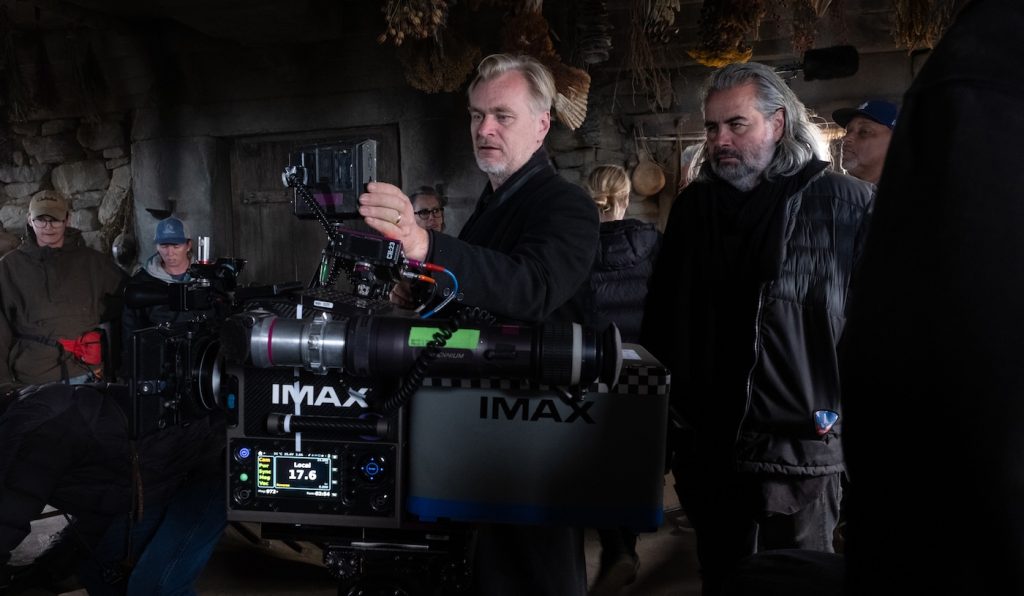
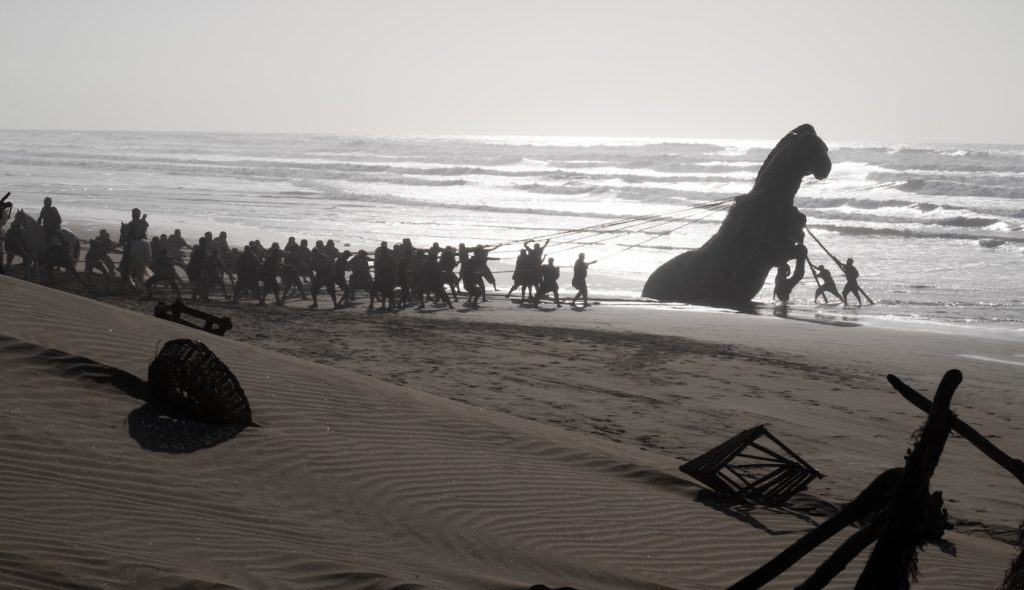
In order to pull off his adaptation as practically as humanly possible, Nolan and his cast and crew filmed on the open ocean (despite Steven Spielberg’s warning to the Waterworld director about doing this all those years ago) in the Mediterranean on a Viking ship called the Drake they sourced in Norway, braving the North Sea off Scotland’s coast and the frigid waters of Iceland. Capturing the epic in IMAX required devising all manner of ingenious fixes and workarounds, including creating a soundproof casing around the cameras to quiet them, and then coming up with a clever mirror hack to make it possible to film smaller-scale, intimate scenes. That commitment to creating something worthy of Homer’s deathless adventure story became a major draw for audiences, who began snapping up premium-format tickets a full year before the film’s release.
Nolan has steadily increased his use of IMAX cameras over the years, from dabbling with it on his 2006 film The Prestige to more full-on use in his 2008 film The Dark Knight, gaining more familiarity with the equipment on each passing film. In speaking with The Hollywood Reporter, Nolan described this continuing education and refinement of the medium.
“Well, I had dabbled with IMAX cameras on The Prestige the year before, but it was really on The Dark Knight that we took what had been the province of purely documentary filmmakers and brought it into the Hollywood machine. The Hollywood camera crew works in a very different way to a documentary camera crew. So there were a lot of refinements that we were able to bring on that film: different lenses, different ways of pulling focus and different monitoring systems internally. Over the years, that’s carried on, particularly putting IMAX in collaboration with Panavision for a wider variety of lens sets, faster lenses and things like that. It’s really about getting the barrels of these lenses to work effectively with the focus control systems that Hollywood ACs use. All of that is a bit arcane and technical, but it’s always an evolution.”
Featuring Matt Damon as the long-suffering, complicated hero Odysseus, and a starry cast that includes Anne Hathaway as his wife, Penelope, Tom Holland as their son, Telemachus, Robert Pattinson as one of the vile suitors, Antinous, Zendaya as Athena, Bill Irwin as the cyclops Polyphemus, and Samantha Morton as Circe, Nolan made some bold but necessary changes to Homer’s source material. The first and most immediately evident was having his characters speak in English and using modern phrases while shifting much of the emphasis from the mythological to the psychological. This means that gods like Zeus and Poseidon are mentioned but remain unseen; the goddesses we do see, like Athena, have been further complicated and humanized; and minor-but-thrilling characters like the Laestrygonians have been changed from giant cannibals to towering armed warriors. The scene that takes place in Hades has been made heartbreaking and compelling by the addition of Elliot Page’s Sinon, a young soldier whom Odysseus tricked into selling his Trojan Horse ruse.
For fans who have been clamoring for Nolan to make a horror film for years, he gives us two thrilling, chilling sequences that might sate their appetites (for now). The first involves Irwin’s cyclops, Polyphemus, who is minding his own business tending to his flock of sheep when he finds Odysseus and his men eating his cheese and cowering in his cave. What follows is a much more brutal encounter than what Homer describes. The poem, yes, Polyphemus eventually eats some of Odysseus’s men and bashes some brains in, but he’s a much more verbose character, getting into a battle of wits with Odysseus before things get really ghastly. In Nolan’s telling, Odysseus and his men aren’t even aware the Cyclops can speak until they blind him with a hot stake and he starts calling for his father, Poseidon. This is after Polyphemus, surprised to find Odysseus’s men there, smashes a few and eats a few others in a gorgeously horrific, firelit sequence. The Polyphemus encounter ends in daylight via a mad chase through the forest and out into the water, where the Cyclops manages to finish off two more of Odysseus’s men before turning back to his island. The entire sequence is terrifying and fantastic.
Yet it’s the encounter with Samantha Morton’s Circe that is the most sustained horror sequence in Nolan’s entire career. In Homer’s poem, Circe drugs Odysseus’s men and turns them into pigs, and when Odysseus shows up, he resists her magic; she brings his crew back to their human forms and takes Odysseus as her lover while allowing his men to stay, feast, and recover. Nolan had none of that. Instead, Morton’s Circe trusts no man and turns the crew into pigs by feeding them her laced food and then physically, horrifically molding them with her hands. It’s a shocking moment of body horror, David Cronenberg-esque, and arguably the film’s turning point. Odysseus doesn’t resist her so much as match her wits by snatching a nearby bird, whom he correctly intuits was once someone important to her (it’s her sister), and trading his life and that of his men for the bird/sister. Circe relents, returning his crew to their original forms, and giving Odysseus his next marching orders: head to Hades to seek out the blind Theban prophet, Tiresias.
When asked by THR if this made him eager to heed fans’ calls to film a full horror movie, Nolan praised another recent film, Curry Barker‘s Obsession.
“They don’t need to beg me to tell a horror story anymore. Just buy a ticket. (Laughs.) It very much whets my appetite for more. But I’ve always believed that horror as a genre has to be approached very carefully from a conceptual point of view. In other words, you have to have an amazing idea. When you go see a film like Obsession, that’s an amazing idea. That movie works like a motherf**ker. It’s not about the technical side. It’s not about what technical itches I would have to scratch. It’s about story. So I’m always looking.”
The Odyssey is in theaters now.
Featured image: Director Christopher Nolan on the set of his film THE ODYSSEY, written, produced, and directed by Christopher Nolan.