Christopher Nolan’s “The Odyssey” Finds the Monster Within Its Hero
Tell me about a complicated man,
Muse, tell me how he wandered and was lost,
when he had wrecked the holy town of Troy…
Christopher Nolan’s The Odyssey isn’t merely a spectacular adaptation of Homer’s epic; it’s a story about a man trying to survive the consequences of the lie that won a war. Nolan’s real subject is the notion of xenia, also known as Zeus’s Law, the ancient Greek custom of hospitality that enabled civilizations to rise and endure. Xenia allowed travelers to trade and commingle with people from faraway islands and lands because they could count on the mercy of strangers. By transforming a gift into a weapon through the Trojan Horse, Odysseus becomes the architect of a broken world where the trust and mercy embodied by xenia have collapsed. This abiding concern gives Nolan’s adaptation a modern resonance, arriving at a moment when the customs and institutions that bind strangers together are once again being tested.
The adaptation has all the hallmarks of Nolan’s abiding obsessions—a father trying to get back to his family (Inception, Interstellar); an epic love story thwarted by ambition (The Prestige); a coming-of-age story (Following); a revenge story (The Batman). Nolan had almost gone down the Greek epic road before—he was in the running to direct the 2004 film Troy, starring Brad Pitt as Achilles and based on Homer’s “The Iliad,” but the job ultimately went to Wolfgang Petersen. Yet an image Nolan conjured from that near miss would become the bedrock of The Odyssey 22 years later: the Trojan Horse “listing over in the sand,” as he told The Los Angeles Times‘ Kenneth Turan. It’s an intentional echo, Nolan revealed, of the iconic shot of the Statue of Liberty in Franklin J. Schaffner’s 1968 film Planet of the Apes.
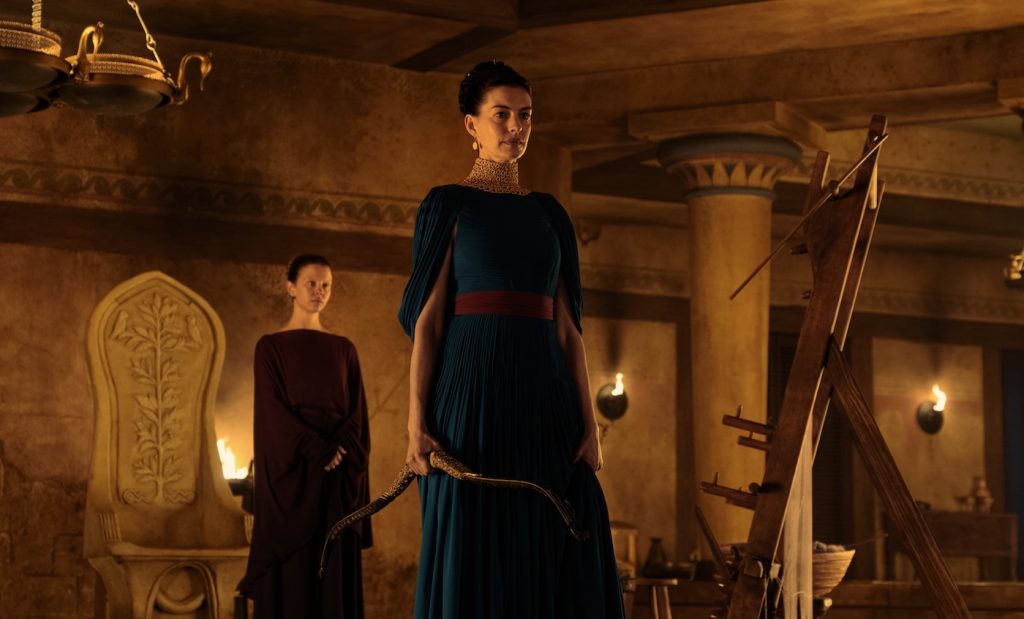
At the outset of The Odyssey, Nolan shows us what Odysseus is being forced to leave behind: his beautiful, wise wife Penelope (Anne Hathaway) and his infant son, Telemachus (played by Tom Holland as a young man). In one of the film’s few moments of dry comedy, Odysseus explains to Penelope why he’s leaving them for Troy. Menelaus’s (Jon Bernthal) wife, Helen (Lupita Nyong’o), has run off with the Trojan prince, Paris, and Menelaus’s brother, Agamemnon (Benny Safdie), is duty-bound to assemble a Greek army to bring her back and sack Troy in the process. Penelope pauses to raise a sensible objection to the entire war: Didn’t Helen want to leave?
Such are the timeless inanities of men. Odysseus can do little more than concede the point to his wife, but the war is coming regardless of the lunacy of its origins, and he’ll be gone a long time, if he ever makes it back at all. For the next two decades, Penelope must use her wits to fend off a slobbering horde of suitors vying for her hand and her land, none more despicable than Antinous (a very game Robert Pattinson), who eventually plots her son’s death.
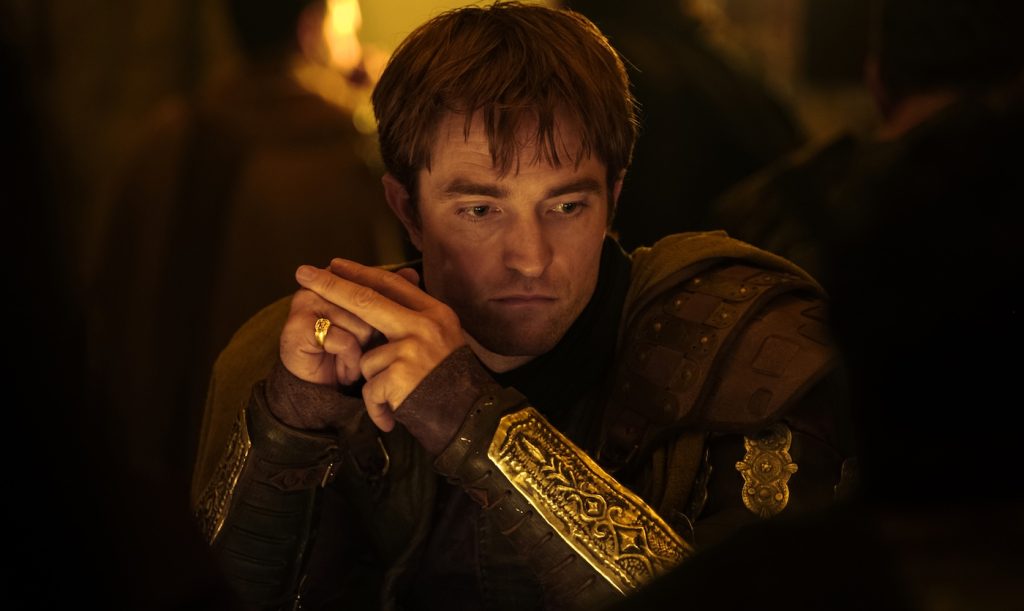
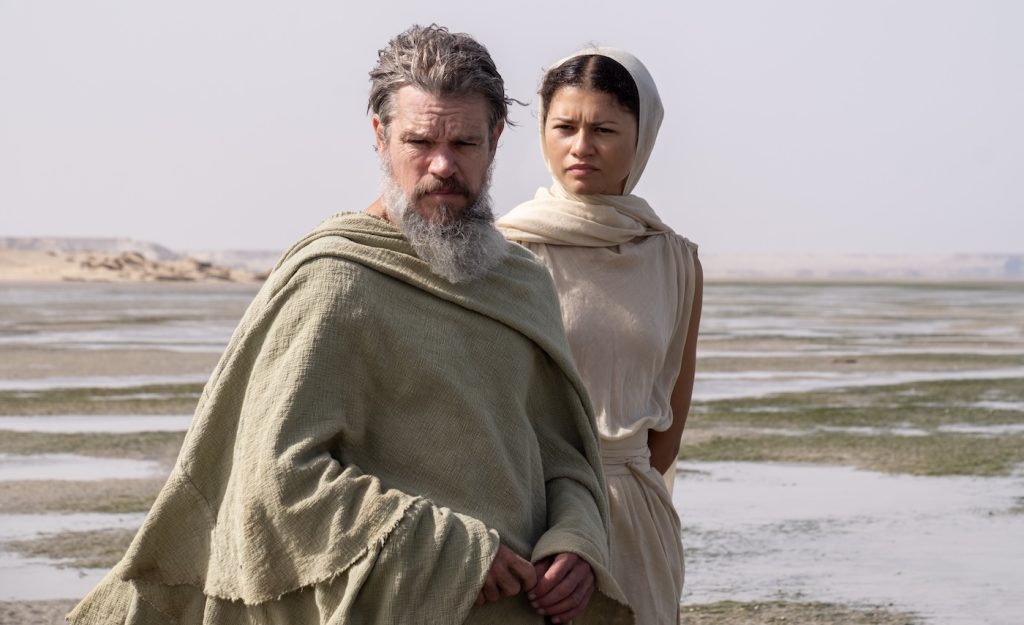
After establishing what Odysseus is giving up to fight in the Trojan War, the film is off and sailing, leaping years into the future. An adult Telemachus makes a clandestine journey in search of news about his father from Menelaus, while Odysseus wanders the shallows of Calypso’s (Charlize Theron) island, now an aged amnesiac long lost at sea and trapped in a tortured peace with the beautiful goddess. Calypso eventually prods the foggy war hero about what he remembers of his past, establishing a framing device that allows the film to sweep back through Odysseus’s tortuous attempts to get home.
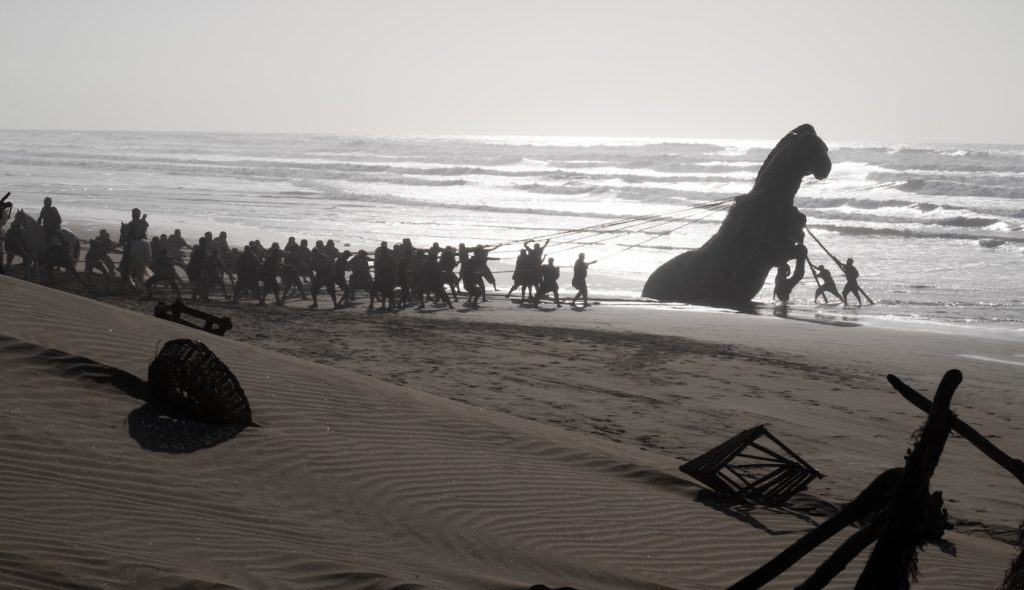
That homeward journey would never have begun had Odysseus not come up with the plan that brought Troy to ruin. Yet the Trojan Horse of Nolan’s film isn’t wheeled easily through the city’s gates. In fact, the famous image of the horse entering Troy is only alluded to in Homer’s epic; its most enduring literary rendering comes from Book 2 of Virgil’s “Aeneid.” Instead, Nolan’s horse is discovered, as he’d imagined all those years ago, “listing over in the sand,” and dragged bodily across the beach by hundreds of men, while Odysseus and a small platoon of soldiers, including Menelaus, struggle to survive within sweltering, claustrophobic darkness, covered in their own filth.
Filming the entire epic in IMAX was a monumental feat of technical mastery, requiring both an appetite for risk and the accumulated filmmaking knowledge to avoid catastrophe. Yet Nolan’s distinction as the first filmmaker to shoot an entire movie using IMAX cameras feels less like a breakthrough than the culmination of a two-decade obsession. He first used them for the bravura opening bank-heist sequence in his 2008 Batman Begins sequel, The Dark Knight, and has been using them with increasing ambition and facility ever since.
Eleven miles of IMAX film weighing in at 530lbs later, the wait was worth it. In dramatic terms, Homer’s epic is arguably more appealing than The Iliad, wedding a relatively pared-down, human-centered drama to a world populated with gods, monsters, witches, and sirens.
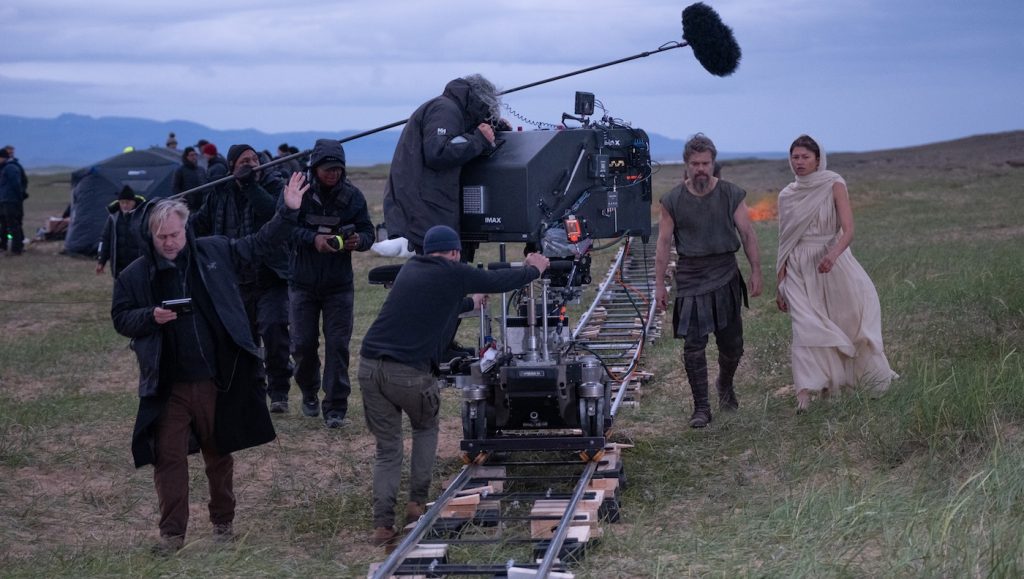
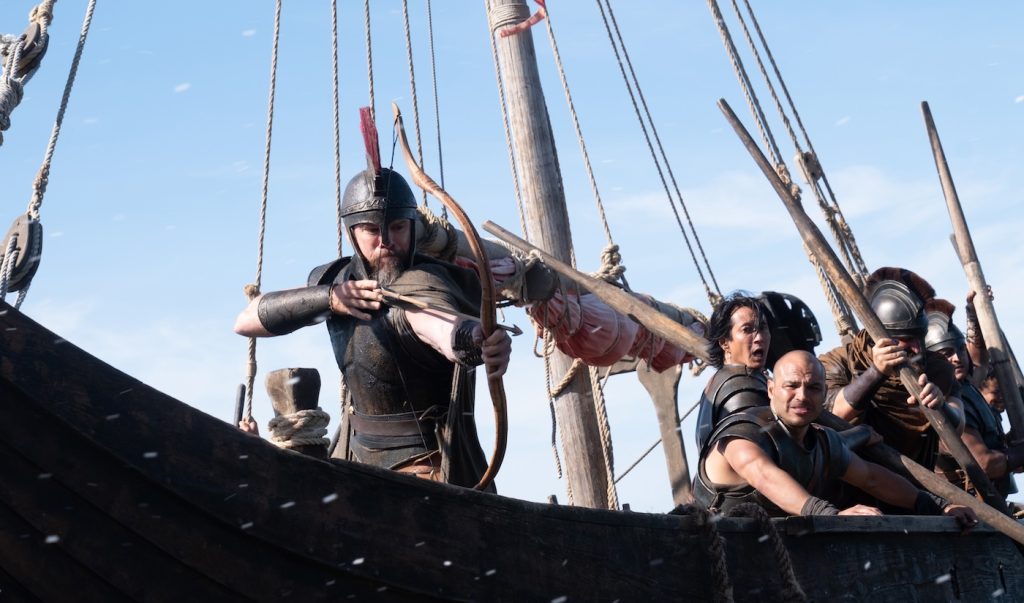
Spielberg famously told Waterworld director Kevin Reynolds to avoid filming on the open water at all costs. He’d learned the hard way on Jaws. Yet Reynolds wasn’t filming at sea with IMAX cameras, and Nolan has never shown much interest in being intimidated by somebody else’s cautionary tale. Before production began, the cameras required novel updates to make them lighter, a necessity given that the cast and crew would spend months filming aboard an actual boat, an authentic Viking ship called the Drake that they sourced in Norway. Despite Spielberg’s wise counsel, Nolan and his team filmed on seas across the world, including the Mediterranean, the waters off Iceland (for the Hades sequence), and the North Sea off Scotland.
Filming on the open water with IMAX cameras might sound like the toughest feat, but it was the quieter scenes that required the most ingenuity. IMAX built a specialized soundproof housing around the camera that would allow Nolan and his trusted cinematographer, Hoyte Van Hoytema, to film close to the actors while capturing usable live sound. Yet the soundproof housing, nicknamed the blimp, created a new problem: the camera was now so large that, in intimate scenes, actors could no longer make direct eye contact. This necessitated another workaround, a clever mirror hack, that allowed Damon and Hathaway, for example, to preserve the intimacy their scenes required.
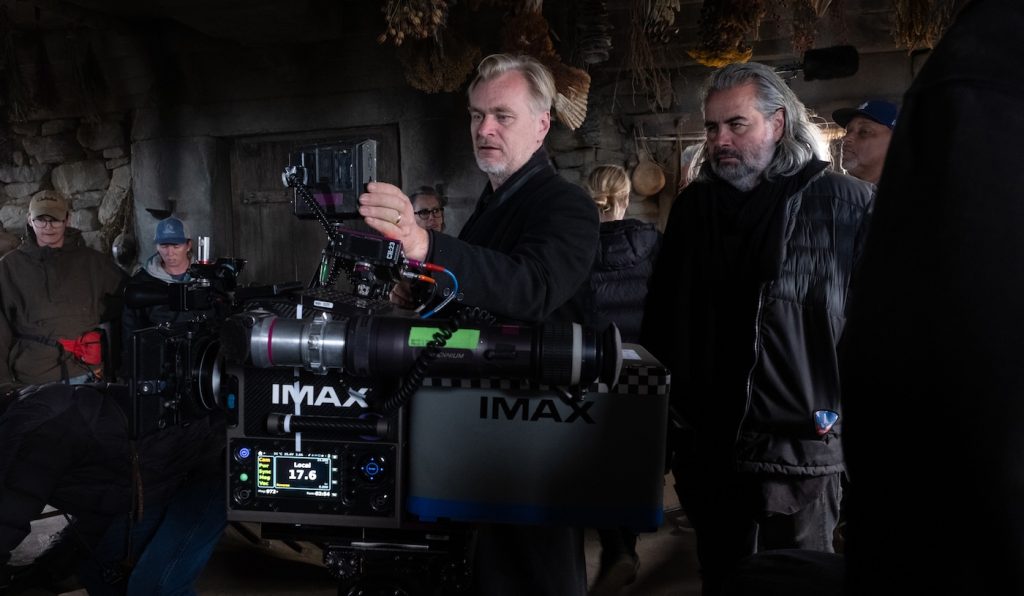
There was one more wrinkle the new IMAX cameras imposed: the film magazines only allowed three minutes of shooting before they had to be changed, which meant interrupting intensely emotional scenes for a reload. The solution was a system in which everyone, cast and crew alike, remained silent during the changeover, allowing the cast to stay in their emotional headspace. Nolan realized that the approach was viable when an intense 8-page scene between Odysseus and Penelope, filmed at the start of the shoot on a soundstage in Los Angeles, retained its emotional continuity despite the multiple magazine changes.
A Pirate in a Shepherd’s Cave
With heavy hearts, we sailed along and reached
the country of the reckless Cyclopes,
lacking in customs…
The first truly terrifying sequence is one of many moments in The Odyssey where Odysseus and his men encounter monsters. Throughout these visually lush, viscerally spooky set pieces, Nolan is doing two things at once: mesmerizing us with indelible images while seeding the deeper meaning of his adaptation through these epic clashes.
There’s a beautiful economy to how Nolan sets up the first of these encounters. We move swiftly from Odysseus and his men seeing a sheep grazing on the island to following it into a cave. The cave belongs to a shepherd, Polyphemus, a colossal cyclops and the son of Poseidon, who tends to his flock with a gentleness that belies his great strength.
Nolan stages the unfolding horror with a nightmarish beauty. Polyphemus might look familiar to art lovers, particularly admirers of the Spanish master Goya. Nolan modeled the cyclops on his “Saturn Devouring his Son,” one of art history’s most stunning grotesques. Trapped and cornered, Odysseus’s men panic as Polyphemus obliterates several of them with crushing ease before snatching up a few more as casually as one might pluck fun-sized Snickers from a bowl. With the untidy slothfulness of an infant, he stuffs them screaming into his mouth and crunches down. (The incredible sound design in The Odyssey requires its own essay.) Limbs and heads tumble off his chin as firelight flickers across his monstrous face, plunging the carnage in and out of shadow.
Polyphemus is played by Bill Irwin, who last worked with Nolan voicing the robot TARS in Interstellar. His single eye hangs crooked above a horribly twisted nose and mouth, both set askew across his face. He is not the muscular brute of popular imagination but a misshapen, gangly creature who is all the more terrifying for his monstrous frailty. To create the Cyclops, Nolan and his team relied on animatronics, robotics, and puppetry, with Irwin, a trained mime and clown, lending the creature its lumbering yet oddly graceful physicality. So who is violating the laws of xenia here: the shepherd unaware that strangers have infiltrated his cave, or the strangers themselves, ready to take what they want?
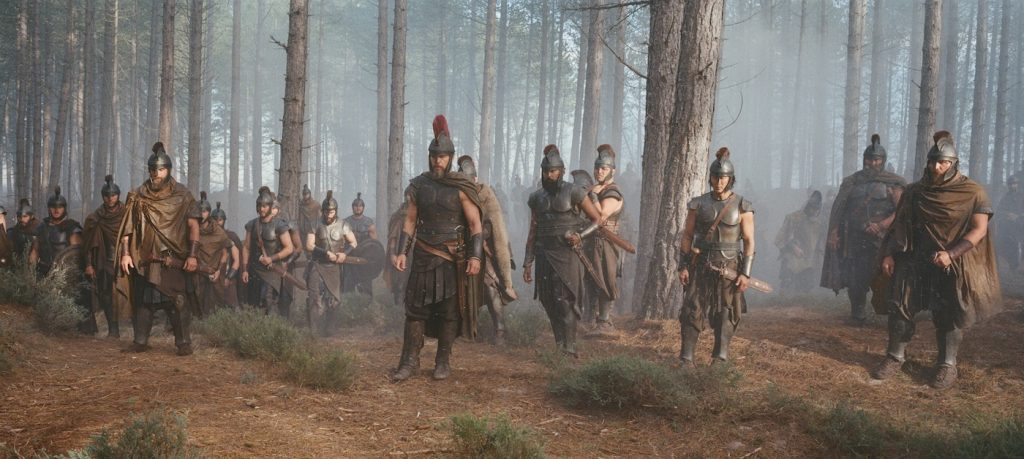
Nolan’s approach to filming Odysseus’s encounter with the Laestrygonians offers another example of the Greeks’ rude, desperate intrusion into somebody else’s world. Odysseus come upon a child in the woods. To the little girl, these are not heroes returning from the heroic battle of the Trojan War; they are a band of bedraggled, armored strangers demanding food and shelter. She does the sensible thing: she screams. The little girl dashes off into the forest, and within seconds, a terrible, beautiful sight: the giant Laestrygonians, towering over Odysseus and his men, marching toward them in their own armor.
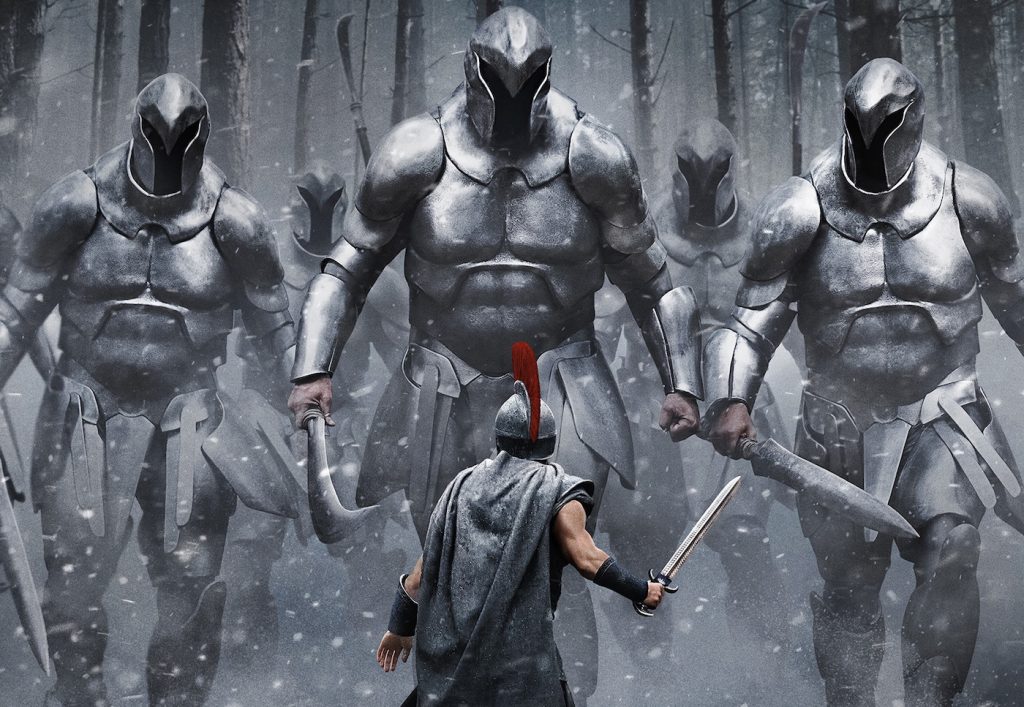
It’s a slaughter. The colossal Laestrygonians brandish swords the size of a ship’s prow. Odysseus’s men are clobbered, dismembered, tossed like stones through the trees.
Perhaps the most surprising and satisfying performance in the film belongs to Samantha Morton. As Nolan recently told Turan, it hadn’t been since Heath Ledger’s performance as the Joker in The Dark Knight that his crew had applauded a performance the way they did for Morton’s portrayal of the witch Circe in The Odyssey.
Here, Nolan and his masterful special effects team conjure the most horrific sequence in the film. As Odysseus’s men devour Circe’s feast with a grotesque fervor, they become literally pliable to her will. Circe begins disfiguring and reshaping them with her hands, shoving an arm down their throats, pulling apart their skulls, and working their flesh and bones as a potter works clay, molding her victims into squealing pigs.
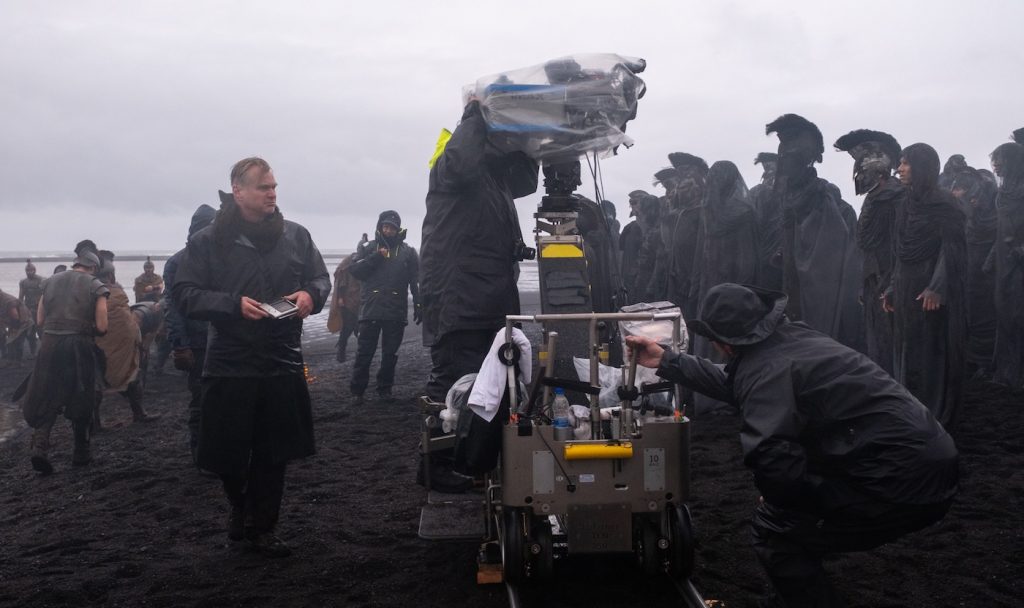
Hades has been rendered a thousand times or more in countless stories, paintings, poems and films, yet Nolan’s approach, like Homer’s before him, was to make the land of the dead a forlorn island. Odysseus and his men arrive seeking the prophet Tiresias, but first encounter Sinon (Elliot Page), the young soldier who sacrificed himself to make the Trojan Horse ruse possible. Page has only a few minutes of screen time, but makes the most of them, delivering a haunting performance of rage and regret. Odysseus is then confronted by the shade of Agamemnon, who returned from the Trojan War victorious only to be felled by his own wife, Clytemnestra (also played by Lupita Nyong’o). Finally, Tiresias (James Remar) appears and offers Odysseus the vision he seeks, and it’s a terrible one: more death and destruction for the men who remain.
Nolan’s approach to the six-headed Scylla feels like a passionate doff of the cap to Guillermo del Toro, who has built an Oscar-winning career out of imbuing monsters with humanity. Although the Scylla is largely a visual effects creation, the six-headed beast never feels like a mere obstacle in Odysseus’s path. In Nolan’s telling, she is a creature whose domain has been violated, attacking Odysseus and his men in a defensive, territorial rage as they sail beneath her cliffside lair to avoid the whirlpool Charybdis.
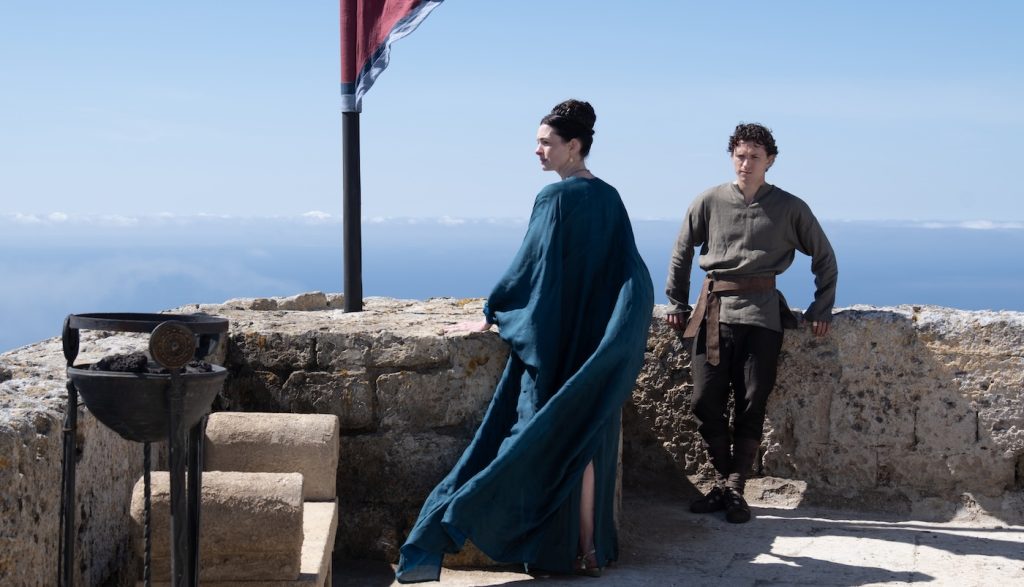
Odysseus’s return, at last, to Ithaca offers a violent comeuppance for the loathsome suitors, but the catharsis is bittersweet. In Nolan’s epic yet deeply human telling, Odysseus’s original sin, the Trojan Horse and its violation of xenia, ripples outward, transforming him from a hero into the unwitting architect of a civilization’s collapse. The sack of Troy is rendered not as a thrilling, ingenious victory but a pillage and a slaughter. (This is where Zendaya’s Athena emerges as the film’s clearest symbol of xenia defiled.) Throughout the film, Penelope and Telemachus worry over rumors of seaborne invaders sacking cities and kingdoms. It’s for this reason Penelope feels compelled, after two decades, to finally abandon hope of Odysseus’s return and place a suitor on the throne, so that Ithaca can raise an army and defend itself. Yet when a disguised Odysseus speaks with her on the eve of the suitors’ bloody reckoning, he tells her a far sadder story: the invaders who have rejected xenia and ushered in the beginning of the end of civilization were Odysseus and his men. It was Odysseus, after all, who hid death inside a gesture of goodwill.
For all the sweeping beauty and terror of Nolan’s adaptation, he brings Odysseus and his world into our own through embodied performances and relatable terrors. More than the gods and monsters, it is this long-delayed personal reckoning that keeps Odysseus away from home. For all the beasts that he slays or outwits, the one who must ultimately confront is the monster within.
Featured image: Matt Damon is Odysseus in THE ODYSSEY, written, produced, and directed by Christopher Nolan.