
From Krypto’s Fur to Kara’s Flight: The VFX Magic Powering “Supergirl”
“I think it’s a matter of approach and coming in with real input,” says Framestore visual effects supervisor Stephane Naze when asked about the magic of visual effects blurring the line between what’s real and unreal. “I’m not saying other vendors don’t do that. I think each company may have its own specialty, and Framestore is pretty good in terms of making creatures.” The award-winning VFX house is behind dozens of famed characters, including Paddington, Toothless, Pikachu, Hulk, and teaming with James Gunn on The Guardians of the Galaxy trilogy to create Rocket. For director Craig Gillespie’s Supergirl, the multi-local company oversaw Krypto the Superdog, an effort first realized on Gunn’s Superman (2025) starring David Corenswet as the Man of Steel.
The creative director behind the DCU was inspired to include Krypto in his Superman story based on his own rescue dog, named Ozu, who had some initial, albeit funny, behavioral issues – destroying furniture, nipping at his feet, and chewing up a pricey laptop – before the director came to the realization: “What if that dog had superpowers?”
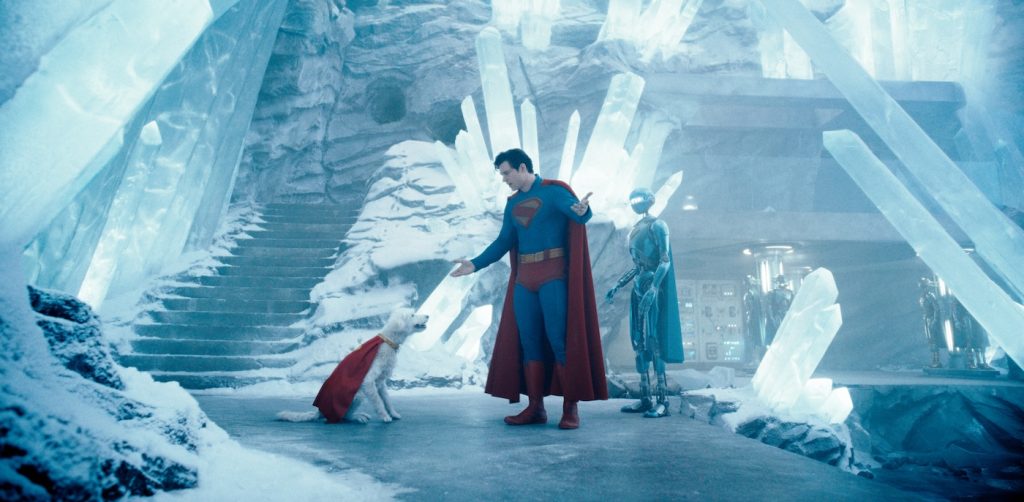
On Superman, Framestore captured detailed photoscans of Ozu to shape Krypto’s anatomy, proportions, and expressions, while home video captured his wonderfully erratic personality. On set, production alternated between a stand-in dog named Jolene, a practical puppet, and a performer in a suit, giving actors a point of interaction and providing VFX with camera and lighting references. Artists then built a CG skeleton, muscle, and skin layers to create smoother, more physically accurate motion. Keyframes, rather than motion capture, brought Krypto’s movements and emotions to life. For the finishing touches, an advanced grooming tool was used to simulate his white fur, while adding snowflakes, dust, and dirt to his coat added subtle detail to the scene’s environment – all in an effort toward photorealistic imagery.
With Supergirl, they again handled all the Krypto shots for a saga that follows Kara Zor-El (Milly Alcock) in a race to save his life, including scenes of how they first met and their new life on Earth–which introduces a puppy version of Krypto. Like Superman, real dogs stood in for Krypto on set: a puppy named Stan and an adult named Blanco.
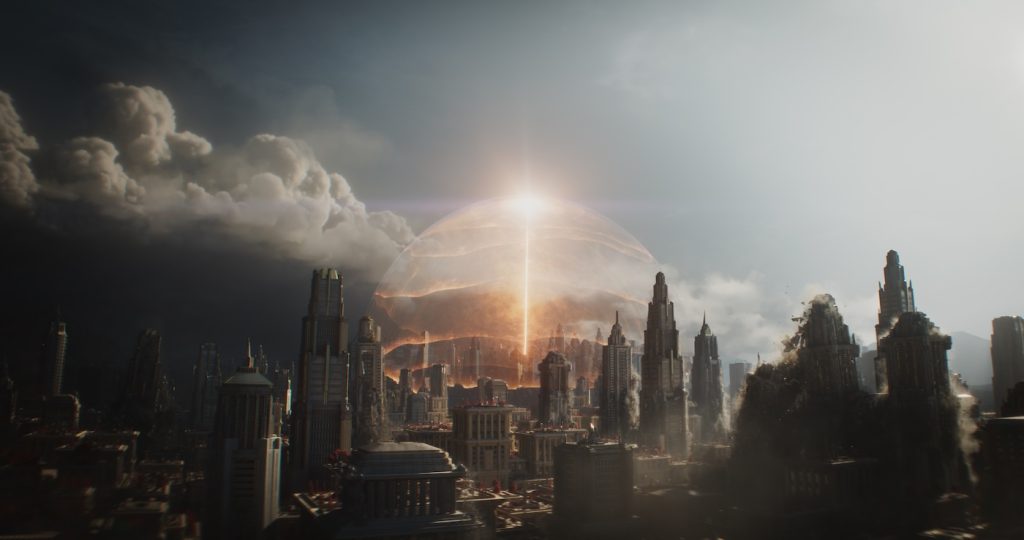
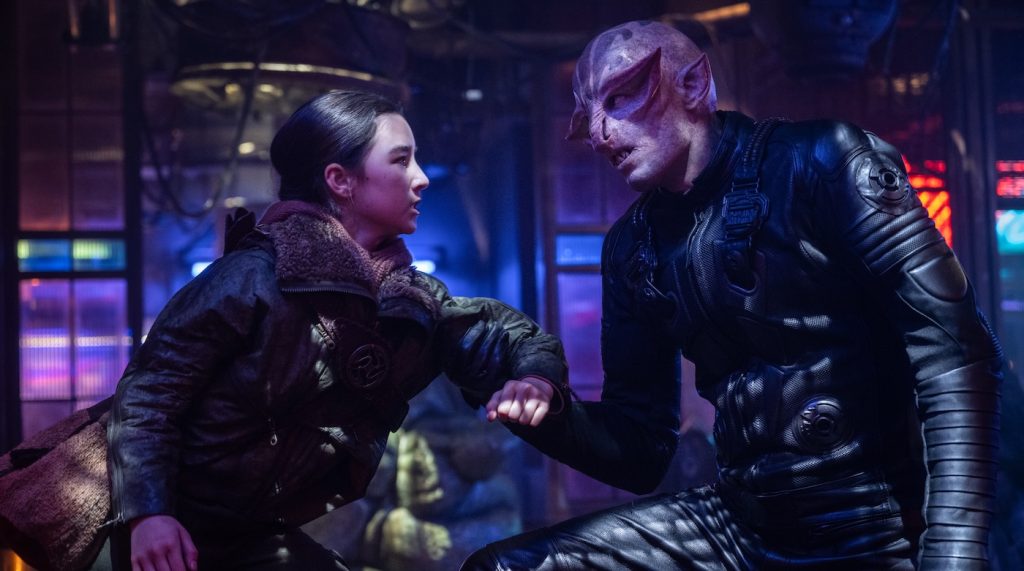
Krypto wasn’t the only challenge on the team’s plate, as a number of pivotal story moments also needed attention, including a galactic rest stop, a pub filled with not-so-friendly aliens, and the destruction of a Kryptonian city. But none more exciting than a sequence in which Supergirl battles a group of female space pirates aboard a flying bus – a climax that sees her soar into a yellow sun and reclaim her powers.
Visual effects supervisor Geoffrey Baumann (Black Panther) and VFX producer Nicole Rowley oversaw the entire VFX pipeline, which included vendors Digital Domain, Industrial Light & Magic, Barnstorm VFX, and Peerless VFX contributing to the project. Framestore was brought in early during prep. “From the very beginning, Geoffrey wanted to be as clever as possible,” says VFX supervisor Benjamin Loch of Framestore. “He got Steph and I over to where they were filming and it was very good to see how Craig was working. But they were also very open. If we needed something, they would try to get it.”
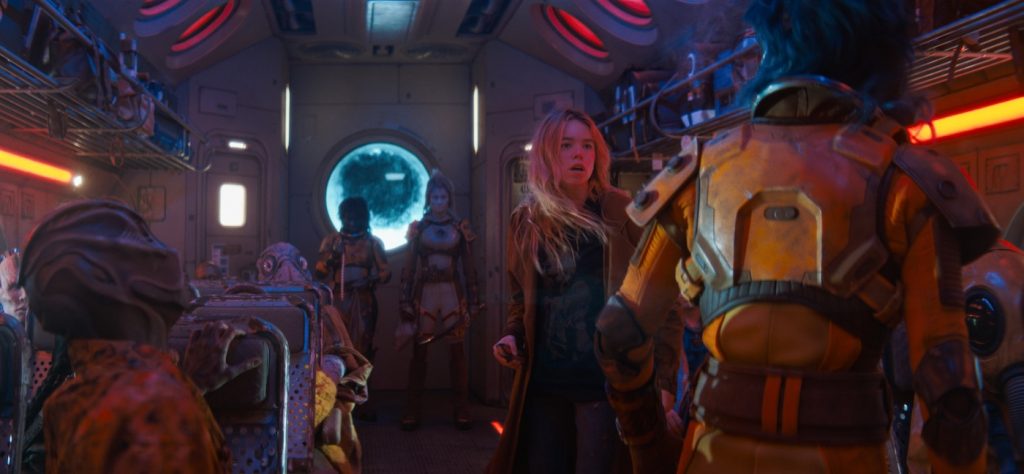
The action initially unfolds aboard the flying Wormhole bus, modeled after a Greyhound bus. Teleporting aboard to steal the passengers’ valuables are blue humanoids called the Sklarians. At that moment, Supergirl doesn’t have her powers, but she has a plan: to kick their butts. It works until it doesn’t—Supergirl is ejected into outer space, and her body floats away as ice begins to form around it.
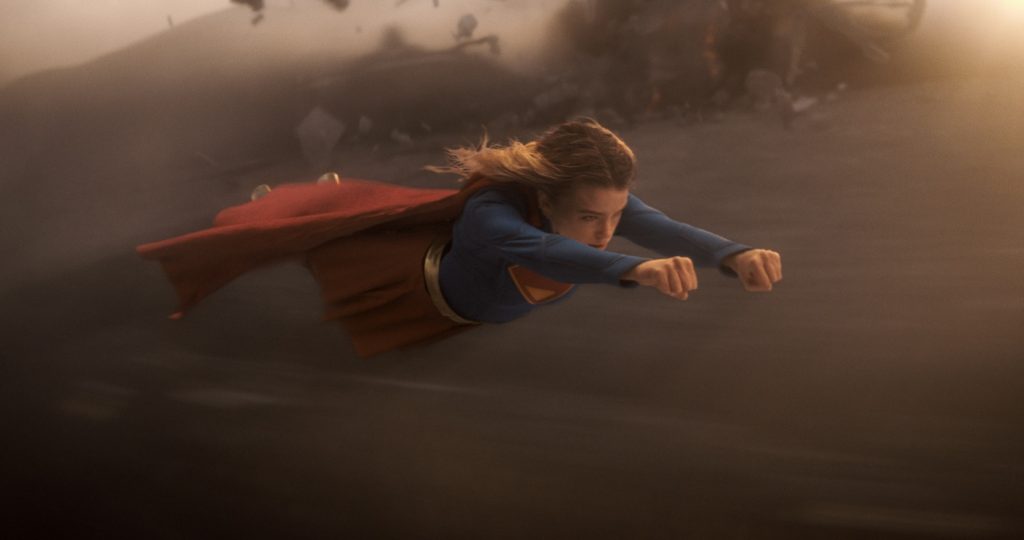
“It was a mix between zero gravity and underwater,” says Loch of Supergirl’s movement. “We were trying to figure out the right amount of underwater motion versus zero gravity, plus figure out the frost. How fast should it freeze? How much of the face do you want to cover up? Then you’ve got the planets in the background and choreographing the junkyard, which Craig had very clear in his head how he wanted it.” Production attached Alcock to a stunt wire to simulate her floating as a reference, but VFX resorted to an almost full CG version of Supergirl, retaining only her face and performance for specific shots. “In the end, we had to replace the hair, the costume, almost everything, so it added another level of complexity,” notes Naze. Loch added, “On the big frost shot, it took a long time to get the animation and tracking right. There were bits of the costume that were good for reference and set lighting, but unfortunately, when you end up adding a lot of other things to it, that changes the lighting and shadowing on her face.”
Inside the bus, visual effects matched the look cinematographer Rob Hardy produced on set. “There were huge amounts of flaring which gave it a really cool in-camera feel, but when you’re adding CG, we had to paint it all out and add it back in,” explains Loch. “They were very specific about us matching it, and they shot a lot of references, which is great because all that stuff had to be spot on.”
Creating outer space for the scene added another layer of complexity. “There was a very strong desire to make sure throughout the film that everything didn’t look the same,” says Loch. The team modeled space debris, a ringed planet, and a yellow sun, giving scale and dimension to the action.
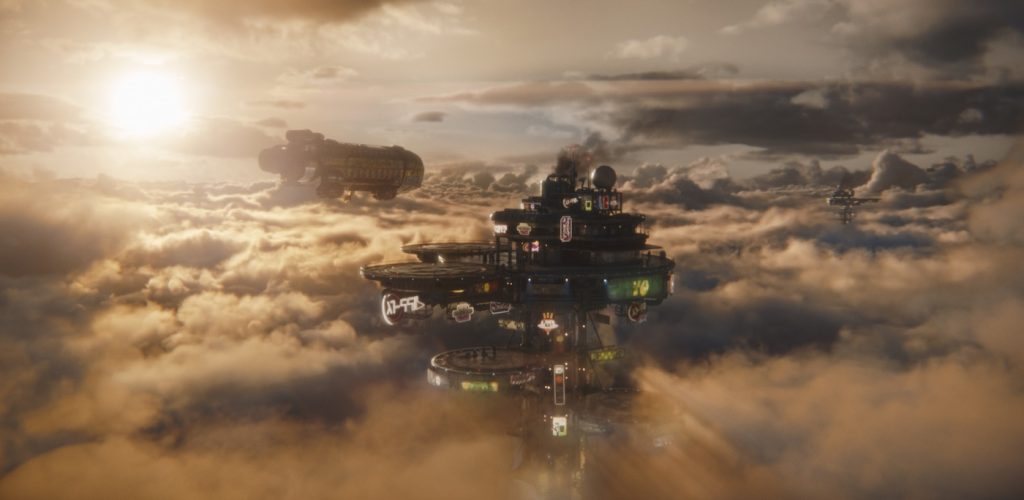
“Craig very much wanted the planet to be a certain size, the ring to be a certain shape and perspective,” notes Loch. “One of the big challenges was the scale of the clouds covering the planet’s surface. We had to do a lot of custom work to make sure nothing was jarring, and that it didn’t feel like we were going from a thousand miles away to a thousand meters up close, which would break the continuity of the sequence as Kara neared the planet. The solution was to create custom cloud surface layouts for these key shots to ensure a consistent cloud size across the screen. That was also a bit of a challenge.”
The Framestore team mentions the work was “a very organic process.” “Craig’s vision of each shot was unique, and we had to adapt ourselves to it,” notes Naze. “Part of what we learned the most was to change our mindset and think in a completely different way.”
Supergirl is in theaters now.
Featured image: (L to r) Milly Alcock as SUPERGIRL and KRYPTO in DC Studios’ and Warner Bros. Pictures’ “SUPERGIRL”, a Warner Bros. Pictures release. (Courtesy of Warner Bros. Pictures)