
From 8‑Bit Nostalgia to Cinematic Scale: Inside the Sound for “The Super Mario Galaxy Movie”
“It’s really great to see audiences embracing the second film,” says Michael Semanick, a rerecording mixer behind The Super Mario Galaxy Movie. The animated sequel to the iconic video game franchise has racked up another high score at the box office.
Its success stems from a new level of nostalgic charm, driven by a narrative that blends vengeance with long-lost reunions. The saga picks up where The Super Mario Bros Movie (2023) left off: Bowser (Jack Black) has been shrunk to a peep-squeak and is held captive by Princess Peach (Anya Taylor-Joy). The Mushroom Kingdom is at peace. Hooray! But that changes when Bowser Jr. (Benny Safdie) hatches a plan to free his father and conquer the universe. Will Mario (Chris Pratt) and Luigi (Charlie Day) save the day again?
That answer was left up to directors Aaron Horvath and Michael Jelenic, who take audiences on an action-packed adventure filled with new (yet familiar) faces, countless gaming nods, and a mix of animation styles that energize each moment on screen. Sonically supporting the story was a team from Skywalker Sound, including sound designer/supervising sound editor Jeremy Bowker, supervising sound editor Dan Laurie, rerecording mixer Scott Lewis, and rerecording mixer Michael Semanick.
Below, Bowker and Semanick discuss how they crafted the sounds for a new villain, Bowser Jr., balanced action sequences, and that cool Star Fox cameo.
What themes or guiding light did the directors have in mind for the overall sonic approach?
Jeremy Bowker: Our general north star was to make sure we retained the nostalgia that comes with all of those games, including the Super Mario Galaxy video game. And to make sure that we held on to a lot of the specific sounds that are identified with Nintendo, but also elevated the entire experience to a cinematic universe.
Michael Semanick: We also didn’t want to overwhelm the audience with too much sound or be too loud. We wanted a pretty well-balanced mix so that people can enjoy themselves and not be pushed back from it.
The movie opens with an action-packed sequence setting up the story. One that sees Bowser Jr. (Bowser’s ambitious son) kidnap Rosalina, Princess Peach’s sister. How did you balance the set piece so the story wouldn’t get lost?
Semanick: We didn’t want to overwhelm the audience, but you want to make it fun and exciting. So getting that balance was tough. We really worked back and forth to feel the energy of the sound effects and where music cues needed to take off.
Bowker: Yeah, there’s kind of a constant volleying back and forth, making it not so obvious as far as highlighting elements or different story points. It’s always kind of this sleight of hand. Maybe a rocket blast will lead off to a music cue, and it’s just keeping that momentum going. There’s always something exciting happening. A new character on screen, a new adventure, or a new battle.
Speaking of new characters, how did you want to shape the sonic envelope of the new villain, Bowser Jr.?
Bowker: So much of what we need to guide us is there on screen. One thing that was exciting about what Aaron [Horvath] and Michael [Jelenic] wanted was a new interpretation of some of the classic Nintendo sounds. It could be anything, like Bowser Jr. ‘s clown car or something else. They also wanted a more realistic take on a few of the items, so we were open to that.
How so?
Bowker: We were always asking ourselves the question, what would something sound like if it dipped its toe a little bit more into realism? There’s obviously a lot of silliness with Bowser Jr., but sometimes, to make those comedic moments work, you have to really set it up with what feels like our interpretation of cinematic realism. It needs to be exciting, it needs to be beefy, it needs to sound like a legitimate action film to help frame a comedic moment.
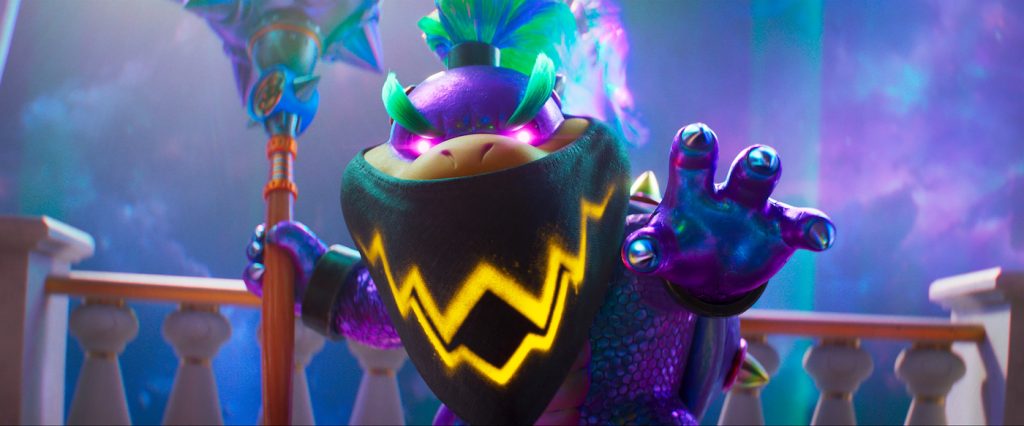
Bowser Jr. uses a paintbrush as a weapon, painting anything he needs to fight Mario and Luigi, including armor and a dragon. How did you want to bring those moments to life?
Bowker: The message that we wanted to get across with the magic paintbrush was that it was evil and powerful, but we still needed to sell the legitimacy of the liquid sound and then highlight what it turns into. It ended up being this multifaceted sound that was very sequential, where you would hear this kind of very viscous liquidy movement. Then this “whoa” vowel sound, which was made from metal resonating, was recognizable and repeatable. And then the third part of what it turns into, like a weapon.
Another new character is Star Fox [voiced by Alexis Lefebvre], who gets introduced with a flashy backstory that intertwines with old-school animation. What was the sound approach for his debut?
Bowker: We really wanted it to feel as 1980s and 1990s as possible. So the sound effects that were selected in that area were very, very specific to that time to try and feel as authentic as possible. I love the transition of going into that, but also coming out of it. There’s a moment when we land on the launching pad of the Gateway Galaxy, and his foot comes down; it’s all just the most realistic foot down. It’s such a great juxtaposition for the kind of 1990s animation we were just in.
There’s an outer space fight between Star Fox and Bowser Jr. Did you want to mix that fight scene any differently from the other action pieces?
Semanick: We really want to hear sound effects and the ship going by and the guns going off. The music helps complement everything. I tried to think of myself as a kid watching the movie. What do I want to really hear? What do I want to feel like? I wanted it to feel like you’re on an adventure with them in the cockpit and riding through.
A T-Rex makes a cameo. Being a Universal film, did you pull effects from Jurassic Park to make its roar?
Bowker: It was not pulled from Jurassic Park, but it has a lot of the same elements that went into Jurassic Park. They were sounds from our Skywalker library, and we wanted to make it feel as much like the audience knows what a T-Rex should sound. So it has a lot of the same ingredients, with the hopes of achieving something that really feels like the same sort of power.
One of my favorite scenes is Mario battling Bowser [voiced by Jack Black] on a bridge. Visually, it slips back and forth between the iconic Super Mario Bros end level game animation and the movie animation. How did you want to treat the juxtaposition?
Bowker: When we go into that kind of 8-bit world, that was a combination of authentic and old-school Nintendo sounds. We were lucky to collaborate with Nintendo, so we were very aware of which sound to use where. Then, for the other half, we wanted it to sound as big and as chunky as possible to create a contrast with those old-school sound effects. And then, as you go into what Mario is actually experiencing, we wanted that to feel like a Mission: Impossible movie. We wanted it to be big and exciting and dangerous.
The climactic ending sees Mario, Luigi, and Yoshi fight a number of battles while Peach tries to save Rosalina. What guided the sound approach?
Semanick: It was a balance of pulling down a little, letting something else breathe, before going back in. It’s a great score that Brian Tyler did in that area. He worked really, really hard to make those things fit. And it’s a busy score, and there are a lot of parts to it. So, trying to get those parts through, trying to make sure we feature some things while the effects take over or dialogue is there. It’s a balancing act, really.
The Super Mario Galaxy Movie is in theaters now.
Featured image: L to R: Luigi (Charlie Day) and Mario (Chris Pratt) in Nintendo and Illumination’s The Super Mario Galaxy Movie, directed by Aaron Horvath and Michael Jelenic.