
How Directors Joel Crawford and Januel Mercado Brought Filipino Folklore to “Forgotten Island”
After watching Forgotten Island in theaters, you might get the urge to call someone you care about.
The animated feature from Puss in Boots: The Last Wish co-directors Joel Crawford and Januel Mercado follows Jo (voiced by H.E.R.) and Raissa (voiced by Liza Soberano), two Filipina besties whose bond veers sideways when Raissa plans to study abroad. While partying on their last night together, they fall into a mysterious portal that takes them to Nakali, a vibrant world filled with exotic animals, wild creatures, and some not-so-friendly monsters. What starts as a “how did we get here” adventure quickly turns into a very bad “what have we gotten ourselves into” situation. Their only way back is to lose memories of their friendship. Not cool.
Woven throughout the story is Filipino culture, from its language, food, folklore, traditions, and rhythms of everyday life, making Forgotten Island the first Philippine-themed animated feature from a major U.S. studio (DreamWorks Animation/Universal Pictures). The decision wasn’t by mistake. Mercado is Filipino-American, and Crawford’s wife was born in the island nation before moving overseas. The directors have also become great friends since meeting on Kung Fu Panda 2. “We both have personal connections to the Philippines, so this movie is a love letter to our families and a culture that shaped our values,” Mercado says. “We thought a lot about the people who shape our lives, the loved ones who influence who we become and the way we move through the world.” That connection wasn’t just on screen; it extended to the Filipino artists working behind the scenes, including Snipple Animation, a studio in Quezon City, which worked on key sequences that help Jo and Raissa remember how they arrived on Nakali.
While visually grounded in Pinoy culture, including the islands of Palawan and El Nido, Nakali, the ground-shaking portal, was designed after the sun on the nation’s flag, and a village made to look like the Chocolate Hills in Bohol. The filmmakers explored a dynamic style influenced by anime, 1990s rave culture, graphic linework, and 2D art, bringing the story’s underlying themes to life in distinct, expressive ways.
In an interview with The Credits, directors share the details behind those references and how they put their own spin on Philippine folklore. “Tayo na!”
You put a lot of attention into small animation details, especially the accent pops around the action, like if a character presses play on a stereo, we get these little animations to emphasize it. Was that an extension of what you did on Puss in Boots?
Januel Mercado: Because Joel and I are just such fans of filmmaking and animation, and in recent years, we’ve seen our peers push the boundaries of visual storytelling, which inspired us to push it ourselves with Puss in Boots: The Last Wish. And coming off of that, there’s no going back. So in moving it forward, we’re embracing these techniques and traditional 2D hand-drawn elements of the past because there’s a handcrafted feel and craftsmanship that we love so much.
Joel and I still love drawing on paper and feeling the pencil and the marker. So having frames that go into, like, pen-and-ink drawings pays homage to the wide array of artistic styles we grew up with beyond animation. We’re utilizing them to make filmmaking more exciting and to show the newer generation, who are more tech-savvy, that there’s still value in this lo-fi, tangible kind of medium.
Though Jo and Rissa are best friends, did you want to show this impending divide early on through framing?
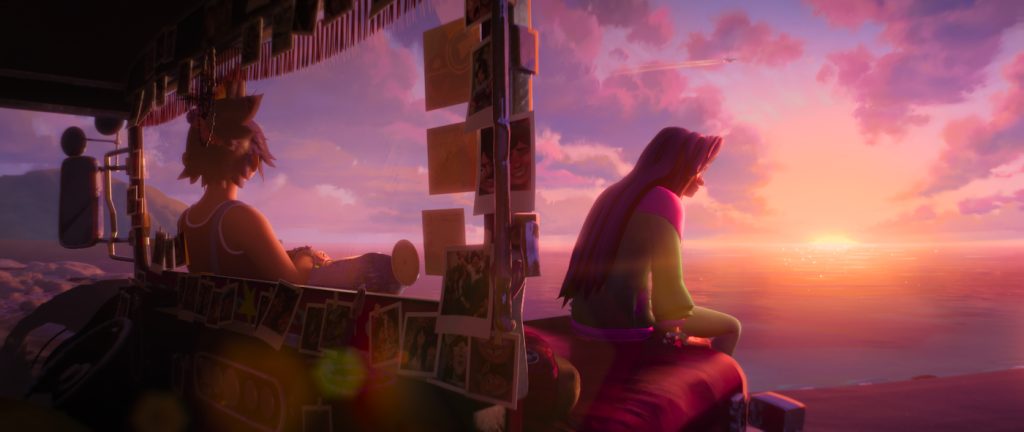
Januel Mercado: Absolutely. One of our favorite shots, actually, is the scene that ends with the portal opening. Prior to that, there’s a shot of the girls sitting on the hood of the jeepney and the camera is shooting through the windshield, and it’s staged so that Raissa is at the edge of the hood and Jo is boxed in by the windshield. That creates a division between them, and it’s a powerful moment because there’s a tension in their friendship. There’s an uncertainty about what’s going to happen, and there’s this awkward silence, and the sun is just setting on their friendship. We really started to see it come to life with Christine Bian, one of our viz-dev artists, who painted this beautiful moment that just really captured the soul of the movie. These are the emotional stakes. This is why you care whether or not these two friends stay together.
In Nakali, the palette shifts to brighter, bolder colors, but also the way we see the world shifts into a wider, almost fisheye perspective. What was the intention behind the change?
Joel Crawford: With our head of cinematography, Scott Cullen, we figured out this film language that we wanted small moments to feel big and meaningful. So at the beginning, in the real world Philippines, we use much longer lenses, shallow depth of field, and you feel like you’re in the moment of these things being created, these experiences of Jo and Raissa growing up together.
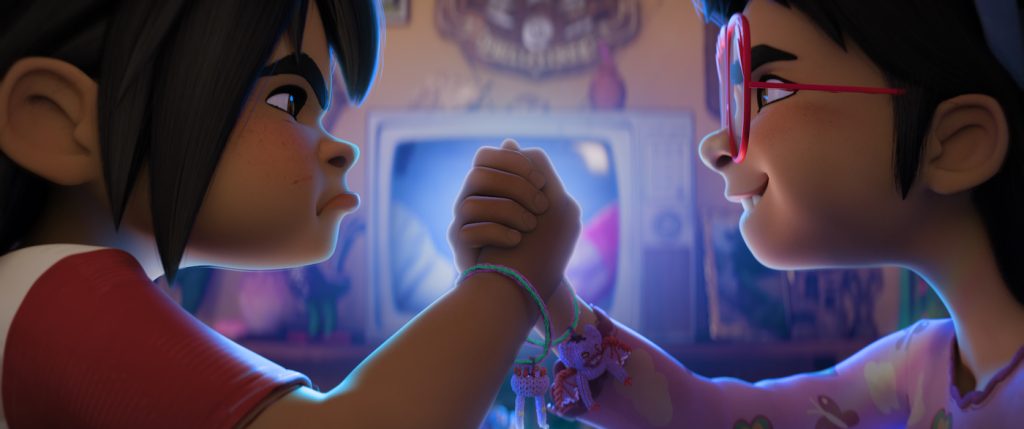
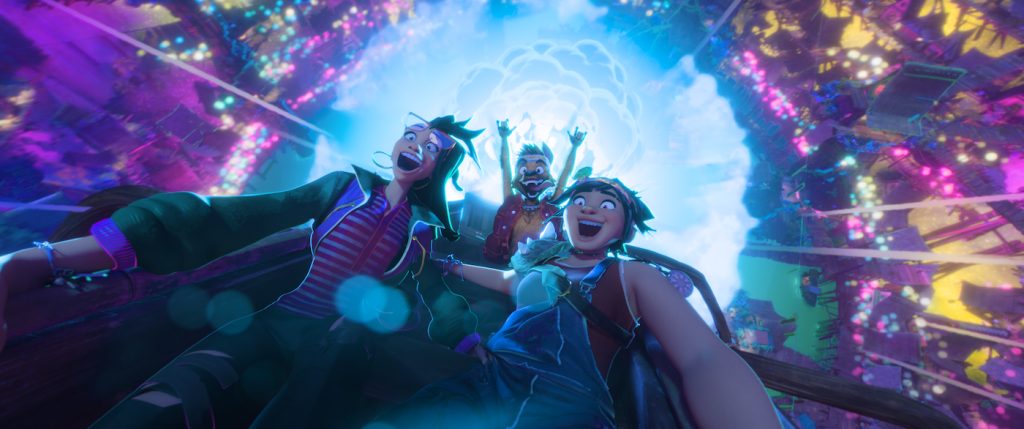
Then when we jump into the world of Nakali, it opens up to this giant kind of epic field of view. We drop down, at some points, to 6mm and 8mm because we really wanted to feel how expansive and huge this island in the fantasy is. But also, when we re-experience memories later in the story, some of those memories we experienced in a shallow depth of field and on the longer lenses are brought to life by experiencing them in this wide angle.
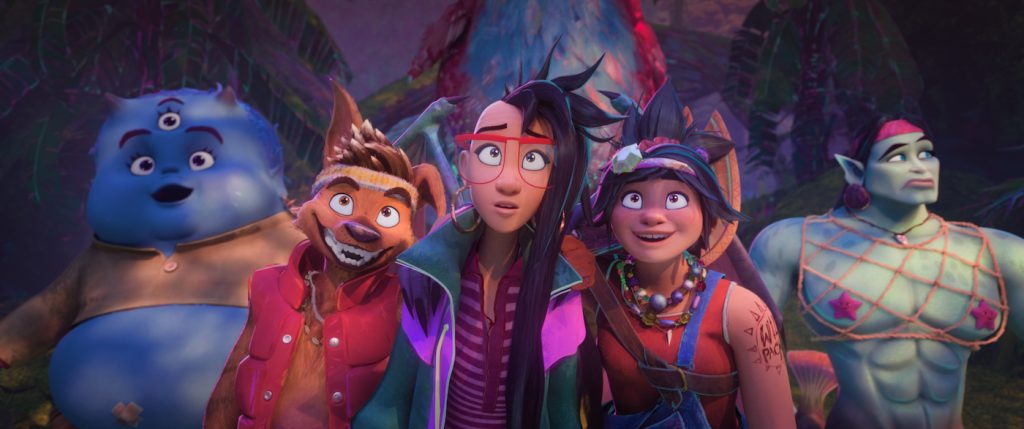
What’s fun is how you took Philippine folklore and spun it into something new. Like Manny Jacinto’s character Bunji is taken from a tiyanak, which is basically a vampire-like baby who eats people. But in Forgotten Island, it takes on a much cuter, comedic form.
Joel Crawford: Anthony Francisco was one of our creative consultants because he’s Filipino, and he pitched us on making Bunji a tiyanak. And I think finding this cool mythology, and how it aligns with the movie, gives you a unique take. And in a story about people looking at an unknown future and being afraid, having a baby that’s 200 years old but never left home gave it a comedic angle.
Januel Mercado: And to your point, we still pay homage and acknowledge the source material, because there’s that joke where Bungi says, Mom didn’t pack enough food for me. I don’t want to have to eat anybody again.
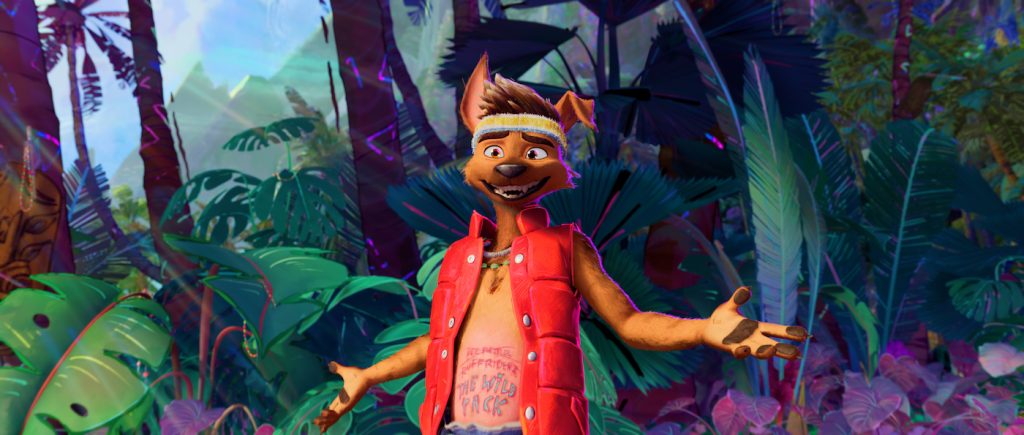
You inject different animation styles throughout the story, especially in the flashback sequences from Wild Pack members who tell Jo and Raissa about their arrival on Nakali. How did you want to approach those moments with Raww (David Franco) and Prince Mermahn (Kevin McCann)?
Joel Crawford: From the beginning, we wanted to push the envelope of where we could take this movie visually. But we wanted to make sure we weren’t doing anything just because we thought it was cool. We wanted to have a story reason behind it. And when we talk about memories and how we experience and relive them, we’re like, well, we remember things, but we probably picture them differently. So using 2D hand-drawn animation with anime inspiration for each flashback represents the character telling it. Raww has this bravado to him, like he’s overcompensating for that. So a Dragon Ball Z Super-inspired style felt right for that moment, versus Prince Merman, who’s narcissistic and glamorous, and Sailor Moon, which felt like that romantic angle. So marrying the characters with the idea actually opened up a world of opportunities.
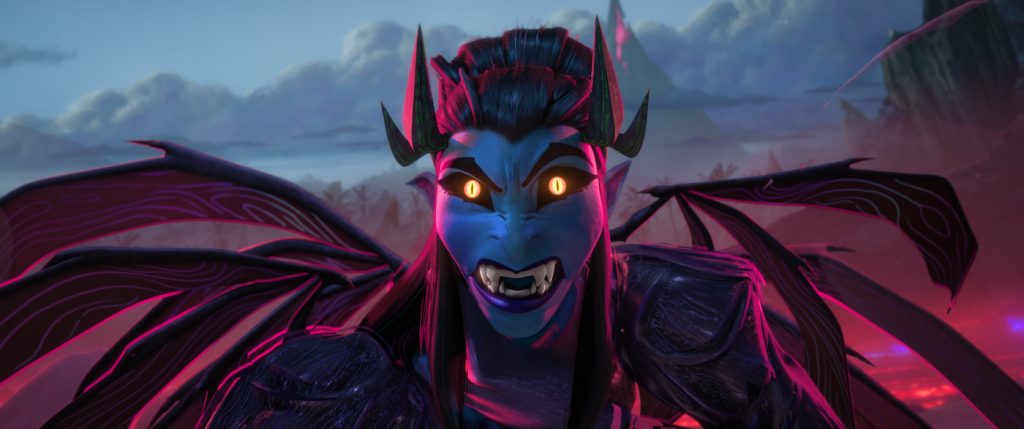
Manang’s (Lea Salonga) color palette gives off villainous vibes, bringing to mind characters like Ursula from The Little Mermaid and the demons in K-Pop Demon Hunters. Was that intentional to make audiences think there might not be more to her character?
Januel Mercado: There’s some intent with using the go-to villain color schemes, like the purples, black, and the blues. Manang was specifically designed to address those tropes on the surface, where she’s clearly the villain, and she’s bad for the sake of being bad. But really, it’s to set up something deeper. The whole “Don’t judge a book by its cover.” So I think we were using those stereotypes to help with the surprise of the storytelling in her ultimate arc.
Forgotten Island is in theaters now.
Featured image: (from center) King Truffle Wuffle (Ronny Chieng) and Manang (Lea Salonga) in DreamWorks Animation’s Forgotten Island, directed by Joel Crawford and Januel Mercado.