Who’s More Human Than a Child? Noah Hawley on Wendy, Humanity, and the Expanding World of “Alien: Earth”
When the news first broke that FX was working on a series based on the Coen Brothers’ flawless 1996 crime drama Fargo, you might have wondered why. Or, if you were a less cynical sort, how? How in the world do you try to make a series that’s remotely even connected to the Coen Brothers’ sui generis creation without serving up something derivative and lukewarm, like three-day-old leftovers from Fryer Tuck’s Smorgasbord.
Noah Hawley knew how. FX’s Fargo has been a hit. Knowing he wouldn’t have Fargo‘s beloved, iconic Marge Gunderson [an excellent Frances McDormand], Hawley wisely decided that his Fargo would instead be an anthology series that channeled the Coen Brothers’ pitch-black humor and location-specific detail into a riveting self-contained crime saga each season. So, years later, when word spread that FX was interested in creating a TV series set in the Alien world, all you needed to know was that Hawley’s name was attached to trap any concerns you had in an airlock and fire them into space.
Granted, the Alien franchise has already been expanded several times over, by original director Ridley Scott (in the prequels Prometheus, from 2012, and Alien: Covenant, in 2017) as well as juggernauts in their own right like James Cameron (1986’s Aliens) and David Fincher (1992’s Alien 3). Most recently, director Fede Álvarez took on Alien: Romulus, which was an interquel set between Alien and Aliens.
One of Hawley’s many challenges was crafting an 8-episode arc that could sustain characters and creatures across a much longer narrative than any single film has. One of his many ingenious moves was to subtly shift the series from a breakneck survival epic to a haunted house from hell—the house being Earth.
Alien: Earth was hatched.
Despite being a major fan of the franchise, Hawley didn’t overdo the reverence or indebtedness to the original two films. Yes, he rewatched them while making the series, but at the beginning, when he was coming up with the idea for the show, he relied on something else.
“I find that when the source material is sitting directly in front of you, the impulse to copy it can be irresistible,” Hawley says. “But when you’re working from memory, you’re naturally drawn to the things that linger…the emotional experience of them, and what I believed they were fundamentally about, which helps reveal what was most meaningful about it.”
One of the things that lingered for Hawley was Ian Holm’s character Ash in Scott’s 1979 masterpiece. Ash is the science officer on the Nostromo, a mild-mannered and seemingly submissive scientist who answers to Tom Skerritt’s Captain Dallas.
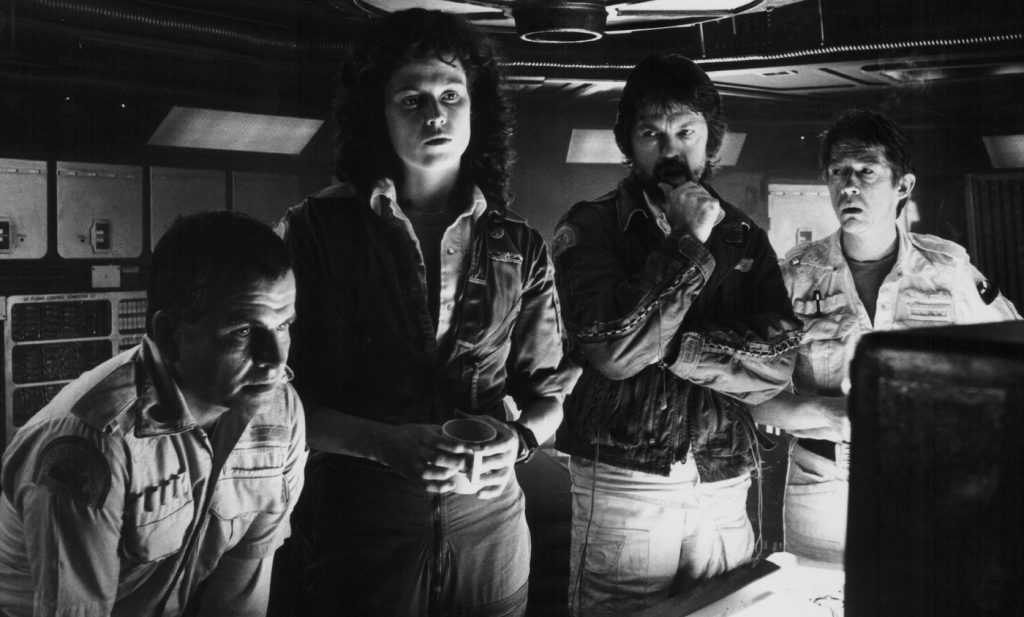
“What fascinated me about Ian Holm’s Ash in the original film is that he’s the only character with a British accent,” Hawley says. “For most of the movie, you just assume he’s British. Then suddenly you discover he’s an android. That kind of surprise is impossible to recreate because audiences expect it now. Any character who seems a little cold, a little off, or even a little British gets scrutinized immediately. So, you can use the audience’s expectations to your advantage. It’s the same way people react to an open doorway in a horror movie. They’re already doing some of the work for the filmmaker.”
Hawley was interested in the dynamic between humans, humanoids, and aliens for reasons deeper than simply playing in the science fiction sandbox. Season one explores the catastrophic aftermath of the crashing of the USCSS Maginot, a Weyland-Yutani deep space research vessel, that barrels into Prodigy City on Earth in the year 2120—exactly two years before the events of Scott’s original 1979 film.
“When I thought about the Alien films, I kept coming back to the moment in Alien when Ash reveals himself to be an android. Ripley is already struggling to survive the monster, and suddenly she realizes she’s trapped between nature and technology. Both are trying to kill her. That felt thematically rich. Science fiction constantly puts humanity in peril, but the question isn’t just whether humanity can survive. It’s whether humanity deserves to survive. So I started thinking about humanity, and then I thought: who’s more human than a child?”
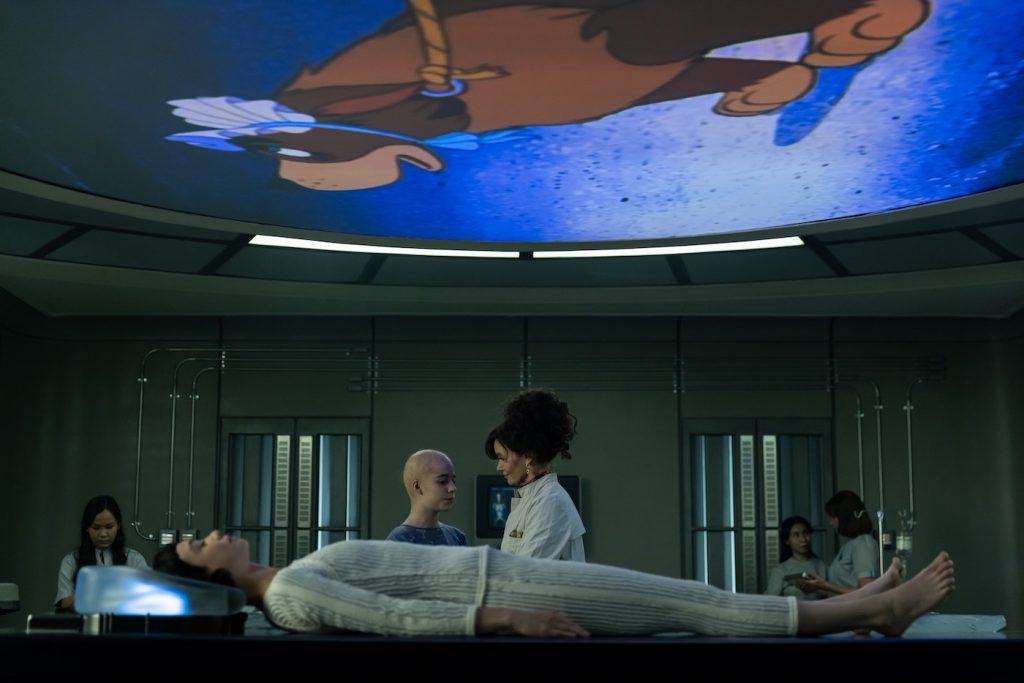
The child, in this case, was Marcy Hermit [Florence Bensberg], a terminally ill girl whom Prodigy Corporation CEO Boy Kavalier [Samuel Blenkin] chose to become the world’s first human-synthetic hybrid. Hawley expanded the world of artificial intelligence in Alien: Earth to include these new Hybrids, synthetic bodies containing downloaded human consciousness. Marcy Hermit ultimately becomes Wendy [Sydney Chandler], arguably the series’ central character, with Marcy’s consciousness now housed inside a young woman’s body with double the strength, agility, and conditioning of a normal human. There are still Ash-like androids, however, and one of season one’s most delicious slow-burns is the animosity building between two classic Alien humanoids—Timothy Olyphant’s android Kirsh versus Babou Ceesay’s cyborg Morrow.
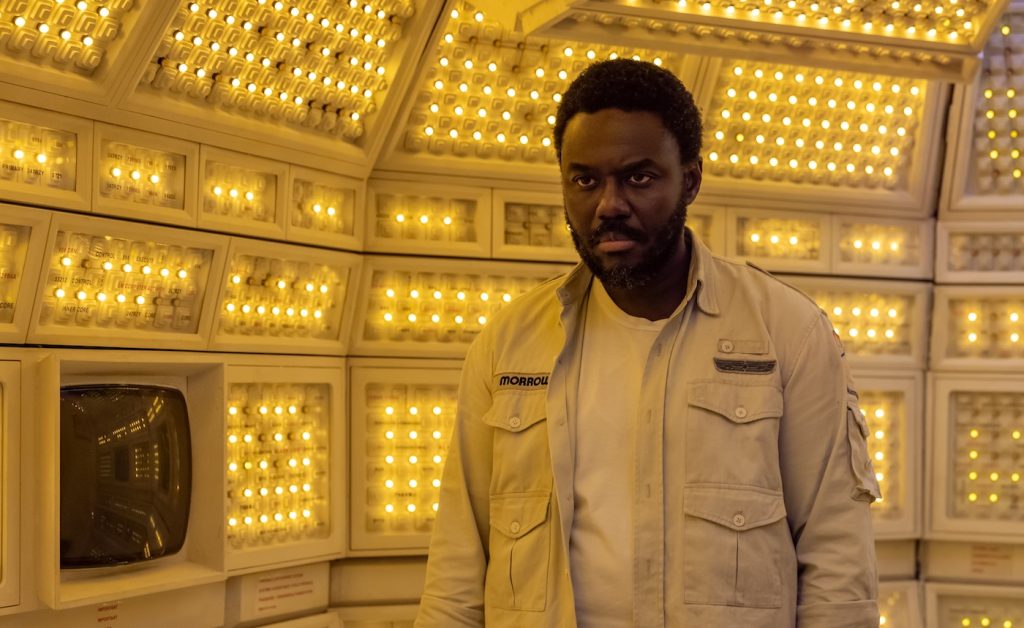
Kirsh and Morrow’s differences are more than just skin-deep. While Kirsh is entirely manufactured, a lab-created android devoid of fear or any other human frailties, Morrow is fundamentally human, fears and all, but bearing deadly cybernetic modification courtesy of the Weyland-Yutani Corporation.
Ceesay’s terrific turn as Morrow has a backstory that involves surviving the series’ most Alien-like sequence; Morrow served as the USCSS Maginot’s Chief Security Officer, and his main directive while onboard the space vessel was to oversee a 65-year deep-space extraction mission to collect and transport live Xenomorph specimens back to Earth. You can imagine how well that goes. A Xenomorph breaks loose on the doomed ship, which crashes into Prodigy City, the territory of the trillionaire head of the Prodigy Corporation, Boy Kavalier [Samuel Blenkin]. Morrow appears from the start as one of the clear villains, but that picture grows murkier as the episodes go on.
“Morrow became the wild card ronin character,” Hawley says. “Through one lens, he’s clearly a villain. He manipulates a child, which is unsettling. But the more you get to know him, the harder it becomes not to root for him. I love characters who occupy that moral gray area. And once you put him and Kirsh on a collision course, the audience immediately starts waiting for the inevitable showdown.”
Of all the complicated characters vying for redemption, revenge, or global domination in Alien: Earth, Hawley has a particular soft spot for Boy Kavalier, who, as played by a very game Blenkin in a selection of open robes and slippers (if he deigns to wear slippers at all), is the picture of sociopathic arrested development wed to a very big and dangerous brain.
“Sam had an incredible time playing that role. When I was meeting actors in London for both Boy Kavalier and the Joe Hermit role, Sam immediately said, ‘Boy Kavalier is the best character in the show,’” Hawley says. “That’s the one I want. He wasn’t interested in any other part. He wanted Boy Kavalier, and he was born to play him. He’s so fun. He’s transgressive. We can all recognize the rich guy who doesn’t think rules apply to him. People think, ‘If I had that much money, maybe I wouldn’t follow the rules either.’ He also manipulates children, which is disturbing, but he has a very Peter Pan quality.”
If Peter Pan was the youngest trillionaire ever, that is.
“I wrote a piece for The Atlantic recently about the billionaire class,” Hawley says. “At a certain level of wealth, things don’t merely become affordable. Everything becomes effectively free.”
Hawley has woven J.M. Barrie’s “Peter Pan” throughout the series, with Boy Kavalier a devout fan. He names each of the hybrids after a character from the book; Chandler’s Wendy is the leader and the first, and she’s eventually joined by Slightly [Adarsh Gourav], Curly [Erana James], Nibs [Lily Newmark], and Smee [Jonathan Ajayi].
“If you go back and reread Peter Pan, it’s actually a pretty dark story,” Hawley says. “Peter is a sociopathic character in many ways. Never growing up may not be the path to becoming your best self.”
It’s probably time to talk about the actual aliens in Alien: Earth.
Alien: Earth draws a few clean lines in the narrative sand about where this particular portion of the franchise stands. Hawley chose not to make the Xenomorph a bioweapon created by the android David (Michael Fassbender) from Scott’s Prometheus and Alien: Covenant and instead leaned into the idea that it’s a more or less perfect creature that evolved over millions of years.
Yet the Xenomorph isn’t asked to carry the burden of the series’ horror itself. Hawley introduced a host of new aliens that are as fascinating as the Xenomorph itself.
“Once the Xenomorph no longer has to carry the entire burden of driving the horror, it can become something closer to a fan favorite,” he says. “It allowed me to play with the idea that Wendy can communicate with them. For a brief moment, the audience might even wonder whether the Xenomorphs could be allies. Of course, that doesn’t last.”
Hawley wanted to recreate the thrill and terror of the first time viewers saw the classic monsters of Alien: the Xenomorph, chestbursters, or facehuggers.
“The challenge is that the original film’s sense of discovery can only happen once,” he says. “The first facehugger. The first chestburster. Those moments are inseparable from the identity of Alien.”
The new creatures in Alien: Earth that crash land along with the Xeno in Prodigy City include the Fly, a nest of space insects that feed on inorganic material and spit acid; the Blood Tick, small but lethal critters that drain their hosts’ blood; and the Orchid, a carnivorous plant that can swallow its victims, asphyxiates them, and then dissolves them. However, one new creature reigns supreme, at least for fans: the Eye Midge. It’s a diabolical little squid-like monster with a fantastically creepy, bulging eye and tentacles. It’s quick and monstrously clever, the Joker of the rogue’s gallery of alien monsters, an agent of chaos. In the Alien: Earth universe, the Eye Midge is designated as Species 64, a member of the Trypanohyncha Ocellus family (“Ocellus” is Latin for “little eye”).
“If you don’t know how they reproduce, what they eat, or how they behave, then you’ve restored that sense of uncertainty and discovery,” Hawley says. “I often approach horror the same way Jordan Peele or Zach Cregger do: through comedy. There’s an absurd quality to horror. Think of Aunt Gladys in Weapons or Anton Chigurh’s haircut in No Country for Old Men. They’re not funny exactly, but they’re so strange that they make you uncomfortable.”
The most uncomfortable and wildly inventive turn in season one has to be when the Eye Midge sucks a sheep’s eyeball out of its socket and takes up residence in its skull, assuming control over the sheep’s brain. Through the sheep, the Eye Midge patiently watches the other creatures: aliens, humans, synths, androids, and cyborgs.
“The sheep was the most innocuous barnyard animal I could think of,” Hawley says. “A sheep is harmless. It’s passive. It’s dumb as a rock. The idea of taking something completely harmless and making it malevolent, calculating, and Machiavellian fascinated me. It’s a little like the rabbit in Monty Python and the Holy Grail. Nobody runs from a screaming sheep.”
As Boy Kavalier lives up to his name and keeps these creatures for observation and study, the dangers rise, the horrors mount, and the Eye Midge-as-sheep watches it all unfold.
“That’s what I love about horror. It’s one of the most cinematic genres because so much of the storytelling happens without dialogue. It’s what’s in the basement. It’s what’s lurking in the corner of the frame. It’s the cut between two shots. With the sheep, we establish that it’s watching,” Hawley says. “It’s observing. Then it sees someone tear a door off its hinges. It learns from that. Later, when someone is trying to hold a door shut, there’s a brief moment of calculation. That’s the moment when the audience realizes the creature is intelligent. As Kirsh says, it’s demonstrating an understanding of cause and effect even though it doesn’t directly benefit from the outcome. It’s creating opportunities for chaos. The audience understands all of that almost instinctively, without anyone needing to explain it.”
Alien: Earth is nominated for four Emmys for cinematography, costumes, sound editing, and visual effects. Season one is streaming on Hulu and Disney+.
Featured image: FX’s Alien: Earth — “The Real Monsters” — Season 1, Episode 8 (Airs Tues, Sept 23) — Pictured (L-R): Sydney Chandler as Wendy, Ade Edmondson as Atom Eins. CR: Patrick Brown/FX