How “The Wrong Girls” Writer/Director Dylan Meyer Captured the B-Sides of Los Angeles With Kristen Stewart & Alia Shawkat
The Wrong Girls writer-director Dylan Meyer wanted to make sure that her L.A. story wasn’t just inspired by her hometown and her own stoner history. She wanted her movie to look and feel like the SoCal-set neo-noir and new wave movies that inspired her and shaped her DNA.
Meyer and her casting director, Jessica Kelly, put together an incredible ensemble, led by two standout performances from Kristen Stewart and Alia Shawkat as Frankie/Frances and Molly, two codependent best friends living “paycheck to paycheck and bong rip to bong rip.” Frances and Molly’s fortunes change dramatically when they’re ensnared in a case of mistaken identity, finding themselves on a trip not even these fun-loving, fearlessly upbeat stoners are prepared for. Suddenly in possession of a top-secret substance with mind-altering effects, their previous concerns with the banal responsibilities of adulthood seem quaint compared to the dangers ahead of them. The phenomenal cast also boasts LaKeith Stanfield, Tony Hale, Kate McKinnon, and Geena Davis, as well as Seth Rogen and Kumail Nanjiani, who voice Dio and GG, respectively, two very opinionated cats.
Shot in 29 days in Los Angeles with a crew that was 95 percent local around the time of the wildly destructive wildfires that tore through parts of Los Angeles, Meyer’s feature directorial debut is imbued with grassroots, gritty authenticity. As she shares with The Credits, this is a personal passion project about where she “grew up and threw up.”
Did you always want your directorial debut to be an L.A. story?
It’s chicken and egg. I wrote a very autobiographical story, and I’m from L.A., so there was no way to do that without acknowledging the place and environment that grew me into the malformed individual I am today. California’s relationship to weed is also very important. It’s different than in other places. I started working on this a long time ago, before cannabis was legalized in nearly any other state; you couldn’t pick the girls up and put them somewhere else and have it be the same. I love being a townie from here, and I love that I had the opportunity to showcase some of the B-sides that don’t get photographed because they’re kind of ugly and trashy.
People in L.A. have our version of L.A., and we’re fiercely protective and proud of it.
Yes, and I think this movie is about people with no ambition. It was important to acknowledge that L.A. has enormous communities that have nothing to do with the entertainment industry. There is no Erewhon. There is no hustle. There is no dream chasing. There is pure suburban stagnation, and that is just as alive and well here.
Several neo-noir and new wave L.A. movies influenced this, like Miracle Mile, Valley Girl, Into the Night, and even To Live and Die in L.A.
Yes, but you’ve skipped perhaps the most important one: Alex Cox’s Repo Man. For me, it’s the punk movie that’s not about punk. It’s the sci-fi movie that’s barely about sci-fi; it has a freewheeling, uninhibited joy meter, and that was a big influence. Also, Robby Müller shot this, and it has the most fantastic-looking, janky textural filmic feeling to it. Comedies stopped being allowed to be shot on film. In the last ten years, we just decided they weren’t worth it, and I think that has contributed to a decline in terms of how we view and create comedies.
You used 95 percent local talent from above-the-line to below-the-line crew, from gaffers to costuming and beyond?
We were the first movie to go back into production after the fires. The 2025 fires were happening during our prep process. It felt really meaningful to be here in a moment when so many people aren’t working. At our wrap party, so many different crew members were like, “Thank you for shooting this here in Los Angeles.” We have the most talented people in the world doing this, and they’re all sitting here waiting for someone to tell them “Go!” I felt really grateful to be able to do this here with the people that are so good at what they do and need to be doing it more.
Do you want to keep working with local crews even outside of L.A.?
When you’re in an environment, having people familiar with it is probably the most helpful thing you can have, especially if you’re not familiar with it. I don’t think you can compete with the Los Angeles crews anywhere. Even though they’re scattering to different production hubs now out of necessity, you always want people who come from a place with both feet on the ground. A very dear production designer friend of mine once described having to start over with new teams in new cities as like playing a video game on hard mode every time.
Do you have a long list of L.A. talent that you can call on?
Definitely, I’ve known so many crew members over the course of growing up here, and I’ve lived here most of my life. For this crew, some of them were people I’d worked with before. I haven’t directed many things, so I bounced ideas off people in other capacities. My friend Heidi Bivens, who has been my friend forever, was our costume designer. I’d never worked with Heidi before; I just knew her, and she is my favorite costume designer, so that worked out. If I can, I’ll reuse a lot of the people I worked with on this movie in the future, because they were so special and so incredible.
Let’s talk about costume design. It’s quite L.A. specific in a lot of cases. Did Heidi go out and go through all the flea markets and thrift stores we have?
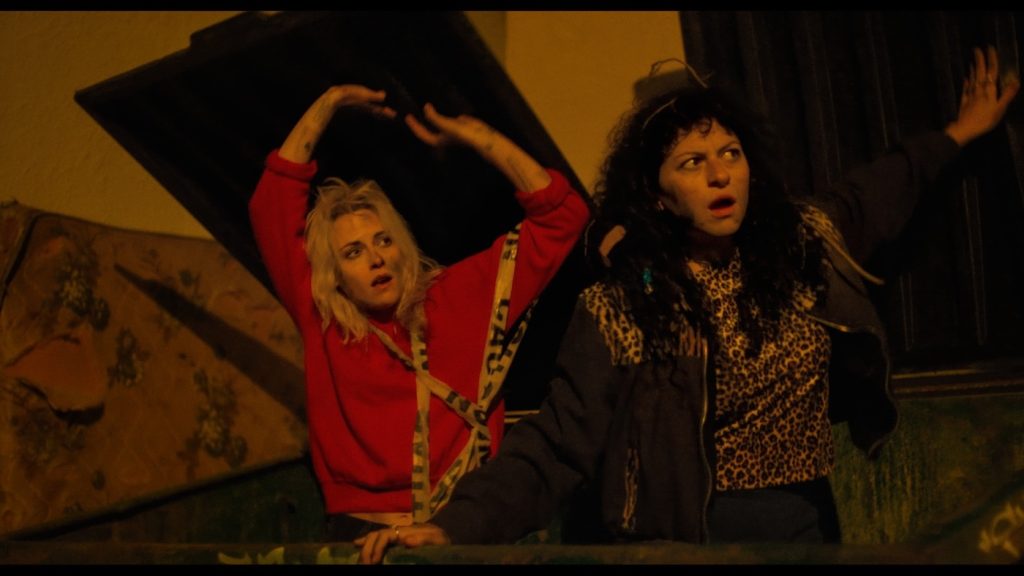
Frankie’s style, especially, was modeled on what I wear all the time. Maggie McLean, my best friend, is the inspiration behind Molly. We had style references for Heidi, but they are both people who wear predominantly vintage clothing. We recreated some vintage pieces so we had more than one outfit for each scene. Those trash bag dresses were a lot more fun in theory than in practice for my performers. We made those, but the other stuff was about sourcing, or we made our own vintage clothing out of other things. We used flyers from old punk shows and turned them into shirts like the one Kristen wears at the end. I’m not a very new clothes person, and neither are the girls in the movie, so everything is sort of born from the creativity that comes with budgetary limitations, both for them as characters and for us in production.
This was a 29-day shoot. What was it like on set?
It was intense, but we were moving fast. What was nice about this movie was that the aesthetic and tone we were shooting for were lo-fi, so we could lean into that in moments when we didn’t quite have time to set something up the way you might have. That adds to the freewheeling, chaotic tone of the movie and its imperfections. I took some of those cues from Repo Man and other ’80s low-budget cult classics we’re talking about. Those fingerprints make something feel more human and lived-in, so I didn’t mind if certain things didn’t feel squeaky clean.
I was going to ask you about locations in the movie, but I’m also curious what you think about audiences supporting smaller movies in theaters.
I go to the movies a lot, and I think if you love movies, you should go to the movies. The way we reinvent what movie-going is going to look like is so important to the next generation. You have to get the youth hooked on the sauce and show them really good things early. I spent my whole youth in the Laemmle movie theaters here watching whatever they were down to show. We need to make the cost of going to the movies less prohibitively expensive. When I was growing up, we had student discounts, and as a teenager without disposable income, that made a huge difference. We also have to take more chances in our content and not lean into a fear-based, risk-averse model. That’s the quickest way to ensure no one goes to the movies anymore, particularly in indie film. It’s important that we take some risks because people can tell when you don’t.
I’m very heartened by the push in L.A. to get old independent movie theaters open. I know you and Kristen are involved in it.
Yeah. Speaking of key locations in the movie, we’re in one of them right now as I talk to you. This is where we shot our punk show in the movie, but this is also where I grew up going to punk shows. It hasn’t hosted shows in 15 years. I have grown up and thrown up in this place, and getting to shoot here was a dream.