Creature Discomforts: Inside “Alien: Earth” With the Artists Behind Its Monsters
Many unexpected things occur in Noah Hawley‘s gruesome, glorious Alien: Earth. Hawley has once again taken the bones and blood of a beloved film, or, in this case, film franchise, and branched off to create a new part of the family tree. He took the Coen Brothers’ flawless 1996 film Fargo and built an anthology series for FX that maintained the dark, humorous heart of the original while introducing new characters, new locations, and new, deeply American motivations.
With Alien: Earth, Hawley brought the Xenomorph, one of cinema’s most iconic monsters, to the blue planet. Yet as Hawley told us, what he didn’t want to do with his series is try to replay the classic hits from Ridley Scott’s 1979 sci-fi horror masterpiece Alien or James Cameron’s biting, breathless sci-fi action epic Aliens. This meant that while the Xenomorph and its pre-adult stages as the Facehugger and Chestburster are still a big part of Alien: Earth, they’re not the only killer game in town. In fact, the Xenomorph nearly becomes something like a surrogate, albeit an unhinged one, for the viewer, as new, even creepier aliens arrive.
The new creatures include one of the most ingenious monsters to lurk on any screen, the Eye Midge, a tiny, formidable chaos agent who became the series’ breakout non-human star.
To learn how these creatures were conceived and brought to life, we spoke with lead prosthetic supervisor and designer Steve Painter and Emmy-nominated VFX supervisor Jonathan Rothbart about building the series’ expanding menagerie, blending practical effects with digital artistry, and why human collaboration remains the secret ingredient behind movie magic.
Like any good entry into the Alien franchise, Alien: Earth has some tremendously gory kills. As two of the people tasked with creating these sequences, I’d love to hear about your favorites.
Steve Painter: I have three favorite kills in Alien: Earth season one. The first happens to Bergerfeld’s [Dean Alexandrou] outside His Lordship’s apartment. The Xenomorph picks Bergerfeld up by the face and shakes him like a rag doll, a practical stunt performed live on set. The Xenomorph rips Bergerfeld’s face off, and the corpse flies through the air before landing on Hermit and bleeding out over him.
Yes, I remember that well.
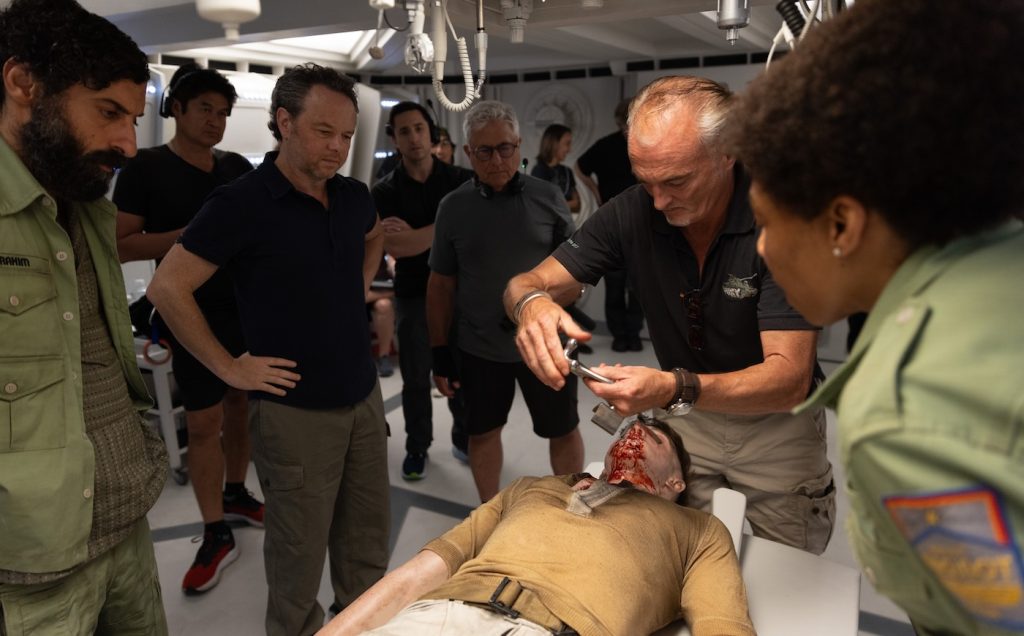
Painter: Number two is Malachite’s [Jamie Bisping] open-chest surgery after alien ticks infest his body. We created a hyper-real silicone replica of actor Jamie Bisping for the surgery scenes. It was so realistic that some crew members mistook it for the real Jamie lying on the table and started talking to it.
The replica had a pumping heart and lungs that inflated and deflated. Jamie himself wore a prosthetic open-chest appliance for certain shots, although the appliance wasn’t as deep as the cavity built into the silicone body. Depending on what Noah wanted for a given shot, we alternated between the prosthetic appliance and the full replica.
And third?
Painter: Arthur Sylvia’s [David Rysdahl] death by chestburster. This highly technical effect involved elements shot in two locations: a real beach in Krabi for the pre- and post-chestburster scenes, and Bangkok Studio Park’s backlot for the chestburst itself. Actor David Rysdahl sat beneath a raised platform covered in sand, with only his head, shoulders, and arms protruding through an opening. A silicone articulated body was attached to David’s neck and upper chest. Inside that body was the chestburster mechanism, from which an animatronic Xenomorph chestburster emerged in a fountain of blood. It took five MUFX crew members to execute the chestburst sequence in Bangkok.
Jonathan, what was the philosophy behind creating the Eye Midge, a creature that doesn’t seem purely driven by propagation and survival?
Jonathan Rothbart: The Eye Midge occupies a unique space in the Alien universe because we think of it as a more intellectual creature. The Xenomorph is very direct in its purpose. It’s driven to survive, consume, and ultimately propagate the species. The Eye Midge operates very differently. It’s much more interested in observing its environment and applying pressure in subtle ways to create change. In that sense, it’s almost an agent of chaos. It’s looking for opportunities to disrupt situations and see how they unfold.
How did you lean into the Eye Midge’s curiosity and cleverness when you were creating it?
Rothbart: That distinction gave us the chance to bring much more character to the creature. Noah and I spent a great deal of time discussing not just what it does, but why it does it. What behaviors would make it feel intelligent, deliberate, and slightly unsettling?
Like when the Eye Midge inserts itself into the sheep…
Rothbart: At that point, it isn’t really a sheep anymore. It’s a host being actively observed and controlled. We wanted its behavior to feel thoughtful and measured, often still and always watchful, so the audience senses that there’s cognition beneath the surface. We also liked the idea that it has to learn how to operate each host. Early on, its movements are slightly off, restrained and somewhat mechanical, as it figures out the body’s physical language. Over time, it becomes more fluid and confident, and we wanted that progression to come through in the performance.
How did you achieve that maturation process within the sheep?
Rothbart: On a practical level, I actually spent time watching my dog. There’s a constant awareness there, always paying attention to what’s happening in the room. We borrowed some of those subtle behaviors for the Eye Midge. It grounds the creature in something familiar while still feeling distinctly unnatural.
Let’s talk about some of the other alien species, specifically the Orchid, a carnivorous plant, and the Ocellus fly swarm. How did those creatures come together?
Rothbart: It grew out of a broader creative approach Noah brought to the series. Several creatures are introduced early, but their true predatory capabilities are deliberately withheld. The goal was to embrace a classic suspense structure, allowing audiences to recognize a potential threat without immediately understanding it.
With the Orchid, we leaned heavily into misdirection. At first, it seems like a dangerous carnivorous plant, but because we don’t reveal exactly what it can do, audiences tend to file it away in the background. That was intentional. We wanted viewers to lower their guard.
When it finally unleashes its capabilities, the Orchid’s lethality is bracing.
Rothbart: When the creature finally acts, the result is much more surprising and unsettling. It’s also fun to leave those blanks for the audience to fill in. Everyone develops their own theory about what the creature can do, and then later we reveal the reality. As the story progresses, we wanted the Orchid to evolve from something that feels almost passive into something highly active and predatory. It becomes strategic, camouflaging itself, waiting for the perfect moment, and then striking. When it attacks, we wanted it to feel physical and grounded. It doesn’t simply snap shut. It wraps around its prey and continues tightening. Internal muscles constrict and crush while needle-like teeth tear through flesh in preparation for digestion. By the time we reach the Siberian sequence, we wanted audiences to truly feel how brutal and inescapable the creature is. We spent a lot of time refining how to stage that sequence so it felt clear, visceral, and impactful, without pulling any punches.
T
These new creatures added so much to the series. Steve, how do you know where the line is between what you can create physically and what you’ll hand off to the visual effects team?
Painter: I’ll tell you a story. Between takes, the cameraman started talking to the animatronic dummy because he thought it was the actor. Noah noticed immediately. I’ve been doing this for 40 years. A lot of it comes down to experience and understanding what the audience wants to see and how we’ll achieve it. There are always new materials and technologies being developed. Ultimately, it’s one giant problem-solving exercise: figuring out how to make something look as realistic as possible. A tremendous amount of artistry is involved. Hair punching, for example, is done one hair at a time. The painting and detailing take countless hours. My crew did a fantastic job. At the end of the day, experience tells you what needs to be done.
There’s a lot of anxiety right now about AI and creativity, yet Alien: Earth succeeds because it’s clearly the product of artists collaborating across disciplines. Do you think audiences can still feel the difference between human-made work and something generated by AI?
Painter: Absolutely. I started before digital visual effects really existed. Back then, we had to build things physically and make them do impossible things. Thank goodness visual effects came along because they became another tool. I can take something only so far practically, then I turn to Jonathan and say, “Help.” That’s how it should work. We help each other. I’ll do whatever I can to help him, and he takes it further.
Rothbart: I completely agree. The collaboration is what makes filmmaking work. Steve creates what he can physically, and then we figure out what we can add digitally. That back-and-forth creates a look and feel that serves the cinematographer, the director, and ultimately the audience. That’s one reason I’m not overly concerned about AI. The films people love, both today and in the past, are usually the product of collaboration. Great moments happen when different people bring different ideas together. It could be a conversation between departments. It could be an actor improvising a line that becomes iconic. Those moments happen because people are involved. If you tried to make a movie entirely with AI, you’d lose that collaborative spark. You’d lose the synergy that creates those lightning-in-a-bottle moments. For me, that’s the best version of filmmaking, and it’s my favorite part of the process.
Painter: I also find AI too clean. There’s something about a human hand creating something, whether it’s Jonathan working digitally or me sculpting with clay, silicone, glue, and hair. Humans make mistakes. That’s natural. Those imperfections often help sell the reality of the work. Audiences look at something and wonder, “How did they do that?” They sense that it’s real.
Featured image: “Alien: Earth” key art. Courtesy FX Networks.