85 Musicians, 60 Singers, Endless Fun: Composer John Powell’s Genre-Bending “Minions & Monsters” Score
In a movie that’s literally filled with gibberish, Minions & Monsters (now in theaters) co-stars an exuberant Old Hollywood-inspired score that rarely pauses for breath. This Despicable Me/Minions franchise prequel, set in 1927, follows the animated creatures as they become silent-movie stars before meeting monsters determined to destroy the world. The Minions, who speak the nonsensical “Minionese” language, are voiced by director/co-writer Pierre Coffin, while Trey Parker and Jesse Eisenberg lend their voices to English-language characters.
To underscore the Minions’ antic quest, British-born Emmy winner John Powell wrote and conducted a propulsive soundtrack brimming with references to classic Hollywood scores. “I think our job is just to make people laugh,” says Powell, who recently co-composed Wicked: For Good after scoring blockbusters like Happy Feet, How to Train Your Dragon, and the Oscar-nominated Wicked. “I’m not sure there’s much more subtext other than being about characters who are trying to find their way in the world by looking for the next evil boss in Hollywood. But it’s really about the joy of being creative and finding people who understand you.”
Speaking from his Pacific Palisades home studio, now fully restored from smoke damage caused by the 2025 Los Angeles fires, Powell remembers conducting his Minions orchestra on the historic Wizard of Oz soundstage, salutes the brilliant Europeans and Americans who forged the sound of golden age Hollywood, and explains why Young Frankenstein has made it impossible for him to take classic horror films seriously.
Bravo.
For walking into the room?
No, for composing the Minions & Monsters soundtrack. Your score energizes every sequence while simultaneously paying homage to Old Hollywood movie music from the twenties and thirties.
Thank you. The whole thing is very much driven by being deliberately too much.
Early on, for example, the Minions get swept up in an old-fashioned western, chasing a black-hatted bad guy on a horse.
For that, I did two cliches of cowboy music. I added [Ennio] Morricone with a trumpet at the same time as Aaron Copland and Elmer Bernstein, so we put those together. Then we hit the Keystone Cops, so you change for that, and then it becomes more stressful. When I first saw the sequence without music, I remember thinking that, from the cowboys all the way into Hollywood, when the train crashes, you end up breathless. We wanted to establish that straight off.
The Minions proceed with boisterous fanfare down Hollywood Boulevard as it existed in the 1920s. Where did that theme come from?
Originally, I called that cue “Sopranos Versus Trombones” because I had a lot of women singing and the trombones were blasting away at the bottom, which made me laugh. It’s honoring Russian music, like that of Aram Khachaturian, and the fantastic “Taras Bulba” by Franz Waxman.
Black and white newsreel footage recaps the Minions’ rapid rise as silent movie stars living in a Beverly Hills mansion. The jazzy big band vibe evokes an era of American optimism before the Great Depression hit in 1929. Who were your influences for that piece?
I’d never done this much jazz in a film before, but I think it’s in my blood a bit more than I realized. There’s a lot of Count Basie stuff that I really like, and Duke Ellington, one of America’s three greatest composers, in my opinion, who wanted to write for the classical world, and of course they wouldn’t let him in. So he did stuff that became the bedrock of American music. If anything, the newsreel [music] was closer to the mid-30s style, and then I kind of went backward for the next scene, which is more of a 20s-style two-step kind of thing.
You switch gears when the Minions transition to “talkies” and “James” tries to play a film noir detective. Which composers did you channel to capture the film noir style?
There’s plenty of Max Steiner going on. I love some of his stuff, but he also did some [film noir] scores that were a bit clunky harmonically. Strangely enough, when we recorded that cue, we had our big string section, which we needed for most of the score, but I was going, “Something sounds a bit wrong.” We cut out half of the strings to a much smaller section, and suddenly it really sounded like the style from that era.
Then we get the Citizen Kane homage.
I did my best impression of the Citizen Kane score with lots of low bassoons and clarinets, contrabassoons and contrabass clarinets, which is all very Bernard Herrmann. Everything’s incredibly low, and there are quiet tubular bells in the background because, musically, he was always talking about death. Bernard Herrmann was incredible at frightening the s*** out of people
Fast-forward to the alien Dort marching down the street, followed by his fanatical Minions, to the strains of this strident, patriotic anthem.
Well, the Russians did that kind of music the best, and a lot of times they were being forced to do it by the Communist government in celebration of the “revolution.” [Dmitri] Shostakovich even did it, and he had a terrible relationship with them because he went too aggressively non-harmonic, and they thought he was being bourgeois. So that march is [inspired by] Shostakovich and Sergei Prokofiev. They kind of evoke the madness of Soviet confidence.
The Minions look delirious with glee, marching behind this guy who resembles the Tin Man from The Wizard of Oz.
Well, Pierre told me he wanted this film to always be seen from the perspective of the Minions themselves, so I always tried to lean into what they would tell me to do [with the music] if I were working for them. Finding a big evil boss who was going to take over Earth was joyful for the Minions, very joyful. This is their heaven.
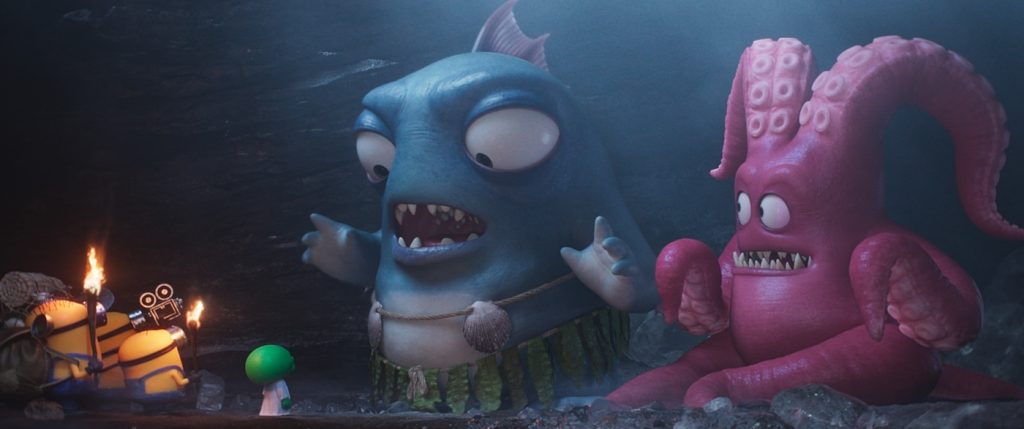
Then we get to the little monster Goomi, who unthaws a couple of frozen mutants and conjures the giant orange blob called Irene. Did you revisit Universal Studios’ 30s-era monster movies for inspiration?
I went back and watched Frankenstein and things like that. Although, to tell you the truth, when I saw [the original] Bride of Frankenstein recently to figure some stuff out, it has a great score by Franz Waxman, but, by God, I cannot watch the film without laughing because my other favorite film of all time is Young Frankenstein.
And once…
Once you’ve seen Young Frankenstein and try to watch Bride of Frankenstein, you can’t take any of it seriously. But again, a lot of that genre comes from classical music. Waxman and [Erich Wolfgang] Korngold didn’t come out of nowhere. They came out of Richard Strauss and Wagner. There were so many amazing composers, concertmasters, and players in the 30s and 40s who escaped the Nazis and came to Hollywood, where you had two traditions at play. You had virtuoso Europeans, who played with great passion. At the same time, you had these great jazz guys from America. Hollywood shoved them all together on these recording stages [in Los Angeles] where the players from the Berlin Philharmonic suddenly had to figure out how to play jazz stuff and swing. And the brass players, who were used to playing Duke Ellington, had to figure out how to sound more Wagnerian. They created a new style.
Different cultures coming together to make something new. Very American?
Absolutely. And here I am a Brit bringing my own influences. Benjamin Britten, prog rock, Genesis. It’s definitely a mishmash. I like to think of this as my most American score.
Your Minions music celebrates Old Hollywood’s orchestral sound with 85 instruments and 60 singers.
My wife is one of the sopranos in the Los Angeles Master Chorale, so she booked a lot of the choir.
You gathered all these musicians in Culver City on the Sony lot’s historic Barbra Streisand Scoring Stage, where MGM musicals were recorded in the 1930s, when production was booming. Now it’s a different climate. Were you mindful of the impact a project of this scale can have on L.A.’s film music community?
Yes. I love the players in London, but I live here, so it’s easier for me to drive to Culver City than it is to get on a plane and go to London. When we started, I told the musicians, “This is the first time in six years that I’ve been able to record a film score without jet lag.” And the score is perfect for L.A. because I’m referencing lots of things that were recorded right there at MGM. I’m trying to get that sound, so it’s been a delight for me. But I am fearful for our community. I wish there were more recordings here because there are so many great players in L.A. who should be working.
Looking back on your Minions & Monsters experience, what stays with you?
When my name was announced as the composer for Minions & Monsters, some people were like, “Why doesn’t he go off and do a serious film?” Well, I enjoy watching big, serious films, but I’m afraid I also like having fun. And I can tell you, every day I came down and wrote on this movie, I was laughing my ass off.
Minions & Monsters are in theaters now.
Featured image: Illumination’s Minions & Monsters, directed by Pierre Coffin.