
“The Mandalorian and Grogu” Animation Supervisor Hal Hickel on Reinventing Hutts and Building a Galactic Bestiary
Alien creatures run rampant in Star Wars: The Mandalorian and Grogu, which follows bounty hunter Din “Mando” Djarin (Pedro Pascal) and his adorable sidekick Grogu (or “Baby Yoda” as he was inevitably christened by fans) as they pursue Imperial warlords on behalf of the New Republic. Their adventures, which pulled in $163 million worldwide over Memorial Day weekend, traverse planets including Nal Hutta and Shakari that are populated by ferociously surreal computer-generated freaks. Production animation supervisor Hal Hickel, an Industrial Light and Magic mainstay who previously worked on The Lost World: Jurassic Park, The Book of Boba Fett, Rogue One: A Star Wars Story, and The Mandalorian TV series, notes that the entire movie was filmed in California. “I’m super happy that we could make the whole production here,” he says. “I think it’s a good demonstration that you can shoot a complex, big-budget film in California that will look great and keep folks busy and paid.”
Speaking from the Lucasfilm and Industrial Light & Magic campus in San Francisco, Hickel explains how they reinvented the formerly mollusk-like Hutt species into a World Wrestling Federation-type gladiator and illuminates how monster DNA in Mandalorian and Grogu can be traced all the way back to the original 1977 Star Wars.
Mandalorian and Grogu can be wonderfully weird, starting with Martin Scorsese’s four-armed food truck vendor. A little later, we see the grown-up son of Jabba the Hutt, Rotta (Jeremy Allen White), in an arena fighting a cavalcade of alien freaks, gladiator style. How did you come up with these monsters?
Going all the way back to the first Star Wars movie, we have Phil Tippett, the legendary original member of ILM, to thank for the weird variety of creatures found in this pit fight because they came straight from the holographic chess game that you see Chewbacca playing with R2D2 and 3PO in the Millennium Falcon.
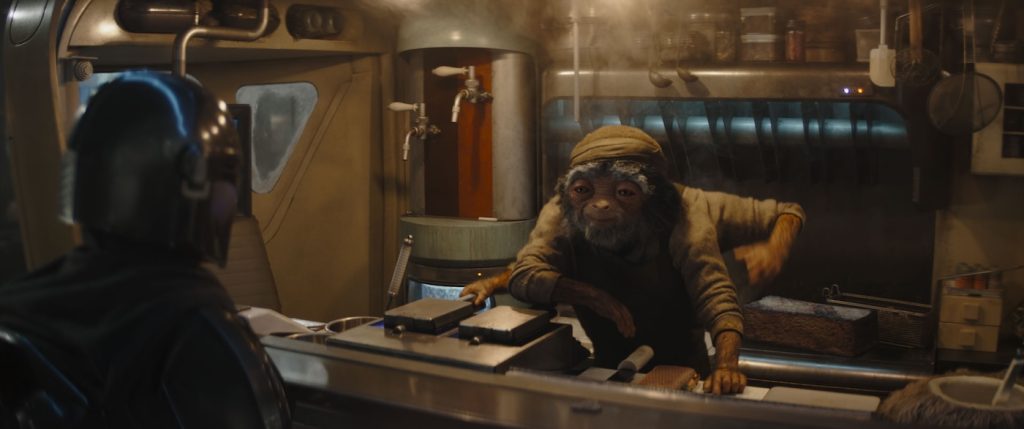
They were action figure versions of actual creatures that existed somewhere out in the universe, so that’s the concept behind seeing them now in a full-sized arena fighting our heroes.
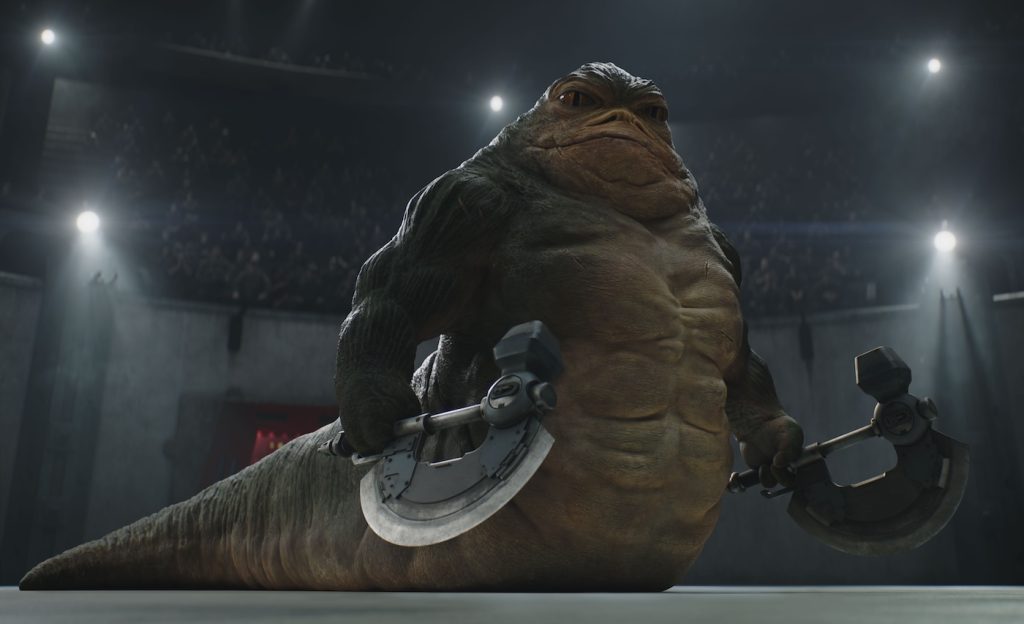
Each monster is freakier than the next.
They all have weird names and weird shapes. Some of them have limbs that bend in the wrong way, and some have tentacles rather than arms. The big challenge in animating them was making creatures that had been seen before look like a Happy Meal toy, but now we’re getting to see the real, living, breathing thing. With each creature, we wanted to make sure the audience could imagine what its breath smells like and what its hide or skin would feel like to the touch. They needed to feel tactile and have weight.
The monsters have to look real and move around convincingly. How’d you do that?
Whenever we’re animating weird alien creatures, we look to nature, or sometimes, to movies. There’s a character in the Pixar movie Monsters, Inc. called Randall Boggs, who’s kind of a salamander thing that scampers horizontally and then pops up vertically, very quickly. We thought that was a good model for our snake-like creature, the K’lor’slug. And then the Kintian Strider and Mantellian Savrip are big bipeds, so we put everything in there from gorillas to sumo wrestlers to whatever, and that informed how they moved. And then some of the creatures are just so weird, we had to kind of make it up. You know, that’s what animators do. That’s our job.
It’s startling to see Rotta the Hutt slugging it out like a U.F.C. fighter because previously, Hutts have barely moved at all!
For sure, Hutts have always been sedentary, heavy creatures stuck in one place, like Jabba the Hutt or even the Hutts in this film, who were previously in The Book of Boba Fett. But we’ve never had a Hutt that was buff and fit, a warrior who could be dangerous and move quickly.
Did you have a model from the natural world to guide your creation of Rotta?
We looked at elephant seals and the way they can rear up and smash into each other. The whole front half of their body goes vertical while the tail section remains on the ground.
What are elephant seals?
They’re extra big seals with this big, kind of blubbery nose that hangs down and cracks together when they battle. They have a way of kind of shuffling along where their whole body undulates [Hickle wiggles his hands]. They use their front fins almost like hands on the ground, so we did that with Rotta, where he plants his fists on the ground and moves his body along. We also created something we call the Rotta Roll, when he drops down and does a side roll to move laterally and then pops up quickly and strikes again.
That sounds complicated.
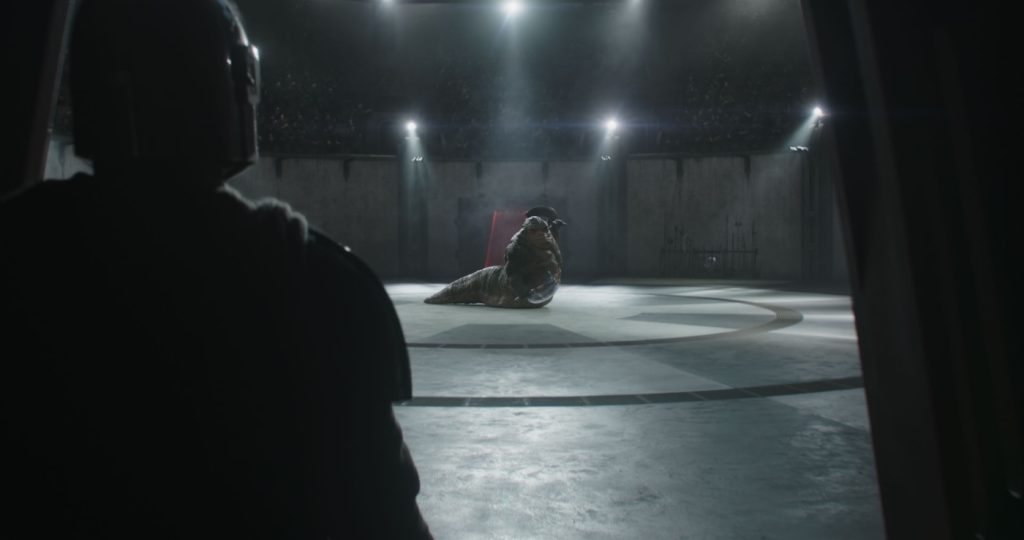
It is hugely challenging because we’ve never seen a Hutt move like that before. And the other thing is, we’ve only seen Hutts as villains before, but Rotta isn’t just a monster or a creature —he’s a sympathetic character who carries whole dialogue scenes with Mando. It’s always daunting to make you care about a digital character, and that was probably the biggest single animation challenge on the show.
They say the eyes are the window to the soul, and that seems to apply to Rotta, especially in his close-ups.
It’s funny you mention that, because the only thing that remains of the big rubber puppet built for Jabba the Hutt in Return of the Jedi back in ’83 is the eyes, since they were made from materials that would last, whereas the rubber has long since gone away. In the Lucasfilm archives, we took pictures of Jabba’s eyes and used that to inform the structure of Rotta’s eyes.
Midway through the movie, Mando finds himself trapped in a sewer with this enormous serpent.
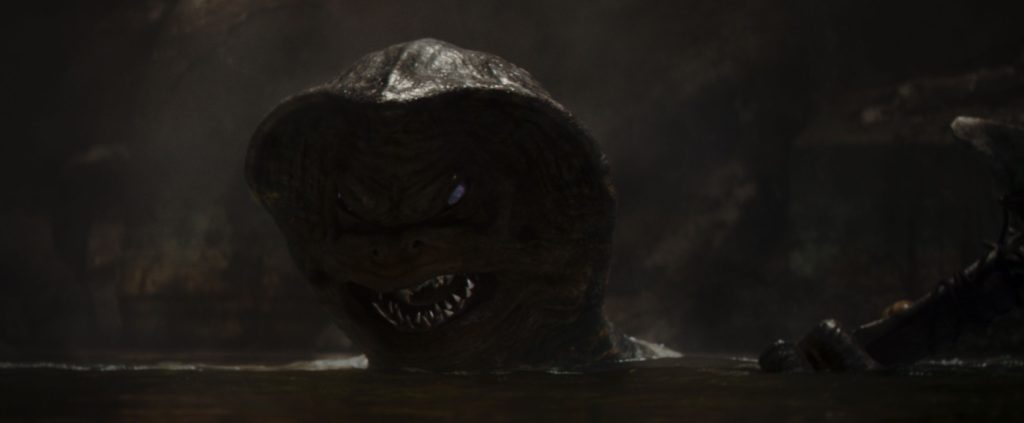
It’s called the Dragon Snake.
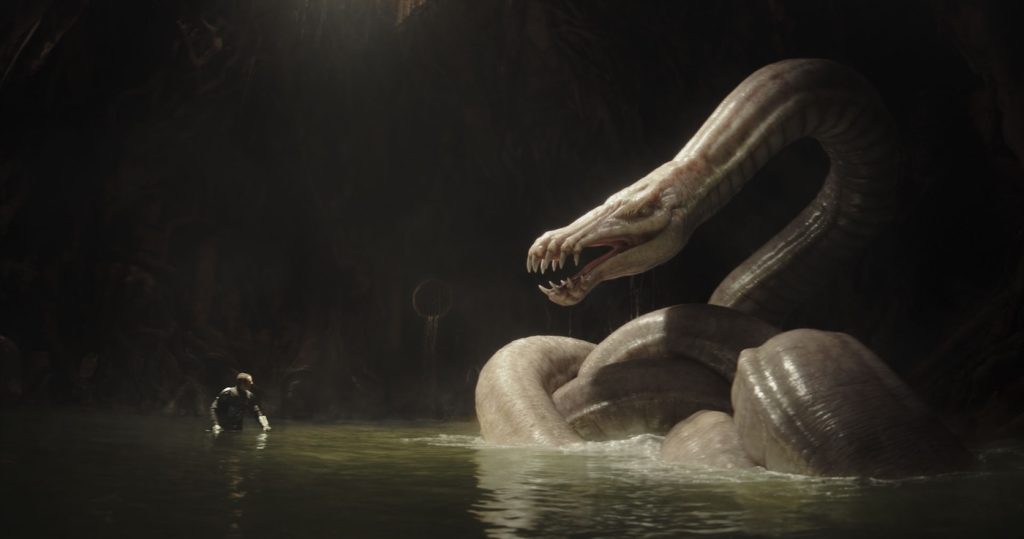
The Dragon Snake is not only huge; it also has teeth. What was your inspiration?
The Dragon Snake was very much in the vein of Frank Frazetta, the famous fantasy artist. We all love Frazetta, so that [homage] is what we were going for. It has super pale, almost translucent skin, and its eyes are milky, so we assume it’s been in the dark for most of its life. Maybe he doesn’t see very well, but he can smell Mando, which makes it even creepier. The other thing is, when Mando leaps off the roots with a spear and attacks the Dragon Snake? That comes from German mythology and the [Fritz Lang 1924 silent] movie about Siegfried, the warrior, leaping with his spear and stabbing the dragon. With Mando being in armor, it felt very mythical and a fantastic image to conjure on the screen.
George Lucas, of course, is a devout believer in the mythology of the hero’s journey.
Exactly.
In the Dragon Snake’s sewer swamp, you, of course, have to contend with water, which has traditionally been considered in the VFX world to be notoriously difficult to render. What was it like this time around?
It’s still really tough, but we’ve gotten better and better. That was a big pool in a 360-degree set with roots and everything beautifully designed by Doug Chiang and realized by Andrew L. Jones. But as soon as you tilted the camera up, you’d see the rafters of the set and so forth, so the set had to be digitally expanded. Any time you see the snake in the water, that wouldn’t be real water anymore. Throughout the action portions of that sequence, particularly in the wider shots featuring creatures alongside Mando, it’s entirely CG water.
Hard to tell the difference.
It really is seamless, I think, cutting from shots with real water straight to digital water and back to real water. As you mentioned, water has bedeviled visual effects for a long time, and it’s always super hard to do, along with fire and smoke. But our tools and artists have gotten so good now that we can do it without folks even noticing.
The adorable scene stealer Grogu, AKA Baby Yoda, is mainly a puppet rather than being computer-generated, right?
Yeah. For The Mandalorian TV series, we were developing a CG version of Grogu and a puppet version simultaneously because we knew we’d need both—we just didn’t know how much of each. Over the course of season one, we found that [the puppet version] plays great on camera. The actors love him. So early on, Jon [Favreau] made the call that if the three puppeteers who control Grogu just couldn’t fit in the space to do the thing we planned, we would just say, “Ok, then let’s plan a new action that the puppeteers CAN do”, rather than simply pulling the puppet and shooting a clean plate to fix with it with CG in post. In this movie, Grogu is almost 100 percent the brilliant work of Legacy Effects puppeteers, bringing him to life as a puppet.
Star Wars: The Mandalorian and Grogu takes viewers to the lush forests of Nal Hutta and the Tokyo-like city of Shakari, yet all that exotic world-building was accomplished on sound stages in the L.A. area including Manhattan Beach and Culver City.
Yeah, the forests and swamps were enormous sets by Andrew Jones, augmented with digital expansion and digital shots as needed. Then we had our big pit set for the Dragon Snake, a huge forest, partial sets in other places, and full normal standing sets, plus our LED [virtual production] stage when appropriate for certain environments and scenes.
All built in L.A.
It’s a wonderful thing, I think, and so needed right now.
The Mandalorian and Grogu is in theaters now.
Featured image: Rotta the Hutt in Lucasfilm’s THE MANDALORIAN AND GROGU. Photo by Francois Duhamel. © 2026 Lucasfilm Ltd™. All Rights Reserved.