Inside Composer Hildur Guðnadóttir’s Bone‑Crushing Score for “28 Years Later: The Bone Temple”
Hildur Guðnadóttir went full method with 28 Years Later: The Bone Temple (available digitally and streaming on Netflix). In addition to playing a mammoth horn on the score, the kind prepped and ready for a battle cry, the composer played bone instruments for the superbly crafted horror film. For her second collaboration with filmmaker Nia DaCosta, following Hedda, Guðnadóttir also went metal.
For the film’s villain, the satanic Jimmy (Jack O’Connell), she went with strings of terror. As for the film’s hero, Dr. Kelson (Ralph Fiennes), she wanted sounds of beauty for the hopeless, infected world. The score clashes and roars, as if the audience is in the belly of the beast.
It’s another intrinsic piece of music from the Academy Award-winning composer, known for Chernobyl, Joker, and Tár. Recently. The artist took The Credits behind the scenes of scoring DaCosta’s thrilling film, the second in a planned trilogy from writer Alex Garland and producer/director Danny Boyle.
You find it helpful to draw when you’re starting a score, so what were your drawings like for 28 Years Later: The Bone Temple?
I don’t think I did any drawings for this one. When I read the script, I had this feeling of wanting to do something very elegant and baroque-connected. I spoke to Nia, and she had that same feeling. We wanted to work with the string orchestras to have some very elegant string music.
Did you want any inelegant strings for the horror as well?
My God, yes. I really love how there’s always been bands that are connected to the films and the music. I was working with my metal band, Osmium, when I got the script. We were working on our new album, and I thought, ‘Oh my God, Osmium was going to be perfect for this less elegant zombie attack moment.’
How does your experience in metal music, in terms of getting a reaction out of an audience, influence your score?
I really like metal music, and I’ve been playing for a long time. There’s a doom metal band rather than drone metal, called Sunn O))), that I’ve played with for a long time. I’ve always worked a lot within the experimental music scene. I’ve worked with a lot of people in the industrial music scene. So, pretty loud music for a lot of my musical life, so that comes naturally to me.
You have an exhibit at the Academy Museum, where you enter a dark room and experience your music, and it’s a quiet but intense experience. It’s hard to explain its full effect, but do you always want music to speak to the subconscious?
I do seek that out. Music is so powerful in that aspect. Music has such immense, direct access to our subconscious. I’m interested in how music can transform a space that you’re in, whether that’s a physical space or a psychological space. When you’re going out running, and you need energy, you can listen to an upbeat piece of music, and it gives you energy. If you want to go the other direction and relax and come down a bit, music can be very helpful in that way, too.
How have you strived for a similar effect in your work?
In films like Tár, you can’t really even hear the music, but it is working on such a subconscious level. I’m trying to go in through the back door and access those places in the subconscious to bring you into the story.
What did the Bone Temple itself give you? How did you want to define that location?
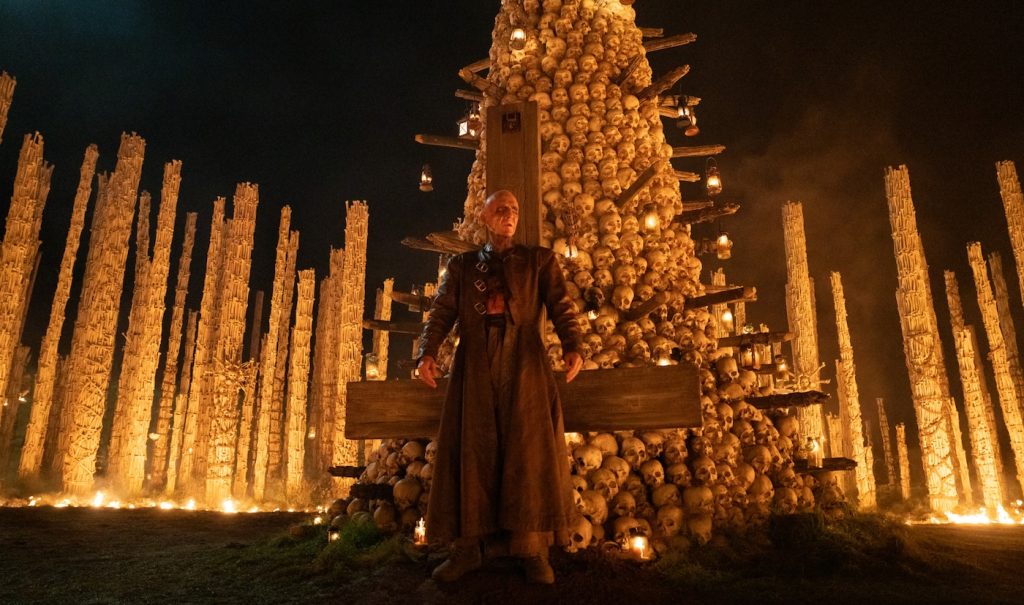
I was keen on having the texture of the bones in the music. There’s such a specific texture to bones when you make any sound with them. Actually, most instruments that are not strings or metal are made from bones. All the percussion is played on actual bones. I did all these bone flutes. One of the main instruments is this horn [displays a laughably gigantic horn].
That is so metal, Hildur.
[Laughs] That is pretty metal. It is very different from plastic, steel, glass, or anything else, which has a much more pointed texture when you bang on it. Bones somehow have a rounder and richer texture. Maybe no one else is going to hear it like that, but I think even in that crazy horn situation, when you blow into it, it’s clearly not an English horn or a French horn. There’s this roundness to the texture that I love. I wanted to bring this elemental, weird, textural feeling into the score because that’s what I was getting from the temple itself. I wanted it to be kind of tribal and elemental. I really didn’t want it to sound fancy or produced. I wanted it very raw.
Jimmy and his followers are almost like Peter Pan and the lost boys gone wrong in the apocalypse. Did you want any childlike sounds for them?
I think a lot of this process of making these sounds was very childlike. When I was making the bone instruments, it was like, how do I make a sound out of this? How do I make this work? What if I go this way or that way? The whole process was pretty childlike because: how can I bang this instrument without covering myself in bone marrow? [Laughs]
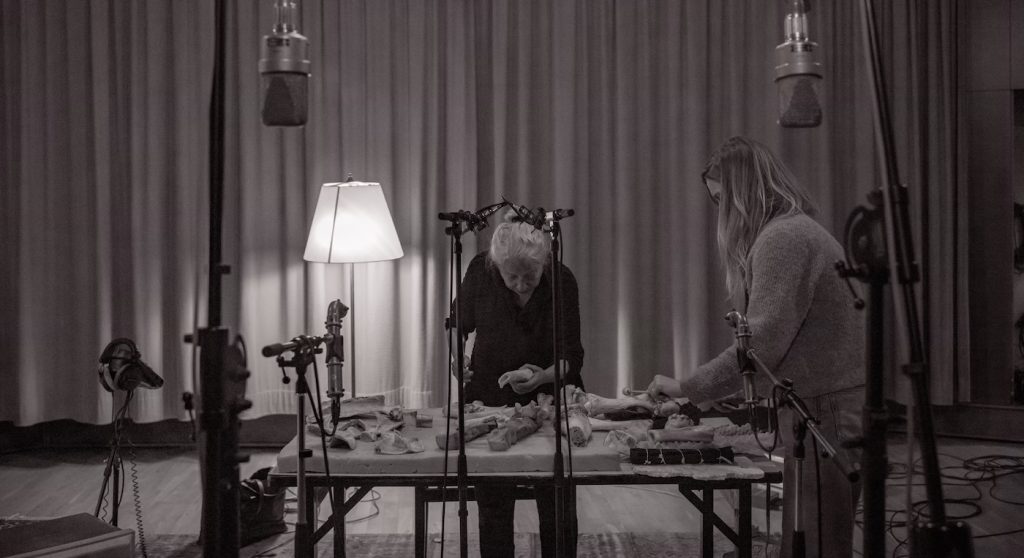
Your blood went into the score.
There literally was. I think that was probably the childish part of the score, just me.
We spoke when Joker was released in theaters, shortly before you won the Academy Award for it. At the time of the interview, you said you weren’t very good at talking about music. Over the years, with more projects and accolades, how has how you talk about music evolved?
In the beginning, when I was doing press for Joker, I was so unused to talking about music. I’d been doing music for 15 years or whatever. By that point, no one had really shown that much interest in what I was doing. All of a sudden, when Joker happened, it was like this crazy bang. And all of a sudden I had to do all these interviews and stuff, and I was like, ‘Oh my God, I’m not used to talking about this.’
You almost do a job like this to not talk to people.
[Laughs] Exactly. I don’t know if I’m great at explaining music. I still think it’s hard to formulate in words the power of music or the effect of music. I think that is still best done through music, but I’ve definitely come to enjoy the process of talking about stories, collaborations, and ways of exploring themes and communicating. For me to learn this other way of communicating through words with people, I don’t know, I guess I’m a little bit better at it. Words come a little bit more easily [Laughs].
I actually thought you were better at talking about music than you gave yourself credit for at the time.
Thank you. It’s also been what, seven years since Joker came out? So, I’m speaking to a lot of students and people who were maybe starting to write music at that time, who were moved by something that I was doing or saying at the time. Sometimes they share what that has meant to them.
That’s great.
When you start feeling that people are listening to what you’re saying, whether it’s in music or words, that’s really moving. I think that’s the point of creating anything: to hope that you inspire someone else to create something. That’s, of course, why I love so much listening to music or seeing art or films, because it inspires me to create more. It moves me, and then I want to say something else. You hope you can, in some way, be part of that ecosystem that inspires others to create something.
28 Years Later: The Bone Temple is streaming on Netflix and available on digital.
Featured image: Composer Hildur Guðnadóttir working on “28 Years Later: The Bone Temple.” Courtesy Sony Pictures