
Lisa Kudrow and Michael Patrick King on the Long-Awaited Comeback of “The Comeback”
The Comeback season 3 follows Lisa Kudrow‘s self-absorbed godmother of cringe, TV actress Valerie Cherish, as she tries to make Hollywood’s first AI-generated sitcom. Created by Kudrow and Michael Patrick King (Sex and the City), this hilariously bleak comedy (Sundays on HBO Max) pictures a near-future in which a slick network executive (Andrew Scott) talks Valerie into headlining a corny series shot the old-fashioned way—in front of a live studio audience—but written in a radically new way; by an unseen artificial intelligence program nicknamed Al.
At a recent press conference, The Credits asked Kudrow and King about filming The Comeback on the historic Warner Bros. lot, where Friends was shot. “It felt great,” King said. “We had two old-fashioned, beautiful sound stages on the Warner Bros. lot. I’ve done a lot of shows here, so it was fun for me. Lisa’s done shows here, so it was fun for her. And the crew was beyond happy to come to work and have that gate go up in their hometown and do what those sound stages are made to do, which is create entertainment.”
Speaking from Burbank, executive producers Kudrow and King addressed reporters’ questions about AI in Hollywood, widespread desperation, and their reasons for reviving The Comeback after a 12-year hiatus. (edited and condensed for clarity).
What was the key element that made you want to go back to work?
King: The key was Valerie’s being cast in the first multi-cam [sitcom] written by AI. That was red meat enough for us. Sorry if there are any vegans here. But, um, that was the red meat that got us to jump over the risk.
What is it about this moment in Hollywood that screamed out to you, “We need Valerie”?
Kudrow: Just as reality TV was the almost-extinction event at the time for scripted television [in Season 2 of The Comeback], it’s the same feeling now about AI. We felt that the world may have escalated to the point of desperation that Valerie was in during the first season [of The Comeback]. People are desperate to get a job and keep a job, and, as you age, you have to think about “How am I coming across? Can I get hired?” A lot of the characters this season are clinging and still reaching for job identity and recognition. All of them, really.
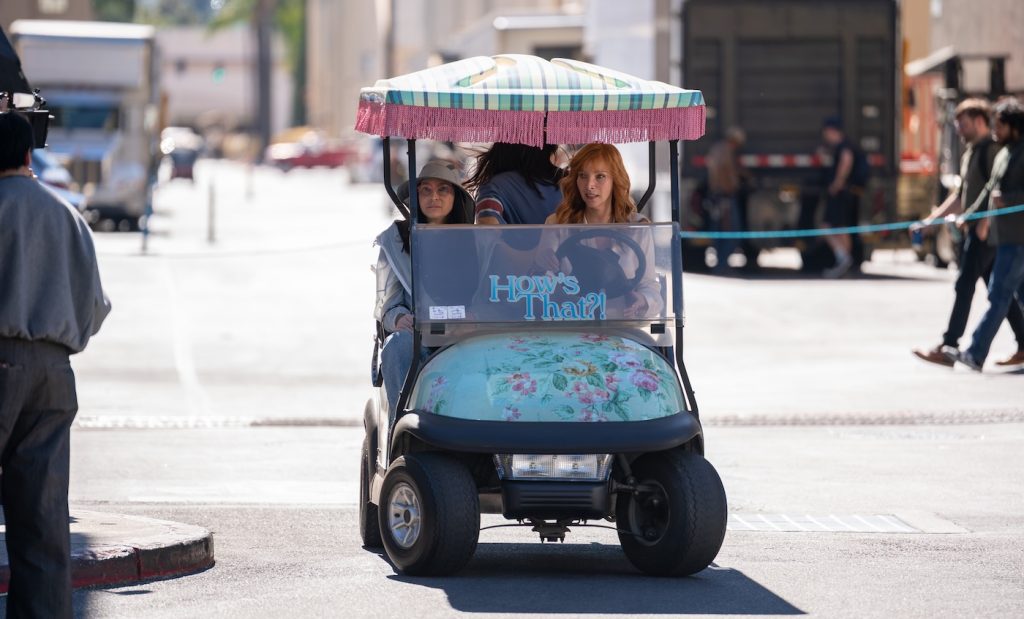
Casey Bloys, the chairman of HBO, quickly gave the project a green light. Did you feel an urgency to tell the story [of an AI sitcom] before reality overtook it?
King: We said, “Here’s the idea,” and Casey said, “Yes. Now.” It was very much [make the show] as fast as you can. All through the writing process, every time something else [in the news] would be touching [on] AI, we would panic. Our goal was to get on the air before a studio admitted they were using AI.
This season, there are a couple of Friends references. How did you decide to put those in?
Kudrow: Couldn’t help it. We were shooting on the Friends stage, and it felt like there was an easy joke there [with the plaque outside Stage 24 inscribed with the names of classic shows filmed inside].
King: Valerie was only looking at the movies on the plaque. She didn’t even see the TV shows.
Kudrow: Like, [in Valerie Cherish voice] “We’re gonna be the first hit for Stage 24!”
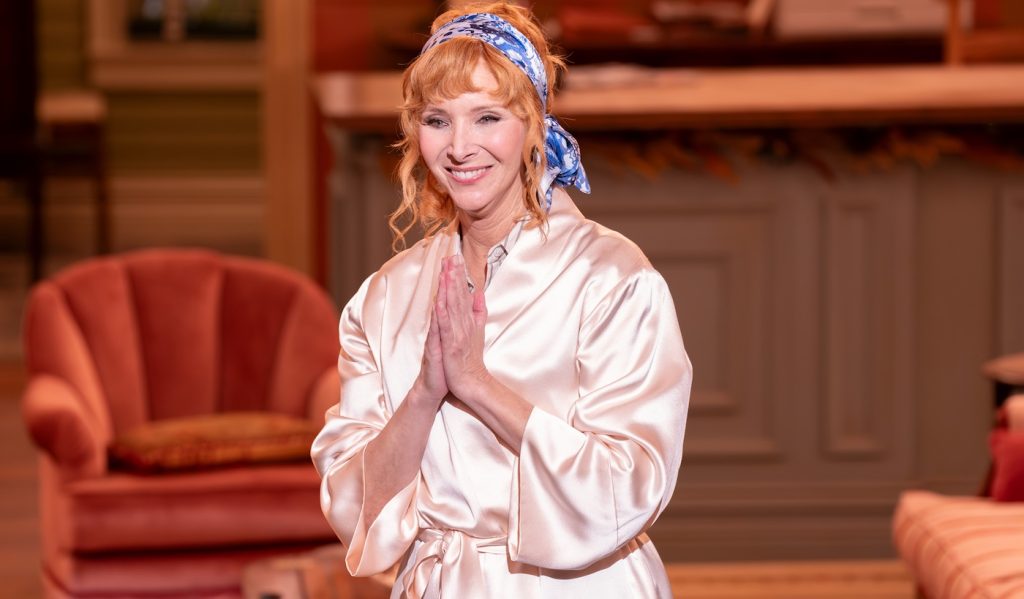
What is it that has made you dedicate your lives to making people laugh?
Kudrow: I’m used to hearing “What pathology is it that leads you to make people laugh?” [laughter]. There’s just nothing better than making people laugh. What’s better than laughing? It’s so healing, it’s so cathartic, it’s so, I don’t know, satisfying. The things that make us feel the best are the things we do for others, right?
King: I like the idea that we can take something that’s a little dark and elevate it to something a little bit lighter.
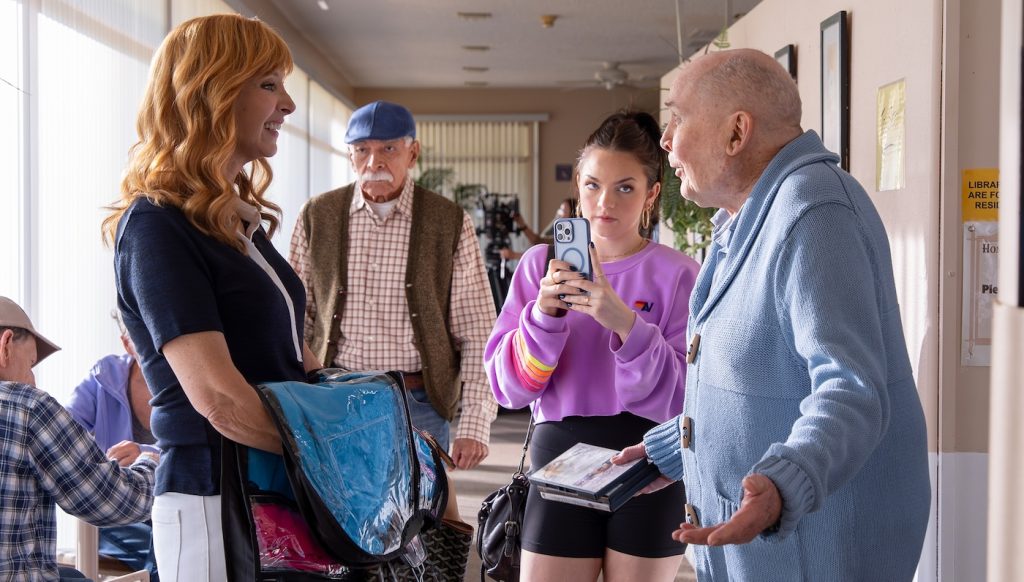
Is the show a way to take jabs or protest things you don’t like about the industry? Seth Rogan said it was very cathartic to make The Studio. Is it like that for you, too?
Kudrow: It certainly was the first season. There was so much information from Michael and the writers’ room about the system of it all.
King: Greg Mottola directed an episode of the first [Comeback] season…where Valerie goes to the studio late at night with cookies to surprise the writers, and she sees some untoward behavior, very 2004 behavior in the writing room. He said to me, “This is outrageous.” And I looked at him and said, “This is a documentary.”
Kudrow: The writers’ rooms could be really rough. Rough. Very rough. Even back in the day, I honestly felt like “Yeah, they’ve got to blow off steam.”
King: Hollywood’s just a great circus arena. So many people want to be in the spotlight that it’s a good cautionary tale for us, about having an ego versus being a person. And I feel like Hollywood’s maybe become a little more grounded now, the egos are checked a little more, because there’s so much competition. Work is not guaranteed. Nothing’s guaranteed for anybody. The excesses are going away. It used to be 23 writers in a writing room for 23 episodes, and then, when we went to premium cable, it was down to one writer writing a show for eight episodes, and now the river just keeps shrinking, so it’s feeling scary, which makes it funny. As long as we all survive.
Lisa, what was it like stepping back into Valerie’s shoes after all these years?
Kudrow: It felt a little tight, I have to say, stepping in, and I had to let it stretch out. I think I just didn’t trust myself, which can happen to me, and it’s really stupid. But after a week or two, yeah, it’s fine.
How has Valerie changed since Season 2?
Kudrow: She aged ten years.
King: And it wasn’t just, “How did she age?” Valerie’s won an Emmy, there’s slightly more confidence, but still the desperation because…remember, the strike? There was nothing happening, and after the strike, it was like, “Great, everyone’s going back [to work],” and there’s nothing.
Kudrow: So Valerie’s been adrift for a few years when we meet her again.
King: Which is right where we want her.
Valerie accepts [what others would see as] humiliation or being mistreated. What do you take from Valerie in that sense?
Kudrow: I think it’s a strength. When people would say [about The Comeback] “Oh, my God, how did you play [all that] hurt?” Especially the first season. “That must have been so hard to be Valerie.” And it wasn’t at all. I mean, I never felt terrible. Is Valerie Cherish that delusional, that she just believes the reality she’s creating? I kept asking myself, like, “Why does [Valerie’s humiliation] hurt everyone so much? She’s fine. That caused some confusion for me, but look, I admire someone—it’s sort of like Phoebe too—somebody who just “Here’s how I see the world, and you don’t have to agree.” I don’t know. Now I’m just gibber-jabbering.
Lisa, how would you react to Valerie’s situation when the news leaks [about her sitcom being written by AI] and the industry turns against her?
Kudrow: You take a deep breath, try to regroup, and go to work. You know, on Friends, there was this huge backlash period where everyone hated us. We were overexposed. And we got together and just said, “All right, we have to [put our] heads down, stop doing press…deal with what our actual job is, which is to say the words and do the show. [With Valerie Cherish in Season 3], it’s kind of the same. At first, she says, “I’m not going to do the step-and-repeat [red carpet] because it’s panic,” but also, it’s just going to bring bad press to the show.
Did you develop a litmus test for how to know when things get too bitter or skirt the line?
King: We feel it as we’re going. In the first season, we had no clue what the reaction to Valerie would be, and people were like, “Ow!” In the second season, people were sort of like, “Oh, we get her.” So, this season, we were like, “How are we gonna give them an ‘ow!’ every now and then,” because the audience likes that. “Oh, s***, where’s this going?” So there are some things that are right at the edge, and then Valerie’s always gonna bounce right out of it.
Kudrow: But I feel like, also, just as time’s gone on, that first season is not as cringe as it was in 2004. Thanks, Housewives of Everywhere. It’s a Rorschach test. If you’re looking at [The Comeback], how you perceive the world is going to generate the scale of intolerability or hilarious laughter.
For more on Warner Bros., DC Studios, HBO, and more, check out these stories:
Mahershala Ali Enters the “Task” Force: HBO’s Brad Ingelsby Drama Adds Two‑Time Oscar Winner
Featured image: Lisa Kudrow in “The Comeback” season 3. Courtesy HBO.