
The Architect of the Upside Down: Inside “Stranger Things” Production Designer Chris Trujillo’s Epic Season 5 Builds
We’ve come a long way from a group of boys playing Dungeons & Dragons in a basement, and their chance encounter with a shy girl with massive powers shivering in the rain. With Season 5, Matt and Ross Duffer’s Stranger Things came to a close, but not without leaving audiences emotionally spent and deeply satisfied. The production of the closing chapter was wildly ambitious. The first table read took place in December 2023 under the codename “Cedar Lodge,” before shooting for 237 days, including 6,725 setups and 630 hours of footage (1 petabyte of data) from the main unit alone, and wrapping in December 2024. The result? An eight-episode saga packed with unforgettable moments: an epic fight at the Mac-Z gate, Will’s sorcery (and coming out), Max’s escape from Creel’s mind prison, and, of course, a final battle against Vecna and the Mind Flayer. Production designer Chris Trujillo has been there from the start, working on all 42 series episodes alongside set decorator Jess Royal. The majority of production took place in Georgia, with stops in New Mexico and Lithuania (for Hopper’s S4 prison scenes).
“It was home for me,” says Trujillo of The Peach State. “That first season was amazing. Our resources were limited because we were this little weird upstart show and nobody expected anything out of it. We all felt like we were making something really special and I was lucky enough that Jess happened to be Atlanta based when we first started shopping for a location to shoot Stranger Things, which, at the time, wasn’t even called Stranger Things. We contemplated Long Island, North Carolina, and then ultimately went with Atlanta because it had this burgeoning film community, there were resources, and a crew base. Everything just kind of fell into place once we started looking at Atlanta.”
For Season 1, practical locations in Jackson, Douglasville, and Stockbridge stood in for the fictional town of Hawkins, the children’s school, and Sheriff Hopper’s (David Harbour) police station. A former mental health institute at Emory University Briarcliff (scheduled to be demolished) was transformed into Hawkins National Laboratory, while studio sets were built at EUE/Screen Gems Studios in Atlanta (bought by Cinespace in 2023). Trujillo’s team recreated 1980s Americana, from wood-paneled basements and cluttered suburban homes to fluorescent-lit schools and grocery stores. The warm, period textures of Hawkins sharply contrast the cold, industrial nature of the eerie lab, creating an atmosphere of everyday detail and creeping otherworldliness. The look earned Trujillo, Royal, and art director William Davis (Sean Brennan served as art director S2-S5) their first Emmy nomination.
Ever since, they’ve expanded the world, matching a growing storyline while keeping to their nostalgic roots. Season 2 brought in The Palace Arcade (shot in Douglasville), where the boys discover a new, mysterious high-scorer named “MADMAX” (Max Mayfield) on their favorite game, Dig Dug. Another challenge was mapping the Upside Down’s tunnel system as Will (Noah Schnapp) begins to channel the Shadow Monster. Season 3 saw the takeover of the Gwinnett Place Mall in Duluth, Georgia, where production recreated the ‘80s mall charm, complete with a giant food court. Scoops Ahoy, anyone?
Following those events, the Byers family and Eleven (Millie Bobby Brown) moved to Lenora Hills, California, for a fresh start. Trujillo found new backdrops in Albuquerque, New Mexico, and surrounding locations to fill in for SoCal. Larger S4 designs included expanding the Upside Down and the Creel family home, a practical location in Rome, Georgia. For the final season, Trujillo staged a military zone battle, gave us a look inside Dr. Brennan’s office, created a radio station for characters to hatch their plan, demolished Hawkins, showed us new corners of the Upside Down, and opened the gates to The Abyss, a.k.a. Dimension X.
Radio Station
WSQK 94.5 FM, “The Squawk,” is home to Robin (Maya Hawke) and Steve’s (Joe Keery) radio show, through which they secretly relay information to take down Vecna (Jamie Campbell Bower). Design inspiration came from a practical station located in North Carolina built during the 1940s.
“It was a serendipitous thing, where the look book I put together, one of the specific images really spoke to the Duffers. They were like, ‘that’s literally the radio station that we grew up seeing.’ So it was just this really lovely bit of coincidence that that radio station was still operating as a transmission facility and we were able to go there and physically survey it and get the nitty gritty detail of this old historic facility,” says Trujillo. “We took those details and directly translated it into a set build. Obviously, we embellished it, changing the interior architecture into something that would shoot nicely and be very Stranger Things.”
The design also required a secret staircase leading to a basement – all constructed on stages in Georgia. “The basement was such a lucky thing. It needed to accommodate all this action and I was worried we’d have to do something totally unrealistic. It just so happened that the radio station we surveyed had a basement and the dimensions, the really high ceilings, the really cool curved walls were all used in the stage build. It was really great for me and my team because everybody is really preoccupied with realism. For us to feel good about a set, it really needs to be founded in some kind of reality.”
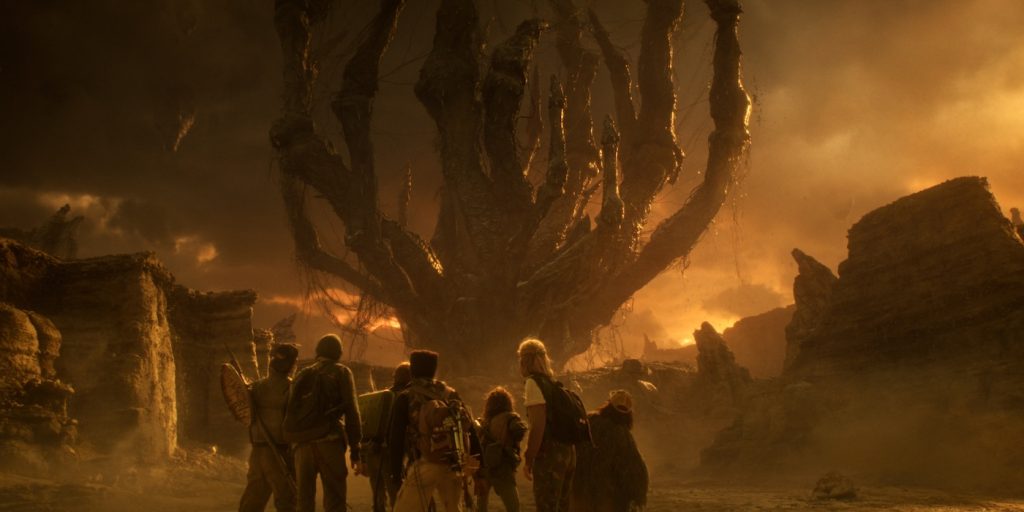
The Abyss
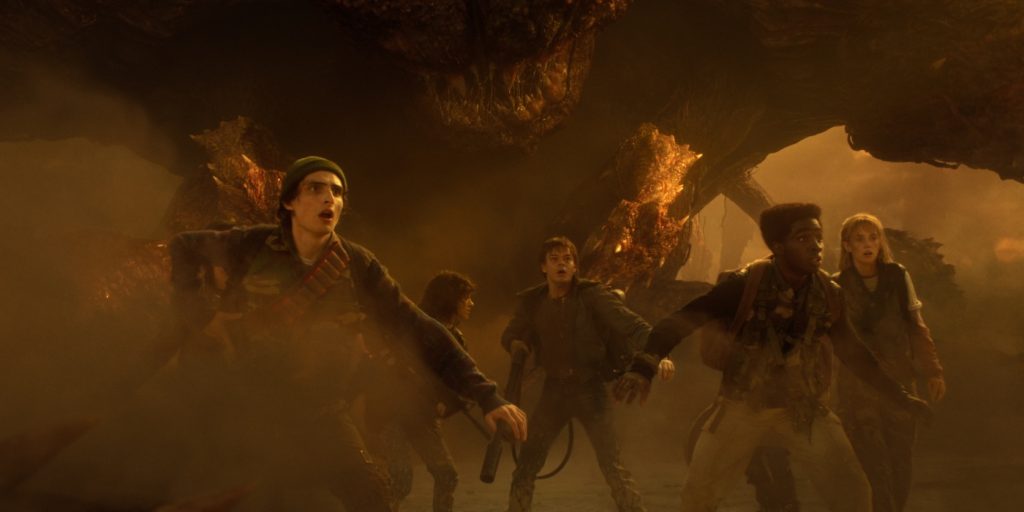
The otherworldly realm home to the Mind Flayer, demogorgons, and creepy vines infecting the Upside Down is finally unmasked as a yellowish, barren wasteland. The look of it influenced by the landscapes of Plaza Blanca in Abiquiu, New Mexico. “The Abyss was directly inspired by that,” notes the production designer. “In fact, we spent a lot of time there and were on the verge of shooting it practically but because of weather circumstances and logistics, it didn’t work with our schedule. So we had to figure out a way to bring some or all of that work to Georgia.” The team flirted with the idea of shooting in a volume for Dimension X but pivoted to traditional shooting methods.
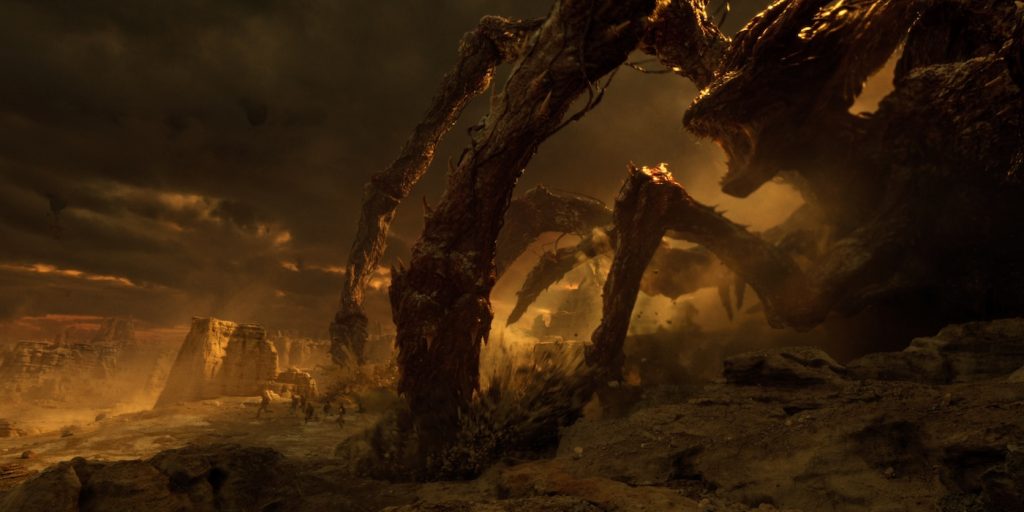
“We went out to a quarry in Georgia and we set up a giant blue screen and then we sculpted all of the foreground rock elements based on what we liked about that place in New Mexico,” says Trujillo. “Anything you see kind of immediately around the characters in the foreground, those are all sculpted elements. Then we ended up creating [vfx] plates based on the [New Mexico] location and those ended up being the physical, vista view that’s around the characters in the distance.”
Pain Tree
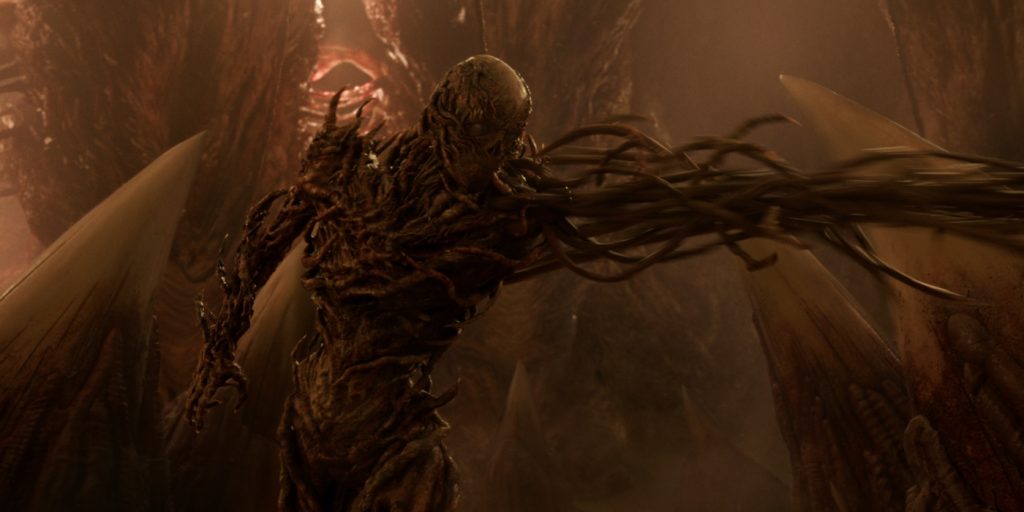
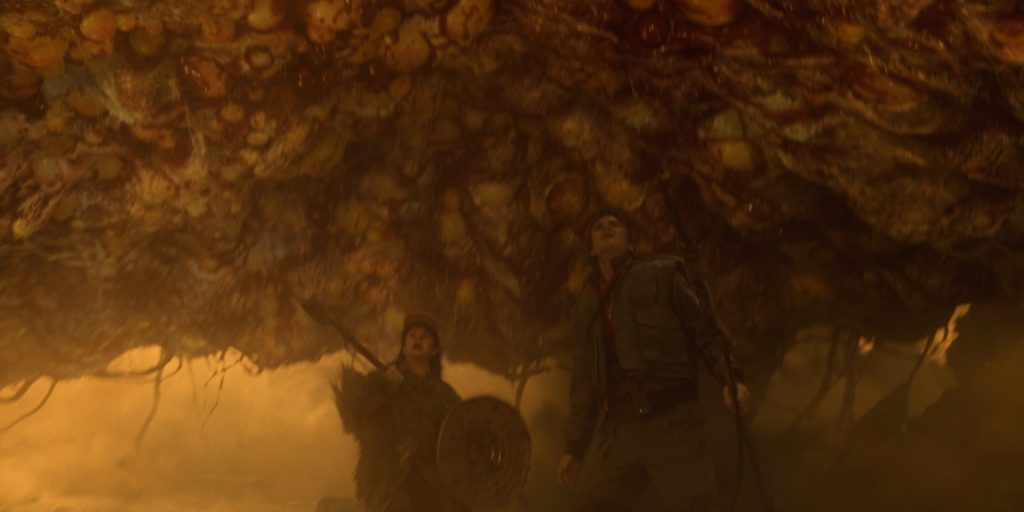
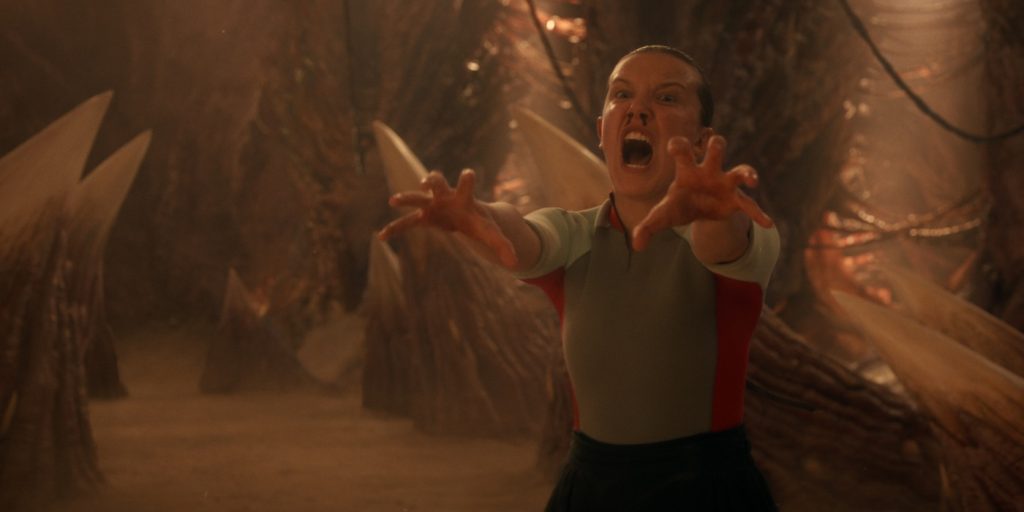
The final battle against the Mind Flayer in the Abyss is an epic clash. El tears an opening in its chest, jumping inside to fight Vecna while others fight from the ground – the creature’s inside becoming an enormous set build. “There was so much creative discussion about conceiving it. One of the concerns was how are the characters going to interact with something so huge. It needed to be big enough that you believe there’s this cavernous, almost cathedral-like abdomen space that the characters are in. And of course, it wanted to be proportioned similarly to the Mind Flayer,” explains Trujillo.
Initial ideas came from concept artist Michael Maher and were turned into a practical set built from metal infrastructure and foam sculptures. “We had a really fabulous sculpture department headed by Alex Sherrod that brought a new toolbox of potential. So it ended up being this giant sculpture essentially of organic shapes, organic matter, and large-scale elements,” Trujillo says. Adding to the creepiness were massive, almost tissue-like columns that trapped the children inside the Mind Flayer. “We ended up getting custom-made dummies that matched pretty closely to all of the child actors. We didn’t want to subject the kids to being in an awkward position for hours at a time, so for background elements, oftentimes those are just the dummies,” notes the production designer.
Another important collaboration was with supervising stunt coordinator Hiro Koda. “If we know an actor is going to take a hard fall, no matter what the surface is, we are prepared to create basically a neoprene version of the area. Then our paint department matches it so that it feels relatively seamless. And then ultimately, VFX will have to do a little bit of cleanup around the edge of a stunt mat or something to help tie it in,” says Trujillo.
Beyond Strange
The impact of the series has been a massive hit for the industry. Netflix reports that Stranger Things created over 8,000 production jobs across the country and over $1.4 billion for the U.S. economy. During its five seasons, 3,800 local vendors provided services, while Georgia benefited the most, generating over $650 million for the state; 2,000 vendors also had a hand in production. Fans can even see Trujillo’s work up close by visiting the newly opened Netflix House venues in Philadelphia and Dallas (Las Vegas in 2027) through immersive experiences. In Dallas, guests can go on a search-and-rescue mission to save missing citizens of Hawkins, exploring Hawkins High, the Creel House, and the Upside Down while trying to escape Vecna.
Looking back, Trujillo says he felt lucky to be part of Stranger Things. “It is very few and far between where you get the opportunity to build giant, supernatural sets,” he says. “I think the more volume technology becomes widely used, I think the less you’re going to see physical sets filling up soundstages.” One moment he won’t forget? The final day of shooting. “It was really special that they made the effort to shoot the final scenes on the final day. As you can imagine, it was very emotional.”
All seasons of Stranger Things are now streaming on Netflix.
Featured image: STRANGER THINGS: SEASON 5. (L to R) Joe Keery as Steve Harrington, Charlie Heaton as Jonathan Byers, Gaten Matarazzo as Dustin Henderson, Finn Wolfhard as Mike Wheeler, Caleb McLaughlin as Lucas Sinclair, and Maya Hawke as Robin Buckley in Stranger Things: Season 5. Cr. COURTESY OF NETFLIX © 2025