
“Sinners” Oscar-Nominated Sound Mixer Chris Welcker on Rigging Michael B. Jordan’s Twin Conversations
Ryan Coogler‘s Academy Award Best Picture contender Sinners—which made history with its 16 nominations—was shot entirely in Louisiana as a backdrop for its Depression-era story about the Moore twins (both portrayed by Michael B. Jordan) and their vampire-attracting juke joint. Writer/director Ryan Coogler employed a crack team of artisans (now nearly all of them are Oscar nominees), including his Oscar-nominated quartet of cinematographer Autumn Durald Arkapaw, production designer Hannah Beachler, costume designer Ruth E. Carter, and composer, Ludwig Göransson. Newly minted nominee Chris Welcker, a New Orleans native, served as the production sound mixer for Sinners. He spent about five months, mainly in rural Louisiana, recording the dialogue and music that dramatize Black experience in the deep South as fictionalized by Coogler and his team.
Welcker, whose credits include Emmy-winning contributions to the seventies-rock series Daisy Jones & the Six, talks to The Credits about designing conversations between two twin brothers, Smoke and Stack, played by another Oscar nominee, Michael B. Jordan, who seem to be on screen at the same time. He also explains how he tamed noisy IMAX cameras and recounts the heat, rain, and bugs that made Sinners, on the ground, a visceral experience for everyone involved.
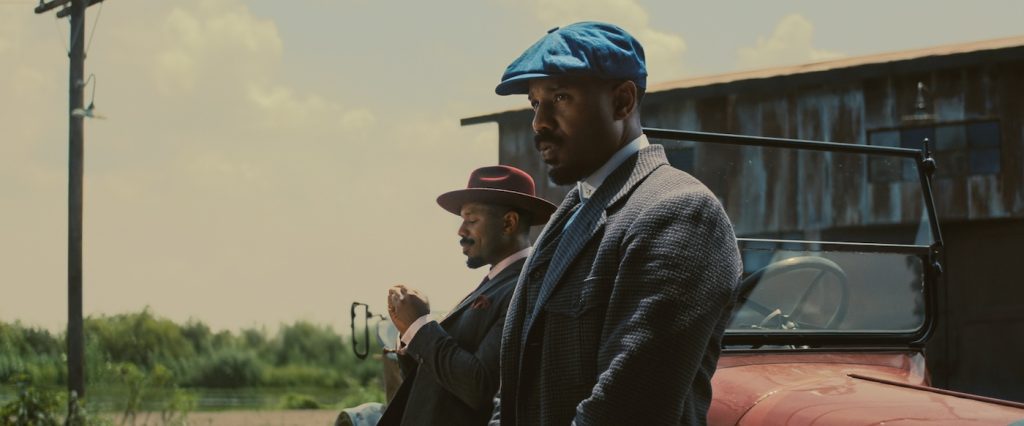
Sinners’ twin sequences are technical marvels. How did you make it look like Michael B. Jordan was talking to Michael B. Jordan, as Smoke, was talking to Michael B. Jordan, as Stack?
We would do the first take, where you have Michael B. Jordan playing the dominant twin. And Percy Bell played the actor double, so Michael had somebody physical he could look at and interact with. We would shoot the scene until everybody was happy. Then we’d send Michael B. Jordan back to costumes and makeup, where he’d become the other twin. During that [break] time, we’d take the video footage, drop it into our Pro Tools playback system, and edit out any dialogue that Percy delivered to make space for Michael, so he could interject his other twin’s dialogue.
Timing must have been critical?
After we pulled out Percy’s audio, we’d put in ADR beeps, a series of four beeps that signify when a handoff needs to take place. Michael would hear beep, beep, beep, and the fourth beep signaled when, for example, the cigarette needed to be handed off from one twin to the other, so even for non-verbal behavior, based on the previous takes. A lot of technical collaboration went into selling the idea that Smoke and Stack are two individual characters.
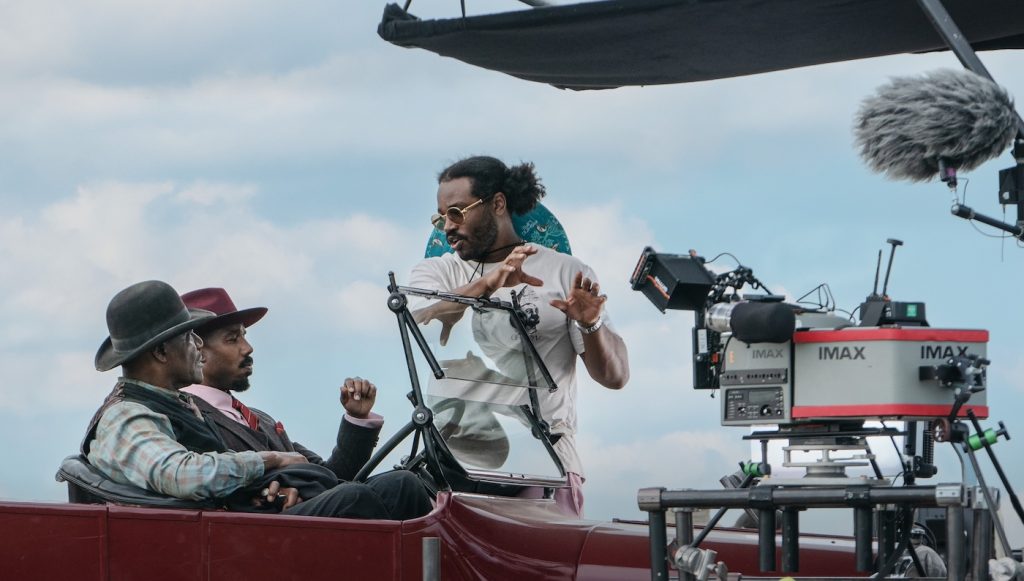
A lot of scenes were filmed on IMAX cameras, which can be noisy, right?
Very noisy, yeah. I watched behind-the-scenes footage from the movie Nope and saw that the IMAX camera they used sounded like a little lawn mower, right next to the actors.
How did you guys address that?
One thing that helped was that our post-production editorial team had just come off Christopher Nolan’s Oppenheimer, which used IMAX quite a bit. They told us their approach was to shoot wide shots, record the take until you’re happy, and then do a sound-only recording.
Almost like a stage play, full intensity performance, but no cameras rolling?
Yeah. The actors do the scene immediately afterwards, while their performances are still locked in their heads, so they can deliver the lines exactly as they did before. And then the post-production sound team used a couple of programs: iZotope RX and Hush Audio, which are really good at removing noise. Once I got my hands on those programs, I’d use them on set to assess whether what we got during these noisy camera takes would be usable.
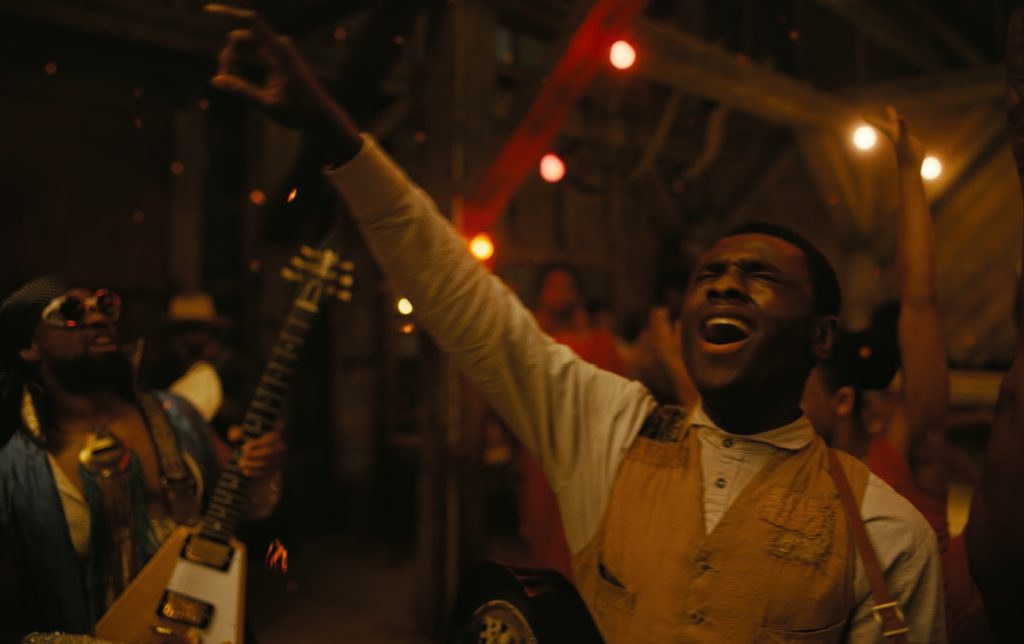
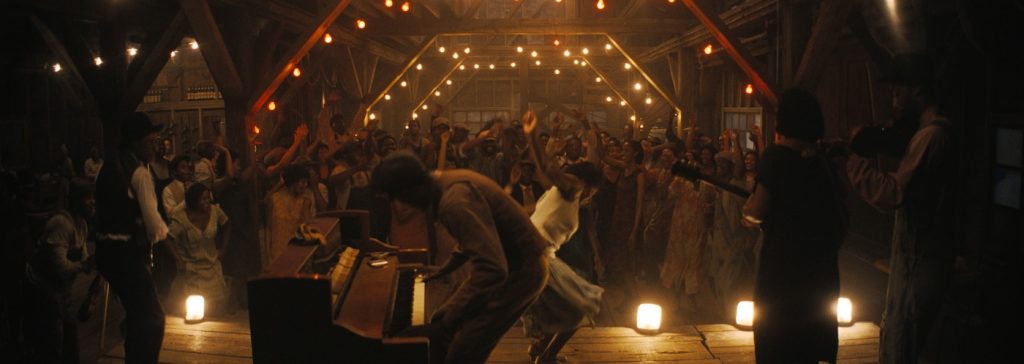
Music plays such an important role in Sinners, especially in the now-famous Juke Joint sequence. How did you get the voices and the acoustic instruments to sound so good without any visible mics?
When I worked on Daisy Jones & the Six, that was basically rock concert stuff in the ’70s, so we had microphones on stage right in front of their mouth and amplified instruments. In this situation, we had to record acoustic string performances, as well as the vocals, without the benefits of having microphones right in front of their faces.
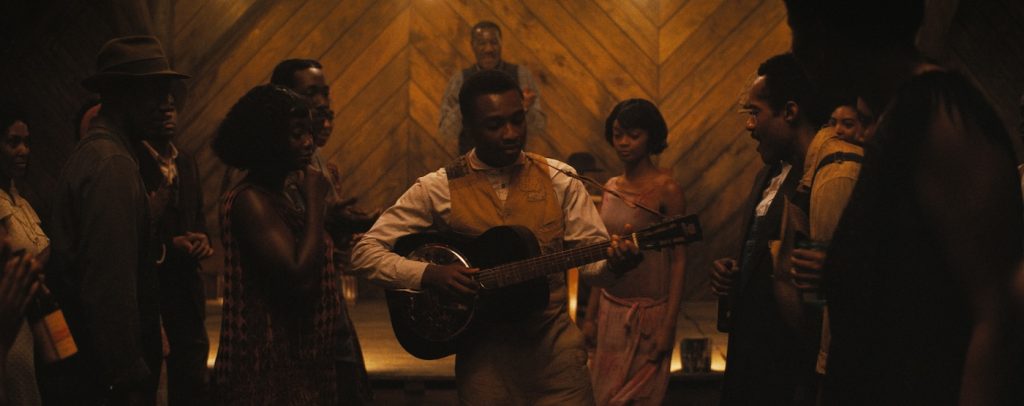
Miles Caton’s Sammie character, for example, strums his acoustic guitar and fills the room with his voice, no mics in sight. How?
Sammy’s guitar is an authentic 1930s Dobro Resonator, so we couldn’t cut the body of this thing open to put a transmitter inside. It’s a relic! And when Miles grabs his guitar, he spins it so you see all the angles of the thing. That meant I couldn’t even tape a transmitter and microphone to the back of the guitar.
So what did you do?
Watching Miles strum the guitar in rehearsal, I noticed that his wrist didn’t move a whole lot, so I asked our costume department to sew one of our lavalier microphones into the cuff of Miles’ shirt.
Aha!
And for Sammy’s voice, we used a lapel mic, plus a boom above the frame for his voice, plus one down below for guitar, so four mics in all.
You grew up in New Orleans and really know your way around music because that’s what you studied at the University of Louisiana. How did you get into the movie business?
After college, I found a job at a local video production house doing custom scores for about a year and a half. But then Hurricane Katrina happened, so I moved back to New Orleans in case there was anything my friends and family needed. And I also remember my grandmother sending me newspaper clippings by mail, saying that the film industry in Louisiana and New Orleans was really taking off and needed people to do all kinds of work on film sets. I thought I might as well give it a shot.
How’d you get started?
I worked as an office P.A. One day, I went to a film set, and I watched the grips, electrics, and camera people doing their work. I spotted this guy holding a microphone at the end of a pole, and I was like, “That looks like my world!” So, I became a boom operator.
Then what?
I worked with [Oscar-winning] sound mixer Kirk Francis. When he retired, Kirk gave me his equipment. I put myself out there as a production mixer on the Keegan-Michael Key and Jordan Peele comedy Keanu and just went from there.
Looking around at your friends, neighbors, and the folks on your crew, have you seen them benefit from the strength of Louisiana’s filmmaking community?
Absolutely. I have a bunch of friends who work in the industry, and I know people who have bought property to house specialty equipment the camera can use to get cool shots—drones, electric cars, things like that. And then there are all the restaurants and hotels that benefit. Maybe it’s not the peak [tourism] season, but if a film all of a sudden comes to town putting up 100 people in a hotel– that can really make the difference for them in any given year.
What was it like shooting Sinners in rural Louisiana?
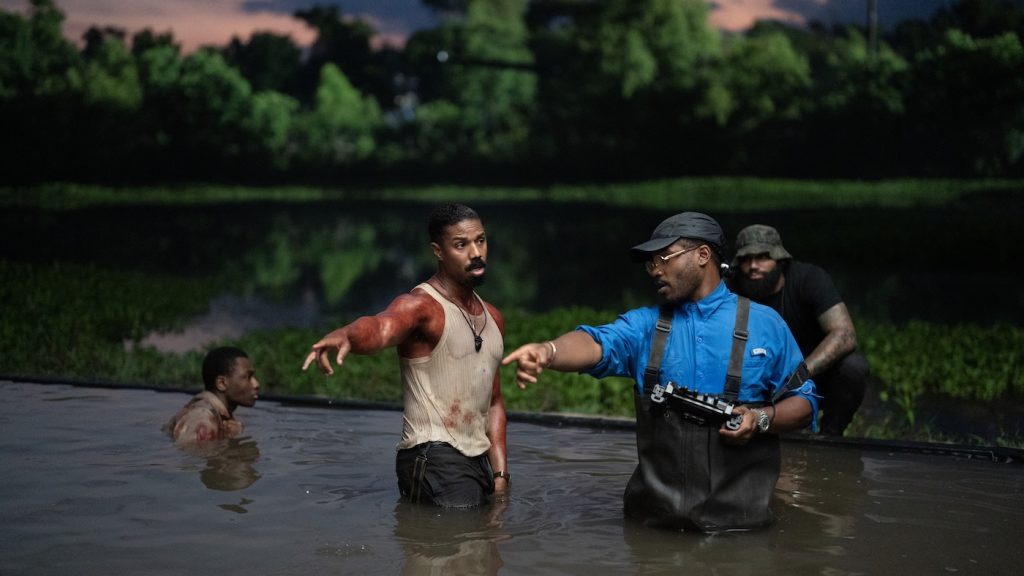
A lot of it took place in sugarcane fields between New Orleans and Baton Rouge, which we dressed to look more like cotton. These were big, wide open pieces of land, a lot of dirt, a lot of bugs, cicadas, mosquitoes, the heat, the rain. Especially in the summertime, the rain can be brutal. You could see a storm coming in, and the locals would say, ” We’d better start getting the equipment and the crew to safety.
Where was Juke Joint filmed?
The exterior of the juke joint was built and shot in this town called Braithwaite. It was extremely hot. Our music editor was accustomed to life in the studios, so it was fun to watch him come outside and tell him, “Put on your bug spray, don’t forget the sunscreen, and you should really consider getting a pair of shorts because you’re going to die out here in your jeans all day.” But that’s where he drew the line. He’s like, “I’m not wearing shorts.”
Looking back on the production, what sticks with you as being a quintessential Louisiana moment?
The second post-credits scene, where Sammy’s playing “This Little Light of Mine” for his father. They ended up not processing the sound, as far as giving it the full treatment, so it’s just the raw recording. You can hear the cicadas coming in through the open church windows, you can hear all the noise just like it really happened, you can see Miles really playing and singing, no edits. The scene shows what we did on set on the day. To me, there’s something really special about that.
Sinners is now streaming on Max.
Featured image: Caption: MICHAEL B. JORDAN as Smoke and as Stack, in Warner Bros. Pictures’ “SINNERS,” a Warner Bros. Pictures release. Photo Credit: Courtesy of Warner Bros. Pictures