
“Wake Up Dead Man” Composer Nathan Johnson: From Beauty to Darkness in Benoit Blanc’s Latest Mystery
Wake Up Dead Man: A Knives Out Mystery composer Nathan Johnson has scored all three of Rian Johnson‘s Knives Out films. Working alongside Johnson (his cousin), Nathan has created a unique sound for each film, culminating in a fantastical, orchestral finale for Benoit Blanc’s closing monologue. So how’d Johnson do? His work on Wake Up Dead Man has recently been shortlisted for an Oscar.
Here, Johnson takes us into the gothic, at times gruesome, and always compelling world of Johnson’s darkest, most delightfully dastardly Knives Out film yet.
This Knives Out was a bit darker, and the music was a bit more unsettling. Can you talk about your creative process in scoring this film?
All of these movies are pretty distinctly different, even from the very beginning of the script stage. And that applies to the music as well. I mean, for the first Knives Out, it was defined by kind of like a cutting quartet in a claustrophobic New England mansion. For the second one, we went big and broad and sort of luscious, orchestral Greek isles. For this one, it was a lot darker. It was Gothic. It was, in Rian’s mind, I think we were going Edgar Allen Poe. And the very first thing you hear in this is the sound of the entire violin section scraping their bows against the strings, and this is a nails-on-a-chalkboard, uncomfortable sound. And then that resolves into a single, pure tone. And for me, it was this tug-of-war between ugliness and beauty, or between darkness and light, that was the whole movie in my mind, and also what I tried to bring to it with the music.
It seemed like there were a lot more singular sounds — the plucking of the strings, the percussion, and violin harmonics. How did those types of sounds help you create the feeling of the film?
So I was looking for a way to use a traditional orchestra, but to kind of upend it, and to lean into these unsettling sounds that were made with traditional instruments, but maybe our ears weren’t quite so familiar with. And part of that had to do with how I approach the rhythm. So instead of having a snare drum, for instance, I got a whole group of bass clarinets. I had them use the keys on their instrument to do this clicky, clacky — almost like a cross between spiders scattering and dominoes falling — and we brought all of them into this big, old stone church and kind of captured the natural reverb in the space. For the strings, we also brought a quartet into the same church, and I led them in these gestural explorations, where I would tell them the key or the chord, and then have them use their bows in a technique called ricochet, bouncing them across the strings. So we got this very precise—yet a little unhinged—sound of skittering and scattering.
What about the harp?
Same thing with the harp. Harp is traditionally a majestic, heavenly sound. But instead, I was using the harp in a lot of ways as a rhythmic instrument, and also sometimes just having our amazing harpist, Skaila (Kanga), pluck the lowest note on her harp and letting it ring. And whereas a harp normally sounds like heaven, in this case, it sounds like the dreaded bells of hell. So it was all about trying to take the instruments I had established in the previous movies and turn them on their heads a little.
I know you guys filmed in London, and then the film, of course, takes place in New York. Were you working with local musicians in London, or do you have a team you regularly collaborate with?
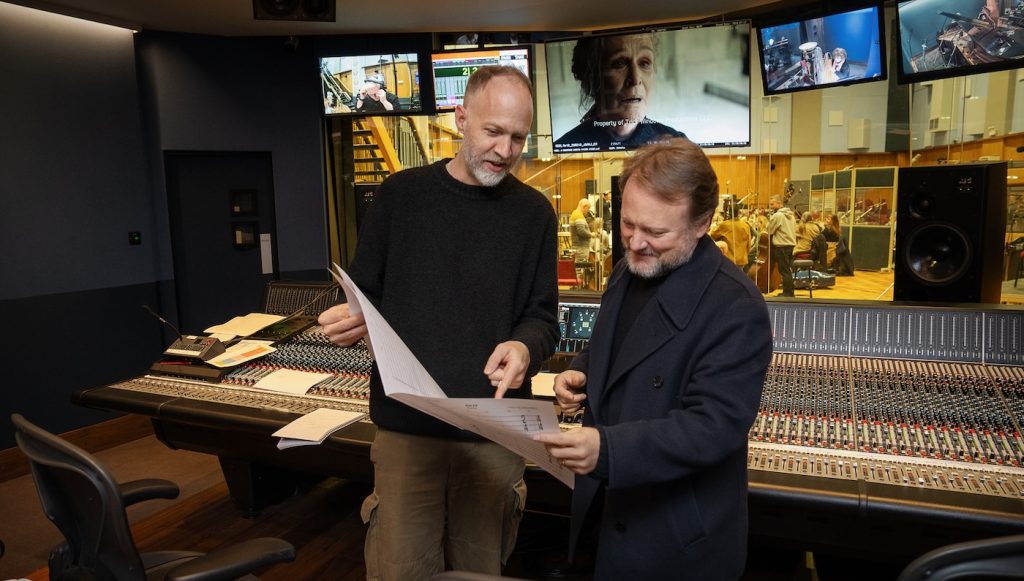
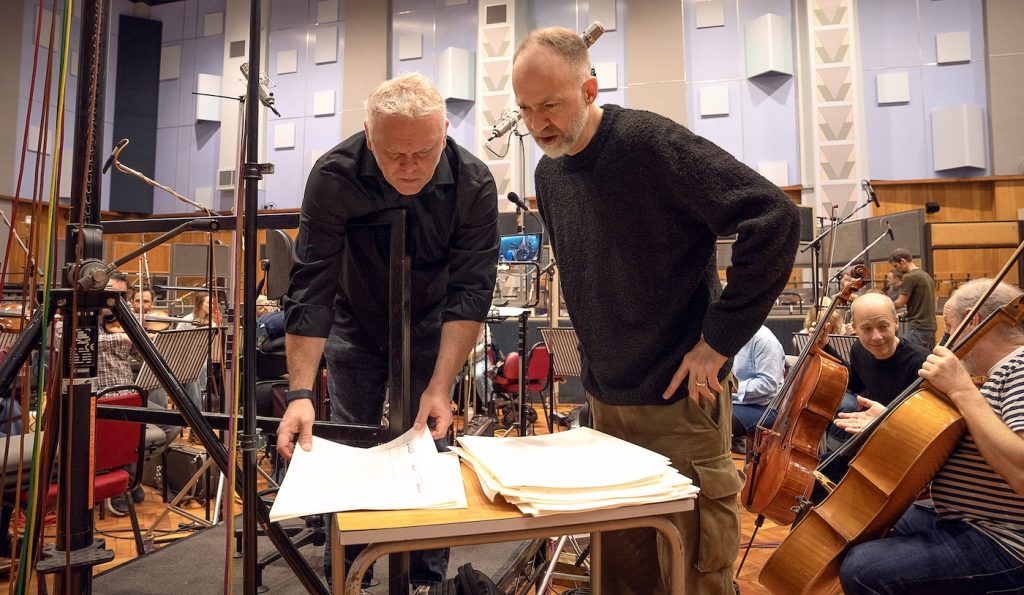
Yeah, 100%. In fact, I was over there during production, so I was on set. I would go on set a couple of days a week, and then a good friend of mine let me just use his writing room. And so that happened to be at AIR Studios. And so when my player friends were working downstairs, they would come up for lunch break, and I would show them an idea, and they would quickly mock it up for me. For instance, the Tippet Quartet has performed on all three of these movies, and the lead violinist, John Mills, is our concertmaster; he plays all the violin solos in the concerto in this movie. That’s sort of the big piece that finishes the whole thing. So, yeah, it’s really pretty special to have developed a shorthand with these individual musicians.
I can imagine that once you’re in the final stage, with the scene filmed and the composition on top of it, you’re not changing things, right?
Exactly. Rian and I are really involved even in that process, so maybe I give him a first pass at what I’ve done for a scene, and he might point out a specific moment. I remember, for instance, during the confession, there’s a moment when one of the characters is talking about what happens, and there’s a very strong musical thread and a really strong rhythmic element. And Rian was asking me at this moment: when the character starts to lose it, can you make it feel like the whole orchestra is falling apart?
I saw you talk in an interview about how you like to let the characters’ motivations drive your thought process. So for you…when you’re thinking about the composition of the film, are you going into it thinking what this character is doing right now? What are they thinking? What are they feeling?
I think what makes these movies special is that, if you look at them from the outside, you might think they’re a puzzle we are trying to solve, and Rian and I both love puzzles. We do puzzles every day, but purely puzzle-solving is not enough to sustain an audience through a movie. And the wonderful thing is that these movies really work the way any good movie works, which is 100% based on character and motivation. Who’s the protagonist? What do they want? Why can’t they get it? And what are they feeling? And that’s really where I come in. I mean, there’s enough plot in these movies already. And I love the fact that I get to come in and dance with each character. And that’s something that Rian is also really, really good about. He’s not making decisions primarily based on his musical taste. He’s making decisions based on the story.
This one, I’m sure, was fun because there are so many heavy emotions.
This is the first movie of Rian’s that made me cry. I watched an early assembly of the edit with no music, and there’s a moment that made me cry, and it’s sort of a crucial moment. And I realized, A) because it moved me, and B) because it’s such a key part of the movie, that if that scene doesn’t land, the whole movie doesn’t work. So that became the first thing I went home and started working on, because I knew I needed to protect that moment. It was so important to me in my first experience of the movie that I knew we had to be really, really gentle with this moment, and to make sure we set it up so it really lands emotionally.
I did want to ask about motifs in this film, because obviously, you have Benoit Blanc in all three movies. Can you talk about the motifs for his character and for the Monsignor?
So Blanc has a couple of motifs that we feature in all of the movies. This one is interesting because Blanc is really the only one who has melodic motifs. All the other motifs in this movie are conceptual. So we talked about that scratch tone as a pure tone? That’s the motif for Eve’s Apple, which is sort of the thing that they’re chasing all throughout the movie. And it represents this agnostic jewel. It can be good or bad, depending on whose hands it’s in. Which I think is really accurate with a lot of these concepts, like money and power today.
Monsignor Wicks’ theme was a really fun one, because it’s a theme of conflicting rhythms. So I’m using this thing called metric modulation to have the orchestra playing in entirely different time signatures and tempos. And anytime Wicks is up in the sermon preaching, the whole orchestra is almost playing at odds with itself, and it’s like mathematically related, but the groove feels so wrong. And I felt like this was just an effective way to evoke the idea of hypocrisy and double-speak among people in power. And it’s this common feeling that we have anytime someone in power is talking about something that very clearly doesn’t exist in the world, and they’re convincing us of a thing that when we look around us, we realize, like, no, that’s not real.
I want to know if there’s a scene you felt particularly proud of when you first saw it on screen.
At the end of every Knives Out movie, there’s this 10-minute monologue extravaganza. And that’s always the biggest challenge for me, and this one’s hanging over my head the whole time I’m working on this, because it has to switch gears every 15 to 20 seconds basically, and it has to feel like we’re pulled through the entire thing. So it’s a really challenging bar to hit, because we’re looking back and sometimes seeing the key scenes in the movie in a different light. So it has to feel exciting, but then we have to — on a dime switch and take our foot off the gas and feel the emotion. And then we have to go from basically a standstill, right back up to fifth gear. And because I know that this is the point where the whole movie has to land, I’m always sort of nervous about it. So I think seeing that scene, watching the audience respond to it — this is the moment where I feel like, phew, I can take a breath.
Wake up Dead Man is streaming on Netflix now.
Featured image: Wake Up Dead Man: A Knives Out Mystery. (L-R) Josh O’Connor and Daniel Craig as Benoit Blanc in Wake Up Dead Man: A Knives Out Mystery. Cr. John Wilson/Netflix © 2025